
A complete issue · 16 pages · 1898
Judge — December 3, 1898
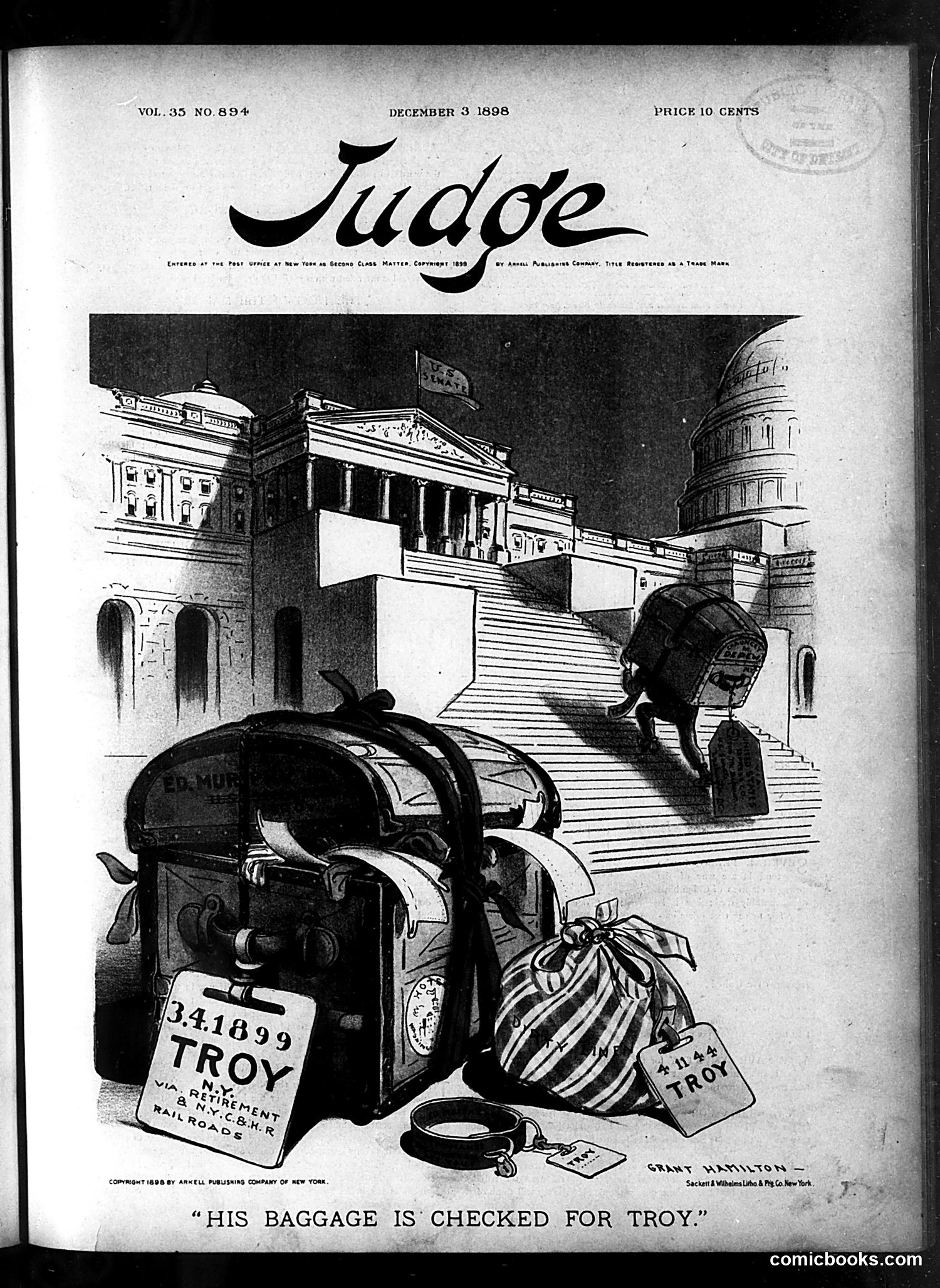
This cartoon satirizes travel to Troy, likely referencing archaeological expeditions or tourism to the ancient Turkish site. The illustration shows a traveler's luggage tagged and checked at what appears to be a government building (possibly a customs house, given the Capitol dome visible in the background). The joke plays on the phrase "checked for Troy"—a pun suggesting baggage inspection while referencing the destination Troy itself. The packed belongings and official tags indicate someone preparing for a journey, with the elaborate Capitol architecture emphasizing this involves official procedures or government involvement. Without additional context from the magazine's date (December 3, 1898), the specific historical event or public figure being mocked remains unclear, though it appears to comment on contemporary travel bureaucracy or a particular newsworthy expedition.
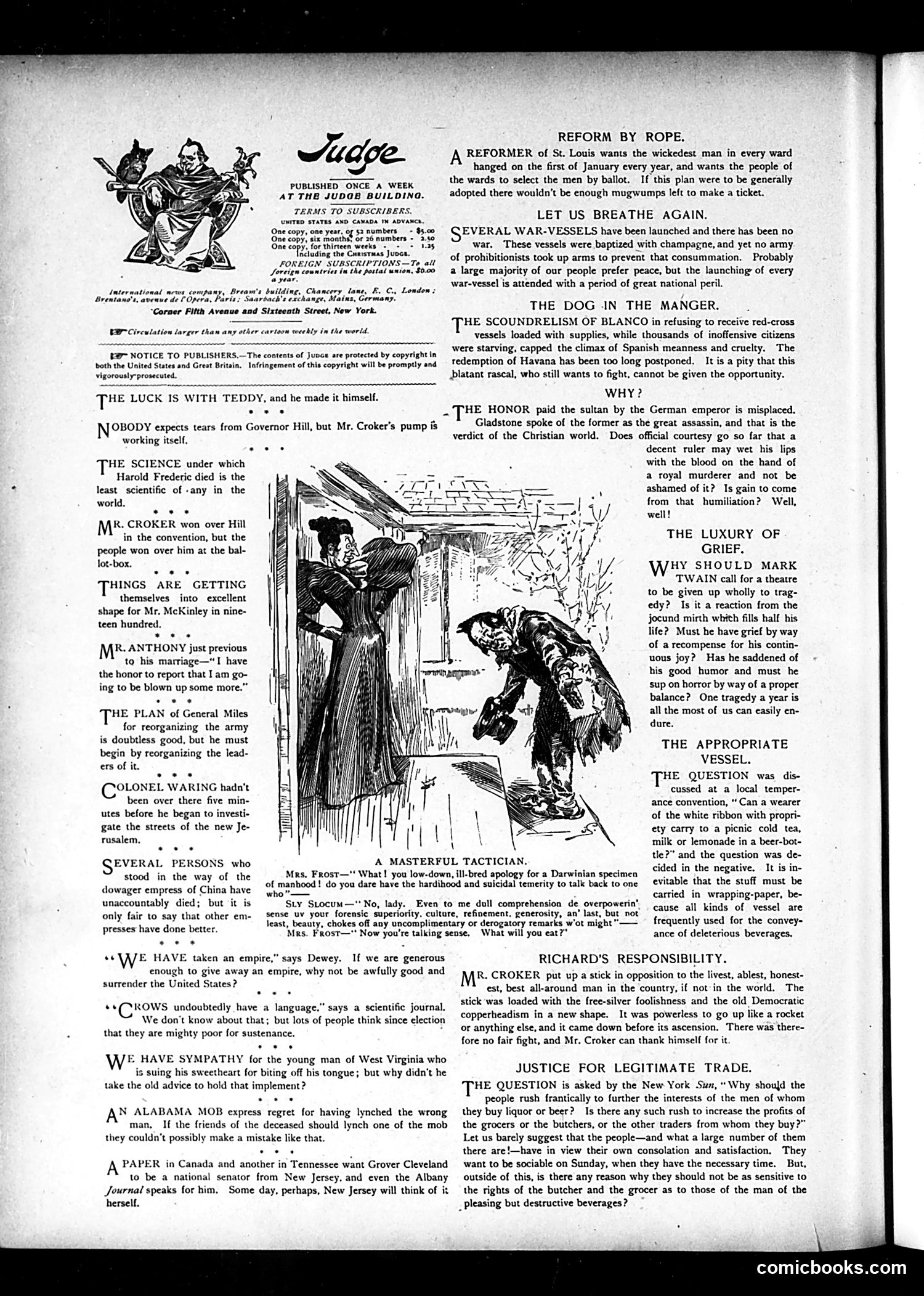
The main cartoon "A Masterful Tactician" depicts a confrontation between two figures in what appears to be a domestic interior. Based on the accompanying dialogue, this illustrates a dispute over scientific credibility—likely referencing the contemporary debate over Darwinism. One figure apologizes for calling the other a "Darwinian specimen," while the other responds with condescension about "superior culture" and "refinement." The page's text sections address various political issues: military preparedness, trade regulation, and governance. References to "General Miles," "Colonel Waring," and debates over liquor licensing suggest early 1900s American politics. The cartoon satirizes intellectual pretension and social snobbery during the height of debates over evolutionary theory's social implications.
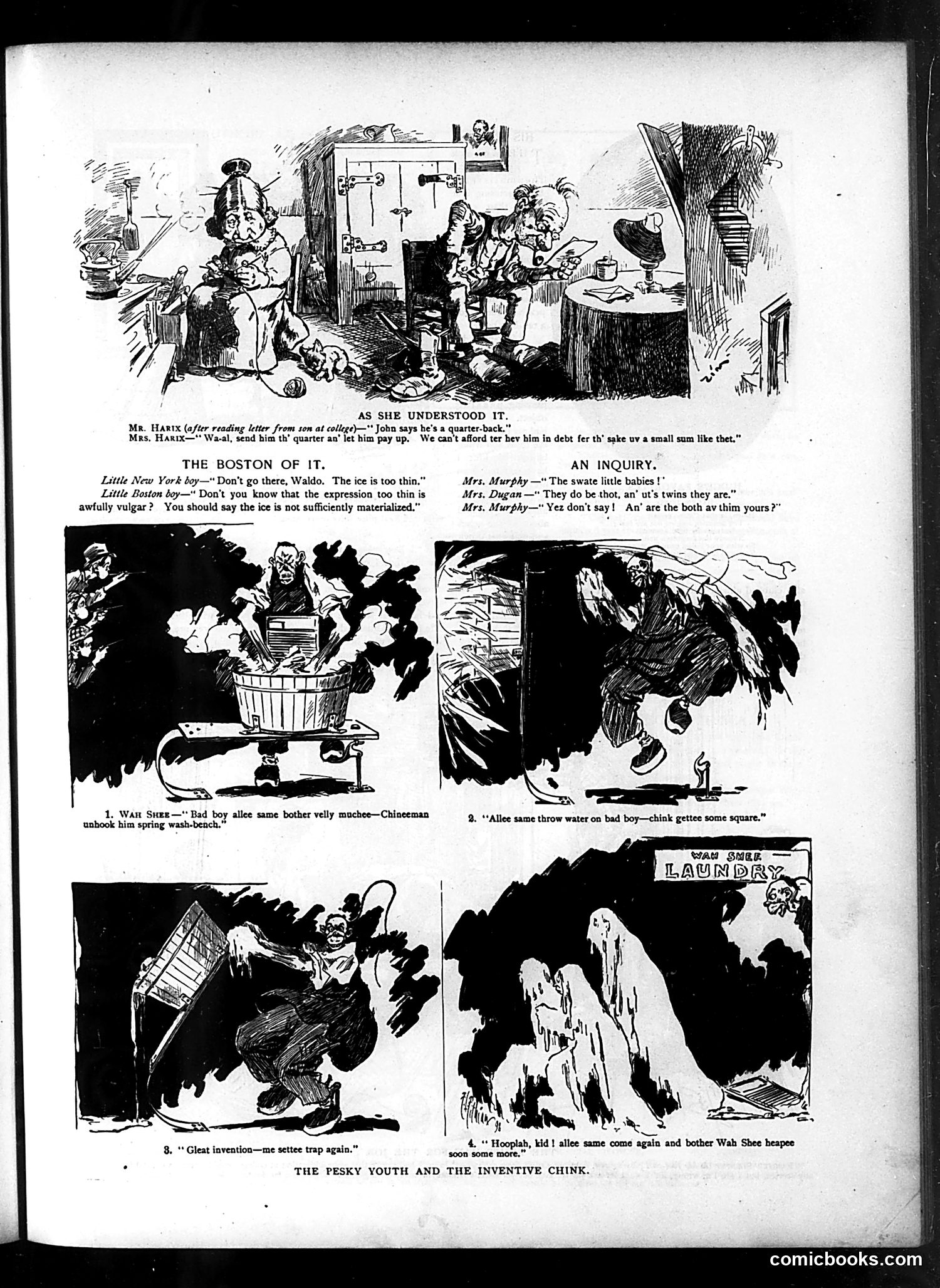
This page contains domestic humor sketches satirizing working-class family life and parenting struggles. The top panel, "As She Understood It," depicts a financial disagreement between spouses about debt. The middle sections—"The Boston of It" and "An Inquiry"—feature comedic dialogue about ice quality and children's behavior, mocking both regional pretension and parenting advice. The lower panels titled "The Pesky Youth and the Inventive Chink" appear to depict a conflict involving an Asian character (using period-appropriate but now offensive terminology) and a troublesome boy, involving schemes with water and laundry. The humor relies on stereotypes common to early 20th-century American magazines: working-class financial anxiety, regional snobbery, and racial caricature. The "Wah Shee Laundry" reference suggests immigrant labor stereotypes prevalent in that era.
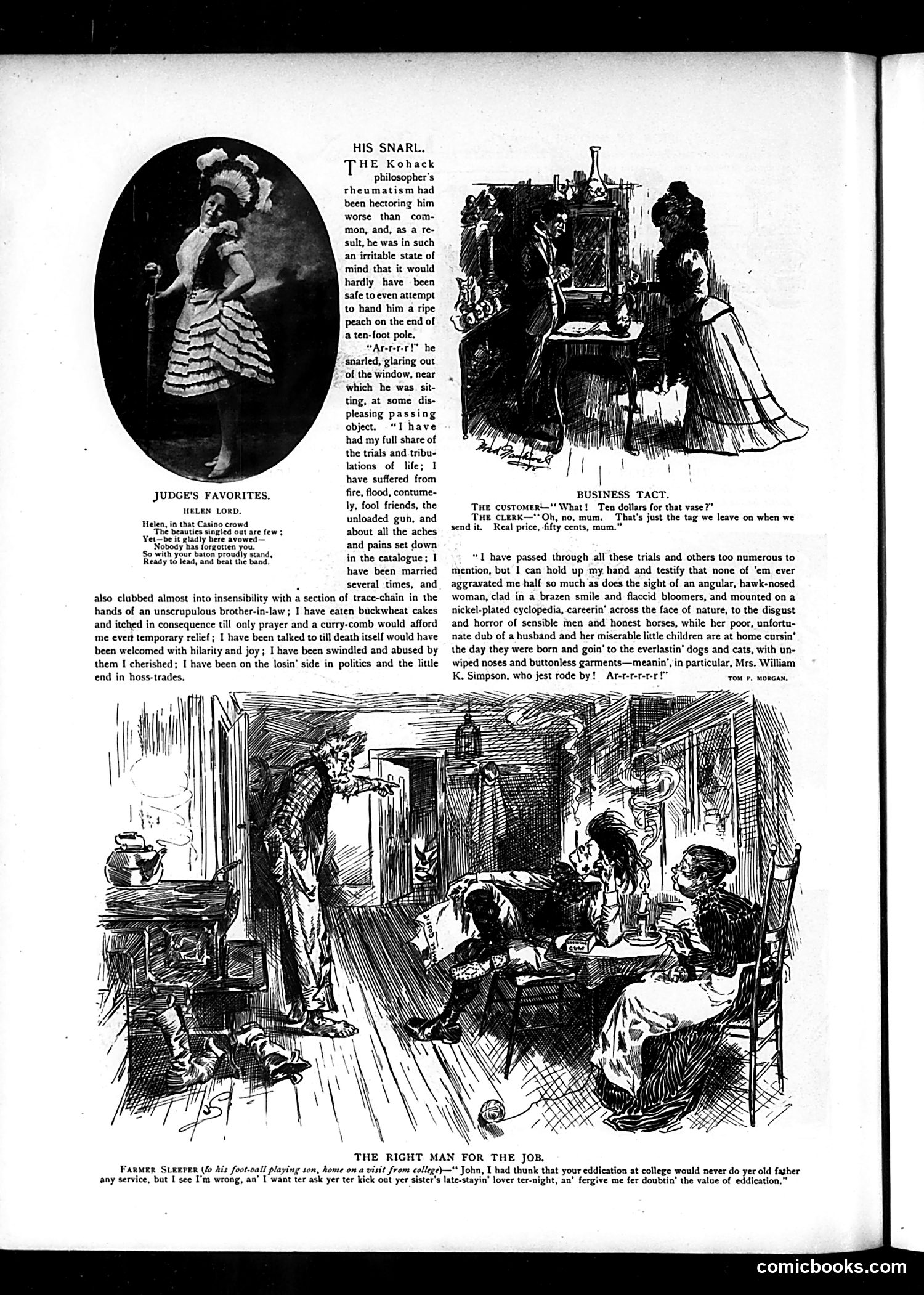
This page contains three separate satirical pieces: 1. **"Judge's Favorites" (Helen Lord)**: A biographical sketch of an actress, celebrating her theatrical career and resilience through life's hardships. 2. **"His Snarl" (The Koback)**: A story about an irritable philosopher whose bad temper makes him difficult to approach, even when offered simple kindness like a peach. 3. **"Business Tact"** and **"The Right Man for the Job"**: Satirical dialogues mocking social pretensions and class assumptions. The bottom cartoon depicts a farmhand arguing that education is worthless compared to practical experience—social satire about rural-urban class divisions and the perceived snobbery of the educated classes. The overall theme critiques human nature, social hierarchies, and character flaws through humor and exaggerated situations typical of Judge's satirical style.
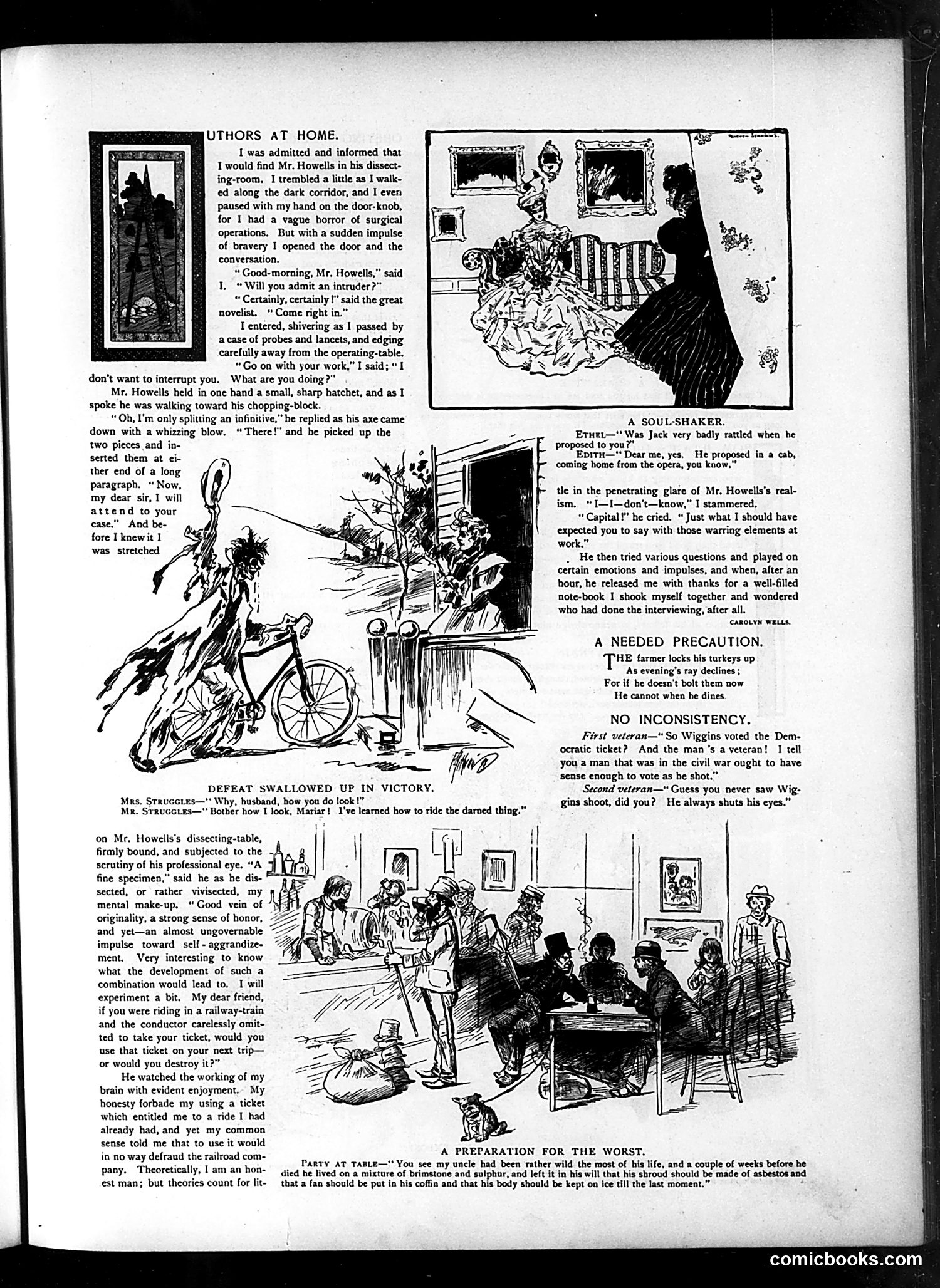
This page satirizes literary figures and contemporary social issues through humor and illustrated vignettes. **"Authors at Home"** (main feature) depicts an interview with novelist William Dean Howells, who is humorously portrayed as a vivisectionist "dissecting" his interviewer's character and morality. The joke plays on Howells's reputation for psychological realism in fiction—he analyzes the visitor's mental makeup as if conducting scientific surgery. The opening "splitting an infinitive" gag mocks Victorian linguistic pedantry. **Smaller cartoons** include: - "A Soul-Shaker": A woman's anecdote about a marriage proposal - "A Needed Precaution": A rural joke about farmers locking up turkeys - "No Inconsistency": Veterans' voting behavior and marksmanship - "Defeat Swallowed Up in Victory": A husband learning to ride a bicycle The page reflects late-19th/early-20th century middle-class humor—domestic situations, literary in-jokes, and gentle mockery of public figures and social conventions.
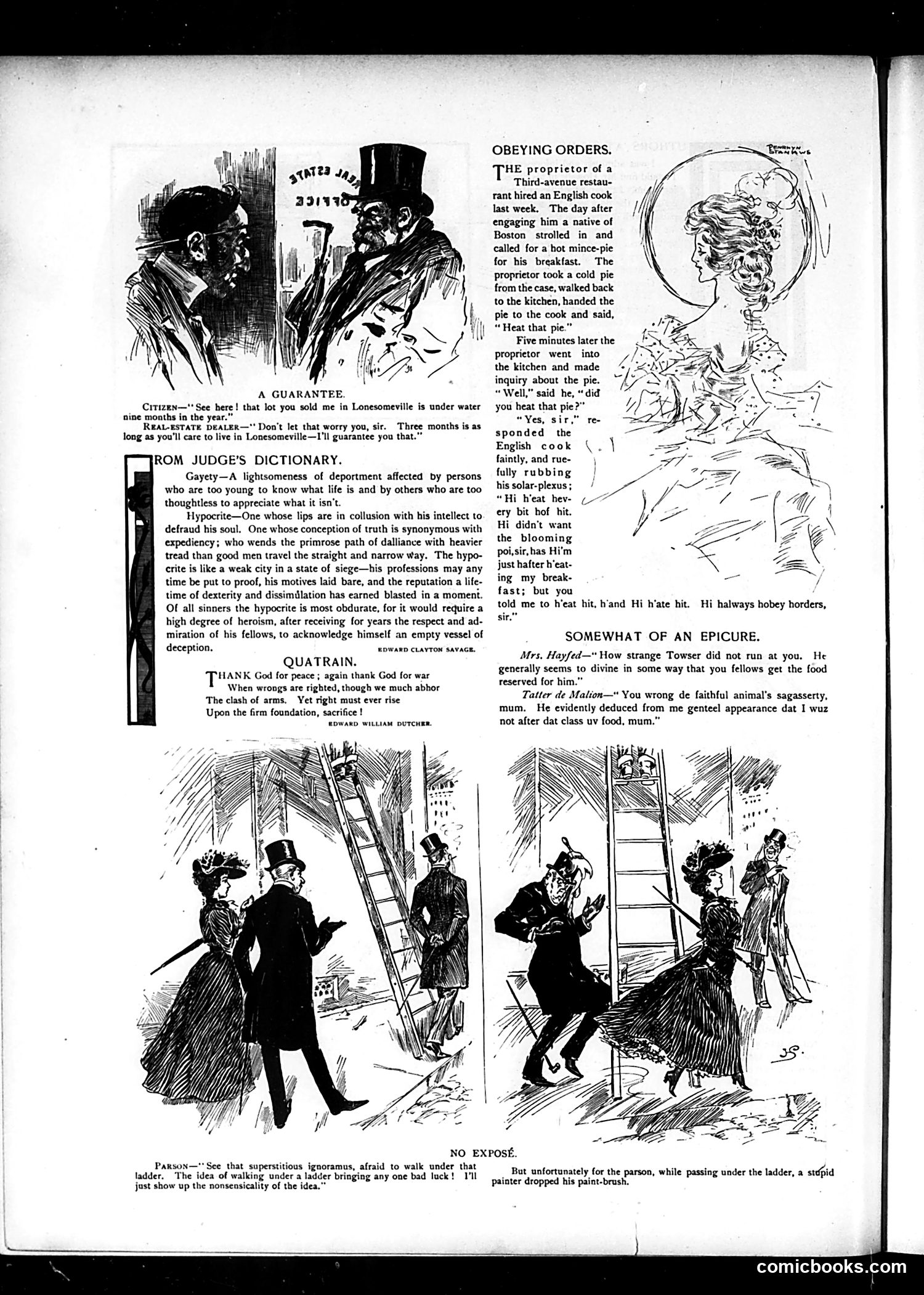
This page contains three separate humorous pieces satirizing social pretension and class distinctions: **"Obeying Orders"** mocks the blind obedience of English servants. An English cook, hired by a Third Avenue restaurant owner, literally interprets an order to "heat that pie" by physically beating it repeatedly—destroying the food but faithfully following instructions. The joke ridicules rigid class hierarchies where English servants robotically obey without common sense. **"Somewhat of an Epicure"** plays on racial stereotypes, with a Black character ("Tatler de Mation") claiming a dog didn't attack him because his "genteel appearance" indicated he wasn't after "dat class uv food." The satire targets pretentious attempts to transcend one's social position through affectation. **"No Exposé"** shows a pompous parson mocking superstitious belief in ladder-crossing bad luck—only to be struck by a falling paintbrush. It ridicules self-righteous rationalism that ignores practical dangers. All three pieces use slapstick and dialect humor typical of late-19th/early-20th-century American satire, emphasizing class anxiety and social mobility themes.
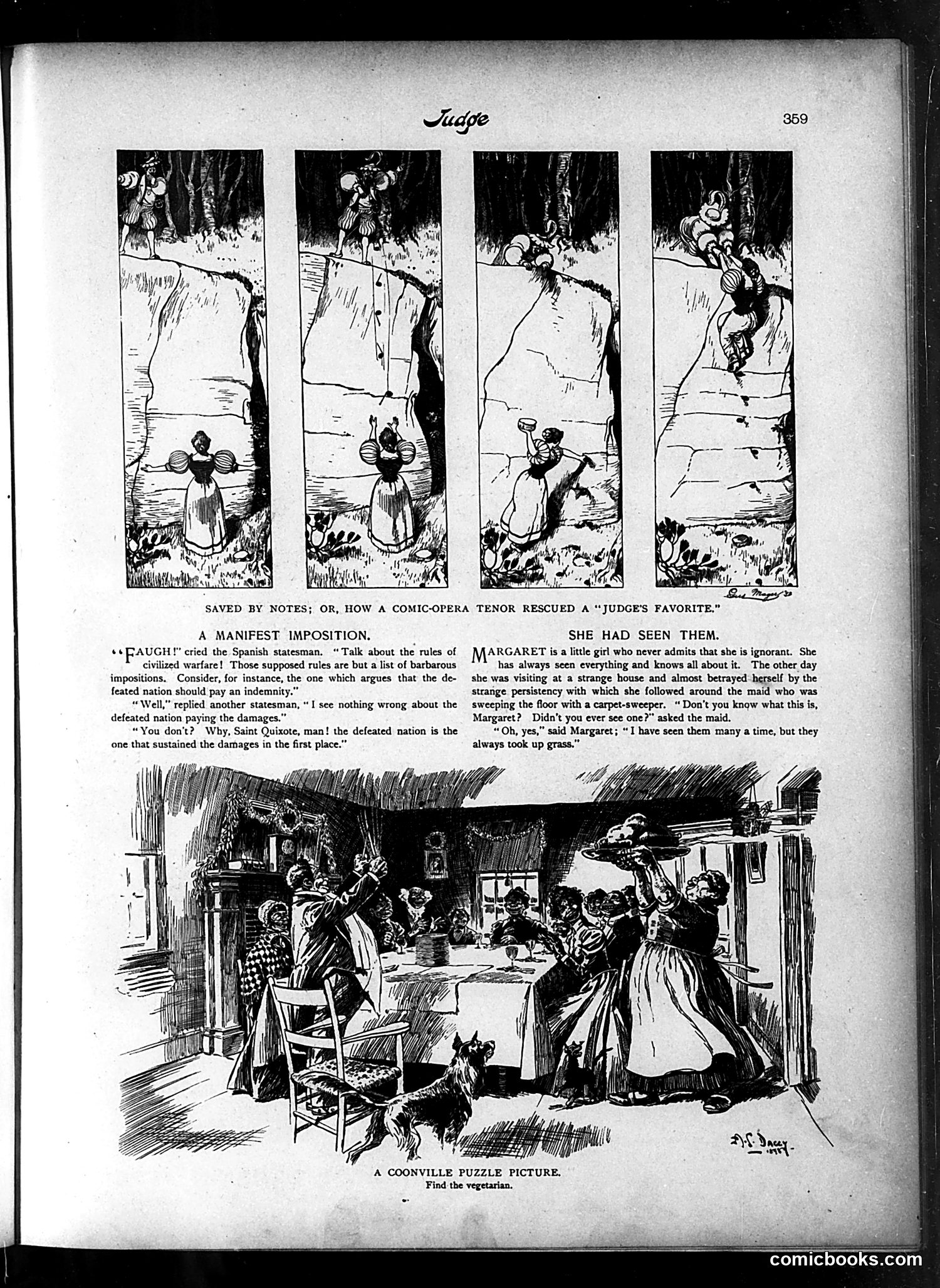
**Top Comic Strip:** "Saved by Notes; or, How a Comic-Opera Tenor Rescued a 'Judge's Favorite'" depicts a dramatic operatic rescue scene with a figure climbing a cliff to save a woman below—a parody of melodramatic opera plots popular in the era. **Political Cartoon:** "A Manifest Impostion" satirizes Spanish statesmen debating war reparations. One argues defeated nations shouldn't pay indemnities (war damages), while the other points out the logical absurdity: the defeated nation already *sustained* the damages, so demanding payment compounds the injury. The reference to "Saint Quixote" invokes Don Quixote, suggesting the first speaker tilts at windmills with impractical idealism. **Humor Piece:** "She Had Seen Them" jokes about a precocious child's false claims of knowledge. Margaret insists she's seen a carpet-sweeper before, but reveals her ignorance by saying "they always took up grass"—confusing the mechanical sweeper with farm implements. **Bottom:** "A Coonville Puzzle Picture" appears to reference a segregation-era feature; the racist terminology indicates this content reflects deeply problematic period attitudes.
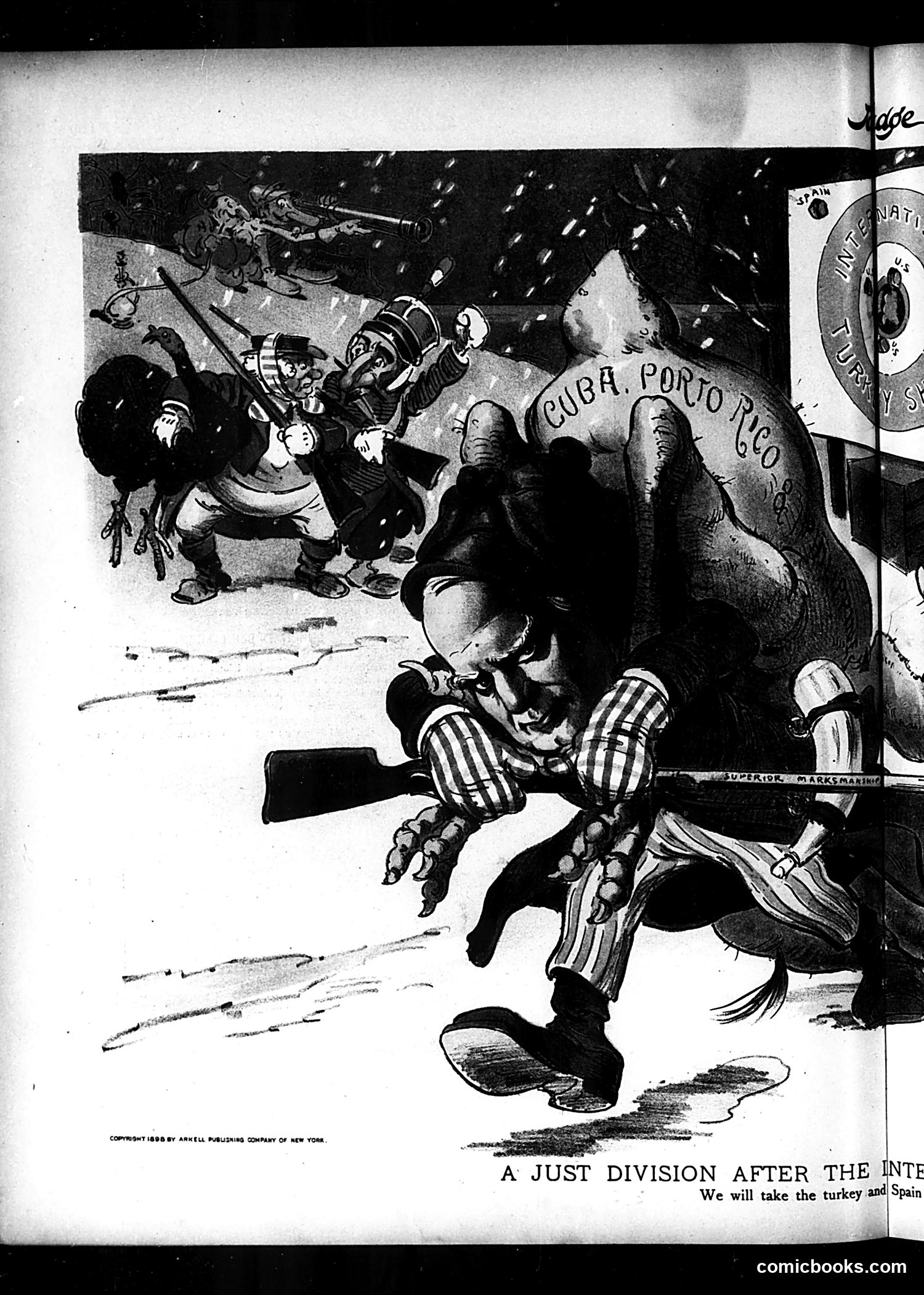
This Judge magazine cartoon satirizes international territorial division, likely related to late 19th-century imperialism. The large bird labeled "CUBA, PORTO RICO" appears to be a turkey being divided among caricatured figures representing different nations. The caption "A JUST DIVISION AFTER THE INTE[RVENTIO]N" and reference to "We will take the turkey and Spain" suggests this comments on the Spanish-American War (1898) and its aftermath. The cartoon mocks how Spain's former colonies were being distributed among imperial powers, with various nations positioning themselves to claim portions of Spanish territory. The exaggerated caricatures and animal imagery were typical of Judge's satirical style, critiquing the era's imperial ambitions and carving up of weaker nations by stronger powers.
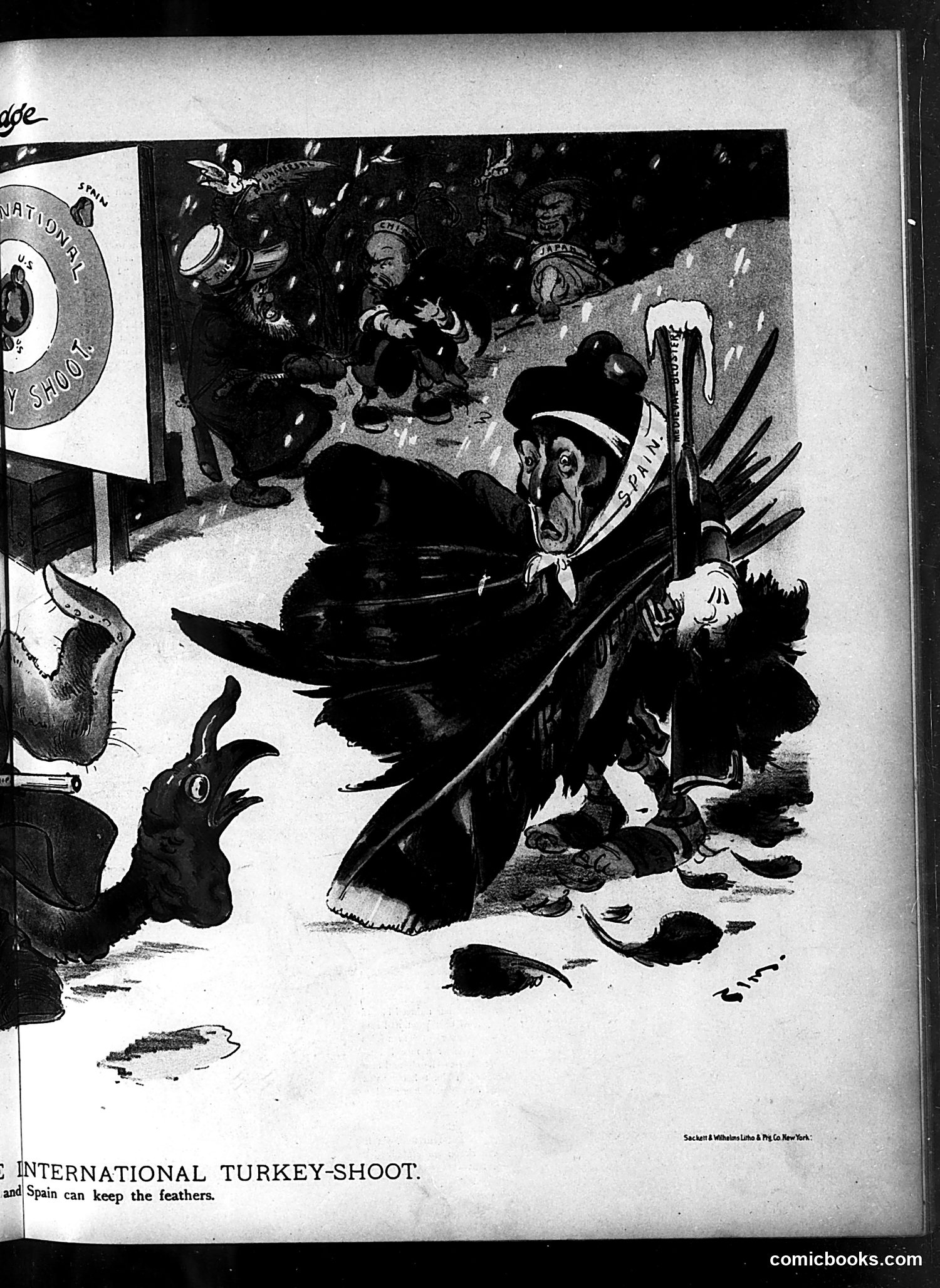
This political cartoon satirizes imperial competition over Spain's colonial possessions, likely from the Spanish-American War era (1898) or its aftermath. The central figure—a skeletal, frightened character labeled "Spain"—is depicted as a hunted turkey being shot at by multiple international powers (shown as aggressive figures in the background, possibly representing the United States, European nations, and others). The caption "Spain can keep the feathers" is sarcastic: while Spain retains nominal ownership of some territories, other nations are stripping away its actual power and colonial holdings. The cartoon mocks Spain's weakness during imperial competition, portraying it as helpless prey in a violent international scramble for territory and influence.
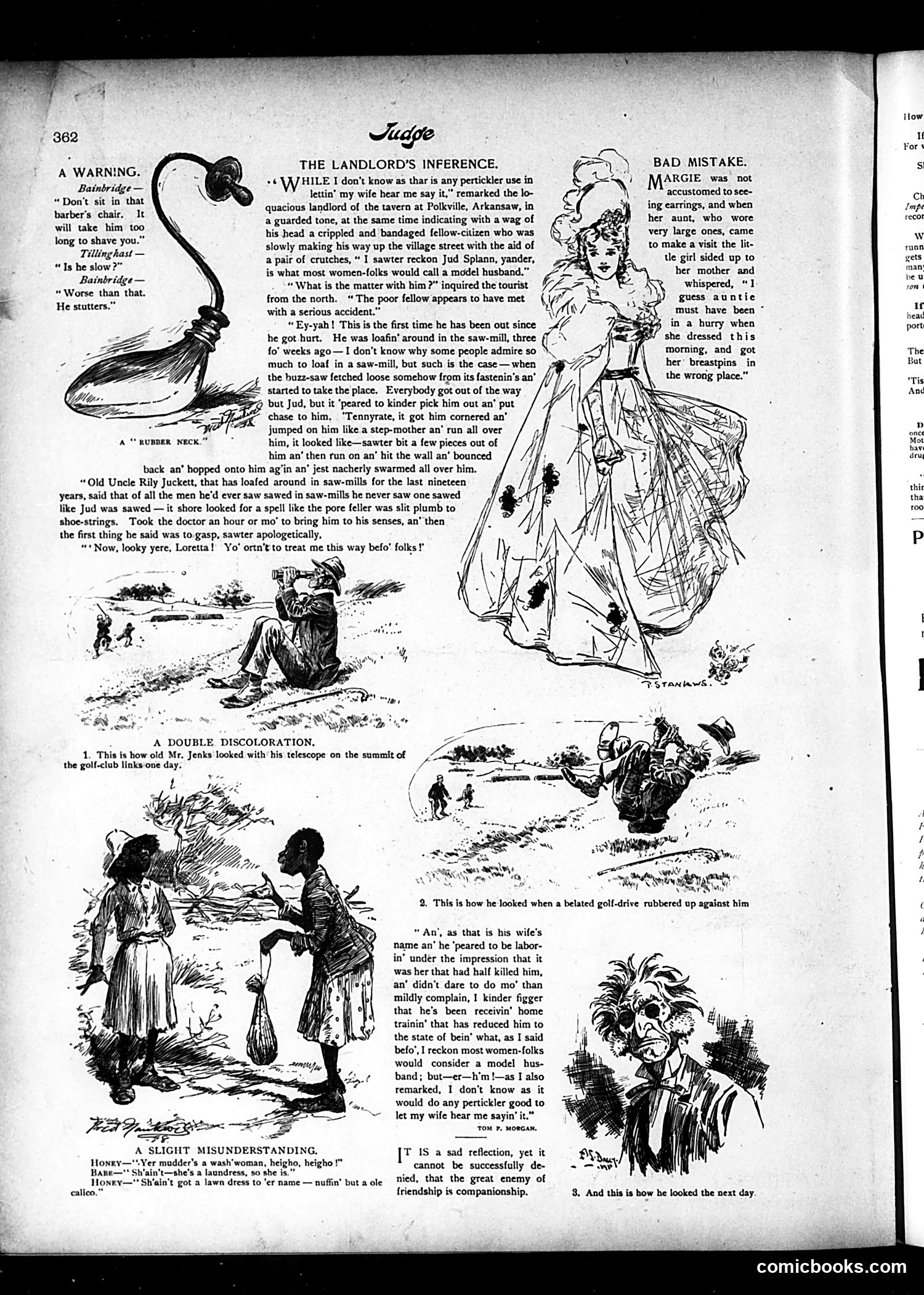
This page contains multiple humorous short stories illustrated with satirical drawings, typical of Judge magazine's format. **"The Landlord's Inference"** depicts an Arkansas tavern keeper explaining a man's injuries from a saw-mill accident. The humor relies on rural dialect ("Tennyrate," "peared") and the landlord's implication that the injured man—despite being nearly killed—must be a "model husband" because he apologizes to his wife instead of complaining. The satire critiques how domestic abuse normalizes male submission to wives. **"Bad Mistake"** shows a girl putting on large borrowed earrings incorrectly, placing them in the wrong location—a simple visual gag about childhood misunderstanding. **"A Double Discoloration"** uses three panels showing a golfer's appearance: normal through a telescope, struck by a golf ball, and severely bruised the next day. It's physical comedy typical of the era. **"A Slight Misunderstanding"** presents a brief dialogue joke about a woman calling her lawn dress by an unflattering name. These are representative examples of Judge's mix of rural Americana humor, domestic comedy, and slapstick.
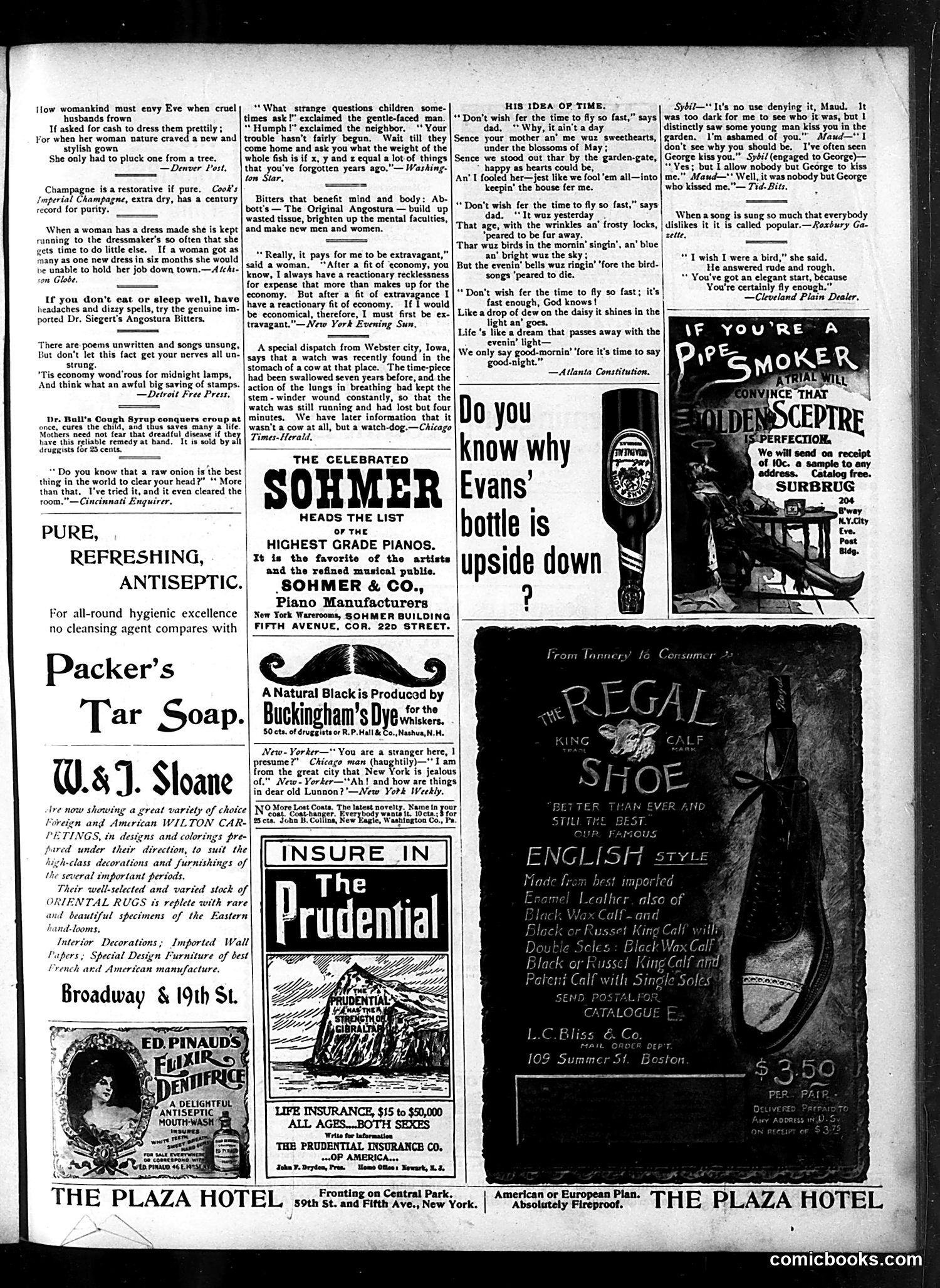
This page contains primarily **humorous editorial cartoons and jokes** rather than political satire. The content focuses on domestic and social comedy: **Main Features:** - Several comic dialogues about time, marriage, and relationships - A father noting how quickly time passes since courting his wife ("ain't a day" since they were sweethearts) - A joke about a watch found in a cow's stomach that kept running for 7 years - Various quips about women's shopping habits, children's questions, and romantic encounters in gardens **Context for Modern Readers:** These represent turn-of-the-century American humor—gentle domestic comedy rather than sharp political commentary. The jokes reflect era-typical gender roles (women obsessed with shopping, marriage's mundane disappointments) and simple situational humor. **Mostly Advertising:** The page is dominated by period product advertisements (Sohmer pianos, Packer's Tar Soap, Champagne, cough syrup) interspersed with the editorial humor—typical of Judge magazine's revenue model.
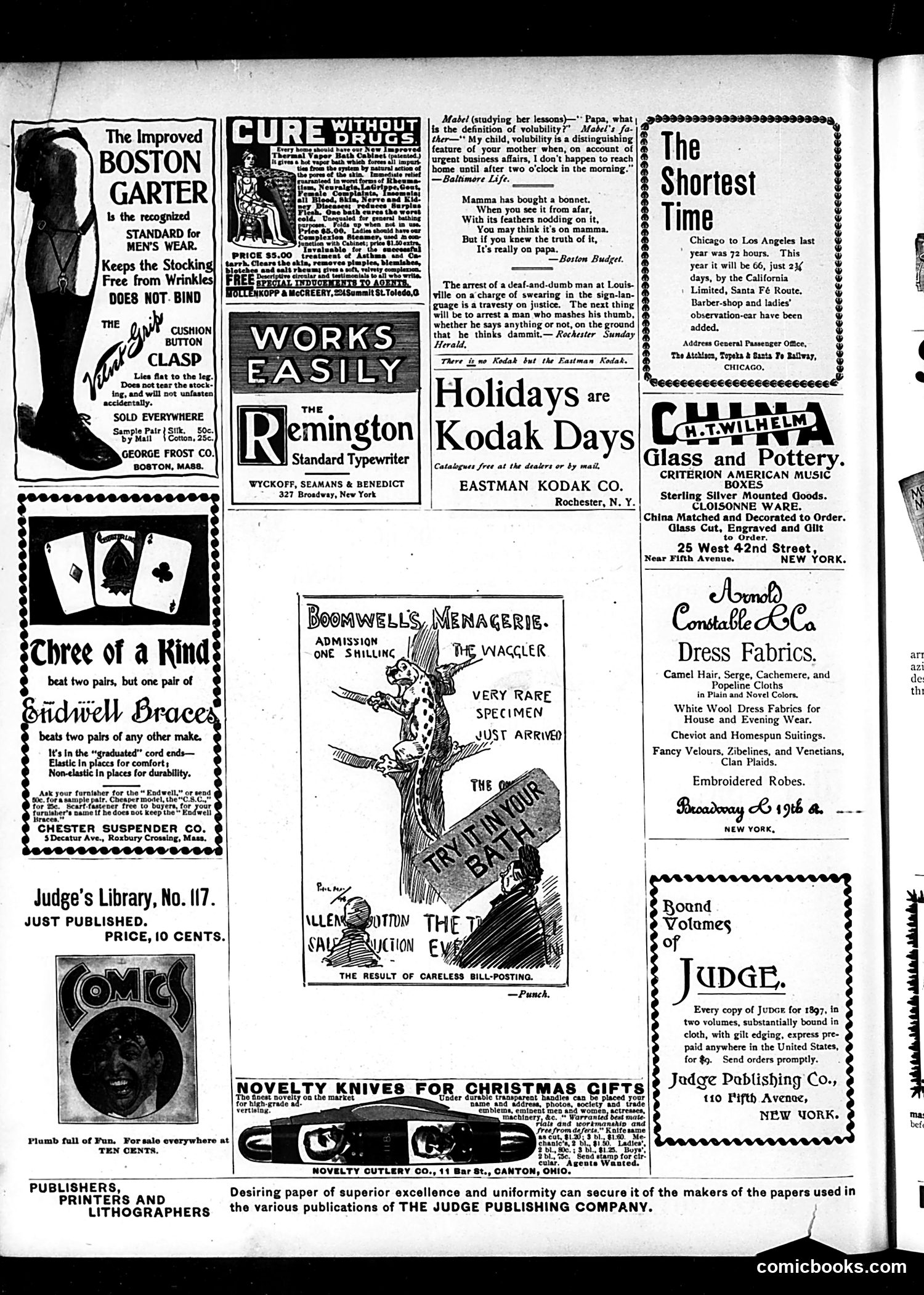
This is primarily an **advertising page** from Judge magazine, with minimal editorial content. The few jokes present reflect common domestic humor of the era: **The Jokes:** - A father defines "volubility" as his wife's chattiness, particularly when he arrives home late—satirizing nagging wives - A mother's new bonnet with nodding feathers is mocked as ridiculous fashion - A deaf-and-dumb man arrested for "swearing" in sign language critiques legal absurdity **The Cartoons:** The Boomwells Menagerie illustration (credited to *Punch*) shows careless bill-posting creating an absurd visual—a satirical jab at poor advertising practices. **Context for Modern Readers:** The ads reveal 1890s consumer culture: Boston Garters, typewriters, Kodak cameras, dress fabrics, and novelty knives. The domestic humor reflects period gender attitudes—wives portrayed as expensive, chatty, fashion-obsessed. The deaf-and-dumb arrest joke represents period attitudes toward disability and law enforcement. The page is largely commercial rather than politically satirical.
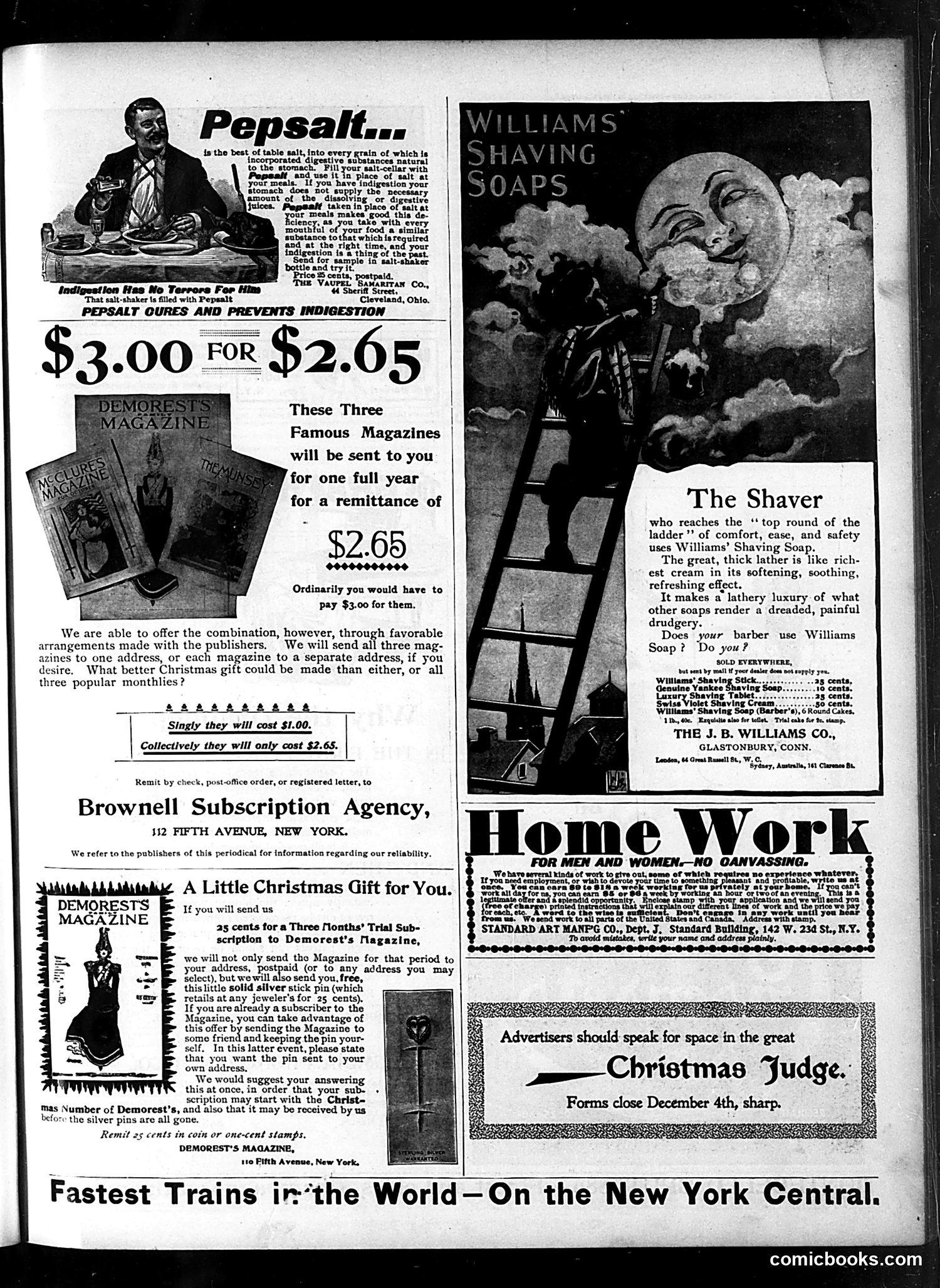
This page is primarily **advertising and promotional material** rather than political satire or editorial cartoons. The main content includes: **Featured Advertisements:** - **Pepsalt**: A patent medicine claiming to cure indigestion, featuring a man at a dining table. The ad promises digestive relief by using salt as a dietary supplement—typical of early 20th-century health product marketing. - **Williams' Shaving Soap**: Uses an image of a man climbing a ladder labeled "comfort, ease, and safety," with the lather compared to rich cream. Standard product positioning. - **Magazine Subscription Offers**: Demorest's Magazine and other publications bundled at discount rates with free premiums (a silver pin), typical Christmas gift marketing. - **Home Work Advertisement**: Offers employment opportunities for "men and women" doing unspecified piecework from home. The page reflects **early 1900s consumer culture**: patent medicines with dubious health claims, subscription bundle promotions, and home employment schemes. There is no significant political cartoon content or satire visible on this page.
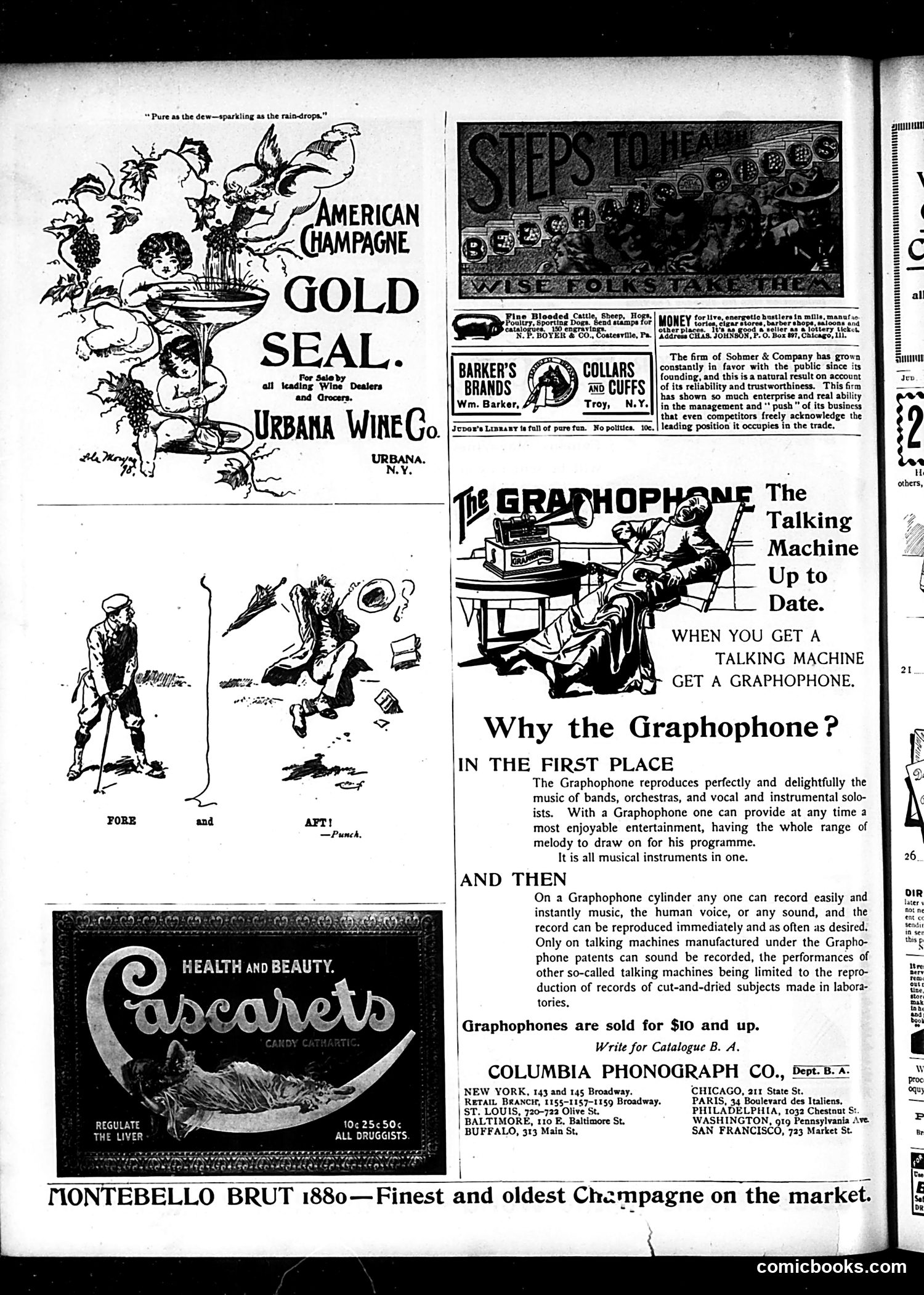
This page is primarily **advertising**, not political satire. The content includes: **Left side:** A wine advertisement for "American Champagne Gold Seal" by Urbana Wine Co., with decorative illustrations of cherubs and grape vines. Below are humorous illustrations labeled "FORE and AFT" showing golfers in exaggerated poses—apparently making fun of golf etiquette or technique. **Right side:** Multiple product advertisements including Cascarets candy laxative, Barker's shirt collars, and prominently, the **Columbia Graphophone**—an early phonograph/record player. The Graphophone ad emphasizes its ability to both *reproduce* music from cylinders AND *record* sound, claiming superiority over competitors (likely Edison's phonograph) that could only play pre-recorded material. **Bottom:** Montebello Brut champagne advertisement. The page reflects early 1900s consumer culture, showcasing emerging technologies (phonographs) and patent-era competition between manufacturers claiming technical superiority.
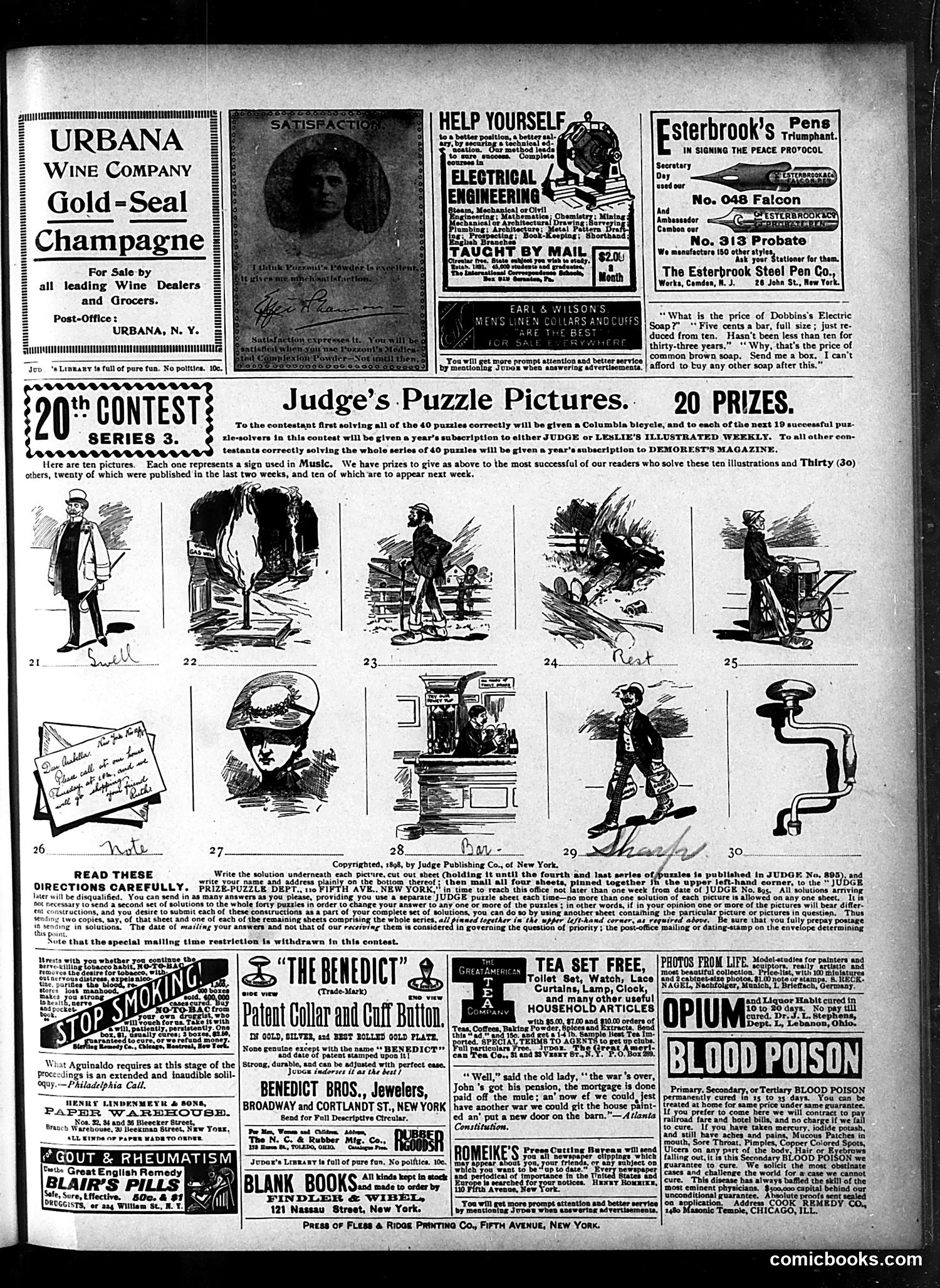
This is primarily an **advertising and puzzle page** from Judge magazine (circa 1898, based on references). The main content is a "$20 Contest" featuring "Judge's Puzzle Pictures"—a musical notation puzzle competition offering a Columbia bicycle to the winner and magazine subscriptions to runners-up. The puzzles themselves (images 21-30 visible) appear to be visual representations of musical terms or songs that solvers must identify—a common early magazine puzzle format. **The page is dominated by period advertisements** for various products: champagne, pens, soaps, patent collars, jewelry, patent medicines (Blair's Pills for gout/rheumatism), and notably **"Opium" and "Blood Poison" remedies**—reflecting late-19th-century marketing practices before drug regulation. There's a brief political reference mentioning **Aguinaldo** (Philippine revolutionary leader), suggesting this relates to the Spanish-American War period. The page contains minimal political satire; it functions mainly as a revenue vehicle through contests and advertisements rather than social commentary.
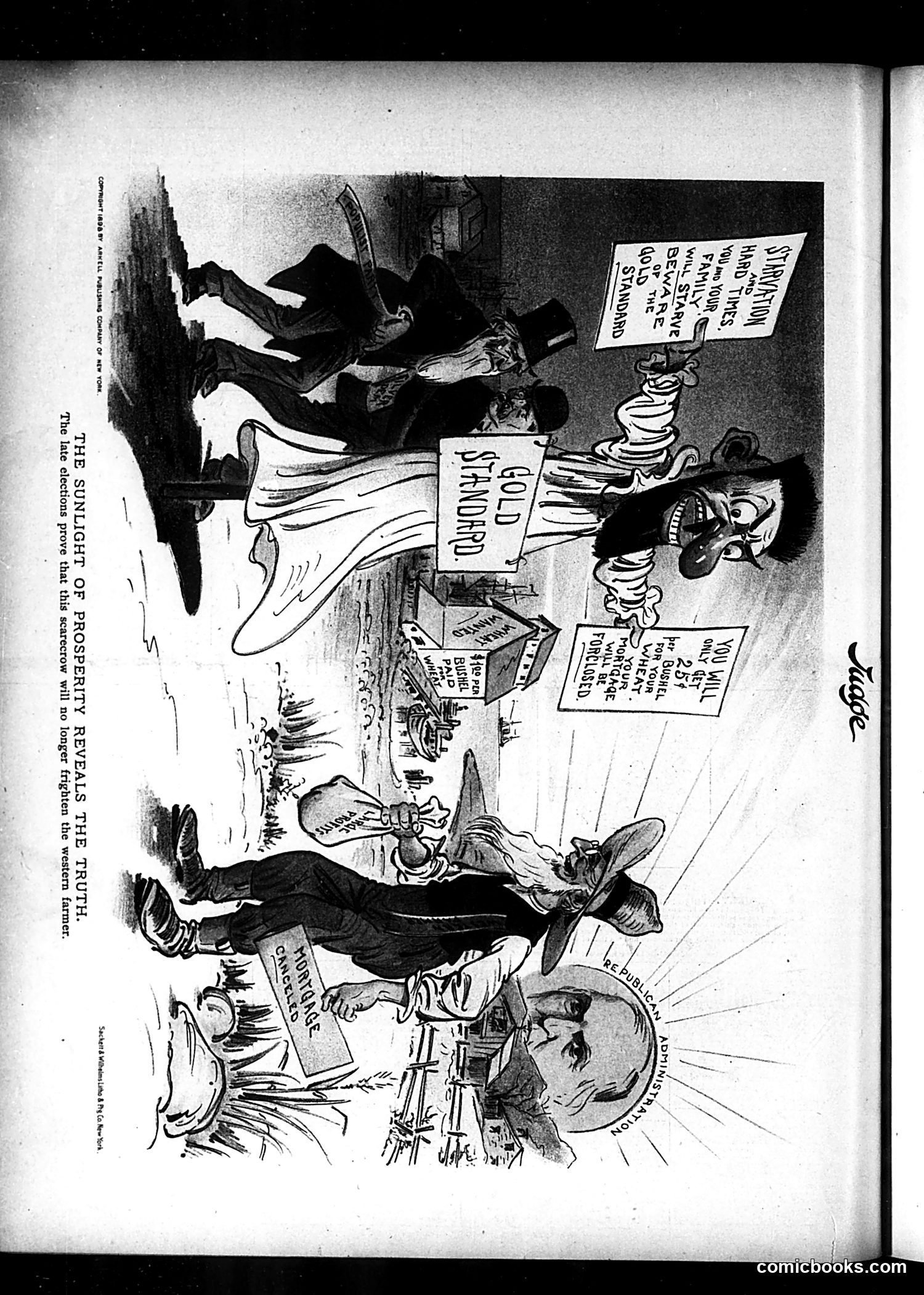
This political cartoon satirizes Republican claims of economic prosperity following recent elections. The image depicts a scarecrow labeled to represent Democratic warnings about economic hardship—positioned as ineffective fear-mongering that no longer persuades Western farmers. The cartoon's central claim: the "sunlight of prosperity" (suggesting Republican economic success) has exposed Democratic electoral messaging as hollow threats. The scarecrow metaphor mocks the opposition party's arguments as insubstantial and unconvincing to rural voters. The text identifies this as commentary on "late elections" where Republicans apparently gained Western farm support by claiming economic improvement. The satire suggests Democrats relied on scare tactics rather than substantive policy critique—tactics that voters have rejected based on actual prosperity. The lithographer credit and Judge magazine date (appears to be early 1900s) indicate this reflects a specific election cycle's rhetoric, likely involving tariff or agricultural policy debates.