
A complete issue · 16 pages · 1898
Judge — October 22, 1898
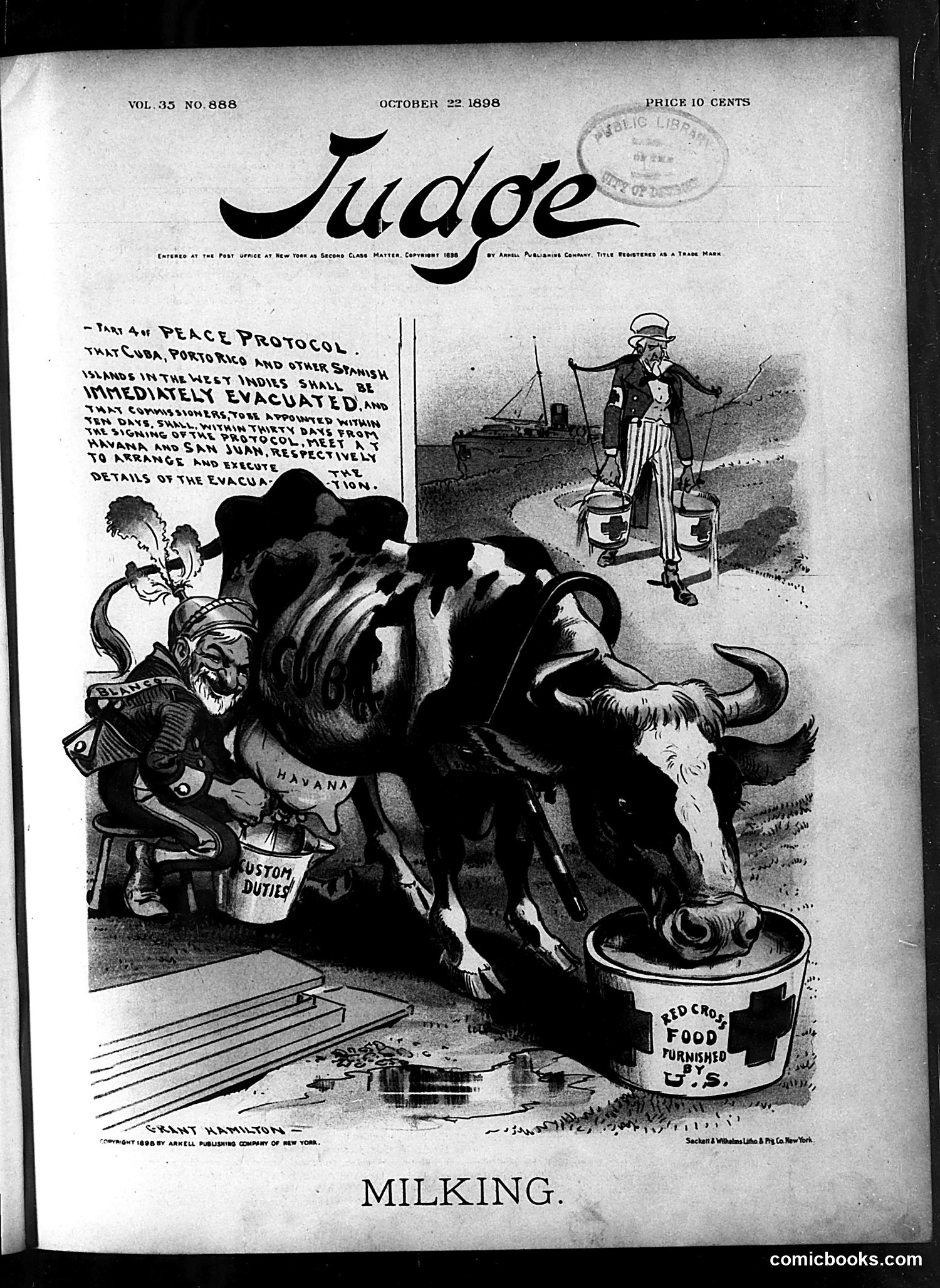
This political cartoon satirizes American intervention in Cuba during the Spanish-American War. The central image depicts Uncle Sam (representing the U.S. government) being "milked" like a cow by a figure labeled "Spain" (the grotesque caricature on the left). The text box references the "Peace Protocol" requiring Spain to evacuate Cuba and other Spanish islands. The satire suggests that despite this agreement, America continues being exploited—"milked"—for resources and support. The Red Cross food container labeled "furnished by U.S." reinforces the theme that American resources are being drained. The figure in the background (possibly representing a U.S. official) oversees the arrangement, suggesting complicity in this extraction of American wealth for Cuban aid.
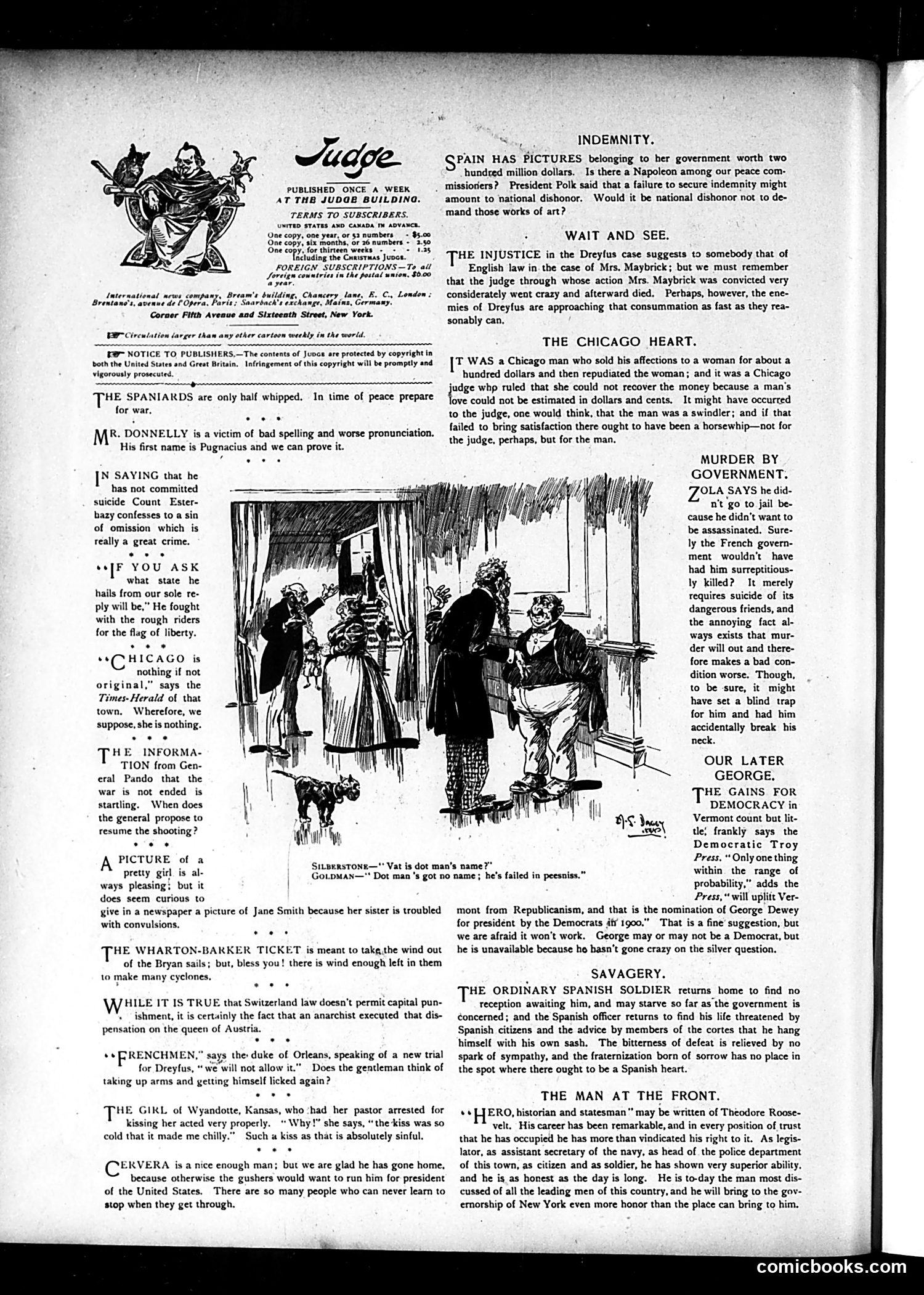
The main cartoon depicts a domestic scene with the caption "Old man's name? Out man's I got no name; he's failed in peanuts." It appears to satirize a man who has failed financially (specifically in the peanut business), now reduced to anonymity or irrelevance within his own household. The accompanying text sections mock various contemporary figures and events: Spanish government art collection disputes, the Dreyfus affair (French legal injustice), Chicago judicial corruption involving a woman's monetary claim, and critiques of political figures like President Polk and Theodore Roosevelt. The overall tone suggests *Judge* magazine's typical approach: lampooning political corruption, legal absurdities, and failed businessmen through humor aimed at educated readers aware of current scandals and personalities.
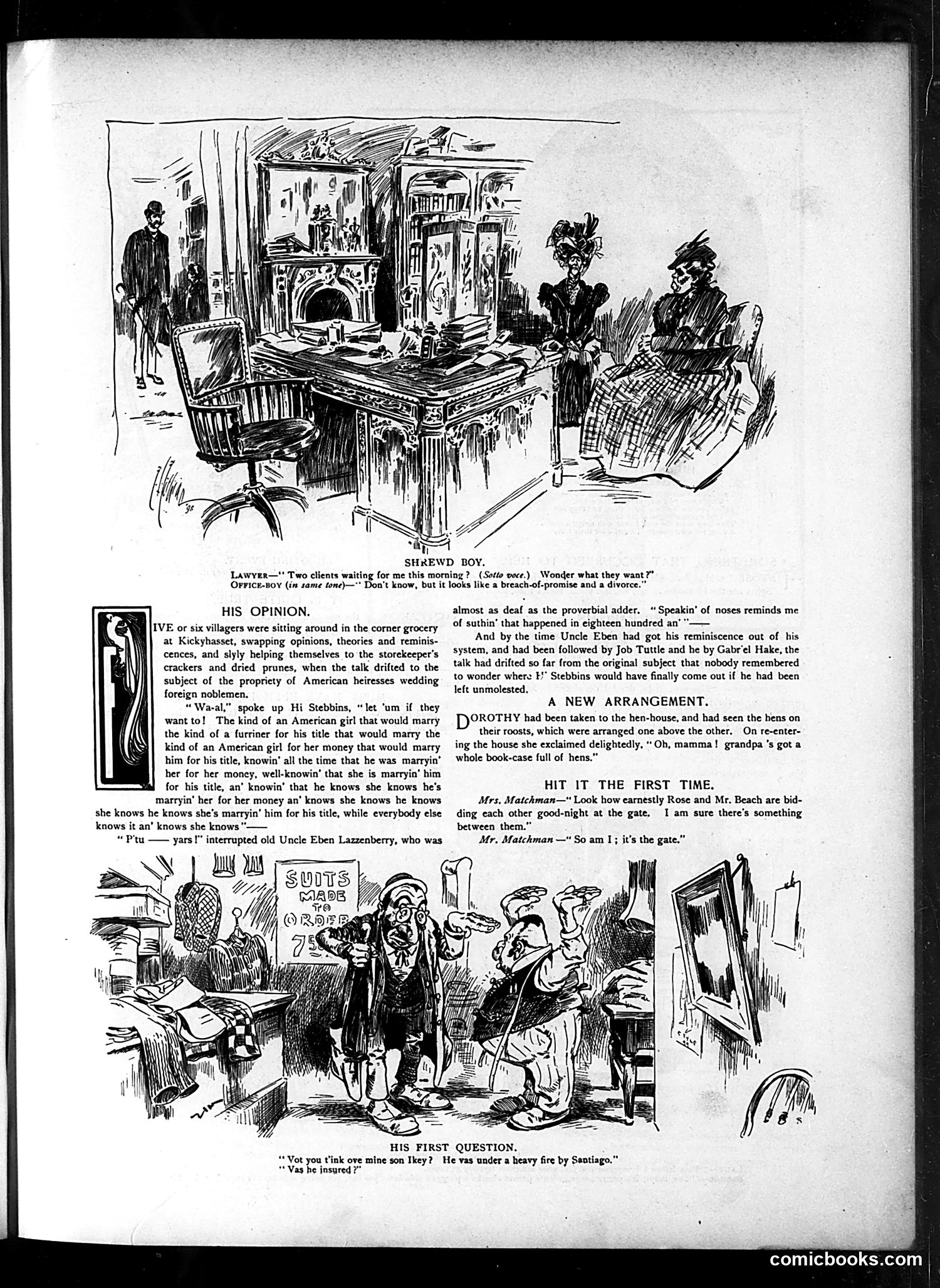
The page contains three separate satirical pieces: 1. **"Shrewd Boy"** (top): An office scene where a lawyer and two clients discuss matrimonial matters. The joke involves wordplay about "marrying" an American girl versus a title—playing on anxieties about wealthy Americans marrying European nobility for titles. 2. **"A New Arrangement"** (middle): Dorothy has reorganized her hens in a bookcase, a humorous domestic vignette with no apparent political content. 3. **"His First Question"** (bottom): A caricatured figure asks about insurance for someone caught in fire "by Santiago"—likely referencing the Spanish-American War (1898) and the Battle of Santiago de Cuba, satirizing post-war concerns about liability and military violence. The overall page reflects turn-of-the-century American anxieties about class, international marriage, and recent military conflict.
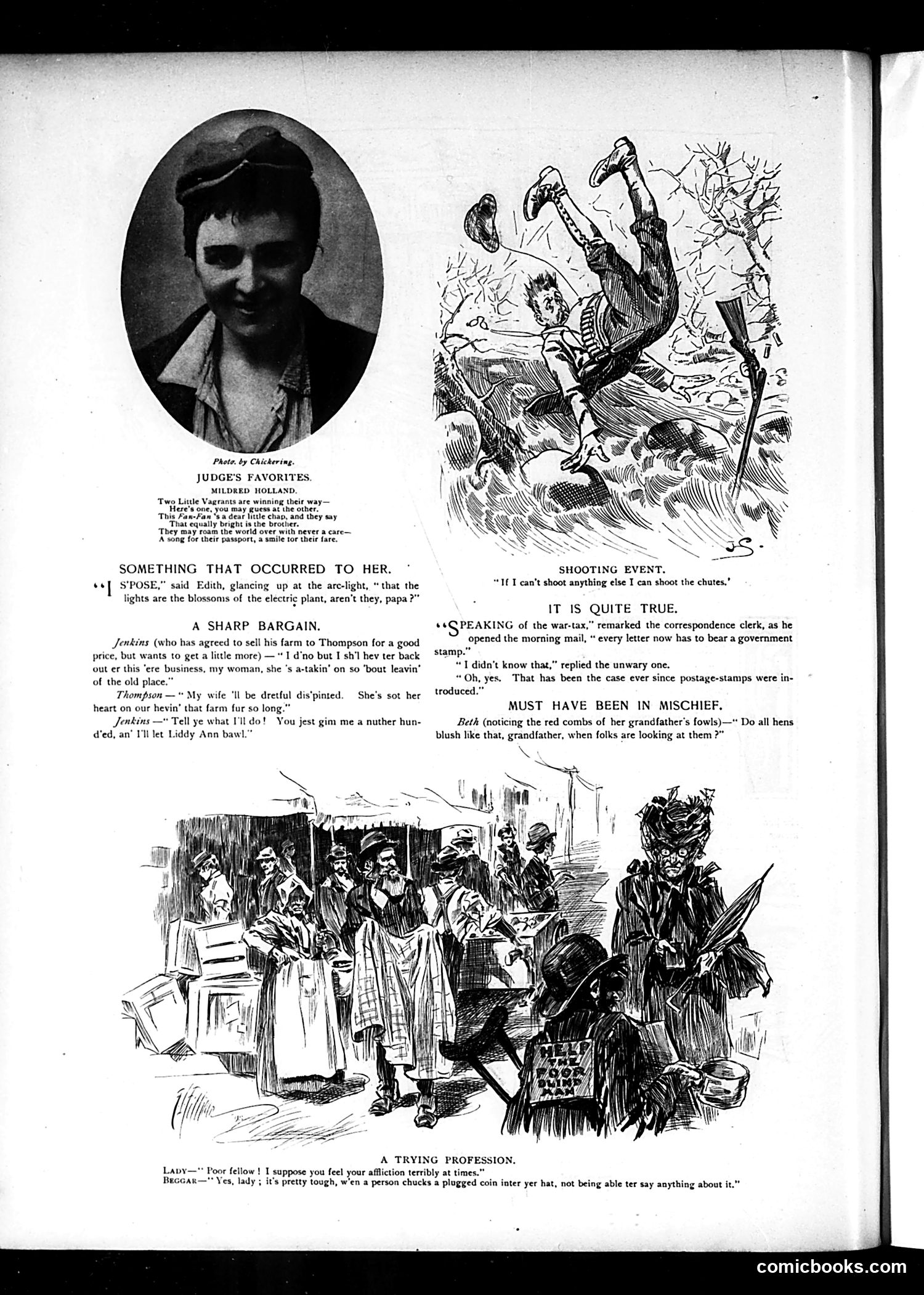
This page contains several satirical sketches typical of early Judge magazine humor: **"Judge's Favorites"** features Mildred Holland with a poem about her theatrical talents. **"Shooting Event"** shows a figure shooting at something while suspended, with dialogue about shooting "chutes"—likely a pun on parachutes or a contemporary entertainment/stunt. **"A Sharp Bargain"** depicts a rural transaction involving farm sale negotiations—typical rural humor. **"A Trying Profession"** shows street-level social commentary about beggars and panhandlers encountering a woman, with dark humor about poverty and coin-operated mechanical devices. The other sketches contain dialogue-based humor about everyday situations: postal taxes, wartime concerns, and familial embarrassment. Without clearer date attribution or specific political context, the precise satirical targets remain somewhat unclear, though the content reflects early-20th-century American social concerns.
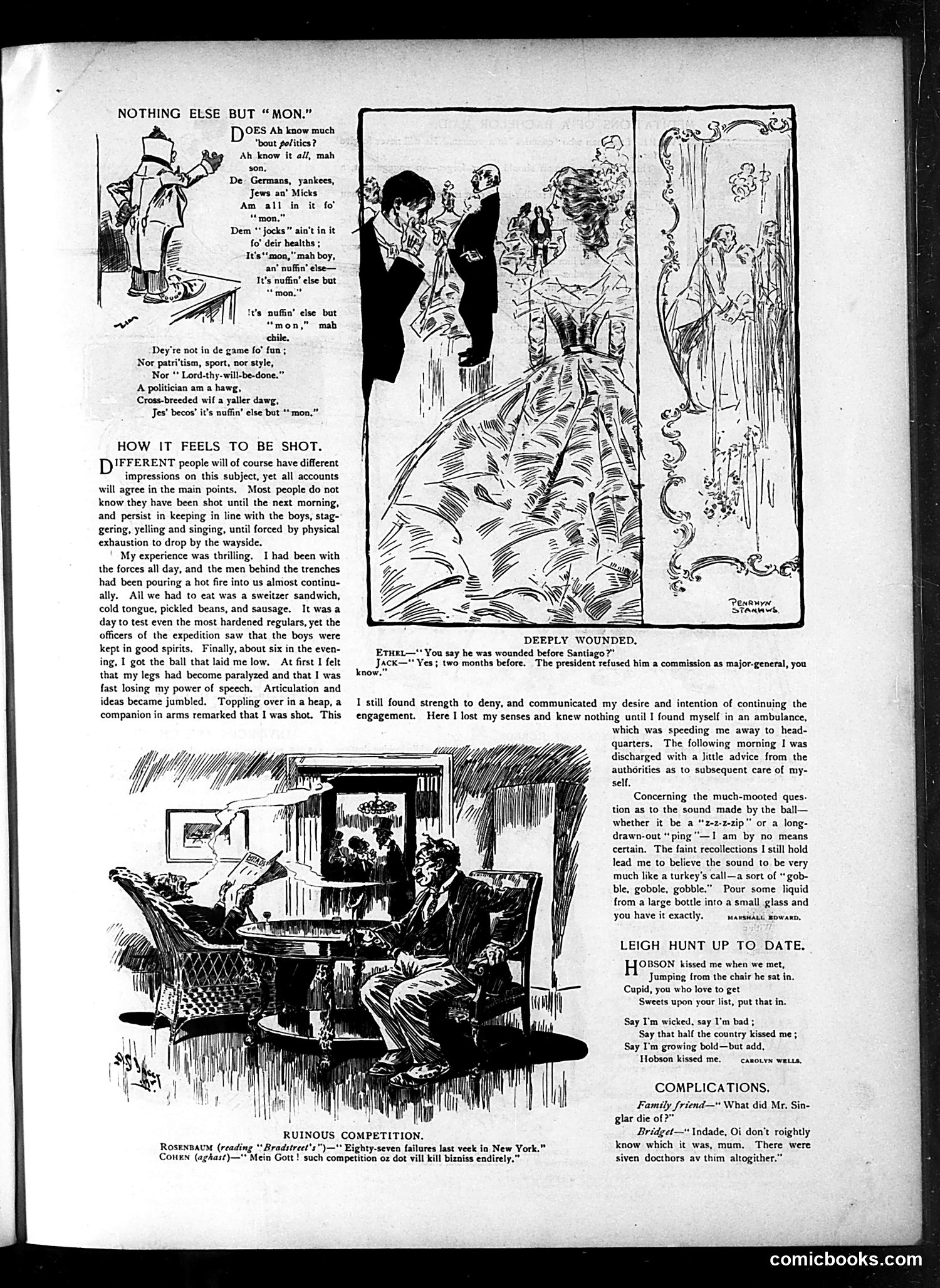
This page contains several humorous pieces rather than unified political cartoons: **"Nothing Else But 'Mon'"** mocks Irish immigration and dialect, with a character insisting everything is "mon" (man) in speech patterns stereotyping Irish immigrants. **"How It Feels to Be Shot"** presents a WWI soldier's first-person account of being wounded in combat—a serious piece amid lighter content. **"Deeply Wounded"** depicts a dialogue between two officers, one wounded at Santiago (likely the 1898 Spanish-American War), discussing military experience and recovery. **"Kuinous Competition"** references eighty-seven funerals in New York, appearing to joke about mortality or mortality statistics. **"Leigh Hunt Up To Date"** and **"Complications"** are brief satirical verses on romance and social situations. The page mixes war commentary with ethnic humor typical of early 20th-century Judge magazine.
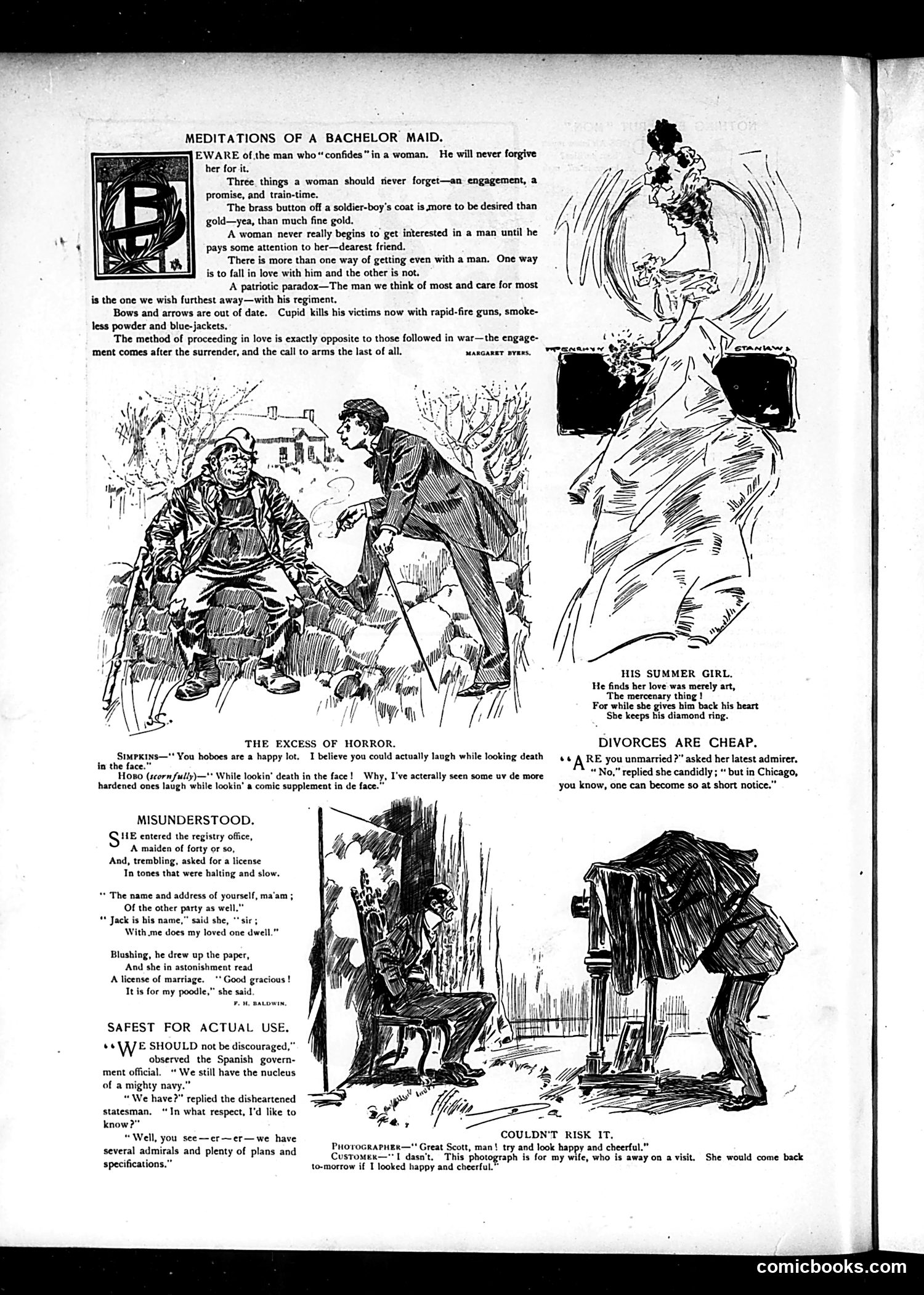
This page presents early 20th-century satirical commentary on courtship, marriage, and gender relations, using humor to critique social conventions. **Main content:** The title piece offers cynical "wisdom" attributed to Margaret Byers about women and romance—warning against men who confide in women, mocking female memory for engagements, and comparing male attention to military siege warfare. The writing reflects period attitudes treating romance as strategic combat. **Cartoons satirize specific situations:** - "His Summer Girl" mocks mercenary courtship (woman returns his heart but keeps his ring) - "Misunderstood" jokes about a 40-year-old woman obtaining a marriage license—for her poodle, playing on spinster stereotypes - "Divorces Are Cheap" references Chicago's reputation for easy divorce laws - "Couldn't Risk It" shows a husband unable to smile for his photo because his wife is away; smiling would suggest he's happy without her **Overall tone:** These pieces use domestic situations and relationship anxieties for humor while reinforcing era-specific gender stereotypes and marriage assumptions.
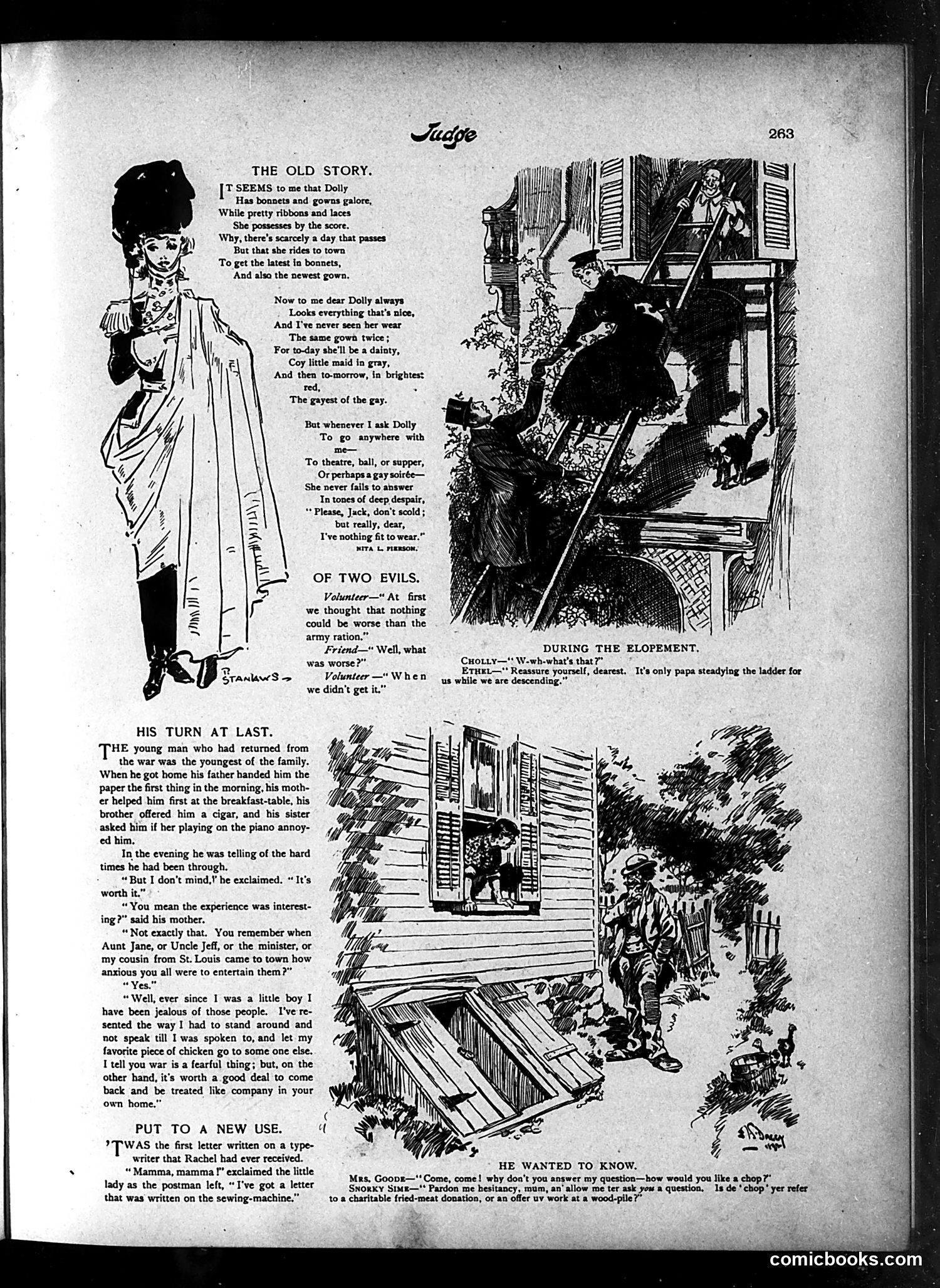
This page contains three humorous pieces satirizing early 20th-century domestic life: **"The Old Story"** mocks the perennial complaint of women who own extensive wardrobes yet claim to have "nothing to wear" when invited out—a timeless feminine stereotype the magazine presents as absurd. **"During the Elopement"** jokes about parental involvement in a young couple's secret escape, with the father literally helping by steadying the ladder—suggesting even elopements require family participation. **"His Turn at Last"** satirizes wartime sacrifice by revealing the young soldier's true motivation: he endured combat merely to finally receive the special treatment previously reserved for distinguished visitors. The piece mocks how families fawn over guests while ignoring family members. The remaining pieces contain lighter domestic humor about food complaints and typewriter correspondence. Overall, the page reflects upper-middle-class concerns (shopping, courtship, returning soldiers) typical of early 1900s satire, using gentle irony rather than sharp political critique.
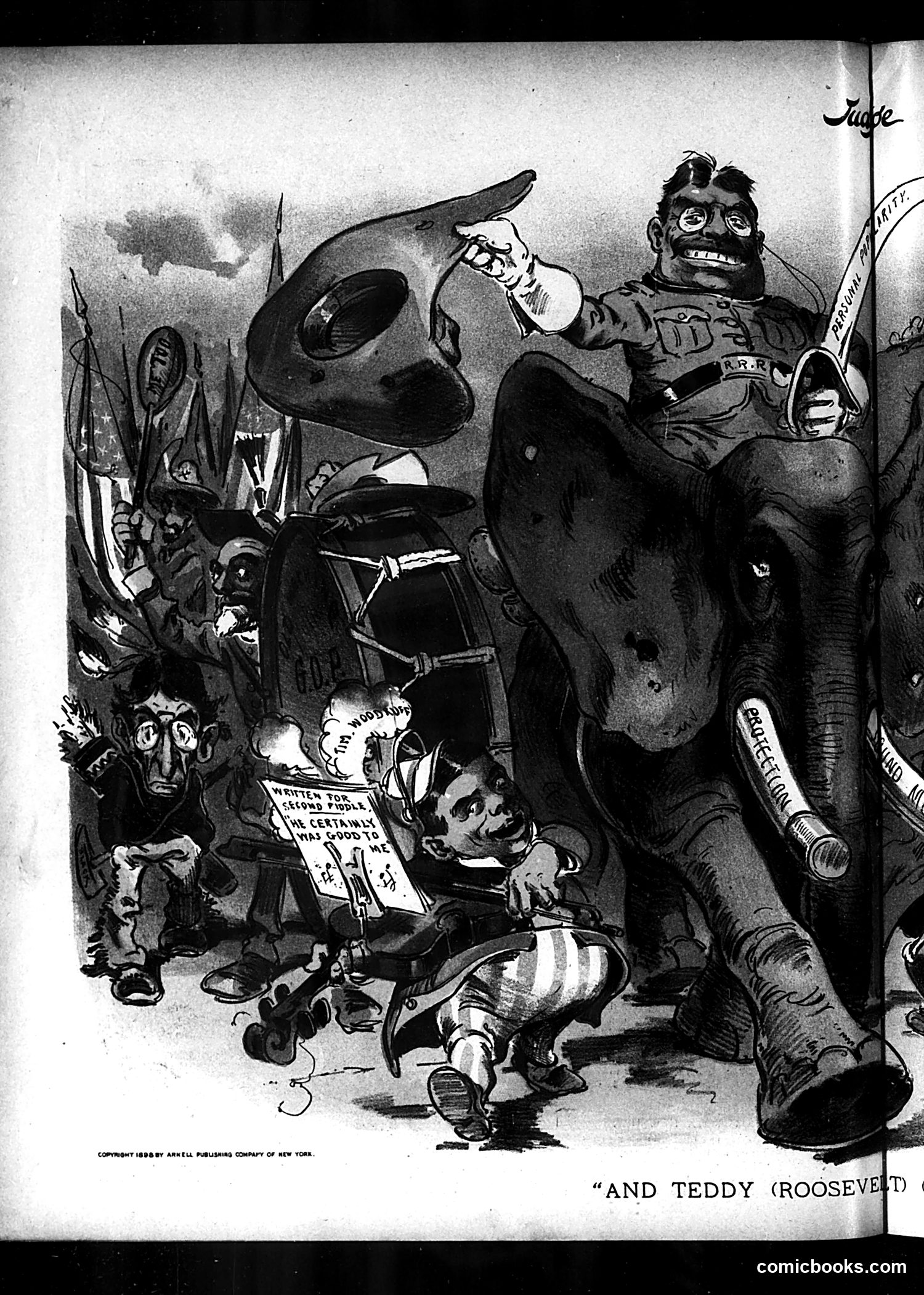
This political cartoon satirizes Theodore Roosevelt's imperial ambitions and militarism. The central figure—a caricatured Roosevelt in military dress marked "A.R.R." (Assistant Roosevelt)—rides an elephant while wielding a large club, depicted as an aggressive imperialist. Surrounding him are smaller caricatures representing conquered or subjugated peoples and territories, flags, and what appear to be colonial troops or indigenous populations. The exaggerated features and hierarchical composition mock Roosevelt's expansionist "Big Stick" foreign policy and his involvement in colonial ventures. The text fragment "And Teddy (Roosevelt)" suggests this is part of a larger critique of Roosevelt's presidency (1901-1909), likely attacking his interventionist policies in Latin America, the Philippines, or other regions. The satirical tone criticizes American imperialism under his administration.
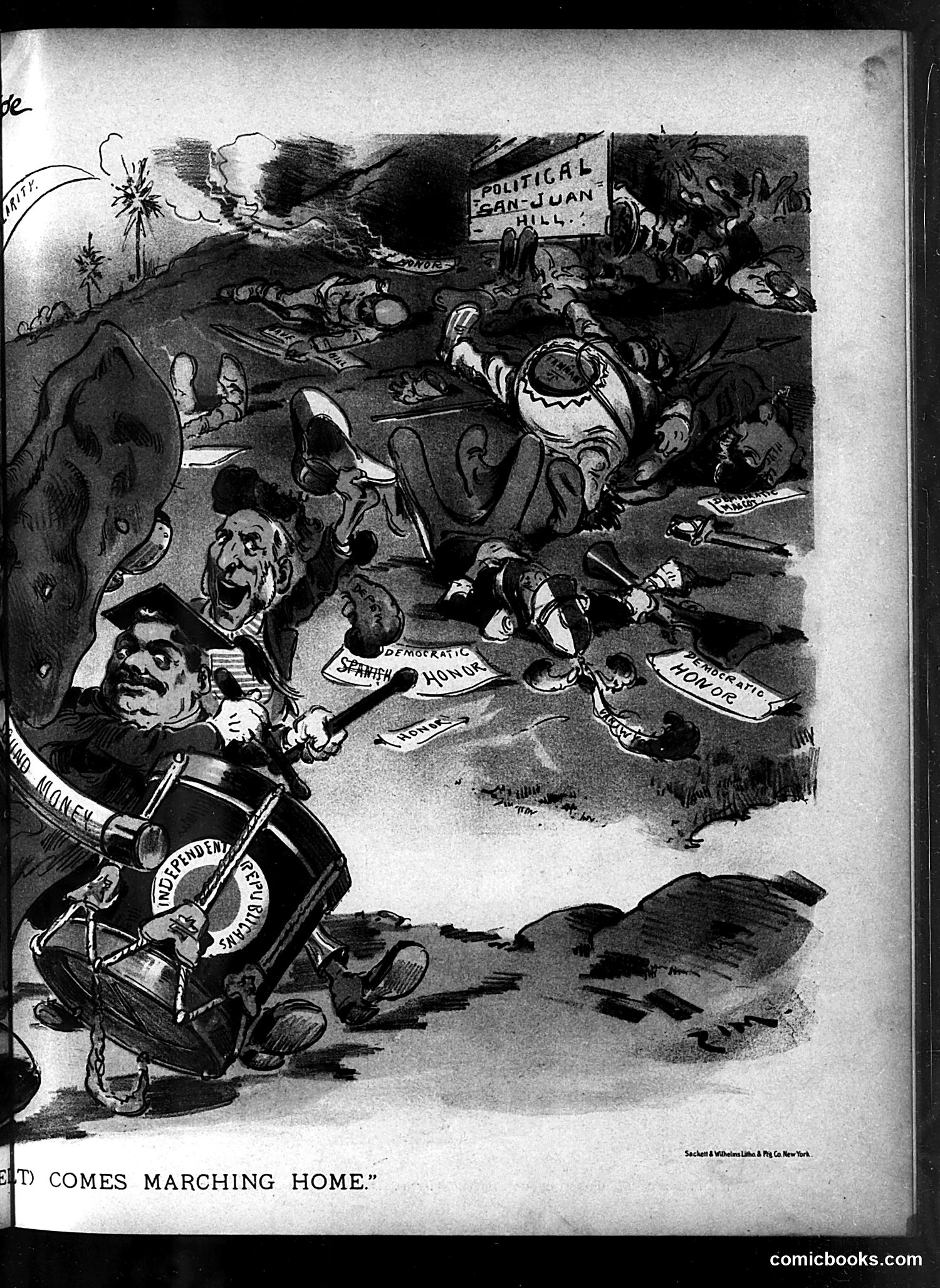
This is a dark satirical cartoon depicting the aftermath of conflict, likely relating to the Spanish-American War or Philippine-American War era (early 1900s). The central scene shows multiple corpses and casualties scattered on the ground. Visible text labels include "Political San Juan Hill," "Democratic," "Republican," and references to "Honor"—suggesting the cartoon critiques how both political parties exploited military deaths for political gain. The figure on the left appears to be a politician or military leader riding what's labeled as an "Independence" vehicle, seemingly profiting from or celebrating the carnage. The title's dark irony suggests that instead of returning home as heroes, soldiers came back as casualties—the real cost of the war that politicians touted for electoral advantage.
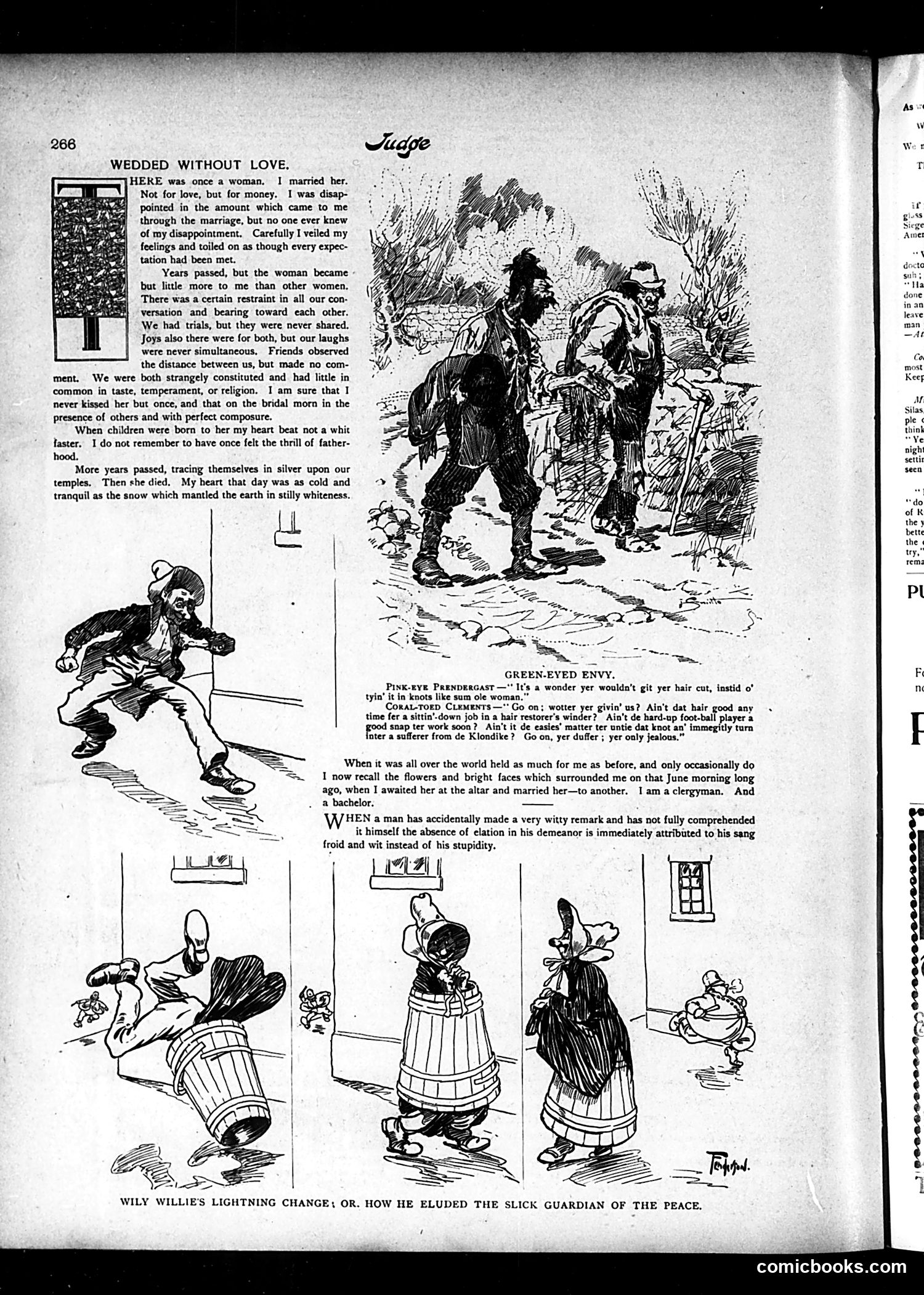
**"Wedded Without Love"** is a dramatic monologue by a clergyman who married for money, not love. He expresses cold detachment toward his wife throughout their marriage—never truly bonding, rarely touching, showing no paternal joy at their children's birth. After her death, he remains emotionally unmoved. The satire targets loveless marriages of convenience and hypocrisy: a man of the cloth publicly performing duty while privately feeling nothing, then recalling only superficial details of their wedding day. It critiques both marital mercenary motives and emotional dishonesty. **"Green-Eyed Envy"** depicts two working-class men (appearing to be street types) where one mocks the other's long, knotted hair. The second man defensively justifies keeping it long—claiming it's useful for sitting jobs and hair-restorer work, sarcastically suggesting the first man is just jealous. It's minor social satire about working-class vanity and one-upsmanship. **"Wily Willie's Lightning Change"** (bottom panel sequence) shows a figure apparently evading a policeman through quick costume changes, suggesting street trickery or criminal evasion of authority.
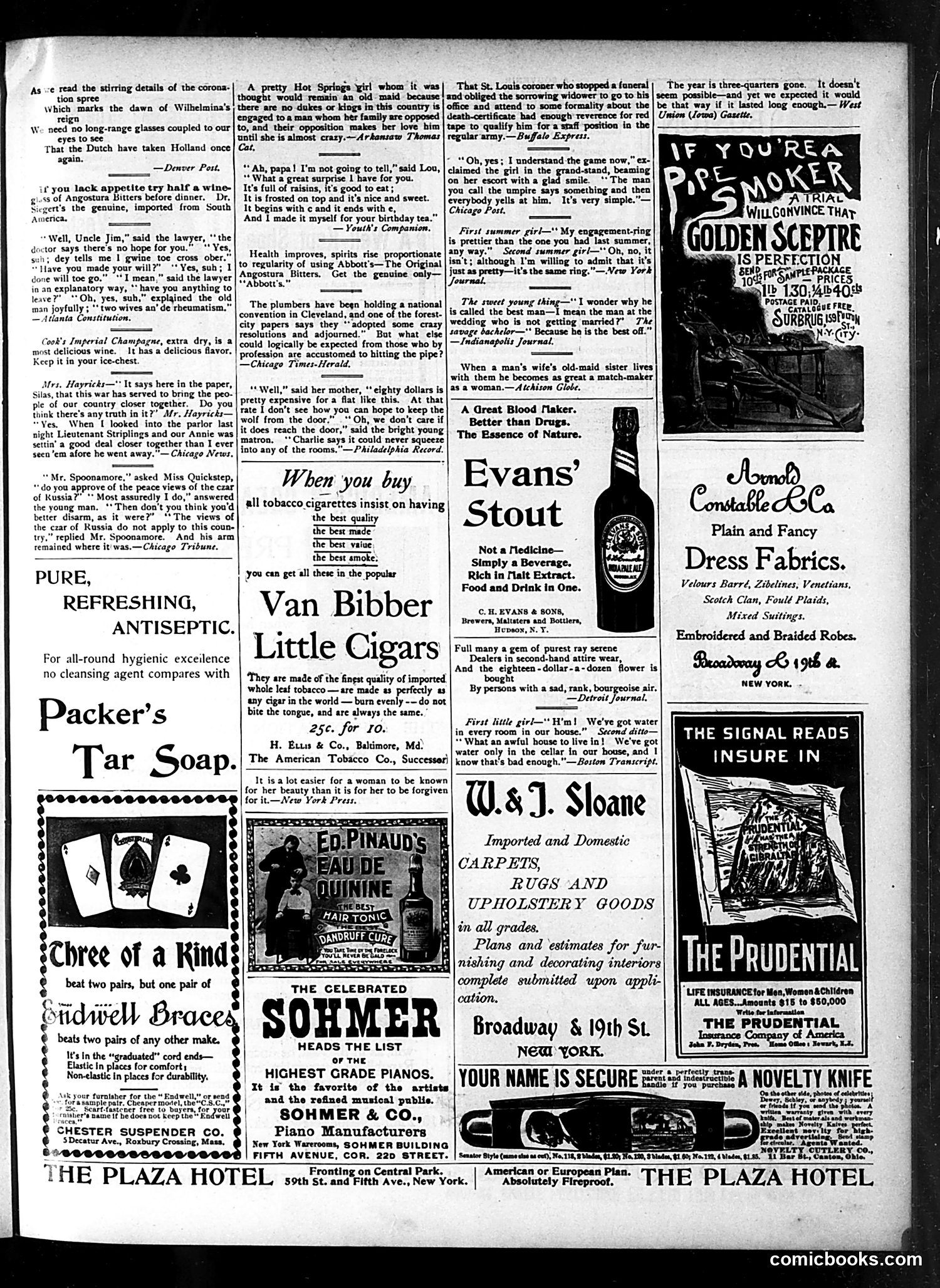
This page is primarily **advertisements and humorous short anecdotes**—typical of Judge magazine's format. There are no significant political cartoons visible. The opening item references **Queen Wilhelmina's coronation in the Netherlands**, joking that the Dutch have "taken Holland once again" (unclear what this references specifically). The rest consists of brief jokes: a lawyer's client claiming "two wives and rheumatism" as his inheritance; a couple becoming physically closer during wartime; a young man refusing to disarm despite supporting the czar's peace views (suggesting hypocrisy about pacifism). **The page is dominated by period advertisements** for products like cigars, soap, pianos, carpets, and insurance—with Van Bibber Little Cigars and Sohmer Pianos receiving prominent display. The humor is gentle domestic comedy rather than sharp satire; the social commentary is minimal and dated (attitudes toward romance, courtship, and marriage).
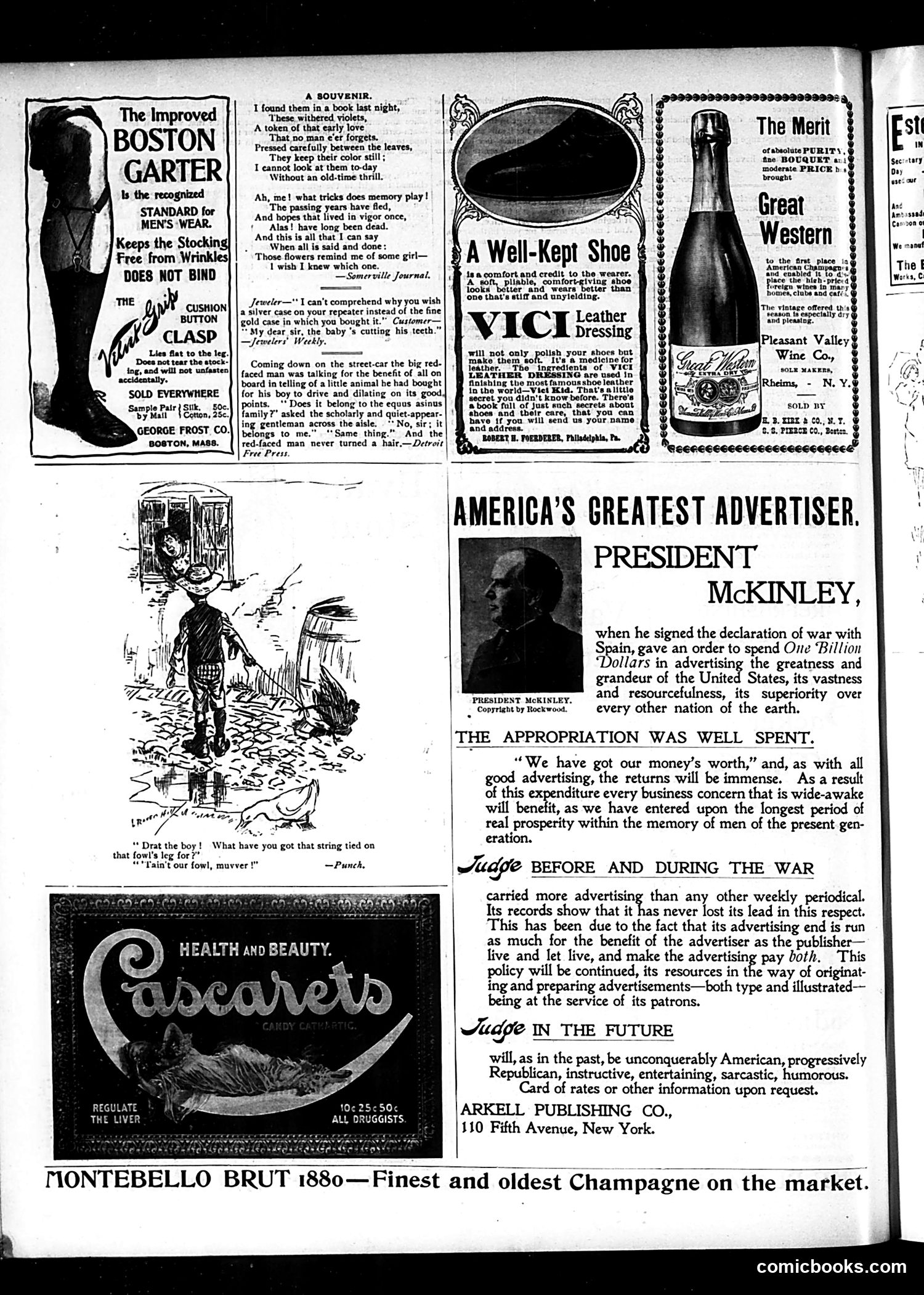
This page combines advertisements with satirical commentary about the 1898 Spanish-American War. The main political content centers on **President McKinley**, depicted in a portrait illustration. The accompanying text praises McKinley as "America's Greatest Advertiser" for his decision to spend one billion dollars promoting American military superiority during the war with Spain. The satire's point: McKinley's massive war expenditure is reframed as "advertising"—treating military propaganda like a commercial marketing campaign. The piece ironically argues this spending benefits American business generally, essentially saying the war served capitalist interests wrapped in patriotic language. The cartoon below (captioned "Drat the boy!") appears unrelated—a domestic humor piece about a child misidentifying a fowl. The remaining content is product advertising (Boston Garters, VICI shoe polish, Cascara laxative, champagne), typical of Judge's commercial-heavy format. This mixture of satire and advertisements reflects Judge's model as a satirical weekly funded by advertisers.
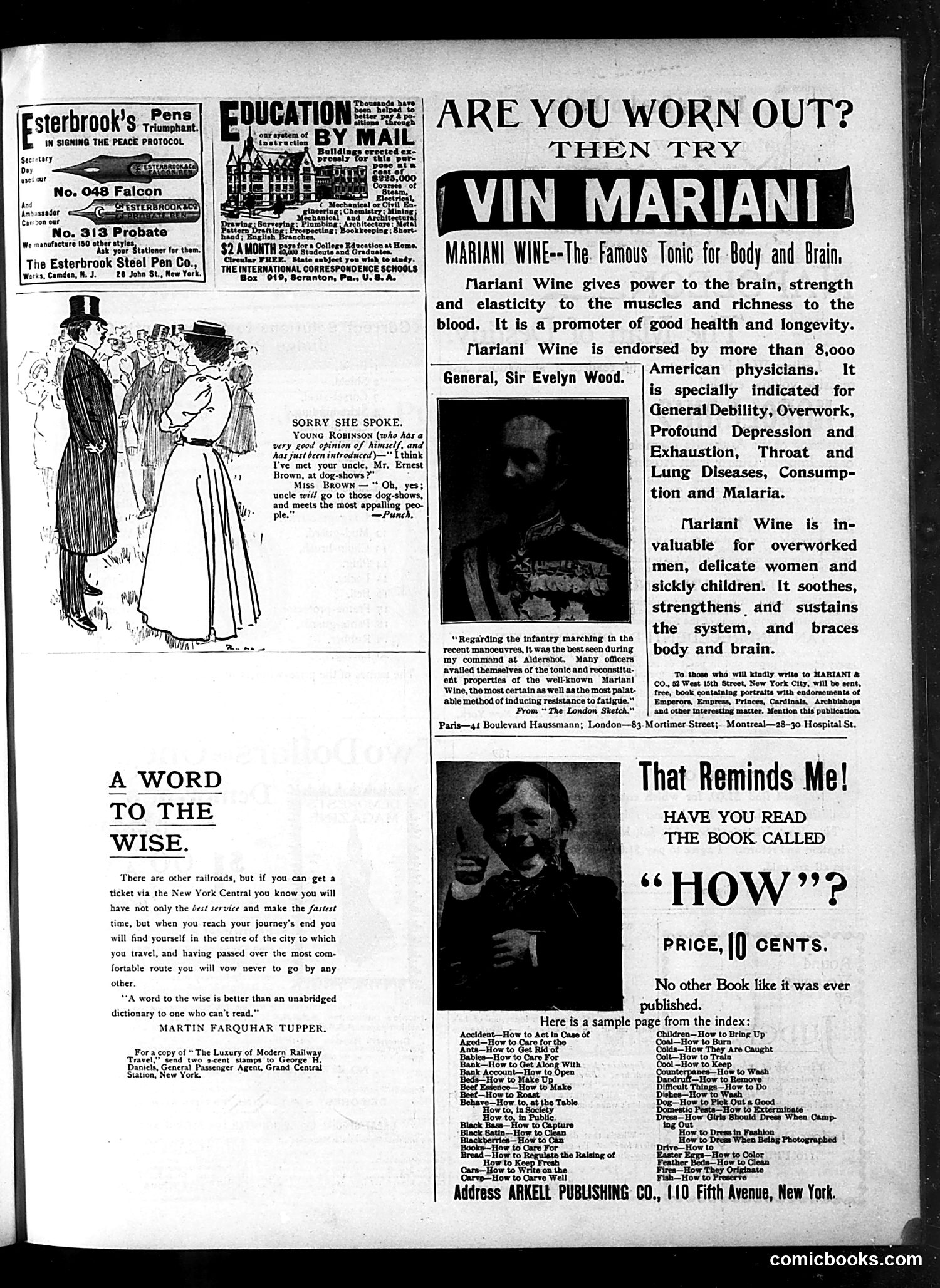
This page consists primarily of **period advertisements** rather than editorial cartoons, reflecting early 20th-century patent medicines and self-help literature. The main satirical cartoon ("Sorry She Spoke") depicts a social awkwardness joke: a young man assumes he's met a woman's uncle at dog shows, but she pointedly responds that her uncle frequents such venues and encounters "the most appalling people"—implying the uncle associates with an undesirable social class. The humor relies on Victorian-era class consciousness. The bulk of the page promotes **Mariani Wine**, a now-notorious "tonic" falsely claiming endorsement by 8,000 physicians and generals to cure exhaustion, depression, and consumption. These were standard dubious health claims before FDA regulation. A secondary ad hawks a book titled **"How?"** (10 cents)—a practical guide covering domestic and etiquette topics. The page reflects an era when such unregulated medical claims and self-improvement literature dominated publication advertising, before modern consumer protection laws existed.
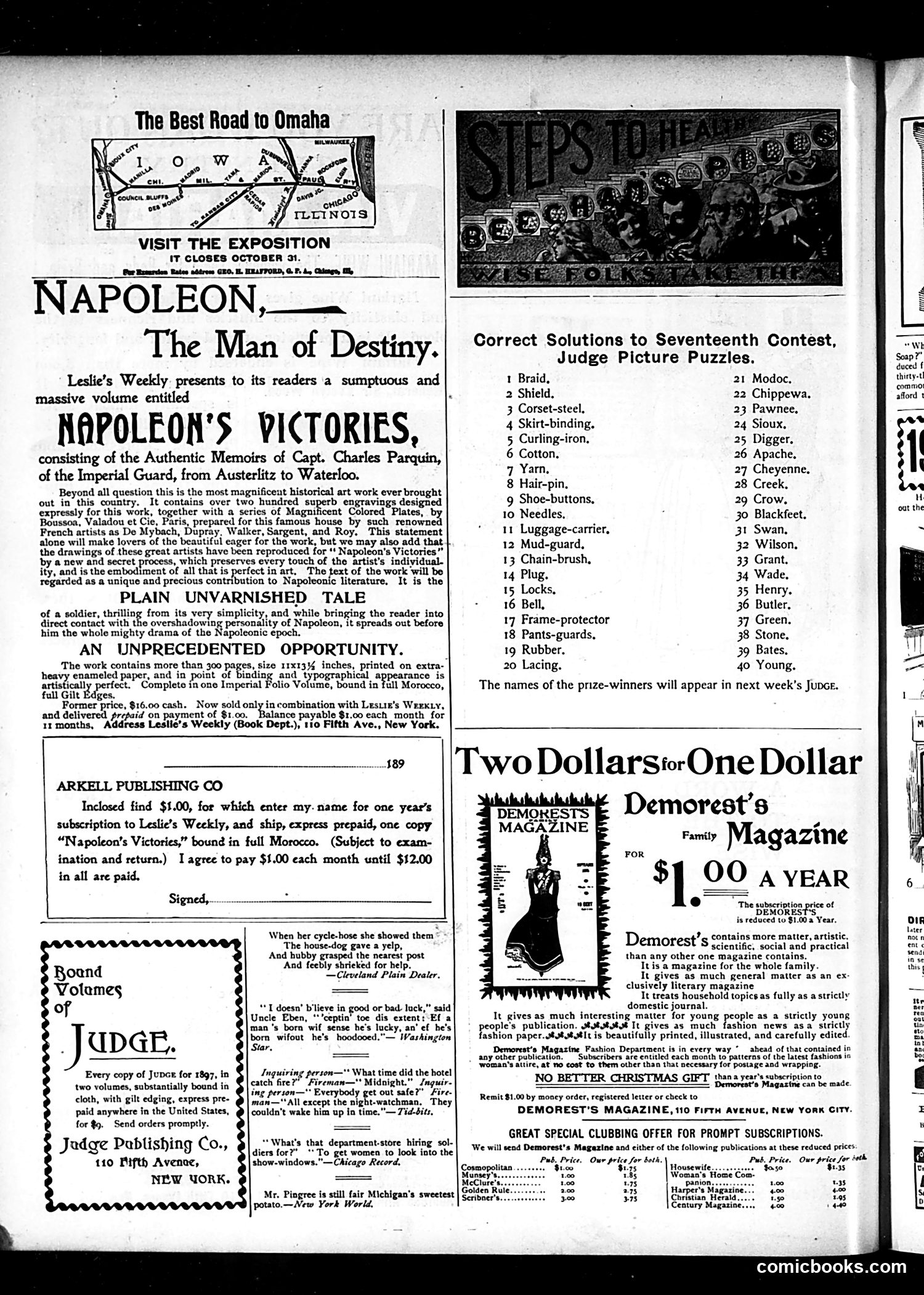
This page is primarily **advertising and contest solutions**, not political satire. The main content promotes: 1. **"Napoleon's Victories"** — Leslie's Weekly is selling an elaborate 300-page illustrated book about Napoleon's military campaigns, based on memoirs of an Imperial Guard officer. The ads emphasize its artistic quality with colored plates by renowned French artists, positioning it as a luxury item. 2. **Magazine subscription offers** — Multiple competing publications (Demorest's Magazine, Judge itself) advertise discounted annual rates, typical of late-19th-century magazine wars. 3. **A puzzle contest** — Solutions to a "Judge Picture Puzzles" contest, likely a visual riddle game popular in the era. The small illustrated snippets (cyclist, Uncle Eben dialogue) are filler humor, not major satire. The page reflects Gilded Age consumer culture and the competitive magazine industry, with publishers using installment plans and bundled offers to attract readers. There's no identifiable political figure or clear satirical target visible.
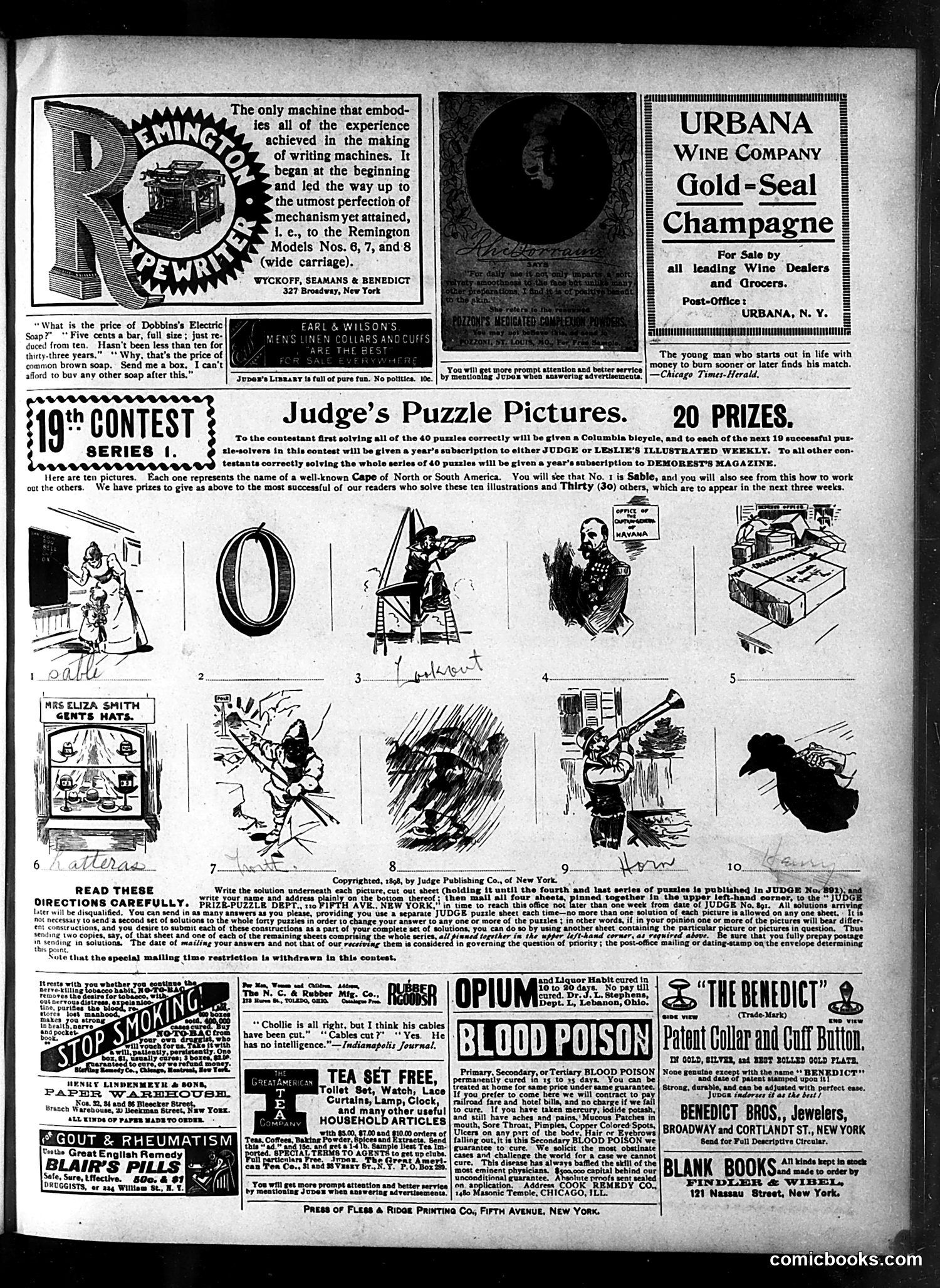
This page is primarily **advertising and contests**, not political satire. The main content is Judge's "Puzzle Pictures" contest—a visual puzzle game where readers identify Cape names (geographic locations) from illustrations. Picture 1 shows a woman at a door, labeled "SABLE" as the example answer (Cape Sable). The contest offered prizes: a Columbia bicycle for first place, year-long subscriptions to Judge or Leslie's Illustrated Weekly for the next 19 solvers, and Demorest's Magazine subscriptions for others. Contestants had to solve 40 total puzzles across multiple weeks. The page includes numerous product advertisements (Remington typewriters, wine, soap, patent collars, tea sets, blood poison remedy) typical of 1890s magazine advertising. There's a brief homily about young men "burning money" finding their match. **This is not a satirical or political cartoon page**—it's a standard late-19th-century magazine layout mixing entertainment contests with commercial advertising.
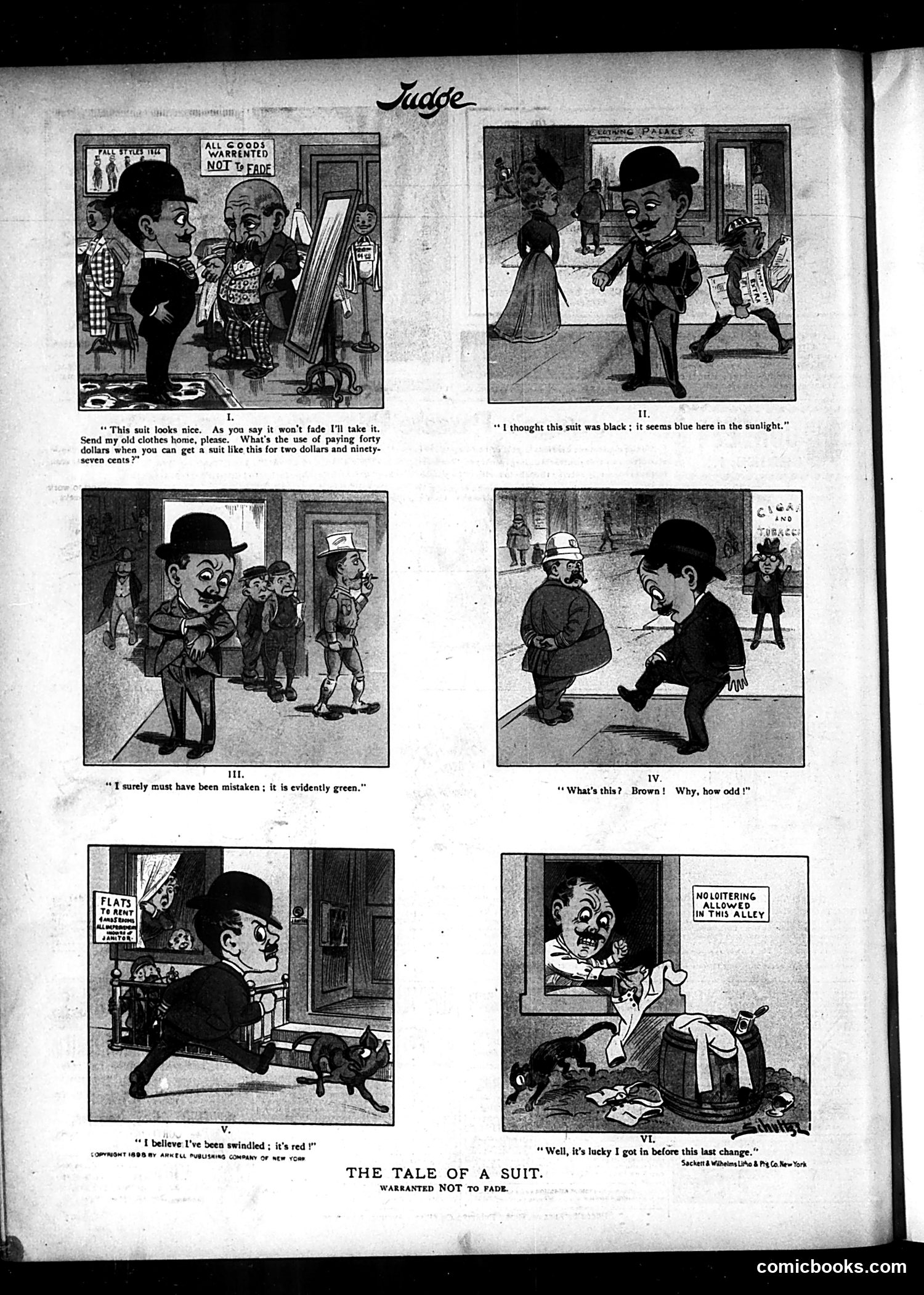
This six-panel satirical comic mocks consumer fraud and cheap goods. A man purchases an inexpensive suit ($2.97) advertised as "warranted not to fade," believing he's getting a bargain compared to a $40 quality suit. The joke unfolds as the suit visibly changes color—appearing black, then blue, then green, then red—in successive panels. Each character (a tailor, a friend, the purchaser) notices different colors, suggesting the dye is unstable and the garment is deteriorating rapidly. The final panel shows the suit has fallen apart into rags and debris, with the man barely visible in a window, commenting it's "lucky I got in before this last change"—implying even more rapid deterioration is occurring. The satire targets both consumer gullibility (buying suspiciously cheap goods) and unscrupulous manufacturers who make false quality claims. It's a straightforward morality tale: you get what you pay for.