
Judge, 1898-10-22 · page 2 of 16
Judge — October 22, 1898 — page 2: what you’re looking at
What you’re looking at
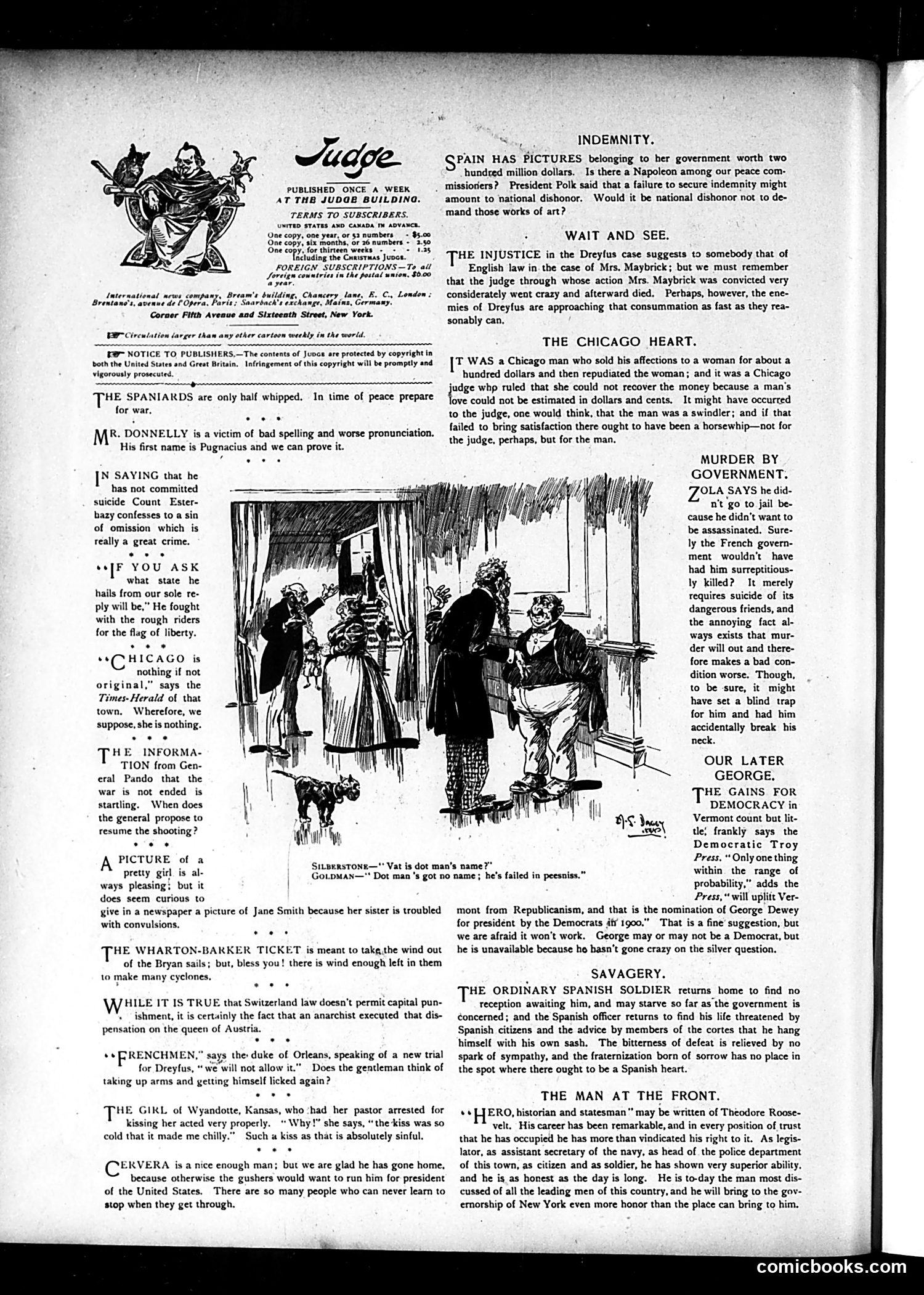
The main cartoon depicts a domestic scene with the caption "Old man's name? Out man's I got no name; he's failed in peanuts." It appears to satirize a man who has failed financially (specifically in the peanut business), now reduced to anonymity or irrelevance within his own household. The accompanying text sections mock various contemporary figures and events: Spanish government art collection disputes, the Dreyfus affair (French legal injustice), Chicago judicial corruption involving a woman's monetary claim, and critiques of political figures like President Polk and Theodore Roosevelt. The overall tone suggests *Judge* magazine's typical approach: lampooning political corruption, legal absurdities, and failed businessmen through humor aimed at educated readers aware of current scandals and personalities.
📄 Transcribed text from this page (OCR, searchable)
Machine-transcribed from the original scan — historical spelling and the odd misread are preserved.
wudge. PUBLISHED ONCE A WEEK AT THB JUDGE BUILDING. TERMS TO SUBSCRIBERS. UNITED STATES AMD CANADA TH ADVANCE. ‘One copy, one year, or 52 numbers - $5.00 ‘One copy, six months, or 26 numbers - 2.50 ‘One copy, for thirteen weeks - + = 1.35 facluding the Cunistaas Ju IBSCRIPTIONS —Te alt in the postal union, $6.00 International news company, Bream’s building, Chancery lane, B.C, Londen : Brentano's, avenue de COpera, Paris; Saarbach's exchange, Mains, Germany. Coraer Fitth Aveaue and Sixteenth Street, New York. ER™-Circulation larger tham any other cartoon weekly in the world. FR NOTICE TO PUBLISHERS,—The contents of Juvce are protected by copyright in both the United States and Great Britain. Infringement of this copyright will be promptly and vigorously prosecuted. es THE SPANIARDS are only half whipped. In time of peace prepare for war. MB: DONNELLY is a victim of bad spelling and worse pronunciation, His first name is Pugnacius and we can prove it. [8 SAYING that he has not committed suicide Count Ester- hazy confesses to a sin of omission which is really a great crime. oe IF YOU ASK what state he hails from our sole re- ply will be,” He fought with the rough riders for the flag of liberty. oe HICAGO is nothing if not original,” says the Times-Herald of that town, Wherefore, we suppose, she is nothing. TH E INFORMA- TION from Gen- eral Pando that the war is not ended is startling. When does the general propose to resume the shooting? PICTURE of a pretty girl is al- ways pleasing; but it does seem curious to give in a newspaper a picture of Jane Smith because her sister is troubled with convulsions. HE WHARTON-BARKER TICKET is meant to takg.the wind out of the Bryan sails; but, bless you! there is wind enough left in them to make many cyclones, HILE IT IS TRUE that Switzerland law doesn’t permit capital pun- ishment, it is certainly the fact that an anarchist executed that dis- pensation on the queen of Austria. ++ PRENCHMEN,” says the: duke of Orleans, speaking of a new trial for Dreyfus, “we will not allow it.” Does the gentleman think of taking up arms and getting himself licked again ? THE GIKL of Wyandotte, Kansas, who ‘had her pastor arrested for kissing her acted very properly. Why!” she says, “the kiss was so cold that it made me chilly.” Such a kiss as that is absolutely sinful. ERVERA is a nice enough man; but we are glad he has gone home, because otherwise the gushers would want to run him for president of the United States. There are so many people who can never learn to stop when they get through. Si-perstone—"* Vat is dot man’s name?" Gotpaax—" Dot man ‘s got no name ; he’s failed in peesniss.”” wise re oP " ry te: ad ian Sis Sen INDEMNITY. GPAIN HAS PICTURES belonging to her government worth two hundred million dollars. Is there a Napoleon among our peace com- _ missioners? President Polk said that a failure to secure indemnity might amount to national dishonor. Would it be national dishonor not to de- mand those works of art? . WAIT AND SEE. THE INJUSTICE in the Dreyfus case suggests to somebody that of English law in. the case of Mrs. Maybrick; but we must remember that the judge through whose action Mrs. Maybrick was convicted very considerately went crazy and afterward died. Perhaps, however, the ene- mies of Dreyfus are approaching that consummation as fast as they rea- sonably can, THE CHICAGO HEART. [TWAS a Chicago man who sold his affections to a woman for about a hundred dollars and then repudiated the woman ; and it was a Chicago judge whp ruled that she could not recover the money because a man's Lore cial iat be atten dallas aad Gents PaaS exiglnl Raveroscered to the judge, one would think, that the man was a swindler; and if that failed to bring satisfaction there ought to have been a horsewhip—not for the judge, perhaps, but for the man. MURDER BY GOVERNMENT. ZOLA SAYS he did- n't go to jail be- cause he didn’t want to be assassinated. Sure- ly the French govern- ment wouldn't have had him surreptitious- ly killed? It merely requires suicide of its dangerous friends, and the annoying fact al- ways exists that mur- der will out and there- fore makes a bad con- dition worse. Though, to be -sure, it might have set a blind trap for him and had him accidentally break his neck. OUR LATER GEORGE, TH GAINS FOR DEMOCRACY in Vermont count but lit- te! frankly says the Democratic Troy Press. “ Only one thing within. the range of probability,” adds the Press, ** will uplitt Ver- mont from Republicanism, and that is the nomination of George Dewey for president by the Democrats iff 1900.” That is a fine’ suggestion, but we are afraid it won't work. George may or may not be a Democrat, but he is unavailable because ho hasn't gone crazy on the silver question. - SAVAGERY. 'HE ORDINARY SPANISH SOLDIER returns home to find no reception awaiting him, and may starve so far as the government is ¢oncerned; and the Spanish officer returns to find his life threatened by Spanish citizens and the advice by members of the cortes that he hang himself with his own sash. The bitterness of defeat is relieved by no spark of sympathy, and the fraternization born of sorrow has no place in the spot where there ought to be a Spanish heart. THE MAN AT THE FRONT. **LJERO, historian and statesman” may be written of Theodore Roose- velt, His career has been remarkable, and in every position of trust that he has occupied he has more than vindicated his right to it. As legis- lator, as assistant secretary of the navy, as head of the police department of this town, as citizen and as soldier, he has shown very superior ability, and he is as honest as the day is long. He is to-day the man most dis- cussed of all the leading men of this country, and he will bring to the gov- ernorship of New York even more honor than the place can bring to him. comicbooks.com