
A complete issue · 16 pages · 1898
Judge — October 8, 1898
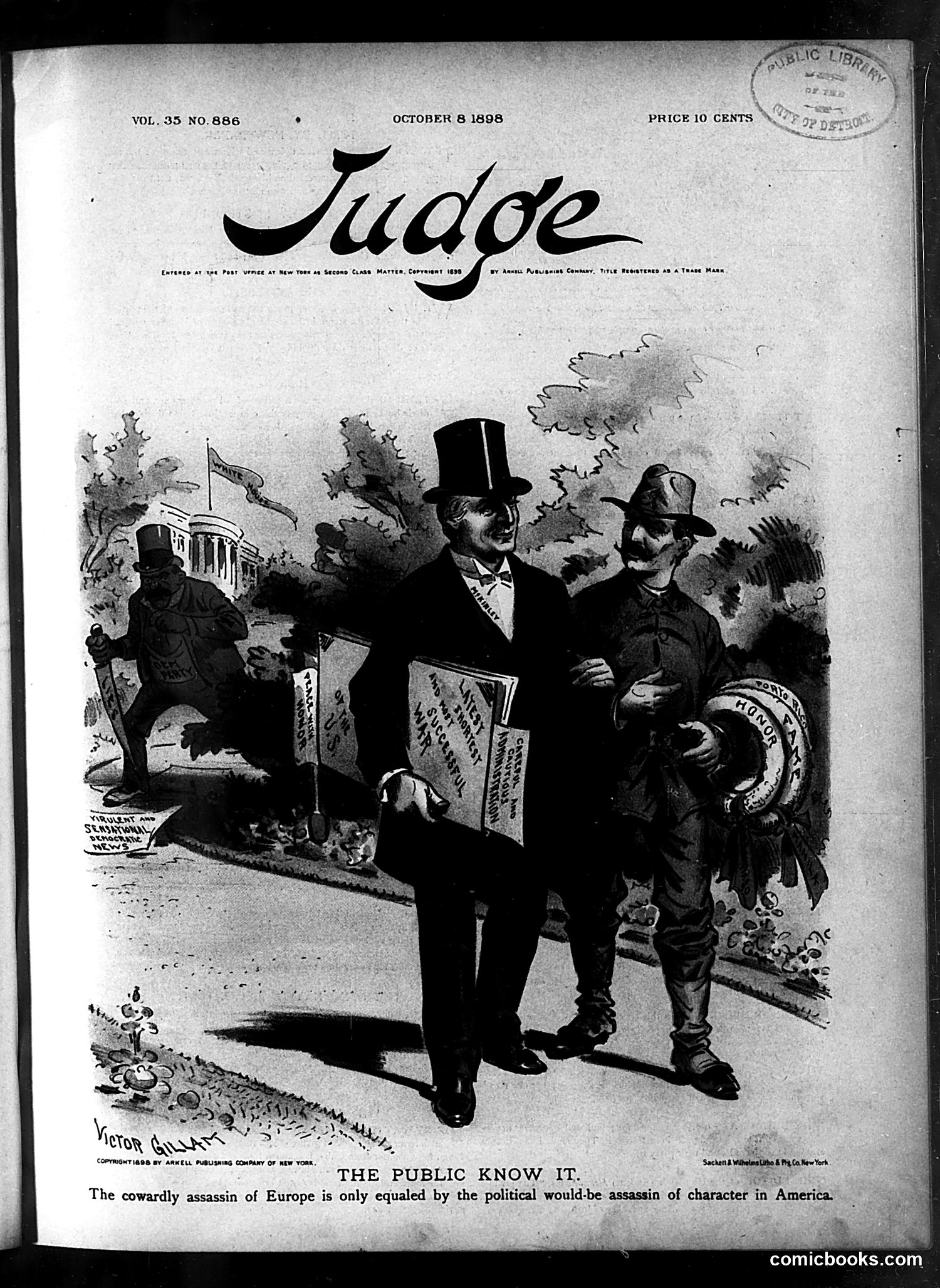
This political cartoon by Victor Gillam criticizes political corruption in America. A well-dressed man in a top hat (likely representing a corrupt American politician) reads a newspaper while figures in the background appear to represent European political assassins and violence. The caption states: "The cowardly assassin of Europe is only equaled by the political would-be assassin of character in America." The satire draws a parallel between European political violence and American political corruption—suggesting that while Europe relies on literal assassination, American politicians commit character assassination through corrupt practices. The cartoon warns that such political corruption is as dangerous to the nation as physical violence is to European governments. The specific political context remains somewhat unclear without additional documentation.
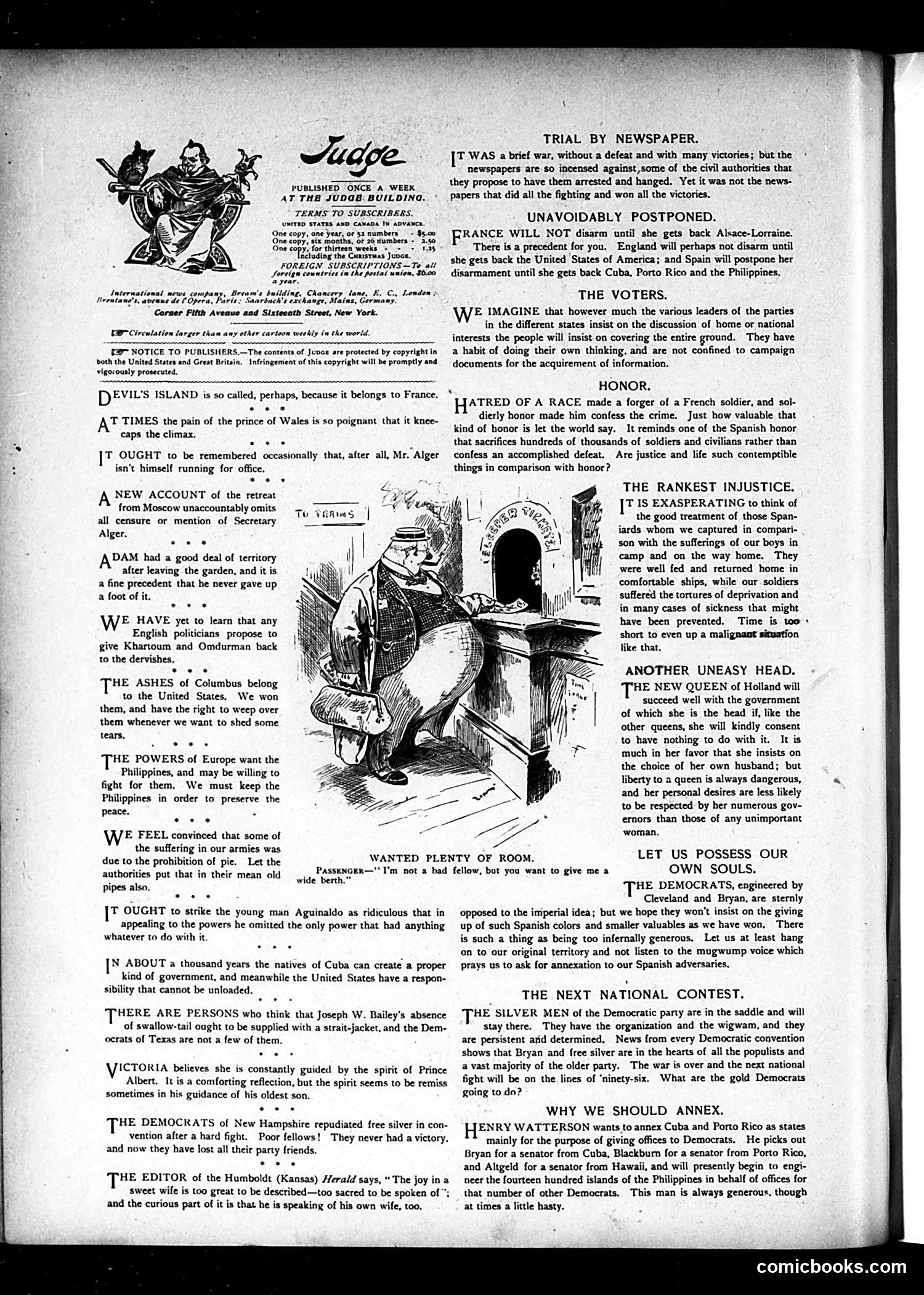
This page contains political commentary rather than a cartoon. The main illustration shows a figure at a desk labeled "TO VERNAS" (unclear reference), apparently depicting a bureaucrat or official. The editorial pieces criticize Democratic leadership, particularly **William Jennings Bryan and Adlai Stevenson**, regarding their positions on annexation and imperial expansion. References include: - Debate over annexing **Cuba, Porto Rico, and the Philippines** - Criticism of Democrats for inconsistent silver-currency positions - Mockery of Democratic strategy regarding territorial expansion The text suggests this was written during or after the **1900 presidential election**, when Bryan ran against McKinley. Judge, a Republican-leaning publication, attacks Democratic hypocrisy on imperialism while defending Republican colonial policies. The specific "VERNAS" reference remains unclear from available context.
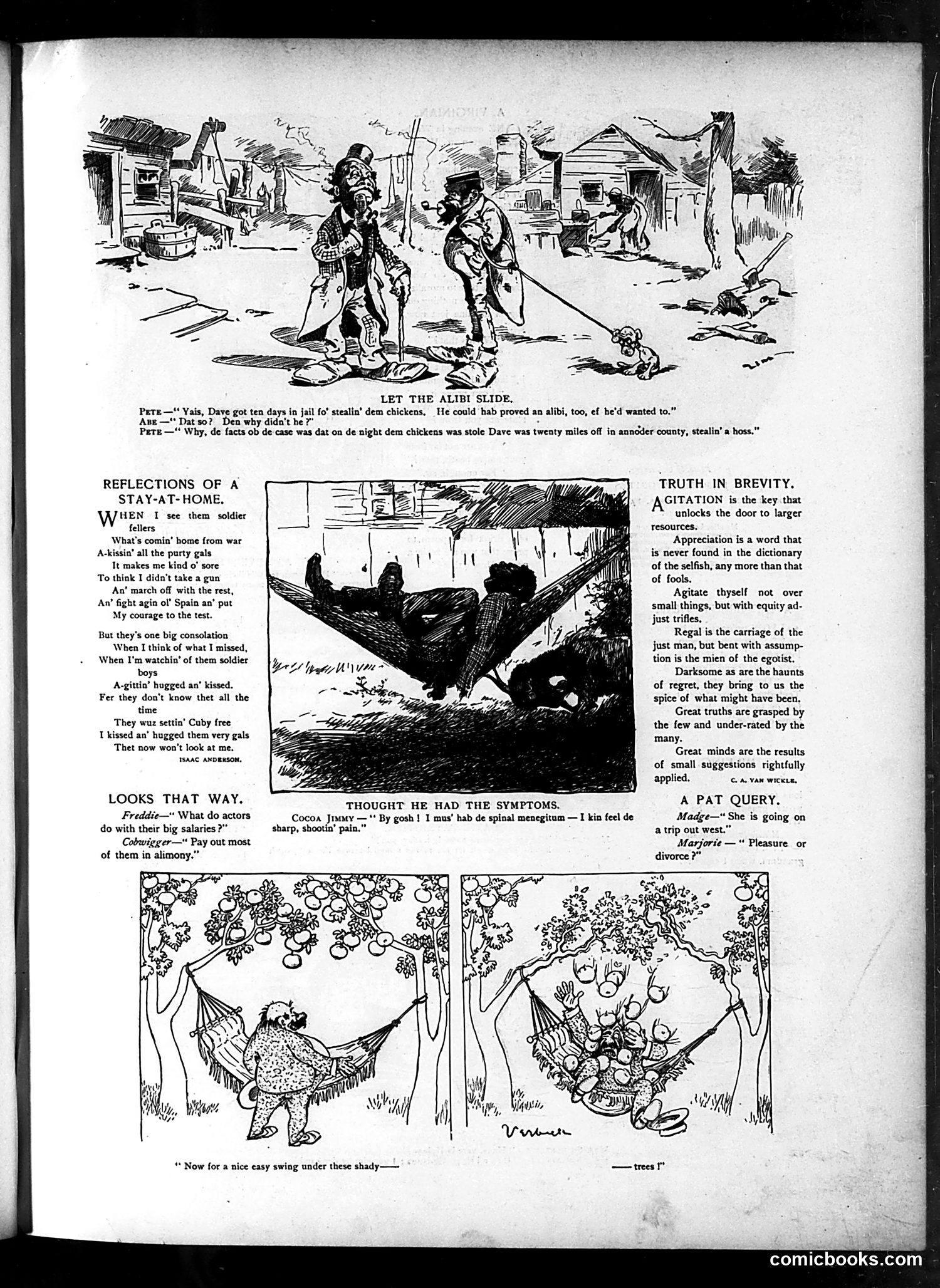
This page contains several unrelated satirical pieces rather than a unified political cartoon. **"Let the Alibi Slide"** (top): A joke about rural chicken theft, where characters Pete and Abe debate whether Dave's alibi holds up—he claimed to be in jail but was actually stealing chickens twenty miles away. This is straightforward rural humor about dishonesty. **"Reflections of a Soldier Coming Home"** (left): A sentimental poem by Isaac Anderson about a returning WWI soldier reflecting on comrades lost and the emotional weight of survival. **Other sections** include brief jokes ("Looks That Way," "A Pat Query") and two identical illustrations of figures in hammocks under fruit trees, captioned about relaxation. The page lacks cohesive political satire, instead offering miscellaneous humor and verse typical of Judge's variety format.
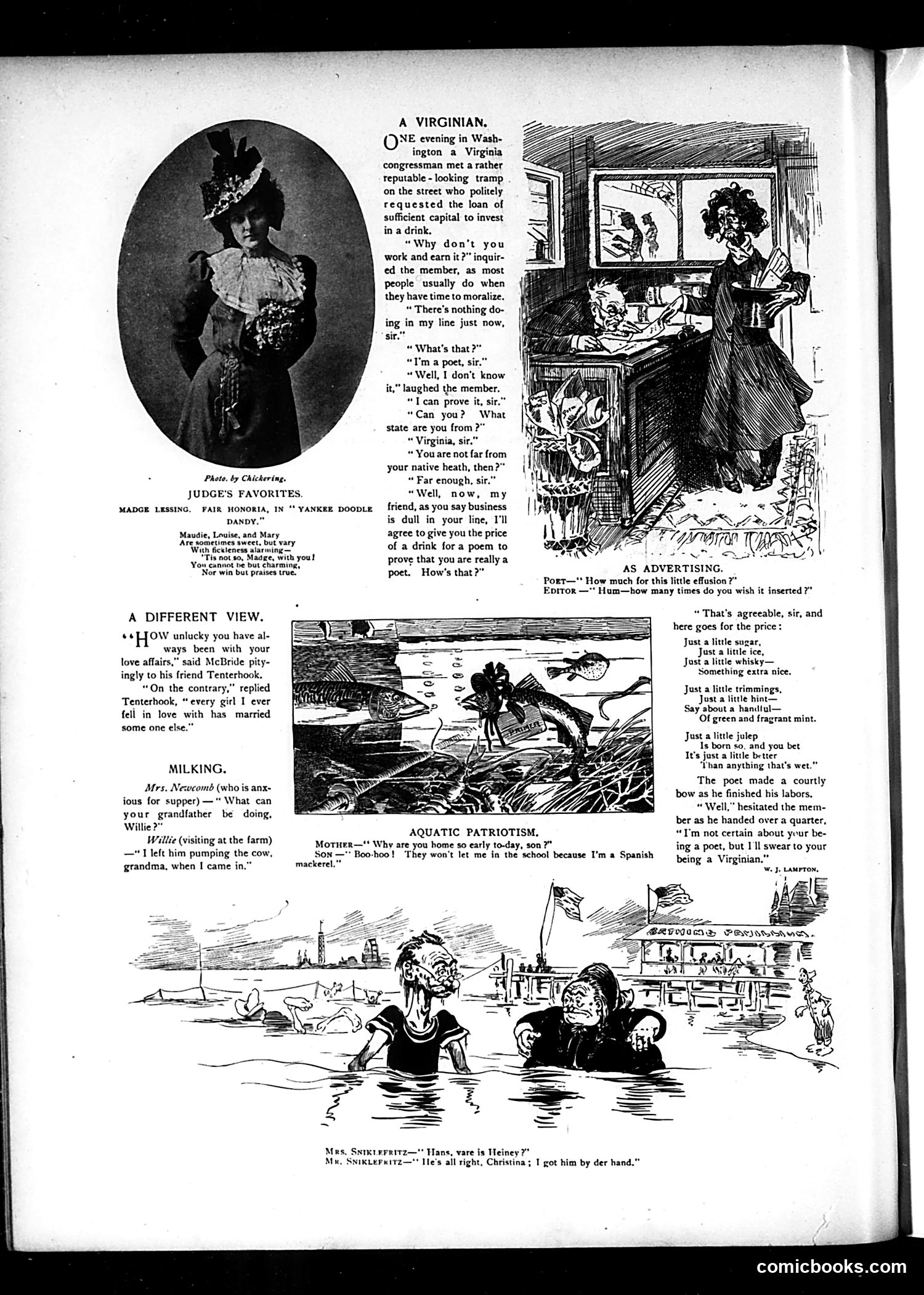
This page contains several satirical sketches typical of early 20th-century American humor: **"A Virginian"** mocks regional stereotypes through dialogue where a poor Virginian asks a Washington member for a loan to buy a drink, then claims to be a poet. The satire targets both vagrant behavior and pretentious literary claims. **"A Different View"** and **"Milking"** present domestic comedy scenarios involving marriage and family relationships. **"As Advertising"** appears to be editorial commentary on poetry and drink prices. **"Aquatic Patriotism"** shows two figures in water discussing a Spanish person attending school—likely commentary on immigration or foreign nationals during this era, though the specific political context remains unclear without additional dating. The page reflects period preoccupations with class, regional identity, and immigration.
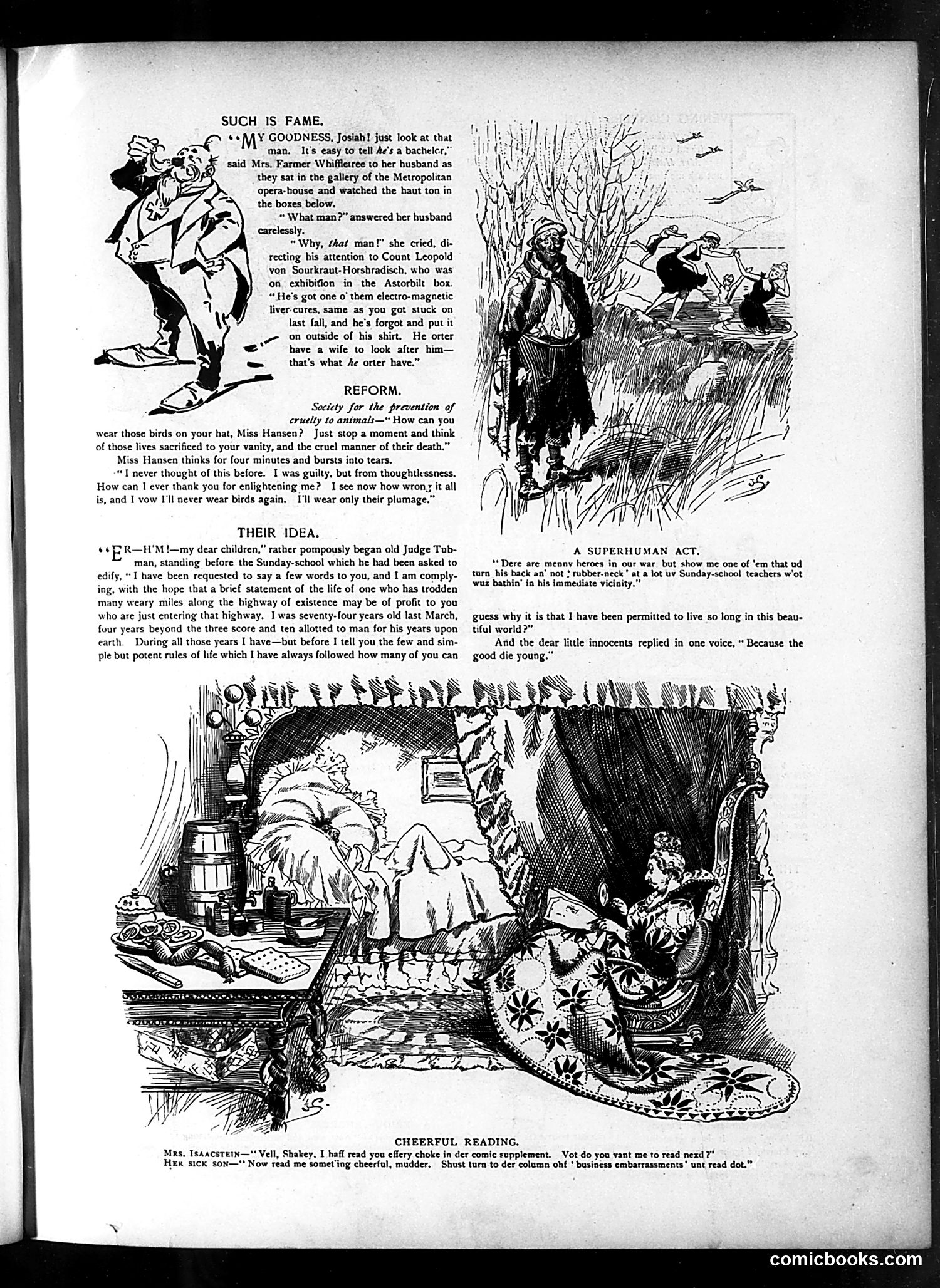
This page from *Judge* contains four satirical pieces mocking social hypocrisy and pretension: **"Such Is Fame"**: Ridicules nouveau-riche social climbers who mistake affectation for sophistication—a country couple at the opera mistakes a foreign nobleman's visible medical device for fashionable eccentricity. **"Reform"**: Exposes shallow activism. A woman convinced to stop wearing feathered hats (animal cruelty) immediately agrees to wear *only* the plumage—missing the point entirely. **"Their Idea"**: An elderly Sunday school teacher boasts of his longevity before offering life wisdom, but the children cynically reply "Because the good die young"—suggesting elderly moralizers aren't actually virtuous. **"Cheerful Reading"**: Uses Yiddish-dialect humor (common in *Judge*). A sick boy asks his mother to read him "cheerful" content—specifically the business bankruptcy column—implying financial ruin is less depressing than serious news. The satire targets moral inconsistency, class pretension, and the gap between stated values and actual behavior.
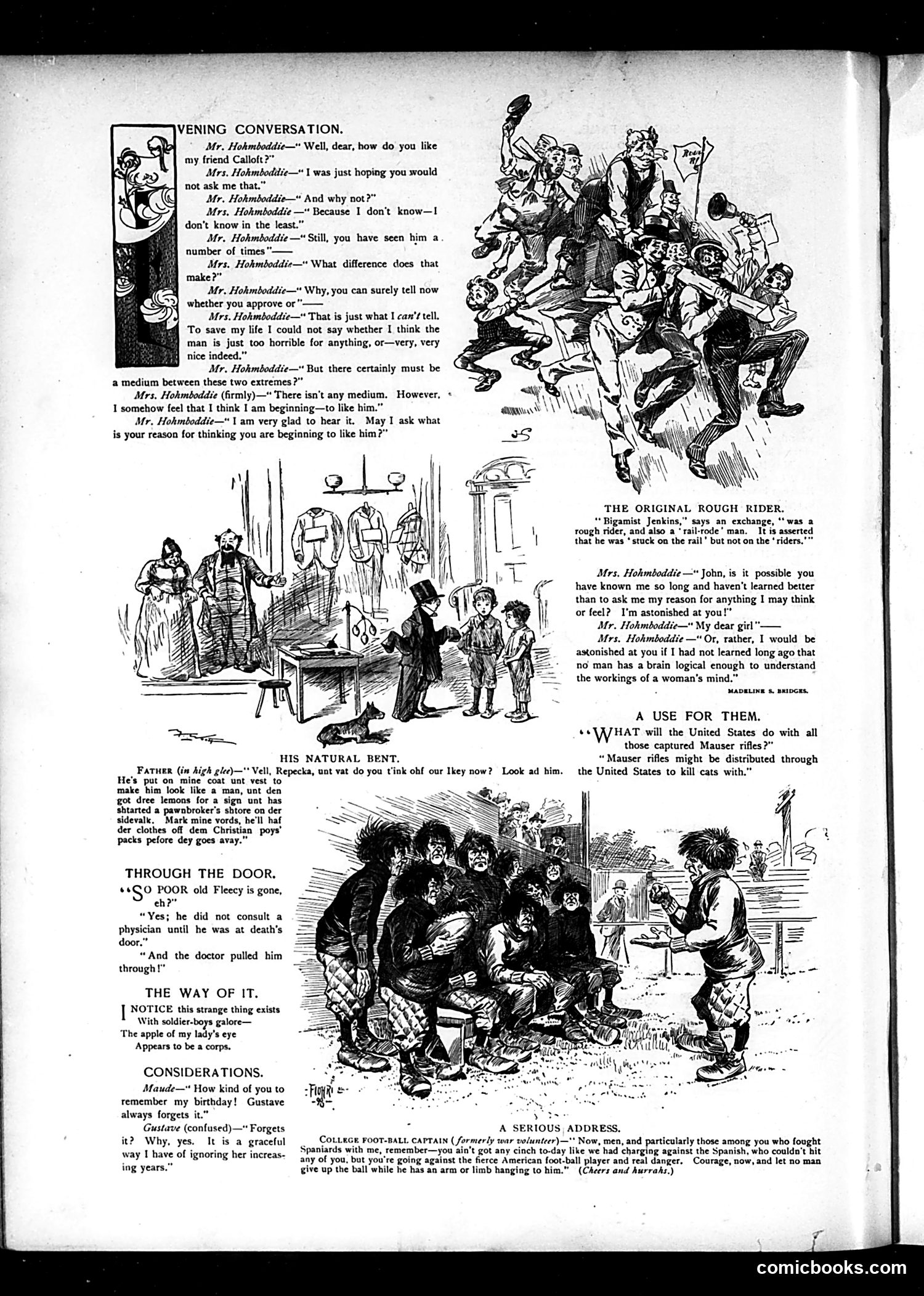
This page contains multiple satirical cartoons and comic sketches typical of early 20th-century American humor: **"Evening Conversation"** mocks marital dynamics, portraying a wife unable to form rational opinions about people despite repeated exposure—a sexist trope suggesting women's illogical nature. **"The Original Rough Rider"** appears to be a pun about "Bigamist Jenkins," conflating railroad and equestrian terminology with marital infidelity. **"His Natural Bent"** depicts an immigrant father (indicated by dialect) proudly noting his son has opened a pawnshop wearing borrowed clothes—satirizing both immigrant aspirations and petty criminality stereotypes. **"A Use for Them"** references captured Mauser rifles from the Spanish-American War (recent at publication), joking they're only good for killing cats—mock commentary on military surplus or American gun culture. **"A Serious Address"** compares American college football to warfare, suggesting football players are fiercer and more dangerous than Spanish soldiers—jingoistic post-war humor. The page reflects period prejudices regarding gender, immigrants, and nationalism.
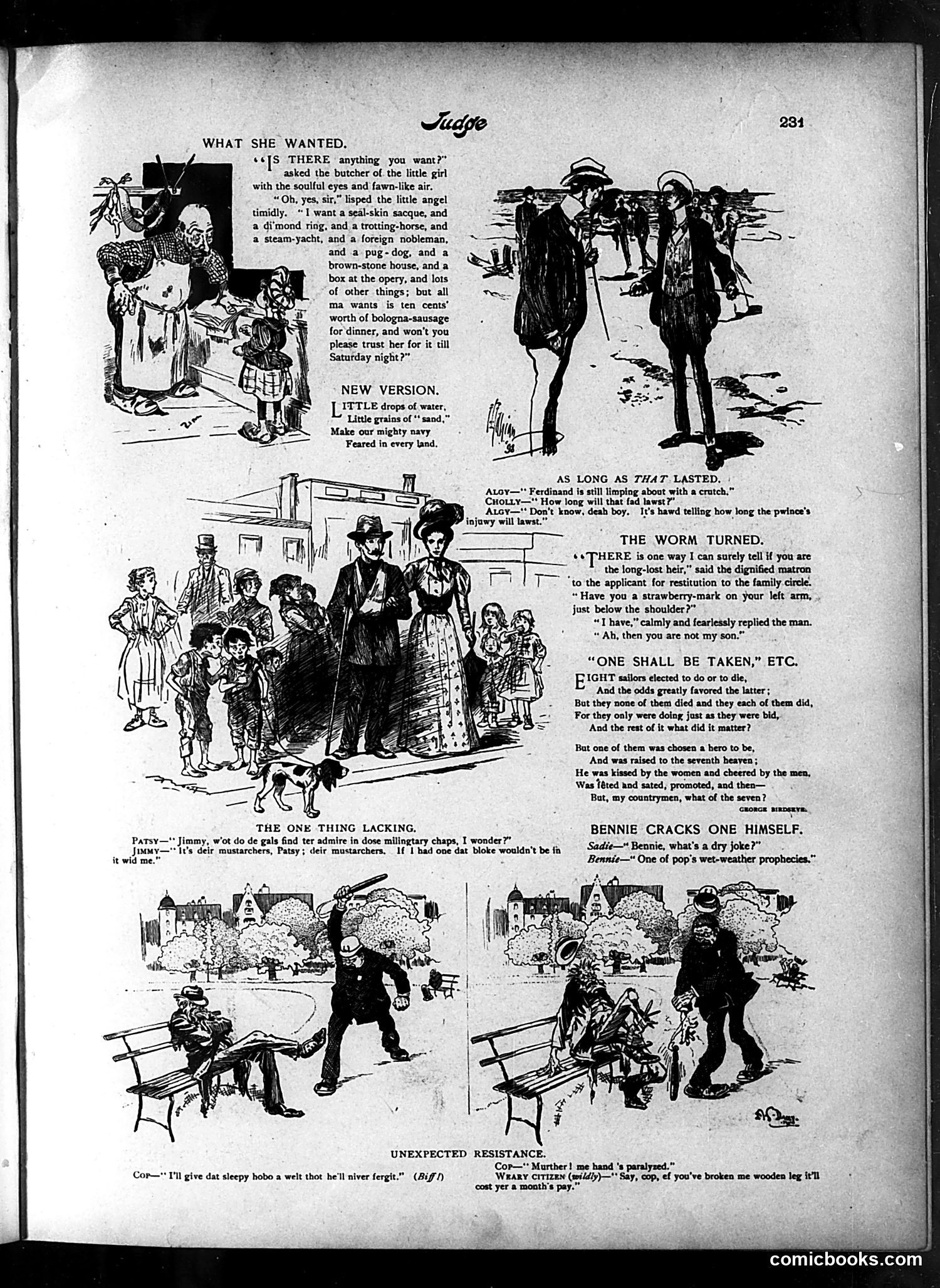
This page contains several Victorian-era satirical cartoons mocking social pretensions and contemporary issues: **"What She Wanted"** contrasts a poor girl's modest need (ten cents of bologna sausage) with her extravagant wishes (seal-skin jacket, diamond ring, yacht, foreign nobleman)—satirizing both children's materialism and class aspiration. **"The Worm Turned"** jokes about a woman rejecting a man claiming to be her lost heir because he *does* have the identifying strawberry-mark—inverting expectations through absurdist logic. **"One Shall Be Taken"** appears to critique military hero-worship, noting that while one sailor receives celebration and promotion, his seven fellow sailors who died receive no recognition, questioning arbitrary heroism. The remaining cartoons ("Bennie Cracks One," "The One Thing Lacking," "Unexpected Resistance") are brief humor vignettes about mustaches, jokes, and a street confrontation. The page reflects Judge's satirical focus on American social hypocrisy, class anxieties, and military/naval matters circa early 20th century.
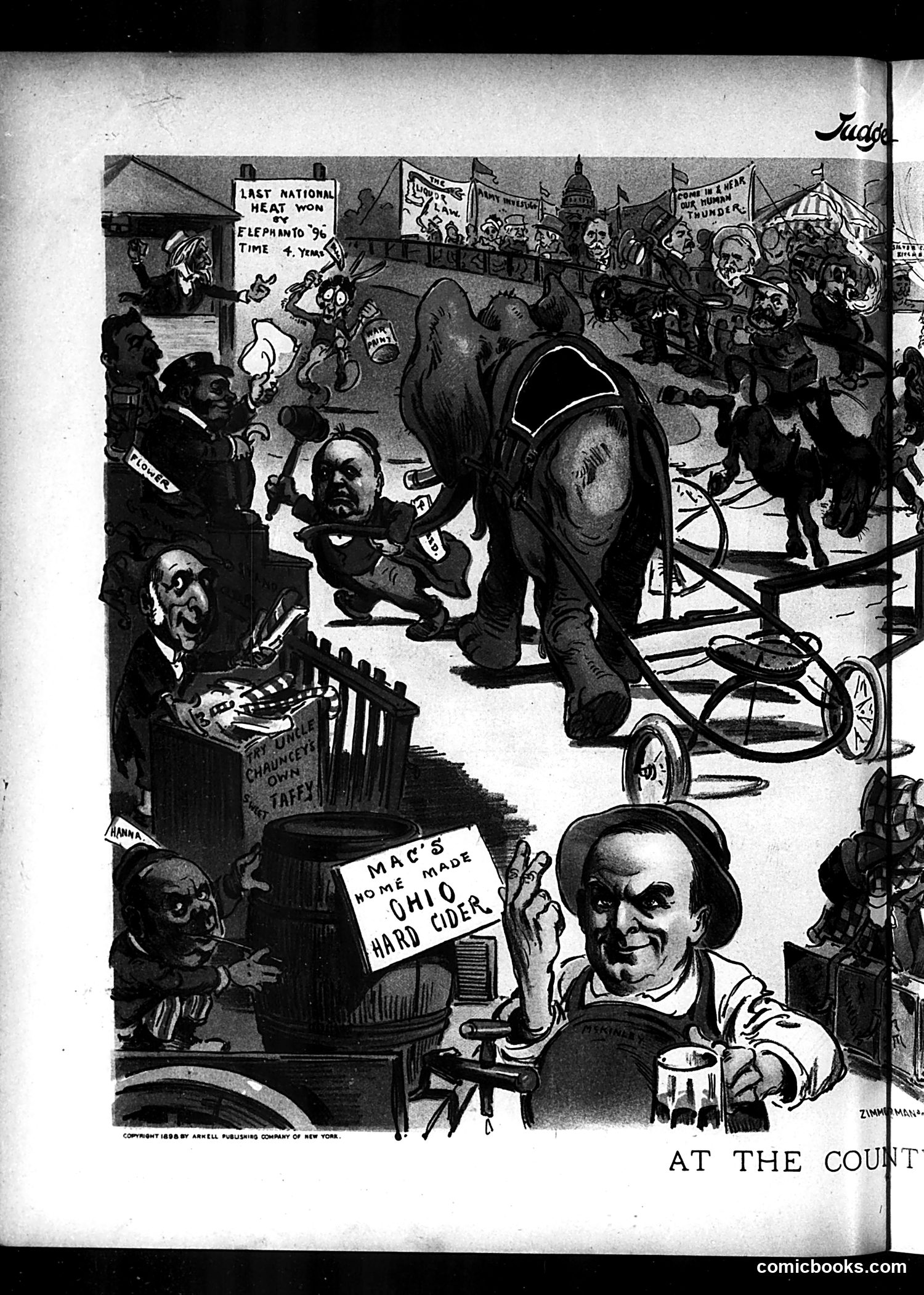
This political satire depicts a chaotic circus scene with an elephant as the central figure. The visible signage references "Last National Heat Wave Elephant 96 Time 4 Years," "Mac's Home Made Ohio Hard Cider," and various banners in the background. The cartoon appears to satirize late-1890s American politics, likely targeting political figures or policies of that era. The elephant (Republican Party symbol) dominates the composition while various caricatured figures observe the spectacle, suggesting political turmoil or scandal. The "hard cider" reference and Ohio location hint at regional political issues, possibly related to William McKinley or contemporary electoral matters. The circus setting—with its chaos, performing animals, and gathered crowds—functions as a metaphor for the political arena as a disorderly, theatrical performance rather than serious governance. The specific identities of individual caricatures remain unclear without additional historical context.
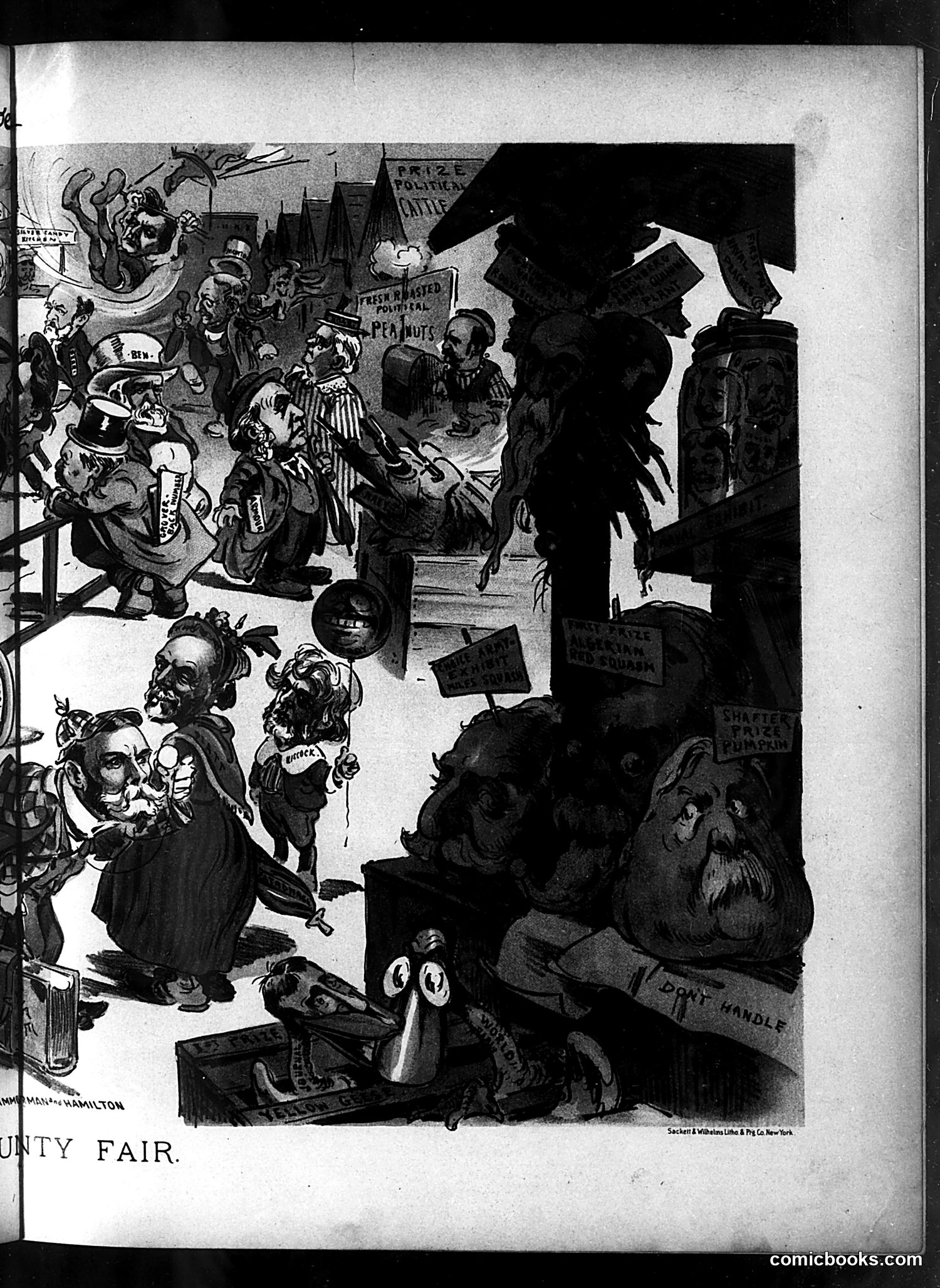
This appears to be a political cartoon titled "COUNTY FAIR" (visible at bottom left), though the OCR text is largely corrupted. The image depicts a crowded fair or public gathering scene rendered in heavy black-and-white contrast, typical of Judge magazine's satirical style. The cartoon shows multiple caricatured figures—many appearing to be political or social types of the era—engaged in various activities at what seems to be an exposition or fair. Various signs are visible but mostly illegible in this reproduction. The style and composition suggest social or political commentary on public institutions, likely from the late 19th or early 20th century. Without clearer text or identifying labels, the specific political targets remain uncertain, though the gathering-place setting suggests commentary on democratic participation or public opinion.
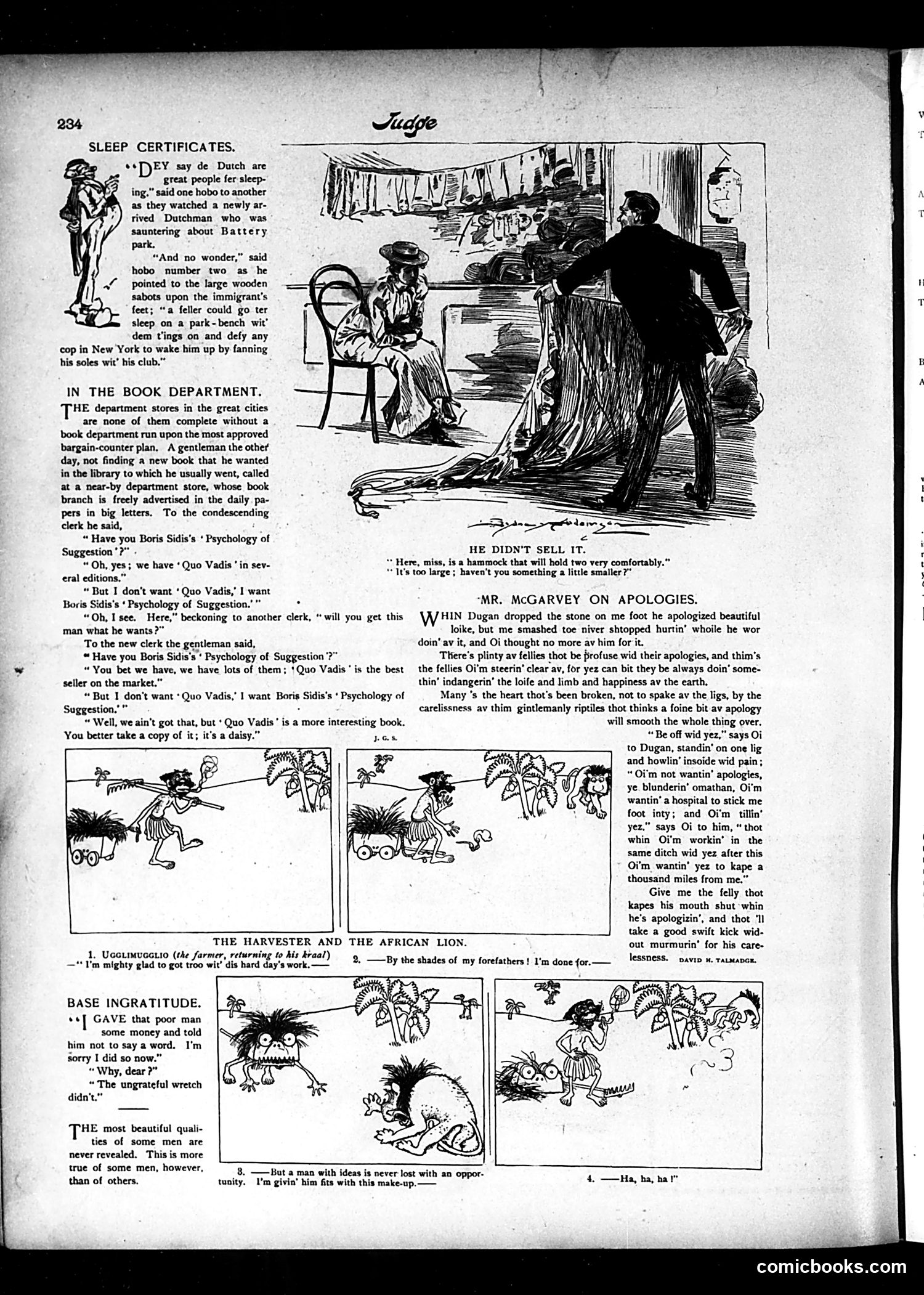
This page contains several satirical pieces typical of early 20th-century American humor: **"Sleep Certificates"**: Two hobos joke that Dutch immigrants sleep well because their wooden sabots (clogs) are so uncomfortable they'd survive even a New York cop's club-beating to wake them—poking fun at both Dutch stereotypes and immigrant experiences. **"In the Book Department"**: Satirizes department store incompetence. A customer repeatedly asks for a specific book ("Psychology of Suggestion" by Boris Sidis), but clerks keep insisting he wants the popular novel "Quo Vadis" instead. The joke mocks retail workers' inability to listen or help customers find what they actually want. **"Mr. McGarvey on Apologies"**: An Irish character (indicated by dialect) complains that apologies don't heal injuries—he'd rather a careless worker stay away than offer insincere regrets while causing harm. **"The Harvester and the African Lion"** and **"Base Ingratitude"**: Brief comic strips with punchlines about practical survival and human nature. The page reflects early 1900s American attitudes toward immigrants, consumerism, and working-class life.
This page is **primarily advertising** with brief humorous anecdotes interspersed. There are no identifiable political cartoons or caricatures. The text consists of short jokes and satirical observations about American life, likely from the early 20th century. Notable themes include: - **Gender satire**: A woman learned about ancient Assyria and cuneiform but couldn't cook—mocking educated women lacking domestic skills - **Patriotism**: A husband refuses to quit drinking beer during wartime, claiming it unpatriotic to abandon the country - **Class humor**: Jokes about the Mayflower ancestry ("too young to remember") The advertisements (Packer's Tar Soap, Van Bibber Cigars, Sohmer Pianos, etc.) dominate the layout. This appears to be a typical Judge magazine page mixing light social commentary with commercial content rather than serious political satire or cartooning.
This page is primarily **advertising with scattered humorous filler content**, typical of late-1890s Judge magazine. The main satirical cartoon appears to be the dialogue about **American imperialism in the Philippines**. "Chollie" (a wealthy dandy type, indicated by the affected spelling) claims to support U.S. administration of the Philippines—not for political reasons, but because he saw a picture of Filipino general Aguinaldo wearing a badly-tied necktie. This mocks upper-class Americans who adopted imperialist positions based on superficial aesthetic judgments rather than genuine political conviction. The reference to "Aguinaldo" dates this to the Philippine-American War era (1899-1902). Other jokes include a standard "tired old maid" pun and references to educator Charles Eliot Norton's pessimism about American conditions. The page is otherwise dominated by product advertisements (cement, typewriters, champagne, shoe polish) and a notice for bound volumes of Judge itself.
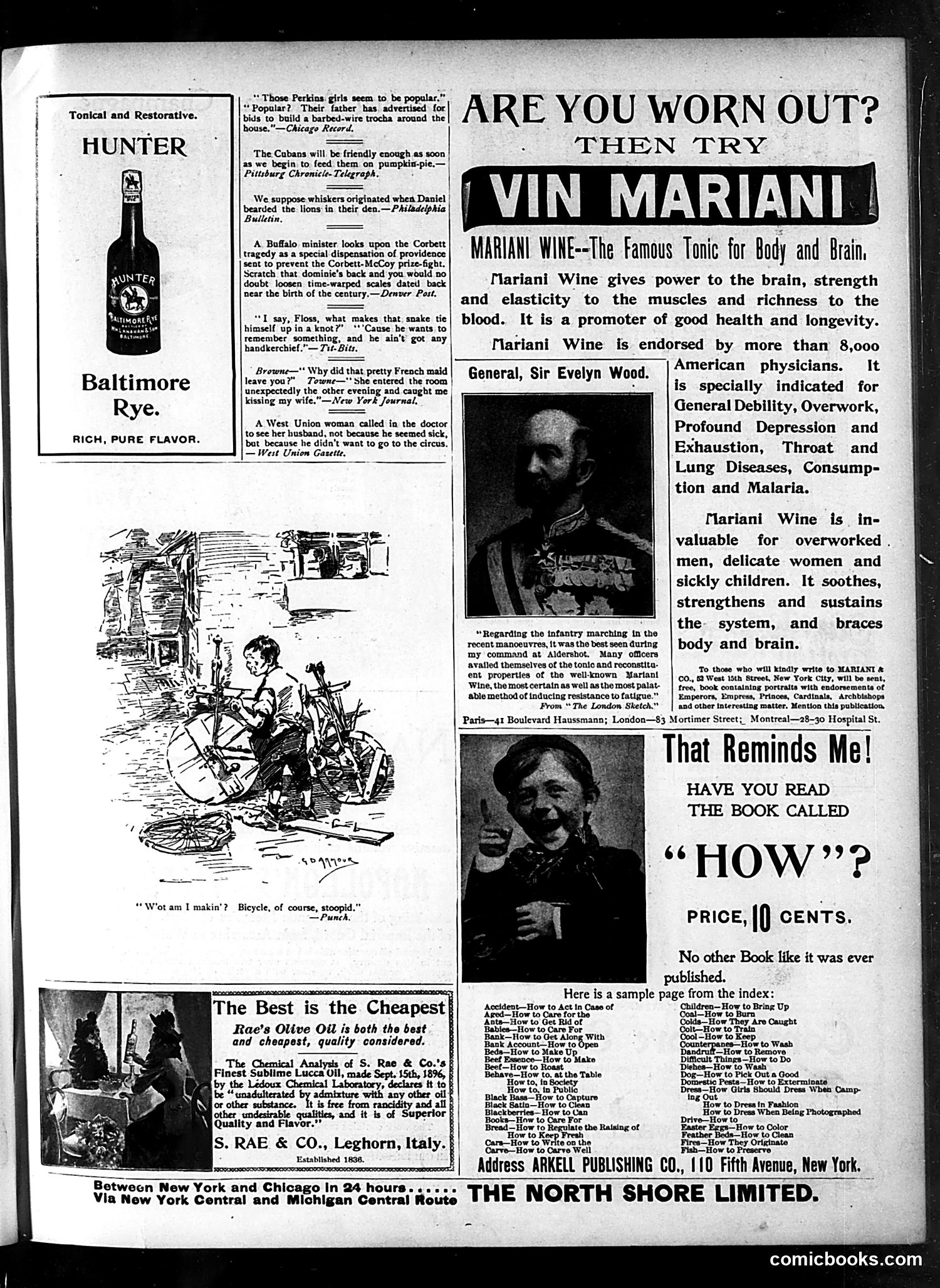
This page is primarily **advertising**, not political satire. It contains: **Main Advertisement:** Mariani Wine, a patent medicine claiming to cure exhaustion, depression, lung disease, and malaria. It's endorsed by "8,000 American physicians" and General Sir Evelyn Wood. This reflects the era's unregulated medicine market where alcohol-based tonics made exaggerated health claims. **Supporting Ads:** - Hunter Baltimore Rye whiskey (another "tonic") - RAE's Olive Oil ("cheapest, quality considered") - A book called "HOW?" (10 cents) - The North Shore Limited railroad **Scattered Jokes:** Small cartoons and quips fill space—one depicts a child building something, captioned about bicycles. The page reflects early 1900s American consumer culture: patent medicines with dubious claims, alcohol marketed as health products, and advertising saturating entertainment publications. Modern readers would recognize these as examples of how differently medical and product claims were regulated then.
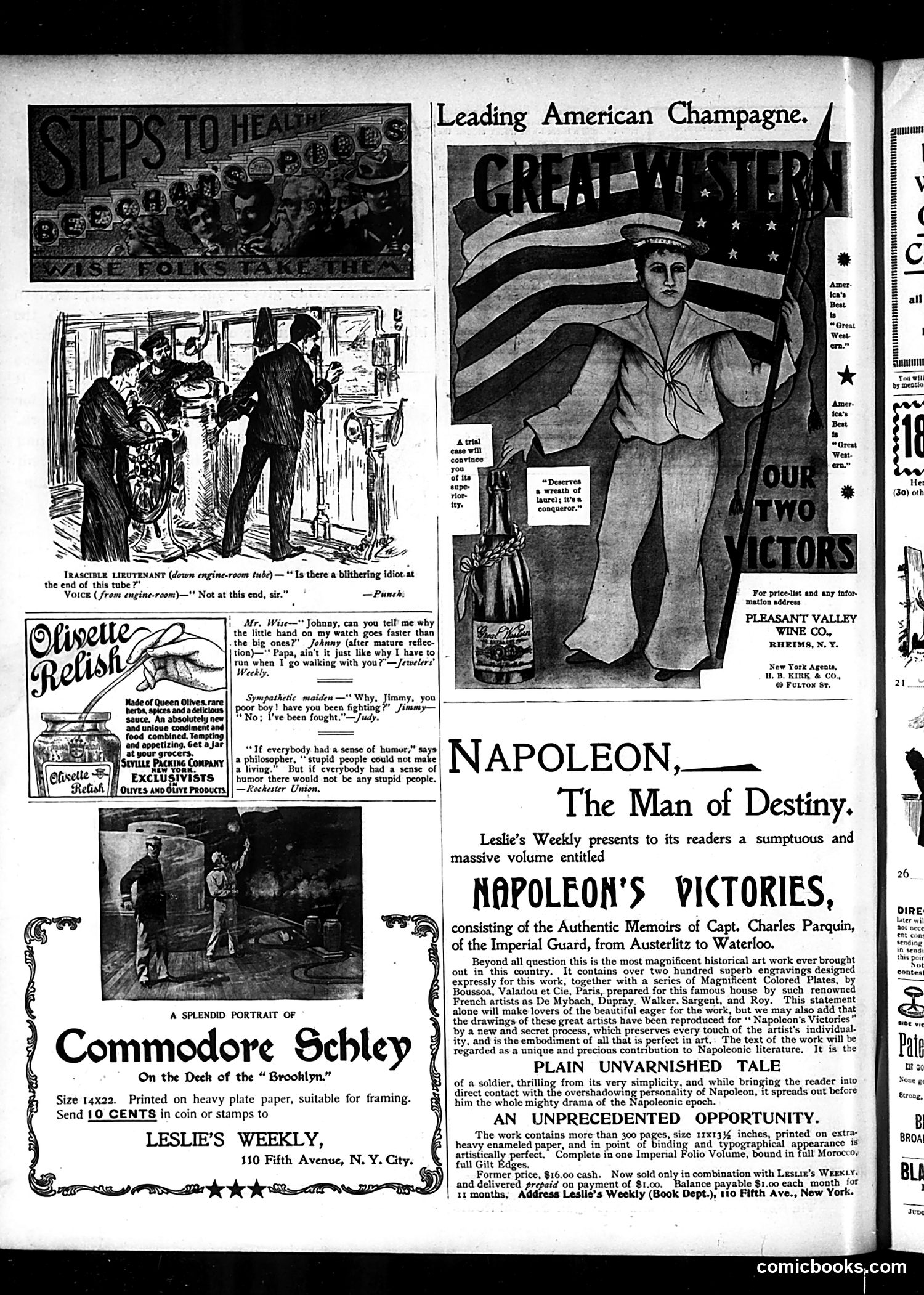
This page contains mostly **advertisements and short humorous items** rather than political cartoons. The main content is an ad for Leslie's Weekly promoting a lavish book on "Napoleon's Victories"—memoirs of an Imperial Guard officer with 200+ engravings by renowned French artists, positioned as a prestigious historical work. The scattered jokes are light social humor: a child's witty response about his father's slow walking pace; a lieutenant barking down a tube and receiving a cheeky reply; a maiden sympathizing with a boy who's "been fought"; and a philosophical observation that without stupid people, philosophers couldn't make a living. There's also an advertisement for a portrait of **Commodore Schley** (likely referring to the Spanish-American War naval commander) and promotions for olive relish and champagne. The page reflects turn-of-century American magazine advertising and lightweight humor typical of Judge's content.
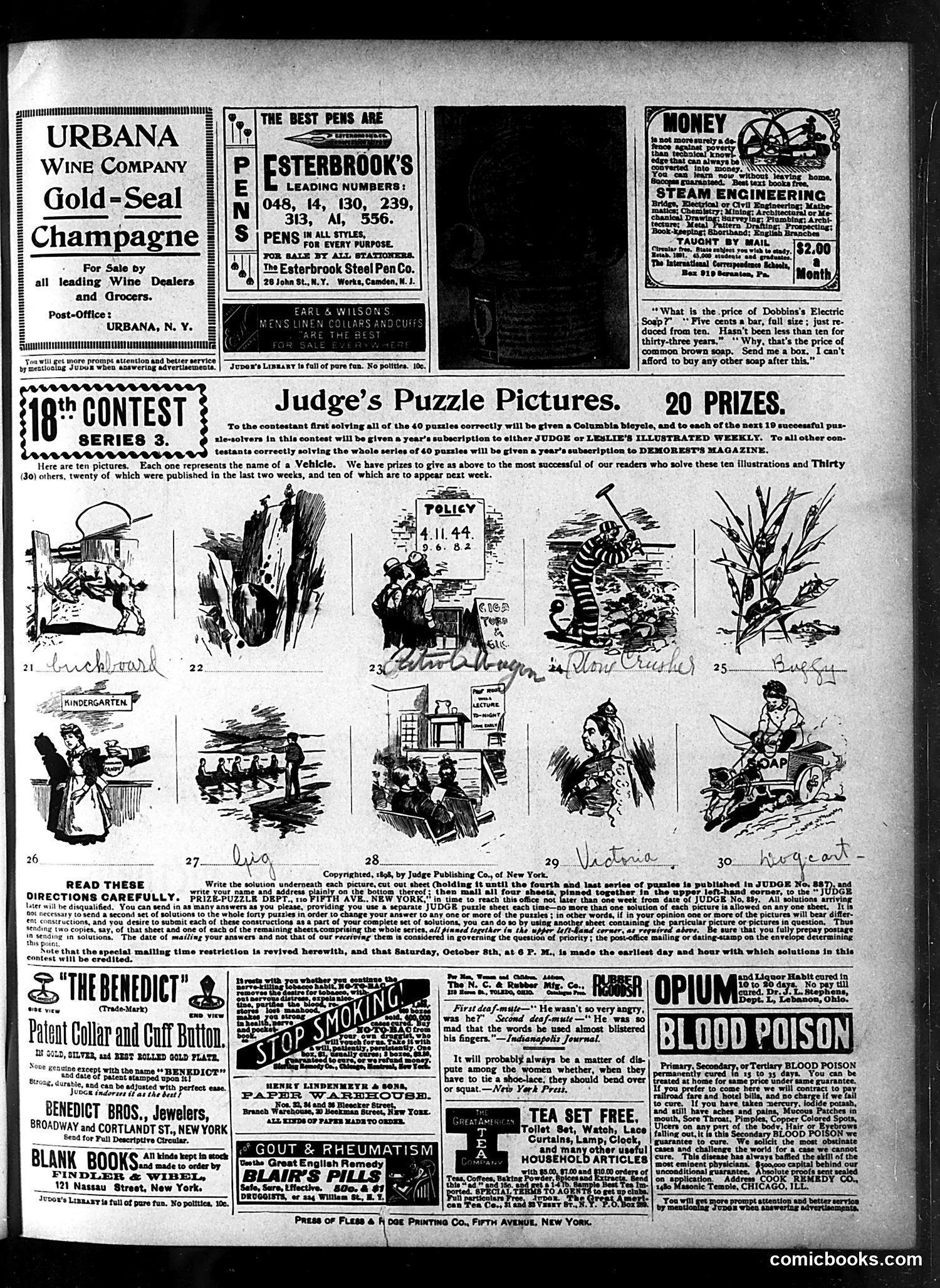
This page is primarily a **puzzle contest** rather than political satire. The main feature is "Judge's Puzzle Pictures"—a visual riddle contest where readers identify ten vehicles from sketched illustrations (numbered 21-30). Winners receive prizes including a Columbia bicycle and magazine subscriptions. The page is **heavily advertisement-laden**, promoting products like Urbana champagne, Esterbrook pens, Dobbins's Electric Soap, and various business services. These ads dominate the margins and footer. One small **joke** appears mid-page: a dialogue about soap prices, likely mocking consumer price claims and advertising exaggeration—typical of Judge's satirical approach. The **puzzle instructions** are detailed and legalistic, emphasizing mailing procedures and deadline rules (October 8th deadline noted). The remaining advertisements—for patent collar buttons, blank books, and medical treatments—reflect turn-of-century consumer culture rather than political commentary. Overall, this is a **commercial entertainment page** with minimal satirical content.
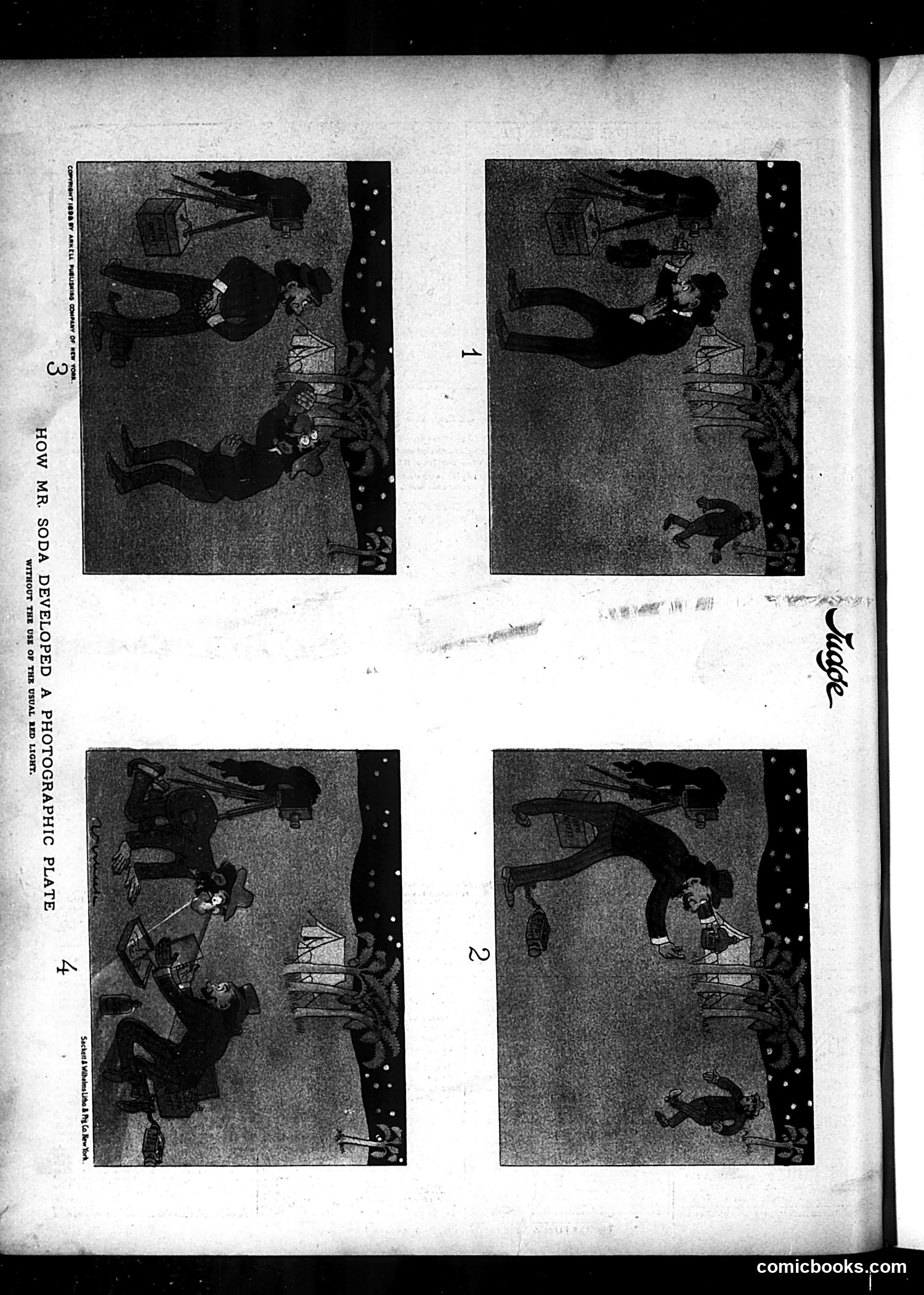
This is a four-panel photographic sequence titled "How Mr. Soda Developed a Photographic Plate Without the Use of the Usual Red Light." The panels show a man performing increasingly acrobatic and contorted poses—bending, stretching, and flipping his body—apparently as a humorous alternative method to traditional darkroom photography development. The joke satirizes both the technical complexity of early photography and physical culture/exercise crazes popular in the early 20th century. By suggesting someone could "develop" a photographic plate through bizarre gymnastic movements rather than chemical processes, Judge mocks either overly complicated scientific procedures or contemporary fads for physical fitness and body contortion. The humor relies on absurdist logic and visual comedy rather than political commentary.