
A complete issue · 16 pages · 1898
Judge — July 16, 1898
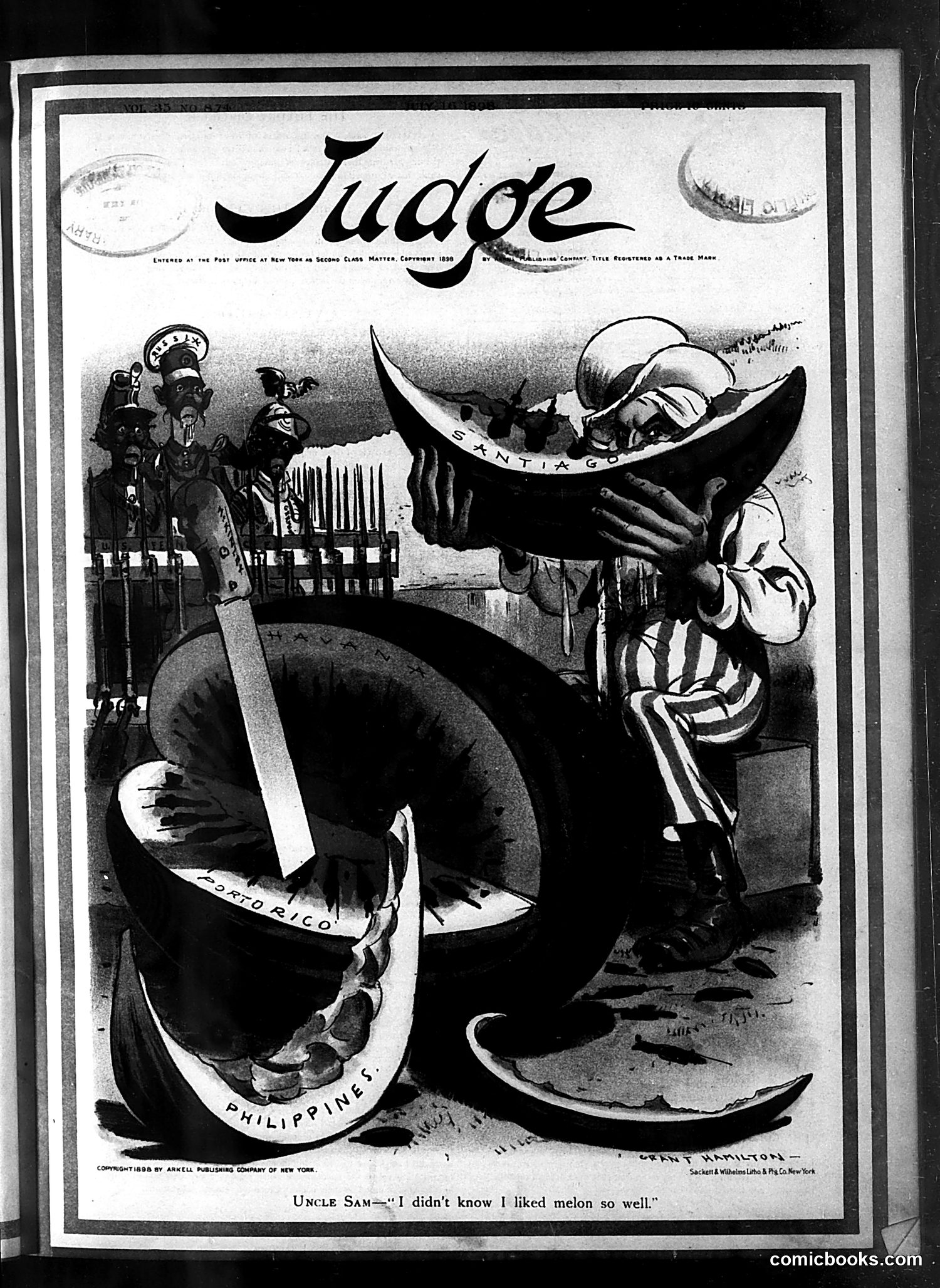
This Judge magazine cartoon satirizes American colonial and imperial ambitions, likely from the early 1900s. Uncle Sam (the tall figure in striped pants) examines melons labeled "Porto Rico" and "Philippines," with military officers observing in the background. The caption—"I didn't know I liked melon so well"—suggests Uncle Sam is discovering newfound appetites for territorial expansion. The melons represent newly acquired or contested territories following the Spanish-American War (1898). The cartoon critiques American imperialism, implying the U.S. government is greedily consuming colonial possessions without fully understanding the consequences. The military presence emphasizes that these acquisitions were secured by force. This reflects contemporary debate about America's emerging role as a world power.
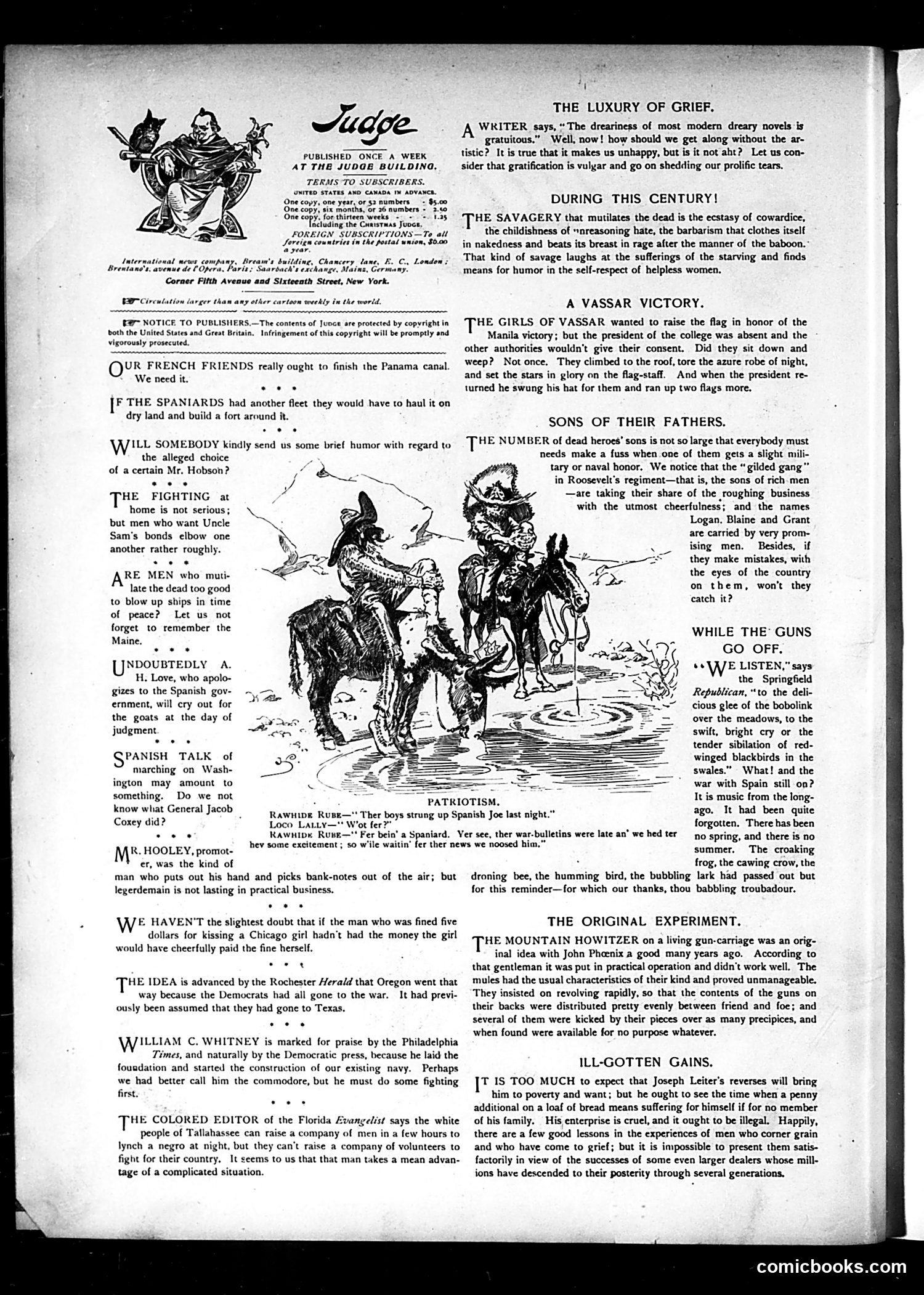
This page combines editorial commentary with satirical illustrations about early 20th-century American politics and society. The central cartoon depicts soldiers on horseback crossing water, labeled "PATRIOTISM," illustrating the tension between military duty and personal sacrifice—a likely reference to Spanish-American War era conflicts. The text snippets mock various targets: politicians' self-interest, wealthy men dodging military service through financial means, and newspaper editors' sensationalism. One section criticizes the "colored editor" and racial dynamics of volunteer recruitment. The commentary on "Sons of Their Fathers" suggests critique of privileged youths avoiding military responsibility while working-class sons fight. Overall, the page satirizes hypocrisy among elites, media manipulation, and debates over civic duty versus personal gain during America's imperial expansion period.
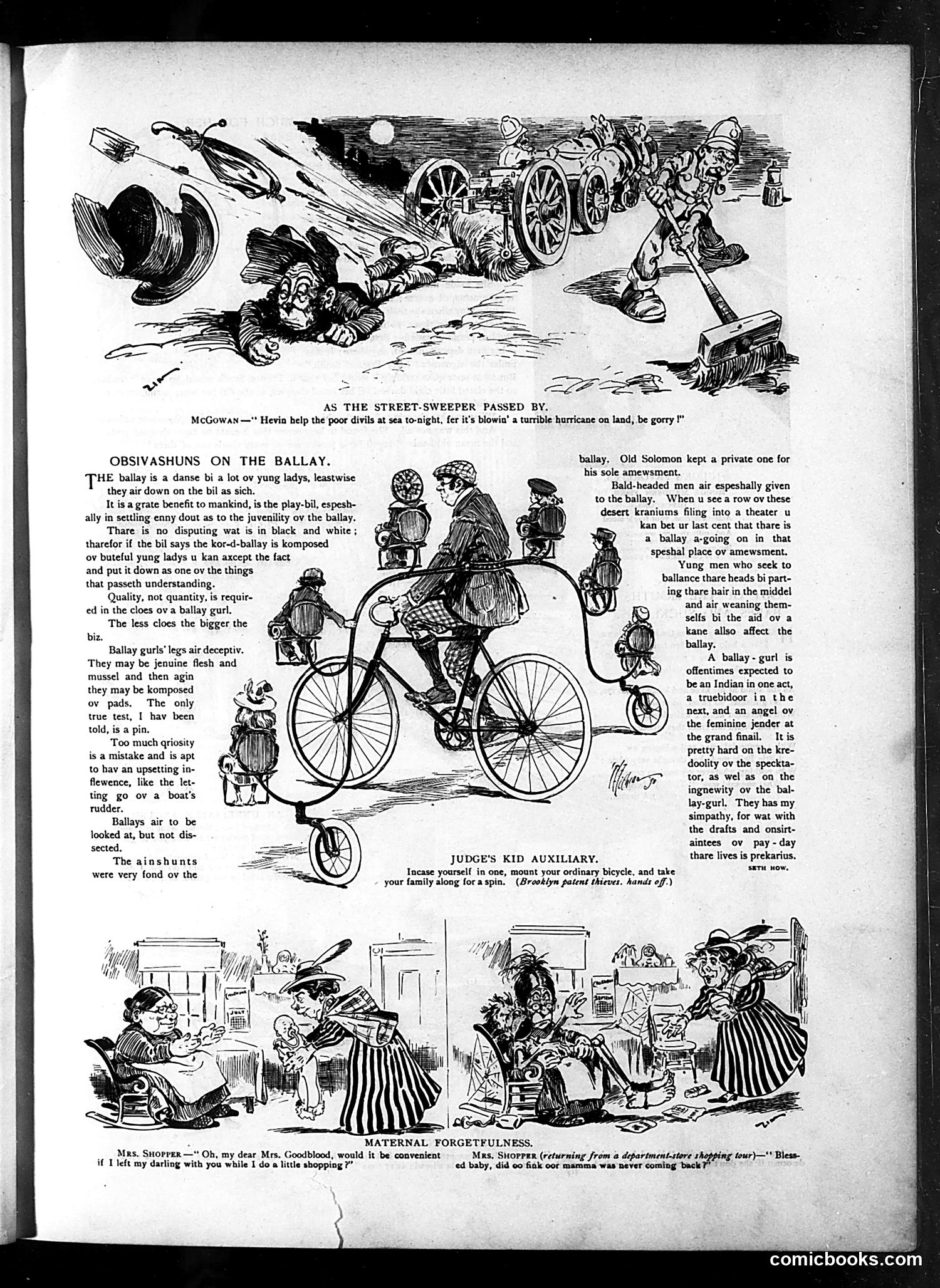
This page from the satirical magazine *Judge* contains three unrelated pieces: 1. **"As the Street-Sweeper Passed By"**: A cartoon mocking political figure McGowan, showing him knocked down by a "hurricane on land," suggesting his political ineffectiveness or downfall. 2. **"Obsivashuns on the Ballay"**: A humorous essay satirizing the "ballay" (ballet), with accompanying illustrations of women on bicycles. The piece mocks the pretentiousness of ballet and suggests bicycle-riding offers comparable entertainment value—likely commentary on emerging bicycle culture as fashionable recreation. 3. **"Judge's Kid Auxiliary" / "Maternal Forgetfulness"**: Comic vignettes showing a mother absent-mindedly leaving her child behind during shopping, illustrating satirical commentary on distracted parenting or women's emerging independence as shoppers conflicting with maternal duties. The overall tone targets social pretensions and changing gender roles in the period.
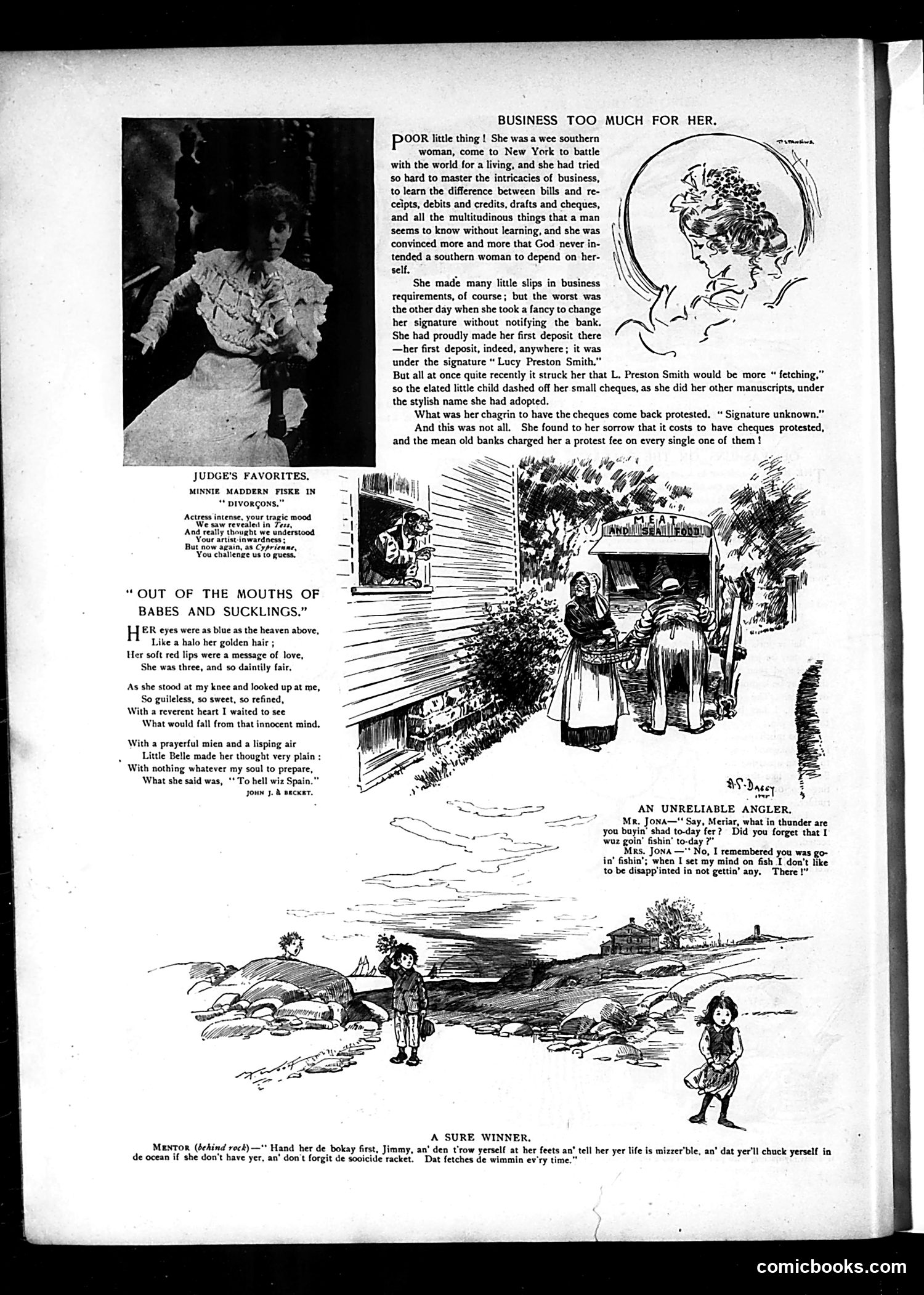
This page contains three separate pieces of social satire: 1. **"Business Too Much for Her"** (top): Mocks a southern woman attempting independent business management in New York. The satire targets her inability to understand banking procedures—particularly her naive signature change and subsequent check protests. The piece suggests women, especially from the South, lack business acumen. 2. **"Judge's Favorites"** (middle): A poem titled "Out of the Mouths of Babes and Sucklings" praising a child's innocent wisdom, reflecting period sentimentality about childhood innocence. 3. **"An Unreliable Angler"** (bottom): Depicts a rural fishing dispute where one character accuses another of burying fish to claim he caught them—satirizing rural gullibility and dishonesty through dialect humor. All pieces employ period stereotypes about women, rural folk, and regional differences for comedic effect.
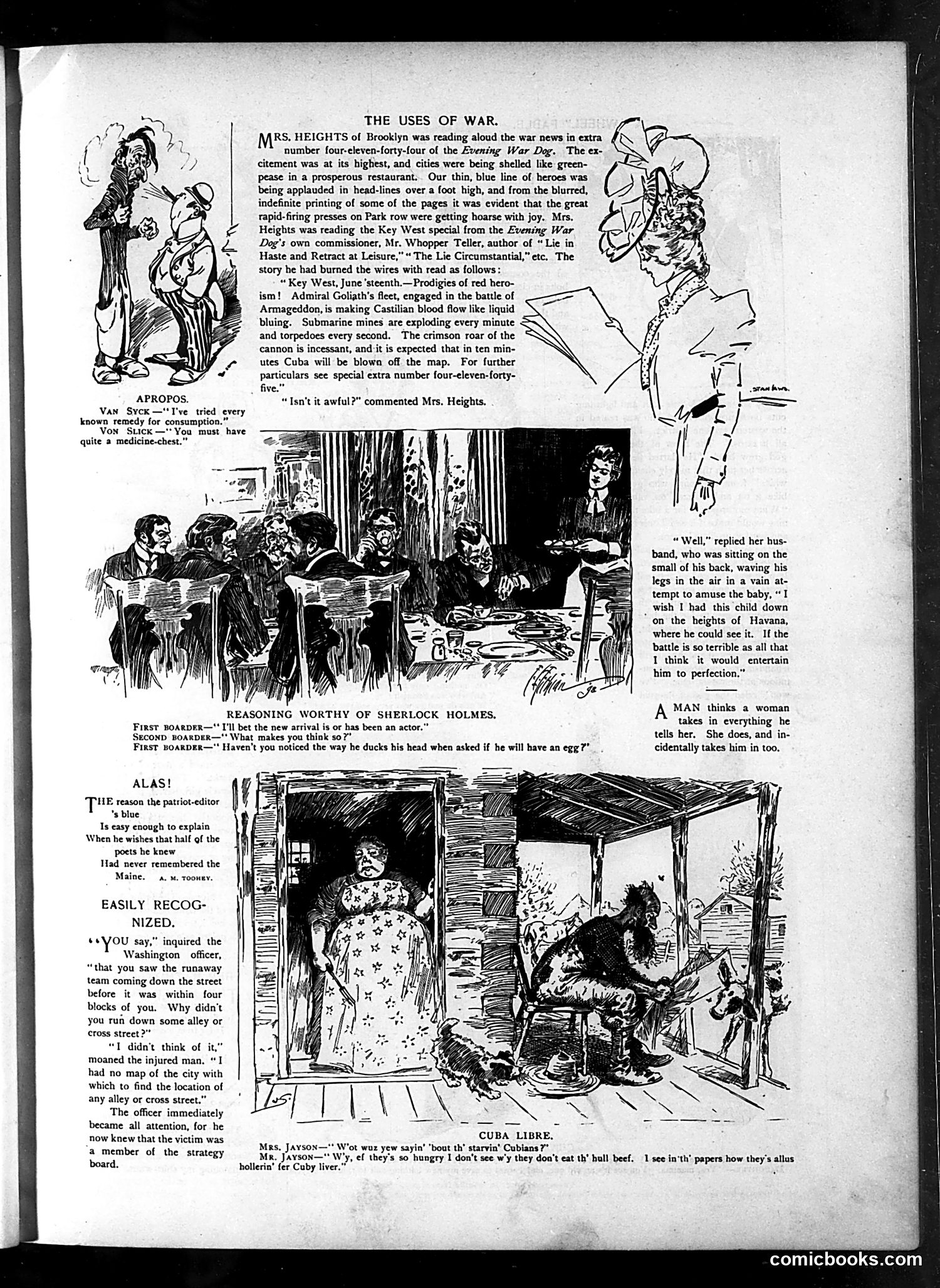
This page satirizes American war reporting during the Spanish-American War (1898). The main article mocks sensationalist journalism: the fictional "Evening War Dog" newspaper and its commissioner "Whopper Teller" (transparently named for exaggeration) publish wildly inflated war reports claiming Cuba will be "blown off the map" in ten minutes. The cartoons extend this critique. One shows a husband, annoyed by his wife's excitement over war news, sarcastically wishing he could take their fussy baby to Havana to witness actual battle. Another ridicules a Washington officer who recognizes a crime victim as a "strategy board" member—suggesting military planners were as disconnected from reality as the man with no city map. The final cartoon mocks simplistic American attitudes toward Cuban suffering: if Cubans are starving, why not just "eat th' hull beef"? This reveals the casual indifference behind humanitarian rhetoric about "liberating" Cuba.
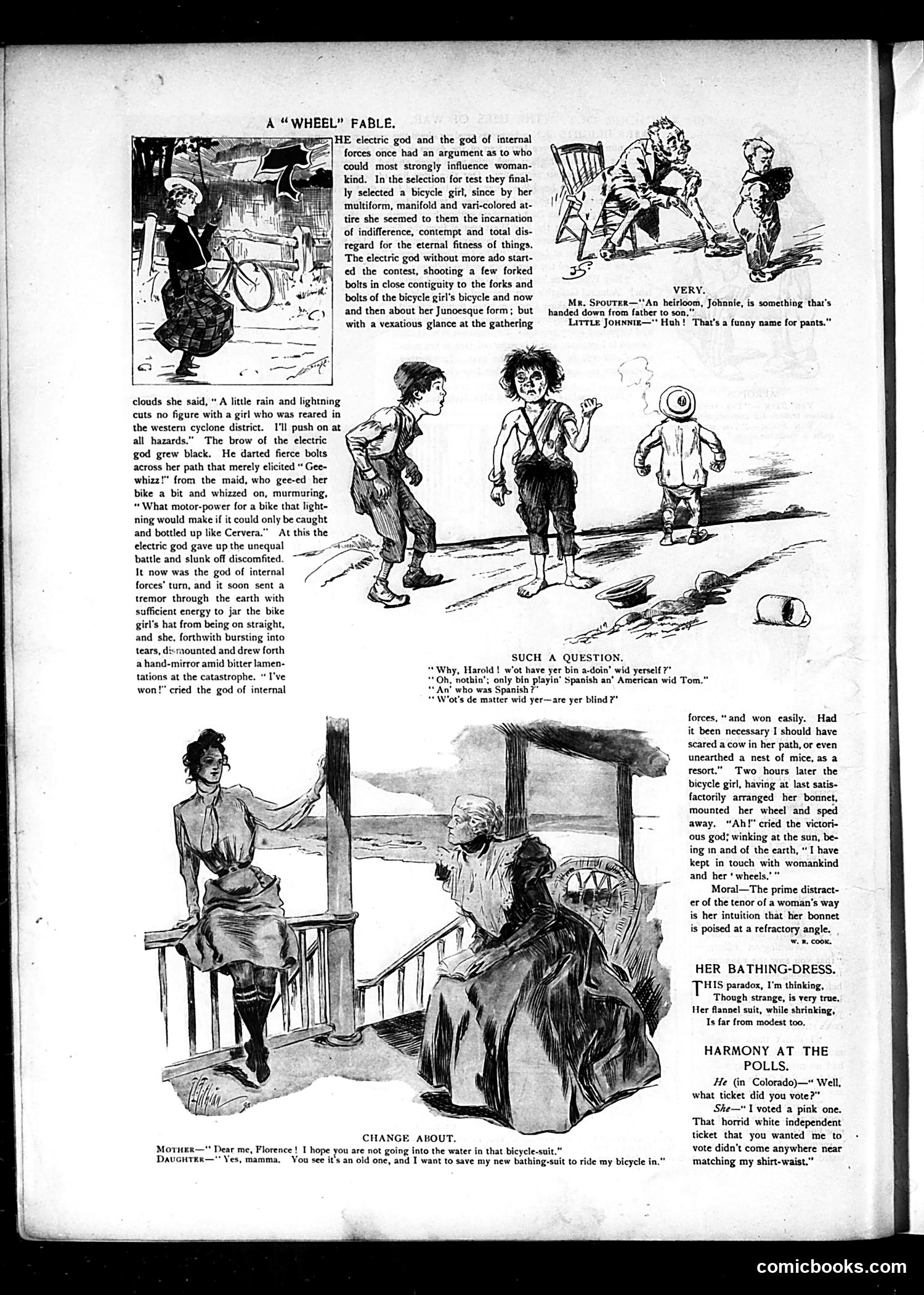
This is a humorous allegorical tale mocking the "New Woman" of the 1890s—specifically the bicycle girl, symbol of female independence and changing social norms. The satire pits the "electric god" (modern technology/progress) against the "god of internal forces" (natural/emotional instability) in a competition to influence womankind. The bicycle girl's indifference to lightning bolts represents women's newfound confidence and mobility through cycling. However, she's ultimately undone not by nature's power but by vanity—a crooked bonnet throws her into tears. The moral is misogynistic humor: women's true weakness is superficial concern with appearance, not genuine resilience. The accompanying cartoons mock women voters ("voting a pink one"), bathing costumes, and working mothers, all reflecting period anxieties about changing female roles. The humor assumes female frivolousness undermines their claims to serious participation in modern life.
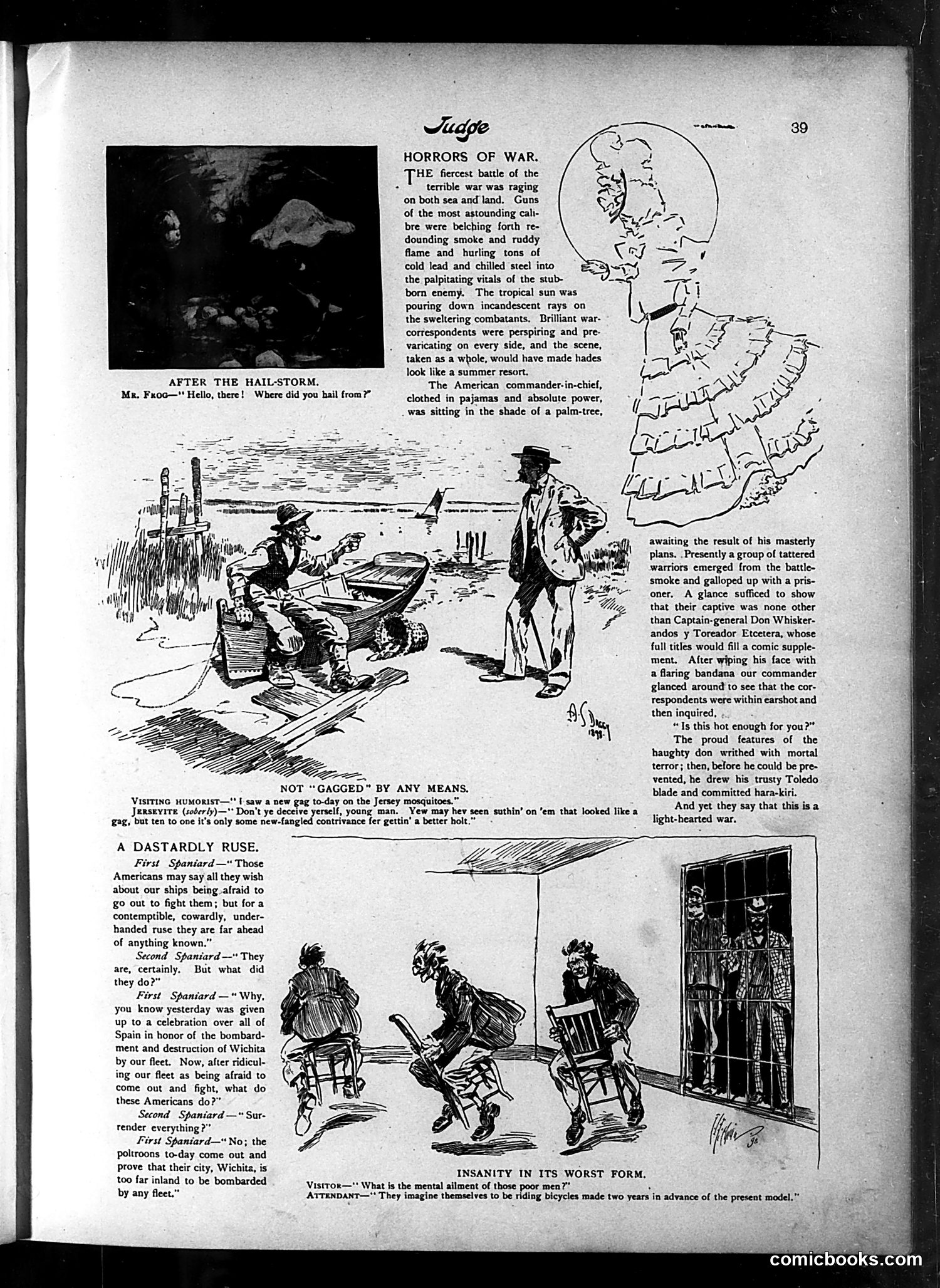
This page satirizes the Spanish-American War (appears to be 1898 era) with multiple cartoons mocking both American and Spanish conduct. **"Horrors of War"** depicts an American commander-in-chief lounging in pajamas while his troops fight. The Spanish prisoner, Don Whiskerandos y Toreador Etcetera (a mock-Hispanic name), commits suicide rather than endure the commander's casual taunt "Is this hot enough for you?" The satire targets American commanders' detachment from combat and swagger. **"A Dastardly Ruse"** shows Spanish officers complaining that Americans are cowardly yet celebrating a victory (bombardment of Wichita), then contradicting themselves by proving Wichita exists inland. The joke mocks Spanish war propaganda's logical inconsistencies. **"Insanity in Its Worst Form"** depicts men imagining bicycles "two years in advance of the present model"—likely satirizing contemporary enthusiasm for bicycle technology. Overall, Judge ridicules both nations' war conduct: American arrogance and Spanish bungling equally.
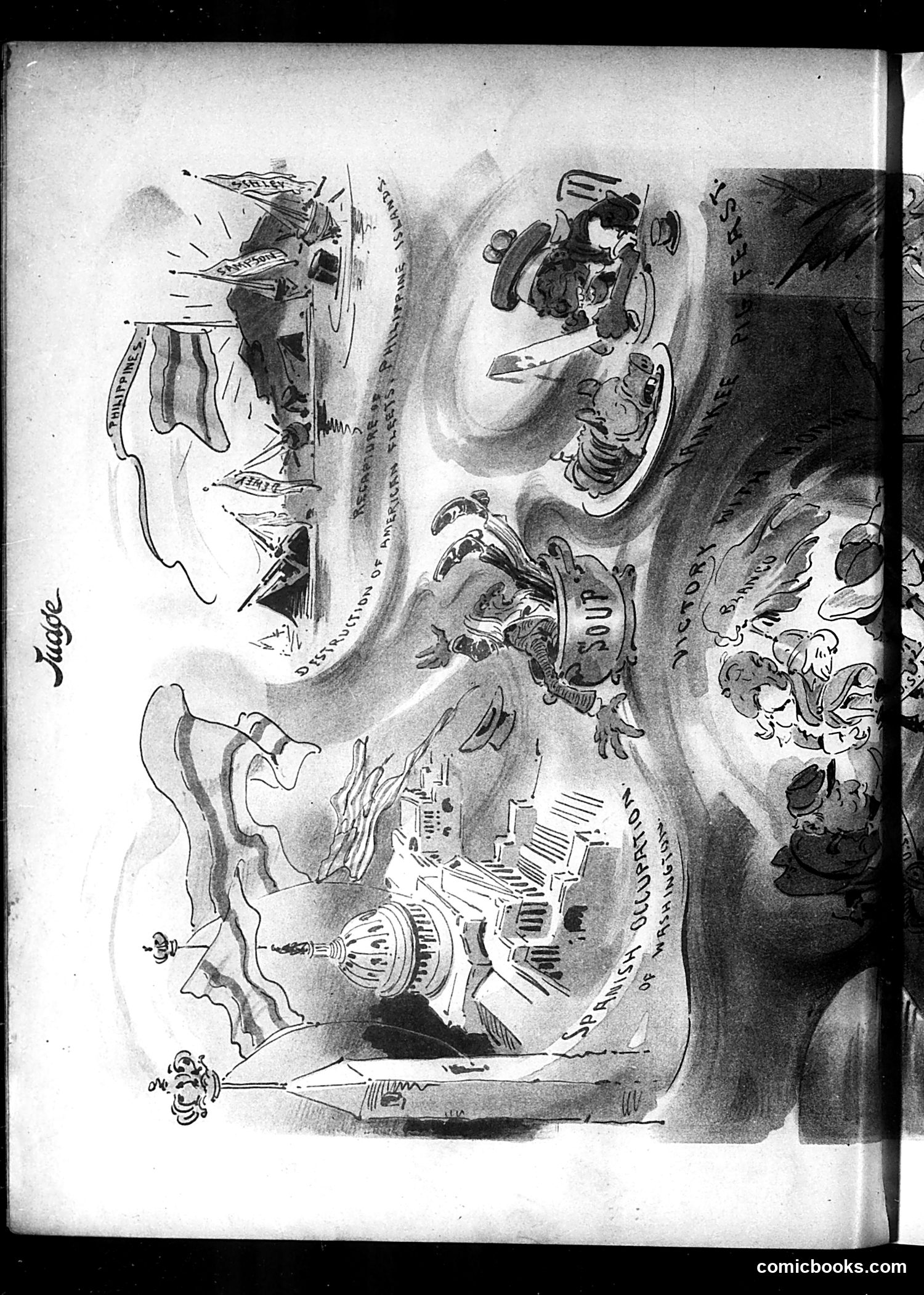
This is a satirical cartoon page from Judge magazine, printed upside-down in the original. The drawing depicts what appears to be a chaotic scene of political or social turmoil, with multiple figures engaged in conflict or disorder. The central imagery suggests political strife or institutional breakdown—there are figures that appear to be officials or authority figures, crowds of people, and architectural elements suggesting government buildings or institutions. The swirling composition and dynamic action convey chaos and upheaval. However, without clearer visibility of specific labels, captions, or readable text on the figures themselves, I cannot definitively identify which political event, figures, or social movement this specifically satirizes. The style is consistent with early-to-mid 20th century American political cartooning.
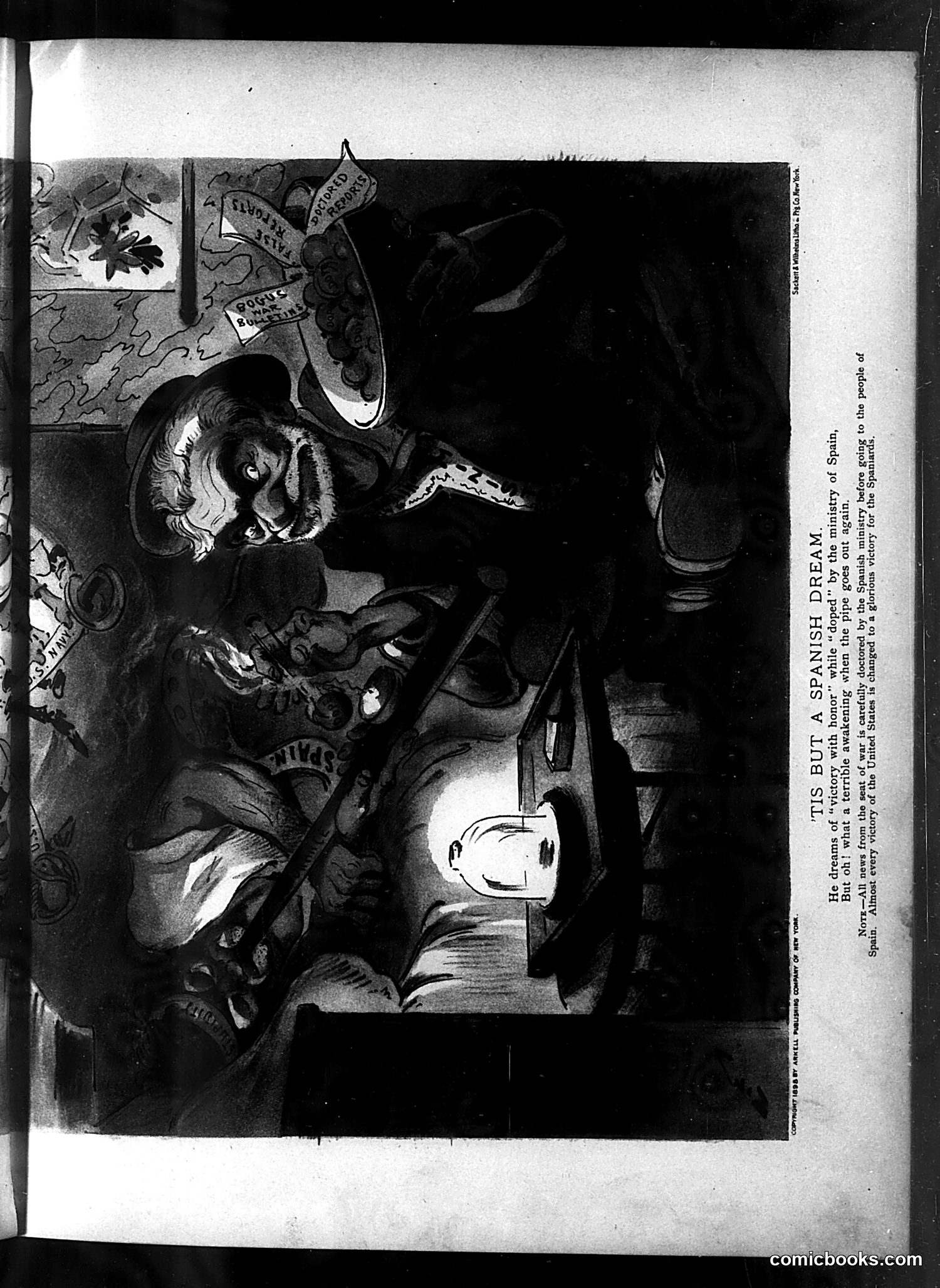
This political cartoon depicts a figure (appears to be Spanish royalty or leadership) in an elaborate, ornate setting, seemingly dreaming or imagining Spain's colonial ambitions. The decorative elements and maps visible in the upper left suggest territorial aspirations or imperial fantasies. The title "This But a Spanish Dream" indicates satirical commentary on Spanish geopolitical ambitions—likely regarding Spain's remaining colonial possessions or territorial claims in the late 19th/early 20th century. The dreaming figure suggests these ambitions are unrealistic fantasies rather than achievable goals. The ornate, somewhat chaotic composition emphasizes the grandiosity and impracticality of these dreams. Without clearer OCR text and specific dating, the exact historical moment is unclear, but this reflects *Judge* magazine's typical satirizing of international politics and imperial overreach during America's own expansionist period.
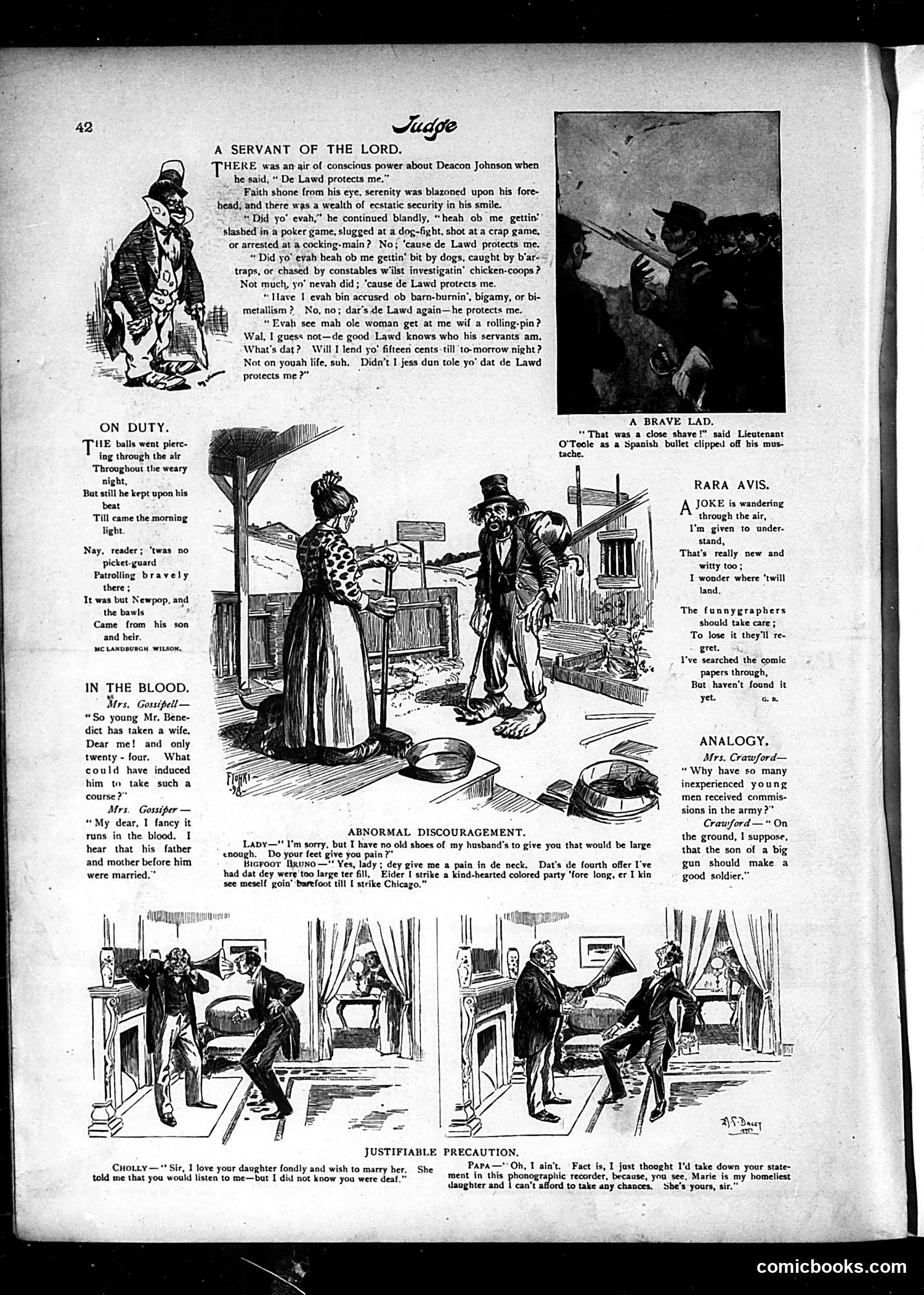
This page contains multiple short satirical pieces typical of Judge magazine's format. The main feature, "A Servant of the Lord," mocks a Black character (Deacon Johnson, depicted in dialect) who hypocritically claims divine protection while engaging in morally questionable behavior—gambling, dog-fighting, cock-fighting, barn-burning, bigamy—yet refuses to lend money, claiming God protects him. The satire targets religious hypocrisy and selective morality. Other pieces include gentle domestic humor ("In the Blood" about impulsive marriage, "On Duty" about a baby's crying) and light social commentary. The page reflects late-19th/early-20th century American humor conventions, including racial caricature that modern readers would find offensive. The overall tone is lighthearted social criticism aimed at middle-class readers.
This is primarily an **advertising page** with interspersed short humor pieces and one patriotic poem. The main satirical content includes brief anecdotes mocking absent-mindedness (a professor hitting a lady with an umbrella instead of a cow) and a joke about an old veteran's obsessive reminiscence—punchlined by "Mr. Dooley" sarcastically asking if he remembers the Maine, a reference to the 1898 USS Maine explosion that triggered the Spanish-American War. A patriotic poem, "Three Cheers for the Old Flag," celebrates American patriotism and the flag itself, appearing to be post-Spanish-American War content emphasizing national unity. The page is otherwise dominated by period advertisements for products like Packer's Tar Soap, Canadian Pacific Railway steamers, insurance policies, and tobacco products. The cartoons or satirical illustrations are minimal—mostly product endorsements rather than political commentary.
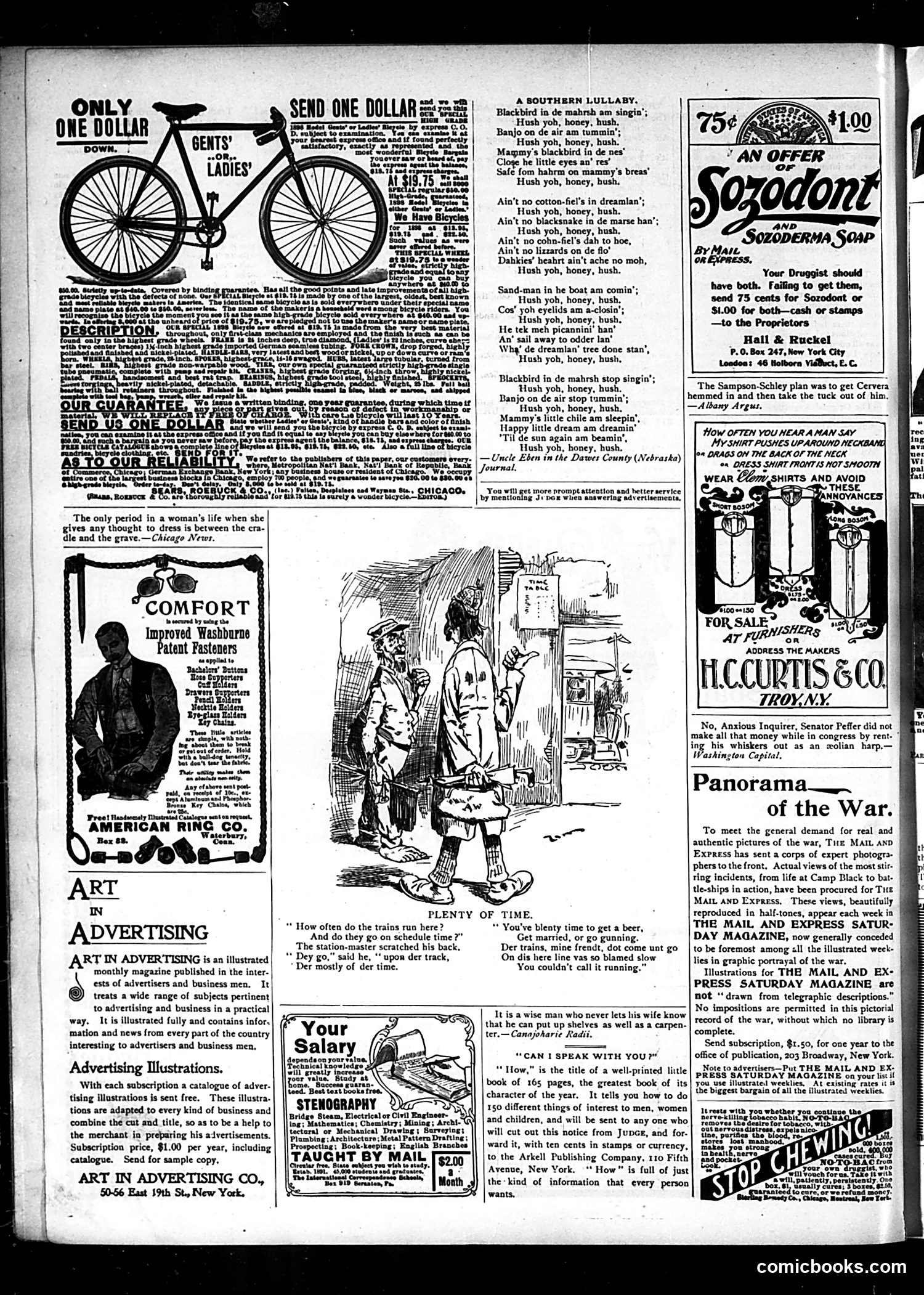
This is primarily an **advertising-heavy page** from Judge magazine, with one notable satirical poem. ## Main Content: **"A Southern Lullaby"** is a dialect poem using racist stereotypes common to the era. It depicts an enslaved Black mother ("mammy") singing to a child, romanticizing slavery by promising escape from field work and hardship only in death/dreams. The dialect spelling and infantilizing imagery reflect the deeply racist attitudes Judge's white audience apparently found acceptable or humorous. ## Advertisements: The page is dominated by period commercial ads: bicycles (dollar down), stenography courses, clothing fasteners, salon services, and self-improvement books—typical early-1900s mail-order offerings. A cartoon titled "Plenty of Time" shows a station master with a comic ethnic accent discussing trains that never run on schedule—standard ethnic humor of the period. **Overall:** This page reflects Judge's mix of political satire and advertising, alongside casual racism that was normalized in mainstream American publications of this era.
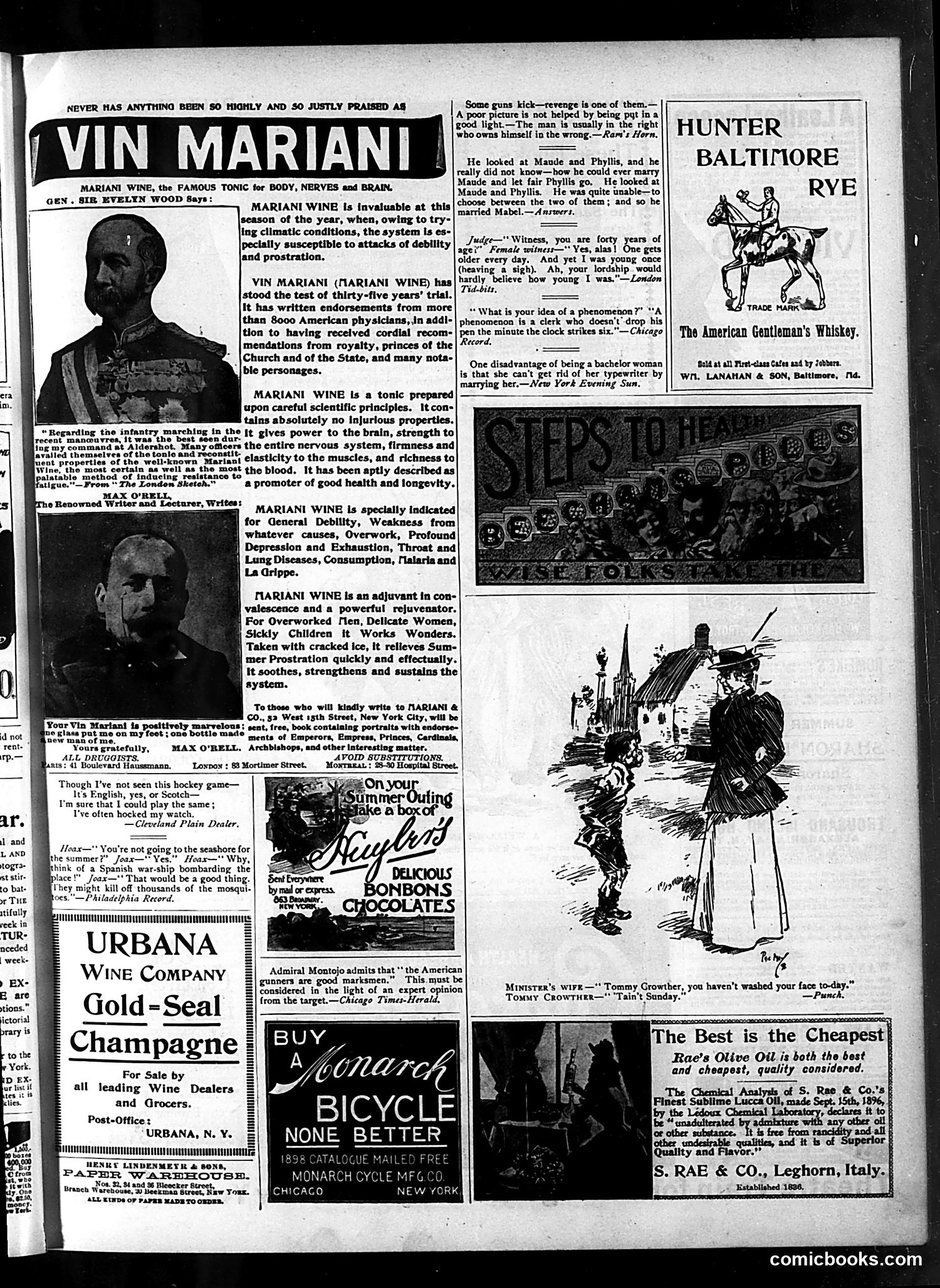
This page is primarily **advertising**, dominated by a large Vin Mariani wine advertisement featuring testimonials from prominent figures (General Sir Evelyn Wood and "Max O'Rell," a noted writer). The main **cartoon** shows a minister's wife scolding a boy named Tommy Crowther, saying "Tommy Crowther, you haven't washed your face today." The caption reads "Tain't Sunday." **The satire**: The joke plays on the implication that Tommy only washes his face on Sundays—suggesting poor hygiene standards or that religious observance is the only motivation for cleanliness. It's gentle social commentary on Victorian-era hygiene habits and parental/moral expectations. The page also includes a humorous quip about Spanish warships and mosquitoes during what appears to be the Spanish-American War period. Otherwise, the page consists of period advertisements for champagne, bicycles, bonbons, and Italian olive oil—typical Judge magazine commercial content from this era.
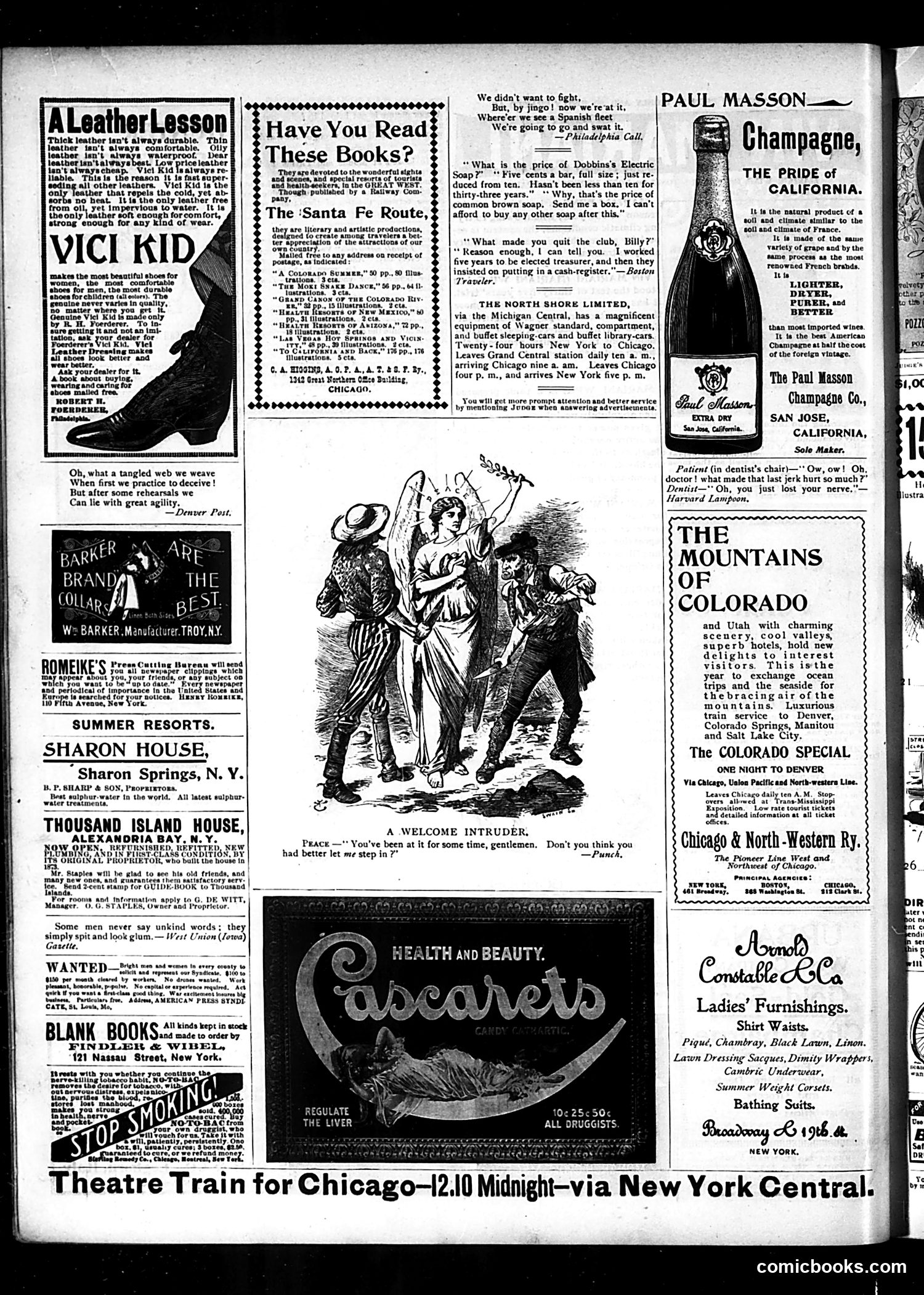
This page is primarily **advertising and commercial content** rather than political satire. It contains: **Main advertisements:** - **Vici Kid** leather product (left column) - **Paul Masson Champagne** (right side) — positioned as superior California product - **Summer resorts** (Sharon House, Thousand Island House) - **Travel services** (Santa Fe Route, Chicago & North Western Railway, Colorado Special) - **Consumer goods** (Cascaret laxative, Arnold Corset) **Humorous content:** The page includes several **light joke exchanges** (not political cartoons): - A joke about soap prices - A club treasurer anecdote - A dentist chair joke - A social gathering interruption scene ("A Welcome Intruder") **Central illustration**: Shows a woman with two men in period dress — likely representing leisure travelers or resort guests. **Context**: This reflects early 1900s America's emerging consumer culture, vacation industries, and advertiser-supported magazine economics. The content prioritizes commercial messaging over editorial satire on this particular page.
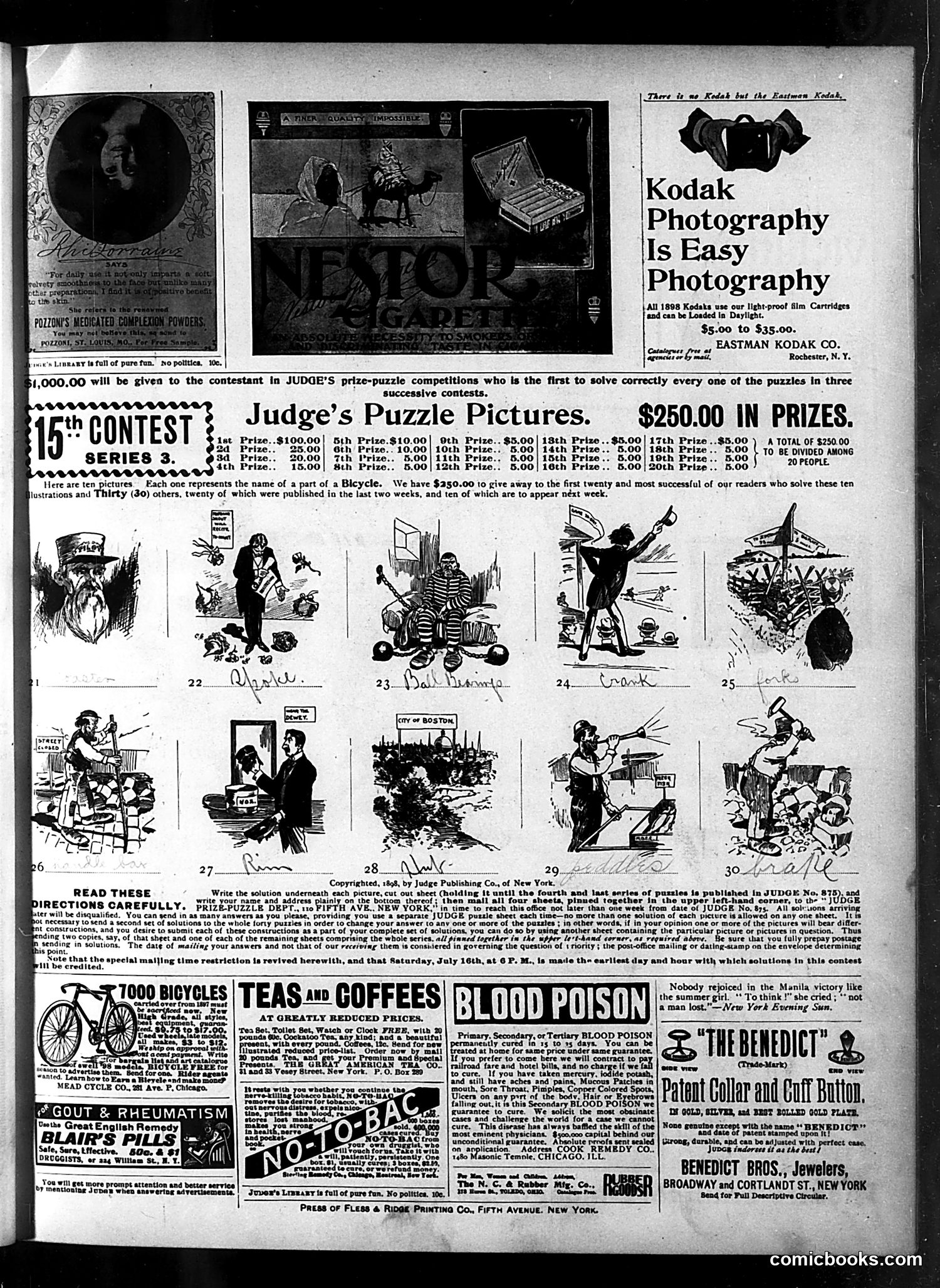
This page is primarily **advertising and contest material** rather than editorial content. The main feature is Judge's "Puzzle Pictures" contest—a puzzle competition offering $250 in prizes where readers identify bicycle parts hidden in illustrated scenes. The puzzles themselves (images 21-30) are generic illustrations with no clear political satire; they appear to depict everyday scenes meant to conceal bicycle component names. The page includes unrelated period advertisements for Kodak cameras, bicycles, patent medicines (Blair's Pills for gout, Cook Remedy for "blood poison"), and jewelry. A small satirical note appears: a quip about the Spanish-American War's Manila victory, where a "summer girl" expresses relief "not a man lost"—likely mocking either her ignorance of actual casualties or jingoistic cheerfulness about the conflict. The contest instructions dominate the layout, reflecting Judge's reliance on reader-participation gimmicks and advertising revenue rather than editorial commentary on this particular page.
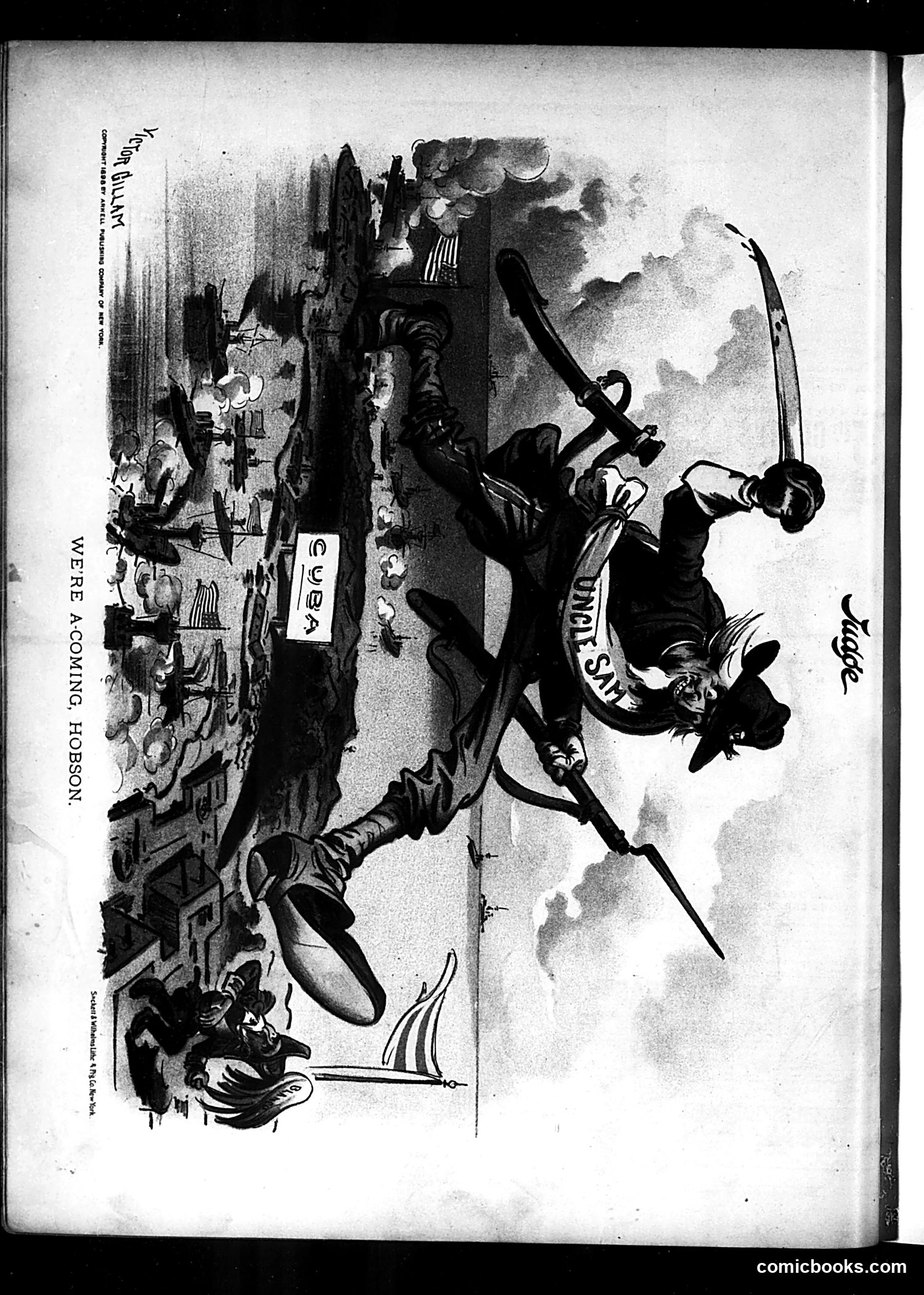
This appears to be a satirical cartoon from Judge magazine (1896) referencing "Hobson" — likely **Richmond P. Hobson**, a U.S. Navy officer who became famous during the Spanish-American War for his heroic (or allegedly exaggerated) actions. The cartoon depicts figures in elaborate dress appearing to perform acrobatic or theatrical feats, with text mentioning "accounting" Hobson. The satire likely mocks either: 1. Hobson's inflated public fame or self-promotion 2. Contemporary political or military figures capitalizing on war heroism 3. The spectacle of celebrating military figures The theatrical staging and exaggerated poses suggest ridicule of overblown hero-worship or performance surrounding contemporary events. Without clearer visibility of all figures, the specific targets remain somewhat unclear, but the overall tone is clearly mocking.