
A complete issue · 16 pages · 1898
Judge — July 2, 1898
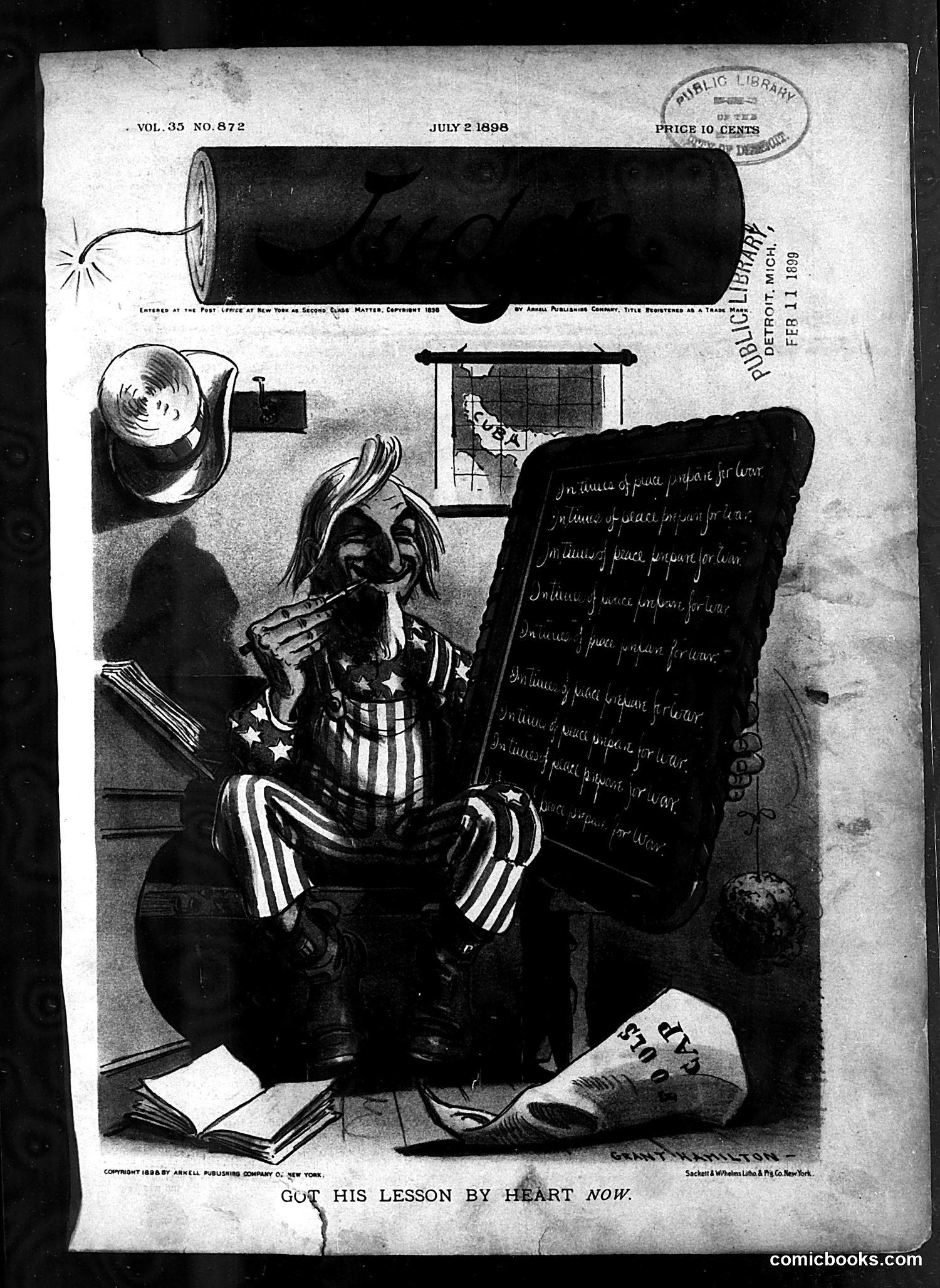
This political cartoon titled "Got His Lesson by Heart Now" depicts Uncle Sam (identifiable by his starred top hat and striped clothing) studying from a slate/tablet covered with handwritten text. The image appears to reference the Spanish-American War, which occurred in 1898. The cartoon likely satirizes American imperial expansion and the lessons learned from the recent conflict with Spain. The slate's text appears to contain repeated phrases or lessons, suggesting Uncle Sam is being forced to memorize or absorb certain principles—possibly regarding colonial obligations or military strategy. The surrounding elements (cannon, military equipment, books) reinforce themes of warfare and military education. The satire likely critiques American imperialism or mocks the nation's newfound aggressive foreign policy following victory over Spain.
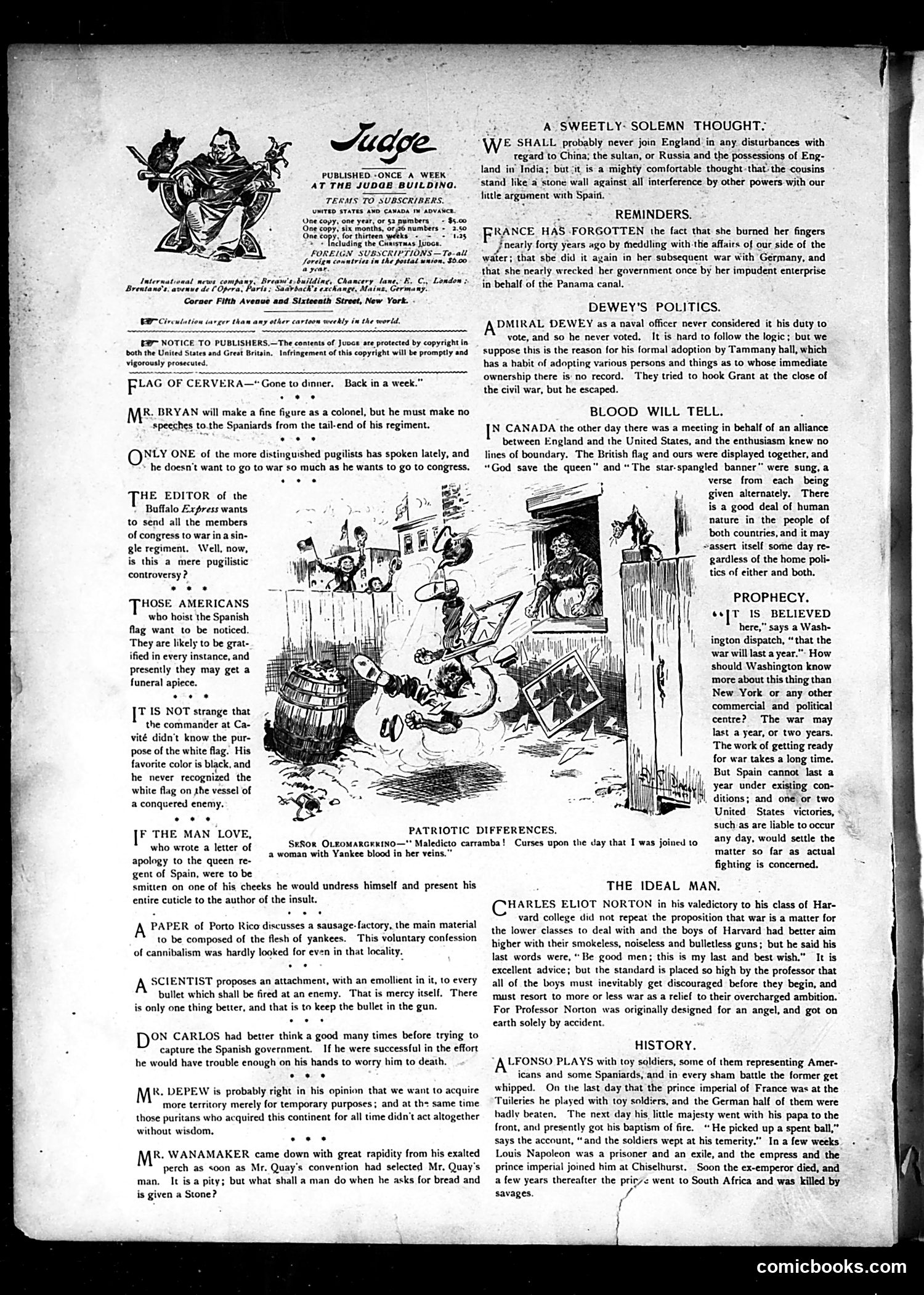
This page contains a political cartoon titled "Blood Will Tell" depicting chaos in Canada during a meeting about Anglo-American alliance boundaries. The illustration shows figures in apparent conflict or celebration around British and American flags. The surrounding text critiques various political figures and events: Admiral Dewey's reluctance to vote, disparagement of Mr. Bryan as a colonel, and commentary on Spanish-American War politics. A section called "The Ideal Man" praises Charles Eliot Norton's advice to Harvard students about discouraging ambition and lowering expectations—presented ironically as excellent guidance. "History" discusses Napoleon and various military campaigns, though context for the specific references is unclear from the visible text alone. The overall tone is satirical commentary on American domestic and foreign politics of the period (appears to be late 1890s).
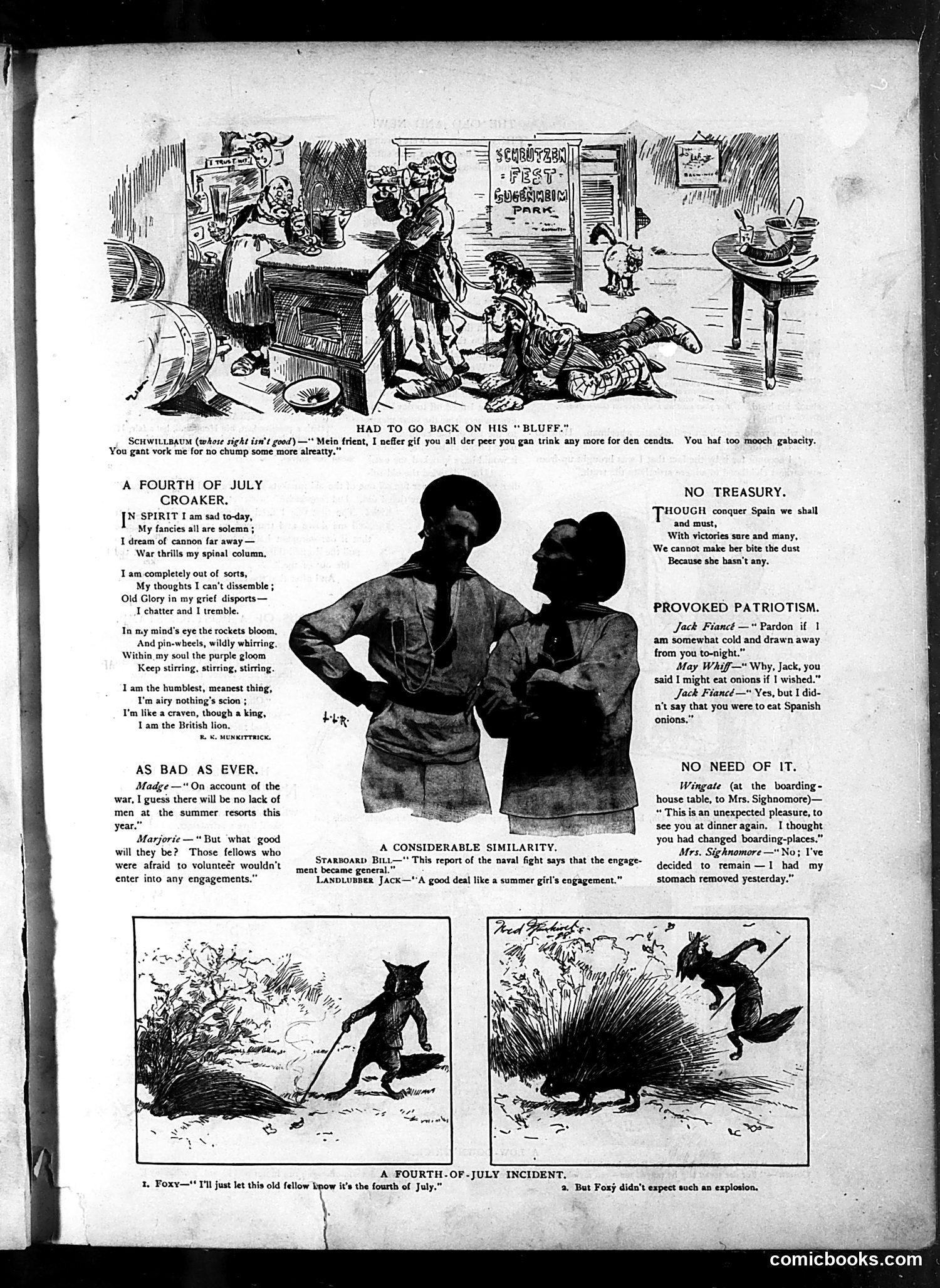
This appears to be a WWI-era satirical page (likely 1898, based on the Spanish-American War reference in the top cartoon). The content includes: **Top cartoon**: A man ("Schwiilbaum") is confronted at what appears to be a beer hall or park, accused of lacking patriotic fervor and not contributing enough to war efforts—satirizing German-Americans during wartime suspicion. **Middle section**: Poems and dialogues mocking various war-related attitudes, including reluctance to volunteer and complaints about summer resort disruptions. **Bottom cartoons**: Two "Fourth of July Incident" panels depicting a fox and porcupine, using animals as metaphors—likely satirizing foolish wartime provocations or unexpected consequences of aggressive behavior. The overall theme critiques both excessive and insufficient patriotism, alongside the disruptions war causes to civilian life.
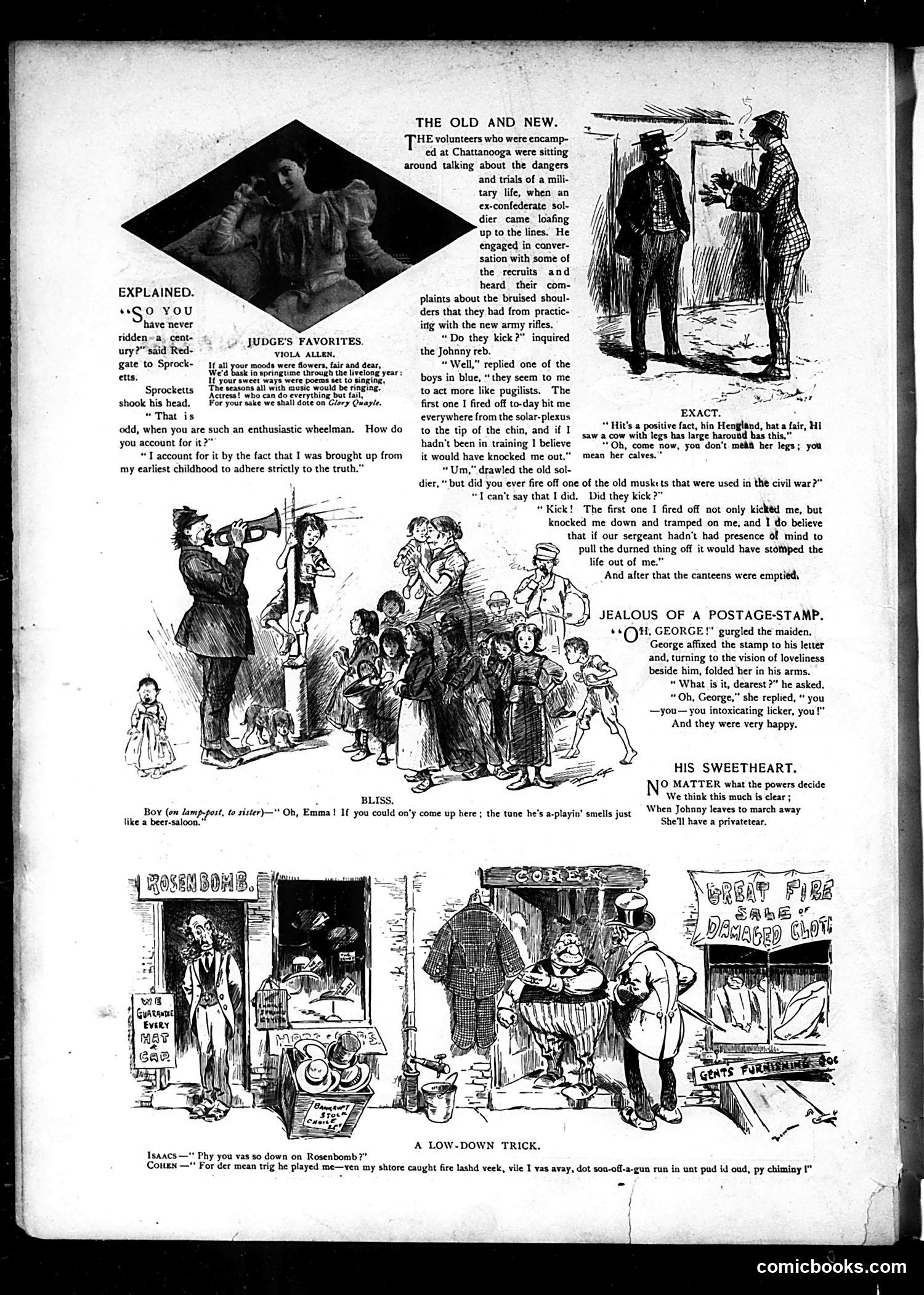
This page contains several Civil War-era humorous sketches and stories from Judge magazine. "The Old and New" depicts volunteers at Chattanooga discussing rifle training—a recruit complains about bruised shoulders from practicing with new army rifles, while a Confederate veteran boasts that Civil War-era muskets kicked harder and once knocked him unconscious. "Judge's Favorites" contains jokes about military life, including references to enlisted men's complaints. The lower section shows street scenes with captions like "A Low-Down Trick" and "Bliss," depicting urban characters in comedic situations—likely commenting on social types or behaviors of the period. The cartoons use exaggerated character drawings typical of 19th-century satirical magazines to mock military inexperience and social pretension.
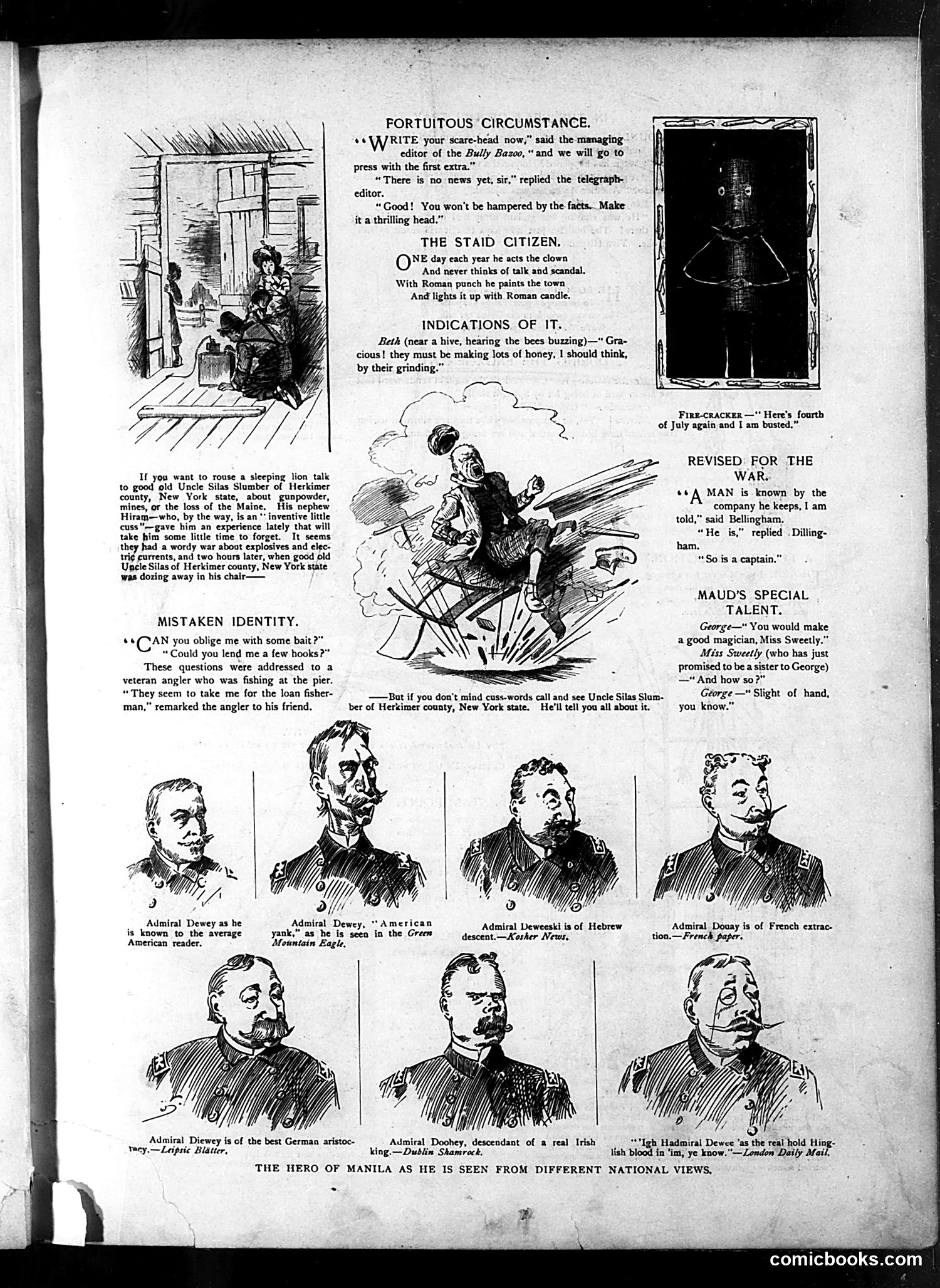
This page satirizes American newspaper sensationalism and international views of Admiral Dewey (hero of the 1898 Manila Bay naval victory during the Spanish-American War). The top section mocks yellow journalism: an editor demands a "thrilling" headline despite having no actual news, illustrating how papers fabricated stories for circulation. The bottom section—"The Hero of Manila as He is Seen from Different National Views"—depicts seven caricatured portraits of Dewey, each labeled with how different countries' newspapers described him: German, American, Hebrew, French, and Irish sources each claim him as their own ethnic/national hero. This satirizes how international press manipulated the same figure to suit nationalist narratives. The joke: Dewey becomes whatever each nation needs him to be, exposing how journalism globally distorts reality for propaganda purposes. Context lost today: Dewey's genuine popularity and the era's intense international rivalries during American imperial expansion.
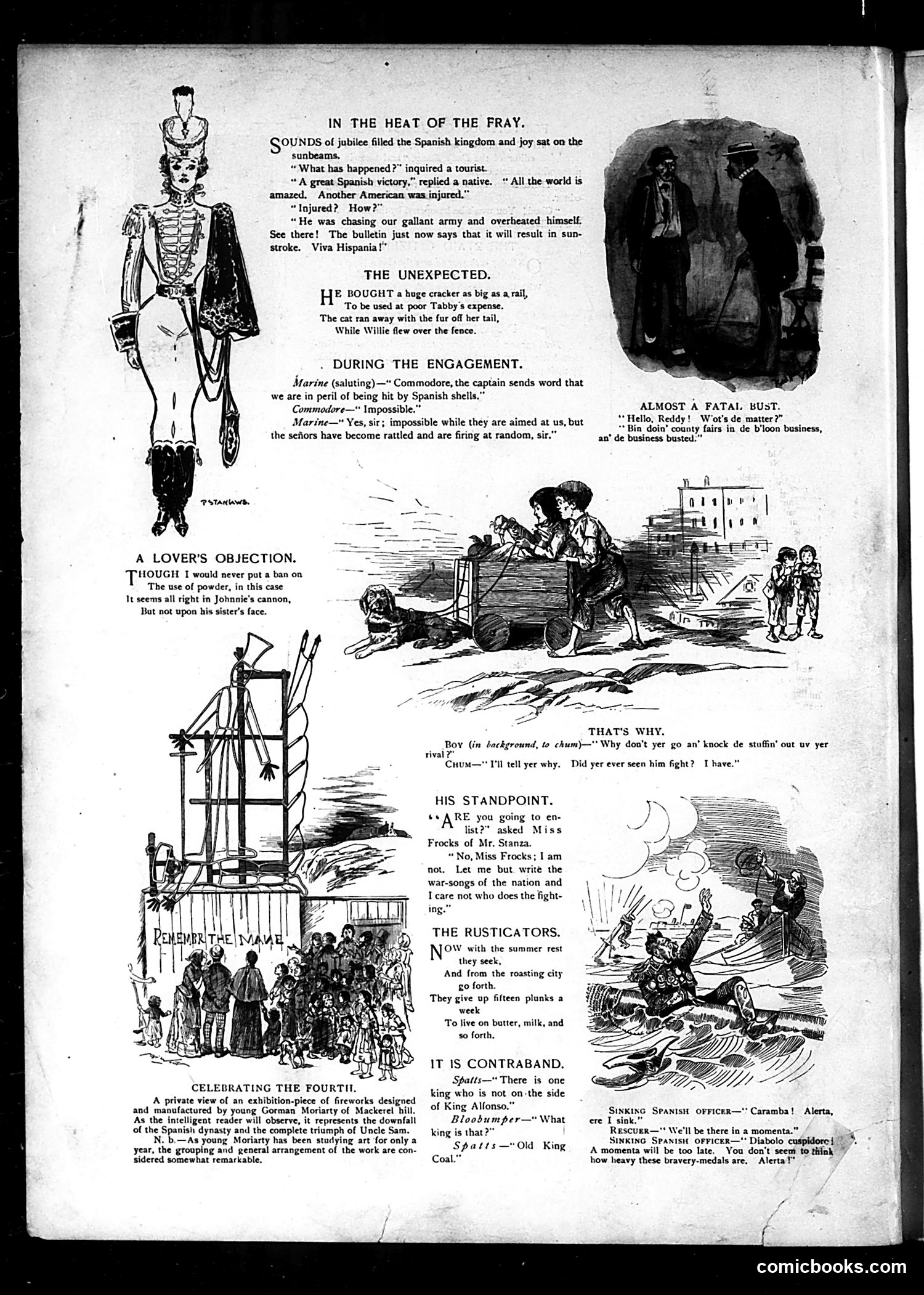
This page satirizes the Spanish-American War (1898), celebrating American victory while mocking Spanish incompetence. The top cartoon mocks Spanish pride—a native boasts of a "great Spanish victory" while admitting an American was injured only by overheating himself chasing their army, suggesting Spanish forces are disorganized and ineffectual. Other cartoons employ typical period humor: children's mishaps, romantic obstacles, and draft-dodging poets. The "Celebrating the Fourth" section uses fireworks as metaphor for Spain's "downfall" and "Uncle Sam's" triumph—heavy-handed propaganda dressed as humor. The sinking Spanish officer scenes mock Spanish naval losses with darkly comic dialogue about drowning sailors and medals, reflecting American triumphalism. Overall, the page presents war through jingoistic satire: Spain is portrayed as bumbling and incompetent, while American victory appears inevitable and righteous. The humor relies on readers' patriotic assumptions about American superiority.
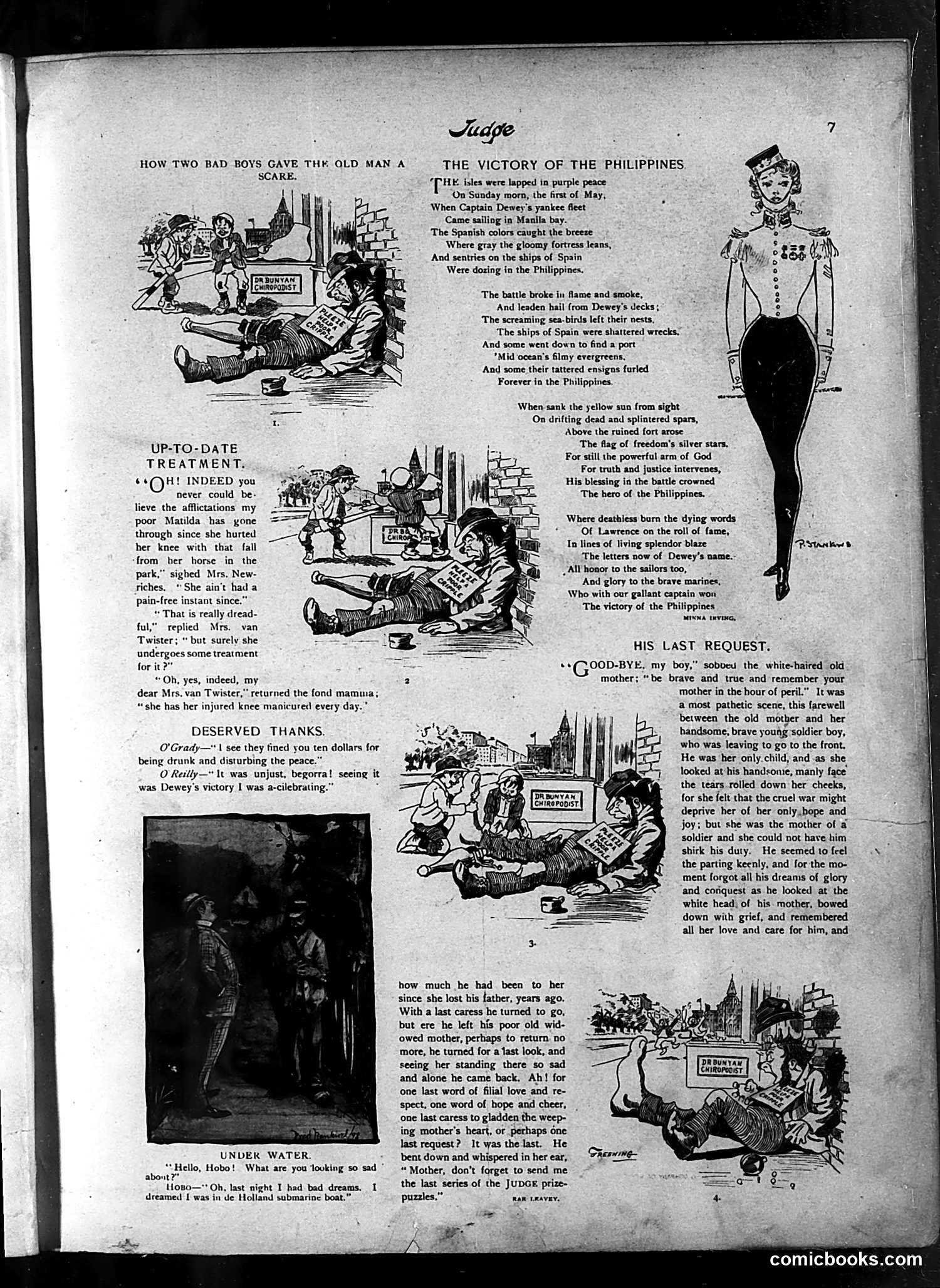
This page celebrates the **Spanish-American War victory at Manila Bay (May 1, 1898)**, when Commodore George Dewey defeated the Spanish fleet in the Philippines. **Main content:** The lengthy poem "The Victory of the Philippines" glorifies Dewey's naval triumph, invoking divine blessing and comparing the battle to historical naval victories. It frames American victory as righteous—"the powerful arm of God / For truth and justice intervenes." **Satirical cartoons** mock various figures: - "How Two Bad Boys Gave the Old Man a Scare" depicts pranksters frightening an elderly man, likely political satire about Spanish weakness - "His Last Request" sentimentalizes a soldier's farewell to his mother—he tearfully asks her not to forget sending him **Judge magazine's prize puzzles**, deflating the emotional moment with absurdist humor - "Under Water" jokes about a hobo dreaming of a submarine, referencing contemporary naval anxieties The page reflects American triumphalism and jingoism during the war, while occasional humor undercuts the earnestness.
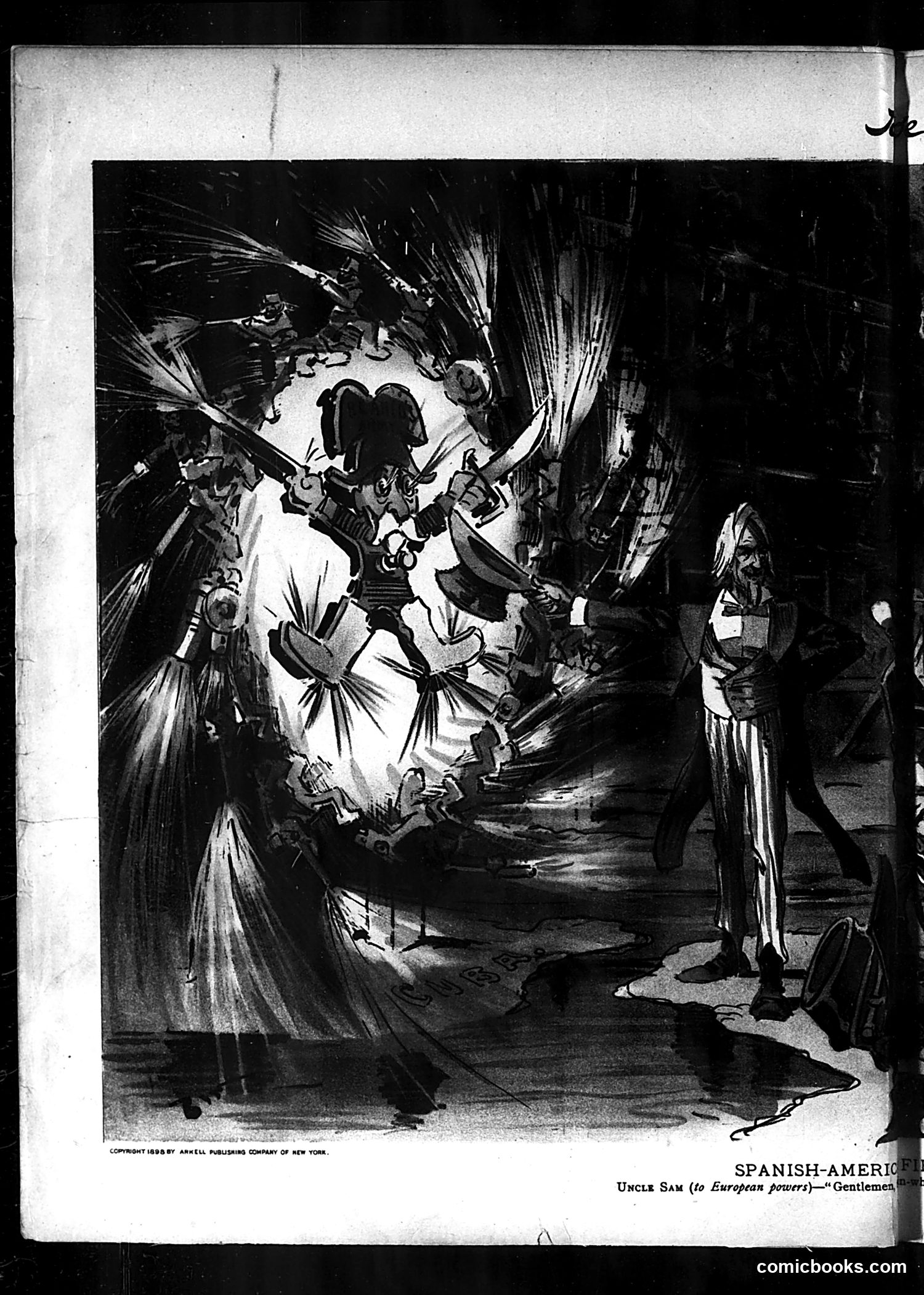
This is a satirical cartoon titled "Uncle Sam (to European powers)—'Gentlemen...'" The image depicts Uncle Sam (the personification of the United States, identifiable by his distinctive appearance) addressing European powers, likely represented by the figures on the right wearing formal attire and what appear to be military uniforms or regalia. The cartoon appears to comment on American diplomatic relations with Europe, possibly regarding the Spanish-American War era (suggested by "SPANISH-AMERIC" visible in the header). Uncle Sam is shown in a dominant, commanding pose, seemingly asserting American authority or issuing warnings to European nations. The dramatic lighting and composition emphasize American strength and determination. Without seeing the complete caption, the precise message is unclear, but the satire likely critiques either American imperialism or efforts to assert U.S. influence on the world stage.
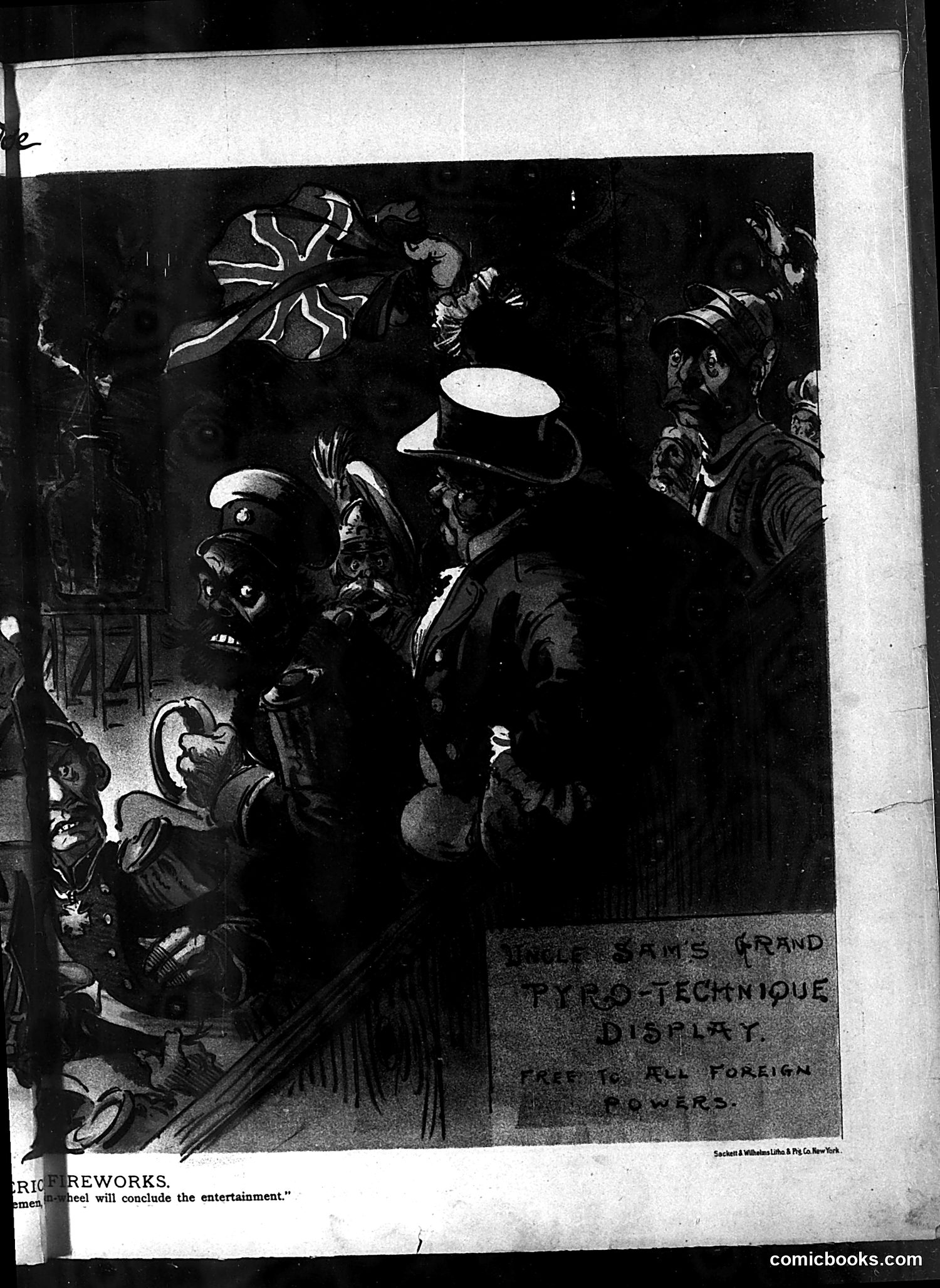
This appears to be a satirical illustration titled "Grand [Something] Pyro-Technique Display" with text referencing "all foreign powers." The central figure wears a top hat and formal attire, surrounded by caricatured military or diplomatic figures displaying exaggerated facial features typical of early 20th-century Judge magazine satire. The "fireworks" and "pyro-technique display" likely reference international military tensions or diplomatic conflicts. The caption fragment "will conclude the entertainment" suggests dark humor about warfare or political conflict being treated as spectacle. However, without a visible date or clearer text, I cannot definitively identify which specific international incident or foreign powers are being satirized. The style and caricature approach suggest pre-WWI or inter-war period commentary on militarism and international relations.
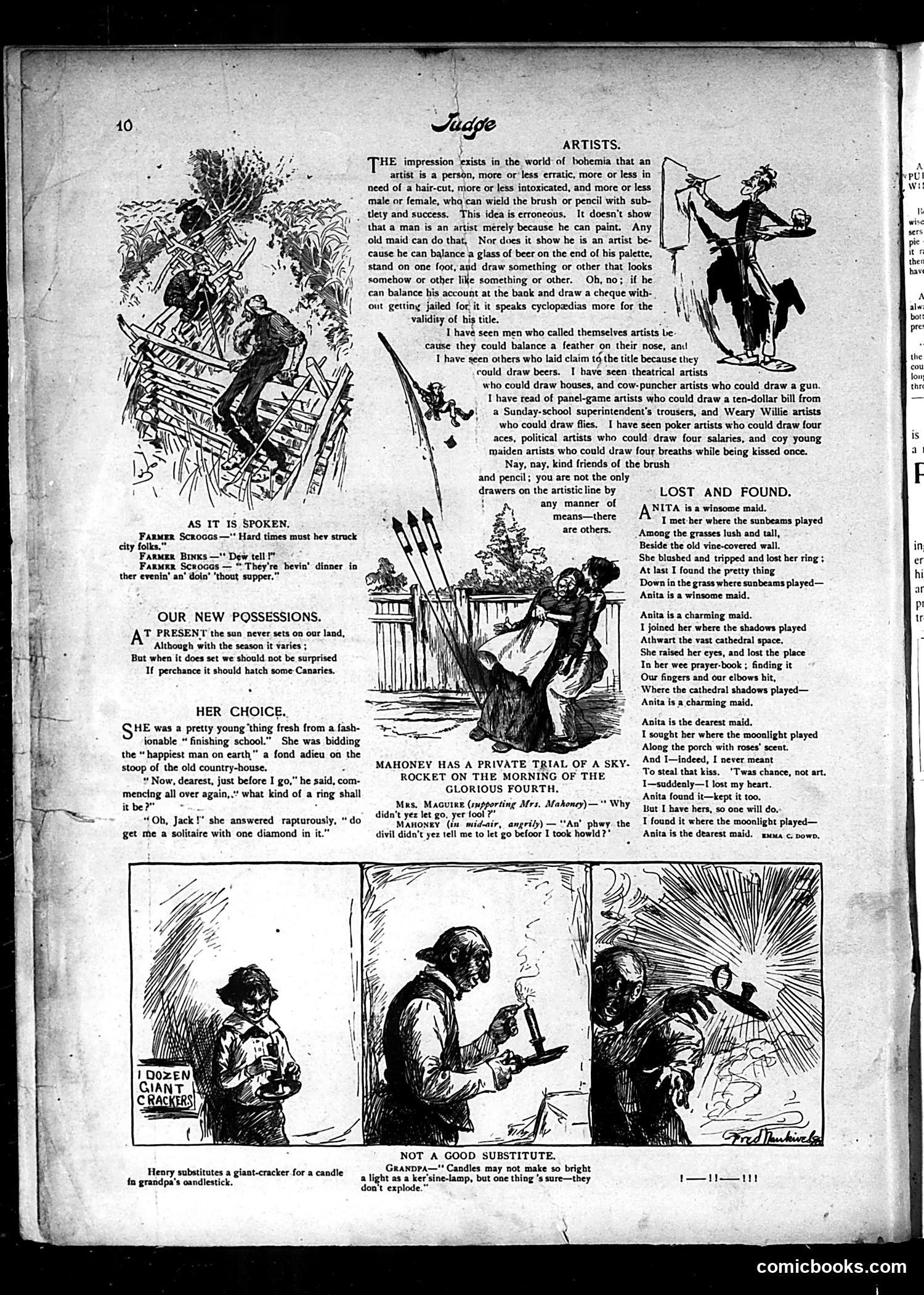
This page from *Judge* contains multiple satirical pieces typical of the era: **"Artists"** is the main essay, mocking bohemian stereotypes about what constitutes a "real" artist. It sardonically lists absurd "artists"—feather-balancers, those who "draw beers," poker artists who draw cards, and politicians who "draw four salaries." The satire targets both pretentious bohemians and corrupt officials, arguing true artistry requires financial responsibility, not eccentricity or drinking. **"Her Choice"** jokes about a young woman from finishing school asking her fiancé for "a solitaire with one diamond"—a double entendre suggesting she values independence (being alone) over marriage. **The rural dialogue** mocks city folk's economic struggles during hard times, reduced to skipping dinner. **"Our New Possessions"** likely references American imperial expansion (unclear which territories specifically). **"Lost and Found"** is a sentimental poem about a man meeting a maiden named Anita three times, gradually escalating romantic involvement. The bottom cartoons show mundane domestic humor: Henry substituting a firecracker for a candle, and Grandpa preferring candles to unsafe kerosene lamps.
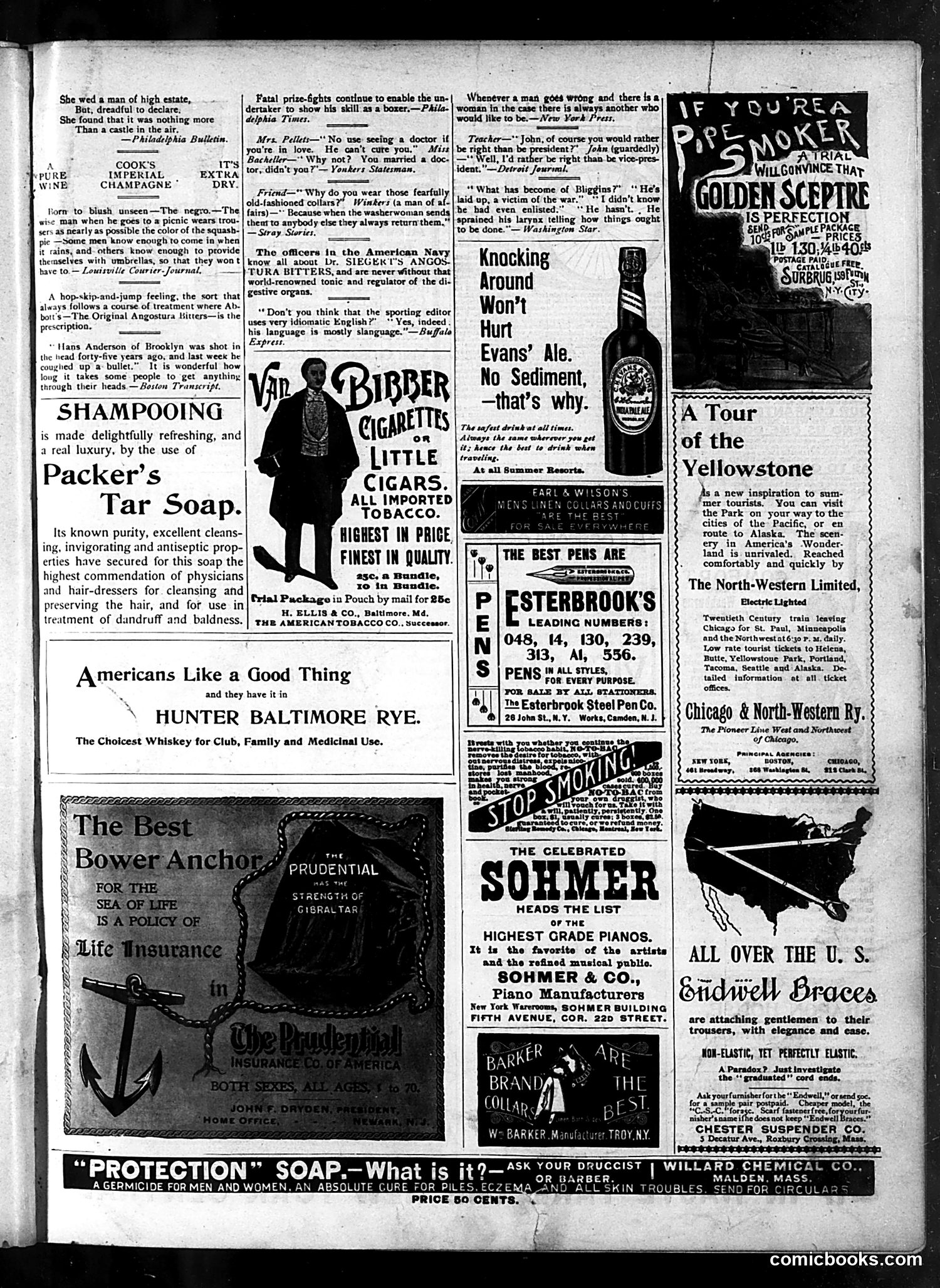
This is primarily an **advertising page** from Judge magazine, with brief humorous filler content between ads. The satire is minimal and embedded in short quoted jokes rather than formal cartoons. The page includes advertisements for luxury goods (Cook's Champagne, Hunter Baltimore Rye whiskey, Sohmer pianos) and everyday items (Packer's Tar Soap, Esterbrook pens). The scattered jokes mock contemporary social situations: a woman marrying a man with no fortune ("castle in the air"), outdated fashion choices, and prize-fighting deaths. One joke appears to reference a war context—a man sprains his larynx complaining about how things "ought to be done" rather than enlisting (suggesting criticism of armchair strategists during wartime). A racial slur appears in the Cook's Champagne section, reflecting deeply offensive period attitudes. The page demonstrates Judge's blend of satirical humor and commercial advertising targeting upper-middle-class readers.
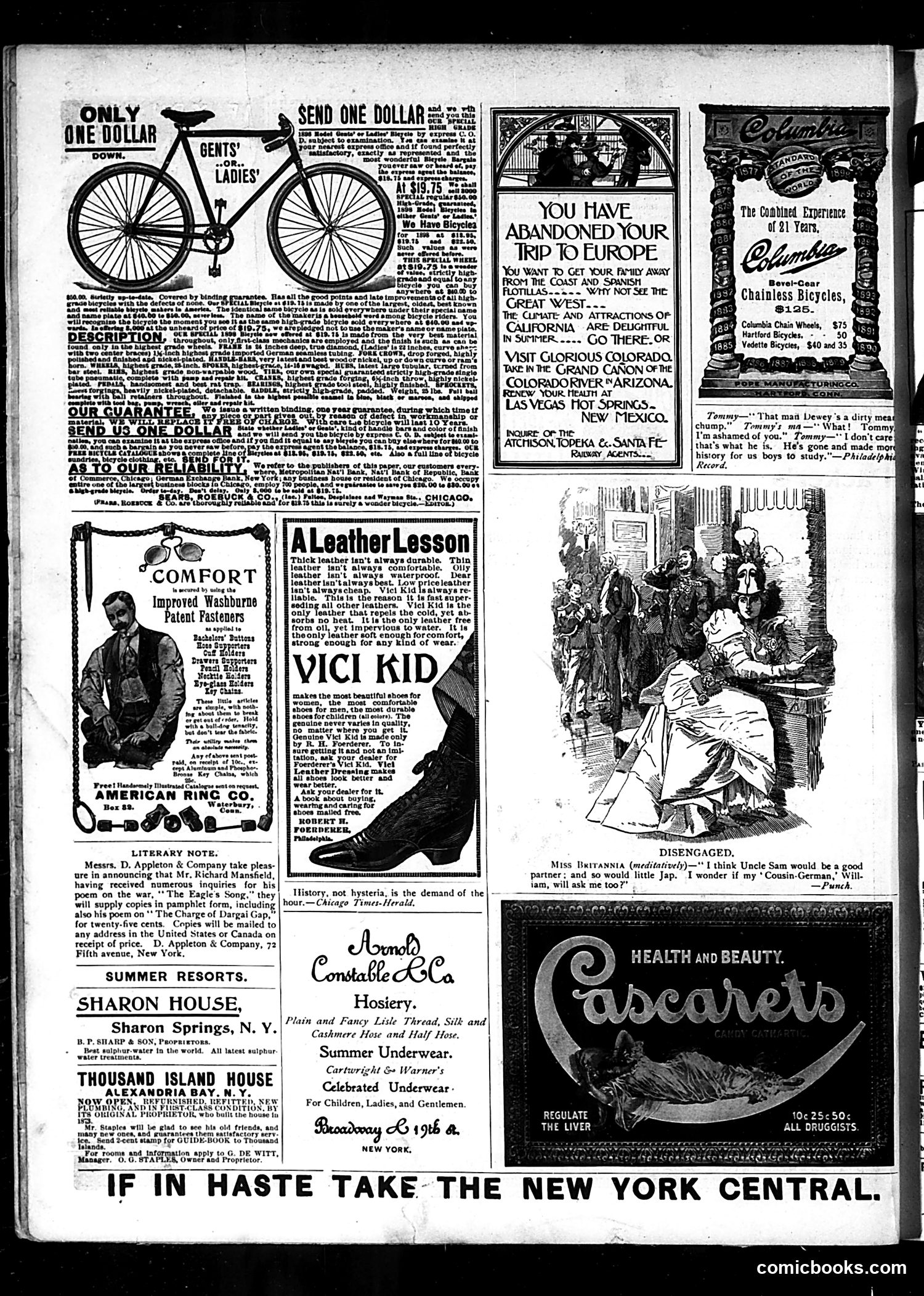
This page is primarily **advertising** with minimal satirical content. The notable exception is a small cartoon labeled "DISENGAGED" showing Miss Britannia (Britain) considering partnership with Uncle Sam (America) and "little Jap" (Japan), while wondering if her "Cousin-German" (Germany) will also ask her. The cartoon appears to reference **turn-of-the-century geopolitical realignment**—likely the Boer War period when Britain was reassessing its diplomatic relationships. The satire suggests Britain flirting with potential allies (America, Japan) while uncertain about Germany's intentions. Most of the page consists of product advertisements: bicycles (one dollar down), shoes (Vici Kid leather), hosiery, summer resort hotels, and patent fasteners. A literary note mentions Richard Mansfield's war poem "The Eagle's Song" and "The Charge of Dargai Gap"—references to contemporary military events. The page reflects early-1900s America: commercial optimism, imperial politics, and patriotic literature about military service.
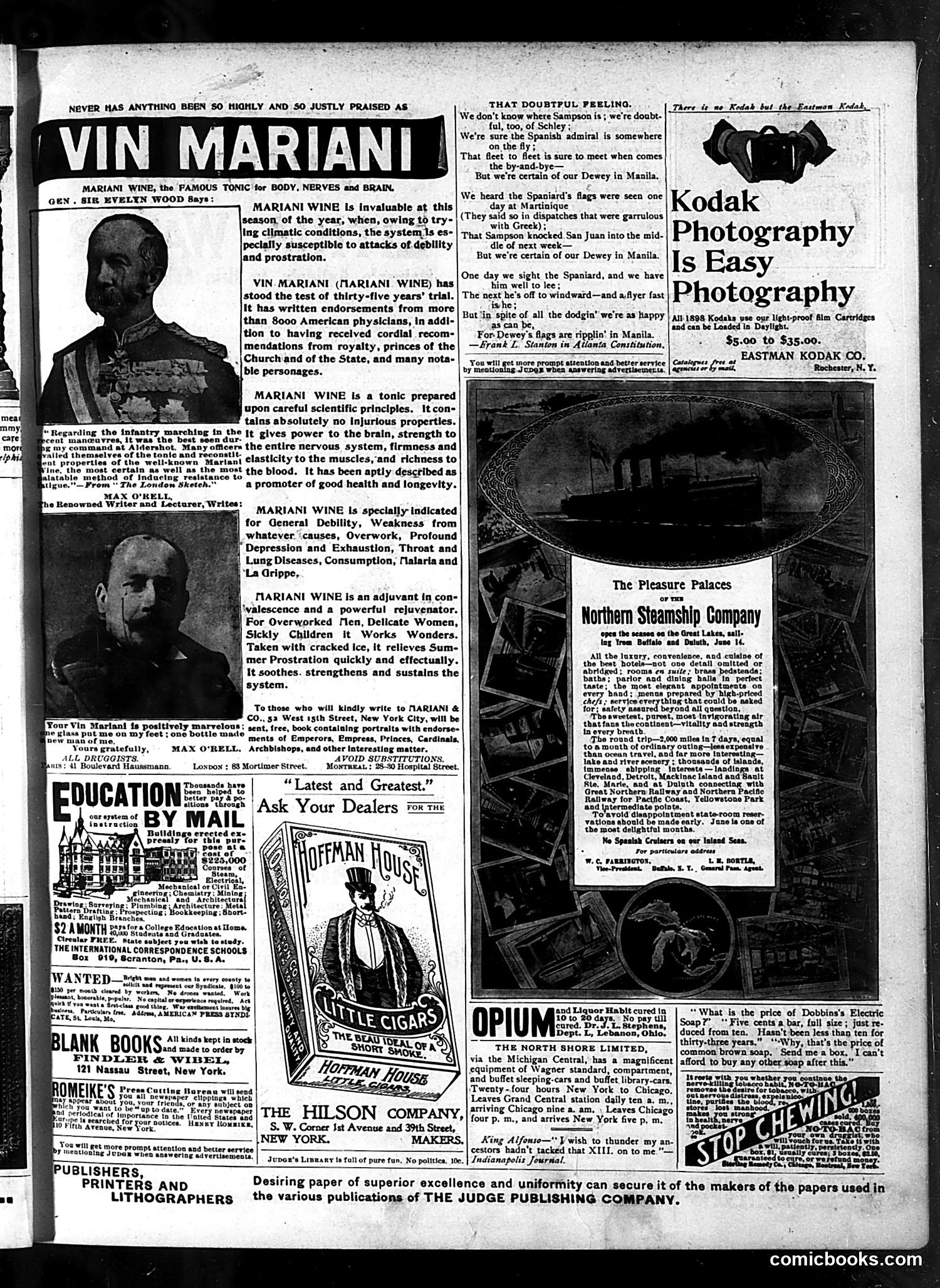
This page is primarily **advertising**, dominated by a large Mariani Wine promotion. The only satirical content is a brief poem titled "That Doubtful Feeling" at the top. ## The Satire The poem references the **Spanish-American War** (1898). It expresses uncertainty about the locations of American naval figures Sampson and Schley, and the Spanish fleet's whereabouts—but expresses absolute confidence in Admiral Dewey's presence in Manila. This appears to be **political satire about American military preparedness**: while the government is uncertain about major strategic matters, there's ironic certainty about one commander. The poem mocks the conflicting reports and "garrulous" dispatches about war movements, suggesting public confusion despite official confidence. The Kodak Photography advertisement on the right is unrelated—it simply capitalizes on the page's readership. **Context for modern readers**: This dates to the Spanish-American War period when Dewey's naval victory at Manila Bay (May 1898) was a major American success story, making him a celebrated figure despite broader strategic confusion elsewhere.
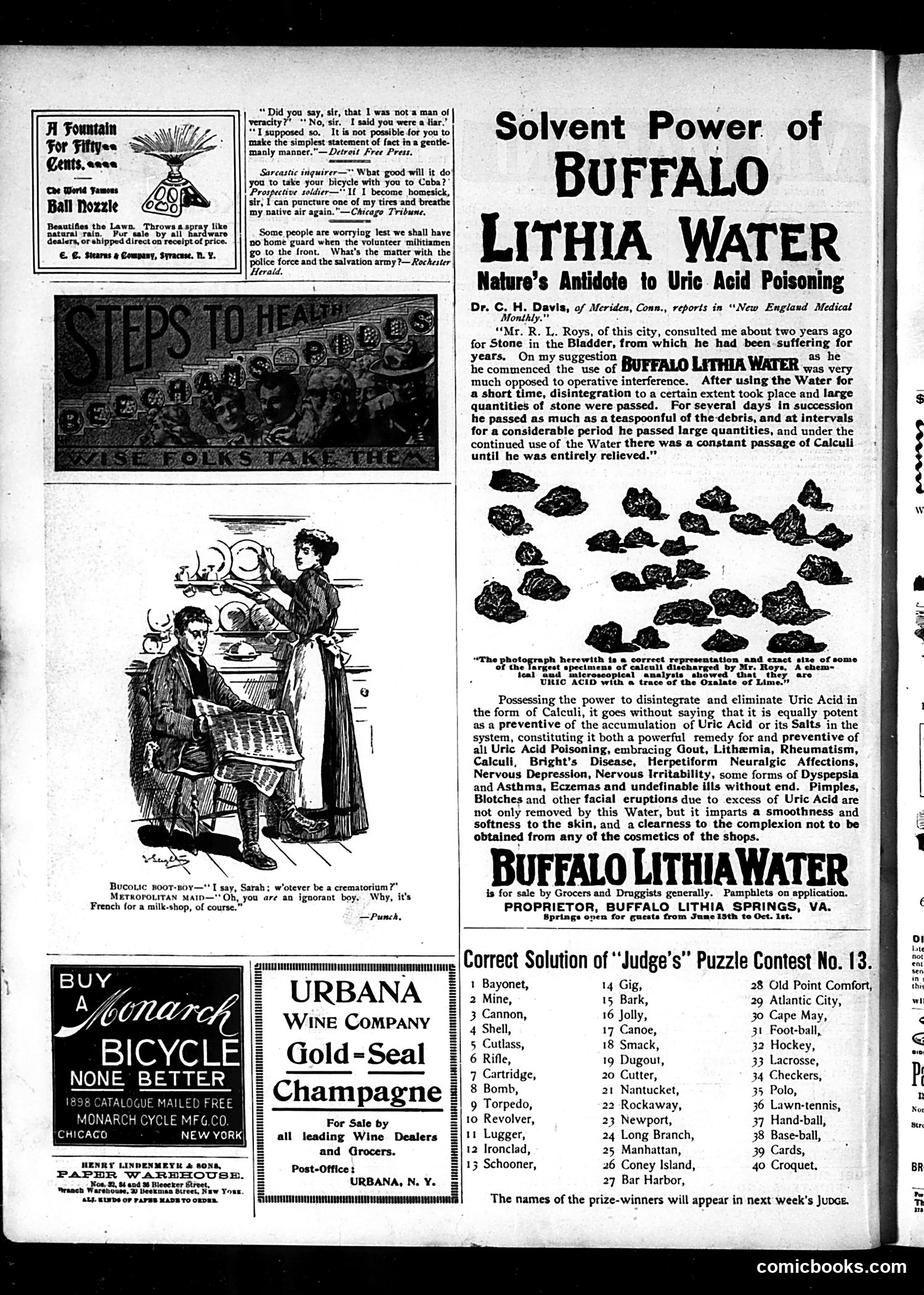
This page from Judge magazine contains several distinct elements: **The Cartoons:** Three brief comic dialogues appear: 1. A debate about honesty between two gentlemen 2. A soldier joking about taking his bicycle to Cuba (likely referencing the Spanish-American War) to cure homesickness by puncturing a tire 3. A rural couple misunderstanding "crematorium" as French for "milk-shop" These represent typical Judge humor: wordplay, social commentary about contemporary issues (the Cuban conflict), and class-based comedy contrasting rural ignorance with urban sophistication. **The Advertisements:** The page is dominated by ads for Buffalo Lithia Water, a patent medicine claiming to dissolve kidney stones and treat various ailments caused by "uric acid poisoning." The ad includes a doctor's testimonial and photographs of actual calculi (kidney stones) supposedly passed by a patient—a marketing strategy common in this era. The other ads promote Monarch bicycles, Urbana champagne, and other products typical of the period's commercial landscape.
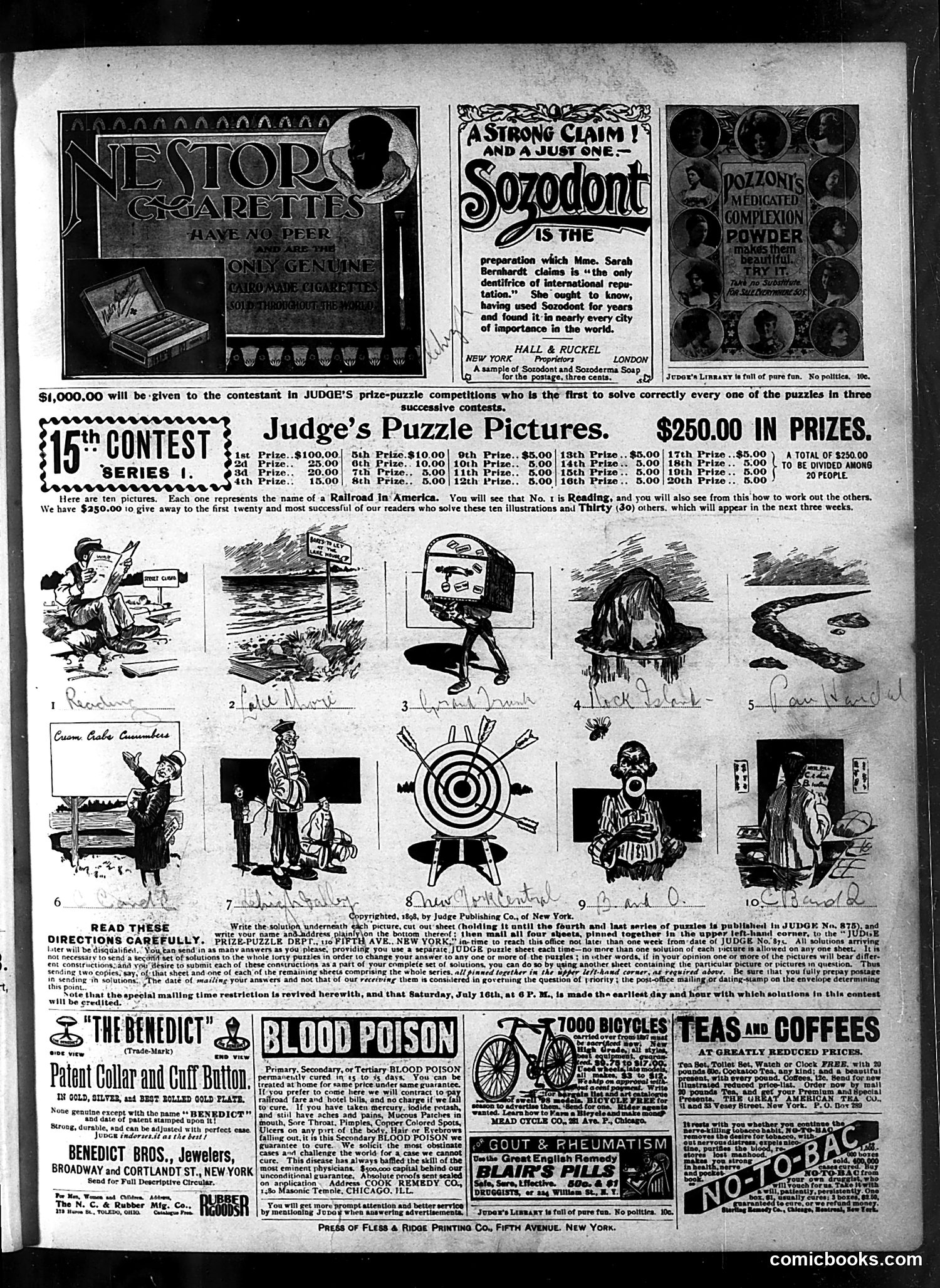
This is primarily a **puzzle contest page**, not a political cartoon. The central feature is Judge magazine's "$250 Prize Puzzle" competition, where readers must identify ten American railroads from illustrated visual puns. Image 1, labeled "Reading," shows a man reading a newspaper—a rebus for the Reading Railroad. The page is **dominated by advertisements** for patent medicines and consumer goods typical of early 20th-century magazines: "The Benedict" collar button, "Blood Poison" treatments, bicycles, and tea. These ads reflect the era's lack of FDA regulation, hawking dubious medical remedies. The small illustrated vignettes (numbered 2-10) appear to be additional puzzle clues, though their specific railroad identities aren't clearly legible in this reproduction. **There is no political satire or social commentary** on this page—it's a commercial engagement vehicle designed to boost readership through prizes while generating advertising revenue.
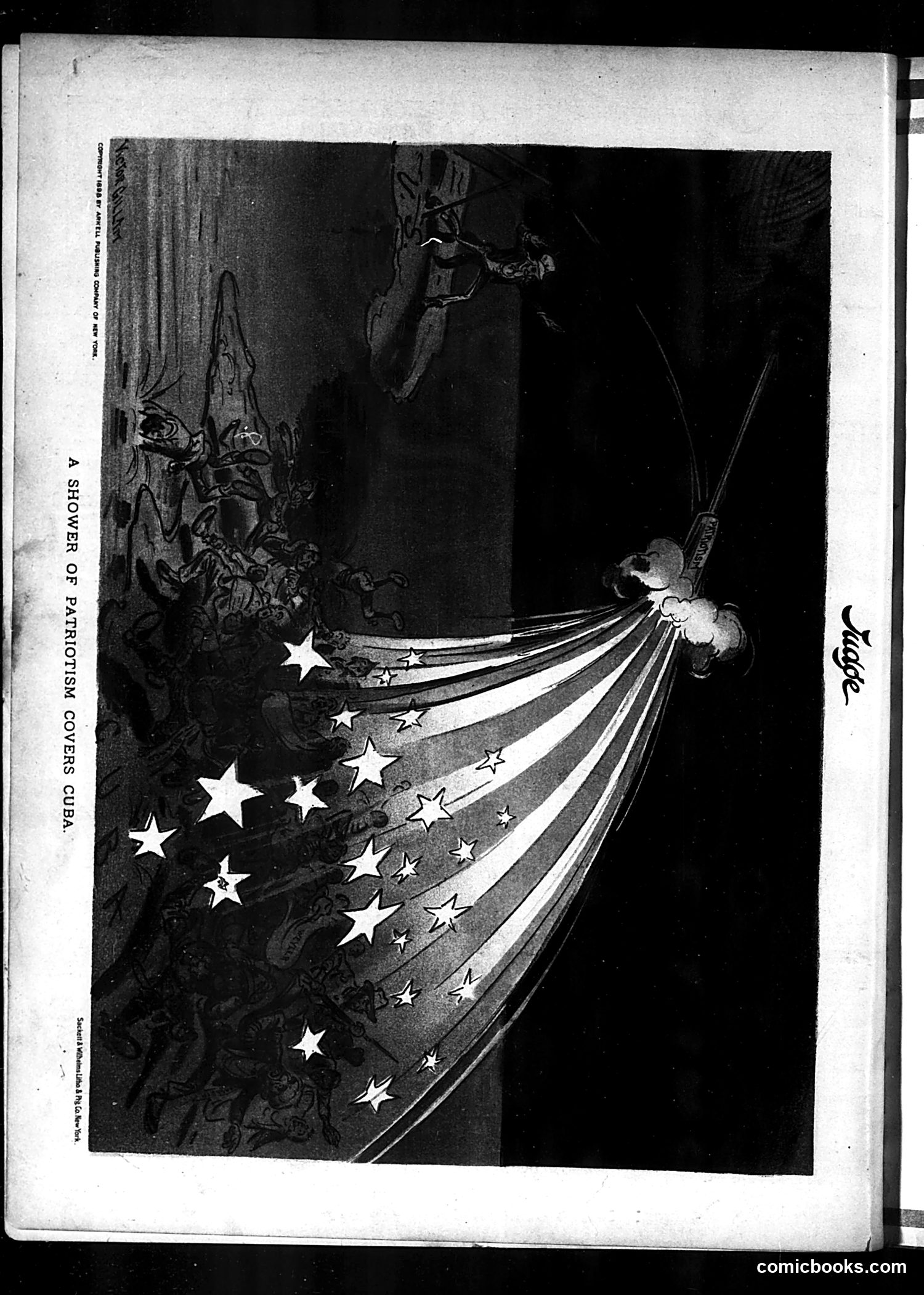
This political cartoon satirizes American intervention in Cuba. The image shows Uncle Sam (identifiable by his characteristic appearance) showering Cuba with an American flag featuring stars. The figure appears to be positioned above Cuban figures or territory below, depicted in a classical allegorical style typical of Judge magazine. The satire likely critiques U.S. imperial ambitions toward Cuba—suggesting America is imposing itself on Cuba under the guise of patriotic protection or "civilization." The shower metaphor suggests either excessive intervention or false benevolence. This artwork likely dates to the late 19th or early 20th century, when American imperialism and Cuban independence were contentious political issues, particularly during or after the Spanish-American War (1898).