
A complete issue · 16 pages · 1898
Judge — April 16, 1898
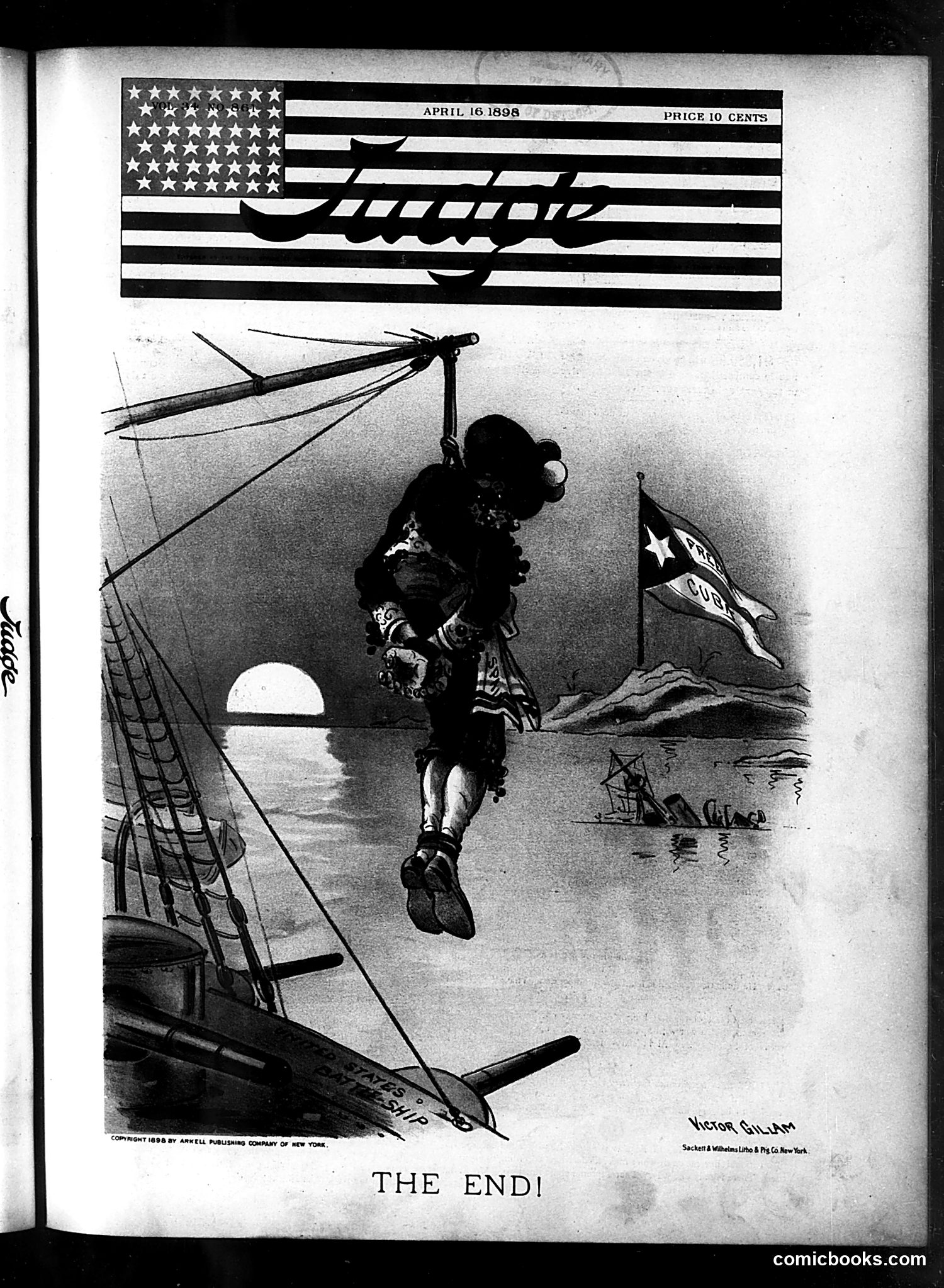
This illustration depicts a figure hanging from a ship's rigging against a sunset backdrop. The accompanying flag and "THE END" caption suggest this represents a conclusion to a conflict or era. Given the April 1898 date, this likely references the Spanish-American War, which began that month. The hanging figure may represent Spain or Spanish colonial power, while the American flag at top and the departing ship suggest American military victory or the end of Spanish imperial dominance. The satirical point appears to celebrate American triumph, depicting Spain's downfall as virtually complete ("THE END"). The romantic, heroic artistic treatment contrasts with the grim subject matter—typical of Judge's jingoistic coverage during this period of American imperial expansion.
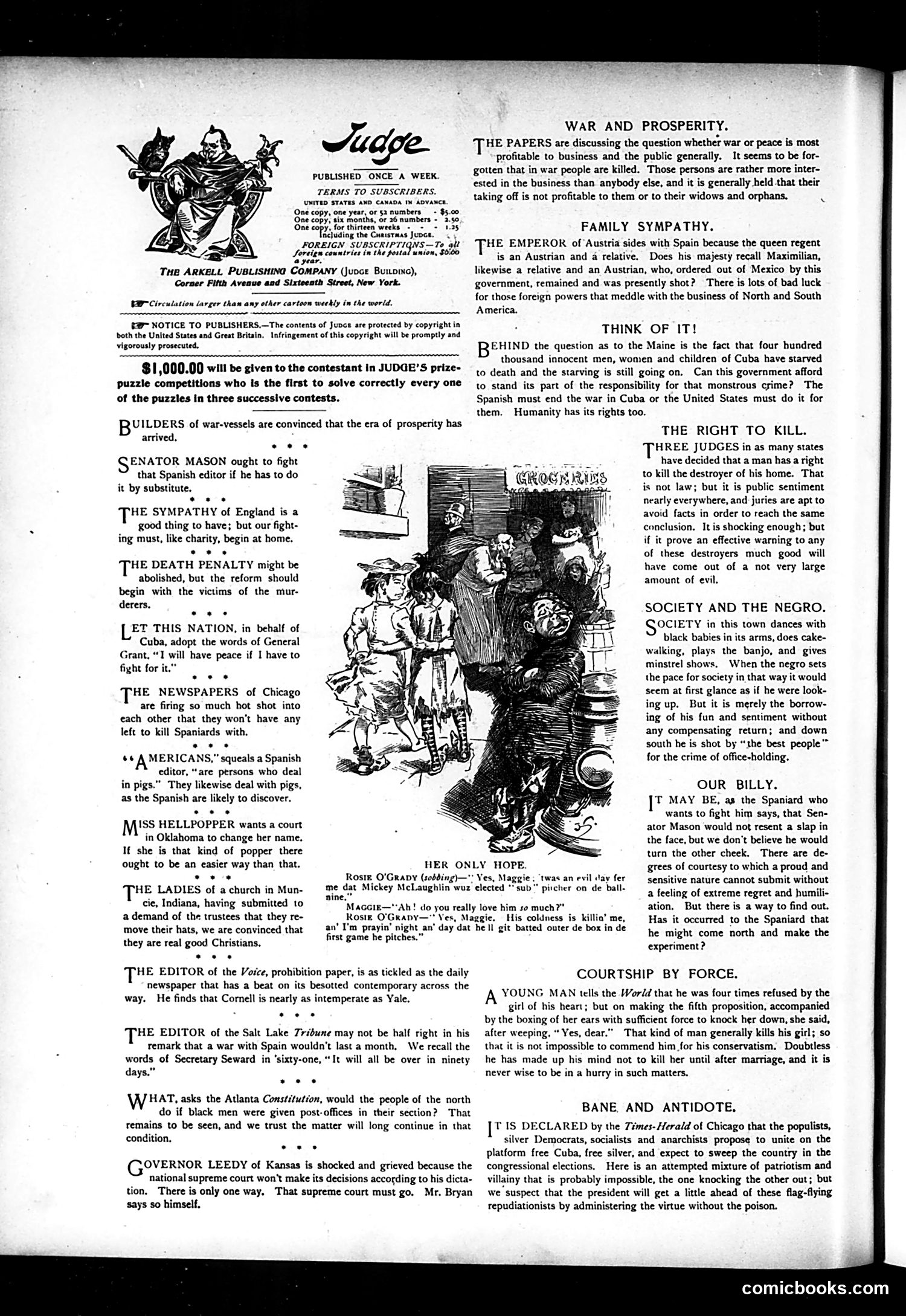
This page from Judge magazine addresses the Spanish-American War and its domestic implications. The central cartoon depicts a confrontation between American and Spanish figures, likely referencing the USS Maine incident or broader war tensions. The editorial content satirizes various positions: it mocks the Austrian Emperor's sympathy for Spain, criticizes those profiting from war, and addresses racial attitudes of the era ("Society and the Negro" section uses dehumanizing language typical of that period). The "Courtship by Force" piece satirizes forced political persuasion, while other sections target politicians like Senator Mason and Governor Leedy. The overall tone suggests Judge's skepticism toward Spanish colonialism while also critiquing American militarism and profiteering—characteristic of progressive-era satire wrestling with America's imperial ambitions.
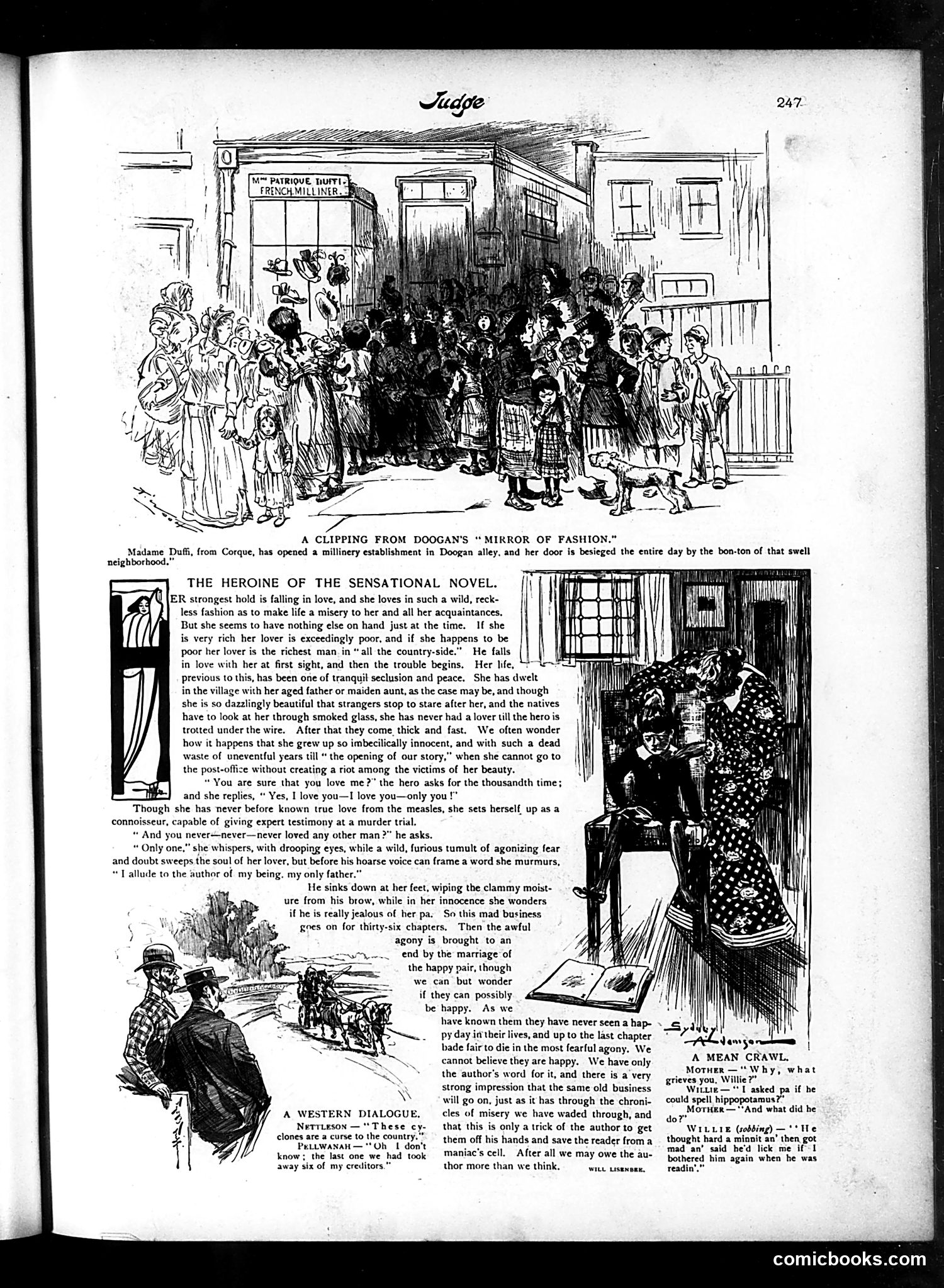
This page contains literary criticism and satirical fiction rather than political cartoons. The main article reviews "the heroine of the sensational novel"—a young woman who falls in love with a poor man despite her wealthy circumstances, leading to romantic complications and eventual marriage. The accompanying illustrations depict scenes from this melodramatic narrative: a crowded street scene outside a milliner's shop (referencing Doogan's "Mirror of Fashion"), interior domestic scenes, and a "Western Dialogue" between characters named Nettleton. The satire targets Victorian sensational fiction's predictable plots and overwrought emotional drama—the magazine mocks how these novels follow formulaic patterns of class conflict and tearful reconciliation, treating such stories as shallow entertainment for readers hungry for melodrama.
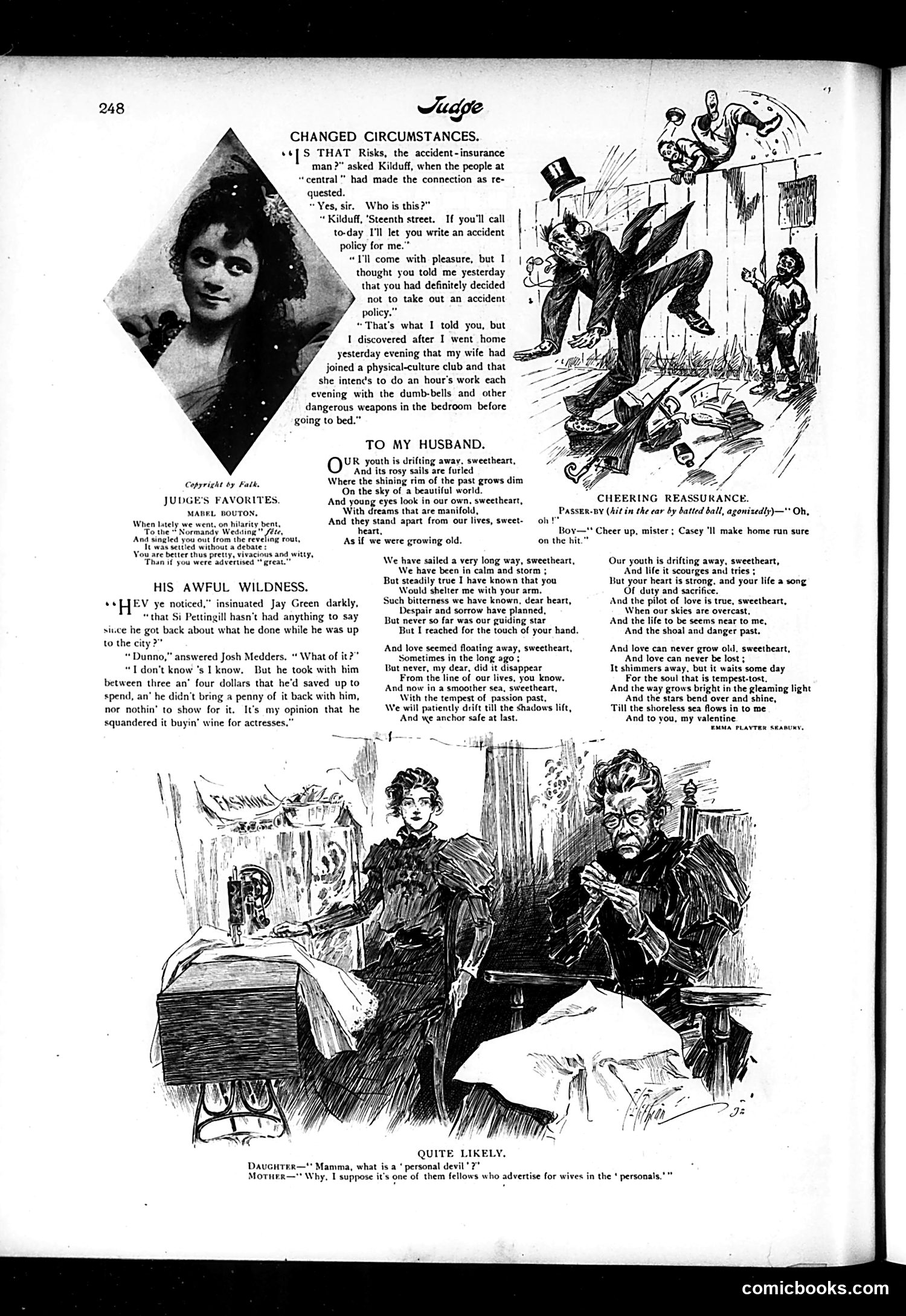
This page contains several unrelated satirical pieces typical of Judge magazine's format: **"Changed Circumstances"** mocks a man named Kidduff who claimed he couldn't afford accident insurance, then his wife joined a "physical-culture club" (exercise club), leading him to reconsider the policy—implying wives engaged in strenuous activities posed greater injury risks, making insurance suddenly necessary. The joke relies on period anxieties about women's newfound participation in athletic pursuits. **"Cheering Reassurance"** appears to be a lighthearted cartoon about a boy reassuring his sister about a baseball game. **"Quite Likely"** is a brief joke about "personal devils" in newspaper personals ads, suggesting disreputable men advertise there seeking wives. The page primarily demonstrates Judge's blend of domestic humor and social commentary about changing gender roles in early 20th-century America.
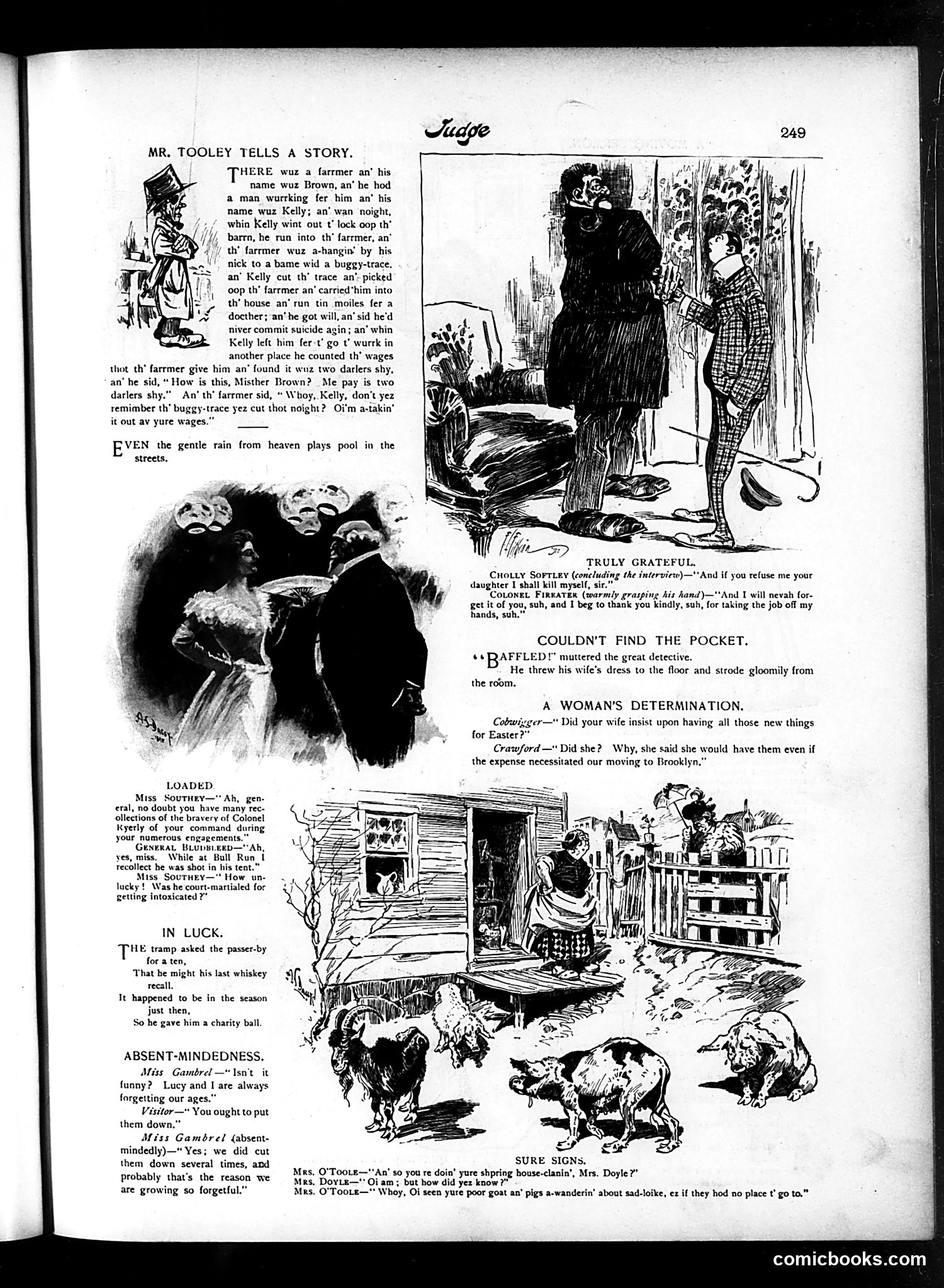
This page contains multiple satirical sketches typical of late 19th/early 20th-century American humor magazine format. **Major content:** The opening story by "Mr. Tooley" uses dialectical Irish-American speech to joke about a farmer who attempts suicide but survives, then deducts the cost of the buggy-trace Kelly cut to save him from the worker's wages—dark humor about miserliness. Other sketches include: - **"Truly Grateful"**: A Southern colonel character welcomes a suitor's suicide threat as preferable to refusing his daughter's marriage - **"Couldn't Find the Pocket"**: A detective story joke about a husband searching his wife's dress - **"A Woman's Determination"**: A wife insists on Easter purchases even if they force moving to Brooklyn (then considered unfashionable) - **Various dialect-heavy vignettes** featuring working-class and immigrant characters in humorous domestic situations The humor relies heavily on period stereotypes, crude characterization, and social class mockery. The illustrations are simple ink sketches typical of the era.
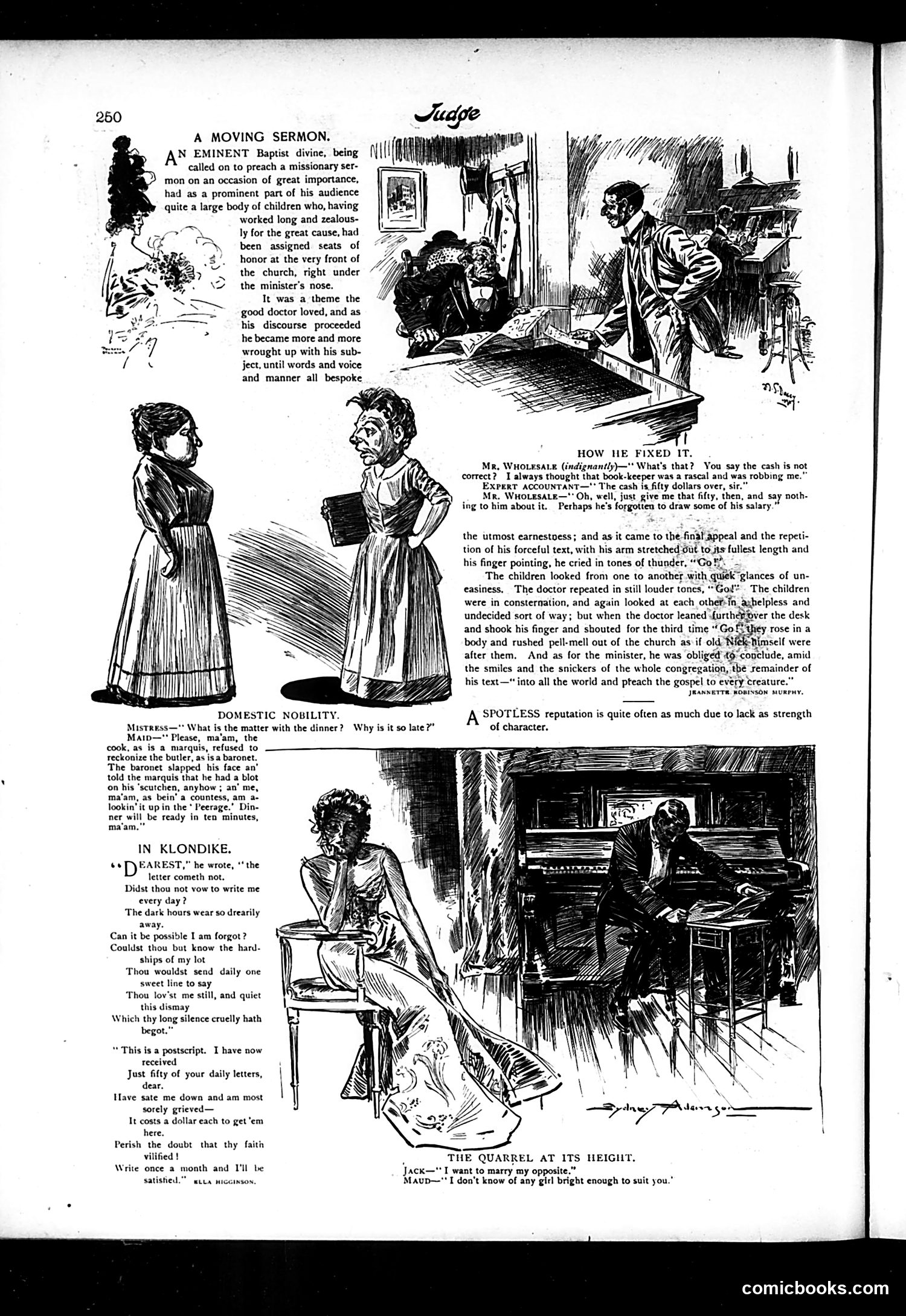
This page contains several satirical pieces: **"A Moving Sermon"** mocks a Baptist minister's passionate missionary sermon. His repeated thunderous cry of "Go!" was meant metaphorically to inspire missionary work, but the children in the front row interpreted it literally as a command to leave—causing them to rush out of the church in confusion. The satire targets overwrought religious rhetoric and the gap between a speaker's intentions and audience comprehension. **"How He Fixed It"** satirizes business dishonesty. A wholesale merchant, accused of being robbed by his bookkeeper, learns the cash is actually *fifty dollars over*—yet asks to keep the extra money anyway, dismissing it as forgotten salary. The joke exposes self-serving hypocrisy among the wealthy. **"Domestic Nobility"** ridicules class pretension through a servant's explanation of dinner delays: each household member (cook, butler, marquis, baronet) refuses to acknowledge the others' status, creating absurd hierarchy conflicts that prevent work. The remaining items—"In Klondike," "Domestic Nobility" dialogue, and "The Quarrel at Its Height"—are brief comedic verses about romantic/domestic misadventures, typical Judge filler content.
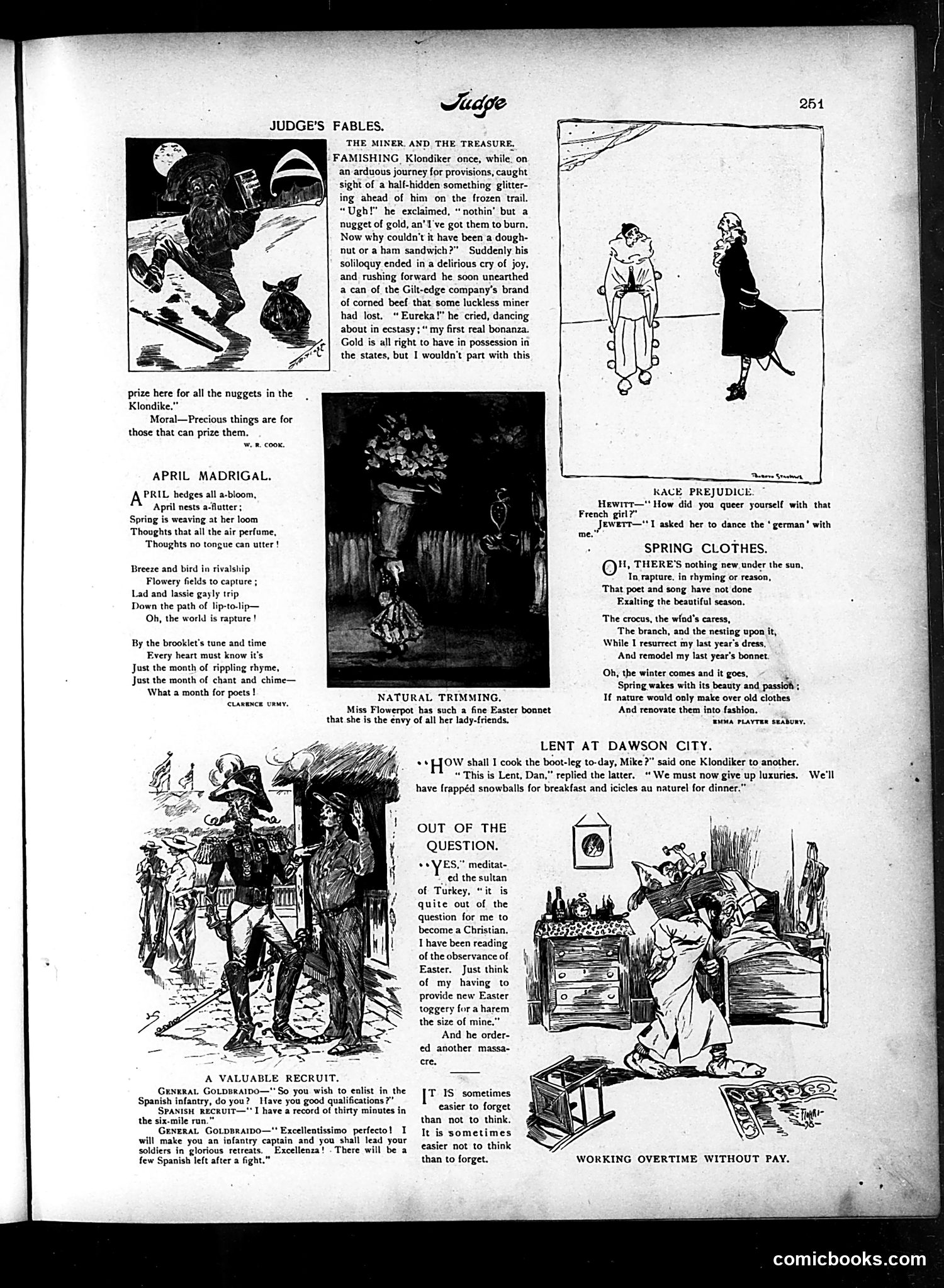
This page contains multiple satirical pieces targeting turn-of-the-century American and international concerns: **"The Miner and the Treasure"** mocks Klondike Gold Rush prospectors (1890s) who obsessed over gold while starving—the irony being that food proves more valuable than precious metals in harsh conditions. **"Race Prejudice"** is a brief joke implying that asking a French woman to dance the "german" (a popular dance) was offensive due to Franco-German tensions, likely referencing the Franco-Prussian War's lingering animosity. **"The Sultan of Turkey"** satirizes the Ottoman Empire's religious intolerance and violence. The sultan refuses Christianity partly due to Easter clothing expenses for his large harem—a crude jab at both Ottoman polygamy and bureaucratic absurdity. **"A Valuable Recruit"** mocks Spain's military incompetence during the Spanish-American War (1898), portraying a Spanish general praising a mediocre recruit and promising "glorious retreats"—emphasizing Spain's military failures. Other pieces address seasonal themes and domestic life with lighter humor.
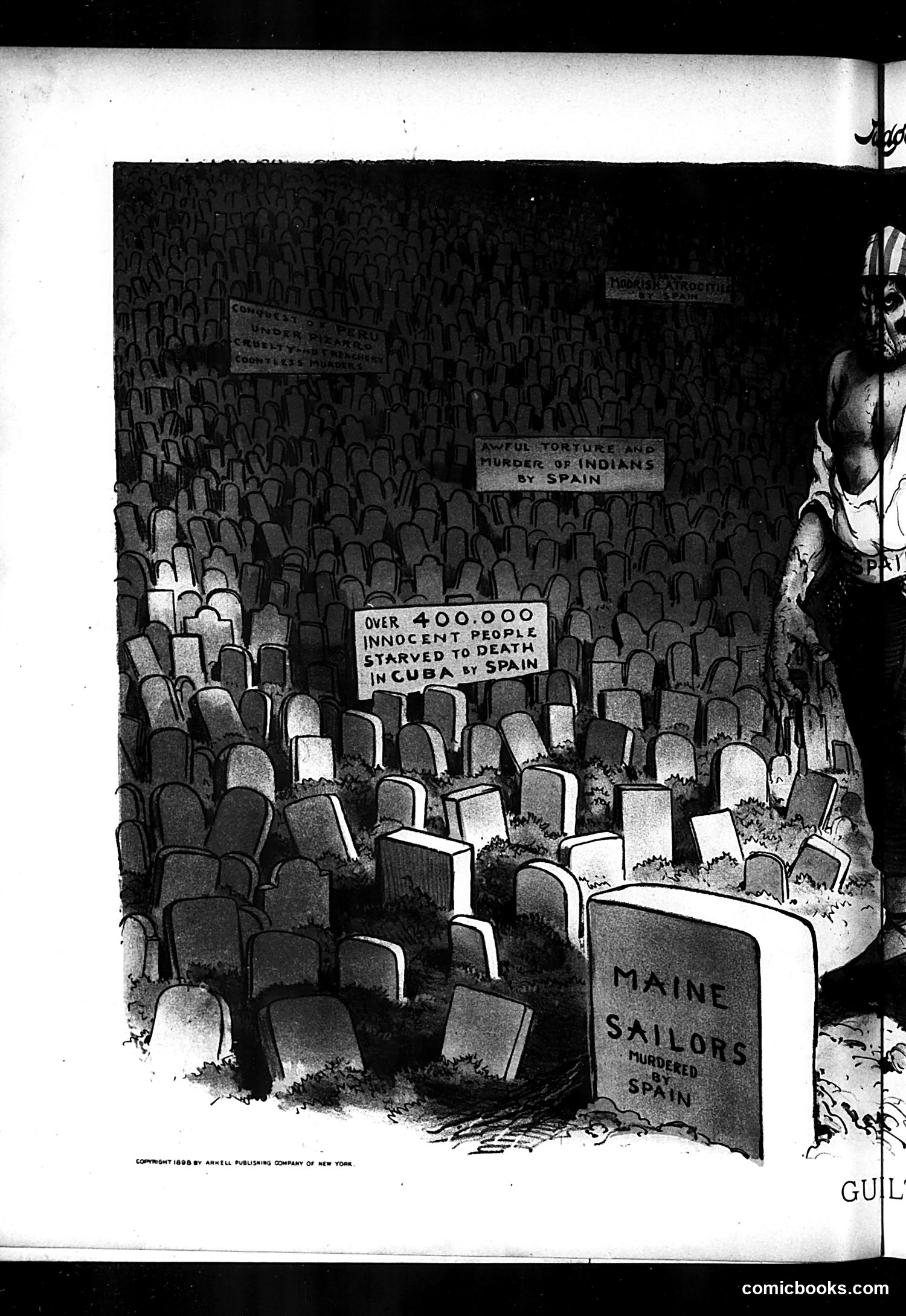
This is a stark anti-Spain political cartoon from *Judge* magazine (copyright 1938, per the visible attribution). It depicts a massive cemetery filled with gravestones, prominently featuring "Maine Sailors Murdered by Spain" and signs reading "Over 400,000 Innocent People Starved to Death in Cuba by Spain" and "Awful Torture and Murder of Indians by Spain." The cartoon references Spain's colonial atrocities in Cuba and its historical treatment of indigenous populations. The 1898 USS *Maine* explosion—which triggered the Spanish-American War—is invoked to stoke American anti-Spanish sentiment. The sheer visual weight of hundreds of graves emphasizes the scale of alleged Spanish brutality, functioning as fierce propaganda against Spain, likely during or before the Spanish Civil War era when American public opinion divided over Spanish fascism.
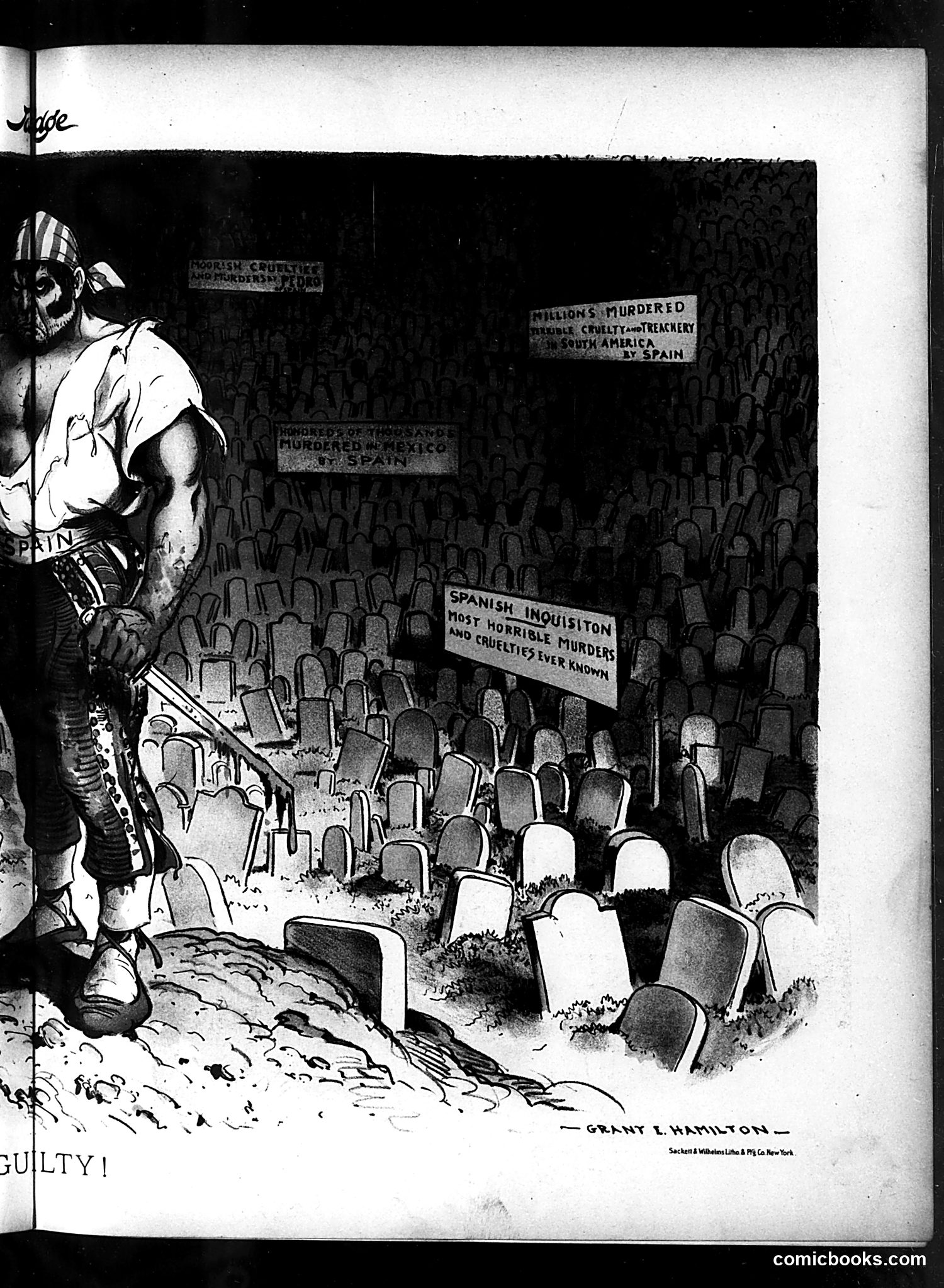
This is a dark satirical cartoon by Grant L. Hamilton depicting Spain as a skeletal, armored figure of Death standing over a vast graveyard. The tombstones bear labels documenting Spanish atrocities: - "Irish Cruelty and Disorders in Ireland" - "Millions Murdered: Spanish Cruelty and Treachery in South America" - "Hundreds of Thousands: Murdered and Starved in Mexico by Spain" - "Spanish Inquisition: Most Horrible Murders and Cruelties Ever Known" The cartoon condemns Spain's historical record of violence and oppression across multiple continents and centuries. This likely appeared during tensions over Spanish colonial rule or the Spanish-American War era, when American political discourse frequently invoked Spain's brutal imperial legacy to justify American interventionism. The visual equation of Spain with Death itself underscores the artist's moral condemnation.
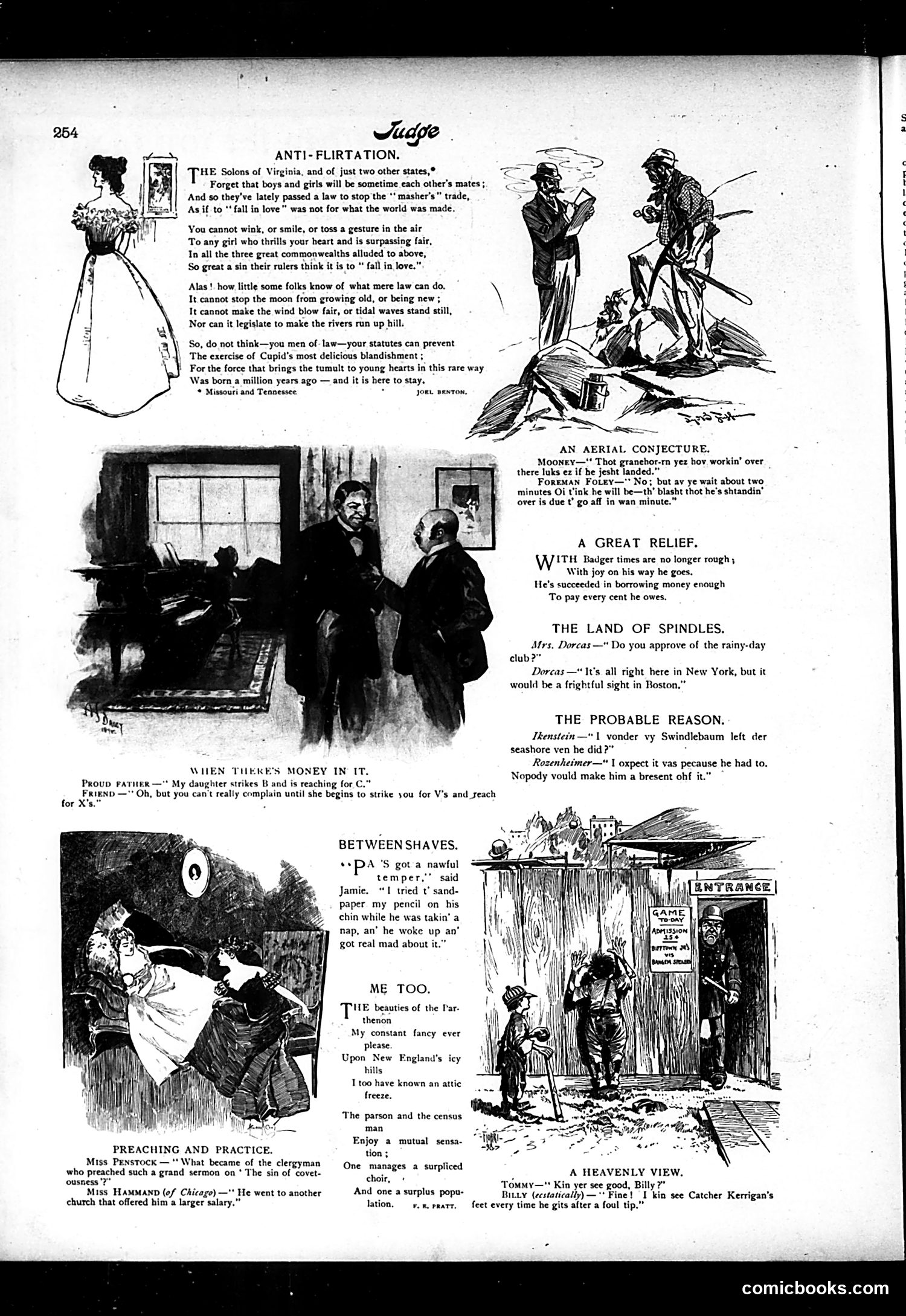
This satirical page from *Judge* contains several brief comic items typical of the publication's style. The main feature, "Anti-Flirtation," mocks recent laws passed in Virginia, Missouri, and Tennessee attempting to criminalize flirting and courtship behavior (the "masher's trade"). The poem argues such legislation is futile—natural human attraction cannot be legislated away. The accompanying illustration shows a woman rejecting a suitor's advances, satirizing these puritanical legal efforts. Remaining items are brief humor vignettes: "An Aerial Conjecture" jokes about construction site accidents; "A Great Relief" plays on financial desperation; "The Land of Spindles" contrasts regional attitudes (Boston being more prudish than New York); "Between Shaves" depicts Irish-accented working-class humor; and others offer simple wordplay and domestic comedy. The page represents *Judge*'s satirical approach: poking fun at social legislation, class distinctions, and contemporary attitudes through verse, caricature, and colloquial dialogue.
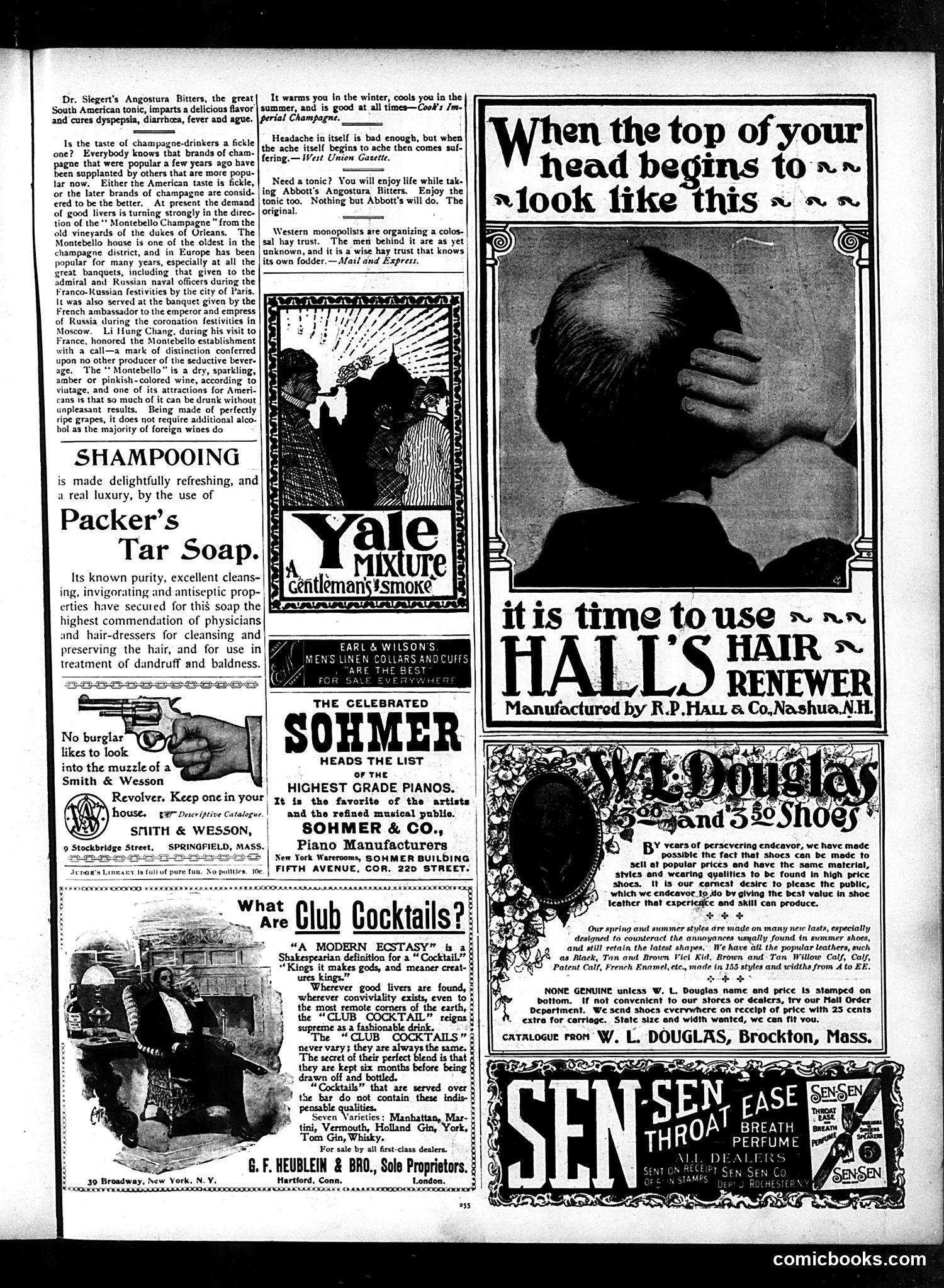
This is primarily an **advertising page** from an early 20th-century American satirical magazine, with minimal editorial content. The main notable item is the **Hall's Hair Renewer advertisement** featuring a dramatic photograph of a bald man's head with the caption "When the top of your head begins to look like this" — a direct appeal to male vanity and anxiety about hair loss. This represents period advertising's common use of shame-based marketing. The remaining content consists of product advertisements for patent medicines (Angostura Bitters), champagne, tar soap, pianos, revolvers, shoes, and cocktail mixers — typical commercial fare for this magazine. One small editorial note mentions **Western monopolists organizing a "hay trust,"** referencing the era's widespread concern about industrial monopolies controlling American commodities — a major political issue of the Progressive era. Otherwise, this page demonstrates how Judge magazines operated: satirical commentary subsidized by advertising revenue from established brands targeting affluent readers.
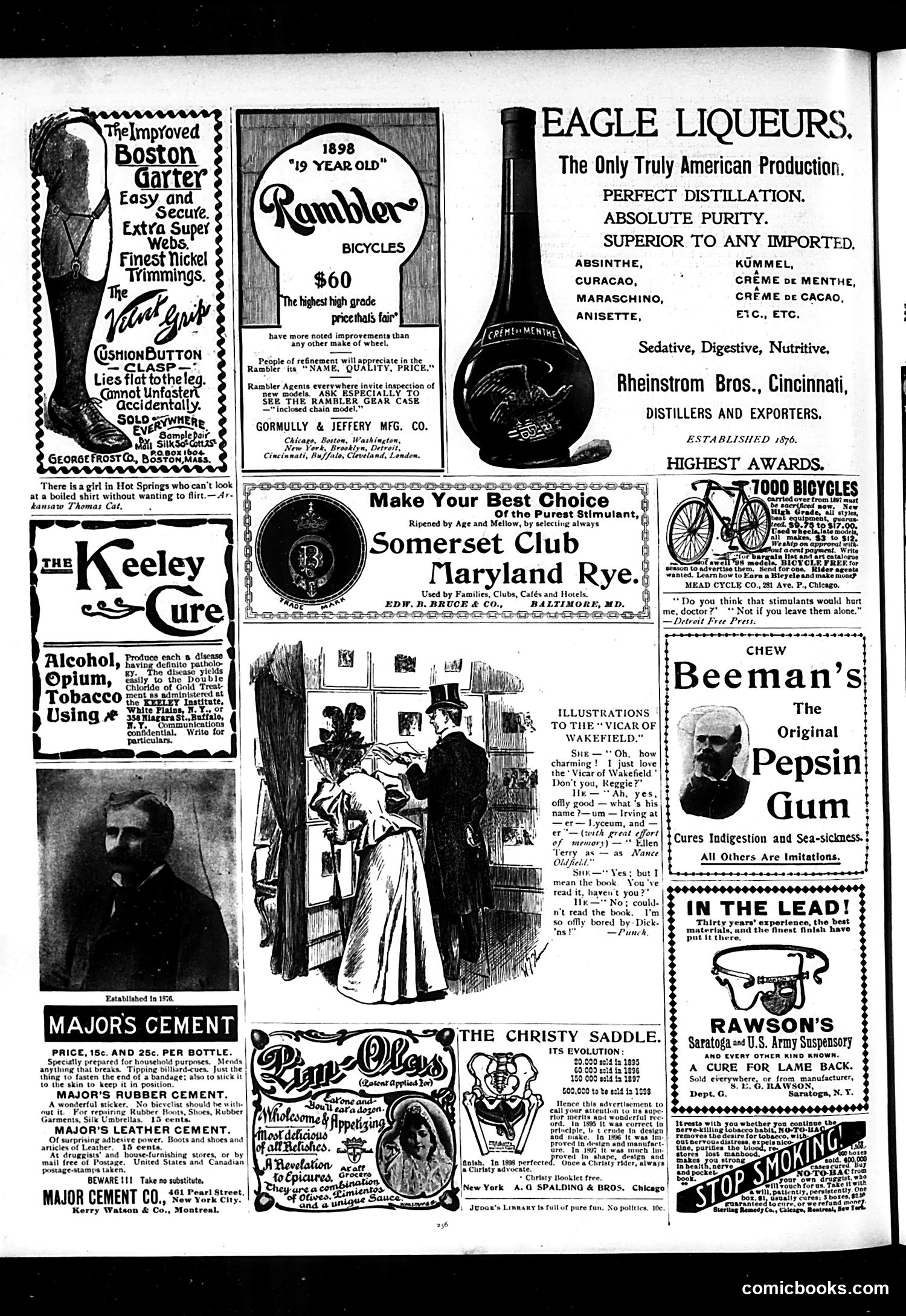
This page is primarily **advertising**, typical of late-19th-century magazines. The advertisements promote patent medicines, bicycles, liqueurs, and novelty products common to the 1890s. The small satirical content includes: **"The Vicar of Wakefield" illustration**: A dialogue mocking shallow Victorian literary appreciation. A woman gushes about loving the classic novel, but when asked the character's name, her companion struggles to remember—implying people praised literature they hadn't actually read or understood. This satirizes pretentious cultural consumption. **The Hot Springs anecdote**: A crude joke about a woman sexually attracted to starched shirts, playing on period anxieties about women's propriety. Most notable are the **patent medicine ads**—products like Beeman's Pepsin Gum, Rawson's Suspensory, and Keeley Cure (treating alcohol and opium addiction) represent the era's largely unregulated pharmaceutical industry. These products claimed curative powers we'd now recognize as dubious or dangerous, reflecting pre-FDA consumer vulnerability.
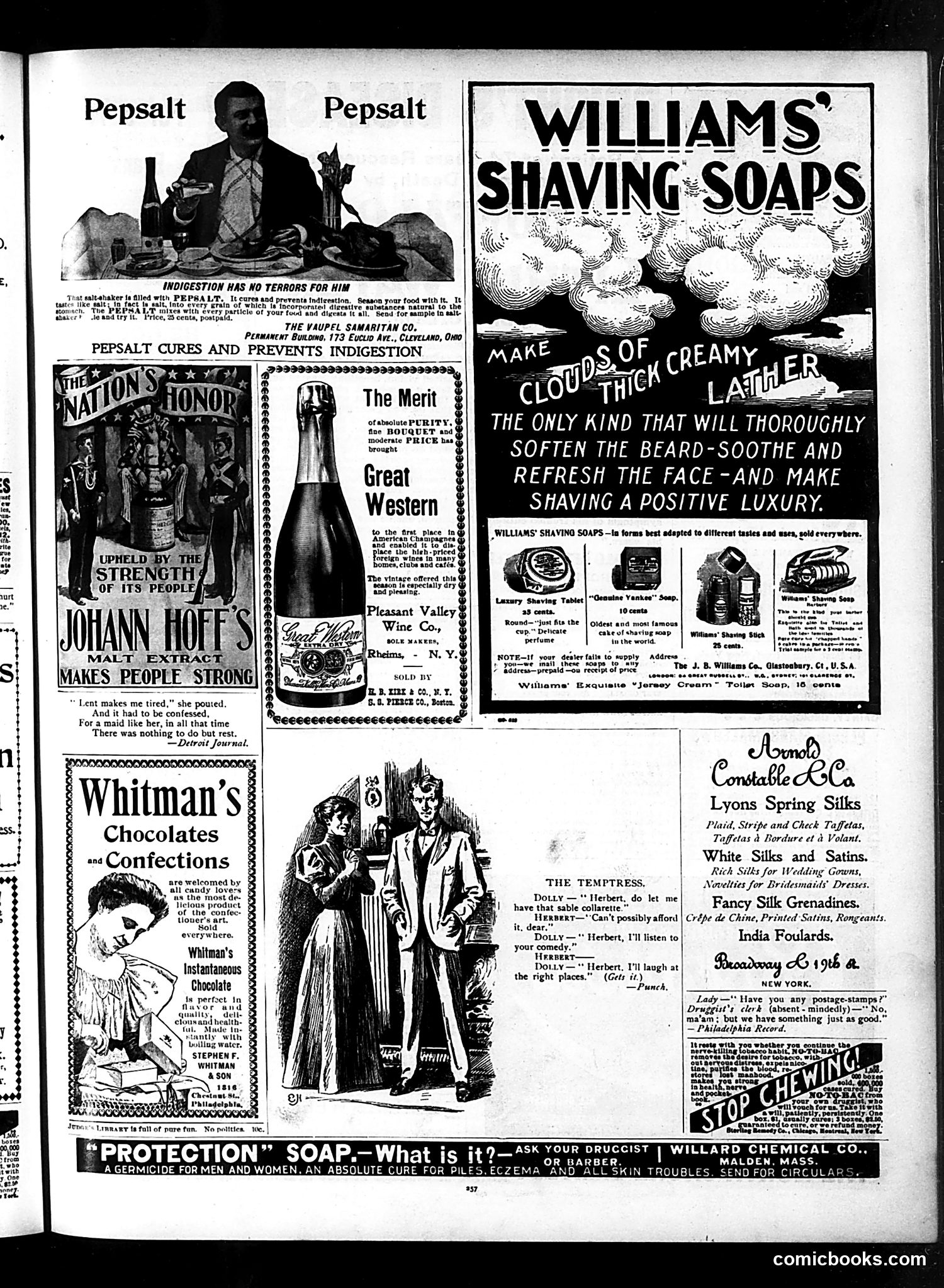
This page is primarily **advertising**, typical of Judge magazine's revenue model. Key advertisements include: - **Pepsalt** (indigestion remedy) featuring a man dining confidently - **Johann Hoff's Malt Extract** ("Makes People Strong") - **Williams' Shaving Soaps** (largest ad, emphasizing luxurious lather) - **Whitman's Chocolates** - **Wine and silk fabric ads** - **"Protection" Soap** (a germicide) The only apparent satirical content is a brief **joke about Lent** (bottom left), where a woman complains about Lenten fasting, with the punchline that "there was nothing to do but rest"—a mild dig at religious observance's tedium. The page reflects early 20th-century consumer culture: patent medicines, alcohol (pre-Prohibition), luxury goods, and personal grooming products dominate. The advertising itself—with confident masculine imagery and pseudo-scientific health claims—represents the era's marketing approach to male consumers.
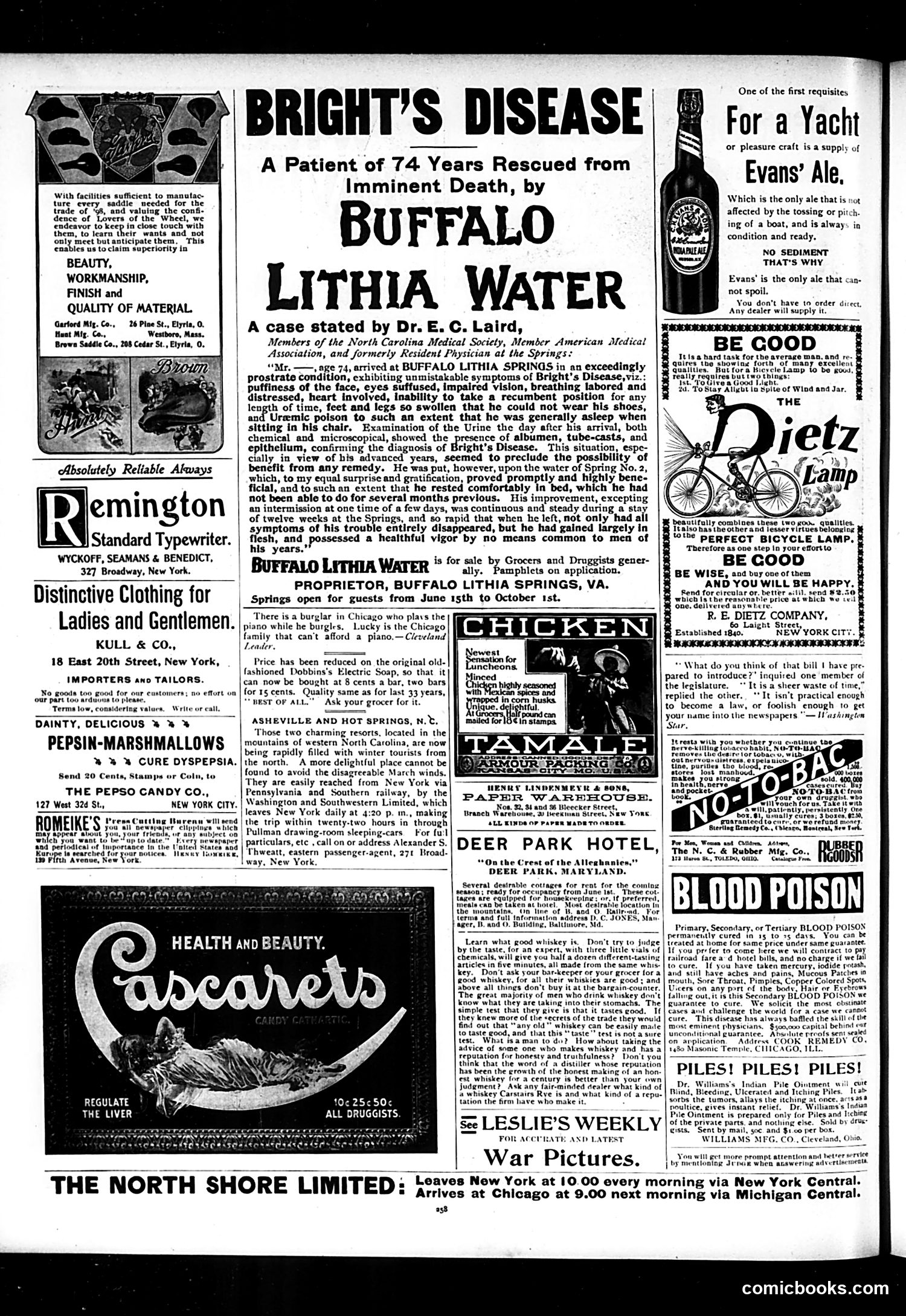
This page is primarily **advertising**, not political satire. The dominant content is a lengthy testimonial for Buffalo Lithia Water, a patent medicine claiming to cure Bright's Disease (a kidney ailment). The advertisement features a case study of a 74-year-old patient supposedly rescued from death through the water's therapeutic properties. The doctor's detailed account describes dramatic symptom reversal—swelling reduced, uremic poisoning cleared, strength restored—after twelve weeks at Buffalo Lithia Springs, Virginia. Surrounding this main ad are typical period advertisements: Remington typewriters, clothing retailers, candy for dyspepsia, saddles, and travel services. A small joke about a burglar pianist in Chicago appears mid-page. The page reflects early 20th-century medicine marketing, when mineral springs and patent medicines were widely promoted with medical testimonials (now largely recognized as fraudulent). No political content or satire is evident—this is purely commercial promotion typical of Judge's revenue model.
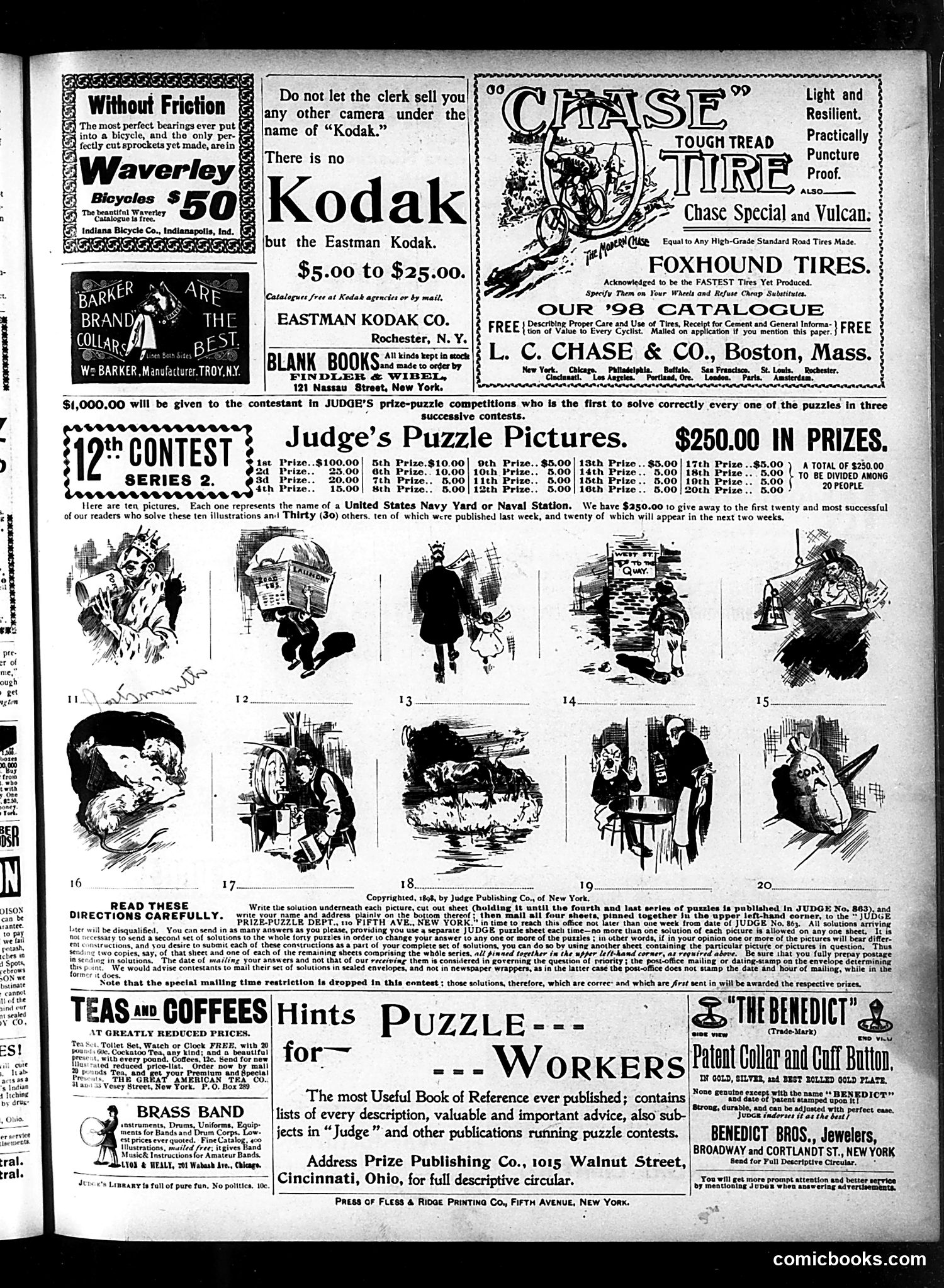
This page is **primarily advertising and contest material**, not political satire. The main content is Judge's "Puzzle Pictures" contest—a visual puzzle competition where readers identify 10 illustrations representing U.S. Navy Yards or Naval Stations. Winners of the first twenty correct solutions share $250 in prizes. Contestants were instructed to cut out pictures, write solutions on special sheets, and mail them to Judge's offices. The surrounding advertisements promote period products: Waverley bicycles, Kodak cameras (emphasizing brand authenticity), Chase tires, Eastman Kodak equipment, and other goods. A "Brass Band" advertisement and reference materials for "puzzle workers" fill remaining space. **No political cartoons or satire appear on this page.** It represents Judge functioning as an entertainment and advertising vehicle—readers solved visual puzzles for monetary prizes while advertisers paid for product promotion. This was a common magazine format of the era.
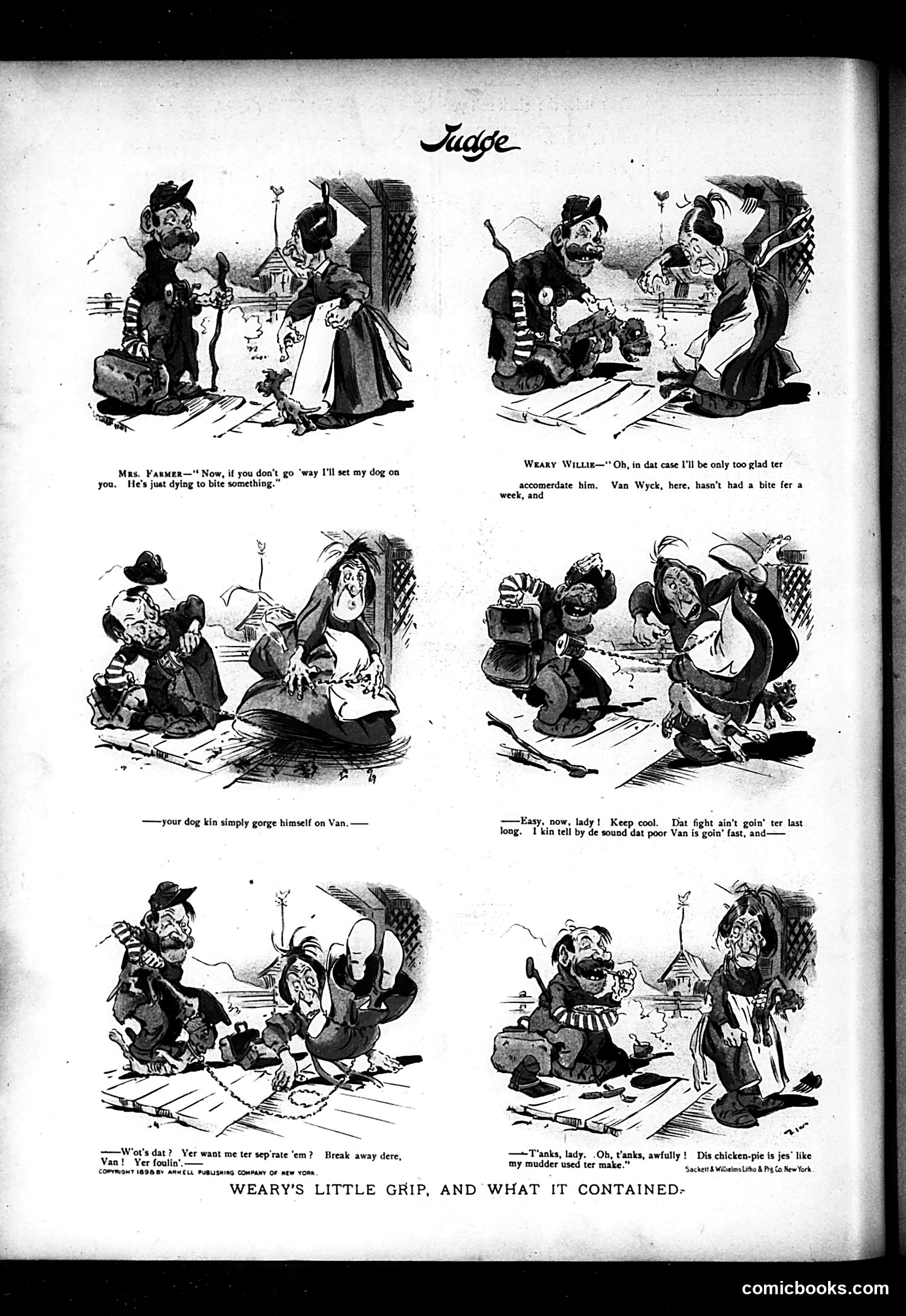
This six-panel comic strip satirizes late 19th-century urban life through the character "Weary Willie" (a vagrant/tramp figure), who carries a small bundle. The narrative shows a confrontation between Willie and Mrs. Farmer, who threatens to set her dog on him. A man identified as "Van Wyck" (likely Mayor Gould Van Wyck of New York) becomes involved in the scuffle. The satire targets political corruption and urban decay: Van Wyck, supposedly hungry ("hasn't had a bite fer a week"), fights over Willie's meager bundle—suggesting even city officials are desperate and corrupt. The joke's punchline reveals the bundle contains only a chicken pie, mocking both poverty and political greed. The exaggerated dialect and caricatured figures reflect period attitudes toward immigrants and the poor. The satire critiques how municipal leaders exploit vulnerable populations.