
Judge, 1898-04-16 · page 3 of 16
Judge — April 16, 1898 — page 3: what you’re looking at
What you’re looking at
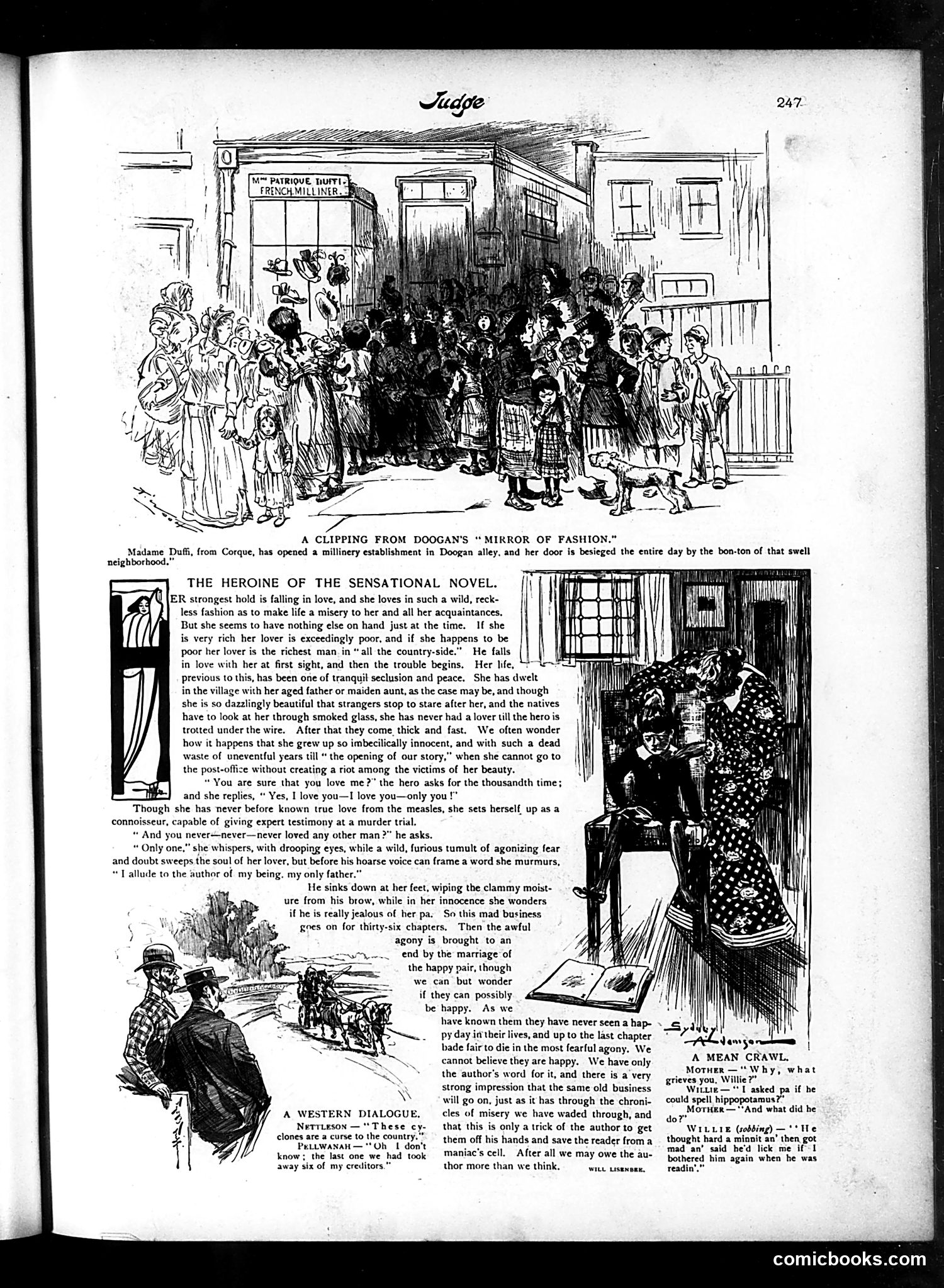
This page contains literary criticism and satirical fiction rather than political cartoons. The main article reviews "the heroine of the sensational novel"—a young woman who falls in love with a poor man despite her wealthy circumstances, leading to romantic complications and eventual marriage. The accompanying illustrations depict scenes from this melodramatic narrative: a crowded street scene outside a milliner's shop (referencing Doogan's "Mirror of Fashion"), interior domestic scenes, and a "Western Dialogue" between characters named Nettleton. The satire targets Victorian sensational fiction's predictable plots and overwrought emotional drama—the magazine mocks how these novels follow formulaic patterns of class conflict and tearful reconciliation, treating such stories as shallow entertainment for readers hungry for melodrama.
📄 Transcribed text from this page (OCR, searchable)
Machine-transcribed from the original scan — historical spelling and the odd misread are preserved.
A CLIPPING FROM DOOGAN'S “MIRROR OF FASHION.” Madame Dufii, from Corque, has opened a millinery establishment in Doogan alley, and her door is besieged the entire day by the bon-ton of that swell neighborhood.” THE HEROINE OF THE SENSATIONAL NOVEL. ER strongest hold is falling in love, and she loves in such a wild, reck- less fashion as to make life a misery to her and all her acquaintances, But she seems to have nothing else on hand just at the time. If she is very rich her lover is exceedingly poor, and if she happens to be poor her lover is the richest man. in “all the country-side.” He falls in love with her at first sight, and then the trouble begins. Her life, previous to this, has been one of tranquil seclusion and peace. She has dwelt in the village with her aged father or maiden aunt, as the case may be, and though she is so dazzlingly beautiful that strangers stop to stare after her, and the natives have to look at her through smoked glass, she has never had a lover till the hero is trotted under the wire. After that they come, thick and fast. We often wonder how it happens that she grew up so imbecilically innocent, and with such a dead waste of uneventful years till “ the opening of our story,” when she cannot go to the post-office without creating a riot among the victims of her beauty. “You are sure that you love me?” the hero asks for the thousandth time; and she replies, “* Yes, I love you—I love you—only you !" Though she has never before known true love from the measies, she sets herself, up as a connoisseur, capable of giving expert testimony at a murder trial. "And you never-—never—never loved any other man >" he asks. Only one,” she whispers, with drooping eyes, while a wild, furious tumult of agonizing fear and doubt sweeps the soul of her lover, but before his hoarse voice can frame a word she murmurs, “TL allude to the author of my being. my only father.” He sinks down at her feet, wiping the clammy moist- ure from his brow, while in her innocence she wonders it he is really jealous of her pa. So this mad business goes on for thirty-six chapters. Then the awful agony is brought to an ey. end by the marriage of oe Ba the happy pair, though we can but wonder if they can possibly be happy. As we have known them they have never seen a hap- py day in their lives, and up to the last chapter bade fair to die in the most fearful agony. We cannot believe they are happy. We have only the author's word for it, and there is a'very Afb /0 AM strong impression that the same old business asked_pa if he will go on, just as it has through the chroni- could spell hippopotamus?" A WESTERN DIALOGUE, cles of misery we have waded through, and yg p-MOTHER— "And what did he Netrursox — "These cy- that this is only a trick of the author to get WILL1E (sobbing) —** He clones are a curse to the country." them off his hands and save the reader from a thought hard a minnit an’ then got know jhe last one we had feck maniac’s cell. After all we may owe the au- Tad an” sald he'd lick me if'-1 con : bothered him again when he was away six of my creditors thor more than we think, wit uisexnee, —_readin’.” comicbooks.com