
A complete issue · 16 pages · 1898
Judge — February 12, 1898
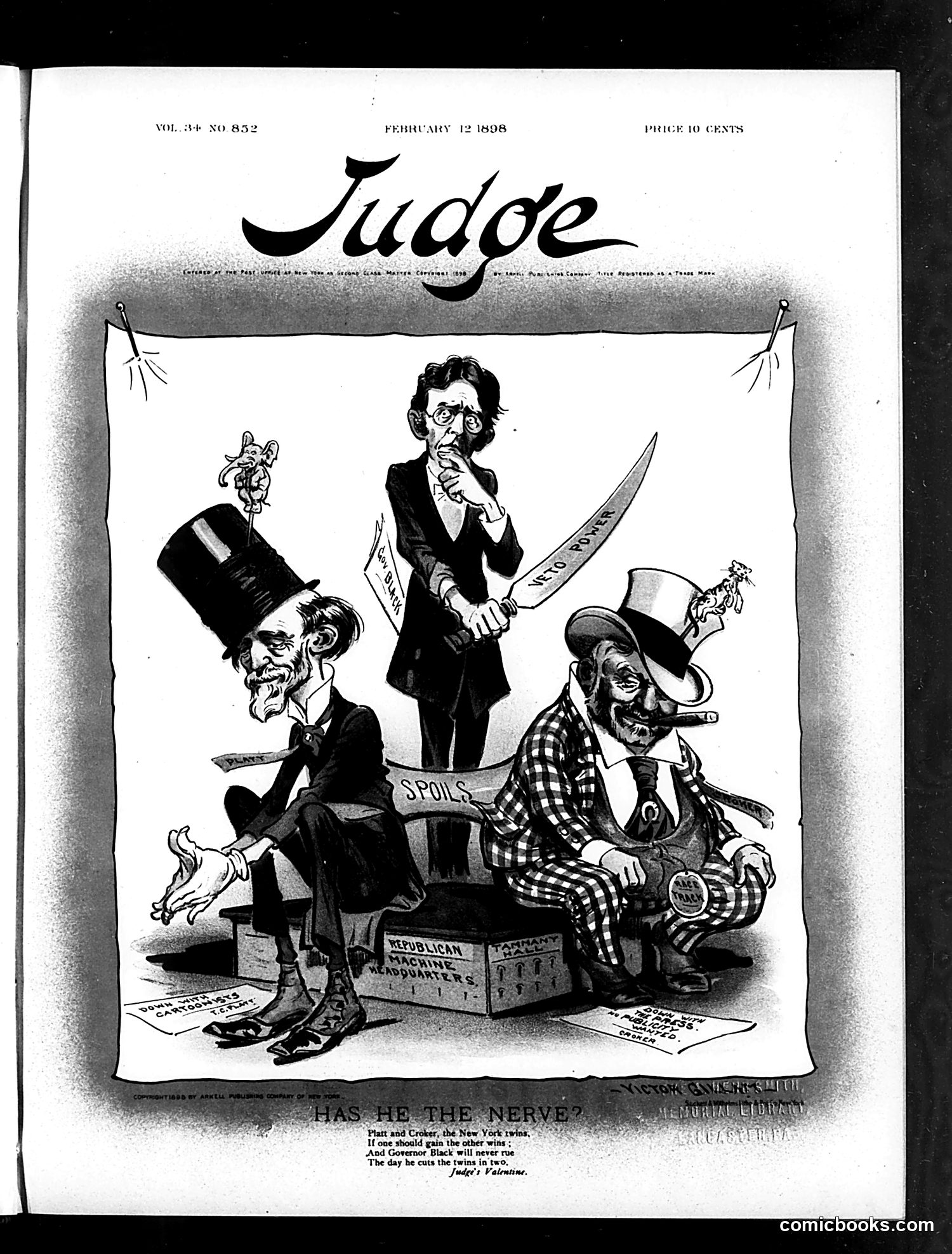
This cartoon depicts three caricatured figures emerging from a "Republican Machine" box labeled "spoils," surrounding a central standing figure. The standing figure holds a sword labeled "Go West" and appears conflicted—hand to chin in contemplation. The caption references Platt and Croker (New York political bosses) and Governor Black, suggesting the cartoon addresses New York Republican Party internal conflict over westward political direction or strategy. The "nerve" referenced in the title likely questions whether a Republican leader has the courage to defy the political machine's established spoils system and pursue an independent course. The caricatured figures represent party establishment opposition to reform or change. The cartoon critiques machine politics and factional Republican disputes during the 1898 period.
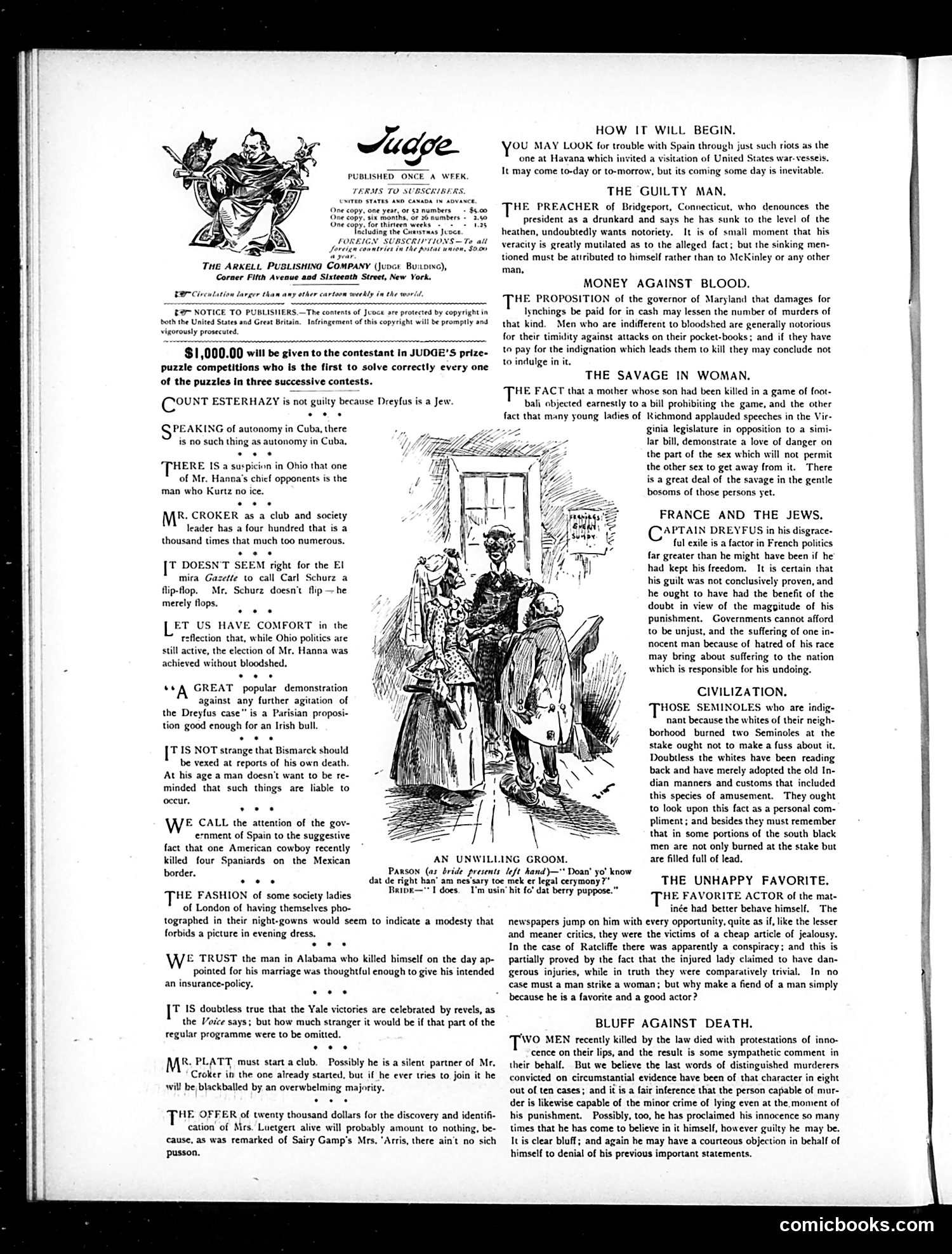
The central cartoon, titled "An Unwilling Groom," depicts a man being forced into marriage by a woman with a gun. The parson conducting the ceremony questions whether this is legal, establishing the joke: coerced marriage as absurd social commentary. The surrounding editorial sections use satirical commentary on contemporary issues: political corruption in Ohio and Cuba, society controversies involving Mr. Croker (likely Richard Croker, NYC political boss), debates about lynching and race violence, and criticism of actors' behavior in the press. The magazine's approach mixes social criticism with crude humor—mocking government hypocrisy, judicial corruption, and racial attitudes prevalent in the Gilded Age. The overall tone suggests Judge targeted educated, urban readers interested in political scandal and social critique dressed in satirical language.
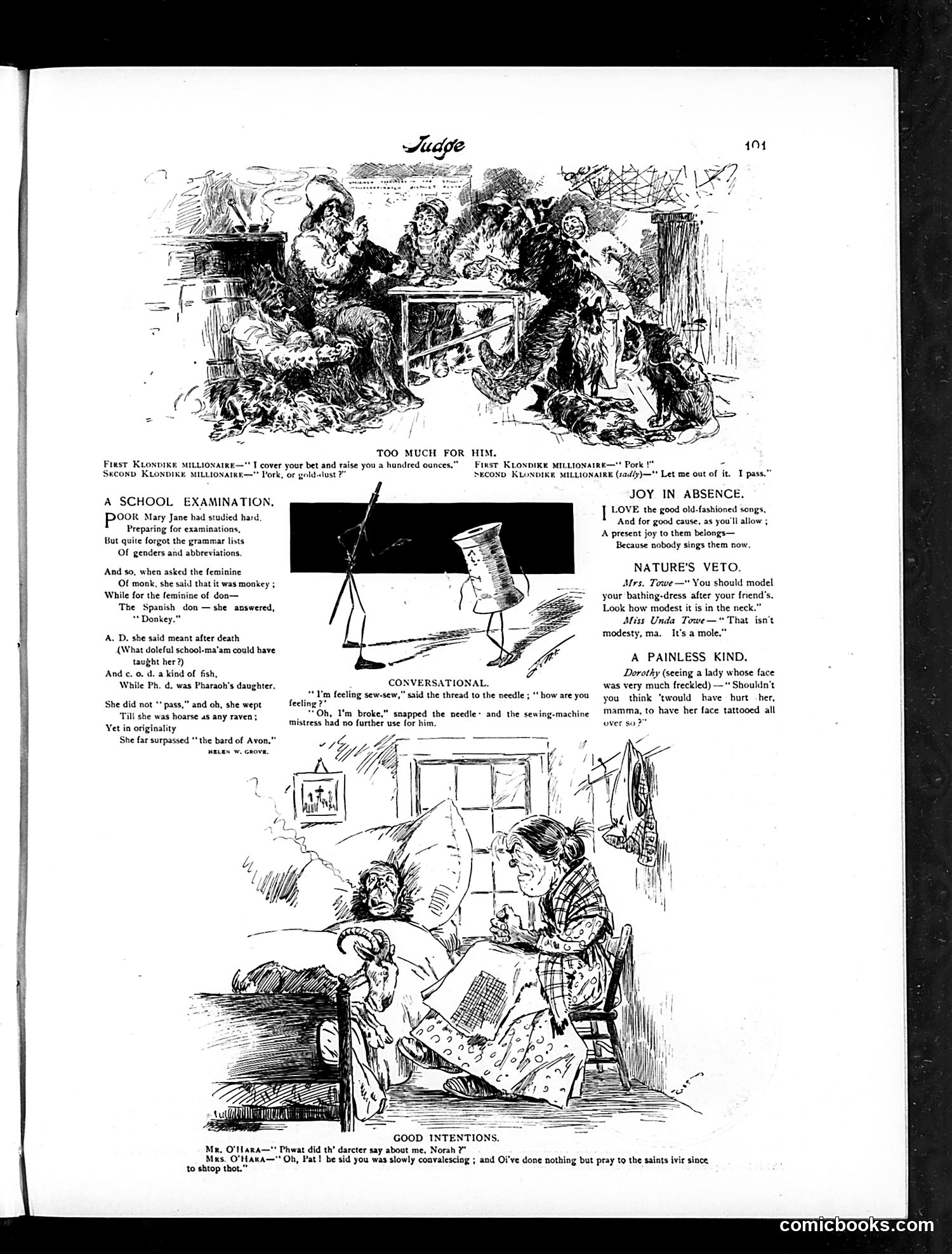
This page contains several separate satirical pieces rather than one unified cartoon: **"Too Much for Him"** depicts two wealthy businessmen (identified as "Klondike millionaires") dining and conversing about money—one boasts he "covers" a bid and raises it by "a hundred ounces," while the other admits being "broke." The satire mocks nouveau-riche excess during the Klondike Gold Rush era. **"A School Examination"** uses verse to ridicule how students memorize grammar rules without understanding meaning—the poem ends with a student calling a donkey a "bird of Avon," demonstrating rote learning without comprehension. The remaining pieces—"Joy in Absence," "Nature's Veto," "A Painless Kind," and "Good Intentions"—are brief humorous observations on social behavior, relationships, and human nature, featuring simple ink sketches rather than elaborate political commentary.
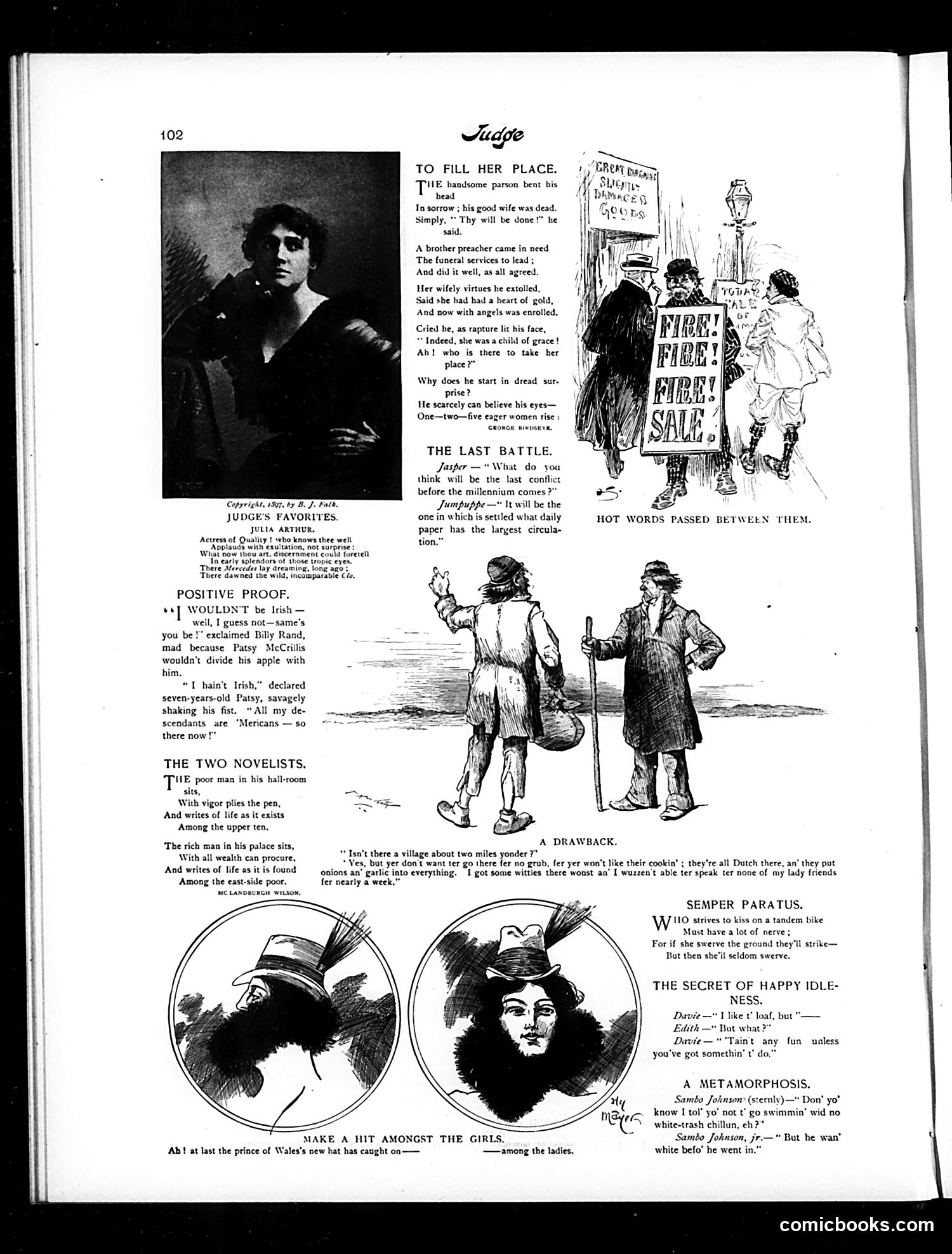
This page contains several short satirical pieces and illustrations typical of Judge's humor circa early 1900s. The main items include: **"To Fill Her Place"** - A poem about a widow's virtue being praised at her husband's funeral, with ironic commentary on her character. **"The Last Battle"** - A dialogue between Father and Jampsape debating which newspaper will be "the last conflict before the millennium comes," mocking newspaper circulation wars. **"Hot Words Passed Between Them"** - An illustration showing two figures arguing over a sign advertising property sales, satirizing real estate disputes. **"A Drawback"** - A sketch mocking Dutch immigrants' accents and cultural habits. The remaining items are brief humorous one-liners on various social topics. The page demonstrates Judge's typical approach: mixing illustrated gags with short satirical verses targeting contemporary American social behavior and urban life.
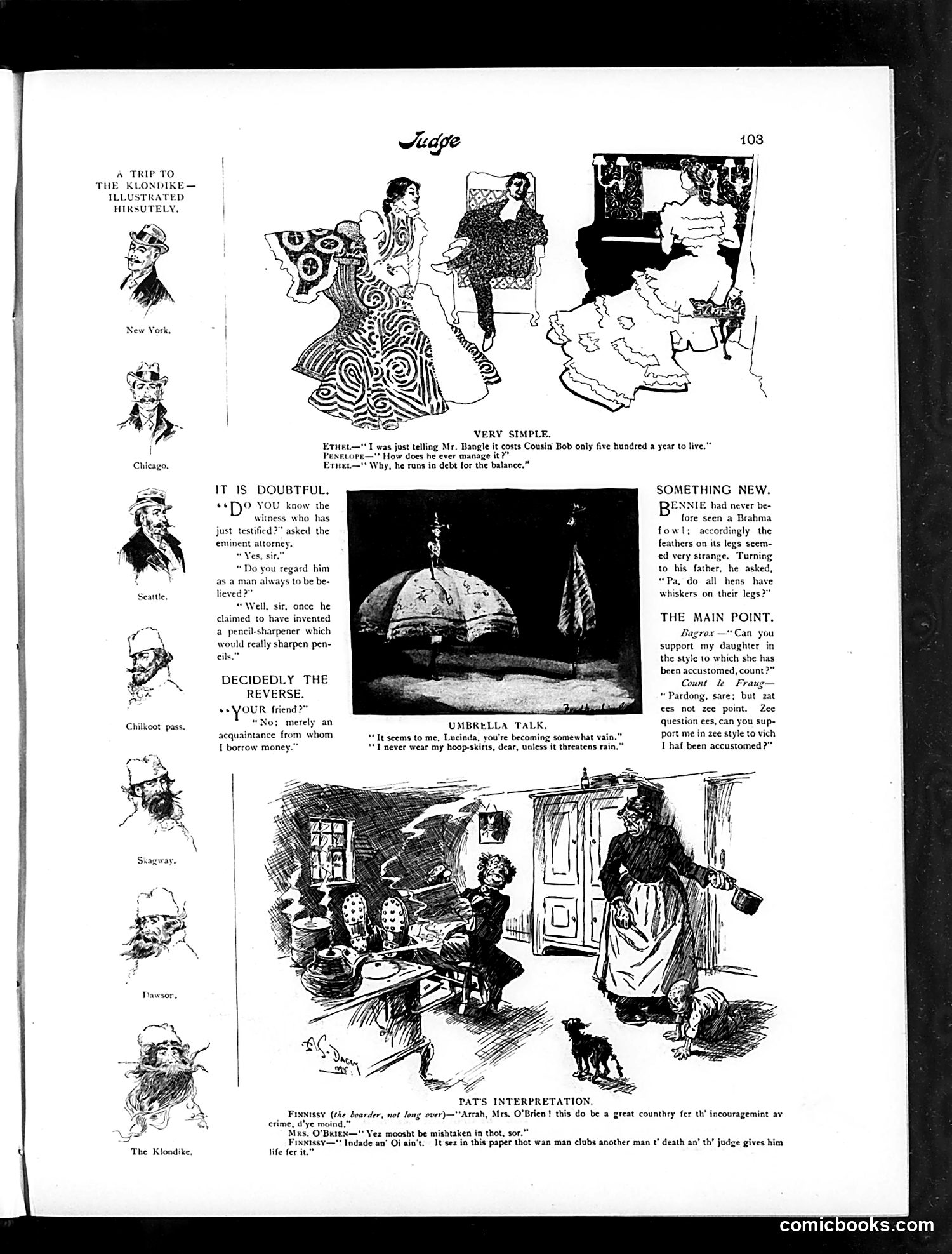
This page from *Judge* contains several unrelated satirical vignettes typical of the magazine's format. **Left sidebar:** Caricatured heads labeled with cities (New York, Chicago, Seattle, etc.) and "The Klondike"—likely representing different regional American types or perspectives during the Klondike Gold Rush era (1890s). **Main cartoons:** - "Very Simple" mocks conspicuous consumption: a man lives lavishly on $500/year by simply going into debt. - "It is Doubtful" questions a witness's credibility through anecdote. - "Umbrella Talk" jokes about women's vanity regarding hoopskirts. - "Pat's Interpretation" features an Irish character mishearing legal proceedings, satirizing Irish-American speech patterns. - "Something New" depicts a child confused by leg feathers on a Brahma chicken. - "The Main Point" reverses gender expectations—a foreign count seeks financial support rather than offering it. The humor relies on period stereotypes, class commentary, and linguistic caricature typical of late 19th-century American satire.
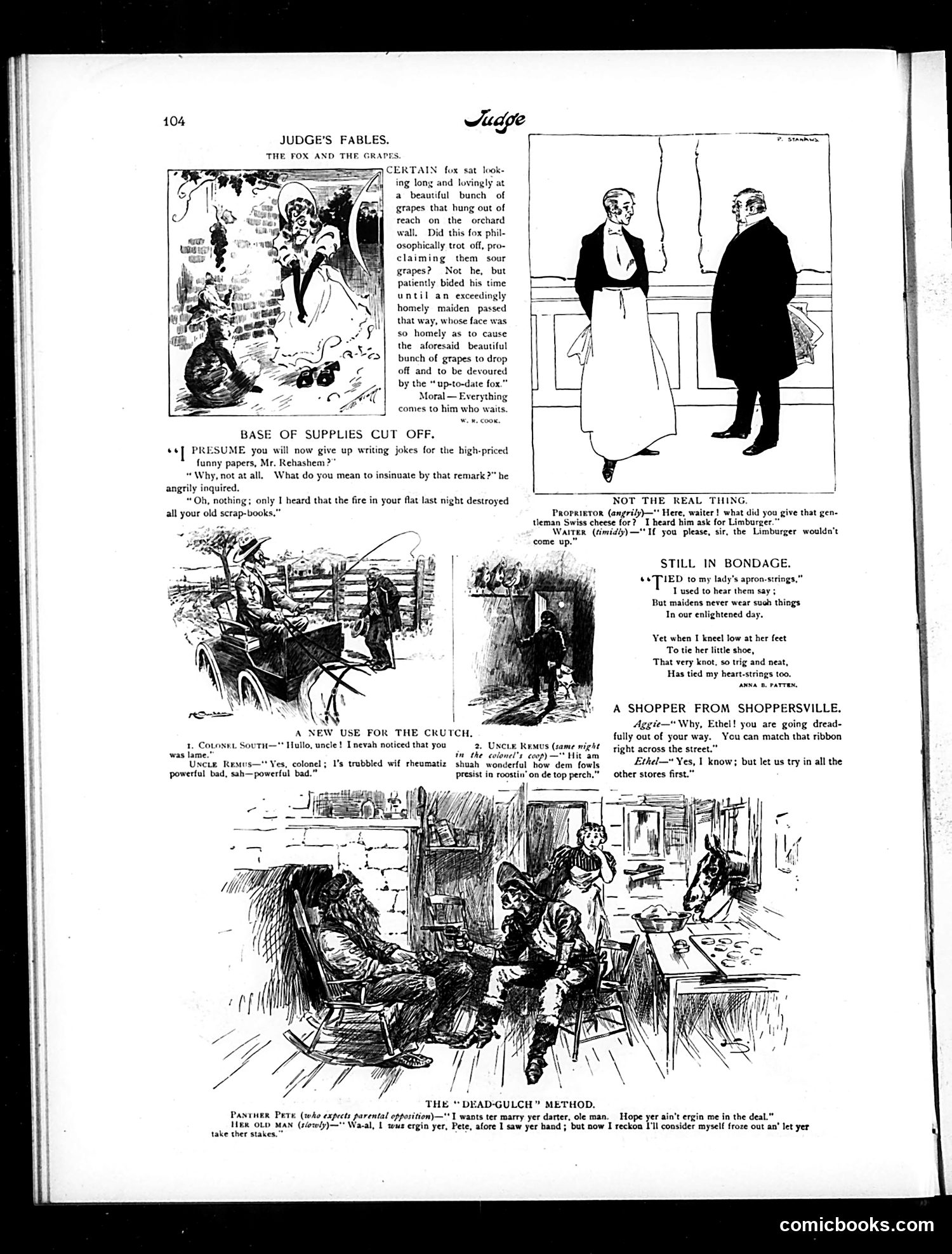
This page contains several humorous fables and social commentary cartoons: **"The Fox and the Grapes"** subverts Aesop's fable: instead of philosophically accepting failure, the "up-to-date fox" waits until an ugly woman passes, whose appearance allegedly causes the grapes to drop—he then eats them. The satire targets modern impatience and suggests that waiting (rather than noble acceptance) achieves goals. **"Base of Supplies Cut Off"** jokes about a joke-writer whose apartment fire destroyed his scrapbooks of old material—implying he recycled old jokes commercially. **Other sketches** include mild domestic humor: a man tied to his fiancée's apron strings, a woman preferring to shop elsewhere, and rural courtship scenarios. The overall tone is light Victorian-era satire targeting contemporary manners, journalism practices, and romance. The "up-to-date" language suggests these mock modern departures from traditional morality or behavior.
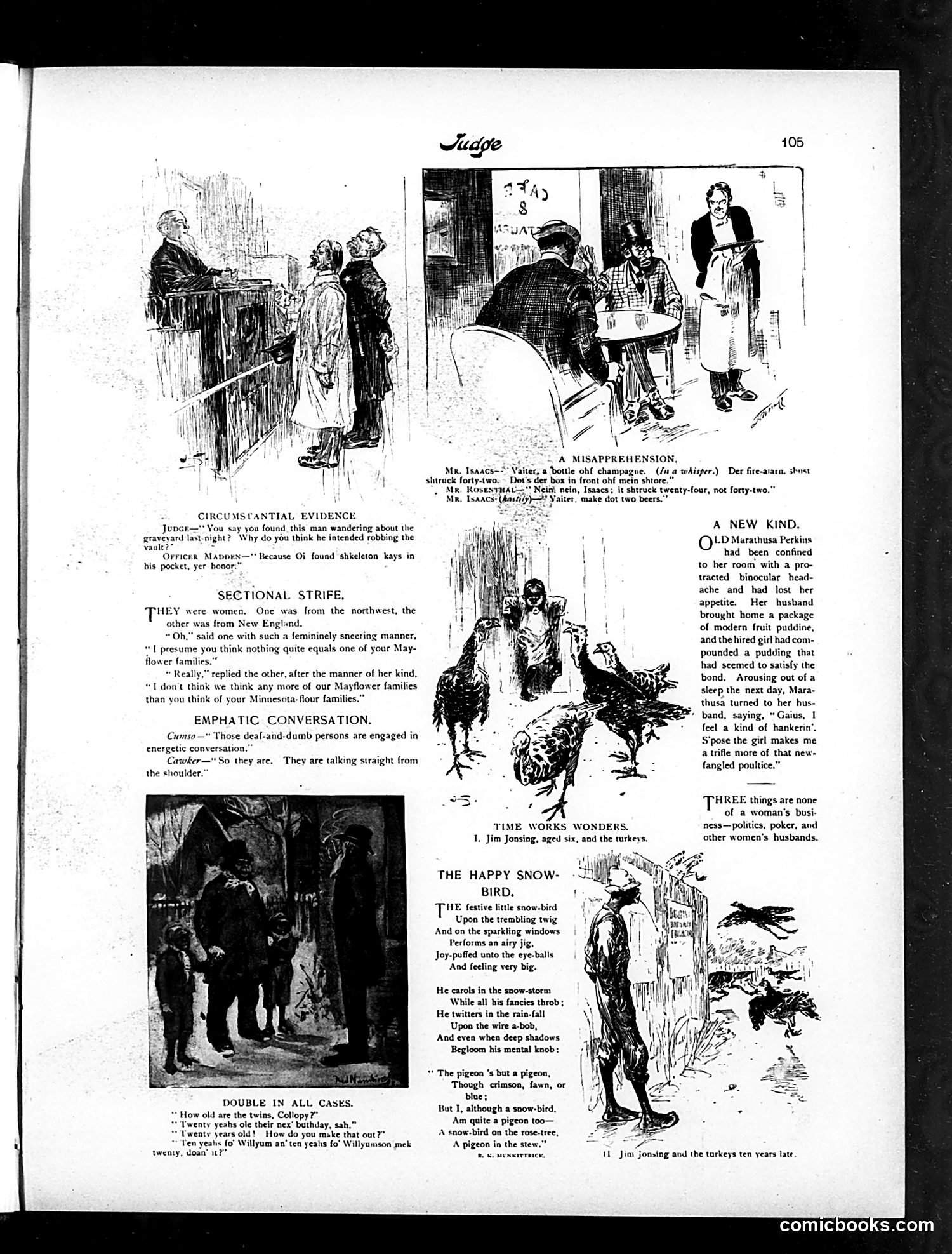
This page contains several short satirical pieces typical of Judge's humor: **"Circumstantial Evil"** mocks faulty police logic: an officer arrests a graveyard vagrant for theft simply because he carries skeleton keys—the obvious (and absurd) "evidence" of grave-robbing intent. **"Sectional Strife"** satirizes regional American pride through two women trading insults—one from New England boasting of Mayflower ancestry, the other from the Midwest sarcastically countering that her "Minnesota-flour" heritage is equally unremarkable. The joke deflates both regions' pretensions. **"Double in All Cases"** plays on dialect humor (likely an African American character) where simple arithmetic becomes absurd: two ten-year-old twins equal twenty years old because "ten yeahs fo' Willyum an' ten yeahs fo' Willyumson mek twenty." The remaining pieces are gentler: a misheard number joke, marital humor about an odd new pudding, and a poem about a cheerful snow-bird. These reflect Judge's mix of political satire with domestic comedy.
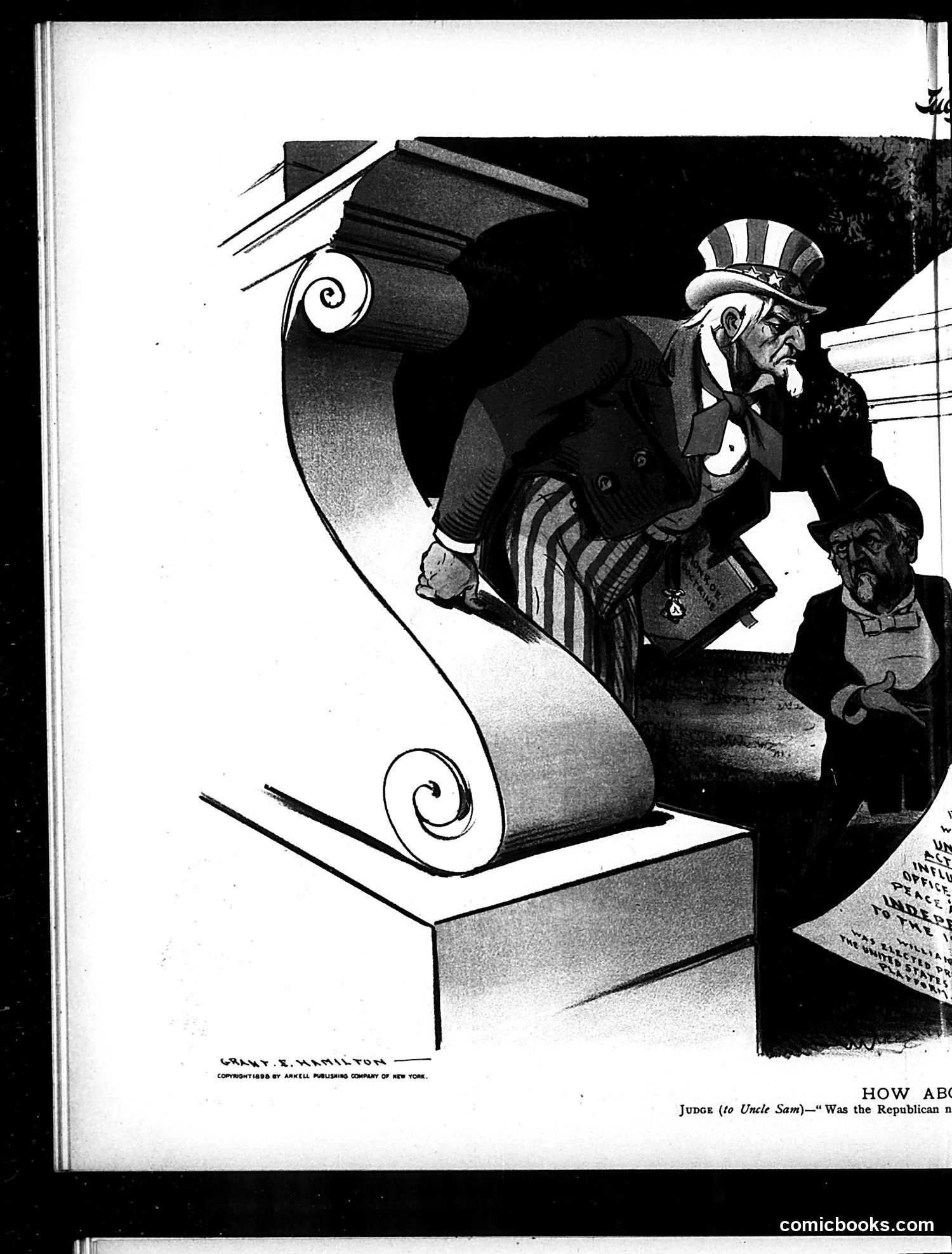
This is a satirical cartoon from *Judge* magazine depicting Uncle Sam (representing the United States government) as a judge examining or judging a large scroll or document—likely representing the Republican Party's platform or policies. A young figure (labeled "Junior," possibly representing a new generation or the American public) questions Uncle Sam about whether the Republican position "was the Republican n[...]" (text is cut off). The satire appears to critique Republican policies or statements, using the metaphor of a legal judgment or examination. The ornate scroll with decorative spirals emphasizes the formality or pretentiousness of the Republican platform being scrutinized. The cartoon's exact political point is unclear due to the truncated caption, but it clearly mocks Republican political positions through this question-and-answer format.
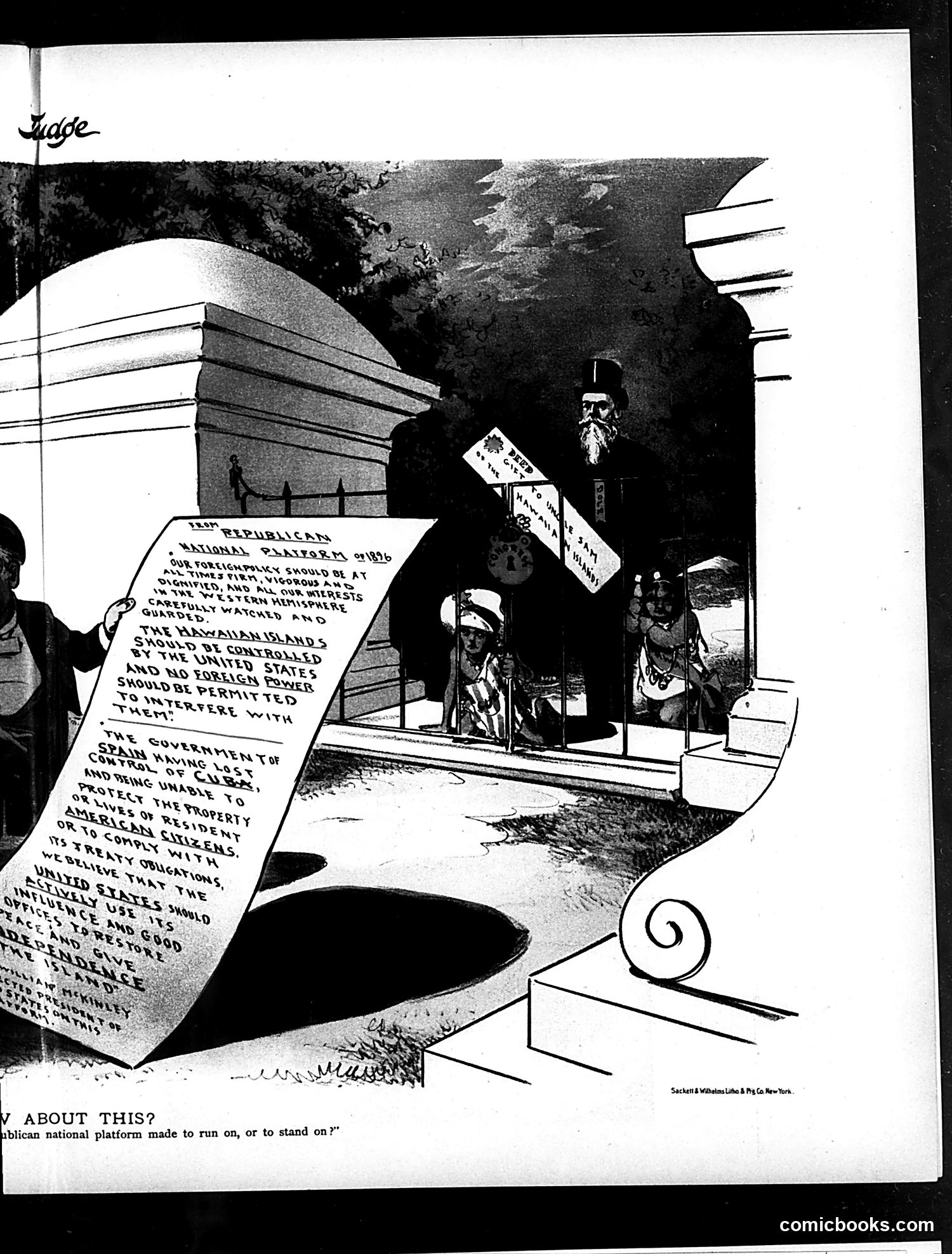
This is a political cartoon satirizing the Republican National Platform. The central image shows a tall, bearded figure (likely representing a Republican party leader or Uncle Sam) standing on an unstable, collapsing platform covered with text—the platform's stated principles. The platform appears to be literally crumbling or giving way, with the figure uncertain whether it can "run on, or...stand on," as the caption asks. This is visual satire: the cartoon treats the platform's written promises as physically unreliable, suggesting the Republicans' stated positions are insubstantial or contradictory. The modernist art style and the figure's uncertain stance emphasize the instability. While the OCR text is largely illegible, the visual metaphor is clear—the cartoon mocks the Republican platform as lacking firm foundation or coherent principle.
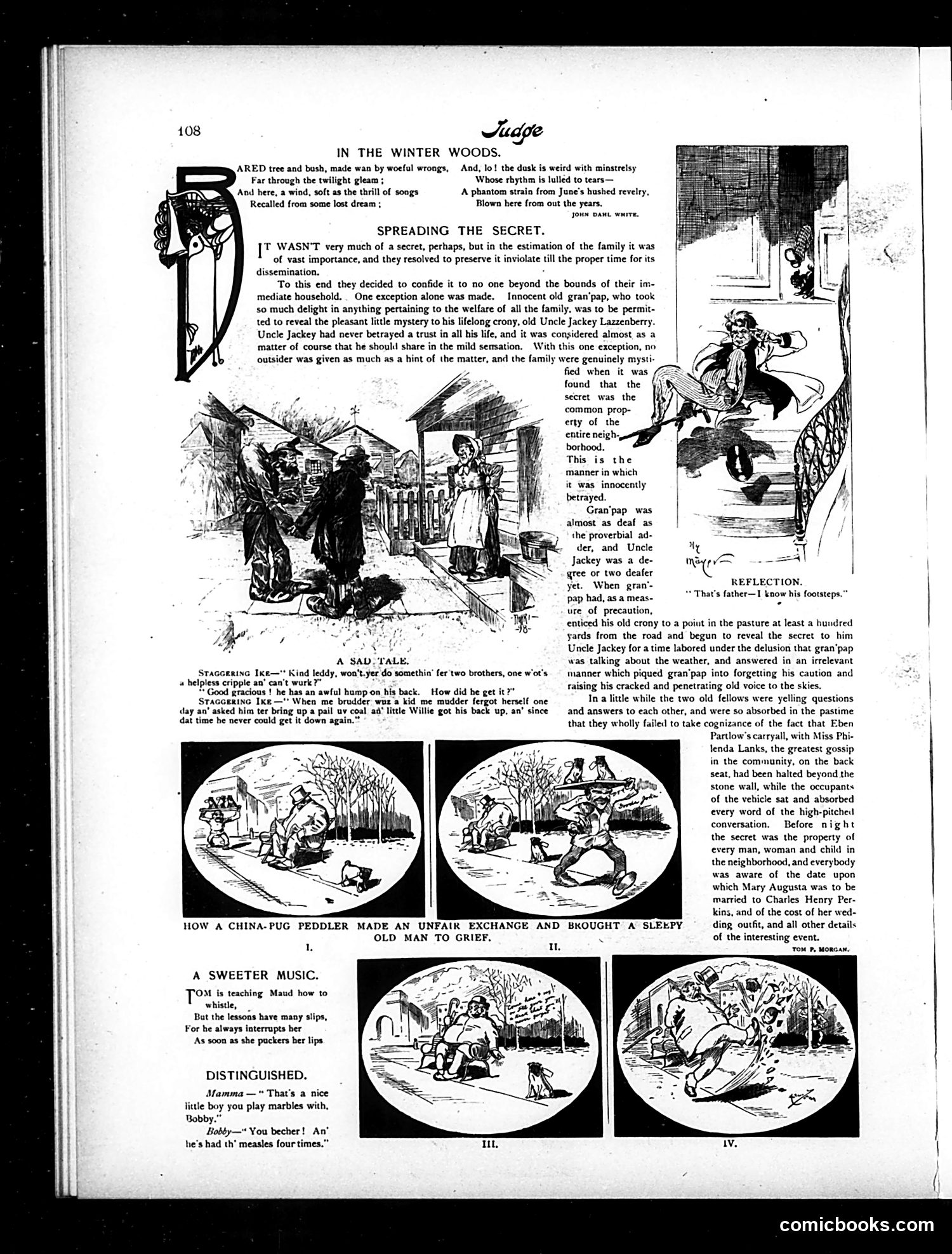
This page contains several humorous short stories and poems typical of Judge's satirical style. **"In the Winter Woods"** is a romantic poem about winter's melancholy atmosphere—straightforward verse without obvious satire. **"Spreading the Secret"** mocks small-town gossip culture. The joke: a family tries to keep their daughter Mary Augusta's upcoming wedding a complete secret, trusting only two elderly, nearly-deaf men (Gran'pap and Uncle Jackey) to share it. However, these men shout their conversation so loudly in a pasture that Miss Philenda Lanks—identified as "the greatest gossip in the community"—overhears everything from a carryall nearby. By nightfall, the entire neighborhood knows all details. The satire targets both small-town nosiness and the futility of keeping secrets in tight-knit communities. The other anecdotes ("A Sad Tale," humor about a china-pug peddler, lessons in whistling) are lighter comic sketches with no apparent political content—just domestic humor typical of the era's magazine humor.
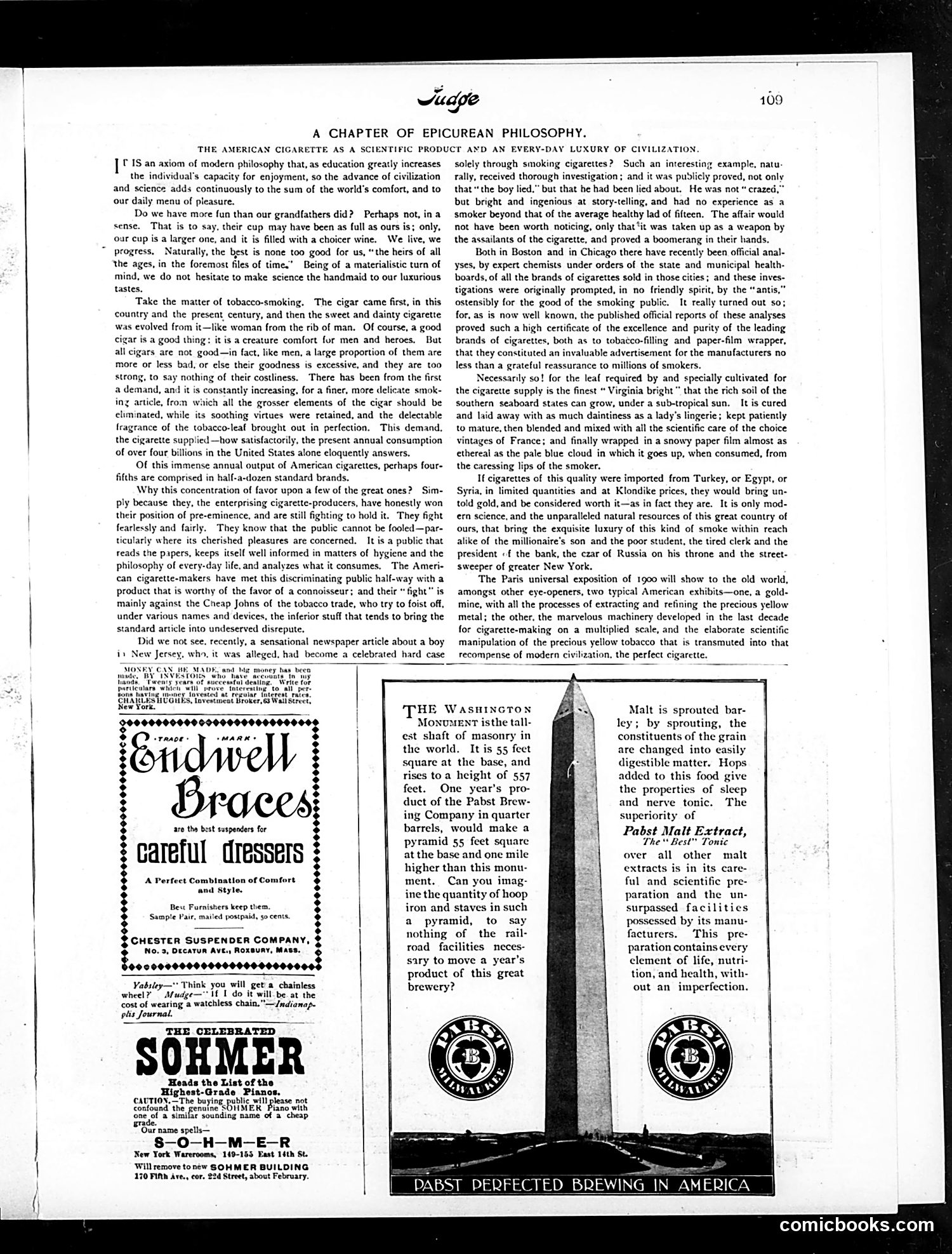
This page is primarily **advertising and editorial promotion** for American cigarettes, presented as sophistication and scientific progress. **The Main Article** argues that cigarettes represent modern civilization's advancement—they're refined alternatives to crude cigars. The text celebrates cigarette manufacturers' "honest" competition and quality control, dismissing cheaper brands as inferior. **The Subtext/Satire**: Judge magazine is satirizing how corporations rationalize luxury consumption as scientific inevitability. The earnest tone about cigarettes as markers of education and taste is itself the joke—this was *Judge's* way of mocking how advertising dressed up commercial products in philosophical language. **Historical Context**: This pre-health-warning era treated cigarettes as unquestionably beneficial. The article even defends cigarettes against "sensational" accusations (referencing a New Jersey boy allegedly harmed by smoking), dismissing health concerns as exaggeration. **The Advertisements**: Endorsel Braces, Sohmer pianos, and Pabst Beer ads reinforce the theme of refined, civilized living through consumer goods—exactly what Judge was gently mocking.
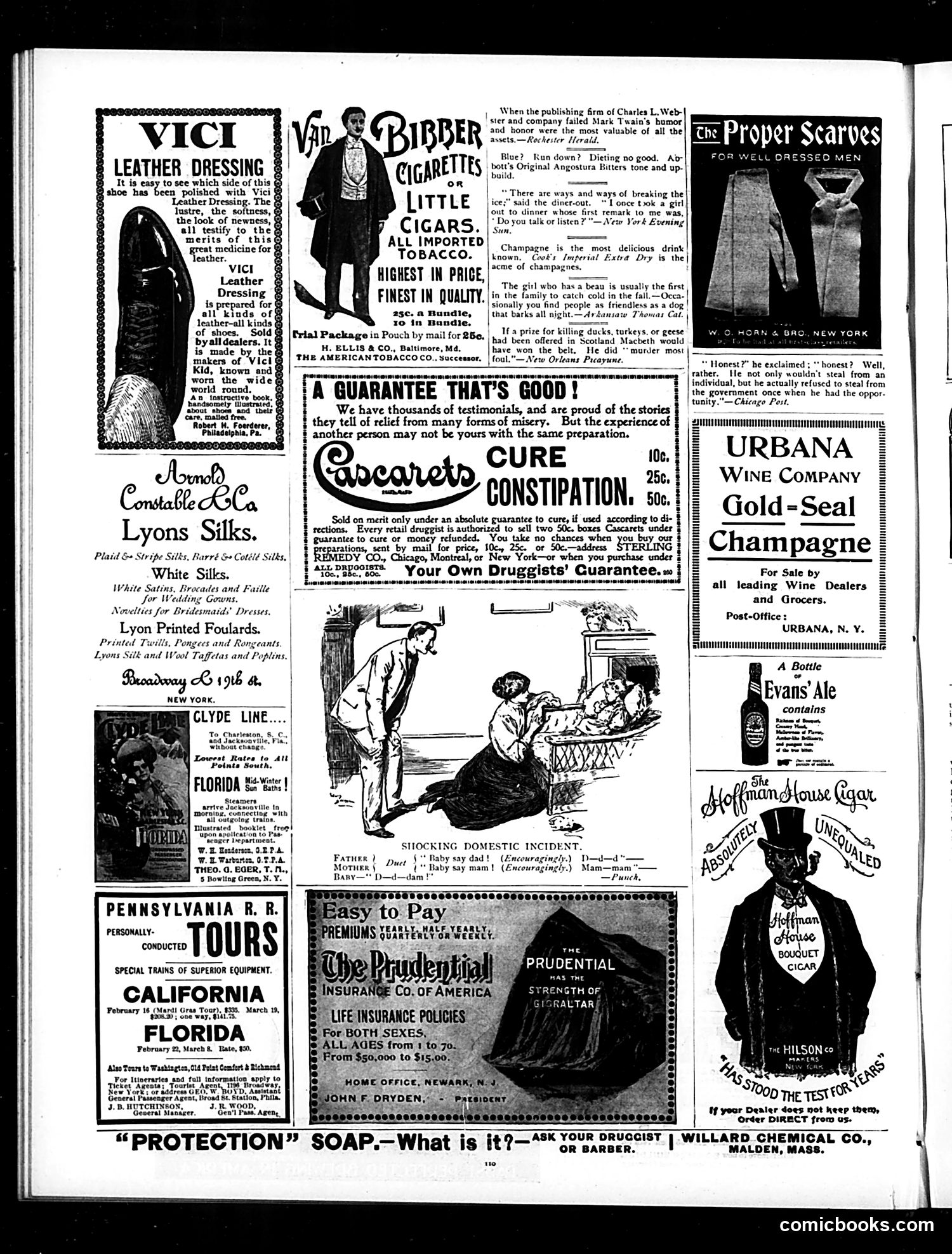
This page is primarily **advertising**, typical of early 1900s magazines. The notable content is a small cartoon titled "SHOCKING DOMESTIC INCIDENT" showing a father, mother, and baby. The joke plays on the Victorian concern about children mimicking adult speech: the parents proudly encourage the baby to say "papa" and "mama," but the child instead blurts out "D—d—dam!"—a mild curse word. The humor derives from the parents' embarrassment at their child repeating what it has heard, undermining their efforts at proper child-rearing. The surrounding ads for products like Vici Leather Dressing, Van Bibber Cigars, Cascarets (a laxative), and insurance reflect period consumer goods and services. The page includes a brief anecdote about Mark Twain referencing his publisher's failure, and scattered witticisms about champagne and Scottish folklore, typical of Judge's satirical commentary style.
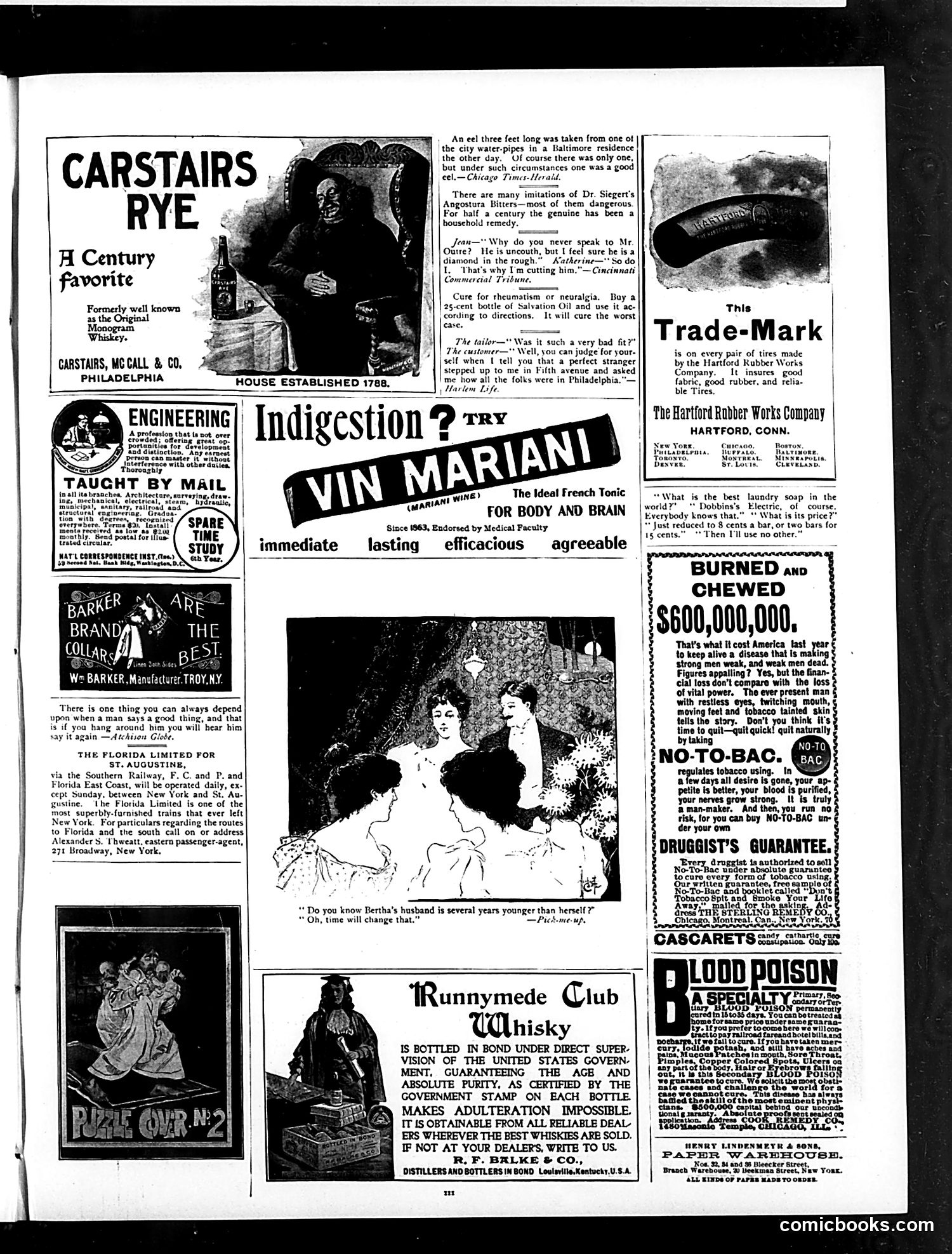
This appears to be primarily an **advertising page** from Judge magazine, dominated by product ads typical of the early 1900s. The small **satirical content** includes: 1. A brief joke about a young husband appearing younger than his wife, with the punchline that "time will change that"—mocking either cosmetic aging or the social expectation that husbands should appear older. 2. Scattered anecdotes about social pretension (a woman rejecting an "uncouth" suitor despite calling him a "diamond in the rough," a customer complaining about a poor-fitting garment). The **advertisements reveal period concerns**: patent medicines for rheumatism, indigestion remedies, and notably a **anti-tobacco product (NO-TO-BAC)** claiming to cure nicotine addiction, with alarming statistics about tobacco's damage ($600 million cost to America). The page reflects turn-of-century anxieties about health, addiction, and product authenticity—note warnings against counterfeit Angostura Bitters and emphasis on government-bonded whiskey. The ads suggest Judge's readers were affluent enough to purchase luxury goods and remedies.
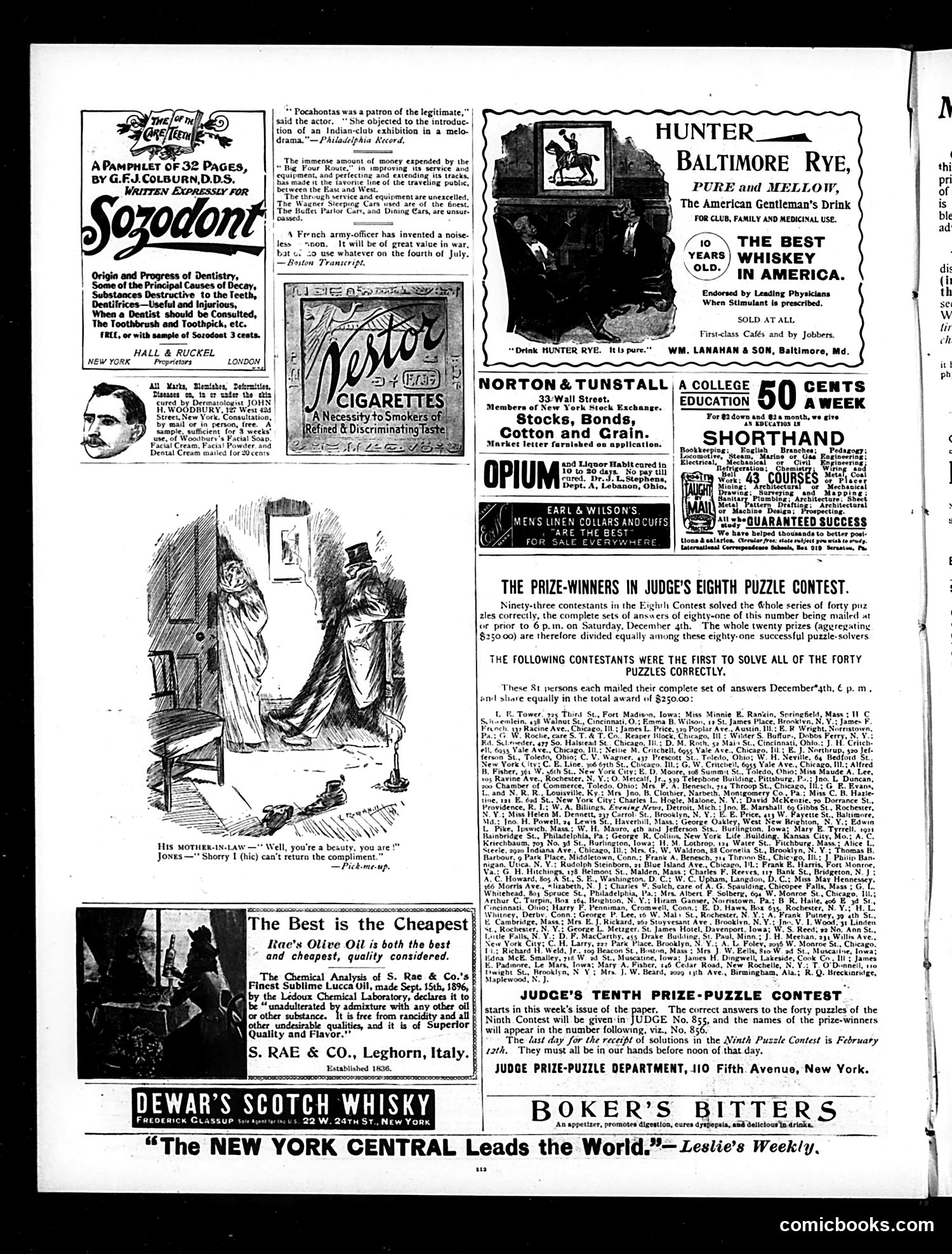
The main cartoon depicts a domestic scene where a drunk man (Jones) returns home to his mother-in-law. She greets him sarcastically with "Well, you're a beauty, you are!" — criticizing his intoxicated state. Jones defensively responds "Sorry I (hic) can't return the compliment," the hiccup indicating his drunkenness. The joke plays on the awkward family tension: the mother-in-law insults his appearance/behavior, and he pretends to take offense at *her* appearance rather than acknowledge his own condition. This is a common turn-of-the-century domestic humor trope — the drunk son-in-law and disapproving relative — rendered here with Victorian-era sensibilities about both alcohol consumption and family propriety. The cartoon satirizes male drinking culture while poking fun at the predictable conflict between intoxicated men and their in-laws.
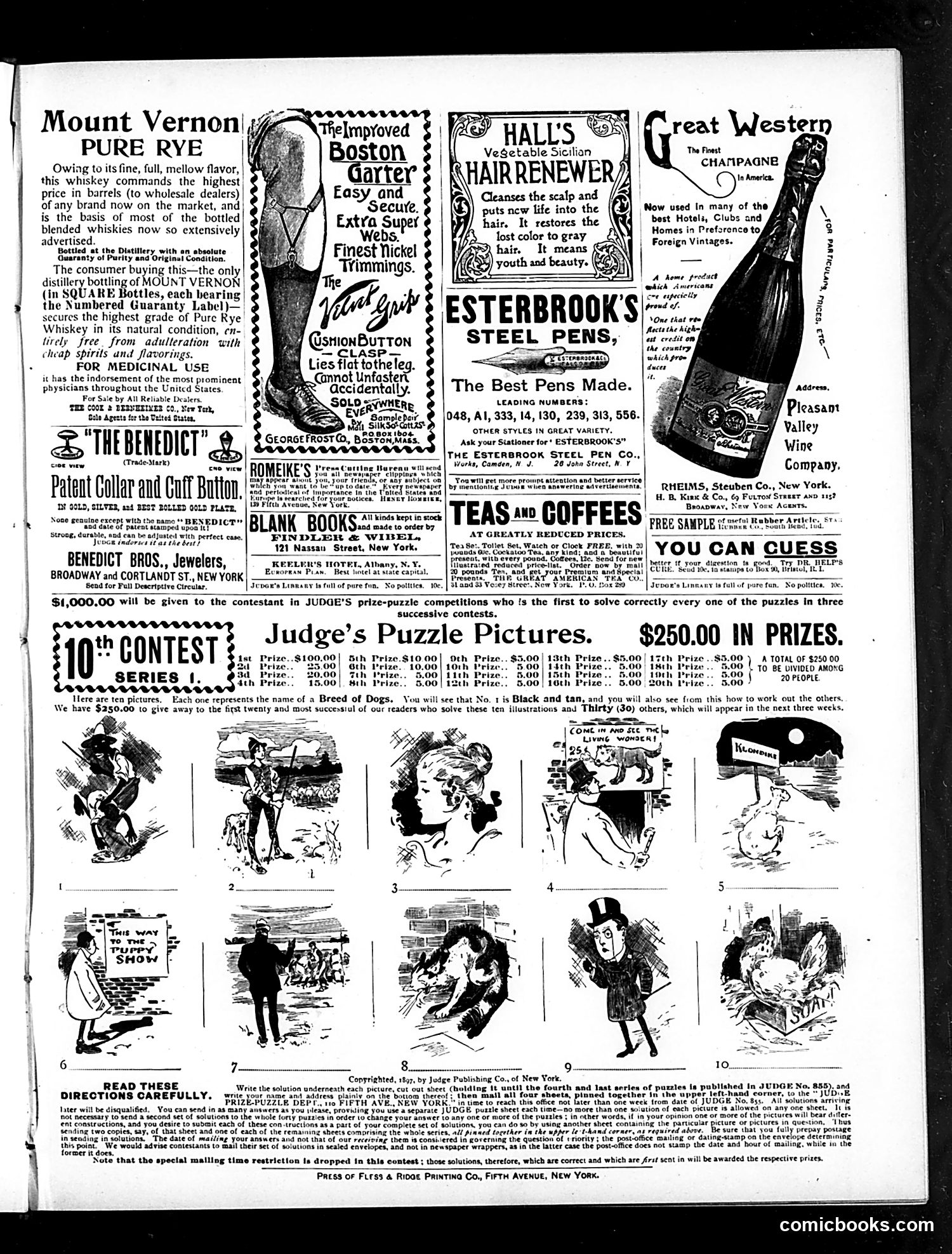
This page is primarily a **advertising and contest section** from Judge magazine, not political satire. The bulk of the content consists of period product advertisements (Mount Vernon Pure Rye whiskey, steel pens, hair renewers, tea, etc.) interspersed with a **puzzle competition**. The main feature is "Judge's Puzzle Pictures"—a contest where readers must identify dog breeds from ten illustrated sketches. The competition offered $250 in prizes ($100 for first place) and promised thirty additional puzzles would appear over three weeks, with $1,000 total available to anyone solving every puzzle correctly across three consecutive contests. The advertisements reflect **turn-of-the-century consumer goods** and their marketing strategies: whiskey sold on purity guarantees, medicinal endorsements, and American-made products proudly distinguished from foreign imports (notably the champagne ad). There is **no political or satirical content** visible on this page—it's a straightforward commercial/entertainment section typical of Judge's mixed advertising-and-content format.
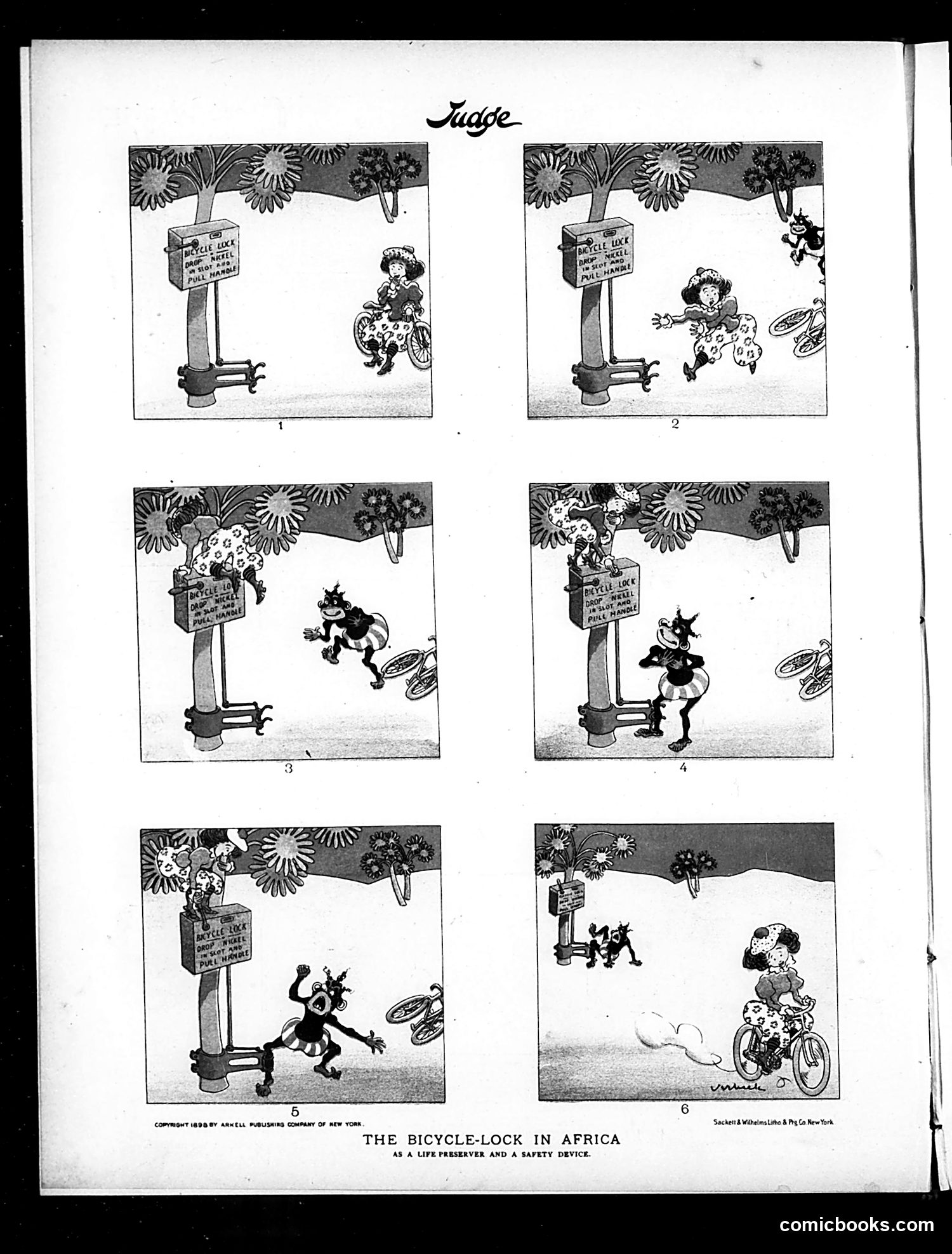
This six-panel Judge cartoon satirizes colonial anxieties about Africa and racial stereotypes. The title "The Bicycle-Lock in Africa as a Life Preserver and a Safety Device" appears to be ironic commentary on European imperialism. The comic depicts what appears to be a white bicycle rider and various Black figures (drawn in exaggerated, dehumanizing style typical of 1890s racist imagery) interacting around a bicycle locked to a post. The progression suggests the bicycle-lock functions as protection from the depicted African figures—playing on period stereotypes portraying Africans as threats. The joke relies on racist assumptions about Africa and Africans that were common in late-19th-century American publications, reflecting the era's imperialist attitudes. Modern readers should recognize this as deeply offensive propaganda reflecting historical prejudices.