
A complete issue · 18 pages · 1897
Judge — November 27, 1897
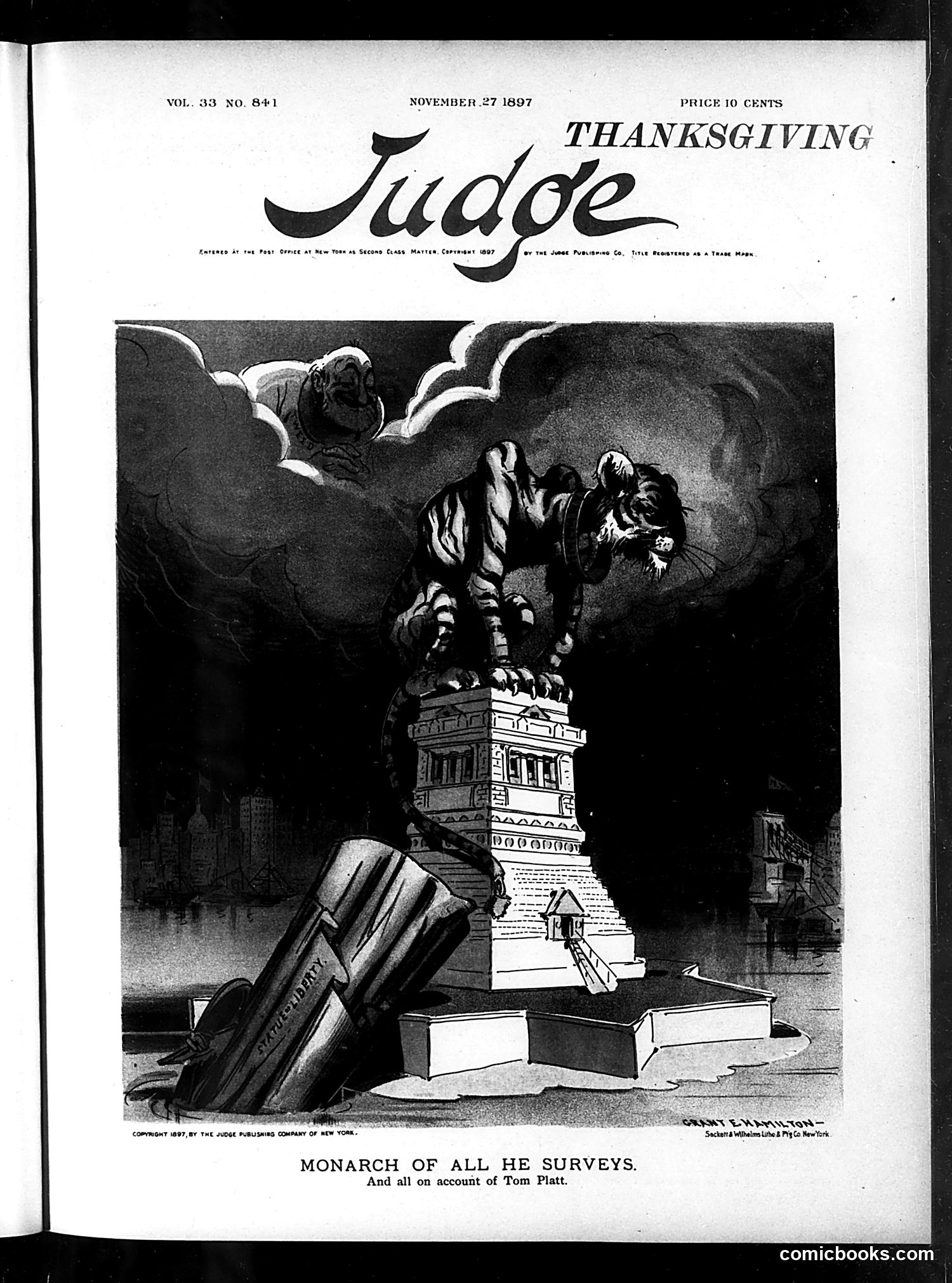
This is a Thanksgiving 1897 *Judge* cover satirizing what appears to be a legal or governmental figure—likely a judge or official—depicted as a towering monument perched atop law books and classical architecture. The caption "MONARCH OF ALL HE SURVEYS: And all on account of Tom Platt" references **Tom Platt**, a prominent New York Republican politician of that era. The satire suggests that this official has become arrogantly powerful through association with or support from Platt's political machine. The dramatic clouds and theatrical composition mock the figure's self-importance. The toppled cannon labeled "CONSTITUTION" at the base implies the critique that constitutional principles have been undermined or overthrown by this political arrangement. The overall message lambastes corruption and political patronage in the 1890s.
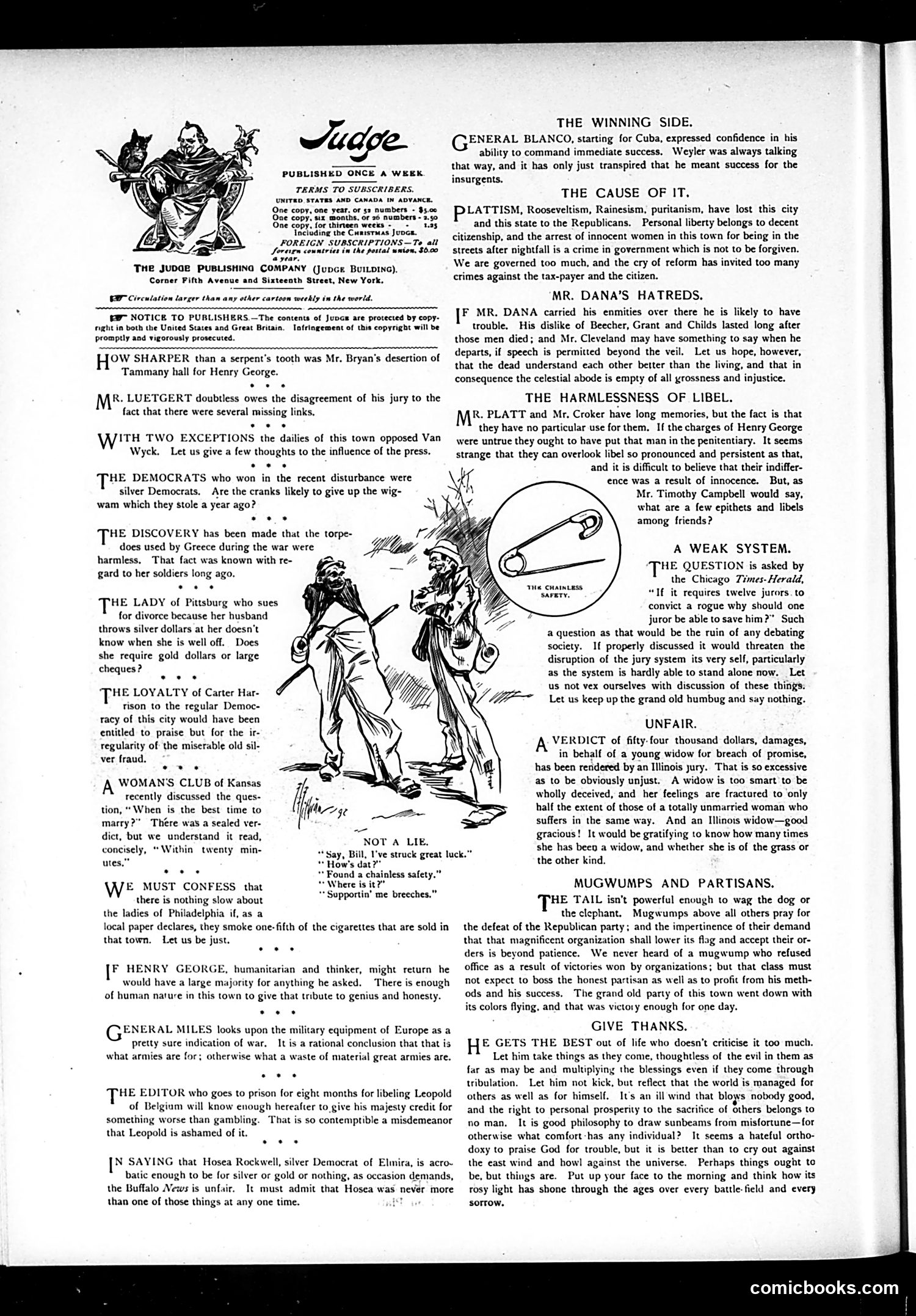
The central cartoon titled "NOT A LIE" depicts two figures in conversation, likely representing political opponents debating a contested claim. One says "Say, Bill, I've struck great luck" while the other responds with accusations: "Found a clanless sister," "Where is it?" and "Supportin' six breaches." This appears to satirize political mudslinging and character attacks common in late 19th/early 20th-century American politics. The exchange mocks how politicians manufacture or exaggerate scandals about opponents' families to discredit them, rather than engaging substantive debate. The surrounding editorial text reinforces this theme, criticizing press coverage of political disputes and emphasizing how libel accusations and personal attacks have become normalized political tactics that undermine serious democratic discourse.
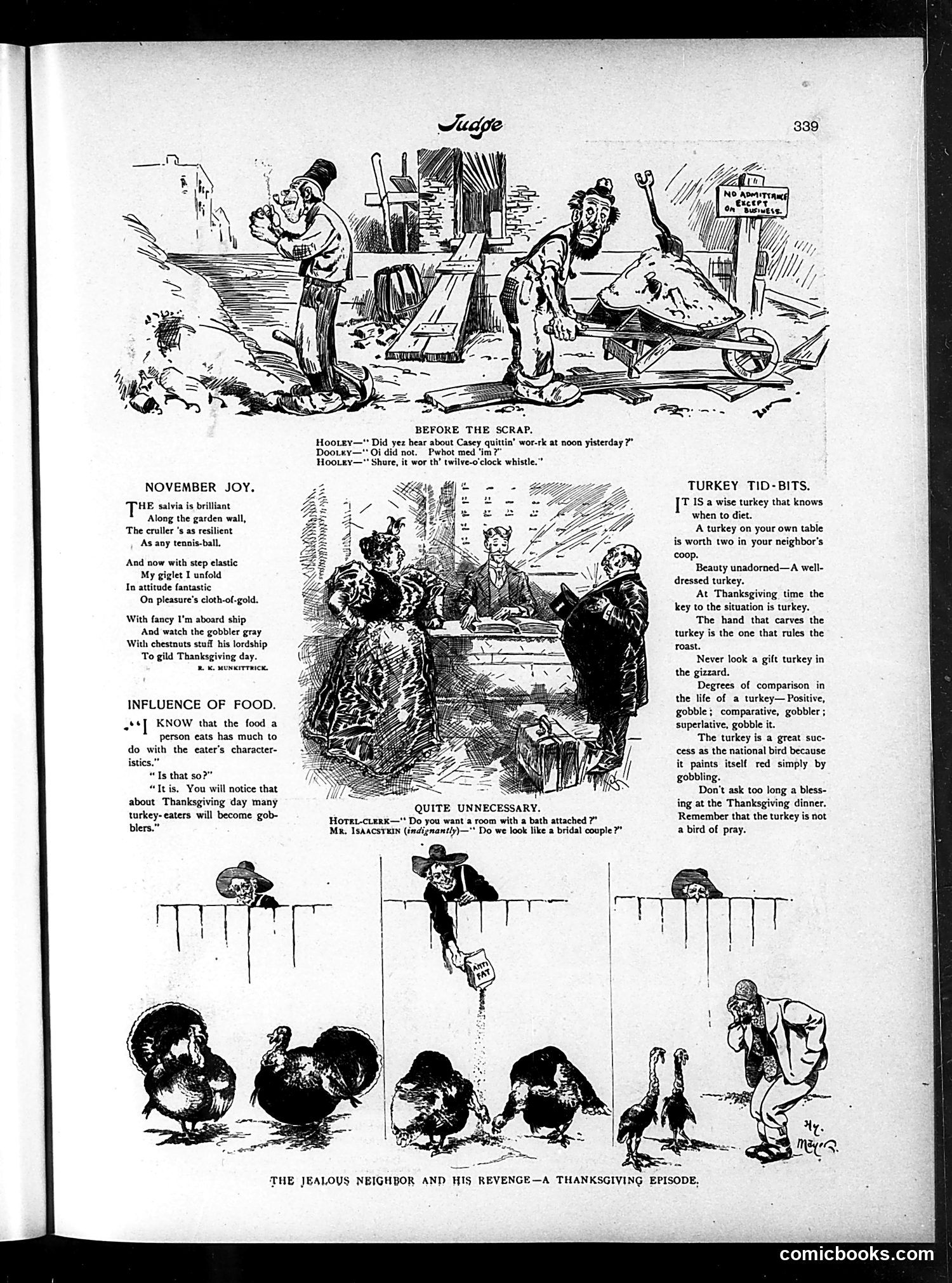
This page contains Thanksgiving-themed humor from Judge magazine. The top cartoon "Before the Scrap" depicts workers in what appears to be a scrapyard or junkyard, with dialogue about someone named Casey quitting work. The middle section includes humorous poems: "November Joy" celebrates autumn scenery, while "Influence of Food" jokes that eating turkey makes people become "gobblers" (greedy eaters). "Turkey Tid-Bits" is a satirical piece mocking turkey's status as a holiday bird, suggesting it's overrated and comparing it to other fowl. The bottom cartoon "The Jealous Neighbor and His Revenge" shows a comic sequence where a man feeds turkeys from a fence to sabotage his neighbor's Thanksgiving dinner. It's a slapstick joke about rural rivalry and holiday preparation gone wrong.
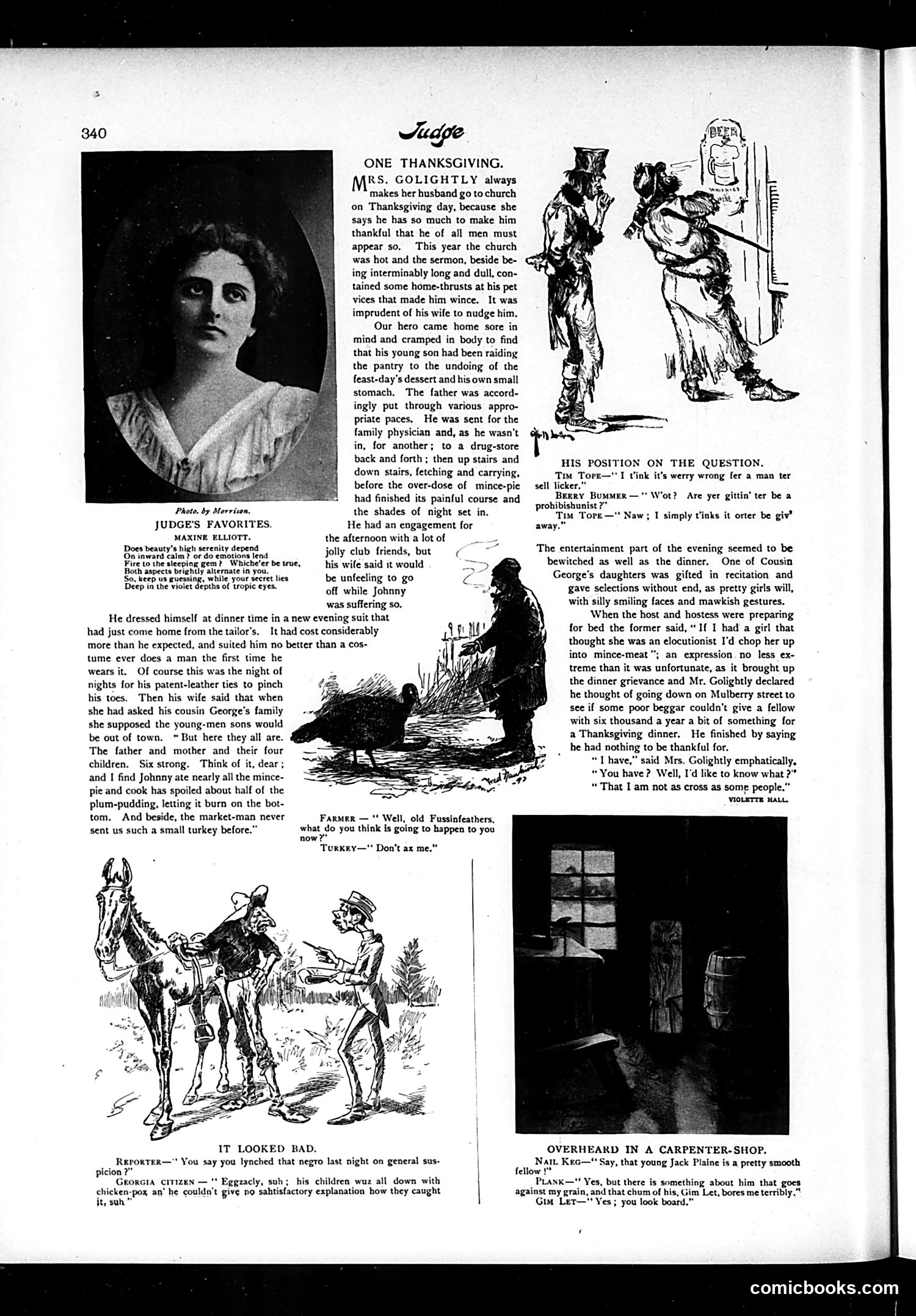
This page from *Judge* magazine presents satirical commentary on early 20th-century American life through multiple cartoons. **"One Thanksgiving"** (main story): Mr. Golightly endures a miserable Thanksgiving—forced to church, his son raids desserts requiring doctor visits, he wears uncomfortable new clothes, and unwanted relatives arrive. His wife mentions the small turkey. When he later says he'd chop up a girl who thinks she's an elocutionist "into mince-meat," she takes offense, ruining his evening. The satire mocks the domesticated husband suffering through mandatory family obligations and how carelessly spoken complaints provoke marital discord. **"His Position on the Question"**: A cartoon about drinking/temperance featuring working-class dialect characters debating whether selling alcohol is wrong—one thinks giving it away instead is better. This reflects contemporary Prohibition debates. **"It Looked Bad"**: A dark cartoon about a lynching, with a Georgia citizen claiming a Black man's children having chickenpox justified the murder. This reflects the magazine's participation in racist discourse of the era. The page satirizes domestic life, class attitudes, and social issues typical of the period.
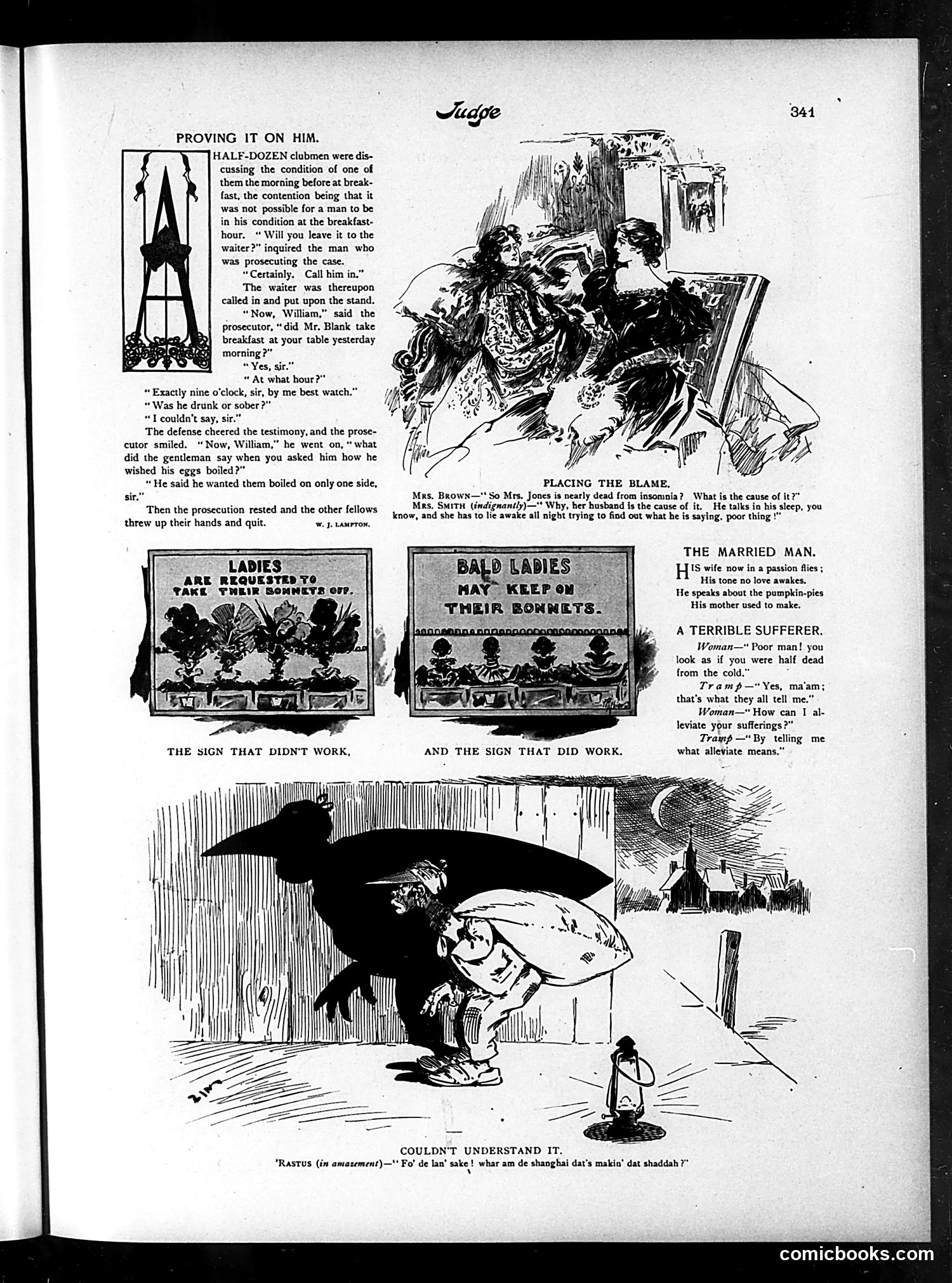
This satirical page from *Judge* contains several distinct humor pieces typical of the publication's style: **"Proving It On Him"** (top): A courtroom anecdote where a man's drunkenness is "proven" when a waiter testifies he ordered eggs boiled "on only one side"—implying only an intoxicated person would make such an absurd request. The joke relies on physical comedy and the logic of inebriation. **"Placing the Blame"** (right): Two women discussing insomnia caused by a husband's sleep-talking—a domestic humor sketch about marital discord. **"The Married Man"** and **"A Terrible Sufferer"**: Brief humorous verses and dialogue about matrimonial complaints and a tramp's misunderstanding of the word "alleviate." **Two advertisement-style panels** mock women's fashions (bonnets). **"Couldn't Understand It"** (bottom): Features a Black character ("Rastus") confused by a Shanghai rooster's shadow—ethnic humor typical of the era's offensive conventions. The page represents *Judge*'s mix of domestic satire, wordplay, and period-appropriate (if problematic) comedic tropes.
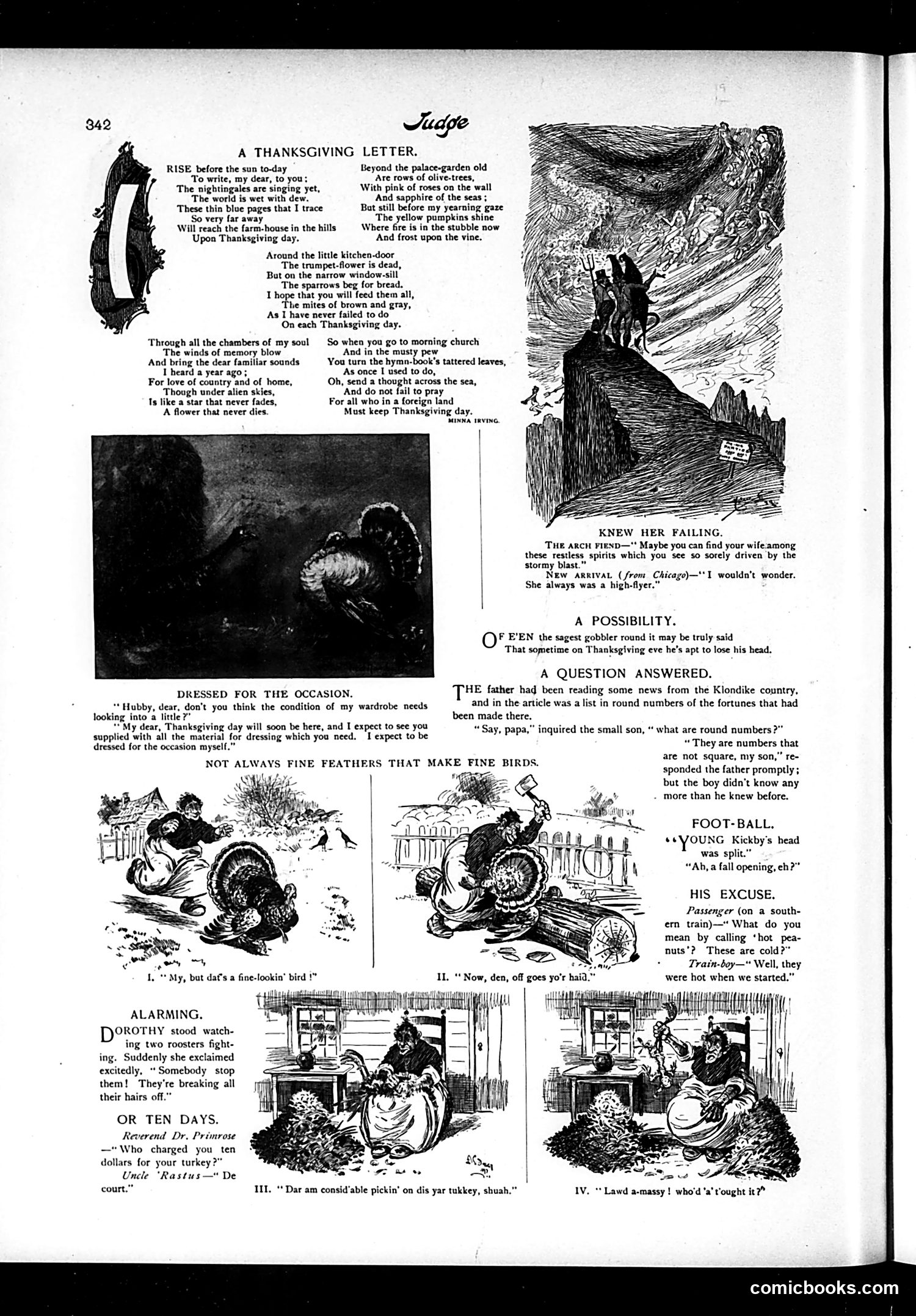
This Thanksgiving-themed page from Judge magazine contains several satirical pieces typical of the era: **"A Thanksgiving Letter"** is sentimental verse from an American abroad, homesick for farm life—likely reflecting common expatriate nostalgia in the late 19th/early 20th century. **"Dressed for the Occasion"** satirizes marital dynamics: a husband promises his wife new clothing for Thanksgiving, a gentle jab at both consumer materialism and gender expectations around holiday preparation. **"Not Always Fine Feathers"** uses turkey imagery to mock pretension—likely commentary on social climbing or false appearances. **"Knew Her Failing"** jokes about a wife being a "high-flyer" (spendthrift/promiscuous), placing her among devils—crude gender satire typical of the period. **"A Question Answered"** is innocent wordplay: a boy misunderstands "round numbers" as geometric shapes rather than approximate figures. The remaining cartoons ("Alarming," "Foot-Ball," "His Excuse") are brief domestic humor vignettes without obvious political content. Overall, this is light satirical comedy focused on social observation and domestic life rather than political commentary.
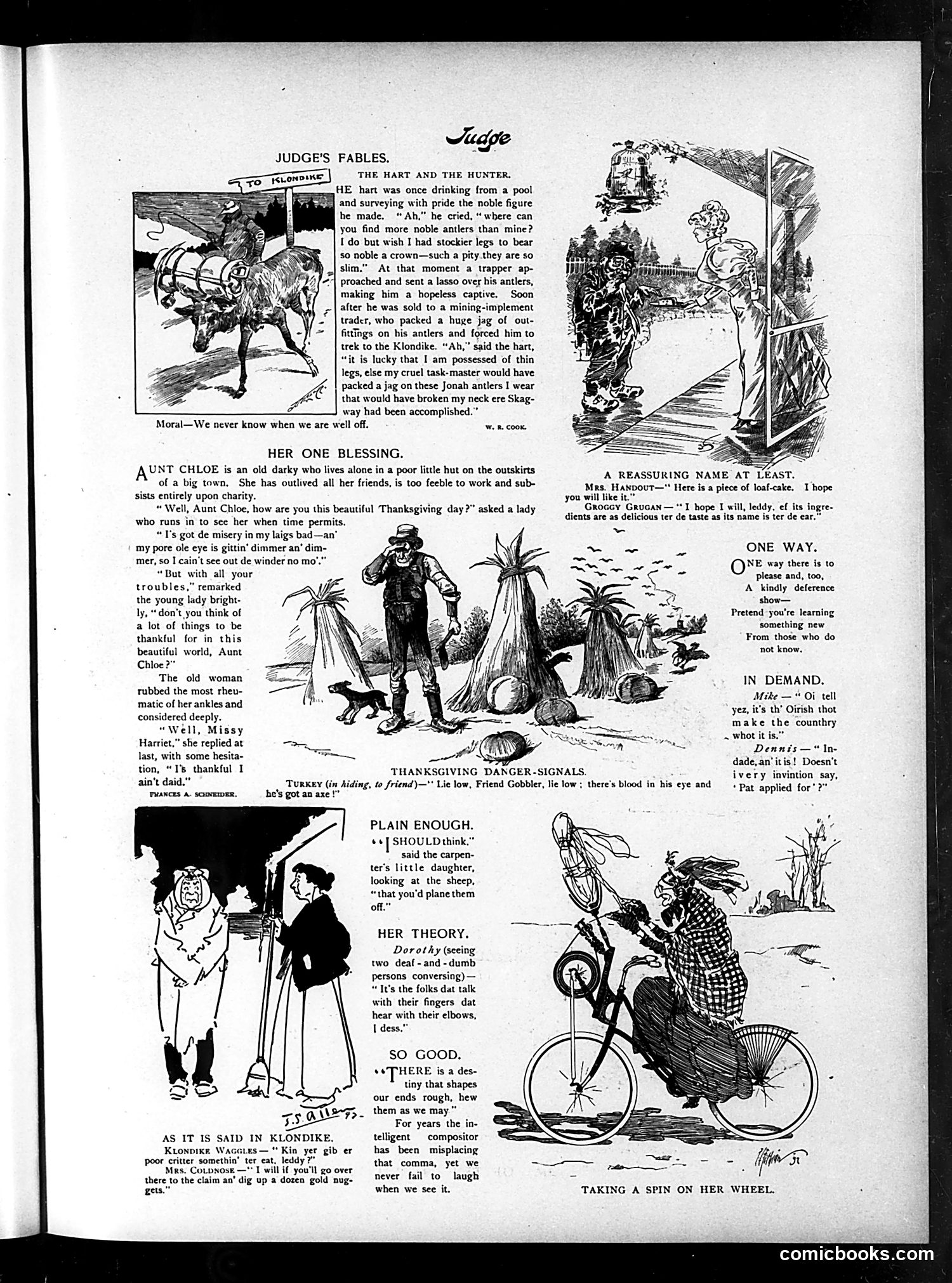
This page from Judge contains several standalone fables and humorous sketches rather than a unified political cartoon. **"The Hart and the Hunter"** is an Aesop-style moral tale: a vain deer admires his antlers but regrets his thin legs, until captured and forced to carry supplies to the Klondike goldfields. Then he's grateful for those same thin legs—the moral being we don't recognize our good fortune. **"Her One Blessing"** depicts an elderly Black woman (drawn in period racial caricature) named Aunt Chloe, living in poverty. When asked what she's thankful for on Thanksgiving despite her ailments, she mentions her eyesight—a gentle commentary on gratitude amid hardship. The remaining items are brief joke vignettes about Irish immigrants, deaf communication, sheep shearing, and a bicycle rider—typical humor of the era. The Klondike references date this to the 1890s gold rush period. The racial caricatures reflect period attitudes. Overall, this is light satirical/humorous content rather than sharp political commentary.
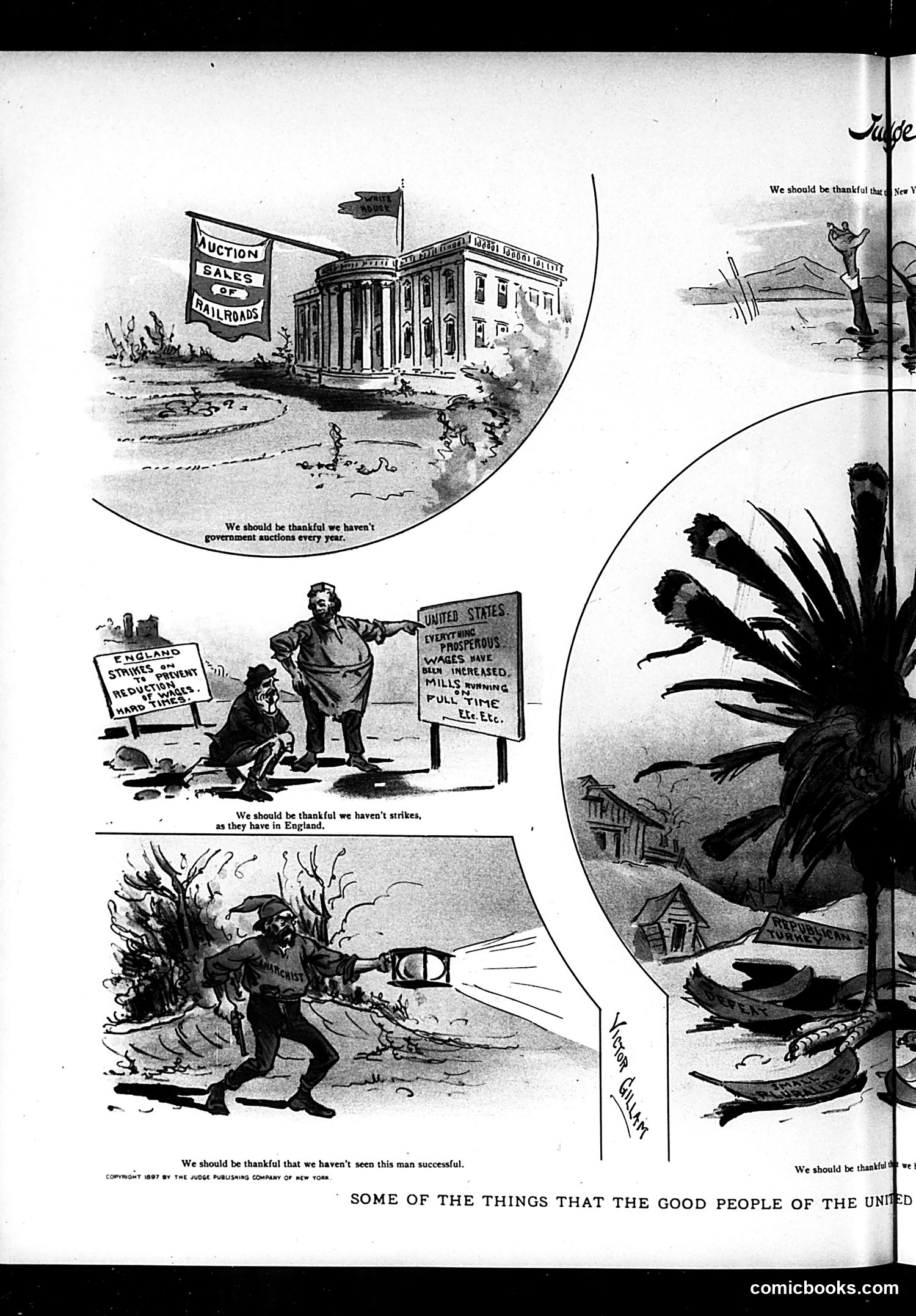
This satirical page from *Judge* presents contrasting scenes of American gratitude. The top panel shows the White House with a banner thanking God for stable government and railroads—representing American prosperity and order. Below, a contrasting panel depicts labor unrest in England, with signs advertising strikes and worker hardship ("Everything prosperous wages have been increased, mills running full time"). An American figure points to this as something Americans should be "thankful" to have avoided. The bottom panel shows an armed figure confronting what appears to be an anarchist or radical threat, suggesting Americans should be grateful they haven't seen such violent upheaval succeed domestically. The cartoon's core message: Americans should count their blessings compared to England's labor strife and the danger of domestic radicalism. It reflects late-19th-century American anxiety about labor movements and anarchism, while promoting nationalist self-congratulation about American stability and prosperity.
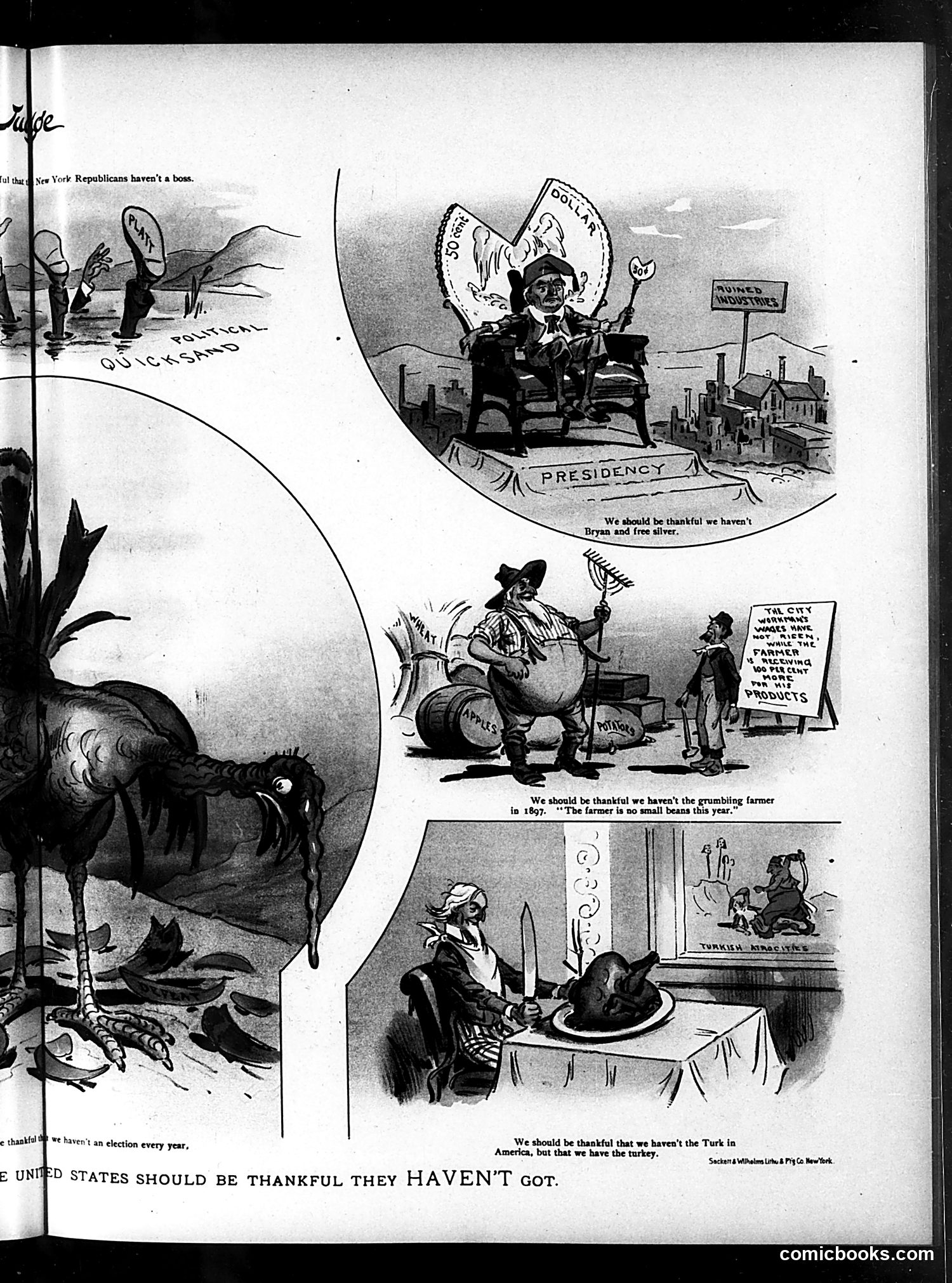
This satirical page from *Judge* magazine uses a Thanksgiving theme to critique American political conditions. The central panel shows a figure labeled "Presidency" sitting atop industrial factories, captioned with gratitude that America hasn't Bryan and "free silver"—referencing the contentious 1896 presidential election where William Jennings Bryan championed unlimited silver coinage, opposed by Republicans and business interests. The surrounding vignettes express relief about other avoided troubles: a grumbling farmer (agricultural discontent), lack of elections every year (suggesting electoral fatigue), and absence of "the Turk" (Ottoman Empire complications, versus having "the turkey" for dinner—a pun). The imagery suggests *Judge's* conservative stance: relief that pro-business Republicans won, averting economic policies (free silver) seen as dangerous to industrial prosperity and stability. The cartoon equates national well-being with Republican electoral victory and rejection of agrarian/populist reform.
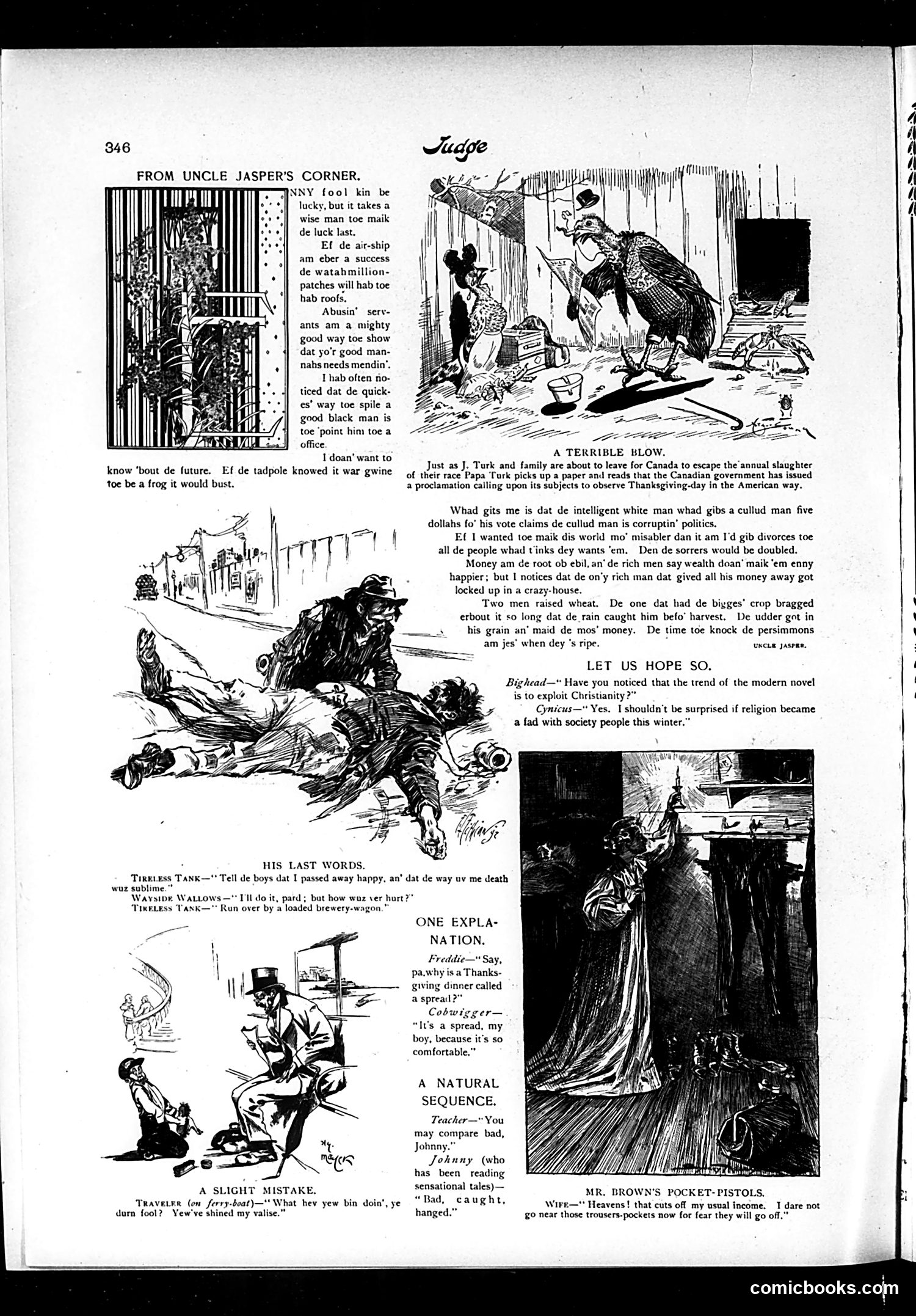
This page collects several satirical pieces targeting turn-of-the-century American social issues: **"From Uncle Jasper's Corner"** presents dialect humor from a Black character offering folk wisdom on topics like airships, servants, and politics—reflecting the era's minstrel-influenced comedy conventions. **"A Terrible Blow"** mocks Canadian Thanksgiving adoption, showing a Turkey family's dismay that Canada will observe the American holiday, threatening their escape from the traditional slaughter. **"Let Us Hope So"** satirizes the trend of modern novels exploiting Christianity as a fashionable topic among wealthy society people. **"Mr. Brown's Pocket-Pistols"** jokes about a wife's concern that her husband's gun-filled pockets will discharge, reducing her "usual income"—implying accidental death would end his income provision. The page reflects Judge's satirical focus on social hypocrisy, wealth inequality, and contemporary cultural trends, using humor that ranges from gentle social observation to racial stereotypes typical of early 20th-century American periodicals.
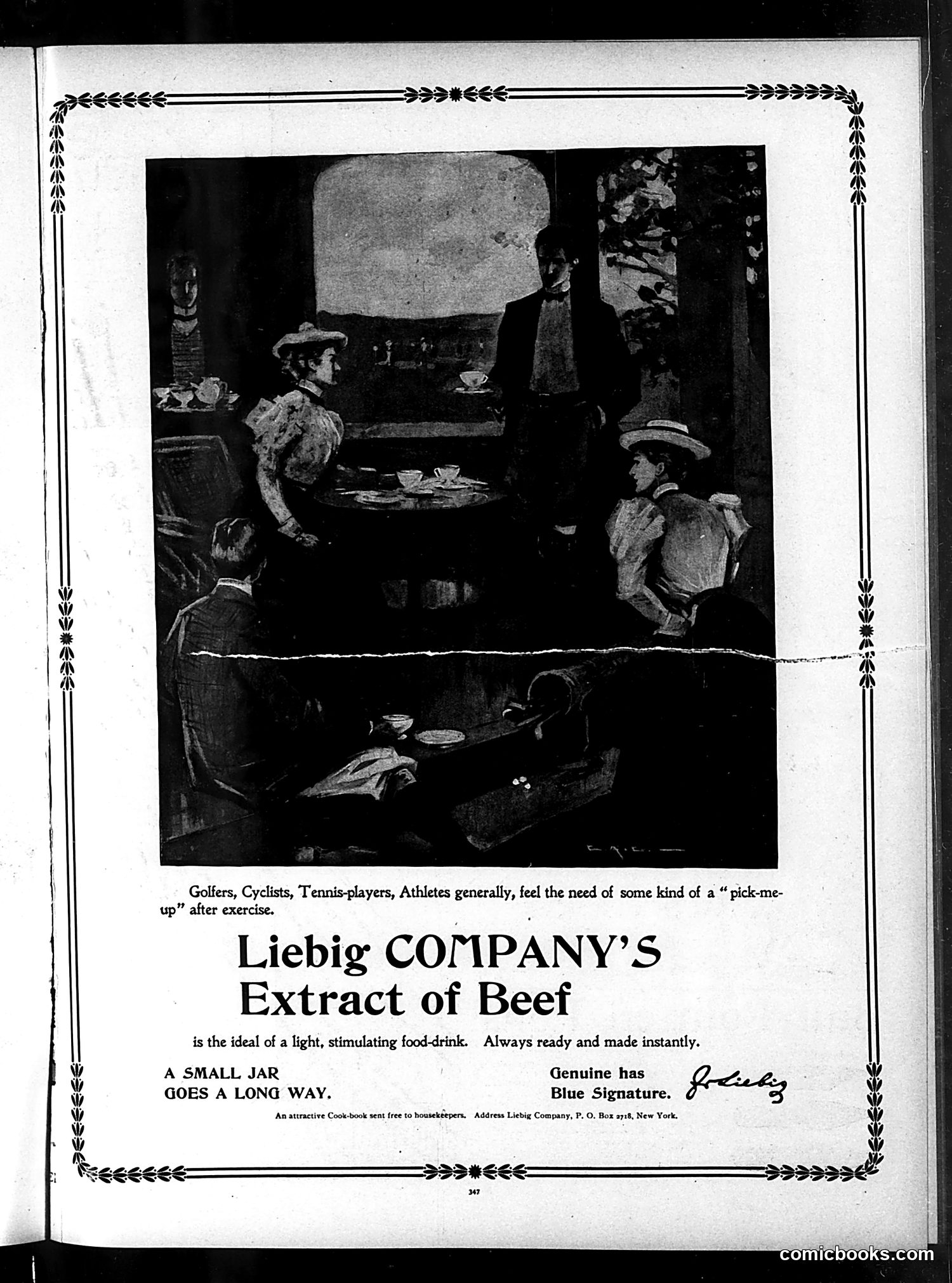
This is primarily a **product advertisement**, not political satire. It promotes Liebig Company's beef extract as a recovery drink for athletes. The illustration depicts an early 1900s indoor social scene where well-dressed people (golfers, cyclists, tennis players mentioned in text) gather for refreshment after exercise. The ad targets the emerging athletic leisure class, positioning the beef extract as an ideal "pick-me-up"—a stimulating beverage that's instant and convenient. The marketing strategy appeals to active, affluent consumers by associating the product with fashionable sports and social status. The emphasis on the "Blue Signature" for authenticity suggests counterfeit products were a concern. The offer of a free cookbook targets housekeepers responsible for purchasing provisions. This reflects late Victorian/Edwardian consumer culture and the commercialization of health and athleticism.
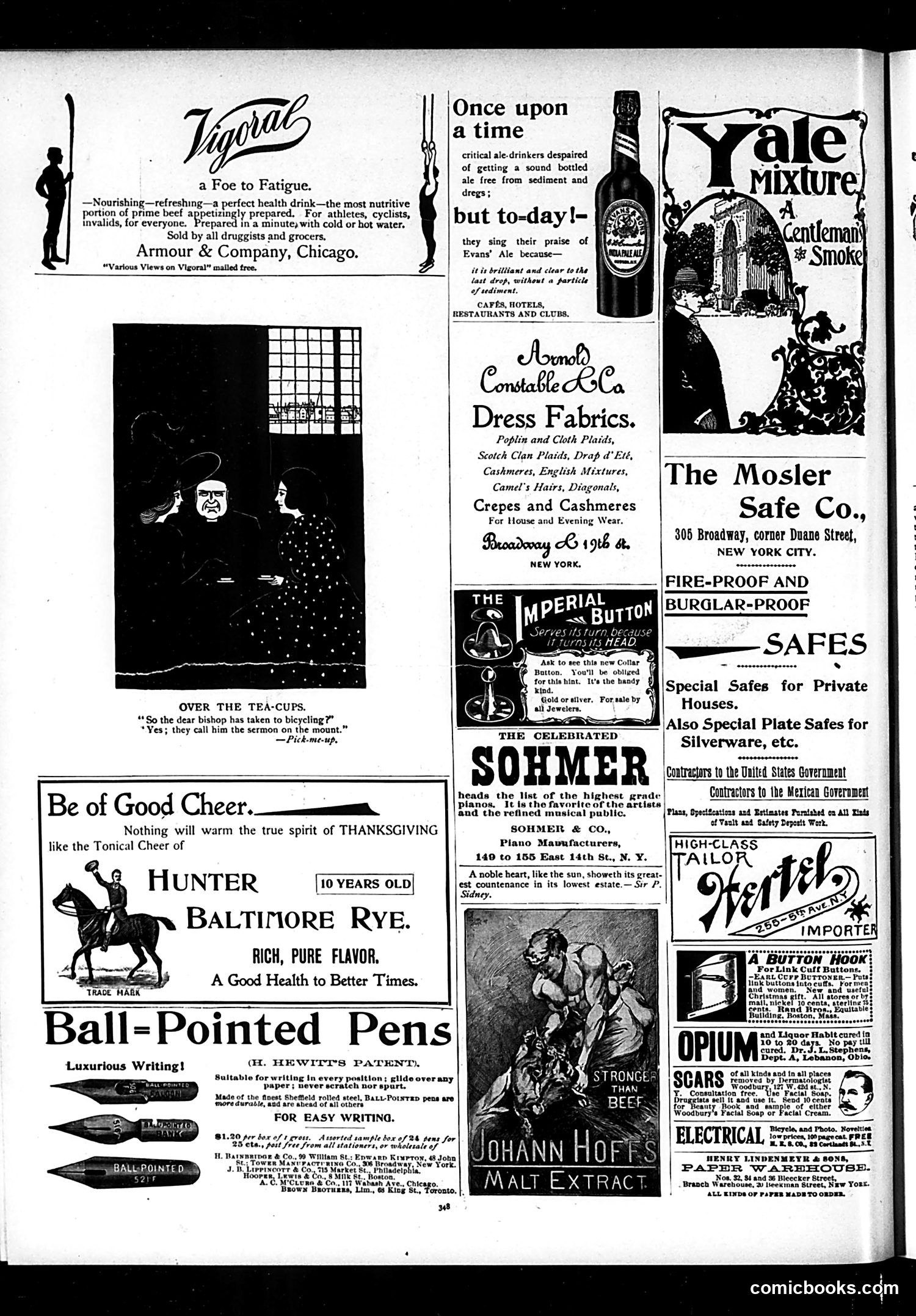
This page is primarily **advertising**, not political satire. It contains various product advertisements typical of early-20th-century publications. The one **cartoon present** is titled "Over the Tea-Cups," showing two women in conversation. The joke reads: A bishop has taken up bicycling, and people "call him the sermon on the mount"—a pun playing on the biblical "Sermon on the Mount" against the image of him "mounting" a bicycle. The remainder of the page advertises patent medicines (Vigoral health drink, Hunter Baltimore Rye whiskey), writing implements (ball-pointed pens), pianos, safes, dress fabrics, and various other consumer goods. These ads reflect common early-1900s marketing strategies targeting middle-class readers. No significant political commentary or social satire appears on this particular page—it functions mainly as a revenue-generating advertising section within the magazine.
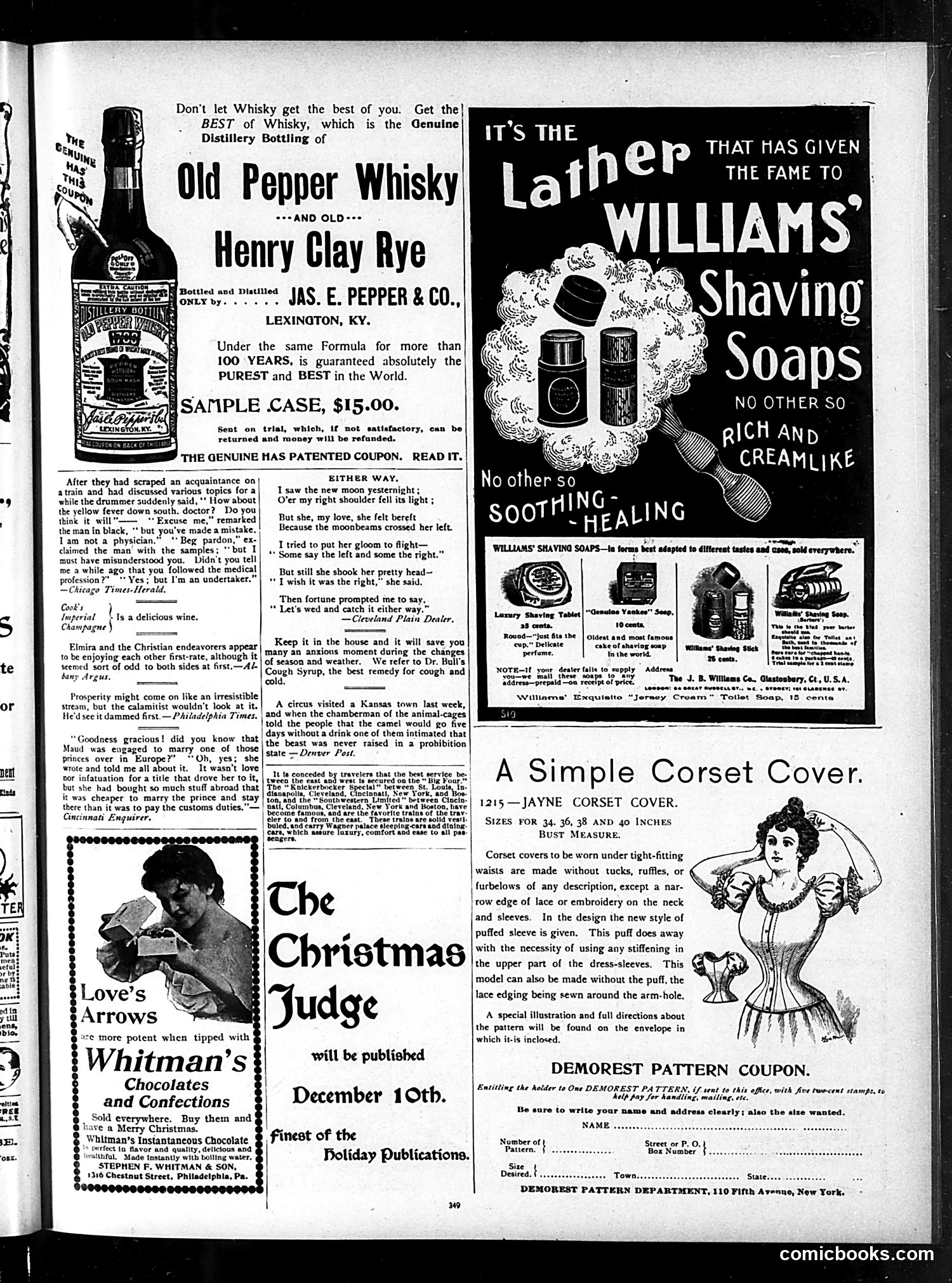
This page is **primarily advertising** with brief satirical anecdotes interspersed. The main content includes: **Advertisements:** - Old Pepper Whisky and Henry Clay Rye (Kentucky distillery products) - Williams' Shaving Soaps - Whitman's Chocolates - Jayne Corset Cover (sewing pattern) - Dr. Bull's Cough Syrup **Satirical Humor:** The short comedic pieces mock various social situations: a drummer mistaking an undertaker for a doctor; a woman marrying a European prince to avoid customs duties; a couple debating moon superstitions; and a Kansas camel owner claiming the animal never drinks (implying prohibition culture). **Context:** These jokes rely on period-specific concerns—customs duties on imported goods, prohibition debates, and class anxieties about marrying into European aristocracy. The humor is gentle, domestic, and aimed at middle-class readers familiar with traveling salesmen ("drummers") and consumer culture. No political cartoons or identifiable caricatured figures appear on this page.
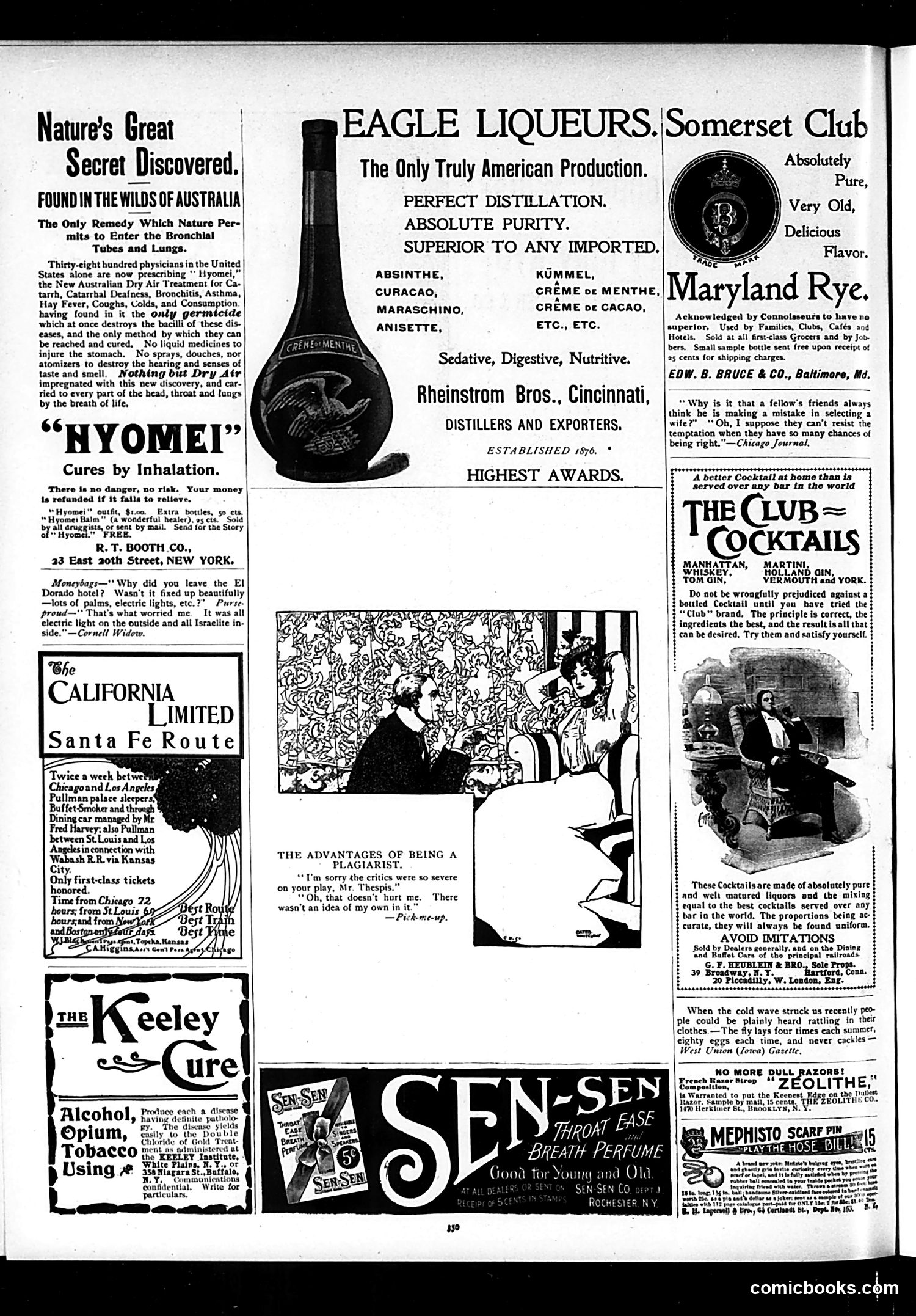
This page is primarily **advertisements** for patent medicines, alcohol, and transportation services typical of early 1900s America. Key satirical content includes: **"Moneybags" Cartoon**: A brief joke mocking antisemitic stereotyping. A wealthy character ("Moneybags") questions why his friend left a luxurious hotel; the friend responds it was "all electric light on the outside and all Israelite on the inside"—suggesting the hotel's elegance masked Jewish ownership/management. This reflects period prejudice against Jewish businesspeople. **"Advantages of Being a Plagiarist"**: A theater critic exchanges with a playwright ("Thespis") where the playwright admits his play contained no original ideas—yet the critics' harsh reviews don't bother him since he had nothing of his own to defend. The satire mocks both unoriginal theater and critics' predictability. The remainder consists of genuine product advertisements (medicines like "Hyomei," liqueurs, railroads), representing the era's largely unregulated patent-medicine marketing and alcohol advertising before Prohibition.
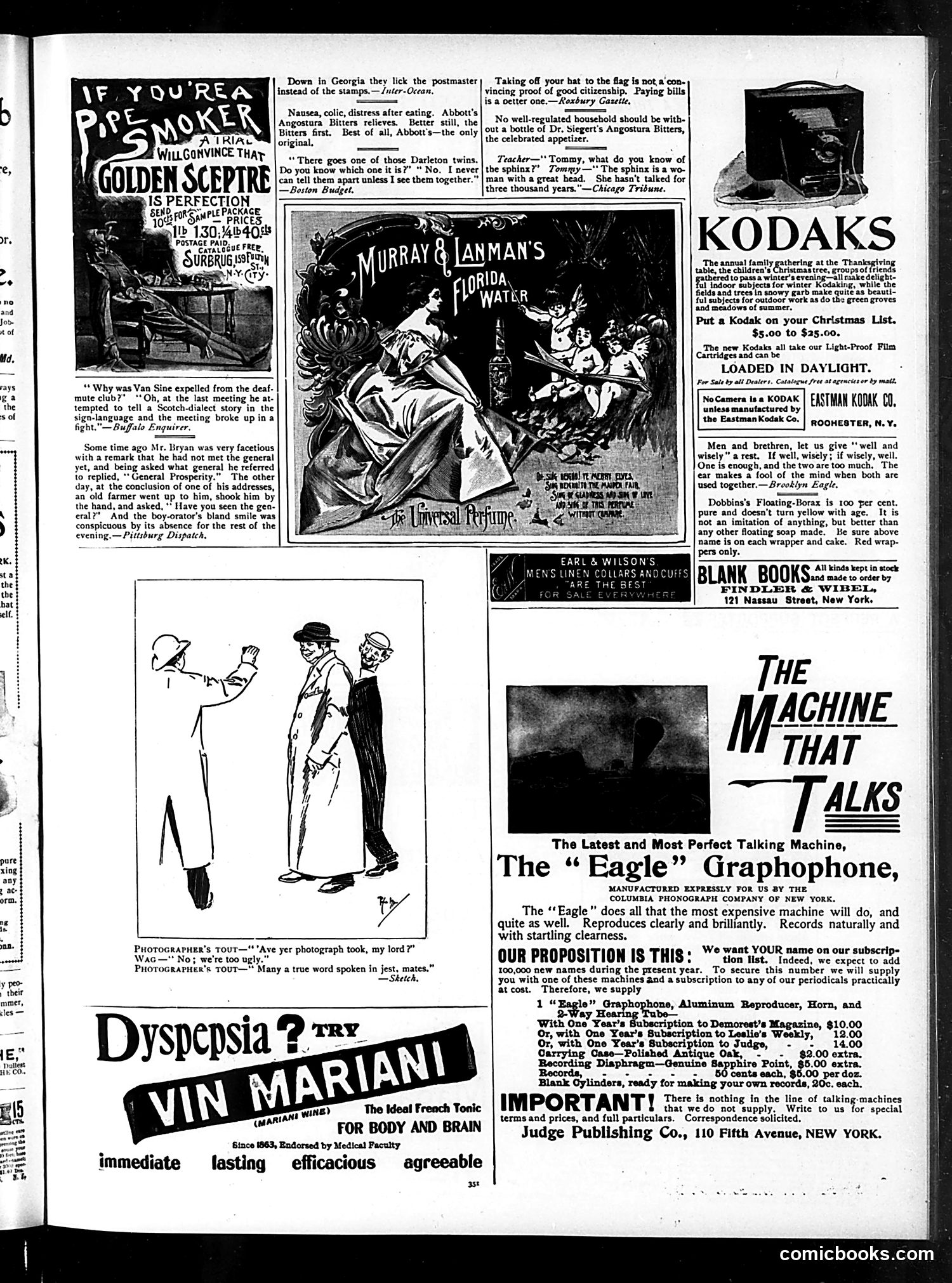
This page from *Judge* magazine is primarily **advertising**, with several short jokes interspersed: **The Cartoons/Jokes:** The main cartoon (lower left) shows a photographer's pitch to a client, poking fun at vanity photography. The joke titles ("Why yer photograph took, my lord?") pun on the pretense of clients refusing to be photographed. The page includes multiple **brief, topical jokes**: one references William Jennings Bryan—a prominent politician of the era—who joked about not meeting "General Prosperity," which was apparently a frequent quip. A farmer later uses the same joke, humiliating Bryan. **Key Advertisements:** - **Kodak cameras** ($5-$25), marketed for winter holiday photography - **Graphophone** (talking machine/early phonograph) by Columbia - **Remedies**: Angostura Bitters, Vin Mariani (a tonic) - **Soap, blank books, various products** The content reflects early 1900s American middle-class consumer culture and gentle political satire. The Bryan reference is the clearest topical element, though specific dating requires knowing when this appeared.
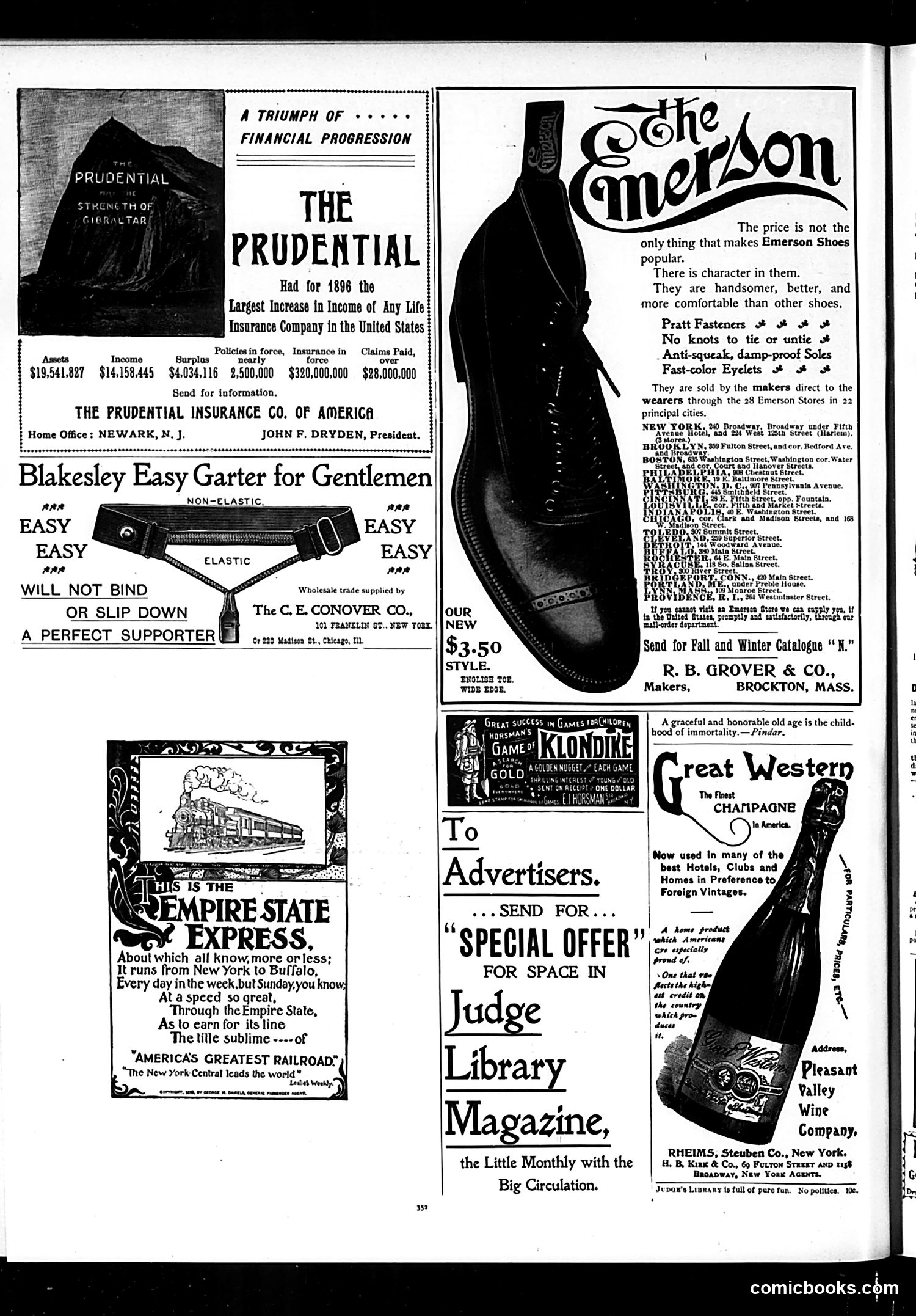
This page is primarily **advertisements** rather than editorial cartoons or satire. The content includes: **Major Ads:** - **The Prudential Insurance Company** promotes its 1896 financial growth with statistics - **Emerson Shoes** advertisement emphasizing quality features (Pratt Fasteners, fast-color eyelets) - **Blakeskey Easy Garter** for men—a non-elastic supporter garment - **Empire State Express** railroad advertisement celebrating New York Central's speed and prestige - **Pleasant Valley Wine Company** promoting champagne for upscale venues - **Klondike Card Game** (small ad) - **Great Western Champagne** advertisement - **Judge Library Magazine** soliciting advertisers **Context for Modern Readers:** The page reflects late-19th-century consumer culture and advertising practices. Products like garters and shoe fasteners address concerns (comfort, durability, fastening methods) relevant to that era. The emphasis on insurance company financial strength reflects post-depression confidence-building. This is essentially a commercial page with minimal satirical content—typical for Judge's revenue model.
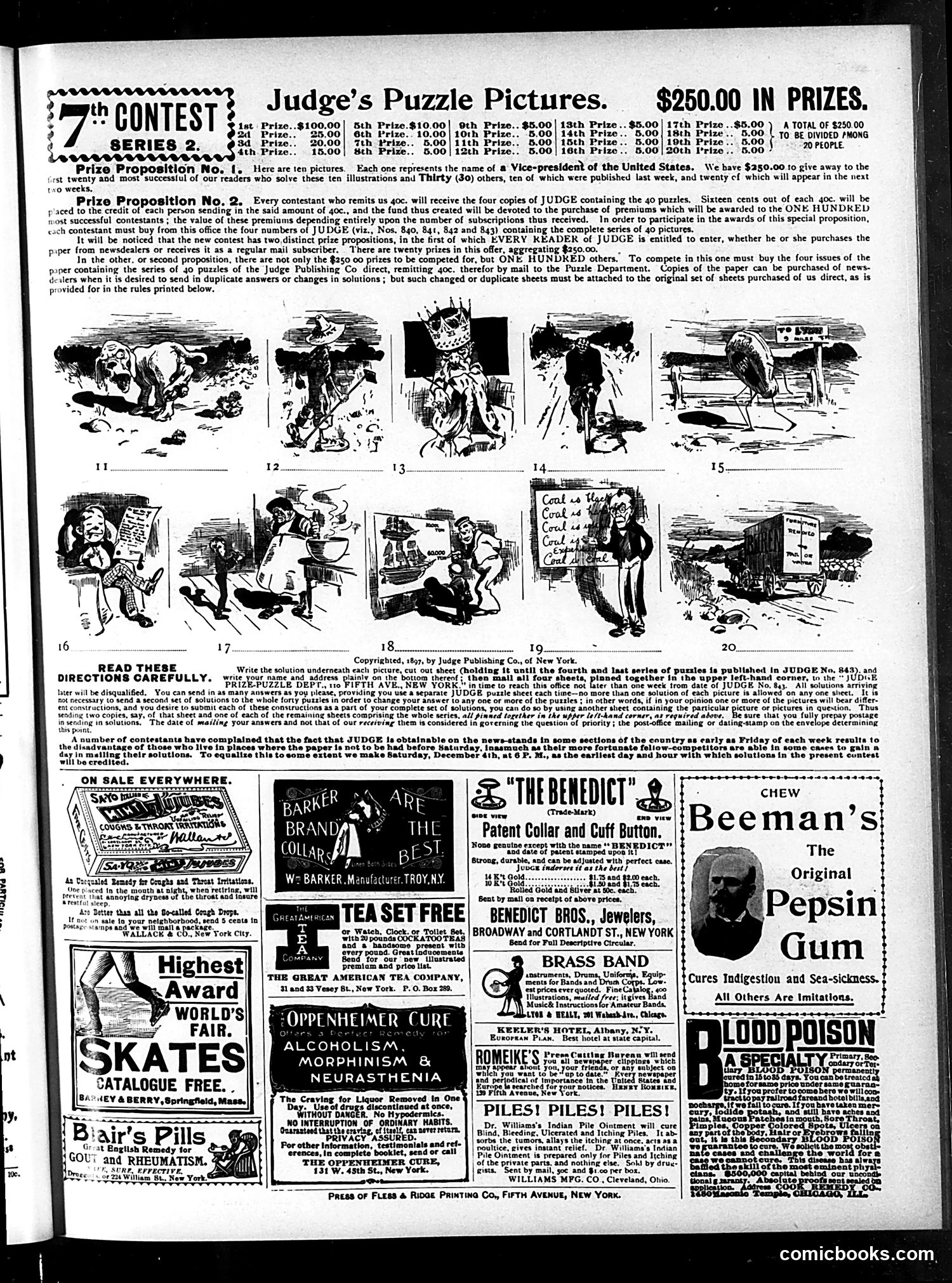
This is primarily a **puzzle contest announcement** rather than political satire. Judge magazine is running a competition asking readers to identify ten pictures, each representing the name of a U.S. Vice-president. The contest offers $250 in prizes distributed across twenty winners. The page includes two prize propositions: one open to all readers (whether they purchase the paper or subscribe), and a second requiring purchase of four specific Judge issues containing forty total puzzles. Participants must submit solutions with their name and address. The bottom half features typical period **patent medicine and product advertisements**—including treatments for alcoholism, indigestion, and pills for various ailments—standard advertising fare for 1890s American magazines. The page demonstrates how Judge combined editorial content with aggressive advertising to fund operations.
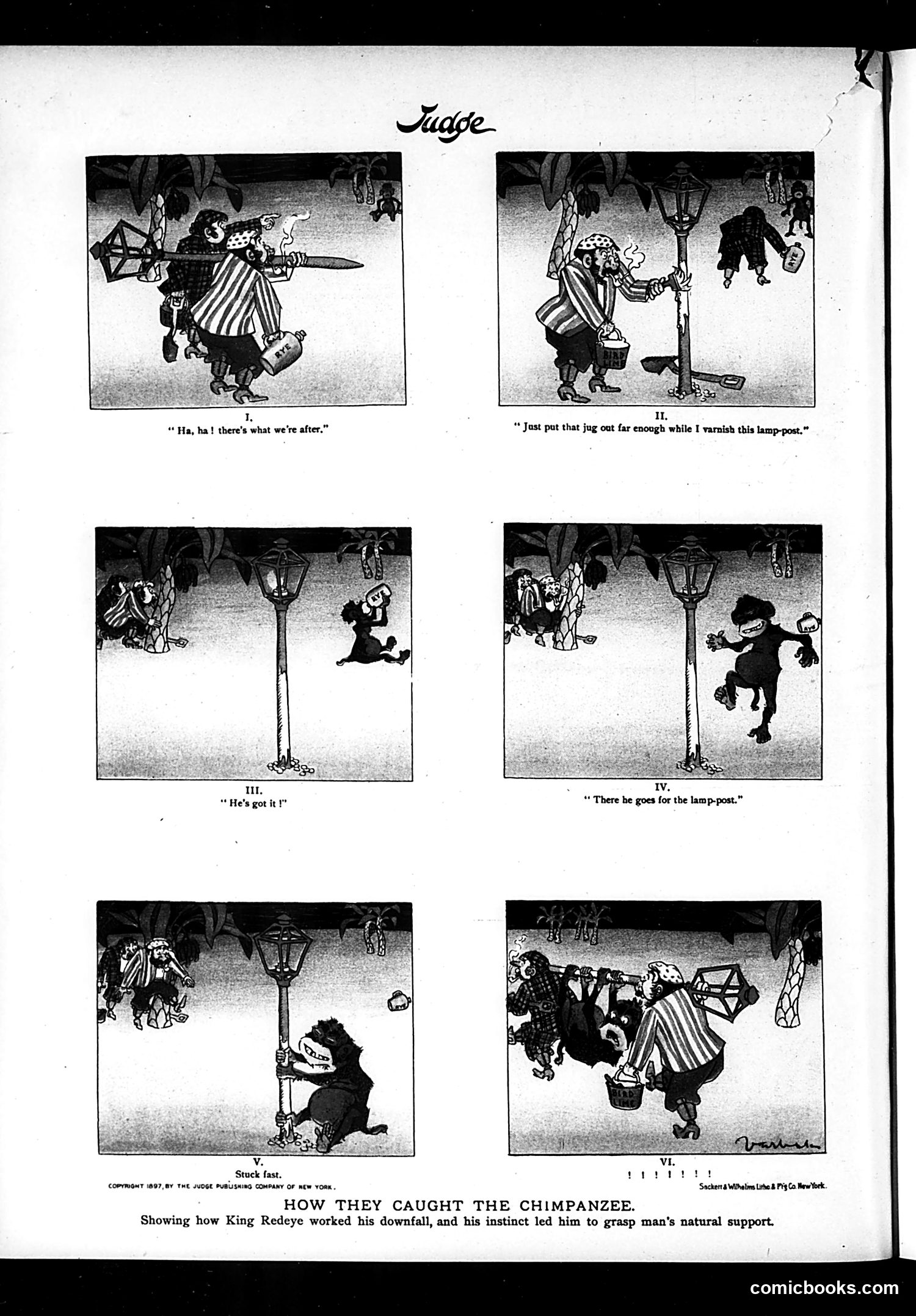
This 1897 comic strip depicts the capture of a chimpanzee named "King Redeye" using a crude trap. The sequence shows figures (appearing to be hunters or zookeepers) positioning a jug as bait near a lamp-post. The chimp, unable to resist grasping the "natural support" of the lamp-post while reaching for the jug, becomes stuck—apparently the jug is attached or the post is sticky ("varnish"). The satire likely mocks both animal behavior and contemporary attitudes toward wildlife capture for zoos or circuses, which were popular spectacles in the 1890s. The emphasis on the chimp's "instinct" suggests commentary on animal intelligence versus human cunning. The crude setup and comedic tone reflect the period's casual approach to animal exploitation and "exotic" specimen collection.