
A complete issue · 16 pages · 1897
Judge — November 6, 1897
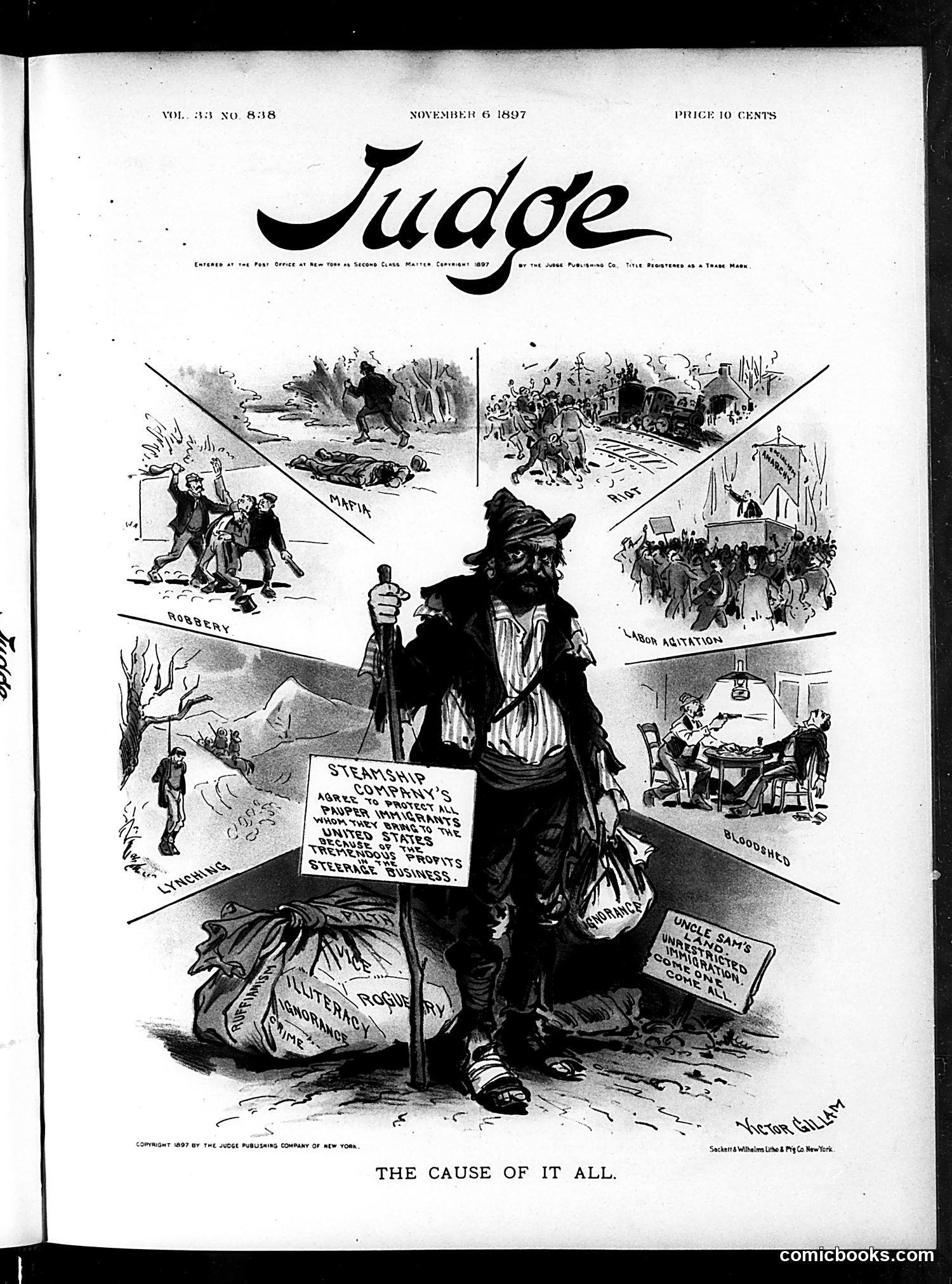
This political cartoon depicts a demonic or villainous figure as the root cause of multiple social problems. Radiating from the central character are vignettes labeled with various contemporary issues: "Robbery," "Lynching," "Steamship Company's Abuse of Immigrants," "Labor Agitation," "Bloodshed," and "Uncle Sam's Unauthorized Coercive Remedy." The central figure appears to represent either corporate greed, political corruption, or a specific antagonist blamed for America's social ills in the 1890s. The surrounding scenes illustrate how this singular "cause" allegedly generates cascading societal crises—from labor disputes to violence to immigrant exploitation. The title suggests the cartoonist's argument that one root problem (likely monopolistic business practices or political mismanagement) produces all these secondary evils.
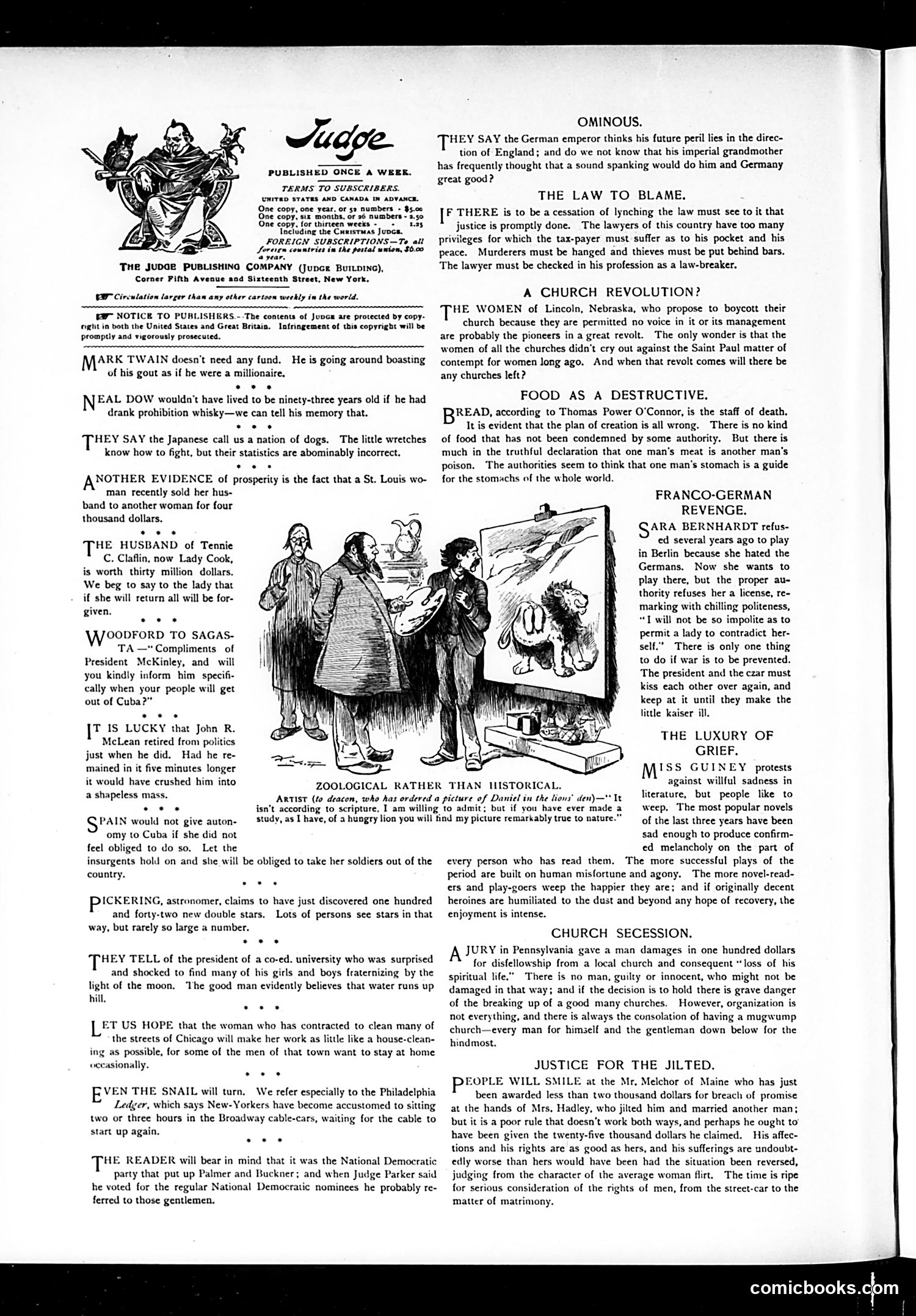
The central cartoon titled "ZOOLOGICAL RATHER THAN HISTORICAL" depicts an artist being ordered to paint "a picture of Daniel in the lion's den" but instructed to make it "remarkably true to nature." The image shows figures examining what appears to be a lion, with the satire suggesting a conflict between historical/biblical accuracy and naturalistic artistic representation. The surrounding editorial commentary critiques various social and political issues: inadequate legal remedies for lynching, a women's church boycott in Nebraska, food waste as moral failing, and divorce settlements. The "Franco-German Revenge" section addresses Sara Bernhardt's theatrical disputes with German authorities. The page exemplifies Judge's approach: combining visual satire with pointed editorial commentary on contemporary American social problems and international affairs.
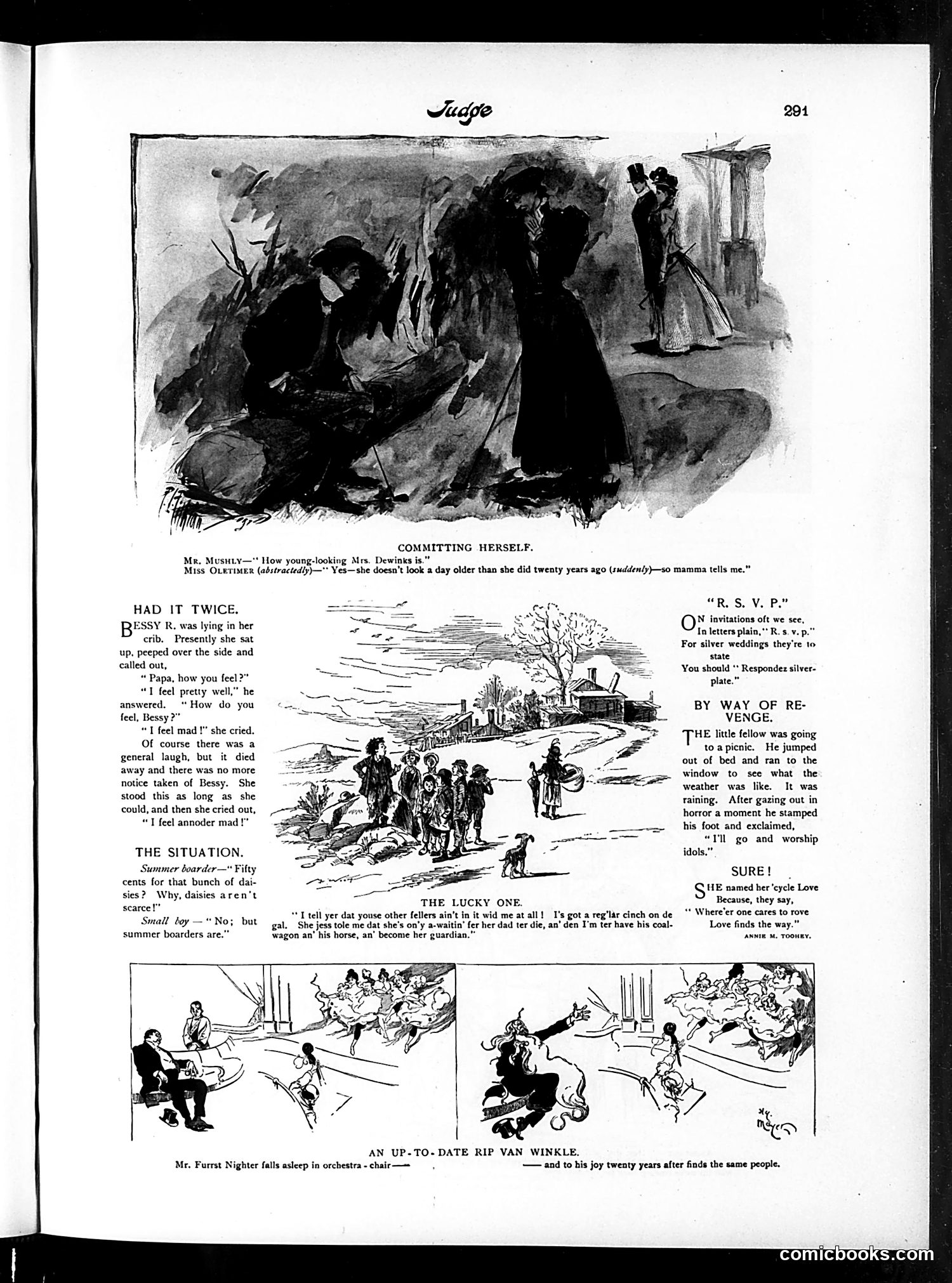
This page contains several brief humorous sketches typical of Judge's satirical format: **"Committing Herself"** depicts a social scene where a young woman's appearance hasn't aged in twenty years—the joke being she's either lying about her age or using cosmetics/procedures to maintain youth, a common vanity target of the era. **"Had It Twice," "The Situation,"** and **"R.S.V.P."** are short comic scenarios about domestic life and social etiquette—a child's fever, summer boarding complaints, and wedding invitation formalities. These reflect middle-class concerns of the period. The remaining sketches ("By Way of Revenge," "Sure!," "The Lucky One," and "An Up-to-Date Rip Van Winkle") are brief observational gags about relationships, romance, and social behavior—typical Judge fare satirizing contemporary manners rather than specific political events.
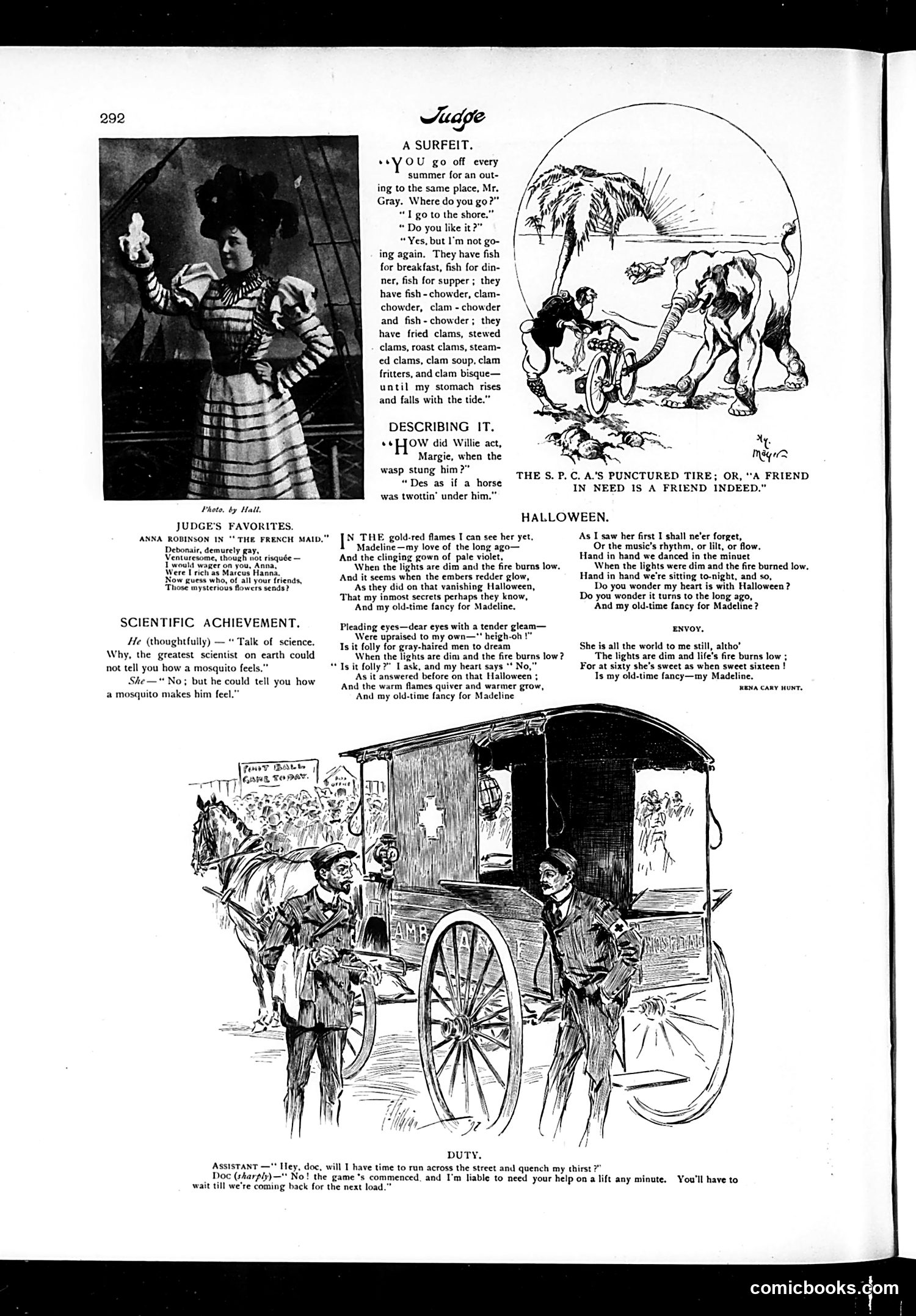
This page contains several unrelated humor pieces typical of Judge magazine's format: **"A Surfeit"** satirizes seaside vacation monotony—a man complains that his shore resort serves only fish and clams in endless variations until his stomach "rises and falls with the tide," a gross pun on tidal rhythms. **"Scientific Achievement"** is a brief gender-dynamics joke: a man claims scientists can't measure how mosquitoes *feel*, but a woman retorts they could measure how mosquitoes make *him* feel—inverting his presumed superiority. **"The S.P.C.A.'s Punctured Tire"** cartoon shows the Society for the Prevention of Cruelty to Animals helping a human with a bicycle, humorously suggesting even this animal-welfare organization extends aid to people in need. **"Halloween"** and **"Duty"** are sentimental poetry and a workplace joke respectively, unrelated to satire. The page primarily offers lighthearted domestic humor rather than political commentary.
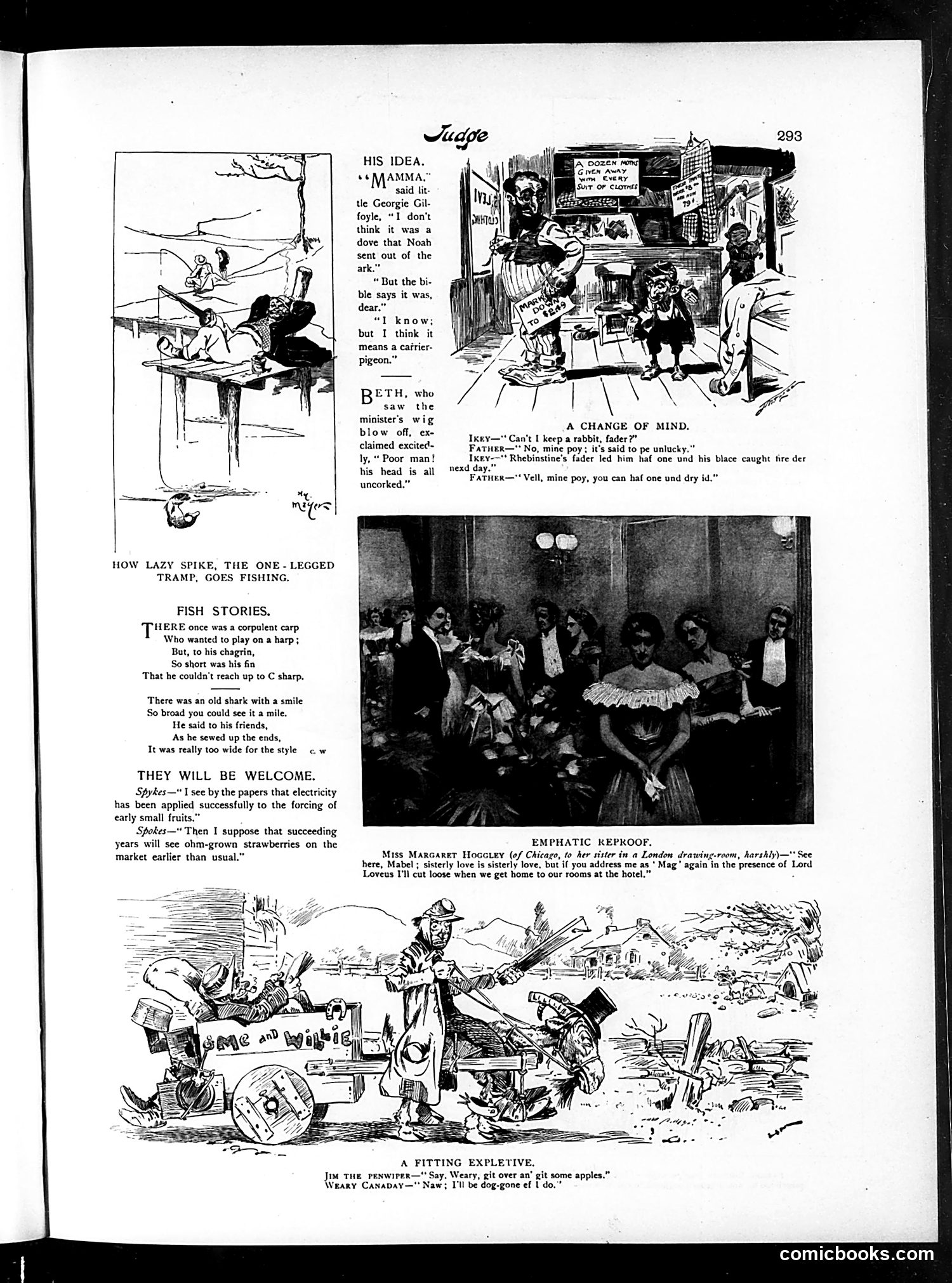
This page contains multiple unrelated comic sketches and jokes typical of Judge's satirical format: **"How Lazy Spike"** depicts a one-legged tramp fishing—a straightforward humorous vignette with no apparent political content. **"Fish Stories"** presents whimsical nonsense verses about animals (a carp, shark) wanting musical ability, poking fun at absurd premises. **"They Will Be Welcome"** is a brief joke about electricity being applied to force early fruit growth, with a pun about "ohm-grown strawberries." **"A Change of Mind"** shows a Yiddish-accented Jewish father initially refusing his son a rabbit as unlucky, then reversing course after admitting his own rabbit caused a fire—immigrant humor relying on dialect stereotypes. **"Emphatic Reproof"** depicts a snobbish American woman (Margaret Hoggley) in London scoldingly telling her sister not to call her "Mag" in front of Lord Loveus, satirizing social pretension and name-consciousness. **"A Fitting Expletive"** presents rural dialect humor about refusing apple-gathering work. The page emphasizes wordplay, ethnic stereotyping, and social class mockery rather than political satire.
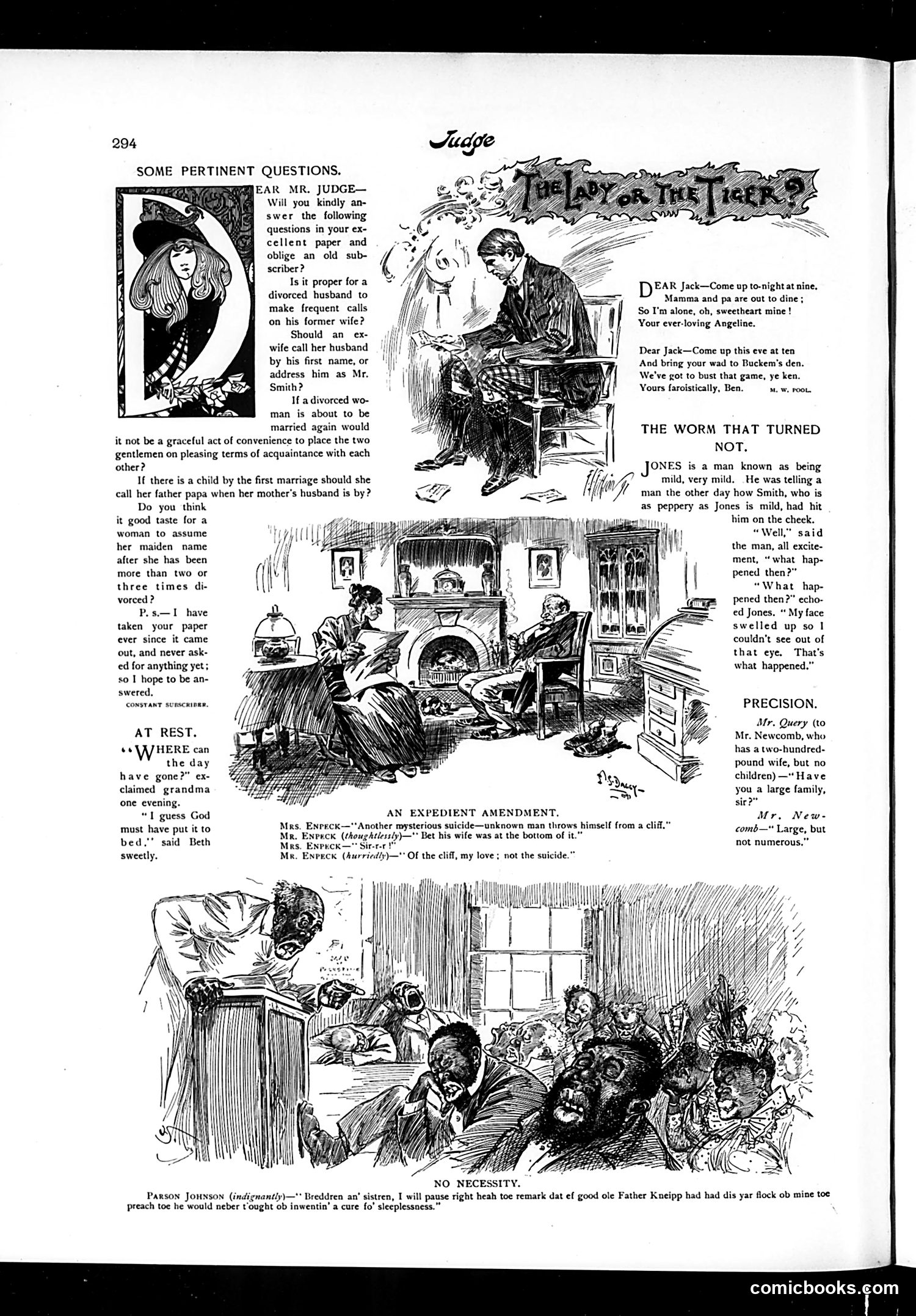
This page from *Judge* (likely early 1900s) contains several satirical pieces mocking social etiquette and human behavior: **"Some Pertinent Questions"** presents absurd inquiries about divorce etiquette—addressing whether ex-spouses should use formal titles, if divorced people should introduce new partners to old ones. The satire targets the rigid Victorian social conventions around divorce, which was becoming more common and creating awkward social situations. **"The Worm That Turned Not"** jokes about mild-mannered Jones, who gets hit by the peppery Smith but merely complains about his swollen eye rather than retaliating. The humor lies in Jones's passivity despite provocation. **Other brief satirical pieces** include jokes about grandmothers, suicides, and a Black preacher claiming Father Kneipp's health cure wouldn't be needed if he had a congregation as "sleepy" as his current one—using dialect humor typical of the era's casual racism. The overall tone mocks social pretension, marital chaos from increasing divorce, and passive masculinity—common *Judge* targets.
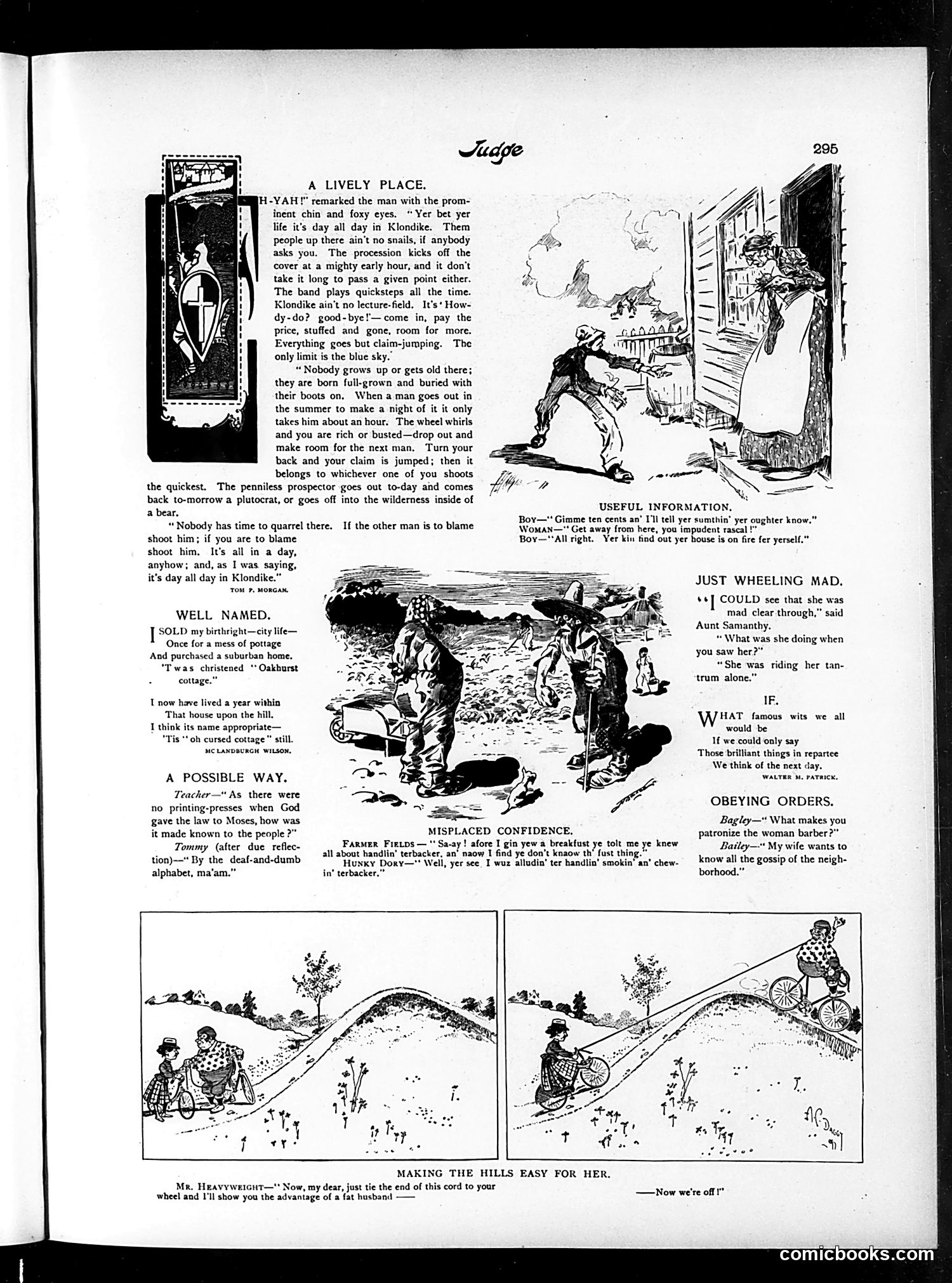
This page contains primarily **humorous short jokes and verses** rather than political satire. The content reflects late 19th/early 20th-century American humor: **"A Lively Place"** depicts a man describing the Klondike Gold Rush—portraying it as chaotic, fast-paced frontier life where fortunes are made or lost instantly, claims are stolen, and violence is commonplace. It's satirizing the lawless rush mentality. **Other items** are domestic humor: a man naming his suburban home "Oakhurst cottage" but cursing it as an "oh cursed cottage"; a farmer catching a hired hand lying about tobacco handling; jokes about a woman's temper ("riding her tantrum alone"); and a fat husband using himself as a pulley to help his wife up a hill. **"Useful Information"** shows a street boy offering gossip, rejected by a woman—who then learns her house is on fire from the boy's comeback. The page is largely **light social comedy** mocking ordinary life situations (real estate disappointments, marital dynamics, hiring deceptions) rather than addressing major political events or figures.
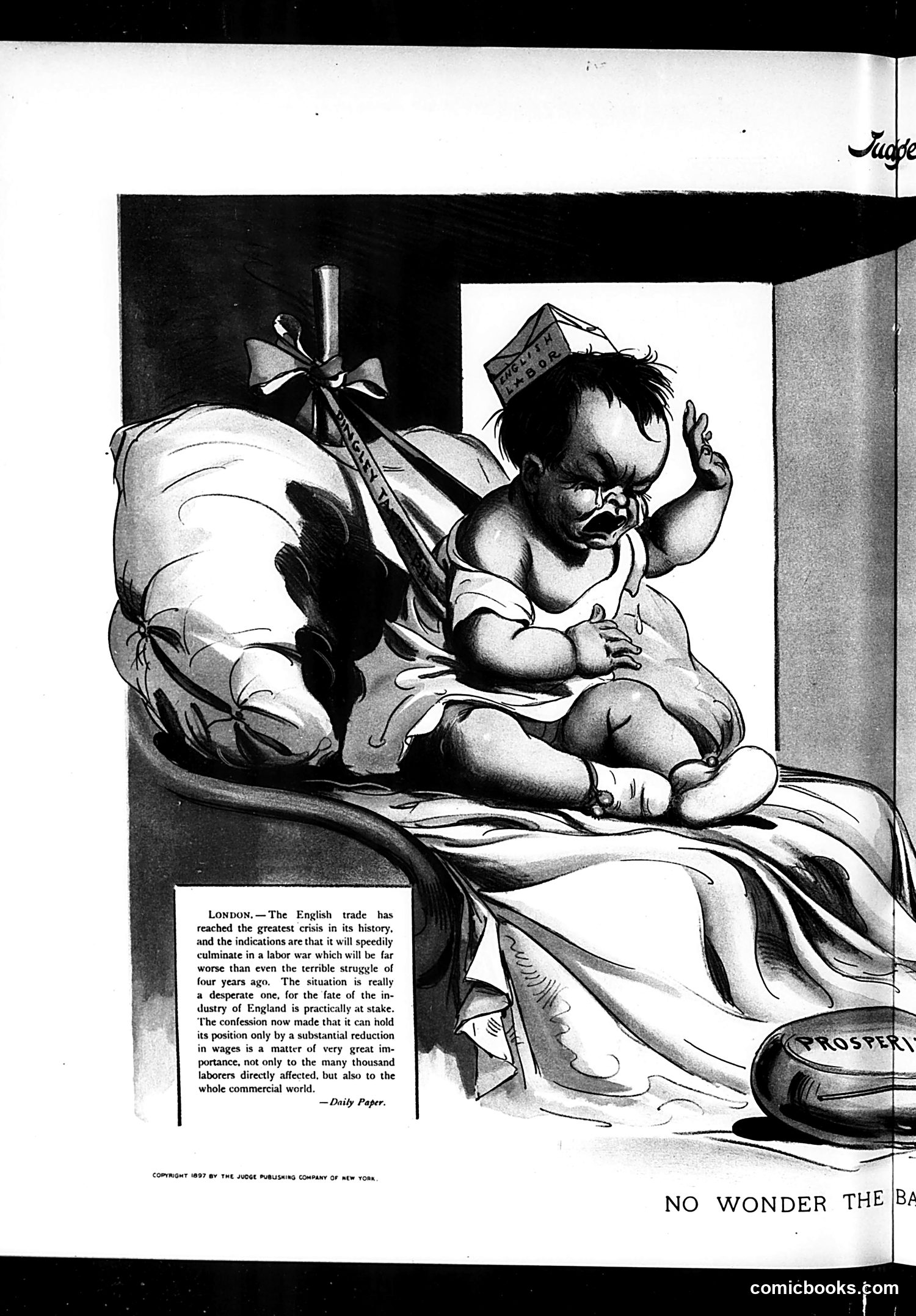
This 1897 Judge cartoon uses an infant as metaphor for England's economy. The baby, depicted with exaggerated facial features suggesting caricature, sits amid tools of trade and industry (visible in background items). A document labeled "PROSPERITY" lies nearby—ironically, given the crisis described. The satire illustrates the text's warning about England facing its worst trade crisis ever, with inevitable wage cuts and labor conflict looming. The crying infant represents Britain's distressed industrial state. The cartoon suggests England's economic troubles are causing national "distress"—hence the baby's anguished expression. The reference to "the terrible struggle of four years ago" likely alludes to labor unrest of the early 1890s. The point: England's industrial dominance is suffering, forcing painful economic medicine (wage reduction) that will only worsen labor relations.
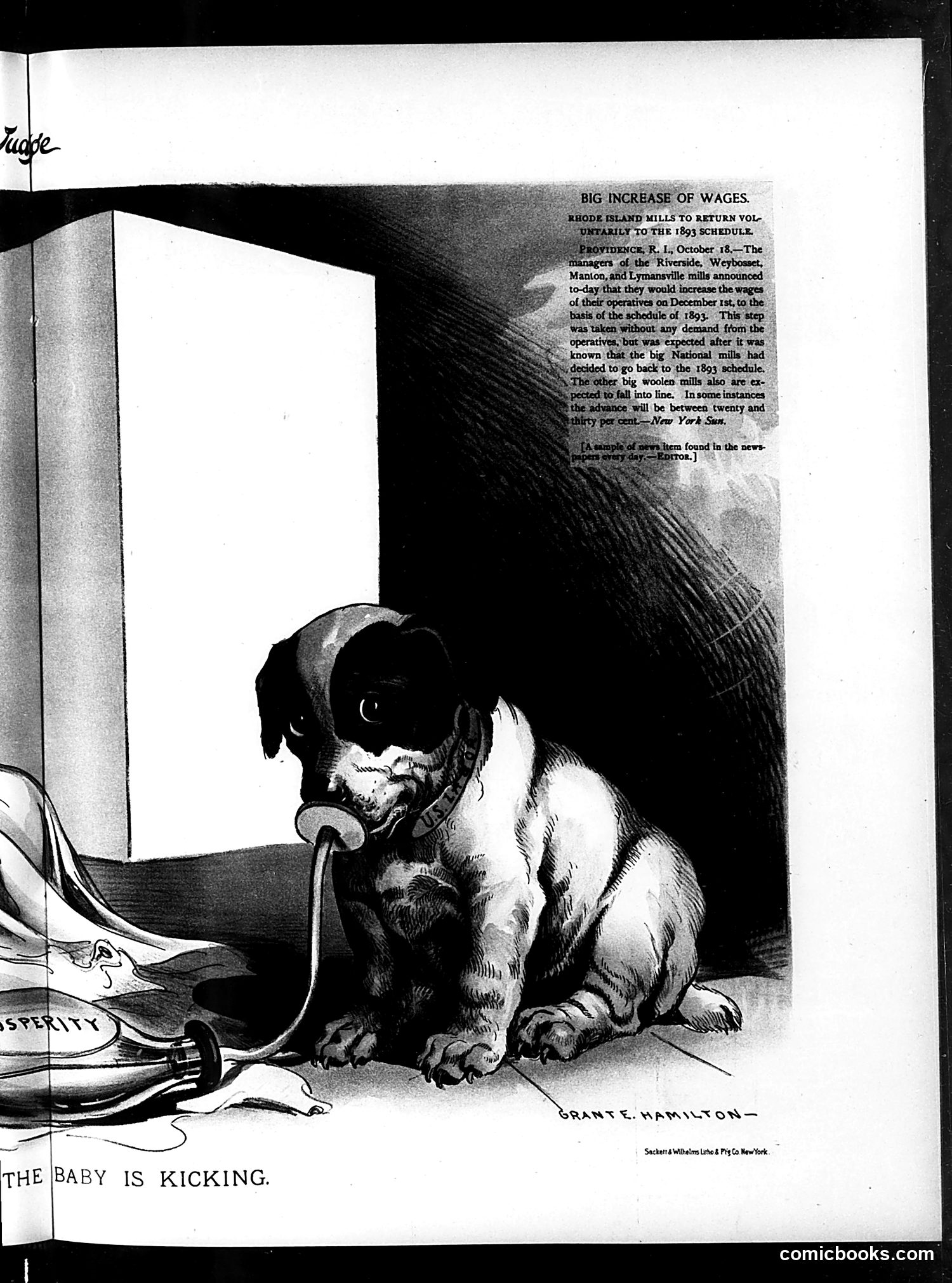
This political cartoon by Grant E. Hamilton depicts a dog wearing a large collar labeled "PROSPERITY" being kicked by an unseen force from a darkened doorway. The accompanying text discusses a wage increase announcement from Rhode Island mill managers, who stated they would restore wages to 1893 levels on December 1st without worker demands—though this was expected after major mills had already decided to return to that schedule. The cartoon satirizes the situation as insincere corporate benevolence. The "baby" (prosperity/the economy) "kicking" suggests economic turbulence or resistance. The dog's distress under the prosperity collar indicates that claimed prosperity is actually causing hardship or instability for workers, despite management's self-congratulatory tone. The satire questions whether wage increases represent genuine economic health or merely desperate corporate maneuvering.
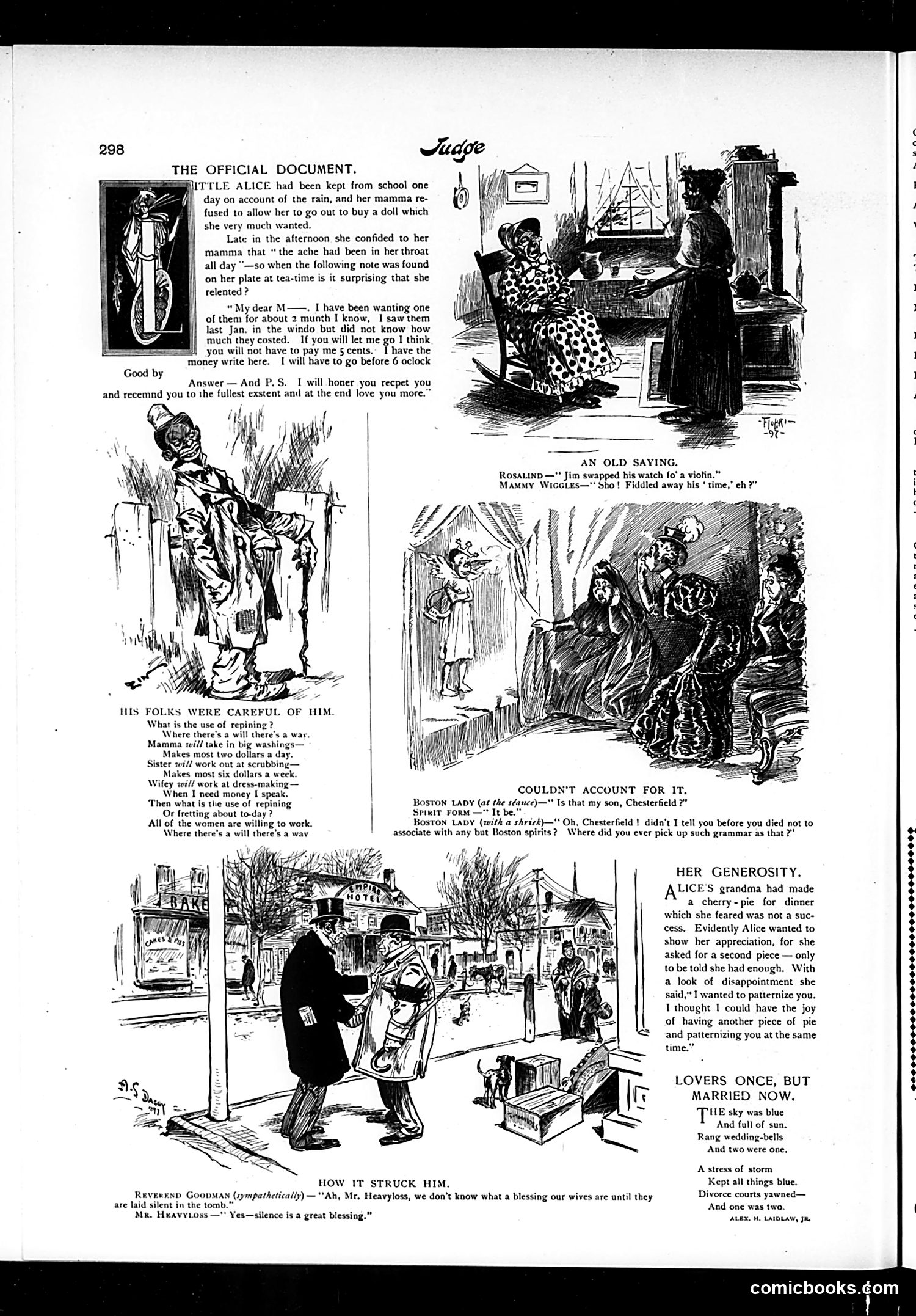
This page contains multiple humorous vignettes satirizing domestic life and social conventions of the era (appears to be early 1900s based on style). **"The Official Document"** mocks children's spelling and grammar through a girl's deliberately misspelled letter requesting a doll—the humor lies in her attempt at formal adult correspondence combined with phonetic spelling ("munth," "windo," "recemnd"). **"How It Struck Him"** is a dark joke about marriage: a reverend offers condolences about a man's deceased wife, and the man responds that "silence is a great blessing"—satirizing marital discord and the relief some husbands supposedly feel when freed from their wives' conversation. **"Her Generosity"** plays on a child's misuse of "patronize," where Alice thinks showing appreciation means "pattern-izing" someone by consuming more pie. **"Lovers Once, But Married Now"** uses contrasting verse to satirize how marriage supposedly destroys romantic love, ending in divorce. These sketches collectively ridicule marriage, domestic unhappiness, and pretension through gentle, family-friendly humor typical of Judge's satirical approach.
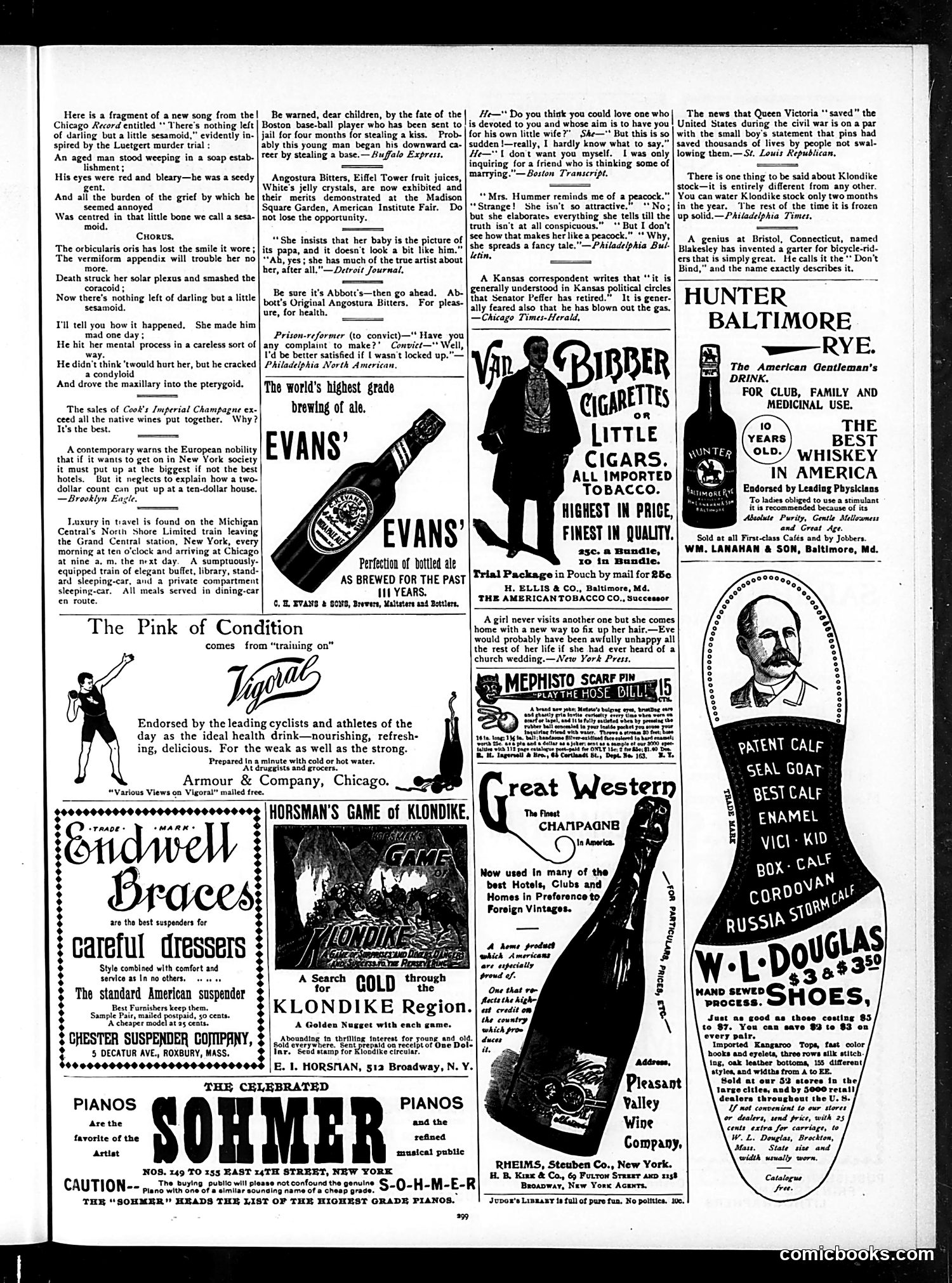
This page from *Judge* magazine is primarily **advertisements with a few satirical fragments**. The main satirical content concerns the **Luetgert murder trial**—a Chicago scandal where a sausage factory owner allegedly murdered his wife and dissolved her body in a vat. The song fragment mockingly catalogs her remains using anatomical terms ("sesamoid," "condyloid," "pterygoid"), treating her gruesome fate as dark comedy. The joke plays on contemporary newspaper sensationalism and public obsession with the macabre crime. Other brief satirical items mock **European nobility** trying to appear respectable in New York society despite limited finances, and a baseball player jailed for stealing a kiss—a joke about moral decline from petty transgressions. The remainder consists of period advertisements for patent medicines, spirits, shoes, pianos, and games. This was typical *Judge* content: mixing biting social commentary with commercial endorsements.
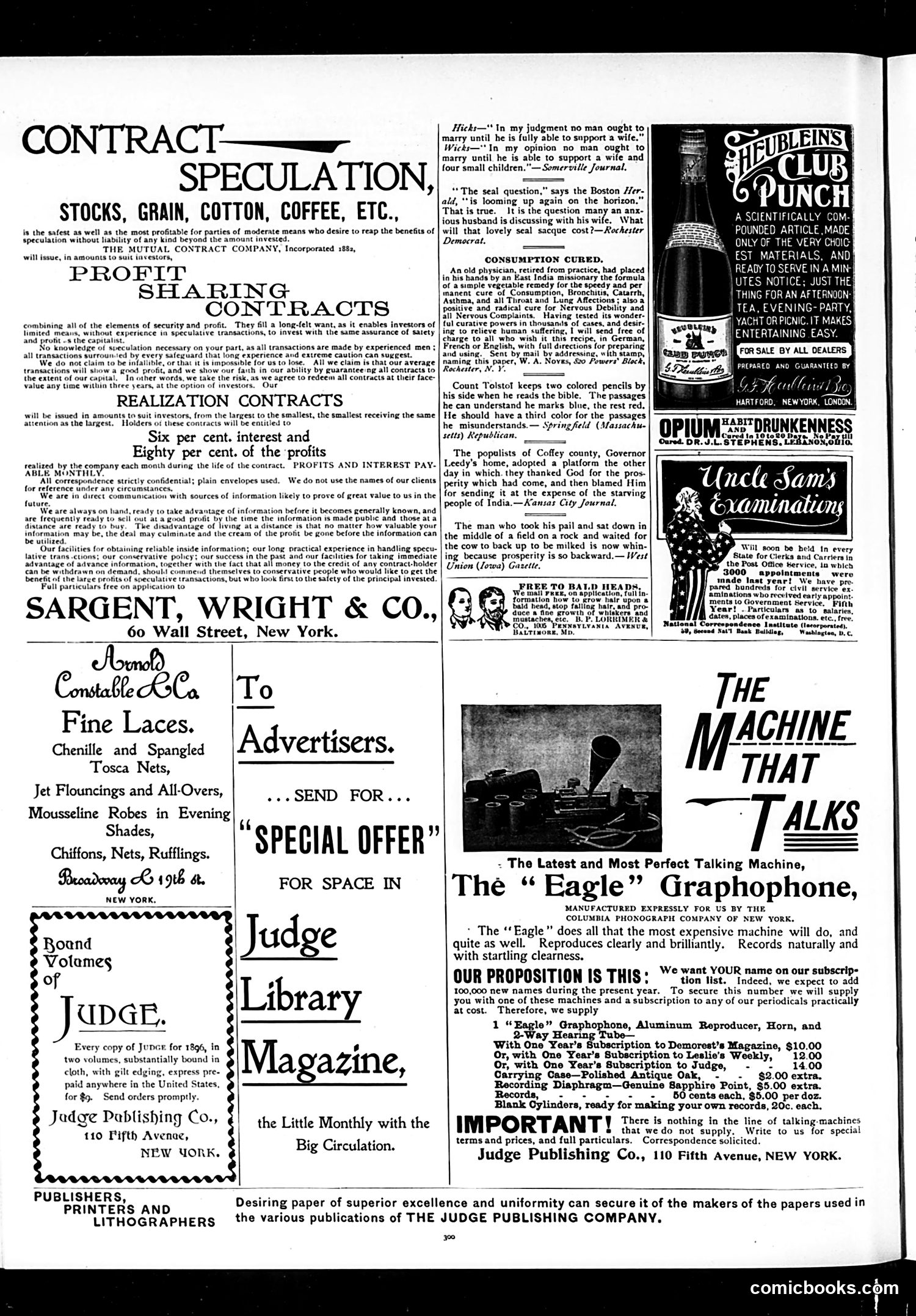
This page is primarily **advertising**, not political satire. It features financial speculation services and consumer product ads typical of late 19th-century publications. The main content is a large advertisement for "The Mutual Contract Company" (est. 1882), promoting risky investment contracts in stocks, grain, and commodities to small investors. The pitch emphasizes "safety" while guaranteeing profits—a classic dubious financial scheme promising returns to people "without experience in speculative transactions." Small humor items appear mid-page: one about marriage obligations (men should support wives/children), another about seal fur coats (a luxury concern of the era). The right side advertises consumer goods: Heublein's Club Punch (beverage), an "Uncle Sam's Examination" publication, and "The Eagle" Graphophone (early phonograph machine). These ads reflect Gilded Age consumer culture and financial speculation prevalent before modern securities regulations. The investment pitch's emphasis on "confidentiality" and inside information suggests the exploitative nature of such schemes.
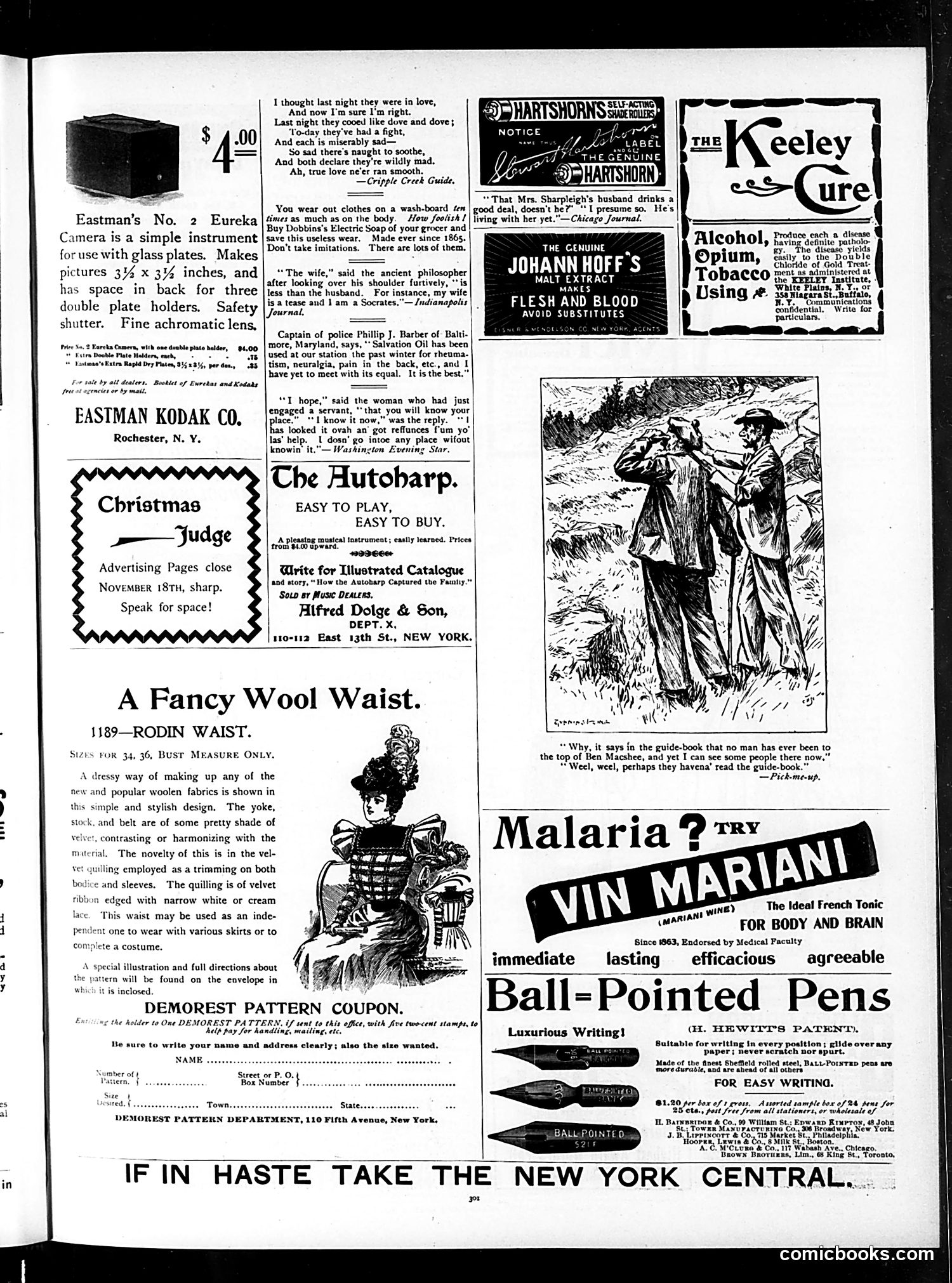
This page is primarily **advertising** for various consumer products and services typical of the late 19th/early 20th century, with minimal satirical content. The notable elements include: **The main cartoon** (center-right) depicts two figures in period dress with the caption about a guide-book claiming no man has reached Ben Machain's summit—likely a mild joke about exaggeration in travel guides, though the full caption is cut off. **Poetry and brief humor snippets** scattered throughout mock domestic life: a couple's relationship troubles, a husband condescendingly comparing himself (a "Socrates") to his "teasing" wife, and a servant's sarcastic response about knowing her place. **Product advertisements** dominate: cameras, soap, patent medicines (Salvation Oil, Vin Mariani tonic), pens, and corsets. Many tout dubious health claims or reflect period gender attitudes (the wool waist ad emphasizes fashionable femininity). The page reflects **late-Victorian attitudes** toward marriage, gender roles, and consumer culture rather than sharp political satire. Overall, it's a typical Judge advertising/filler page with lightweight humor rather than pointed editorial content.
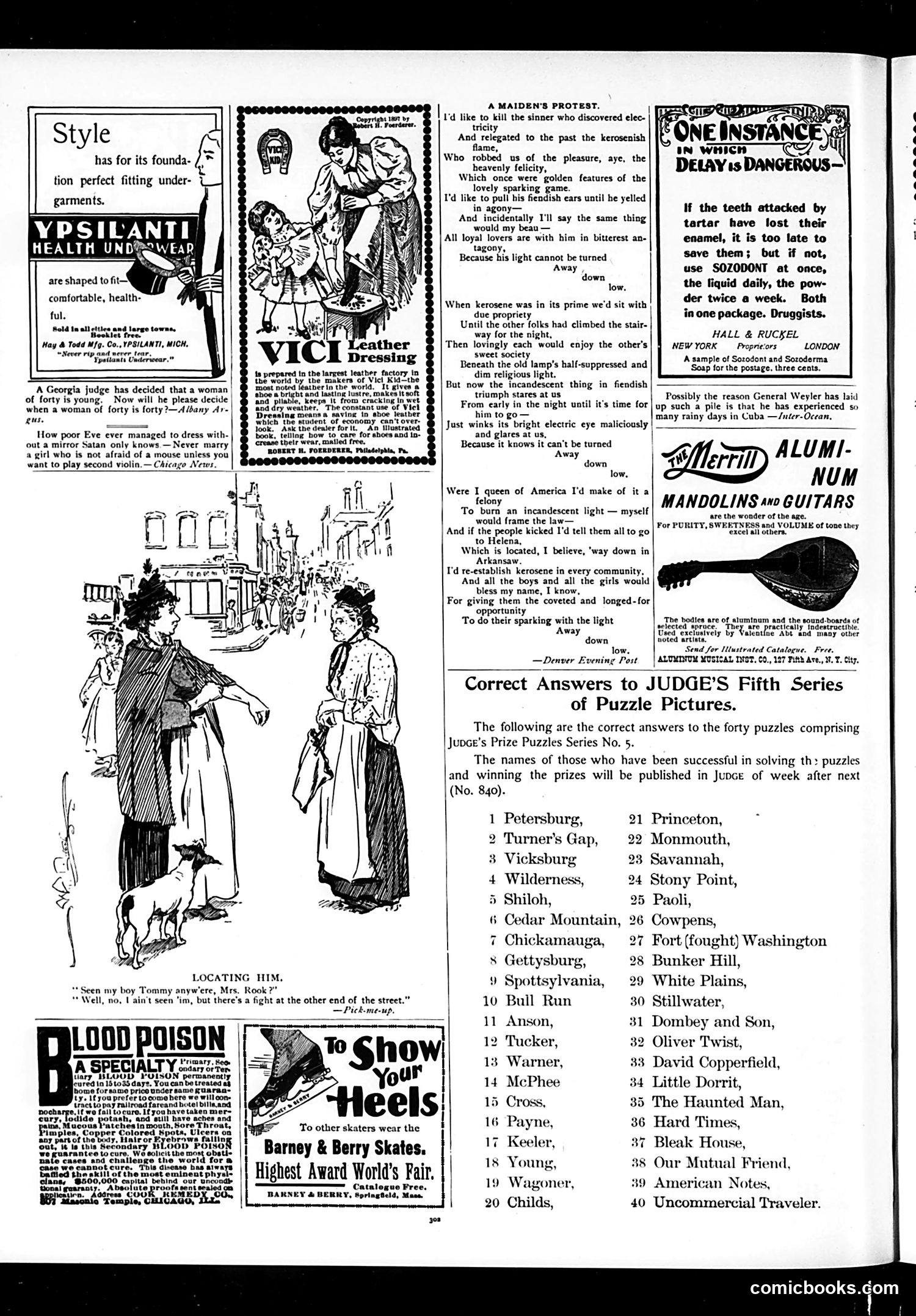
This page primarily features **advertisements and light satirical humor** rather than political cartoons. The main content includes: 1. **"A Maiden's Protest"** — A humorous poem lamenting the invention of the electric light bulb. The joke: young couples previously could dim kerosene lamps for romantic "sparking" (courtship), but bright electric lights cannot be dimmed, eliminating privacy. The maiden threatens to ban electric lights and restore kerosene if she were queen. 2. **Filler jokes** about women, mirrors, and a child-locating joke. 3. **Extensive patent medicine advertisements**, including blood poison "cures" and various commercial products (underwear, shoe dressing, skates). The page appears to be from the early 1900s, when electric lighting was still novel enough to joke about its social disruptions. The satire is genteel and domestic rather than political — poking fun at modern technology's interference with courting customs.
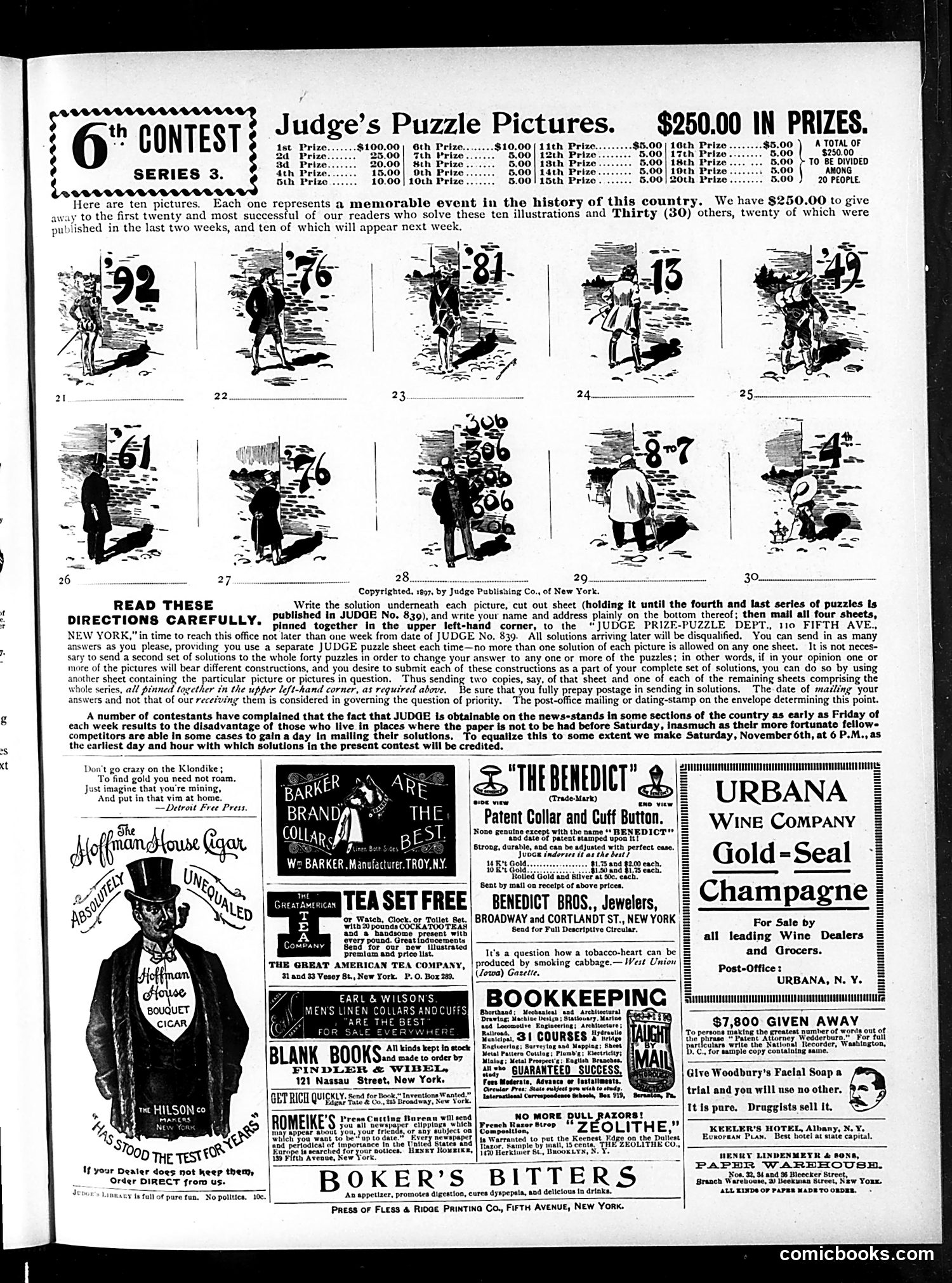
This page features a **puzzle contest**, not political satire. Judge magazine offered $250 in prizes for readers to identify "ten pictures" representing "memorable events in the history of this country." The ten numbered illustrations (21-30) appear to be historical scenes requiring identification. The detailed instructions specify contestants must submit solutions by November 6th, 1897, addressing them to Judge's offices. Notably, the text addresses a fairness complaint: some regions received the magazine earlier in the week than others, giving certain competitors extra time. Judge therefore set a uniform Saturday deadline to equalize opportunity. The page is largely **commercial**, filled with period advertisements for cigars, tea, champagne, jewelry, and other products typical of 1890s publications. This was Judge's revenue model—puzzles attracted readers while ads filled remaining space.
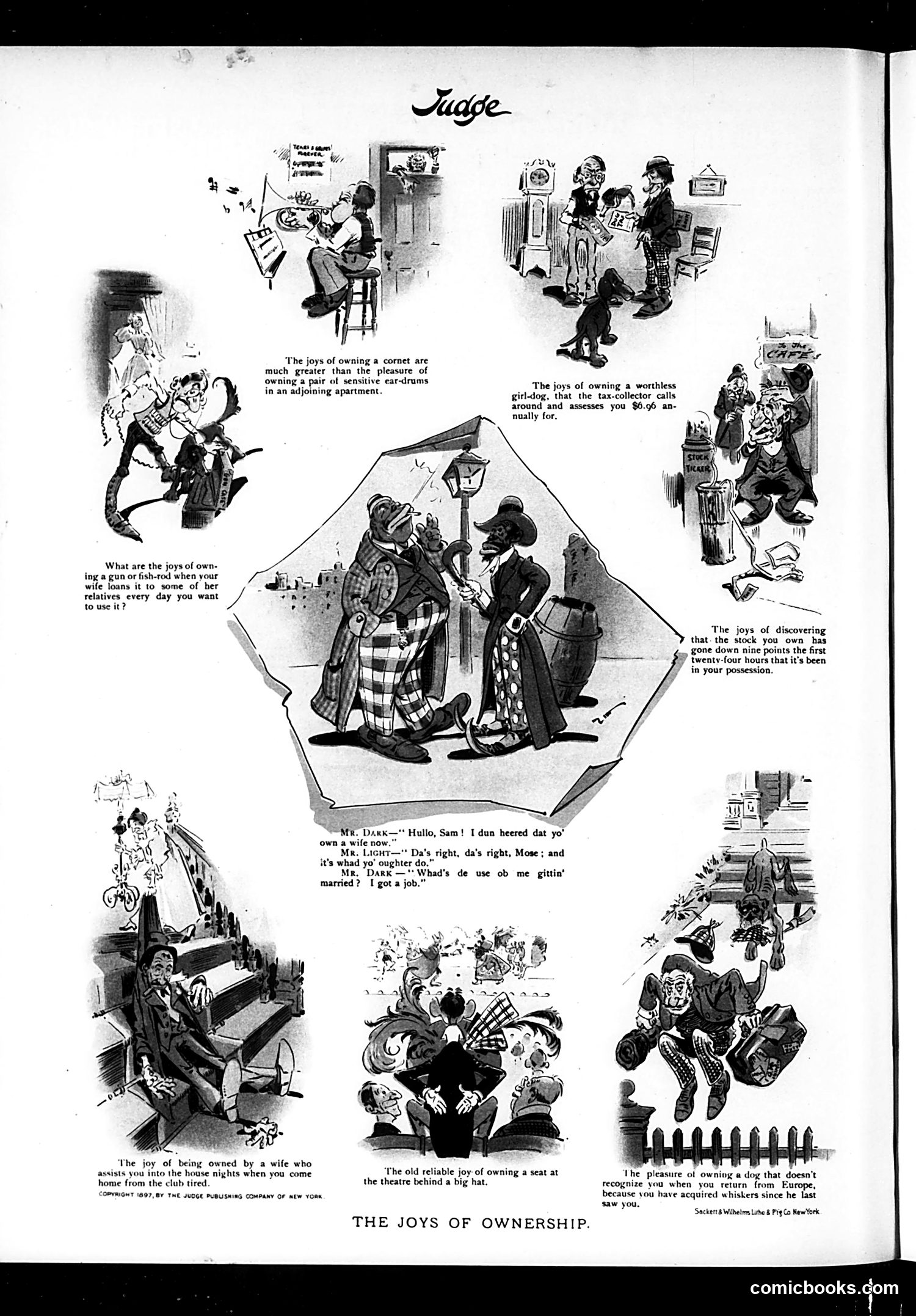
This is a satirical illustrated essay mocking the supposed pleasures of ownership in early 20th-century American life. Each vignette presents an ironic "joy" that is actually a burden or annoyance: - **Owning a cornet or gun**: wives lend them to relatives, making them unavailable - **Owning stocks**: they lose value immediately - **Owning a worthless dog**: the tax collector assesses property taxes on it - **Being owned by a wife**: she "assists" a tired husband home from his club - **Theater seats**: blocked by ladies' large hats - **Dogs**: fail to recognize their owners upon return from abroad The humor relies on inverting expectations—presenting genuine frustrations as mock "joys." The dialogue between Mr. Dark and Mr. Lict about marriage being preferable to a job adds class commentary. Overall, the page satirizes modern consumer culture and domestic life's petty annoyances for educated, middle-class readers.