
A complete issue · 16 pages · 1897
Judge — August 28, 1897
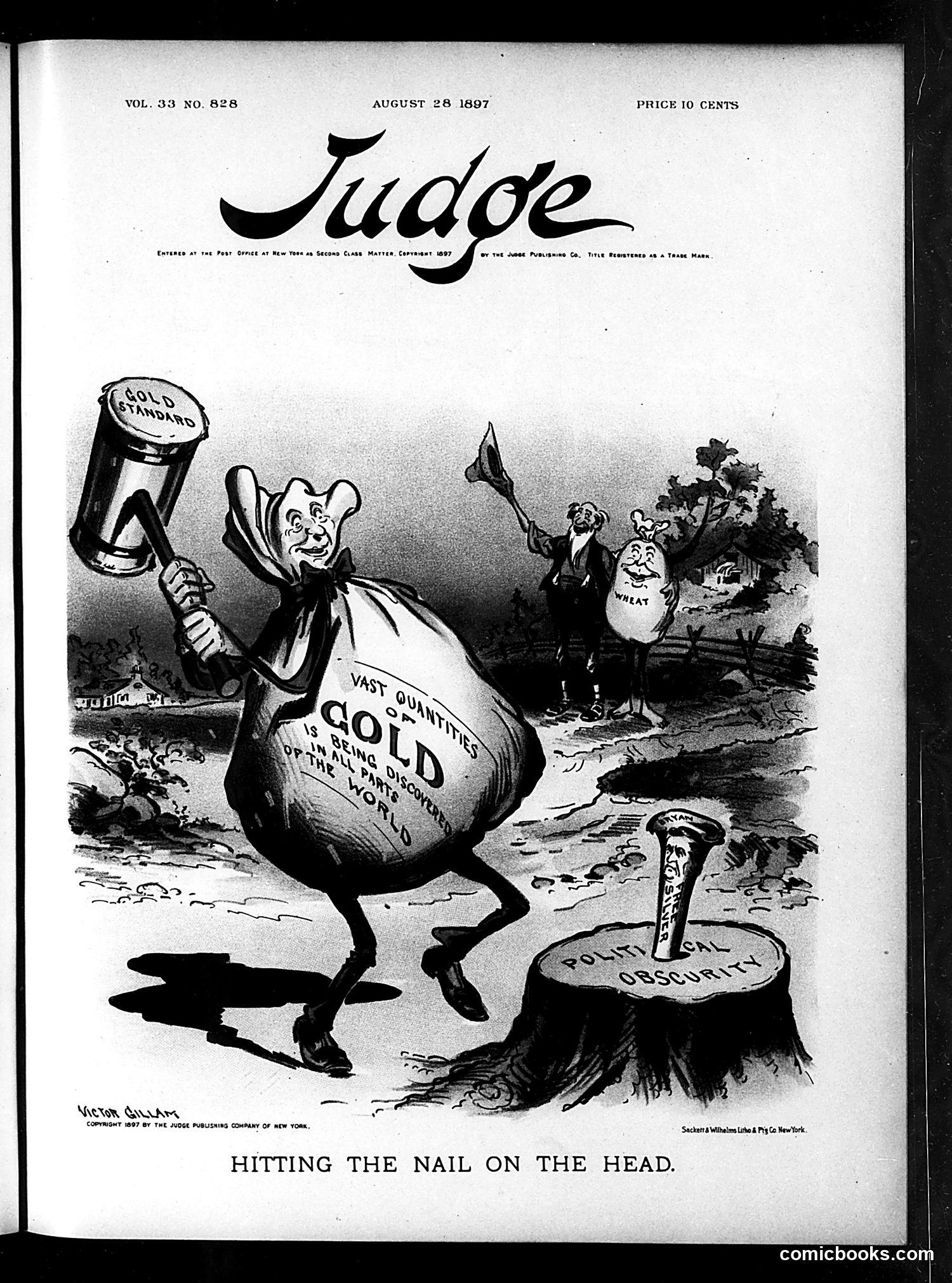
This August 1897 *Judge* cartoon satirizes gold standard advocates' response to economic concerns. The large anthropomorphic figure labeled "VAST QUANTITIES OF GOLD IS BEING SECURED FOR THE WORLD" celebrates wildly, holding a "Gold Standard" torch while striking a nail labeled "POLITICAL OBSCURITY" into a tree stump. The figures in the background appear to represent "Wheat" and other economic interests watching skeptically. The cartoon mocks how gold standard proponents believed acquiring more gold would solve economic problems—symbolized as "hitting the nail on the head"—while actually addressing only their narrow political interests. This reflects 1890s currency debates between gold standard supporters and those favoring free silver coinage.
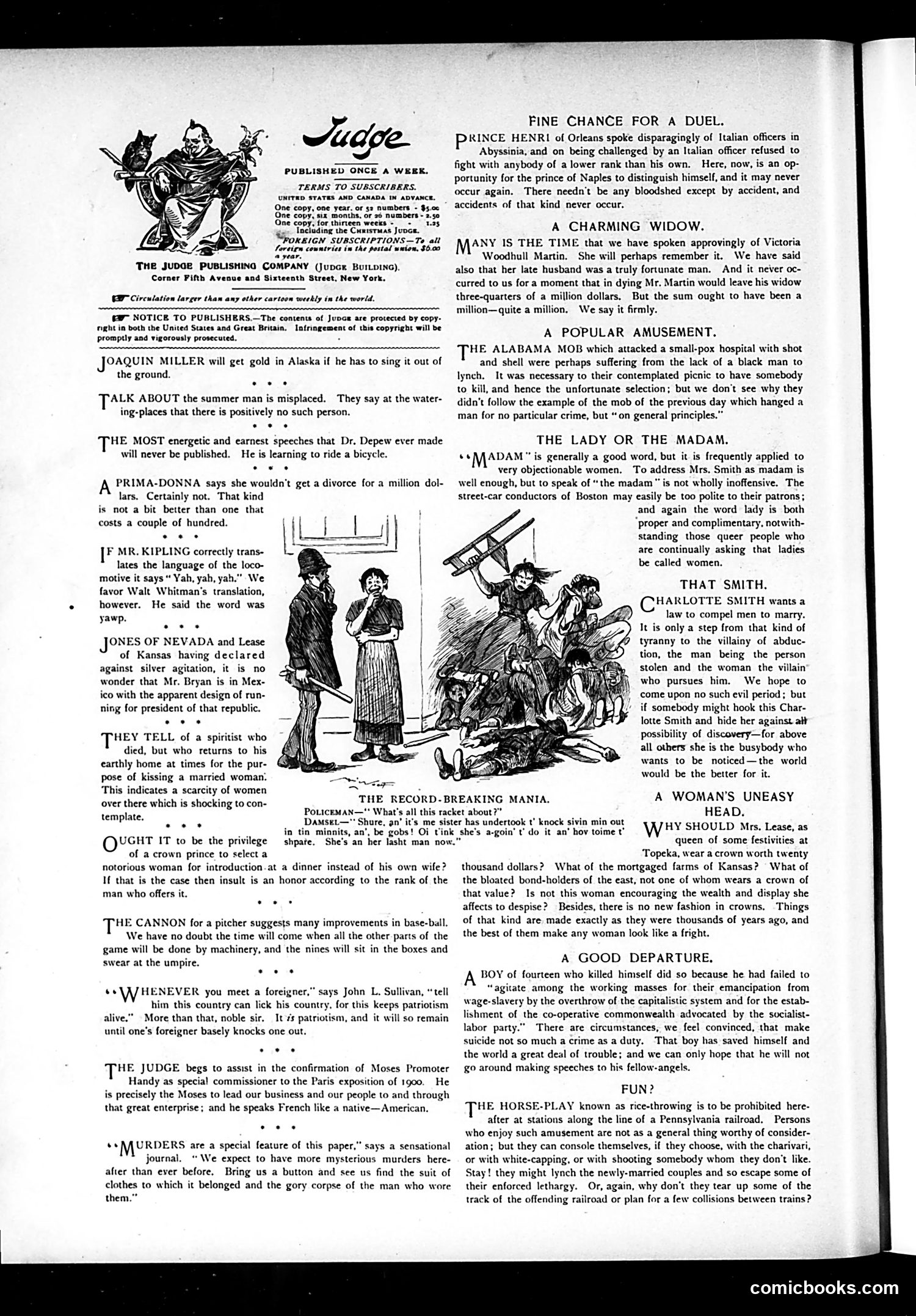
This page contains several brief satirical items rather than a single cartoon. The main illustrated piece, "The Record-Breaking Mania," shows a woman commanding a man to break a world record by kissing her—a domestic comedy about competitive absurdity. Other items mock contemporary figures and social trends: a comment on Prince Henry of Prussia allegedly refusing a duel; observations about summer men, bicycle riders, and divorces for money. One item references "Mr. Bryan" (likely William Jennings Bryan) and Mexican politics, suggesting 1890s-1900s dating. The satirical tone targets social pretension, gender relations, and public figures' eccentricities. Without seeing specific caricatures clearly, precise political targets remain uncertain, though the magazine's general approach was lampooning American society's fashionable absurdities.
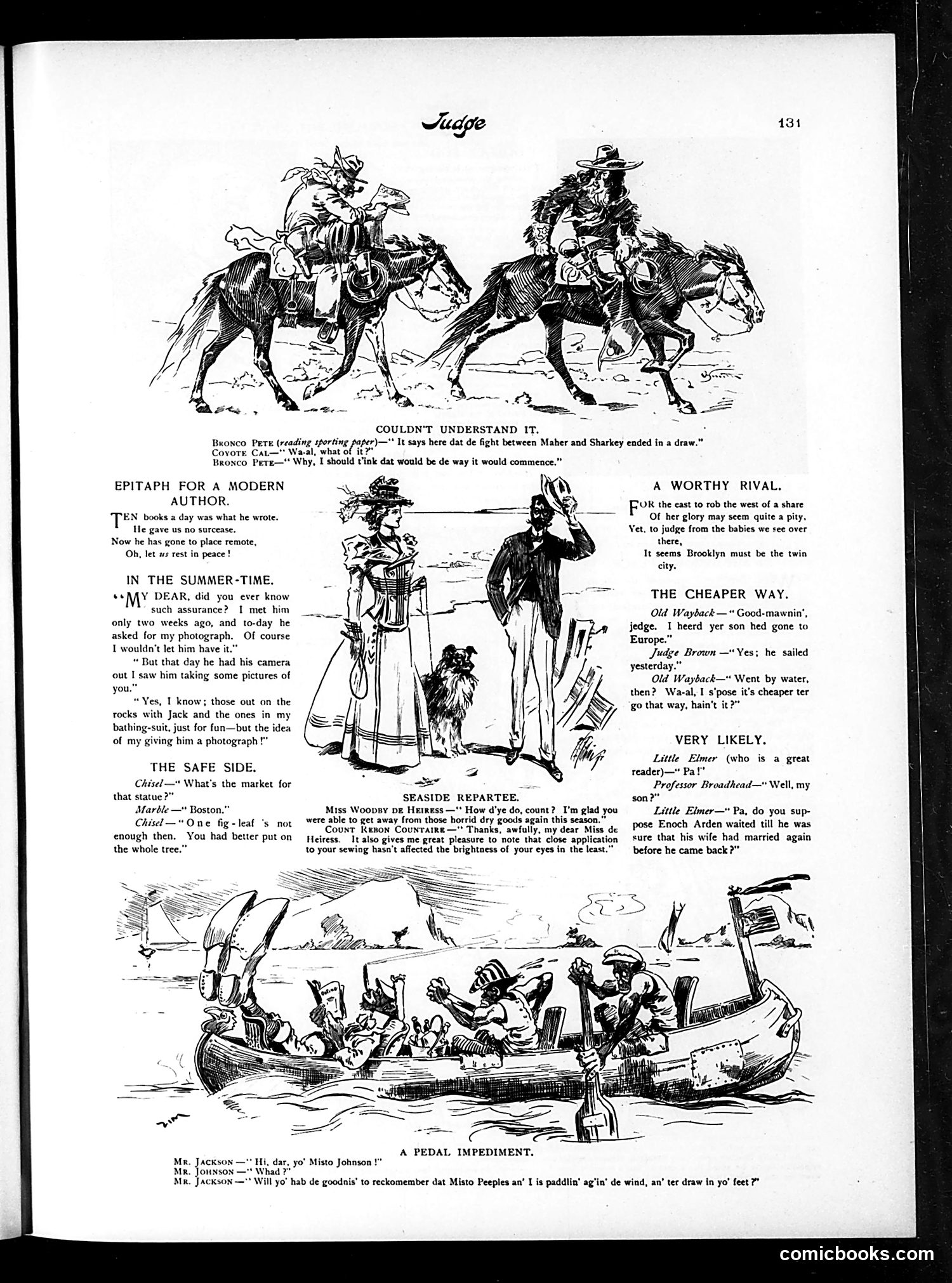
This page contains multiple comic sketches with satirical humor typical of Judge magazine's style. **Top cartoon:** "Couldn't Understand It" depicts two cowboys (Bronco Pete and Coyote Cal) discussing a fight between Maher and Sharkey that "ended in a draw"—likely referring to a famous boxing match. The joke plays on frontier dialect misunderstanding of boxing terminology. **Remaining sketches:** Include various social commentary pieces like "Epitaph for a Modern Author," "The Cheaper Way" (about travel costs), and "A Pedal Impediment" (showing a crowded boat). These are brief, disconnected jokes targeting contemporary social situations—travel, literature, and urban life. The page exemplifies Judge's format: simple line drawings paired with punchy satirical captions reflecting turn-of-the-century American attitudes and concerns.
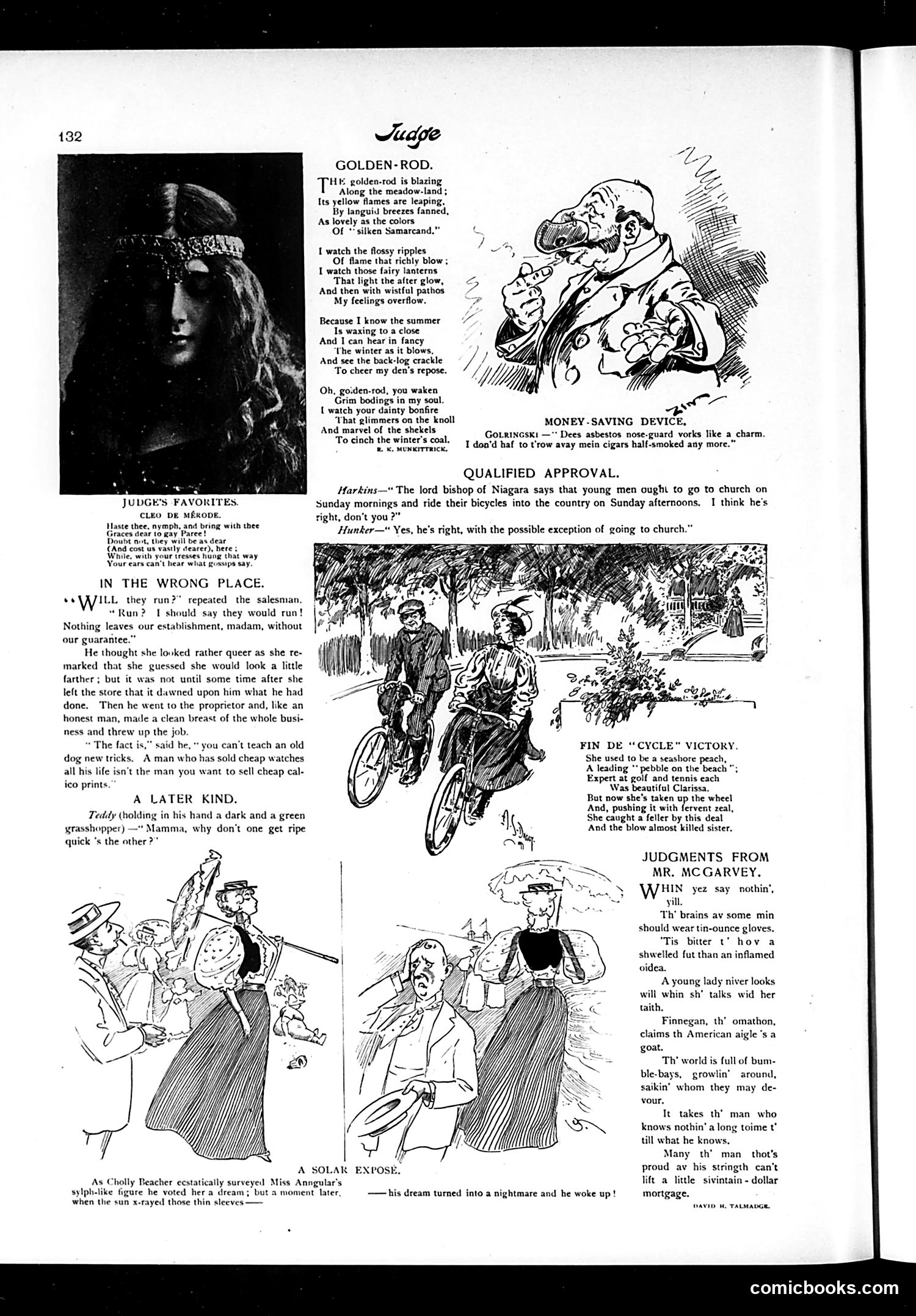
This page from *Judge* (a satirical weekly) contains several unrelated humor pieces typical of the era: **"Golden-Rod"** is a sentimental poem about autumn flowers, with no apparent satire. **"Money-Saving Device"** mocks immigrant speech (likely German or Yiddish dialect) showing a character using asbestos as a cigar nose-guard to avoid waste—satirizing both frugality and the casual early-20th-century attitude toward asbestos safety. **"Qualified Approval"** jokes about a bishop's compromise position: endorsing church attendance while tacitly accepting young men skip it for bicycle rides instead. **"Fin de 'Cycle' Victory"** puns on the bicycle craze, showing a woman cyclist hitting a man so hard she injures herself—satirizing both the "New Woman" on wheels and the physical comedy of the cycling fad. **"Judgments from Mr. McGarvey"** offers Irish-dialect aphorisms (appearing to mock working-class Irish immigrants through exaggerated speech patterns). The page emphasizes period humor: immigrant stereotypes, bicycle-era satire, and genteel sentimentality.
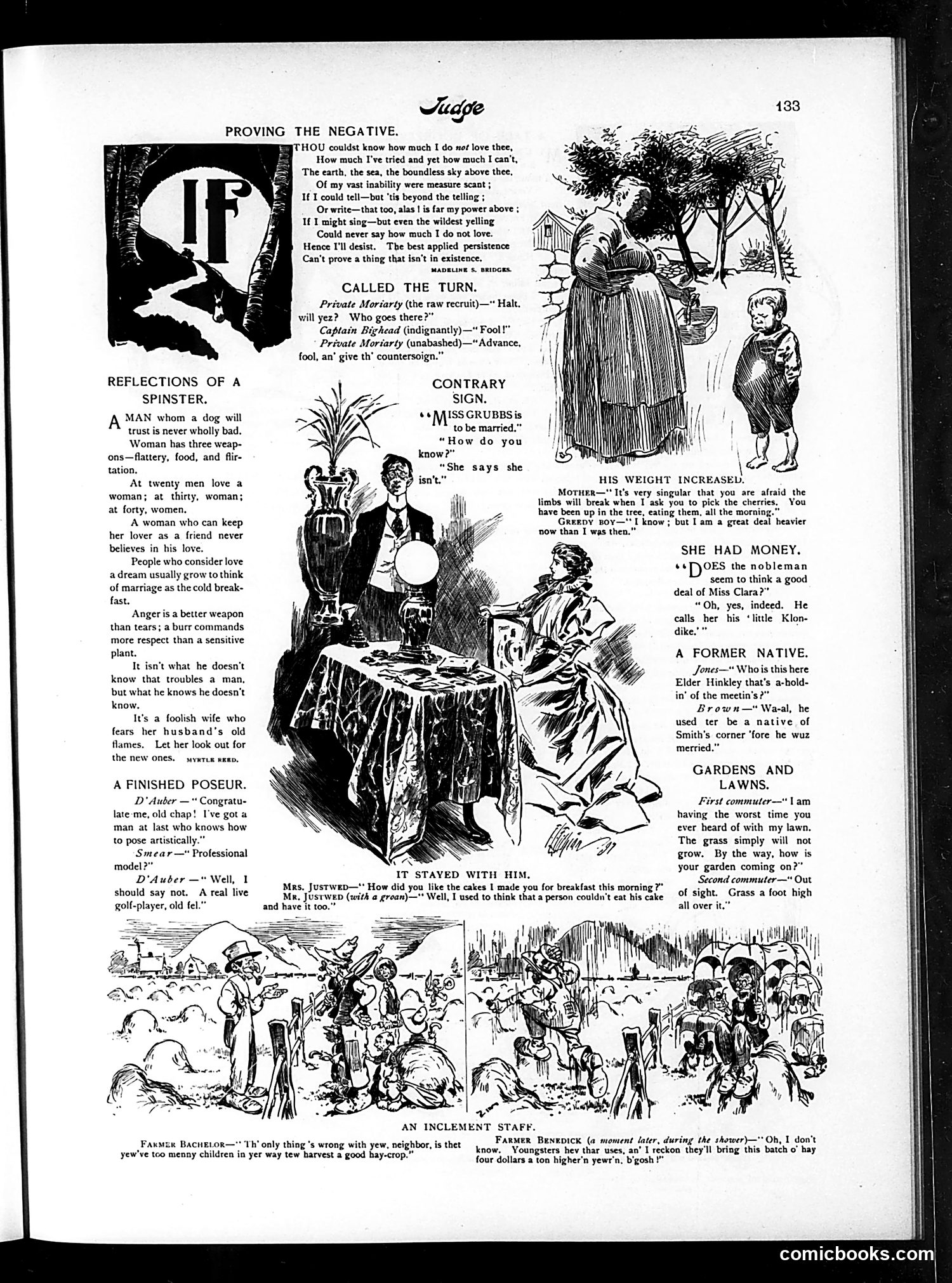
This page from *Judge* (a satirical weekly) contains multiple short humorous pieces typical of the era: **"Reflections of a Spinster"** offers cynical observations on love and marriage—women's "three weapons" (flattery, food, flirtation), how men's romantic interests shift with age, and marriage as a "cold breakfast." **"A Finished Poseur"** mocks a man bragging that his lover is "artistic"—the joke being he's just a professional golfer, not genuinely artistic. **Military humor** ("Called the Turn") depicts a raw recruit impertinently challenging his captain, subverting rank hierarchy. **Domestic jokes** include wives' cooking ("couldn't eat his cake and have it too"), children stealing cherries, and a nobleman calling his wealthy fiancée his "Klondike" (gold rush reference—she's valuable for her money). **"A Former Native"** uses dialect humor about a man who married and left his rural community. **Farming humor** contrasts two neighbors' hay crops, suggesting children provide free labor offsetting their cost. The satire targets gender relations, class pretension, military bureaucracy, and rural life—typical *Judge* targets of the period.
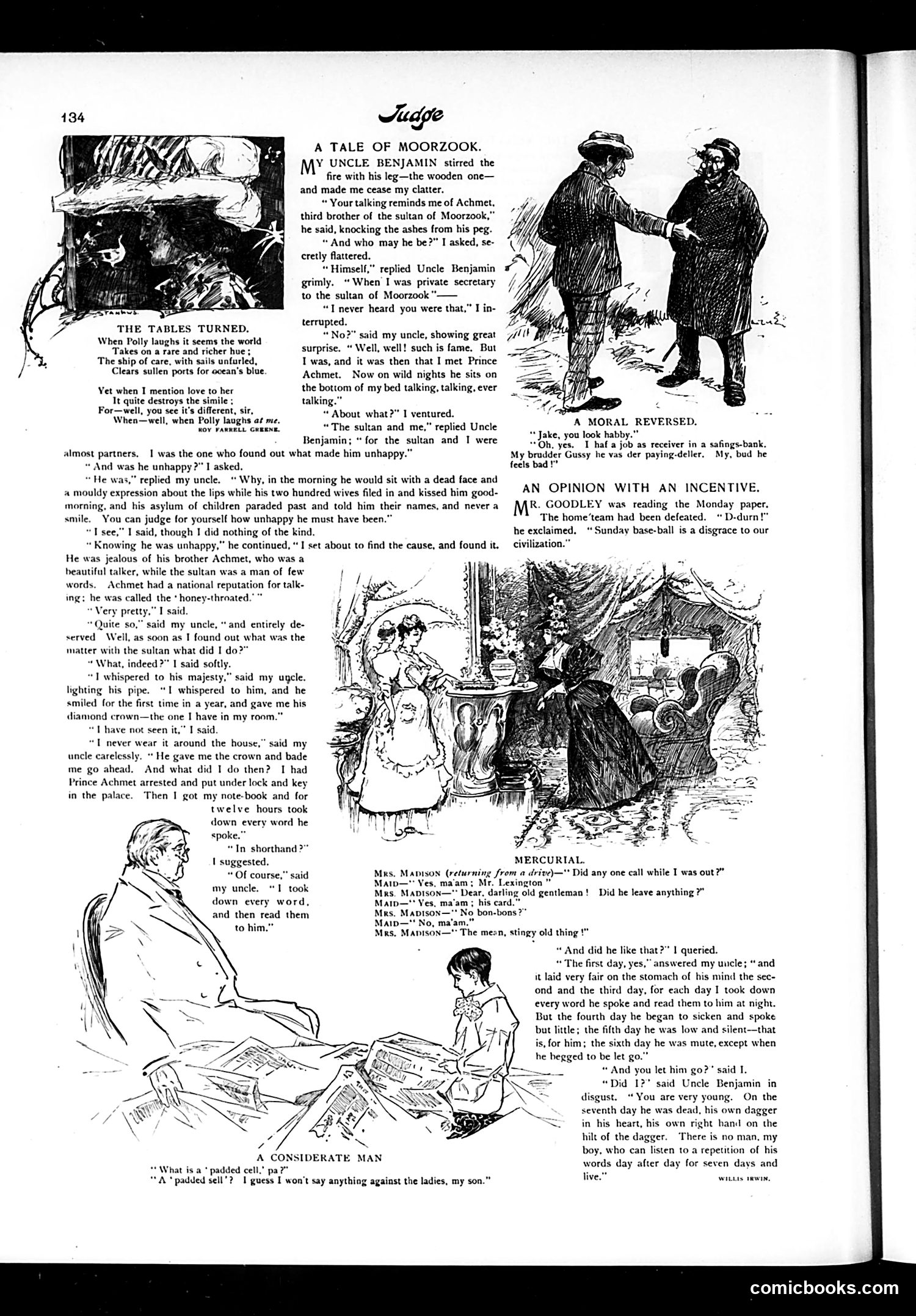
This page contains several humorous short pieces typical of Judge magazine's satirical style. **"A Tale of Moorzook"** is a tall tale where Uncle Benjamin claims to have been private secretary to an Oriental sultan. The humor lies in his increasingly absurd fabrications—he supposedly discovered the sultan's unhappiness stemmed from jealousy of his brother Achmet, a famous talker. Benjamin's "solution" was to have Achmet arrested and force-feed him his own recorded words until he died. The satire mocks pompous liars who fabricate exotic adventures to impress listeners. **"The Tables Turned"** is a brief poem playing on romantic clichés—when a woman laughs, it typically brightens the world, but this woman's laughter is different and disturbing. **"A Moral Reversed"** and **"An Opinion with an Incentive"** are brief comedic vignettes about immigrant dialect humor and sports criticism respectively. The illustrations, rendered in Judge's characteristic pen-and-ink style, accompany these narrative pieces with visual gags.
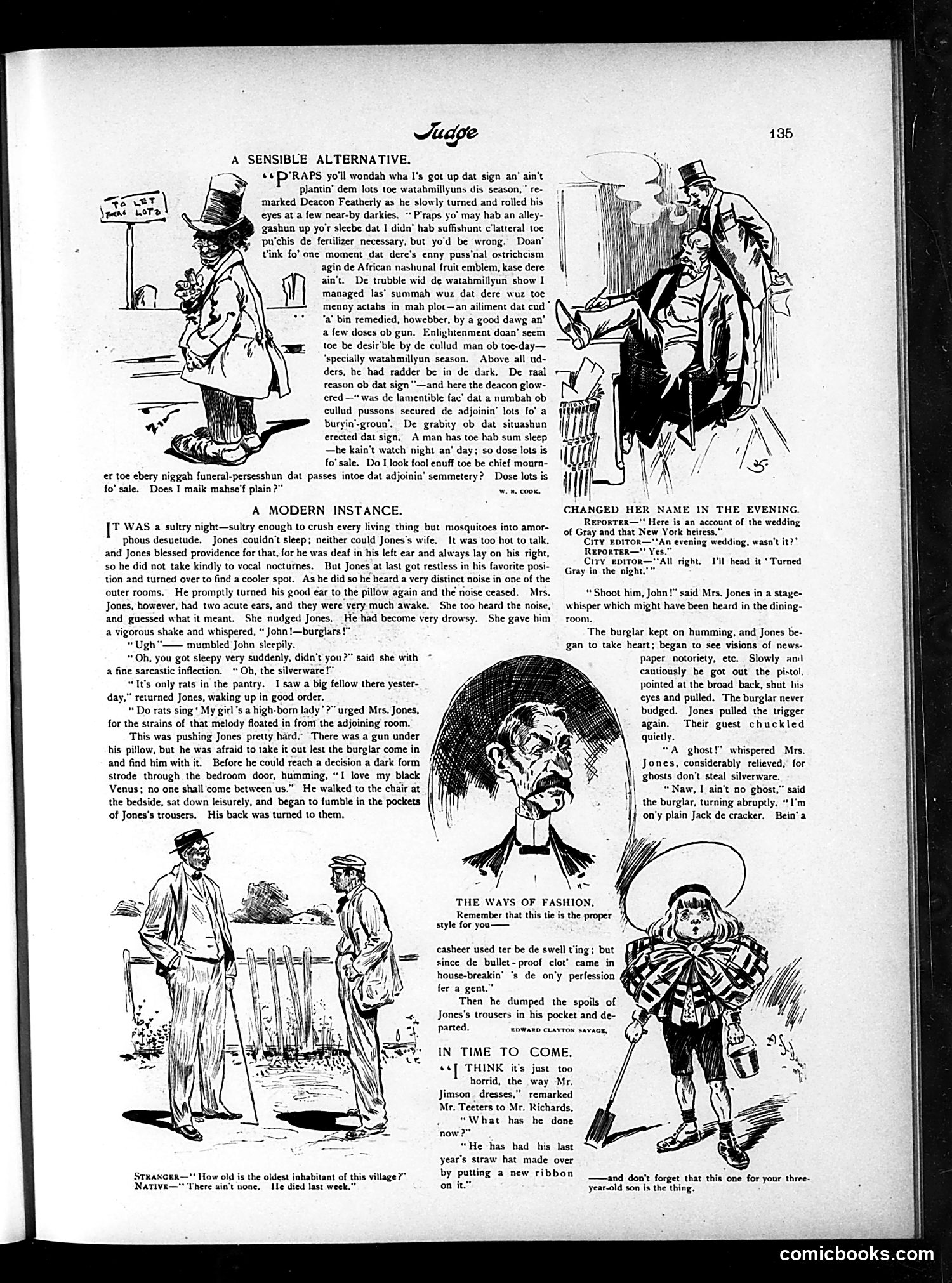
This page contains three satirical pieces from *Judge* magazine (circa early 1900s): 1. **"A Sensible Alternative"**: A caricatured dialect monologue from "Deacon Featherly" explaining why he won't plant watermelons. The piece employs racist stereotypes and exaggerated "plantation dialect" common to period humor. He claims he stopped farming because Black neighbors purchased adjacent burial ground property—reflecting contemporary racial anxieties about segregation and property boundaries. 2. **"A Modern Instance"**: A humorous story about Mr. Jones ignoring his wife's warnings of a burglar because he's deaf in one ear. The burglar, hearing Jones's resistance, defuses tension by singing sentimental songs, allowing him to steal the family silver unmolested. 3. **Minor comic pieces**: "Changed Her Name in the Evening" (newspaper wordplay), "The Ways of Fashion," and "In Time to Come" offer lighter satirical commentary on contemporary social customs and fashion. The overall tone reflects *Judge's* satirical approach to American social life, though employing now-offensive racial caricatures standard to the era.
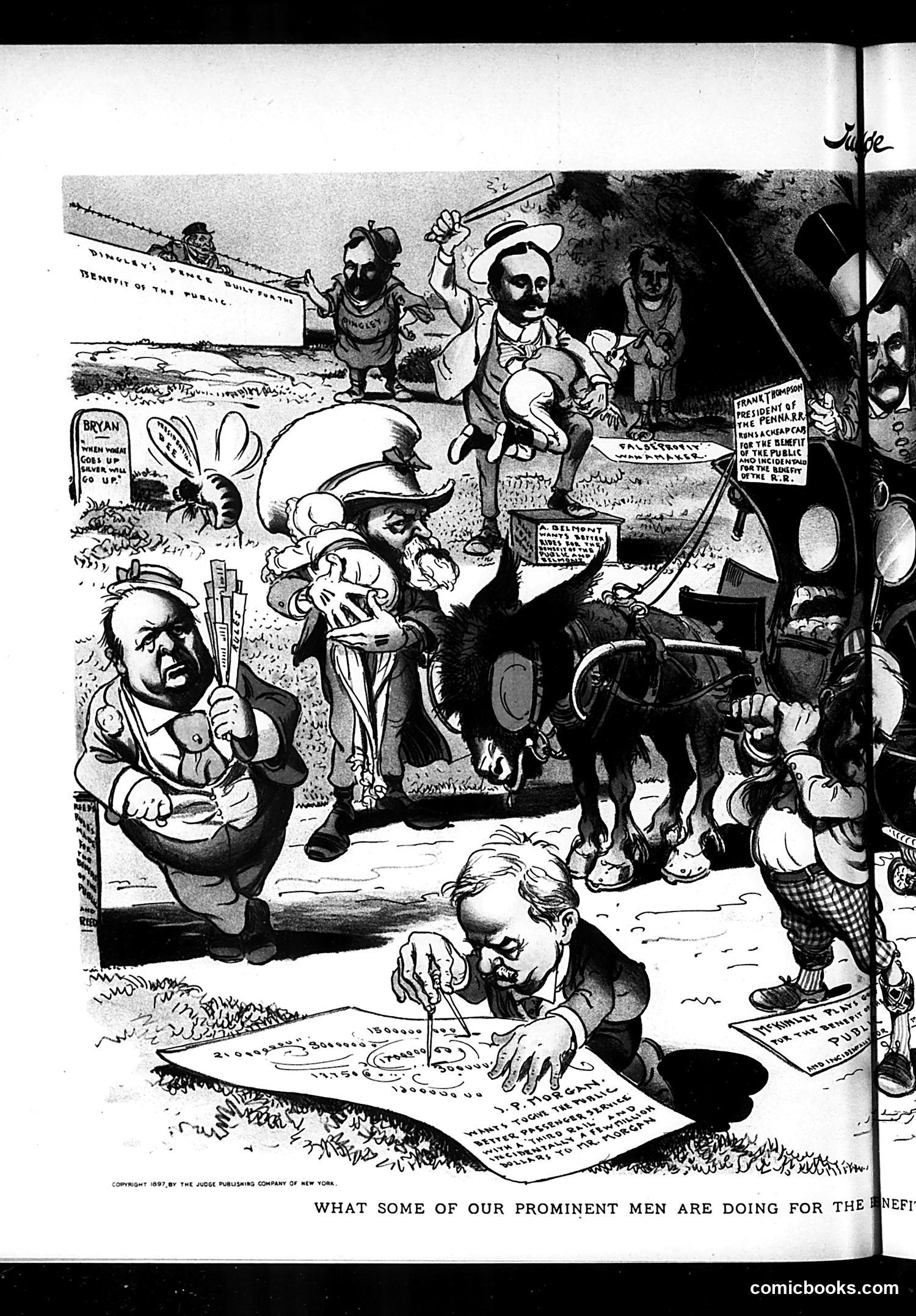
This 1897 *Judge* cartoon satirizes prominent public figures' efforts toward some unnamed benefit (the title is cut off). The caricatured men—depicted with exaggerated features typical of the era—appear to be engaged in various self-interested or ineffective activities rather than genuine public service. A man kneels examining maps or plans, while others gesticulate, hold implements, or ride a donkey. The chaotic composition suggests these "prominent men" are more interested in theatrical display or personal gain than substantive help. Without clearer labels identifying specific individuals, the precise targets remain unclear, but the satire mocks how wealthy or powerful figures publicly claim civic virtue while their actual contributions prove dubious or performative. This reflects *Judge* magazine's regular critique of political hypocrisy and the gap between public personas and private motives.
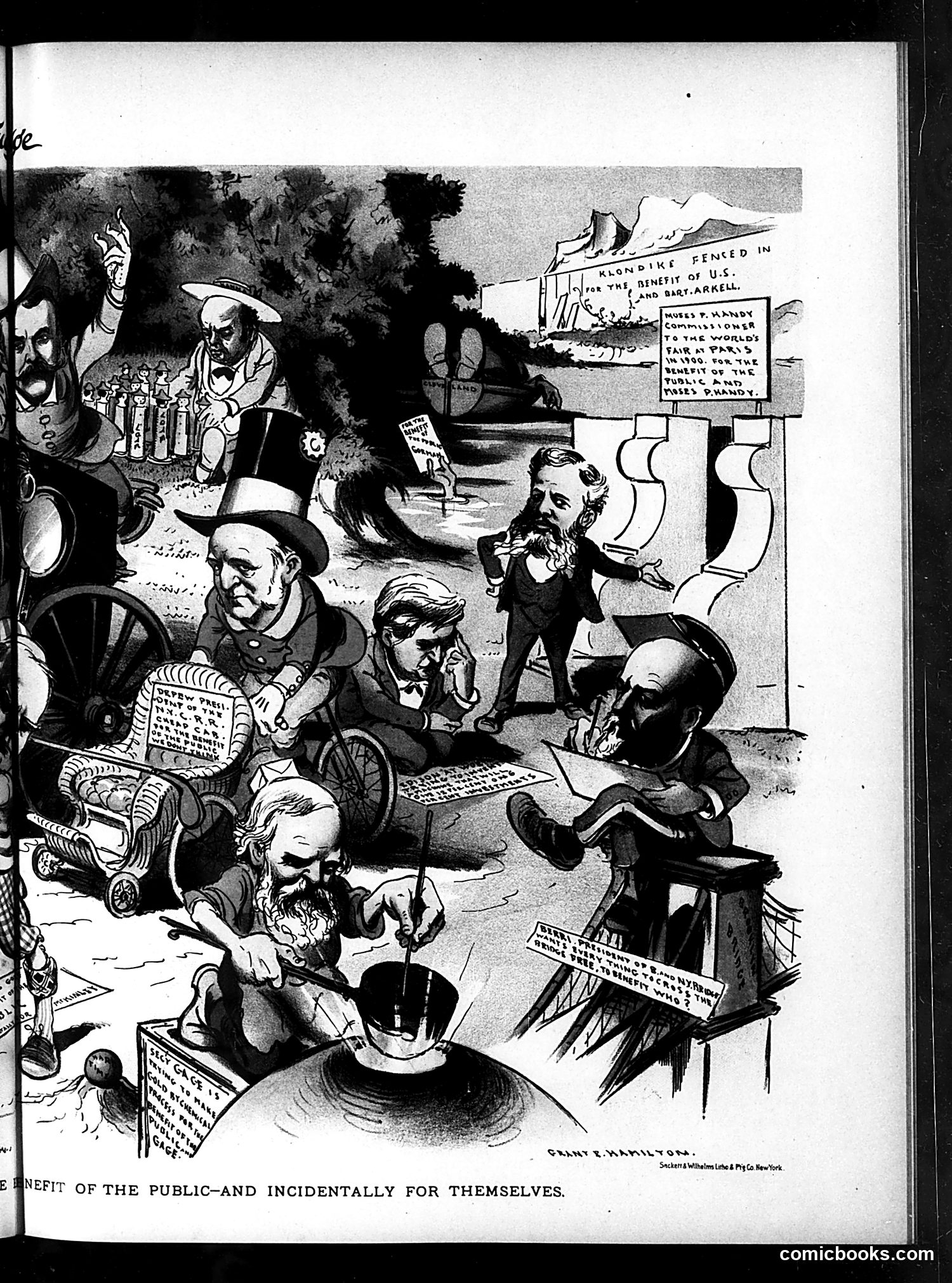
This Judge magazine cartoon satirizes a Klondike Gold Rush benefit event, appearing to mock the hypocrisy of wealthy figures claiming to aid public welfare while enriching themselves. The caption identifies **Moses P. Handy** as "Commissioner to the World's Fair" organizing a benefit "for the benefit of the public—and incidentally for themselves." The cartoon depicts various caricatured men in top hats and formal dress gathered around what appears to be a scheme or con, with a tent labeled "Klondike Fenced In" visible in the background. The satire targets wealthy elites using charitable pretenses as cover for personal profit-making. The exaggerated facial features and body language suggest these figures are duplicitous operators. The phrase "incidentally for themselves" in the title makes the cartoon's point explicit: public benefit events often primarily benefited their organizers. Without knowing the specific historical context of this Klondike-related event, the broader critique concerns wealthy men's self-enrichment masked as philanthropy.
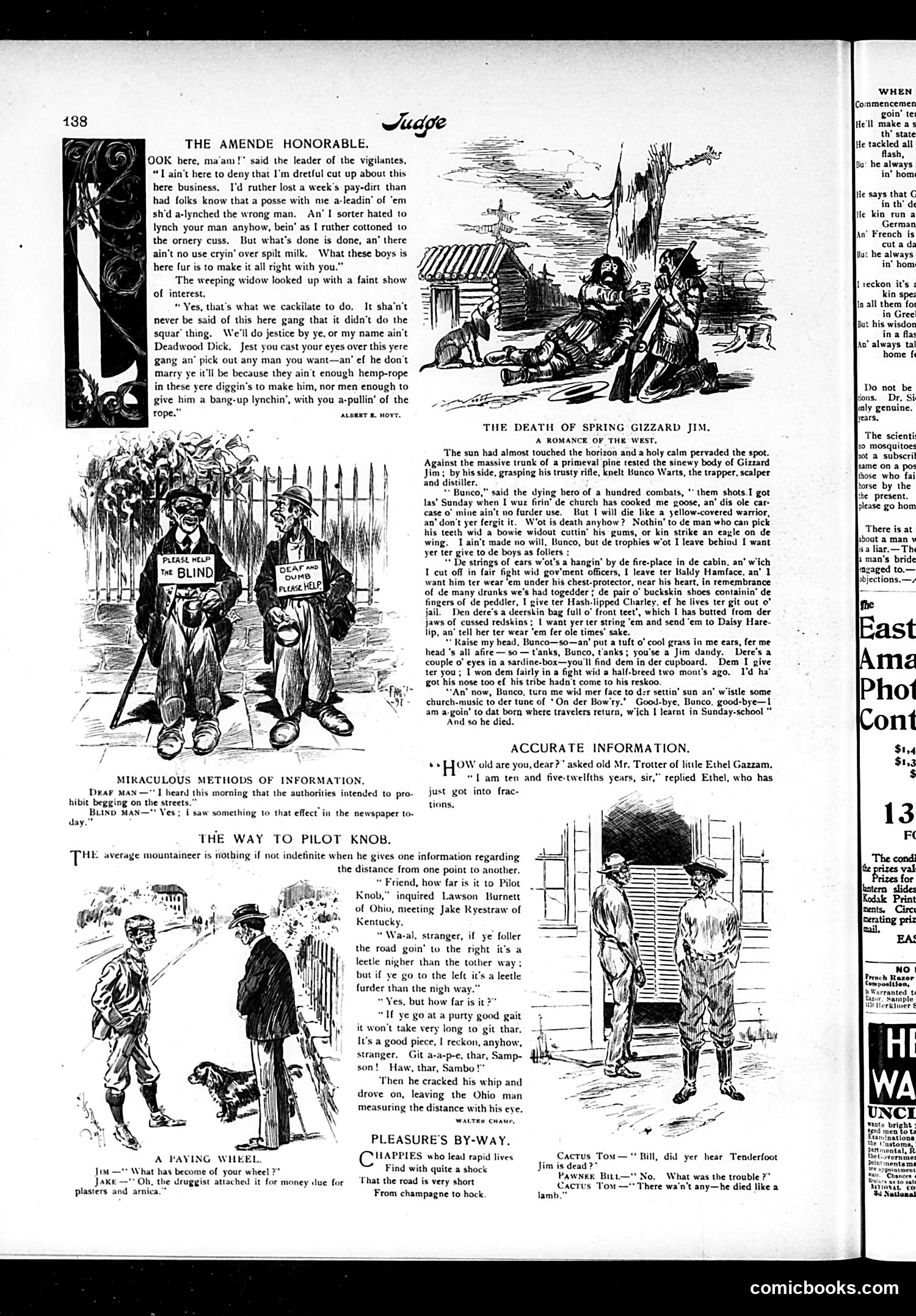
This Judge magazine page contains several satirical pieces mocking American frontier culture and vigilante justice: **"The Amende Honorable"** depicts a lynch mob apologizing to a widow after executing the wrong man. The leader offers her choice of any gang member as compensation/husband—darkly satirizing frontier "justice" as arbitrary and absurd. The cartoon mocks both vigilante violence and their crude attempts at restitution. **"Miraculous Methods of Information"** jokes about a blind man who claims he "saw" a newspaper article about banning street begging—obvious nonsense presented deadpan. **"The Way to Pilot Knob"** satirizes rural mountain people as hopelessly vague when giving directions, stereotyping Appalachian speech and ignorance. **"The Death of Spring Gizzard Jim"** parodies melodramatic frontier literature with absurd "last wishes" involving collections of severed ears, teeth, and eyes—grotesque and humorous exaggeration of Wild West violence tropes. The overall theme mocks frontier mythology, depicting settlers as brutal, ignorant, and uncivilized.
This humorous poem satirizes a college graduate named Dick who studies multiple languages—Latin, Greek, French, German—yet abandons this cultivation entirely when writing home to his parents requesting money. The joke is the obvious hypocrisy: he fluently uses all these languages to impress, but reverts to plain English (specifically, asking for cash) in letters home. The satire mocks both pretentious college education and the transparency of students' mercenary motives. Dick's linguistic prowess becomes comically useless once actual needs arise. The piece likely reflects broader turn-of-the-century American skepticism toward classical higher education and its perceived disconnection from practical life.
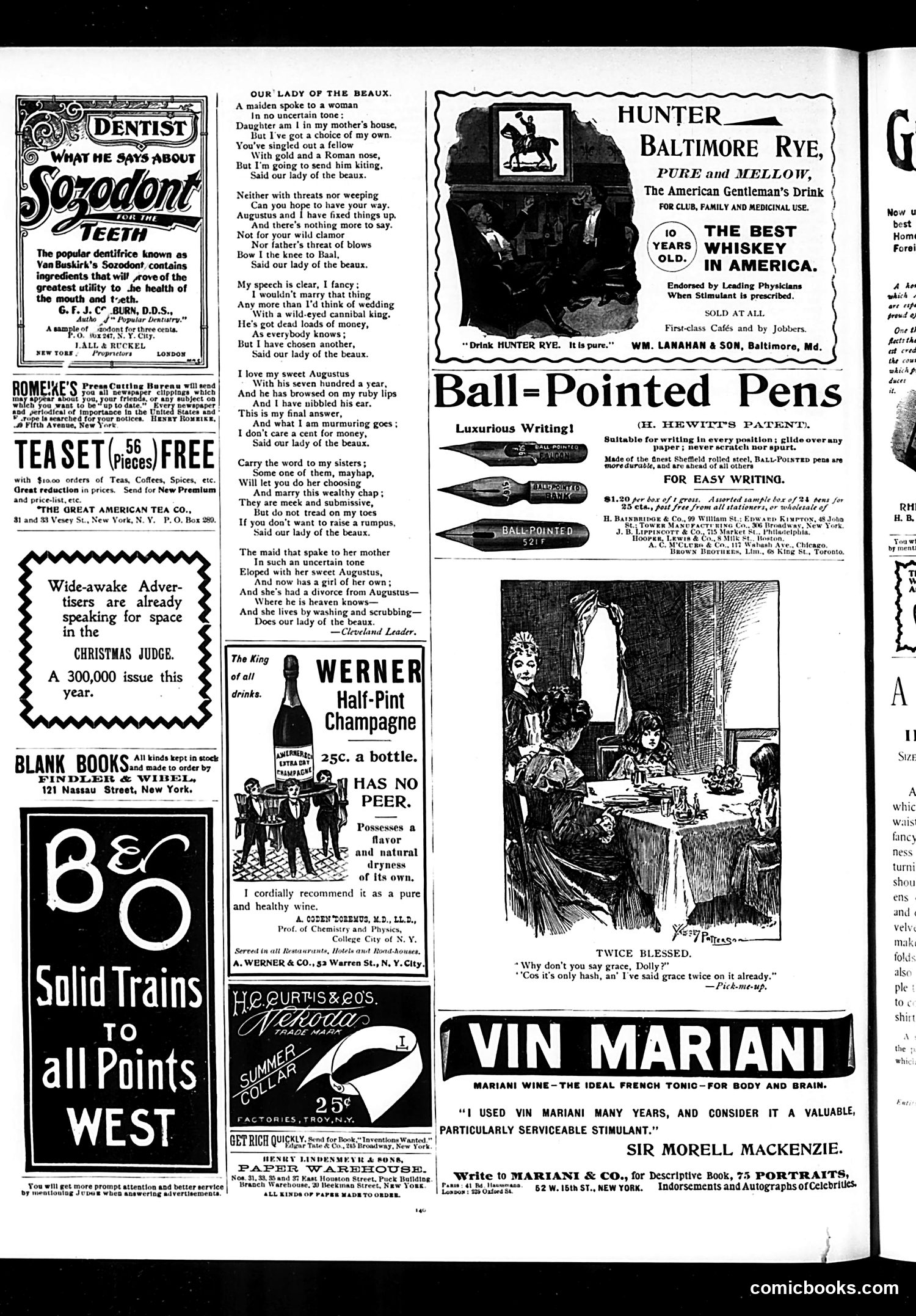
This page is predominantly **advertising**, typical of Judge's revenue model. Key content includes: **"Our Lady of the Beaux"** (poem): A satirical narrative about a young woman who defies her mother's wishes by rejecting a wealthy suitor (Augustus with "gold and a Roman nose") to marry a poor man she loves ("seven hundred a year"). The ironic twist: she divorces him and ends up "washing and scrubbing" for survival. The satire mocks both romantic idealism and women who prioritize love over financial security, ultimately suggesting the woman's choice leads to ruin. **Advertisements**: The page features typical period product ads—dental products (Sozodont), alcohol (Hunter Baltimore Rye, Werner Champagne, Vin Mariani wine), writing instruments (Ball-Pointed Pens), trains, tea, and other goods. These ads reflect late 19th-century consumer culture and proprietary medicines. The cartoon illustration (bottom) depicts a domestic dinner scene but lacks sufficient context in the visible text to determine its specific satirical target.
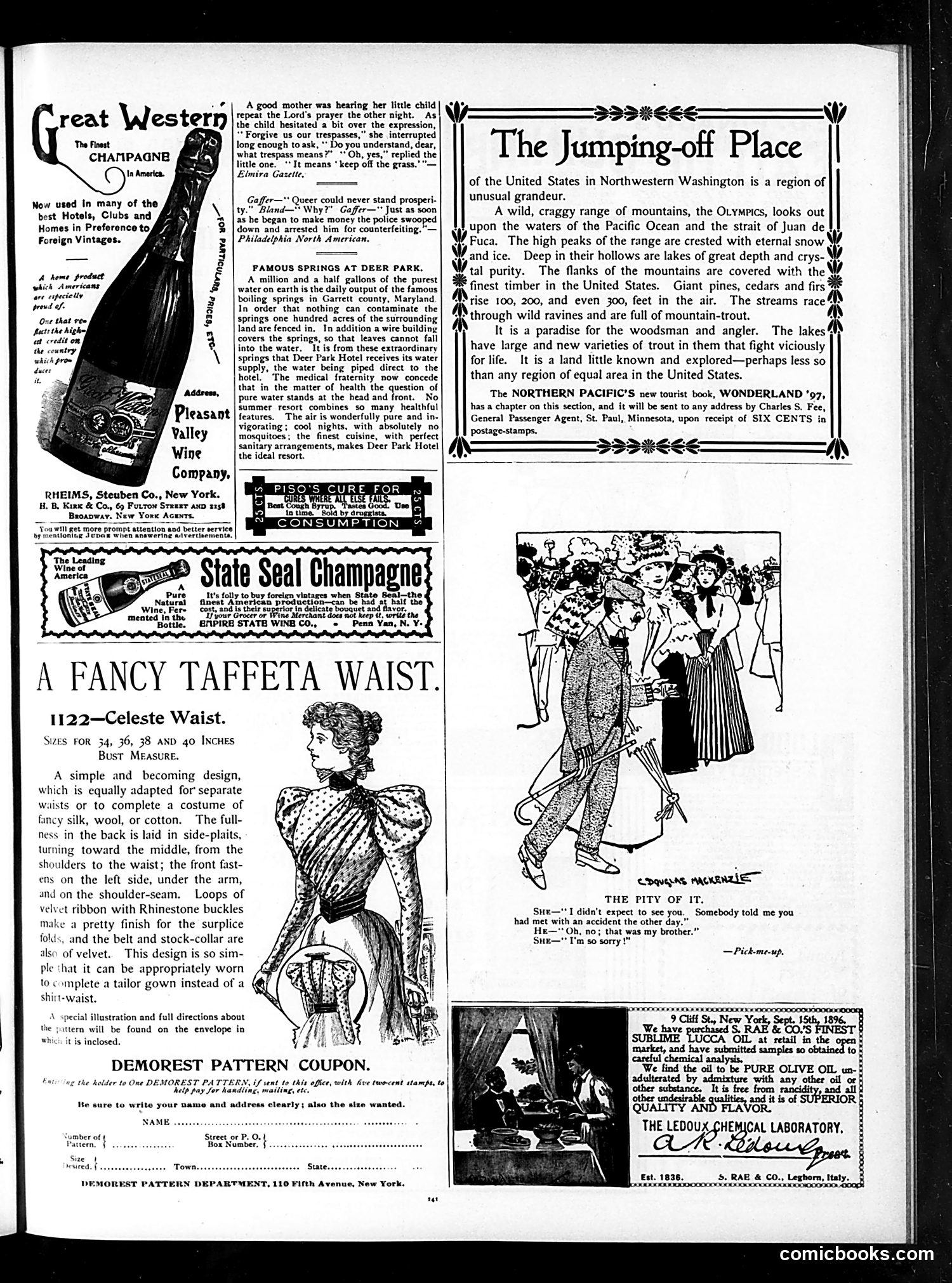
This page is primarily **advertising and fashion content**, not political cartoons. The bulk consists of: 1. **Two brief humorous anecdotes** (top): A child misdefines "trespasses" as "keep off the grass," and a story about someone arrested for counterfeiting. These are gentle domestic humor, not satire. 2. **Product advertisements**: Pleasant Valley Wine, State Seal Champagne, Deer Park Hotel's mineral springs, and Sublime Lucca Oil dominate the page—typical late-19th/early-20th century magazine advertising. 3. **Fashion content**: The "Fancy Taffeta Waist" pattern (center) with Demorest Pattern coupon—standard women's magazine material. 4. **A cartoon illustration** (right): Shows women in period dress with caption "The Pity of It"—appears to be light social commentary on courtship or relationships, but lacks clear satirical bite. **No significant political satire or caricature is present.** This appears to be a typical Judge magazine page mixing light humor with commercial advertisements and women's fashion—the standard content mix of such publications.
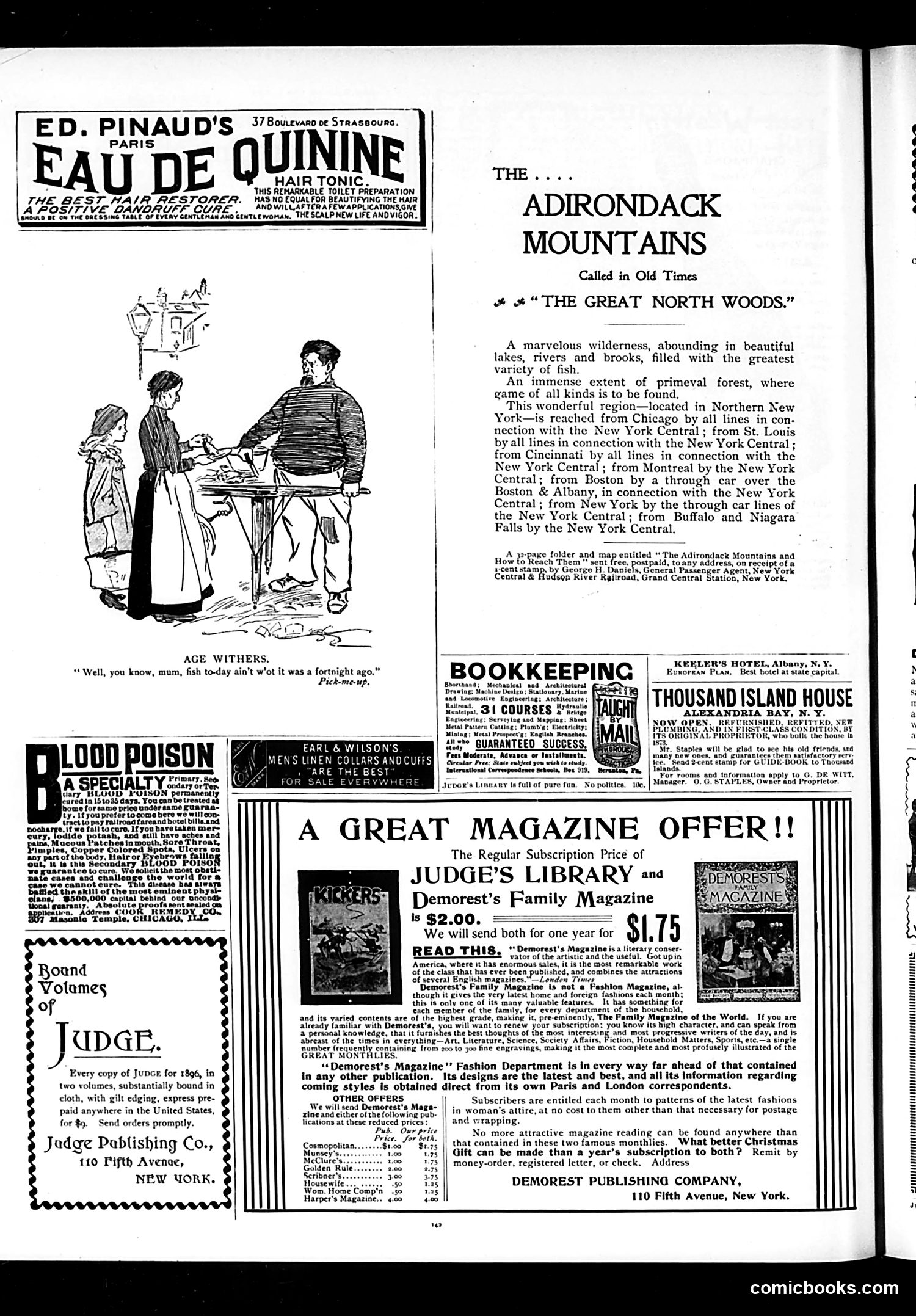
This page is primarily **advertising and promotional material** rather than political satire. The main content includes: **Prominent Features:** - A small cartoon titled "Age Withers" showing a fishmonger and customers, with mild social humor about declining fish quality—typical period domestic comedy with no clear political message. - A large travel promotion for the **Adirondack Mountains**, marketed as "The Great North Woods," emphasizing accessibility via the New York Central Railroad from major cities (Chicago, St. Louis, Cincinnati, Montreal, Boston, New York). **Advertisements:** - Hair tonic, men's collar/cuff products, blood poison treatment - Hotel promotions (Keeler's Hotel Albany, Thousand Island House) - Bookkeeping school - Subscription offers bundling Judge's Library and Demorest's Family Magazine for $1.75 **Context for Modern Readers:** This reflects late-19th century America's growing leisure tourism, railroad expansion, and mail-order consumer culture. The page demonstrates how magazines funded operations through dense advertising rather than subscription alone.
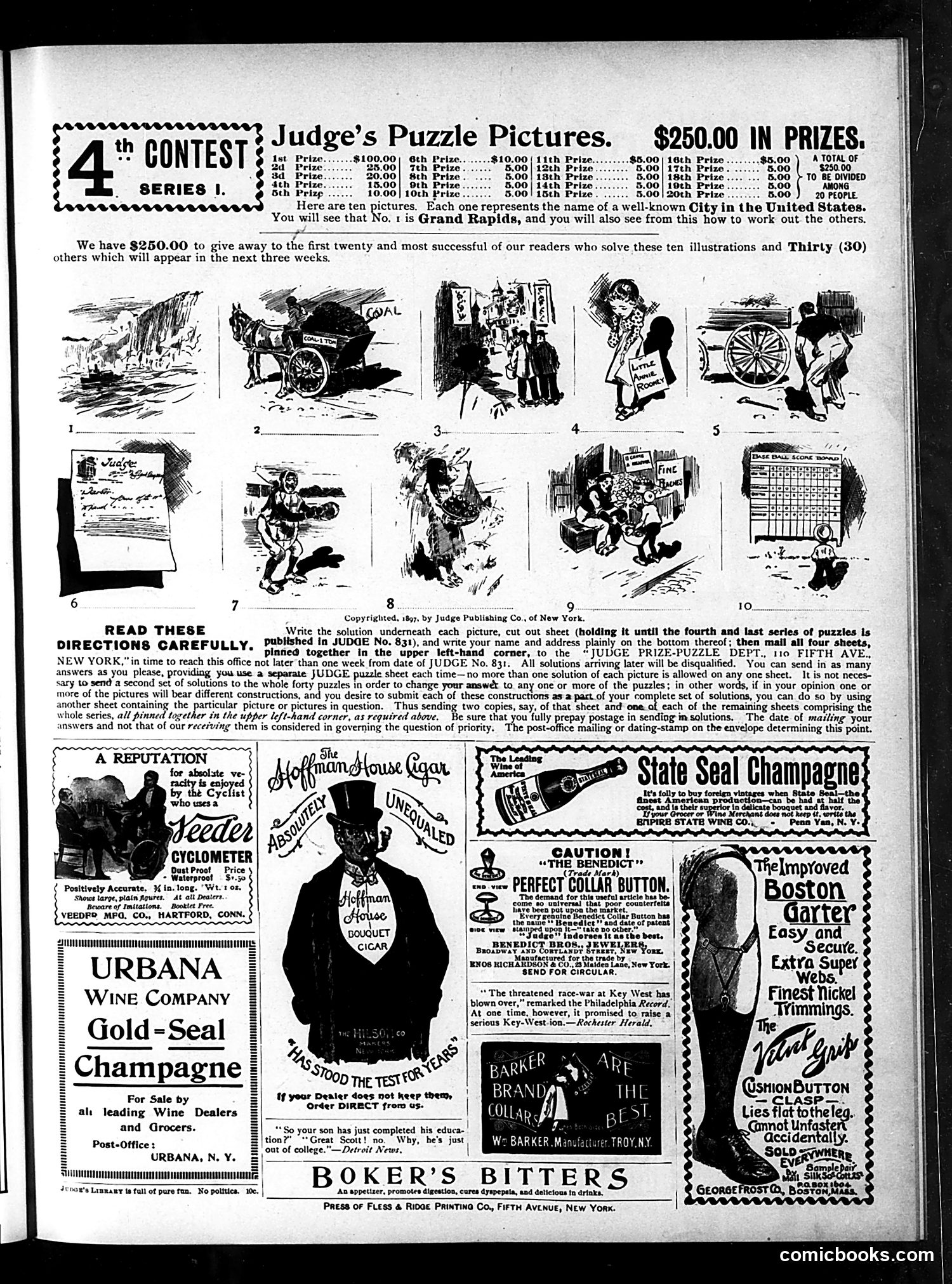
This page is primarily a **puzzle contest**, not political satire. Judge magazine is running a visual puzzle competition where readers must identify ten U.S. cities from cartoon illustrations (picture #1 is identified as Grand Rapids). The contest offers $250 in prizes distributed across twenty winners, with thirty additional puzzles to follow in subsequent weeks. The bulk of the page consists of **contest instructions** and **commercial advertisements** for period products: champagne, collar buttons, bitters, cyclometers, and cigars. The sole editorial content appears to be a brief newspaper excerpt mentioning a "threatened race-war at Key West" that "has blown over"—suggesting a minor local incident that resolved without escalation. This is essentially a **puzzle-game page with advertising**, not a satirical or political commentary piece.
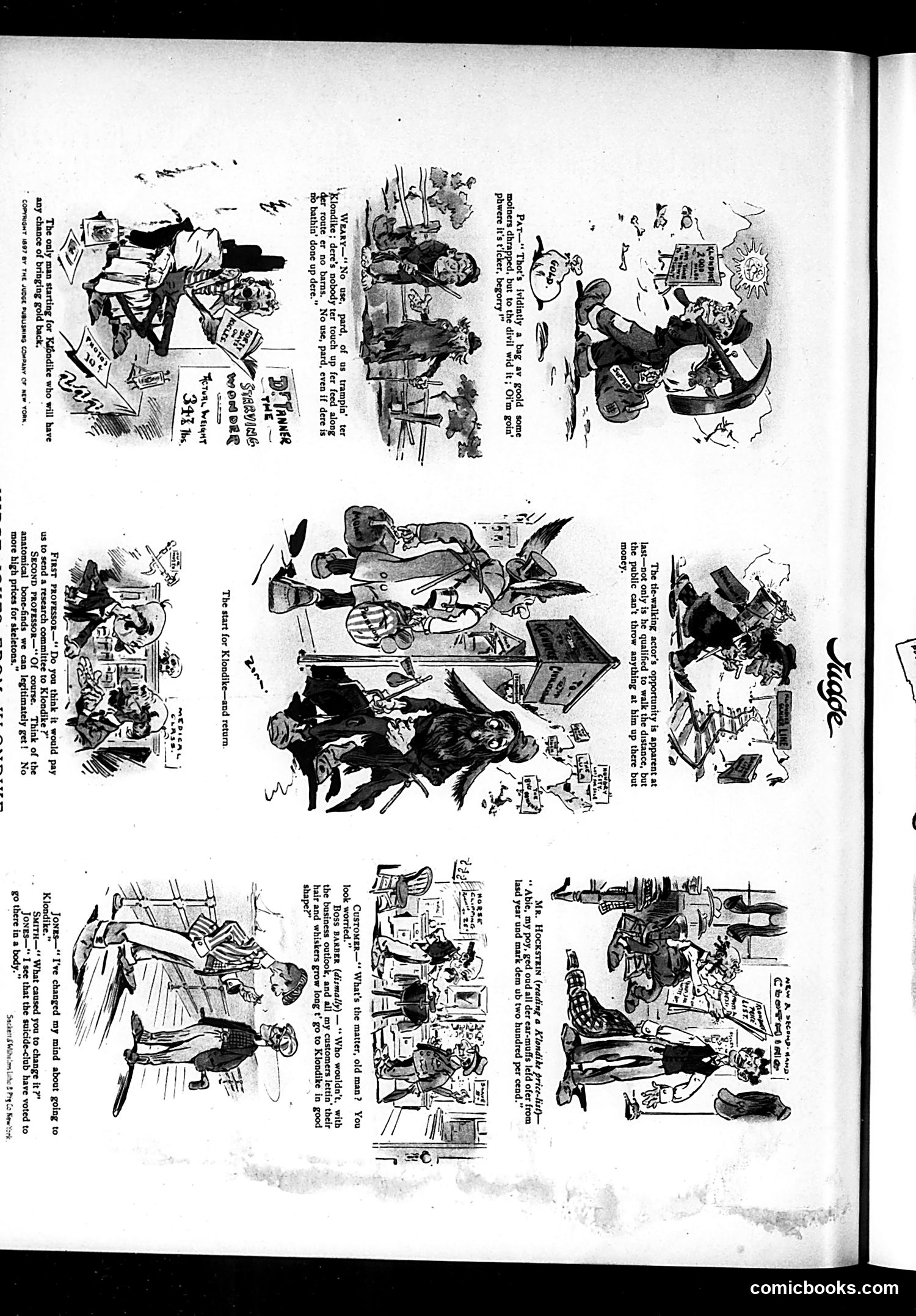
This 1897 page satirizes the Klondike Gold Rush frenzy. Multiple cartoons mock different groups exploiting or participating in the stampede: **The main cartoon** depicts a tramp as "the only man...who will have any chance of bringing gold back"—satirizing that the poor, with nothing to lose, were ironically best-positioned for the harsh journey. **Other sketches target profiteers**: Professors plan skeleton-selling schemes; merchant "Mr. Hockstein" jacks up prices on ear-muffs 200%; a barber laments customers abandoning grooming for Klondike preparation. **The final joke** references a "suicide-club" heading north, darkly suggesting the venture was essentially suicidal. The satire critiques gold-rush mania as economically irrational and exploitative, where only con artists and the desperate actually benefited. It mocks both the dreamers chasing riches and the merchants profiting from their desperation.