
A complete issue · 16 pages · 1897
Judge — July 24, 1897
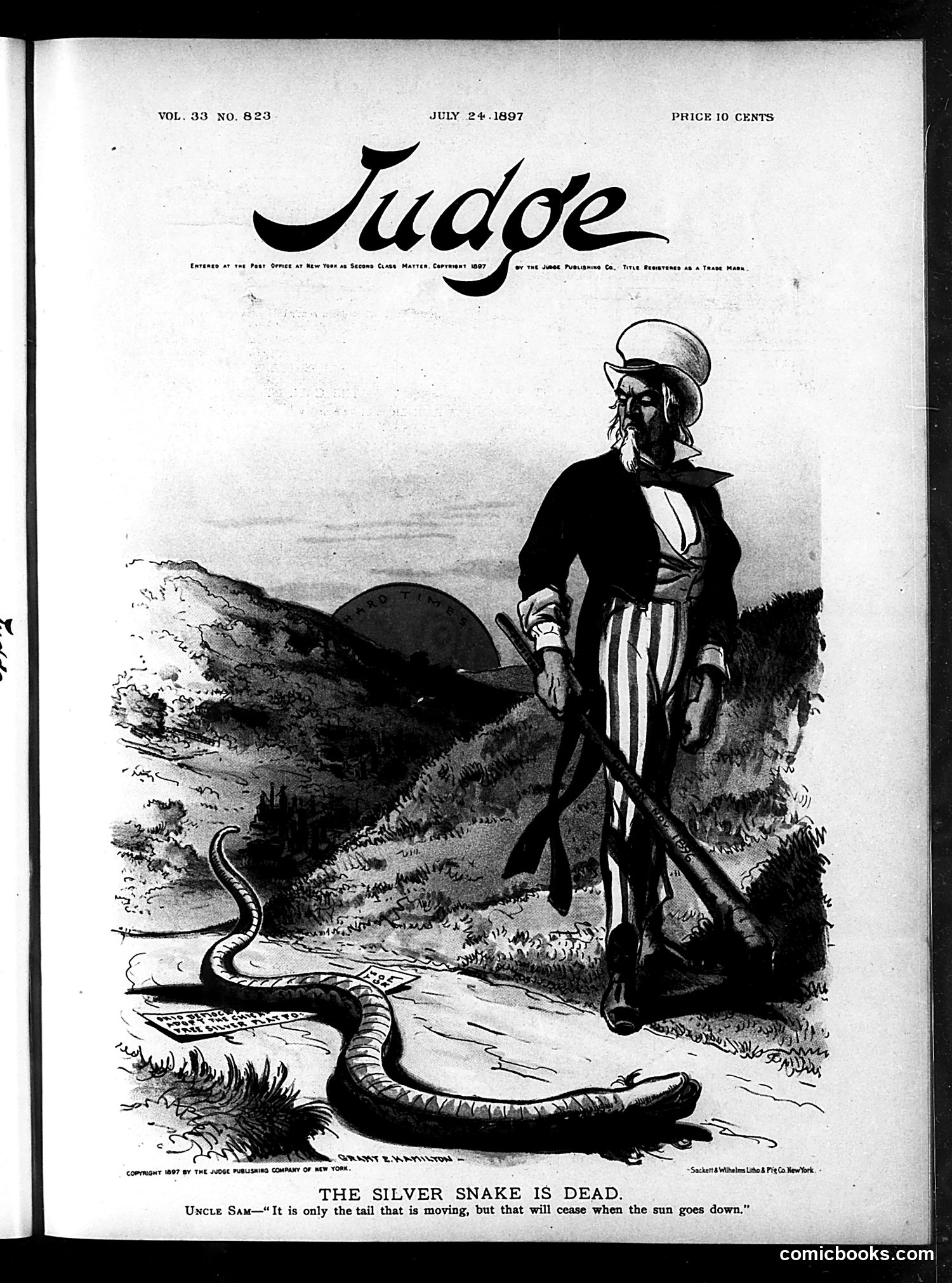
This *Judge* magazine cover from July 24, 1897 depicts Uncle Sam standing over a dead snake labeled "The Silver Snake." The caption reads: "It is only the tail that is moving, but that will cease when the sun goes down." This cartoon references the monetary debate of the 1890s—specifically the conflict between advocates of free silver (unlimited coinage of silver) and supporters of the gold standard. The "silver snake" represents the free-silver movement, which had gained political momentum. The cartoon suggests Uncle Sam has defeated this threat, though it implies some "death throes" remain (the moving tail). The sunset symbolizes the final end of silver's political threat, likely alluding to the recent 1896 election where gold-standard candidate William McKinley defeated free-silver advocate William Jennings Bryan.
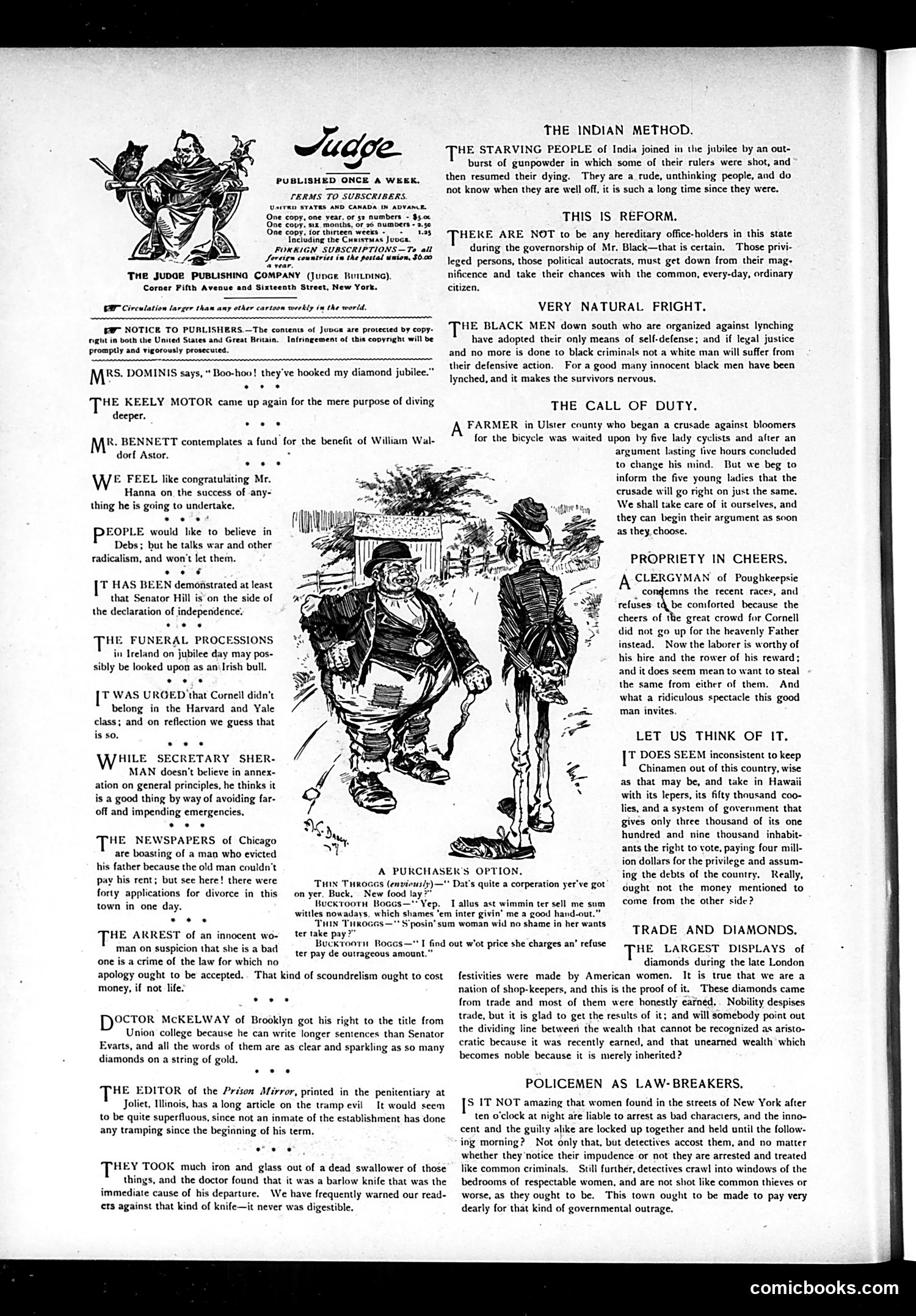
This page contains multiple short satirical pieces and one large cartoon labeled "A Purchaser's Option." The cartoon depicts what appears to be a working-class man or laborer confronted by a woman, likely satirizing consumer transactions or labor disputes of the era. The text pieces mock various targets: Indian famine relief efforts ("The Indian Method"), lynching and racial violence ("Very Natural Fright"), political office-holding, and women's suffrage concerns. One section criticizes Chicago newspapers for attacks on their father's divorce case. The satire generally reflects early 20th-century conservative positions: skepticism toward reform efforts, concerns about women's public roles, and commentary on labor and commercial disputes. The specific political references and figures remain unclear without additional historical context about Judge's contemporary coverage.
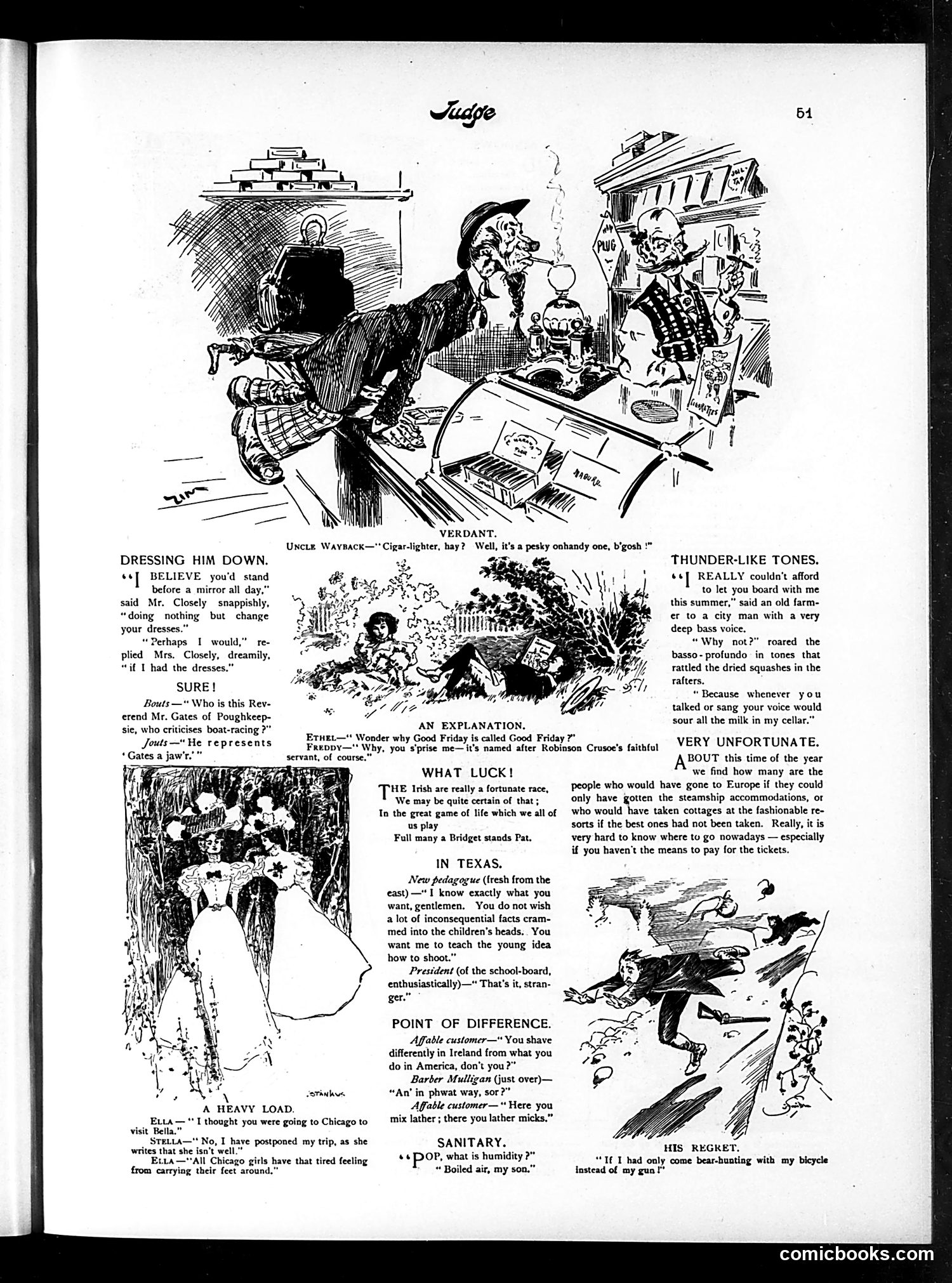
This page contains multiple short satirical pieces and cartoons typical of Judge's format. **"Verdant"** depicts an Irish immigrant (Uncle Wayback) offering a cigar to someone, with ethnic stereotyping common to the era. **"Dressing Him Down"** and **"Sure!"** appear to be domestic humor about marriage and housekeeping disputes, without clear political content. **"What Luck!"** references Irish fortune and includes a poem about Irish character—typical period ethnic humor. **"In Texas"** satirizes educational philosophy debates about teaching children practical skills versus traditional methods. **"Point of Difference"** and other pieces are brief comedic vignettes about Irish-American characters, focusing on dialect humor and cultural contrasts between Ireland and America. The page reflects early 20th-century American magazine humor, relying heavily on ethnic stereotypes and domestic comedy rather than explicit political satire.
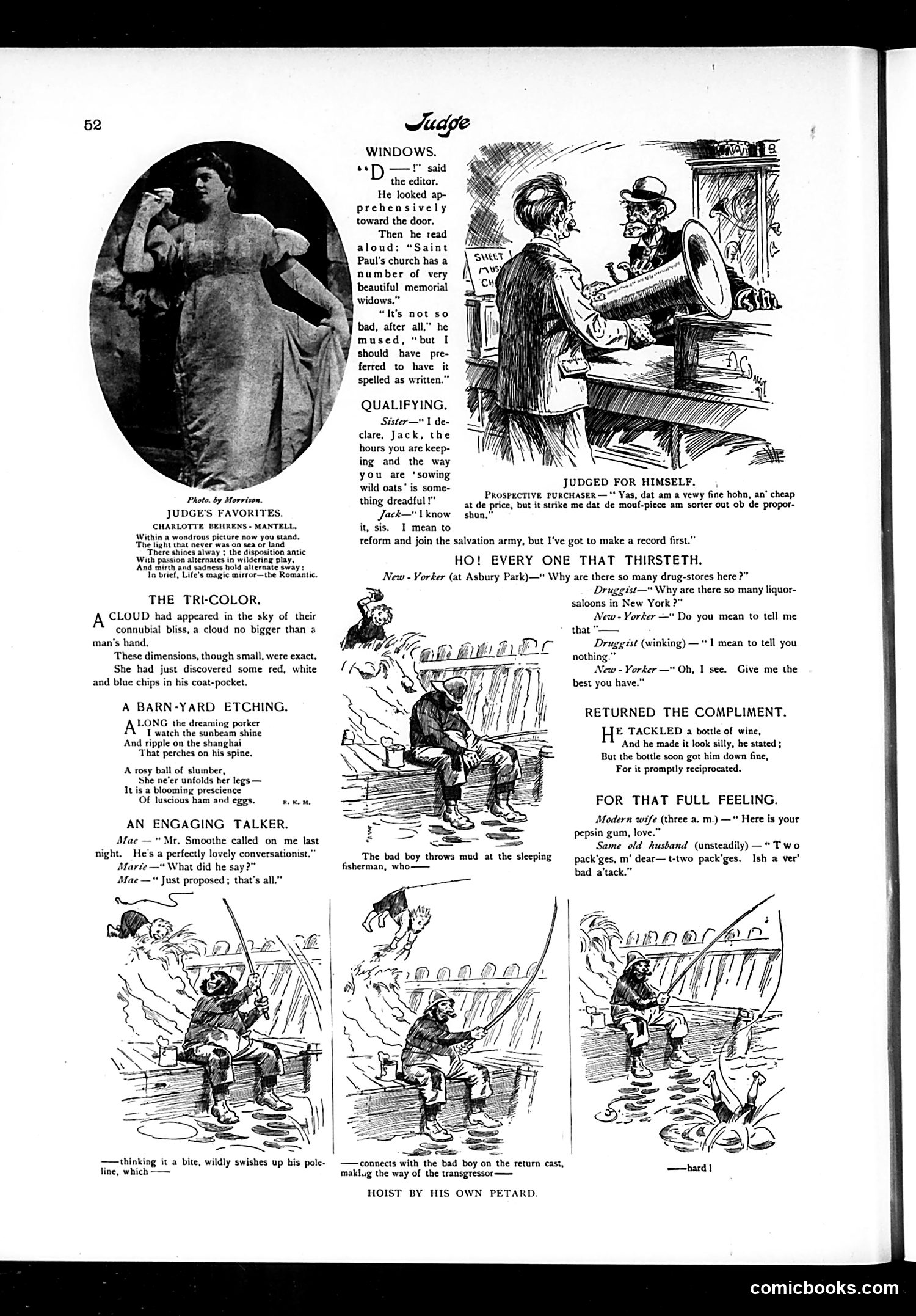
This page contains several unrelated humorous vignettes typical of Judge's satirical style: **"Windows"** mocks a typographical error: "memorial widows" instead of "windows" in a church notice—a simple pun on homonyms. **"The Tri-Color"** references marital suspicion: a husband's coat contains red, white, and blue chips, suggesting gambling or infidelity—the "cloud" on their marriage. **"A Barn-Yard Etching"** is whimsical verse about a pig sleeping, with fanciful observation. **"An Engaging Talker"** jokes about a suitor who only proposes—his "engagement" consists of proposing marriage. **The fishing illustrations** show a "bad boy" prank: throwing mud at a fisherman, who mistakes it for a fish bite, then catches the boy on the return cast—poetic comeuppance. **"Hoist by His Own Petard"** depicts a prospective buyer's dialect humor criticizing a horn's mouthpiece proportions. **"Ho! Every One That Thirsteth"** plays on New York's abundance of liquor saloons versus drugstores—the druggist's wink suggests they're similarly stocked. Most humor relies on wordplay, dialect, and everyday social situations rather than specific political references.
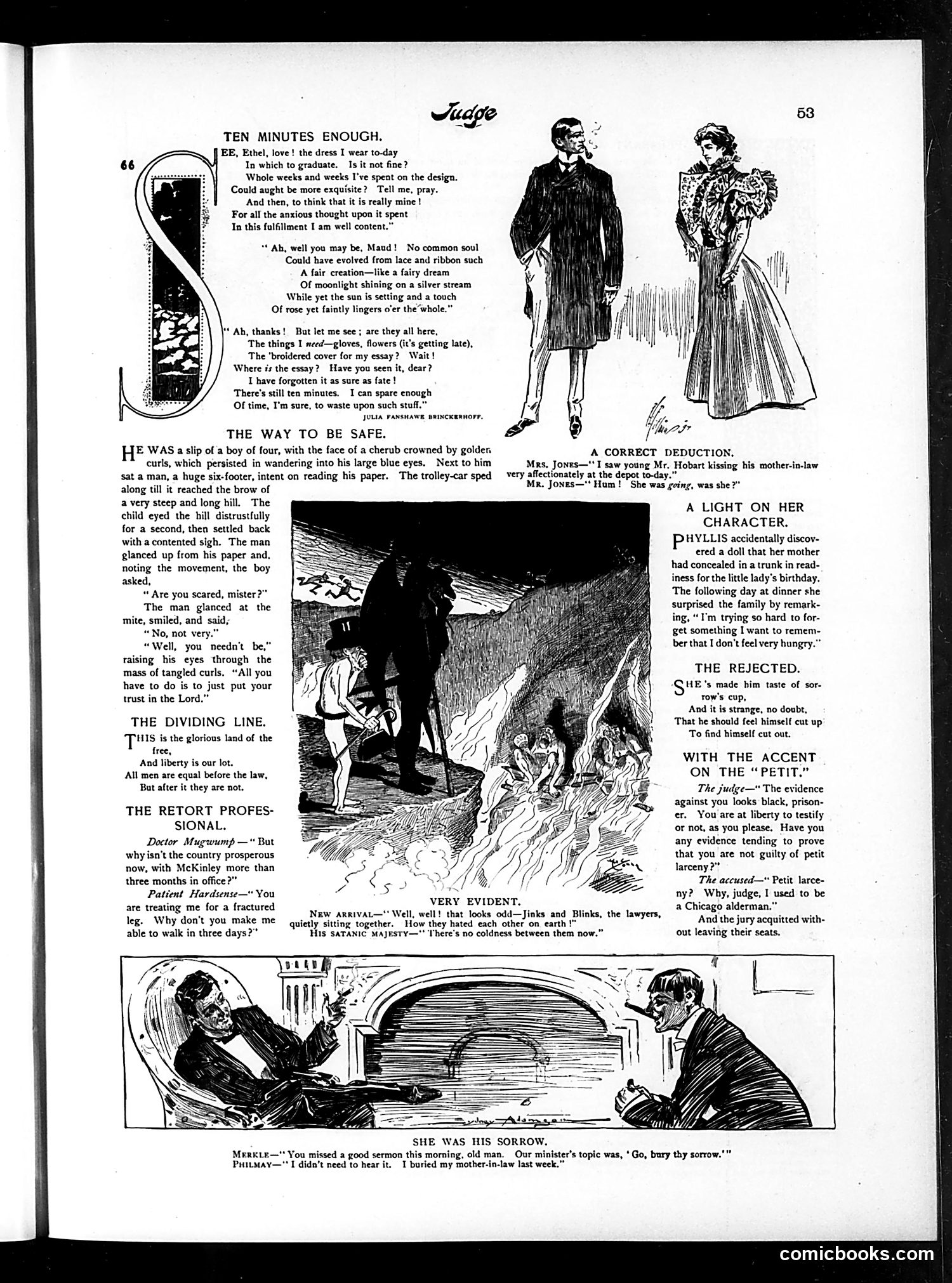
This page contains multiple short satirical pieces typical of late-19th/early-20th century American humor: **"Ten Minutes Enough"** mocks a graduate's carelessness—she's spent weeks perfecting her graduation dress but nearly forgot her essay, dismissing it as unimportant. **"The Way to Be Safe"** presents a child's innocent wisdom: when a man fears going down a steep hill on a trolley, the boy advises simply trusting in the Lord—gentle satire on faith versus rational worry. **"The Dividing Line"** is political commentary: America claims all men are equal before law, but unequal after—criticism of post-legal inequality. Other pieces include: jokes about a doctor's inability to cure patients under McKinley's administration; a woman deducing a man kissed his mother-in-law because she was "going" (leaving); puns about romantic rejection ("cut out"); and wordplay on "petit" larceny versus a Chicago alderman's major crimes. The humor is gentle, domestic, and relies on puns and social observation rather than sharp political critique.
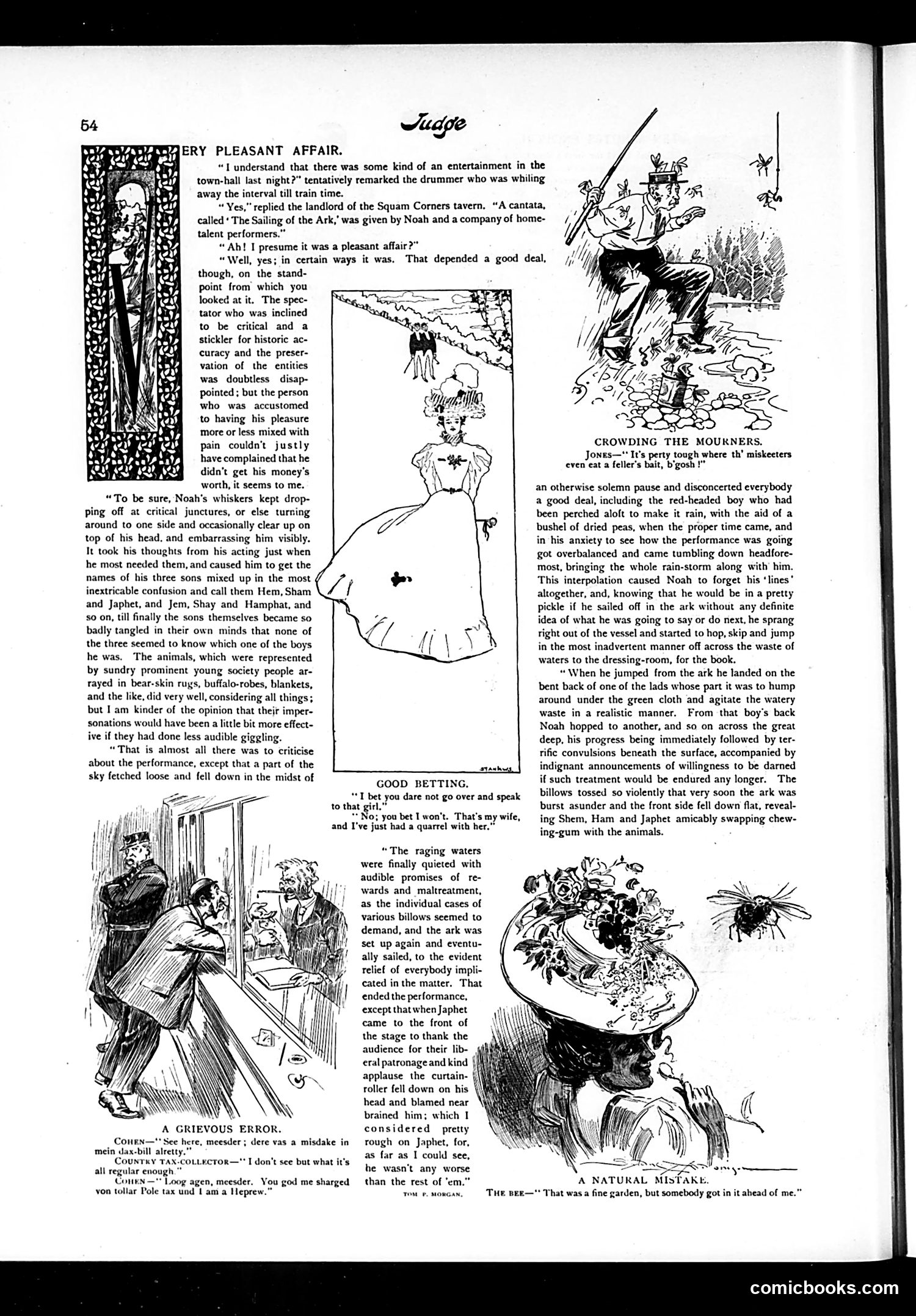
This page contains three satirical pieces mocking amateur theatrical productions and social absurdities of the era. The main story, "A Very Pleasant Affair," ridicules a poorly-executed community cantata about Noah's Ark performed at a town hall. The humor targets the incompetence: Noah's whiskers keep falling off, the actor confuses his sons' names (calling them "Hem, Sham and Japhet" instead of the biblical names), and young society people in animal costumes giggle audibly. A stage prop literally falls and nearly injures an actor. The satire mocks both pretentious amateur theatricals and the social climbing of "prominent young society people" participating in such performances. The lower cartoons address other topics: "A Grievous Error" jokes about a Polish immigrant (indicated by accent) being wrongly taxed as a "Pole" when he's actually Hebrew; "Good Betting" shows a marital quarrel; and smaller gags about mosquitoes and bees. The overall tone ridicules small-town cultural pretensions and ethnic stereotypes common to late 19th/early 20th-century American humor magazines.
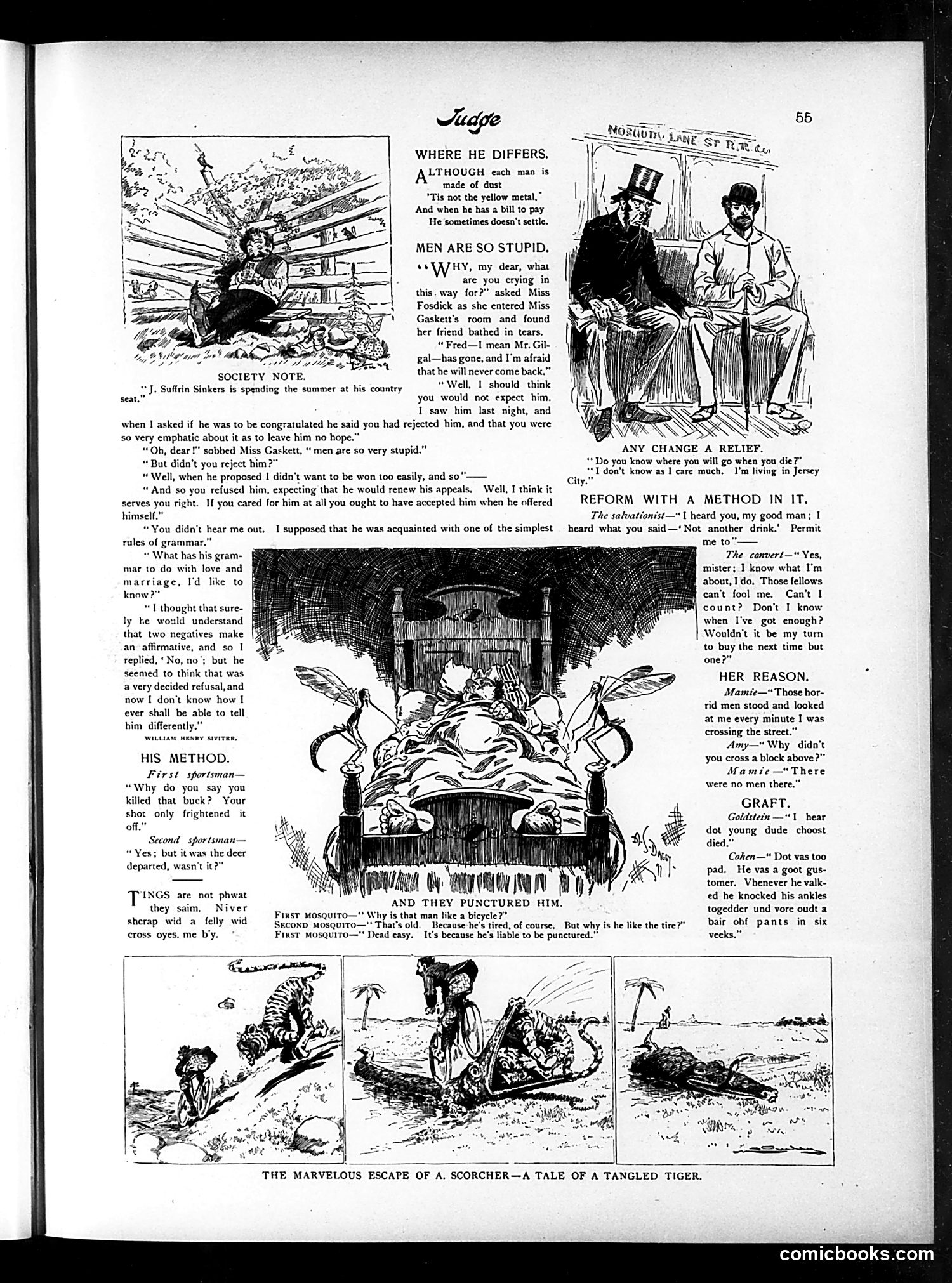
This satirical page from *Judge* presents various humorous commentary on American society and human nature. The main pieces include: **"Men Are So Stupid"** mocks romantic miscommunication—a woman rejects her suitor saying "No, no" (intending to play coy), but he interprets it as refusal. The joke turns on her absurd logic that he should understand "two negatives make an affirmative" as a grammar rule. **"His Method"** plays on wordplay: a hunter claims he "killed" a deer because it "departed"—a pun on "deer departed." **"Reform with a Method"** satirizes temperance campaigns, showing a "convert" who cynically calculates when it's *his turn* to buy drinks rather than genuinely abstaining. **"Graft"** features Yiddish-dialect characters discussing a customer's death—he was profitable because his friction-worn pants required frequent replacement. This suggests petty exploitation. The page also includes mosquito jokes, romantic complications, and lighter society humor. Overall, it reflects *Judge's* skepticism toward human rationality, romantic sincerity, reform movements, and ethnic stereotypes typical of early 20th-century American satire.
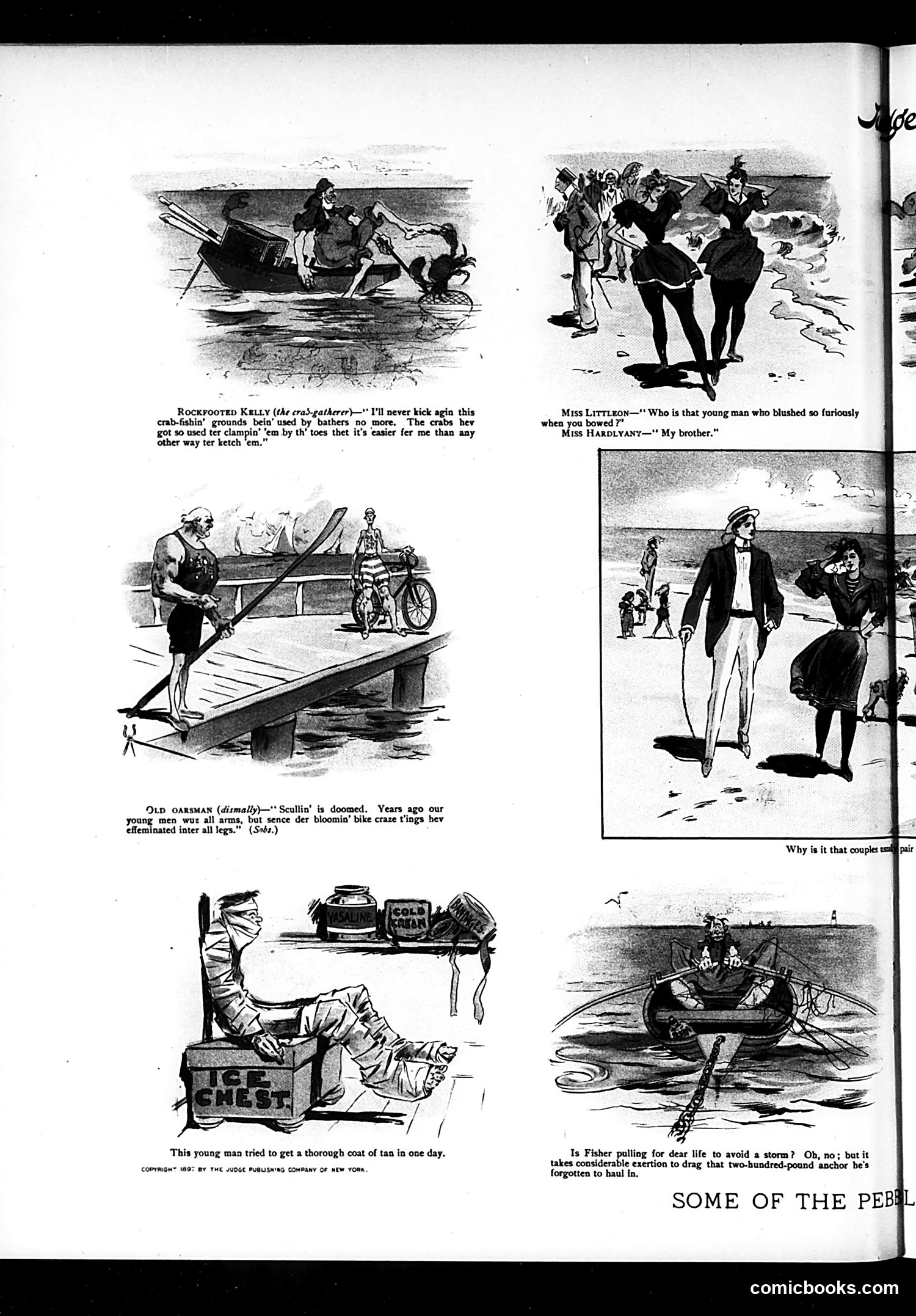
This page contains six separate satirical cartoons mocking various leisure activities and social trends of the era (likely late 1800s): 1. **"Rockfooted Kelly"**: A crab-fisher claims bathers have made crabs so accustomed to being grabbed by their toes that catching them is now easier. 2. **Miss Littleton dialogue**: A young woman's brother blushes when she greets someone, suggesting possible romantic embarrassment. 3. **"Old Oarsman"**: Laments that the bicycle craze has weakened young men's arms, leaving them with only strong legs—a jab at cycling's popularity replacing rowing. 4. **Tan mishap**: A man attempts rapid tanning with comedic results. 5. **"Tiger Chest" product**: Appears to be a dubious patent medicine advertisement being mocked. 6. **Fisher and storm**: The caption jokes that a fisherman struggles with anchors rather than avoiding actual storms. The overall theme ridicules fashionable pursuits, dubious health products, and generational decline through physical weakness.
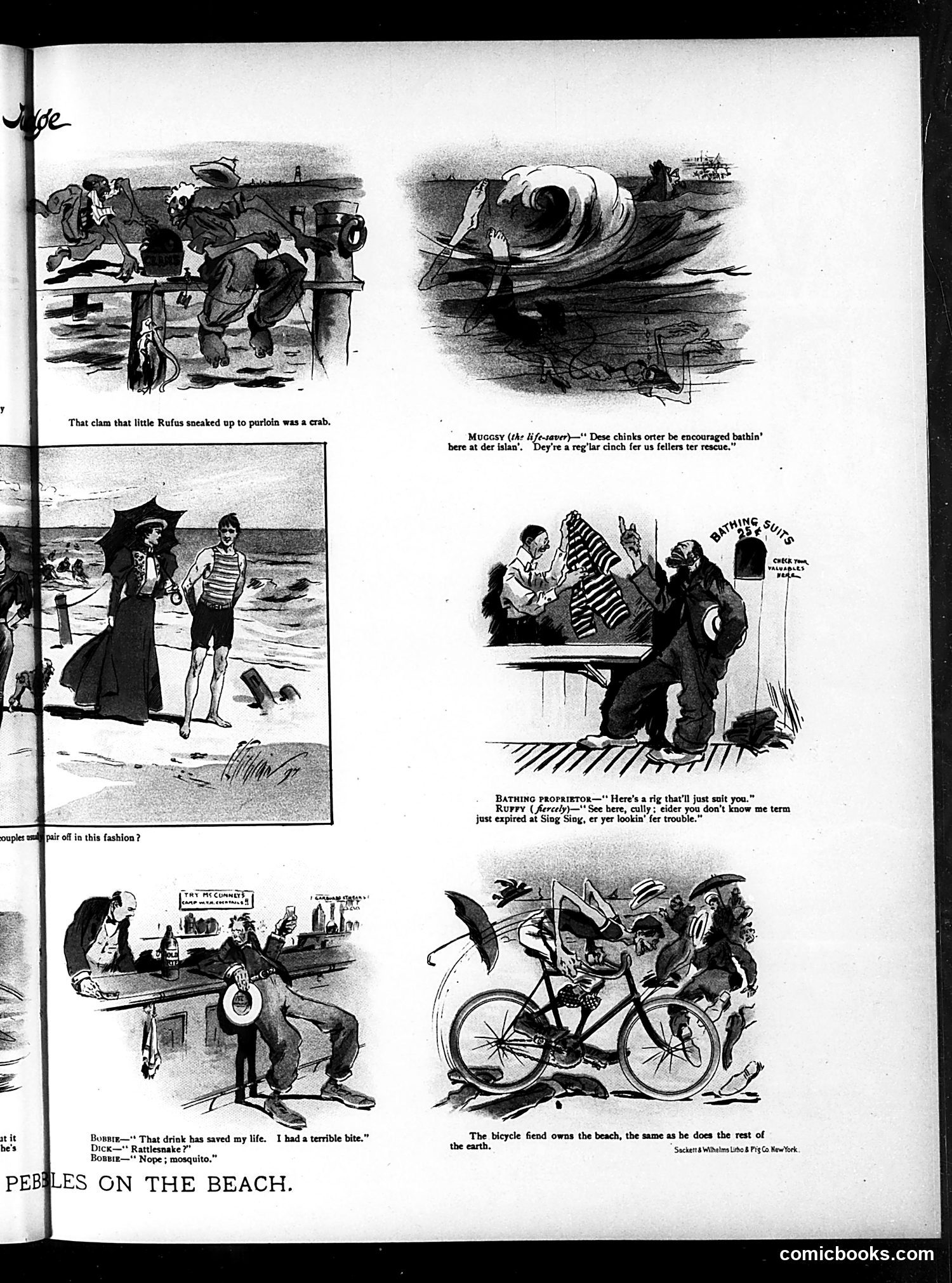
This page of satirical sketches depicts various beach scenes with period stereotypes and social commentary typical of early Judge magazine humor. The top panels mock dangerous beach conditions: a crab pinches someone, and a lifeguard cynically suggests encouraging Chinese swimmers ("chinks") as rescue opportunities—reflecting contemporary racial prejudice and exploitation. The middle sketch shows a bathing suit proprietor offering a garment to a man named "Rutty," who threatens violence, apparently mistaking the proprietor for someone recently released from Sing Sing prison. This plays on criminal stereotypes. The mosquito joke presents a man who was bitten by a mosquito rather than a rattlesnake, suggesting mosquitoes were considered equally dangerous threats. The final panel satirizes the "bicycle fiend"—the obsessive cyclist who dominates public spaces, reflecting late-19th-century anxieties about the bicycle craze's social disruptiveness. The cartoons collectively mock lower-class beach culture, immigrant groups, and contemporary fads.
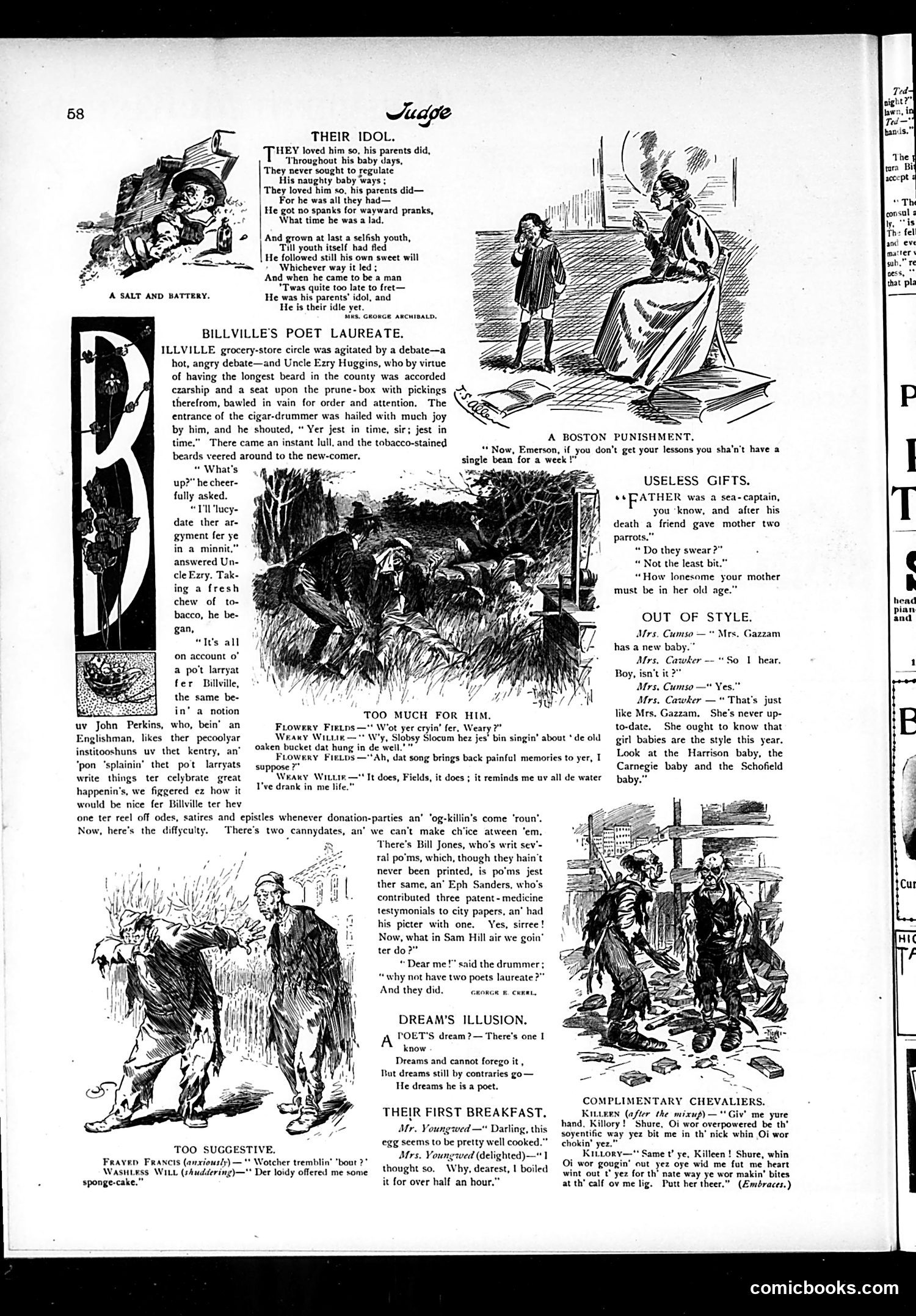
This page from *Judge* collects several short satirical pieces and cartoons typical of late 19th-century American humor: **"Their Idol"** mocks indulgent parenting—a universal theme where parents' excessive love produces a selfish, idle adult. **"Billville's Poet Laureate"** satirizes small-town life and democratic decision-making. Rural characters debate selecting a "poet laureate" for their grocery store circle, unable to choose between two mediocre candidates (Bill Jones and Eph Sanders). The humor lies in the absurdity of rustic pretension and endless deliberation. **"A Boston Punishment"** shows a mother threatening her son with lost lessons—a mild, educated punishment contrasting with harsher discipline. **"Out of Style"** mocks class-conscious mothers who follow wealthy families' naming trends (Harrison, Carnegie, Schofield babies) rather than choosing names naturally. **"Their First Breakfast"** presents newlywed incompetence: the wife boils an egg for half an hour, destroying it, while the husband diplomatically praises it. The dialect humor and character types reflect *Judge's* focus on American social foibles—parenting, small-town life, and nouveau-riche pretension.
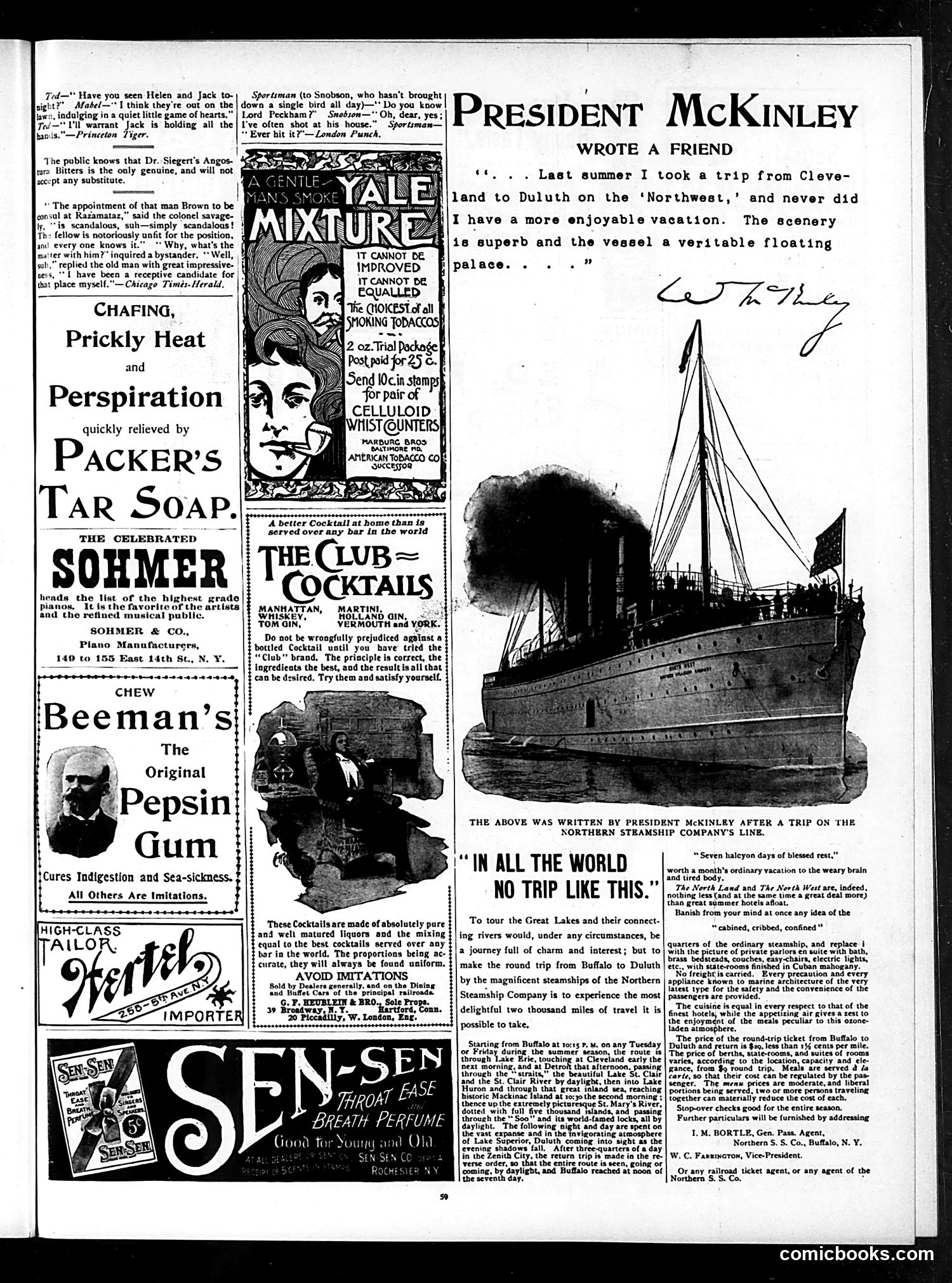
This page is primarily **advertising**, not satire or political commentary. The dominant feature is a promotional article about Northern Steamship Company cruises on the Great Lakes, illustrated with a large ship image. The page includes President McKinley's endorsement of a Great Lakes voyage, where he praises the "Northwest" steamship and calls it "a veritable floating palace." This appears to be a genuine testimonial (or advertisement posing as one) rather than satire—McKinley is being used to legitimize the luxury cruise experience. The surrounding content is standard **period advertisements**: Packer's Tar Soap, Sohmer pianos, Beeman's Pepsin Gum, Club Cocktails, and Sen-Sen breath perfume. The small jokes at the top ("Have you seen Helen and Jack tonight?") are unrelated filler—typical of Judge magazine's miscellaneous humor columns. There is **no political satire** on this page; it's a commercial showcase featuring the President's name for marketing purposes.
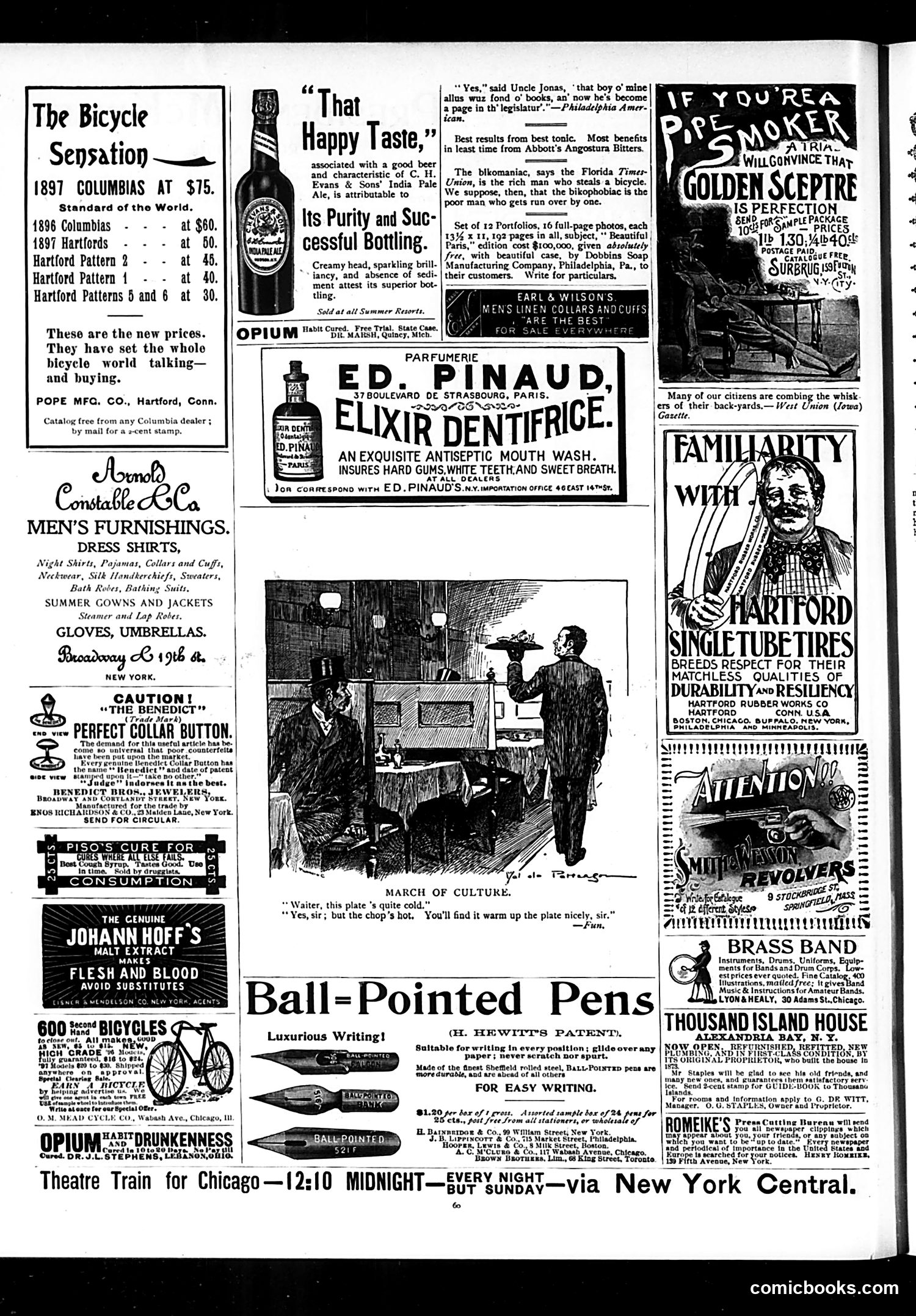
This page is primarily **advertising** with one cartoon aside. The main cartoon, titled "March of Culture," depicts a restaurant server addressing a cold-plate complaint with condescending logic: he'll warm the cold plate by placing hot chop on it—solving the symptom while missing the actual problem. The satire mocks false solutions and superficial remedies to real issues, a common fixture in *Judge*. The page otherwise showcases period advertisements (1897-era): bicycles at competitive new prices, malt extract promising bodily vigor, patent pens, toothpaste, rubber bicycle tires, and musical instruments—all typical consumer goods marketing of the Gilded Age. A small joke at top-left involves an Uncle Jonas character praising his son becoming a "page in th' legislatur'"—a pun playing on the homophone between "page" (servant) and legislative office, gently satirizing political corruption or incompetence.
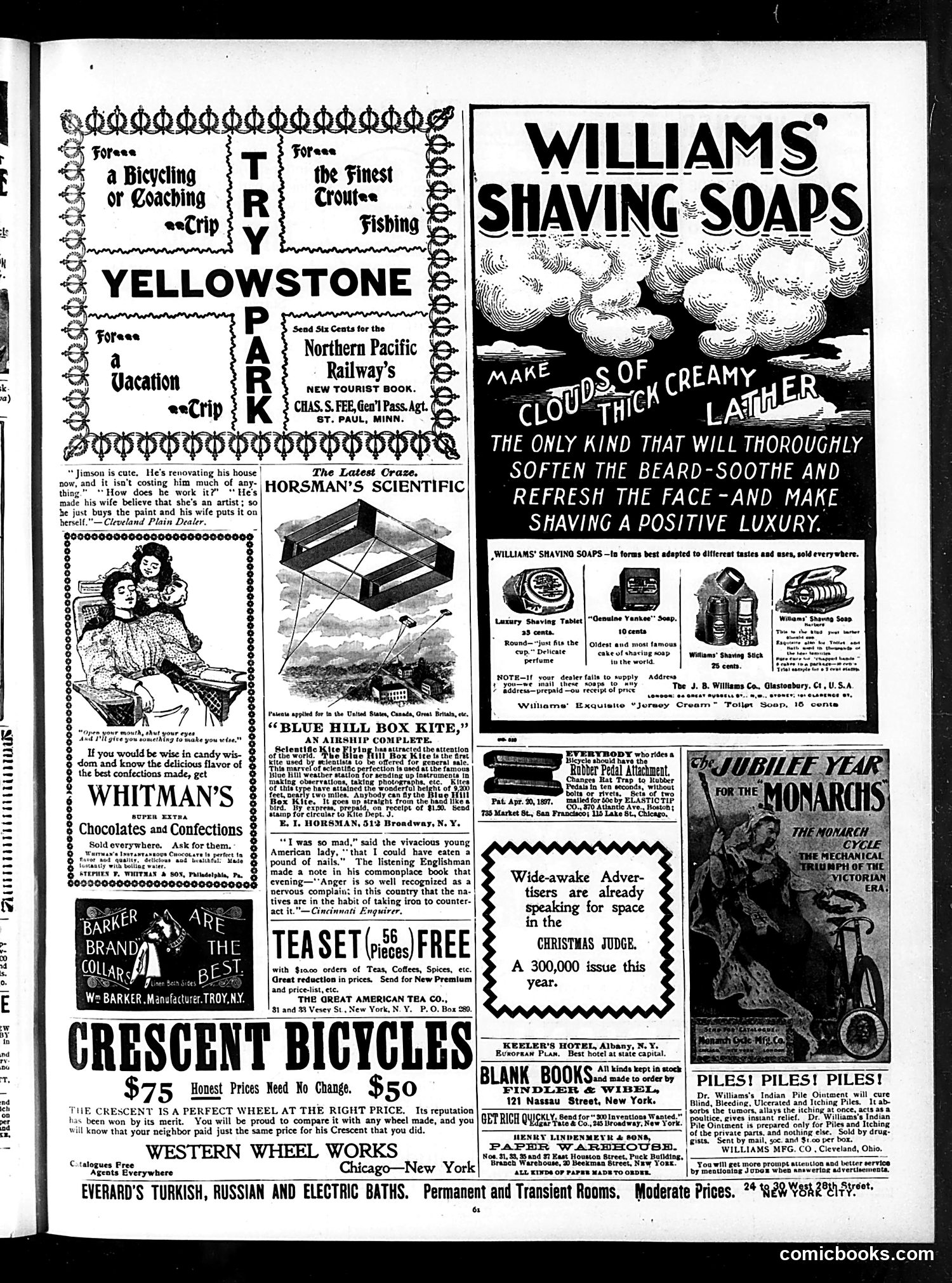
This is primarily an **advertising page** from Judge magazine, with minimal editorial content. The page features commercial advertisements for consumer products popular in the late 19th century. The only identifiable cartoon/joke appears in a small panel near the top: a anecdote about a man named "Jimson" renovating his house cheaply—his wife applies the paint herself. The humor is mild domestic satire about penny-pinching. Below that is another brief joke about an American lady telling an Englishman she was so angry she could have eaten nails; the Englishman notes in his journal that Americans treat anger as a "nervous complaint" by consuming iron. The remainder of the page consists of advertisements for: Williams' Shaving Soaps, Whitman's Chocolates, Crescent Bicycles ($75), Blue Hill Box Kites, Blank Books, Dr. Williams's Indian Pile Ointment, and various baths and hotels. These reflect typical consumer products of the 1890s era. No significant political or social satire is evident on this page.
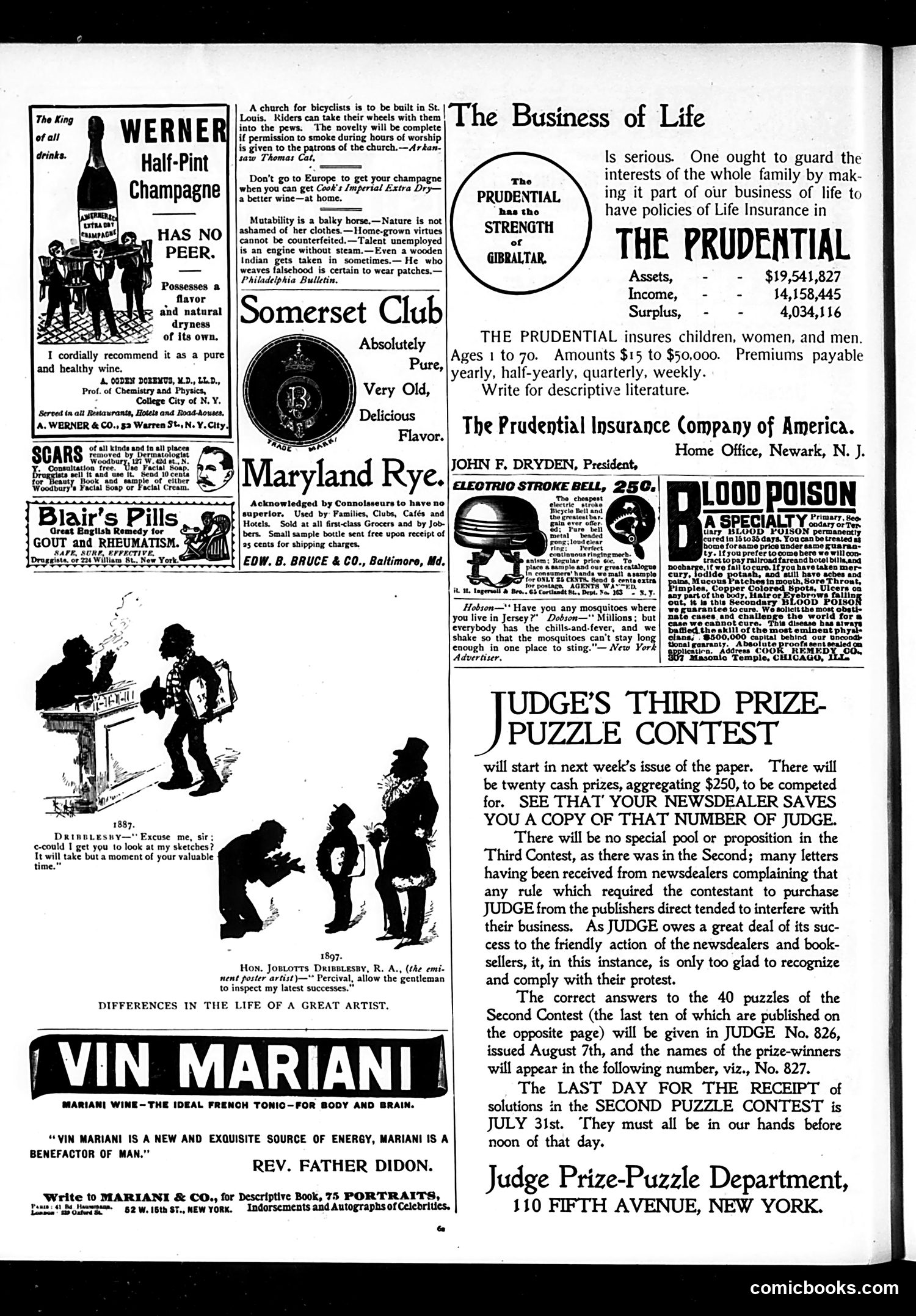
This is primarily an **advertising page** from Judge magazine, circa 1897, with one cartoon titled "Differences in the Life of a Great Artist." The cartoon contrasts two scenes: an unknown artist shyly asking an established Royal Academician (R.A.) to review his sketches, versus that same artist years later, confidently showing his work to someone else. The joke satirizes the ego inflation that success brings—the once-humble artist becomes dismissive toward aspiring creators, a commentary on artistic snobbery and social climbing. The remainder of the page contains period advertisements for champagne, patent medicines, insurance, and wine tonics typical of 1890s publications. One item notes the novelty of a "church for bicyclists" in St. Louis—mocking the bicycle craze of the era. The page preserves contemporary attitudes about health remedies (blood poison "cures"), social aspirations, and marketing tactics of the Gilded Age.
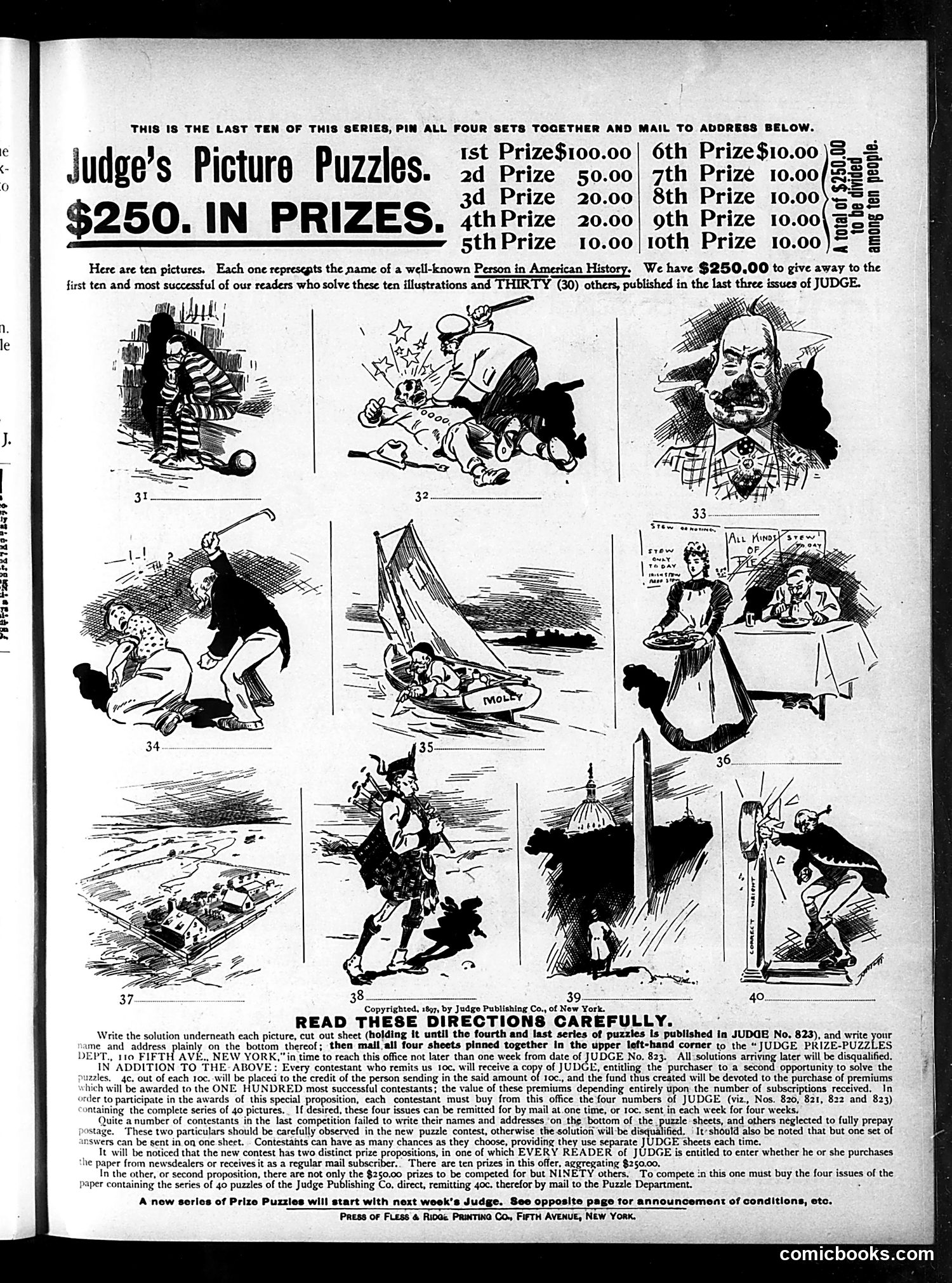
This page is primarily **advertising/contest material**, not political satire. It announces Judge's "Picture Puzzles" contest offering $250 in prizes. The ten numbered illustrations (31-40) are rebus puzzles where each sketch represents the name of a "well-known Person in American History." Readers must identify the figures and mail solutions to compete for cash prizes ranging from $100 (first place) to $10 (sixth-tenth places). The puzzles appear to use visual puns and caricature—for example, illustration 35 shows a boat labeled "MOLL," suggesting a wordplay on a historical name. However, **without clearer resolution or contemporary context, specific identifications of most figures remain unclear**. The extensive fine print details contest rules: contestants must collect all four puzzle series from Judge issues 820-823, pin sheets together, and mail entries within one week. Notably, submitting 10¢ grants additional entry opportunities and chances to win "premiums" funded by subscriber contributions. This reflects late-Victorian magazine marketing: puzzles drove subscriptions and reader engagement.
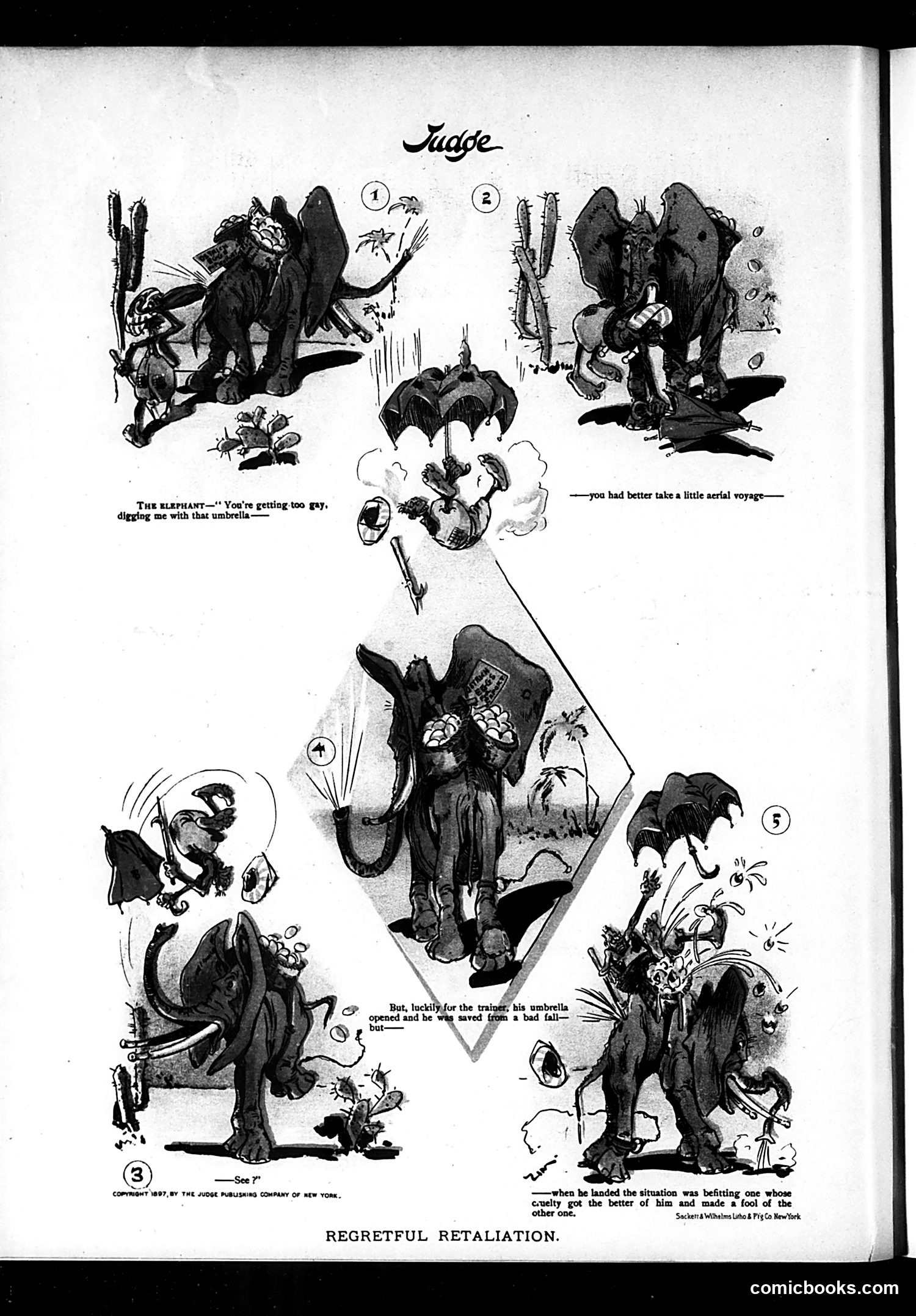
This political cartoon uses anthropomorphized animals to satirize a conflict. The central figure appears to be a **donkey** (traditionally representing the Democratic Party) being threatened or attacked by an **elephant** (representing Republicans). The title "Regretful Retaliation" suggests the donkey is retaliating reluctantly or apologetically. The elephant warns about using an umbrella as a weapon, while various panels show the donkey being harassed, suggesting political aggression or bullying. The cartoon satirizes what appears to be a **political dispute** where the weaker party (Democrats) is forced into defensive retaliation against stronger opposition, but does so regretfully—implying moral reluctance or acknowledgment that the response is justified but unwanted. Without the publication date visible, the specific political context remains unclear, though the imagery suggests conflict between Democratic and Republican factions during the late 19th or early 20th century.