
A complete issue · 16 pages · 1897
Judge — July 10, 1897
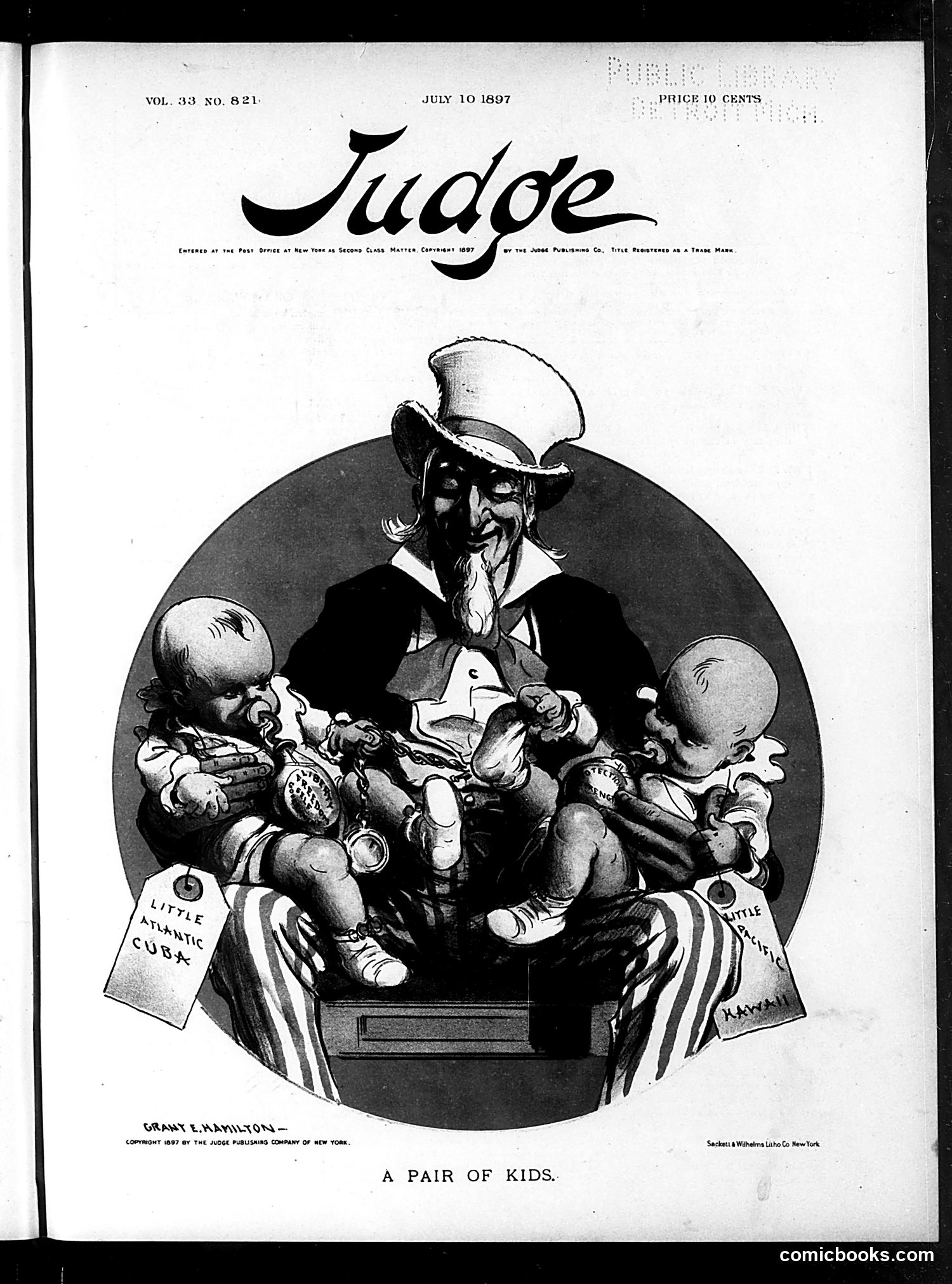
This 1897 *Judge* cartoon by Grant E. Hamilton satirizes U.S. imperial ambitions regarding Cuba. The devil-like figure represents American expansionism or imperialist greed, depicted as a malevolent force "rocking the cradle" of two infant figures labeled "Little Atlantic Cuba" and "Little Pacific" (likely referring to U.S. territories or spheres of influence). The satire criticizes how America is treating these regions as playthings or possessions to manipulate, rather than as independent entities. The diabolic imagery suggests the moral corruption inherent in imperial conquest. Published during the Spanish-American War period, when Cuba's fate was hotly debated, the cartoon warns against American intervention presented as benevolent guardianship.
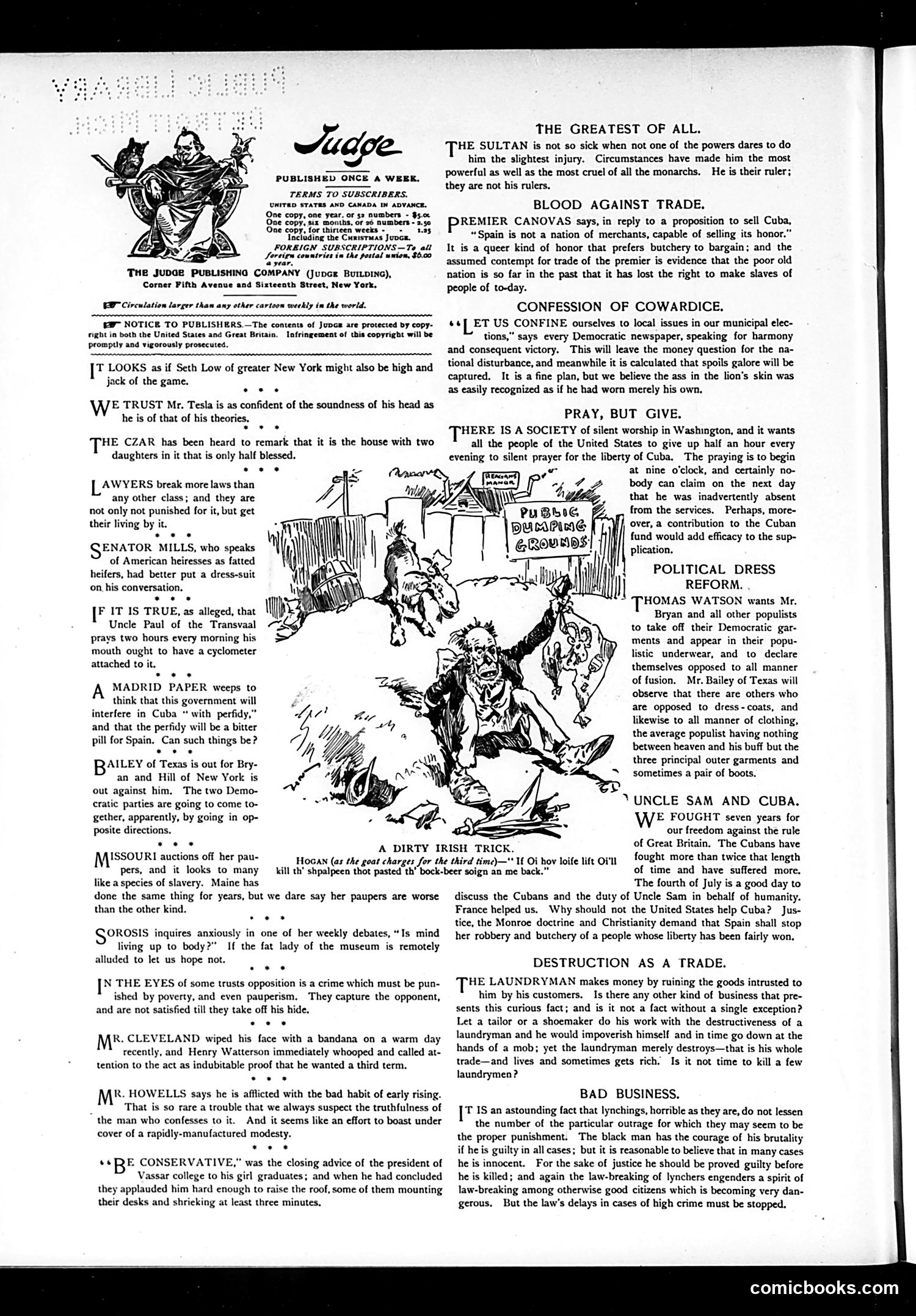
The central cartoon, titled "A Dirty Irish Trick," depicts a chaotic street scene with caricatured Irish figures engaged in violence and disorder. The caption quotes an Irish character using dialect: "O! boy loife lift Oil! kill th' sheepeen that pasted th' book-beer sign as we back." This appears to reference anti-Irish stereotypes common in late 19th/early 20th-century American satire, portraying Irish immigrants as drunk, violent, and lawless. The "dirty trick" likely refers to some specific incident involving Irish-American political or social conduct that Judge's editors considered scandalous or hypocritical. The surrounding editorial snippets discuss Cuba, American politics, and social reform—suggesting this issue addressed contemporary debates about immigration, municipal governance, and American identity during a period of significant Irish-American political influence.
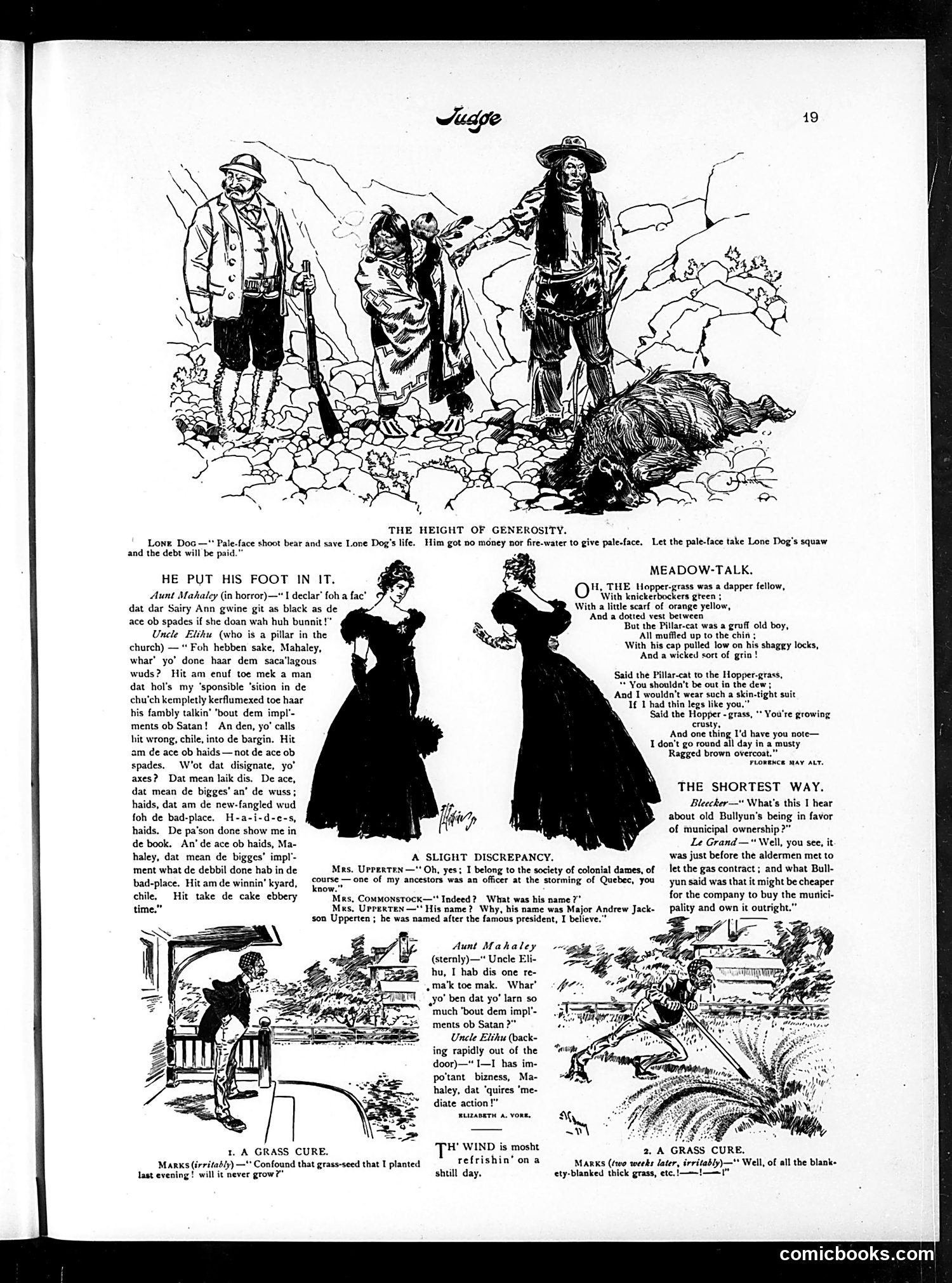
This page contains several unrelated satirical items typical of Judge magazine's format: **"The Height of Generosity"** depicts a confrontation between what appears to be a prospector and a Native American, playing on period stereotypes about frontier dealings and broken promises. **"He Put His Foot In It"** features dialect humor involving "Aunt Mahaley" and "Foh" (likely "Flo"), using exaggerated rural/working-class speech patterns for comedic effect. **"A Slight Discrepancy"** appears to mock confusion over names in colonial society contexts. The remaining items—"Meadow-Talk," "The Shortest Way," and "A Grass Cure"—are brief humorous sketches with anthropomorphized animals and rural characters. The page relies heavily on period-specific dialect humor, class-based comedy, and stereotyping common to early 20th-century American satire, which would require substantial historical context for modern readers to fully appreciate.
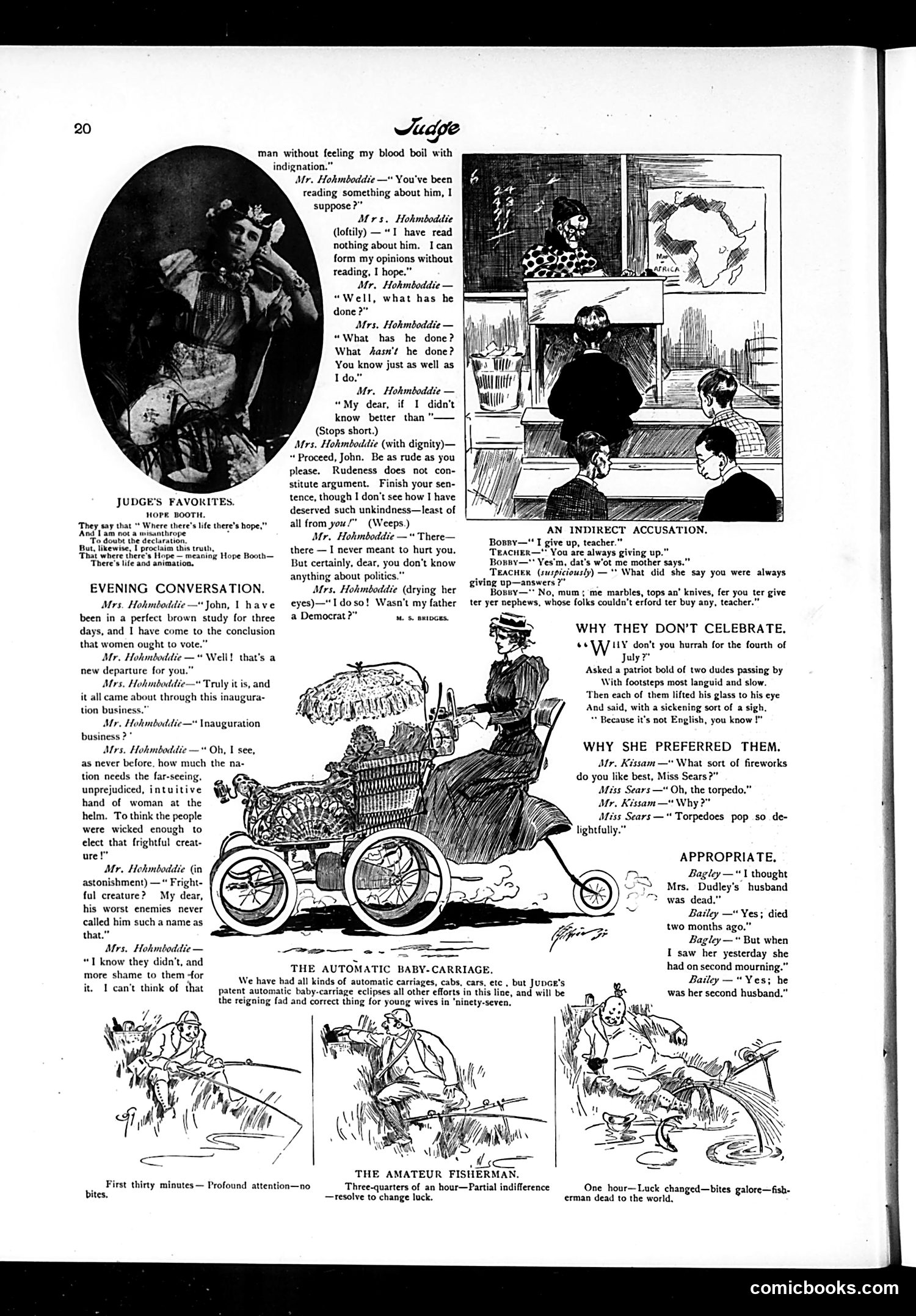
This page contains several brief satirical sketches typical of 1890s American humor: **"Evening Conversation"** mocks women's suffrage advocates. Mrs. Hohmboddie demands voting rights after witnessing an presidential inauguration, yet admits she hasn't read about the new officeholder and forms opinions "without reading." Her husband points out she knows nothing of politics; she defensively cites her Democratic father. The satire targets women voters as uninformed and emotionally reactive rather than intellectually engaged—a common anti-suffrage argument of the era. **"Why They Don't Celebrate"** ridicules young American dandies ("dudes") who refuse to celebrate Independence Day because it's "not English," suggesting they've adopted affected British pretensions. The remaining brief jokes address babies, fireworks preferences, and remarriage—standard period humor with no particular political significance. The **"Automatic Baby-Carriage"** section appears to be an advertisement or humorous product notice rather than political commentary.
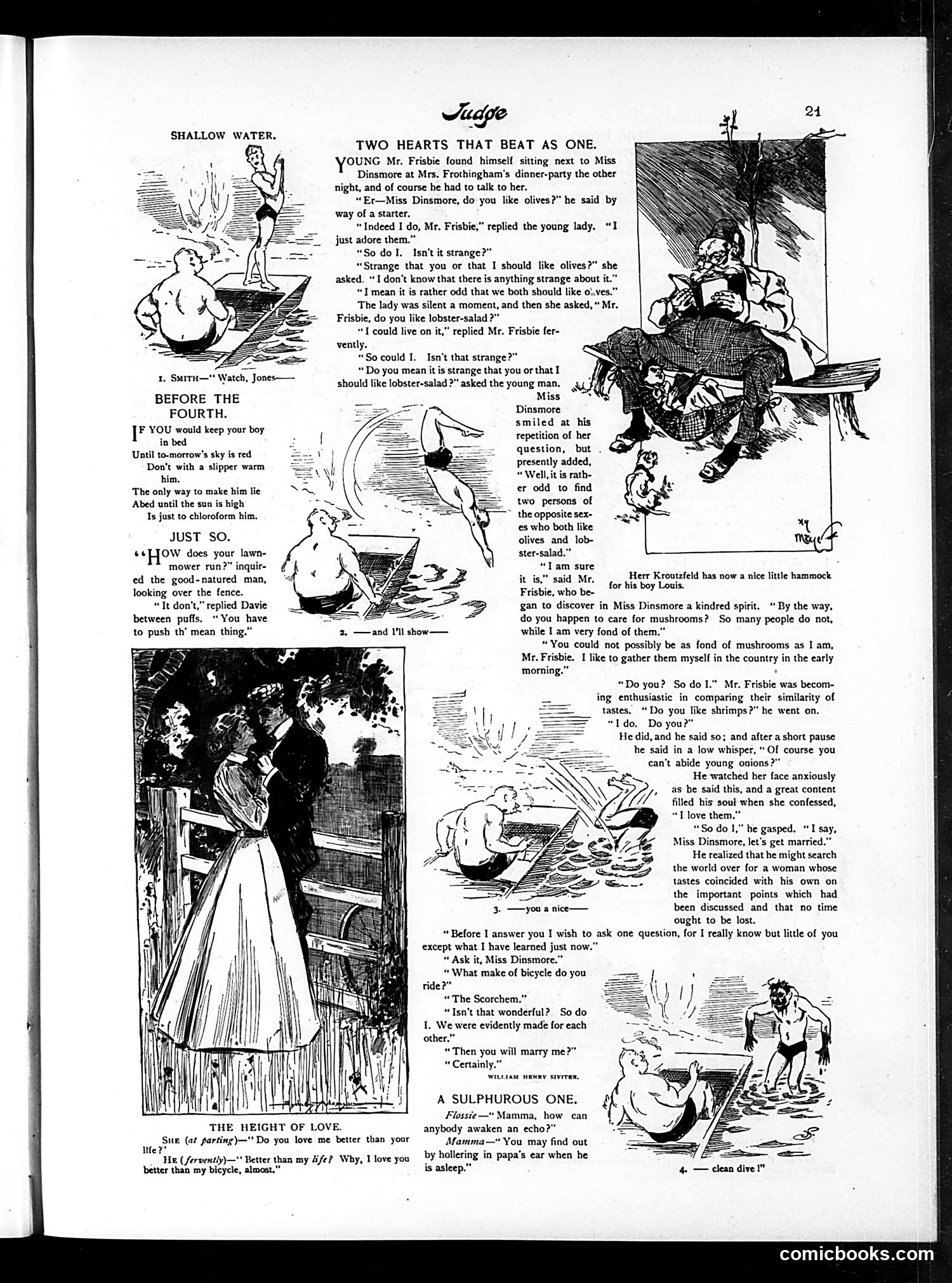
This page satirizes the superficiality of courtship and romantic compatibility among the upper-middle class. The central story depicts Young Mr. Frisbie and Miss Dinsmore discovering they share identical food preferences (olives, lobster-salad, mushrooms, shrimps, onions) and bicycle brand (the "Scorchem"), leading him to propose marriage based solely on these coincidences. The joke mocks the era's dating conventions: that finding common tastes signals deep compatibility and justifies immediate matrimonial commitment. The couple's mechanical discovery process—systematically comparing preferences—reduces romance to consumerist matching. The punchline about the bicycle brand suggests how trivial these "shared values" actually are. The accompanying humor pieces ("The Height of Love," "A Sulphurous One") reinforce the theme: relationships reduced to absurd comparisons and material concerns rather than genuine emotional connection. This reflects Judge magazine's regular satirization of Gilded Age courtship rituals and social pretension.
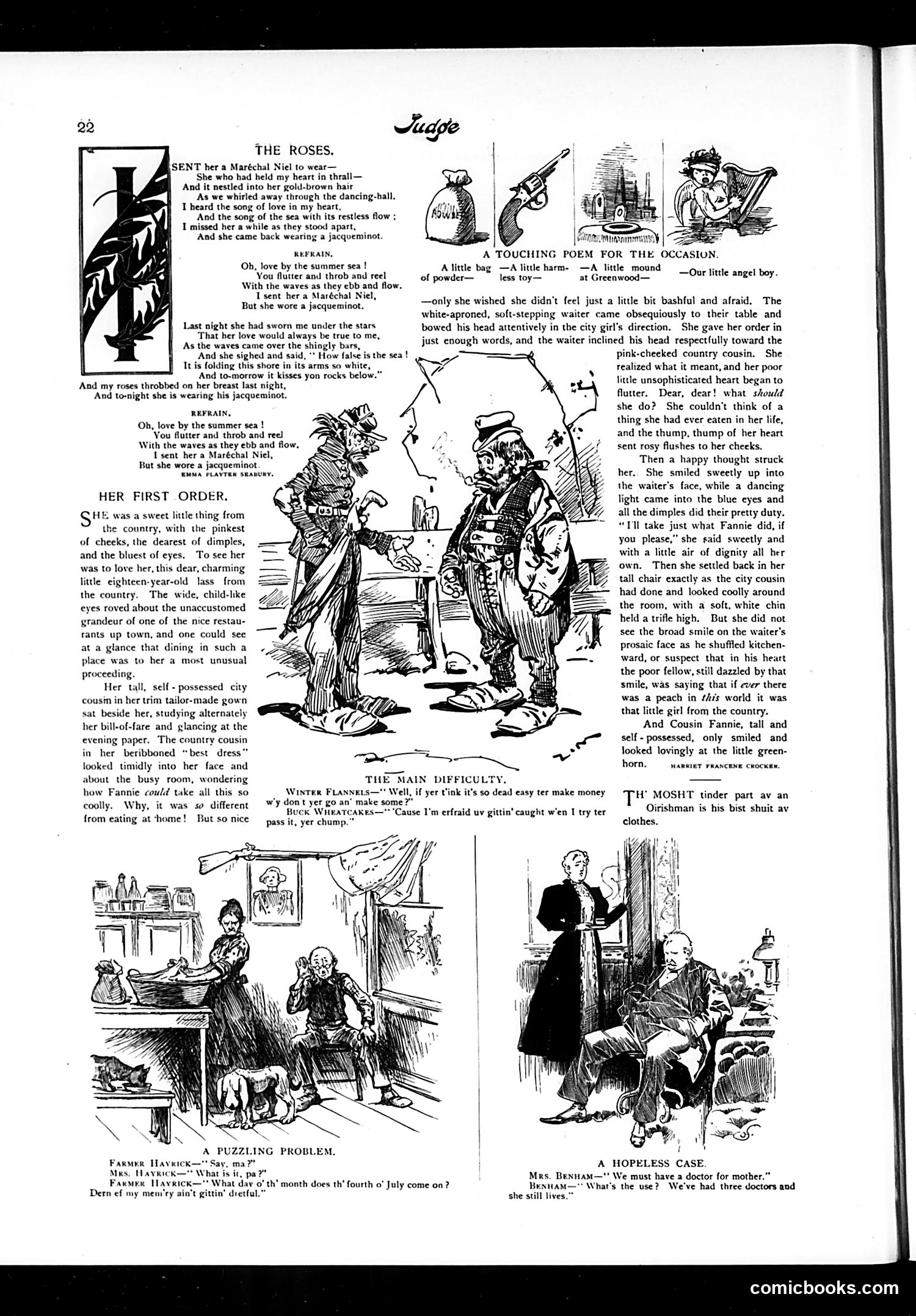
This page contains three unrelated satirical pieces typical of late 19th-century Judge magazine: 1. **"The Roses"** (poem): A romantic lament about a suitor who gives his beloved different roses, only to have her wear another man's variety instead. The repeated substitution of "jacqueminot" for "Maréchal Niel" mirrors romantic fickleness—likely satirizing superficial love or women's inconstancy, a common theme in period humor. 2. **"Her First Order"** (story): A country girl dining at a fancy restaurant, intimidated by the menu, ultimately orders by copying her city cousin. This gentle satire mocks rural unsophistication versus urban sophistication—a staple Judge topic reflecting period class anxieties. 3. **Three brief captioned comics**: "Puzzling Problem," "Main Difficulty," and "Hopeless Case" depict working-class confusion (farmers struggling with calendar math, concerns about money-making and getting caught, mothers needing doctors)—all gentle mockery of the poor or uneducated. The overall tone is light, sentimental humor rather than sharp political satire.
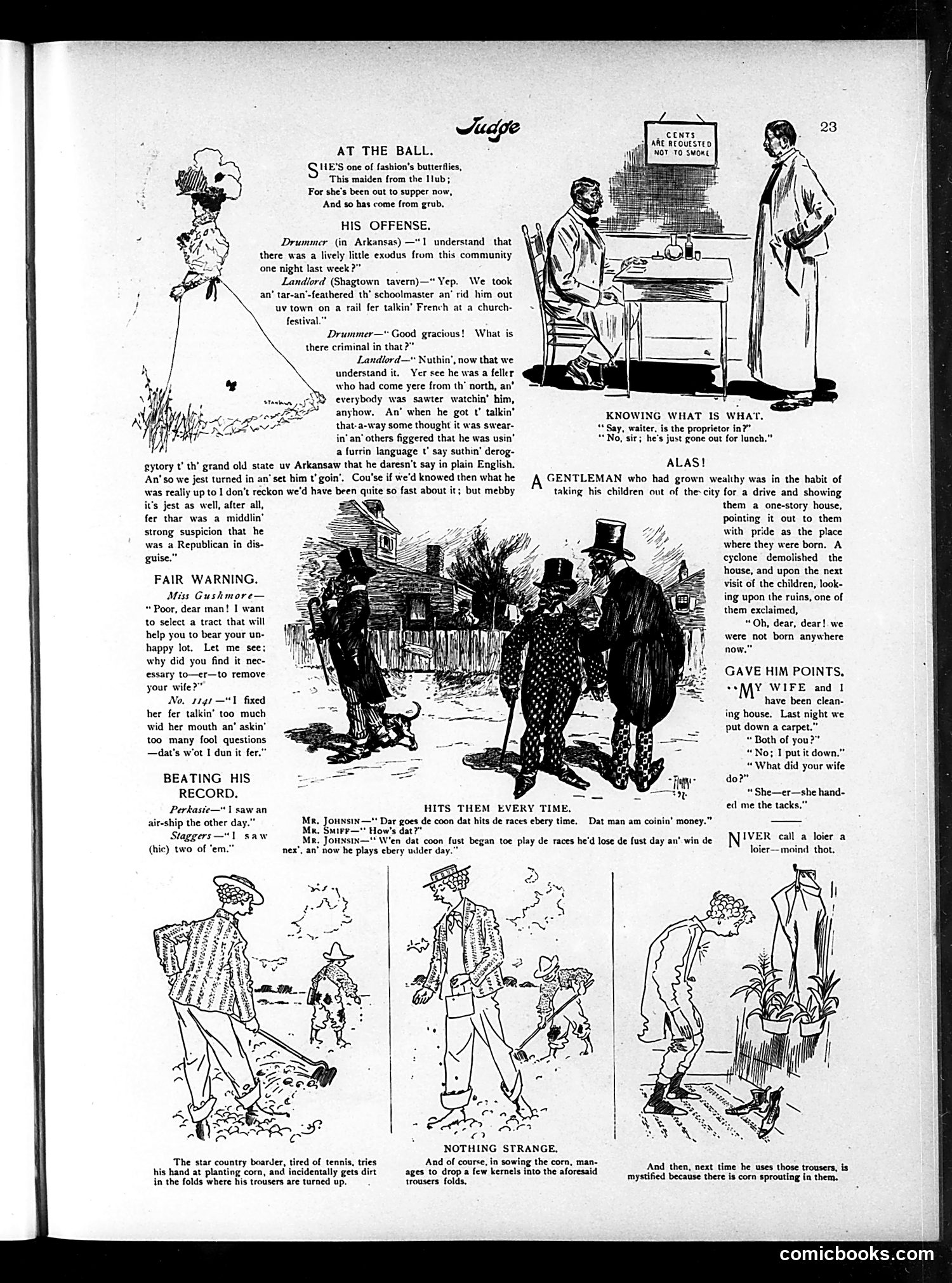
This page contains multiple humorous anecdotes satirizing rural American attitudes and social pretensions: **"His Offense"** mocks Southern provincialism: An Arkansas community tar-and-feathers a Northern schoolteacher for speaking French at a church festival, suspecting it was either swearing or Republican sedition. The joke ridicules backwoods intolerance and linguistic ignorance. **"Fair Warning"** satirizes domestic violence, presenting a man who brutalized his wife for "talking too much" as matter-of-fact and deserving sympathy—dark humor exposing casual misogyny. **"Alas!"** jokes about a wealthy man's prideful habit of showing his children his humble birthplace; a cyclone destroys it, leaving the children unable to verify the story. **"Hits Them Every Time"** uses racial dialect humor (common in period Judge) about a Black man consistently winning at horse racing. The bottom comics mock incompetence: a country visitor accidentally plants corn kernels in his trouser folds while farming, resulting in sprouting grain. Throughout, Judge targets rural ignorance, pretension, and absurdity for urban middle-class amusement.
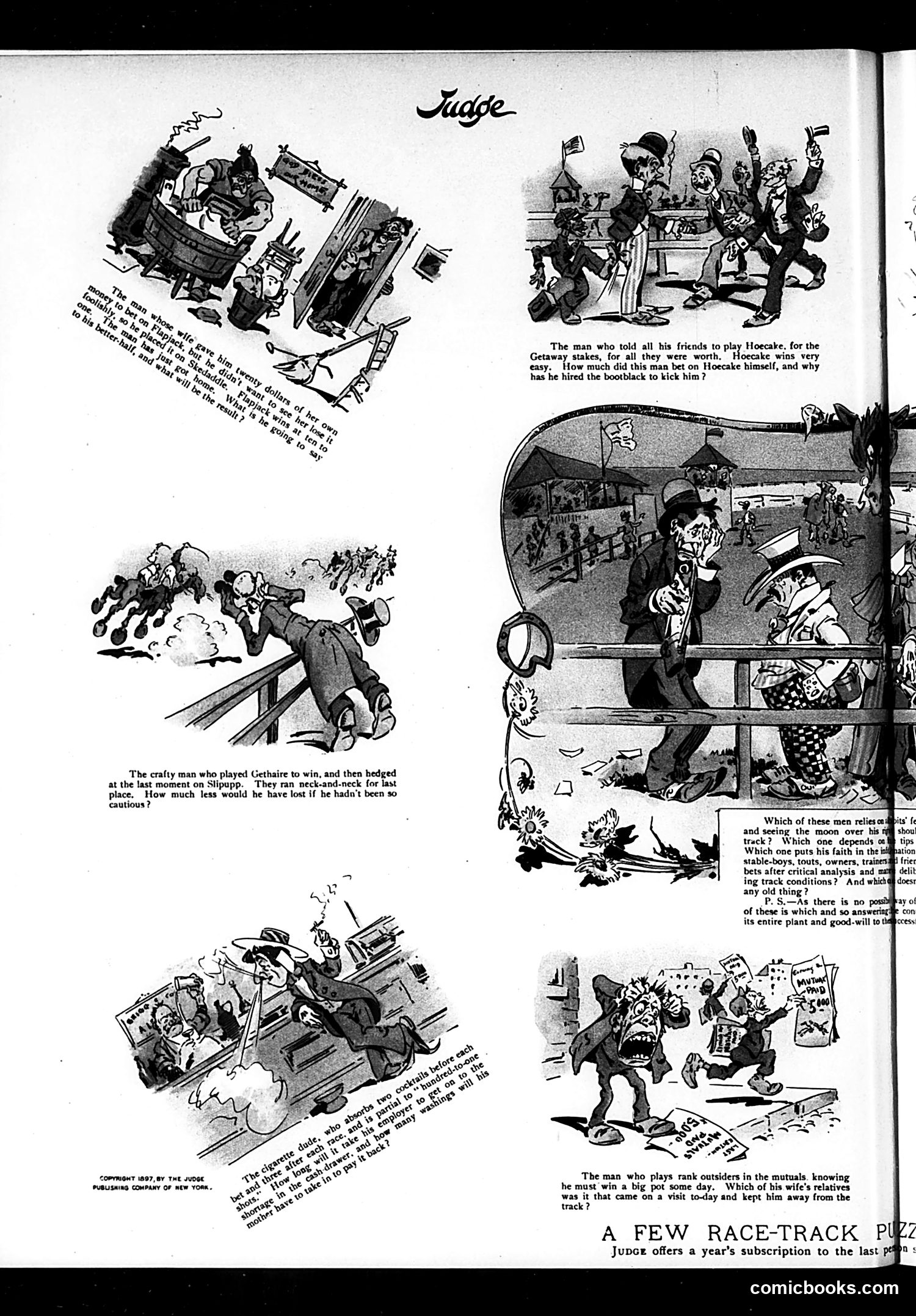
This page from *Judge* presents satirical "puzzles" mocking various types of horse-racing bettors and their flawed reasoning. The cartoons ridicule common gambling behaviors: a man who confidently tips others on "Hoecake" but won't bet on it himself (hypocrisy); someone who hedges bets at the last moment, losing more through overcaution; and a bettor relying on superstition (the moon) rather than analysis of track conditions. The final puzzle jokes about men betting on "rank outsiders" while their wives' relatives keep them from the track—implying wives are obstacles to gambling addiction. Each vignette exposes a different rationalization or self-deception gamblers use. The page presents these as puzzles readers should solve, inviting them to recognize the illogical thinking. It's lighthearted social commentary on the absurdity of racing culture and betting behavior among American men of the era.
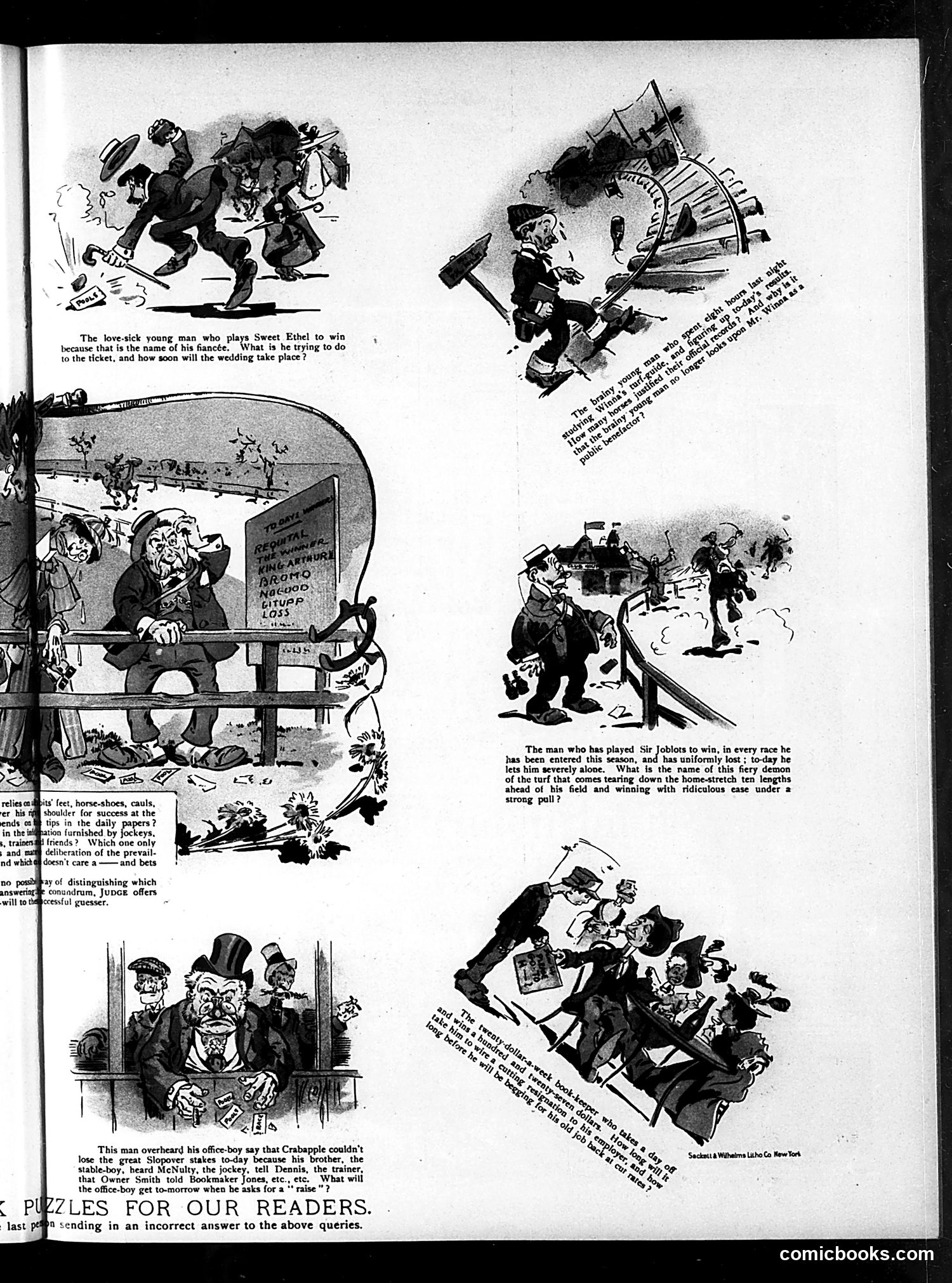
This is a "Puzzles for Our Readers" page featuring horse-racing themed riddles, popular gambling humor of the era. The cartoons mock the obsessive betting culture around horse racing, a major public pastime in early 20th-century America. The riddles satirize different betting archetypes: a lovesick man betting on his fiancée's namesake horse; a chronic loser who abandons his "lucky" horse, only to watch it win dramatically; and an office boy who believes he's obtained insider information about a fixed race through office gossip. The humor targets how ordinary people became convinced they possessed secret knowledge about race outcomes, leading to poor financial decisions. The final riddle's punchline—suggesting the office boy will be fired for asking for a raise based on his supposed insider tips—underscores the futility and danger of betting based on hearsay rather than actual earnings.
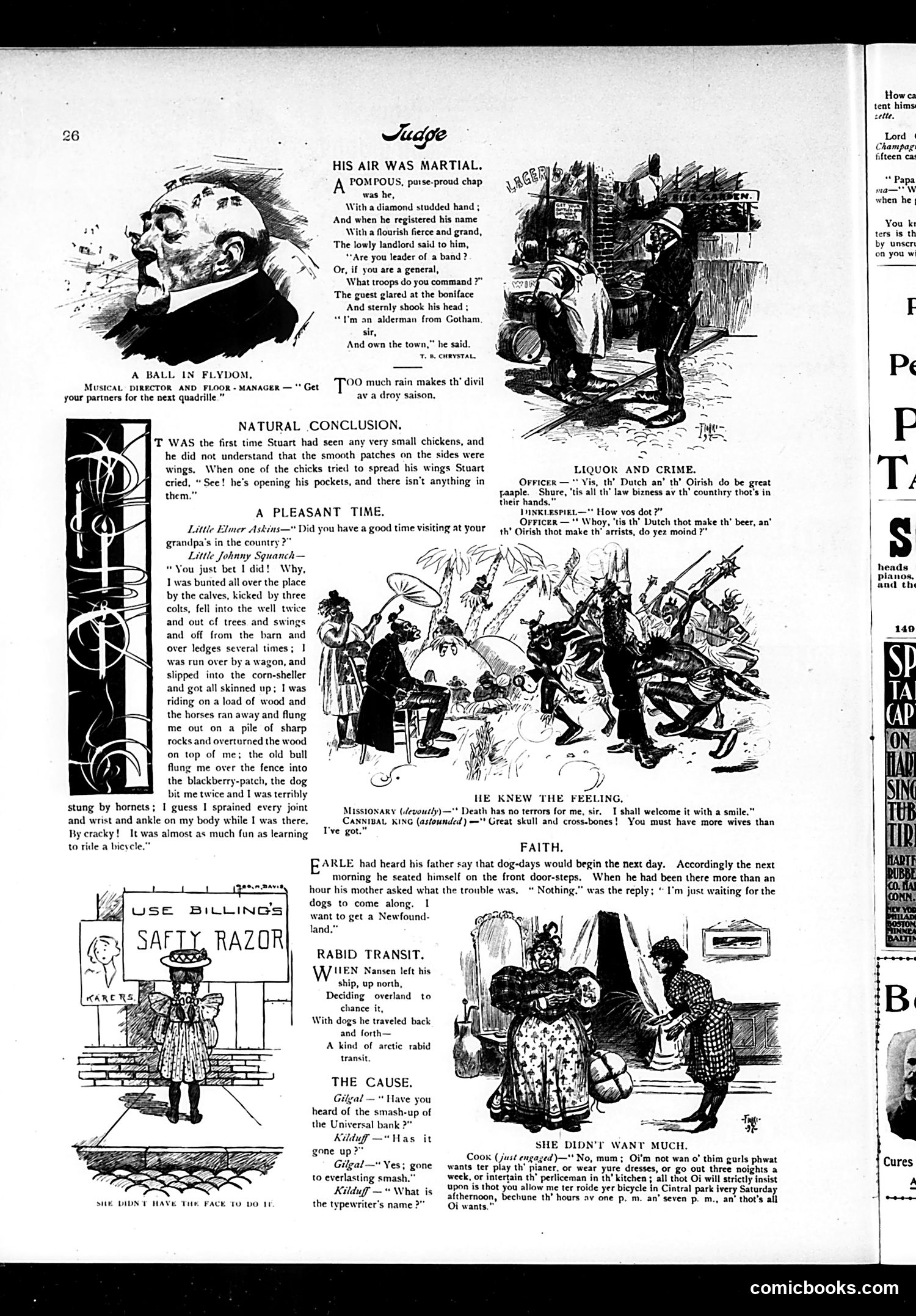
This page from Judge contains multiple short satirical cartoons and jokes typical of late 19th/early 20th-century American humor: **"His Air Was Martial"** mocks pompous small-town politicians. An overbearing alderman from Gotham registers at an inn with exaggerated formality, claiming to "own the town," prompting the innkeeper's sarcastic questions about whether he's a general or band leader. **"Liquor and Crime"** presents ethnic stereotyping common to the era, with Irish and Dutch characters discussing how the Dutch make beer while the Irish create arrests—a crude joke about immigration and crime. **Other sketches** include a child misidentifying chicken wings as "pockets," a boy injured visiting his grandfather's farm, and a newly engaged woman making minimal domestic demands (only wanting bicycle rides in Central Park). The page exemplifies Judge's reliance on ethnic caricature, slapstick humor, and social commentary through exaggeration. Modern readers should note the casual prejudice embedded in what was mainstream entertainment at the time.
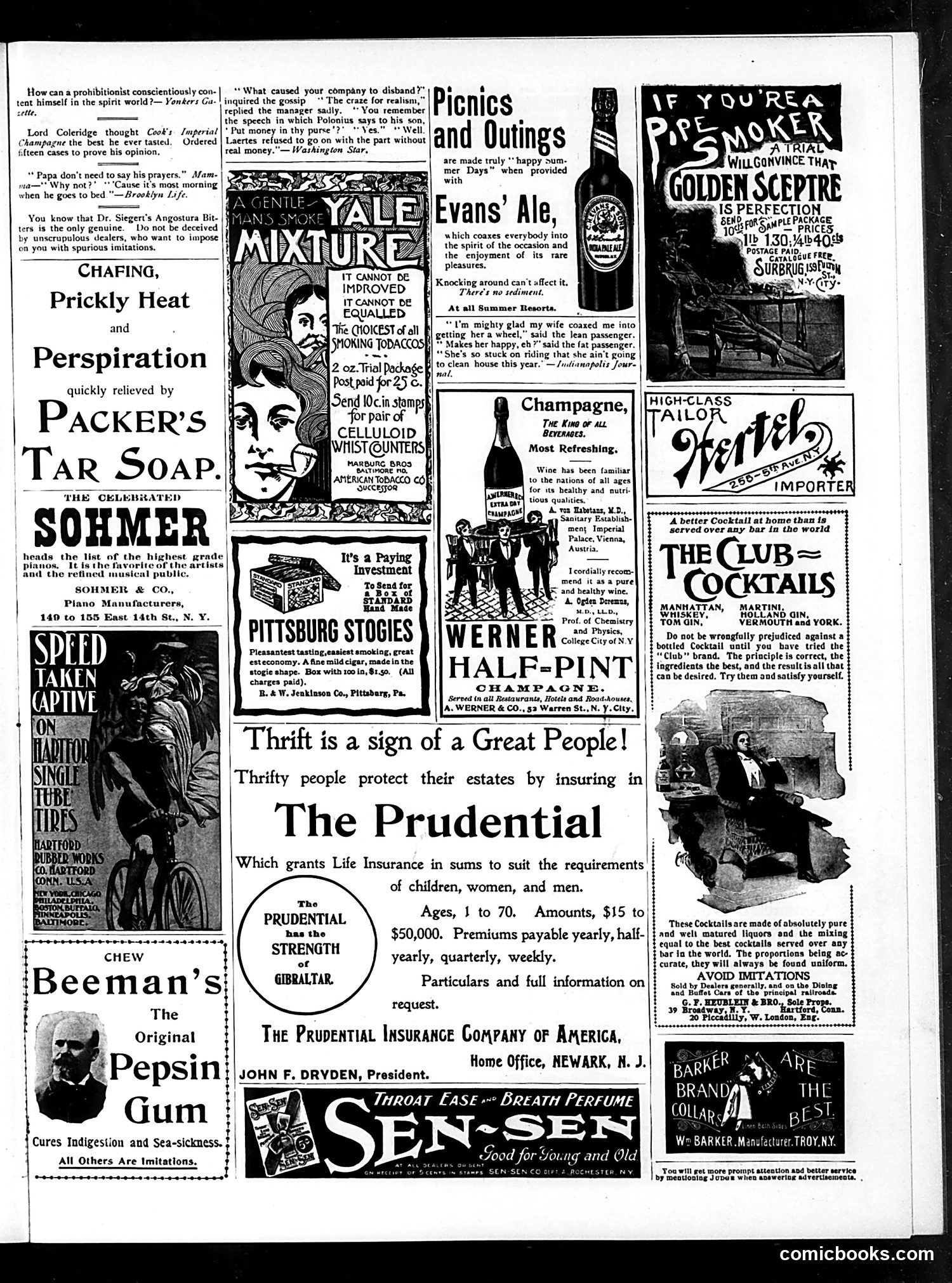
This page is primarily **advertising**, with brief comedic items scattered throughout rather than sustained political cartoons. The content reflects early 20th-century commercial culture and humor. **Key Elements:** The advertisements promote consumer goods (soap, tobacco, champagne, insurance) and remedies typical of the era. Notable is the **Prudential Insurance ad**, which frames life insurance as patriotic ("Thrift is a sign of a Great People"). The **short jokes** are domestic humor rather than political satire—quips about prohibitionists, theatrical actors demanding real money onstage, wives on bicycles neglecting housework, and husbands buying their spouses wheels. These reflect contemporary anxieties about changing social roles. The **tone** is lighthearted and consumerist, not satirical. There are no identifiable political figures or significant social commentary. The page mostly demonstrates how Judge monetized space through advertising while filling gaps with brief, genteel humor designed to appeal to middle-class readers.
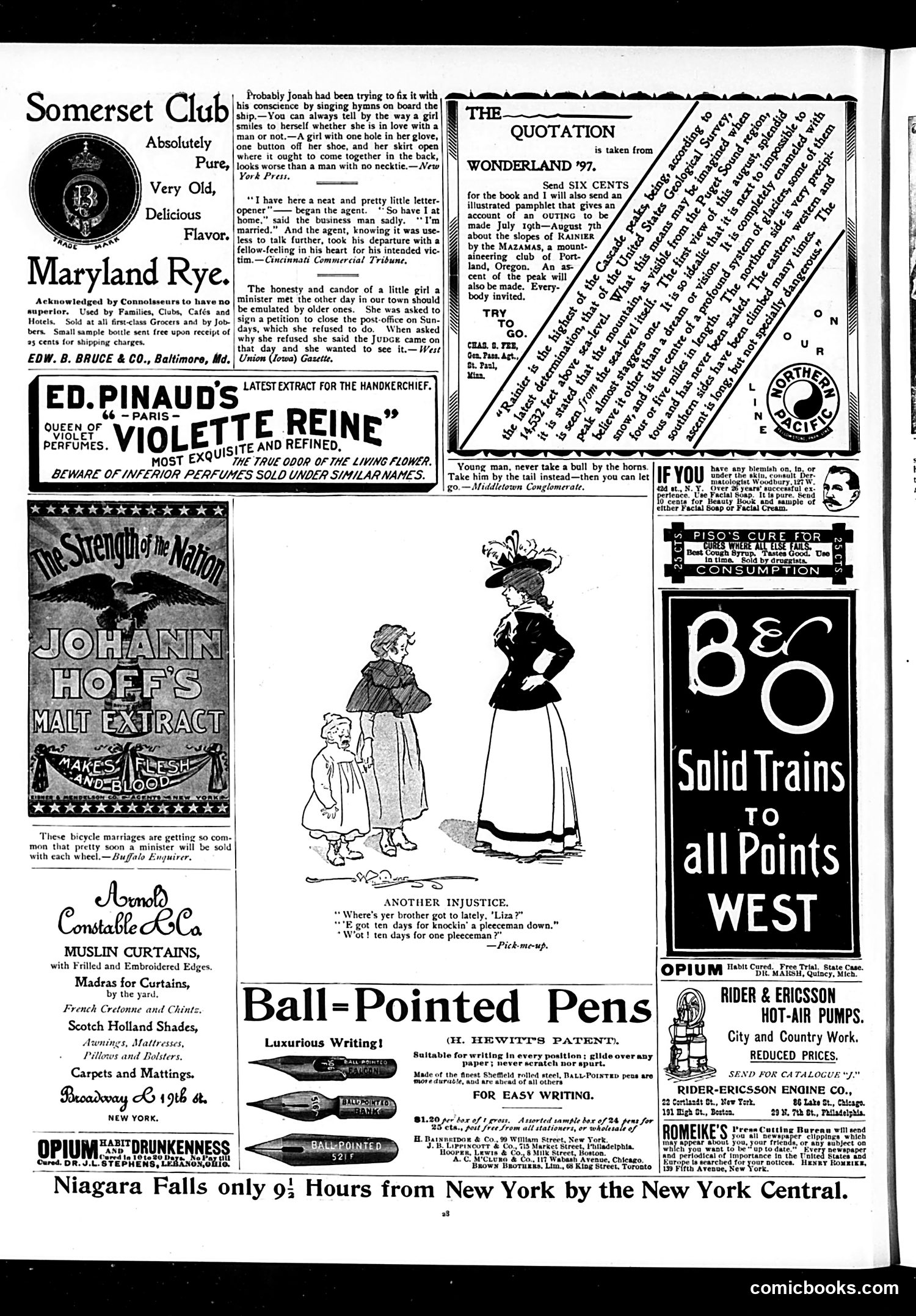
The cartoon depicts a dialogue about judicial inequality during the late 19th century. A character named "Liza" asks where her brother has gone, learning he received "ten days for knockin' a pleeceman down" (hitting a policeman). She protests this seems unjust—the policeman only received "ten days for one pleeceman," implying the brother deserves similar or lesser punishment for striking one officer. The satire critiques the unequal justice system: assaulting a police officer received harsher punishment than what the victim suffered. The dialect and working-class characters suggest this mocked how poor or immigrant communities experienced discriminatory law enforcement. The joke exposes the absurdity of valuing a policeman's injury more heavily than the ordinary citizen's offense warranted.
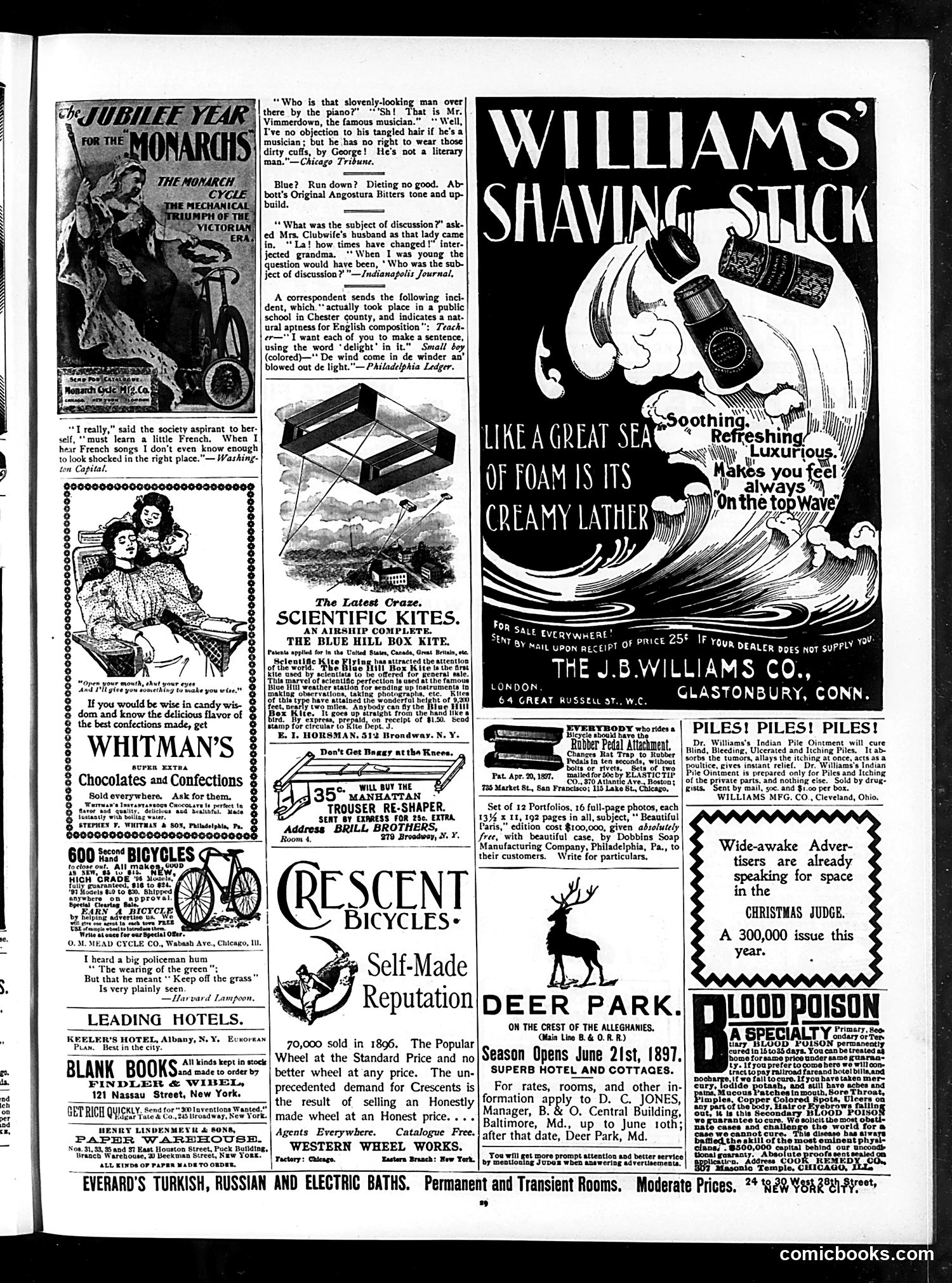
This page from Judge magazine (circa 1897, based on visible dates) is primarily **advertising with scattered humorous anecdotes**, not political cartoons. The main humor pieces are brief, genteel jokes about social etiquette and class pretension: - A society woman doesn't recognize a famous musician because his appearance is slovenly - A grandmother laments how young women no longer know which social figures to gossip about - A schoolchild (marked as "colored") misunderstands "delight," saying the wind blew out "de light" from the window These jokes reflect **late-Victorian anxieties about social propriety, education, and changing gender roles**. The humor depends on recognizing social transgressions—musicians shouldn't look shabby, refined ladies should know social hierarchies, and children should master standard English. The bulk of the page advertises period products (shaving sticks, bicycles, kites, chocolates, piles ointment), typical of Judge's revenue model. There are no identifiable political figures or satirical commentary on current events visible here.
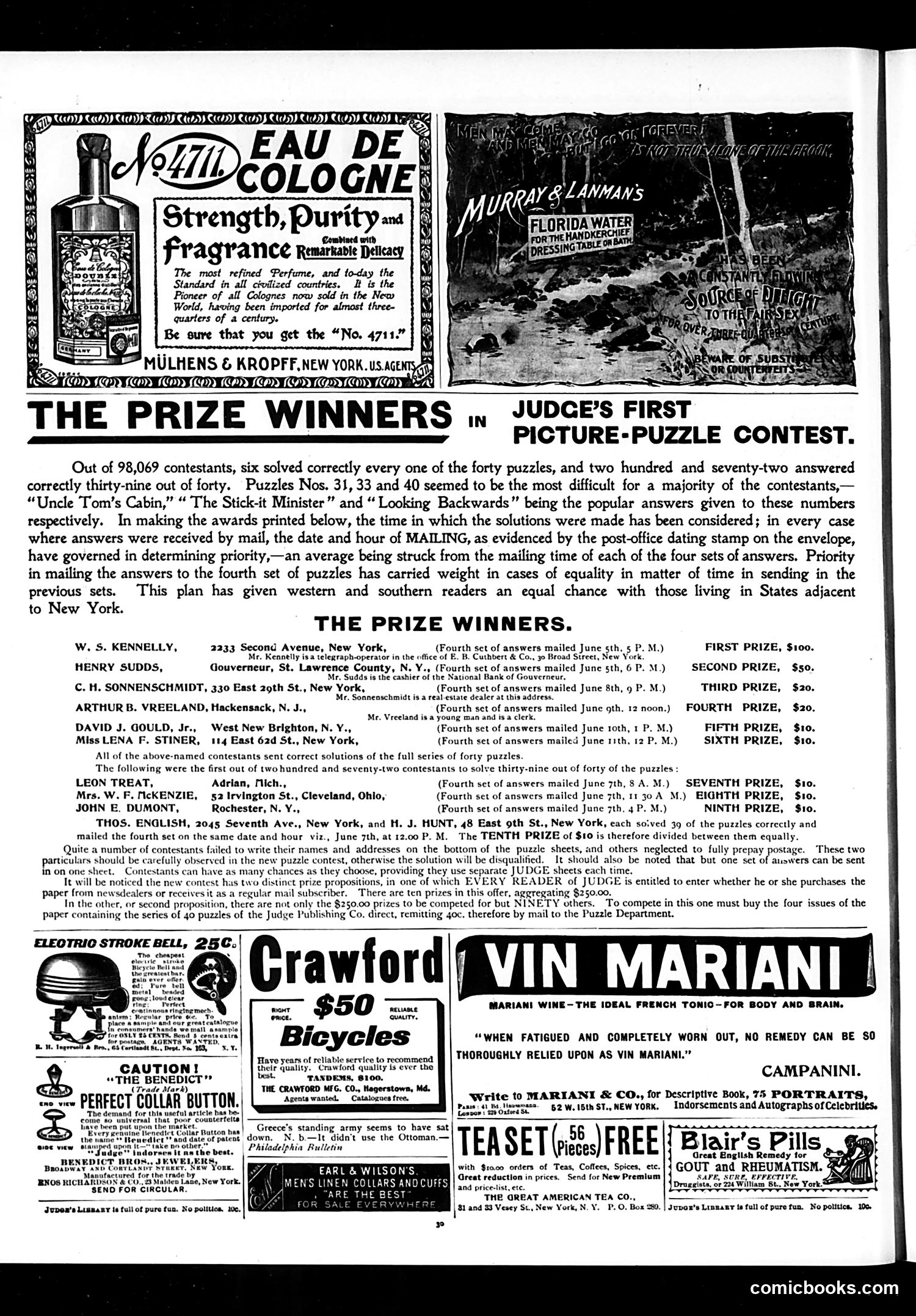
This page documents the results of Judge's first picture-puzzle contest, a popular early-20th-century newspaper game. The top half announces winners of a forty-puzzle competition that attracted 98,069 contestants. Six solved all puzzles correctly; winners received prizes ranging from $100 to $10. The text notes that puzzles 31, 33, and 40 ("Uncle Tom's Cabin," "The Stick-it Minister," and "Looking Backwards") proved most difficult. The contest's selection method—based on mailing times recorded by post office stamps—aimed to give western and southern contestants equal footing with New Yorkers, addressing geographical disadvantages in mail delivery. The bottom half features vintage advertisements typical of Judge's era: a No. 4711 cologne ad emphasizing purity and refinement, plus endorsements for an Electro Stroke Bell, Crawford bicycles, Vin Mariani tonic, and other patent medicines and consumer goods. These ads reflect Gilded Age commercial culture and product marketing strategies.
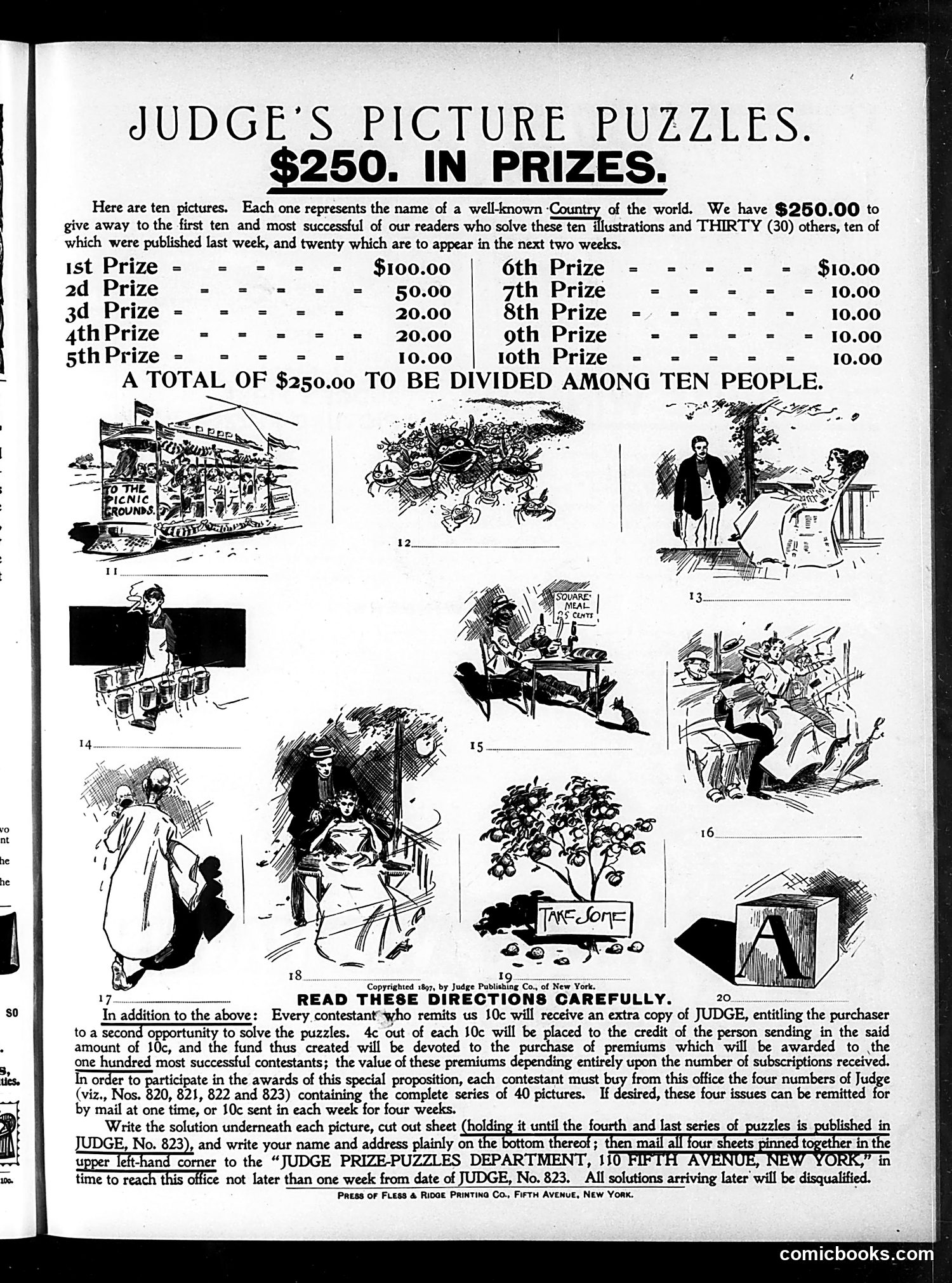
This is a contest page, not political satire. Judge magazine offered $250 in prizes for readers who could identify ten countries based on illustrated visual puns. The ten numbered cartoons (11-20) each represent a nation's name through wordplay or symbolic imagery. The contest required purchasing four consecutive issues of Judge (Nos. 820-823) to see all 40 pictures across the series. Contestants paid 10 cents per issue, with proceeds going toward premiums for top solvers. Solutions had to be mailed within one week of the final issue's publication. This reflects Judge's early-1890s strategy of using interactive contests to boost circulation and reader engagement—a common magazine marketing tactic of the era. The actual country identifications remain unclear from this image alone.
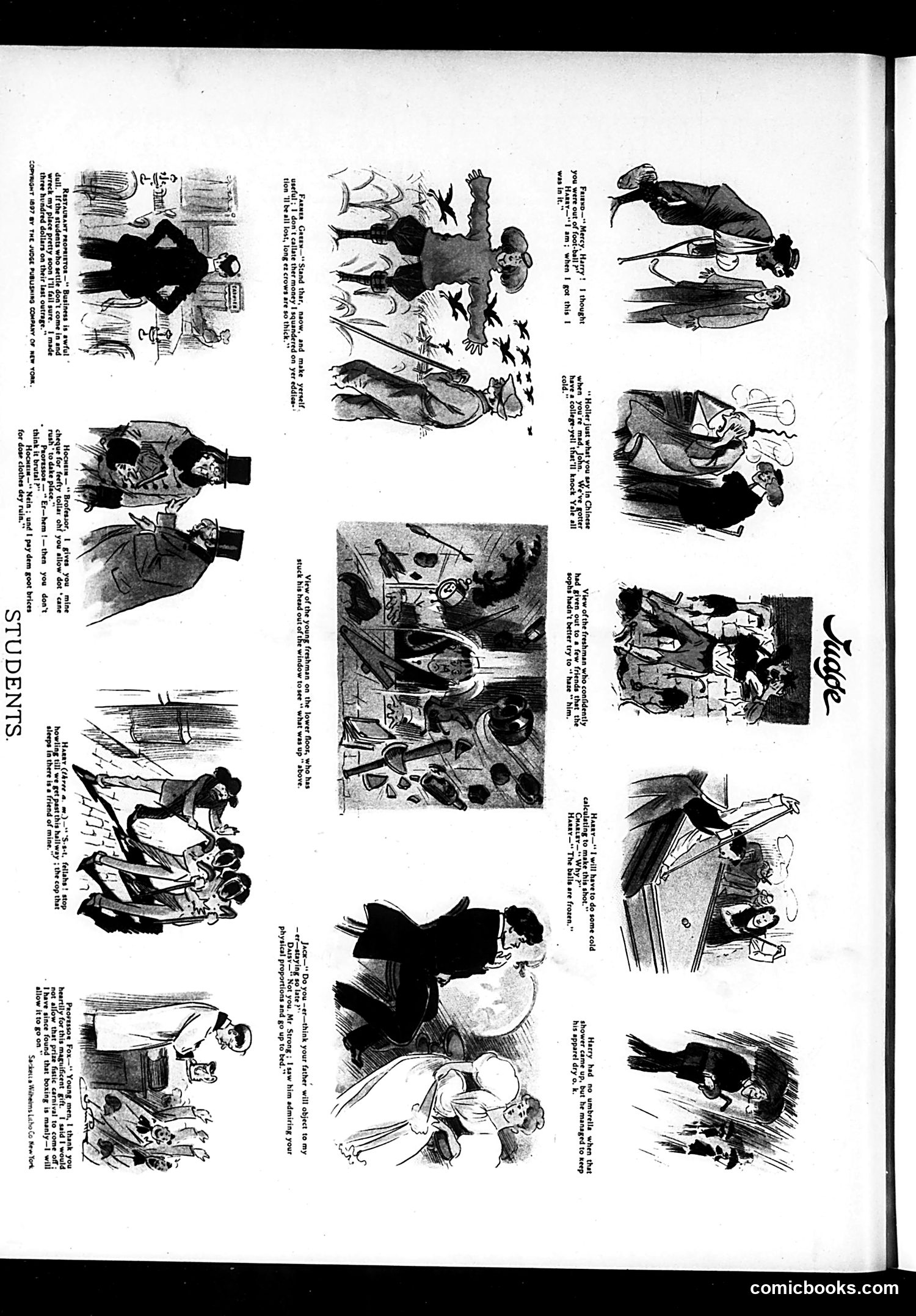
This page satirizes college hazing practices, a significant social issue of the era. The cartoons depict various hazing scenarios involving freshmen (new students) at what appears to be Yale University, referenced in the dialogue. The humor targets both the hazers' brutality and the freshmen's varied responses—from bravado about creating impressive "college yells" to fearful observations from windows. One exchange mocks a freshman's concern that his father might object to the hazing, suggesting parents were aware these dangerous rituals occurred. The satire critiques the normalization of student abuse: hazing was socially accepted despite being physically and psychologically harmful. By presenting multiple vignettes of harassment, Judge ridicules the tradition as barbaric while implying it was widespread at prestigious institutions. The overall message: college hazing was cruel, commonplace, and hypocritically tolerated by an establishment that should know better.