
A complete issue · 16 pages · 1897
Judge — May 22, 1897
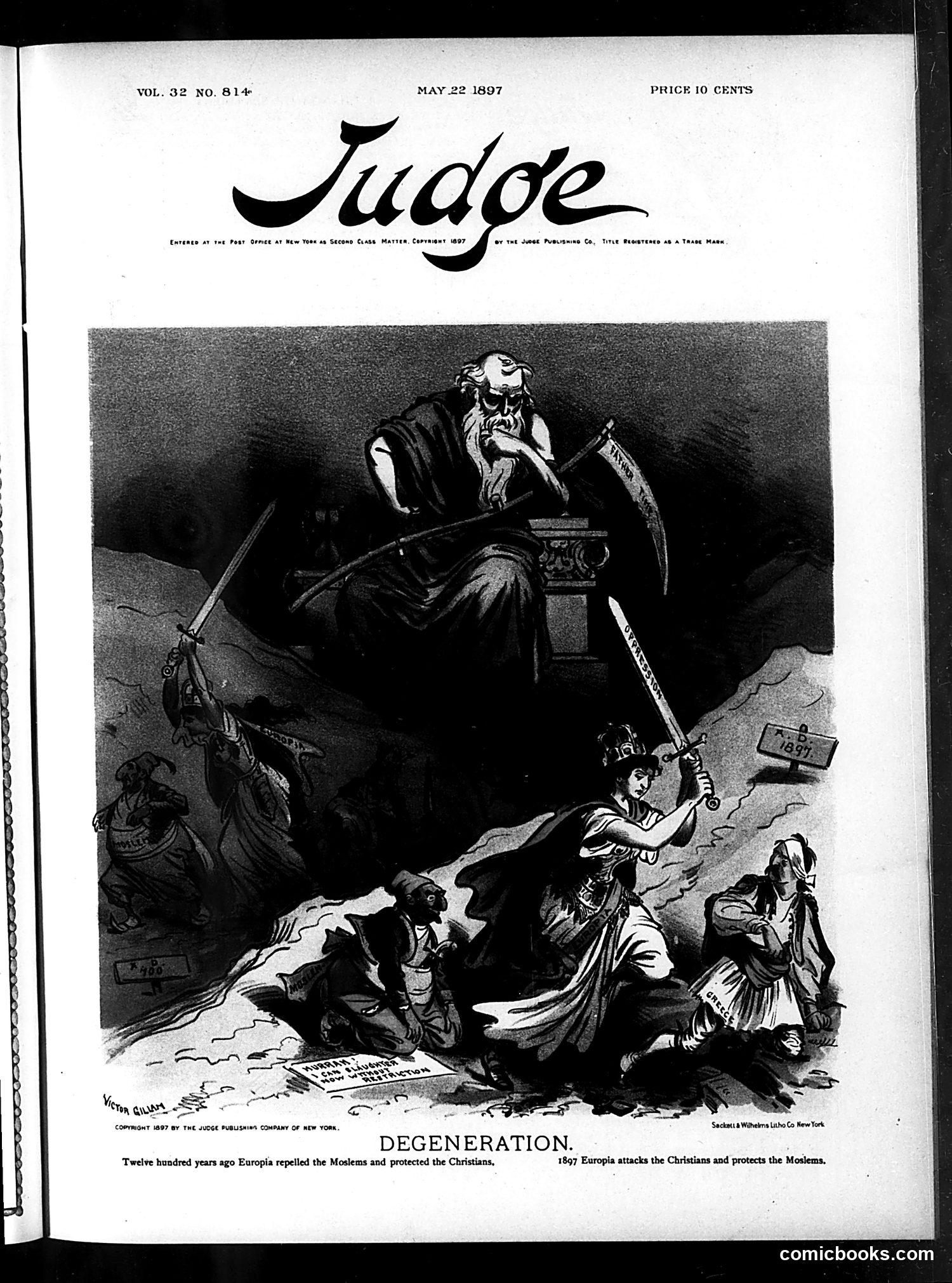
This cartoon illustrates a stark historical reversal. The caption contrasts two moments: - **1200 years ago**: Europe repelled Muslim invasions and "protected Christianity" - **1897**: Europe now "attacks the Christians and protects the Molem" [sic] The towering grim reaper figure represents Death or Fate presiding over this moral decline. Below, figures appear to represent European powers attacking Christian peoples while allying with Ottoman/Muslim forces. This reflects late-19th-century anxieties about European imperial policy in the Ottoman Empire and Near East, particularly regarding Christian minorities. The cartoon satirizes what the artist viewed as Europe's abandonment of Christian solidarity in favor of realpolitik and imperial interests—a supposed "degeneration" from medieval crusading ideals to modern cynical statecraft.
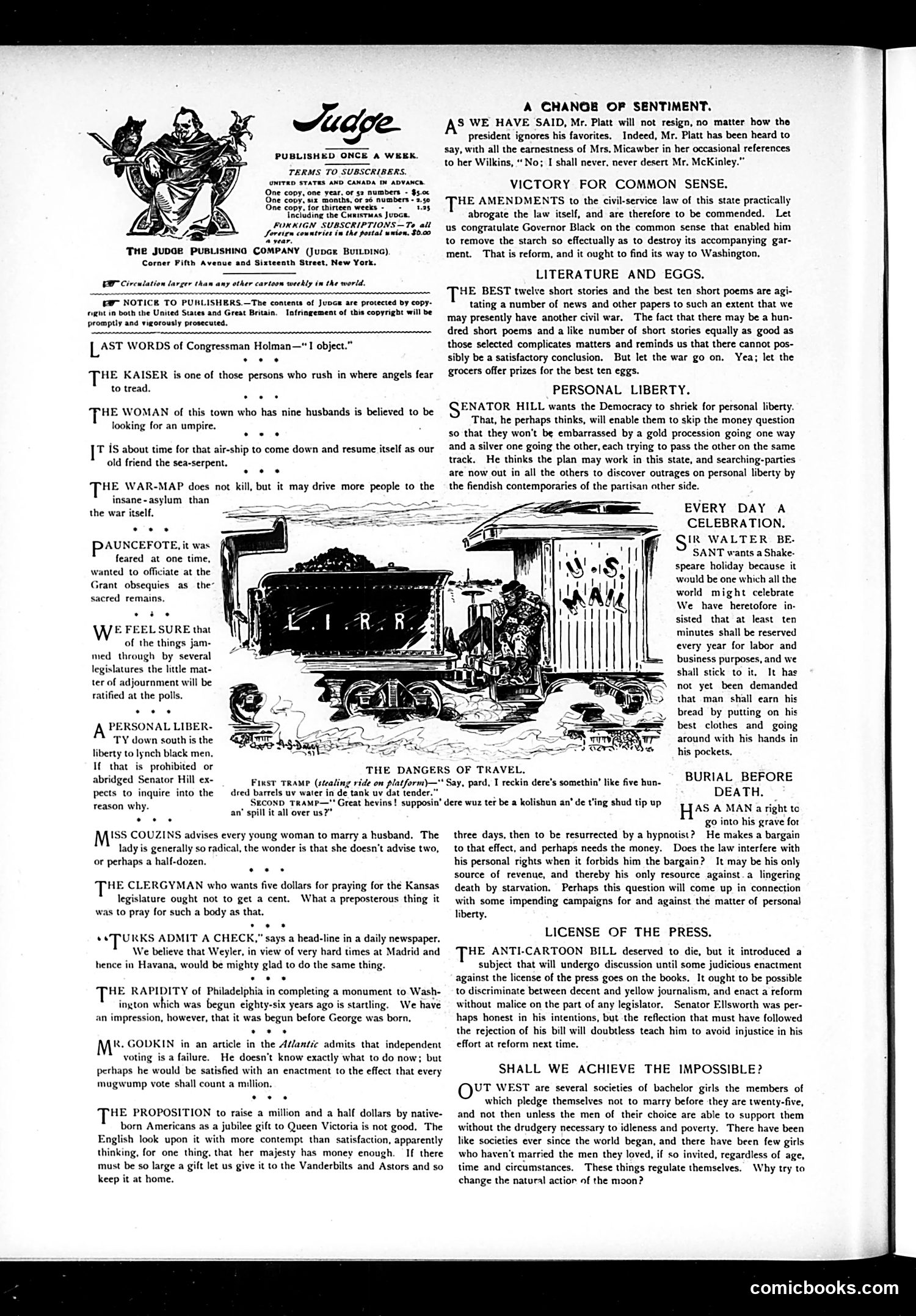
The central cartoon depicts a railroad locomotive labeled "L.I.R.R." (Long Island Rail Road) with a large cargo bin overflowing with what appears to be eggs or round objects. This illustrates the article "THE DANGERS OF TRAVEL," which discusses the risks of transporting fragile goods by rail—specifically comparing a trainload of eggs to other hazardous cargo. The satire critiques the practical perils of railroad transport in this era, when shipping delicate items like eggs by train was genuinely problematic. The overloaded, precarious appearance suggests both the inefficiency and danger of contemporary freight methods. The surrounding text includes various short satirical commentary pieces on political and social topics typical of Judge magazine's editorial content from this period.
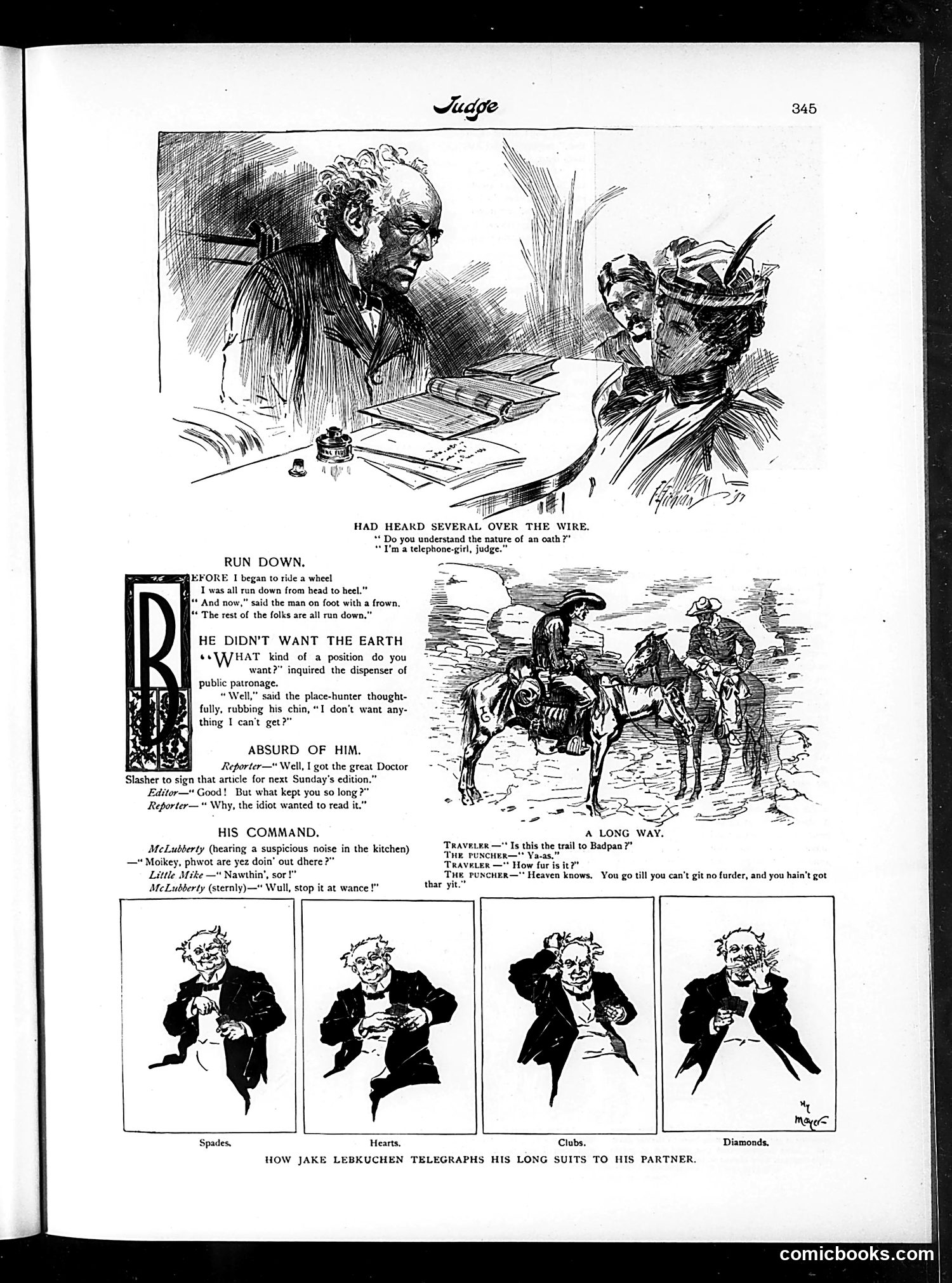
This page contains multiple satirical sketches lampooning late 19th-century American figures and situations: **Top cartoon**: A judge interviews a telephone operator about oath-taking, mocking judicial pretension regarding modern technology and female workers. **"Run Down" section**: Critiques someone's physical exhaustion from overwork—likely commentary on labor conditions. **"The Dumbly Want the Earth"**: A reporter interviews a "Doctor" character (possibly a quack or fraudulent physician) about public patronage, satirizing medical charlatans and gullible patients. **"His Command"**: Depicts "Jake Lebkuchen" sending telegraphed messages via playing-card suits to a business partner—a visual pun on "long suits" (strengths/advantages), mocking commercial pretension or corporate culture. The humor relies on contemporary references to telephone technology, journalism, and business practices that have since become antiquated.
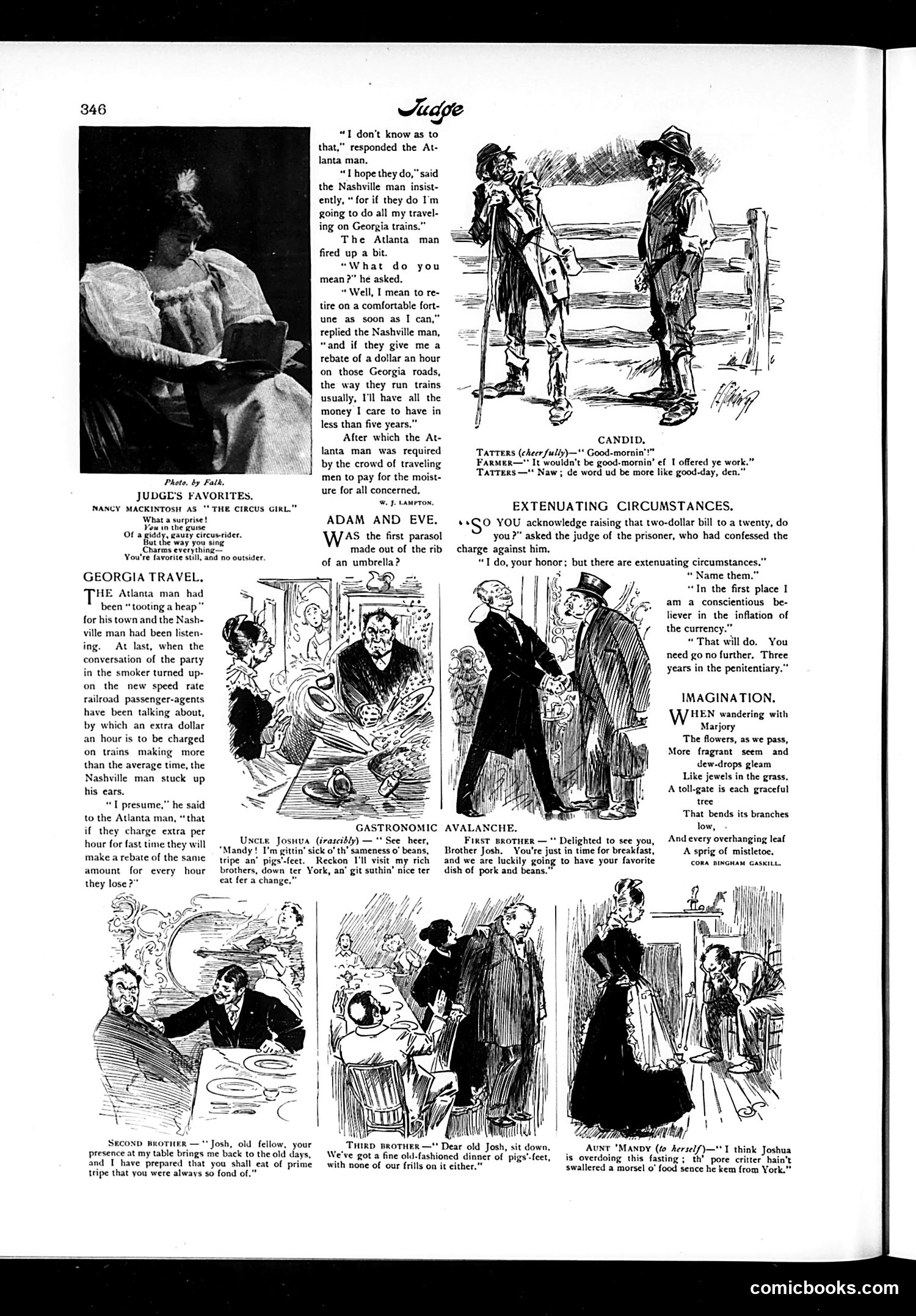
This page contains several disconnected satirical pieces typical of Judge magazine's humor: **"Georgia Travel"** mocks Southern railroad practices. An Atlanta man boasts about Georgia's fast trains, while a Nashville man quips that if railroads charge extra for speed, they should refund money for their typically slow service—implying Georgia trains are notoriously unreliable. The joke targets regional transportation infrastructure and Southern pride. **"Adam and Eve"** is a visual pun questioning whether the first parasol was made from an umbrella's rib, playing on the biblical creation story. **"Extenuating Circumstances"** satirizes both currency inflation debates and lenient judicial reasoning. A counterfeiter claims belief in "inflation of the currency" as his defense, and the judge surprisingly accepts this as legitimate justification—mocking both economic policy arguments and judicial logic. **"Gastronomic Avalanche"** depicts poor relatives visiting a wealthy brother, each refusing his increasingly humble food offerings, while their aunt notes the visitor hasn't eaten anything—gentle satire on class pretension and familial hypocrisy. The remaining pieces are brief jokes and verses, typical filler for the magazine.
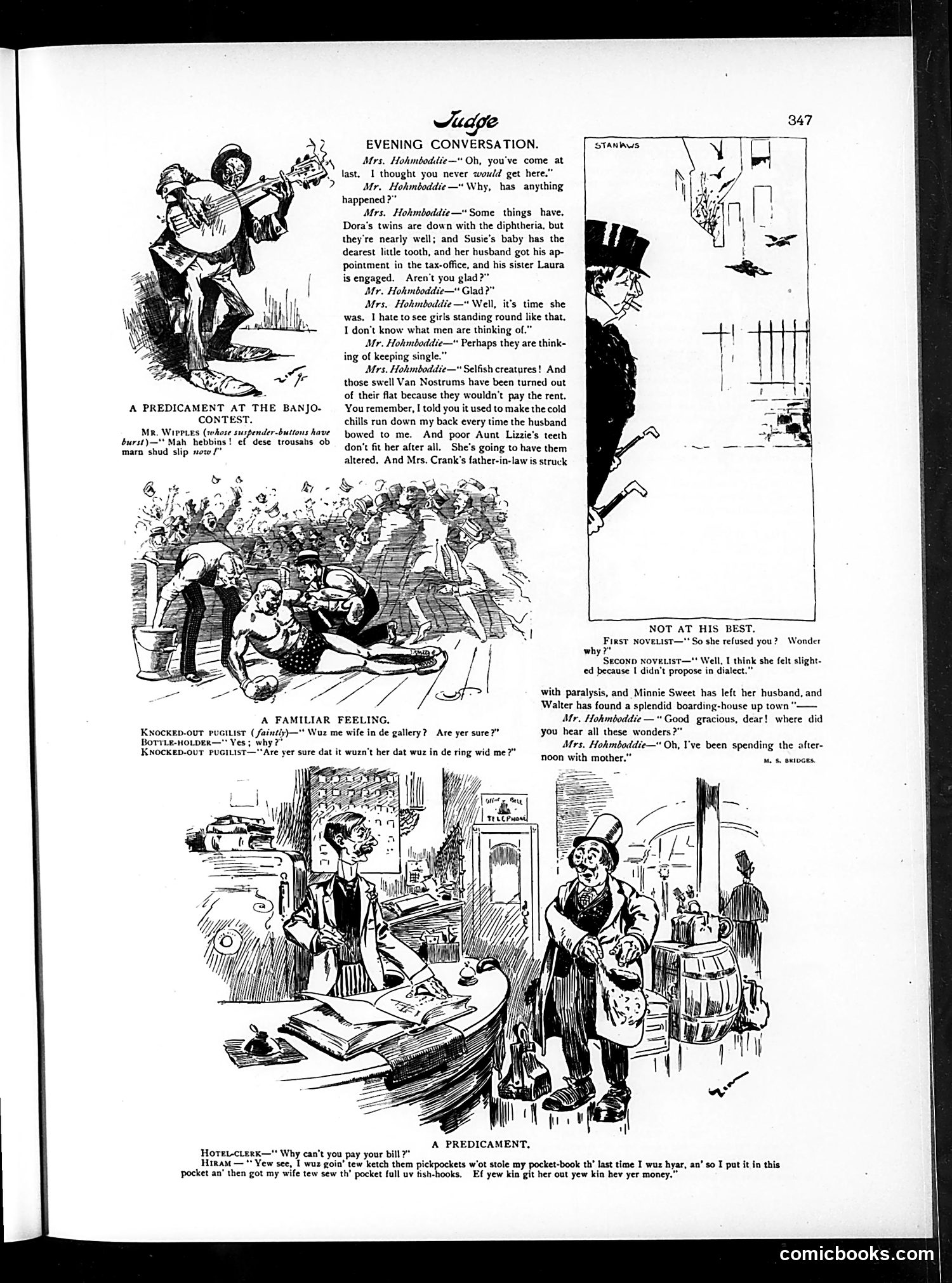
This page contains several satirical comic sketches typical of late-19th-century American humor: **"Evening Conversation"**: Mrs. Hohmboddie breathlessly recounts various domestic news (diphtheria, teeth, engagements, evictions) while her husband listens with apparent indifference. The satire mocks women's perceived obsession with gossip and social matters versus men's supposed detachment. **"Predicament at the Banjo"**: A boxer's wife apparently attended a boxing match, causing confusion about whether she was in the gallery or the ring—a joke about women attending sporting events. **"A Familiar Feeling"**: A knocked-out pugilist confuses whether his wife hit him or fought in the ring, suggesting marital discord through physical comedy. **"Not at His Best"**: Two novelists discuss romantic rejection, with one attributing failure to not proposing "in dialect"—satirizing literary affectations. **"A Predicament"**: A hotel clerk's guest uses fish-hooks sewn into his pocket to trap pickpockets—absurdist humor about catching thieves. The overall tone reflects period attitudes toward gender roles, class, and urban life.
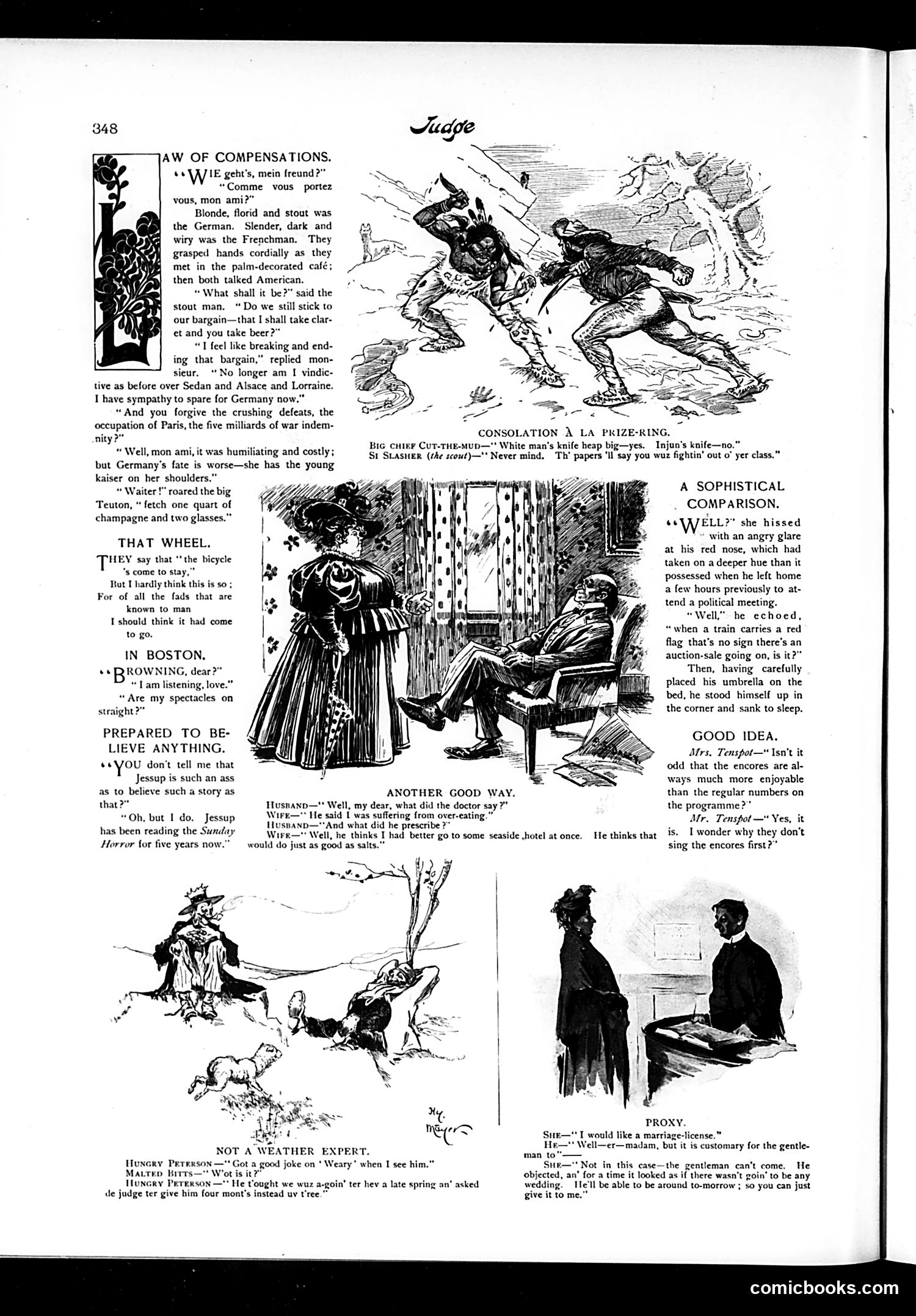
This satirical page contains multiple short humor pieces typical of late 19th-century American comics. The main cartoon, "Law of Compensations," depicts a German and Frenchman meeting cordially despite their nations' recent conflict (likely referencing the Franco-Prussian War of 1870-71, where France lost Alsace-Lorraine and paid heavy war indemnities). The joke's irony: the Frenchman has forgiven Germany's victories, but both agree Germany's real burden is having "the young kaiser on her shoulders"—a dig at German leadership. Other pieces satirize contemporary concerns: bicycle fads, spectacles, newspaper sensationalism ("Sunday Horror"), and domestic life. "Consolation à la Prize-Ring" mocks racial stereotypes in boxing commentary. The remaining sketches target marital discord, concert encores, and legal procedures—everyday absurdities rendered through exaggerated dialogue and situations typical of Judge's humor style. The page reflects how turn-of-century satire mixed political commentary with domestic comedy.
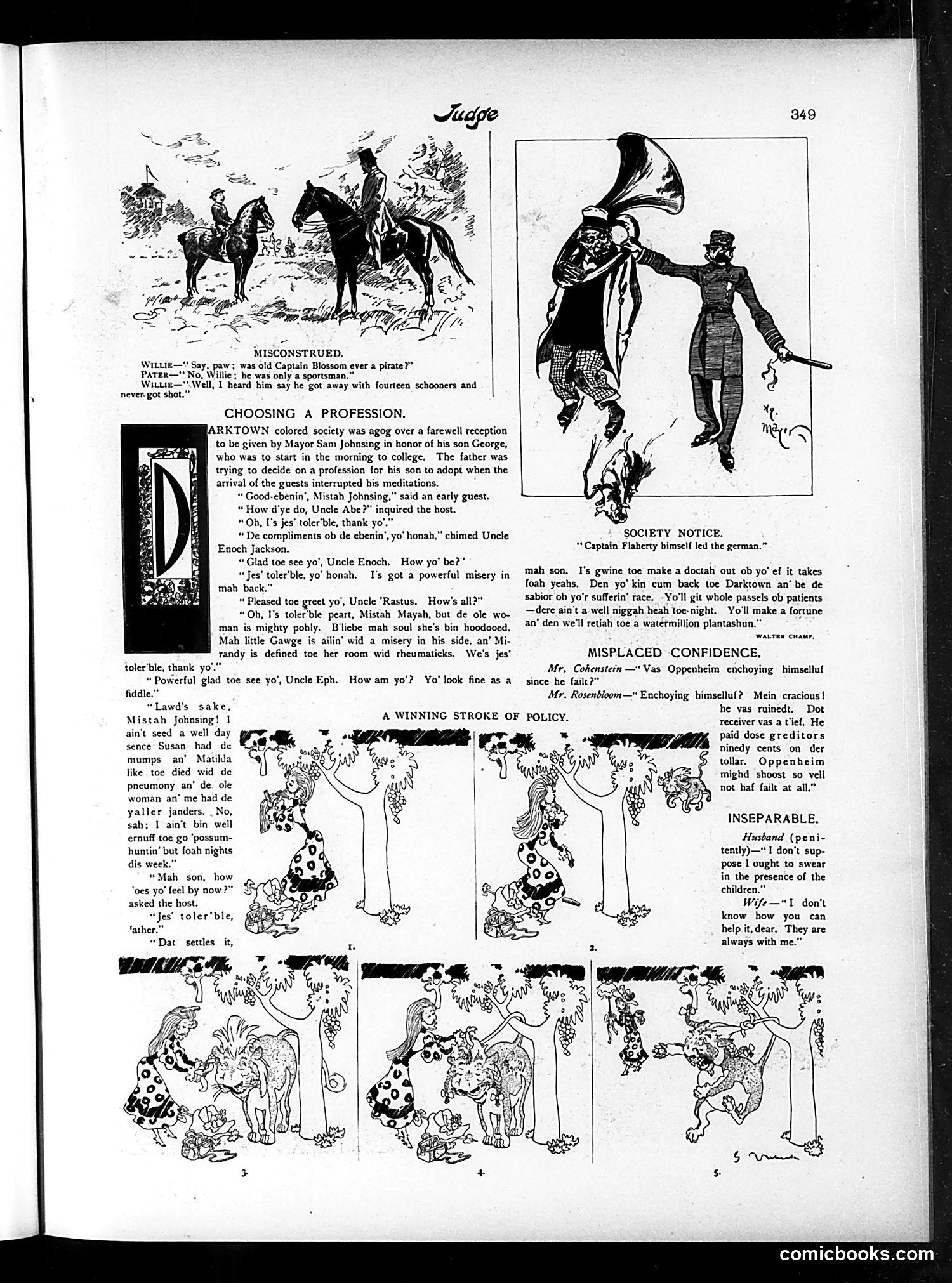
This page contains three distinct satirical pieces: **"Misconstrued"** (top left): A brief joke where a child misunderstands an adult's description of Captain Blossom as "a sportsman," thinking he meant someone who "got away with fourteen schooners"—confusing the nautical/piracy reference with ordinary sportsmanship. **"Choosing a Profession"** (center): A racial stereotype piece depicting an African American mayor deciding his son should become a doctor. The humor relies on dialect humor and the observation that every guest complaints of ailments ("toler'ble" condition), leading the father to conclude there's guaranteed business for a Black doctor in their community. **"A Winning Stroke of Policy"** (bottom): A five-panel comic (unclear plot from OCR text provided). **"Misplaced Confidence," "Inseparable,"** and **"Society Notice"** (right side): Brief satirical anecdotes—one about a failed Jewish businessman, one about marital discord, one about socialite gossip. The page reflects early 20th-century Judge magazine's heavy reliance on ethnic stereotypes and domestic humor as comedic fodder.
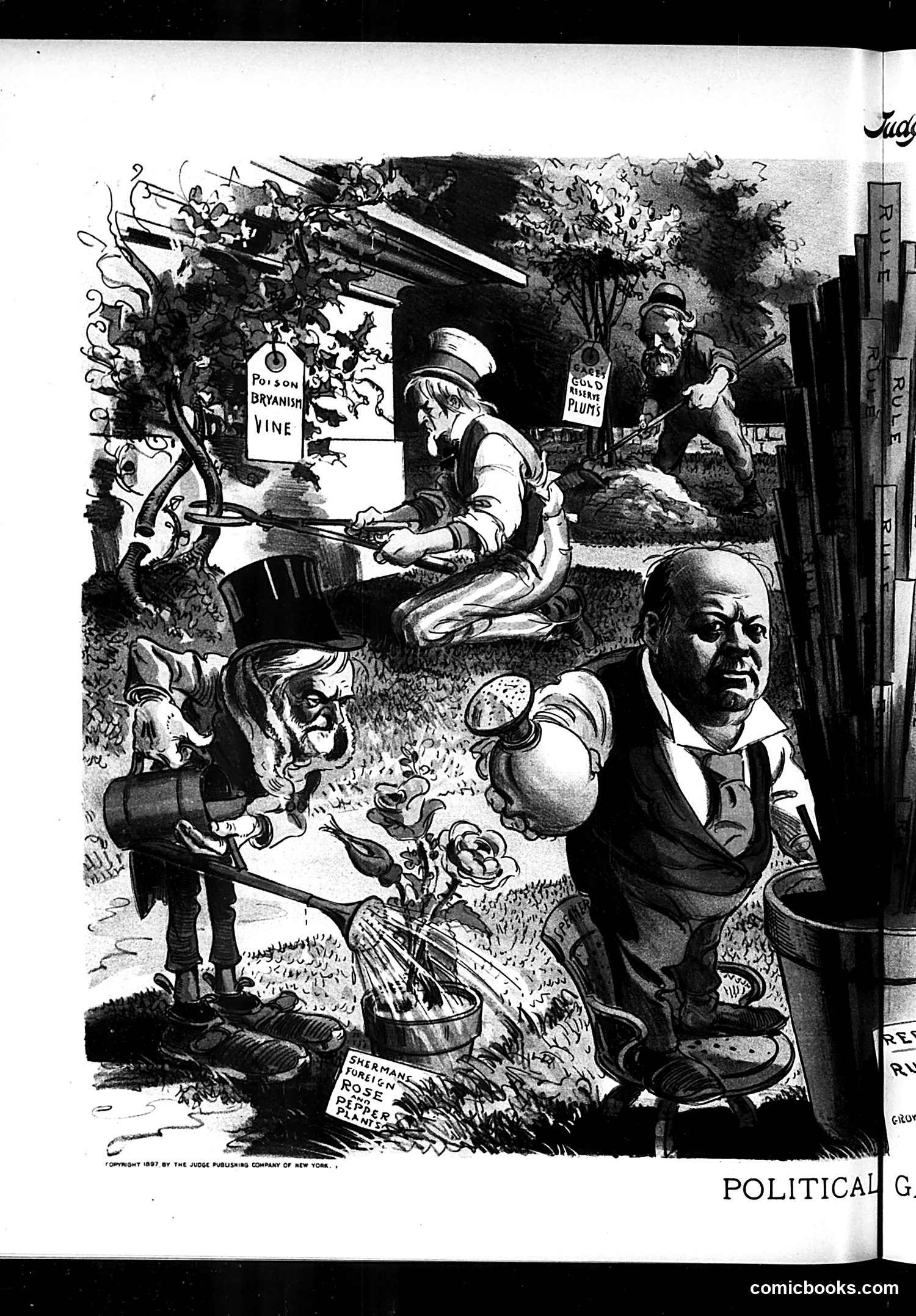
This appears to be a satirical Judge magazine cartoon depicting political corruption or malfeasance, though the specific date and figures aren't clearly legible in the image. The cartoon shows multiple caricatured men in formal dress engaged in what appears to be poisoning or contaminating grapevines labeled "Poison Bryanish Vine" and "Gold Standard Plume." The imagery suggests deliberate sabotage of agricultural/economic resources. The composition implies wealthy or powerful political figures are actively destroying something of value—likely a metaphor for corruption of the political system or economy. The detailed, elaborate caricatures and multiple figures suggest this critiques a conspiracy among elite political players rather than a single target. Without clearer text or dating, the specific political moment remains unclear, though the style suggests late 19th or early 20th-century American politics.
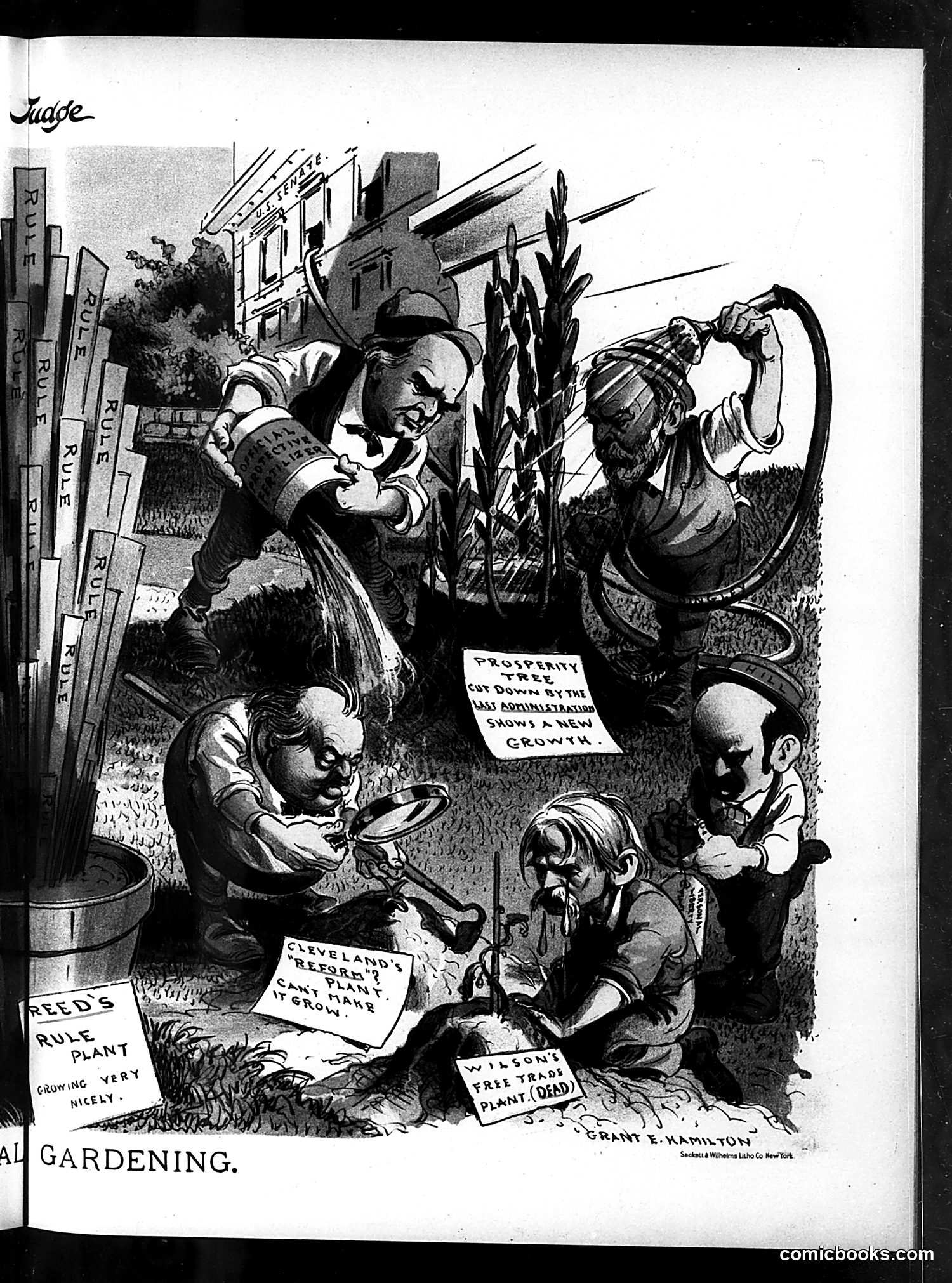
This Judge cartoon satirizes Republican economic policies under the Grant administration. The "Prosperity Tree" labeled "cut down by the last administration" shows growth—suggesting the previous (Democratic) administration damaged prosperity, which Republicans claim to be restoring. The caricatured figures appear to be Republican politicians tending various "plants" representing their policies: "Reed's Rule," "Cleveland's Reform," "Wilshire's Free Trade Plant," and others. The satire mocks Republicans for simultaneously claiming credit for prosperity while blaming Democrats for past damage—a "have it both ways" argument. The cartoon criticizes the inconsistency of Republican rhetoric about economic growth, suggesting their explanations contradict themselves. The gardening metaphor represents their claimed careful cultivation of American economic prosperity.
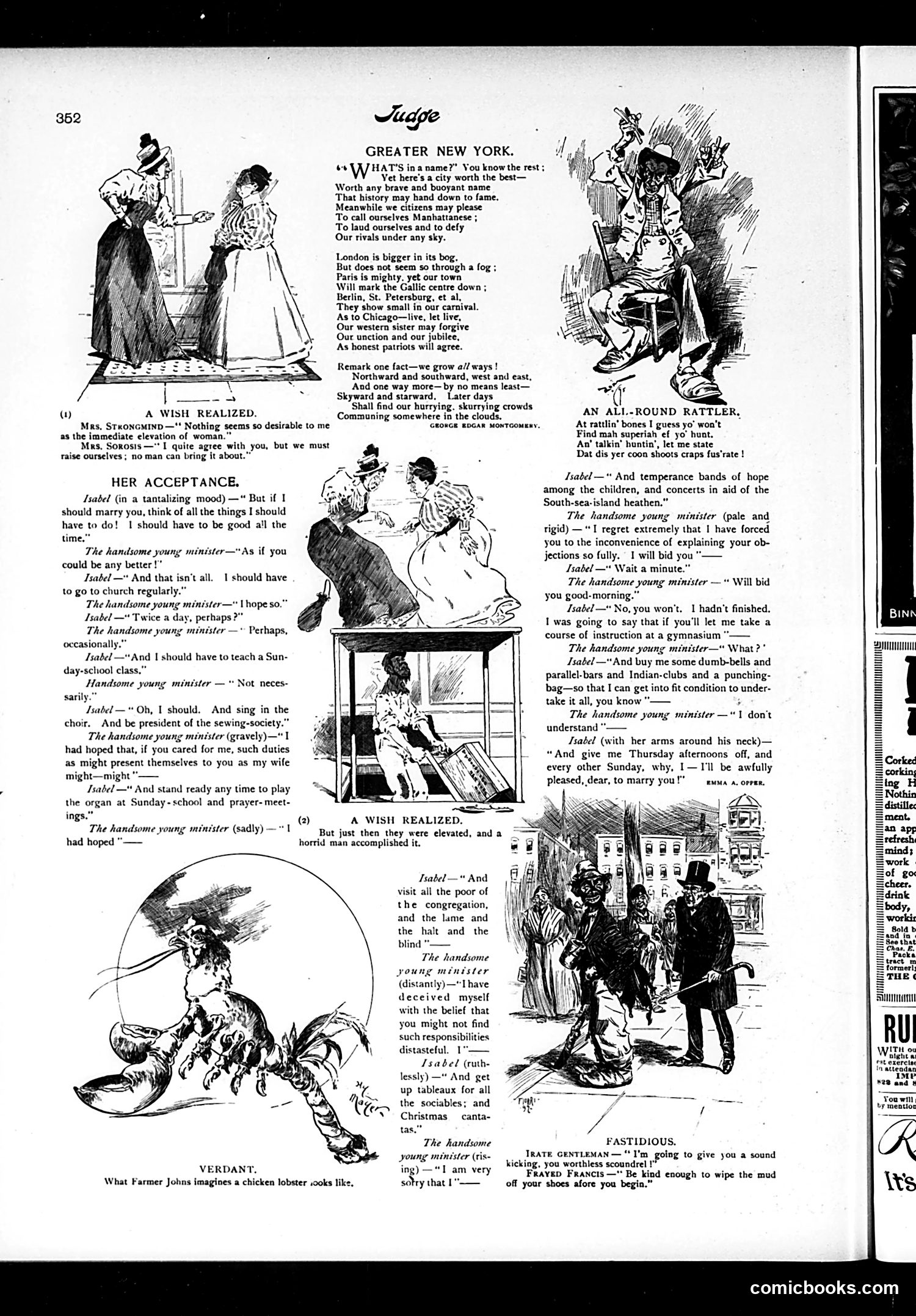
This page contains three distinct satirical pieces: **"Greater New York"** celebrates the newly consolidated New York City (post-1898), humorously boasting of its superiority to London, Paris, Berlin, and Chicago. The satire mocks the city's self-congratulatory civic pride and expansionist ambitions, including its literal and figurative upward growth ("skyward and starward"). **"Her Acceptance"** depicts a courtship dialogue where a young woman lists increasingly demanding domestic and charitable duties she'd assume if married. The minister's growing dismay—culminating in him fleeing—satirizes both Victorian gender expectations and the gap between romantic ideals and marital reality. The punchline, "A Wish Realized," shows her elevated (literally lifted) by another man, suggesting fate intervenes. **"An All-Round Rattler"** is a brief racial caricature in dialect about a Black man's skill at dice and hunting—representative of the era's deeply offensive entertainment humor found in mainstream publications. **"Verdant"** is a simple joke about a rural farmer's ignorance of what a lobster resembles. The page reflects Judge's satirical approach to contemporary urban life, marriage customs, and social pretensions.
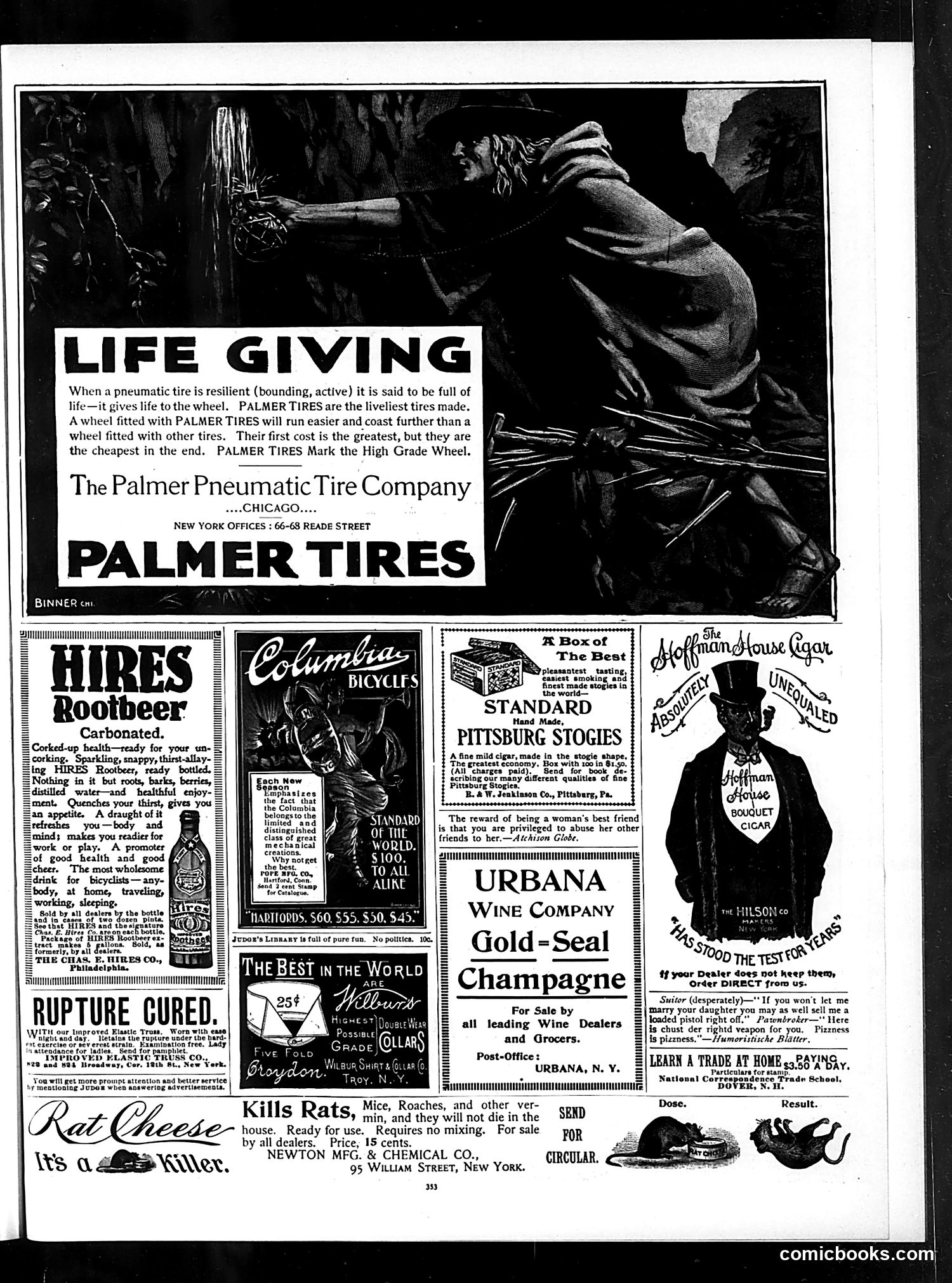
This page is primarily **advertisements** rather than political satire or editorial cartoons. It showcases various consumer products from the early 1900s, including: - **Palmer Pneumatic Tires** (top): Features an illustration of a man working on a wheel, advertising tire quality and value - **HIRES Rootbeer**, **Columbia Bicycles**, **Pittsburgh Stogies** cigars, and **Hoffmann House Cigars**: Standard product advertisements - **Urbana Wine Company** champagne advertisement - **Rat Cheese** pest control and other consumer goods The page includes brief **humorous one-liners** typical of Judge magazine—small jokes about relationships and social observations (e.g., the quote about women's friendships). There is **no identifiable political cartoon** or caricature of public figures on this page. It represents Judge's business model: satirical content subsidized by advertisements, reflecting early 1900s consumer culture and marketing strategies.
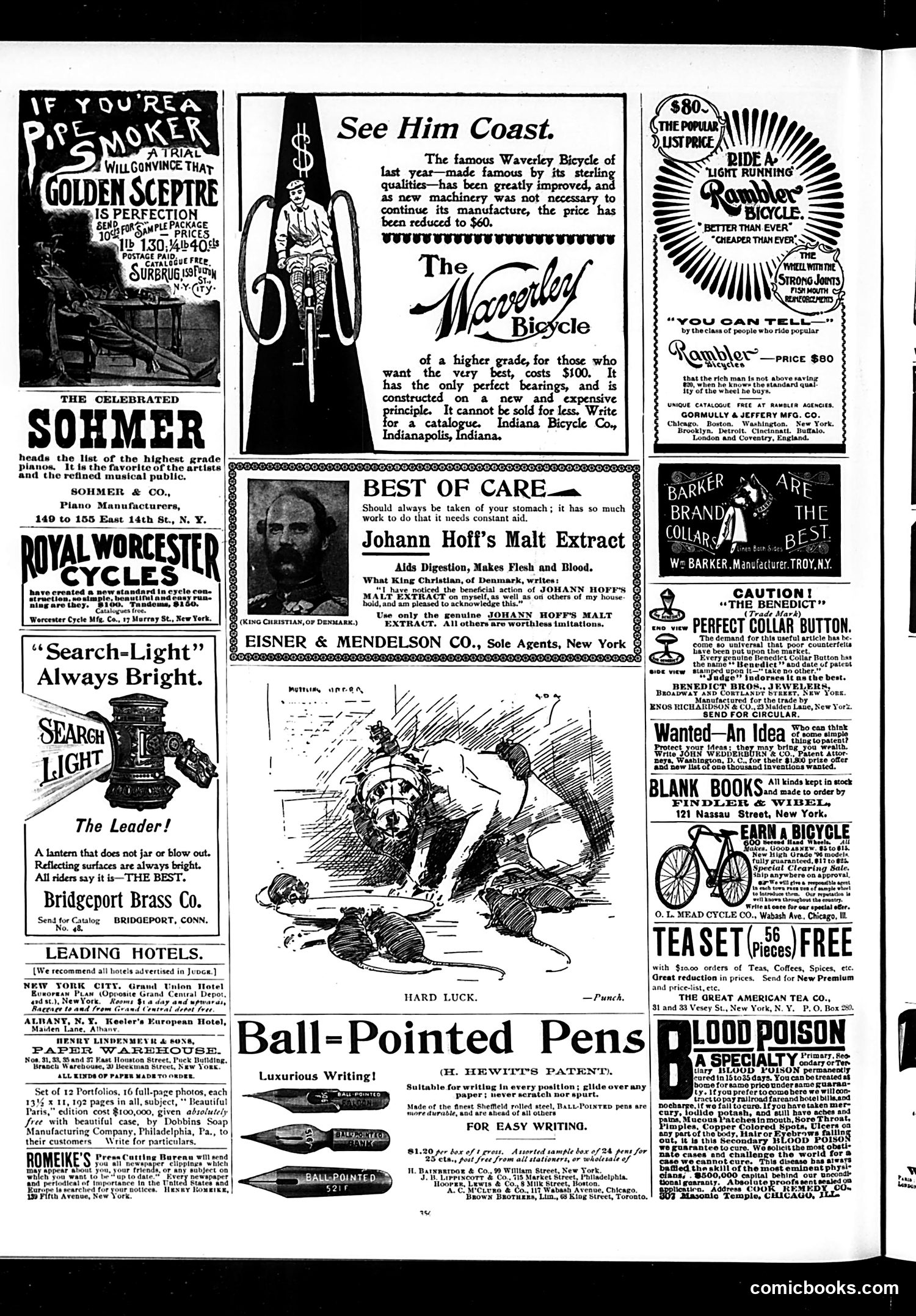
This page is primarily **advertisements** from an 1890s issue of *Judge* magazine, with one notable cartoon. ## The Main Cartoon: "Hard Luck" The central illustration shows a figure lying on the ground after apparently falling from a bicycle—a visual punchline titled "Hard Luck." The joke appears to reference the bicycle craze of the 1890s, when cycling was fashionable but genuinely dangerous without proper safety equipment or experience. The humor is straightforward slapstick: someone has taken a tumble. ## Context The surrounding ads reveal what made this relatable: numerous bicycle manufacturers (Waverley, Rambler, Royal Worcester, Indiana Bicycle Co.) competed intensely. Bicycles cost $60-$100—substantial sums then. The ads promise safety features ("Ball-Pointed Pens," safety lanterns), suggesting riders genuinely worried about accidents. The cartoon captures the *Judge* audience's ambivalence: bicycles were modern, desirable status symbols, yet comically accident-prone. "Hard Luck" mocks the gap between cycling's aspirational image and messy reality.
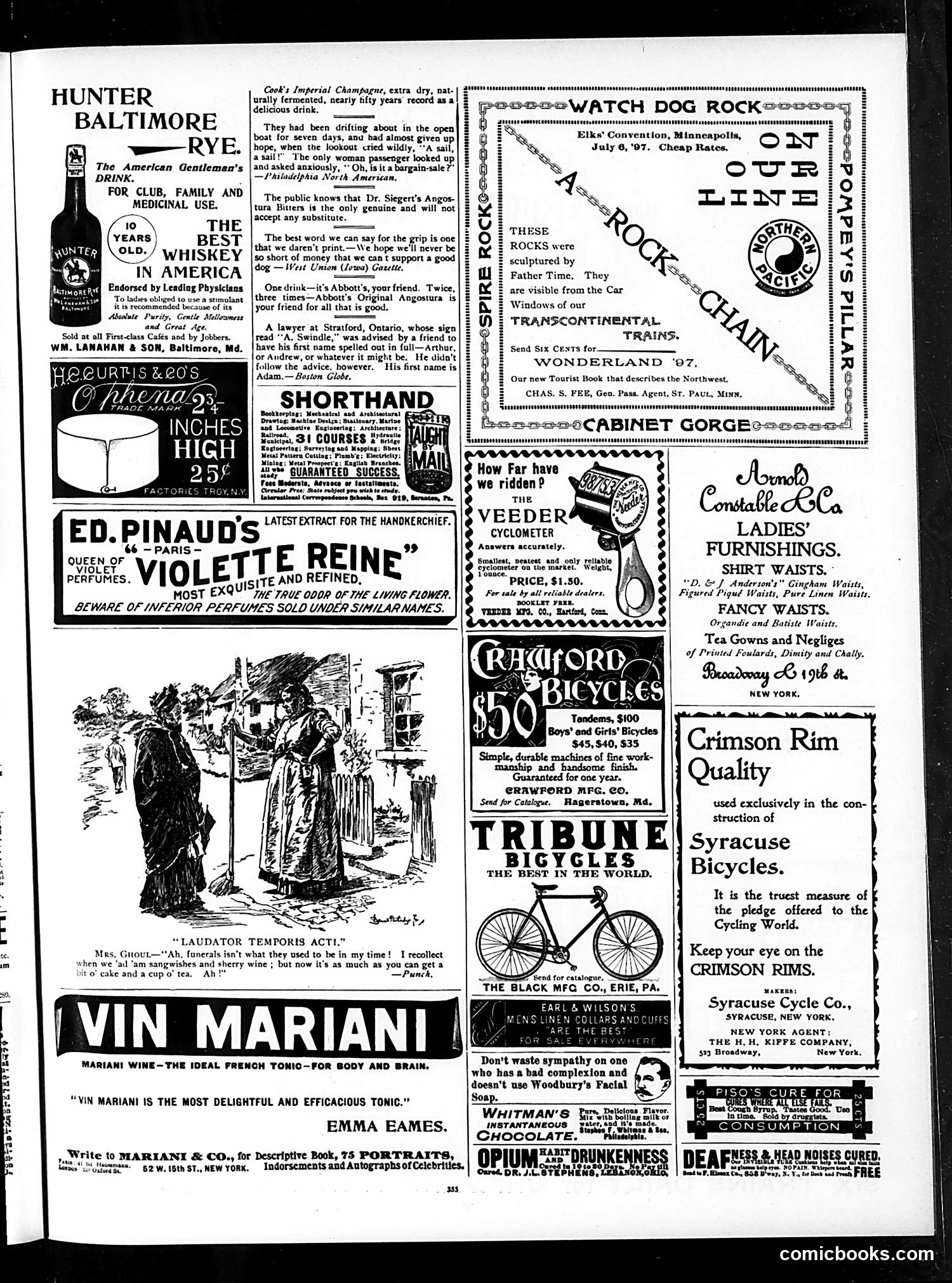
This is primarily **an advertising page** from Judge magazine (circa 1897, based on the Elks Convention date). Rather than political satire, the page showcases period commercial advertisements. The **one cartoon** depicts "Laudator Temporis Acti" (Latin: "praiser of past times")—an elderly woman nostalgically lamenting how funerals have declined. She recalls when they featured "sangwishes and sherry wine," whereas now guests receive only "cake and a cupo' tea." The joke satirizes **elderly nostalgia and class anxiety**: she mourns the loss of generous hospitality at funerals, reflecting broader anxieties about economic change and diminished social standards. The advertisements reflect **late-Victorian consumer culture**: liquor (whiskey, wine, Angostura bitters), bicycles (wildly popular then), perfume, ladies' clothing, and patent medicines—many with dubious health claims (Vin Mariani, opium-based products). These ads reveal contemporary attitudes toward gender, consumption, and pseudo-scientific wellness products now recognized as harmful.
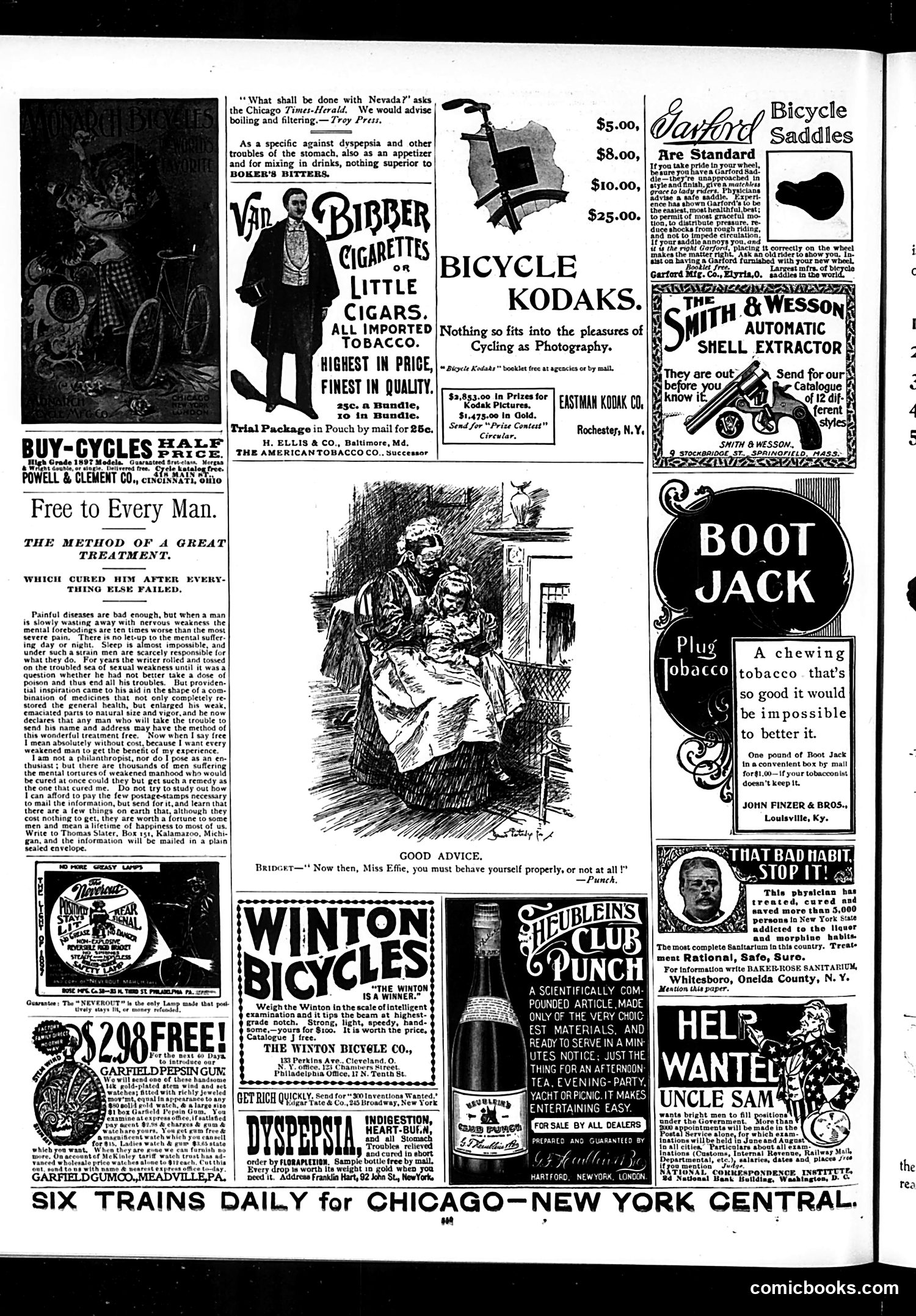
This page from *Judge* magazine is primarily **advertising** with minimal political content. The small satirical element appears at the top: a brief joke quoting the Chicago *Times-Herald* asking "What shall be done with Nevada?" with the reply "boil and filter it"—likely mocking Nevada's perceived problems or undesirability around the 1890s. The rest of the page consists of product advertisements typical of the era: bicycles, cigarettes, tobacco, photographic equipment (Bicycle Kodaks), patent medicines (Boker's Bitters for dyspepsia), and various remedies. One notable ad promotes a "free" treatment for male sexual weakness, reflecting common mail-order medical schemes of the period. The cartoon illustration shows a domestic scene with a bridegroom and bride, captioned with marriage advice from *Punch*, unrelated to politics.
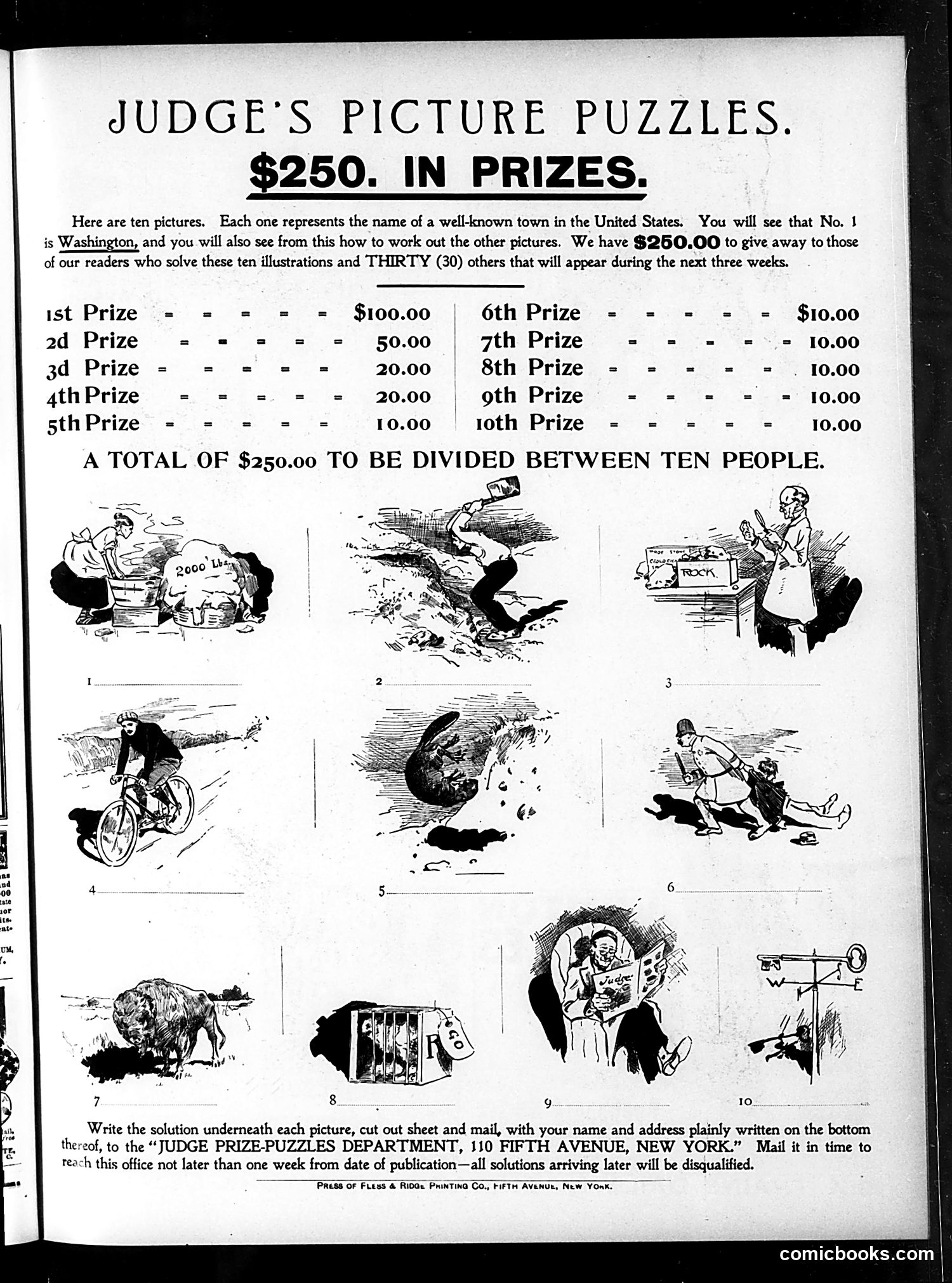
This is a contest page from *Judge* magazine offering $250 in prizes for solving visual riddles. Each of the ten pictures represents the name of a well-known American town, rebus-style. Picture #1 shows a figure washing—representing "Washington." The remaining nine pictures use visual puns and wordplay to suggest town names through imagery. For example, Picture #4 appears to show a person on a bicycle, Picture #7 shows an animal, and Picture #8 shows what looks like a cage or crate—each designed to prompt solvers to guess the corresponding town name. Readers were invited to mail solutions to Judge's office with their name and address. The contest ran over multiple weeks with 40 total puzzles across the series. This was a common popular entertainment in early-to-mid 20th century magazines—combining humor, wordplay, and the appeal of potential prize winnings to boost readership and engagement.
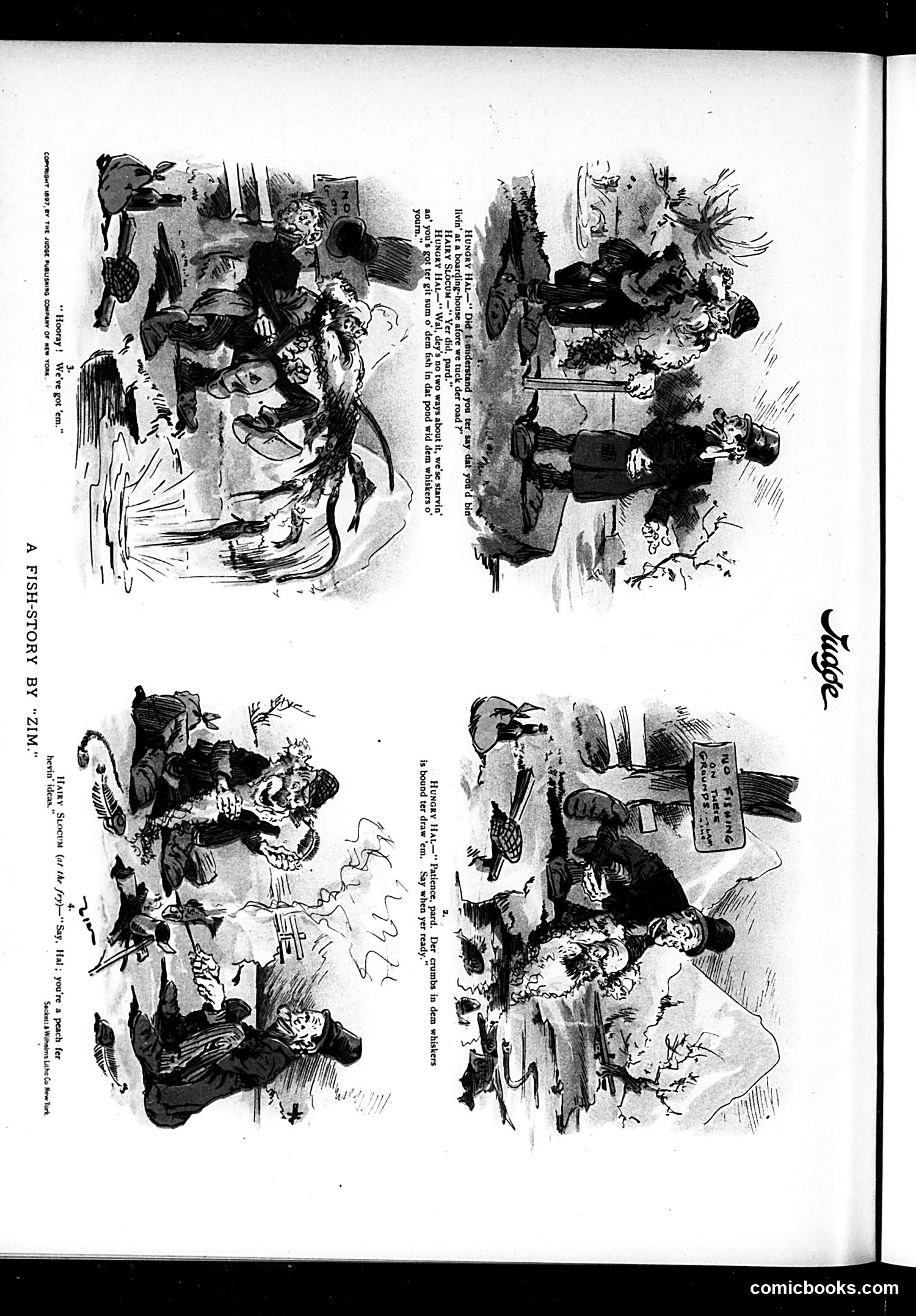
This is a four-panel comic strip satirizing fishing methods. The narrative follows two characters—"Hungry Hat" and "Harry Stocum"—attempting to catch fish using an unconventional lure: crumbs trapped in one character's whiskers. The humor derives from the absurdist premise: instead of proper fishing equipment, they're using facial hair as bait. Panel 1 shows their desperate hunger; Panel 2 presents the ridiculous "plan"; Panel 3 celebrates its apparent success ("We've got 'em"); Panel 4 praises the inventor's ingenuity. The "fish-story" title likely references the exaggerated tall tales fishermen traditionally tell. The comic mocks both fishing culture and desperation—the characters are so hungry they resort to ludicrous improvisation. The crude dialect suggests working-class or immigrant characters, typical of Judge magazine's humor from this era (1897).