
A complete issue · 22 pages · 1897
Judge — May 15, 1897
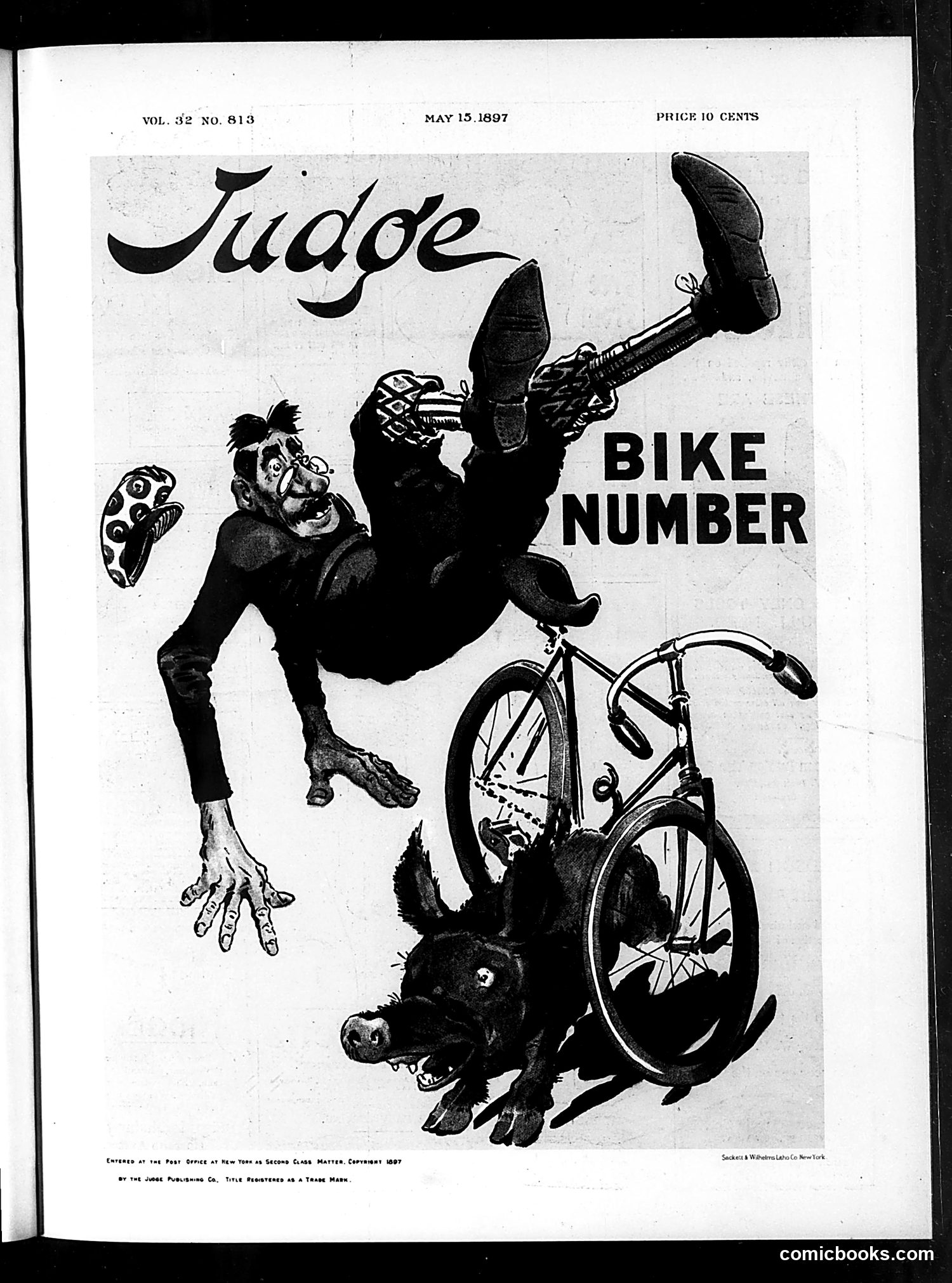
This is a satirical cover featuring a grotesque monkey-like figure riding a bicycle while kicking its legs wildly. A snarling dog appears beneath the bike. The exaggerated, violent posture and the caricatured features suggest this is mocking bicycle craze participants—likely poking fun at the popularity of cycling in the 1890s and the often-reckless behavior of cyclists. The simian imagery reflects period racial caricature conventions common in 19th-century American satire, though the specific target remains unclear from visual evidence alone. The overall joke appears to satirize the absurdity and danger associated with the bicycle fad that swept America in the 1890s, treating cyclists as foolish or animalistic.
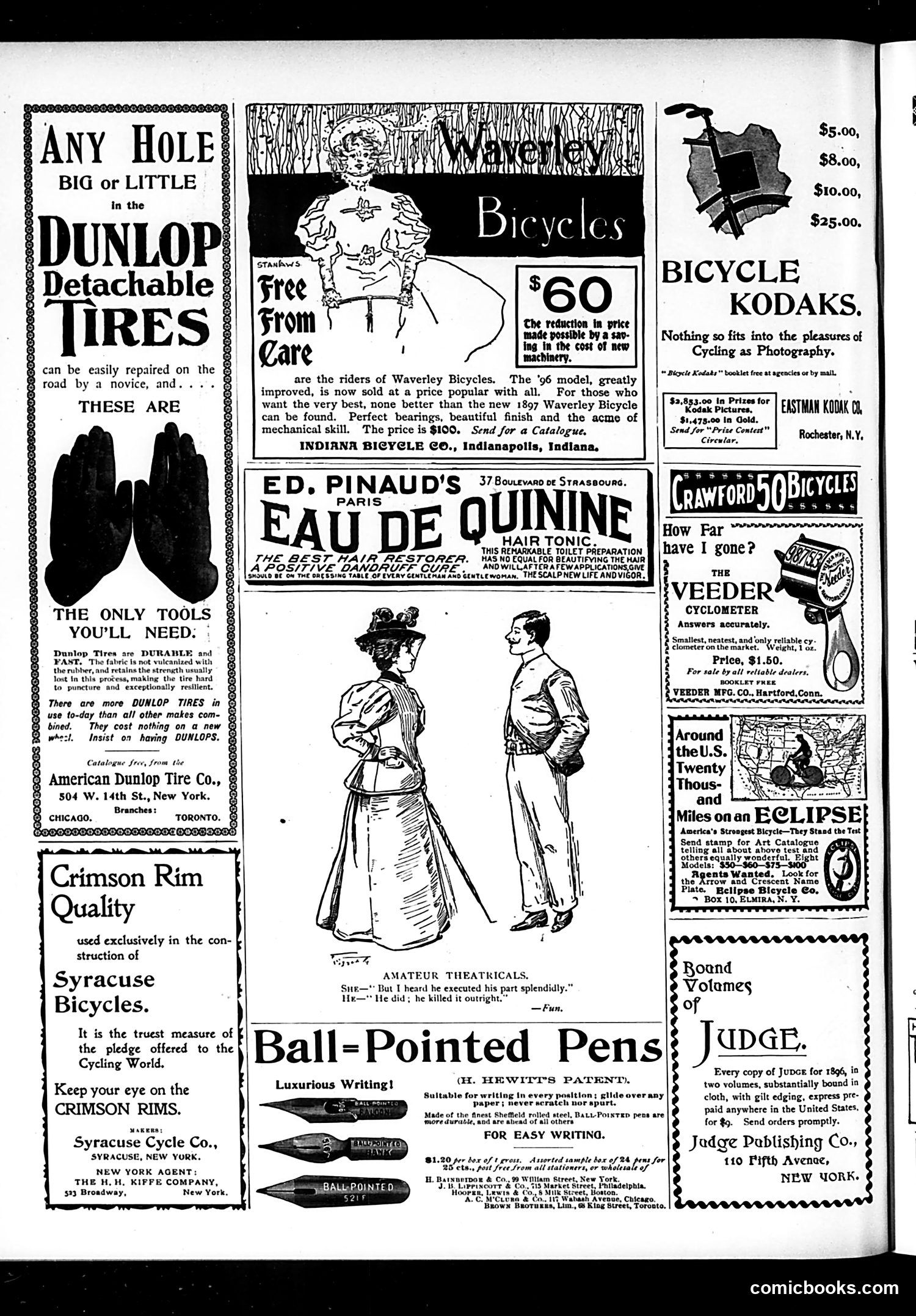
This page is predominantly **advertisements** rather than political cartoons. The content includes: - **Dunlop Tires** (top left): Promotional ad emphasizing durability - **Waverley Bicycles** (center): Highlighting a $60 model with improved design - **Bicycle Kodaks** (right): Photography equipment marketed to cyclists - **Ed. Pinaud's Eau de Quinine** (center): Hair tonic advertisement - **Syracuse Bicycles** (left): Quality rim promotion - **Ball-Pointed Pens** (bottom center): Writing instrument ad - **Judge Publishing** (bottom right): Bound volumes promotion - **Crawford Bicycles** and **Veeder Cyclometer** (right): Related cycling products The sole cartoon appears at center: two figures in period dress with the caption "Amateur Theatricals"—a simple social humor piece about theatrical performance, not political commentary.
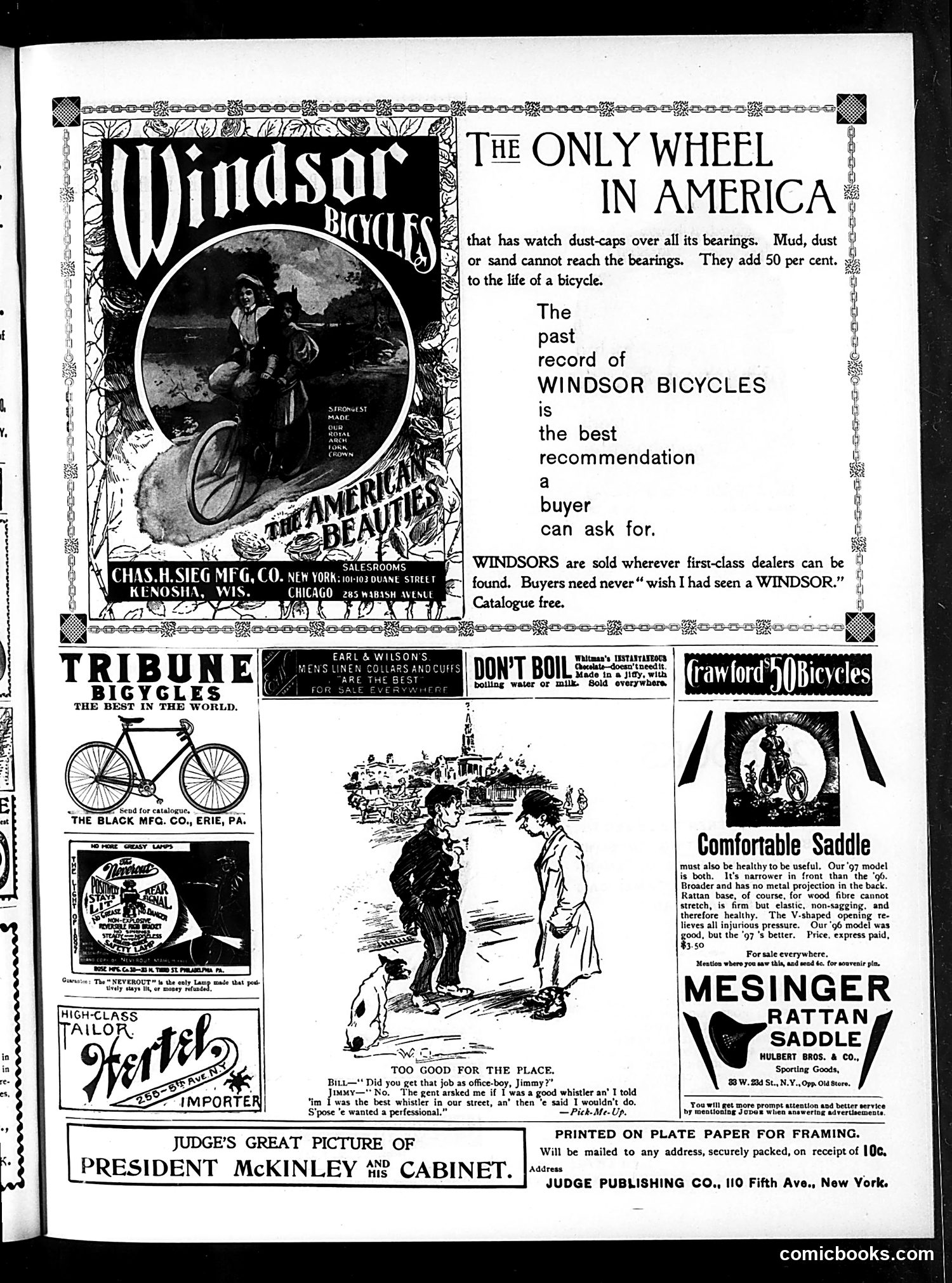
This page is primarily **advertising** for bicycles and bicycle accessories from the early 1900s era, with one small cartoon. The central cartoon, titled "TOO GOOD FOR THE PLACE," depicts two men and a dog discussing a lost boy. One man asks if the other found "that little lost boy," to which he replies he was "the best whistler in our street" and is now a professional. The joke appears to be a mild satire on child labor or street performance—suggesting a talented child from poor circumstances has found work, though the humor is genteel rather than pointed. The page otherwise showcases various bicycle brands (Windsor, Tribune, Crawford, Mesinger Rattan Saddle) and components, reflecting the bicycle craze of the 1890s-1900s. The advertisements emphasize durability and quality—typical marketing of the period.
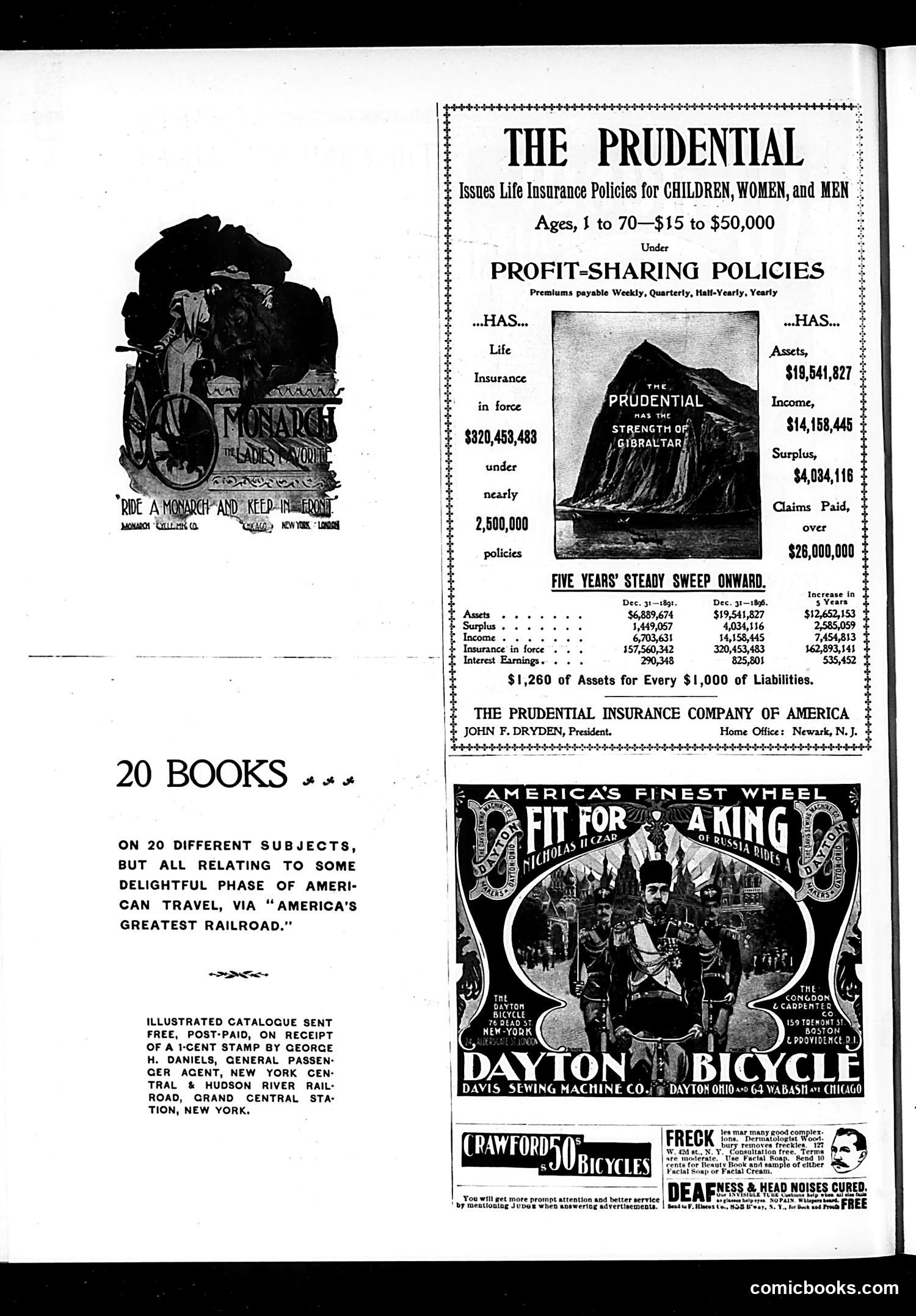
This page is primarily **advertising**, not satirical content. It contains four advertisements typical of Judge magazine circa 1890s: 1. **New York Central Railroad** promotes 20 travel books celebrating American rail journeys—positioning railroad travel as cultured leisure. 2. **The Prudential Insurance Company** showcases financial strength and growth over five years, targeting working families with affordable policies for "children, women, and men." 3. **Dayton Bicycle** advertises "America's Finest Wheel," featuring an ornate theatrical poster style common to 1890s product marketing. 4. Minor ads for **Crawford Bicycles** and a deafness cure. The **monarchist emblem** on the left—"Ride a Monarch and Keep Ahead"—is simply a bicycle brand's logo, not political commentary. These ads reflect Gilded Age consumer culture: insurance democratization, bicycle craze popularity, and railroad expansion as progress markers. The ornate design and grand claims typify period advertising hyperbole.
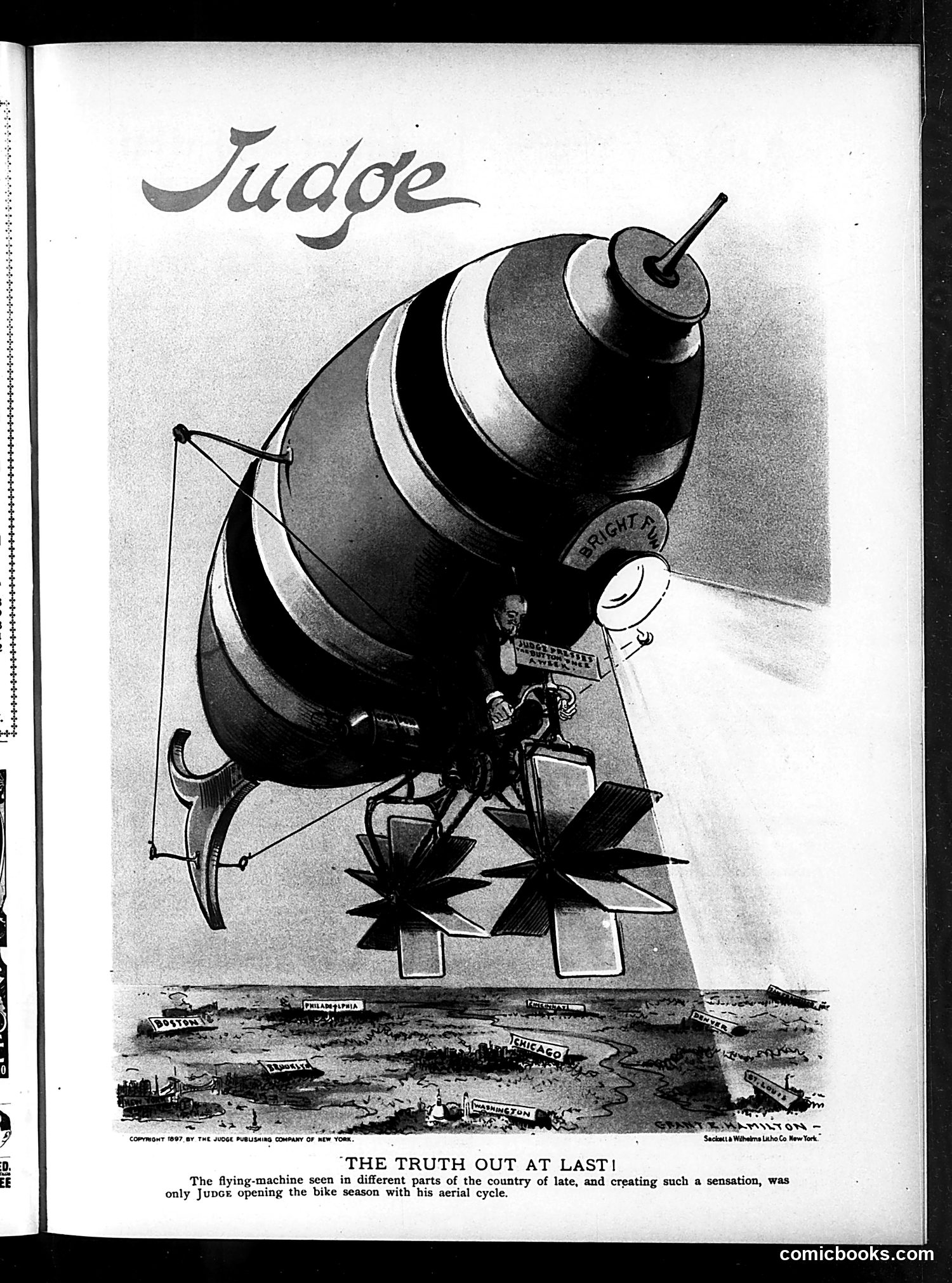
This cartoon satirizes early aviation claims and the bicycle craze of the 1890s. The image shows a massive, improbable flying machine—essentially a giant balloon-like contraption with mechanical legs—piloted by a tiny figure labeled "Judge" (the magazine's personified mascot). The satire works on two levels: First, it mocks recent "flying machine" sightings reported across America, implying these were likely hoaxes or misidentifications. Second, it jokes that Judge magazine itself was behind the spectacle, using it as a promotional stunt to kick off the bicycle season. The exaggerated, impossible design of the craft underscores the cartoonist's skepticism about such aerial claims. The bicycle reference suggests this is promotional content tying the invention trend to bicycle popularity.
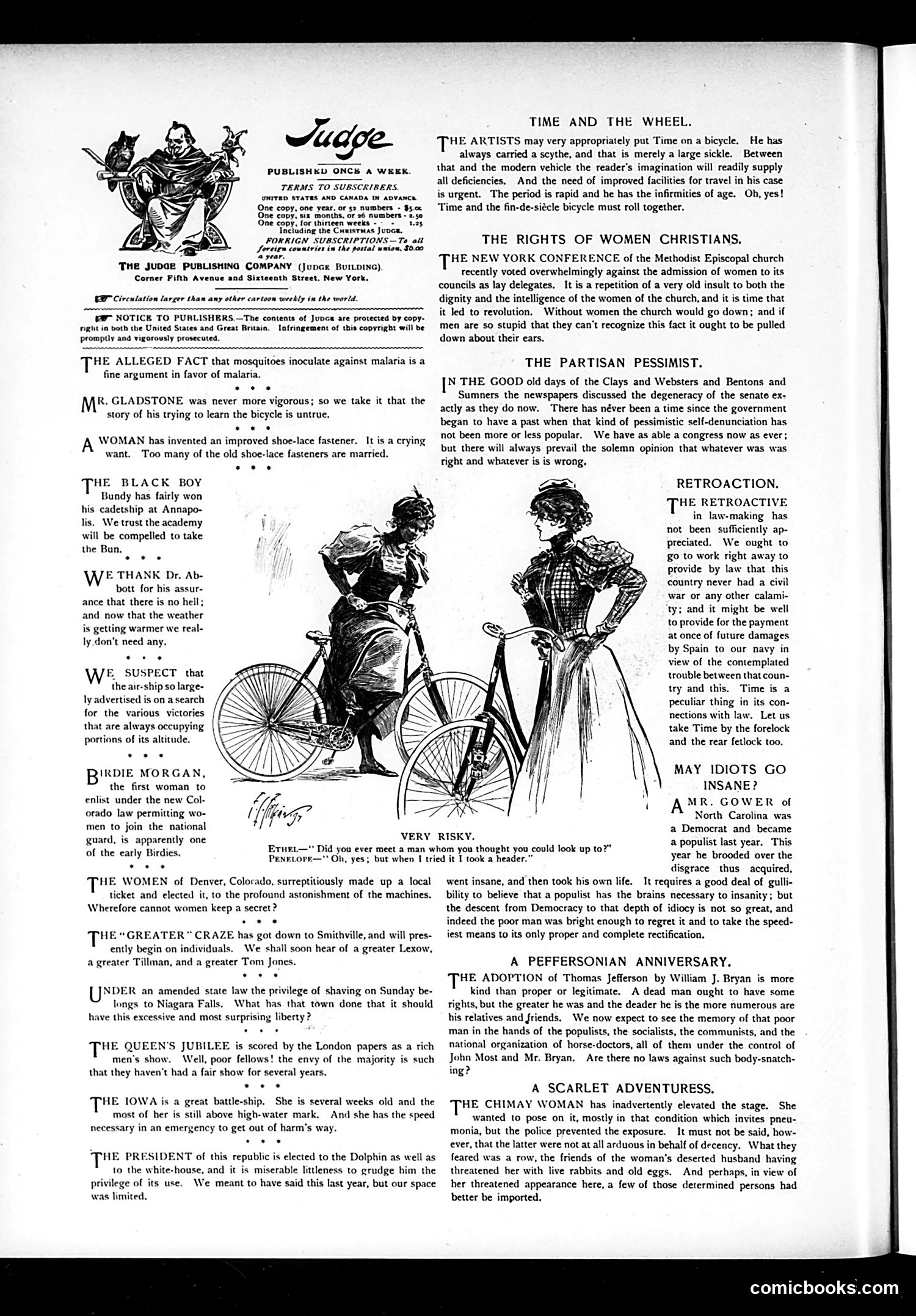
This page from Judge presents brief satirical commentary on contemporary issues, with one major illustration showing two women with bicycles. **The main cartoon** ("TIME AND THE WHEEL") depicts Time as a cyclist rather than the traditional scythe-bearer, suggesting modern progress moves rapidly. The accompanying text plays on the bicycle craze of the 1890s. **Other notable items:** - A jab at William Gladstone attempting to learn to ride a bicycle, suggesting age/vigor debates - Commentary on women's emerging roles: Birdie Morgan enlisting in Colorado's newly-permitted female National Guard; Denver women secretly organizing and winning a local election ("Wherefore cannot women keep a secret?") - Criticism of the Methodist Episcopal Church's vote against female lay delegates—Judge argues this insults women's dignity and intelligence - Various brief satirical quips on unrelated topics (mosquitoes, shoe-laces, airships) **Overall context**: The page captures 1890s anxieties about women's expanding public participation, technological change (bicycles, battleships), and institutional resistance to modernization.
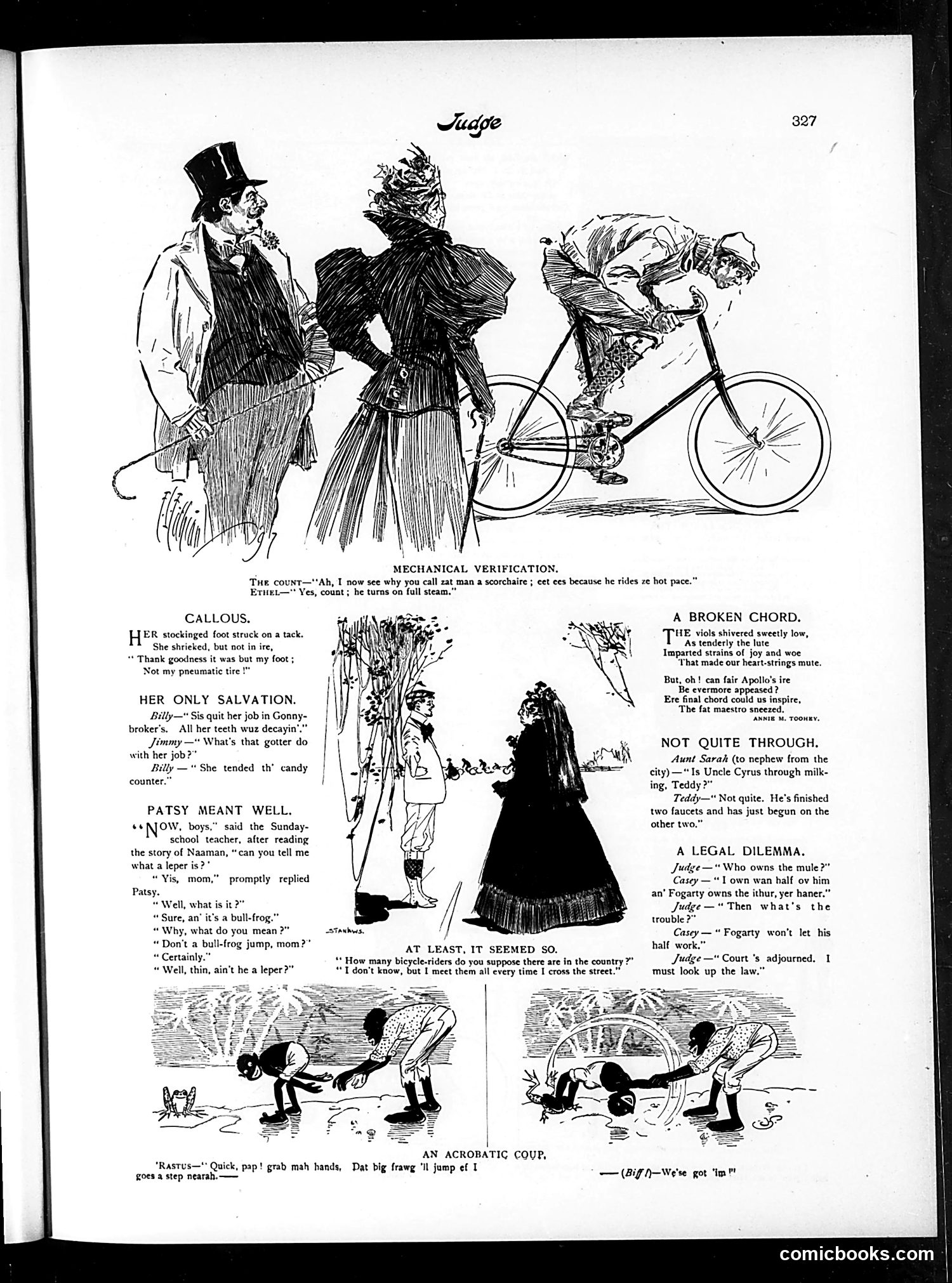
This page from Judge magazine presents multiple satirical vignettes typical of the publication's humor circa the early 1900s. **"Mechanical Verification"** mocks cyclists ("scorchairs"—fast riders) by having European aristocrats confuse bicycle riding with mechanical steam power, suggesting the bicyclist travels at dangerously high speed. **Other brief comic sketches** include wordplay and ethnic humor: "Callous" jokes about pneumatic tires (newly common on bicycles); "Her Only Salvation" features working-class Irish dialect humor; "Patsy Meant Well" plays on a child's misunderstanding of "leper" as "bull-frog"; the "Legal Dilemma" uses Irish-dialect humor about mule ownership disputes. **"An Acrobatic Coup"** appears to depict Black characters in a physical comedy scenario with racist dialect ("Rastus"). The page reflects Judge's mix of genteel satire for educated readers alongside period-typical ethnic and racial caricature that modern audiences would find offensive. The bicycle references suggest early-1900s dating, when cycling was fashionable among the wealthy.
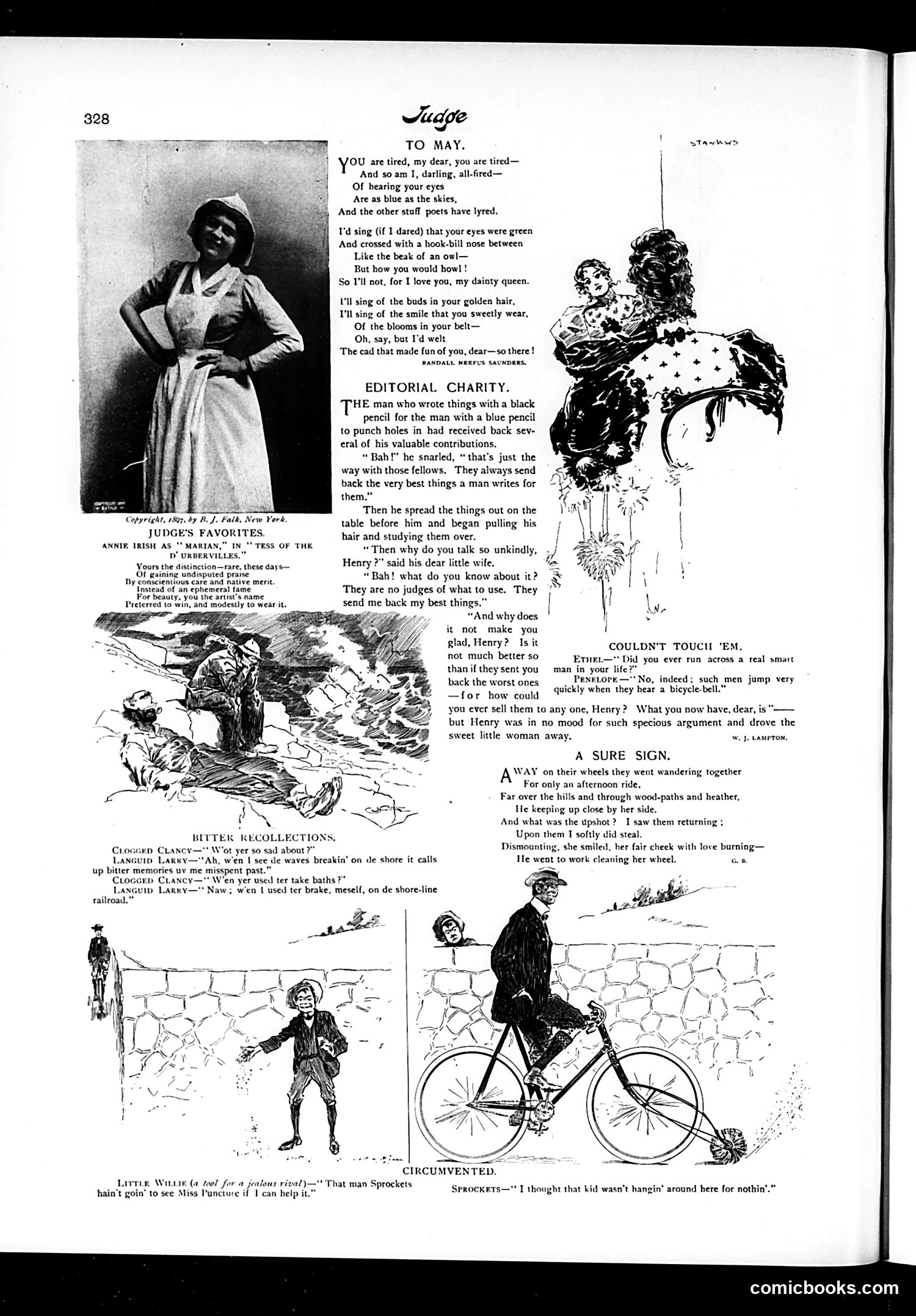
This page from Judge (appears to be late 1890s) contains several satirical pieces: **"To May"** is a tongue-in-cheek poem mocking sentimental Victorian poetry. The poet admits he's tired of clichéd romantic verses praising women's eyes and features, sarcastically suggesting he'd prefer honesty (green eyes, hook noses) over flowery flattery—commentary on the artificiality of period poetry. **"Editorial Charity"** satirizes a writer's hypocrisy. A rejected contributor complains editors don't recognize quality, yet when his wife points out they're actually protecting him from poor work, he refuses to accept the logic. The joke: his "best things" are probably mediocre, and rejection serves him well. **"A Sure Sign"** and the dialect humor pieces ("Bitter Recollections," "Circumvented") are light social comedy about romance, jealousy, and foolishness. The page reflects Judge's typical mix: mild satire of literary pretension and human nature rather than hard political commentary.
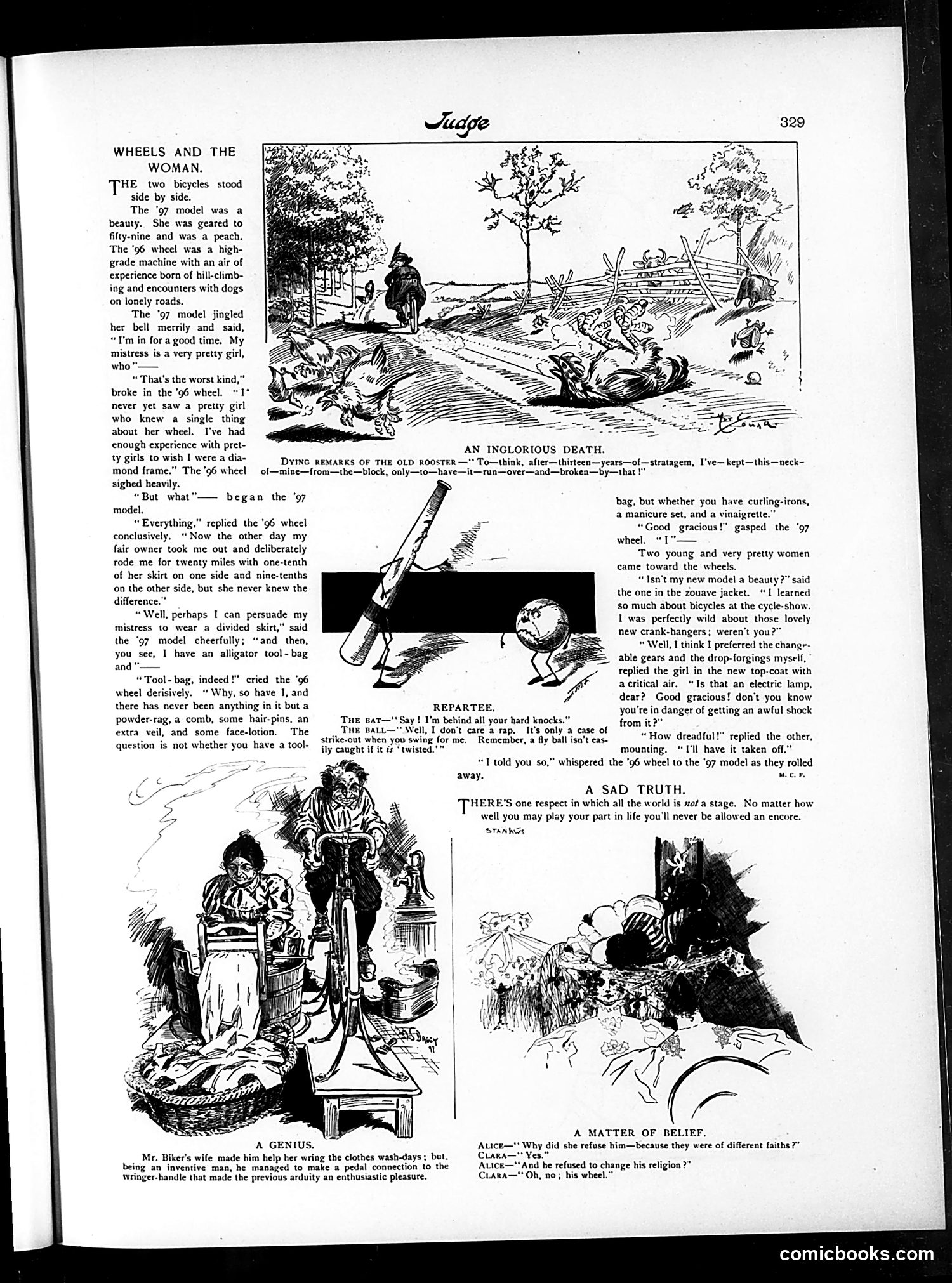
This page contains three satirical pieces about bicycles and social behavior circa the 1890s: **"Wheels and the Woman"** personifies two bicycles—an experienced 1896 model and a naive 1897 model—debating women cyclists. The joke targets upper-class women's ignorance about their bikes despite owning expensive models. The '96 wheel complains that pretty female owners carelessly ride with unbalanced skirts and fill tool-bags with cosmetics (powder-rags, hair-pins, face-lotion) rather than actual tools. When two fashionable women approach discussing "crank-hangers" and "drop-forgings," they reveal superficial knowledge while fearing electrical shock—confirming the wheels' pessimistic view. **"An Inglorious Death"** shows a rooster killed by a bicycle after surviving thirteen years of predators—dark humor about the bicycle's unexpected danger. **Minor sketches** include wordplay about baseballs and wrenches, observations on life's lack of encores, and a pun about a man's conversion to "his wheel" (religion/bicycle). The satire mocks wealthy women's pretentious adoption of cycling fashion without genuine mechanical understanding.
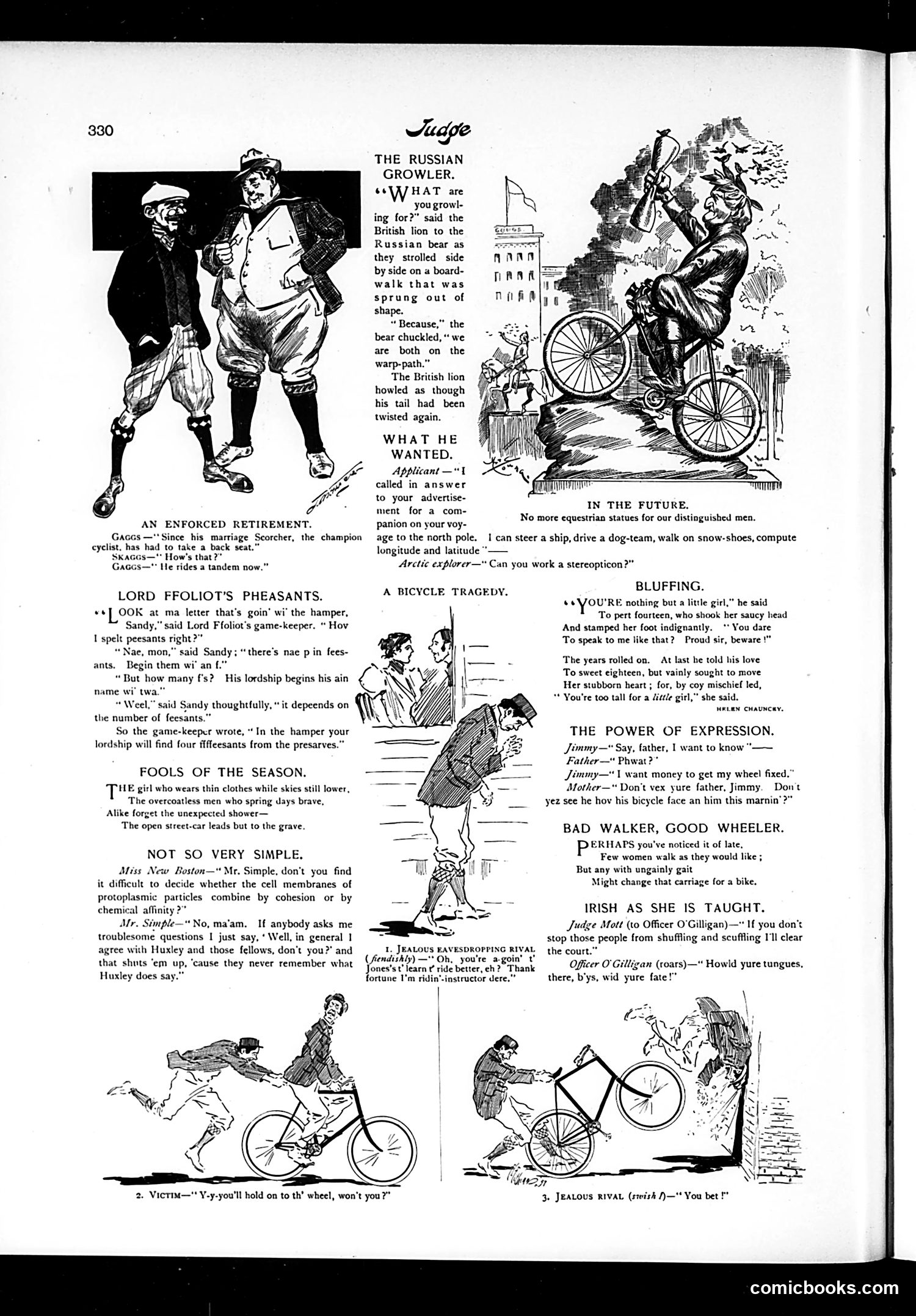
This satirical page contains multiple comic vignettes typical of early Judge magazine: **"The Russian Growler"** depicts the British Lion and Russian Bear as friendly rivals, both "on the warp-path"—a pun suggesting both nations are warped/unstable, likely referencing Anglo-Russian imperial tensions. **Bicycle-themed humor** dominates several pieces, reflecting the bicycle craze of the 1890s. "A Bicycle Tragedy" shows a romantic rejection; "Bad Walker, Good Wheeler" suggests women prefer cycling to walking; "Jealous Eavesdropping Rival" depicts romantic rivalry over bicycles. **Social satire** includes "Lord Ffoliot's Pheasants" (mocking upper-class pronunciation), "The Power of Expression" (fathers irritable about bicycle repairs), and "Irish as She is Taught" (ethnic stereotype humor about Irish court officers). **"Not So Very Simple"** mocks pseudo-intellectual pretension—a character admitting he just agrees vaguely with famous scientists rather than understanding anything. The cartoons reflect 1890s concerns: imperial rivalry, technology anxiety, class distinctions, and ethnic stereotyping common to the period.
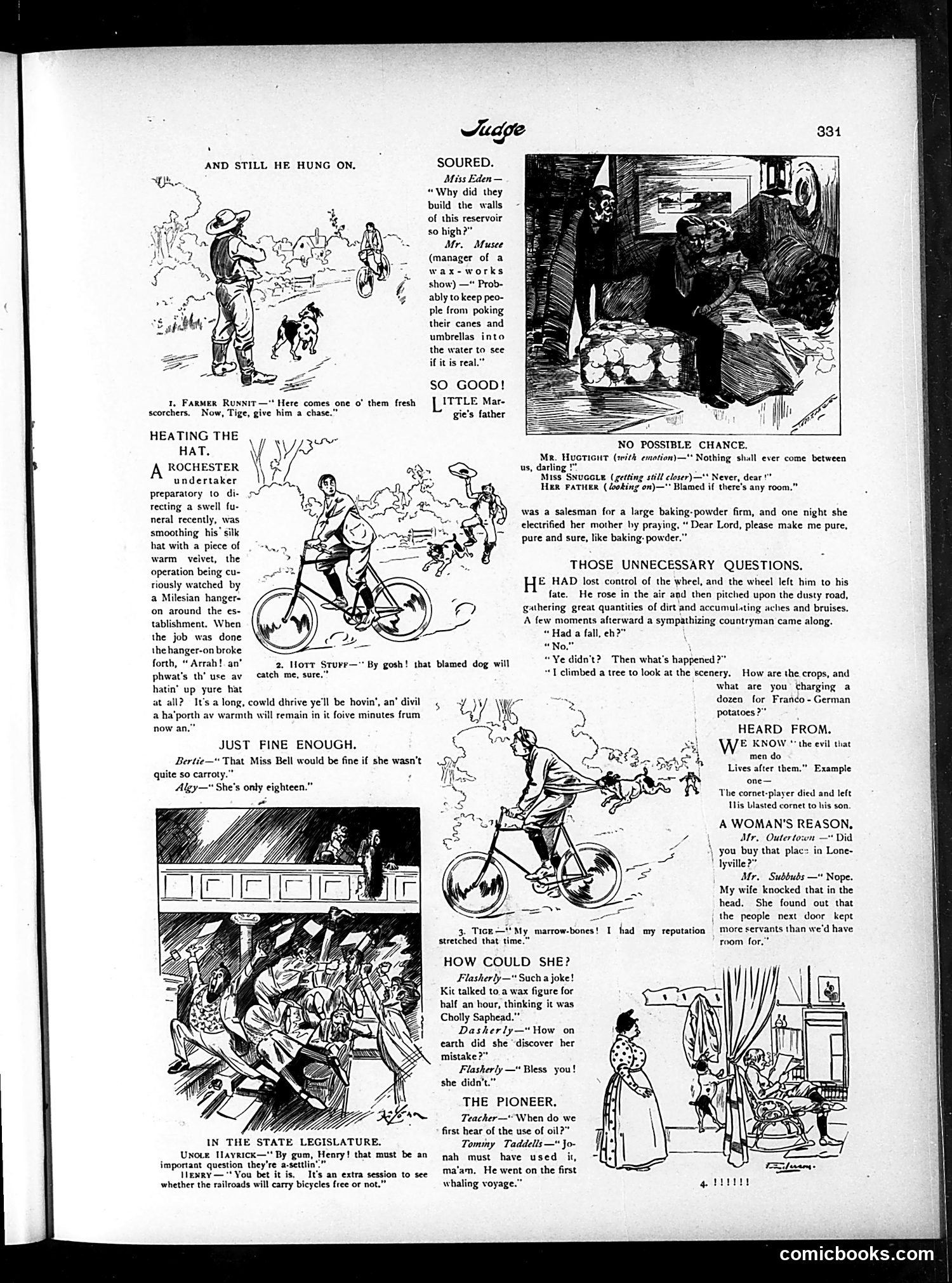
This page contains multiple brief humorous sketches typical of early 20th-century American satirical journalism. The cartoons mock various social situations and character types: **Key sketches include:** - A wax-museum manager explaining why reservoir walls are high (to prevent visitors from testing the water with canes, implying people are foolishly skeptical of reality) - A Rochester undertaker smoothing a hat with velvet before a funeral - Cyclists and dogs in various comedic situations - A romantic couple where the woman's father literally has no room to sit between them - A man who fell from a tree but won't admit it to a sympathetic countryman - Various puns and wordplay (a woman praising baking powder like a prayer; a cornet player's son inheriting his father's instrument) The humor relies on observational comedy about middle-class life, physical comedy, and Irish-immigrant dialect jokes (typical of the era's casual ethnic stereotyping). The sketches satirize pretension, romantic absurdity, and human stubbornness rather than specific political figures or events.
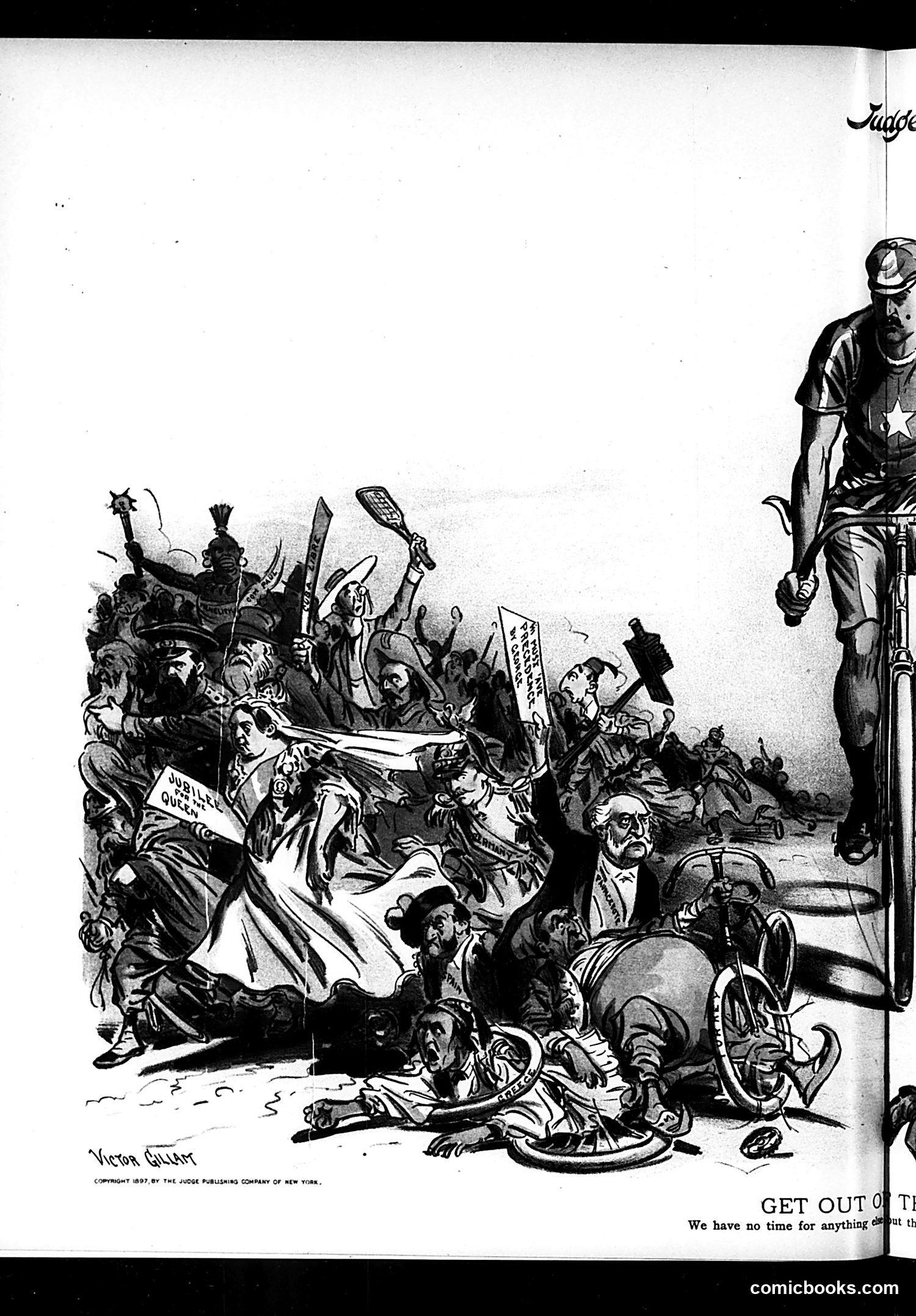
This 1897 Judge magazine cartoon by Victor Gillam depicts a chaotic scene of conflict. On the right stands a single figure (appearing to represent a nation or authority) on elevated ground. On the left, a large mob of aggressive figures wielding weapons, torches, and banners surge forward in apparent revolt or invasion. The composition suggests commentary on labor unrest, revolutionary movements, or international conflict characteristic of 1890s America. The mob's disorganized chaos contrasts with the solitary, elevated defender—possibly representing established order facing popular uprising or foreign threat. The partial caption "GET OUT OF TI[ME]" and "We have no time for anything but th[is]" suggests urgency and existential stakes, though the complete message is unclear from this partial page. Without additional context, the specific political event referenced remains uncertain.
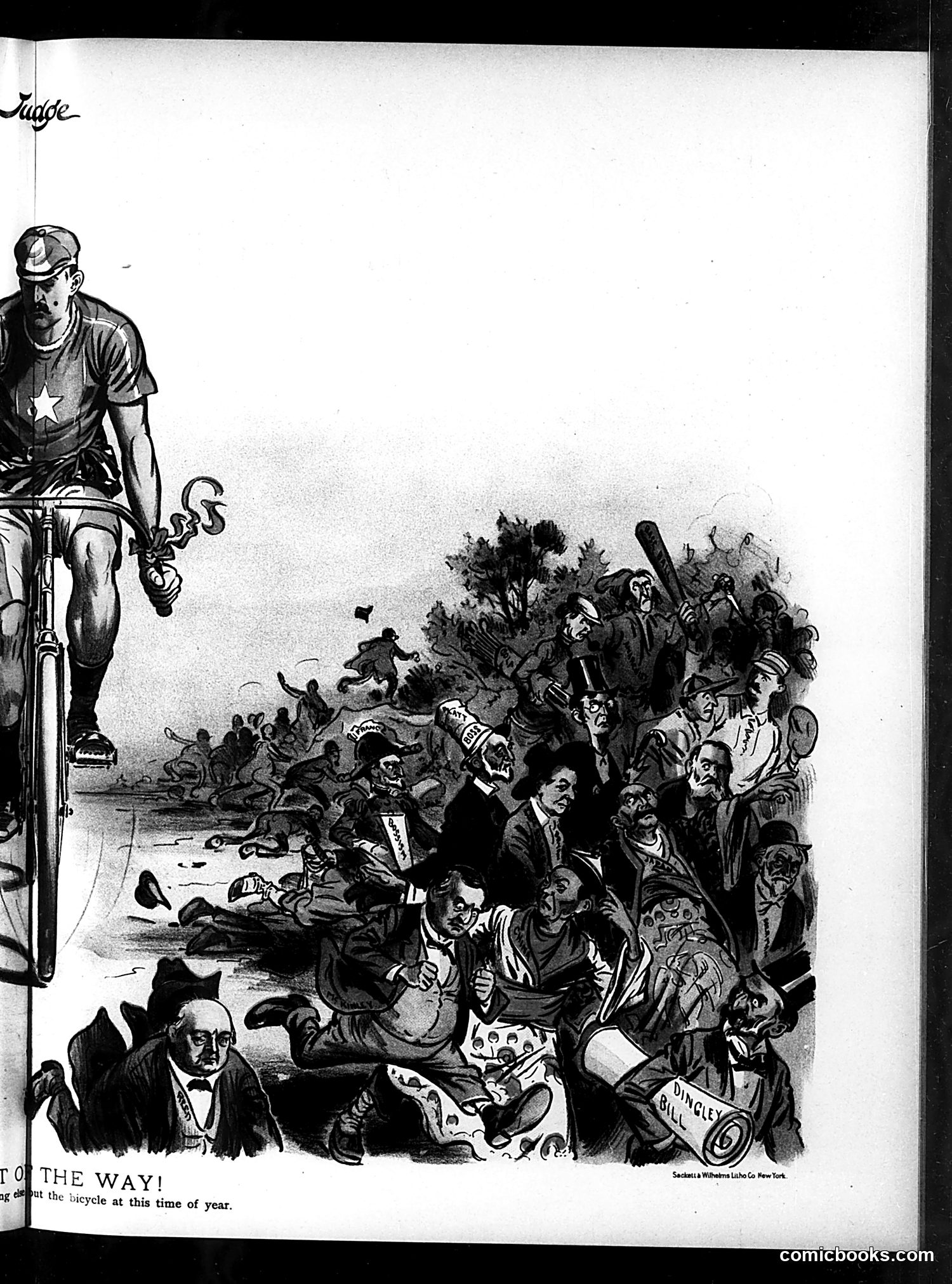
This Judge magazine cartoon satirizes bicycle safety and pedestrian hazards. A cyclist on the left, wearing a star-emblazoned shirt and cap, rides elevated above a chaotic crowd below. The crowd—depicted as working-class figures, some fallen or struggling—appears trampled or endangered by bicycle traffic. The visible text references "the bicycle at this time of year," suggesting seasonal cycling increases caused accidents. The cartoon mocks both reckless cyclists who endanger pedestrians and perhaps the era's cycling craze itself. The elevated cyclist's confident pose contrasts darkly with the disorder below, emphasizing the danger cyclists posed to crowded urban streets in what appears to be the late 19th century, when bicycles were novel and traffic rules undefined.
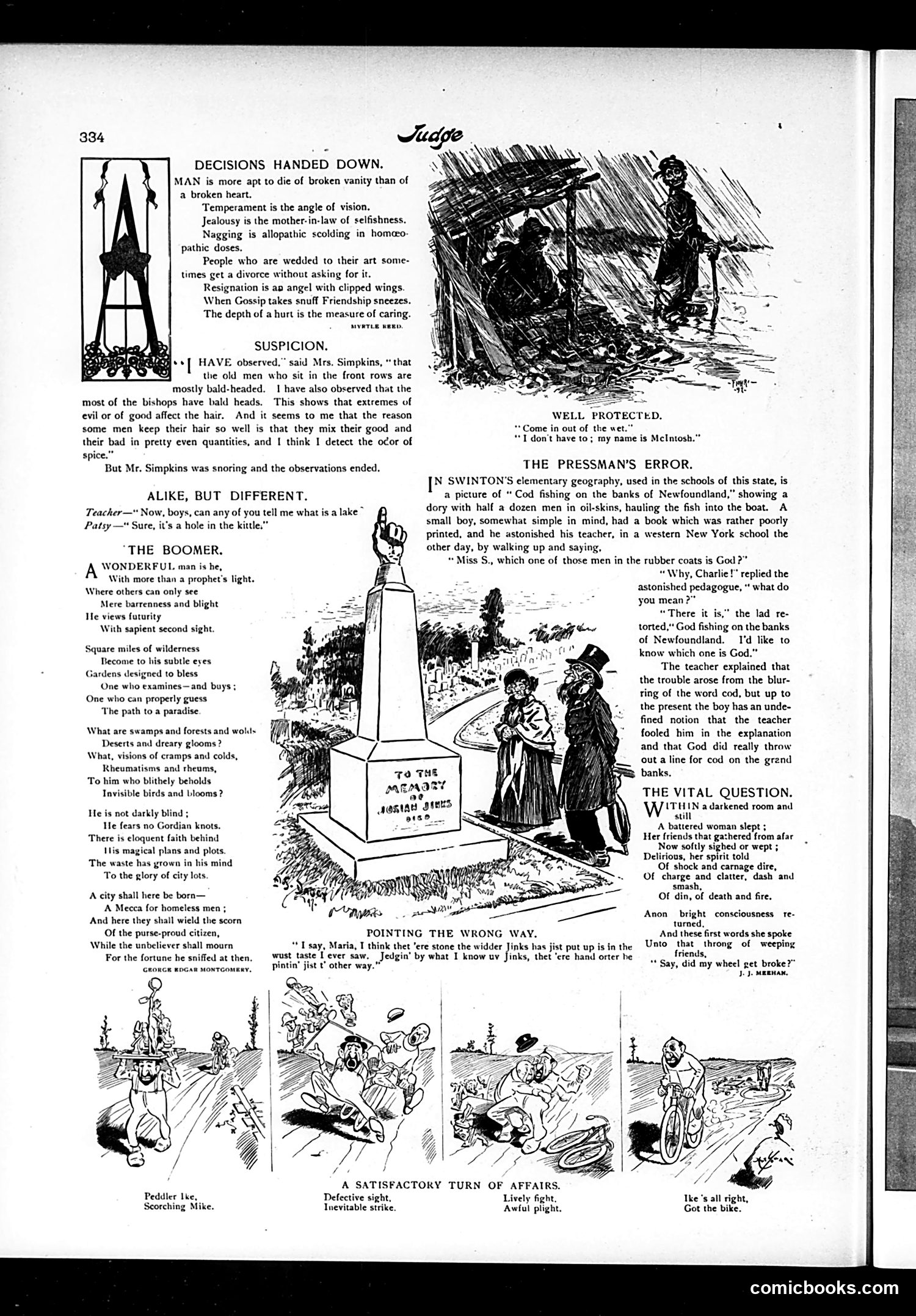
This page contains satirical commentary and humorous anecdotes typical of Judge magazine's social criticism. **"Decisions Handed Down"** offers cynical observations on human nature—broken vanity kills more than broken hearts; gossip destroys friendship. These are mock-philosophical aphorisms skewering pretension. **"Suspicion"** mocks Mrs. Simpkins's pseudo-scientific reasoning: bald men in front church rows and bald bishops both exist, therefore baldness indicates moral extremity. The joke is her illogical leap from observation to conclusion. **"The Boomer"** satirizes land speculators and real-estate promoters who see profit potential where others see worthless wilderness. The "boomer" possesses visionary optimism (or delusion) that transforms swamps into "city lots," appealing to homeless men's desperation. This critiques Gilded Age land schemes and unbridled commercialism. **"The Pressman's Error"** humorously describes a printing error in a schoolbook: "Cod fishing" becomes "God fishing," leading a naive student to ask which rubber-coated fisherman is God. The joke exploits childhood literalism and printing mistakes. The page reflects Judge's satirical focus on American commercial excess, social pretension, and absurdity.
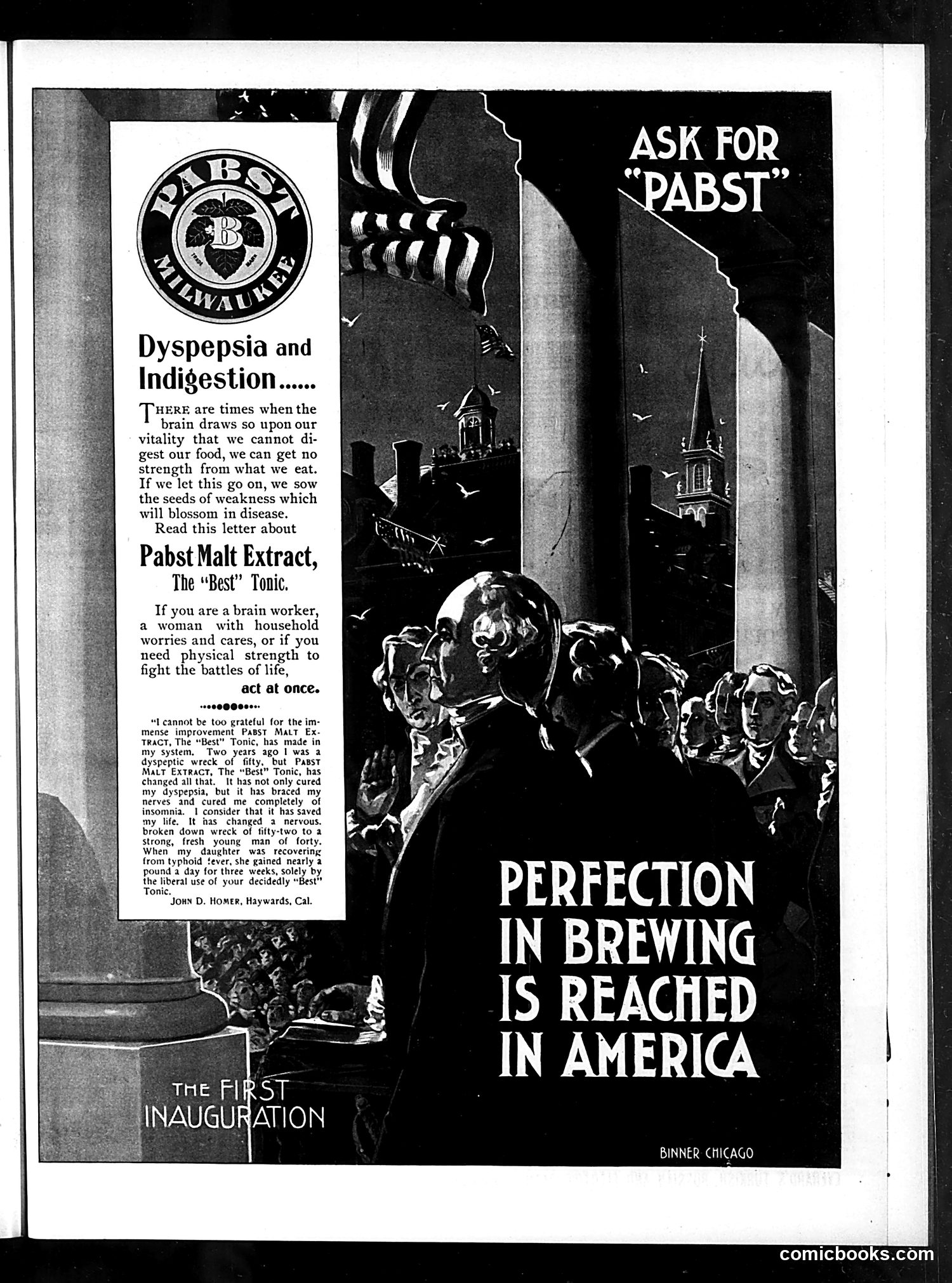
This page is primarily **advertising**, not political satire. It promotes Pabst Malt Extract as a medicinal tonic for digestive ailments and general weakness. The left side features a testimonial from John D. Homer claiming the product cured his severe dyspepsia and restored his vitality. The right side shows an allegorical illustration—"The First Inauguration"—depicting figures ascending toward a cathedral, symbolizing the triumph or elevation promised by the product. The headline "Perfection in Brewing is Reached in America" asserts American manufacturing superiority, a common early-20th-century advertising trope. This reflects the era's patent medicine culture, when tonics made unregulated health claims. Pabst Malt Extract was marketed as a legitimate medicinal product, not purely as beer, exploiting consumer anxieties about modern ailments like "dyspepsia" caused by brain work and stress.
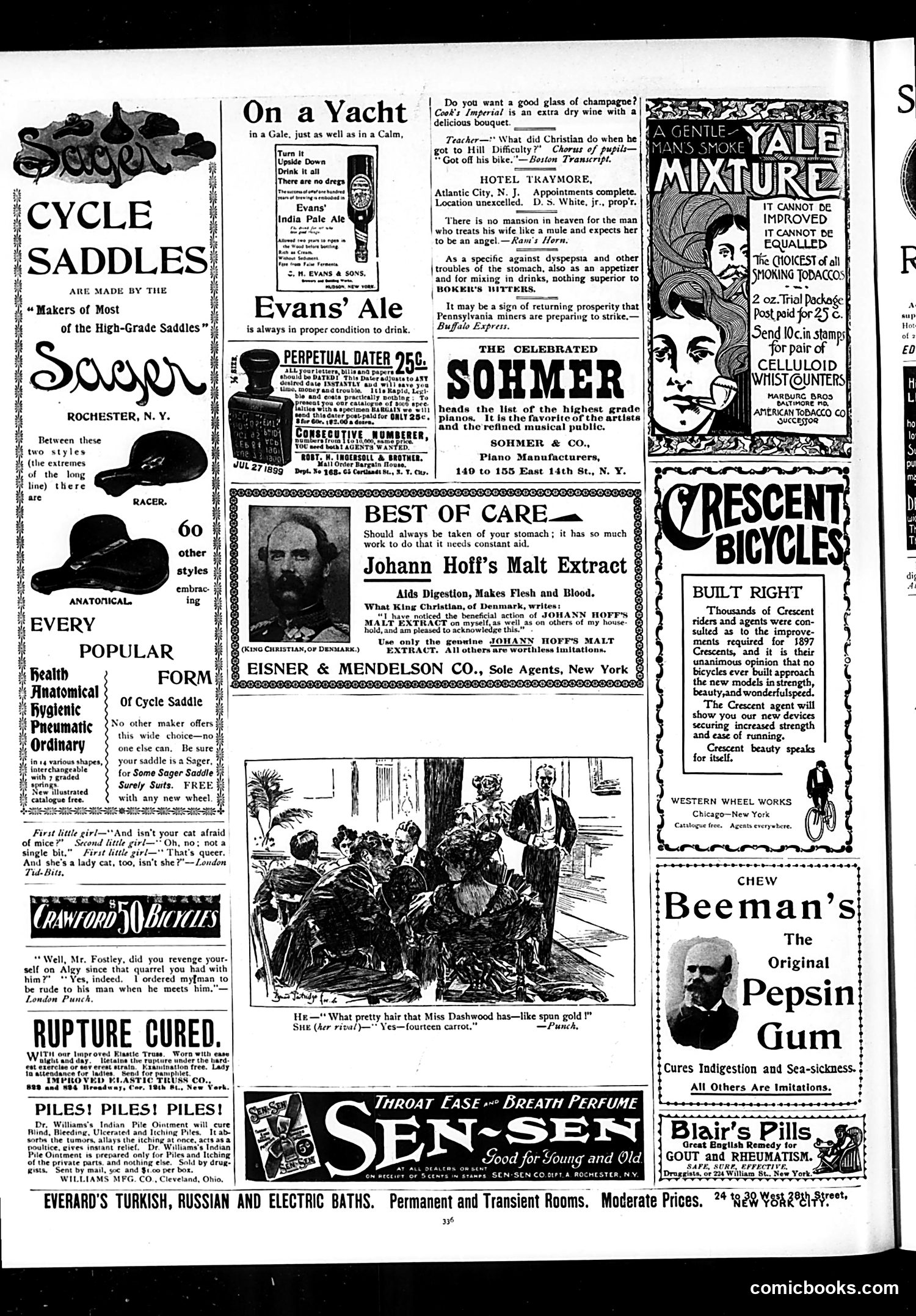
This is primarily an **advertising page** from Judge magazine, with one small cartoon at the bottom center. The main cartoon depicts a social scene with multiple figures in Victorian dress. The caption reads: "He—'What pretty hair that Miss Dashwood has—like spun gold!' She (her rival)—'Yes—fourteen carrot.'" This is a **joke about a woman's dyed hair**—the rival suggests Miss Dashwood's blonde hair is artificially colored (cheap/"carrot" colored), not natural gold. The humor relies on the cattiness of female social competition and mockery of beauty enhancement, common satirical targets in the era. The rest of the page contains **patent medicines and consumer goods advertisements** typical of the period: cycle saddles, ale, malt extract, piles ointment, bicycles, and tooth powder. These reflect both the commercial realities of magazine publishing and period consumer culture, including the prevalence of dubious medical "cures" before FDA regulation.
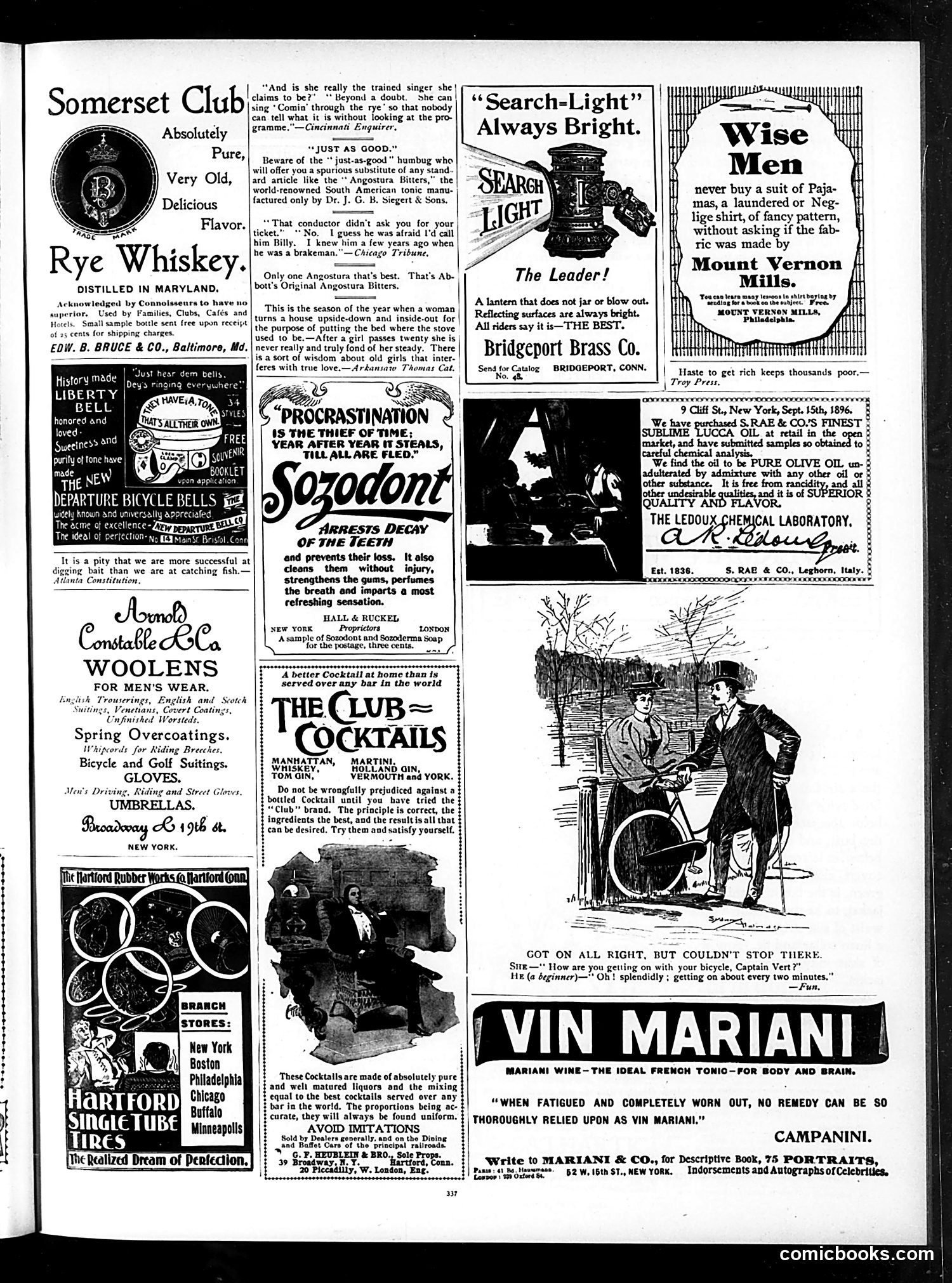
This page is primarily **advertisements and short humorous anecdotes** rather than political cartoons. The content reflects turn-of-the-century American consumer culture and social humor. **Key elements:** The brief jokes mock everyday situations: a singer who performs "Comin' through the Rye" unintelligibly, a conductor avoiding a passenger he knew as a brakeman, and observations about housewives rearranging furniture seasonally. **Advertisements dominate**, promoting whiskey (Somerset Club Rye), dental products (Sozodont toothpaste), ready-made cocktails, tires, bicycle lamps, and men's woolens. The ads emphasize quality and brand authenticity—notably the Angostura Bitters warning against "spurious substitutes." A central illustration shows two men with a bicycle by water, captioned with a joke about being unable to stop there. **The satire is mild**: poking fun at social pretension, advertising hype, and human foibles rather than political issues. This reflects Judge's role as a light humor and lifestyle magazine for middle-class readers, mixing entertainment with targeted consumer advertising.
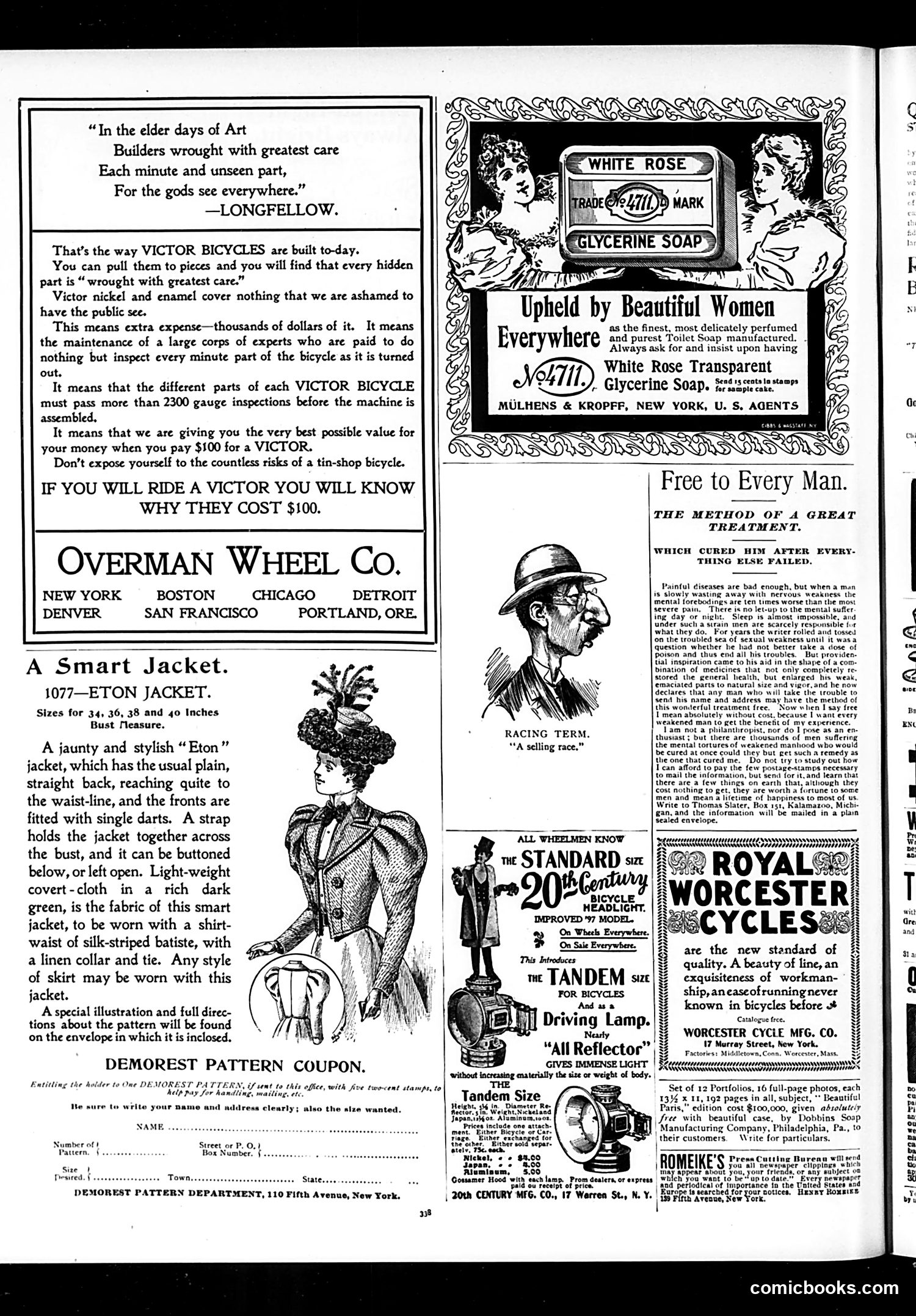
This page is primarily **advertising**, not satire or political commentary. The main content includes: 1. **Victor Bicycles ad** (left): Appeals to quality-conscious consumers by citing Longfellow poetry and emphasizing rigorous inspection (2,300 gauge checks). The sales pitch: premium craftsmanship justifies the $100 price tag—a significant sum in this era. 2. **Fashion pattern ad** (left): Offers a Demorest Eton jacket pattern for women, featuring styling details typical of the period. 3. **White Rose Glycerine Soap ad** (top right): Uses images of attractive women to market toilet soap as refined and pure. 4. **"Racing Term" illustration** (center): A humorous sidebar showing a bearded man labeled "A selling race"—appears to be a joke about auction terminology. 5. **Other product ads** (right side): Standard Period advertisements for bicycles, lamps, and medical treatments. The page reflects early-1900s consumer culture with no discernible political satire—it's a magazine revenue page filled with period-appropriate commercial appeals.
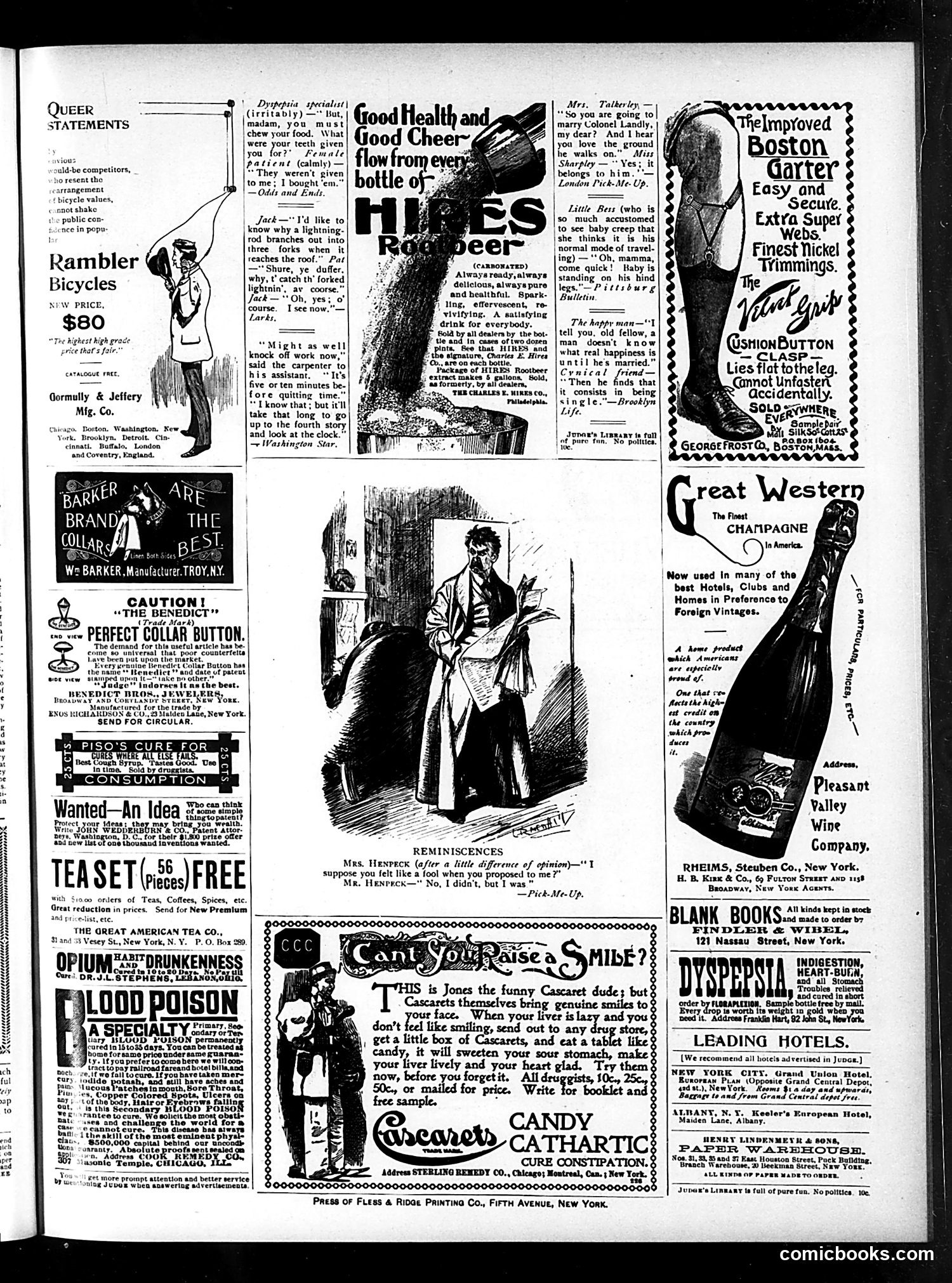
This page is primarily **advertisements and humorous filler content** typical of Judge magazine. The central cartoon titled "Reminiscences" shows a domestic dispute scene: a husband and wife arguing, with the caption implying he felt foolish after proposing marriage to her. The humor relies on the era's common marital conflict trope—portraying marriage as a man's regrettable mistake. The surrounding content consists of product ads (Rambler bicycles, Hires Rootbeer, Cascarets candy laxative) mixed with brief comic anecdotes under "Queer Statements"—short jokes about literal-minded servants, lazy workers, and nagging wives. These reflect period attitudes: gender dynamics favoring men, class distinctions, and bodily humor. The page contains no apparent political satire or commentary on major events. Instead, it represents Judge's formula of light domestic humor and commercial advertising aimed at middle-class readers seeking entertainment and consumer goods.
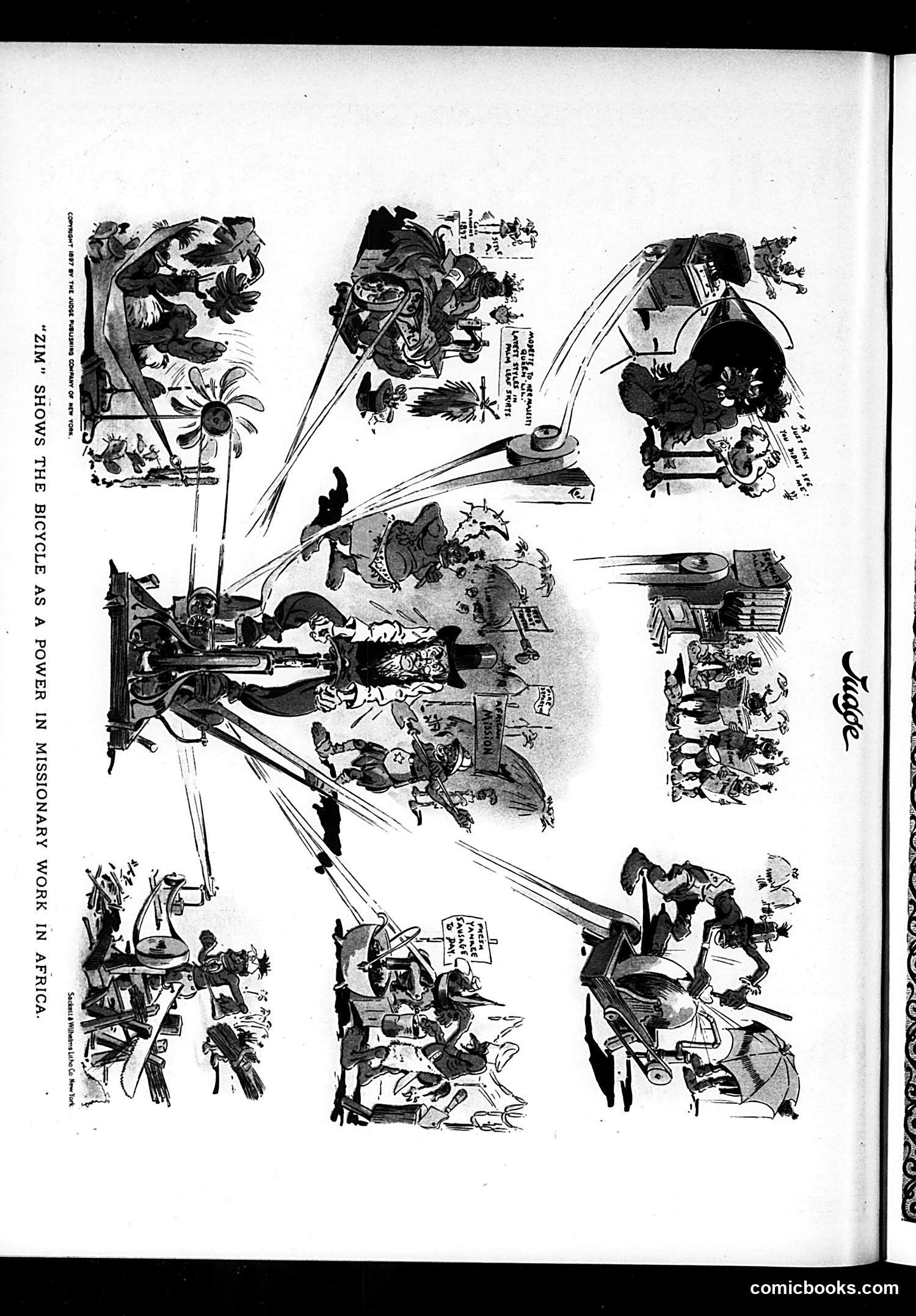
This page from *Judge* magazine features cartoons by "Zim" (Eugene Zimmerman) depicting bicycles as tools for missionary work in Africa. The central large illustration shows a bicycle as a powerful force—literally radiating energy—being used to spread Christianity and Western influence across the continent. The surrounding smaller panels illustrate various scenarios where bicycles facilitate missionary activities: transporting missionaries, reaching remote populations, and converting African peoples. This reflects late-19th/early-20th-century attitudes celebrating Western technological superiority and the "civilizing mission" of colonialism. The satire likely mocks both the exaggerated faith in technology's transformative power and the patronizing view of African peoples as passive recipients of Western "progress" and religion.
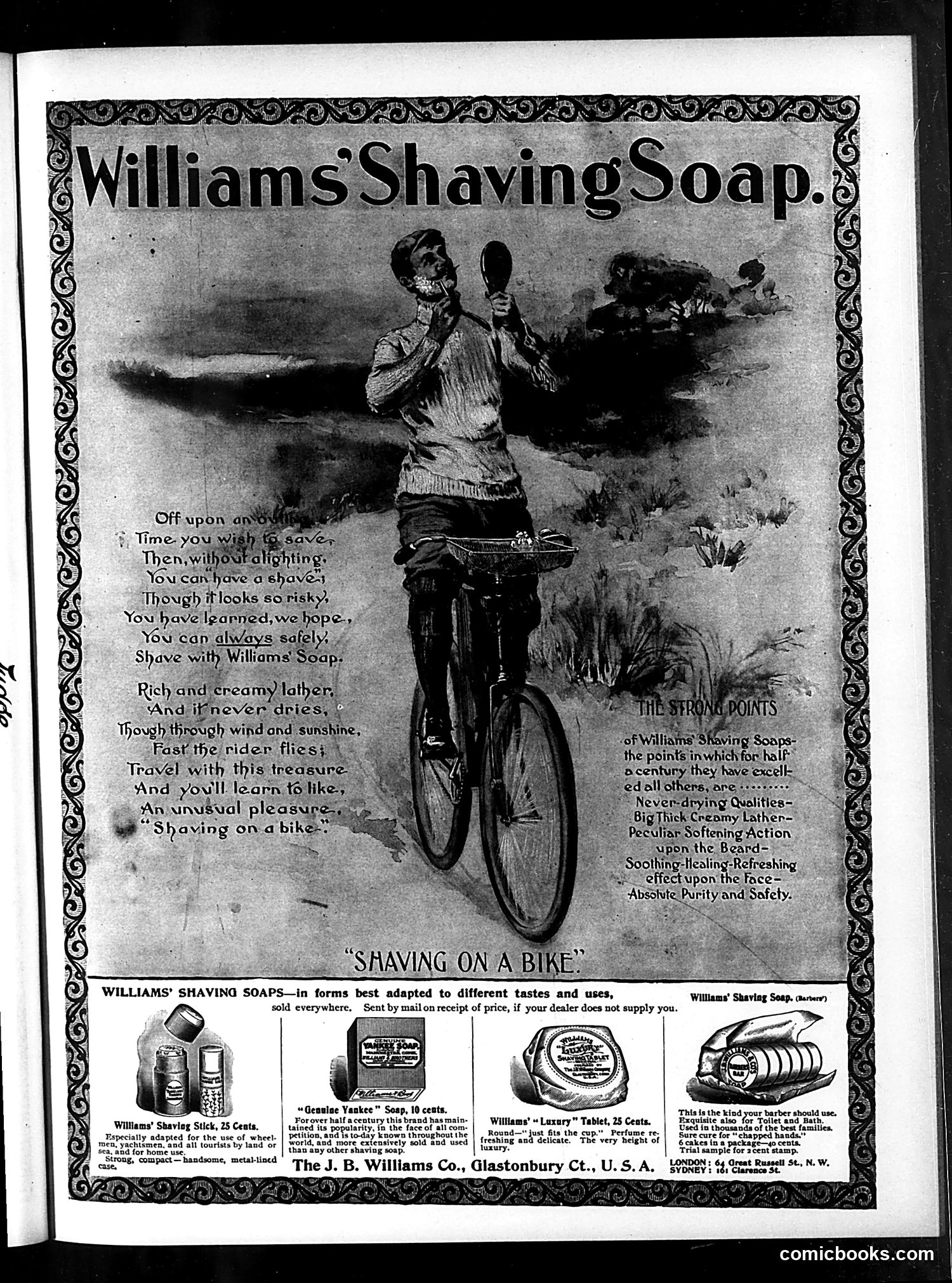
This page is primarily a **product advertisement**, not political satire. It promotes Williams' Shaving Soap through an illustrated ad featuring a man "shaving on a bike"—a humorous, attention-grabbing image showing someone precariously balancing while shaving during bicycle travel. The accompanying poem humorously suggests the soap's reliability: even during risky activities like cycling, one can shave safely. The satirical edge is gentle—poking fun at the absurdity of the scenario rather than targeting political figures or issues. Below the main illustration, the ad showcases five different soap product variants (Shaving Stick, Genuine Yankee Soap, Luxury Tablet, etc.) with prices and uses, emphasizing their popularity and quality over "half a century." The company is J.B. Williams Co. of Glastonbury, Connecticut. This represents typical **late 19th/early 20th-century advertising**—using humor and illustration to build brand recognition and product differentiation in a competitive market.
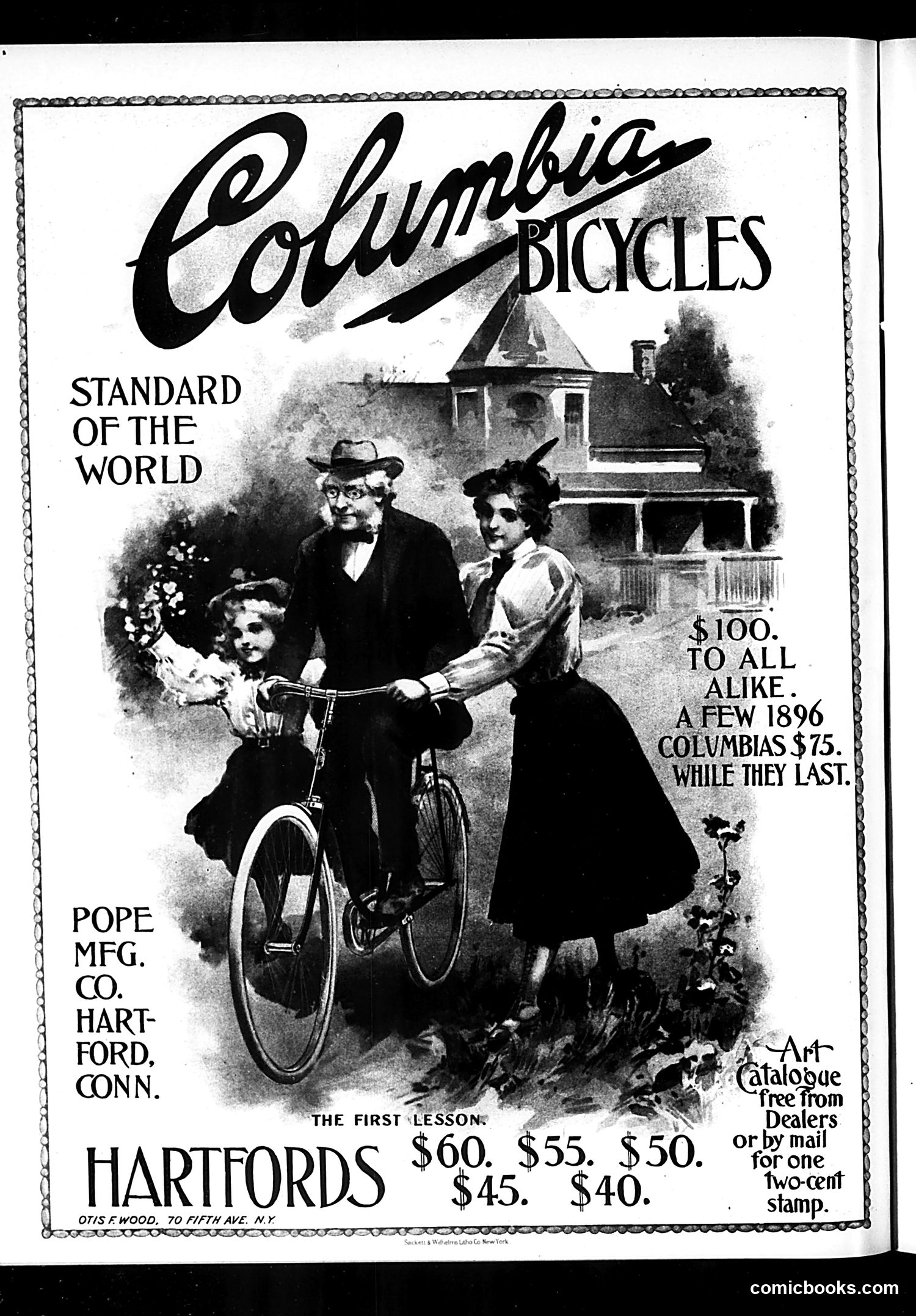
This is primarily a **bicycle advertisement**, not political satire. Columbia Bicycles, manufactured by Pope Mfg. Co. (Hartford, Connecticut), markets their products as the "Standard of the World." The image depicts "The First Lesson"—a domestic scene where an older gentleman teaches a young woman to ride a bicycle, while another woman observes. This reflects **late 1890s social commentary**: the bicycle was revolutionary for female independence and mobility, challenging Victorian restrictions on women's movement and clothing. The pricing ($40-$60) and special 1896 offer ($75 for older models) target affluent consumers. The satirical angle—if present—likely relates to how bicycles represented women's liberation, a contested social issue of the era. However, this reads primarily as earnest marketing capitalizing on bicycle enthusiasm rather than pointed satire.