
A complete issue · 16 pages · 1897
Judge — March 27, 1897
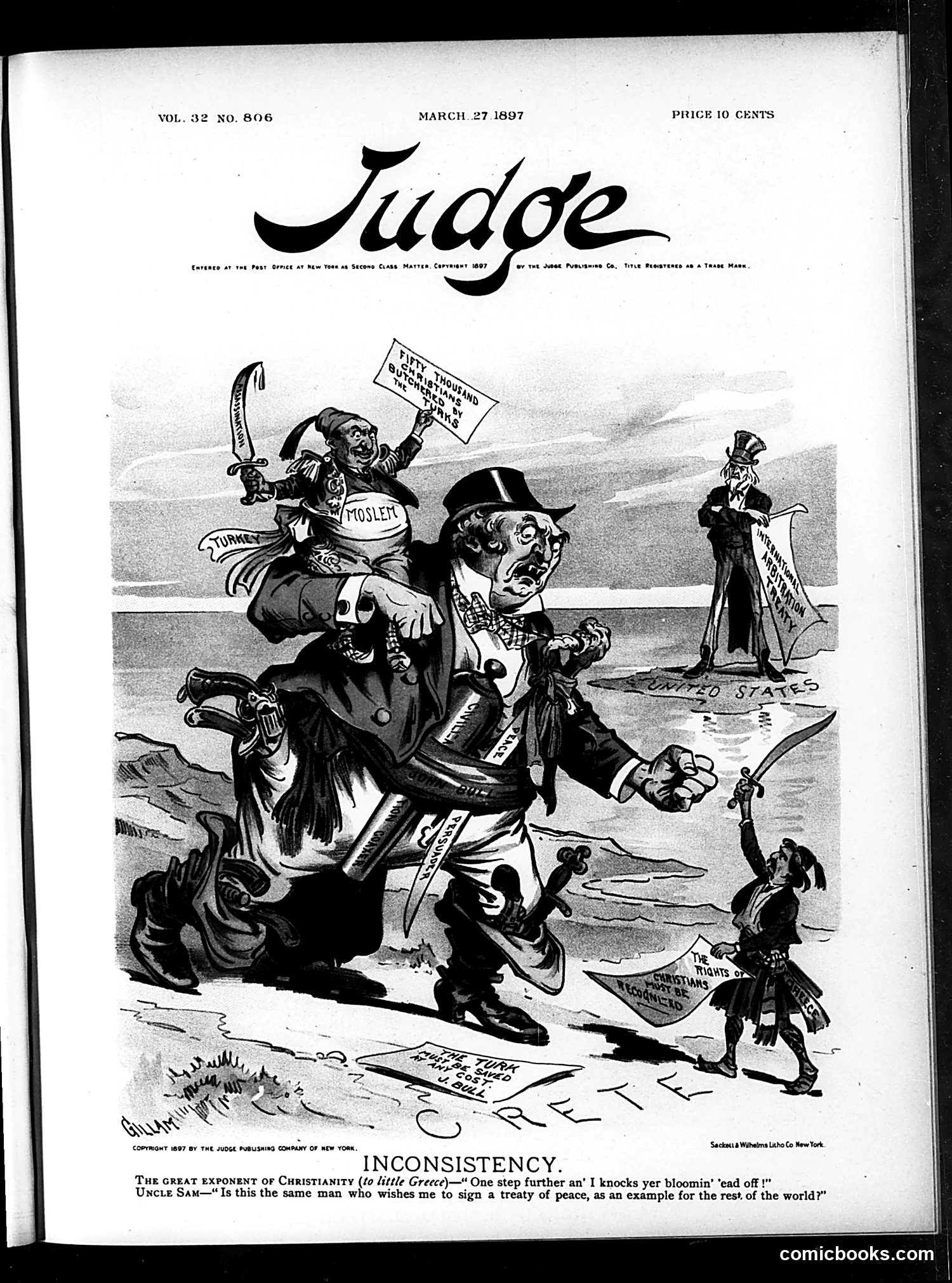
This cartoon satirizes what it calls "The great exponent of Christianity (to little Grace)"—Uncle Sam—for hypocrisy. The central caricature depicts Uncle Sam as a fierce warrior wielding a sword and holding a banner about "a thousand words," surrounded by smaller figures labeled with various nations or conflicts. The satire critiques Uncle Sam's contradictory positions: he preaches peace treaties to other nations while simultaneously engaging in military aggression. The quote captures this: Uncle Sam claims to wish others to "sign a treaty of peace, as an example for the rest of the world," yet his violent posture suggests otherwise. The cartoon appears to reference American imperialist ambitions during the 1890s, when the U.S. was expanding its global military involvement despite professing peaceful intentions.
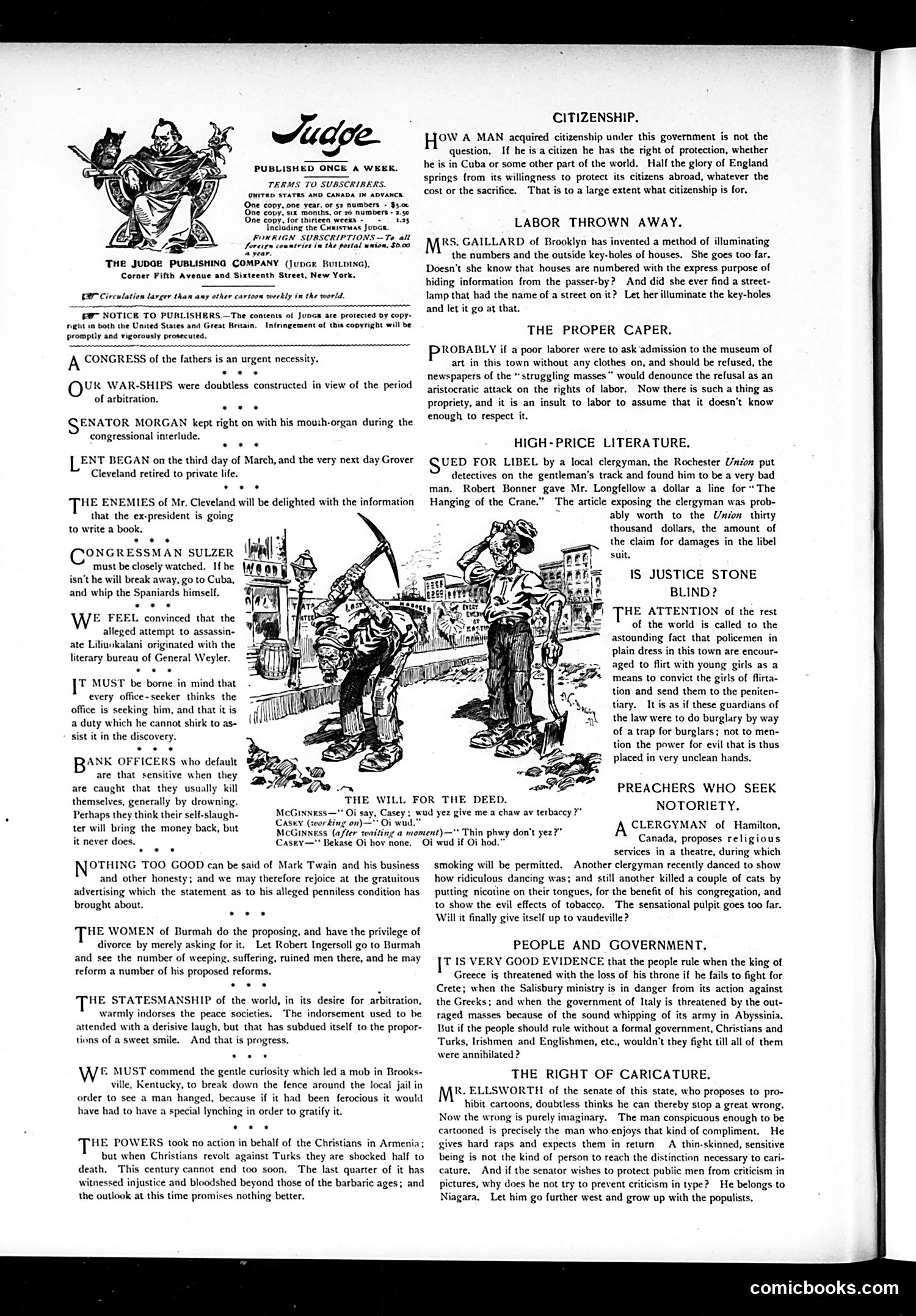
This cartoon depicts a street scene where a man appears to be attempting to assault or harass a woman, while another figure (possibly a police officer or authority) observes. The accompanying dialogue suggests the perpetrator is claiming good intentions despite his clearly predatory behavior—the caption "The Will for the Deed" implies his stated wishes don't match his actions. The satire targets hypocrisy: men (particularly those in positions of authority or respectability) who claim virtuous motives while behaving exploitatively toward women. The cartoon critiques the gap between professed morality and actual conduct, particularly regarding street harassment and women's safety—a social problem Judge's editors felt was being excused or ignored by society.
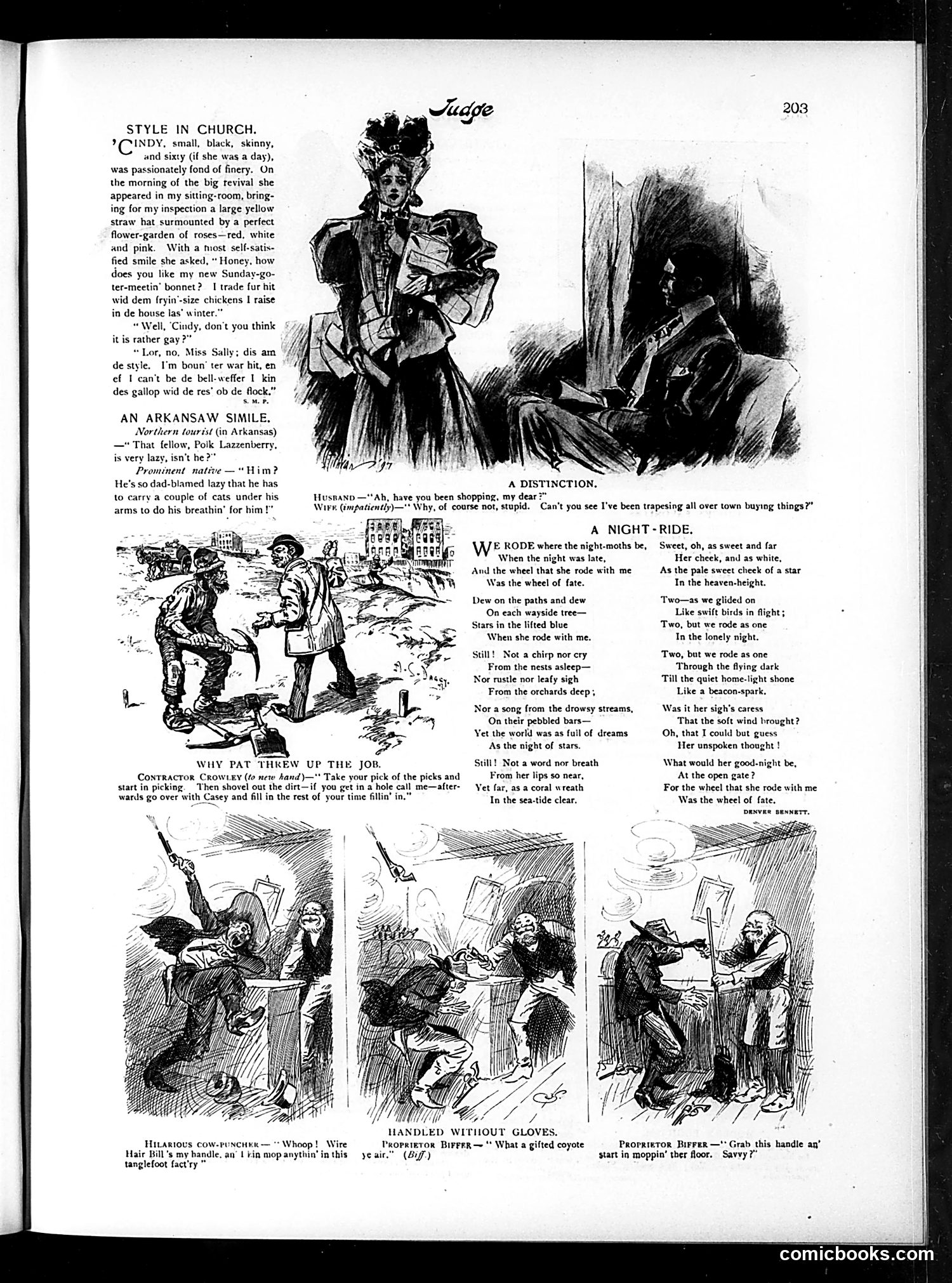
This page contains humor pieces and illustrations typical of late 19th/early 20th-century satirical magazine content: **"Style in Church"** mocks a woman named Cindy for wearing an ostentatious yellow dress with roses to church—prioritizing fashion over religious decorum. **"An Arkansas Simile"** jokes about a lazy man who won't work, comparing him to a cat lounging on his chest. **"A Night-Ride"** is a romantic poem about two riders under stars. **"Why Pat Threw Up the Job"** shows a contractor quitting work due to difficult labor conditions. The bottom three cartoon panels depict slapstick humor involving workers and physical comedy—"Hilarious Cow-Puncher," "Handled Without Gloves," and "Proprietor Ruffed," all featuring comedic violence or mishaps typical of Judge's working-class humor.
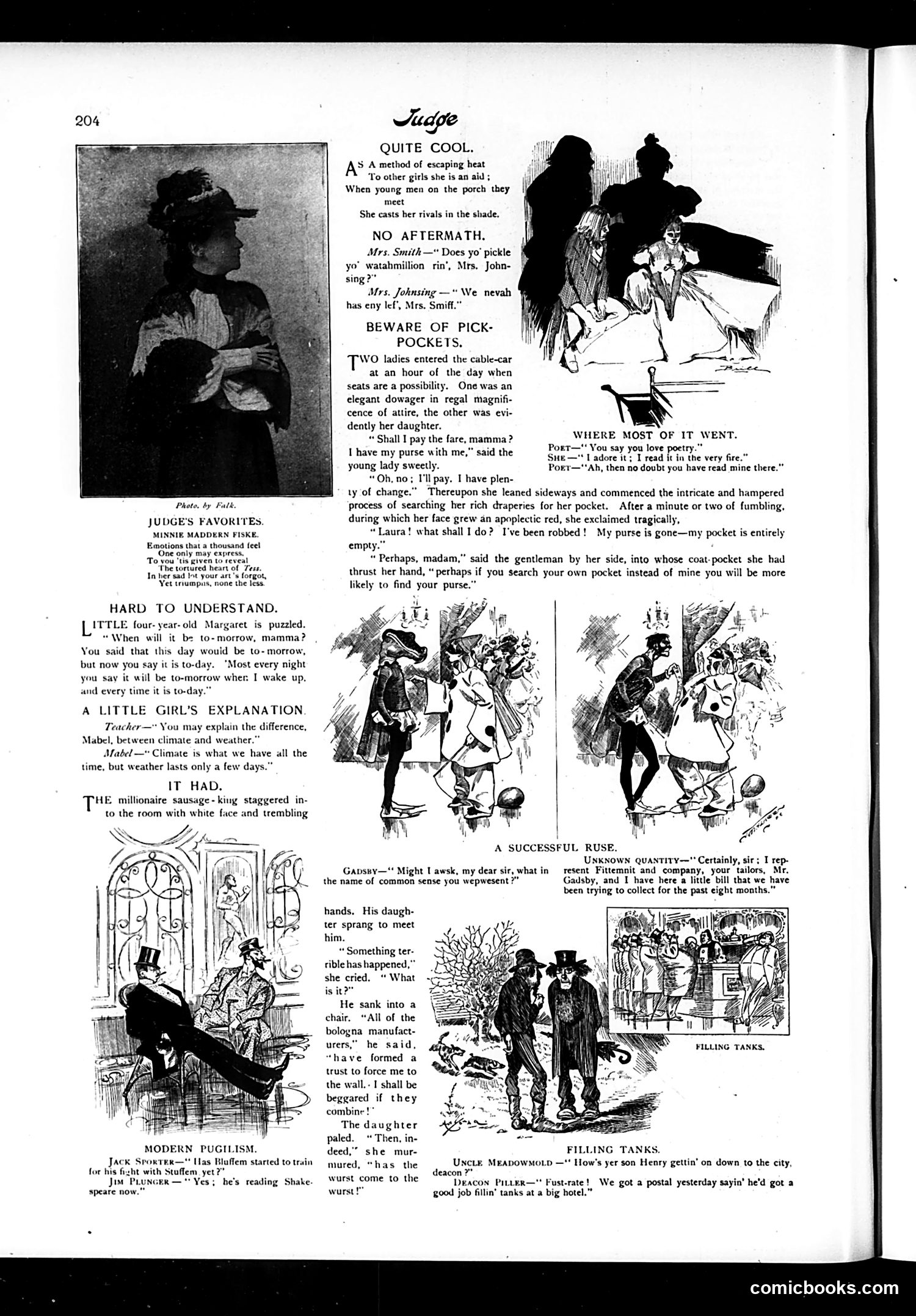
This page collects brief satirical sketches typical of Judge magazine's humor, targeting middle and upper-class social pretensions around 1900. **Key pieces:** - **"Beware of Pickpockets"**: A wealthy dowager struggles to find her purse in her elaborate dress while searching a gentleman's coat pocket, then accuses him of theft. The joke: she's actually pickpocketed *him* while fumbling through his pocket. - **"Quite Cool"**: A young woman keeps rivals away by casting them "in the shade"—flirting with young men on porches. - **"No Aftermath"**: African American domestic servants discussing watermelon preservation, using dialect stereotyping common to the era's racist humor. - **"Where Most of It Went"**: A man claims his poetry is so bad it belongs in the fire—self-deprecating humor about artistic failure. - **"Hard to Understand"**: A child confused about "tomorrow" versus "today." The magazine's humor relies heavily on period class anxiety, racial caricature, and domestic/romantic mishaps.
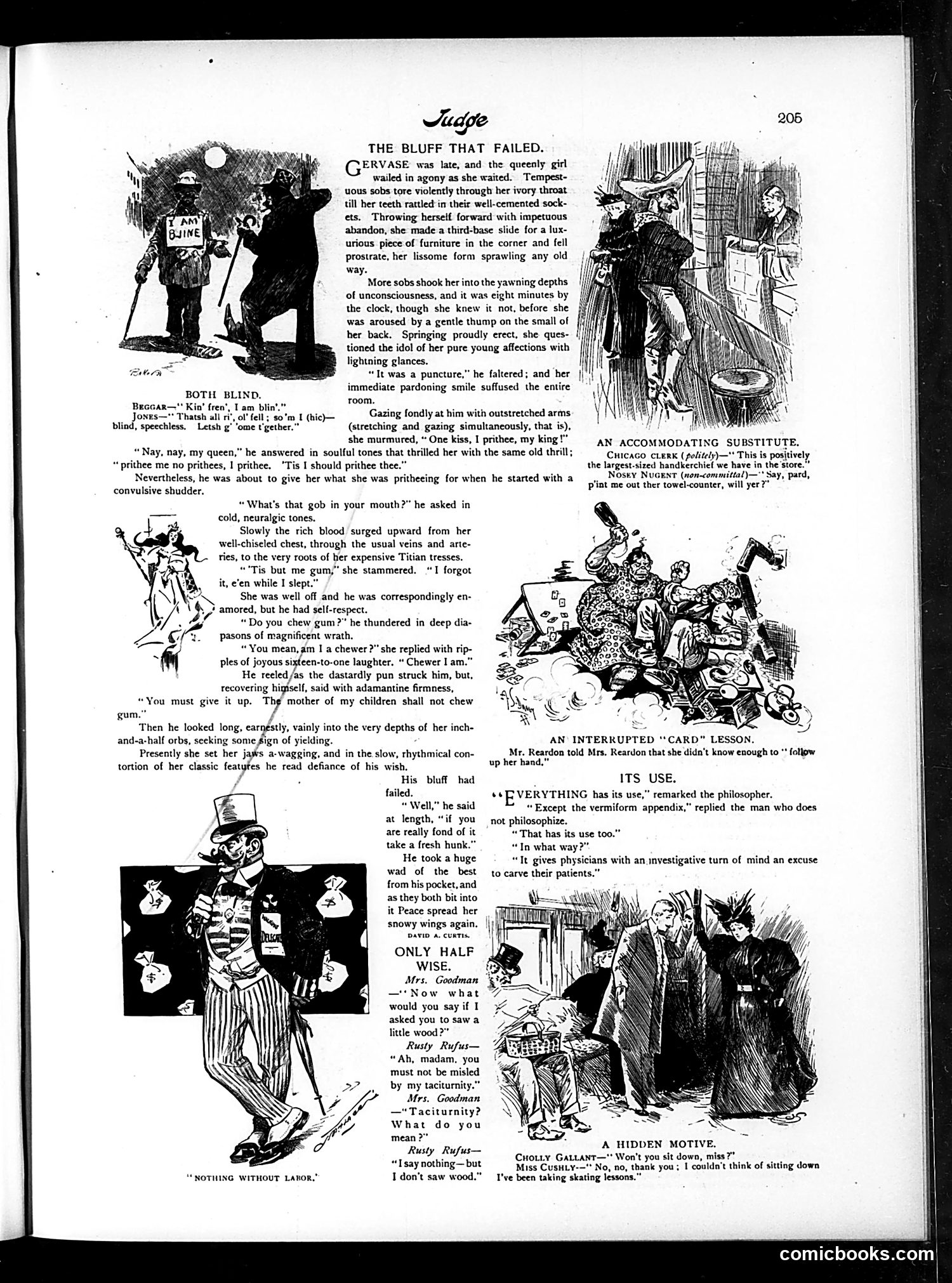
This page contains several brief humorous sketches typical of early 20th-century Judge magazine. The main story, "The Bluff That Failed," mocks romantic melodrama: a woman dramatically waits for her suitor, who arrives late with a puncture excuse. She forgives him readily, but when he discovers she chews gum, he theatrically threatens to leave. She calls his bluff by refusing to quit, and he immediately capitulates—hence the title. The surrounding cartoons offer brief comedic vignettes: two drunk men, a large handkerchief purchase, a woman who defies her fiancé's demand to stop chewing gum, and social situations involving class dynamics. The satire targets romantic pretension, male posturing, and working-class behavior rather than specific political figures or events. The overall tone emphasizes domestic comedy and social observation rather than political commentary.
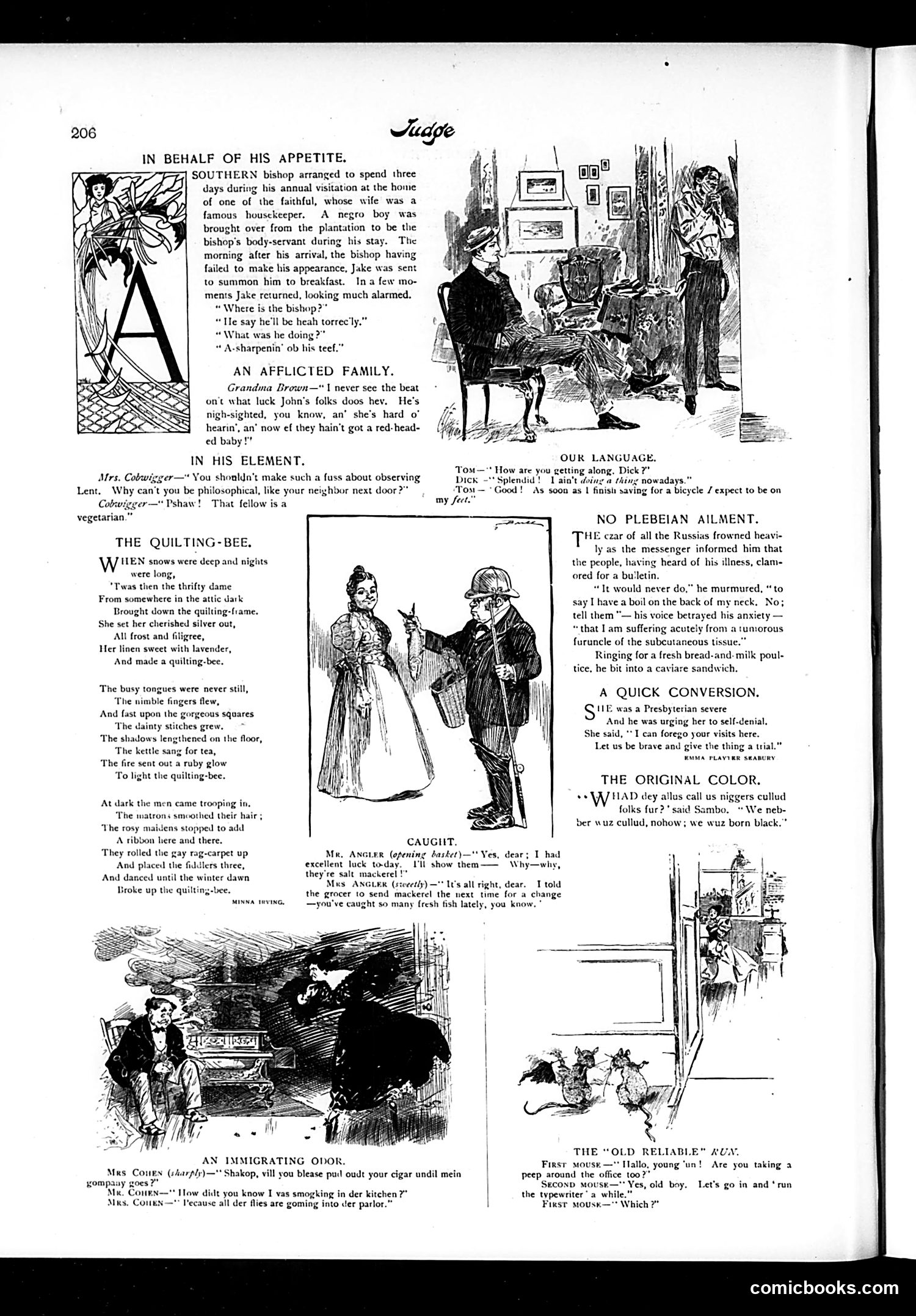
This page contains several short humorous pieces typical of Judge's satirical content from the late 19th/early 20th century. **Key Items:** - **"In Behalf of His Appetite"**: Mocks a Southern bishop through racial stereotype humor, with a enslaved boy reporting the bishop is "sharpening his teeth"—implying gluttony. - **"The Quilting-Bee"**: A sentimental poem (not satire) about rural domestic life and community gatherings. - **"No Plebeian Ailment"**: Satirizes the Russian Czar's vanity—when ill, he demands doctors use the fancy term "furuncle of the subcutaneous tissue" rather than admit to a common boil. - **"An Immigrating Odor"**: Uses ethnic stereotypes (German accent) for humor about cooking smells. - **"The Original Color"**: Contains offensive racial dialogue using outdated terminology. The page relies heavily on period stereotypes (racial, ethnic, class-based) that were considered acceptable satirical fodder then but are now recognized as crude and offensive.
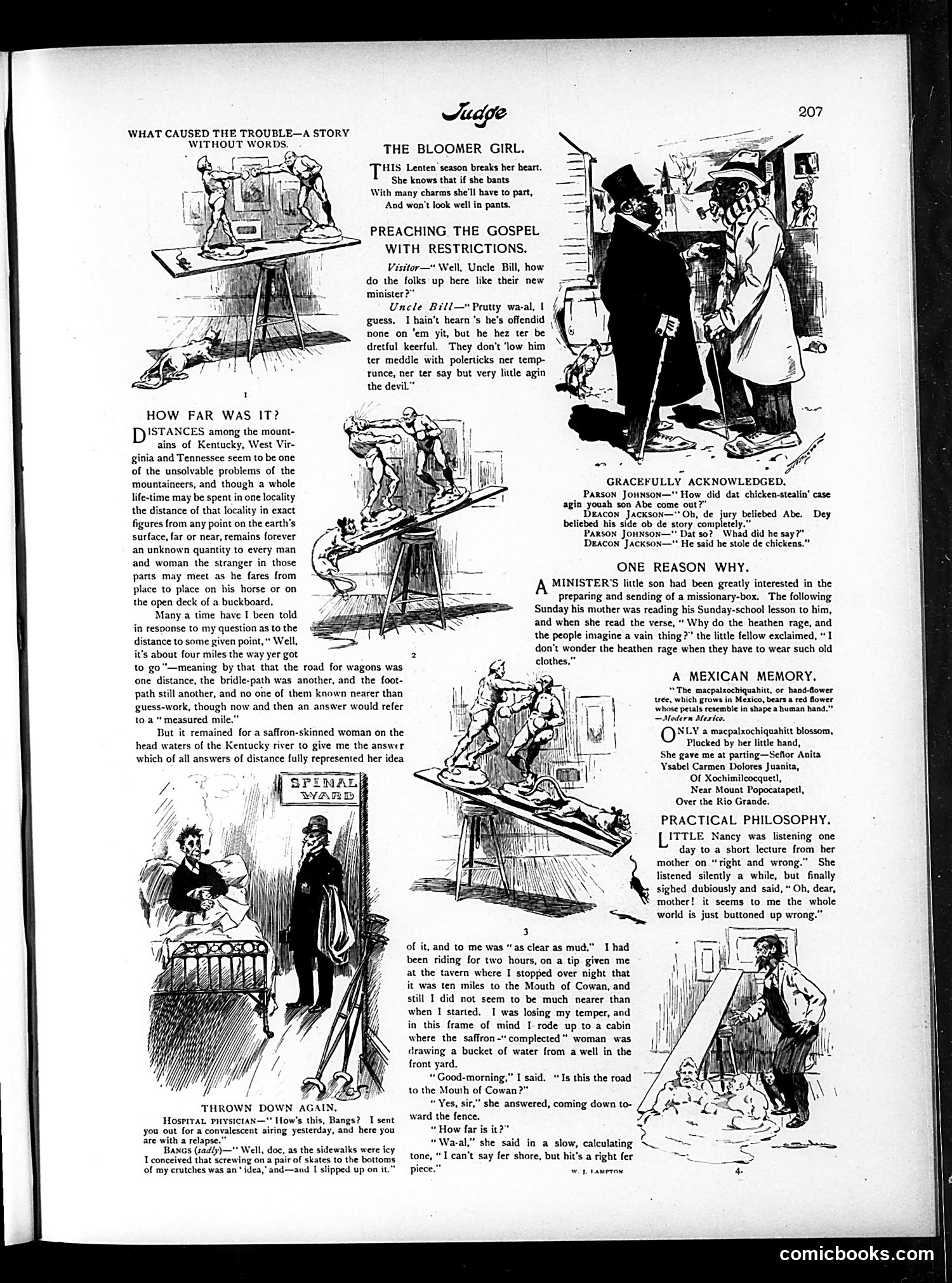
This page contains several brief satirical pieces typical of Judge's humor: **"How Far Was It?"** mocks Appalachian mountaineers' inability to measure distances precisely, culminating in a woman's answer that distance is "as clear as mud"—suggesting rural ignorance or indifference to factual information. **"The Bloomer Girl"** jokes about women's fashion reformers (bloomers) who fear Lenten fasting will make them look unflattering in their unconventional pants. **"Preaching the Gospel with Restrictions"** satirizes rural religious hypocrisy: a minister must avoid discussing politics, temperance, or the devil—essentially neutering his moral authority. **"One Reason Why"** uses a child's innocent logic to critique missionary work: why send clothes to "heathens" when they're old and worn? The remaining pieces are lighter anecdotes about clerical life, Mexican travel, and childhood philosophy. The overall tone reflects turn-of-century American urban attitudes toward rural and immigrant populations as quaint or foolish.
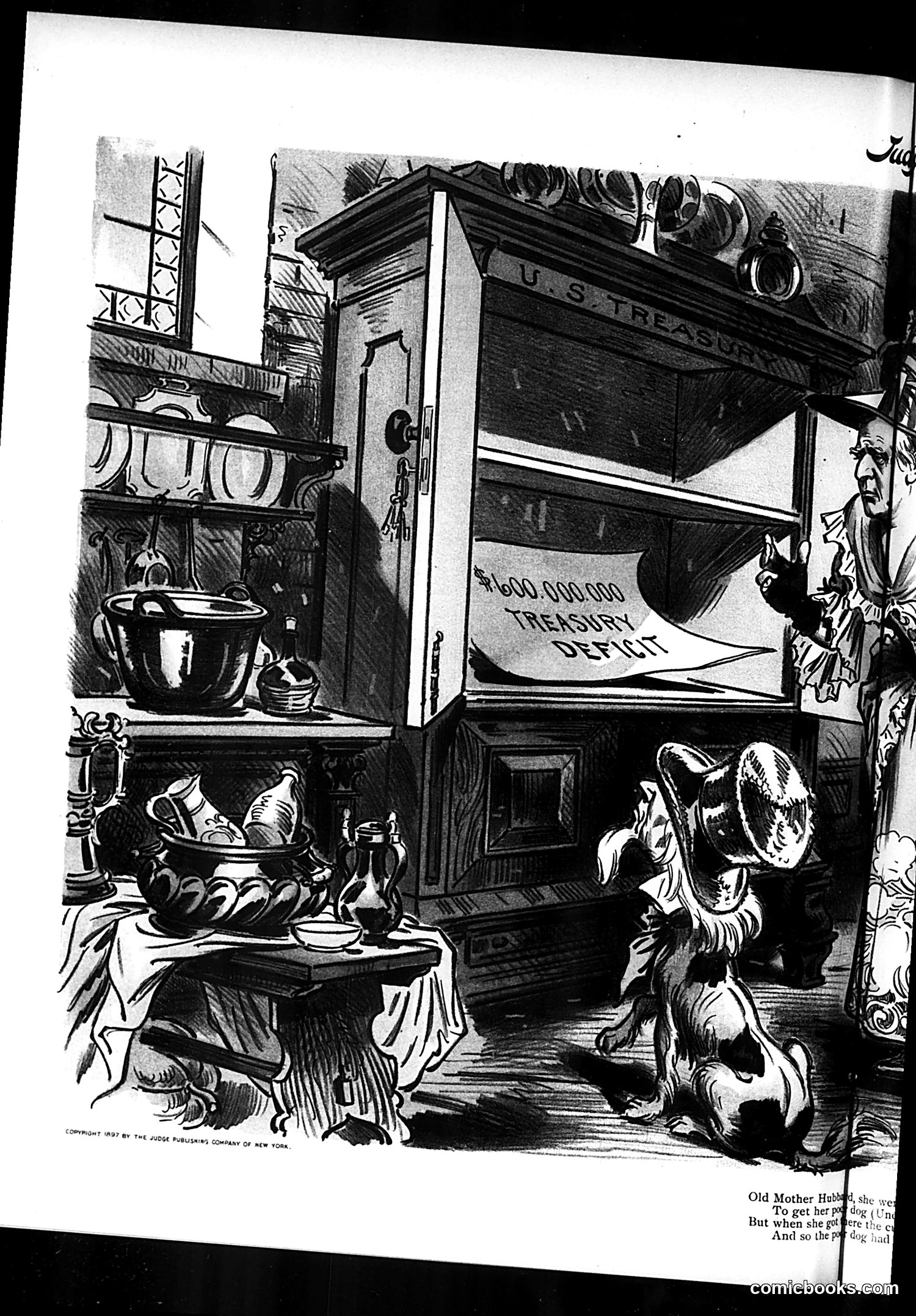
This appears to be a satirical cartoon from *Judge* magazine depicting a nursery-rhyme scene. The visible text references "Old Mother Hubbard" and mentions going to a cupboard for a dog. The central image shows a cupboard labeled "U.S. TREASURY" with a sign reading "$1,600,000,000 TREASURY DEFICIT" — indicating an empty or nearly bare treasury. An Old Mother Hubbard figure discovers this emptiness while seeking provisions. The satire criticizes a massive federal budget deficit, likely from the early 20th century (based on the copyright notice visible). The cartoon uses the familiar nursery rhyme to mock government fiscal mismanagement, suggesting the treasury is as bare as Mother Hubbard's cupboard. The anthropomorphized dog character watches helplessly as the nation's finances are depleted.
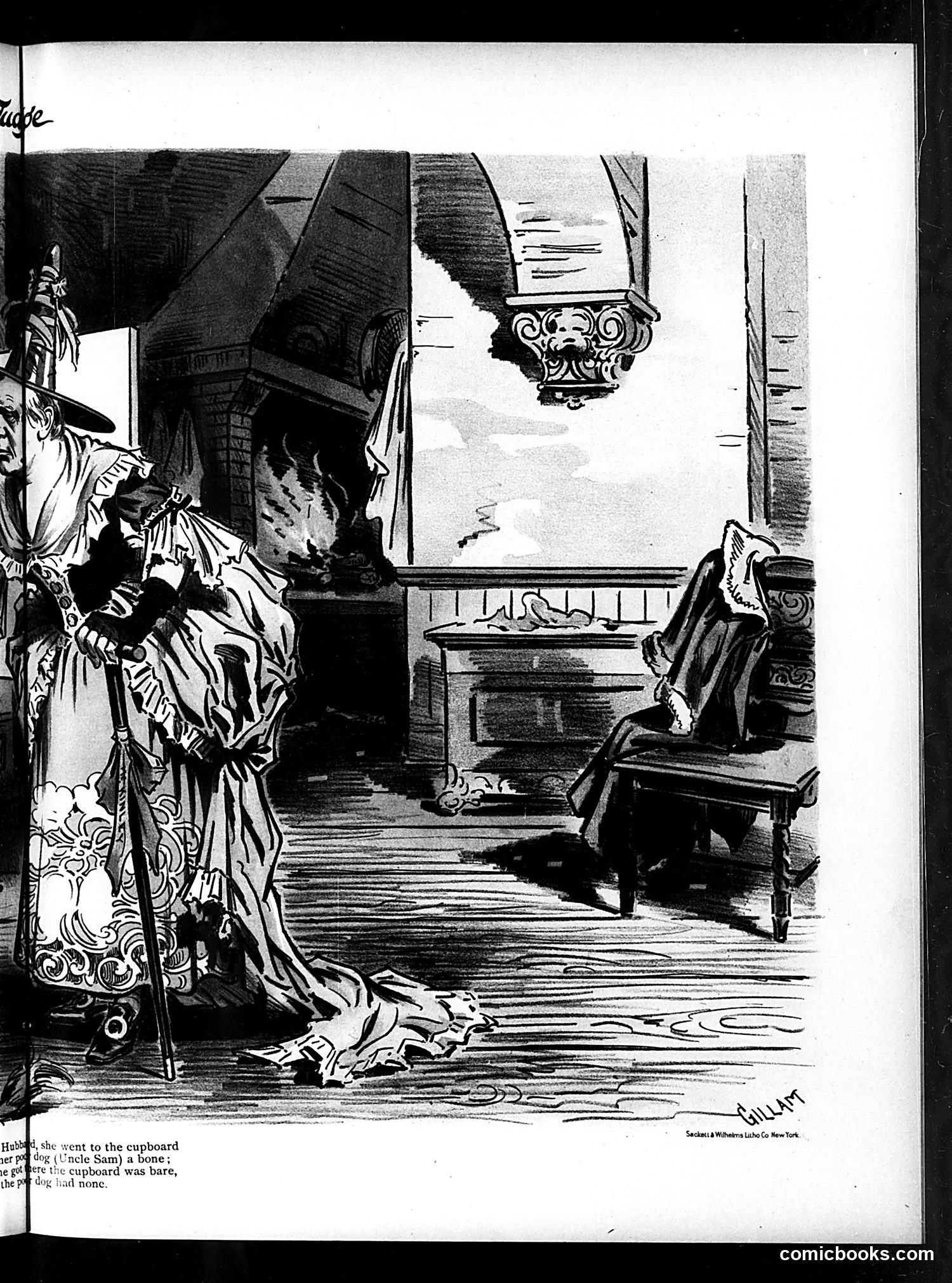
This appears to be a satirical illustration depicting a scene of class or social hierarchy. On the left stands an elaborately dressed figure in ornate robes, holding a staff—likely representing wealth, aristocracy, or political power. On the right sits a plainly dressed figure on a simple bench, appearing subordinate or dismissed. The contrast between their costumes and positioning suggests commentary on social inequality or the dismissal of common people by the powerful. The architectural setting with its grand details emphasizes the disparity. The OCR text fragment mentioning "Uncle Sam" and references to a dog and cupboard suggests this may critique American social conditions, though the full caption is partially obscured. The artist's signature appears at the bottom right. Without the complete text, the specific political target remains unclear, but the visual satire clearly mocks power imbalances.
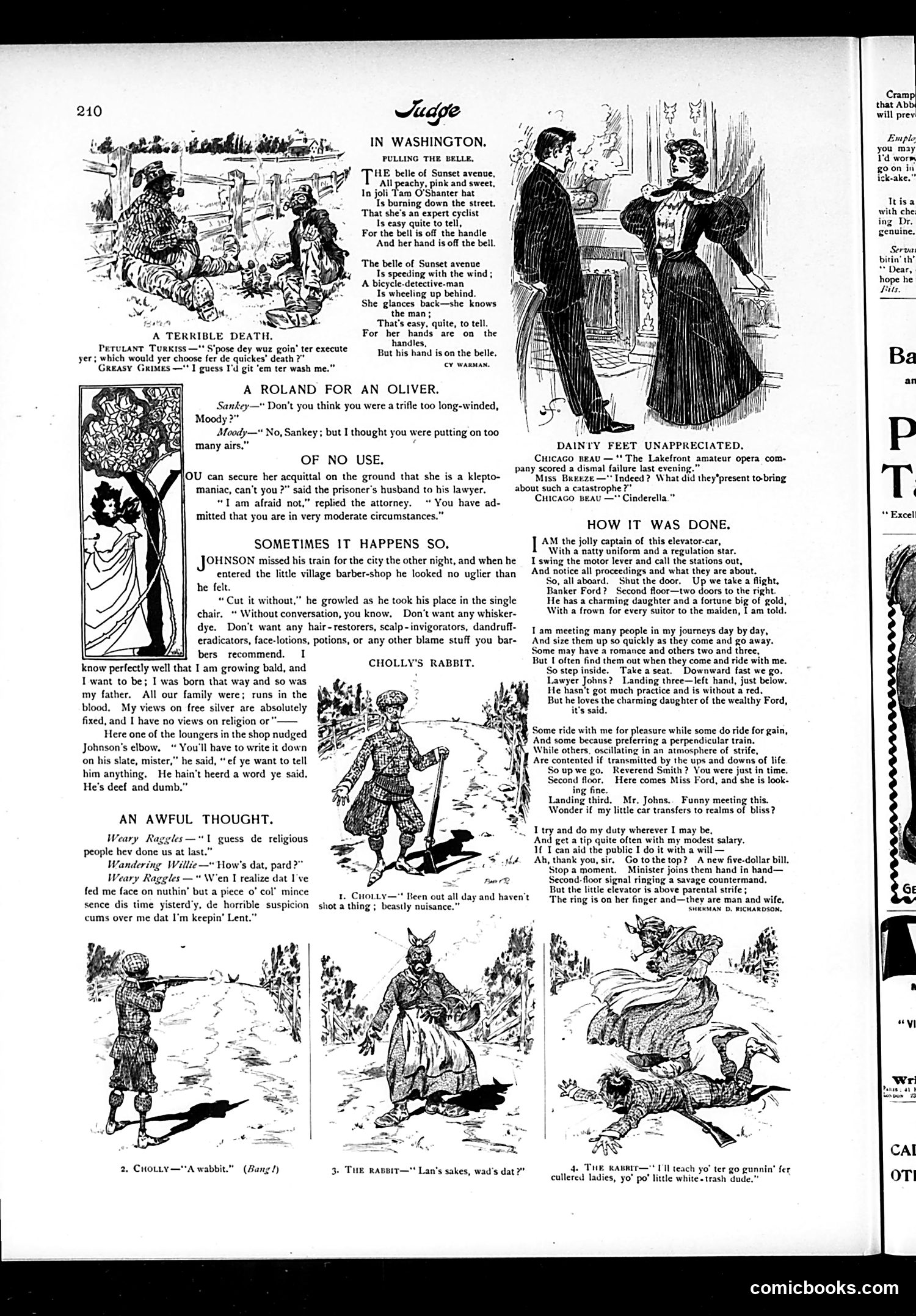
This page contains several brief satirical pieces typical of late-19th-century American humor: **"Pulling the Belle"** mocks a careless female cyclist on Sunset Avenue who removes her hands from the bicycle handlebar to ring the bell—the opposite of safe riding. A detective follows, implying social concern over women's independence. **"A Roland for an Oliver"** plays on the Sankey-Moody evangelist duo, with each accusing the other of affectation—a jab at religious revivalists. **"Sometimes It Happens So"** jokes about a deaf-and-dumb barber, where a customer's demands for silence become ironic. **"Cholly's Rabbit"** appears to be a four-panel visual gag (images numbered 2-4) involving a character named Cholly and a rabbit, though specifics are unclear. The remaining pieces are brief anecdotes satirizing American social types: vagrants, women's behavior, and urban life. The humor relies on period-specific references and stereotypes now largely obscured.
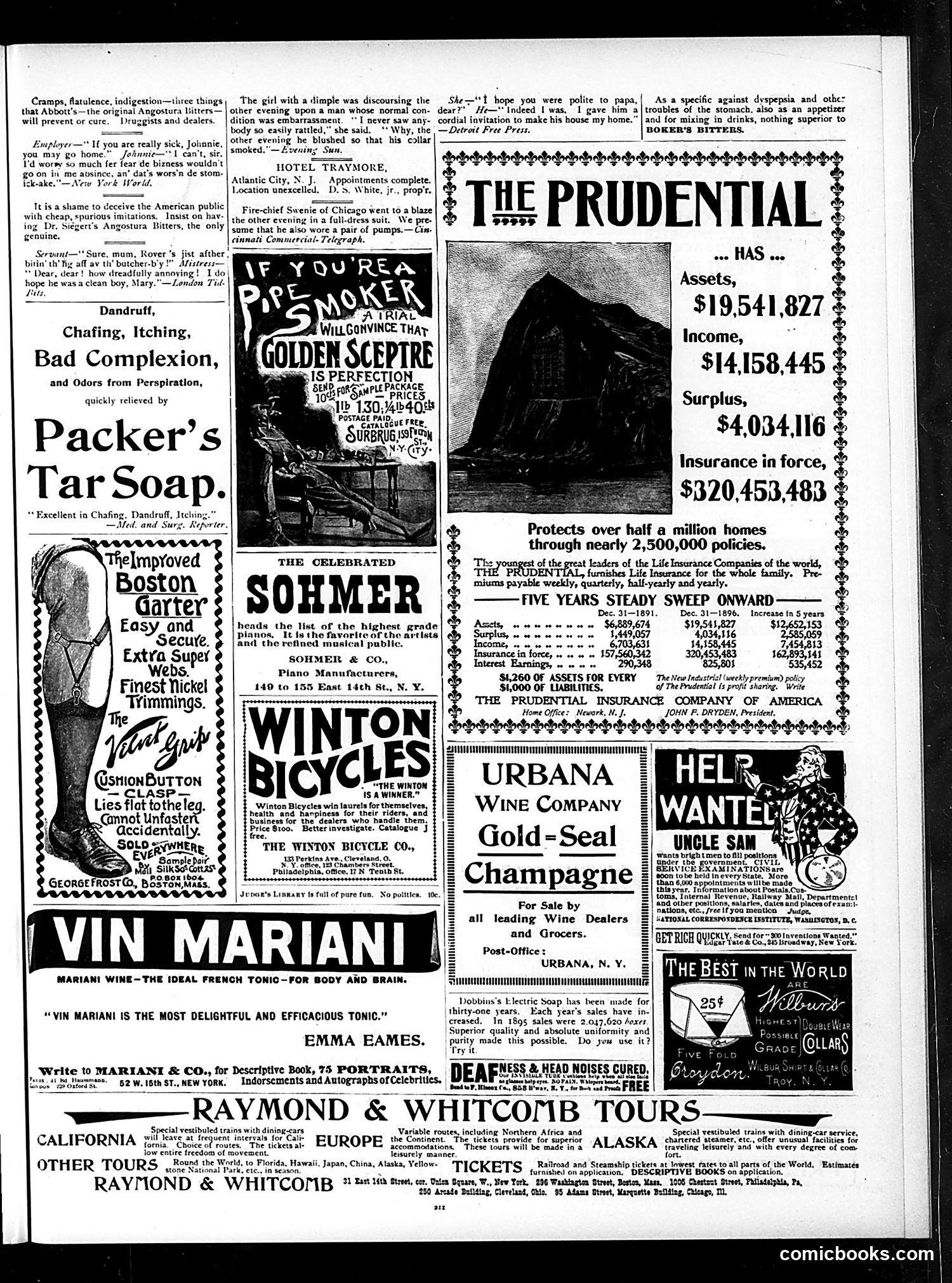
This page is primarily **advertising**, featuring various product and service endorsements typical of late 19th-century American magazines. The small comic vignettes scattered among ads are brief workplace or social humor: 1. **"Employer" joke**: A working-class boy (dialect suggests immigrant or poor background) refuses to go home sick because he fears the business will suffer without him—satirizing both employer exploitation and worker anxiety. 2. **"Girl with a dimple" anecdote**: A woman describes a chronically embarrassed man who blushed so intensely his collar turned red—mild social satire about awkwardness. 3. **"Fire-chief" quip**: A crude joke about a Chicago fire chief attending a blaze in formal dress, suggesting absurdity or pretension. The dominant content is **product advertising**: patent medicines (Angostura Bitters, Vin Mariani wine tonic), soap, bicycles, pianos, and notably **The Prudential Insurance Company**, whose large display emphasizes financial stability through statistical charts. No significant political commentary appears. The page reflects period consumer culture and working-class comedy conventions rather than satire.
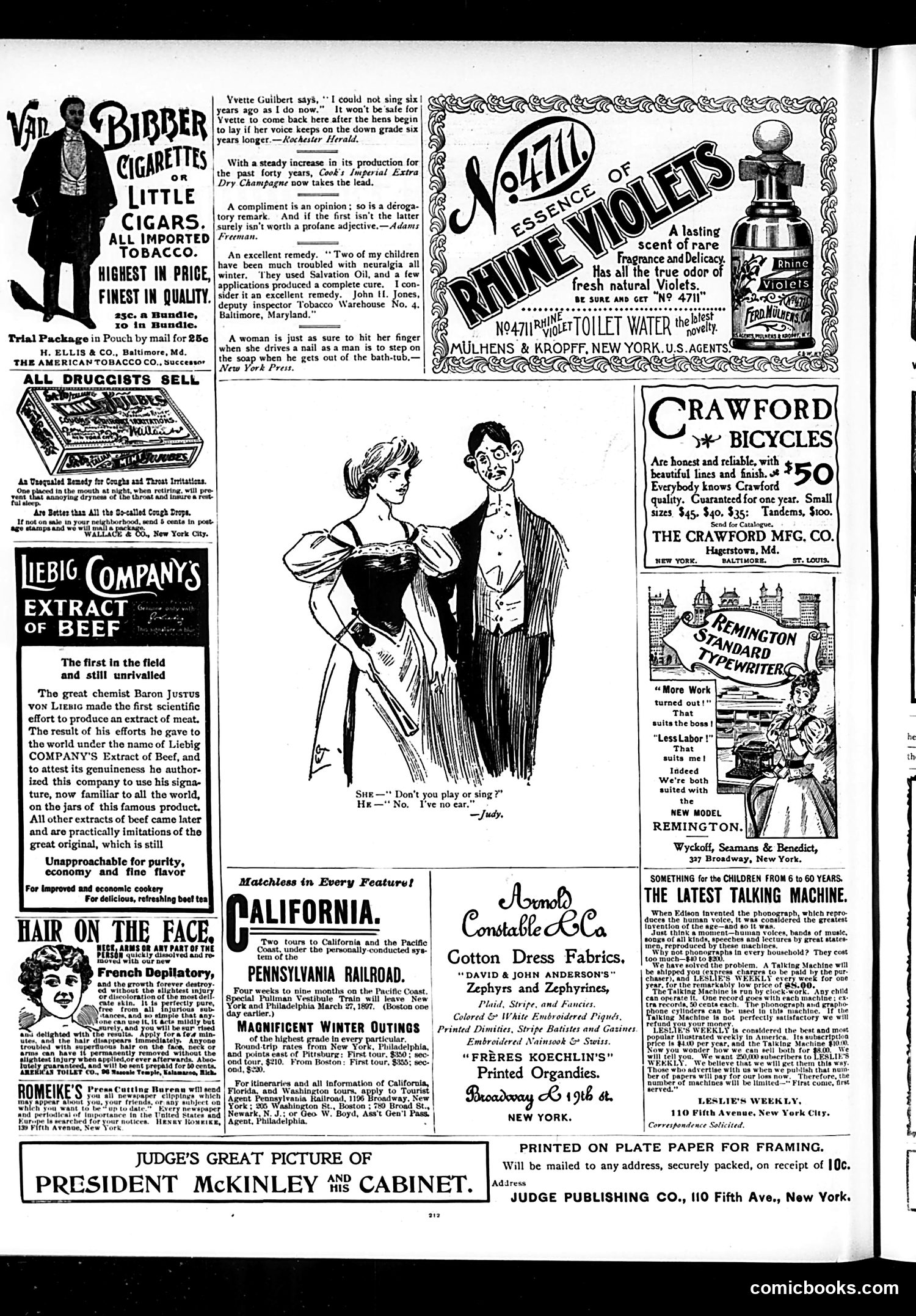
This is primarily an **advertising page** with one small cartoon at center. The cartoon shows a couple in formal dress. The woman asks, "Don't you play or sing?" The man replies, "No. I've no ear." This is a visual pun—he's being literal about lacking musical talent, but the joke plays on "ear" as both auditory sense and physical feature. The page is dominated by **period advertisements** for various products: Van Bibber cigarettes, Liebig's Extract of Beef, Crawford Bicycles, Remington typewriters, Arnold Constable fabrics, and California travel tours via Pennsylvania Railroad. There's also a small satirical quote at top from the *Leicester Herald* mocking singer Yvette Guilbert's declining voice. The content reflects **turn-of-the-century consumer culture**—luxury goods, emerging technologies (typewriters, bicycles), and leisure travel marketed to affluent readers. The cartoon's mild humor about tone-deafness fits Judge's typical light satirical tone, far removed from serious political commentary.
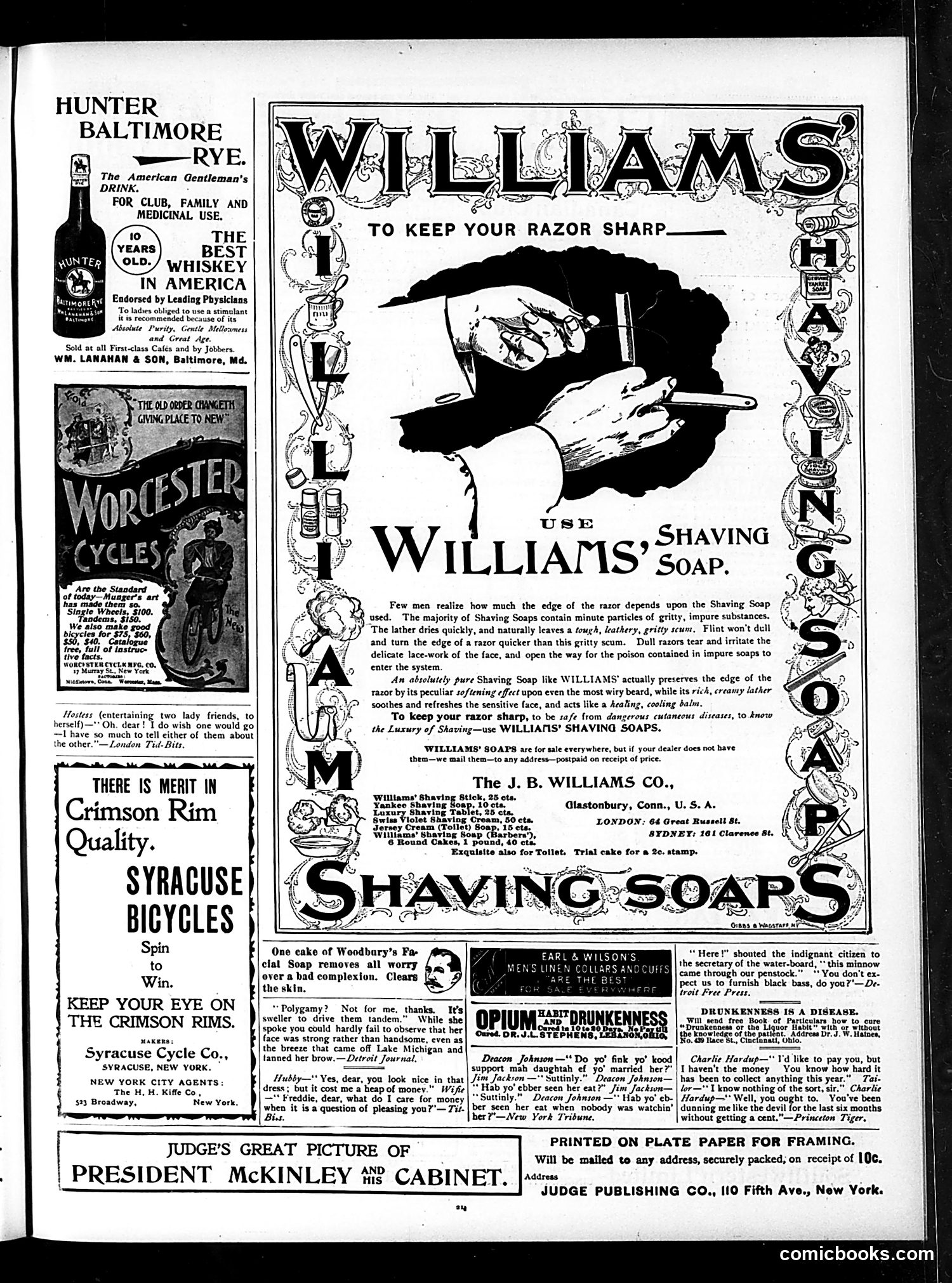
This page is primarily **advertisements** for consumer products (whiskey, bicycles, shaving soap, etc.), interspersed with small humor pieces—not political cartoons in the traditional sense. The main content includes: **Small comic vignettes** with social humor: a "Hostess" joke about ladies' friendships, a "Polygamy" joke about tandem bicycles, and dialect humor featuring "Deacon Johnson" and "Charlie Hardup"—typical period comedy relying on caricatured African American and working-class speech patterns. **One actual joke with satirical edge**: A citizen complains to a water board secretary that a minnow came through the water pipe, sarcastically asking if they expect him to complain about black bass too—mocking bureaucratic indifference. The page reflects **early 1900s advertising aesthetics and humor conventions**, including casual racial caricature common to the era. The "disease" advertisements (for drunkenness and opium cures) suggest these were genuine period concerns marketed as medical solutions. No identifiable political figures or events appear on this particular page.
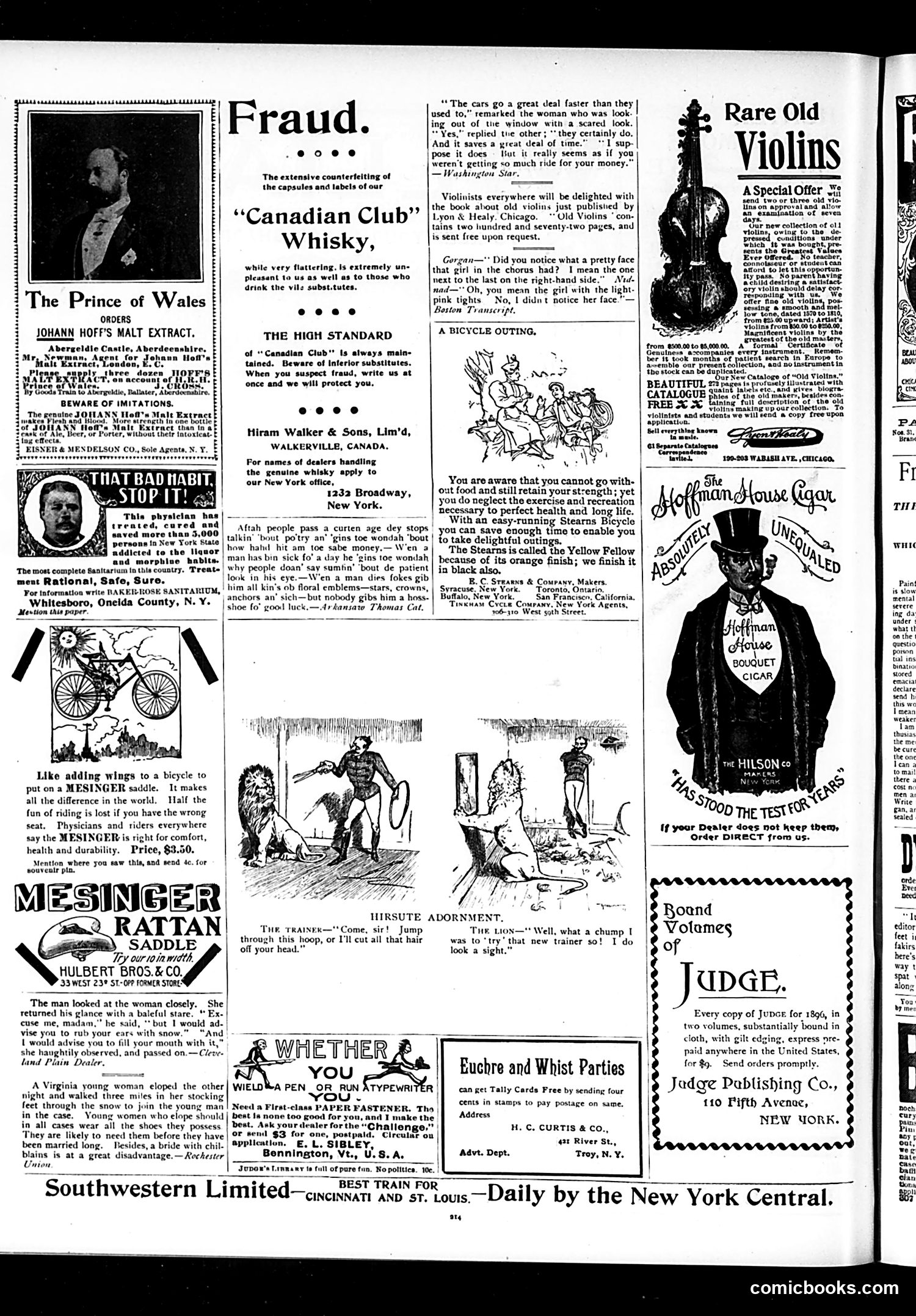
This page primarily contains **advertisements and social humor** rather than political cartoons. The main content satirizes consumer fraud and everyday social absurdities: **"Fraud" Section**: A prominent advertisement warns against counterfeit "Canadian Club" whiskey, playing on consumer anxiety about fake products—a genuine problem in this era before strict packaging regulations. **Social Humor**: Several brief comedic pieces mock ordinary human behavior: people stop discussing poetry and worry about money as they age; train passengers fixate on trivial details rather than appearance; a woman and man exchange insults about rubbing snow on ears/mouth. **Advertisements**: The page is dominated by product pitches (Stearns bicycles, Mesinger saddles, malt extract, violins) targeting middle-class readers. The overall tone reflects *Judge*'s satirical mission: poking fun at consumer culture, pretension, and human foibles rather than attacking specific political targets. The humor is gentle, domestic, and aimed at recognizable middle-class experiences.
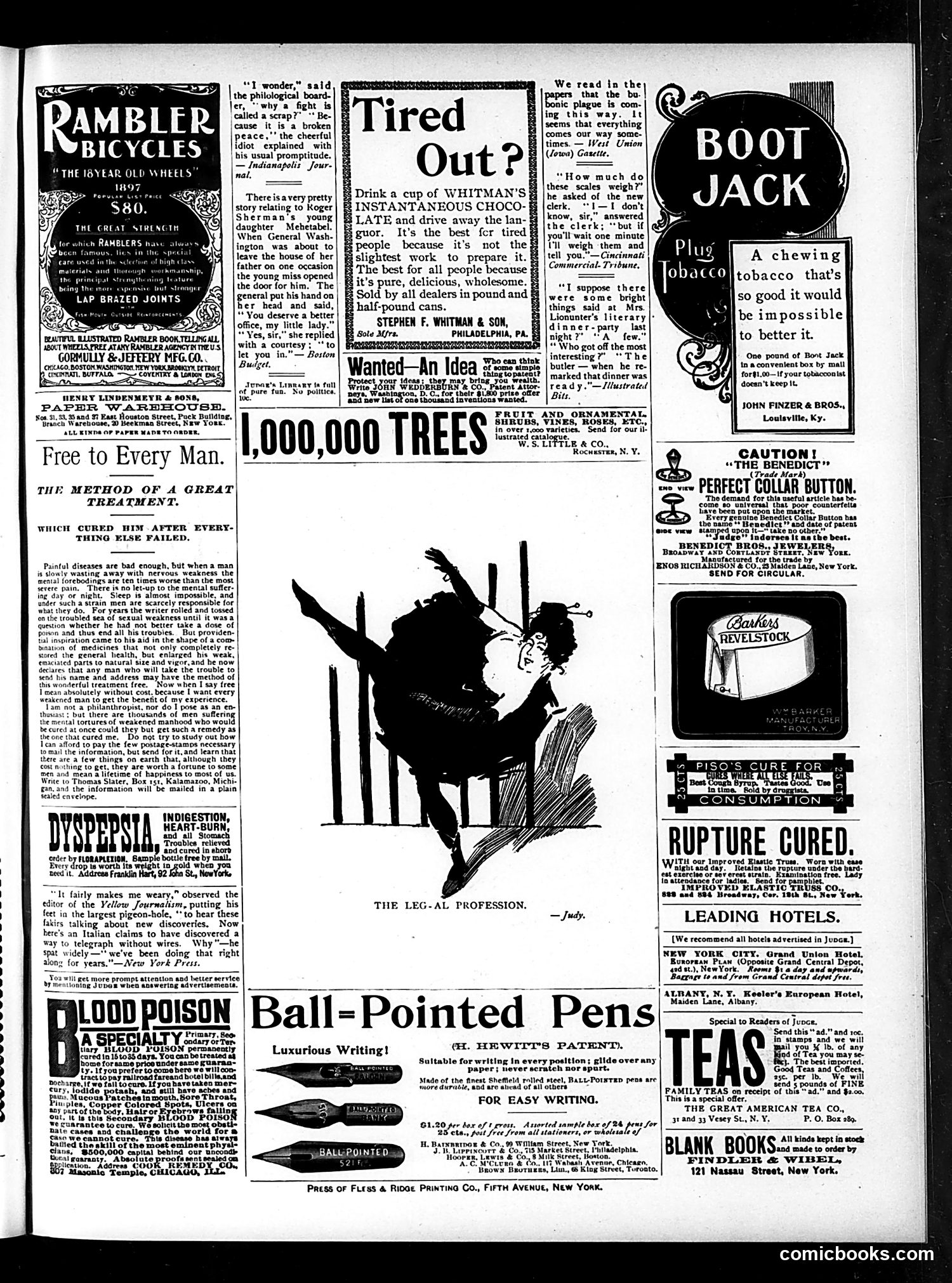
This full-page Judge magazine advertisement and editorial content features a central cartoon titled "The Legal Profession" depicting a man falling or tumbling backward off a cliff or ledge, rendered in dramatic black silhouette. The satire appears to mock the legal profession as inherently precarious or unstable—suggesting lawyers' careers involve dangerous, uncontrolled descent. The cartoon's placement amid advertisements for various patent medicines, bicycles, and commercial products is typical of Judge's format. The page also includes period humor snippets (brief jokes about "scraps," plagues, and scales) that represent typical turn-of-the-century magazine filler. Without additional context about specific legal scandals or debates contemporary to this issue, the exact political target remains unclear, though the cartoon's exaggerated physicality suggests general professional criticism rather than commentary on specific individuals or legislation.
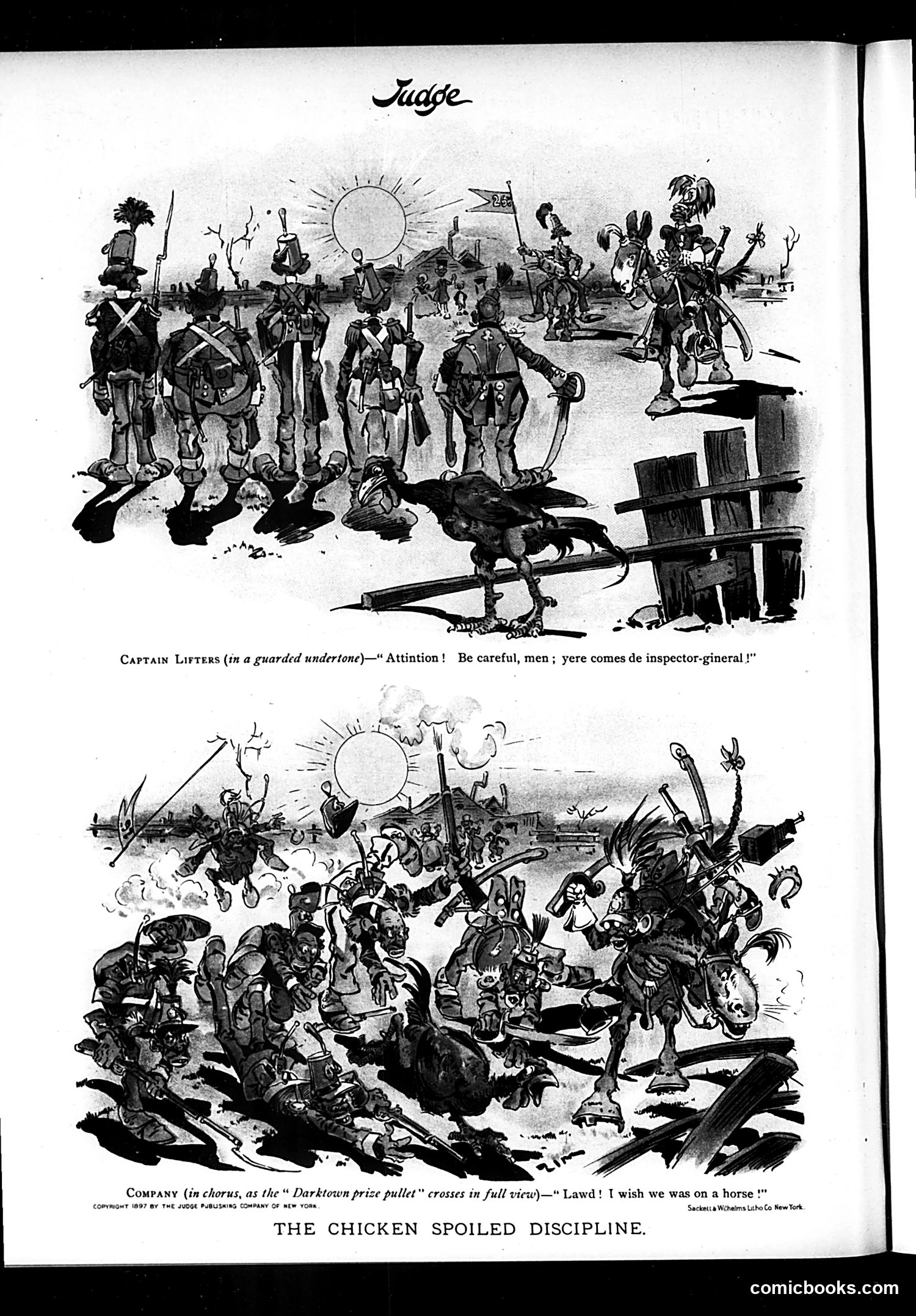
This 1897 Judge cartoon satirizes military discipline breaking down over a runaway chicken. The top panel shows uniformed soldiers standing at attention as an inspector approaches—they're warned to be careful. The bottom panel depicts chaos: the same soldiers have abandoned formation to chase after a chicken (labeled "Darktown prize pullet"), with one soldier wishing they were on horseback to catch it. The joke mocks how even strict military order collapses when faced with mundane distraction. The "Darktown" reference reflects the period's racist minstrelsy terminology. The satire targets the fragility of discipline and military authority rather than commenting on specific events, using slapstick humor common to Judge's satirical style.