
A complete issue · 16 pages · 1896
Judge — November 28, 1896
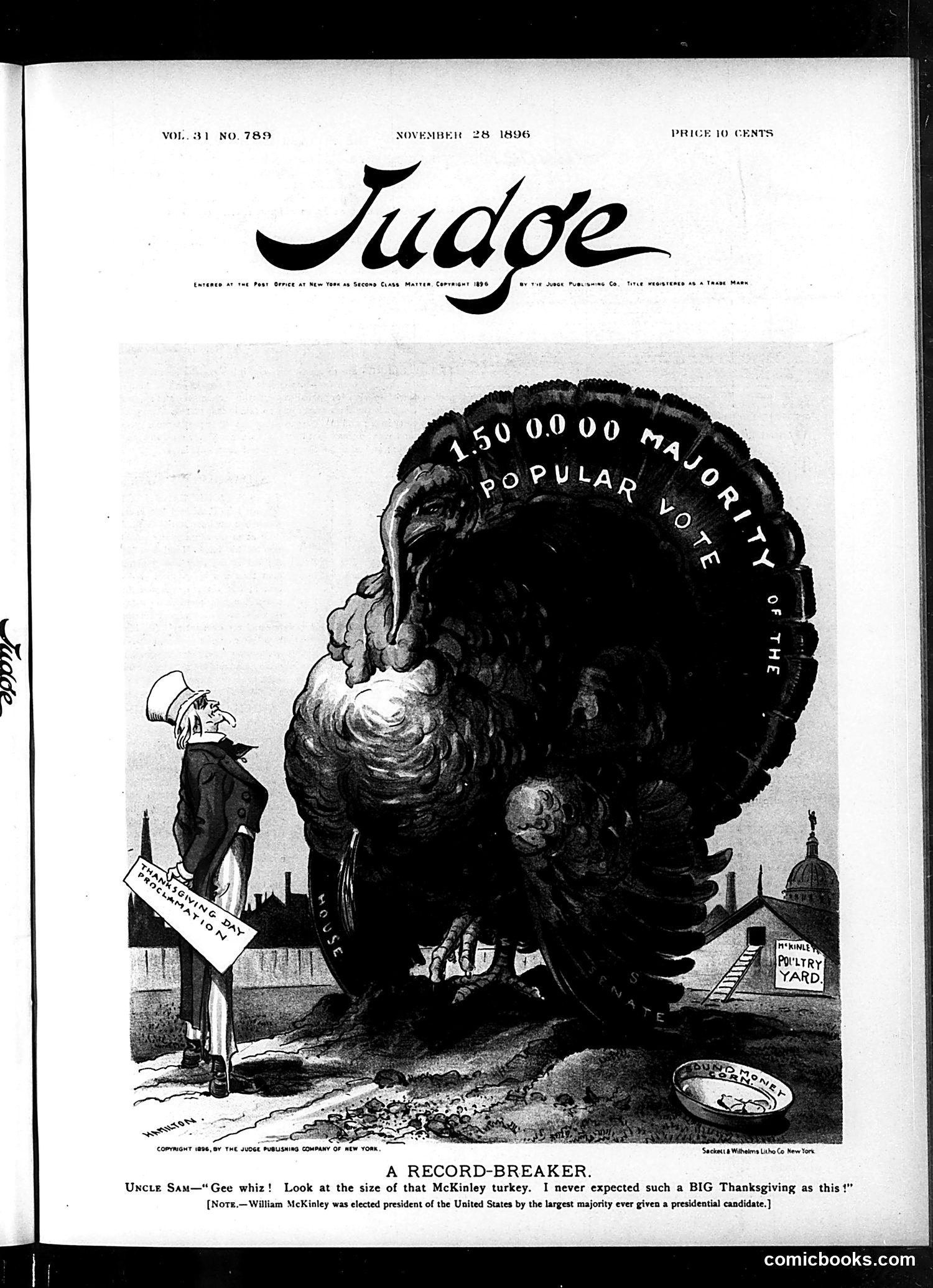
This political cartoon satirizes William McKinley's 1896 presidential election victory. Uncle Sam (left, in top hat) marvels at an enormous turkey labeled "150,000,000 POPULAR VOTE MAJORITY OF THE" — representing McKinley's record-breaking electoral support, depicted as a grotesquely oversized bird. The caption reads: "Gee whiz! Look at the size of that McKinley turkey. I never expected such a BIG Thanksgiving as this!" The note clarifies: McKinley was elected "by the largest majority ever given a presidential candidate." The joke equates his electoral landslide to an absurdly large Thanksgiving turkey — celebrating the exceptional scale of his victory. The Industrial Poultry Yard sign and urban backdrop emphasize American prosperity tied to McKinley's pro-business platform.
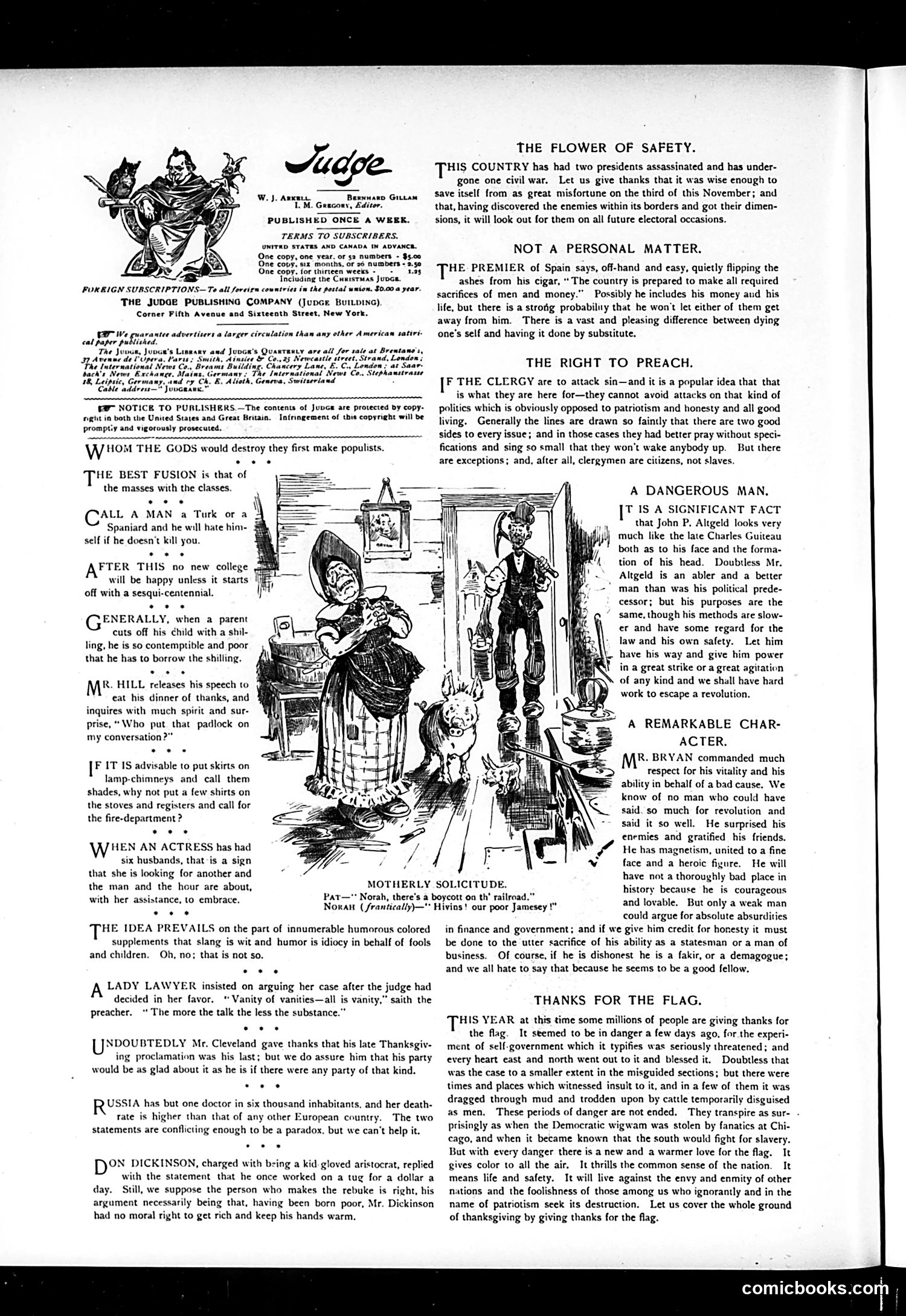
This page combines political commentary with humor sections. The main cartoon depicts a domestic scene with a woman (likely representing a wife or homemaker) surrounded by various household items and furnishings, with a man entering. The caption "MOTHERLY SOLICITUDE" suggests the humor involves traditional gender roles and domestic life. The text sections contain social satire on various topics: clergy preaching, a man resembling Charles Guiteau (likely referencing political assassination), and commentary on patriotism and the flag. Several brief jokes mock lawyers, actresses, parents, and political figures including Cleveland. The overall tone mocks American institutions—government, law, religion—while reinforcing conventional values around family and patriotism, typical of Judge's late-19th-century satirical approach.
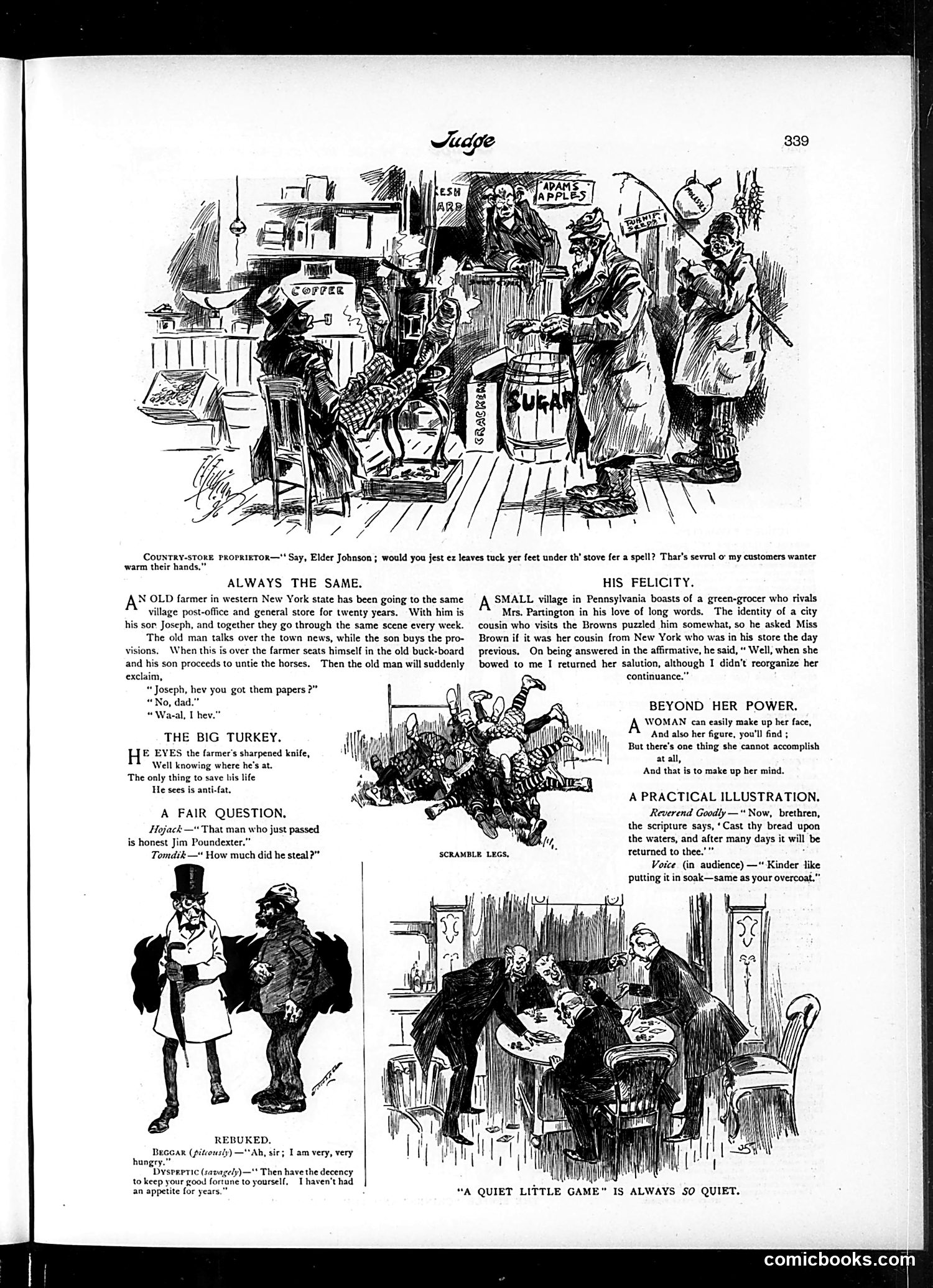
This page contains several brief humorous anecdotes and illustrations rather than political cartoons: **"Always the Same"** mocks rural tradition—a farmer and son repeat identical market transactions weekly, illustrating stubborn habit. **"The Big Turkey"** is a short joke about a man so absorbed in his knife that he ignores the turkey itself—a comment on misplaced priorities. **"A Fair Question"** depicts someone rebuked for asking if Jim Poundsetter is "honest," suggesting the name itself answers the question (implying dishonesty). **"Rebuked"** shows a beggar claiming hunger while refusing food, preferring money—satirizing panhandlers' supposed duplicity. The remaining illustrations appear to be standalone visual gags about hospitality and card games, typical of Judge's light humor style rather than serious political satire.
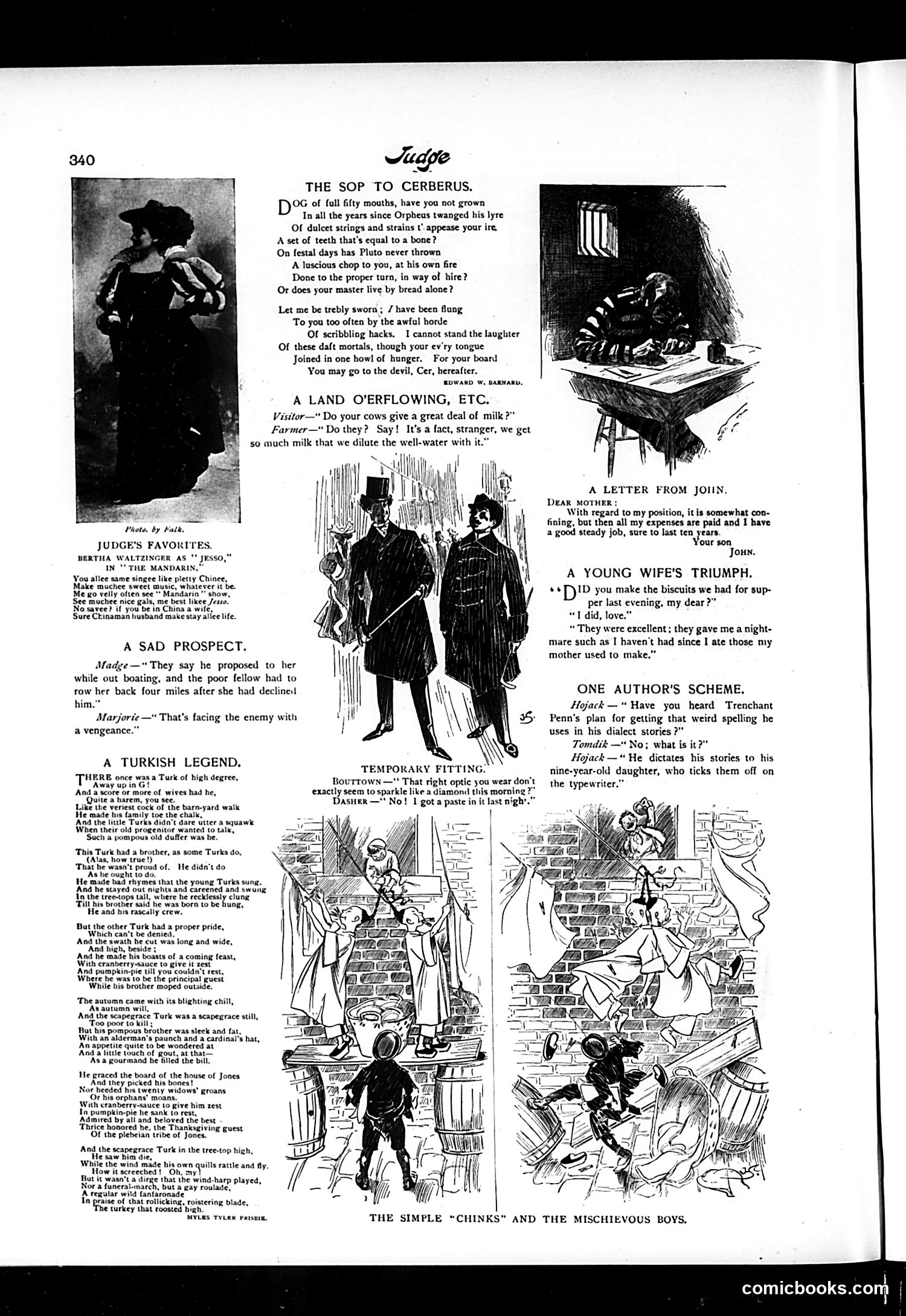
This page contains several satirical pieces typical of late 19th/early 20th-century American humor: **"The Sop to Cerberus"** mocks Cerberus (the mythological three-headed dog guarding the underworld) in mock-elevated language, complaining about being fed scraps by "daft mortals"—a classical allusion used for absurdist comedy. **"A Land O'erflowing"** satirizes an immigrant farmer's exaggerated claims about American dairy production, using stereotypical "broken English" dialogue common to period humor. **"A Turkish Legend"** tells a morality tale where a pompous Turkish patriarch, boasting of a grand feast, becomes the actual meal when invited to dine at a American home. The joke plays on presumed American crudeness and the ironic downfall of the arrogant character. The other brief sections ("A Sad Prospect," "Judge's Favorites," "A Letter from John") are characteristic light social satire about relationships and daily life. The cartoon illustrations accompanying these pieces used visual caricature and slapstick scenarios standard to the era's comedy magazines.
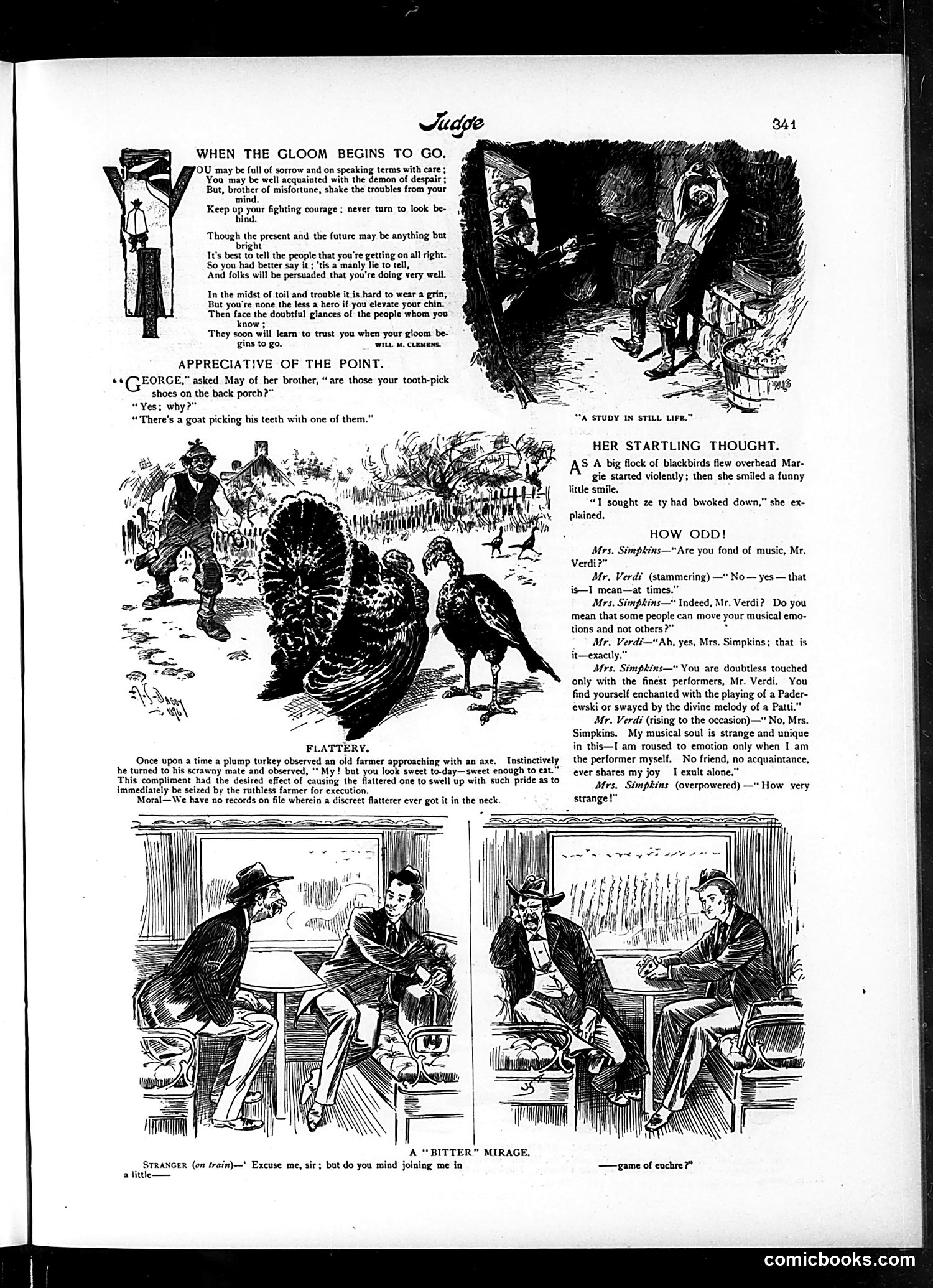
This page contains several brief satirical pieces typical of early 20th-century American humor: **"When the Gloom Begins to Go"** offers cynical advice to maintain appearances despite hardship—"a manly lie to tell" that you're doing well even in trouble. This reflects Depression-era stoicism about hiding financial or personal struggles. **"Appreciative of the Point"** is a simple visual joke: a goat uses a shoe as a toothpick, playing on the phrase "tooth-pick shoes" (likely referring to narrow, pointed dress shoes). **"How Odd!"** mocks a supposedly famous musician (Verdi) who admits he's only moved by his own performances—satirizing artistic vanity and self-absorption. **"Flattery"** uses a turkey fable: one turkey flatters another to hide his true intention (fattening him for slaughter), suggesting flattery conceals deception. **"A Bitter Mirage"** shows a stranger approaching someone on a train to play cards—implying potential con-artist behavior. The overall theme emphasizes social pretense, deception, and hidden motives beneath polite society.
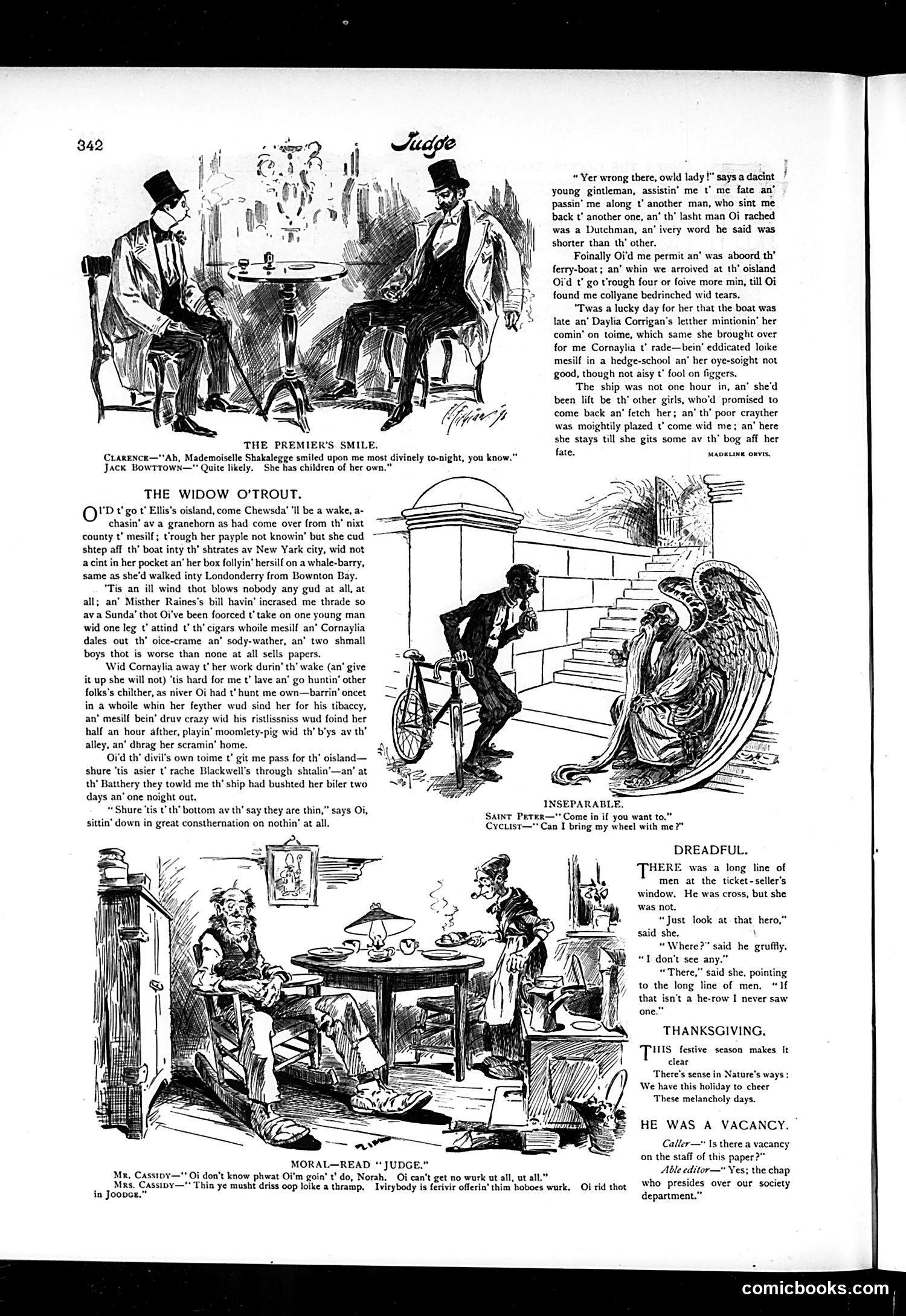
This page contains several satirical sketches typical of Judge's late 19th-century humor: **"The Premier's Smile"**: A brief joke where Clarence brags that a woman (Mademoiselle Shakalegge) smiled at him; Jack dismisses this by noting she smiles at everyone—the humor relies on implying she's promiscuous or indiscriminate. **"The Widow O'Trout"**: A lengthy Irish-dialect monologue about immigration bureaucracy. An Irish widow describes the tedious process of retrieving her daughter from Ellis Island after a ship delay. The satire targets inefficient immigration procedures and the contrast between harsh official processes and Irish working-class resilience. **"Inseparable"**: A brief visual gag showing a cyclist refusing to enter a church without his bicycle—mocking the obsessive devotion cyclists had to their new machines. **Other items**: Short jokes about employment difficulties, a Thanksgiving verse, and a quip about society column editors being vacant positions (implying they're empty-headed). The page reflects Judge's focus on immigration, social mobility, and emerging technologies as comedy subjects.
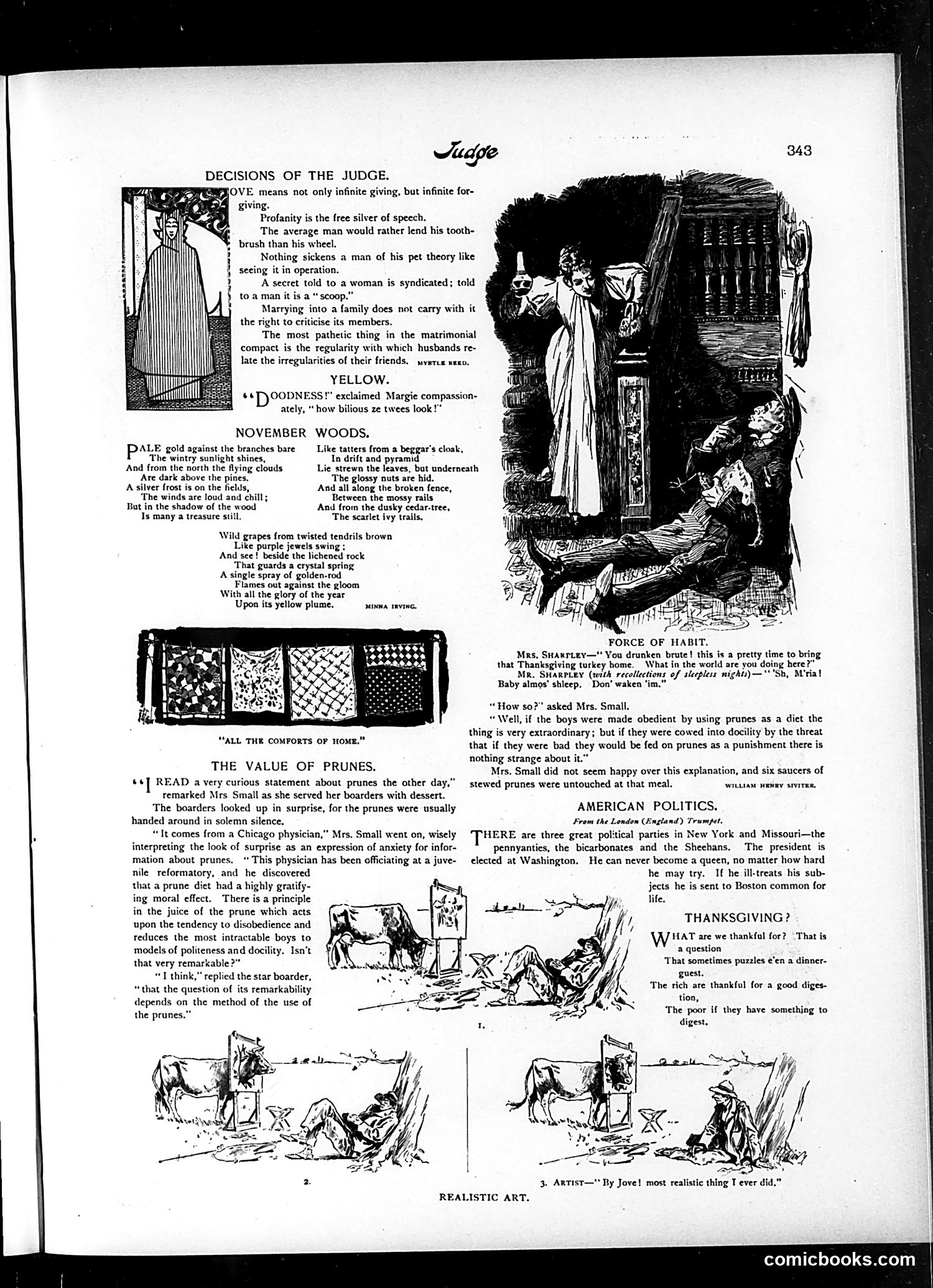
This page contains satirical commentary typical of Judge's late-19th/early-20th-century approach. The main content includes: **"Decisions of the Judge"**: Pithy observations on social behavior—mocking pretense, gossip, and marital dynamics with barbed wit. **"November Woods"**: A sentimental poem about autumn foliage, contrasting with the satirical tone elsewhere. **"Force of Habit"**: A domestic cartoon where a drunk Mr. Sharpley returns home late on Thanksgiving. The joke plays on how wives' complaints become background noise—he shushes her because the baby is sleeping, implying her nagging is routine as a baby's needs. **"The Value of Prunes"**: Anecdotal humor about prunes' supposed moral effect on unruly boys in reform schools. The satire suggests whether prunes work through nutrition or punishment-threat depends on which explanation one prefers. **"American Politics"**: Mockery of New York and Missouri political factions (pennyanties, bicarbonates, Sheehans)—likely references to contemporary political movements or ethnic voting blocs, portrayed as absurdly chaotic. **"Thanksgiving?"**: A brief joke questioning gratitude priorities among social classes.
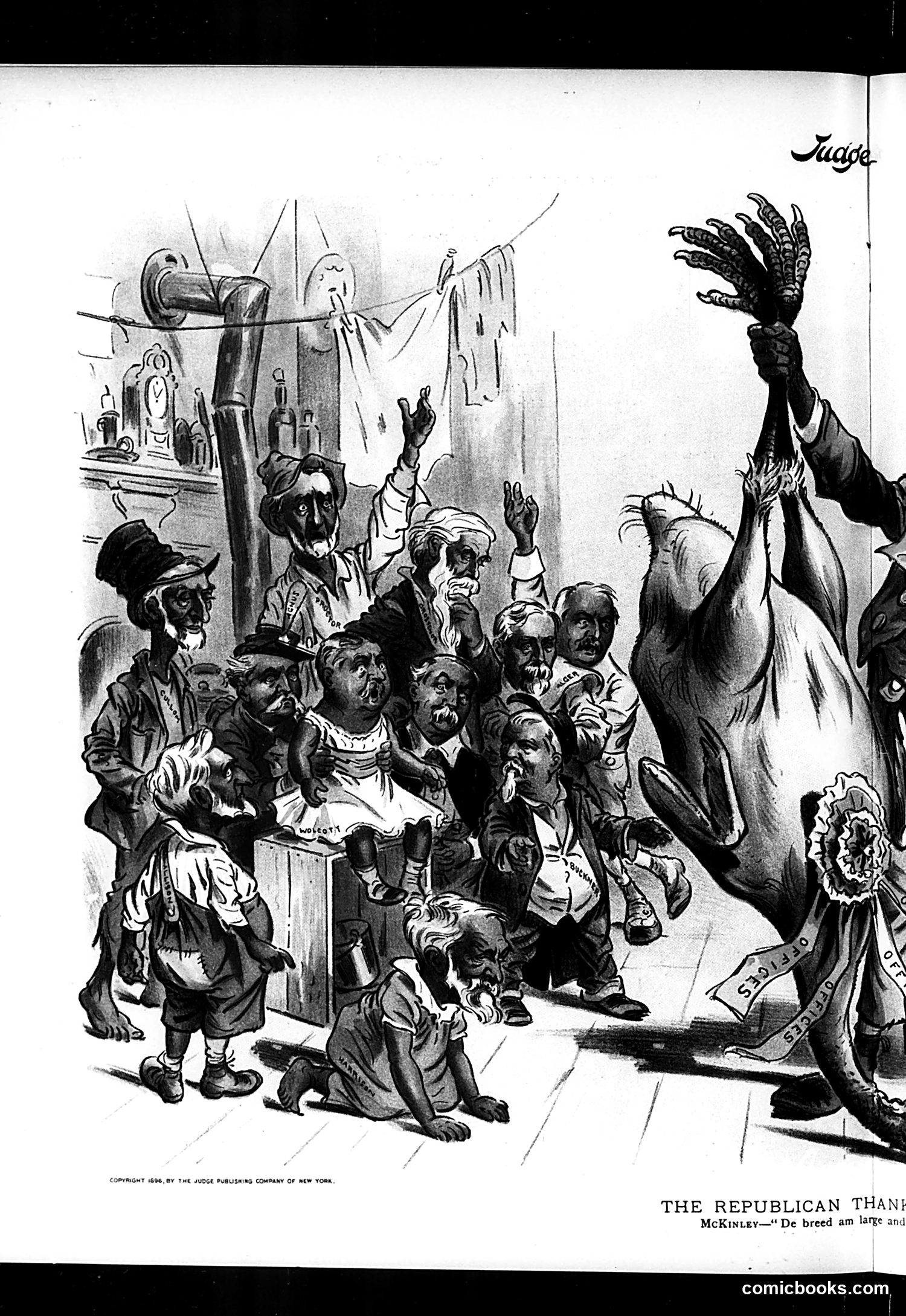
This political cartoon satirizes Republican leadership under President McKinley. The title is a pun on "The Republican Thanksgiving," playing on the phrase "De breed am large" (dialect speech common in period satire). The image shows a large turkey or bird being presented to a crowd of caricatured figures with exaggerated features—a common satirical technique of the era. The figures appear to represent various political or social groups, though specific identities are unclear from the visible text. The cartoon likely critiques Republican policies or internal divisions, using the Thanksgiving feast as metaphor. The incomplete OCR text makes the precise political point difficult to determine, but the celebratory presentation contrasts with what may be satirical commentary on Republican governance or their treatment of constituents.
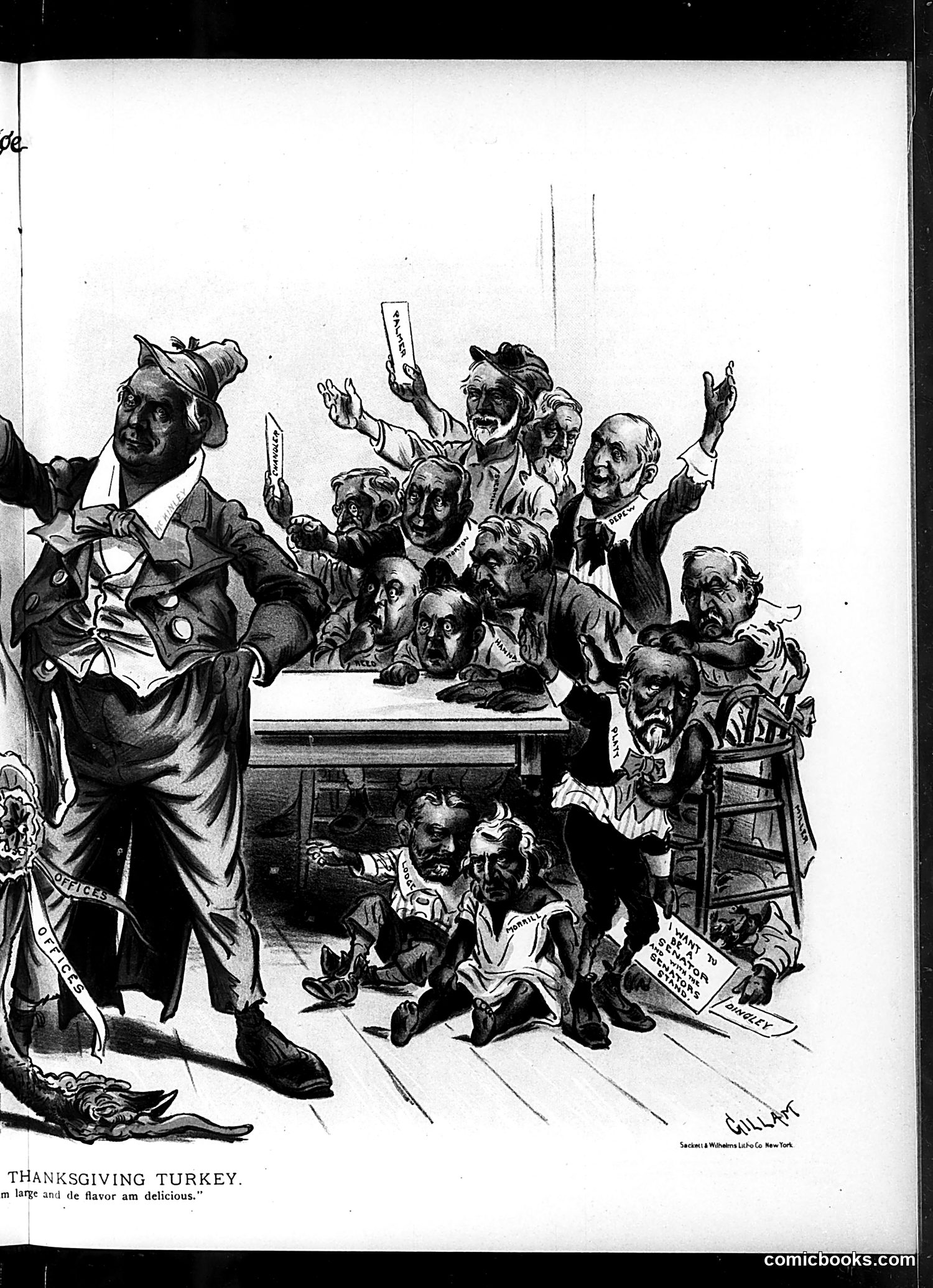
This political cartoon depicts a grotesque dinner scene where caricatured men with exaggerated features—appearing to represent politicians or public figures—gather around a table. Several hold papers or documents, suggesting debate or legislative business. The men display animalistic characteristics, with dog-like faces, suggesting they're portrayed as corrupt or base politicians "fighting like dogs" over something. The title's reference to a "Thanksgiving Turkey" likely uses the holiday feast as metaphor for political patronage or spoils being contested. The grotesque caricatures and animalistic depictions were common Judge magazine techniques for satirizing politicians as greedy, undignified, or self-serving. Without clearer identification of specific figures or visible date, the exact political controversy remains unclear, though the cartoon clearly mocks governmental infighting over resources or power.
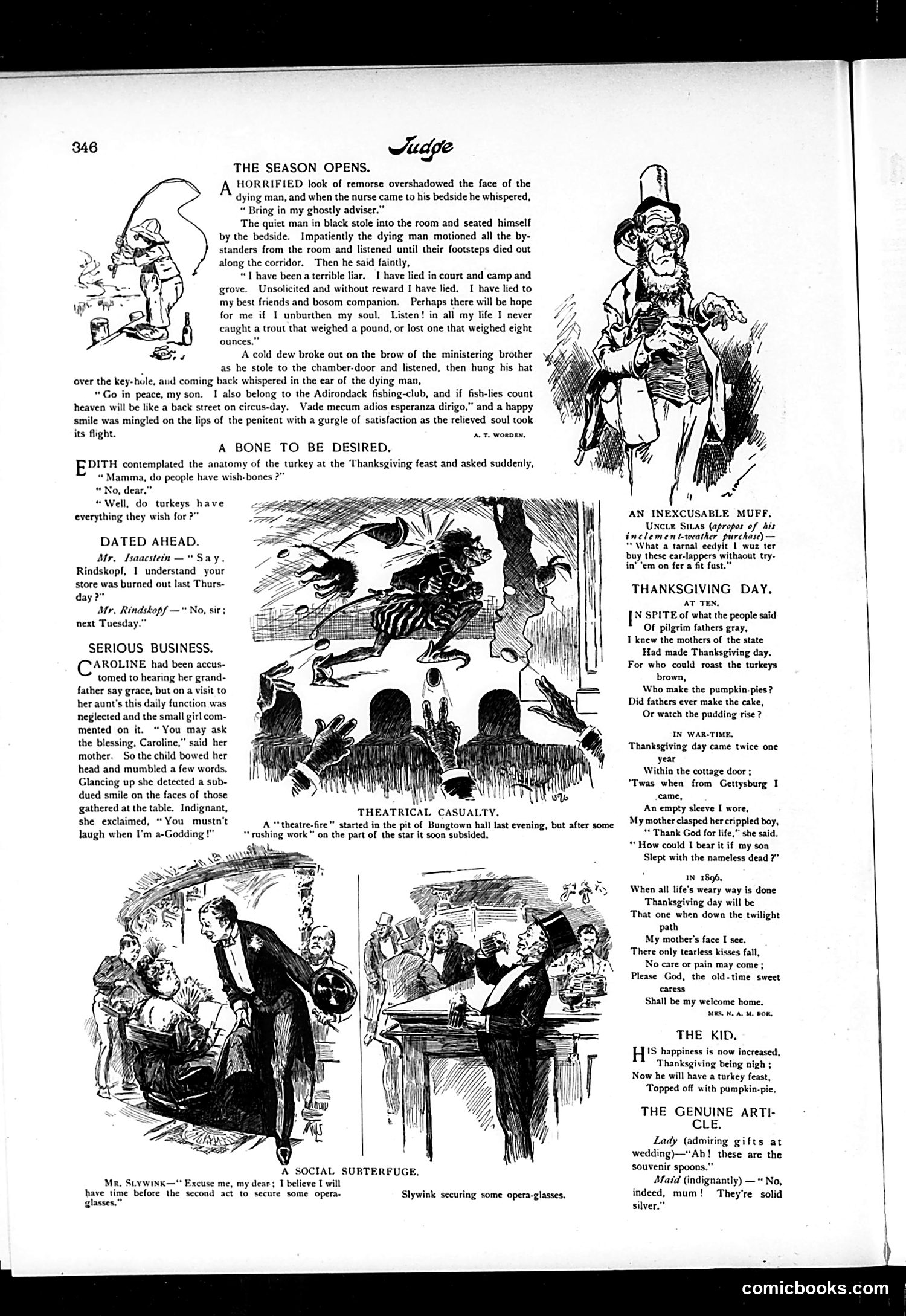
This page contains multiple brief satirical pieces typical of Judge's humor: **"The Season Opens"** mocks Adirondack fishing culture—a wealthy leisure activity. A dying man confesses to his priest that he's never caught a real fish, only lied about it. The priest reveals he too belongs to the fishing club, implying mutual dishonesty is acceptable among gentlemen. **"A Bone to Be Desired"** is a children's joke: a girl asks if turkeys have wishbones and whether they get everything they wish for—simple wordplay humor. **Other brief jokes** include: a man claiming his store burned "next Tuesday" (insurance fraud); a child's malapropism calling grace "a-Godding"; and various Thanksgiving-themed pieces mixing sentimental poetry about mothers with humorous observations (Uncle Silas buying ear-lappers without trying them on). The cartoons depict social scenes—theater-goers, dining situations, and domestic moments. Overall, this represents typical late-19th/early-20th century American satirical magazine fare: genteel humor targeting social pretension, family dynamics, and seasonal traditions.
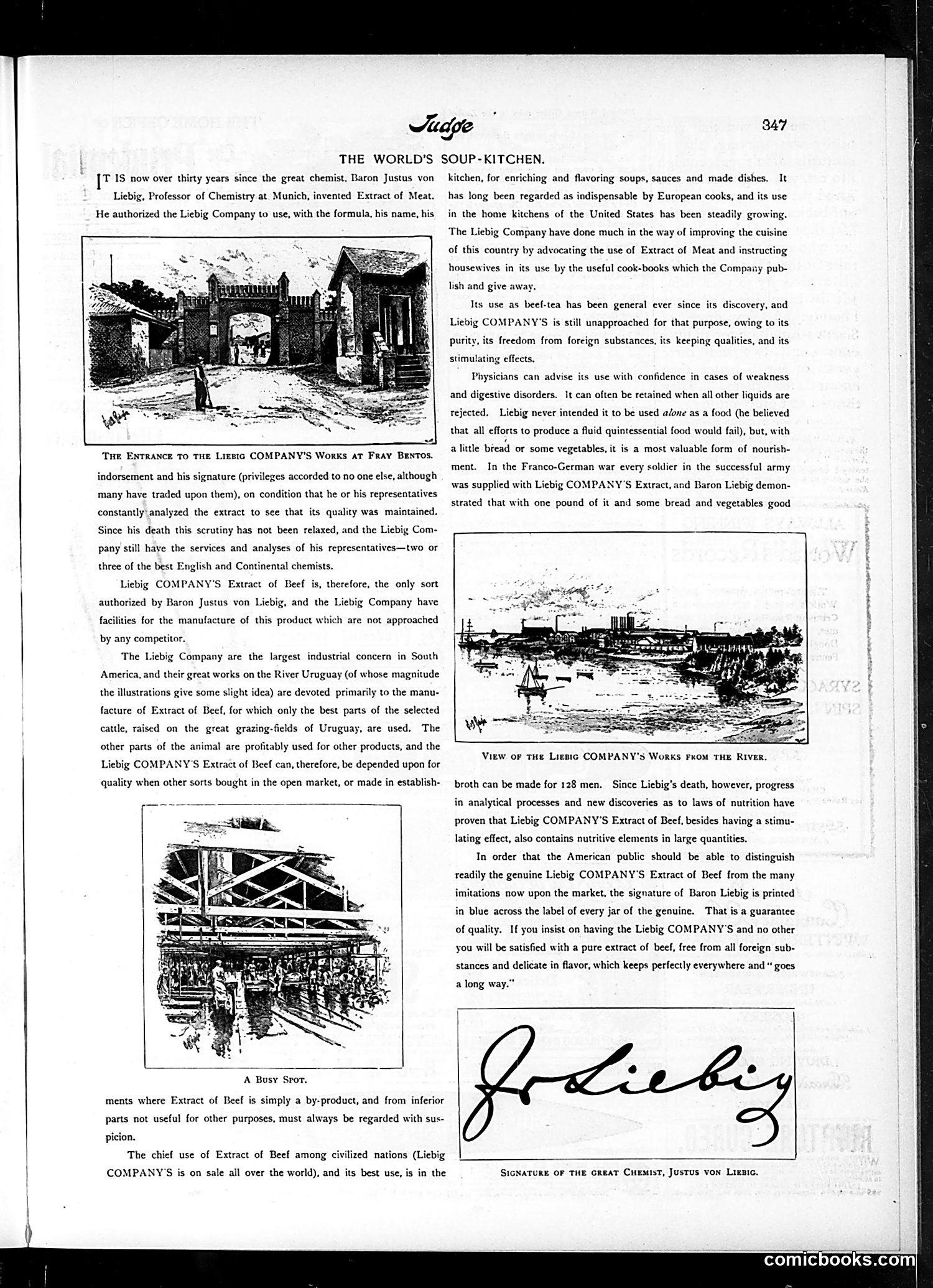
This page is primarily **advertising**, not satire. It promotes Liebig Company's Extract of Meat—a meat-based bouillon product invented by German chemist Baron Justus von Liebig around 30 years prior. The three engravings show the company's manufacturing facility in Fray Bentos, Uruguay, emphasizing industrial scale and legitimacy. The text repeatedly stresses that only the "genuine" Liebig product bears Baron Liebig's signature in blue ink (reproduced at bottom), distinguishing it from inferior imitations flooding the market. The implicit joke in calling this "The World's Soup-Kitchen" is that Liebig's extract has become universally essential to cooking—it's the foundation of every kitchen's broths and soups. The page emphasizes purity, scientific authorization, and quality control to assure middle-class American consumers (Judge's audience) that this imported luxury product justifies its cost over cheaper domestic competitors or by-products.
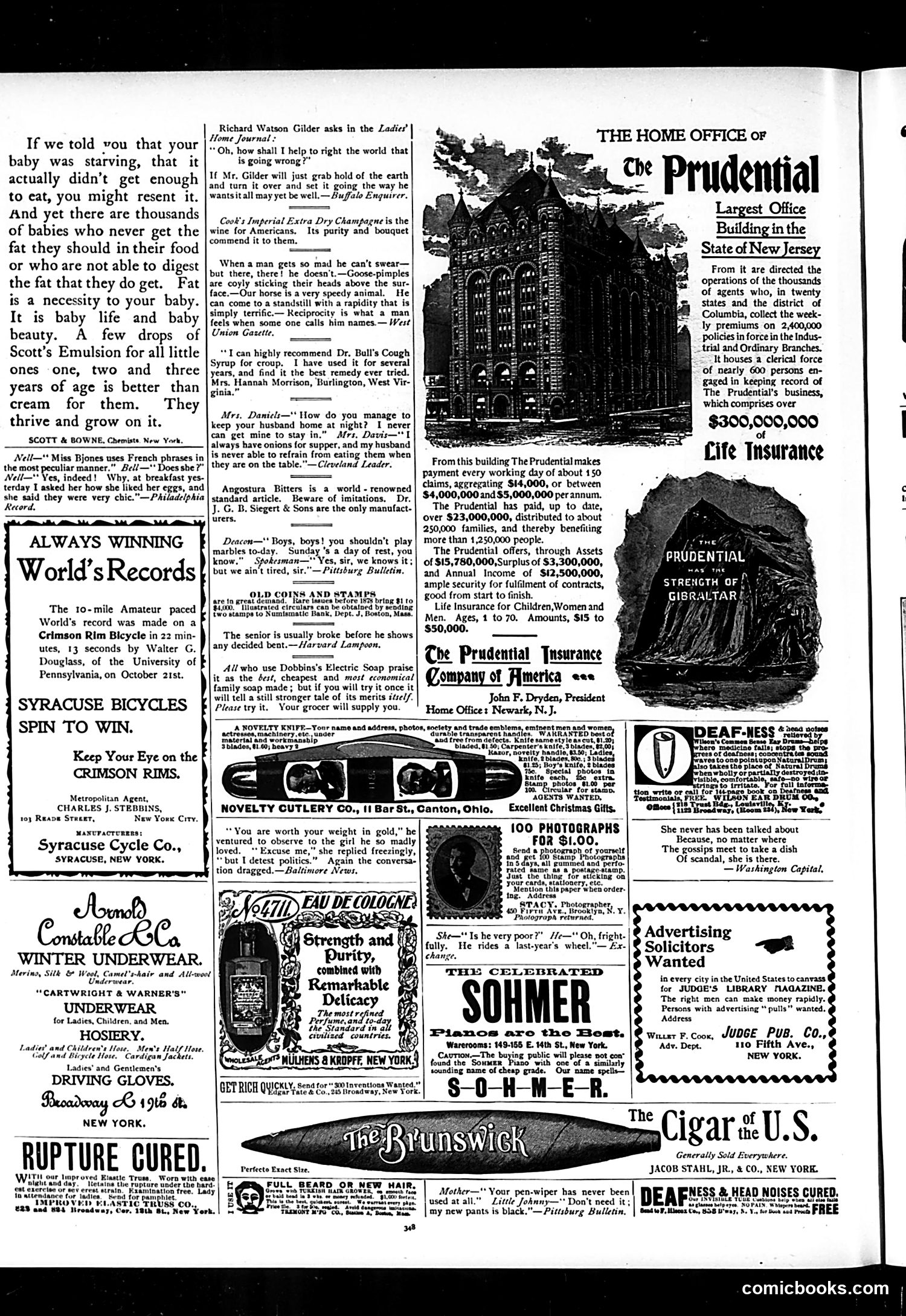
This page is primarily **advertising** with minimal editorial content. The masthead item at top is a brief satirical exchange: Richard Watson Gilder (editor of *Ladies' Home Journal*) asked how to "right the world that is going wrong." The response mocks his grandiosity—suggesting he should literally grab and turn over the Earth itself to fix things his way. The rest of the page consists of commercial advertisements for products (Scott's Emulsion baby supplement, Syracuse bicycles, Prudential Life Insurance) interspersed with brief humorous one-liners from various newspapers. These jokes address domestic life (keeping husbands home, cooking with onions) and student life ("seniors are usually broke"). The dominant visual is the Prudential Insurance building advertisement, emphasizing the company's size and financial security through statistics. **There is no coherent political cartoon** on this page—it functions as a standard advertising/content miscellany typical of early 20th-century magazines.
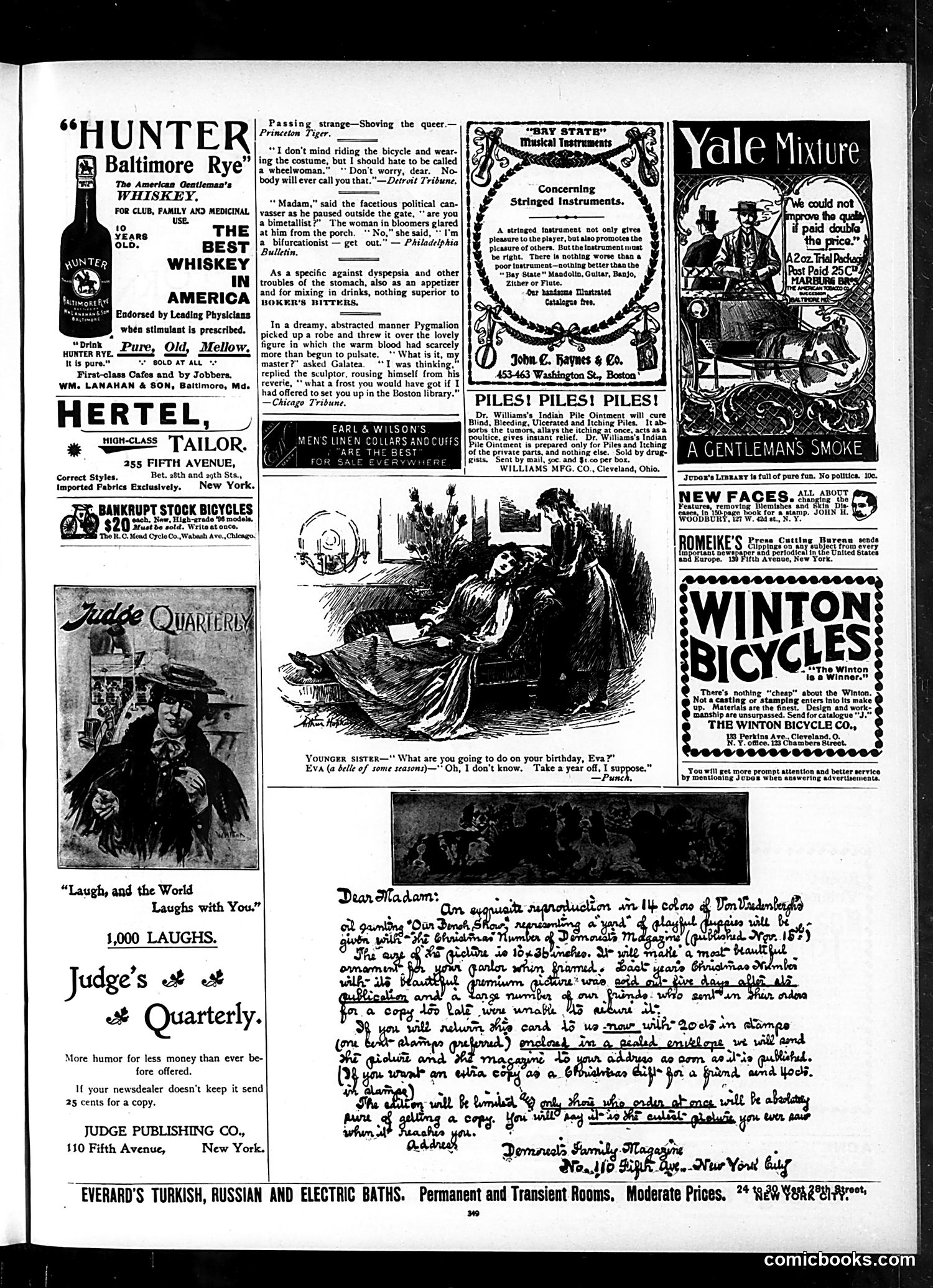
This is primarily an **advertising page** from Judge magazine (a major American satirical weekly), featuring product advertisements interspersed with short humorous passages and jokes. The notable content includes jokes about **women's fashion and social roles**, particularly regarding "bloomers" (the controversial new split-skirt bicycle outfit) and the term "wheelwoman." These jokes reflect contemporary anxiety about women's independence through cycling—a technology that gave women mobility and required practical clothing that challenged Victorian dress codes. One passage mocks a political canvasser confronting a woman in bloomers, suggesting tension between traditional politics and women's emerging public visibility. The page also includes advertisements for whiskey (endorsed by physicians—common in that era), bicycles, tailoring, and medical products (including a pile ointment ad), reflecting typical late-19th-century magazine content. The handwritten letter at bottom appears to be reader correspondence, standard for Judge's format.
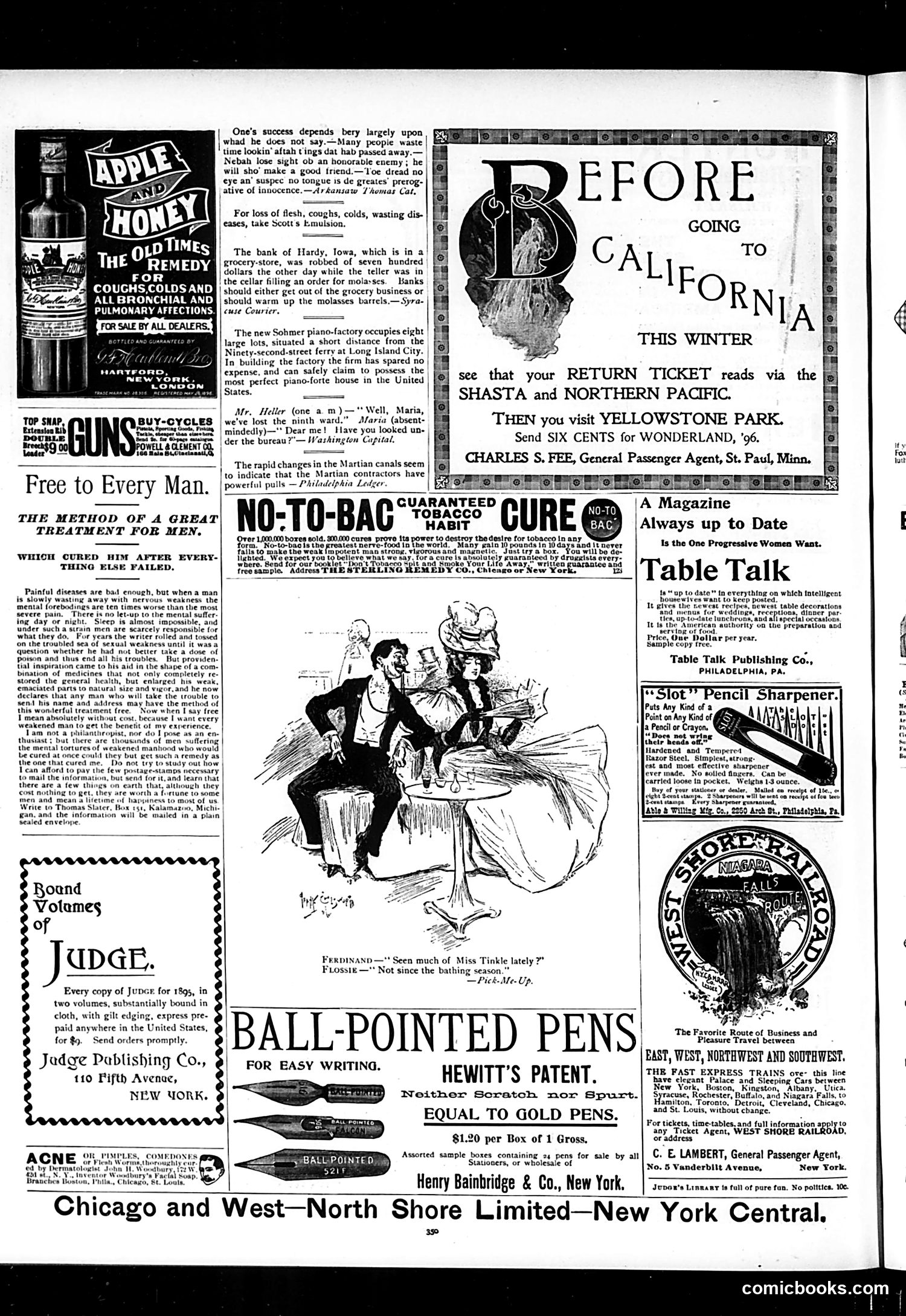
This page is primarily **advertising** with one central cartoon. The main cartoon depicts a dinner conversation between two men. The caption identifies the figures as "Ferdinand" and "Floscie," with Ferdinand remarking he's "seen much of Miss Tickle lately?" and Floscie responding "Not since the bathing season." The joke appears sexual in nature—referencing a woman known as "Miss Tickle" and implying intimate behavior restricted to summer bathing season. The page is dominated by product advertisements: Scott's Emulsion tonic, No-To-Bac (tobacco cessation), Judge magazine subscriptions, and various patent medicines. There's also a prominent travel advertisement encouraging California visits via the Shasta and Northern Pacific railroad. The small text snippets at top appear to be aphorisms or quips ("One's success depends very largely upon what he does not say"), typical of Judge's satirical style. Overall, this is a standard issue page mixing light social satire with commercial advertising—the magazine's primary revenue source.
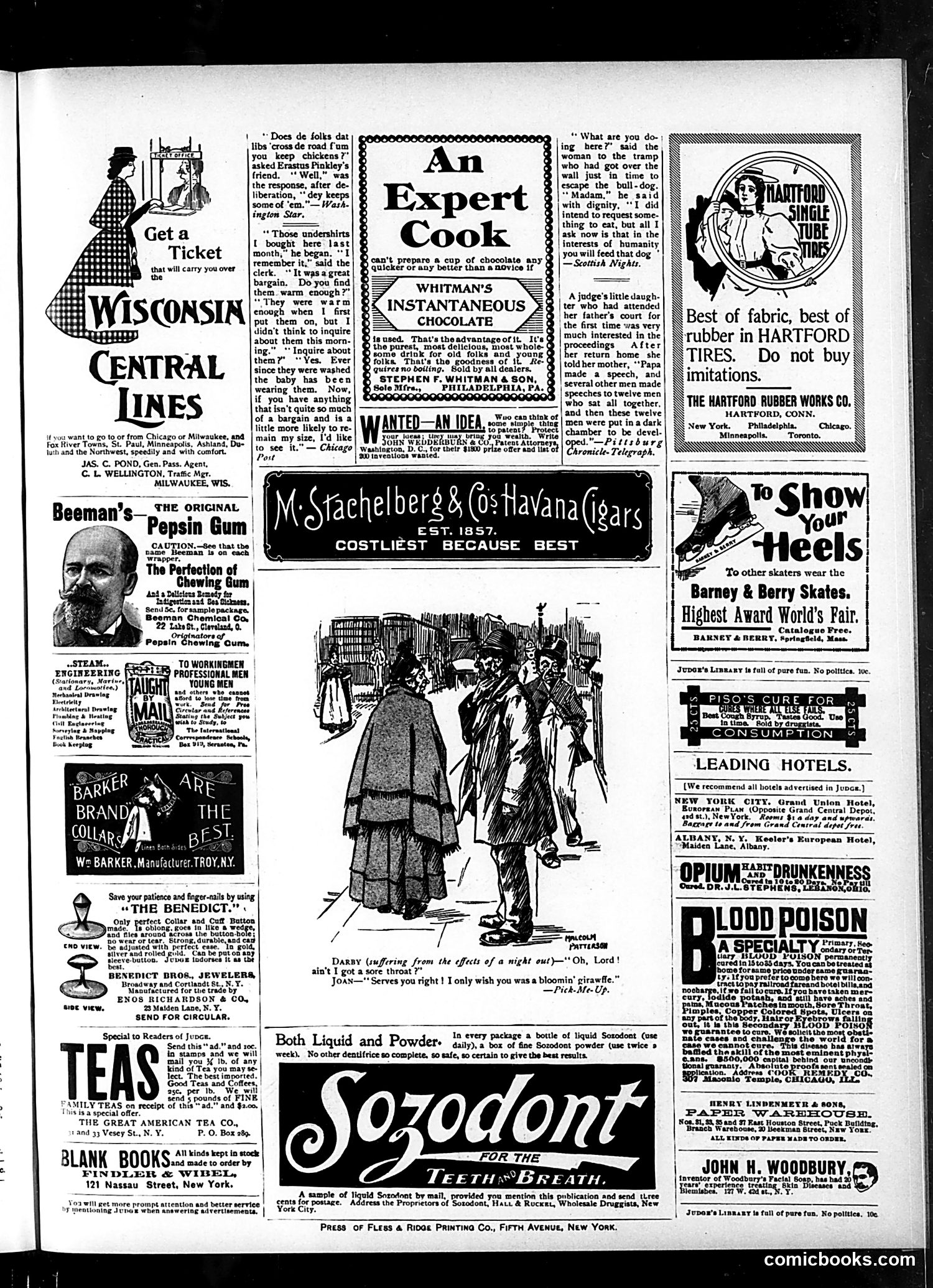
This page is primarily **advertising**, typical of early 20th-century magazines. However, it contains several brief humor cartoons scattered among ads: **Main cartoon (center):** A woman confronts a man climbing over a wall, escaping a bulldog. The tramp quips that he originally wanted food but now only asks that she feed the dog "in the interests of humanity"—satirizing the beggar's shift from hunger to self-preservation. **Small cartoon (lower left):** A hungover man named Danny wishes someone were a giraffe so his sore throat complaint would be justified—absurdist humor about overindulgence. **Small cartoon (top):** A judge's daughter describes courtroom proceedings, reducing serious legal proceedings to a child's naive observation about men in a "dark chamber" being "developed"—gentle satire on courtroom formality. The ads (Sozodont toothpaste, Beeman's gum, Hartford tires, hotels) reflect period consumer products. The overall tone is light, domestic humor typical of Judge magazine's satirical approach.
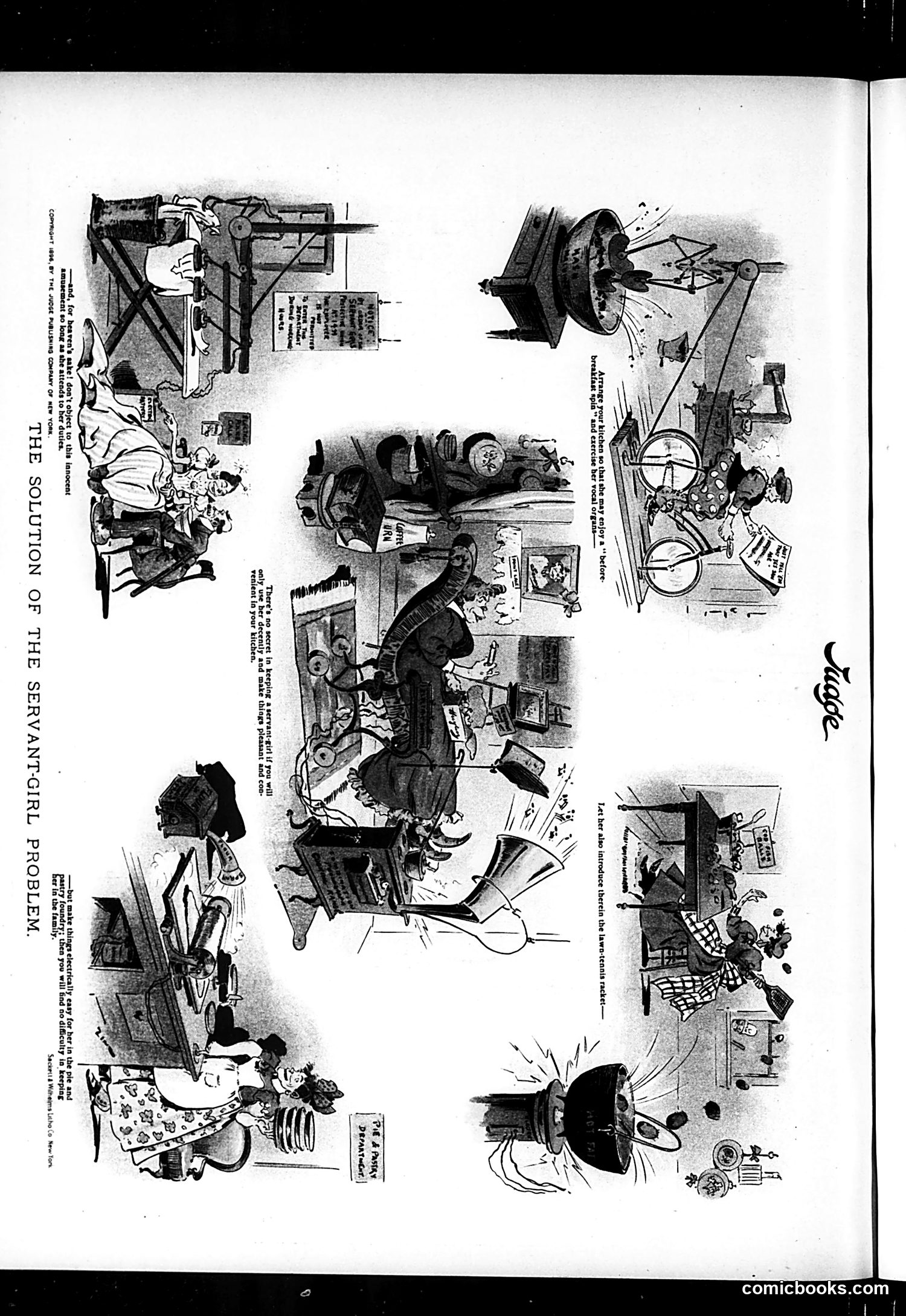
This satirical cartoon addresses the period's widespread "servant problem"—difficulty retaining household domestic help. The page shows various scenes of a servant girl's daily life, with the satirical "solution" being that employers should treat servants well: provide decent working conditions, modern conveniences (like electric appliances), allow them innocent pleasures and vocal exercise, and overlook minor amusements so long as duties are performed. The humor is ironic: the cartoon mocks employers who complain about servant retention while treating workers poorly. It advocates for treating servants "decently" and making things "pleasant and convenient"—reasonable demands presented as obvious solutions that apparently many employers resisted. This reflects late-Victorian class tensions and changing attitudes toward domestic labor, suggesting even satirical magazines acknowledged workers deserved basic consideration.