
Judge, 1896-11-28 · page 5 of 16
Judge — November 28, 1896 — page 5: what you’re looking at
What you’re looking at
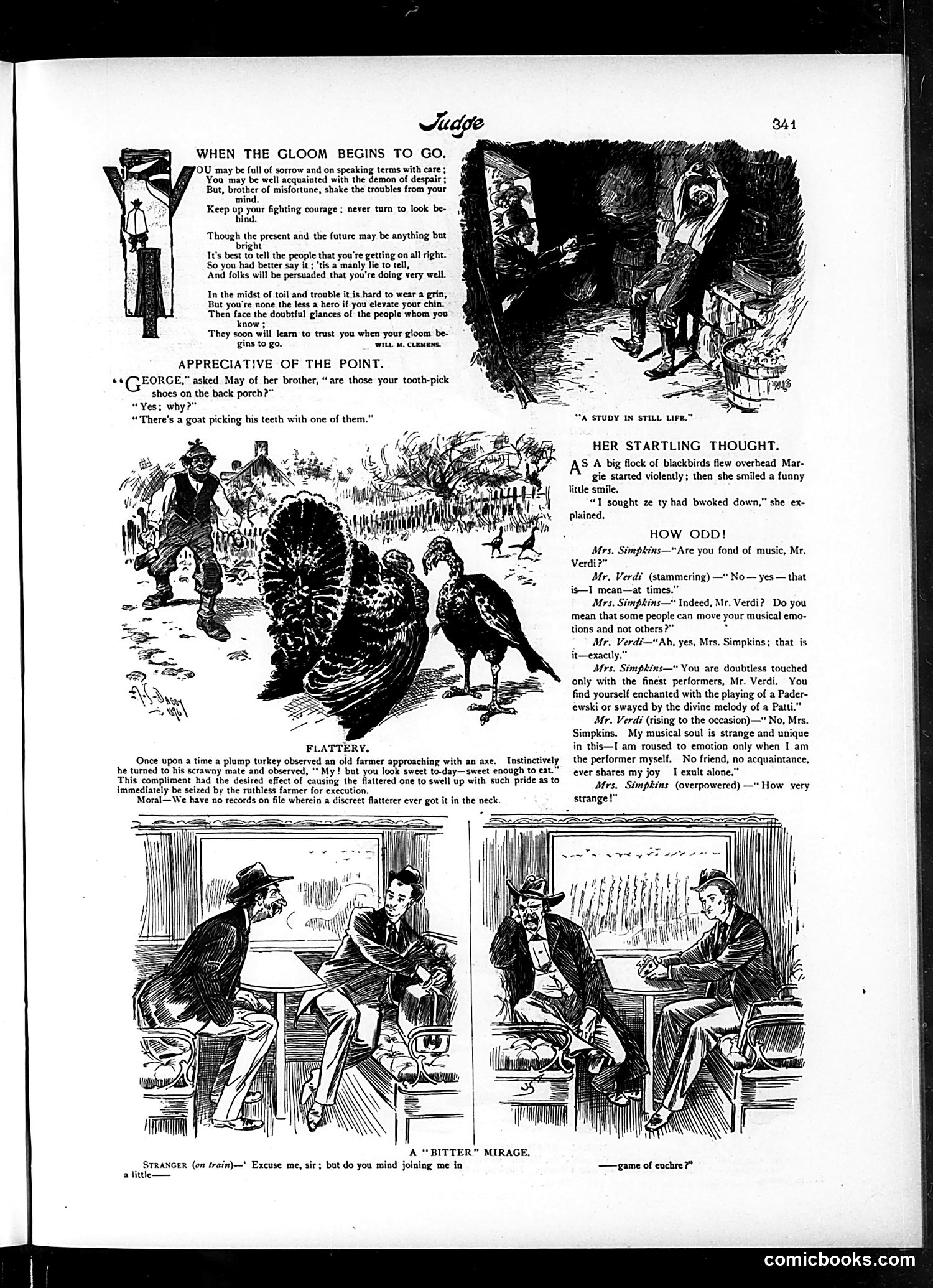
This page contains several brief satirical pieces typical of early 20th-century American humor: **"When the Gloom Begins to Go"** offers cynical advice to maintain appearances despite hardship—"a manly lie to tell" that you're doing well even in trouble. This reflects Depression-era stoicism about hiding financial or personal struggles. **"Appreciative of the Point"** is a simple visual joke: a goat uses a shoe as a toothpick, playing on the phrase "tooth-pick shoes" (likely referring to narrow, pointed dress shoes). **"How Odd!"** mocks a supposedly famous musician (Verdi) who admits he's only moved by his own performances—satirizing artistic vanity and self-absorption. **"Flattery"** uses a turkey fable: one turkey flatters another to hide his true intention (fattening him for slaughter), suggesting flattery conceals deception. **"A Bitter Mirage"** shows a stranger approaching someone on a train to play cards—implying potential con-artist behavior. The overall theme emphasizes social pretense, deception, and hidden motives beneath polite society.
📄 Transcribed text from this page (OCR, searchable)
Machine-transcribed from the original scan — historical spelling and the odd misread are preserved.
WHEN THE GLOOM BEGINS TO GO. OU may be full of sorrow and on speaking terms with ca You may be well acquainted with the demon of despair ; But, brother of misfortune, shake the troubles from your mind. Keep up your fighting courage ; never turn to look be- hind. Though the present and the future may be anything but bright ig ‘ ; It's best to tell the people that you're getting on all right. So you had better say it ; ‘tis a manly lie to tell, And folks will be persuaded that you're doing very well. In the midst of toil and trouble it is.hard to wear a grin, But you're none the less a hero if you elevate your chin. Then face the doubtful glances of the people whom you know ; They soon will learn to trust you when your gloom be- gins to go. wits oe. CUnseEns, APPRECIATIVE OF THE POINT. **+GGEORGE,” asked May of her brother, “are those your tooth-pick shoes on the back porch?” “Yes; why?” “There's a goat picking his teeth with one of them.” “A STUDY IN STILL LIFE.” HER STARTLING THOUGHT. S A big flock of blackbirds flew overhead Mar- gie started violently; then she smiled a funny little smile, “T sought ze ty had bwoked down,” she ex- plained. HOW ODD! Mrs, Simpkins—“Are you fond of music, Mr. Verdi?" Mr. Verdi (stammering) — No— yes — that is—I mean—at times.” Mrs, Simpkins—" Indeed, Mr. Verdi? Do you mean that some people can move your musical emo- tions and not others?” 3 Mr. Verdi—"Ah, yes, Mrs. Simpkins; that is it—exactly.” Mrs. Simpkins—* You are doubtless touched only with the finest performers, Mr. Verdi. You find yourself enchanted with the playing of a Pader- ewski or swayed by the divine melody of a Patti.” Mr. Verds (rising to the occasion) —"' No, Mrs. Simpkins. My musical soul is strange and unique FLATTERY. in this—I am roused to emotion only when I am Once upon a time a plump turkey observed an old farmer approaching with an axe. Instinctively the performer myself. No friend, no acquaintance, he turned to his scrawny mate and observed, ‘* My! but you look sweet to-day—sweet enough to eat.”” be ‘ bagless yea ‘ 7.1 but you look in me ah wride as to ever shares my joy I exult alone.” is compliment had the desired effect of causing the flattered one to swell up with such pride Pe fone ep te immediately be seized by the ruthless farmer for execution. ales. Stemphins: (overpowered) —" How:ixery Moral—We have no records on file wherein a discreet fatterer ever got it in the neck. strange! Hi i A “BITTER” MIRAGE. STRANGER (on train)—' Excuse me, sir; but do you mind joining me in —game of euchre?” a littlhh—— comicbooks.com