
A complete issue · 16 pages · 1896
Judge — September 19, 1896
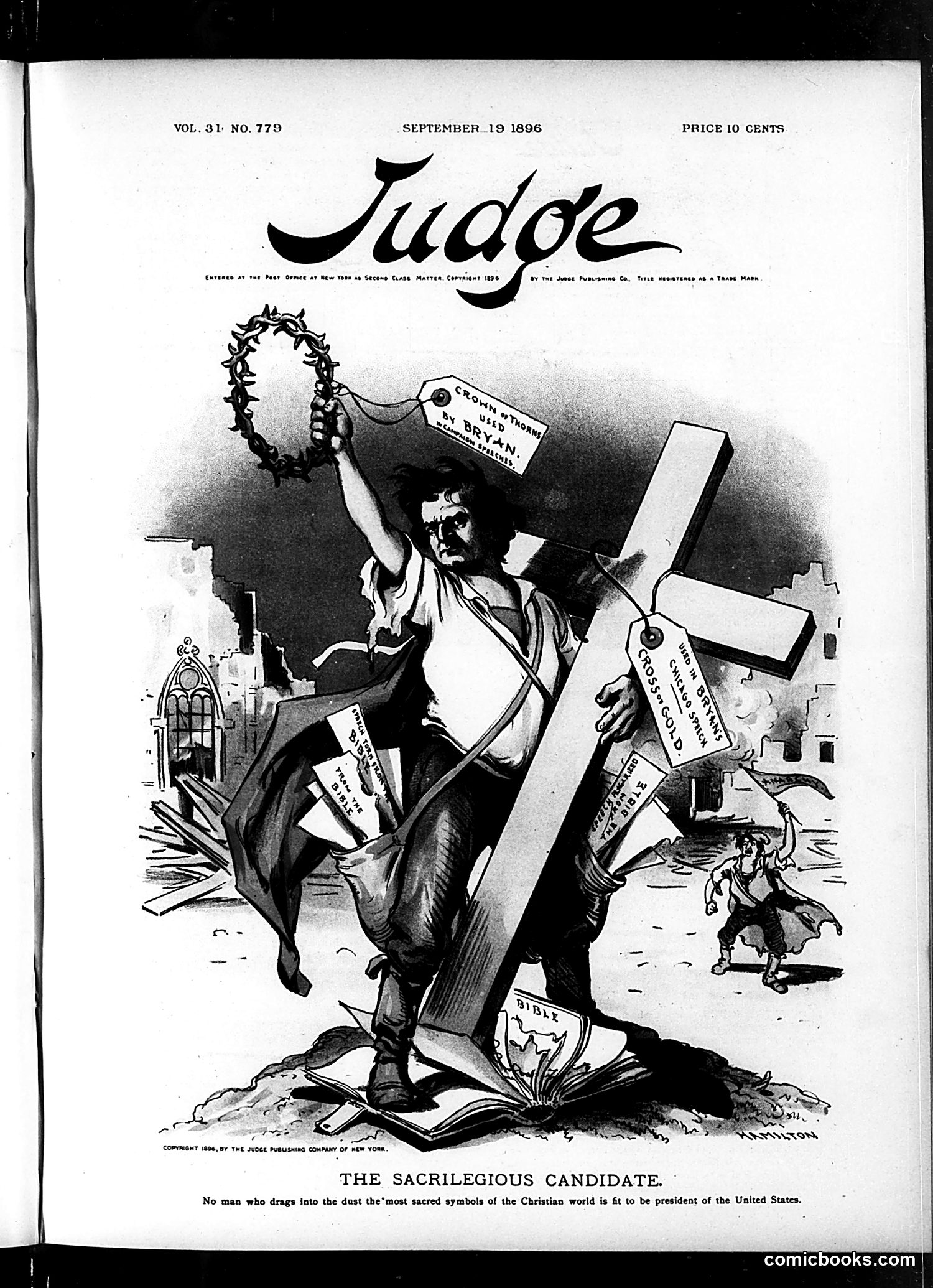
This September 1896 Judge magazine cartoon satirizes a presidential candidate—likely William Jennings Bryan, based on the period—for allegedly disrespecting Christian symbolism. The figure jugggles Christian sacred objects (a crown of thorns, a cross) alongside political labels reading "Crown of Thorns" and what appears to be "By Bryan" or similar. The caption warns: "No man who drags into the dust the most sacred symbols of the Christian world is fit to be president of the United States." The satire targets the candidate's perceived irreverence toward religion, a significant concern in 1890s American politics. The juggling act suggests reckless treatment of faith. This reflects fierce debates over religion's proper role in presidential campaigns and governance during the Gilded Age.
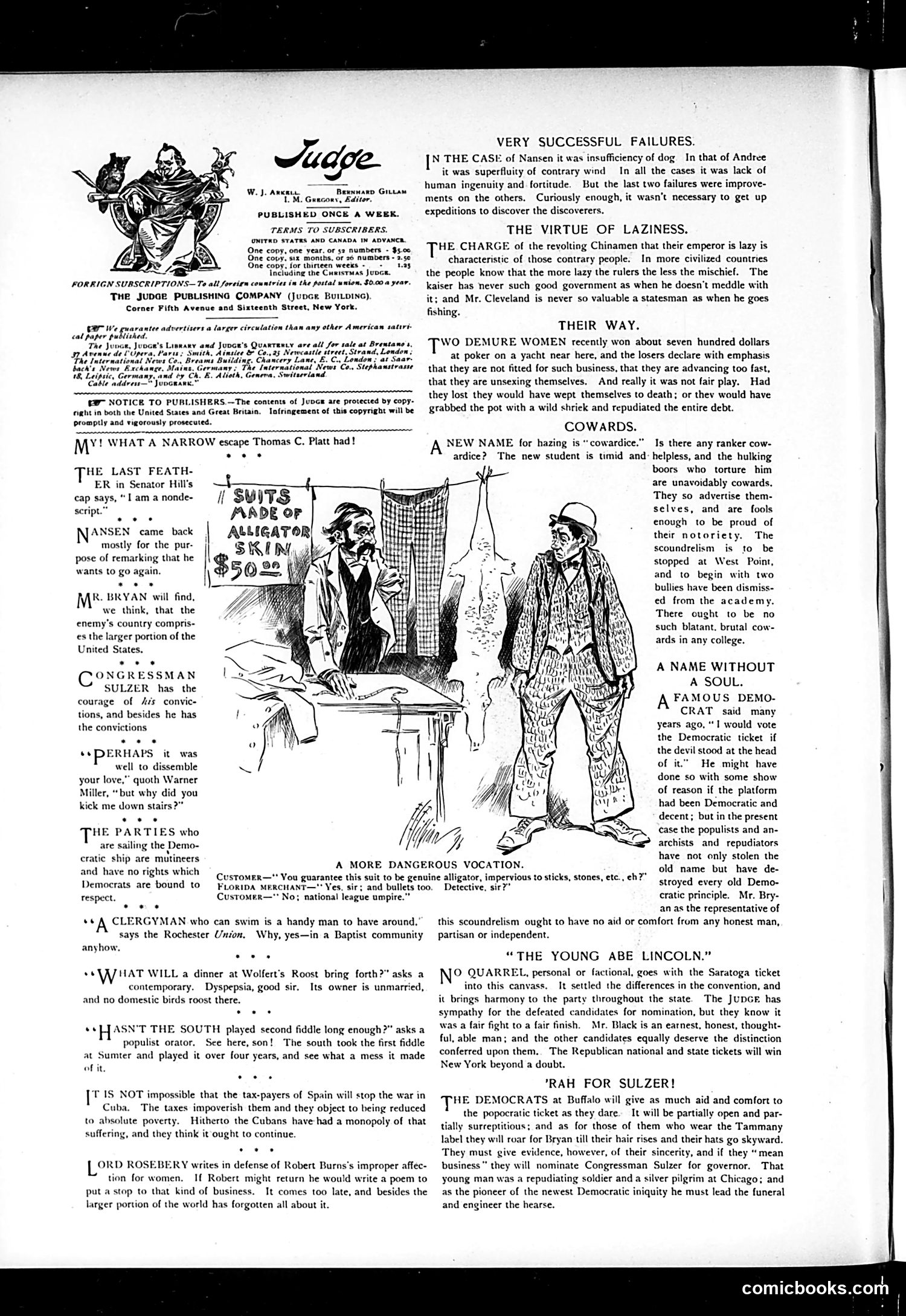
The central cartoon depicts two men examining an "alligator skin suit" for $50—likely satirizing late 19th-century consumer fraud and dubious merchandise claims. The dialogue between "Customer" and "Detective" suggests skepticism about whether the garment is genuinely alligator or inferior materials misrepresented as such. The surrounding text contains brief political jabs, including commentary on Democratic political conventions, Senator Hill, Congressman Sulzer, and figures like Bryan and Cleveland. Most references are oblique one-liners rather than sustained arguments. The overall page blends commercial satire (fake products) with political commentary typical of Judge's format—quick hits mocking politicians, social pretensions, and consumer gullibility. Without specific dates or clearer context, precise historical identification of most figures remains uncertain.
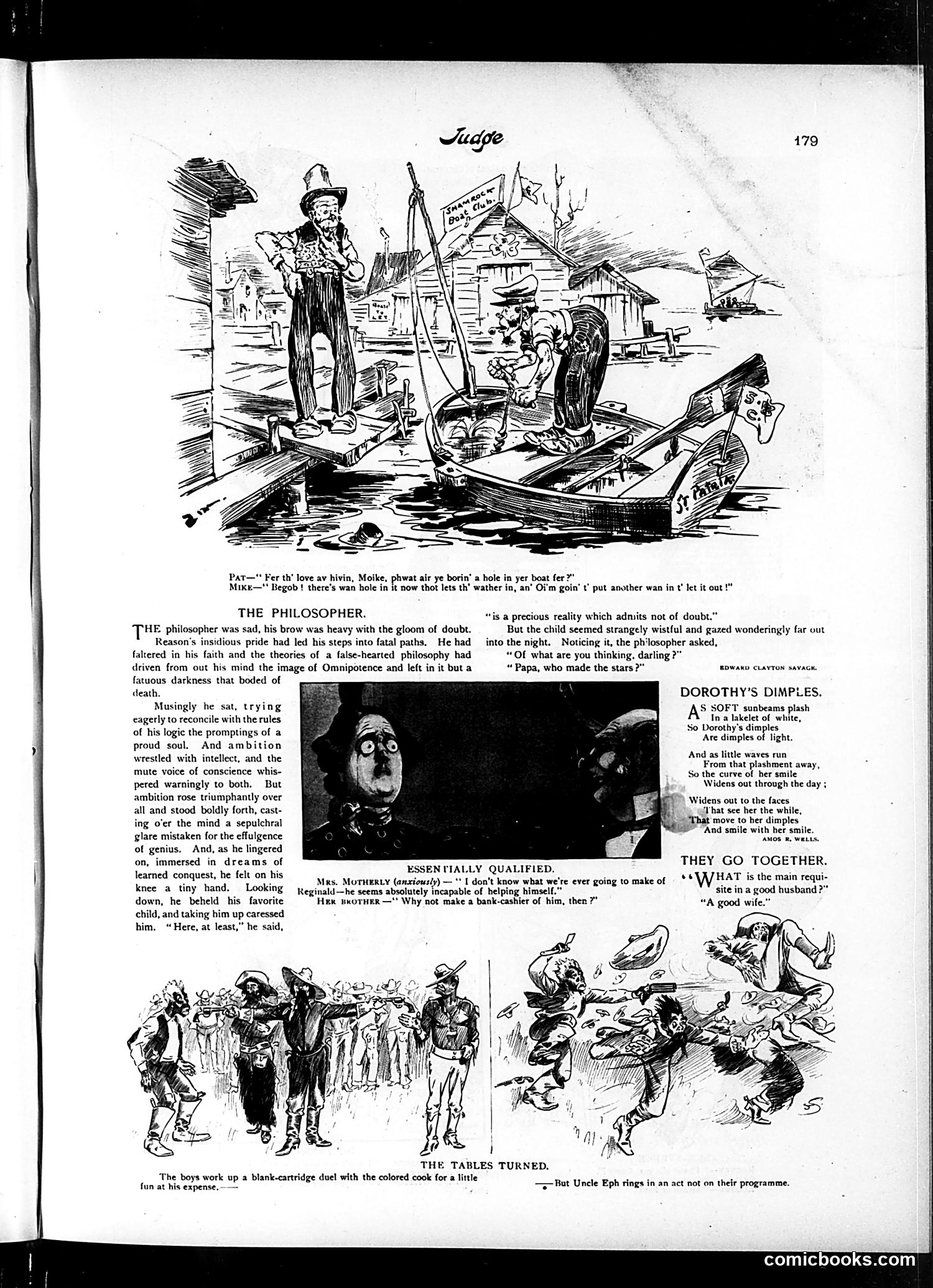
**Top cartoon ("Judge"):** Two men in a boat with holes—one standing, one sitting—debate whether to patch the leak. This is a straightforward visual joke about poor decision-making: the sitting man suggests adding *more* holes to "let it out," which is absurd logic. The satire mocks illogical thinking applied to obvious problems. **"The Philosopher" section:** A story about a man who lost faith in philosophy and reason, now cynically "lingering on, immersed in dreams of learned conquest." This appears to mock intellectuals or academics disconnected from practical reality. **"Dorothy's Dimples" and "They Go Together":** Light verse and humor pieces unrelated to political satire—standard filler content for the magazine. **Bottom cartoons:** Depict children's mischief and domestic scenes with no apparent political significance.
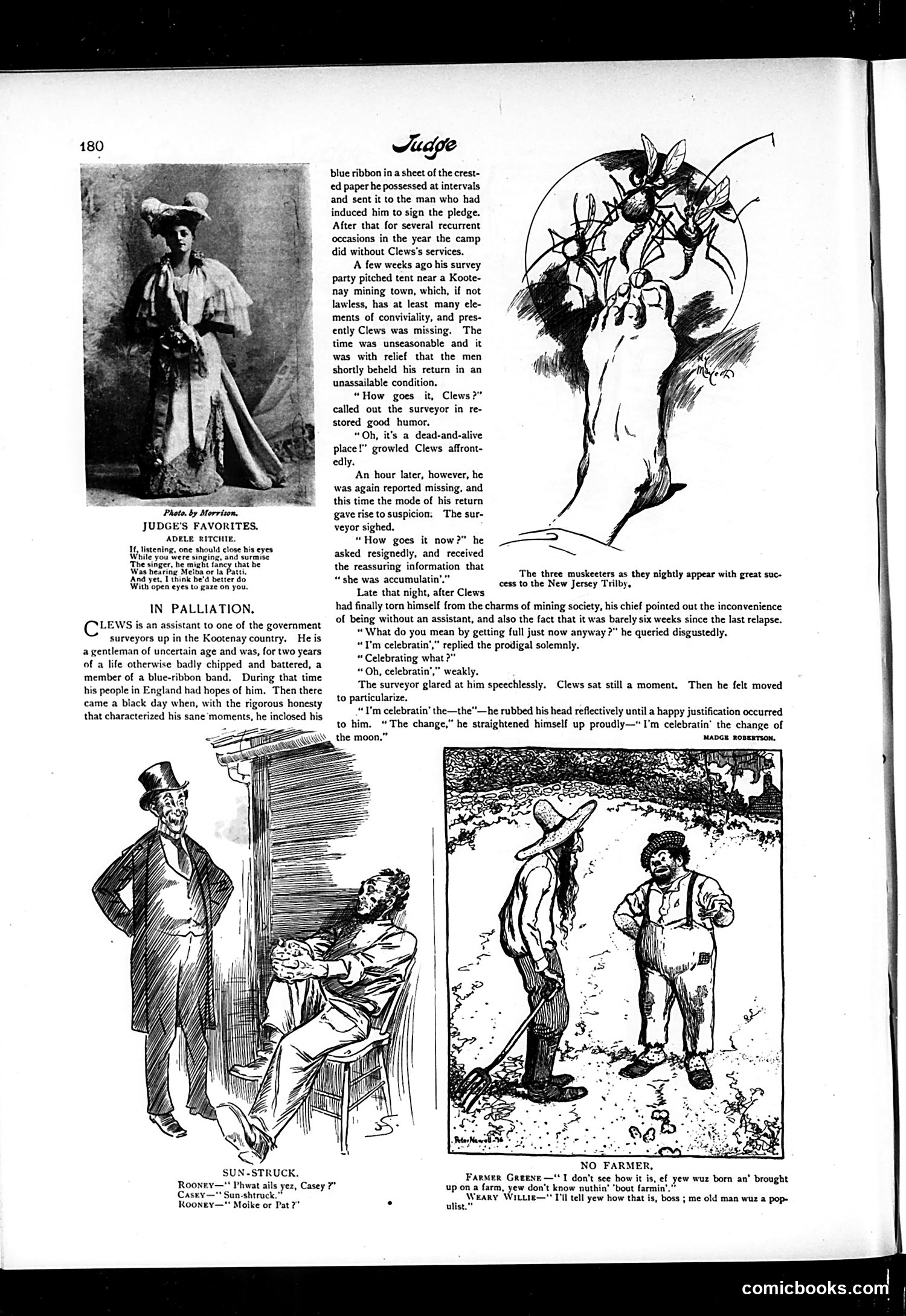
This page contains three satirical pieces mocking human weakness and pretense: **"In Palliation"** (main story with illustrations): Clews, a government surveyor in British Columbia, repeatedly gets drunk despite having once pledged temperance (symbolized by returning his "blue ribbon"). When caught repeatedly intoxicated, he absurdly claims to be "celebrating" — first vaguely, then finally declaring he's celebrating "the change of the moon." The satire targets alcoholics who make feeble excuses for relapses, treating drinking as somehow justified or inevitable. **"Sun-Struck"** (small cartoon): A wordplay joke. When Rooney asks Casey what's wrong, Casey says he's "sun-struck." Rooney asks "Moike or Pat?" — implying the sun struck someone else named Moike or Pat, missing that Casey means *he* was affected. The humor relies on Irish immigrant dialect and misunderstanding. **"No Farmer"** (bottom): Farmer Green questions why Weary Willie, supposedly farm-raised, knows nothing about farming. The punchline reveals Willie's father was a "populist" — suggesting political radicalism made him a poor farmer, satirizing Populist politics as impractical.
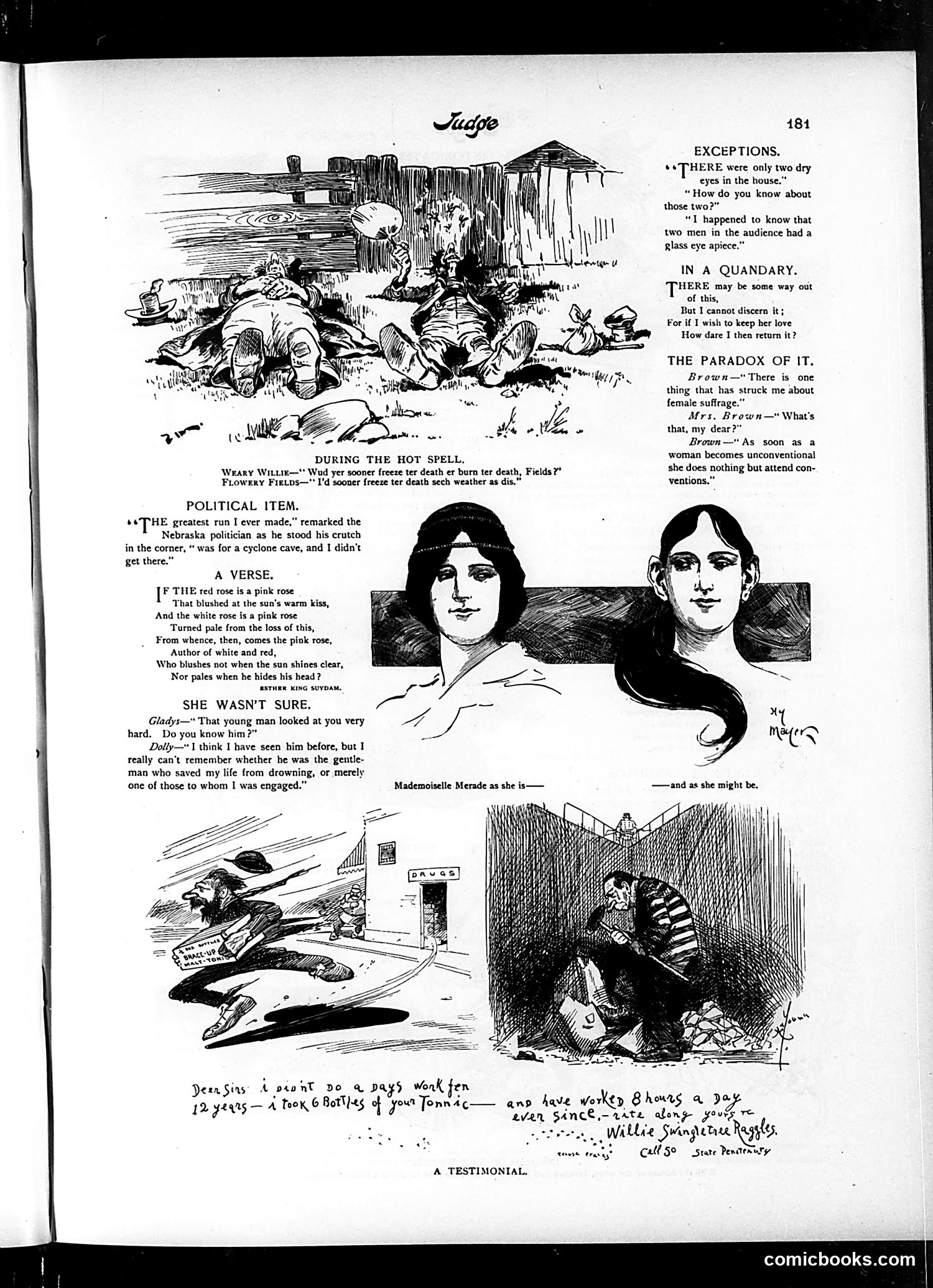
This page from *Judge* contains mostly brief comic anecdotes and wordplay typical of the magazine's humor: **The Political Item** mocks a Nebraska politician's cowardice—he brags about running from a cyclone but couldn't even reach safety. **Female Suffrage Paradox** jokes that once women gain voting rights, they abandon home life for conventions, suggesting anti-suffrage sentiment common to the era. **Gender/Romance Humor** includes pieces like "She Wasn't Sure," where a woman confuses her various suitors, and "In a Quandary," reflecting period attitudes about courtship and female fickleness. **The Testimonial** (bottom) appears to be a convict's endorsement of a tonic or patent medicine—satirizing dubious product testimonials. The hot-spell dialogue simply offers working-class humor about extreme weather. The verse is conventional poetry. Overall, the page emphasizes *Judge*'s mix of topical satire, romantic comedy, and vernacular humor aimed at early-20th-century American readers.
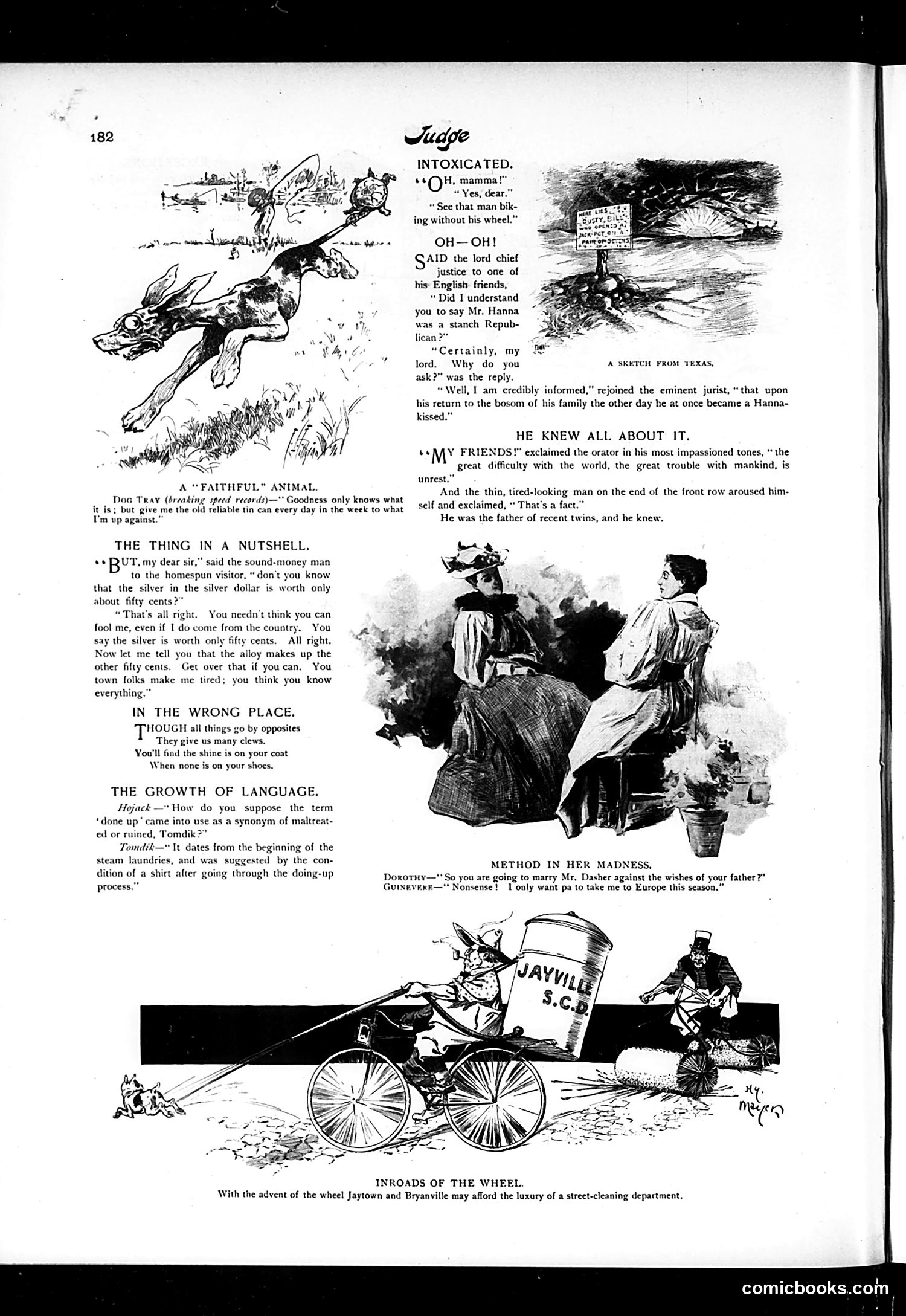
This page contains multiple brief satirical pieces typical of 1890s Judge magazine humor: **"Intoxicated"** jokes about a man riding a bicycle without his wheel—absurdist humor about the bicycle craze. **"He Knew All About It"** satirizes an orator complaining about "unrest" in the world; a tired man with newborn twins interrupts to agree, having personal experience with sleeplessness and disorder. **"The Thing in a Nutshell"** mocks currency debates of the era (likely referencing the free silver controversy) through a country visitor outwitting an urban "sound-money" advocate with rustic logic about alloy composition. **"Method in Her Madness"** jokes that a woman agrees to marry to manipulate her father into European travel—satirizing women's limited agency and marriage as transactional. **"Inroads of the Wheel"** suggests bicycles' popularity is so transformative that even small towns can now afford street-cleaning infrastructure. The overall tone reflects fin-de-siècle American preoccupations: economic debate, urbanization, new technology, and social pretension.
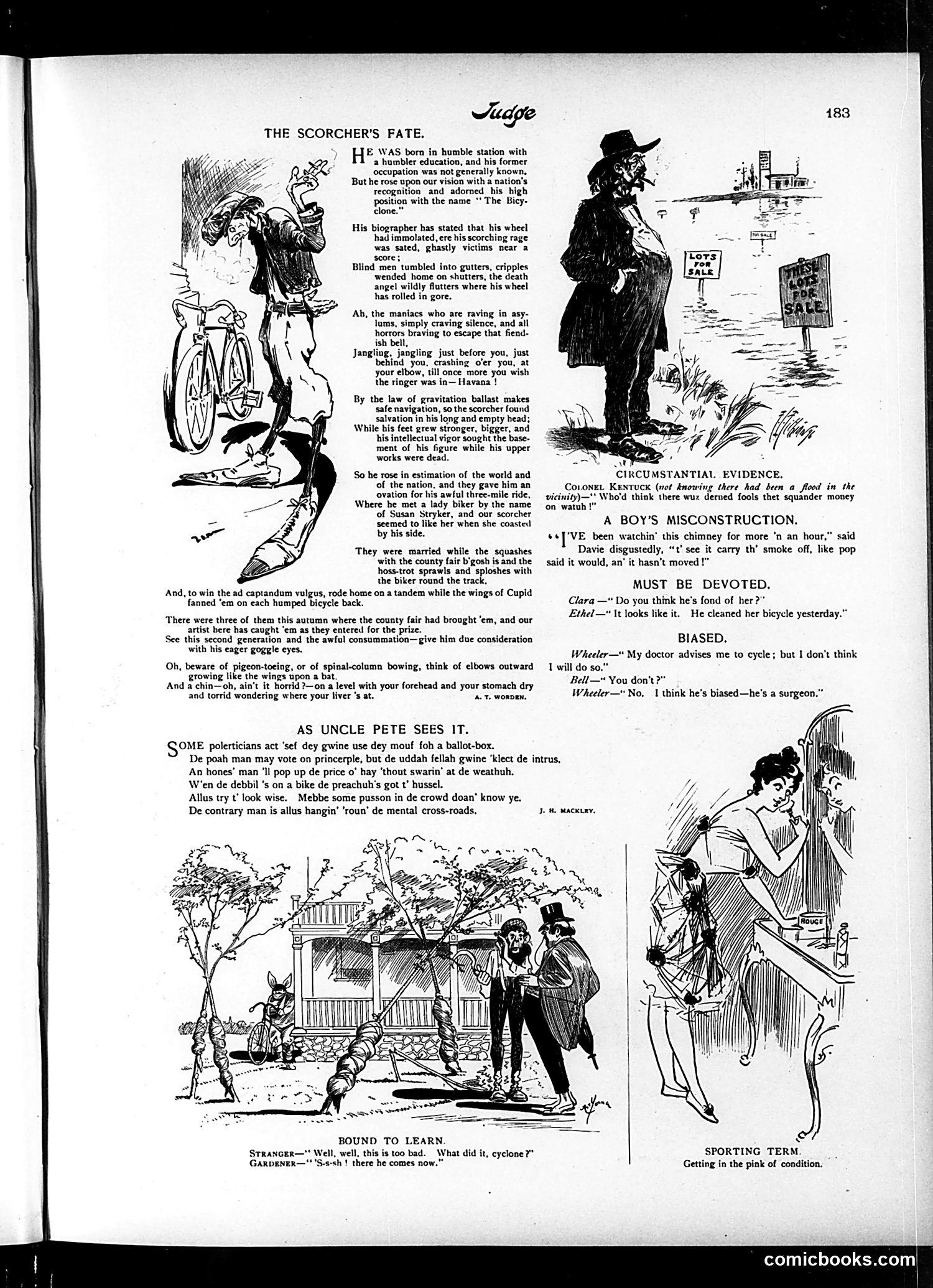
This page satirizes the bicycle craze of the 1890s, particularly the dangerous "scorchers" (reckless cyclists) who terrorized pedestrians. **Main Cartoon - "The Scorcher's Fate":** A mock-heroic narrative poem mocks a cyclist called "The Bicycle" who rises from humble origins to fame despite causing numerous injuries. The satire suggests his empty head provides "ballast" for safe riding. He marries another cyclist (Susan Stryker) and their offspring—shown with exaggerated physical deformities—represent the supposed hereditary dangers of cycling obsession. This reflects genuine Victorian anxiety about bicycles as both a danger and a corrupting social influence. **Minor Cartoons & Jokes:** Include commentary on voting ("polerticians"), a boy misunderstanding his father's instruction about a chimney, and doctor/cycling puns. The "Bound to Learn" cartoon depicts a cyclist causing accidents. The overall message: cycling, while fashionable, produces dangerous maniacs whose recklessness harms society and whose children bear the physical consequences.
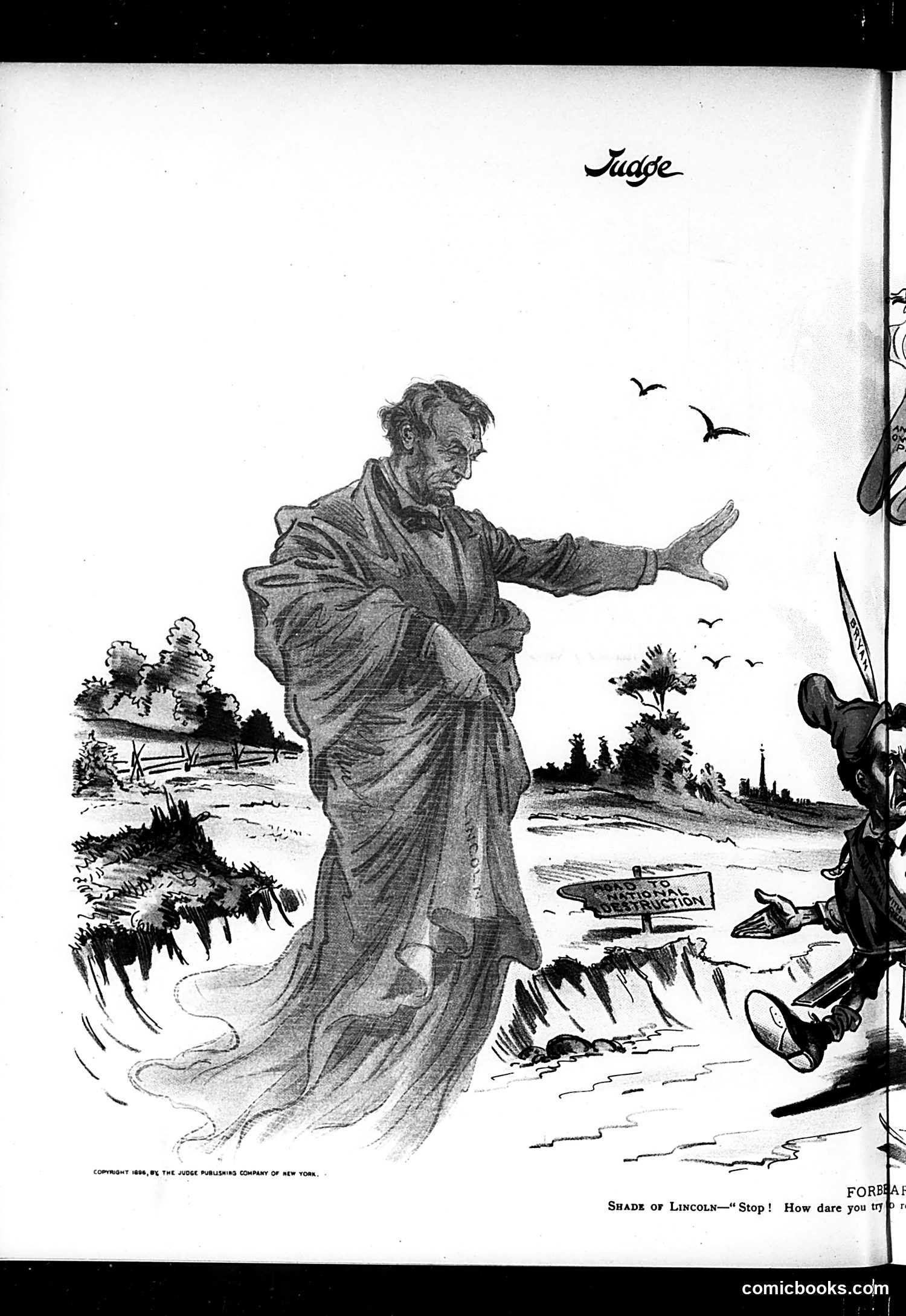
This is a Judge magazine cartoon titled "Shade of Lincoln—'Stop! How dare you!'" The image depicts the ghost or spirit of Abraham Lincoln gesturing to halt someone or something in a landscape. The spectral Lincoln appears to be protesting or objecting to an action occurring in the scene below him. Without additional visible context on this page, the specific event being satirized is unclear. However, the invocation of Lincoln's shade typically signaled editorial disapproval of actions the cartoonist believed violated Lincoln's principles—likely related to Civil War legacy, Reconstruction policies, or civil rights issues. The dramatic supernatural framing emphasizes moral outrage, suggesting the cartoonist saw contemporary actions as betraying Lincoln's vision. The copyright date (1806 appears to be a transcription error) and Judge's satirical nature indicate this comments on a specific political controversy of its era.
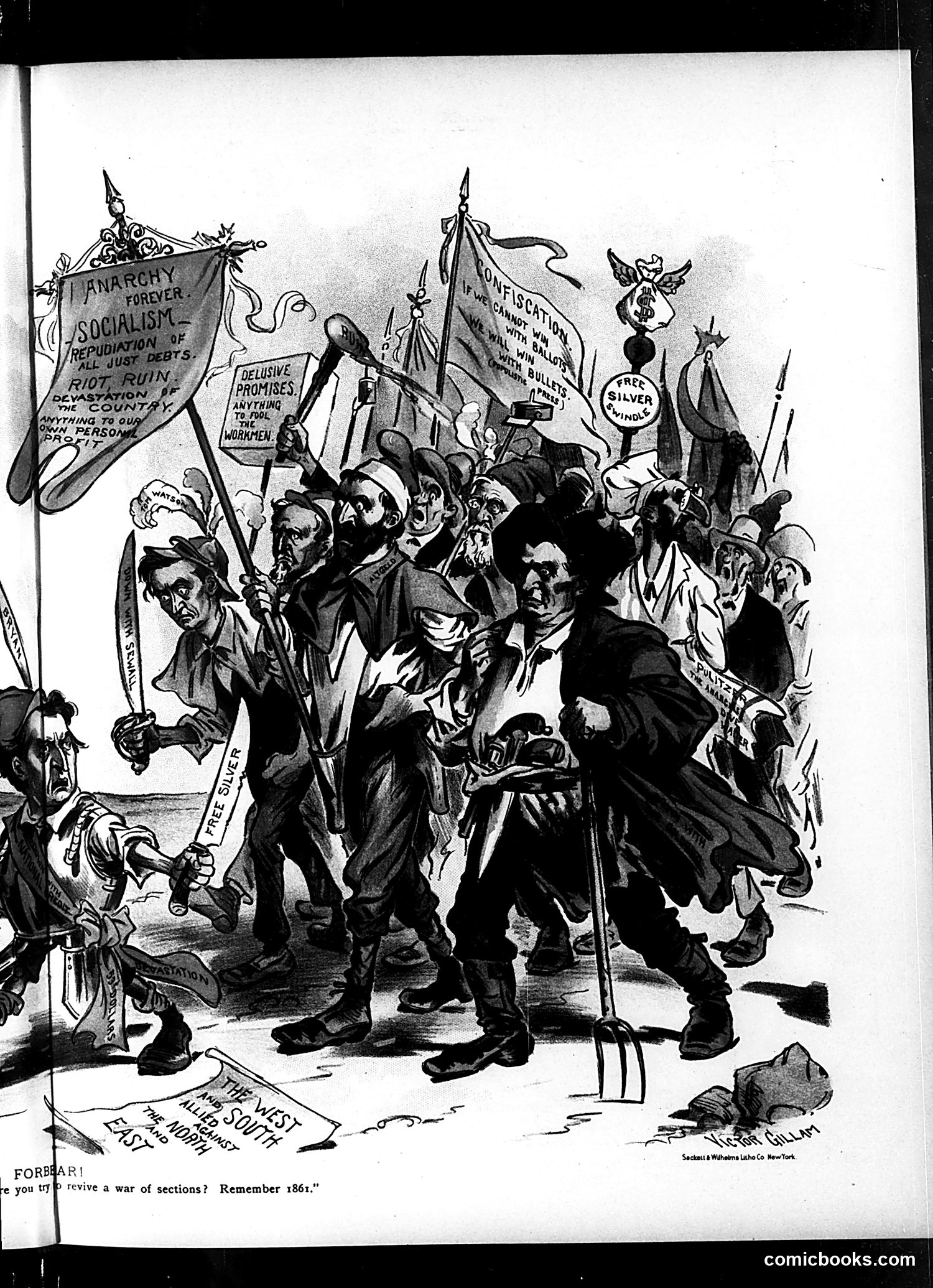
This satirical cartoon depicts a chaotic mob carrying inflammatory banners and weapons, representing radical political factions. Visible signs reference "Anarchy," "Socialism," demands for "Free Silver," and "Confiscation" of property. The figures appear caricatured as dangerous extremists. The caption—"Do you wish to revive a war of sections? Remember 1861"—references the Civil War, warning that such radical movements threaten national unity and could spark sectional conflict again. The cartoon sarcastically presents socialism and anarchism as existential threats comparable to pre-Civil War tensions. This likely dates to the 1890s when Judge magazine opposed populist and socialist movements through such alarmist imagery. The "Free Silver" reference particularly suggests the 1896 election period, when Judge opposed William Jennings Bryan's currency proposals as dangerously radical.
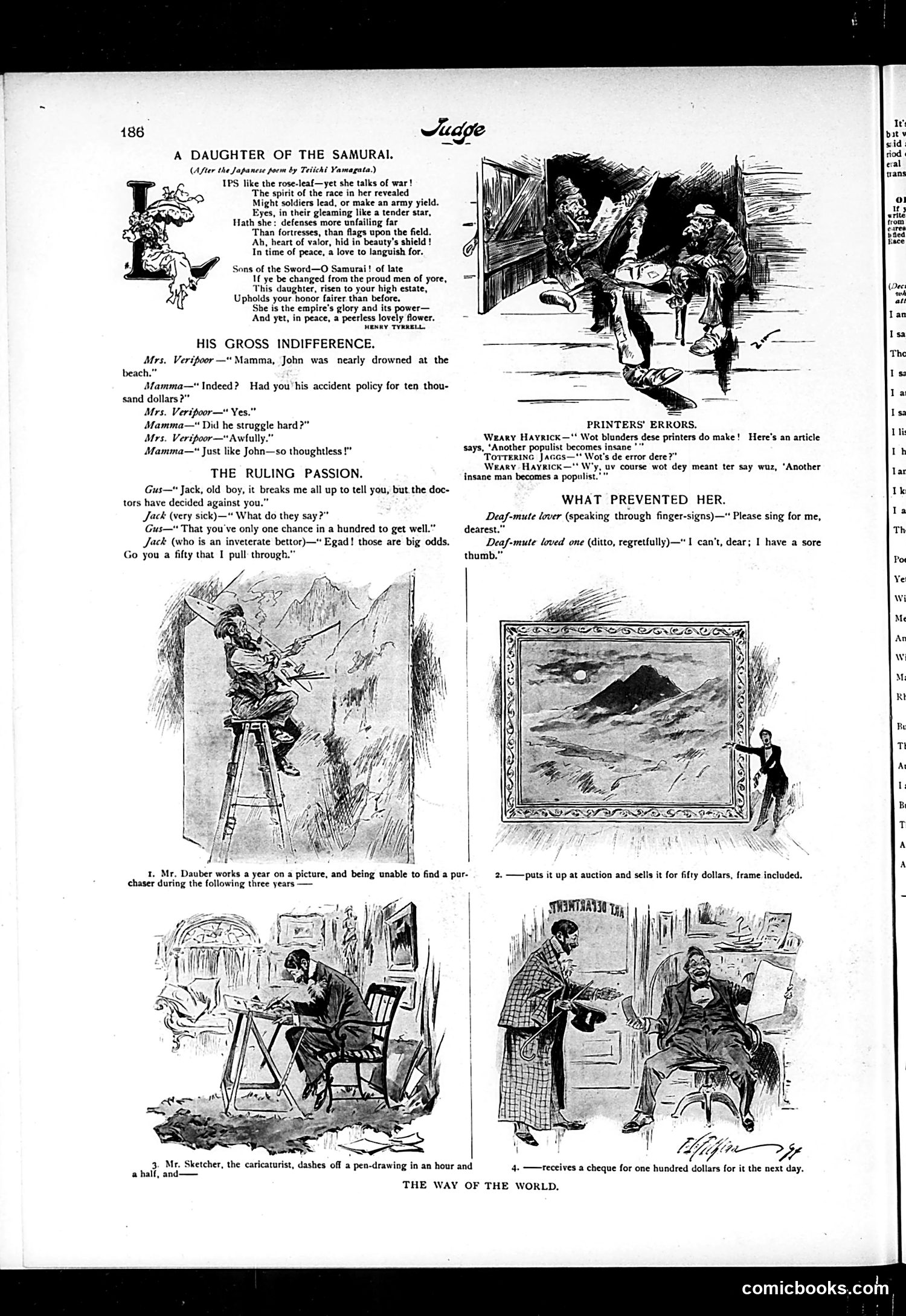
This page contains several satirical humor pieces typical of Judge magazine's social commentary: **"A Daughter of the Samurai"** is a poem celebrating Japanese women's strength and patriotism, likely reflecting early 20th-century American fascination with Japanese culture following Japan's military victories. **"His Gross Indifference"** mocks a wealthy woman's callousness—she's more concerned about her son's insurance payout than his near-drowning, satirizing materialistic indifference to human welfare. **"The Ruling Passion"** jokes that a compulsive gambler (Jack) remains true to character even facing death, betting on his own survival despite 99-to-1 odds. **"Printers' Errors"** ridicules Populist politicians by having workers joke that the real error was saying a populist *became* insane, implying populists are already insane. **"The Way of the World"** (four-panel sequence) satirizes artistic commerce: a struggling artist labors a day-and-a-half on a painting, sells it cheaply at auction, then receives a substantial check—suggesting the art market's arbitrary valuations and the gap between creator and beneficiary.
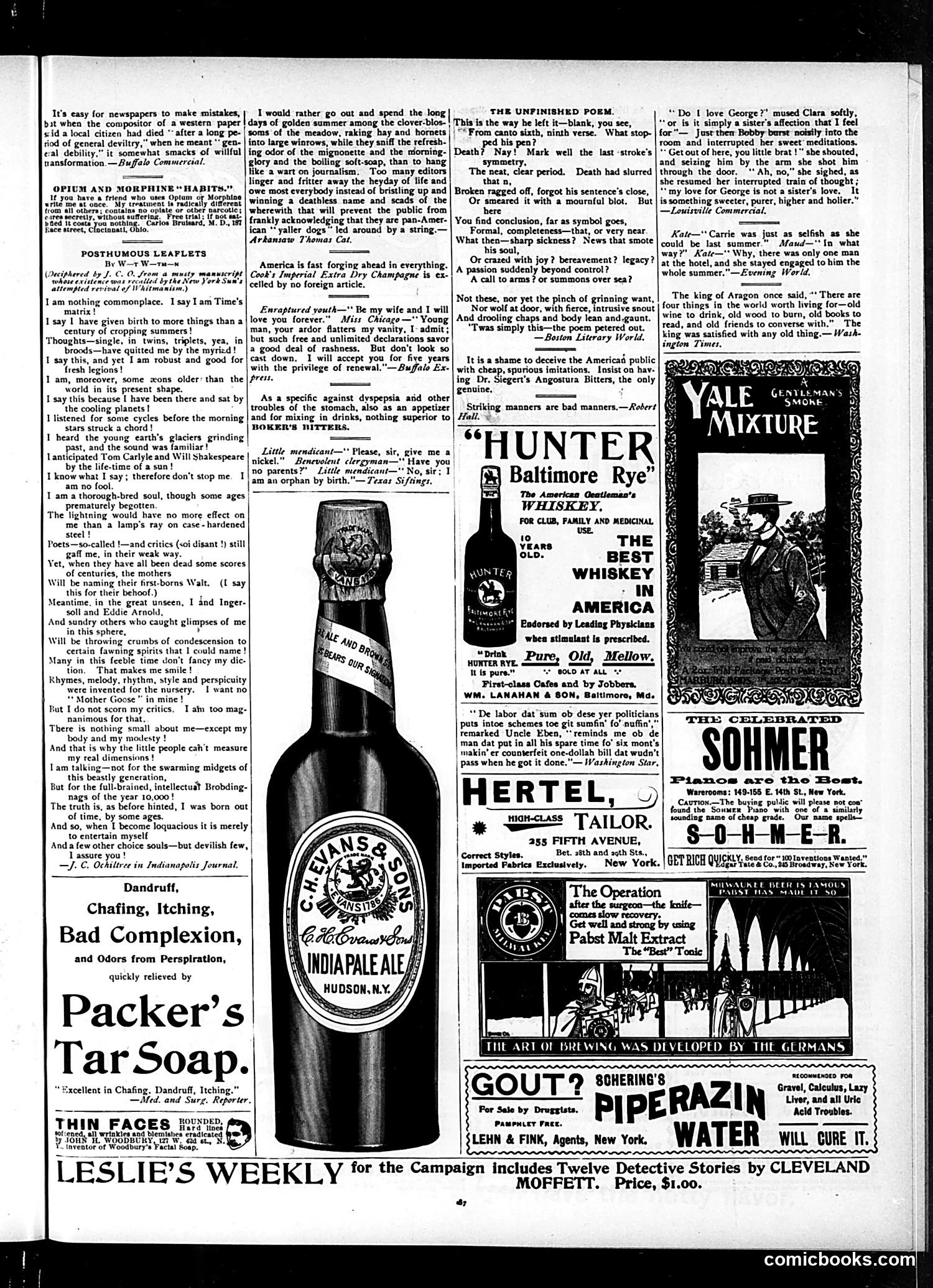
This page is primarily **advertisements and filler content** rather than political cartoons. The main elements are: **"Posthumous Leaflets"** — A satirical poem parodying Walt Whitman's grandiose, self-aggrandizing style. The piece mocks Whitman's characteristic verbose free verse and his inflated self-importance ("I am Time's matrix," claims to predate creation). This was a common literary jab at Whitman, whose work was experiencing a revival around this period. **Text snippets** include editorial humor about newspaper typographical errors and complaints about various professions. **The rest** consists of patent medicine advertisements typical of the era—for opium/morphine addiction treatment, tar soap for skin conditions, and other dubious remedies. The Whitman parody is the only substantive satirical content here; it requires knowledge of Whitman's actual poetry style to land effectively. Most modern readers would miss the literary reference entirely.
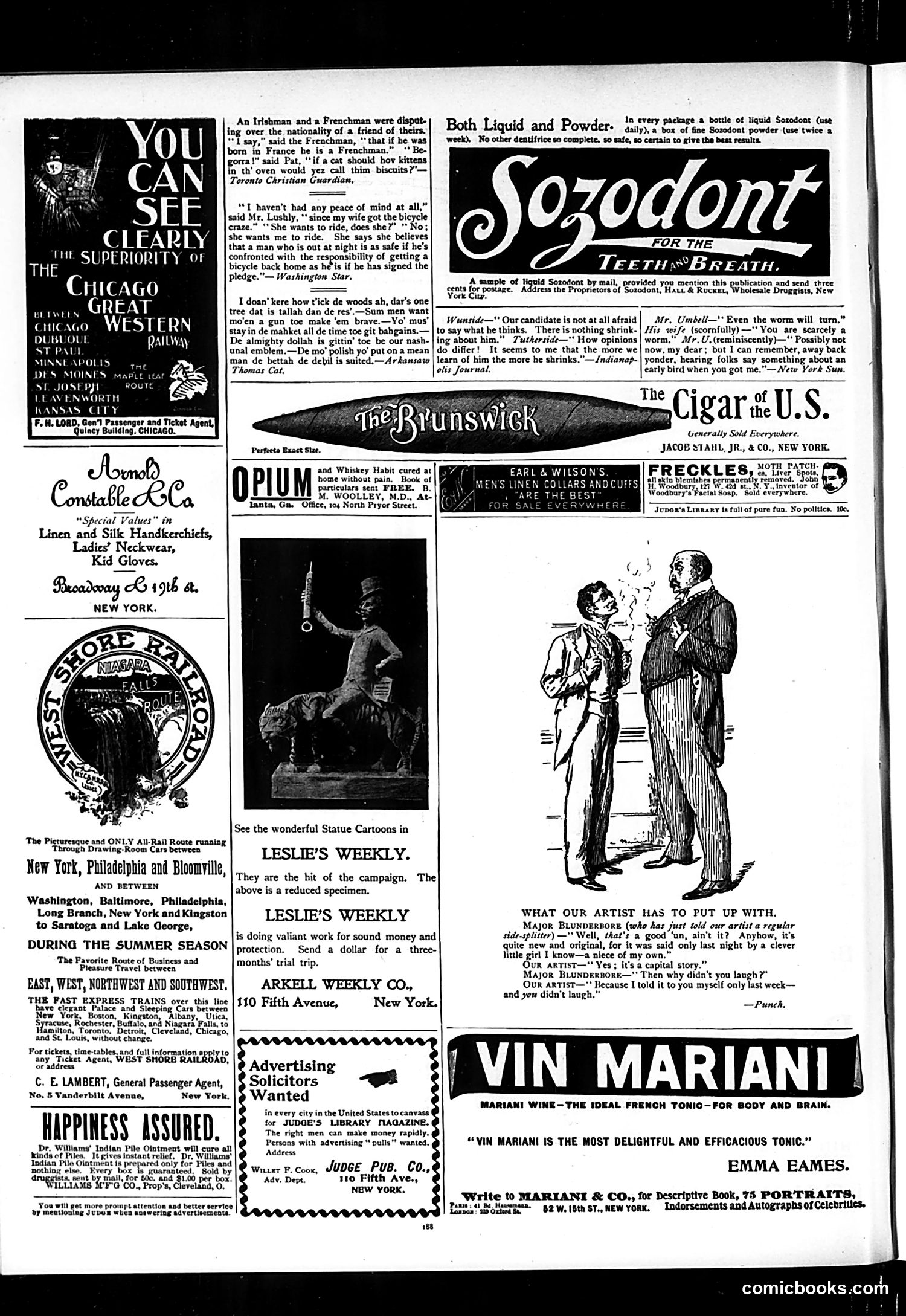
This page is primarily **advertising and filler content**, typical of early-20th-century magazines. The notable satirical content includes: **"What Our Artist Has to Put Up With"** (bottom right): A cartoon dialogue between a businessman and an artist complaining about criticism. The businessman claims he told the artist "it's a capital story" and the work is funny, yet the artist remains unappreciated. This satirizes the tension between commercial patrons and creative professionals—a relatable complaint about difficult clients who claim to like your work but offer little genuine support. The rest of the page consists of advertisements (railroads, patent medicines, clothing, dental products, wine) and short humorous anecdotes about national stereotypes (an Irish-French dispute), marriage, money, and rural wisdom. These represent Judge's typical satirical voice: gentle mockery of everyday American life rather than sharp political commentary.
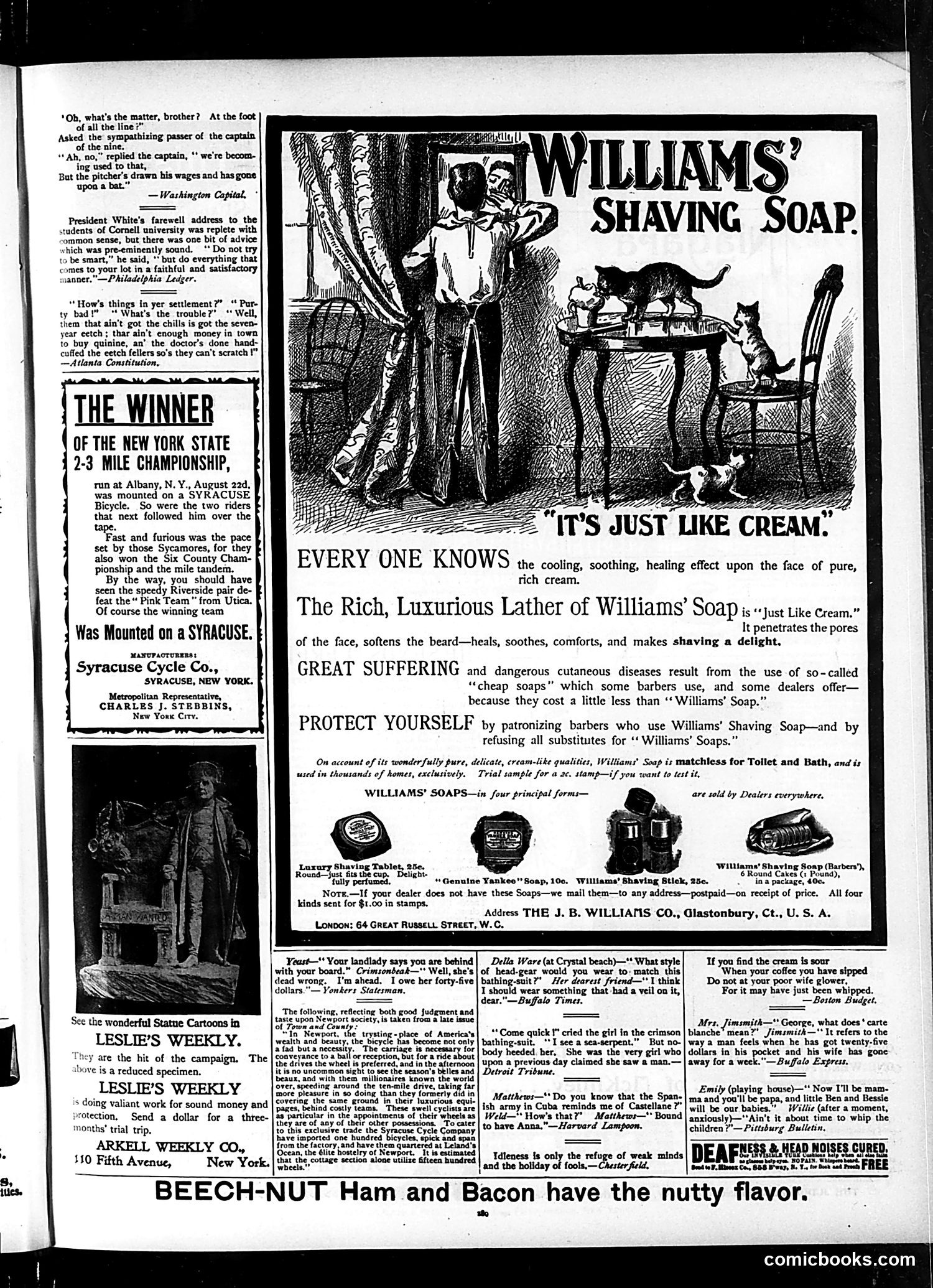
This page mixes **humor columns and advertisements**, primarily from the early 1900s. The **cartoons/jokes** are brief quips about everyday life: a baseball captain whose pitcher abandoned the team, a rural settlement plagued by illness and poverty, and various domestic situations involving landlords, bathing suits, and soured cream. The dominant content is a **Williams' Shaving Soap advertisement** featuring a Victorian-era illustration of a man shaving. The ad emphasizes the soap's luxurious lather and warns against cheap substitutes that cause "dangerous cutaneous diseases"—a common fear-based marketing tactic of the era. It promises quality and purity. Also included: notice of a **Syracuse bicycle championship** and an Arkell Weekly comedy publication advertisement. The satire is gentle and domestic rather than political. The page reflects turn-of-the-century American concerns: economic hardship, product quality/fraud, and humor centered on class distinctions and rural versus urban life.
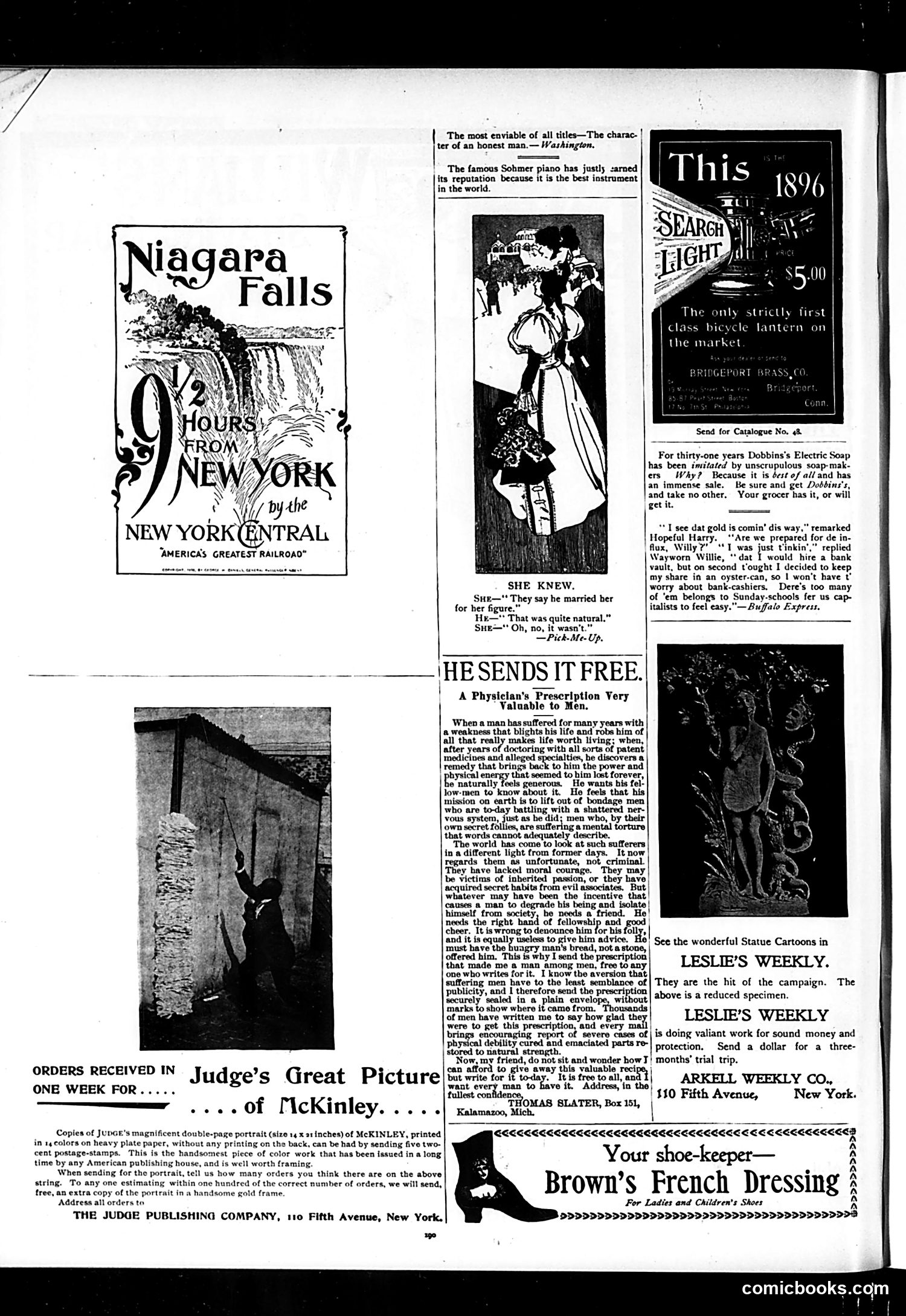
This page is primarily **advertising and promotional content** rather than political satire. The dominant feature is Judge Publishing Company's offer of a color portrait of President **William McKinley** (14 colors, 14 x 20 inches) available for five two-cent stamps. The page includes a guessing contest: readers estimate the number of orders received in one week, with the closest guesser winning a framed copy of the McKinley portrait. The remaining content consists of **commercial advertisements** for various products (Sohmer pianos, bicycle lanterns, soap, shoe dressing) and a doctor's "free prescription" for male sexual dysfunction—typical of the era's patent medicine culture. There is one small joke labeled "SHE KNEW" about a man marrying a woman "for her figure," which plays on the double meaning of the word. The McKinley portrait promotion suggests this issue dates from McKinley's presidency (1897-1901), when his image held commercial appeal.
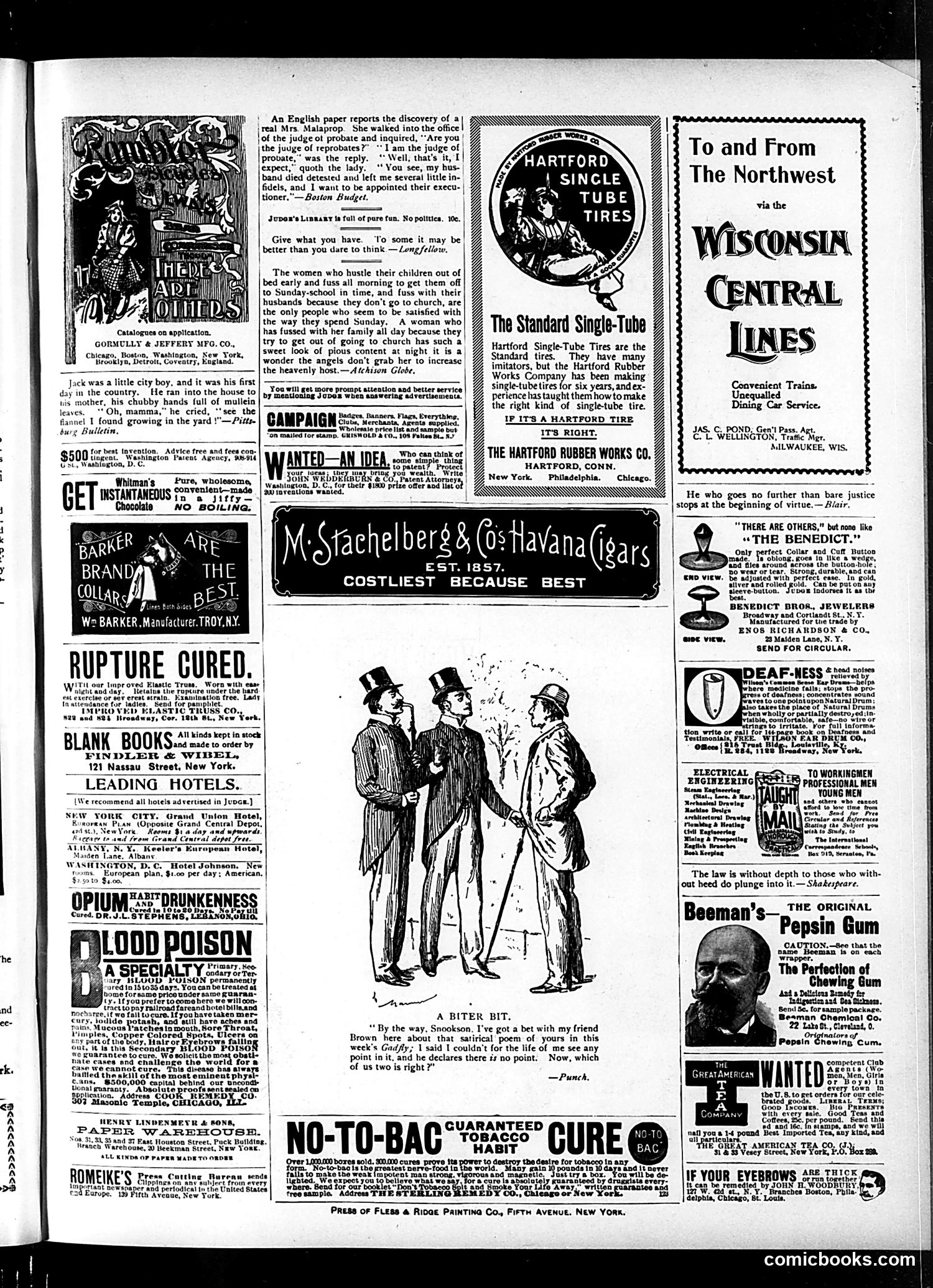
This page is primarily **advertising**, typical of late 19th-century magazines. However, it contains one small cartoon worth noting: **"A Biter Bit"** (center-bottom) depicts three men in conversation. One says he bet a friend that a satirical poem published in "Gadfly" (a competing magazine) had no point—and his friend agreed there *is* no point. He asks which of them is right. This is **inter-magazine satire**: Judge is mocking a rival publication's (Gadfly's) poetry as pointless. The joke's irony is that both parties agree the poem is bad, making the original bet meaningless. The page otherwise features patent medicines (Blood Poison cure, No-To-Bac tobacco treatment), hotels, blank books, and other period products. A brief humorous anecdote involves a widow misusing "probate" as "reprobates" and "executioner" for "executor." Nothing here references current politics or major historical events—it's entertainment and commercial content typical of Judge's satirical-humor-plus-advertising formula.
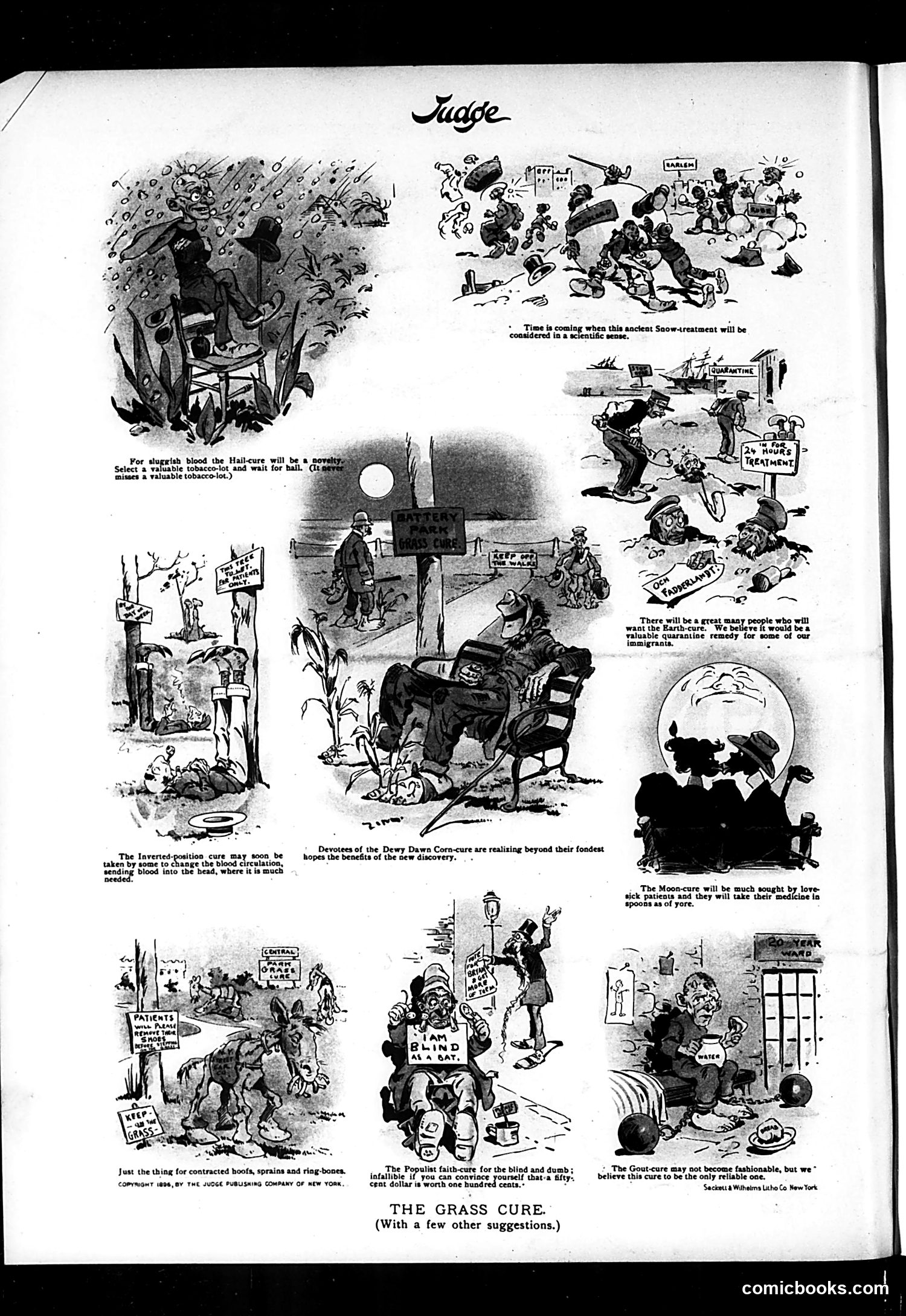
This page satirizes various fraudulent medical "cures" popular in the 1890s, mocking both quack doctors and gullible patients. The title treatment—sending patients to graze like animals—anchors the joke about absurd remedies. The cartoons ridicule specific fake cures: the "Hail-cure" (standing in hail), "Snow-treatment," "Moon-cure," "Populist faith-cure," and others. Each illustration shows ridiculous or contradictory practices presented as serious medicine. The satire targets multiple audiences: wealthy hypochondriacs seeking fashionable treatments, immigrants vulnerable to exploitation ("quarantine remedy for some of our immigrants"), and Populist politicians—the "faith-cure for the blind and dumb" likely references Populist Party's perceived naïveté or false promises. The page mocks both the era's medical charlatanism and society's willingness to believe nonsense. By treating absurdities with deadpan captions, Judge exposes how easily people—particularly the wealthy and gullible—embrace worthless remedies.