
A complete issue · 16 pages · 1896
Judge — August 8, 1896
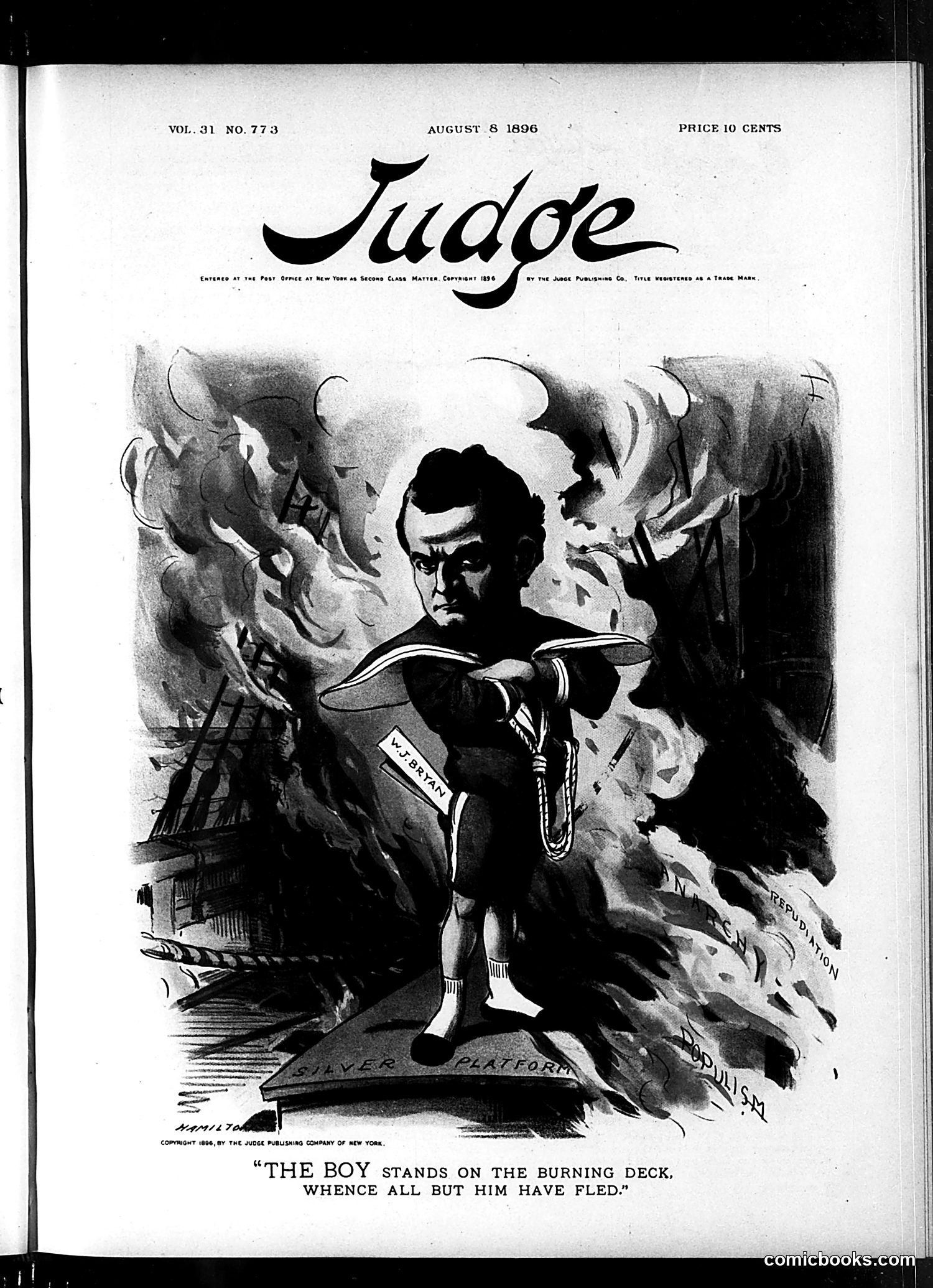
This political cartoon depicts a young sailor standing resolute on a burning ship's deck as flames engulf the vessel around him. The caption reads: "The boy stands on the burning deck, whence all but him have fled." This references the famous 1826 poem "Casabianca" by Felicia Hemans, about a boy who remains at his post on a burning ship during battle. The cartoon uses this literary allusion as satire, likely commenting on a contemporary political or social figure showing stubborn loyalty or duty amid crisis—possibly relating to a political leader or candidate facing difficult circumstances during the 1896 presidential election period. The specific political target remains unclear without additional context, but the imagery suggests criticism of misplaced heroism or foolish persistence in a failing situation.
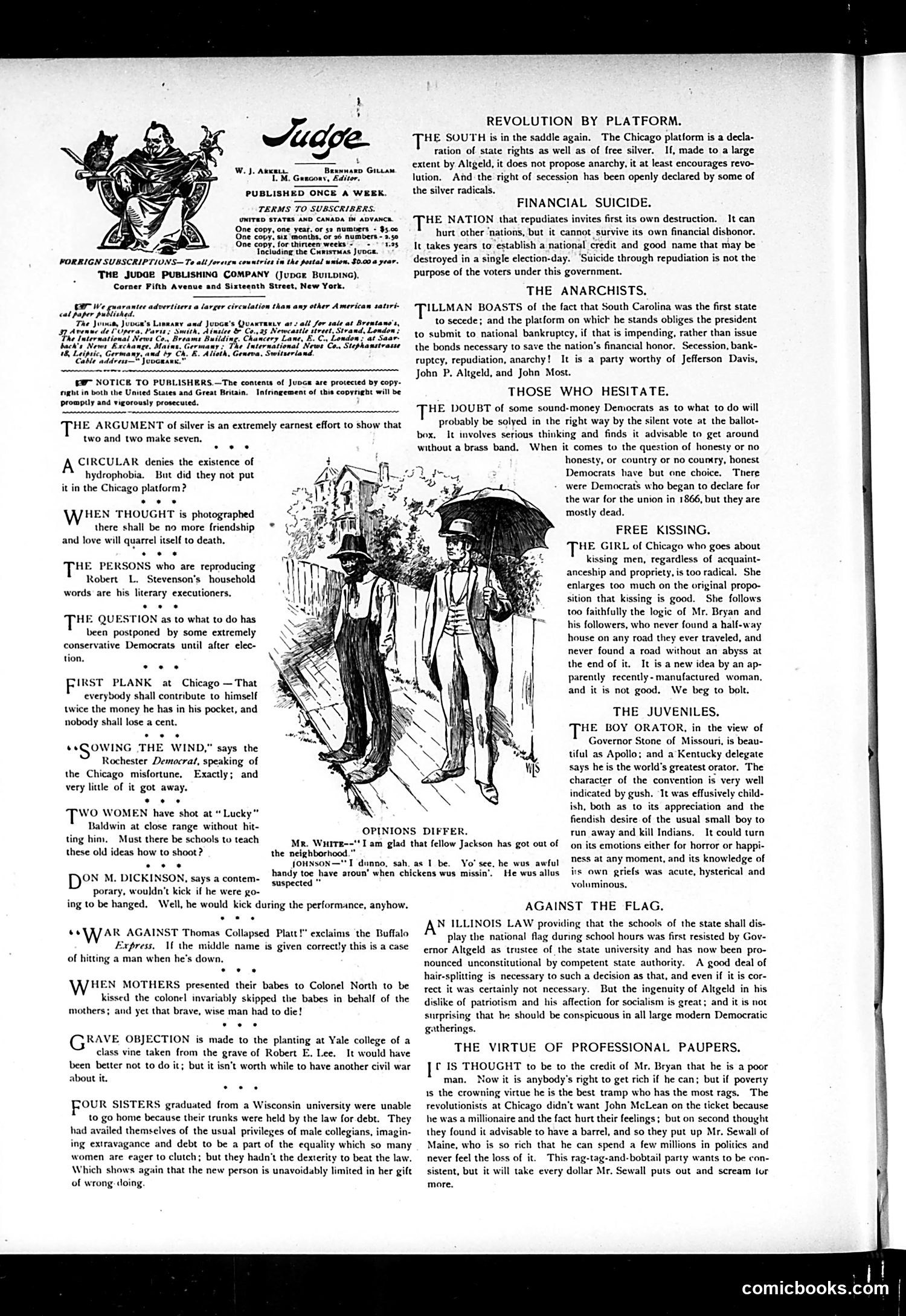
This page contains editorial commentary rather than cartoons. The central illustration shows a woman with an umbrella, accompanying a section titled "OPINIONS DIFFER." The brief satirical items critique various political and social issues of the era: - "Revolution by Platform" mocks the Populist Party's monetary proposals - "Financial Suicide" attacks Democratic financial policy as destructive - "The Anarchists" criticizes figures like John Altgeld (Illinois governor) for allegedly sympathizing with anarchists - "Against the Flag" ridicules an Illinois law banning flag display in schools as unconstitutional overreach - "The Virtue of Professional Papers" sarcastically comments on Bryan's poverty despite his political prominence The commentary reflects Republican/conservative opposition to Populist and Democratic positions during the 1890s political era, using sharp wit and mockery as rhetorical weapons.
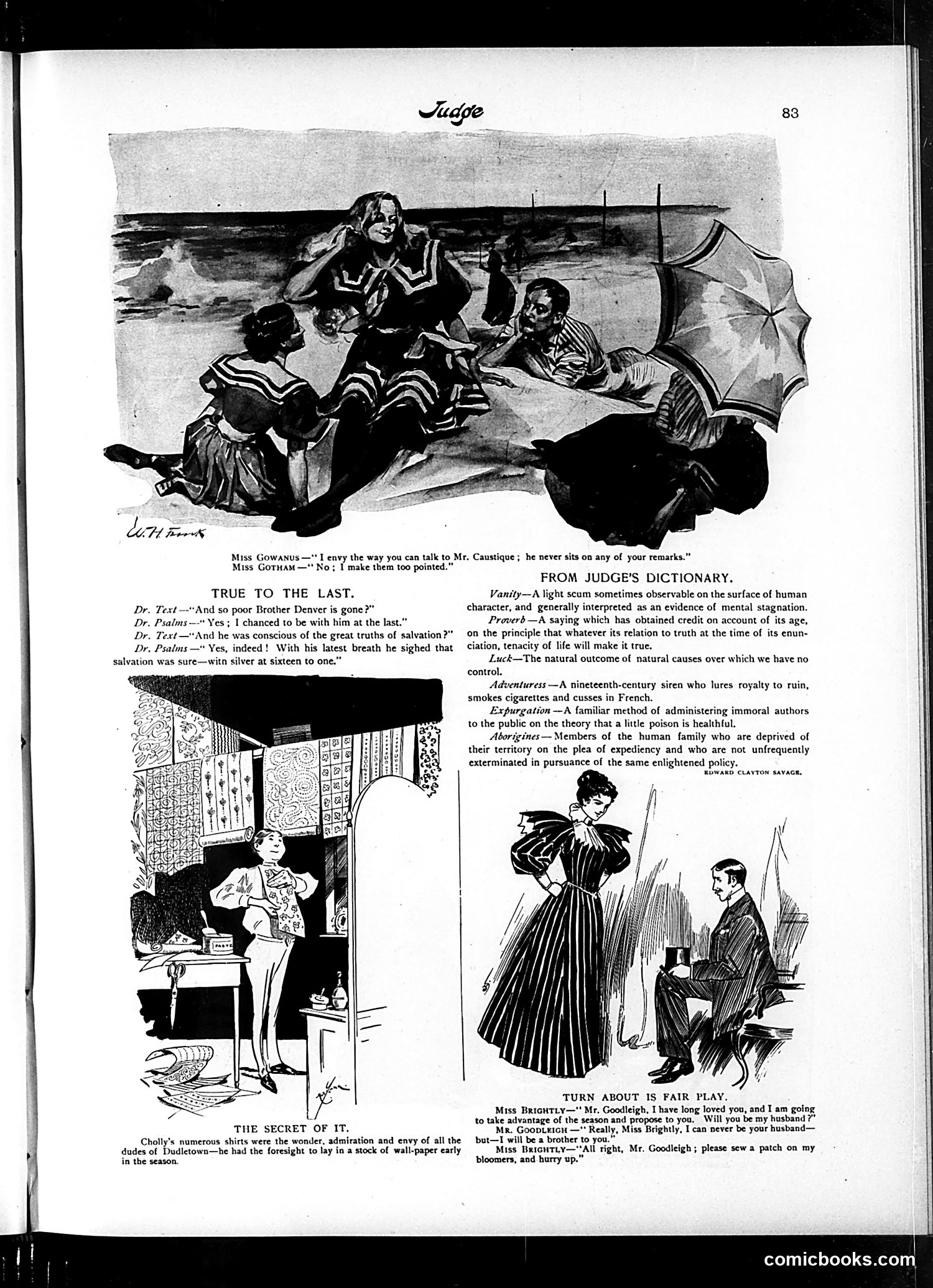
This page contains three separate satirical cartoons typical of Judge magazine's humor: 1. **"True to the Last"** depicts a doctor and patient in a darkly comic exchange about honesty—the patient insists doctors never tell the truth, even at death's end. 2. **"The Secret of It"** shows a man admiring wall-paper in a shop, with caption explaining his numerous shirts were the "wonder, admiration and envy" of society because of this secret source. 3. **"Turn About is Fair Play"** presents a woman (Miss Brightly) proposing marriage to a man (Mr. Goodleigh), inverting Victorian gender roles for comic effect—she initiates what convention dictated men must do. The humor relies on period social expectations: medical cynicism, material consumption, and rigid courtship protocols. The cartoons satirize these norms through exaggeration and role reversal.
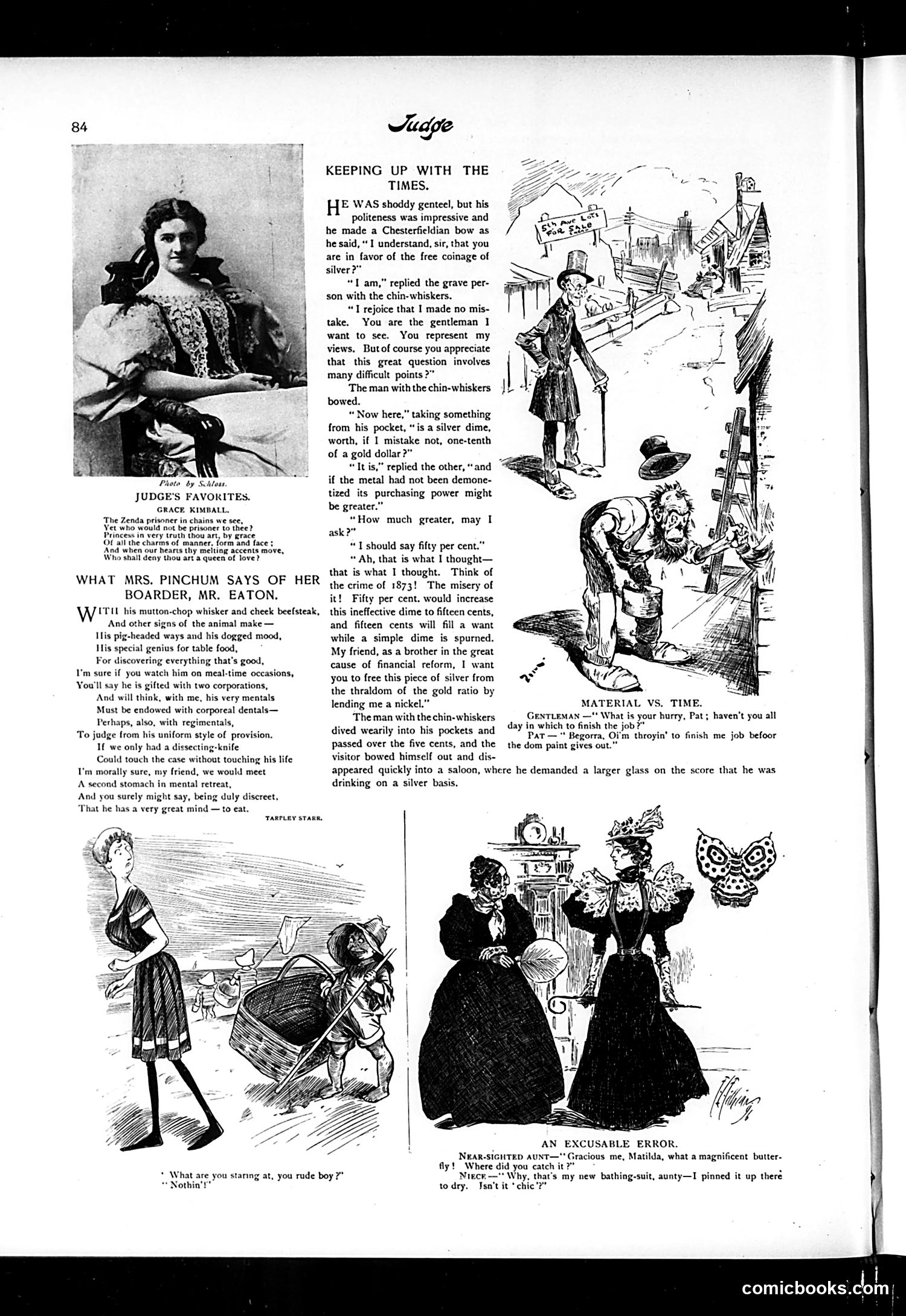
This page from *Judge* satirizes late-19th-century American economic debate, particularly the **free silver movement**—a major political issue of the 1890s. ## Main Cartoon: "Keeping Up with the Times" A well-dressed man approaches someone favoring free coinage of silver (demonetization of gold). Through flattery and false camaraderie, he engages the man in a discussion about how demonetizing silver would increase its purchasing power. The "reformer" then asks to borrow a nickel, exploiting his new acquaintance's sympathies. **The joke**: The cartoon mocks free-silver advocates as naive idealists whose abstract economic arguments are easily exploited by smooth-talking con men. The borrower represents predatory individuals who use monetary reform rhetoric as a pretense to extract money from believers. The page's other content includes society-page humor and jokes unrelated to this satire. This reflects *Judge's* skepticism toward populist economic movements of the era.
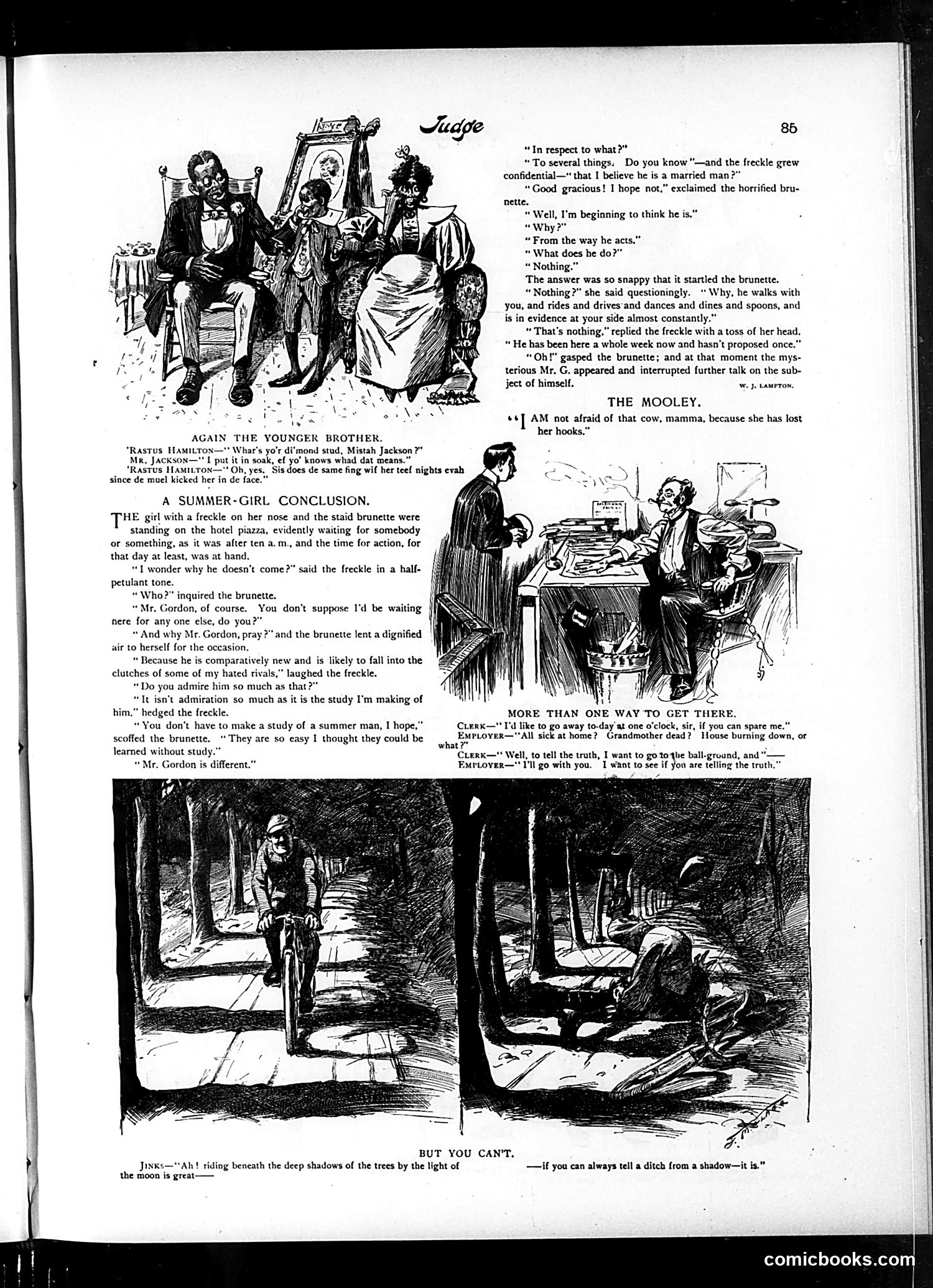
This page contains three unrelated satirical sketches typical of Judge's humor: **"Summer-Girl Conclusion"**: A freckled girl waiting for "Mr. Gordon" tells a brunette companion that a man who hasn't proposed after a week of constant companionship must be married. The joke satirizes women's expectations of quick marriage proposals from summer visitors and the absurdity of her logic. **"Again the Younger Brother"**: A brief dialogue between two Black characters using stereotypical dialect, joking about pawning jewelry and loose teeth—crude racial humor typical of the era. **"More Than One Way to Get There"**: An employer agrees to let his clerk leave early for the "ball-ground," thinking he's lying about the excuse. The humor plays on the employer's cynicism about workers' honesty. The bottom panel, "But You Can't," appears to be a caption about distinguishing ditches from shadows while riding at night—likely a safety joke about moonlit travel. These sketches reflect Judge's typical mix of social satire, romance comedy, and ethnic stereotypes common to 1890s American humor.
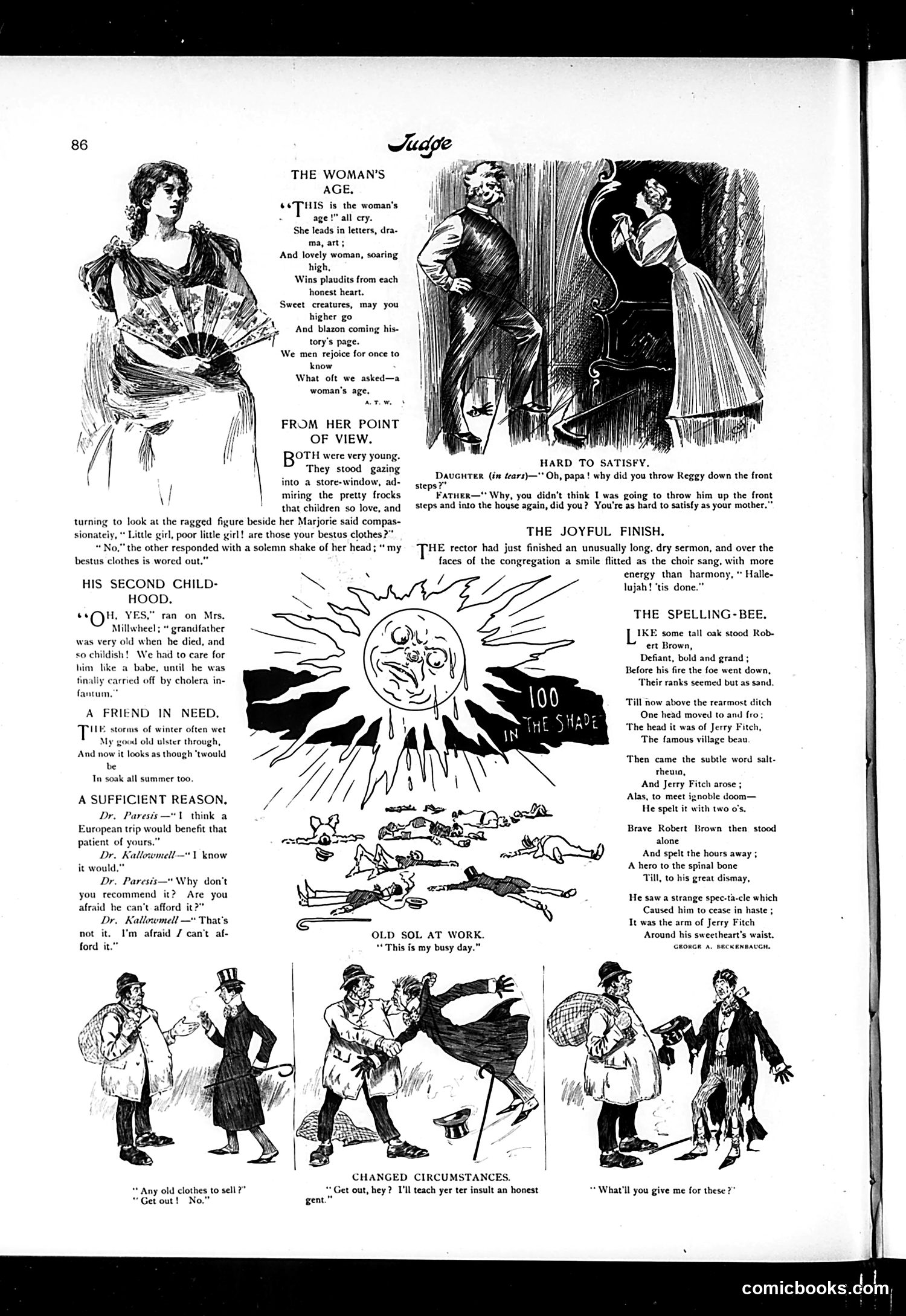
This page from *Judge* contains multiple satirical pieces typical of late 19th-century American humor: **"The Woman's Age"** opens with gentle mockery of contemporary feminism—celebrating women's achievements in letters, drama, and art, then undermines itself with a joke that men finally learn "a woman's age" (implying women's reluctance to reveal their age). **Other sketches** employ standard Victorian-era humor: a wealthy child's compassion toward a poor girl; elderly senility; marital discord; medical professionals admitting financial desperation. The "Old Sol at Work" cartoon depicts the sun exhausted from summer labor. **"The Spelling-Bee"** offers romantic comedy: village hero Robert Brown dominates a spelling competition until distracted by rival Jerry Fitch embracing Brown's sweetheart, causing Brown to misspell. The recurring theme is gentle domestic and social satire—nothing overtly political. These are conventional jokes about class differences, aging, marriage frustrations, and small-town romance, typical of *Judge*'s entertainment-focused content circa 1880s-1890s.
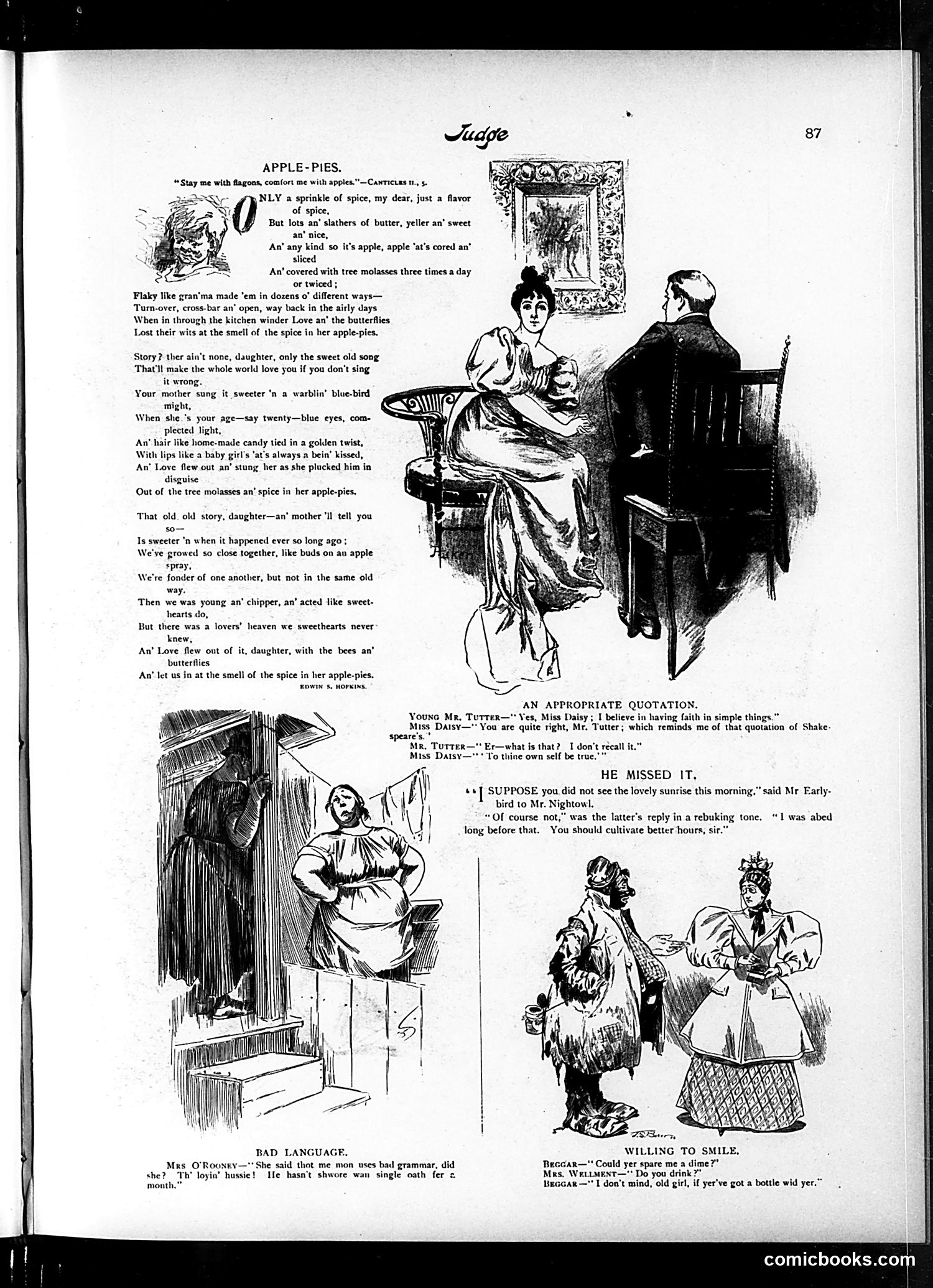
This page contains sentimental verse and four separate humorous vignettes rather than political cartoons. **"Apple-Pies"** is nostalgic poetry celebrating homemade apple pie as a metaphor for romantic love and domestic contentment. The narrator reflects on how his mother's pie-baking attracted suitors, and how he and his wife have grown together over time—their passion transformed into deeper companionship. The four cartoon jokes below are lighthearted social satire: 1. **"An Appropriate Quotation"**: A young man earnestly discusses having "faith in simple things," unaware he's being mocked with Shakespeare's "To thine own self be true"—implying his simplistic philosophy needs sophistication. 2. **"He Missed It"**: An early-riser criticizes a night-owl for missing sunrise; the owl retorts that staying up late is more cultured than waking early. 3. **"Bad Language"**: An Irish woman defends her husband's lack of swearing as evidence of virtue. 4. **"Willing to Smile"**: A beggar cleverly suggests sharing a bottle of alcohol as payment for begging, implying the wealthy woman is a drinker. The humor relies on class dynamics and character stereotypes common to the era.
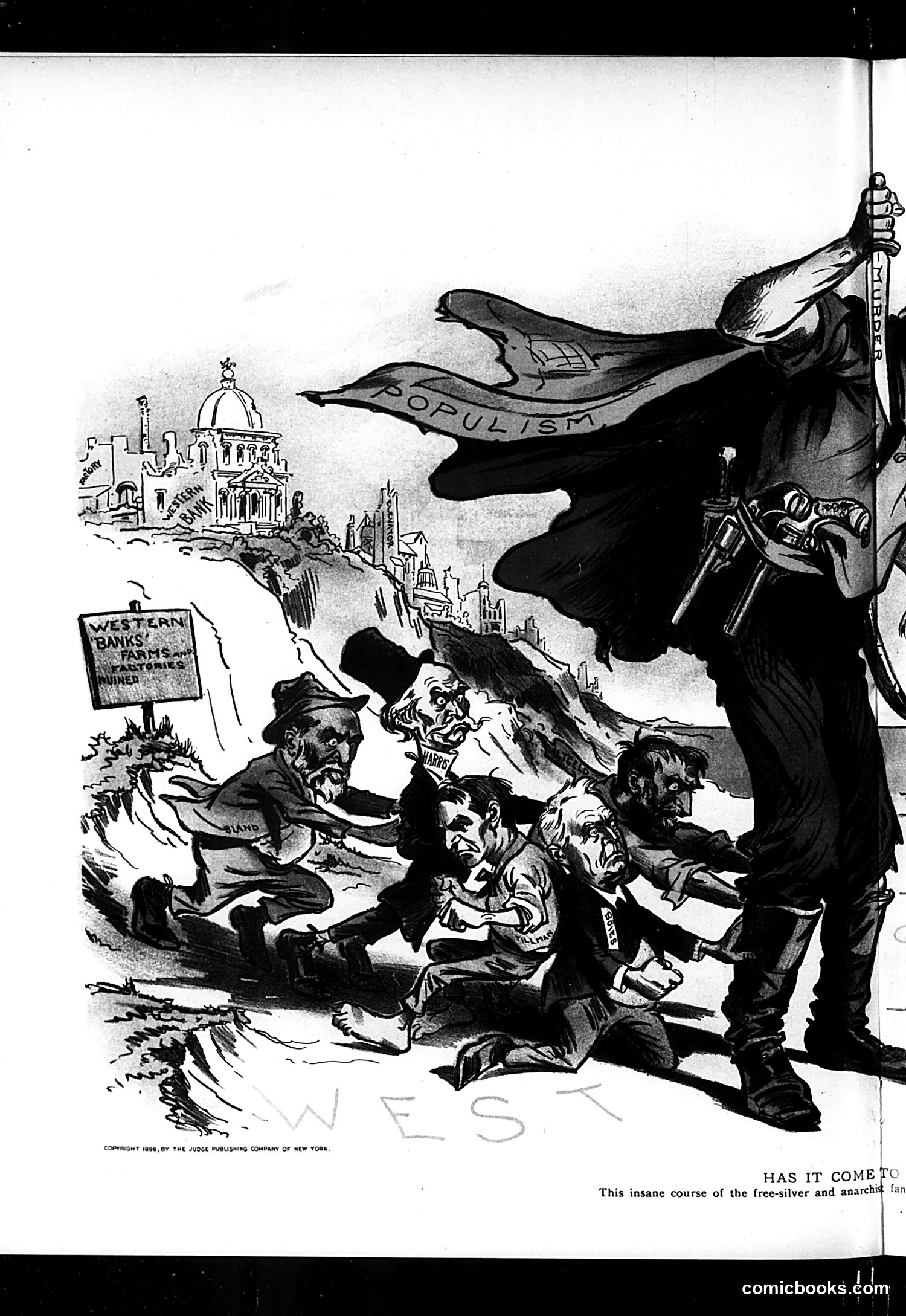
This Judge magazine cartoon satirizes the "free-silver" movement of late 19th-century American politics. A menacing figure labeled "POPULISM" (wearing a cape with that word) looms over a group of disheveled men crawling beneath a sign reading "WESTERN BANKS AND FARMS RUINED." The cartoon attacks free-silver advocates—primarily Populists who demanded unlimited silver coinage—depicting them as foolish victims being manipulated by an ominous, anarchist-tinged force. The cathedral in the background suggests Western civilization under threat. The image equates free-silver with anarchism and depicts its supporters as deluded dupes whose policies destroy agricultural and banking interests. This reflects conservative opposition to Populist economic reforms during the 1890s political debates.
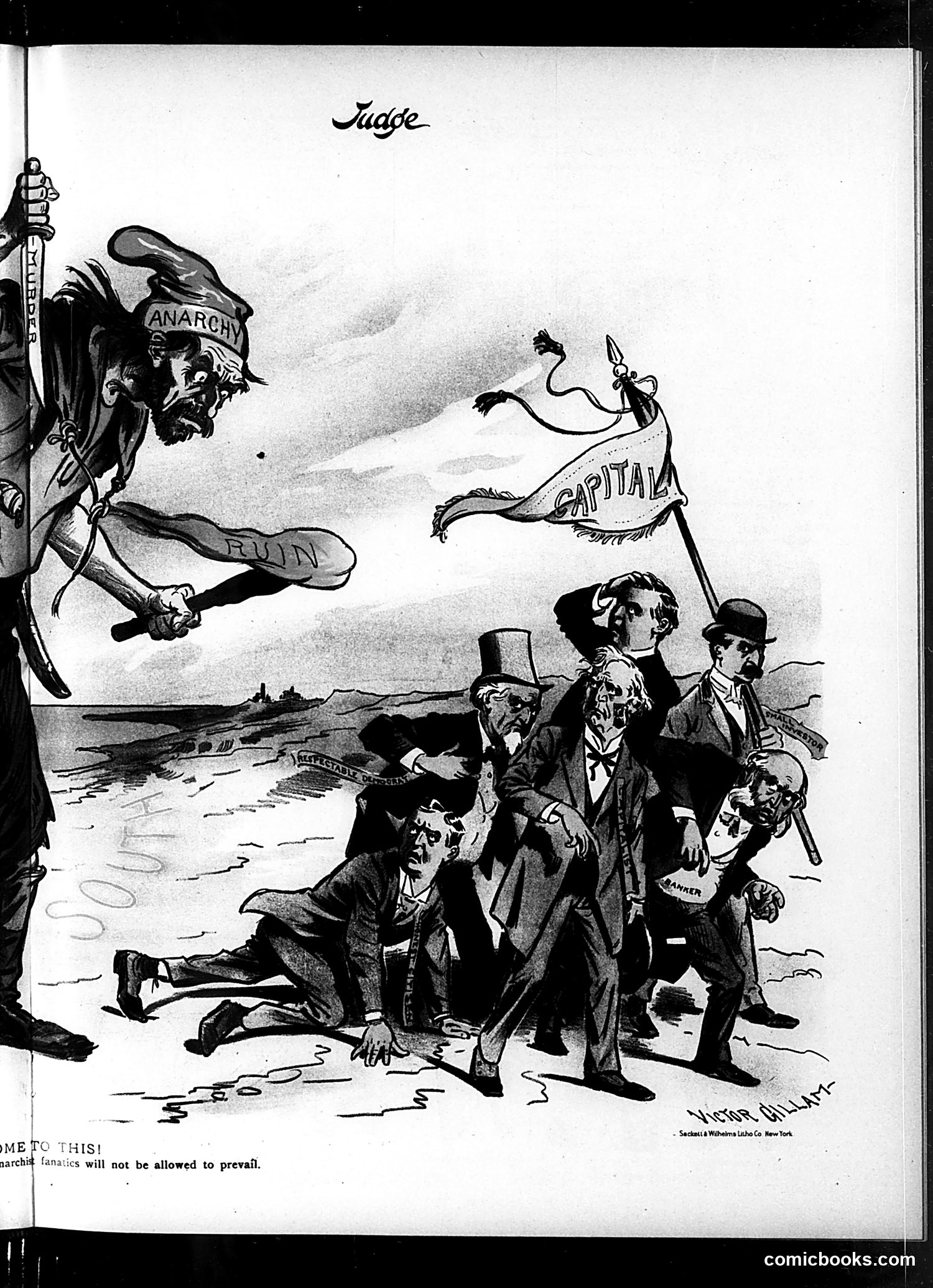
This Judge magazine cartoon depicts a confrontation between "Anarchy" (a demonic winged figure on the left, wielding a club labeled "Ruin") and representatives of "Capital" (a flag-bearing figure). Below them, a group of well-dressed men—appearing to represent business interests, bankers, or the establishment—cower or crouch defensively on the ground. The cartoon's message, reinforced by the caption "Anarchist fanatics will not be allowed to prevail," presents a pro-establishment stance. It frames anarchism as a threatening, destructive force that Capital and organized society must resist. This likely reflects early-20th-century American anxieties about anarchist movements, which were associated with labor unrest, bombings, and radical political activity. The cartoon uses visual propaganda to reassure readers that established power structures will defeat revolutionary threats.
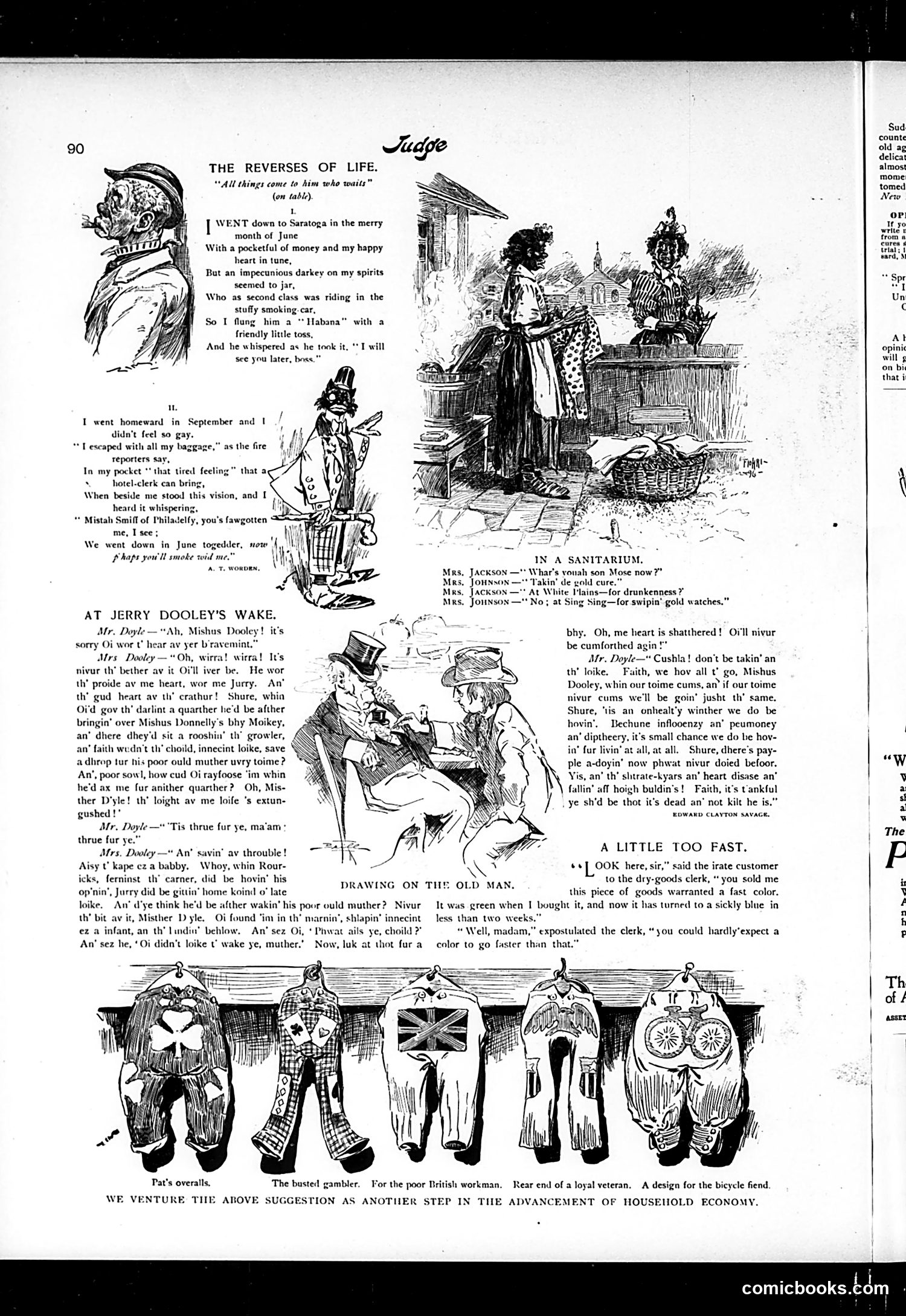
This page contains several satirical pieces reflecting late 19th-century American attitudes: **"The Reverses of Life"**: A white man gives a cigar to a Black porter at Saratoga, then encounters the same man later—now apparently wealthy and demanding repayment through intimidation. The satire mocks both the giver's casual condescension and fears of Black economic advancement. **"At Jerry Dooley's Wake"**: Irish-dialect dialogue between mourners. Dooley's widow praises her late husband's generosity to neighbors' children and his reliability, while Mr. Doyle philosophizes about death's inevitability and contemporary disease. The humor relies on Irish immigrant stereotypes and accent-heavy speech. **"In a Sanitarium"**: A joke about Mrs. Jackson's son Mose—he's at "White Plains for drunkenness" versus "Sing Sing for swiping gold watches." The humor appears to play on class/racial stereotypes about criminality. **Bottom section**: Includes design sketches for practical household items (overalls, etc.), presented as economical innovations. The page reflects Judge's satirical approach: mocking immigrants, Black Americans, class pretension, and contemporary anxieties about social mobility.
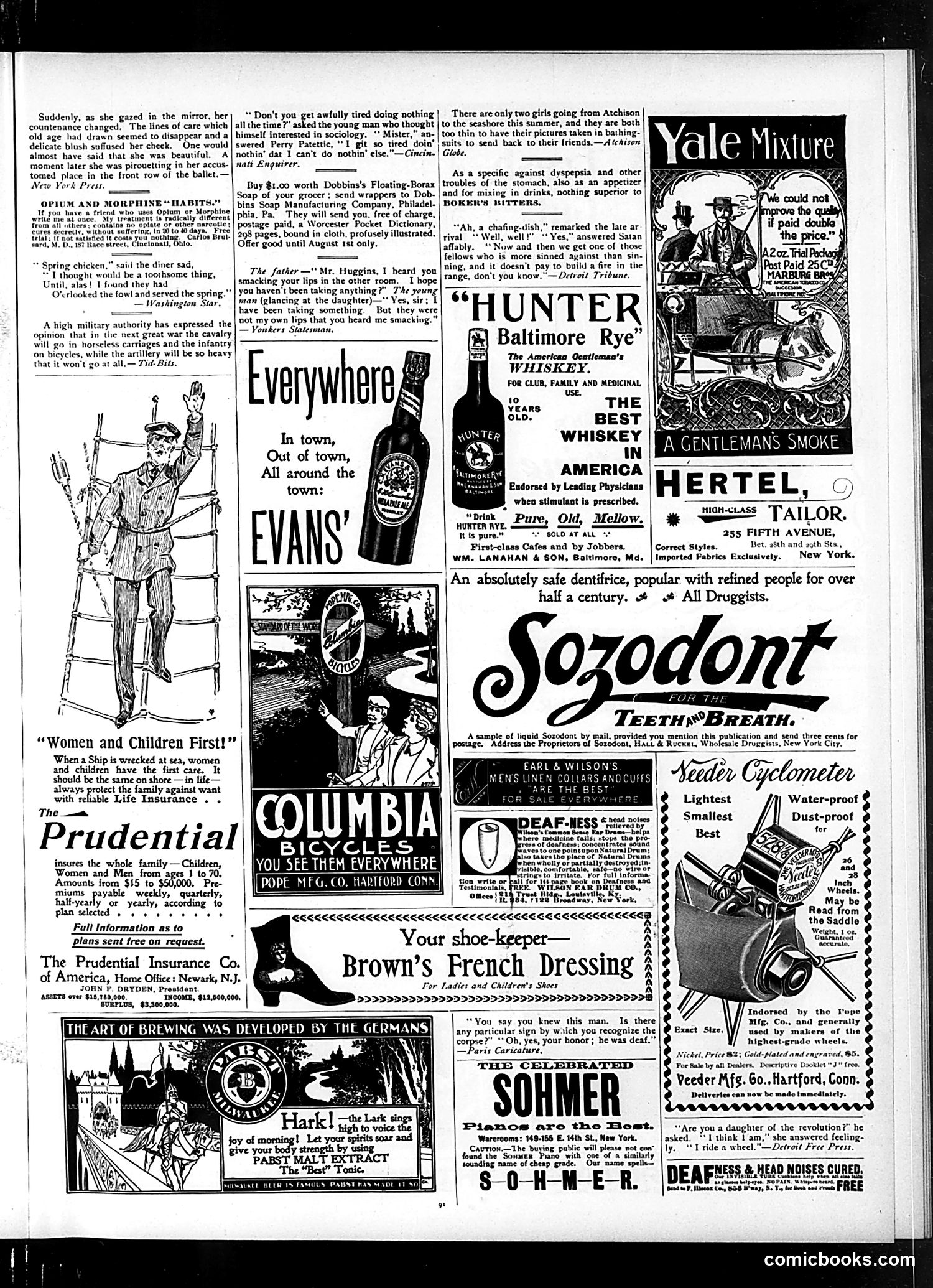
This is primarily an **advertising page** from Judge magazine, with minimal editorial cartoon content. The page showcases various product advertisements typical of the early 20th century. The few text-based humor pieces are brief conversational jokes: - A poor man's exchange about being tired from doing nothing - A father catching a young suitor kissing his daughter - A seashore joke about thin women not wanting bathing suit photos The substantive content consists of advertisements for products including: - **Evans Bicycles** (with imagery of cyclists) - **Prudential Life Insurance** (emphasizing family protection) - **Hunter Baltimore Rye whiskey** (marketed for medicinal use) - **Dobbins Soap** (offering dictionary premiums) - Various personal care and tailoring services The ads reflect period concerns: life insurance, temperance/medicinal alcohol framing, industrial products. There is no identifiable political satire or commentary on this particular page—it functions primarily as a commercial vehicle dressed in Judge's humorous presentation style.
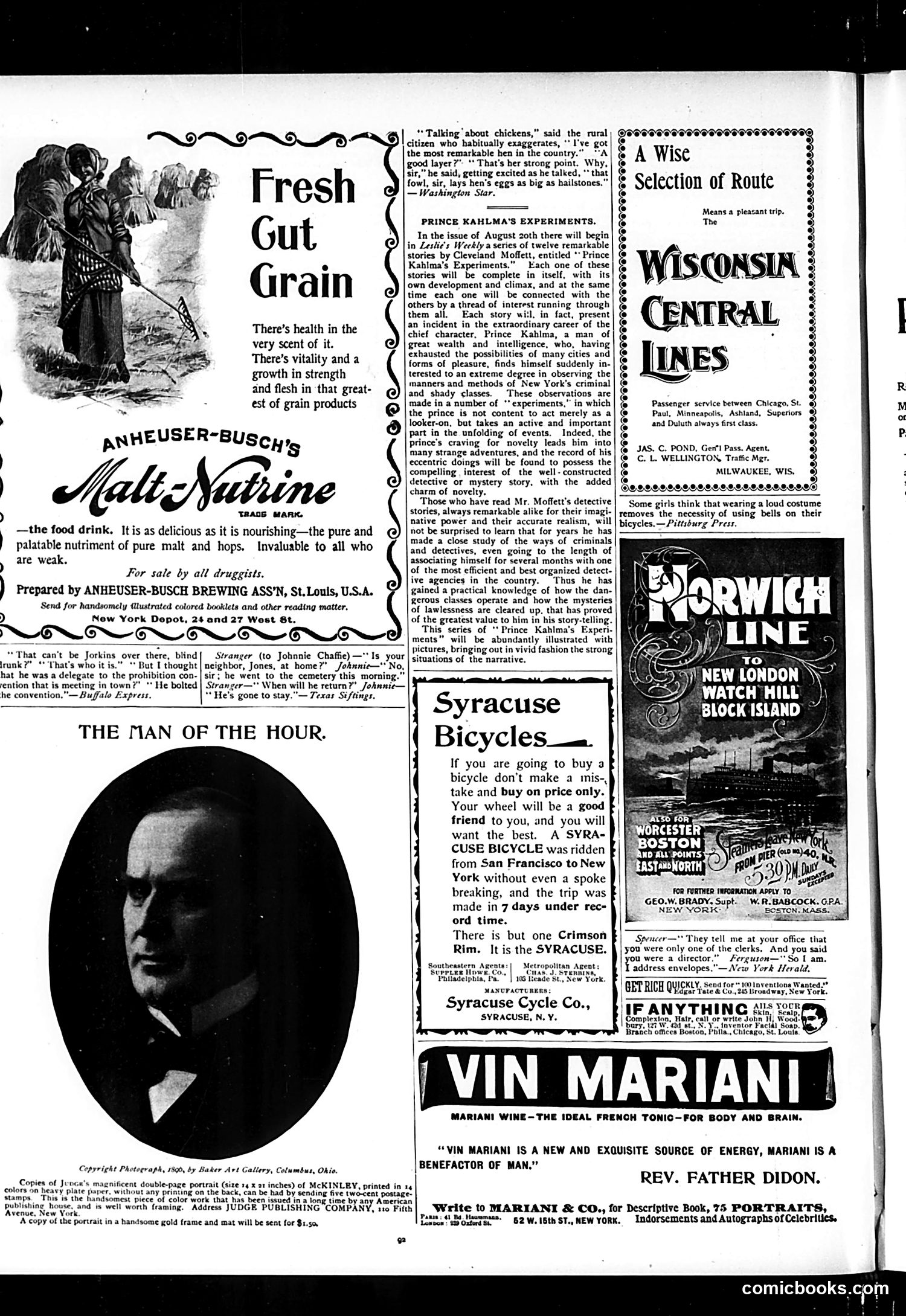
This page is primarily **advertising and entertainment content** from Judge magazine, not political satire. The main elements are: 1. **"Fresh Gut Grain" advertisement** for Anheuser-Busch's Malt Nutrine—a malt beverage marketed as nutritious "food drink" for the weak, sold by druggists. This reflects the pre-Prohibition era when alcohol was promoted for medicinal purposes. 2. **"The Man of the Hour"** portrait—a large headshot of an unidentified man, described as a McKinley portrait. Without additional context, his significance is unclear. 3. **"Prince Kahlma's Experiments"** announcement—promoting Cleveland Moffett's upcoming serial stories in Leslie's Weekly about a wealthy eccentric investigating New York's criminal underworld. 4. **Various smaller advertisements** for bicycles, train lines, and other products. The page contains **humor snippets** about rural exaggeration and bicycles, but no discernible political cartoon or social satire targeting specific issues or figures.
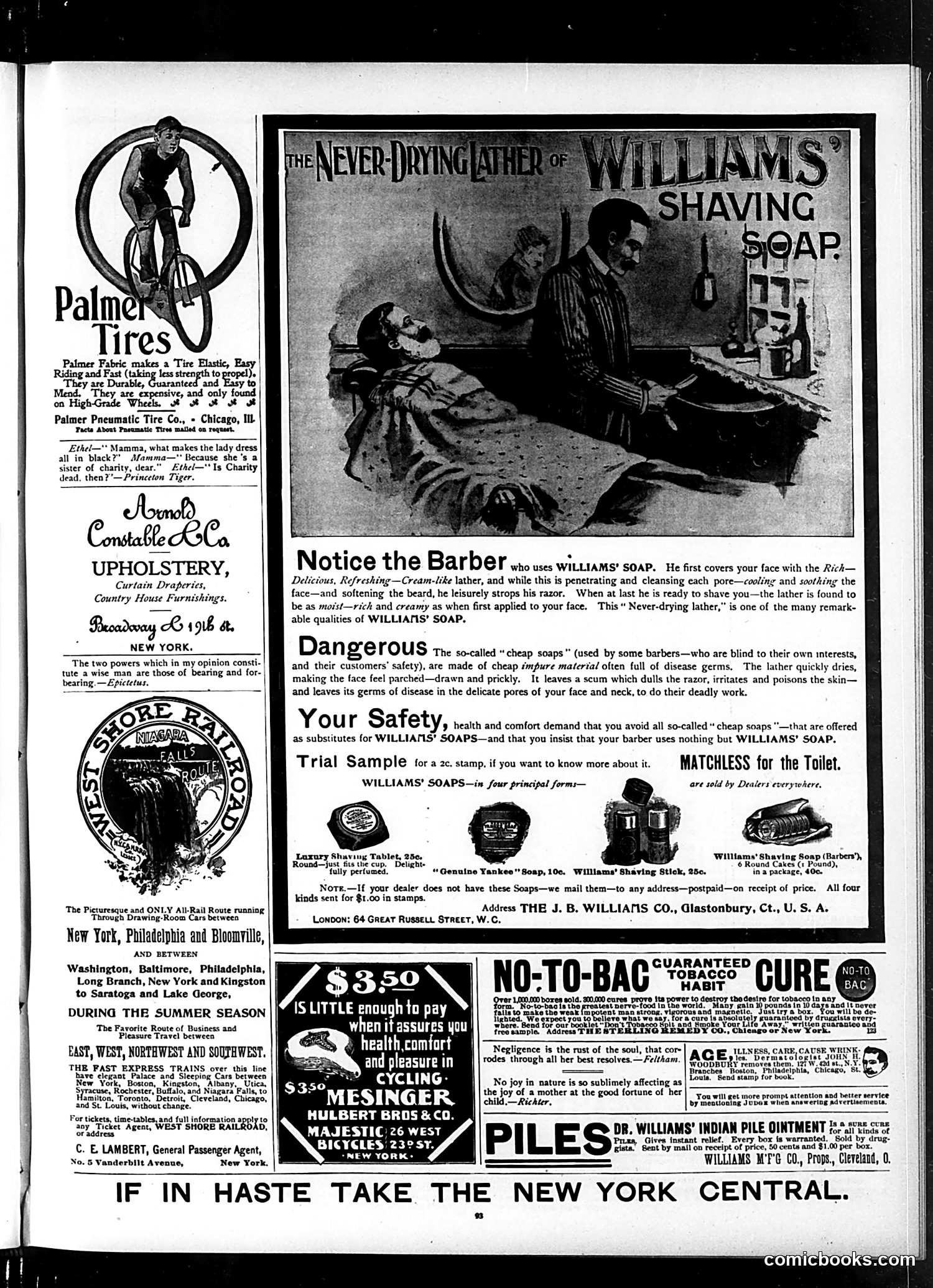
This page is primarily **advertisements** from an early 1900s Judge magazine, not political satire. The main content is commercial copy promoting various products: Palmer Tires, railroad services, upholstery, and notably a large advertisement for **Williams' Shaving Soap**. The Williams' Soap ad features a barber scene and contains implicit **class and safety commentary**. It contrasts expensive, quality "Williams" soap against cheap alternatives, warning that inferior soaps leave residue, irritate skin, and harbor "disease germs"—reflecting early 20th-century anxieties about hygiene and germ theory. The ad's language about "blind" barbers using cheap soaps suggests moral judgment alongside product differentiation. A small joke (attributed to Princeton Tiger) about a child asking if "Charity" is dead because a nun wears black appears near top—gentle wordplay, not political satire. The page demonstrates how Judge mixed satirical content with revenue-generating advertisements, making consumer products into social statements about respectability and health.
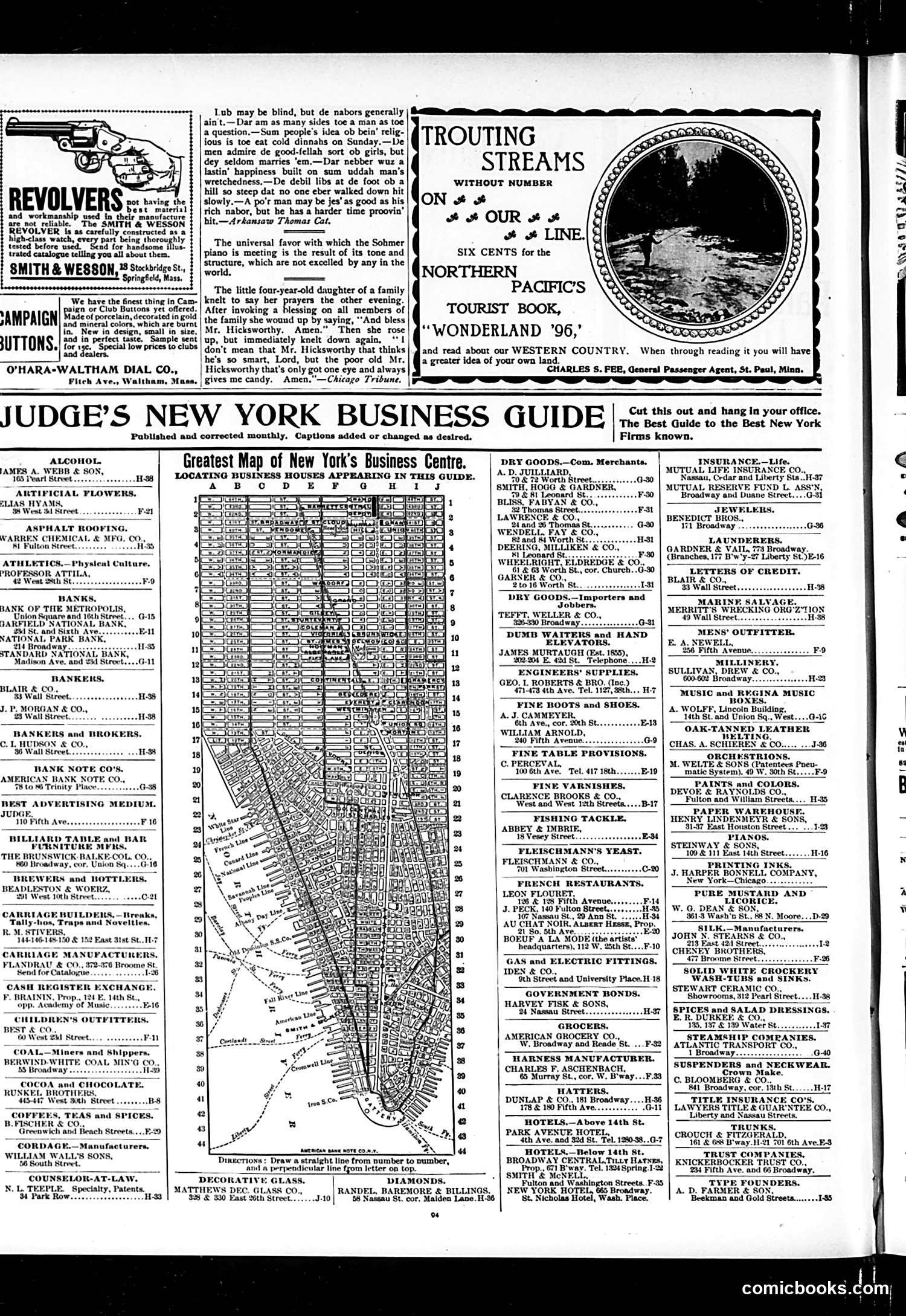
This page is primarily a **business directory and advertising section** from Judge magazine, not political satire. The substantive non-advertising content consists of: 1. **A folk-wisdom column** attributed to "Arkansaw Thomas Cat" containing aphorisms (e.g., "De debil libs at de foot ob a hill," "a po'r man may be jes' as good as his rich nabor"). This uses dialect stereotyping common to the era. 2. **A brief humorous anecdote** about a child's prayer, where she distinguishes between "Mr. Hicksworthy that thinks he's so smart" and "the poor old Mr. Hicksworthy" who gives candy—a gentle joke about childhood logic. 3. **Judge's New York Business Guide**: A map and directory of New York businesses, useful for the era but not comedic. The page includes advertisements for products (Smith & Wesson revolvers, Sohmer pianos, campaign buttons, dial clocks) and numerous business listings. There is **no identifiable political cartoon** on this page.
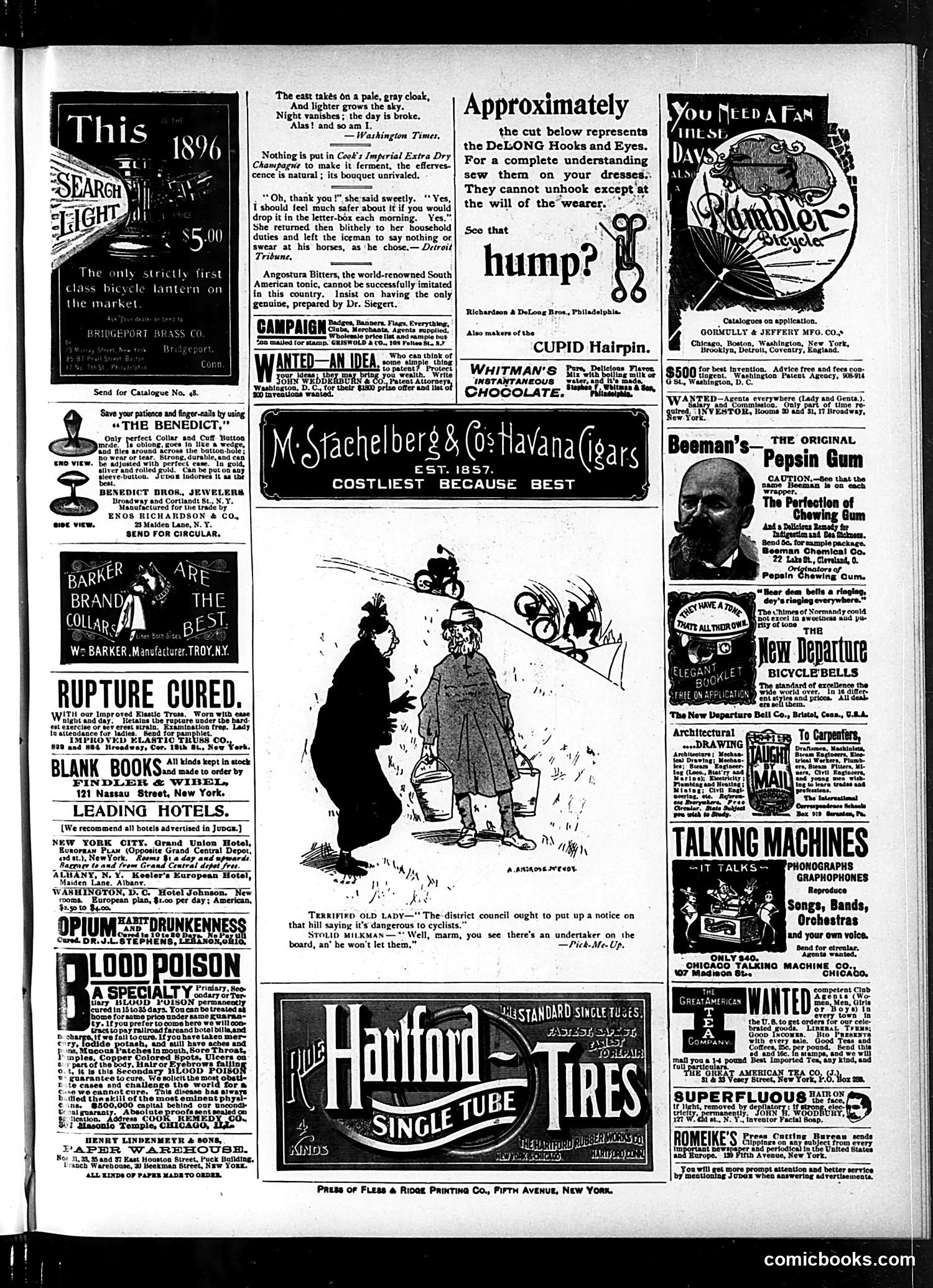
This page is primarily **advertising**, typical of 1890s American magazines. The content mixes commercial notices with a few editorial cartoons and humorous poems. The main cartoon (center) depicts a "Terrified Old Lady" warning cyclists about a dangerous hill, while a "Stolid Milkman" responds that an undertaker on the road won't permit them—a dark joke about inevitable cycling accidents. The poems and brief items offer typical period humor: a melancholic verse about a broken heart ("the day is broke, / Alas! and so am I"), and an anecdote about a woman reassuring herself by having a man deliver mail daily—playing on courtship anxieties. Advertisements include bicycle lanterns, patent collar buttons, trusses for ruptures, medical treatments for opium addiction and "blood poison," and period novelties like talking machines and bicycle bells. Notable is the promotion of DeLong Hooks and Eyes—fasteners marketed with the selling point that they "cannot unhook except by the will of the wearer." The content reflects 1890s consumer culture, medical quackery, and anxieties about new technologies like bicycles.
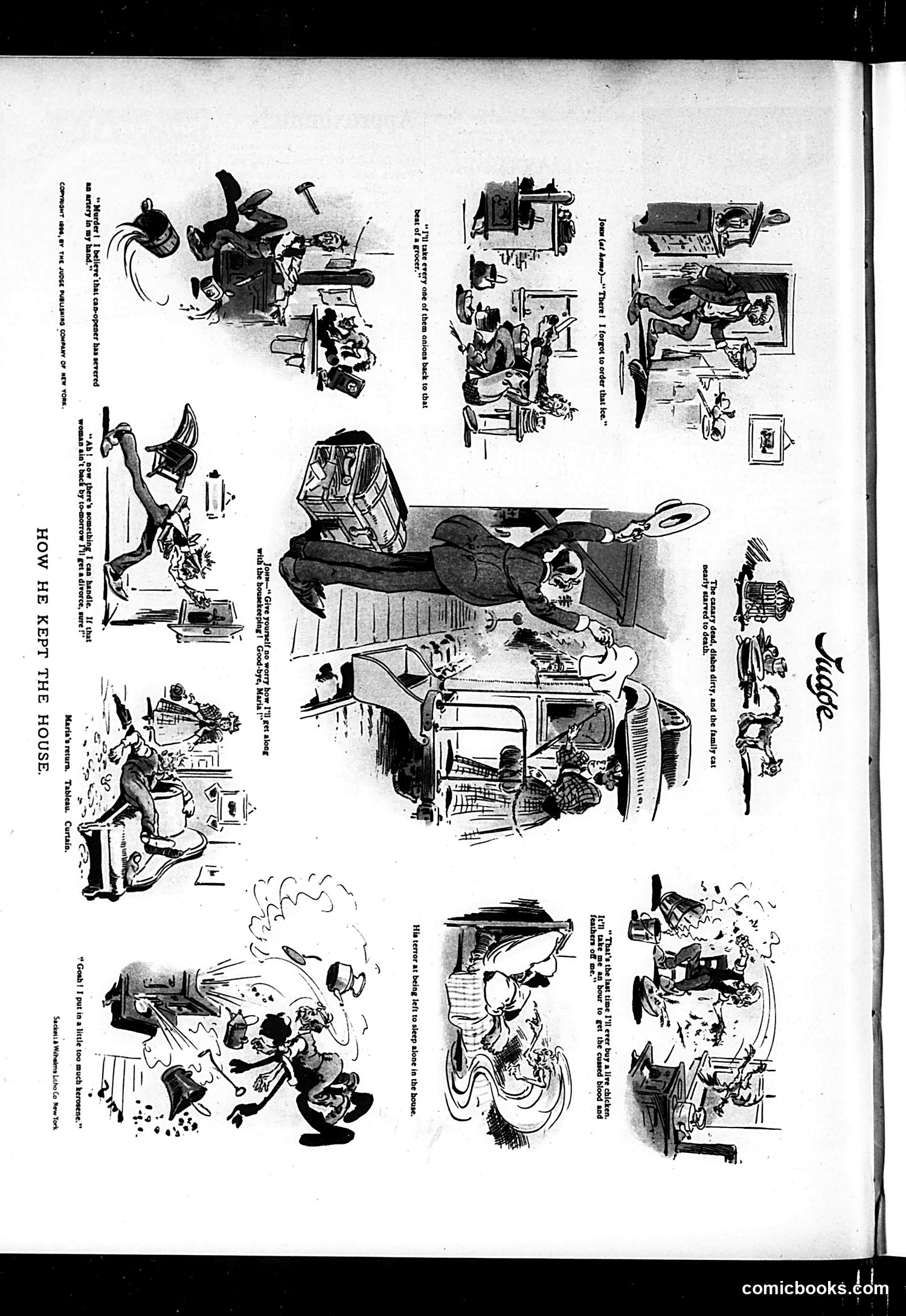
This is a domestic comedy strip depicting a husband's catastrophic attempt at housekeeping while his wife (Maria) is away. The narrative arc shows: **The Setup**: A man left alone to manage the household fails spectacularly—the canary dies, dishes pile up, the cat starves. **The Complaints**: He attempts to return onions to the grocer (blaming external vendors for his problems) and injures himself with a can-opener, dramatizing the injury as life-threatening. **The Punchline**: Maria's return ends the tableau, suggesting her discovery of the domestic disaster. This reflects late-19th-century gender norms satirizing male incompetence at "women's work." The joke assumes men are naturally helpless at housekeeping, positioning domestic labor as exclusively female domain. The exaggerated mishaps—dead pets, negligence—mock both the husband's ineptitude and implicitly critique the era's rigid gender roles by showing how absurd male household management becomes.