
A complete issue · 16 pages · 1896
Judge — July 25, 1896
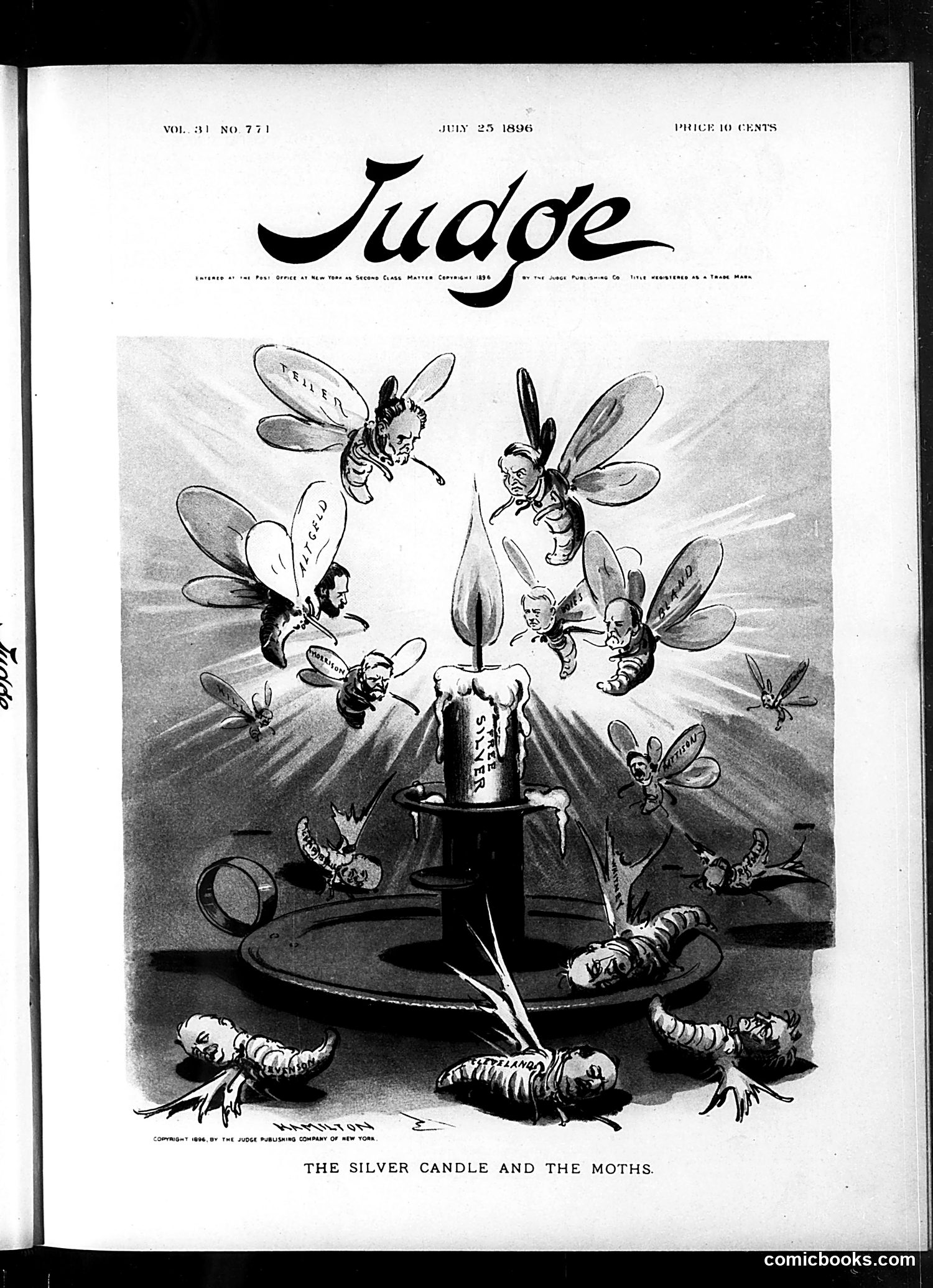
This satirical cartoon depicts a silver candle labeled "SILVER" surrounded by figures with moth wings. The moths appear to be politicians or wealthy industrialists drawn toward the candle's light—a classical metaphor for destructive attraction to wealth or power. The figures lying dead or dying at the base suggest these "moths" are consumed or ruined by their pursuit. This likely references the Gilded Age's unchecked capitalism and the destructive competition among business interests or politicians vying for wealth and influence. The candle represents either a financial opportunity, monopoly, or political prize that attracts and ultimately destroys those who pursue it recklessly. The cartoon critiques both the corrupting nature of greed and the self-destructive behavior of those blinded by ambition.
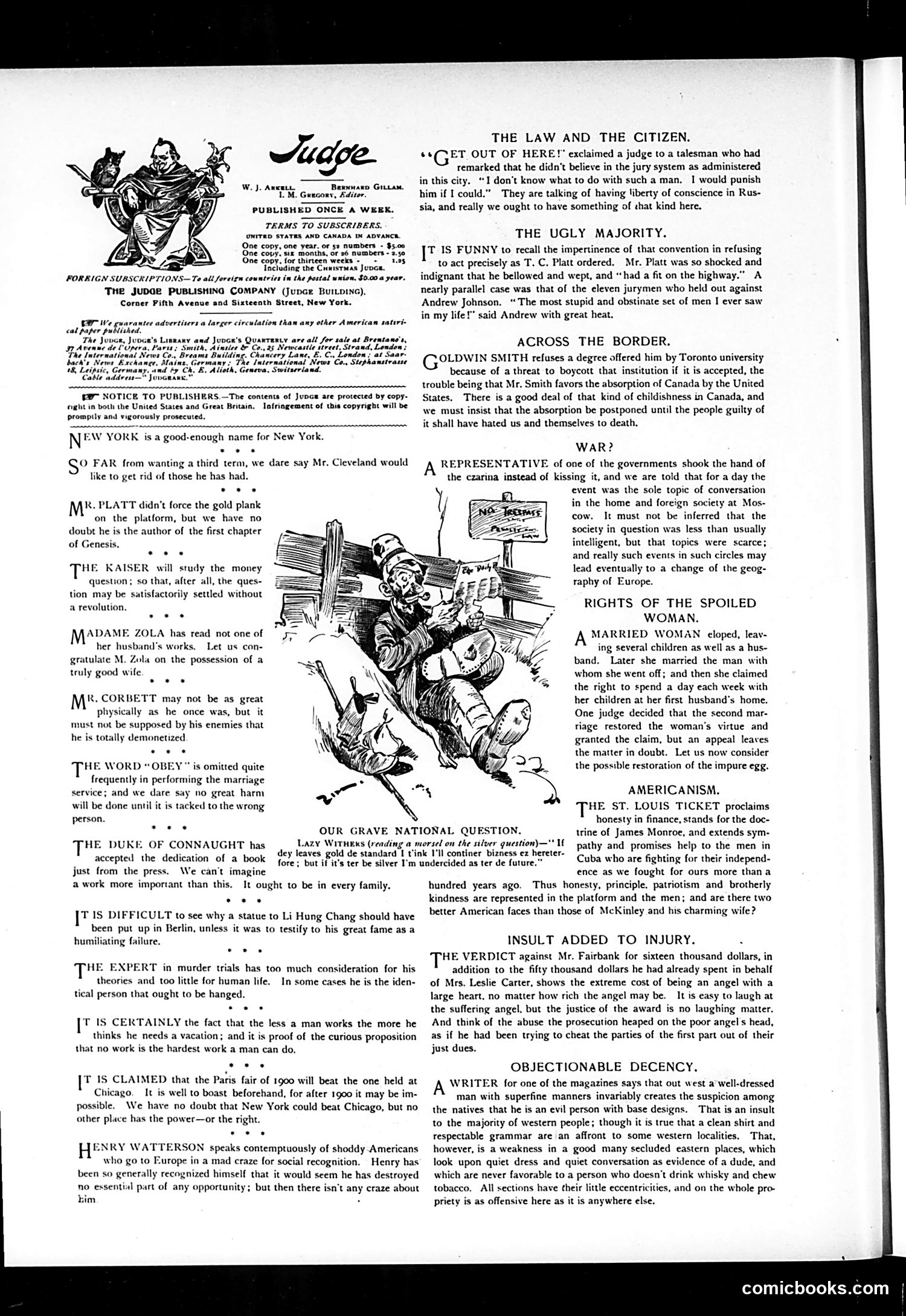
The central cartoon depicts a figure labeled "No. 1 Suspect" being interrogated or investigated, likely referencing a criminal investigation or scandal. The character appears distressed, suggesting the satire targets someone accused of wrongdoing. The surrounding editorial content addresses contemporary issues: "The Ugly Majority" discusses jury bias and Andrew Johnson; "Across the Border" critiques Canadian-American relations; "War?" references Czarist Russia and European geopolitics; and "Rights of the Spoiled Woman" satirizes divorce and alimony disputes. "Americanism" praises the St. Louis Ticket's honesty in finance, while other sections mock legal absurdities and social pretension. Without clearer identification of the suspect figure or specific dates, the precise scandal remains unclear, though the overall tone criticizes judicial incompetence and political hypocrisy.
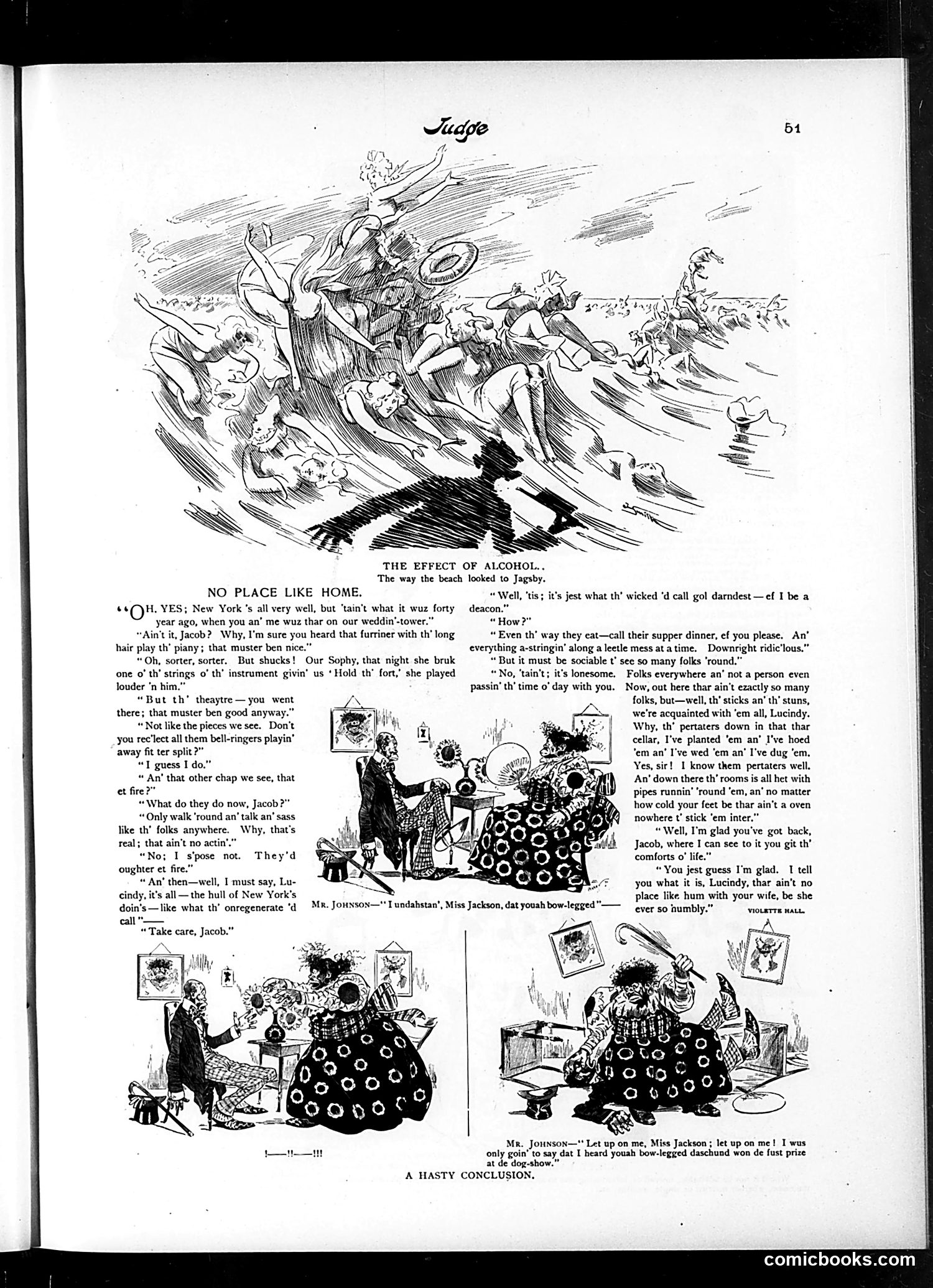
This page satirizes middle-class domestic life and alcohol's social effects. The top illustration titled "The Effect of Alcohol" depicts a chaotic beach scene, contrasting with the text's dialogue about a couple's anniversary and marital discord. The main dialogue features "Jacob" and his wife discussing their deteriorated relationship. She recalls their wedding day fondly, while he complains about her piano playing and domestic habits. The satire targets how alcohol and modern leisure activities (beach outings, "sassiness") disrupted traditional family values. Ms. Johnson (likely a servant or friend) offers commentary on marriage's hardships. The cartoon mocks both spousal friction and the era's anxieties about changing social behavior, particularly women's independence and the perceived negative influences of leisure culture on domestic stability.
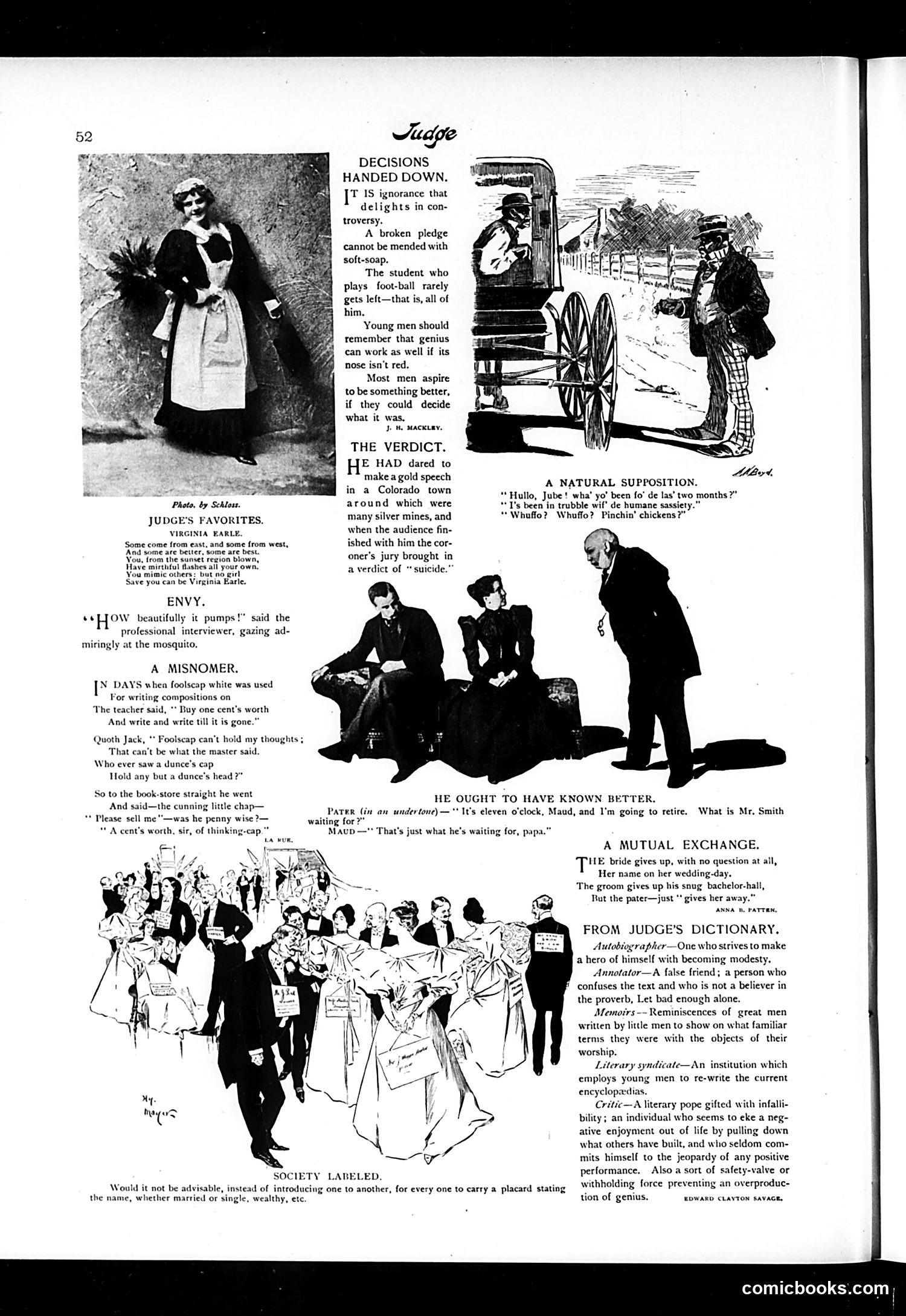
This page from the satirical magazine *Judge* contains short humorous pieces mocking social conventions and human nature circa the 1880s-1890s. **"The Verdict"** satirizes the free-silver movement, depicting a speaker making pro-silver arguments in a Colorado mining town who is so unpopular the coroner's jury rules his death a "suicide"—absurdist political mockery. **"A Natural Supposition"** uses racial dialect humor (typical of the era) to joke about an African American man jailed for animal cruelty, playing on stereotypes. **"A Mutual Exchange"** wittily observes that while brides surrender their names and grooms their bachelor freedom upon marriage, fathers simply "give her away"—critiquing gendered expectations. The remaining pieces are brief satirical aphorisms and dictionary definitions mocking literary pretension, journalism, and social hypocrisy. The overall tone targets upper-class pretension and universal human folly rather than specific political targets.
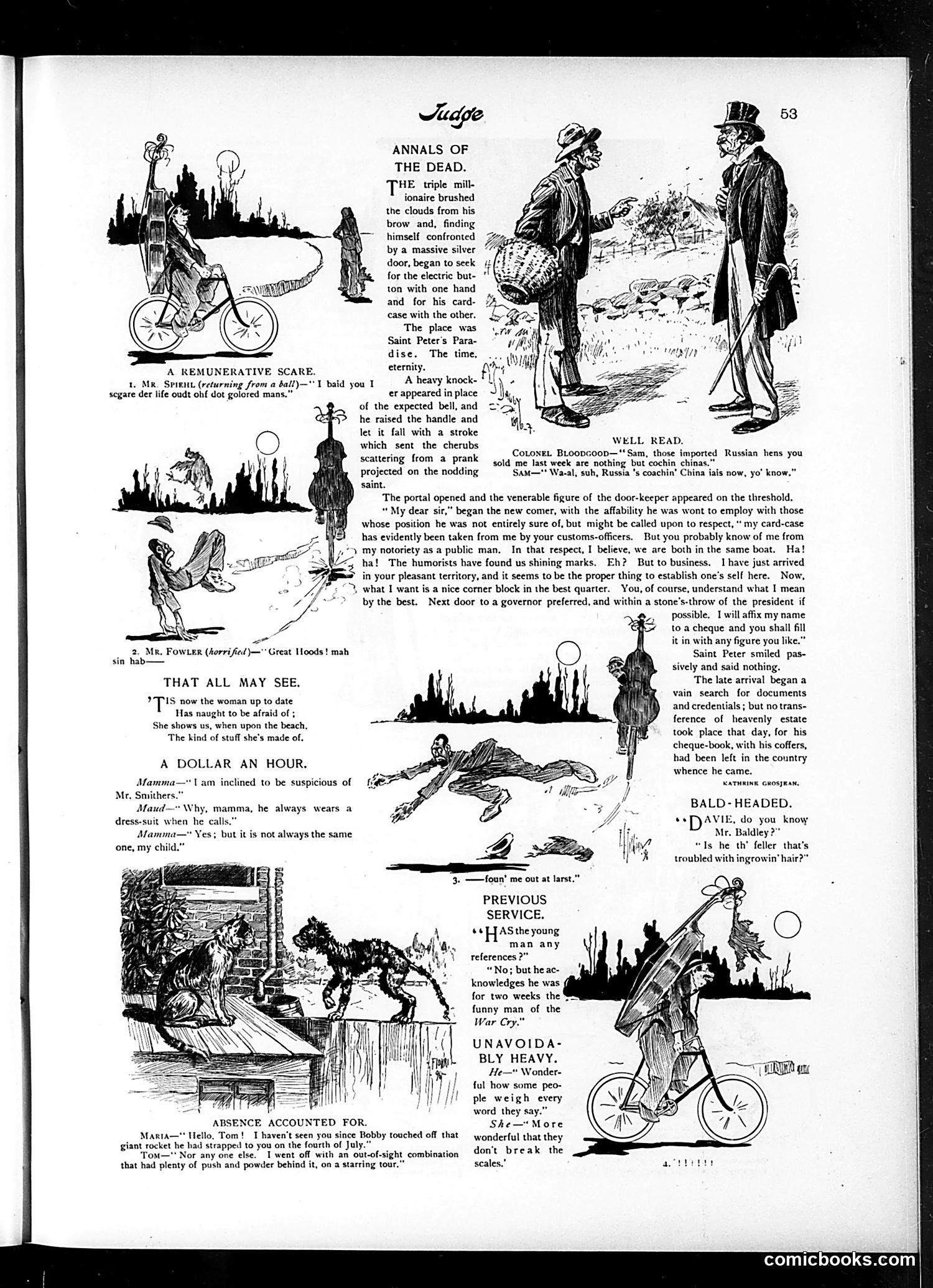
This page contains multiple brief satirical sketches typical of Judge's humor: **"Annals of the Dead"** is the main piece—a satirical afterlife story where a wealthy businessman tries to bribe Saint Peter with a blank check to secure premium real estate in heaven, only to discover his money and influence are useless after death. It mocks the wealthy's assumption that their status transcends mortality. **Smaller sketches** include: - A woman's fashion joke about showing her body at the beach - A mother suspicious of a suitor who wears the same dress suit (implying he can't afford multiple suits) - Various one-liners about Russian hens, bald men, and job references The overall tone ridicules social pretension, materialism, and class assumptions. The "Annals of the Dead" piece particularly satirizes the Gilded Age obsession with wealth and social position by suggesting these advantages literally cannot be carried into the afterlife—a common moralistic theme in period humor.
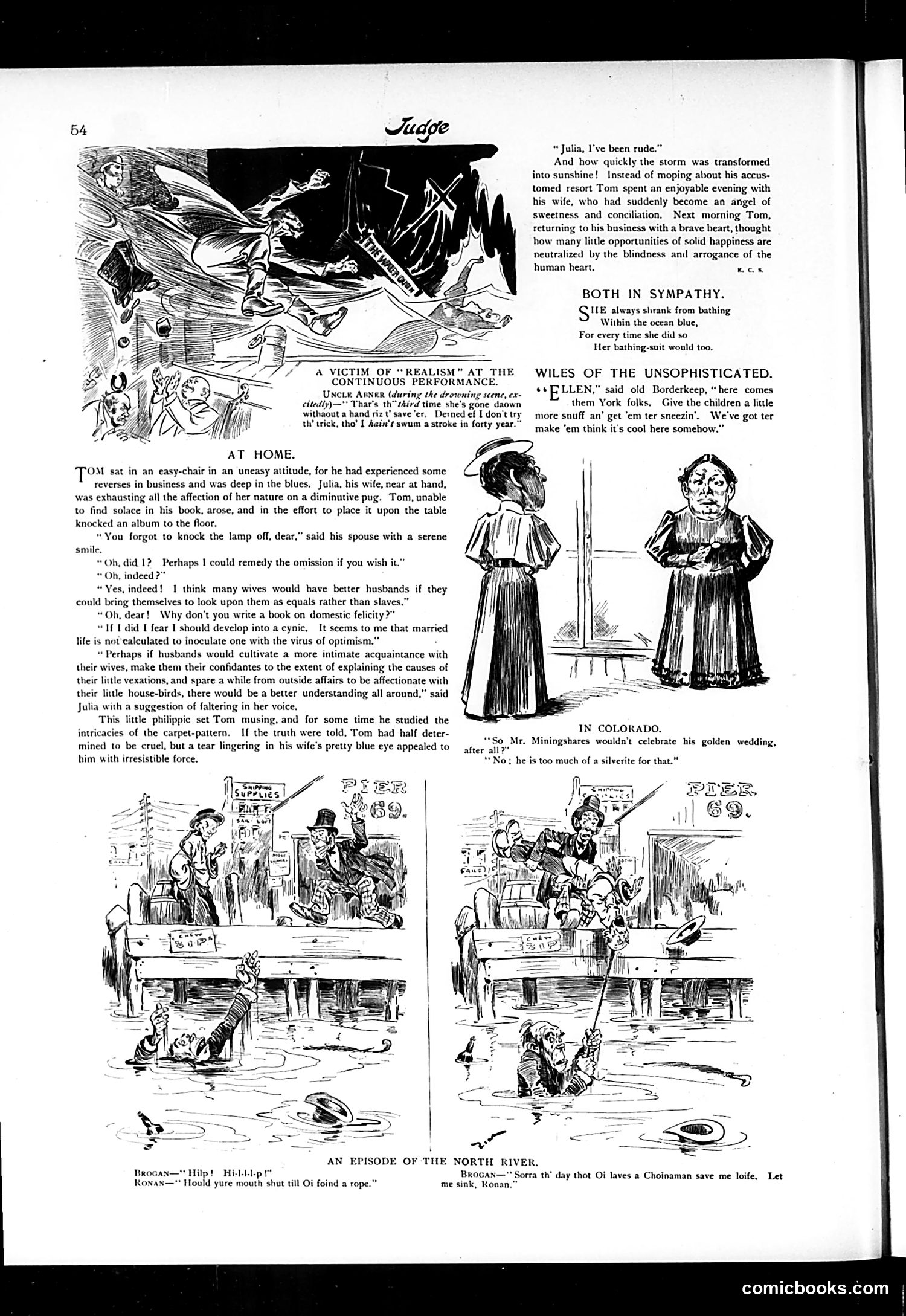
This page contains several satirical pieces typical of late 19th-century American humor: **"At Home"** depicts a domestic quarrel between Tom and Julia. The satire targets both marital discord and gender relations—Julia criticizes husbands who treat wives as "slaves" rather than equals. Tom's eventual reconciliation after seeing her tears suggests the piece mocks sentimental domesticity while subtly critiquing male indifference to women's grievances. **"A Victim of 'Realism'"** satirizes theatrical realism (a contemporary movement emphasizing naturalistic performance). An audience member complains that an actress drowns three times without rescue—he suggests actually swimming to save her, mocking the movement's pretense of authenticity while remaining impractical. **Other sketches** include light humor about bathing suits and mining wealth. The "North River" cartoons feature working-class dialect humor typical of the era. The overall tone reflects Judge's satirical approach to marriage, class, theatrical trends, and American social pretension.
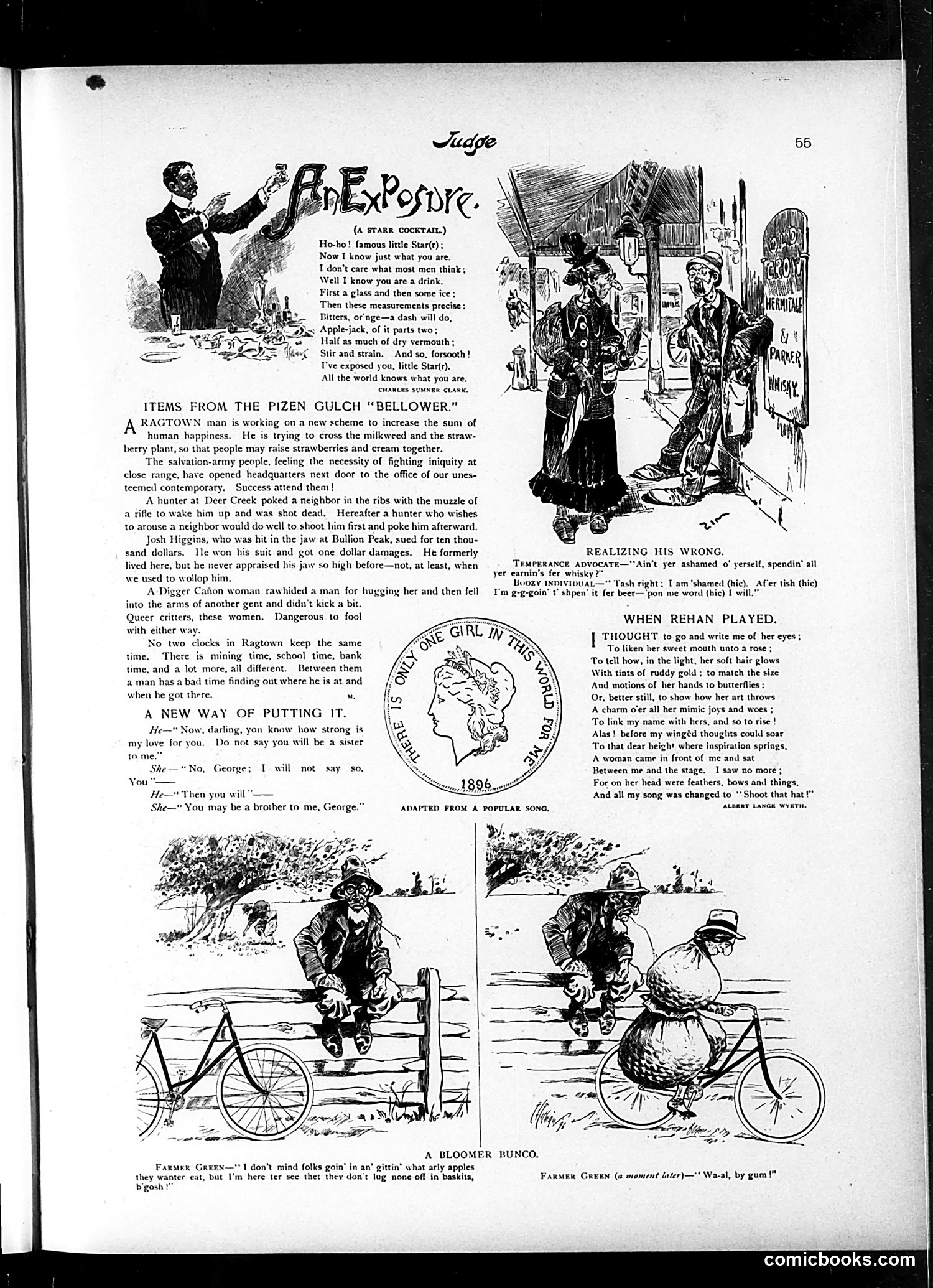
This 1896 page contains several satirical pieces targeting contemporary social issues: **"By Exposure"** mocks the cocktail culture and a figure nicknamed "Star(r)" (likely a reference to a known personality), revealing it as merely a drink recipe rather than anything substantive. **"Pizen Gulch Bellower"** satirizes rural American absurdities: a farmer's scheme to cross-breed plants, a hunter's fatal miscommunication, and a jaw-injury lawsuit settled for one dollar—mocking both frontier violence and frivolous litigation. **"When Rehan Played"** references actress Ada Rehan, lamenting how a woman's hat blocked the speaker's view during her performance—a gentle jab at theater etiquette and fashion excess. **"A Bloomer Bunco"** depicts a farmer catching someone stealing apples in a "bloomer" (baggy women's pants), with visual humor showing the thief's inflated appearance. This ridicules the women's dress-reform movement through slapstick. The temperance piece mocks a drunk man's hypocrisy about spending money on beer rather than family. Overall, the page reflects 1890s American anxieties about modernity, women's changing roles, rural versus urban culture, and social pretension.
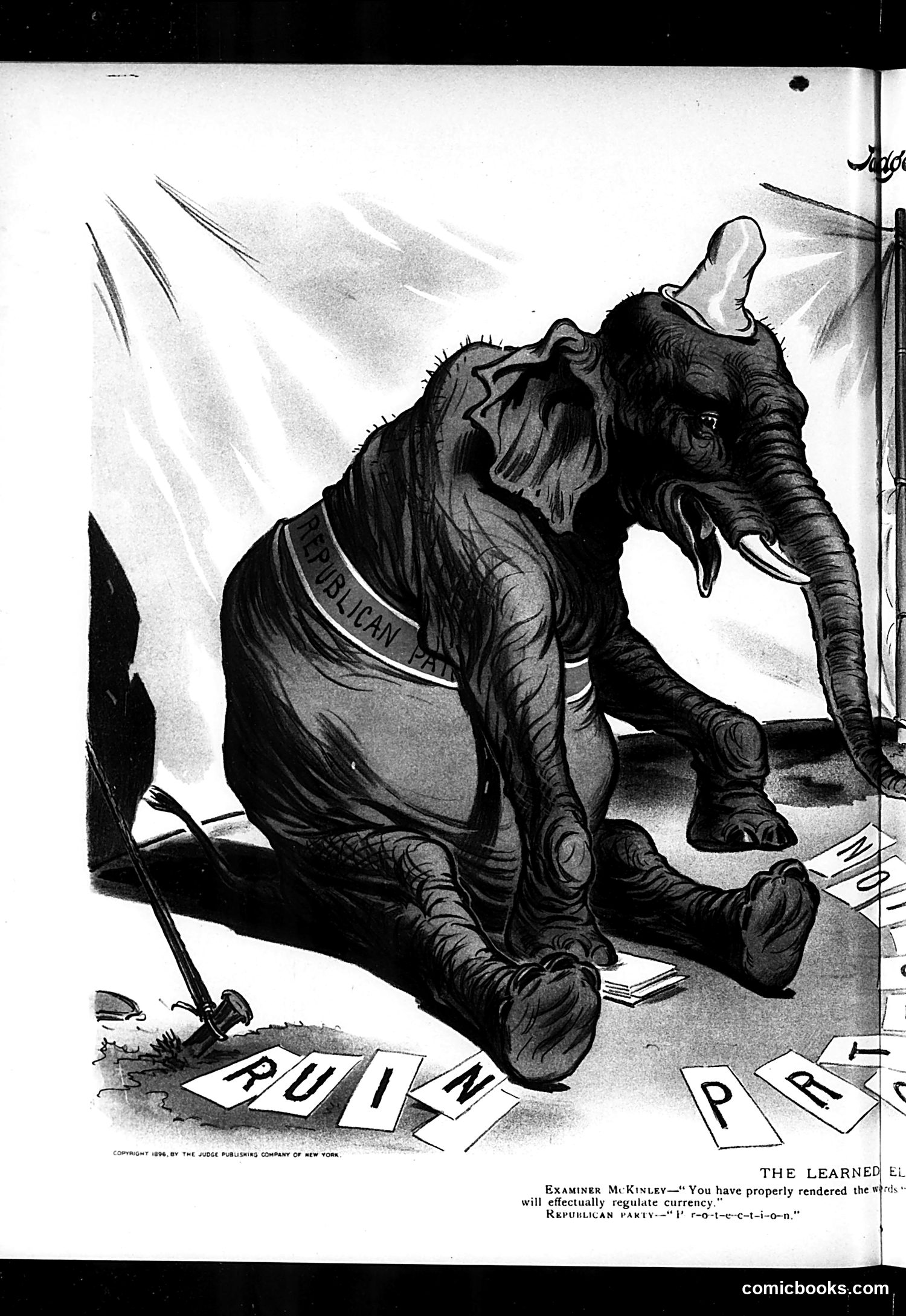
This is a satirical cartoon depicting an elephant (the Republican Party symbol) being examined or tested, presumably by "Examiner McKinley" (likely President William McKinley). The elephant appears to be spelling out or reciting "PROTECTION" while standing on papers labeled "RUIN." The satire critiques Republican protectionist trade policies. The cartoon suggests that while Republicans claim their tariff protection will "regulate currency" and benefit the economy, the actual result is financial ruin—symbolized by the papers beneath the elephant's feet. The image mocks the gap between Republican rhetoric about currency regulation and the perceived harmful economic consequences of their protectionist stance. This reflects late-19th-century political debate over tariffs and economic policy.
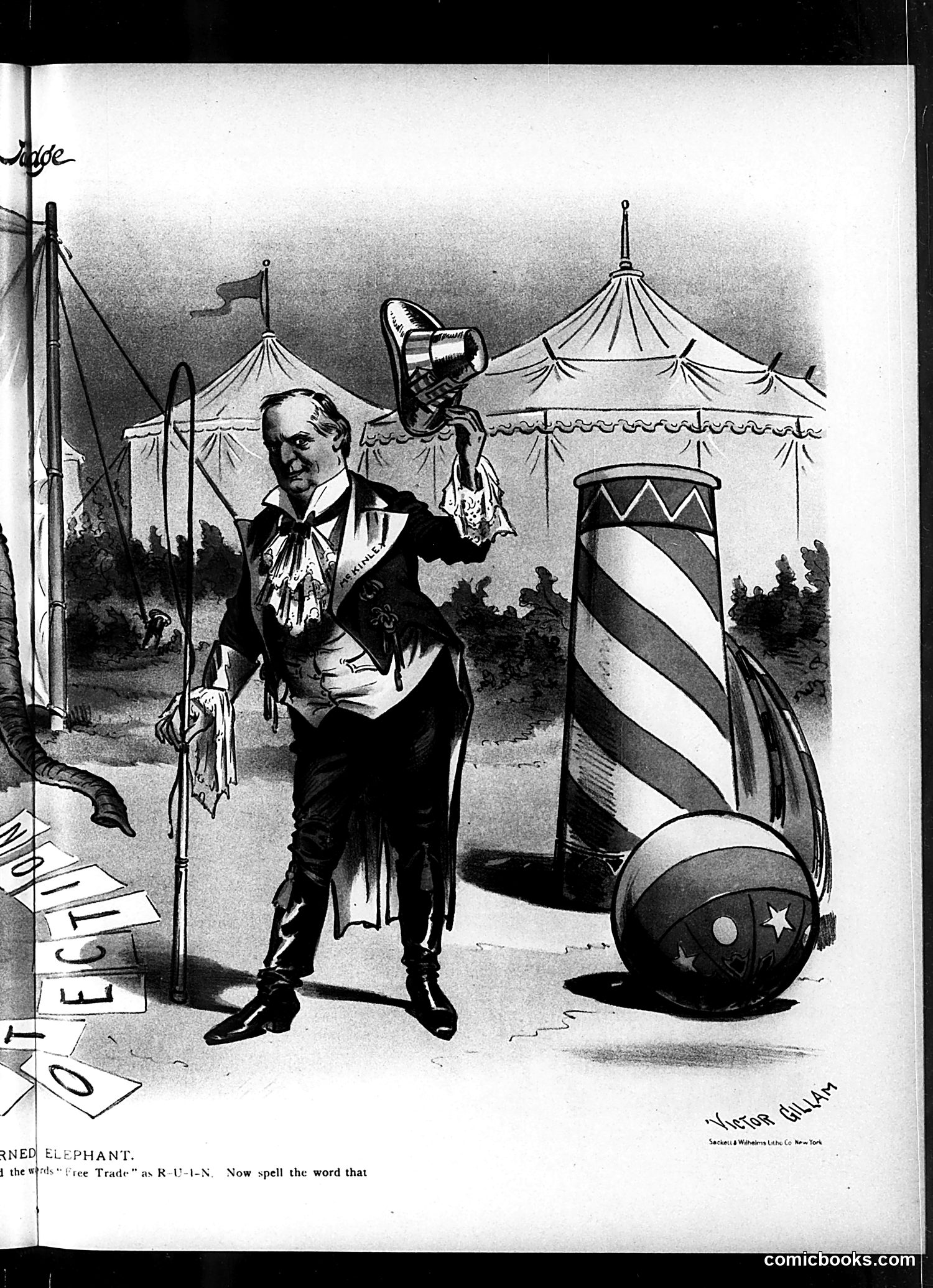
This is a political cartoon satirizing Republican trade policy, symbolized by the Republican Party's elephant mascot. The well-dressed figure (likely a Republican politician or party leader) holds a megaphone, literally spelling out that "Free Trade" spells "R-U-I-N" — the cartoon's central message that free trade policies lead to economic ruin. The circus tent setting and theatrical props suggest the Republicans are engaged in propaganda or performance rather than substantive policy. The cartoon criticizes what the cartoonist viewed as the Republican Party's deceptive promotion of free trade as economically destructive. The specific political moment is unclear without additional dating, but this reflects late 19th or early 20th-century American debates over protectionism versus free trade.
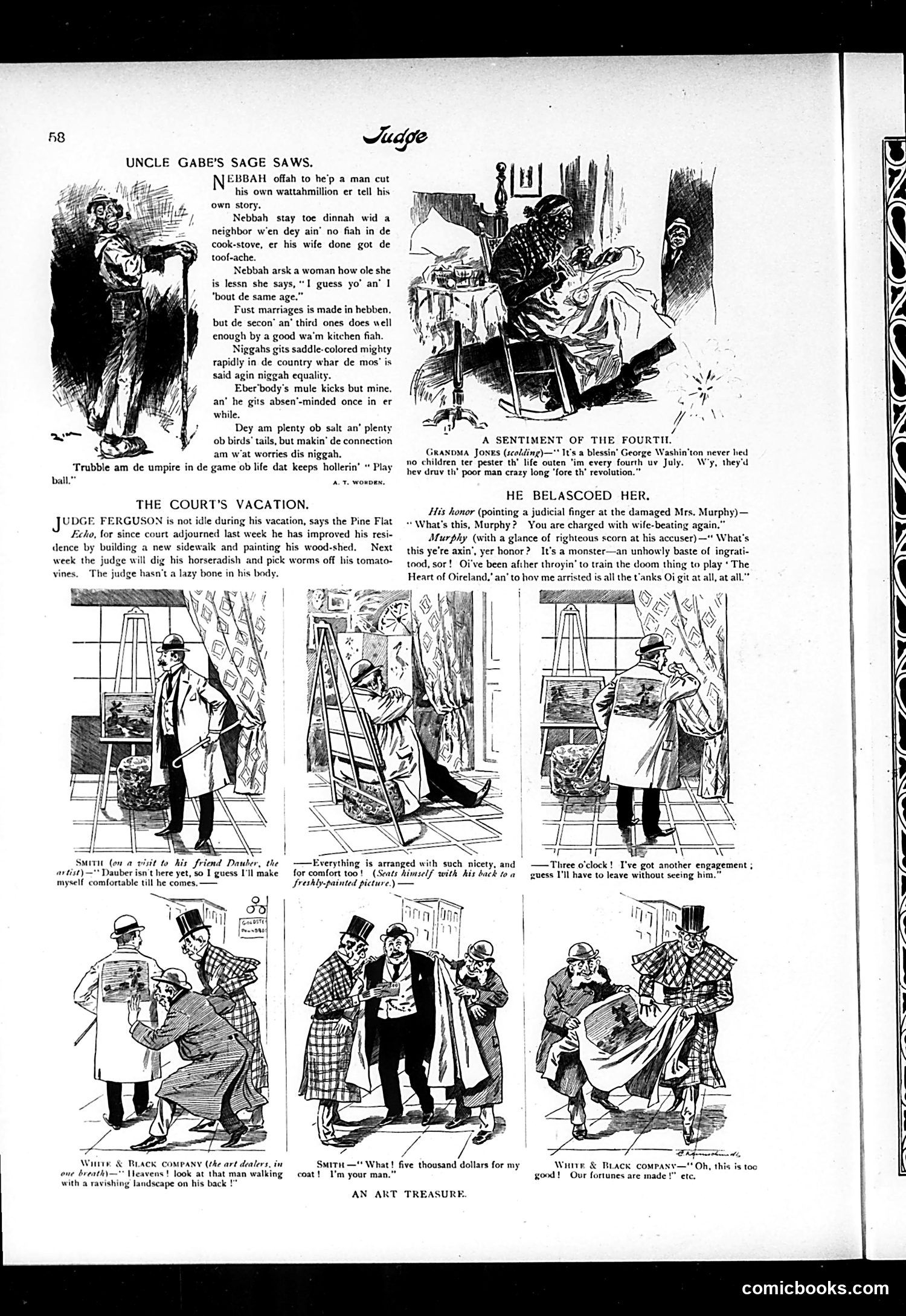
This page contains several humor pieces typical of late-19th/early-20th century American satire: **"Uncle Gabe's Sage Saws"** features dialect humor attributed to a Black character offering folk wisdom. This reflects the period's widespread use of racial caricature and stereotypical "Negro dialect" comedy—offensive by modern standards but common in publications like Judge. **"The Court's Vacation"** mocks a rural judge's mundane domestic activities (painting, gardening) rather than actual leisure, suggesting small-town judicial pretension. **"An Art Treasure"** satirizes art dealers' dishonesty: a man sells a landscape painting for $5,000 while secretly sitting on a freshly-painted canvas to damage it, implying the "treasure" is worthless. **"He Belascoed Her"** plays on "Belasco" (likely theater producer David Belasco), with an Irishman defending wife-beating by claiming he's training her like a theatrical prop—absurdist humor mixing domestic violence with theatrical reference. The page overall reflects Judge's formula: ethnic/dialect humor, urban-versus-rural satire, and commentary on professional pretension.
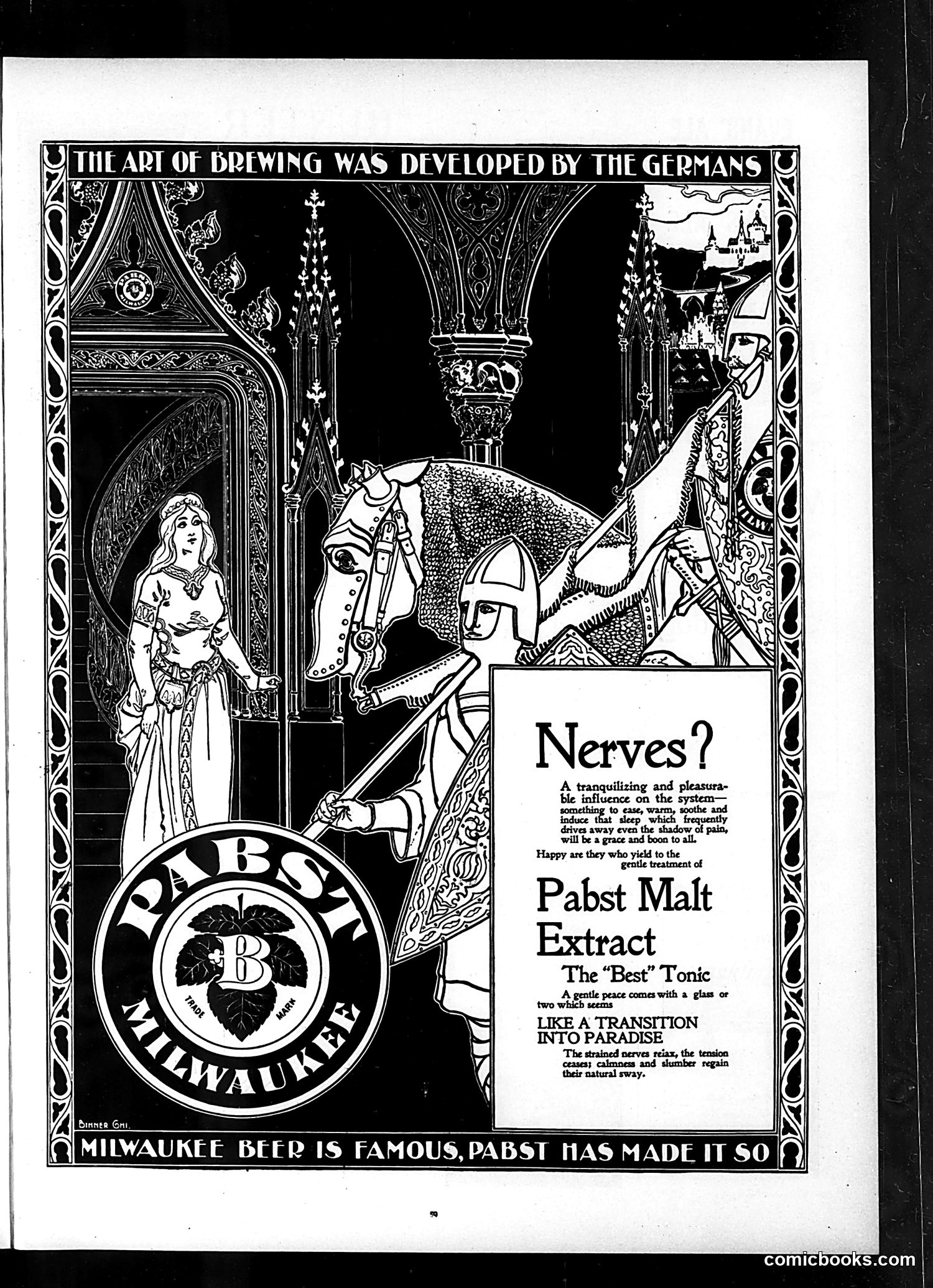
This is a full-page advertisement for Pabst Malt Extract positioned as a medicinal tonic. The medieval-themed illustration depicts a woman and armored German knights, referencing the header claim that "the art of brewing was developed by the Germans." The ad claims the product induces sleep and calms "strained nerves"—marketing it as a therapeutic drink for nervous conditions, common in early 20th-century patent medicine advertising. The phrase "like a transition into paradise" promises relaxation. The bottom text emphasizes Milwaukee's beer reputation, with Pabst taking credit for its fame. This reflects Pabst's actual dominance in American brewing and the German-immigrant heritage of Milwaukee's beer industry. The medieval imagery reinforces "authentic" Germanic brewing tradition to appeal to consumers.
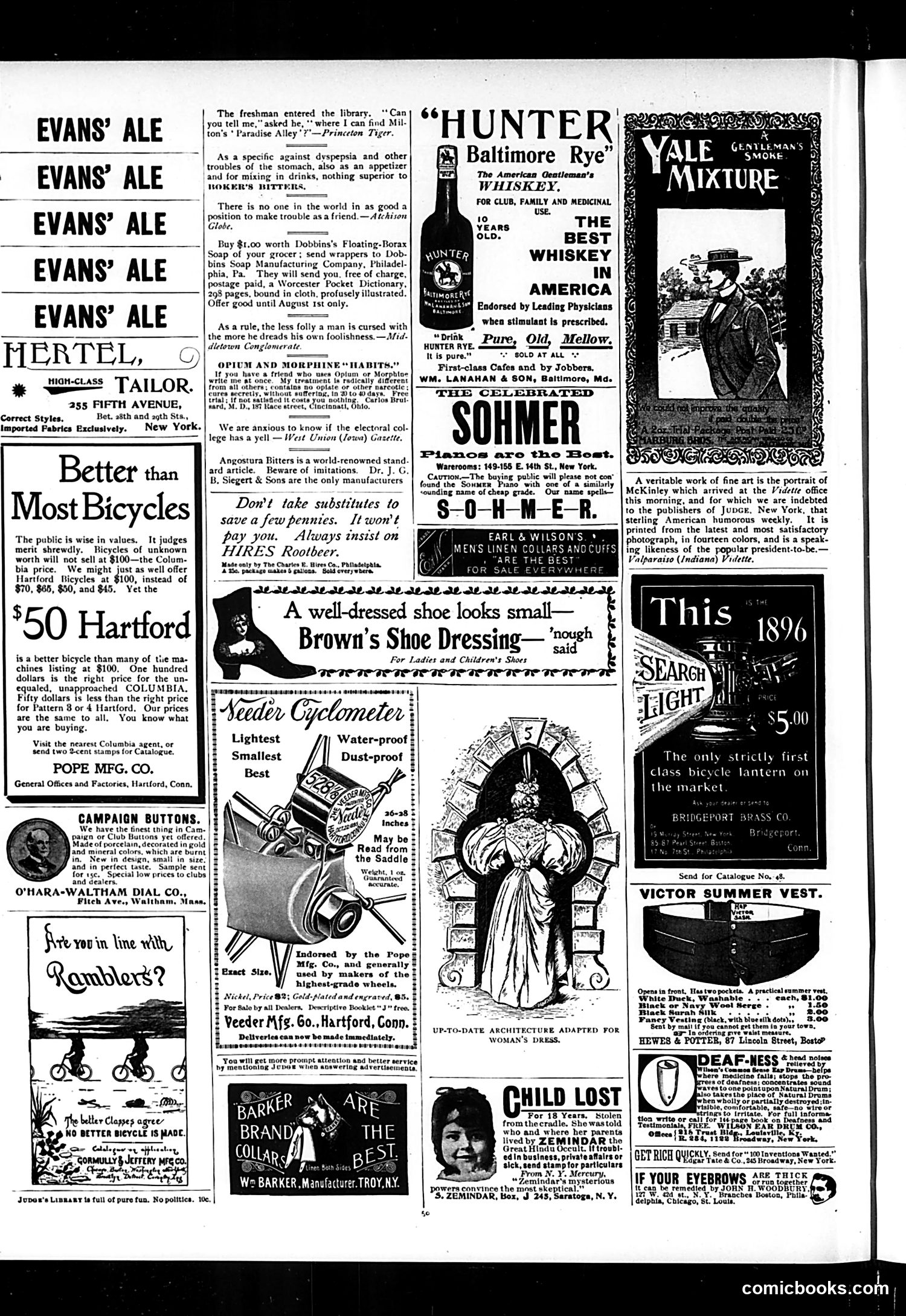
This page is **primarily advertising**, typical of late-19th-century magazines. The advertisements are for consumer goods (bicycles, ale, whiskey, pianos, shoe dressing) and services (tailoring, opium treatment). The only **satirical content** appears as brief, captioned jokes interspersed among ads: - A joke about a college freshman confusing Milton's "Paradise Lost" with "Paradise Alley" - Observations about human nature (trouble-making friends, foolishness) - A quip about the Electoral College needing a "yell" (school cheer) These are mild, generic humor pieces with **no clear political satire or caricature**. They reflect period concerns: college education, social etiquette, and electoral politics. The advertisements themselves reveal period attitudes—notably **opium/morphine addiction treatment** advertised openly, and whiskey promoted for "medicinal use," reflecting pre-regulation attitudes toward substances later controlled.
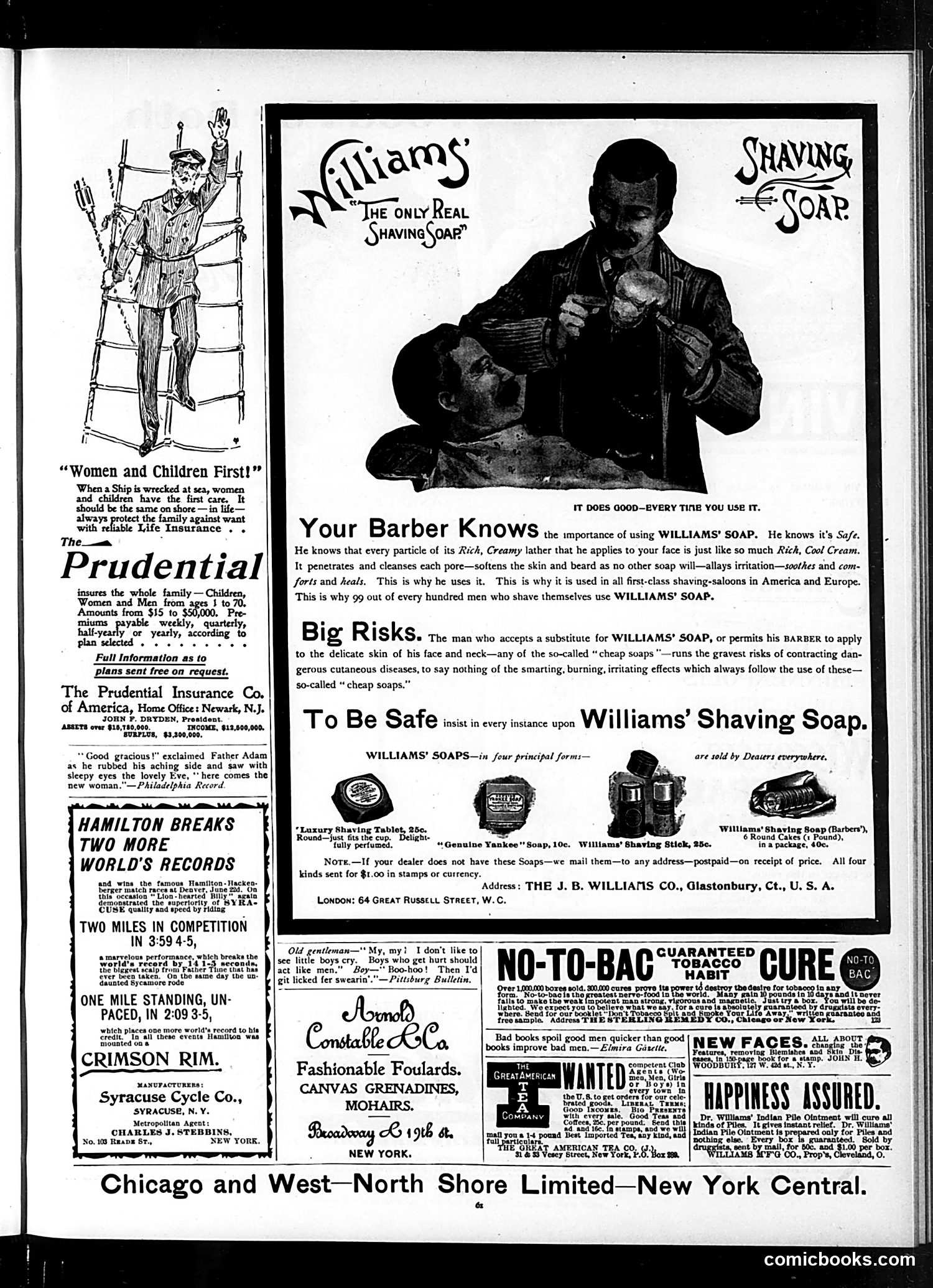
This page is primarily **advertising**, not political satire. It features multiple product advertisements typical of early 20th-century magazines. The dominant content is a **Williams' Shaving Soap advertisement** depicting a barber applying soap to a customer's face. The ad emphasizes safety and quality, warning against "cheap soap" substitutes that cause skin diseases and irritation. A secondary advertisement is **The Prudential Insurance Company's "Wife Insurance"** campaign, using the maritime safety slogan "Women and Children First!" to promote life insurance protecting families against financial hardship. Additional small ads include **Hamilton bicycle racing records**, **No-To-Bac** (a tobacco cessation product), **Arnold Constable fashionable clothing**, and **Williams' Hair and Scalp Ointment**. There are brief humorous snippets: a joke about Adam seeing the "new woman," and a boy's irreverent response to an old man's disapproval of crying. The page reflects early 1900s consumer culture, health anxieties (disease prevention), and emerging concepts like life insurance marketed through emotional family appeals.
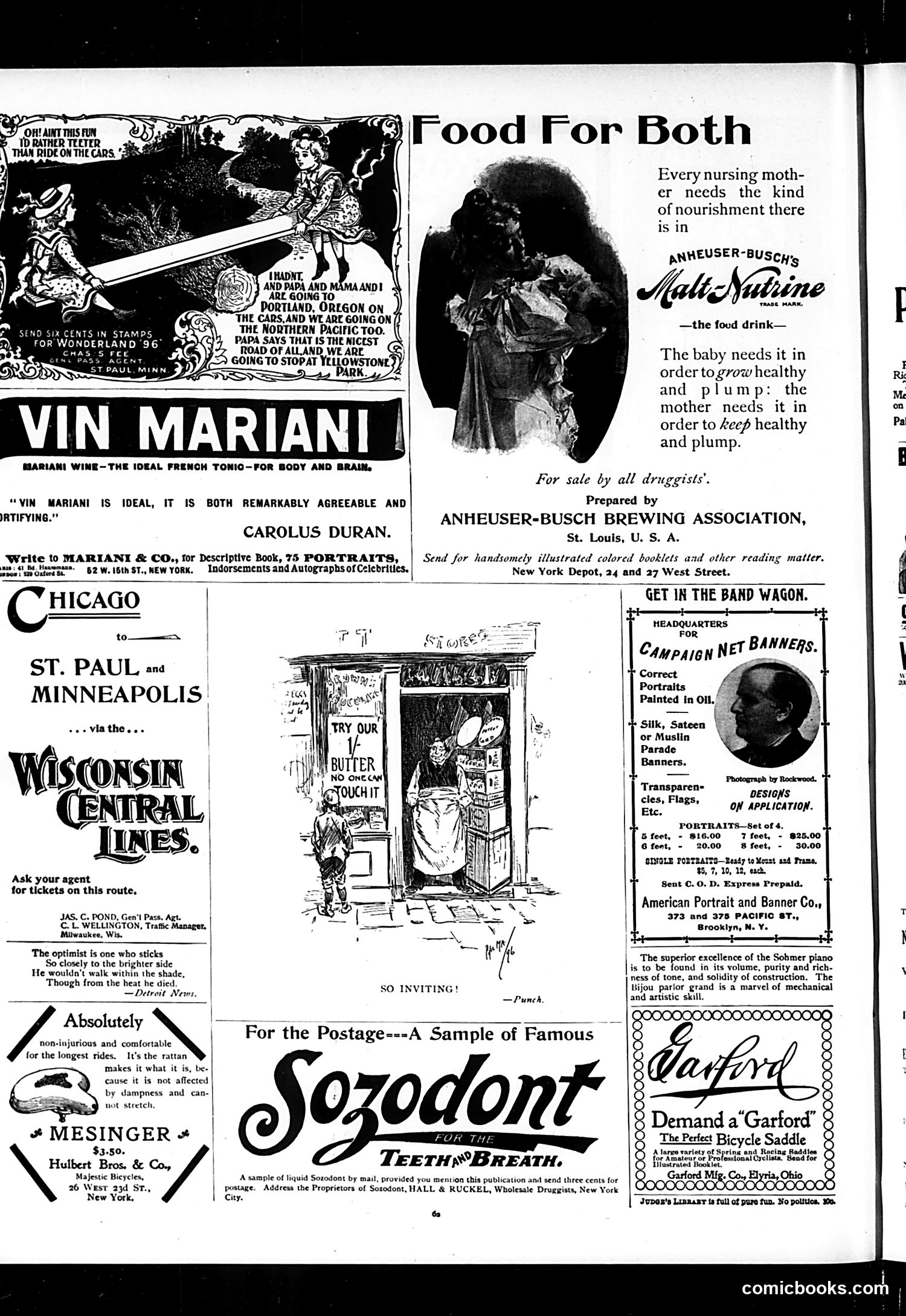
This page is primarily **advertising**, not political satire. It showcases late-19th/early-20th-century product endorsements targeting different demographics. Notable is the **Anheuser-Busch "Malt Nutrine" ad**, which explicitly markets beer as nutrition for nursing mothers and babies—claiming infants need it to "grow healthy and plump." This reflects the era's pre-FDA attitudes toward alcohol and medicines; beer was considered wholesome and medicinal. Similarly, **Vin Mariani** (a wine tonic) advertises as beneficial for "body and brain," endorsed by celebrity Carolus Duran. Other ads include a **Sozodont tooth powder sample** offer, Wisconsin Central railroad tickets, and various bicycle/saddle advertisements. The small cartoon fragment at top-left appears unrelated, possibly advertising a tour or publication. By modern standards, marketing alcohol to nursing mothers is shocking, but this page documents period attitudes toward substances later recognized as dangerous.
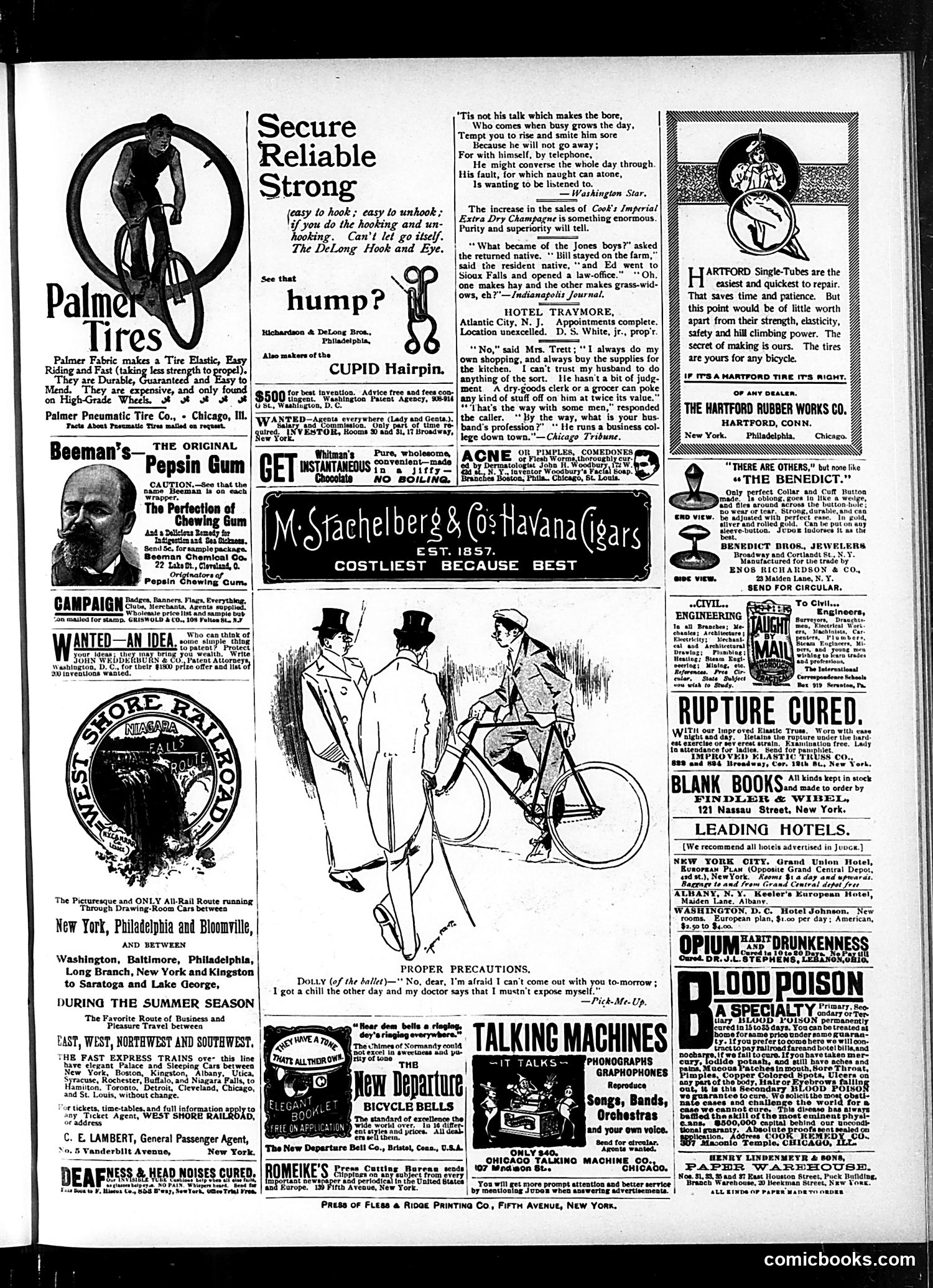
This page from *Judge* magazine is primarily **advertising**, not political satire. It contains: **Main Content:** - Product advertisements (Palmer Tires, Beeman's Pepsin Gum, DeLong Hooks, Hartford Rubber Works, talking machines, cigars, etc.) - Small humorous anecdotes and jokes scattered between ads—typical filler for period magazines **The Cartoons:** The only substantial cartoon labeled "PROPER PRECAUTIONS" shows three well-dressed men with a bicycle, captioned with a domestic joke about a woman avoiding exposure to illness. It's genteel social humor, not political commentary. **Context for Modern Readers:** This reflects late 19th-century magazine culture, where ads subsidized content and humor was mild domestic/social material rather than sharp political satire. The "satire" magazine *Judge* still relied heavily on advertising revenue, mixing lightweight jokes with patent medicines and consumer goods typical of the era.
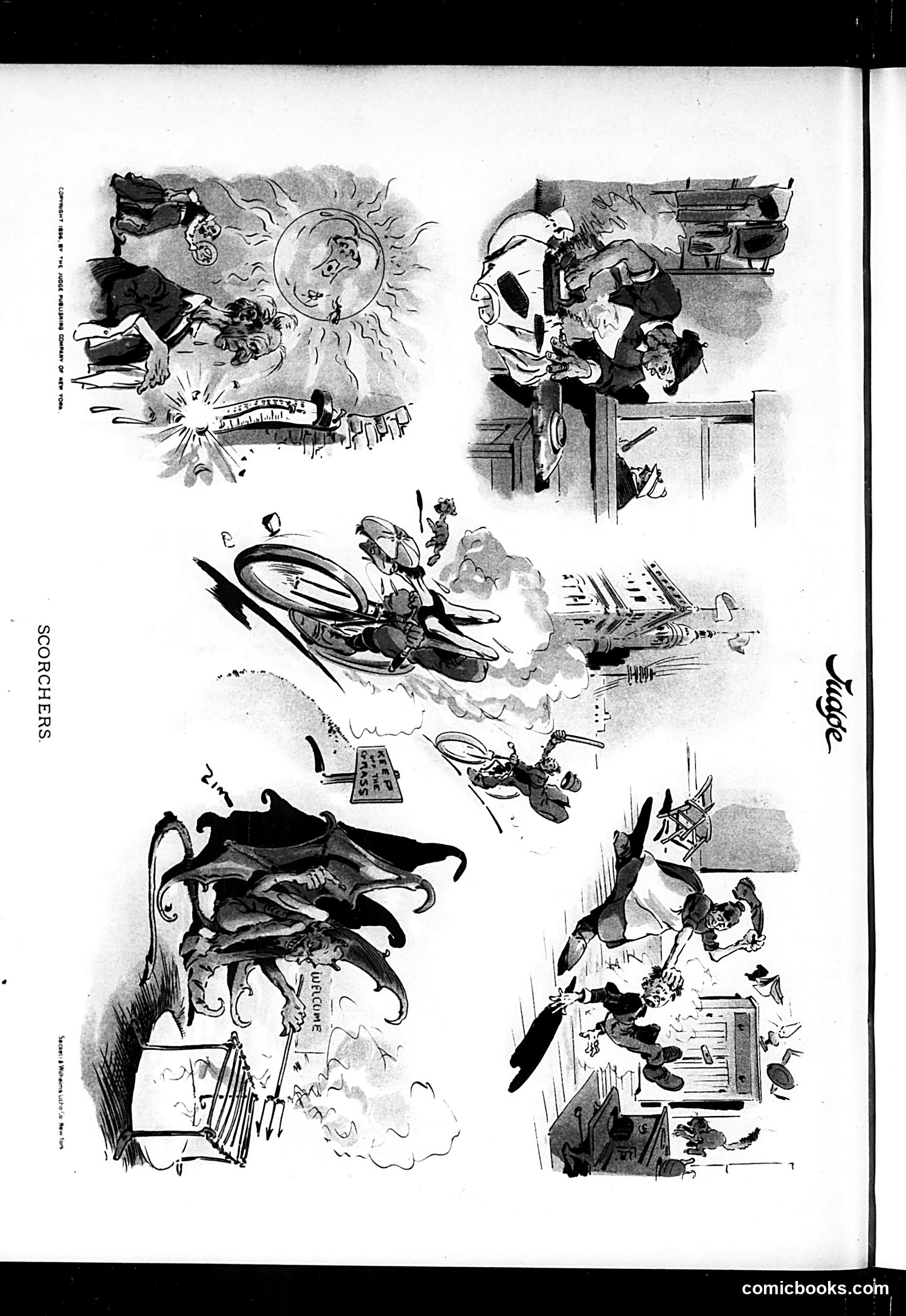
This page contains multiple satirical cartoon panels, though the OCR text provides minimal clarity on specific references. The cartoons appear to use exaggerated caricature and surreal imagery typical of Judge magazine's style. Visible elements include: - A sun-faced figure in the upper left (possibly representing a celestial or authority figure) - Various scenes depicting domestic or social situations with dramatic poses - Anthropomorphic or grotesque figures throughout - What appears to be satirizing everyday situations or social behaviors **However**, without clearer OCR text or visible captions identifying the specific figures, events, or political references, I cannot definitively explain the cartoons' intended meaning or targets. The page's actual satirical points remain unclear from the image alone. Additional context about the publication date would help contextualize any contemporary references.