
A complete issue · 16 pages · 1896
Judge — July 4, 1896
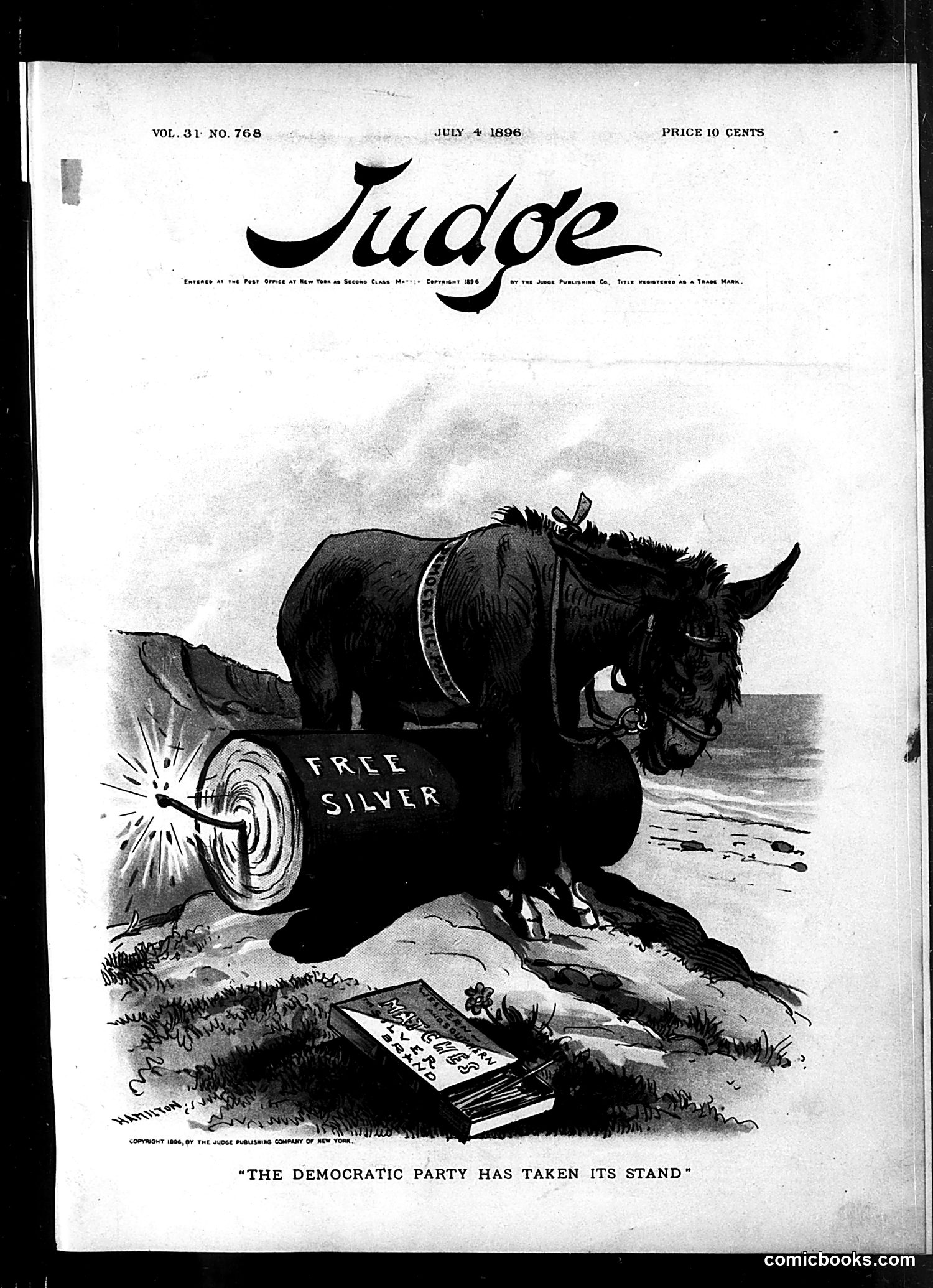
This satirical cartoon depicts a donkey (the Democratic Party symbol) harnessed to a cart labeled "FREE SILVER," straining under the weight. The donkey appears exhausted or struggling. Below lies an open book labeled "CHICAGO PLATFORM" (the Democratic Party's 1896 platform). The caption states: "THE DEMOCRATIC PARTY HAS TAKEN ITS STAND." **Context:** In 1896, the "free silver" debate was central to American politics. Democrats advocated unlimited silver coinage, while Republicans opposed it. This cartoon mocks the Democratic Party's commitment to the free silver position, suggesting it's an unsustainable burden. The struggling donkey implies the party has foolishly hitched itself to a losing, exhausting cause that will drag it down.
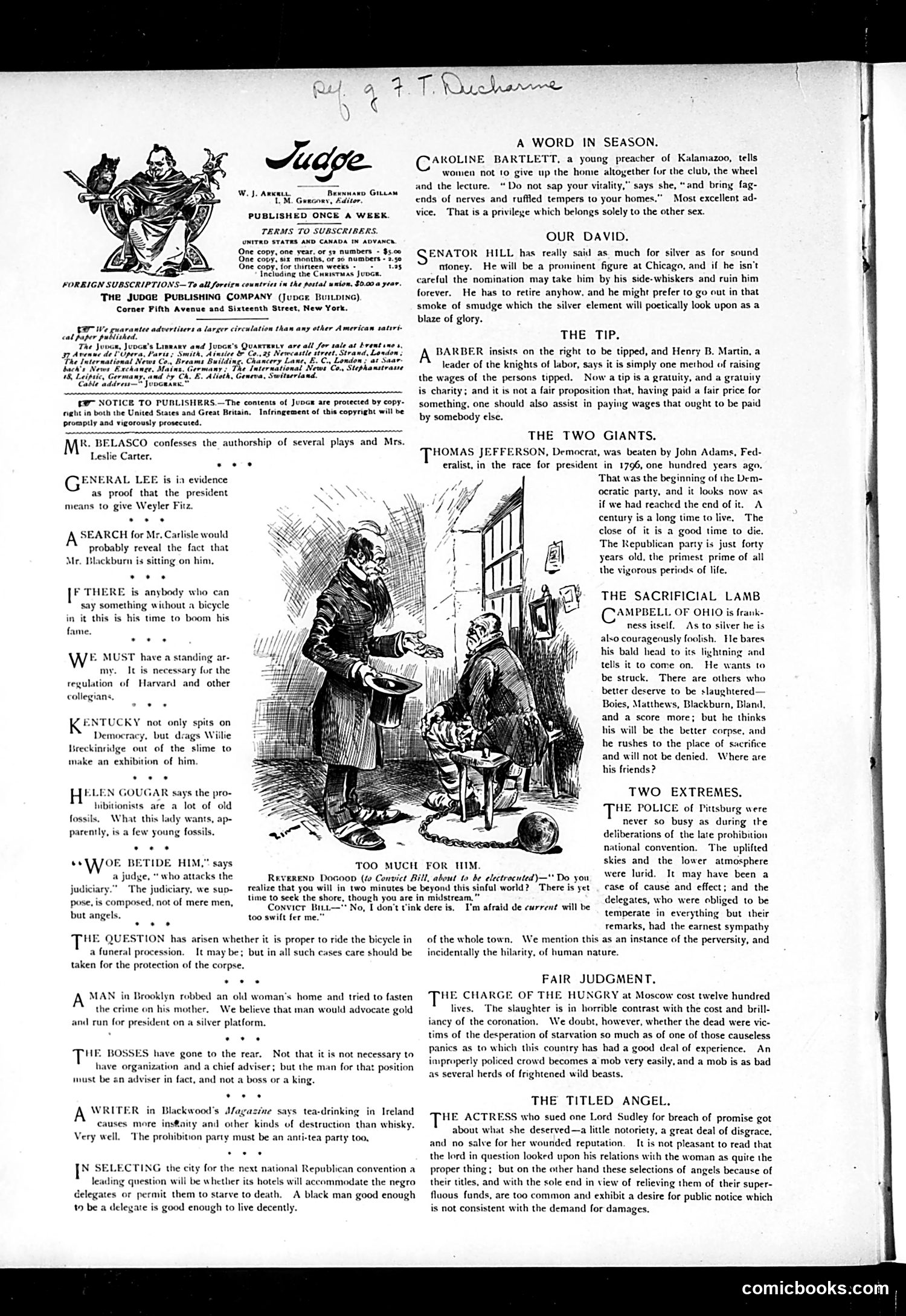
The main cartoon depicts "Reverend Dodson (to Conduct Bill, about to be electrocuted)" confronting a condemned man. The caption reads: "Do you realize that you will in ten minutes be beyond this sinful world? There is no time to seek the block, though you are in midstream. No, I don't ask there is." This appears to satirize clergy who visit death-row inmates before execution, offering spiritual counsel at the last moment. The reverend's awkward, intrusive moralizing—arriving too late to genuinely help—is the joke. The cartoon mocks both overzealous ministers and the uncomfortable absurdity of deathbed religious interventions. The surrounding editorial snippets address unrelated political topics including Democratic leadership and judicial matters, typical of Judge's satirical format.
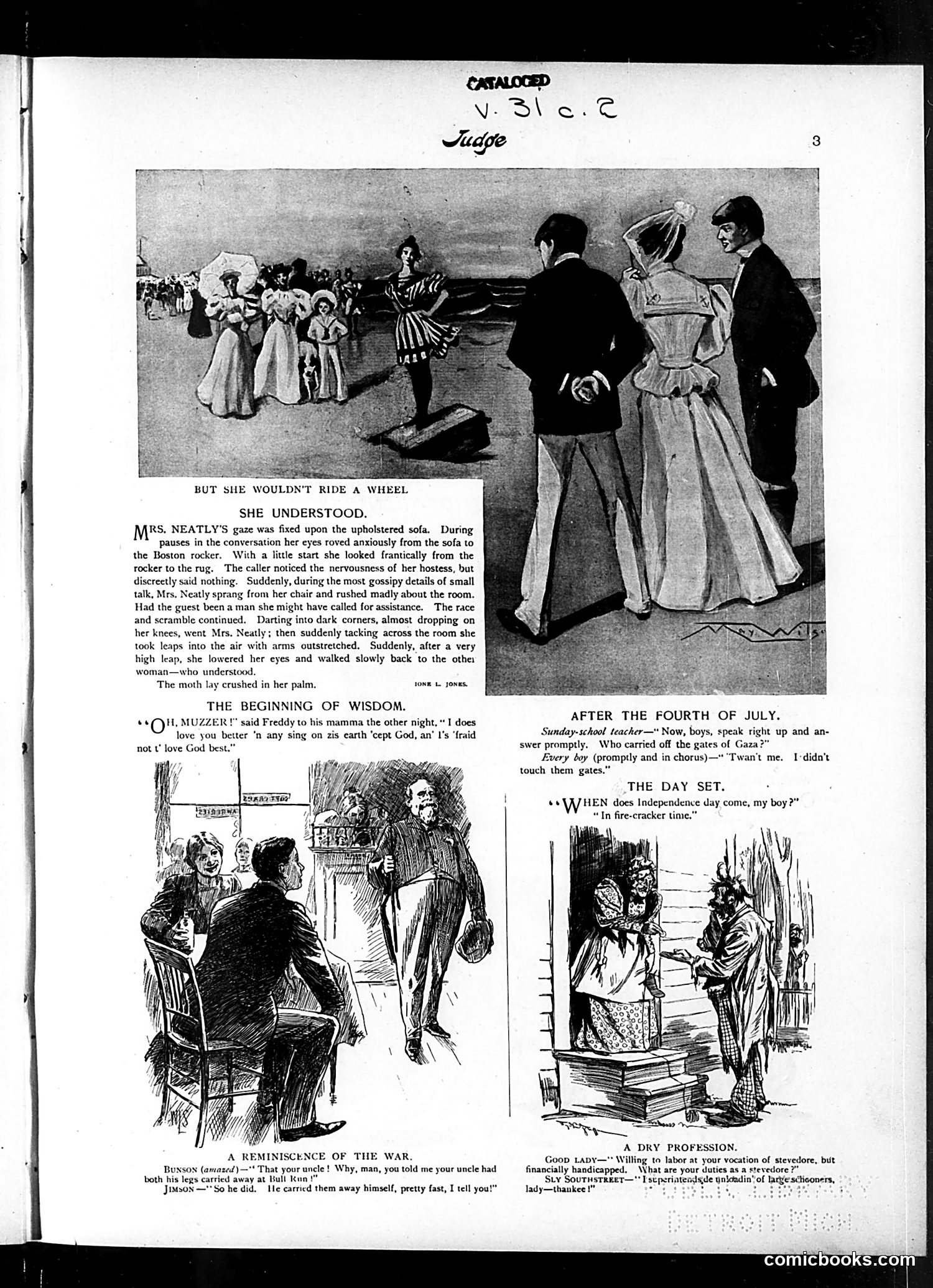
This page contains several satirical vignettes from Judge magazine. The top illustration, "But She Wouldn't Ride a Wheel," mocks a nervous society woman reluctant to ride a bicycle—a then-controversial activity for women. The accompanying text suggests her anxious behavior during a carriage ride, poking fun at upper-class female timidity. "The Beginning of Wisdom" and other sketches below feature dialogue-based humor about everyday situations: a child's innocent song choice, Independence Day celebrations, and class interactions between servants and employers. The humor relies on character types and social pretension typical of Gilded Age satire—nervous wealthy women, working-class dialect, and servant-employer dynamics. Without specific date information visible, the precise historical context remains unclear, though bicycle adoption and gender roles appear central to the satire.
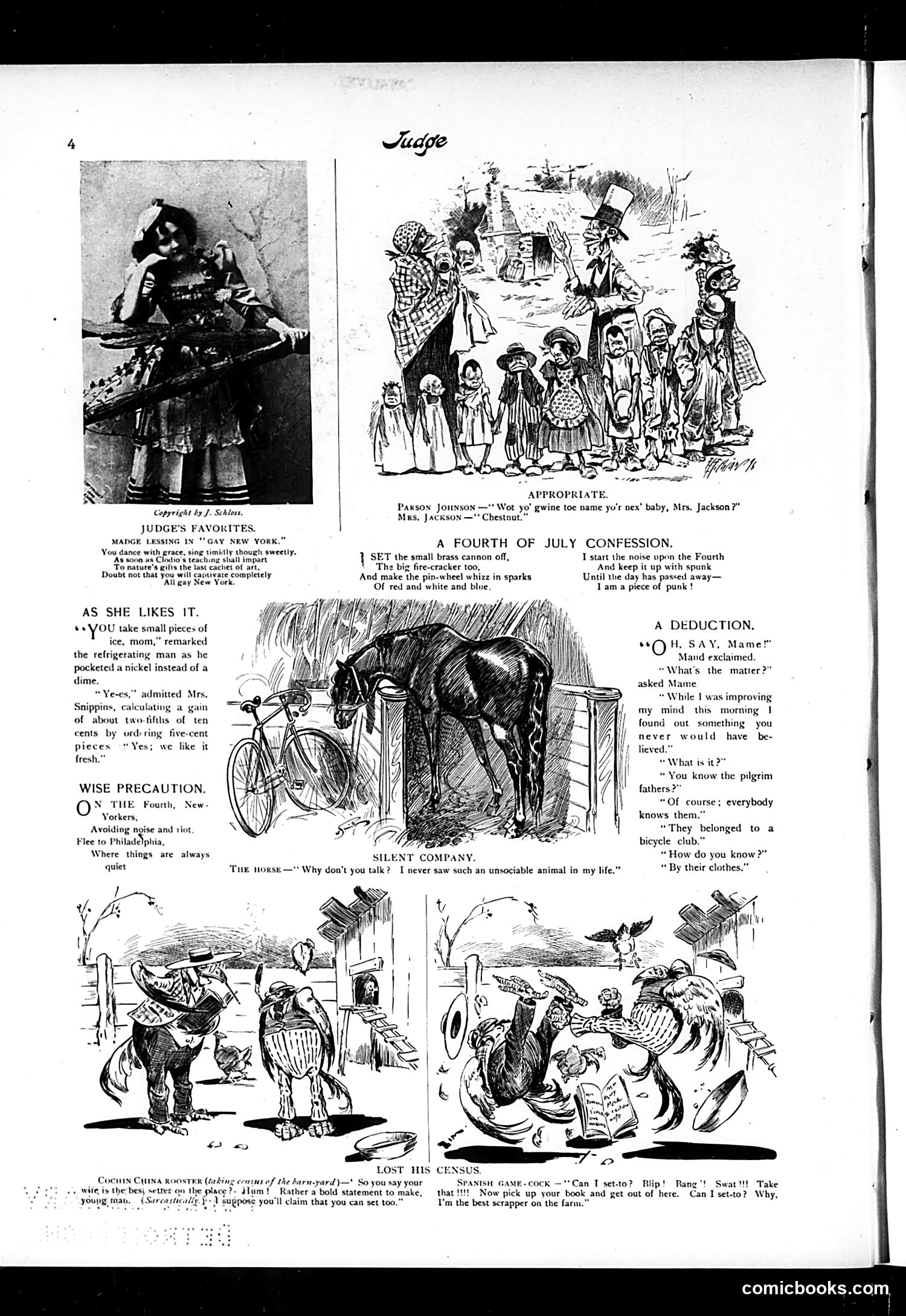
This page of *Judge* satirical magazine contains several comic sketches mocking contemporary American life and behavior circa early 1900s. **Top section** features "Madge Lessing in Gay New York"—likely a theatrical performer or socialite being praised for her dancing and singing abilities. **"As She Likes It"** jokes about a milkman cheating customers by substituting nickels for dimes when they request "fresh ice," revealing petty fraud in daily commerce. **"Wise Precaution"** satirizes New Yorkers fleeing the city on July 4th to Philadelphia because New York crowds are rowdy during Independence Day celebrations, whereas Philadelphia is "always quiet"—a humorous jab at both cities' reputations. **Lower sketches** include a farmer's rooster bragging about fighting ability, and a "deduction" joke where someone humorously concludes that Pilgrim Fathers belonged to a bicycle club based solely on their clothes. The overall tone mocks vanity, petty dishonesty, urban chaos, and illogical reasoning—typical *Judge* humor targeting middle and upper-class American audiences.
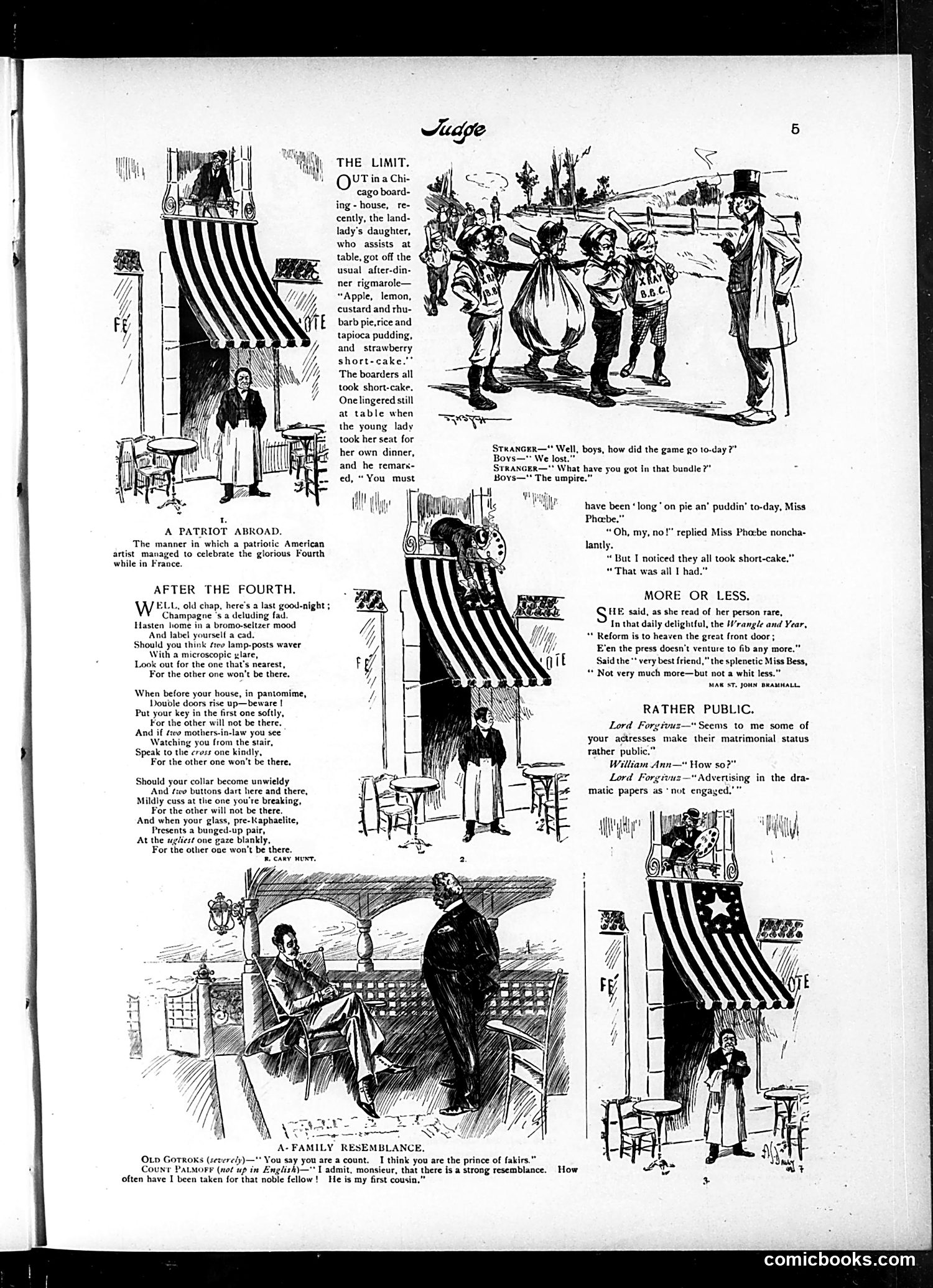
This page contains several satirical pieces typical of early 20th-century American humor: **"The Limit"** mocks a Chicago boarding house where the landlady's daughter recites dessert options daily, yet boarders always choose short-cake—suggesting repetitive monotony and predictability. **"A Patriot Abroad"** and **"After the Fourth"** likely satirize Americans celebrating Independence Day abroad (probably in France), using drunken mishaps and double-vision jokes to mock patriotic excess and poor behavior. **"Rather Public"** jokes about actresses advertising their unmarried status in theatrical papers—implying they're commodifying their availability, making private marital status a public commercial concern. **"Family Resemblance"** features a supposed Count Palmoff claiming kinship to a famous faker/con artist, humorously suggesting he himself may be fraudulent. **"Stranger" segment**: Boys joke about bringing an umpire in a bundle, suggesting he made bad calls—common sports humor. The page emphasizes deception, excess, and social pretension as recurring satirical targets.
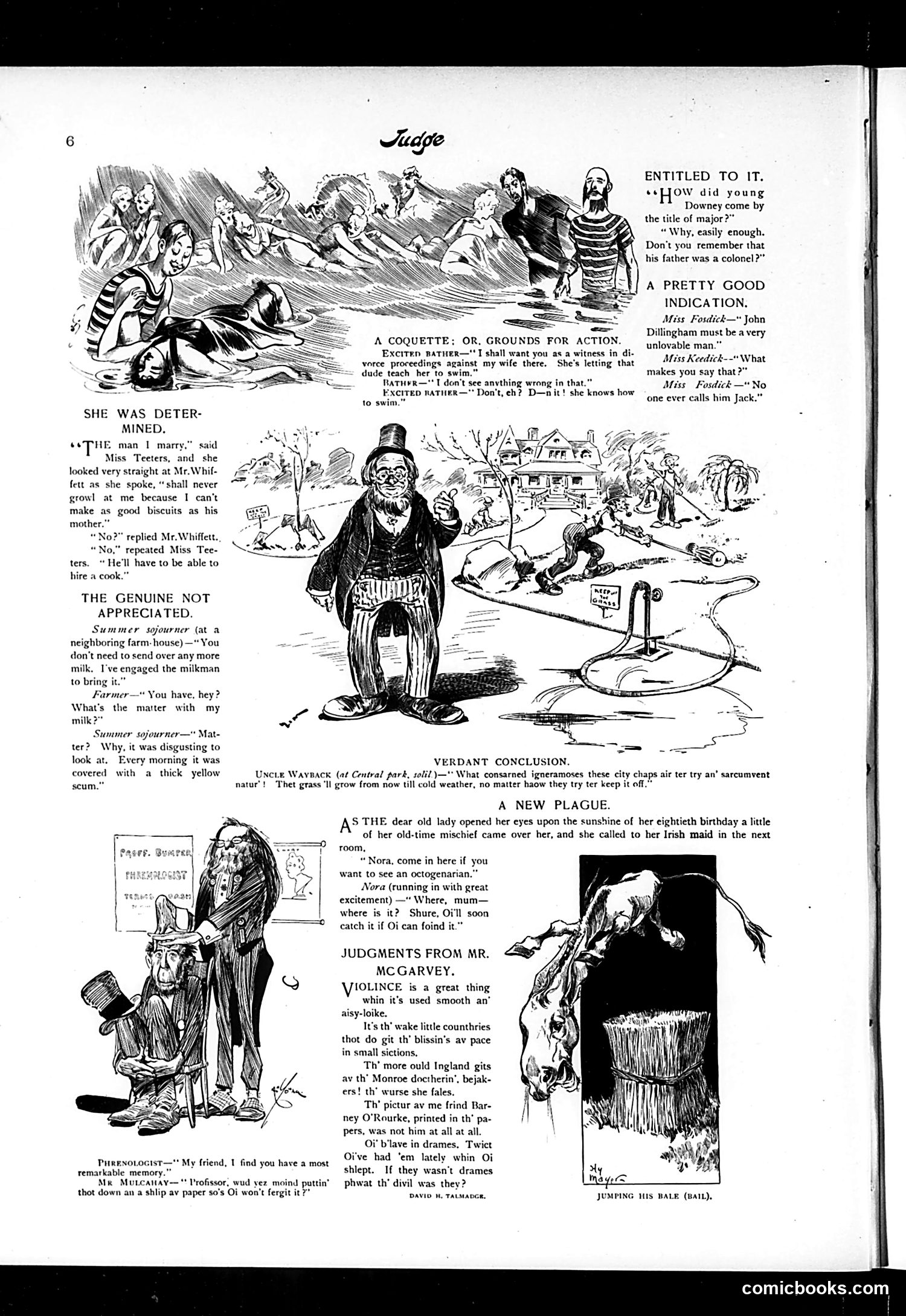
This page contains multiple humor pieces typical of late 19th-century American satire: **"Entitled to It"**: Mocks inherited social status—a man gains a "major" title solely because his father was a colonel, satirizing how titles pass unearned through families. **"A Coquette"**: A domestic humor piece where a husband considers divorcing his wife because she's taking swimming lessons from another man, played for comic jealousy. **"She Was Determined"**: A woman declares her future husband must be able to hire a cook since she can't make good biscuits, inverting traditional domestic expectations. **"The Genuine Not Appreciated"**: Rural/urban humor—a city visitor tells a farmer to stop delivering milk, having hired a milkman instead, missing that the farmer *is* the milkman. **"Verdant Conclusion"**: An Irish country character in Central Park naively believes grass will grow there year-round despite city interference. **"A New Plague"**: An elderly woman tricks her Irish maid by saying she wants to see an "octogenarian" (herself), and the maid hilariously searches for an actual creature. The page also includes Mr. McGarvey's Irish-dialect commentary on violence, England, and dreams—typical ethnic humor of the era.
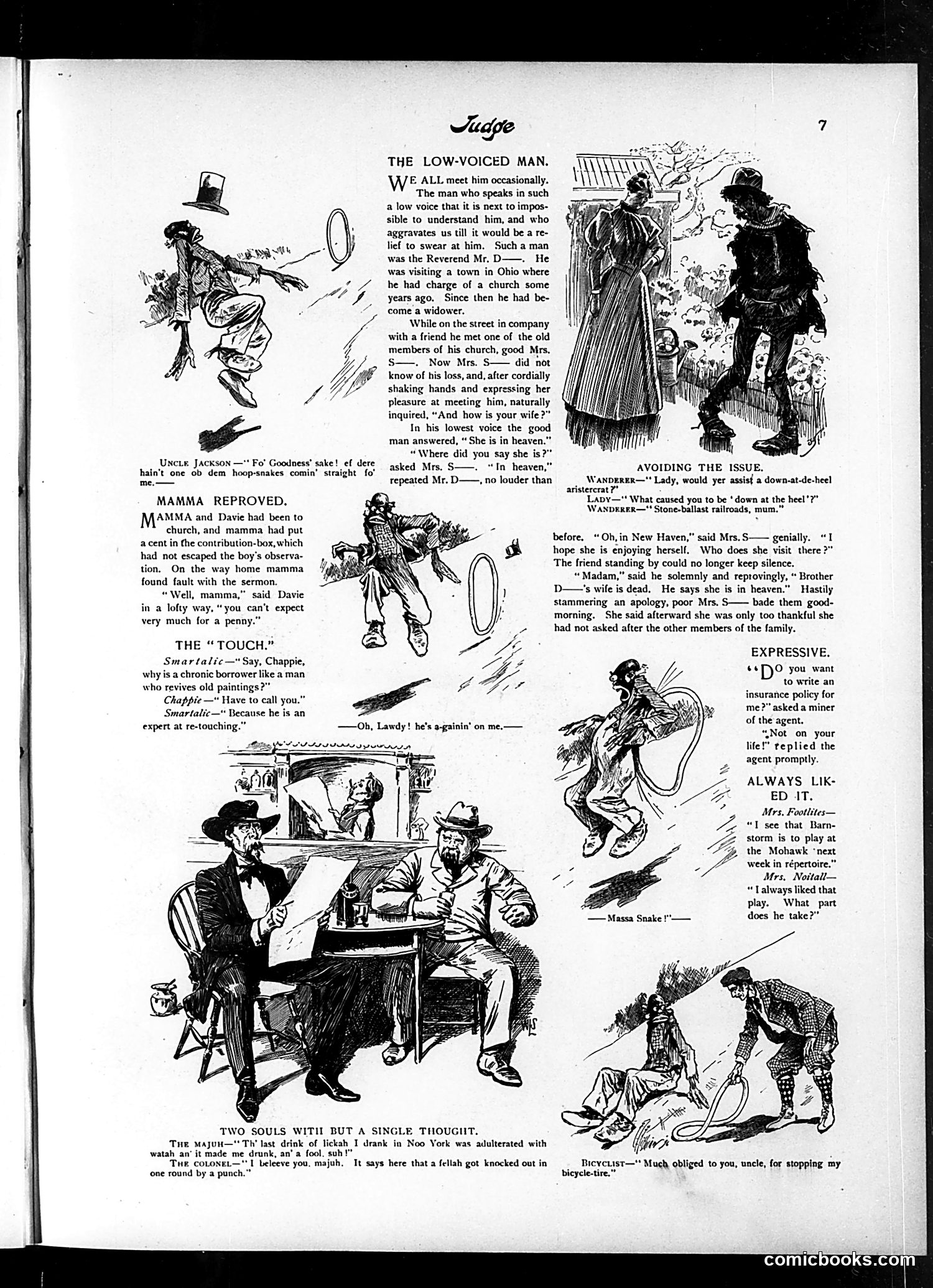
This page contains several unrelated comic vignettes typical of Judge's satirical format: **"The Low-Voiced Man"** mocks a reverend's inaudibly quiet speech. When asked about his wife, he mumbles "she is in heaven"—meaning deceased—but Mrs. S— mishears it as "New Haven," leading to an embarrassing misunderstanding about his dead wife's supposed social activities. **"Mamma Reproved"** presents a child's logic: after donating only a penny, he defends the sermon's quality by saying "you can't expect very much for a penny." The remaining items are brief joke exchanges: **"The Touch"** compares chronic borrowers to art restorers (both "re-touch"); **"Avoiding the Issue"** satirizes a vagabond blaming railroads for his poverty; **"Expressive"** shows a miner's dangerous occupation making him uninsurable; **"Always Liked It"** features theater gossip; and **"Two Souls"** presents drunk men's similar logic. The cartoons use working-class and rural characters to highlight human folly and miscommunication—Judge's typical approach to American social satire.
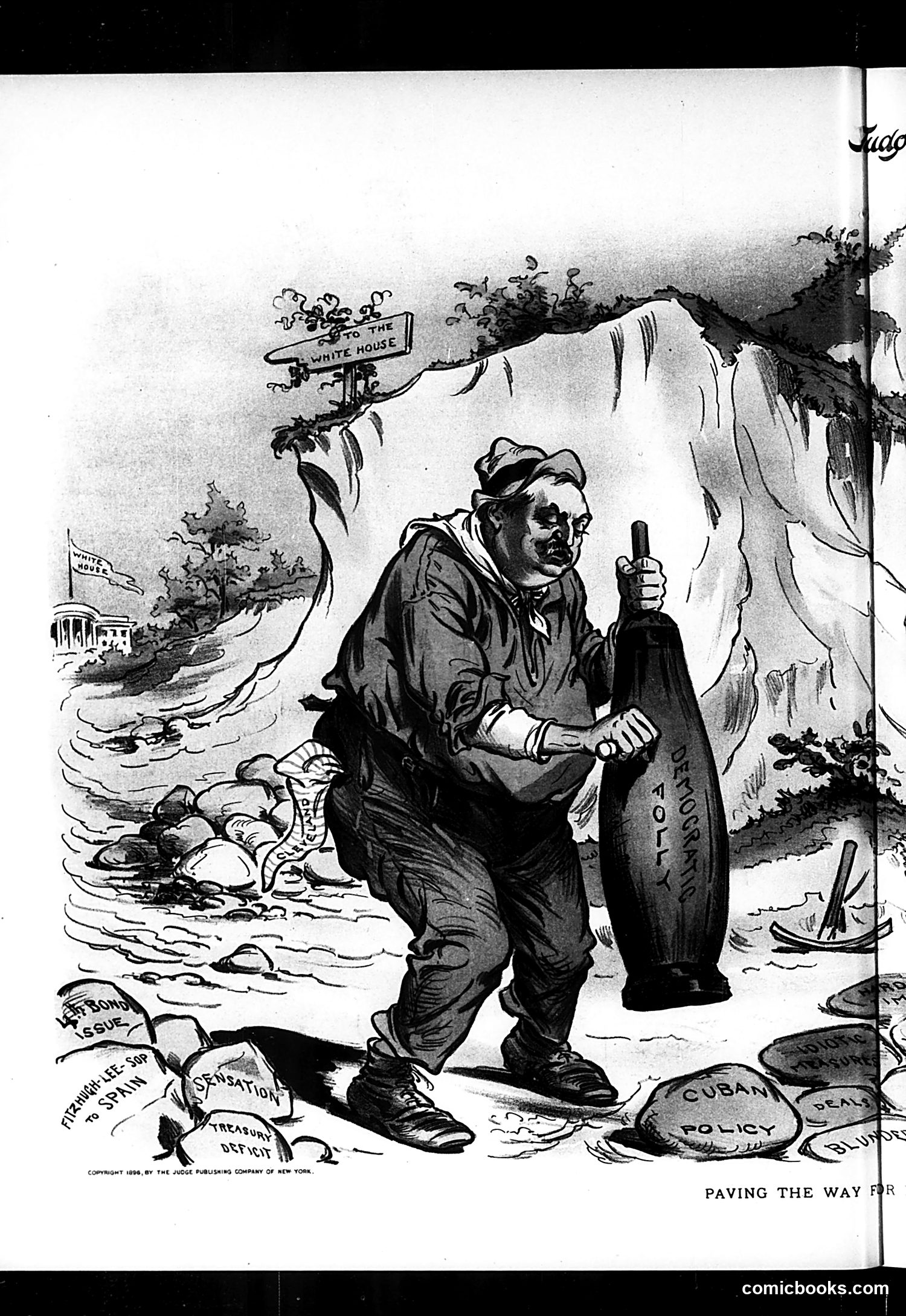
This 1896 *Judge* cartoon depicts a figure carrying a large bomb labeled "POLICY," trudging past the White House toward it. The ground is littered with debris labeled "CUBAN," "SILVER," "TREASURY DEFICIT," "FISCAL ISSUE," and "SPOILS," suggesting accumulated political problems. The cartoon satirizes a political figure (likely President or a presidential candidate) who is "paving the way"—advancing a dangerous policy agenda despite surrounding chaos and unresolved crises. The bomb represents an inflammatory or risky political position, possibly related to Cuban affairs or monetary policy (the "silver" reference suggests the contentious silver-versus-gold debate of that era). The satire criticizes reckless policymaking amid existing governmental problems, warning that this figure is moving toward the White House with destructive intentions.
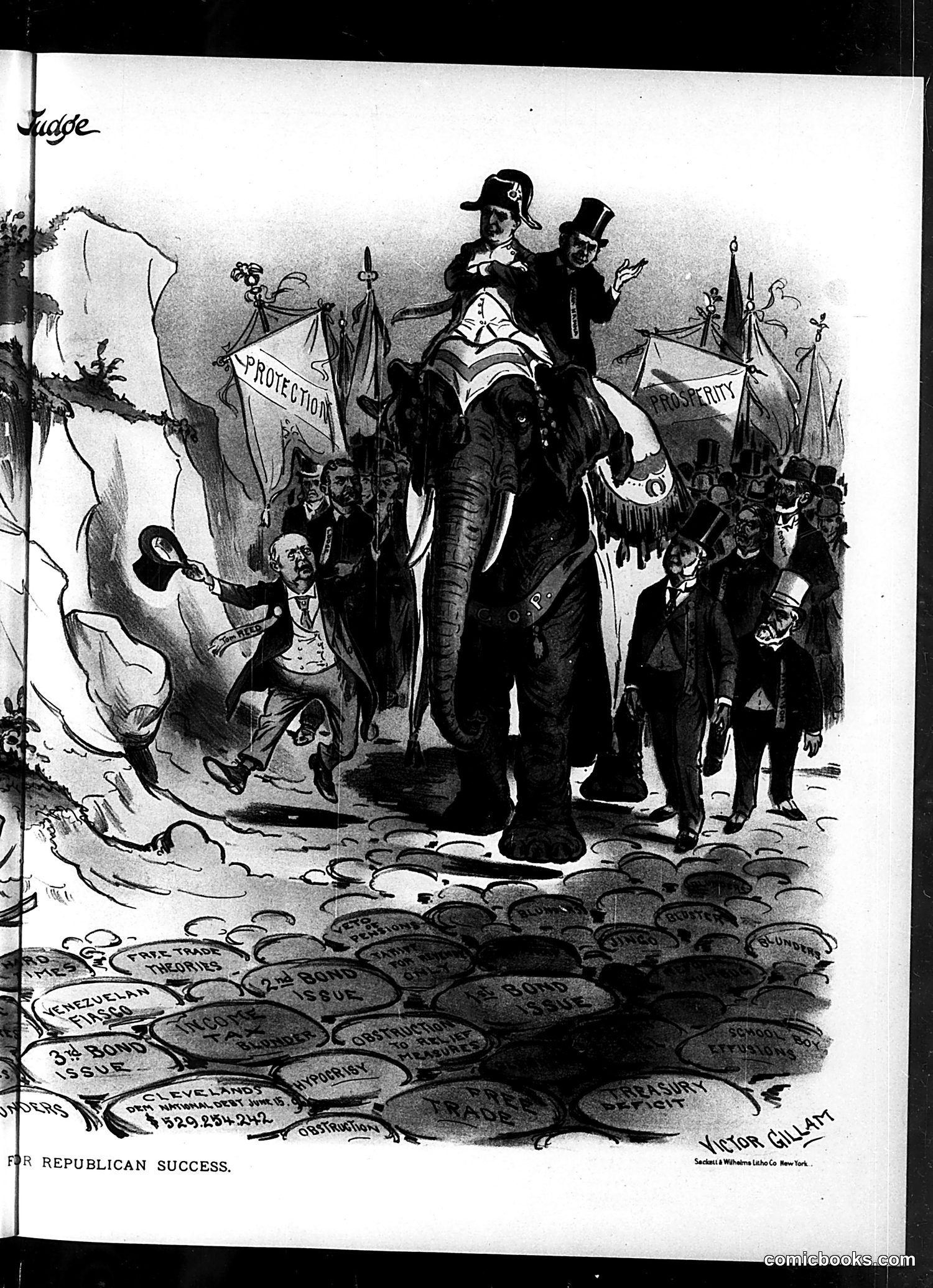
This cartoon depicts an elephant (the Republican Party symbol) laden with heavy baggage labeled with various controversial issues and financial scandals—visible text includes references to bonds, construction costs, and what appear to be corruption-related matters. Politicians in formal dress ride atop and accompany the overburdened elephant, carrying flags labeled "Protection" and "Prosperity." The satire suggests Republicans are attempting to achieve electoral success while weighted down by numerous scandals and failed policies. The cartoon critiques the party's claim to represent prosperity and protection when burdened by real-world problems and corruption. The figures appear to be Republican leaders of the era, though specific individuals cannot be definitively identified from the image alone. This reflects late 19th or early 20th-century political criticism of Republican governance.
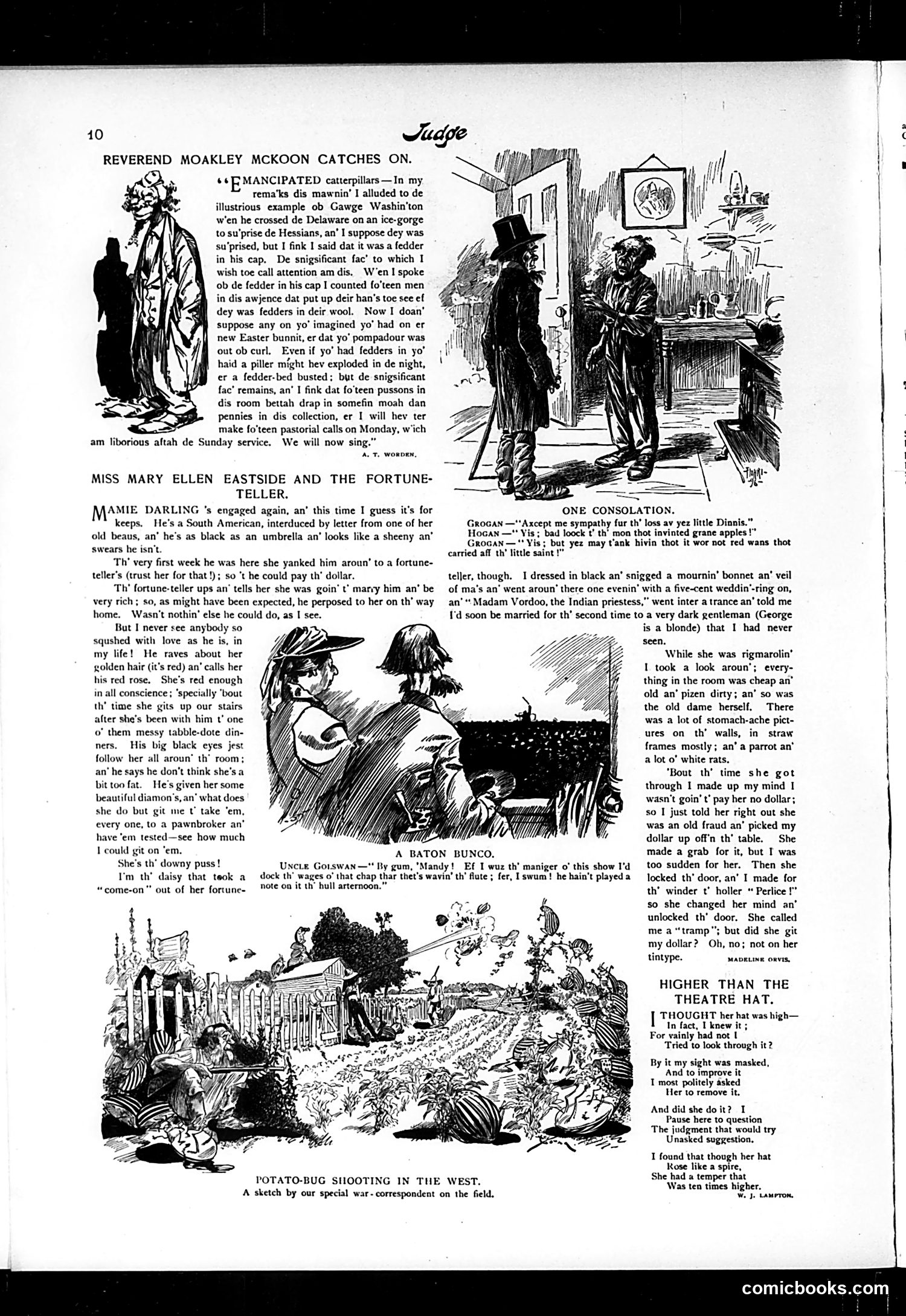
This page contains three separate humorous stories from *Judge* magazine: **"Reverend Moakley McKoon Catches On"** features a Black preacher using exaggerated dialect ("de," "fo'teen") who makes a joke during a sermon: when mentioning a "feather in his cap," fourteen parishioners raised their hands thinking he was referring to feathers in their hair. He then guilt-trips them into donating more than pennies to the collection plate. **"Miss Mary Ellen Eastside and the Fortune-Teller"** mocks a working-class woman whose South American fiancé is infatuated with her. She visits a fortune-teller (a con artist with cheap décor and rats), then cleverly poses as a widow to expose the fraud and avoid paying. **"One Consolation"** and **"Potato-Bug Shooting"** are brief joke items about Irish immigrants and rural folk, using thick accent dialect. The page reflects early 20th-century stereotypes through exaggerated dialect and caricature—targeting Black preachers, working-class women, and immigrants—which modern readers should recognize as reflecting the magazine's casual bigotry.
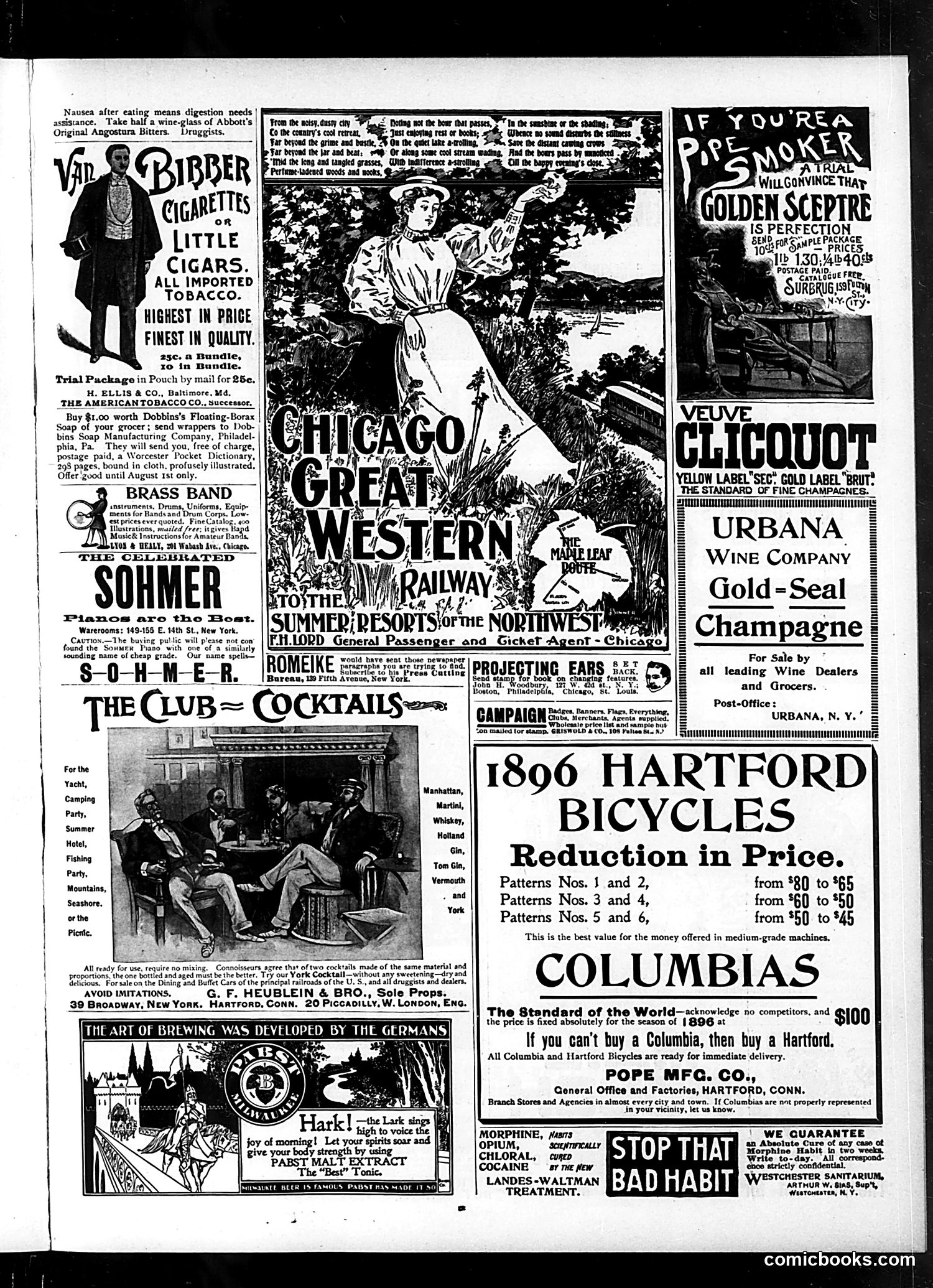
This page is **primarily advertising**, not satirical editorial content. It showcases various commercial products typical of 1896 America: **Notable advertisements include:** - **Tobacco products** (Vad Bibber cigars, emphasizing imported quality) - **Patent medicines** (Abbott's Angostura Bitters for digestion; Landes-Waltman treatment for morphine and cocaine addiction) - **Luxury goods** (Sohmer pianos, champagne, wine) - **Bicycles** (Hartford and Columbia brands, with price reductions—bicycles were hugely popular in the 1890s) - **Bar supplies** (Heublein cocktail mixers for yachts and hotels) **Social context for modern readers:** The addiction treatment ads are particularly striking—they openly advertised cures for morphine and cocaine dependency, reflecting the era before these substances were legally restricted. The bicycle advertisements reflect the 1890s bicycle craze. Luxury alcohol and tobacco ads dominated magazines targeting affluent male readers. The page contains **no visible political satire or cartoon humor**—it's a straightforward commercial publication.
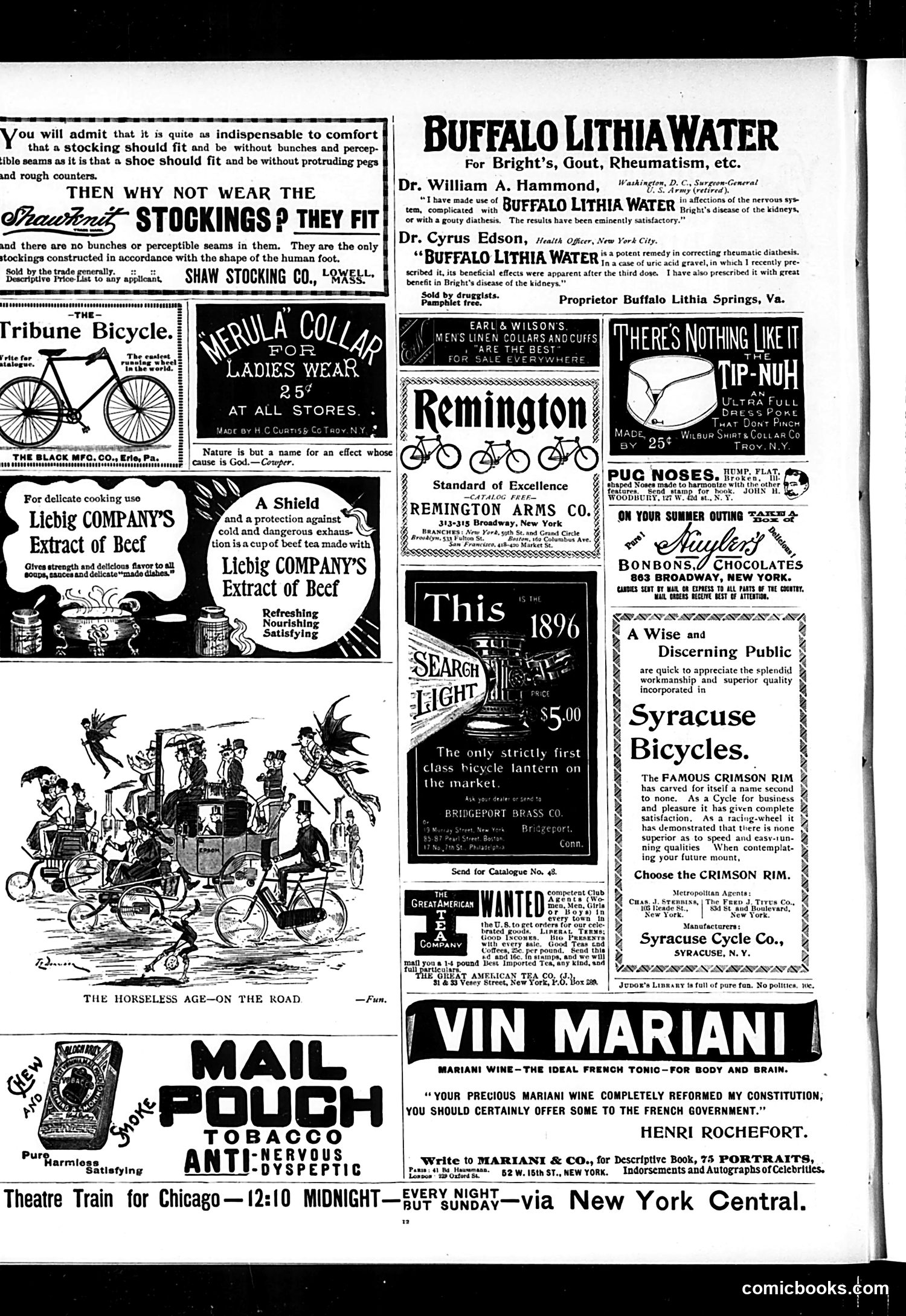
This is primarily an **advertising page** from Judge magazine, circa 1896, rather than satirical editorial content. The page features numerous product advertisements typical of the Gilded Age, with only one cartoon illustration ("The Horseless Age—On the Road"). ## Key Advertisement Content: **Medical/Wellness Products**: Buffalo Lithia Water is promoted using testimonials from prominent figures like Dr. William A. Hammond (Surgeon-General, U.S. Army) and Dr. Cyrus Edson (Health Officer, NYC) claiming it treats Bright's disease, gout, and rheumatism—reflecting late-Victorian faith in mineral water cures. **Bicycles**: Multiple manufacturers (Tribune, Remington, Syracuse) advertise bicycles, reflecting the 1890s cycling craze. **The One Cartoon**: "The Horseless Age—On the Road" depicts early automobiles sharing roads with bicycles and pedestrians, humorously capturing contemporary anxiety about new transportation technology. **Patent Remedies**: Mail Pouch Tobacco and Vin Mariani (wine tonic) represent the era's unregulated patent medicine market, endorsed by celebrities like Henri Rochefort. The page primarily documents consumer culture and medical pseudoscience of 1890s America.
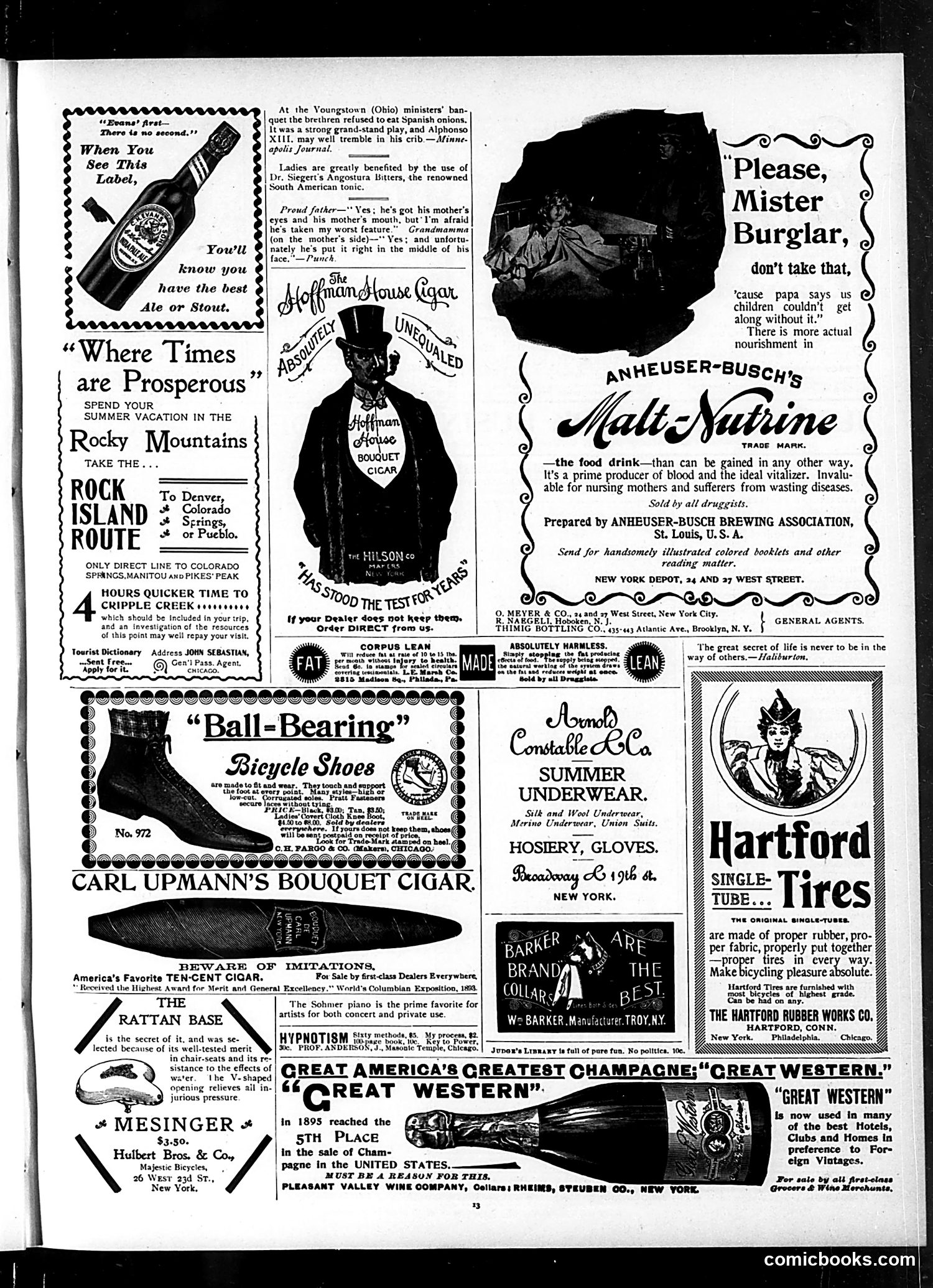
This is primarily an **advertising page** with minimal editorial content. The few jokes present are brief: 1. **"Beans? First" joke**: A simple gag about beans being the only food worth mentioning—likely playing on beans as a cheap, common staple food. 2. **"Proud Father" joke**: A mild family humor piece from *Punch* magazine about a baby's unflattering facial features inherited from his father. 3. **"Spanish Onions" reference**: A topical quip about Ohio ministers refusing Spanish onions at a banquet, sarcastically suggesting this snub might worry King Alfonso XIII of Spain—mocking the ministers' gesture as performative and ineffectual. The page is dominated by **commercial advertisements** for beer (Anheuser-Busch), cigars, champagne, bicycles, tires, underwear, and other products typical of the era. The Anheuser-Busch ad notably markets malt beverage as nutritious and medicinal—reflecting early 20th-century attitudes toward alcohol. **No significant political cartoons appear on this page.**
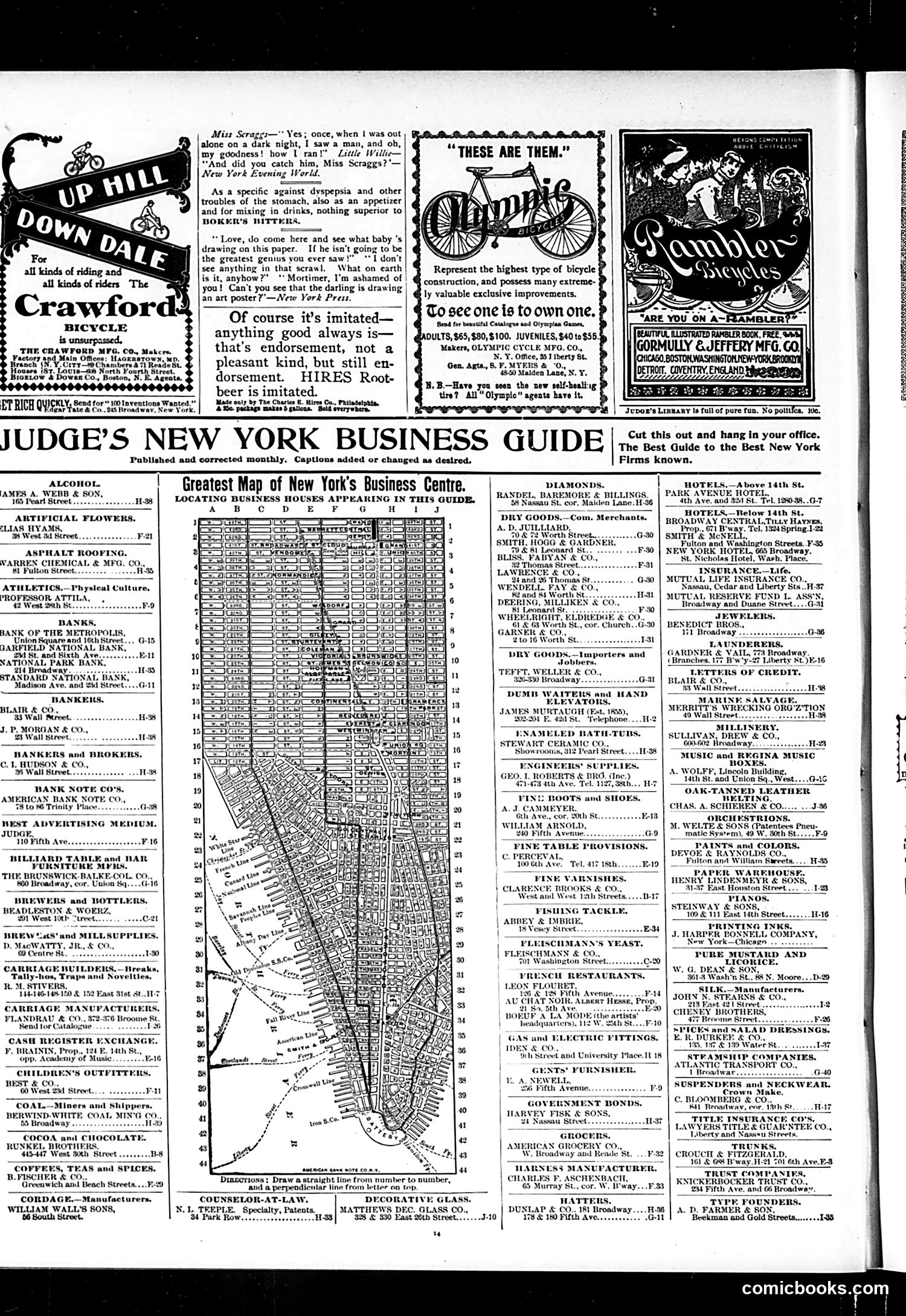
This is primarily a **business directory and advertisement page**, not a political cartoon. The page contains three distinct elements: **Top section**: Three humor vignettes unrelated to the business guide itself—including jokes about a woman seeing a man in the dark, a baby drawing, and imitation of Hires Root Beer. **Main content**: A detailed map of Manhattan's business district with numbered grid references, allowing readers to locate specific companies listed alphabetically by industry type (banks, dry goods, coal, etc.). **Purpose**: This appears to be a regular monthly feature in Judge magazine—a practical, advertiser-supported guide helping New York businesspeople find vendors and services. The humor pieces serve as filler content typical of Judge's satirical format, while the directory itself is straightforward commercial reference material with no apparent political satire.
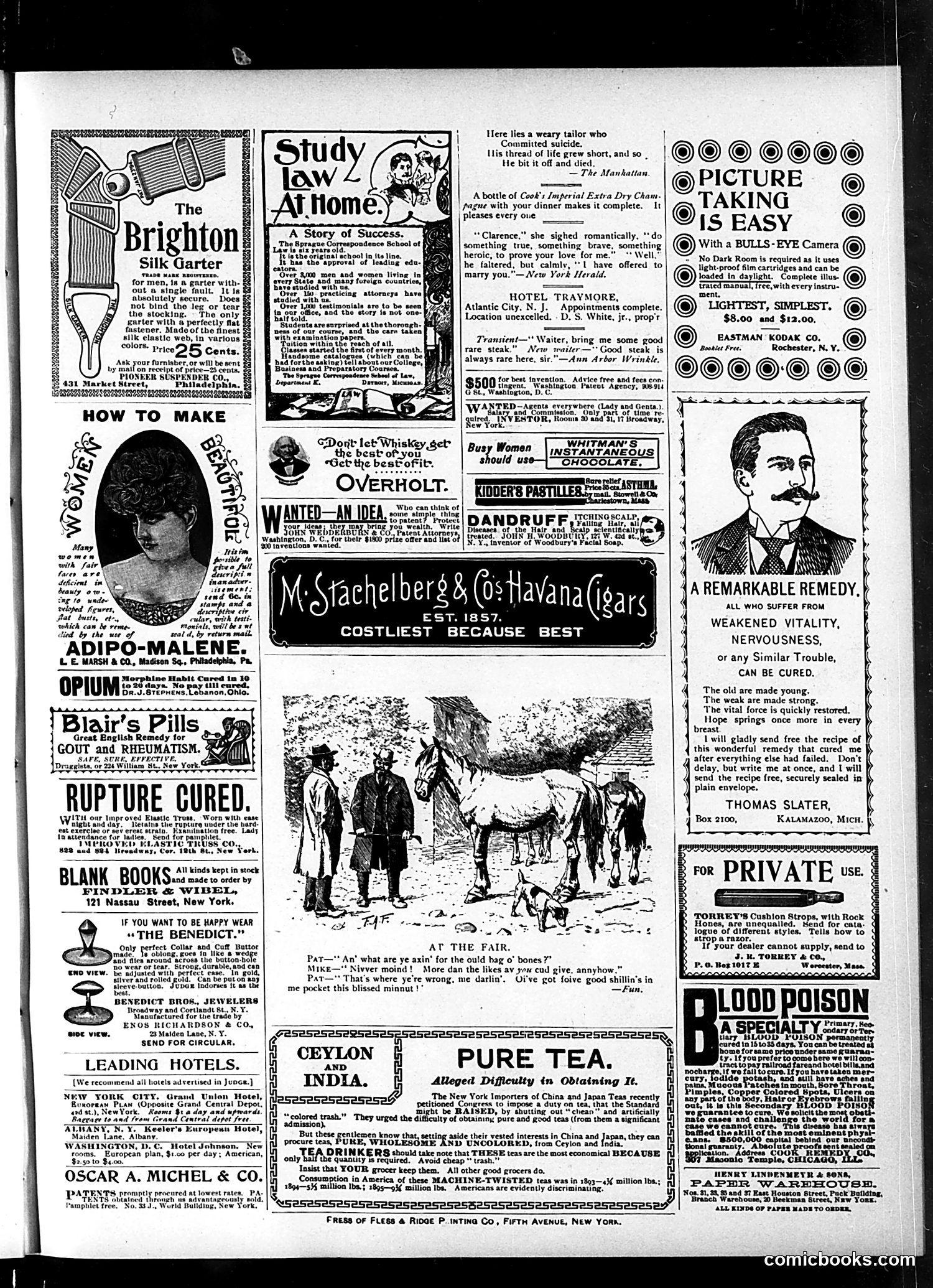
This page is primarily **advertising**, typical of Judge magazine's revenue model. The content consists of patent medicines, hotel listings, and consumer goods rather than political satire. The few editorial pieces are mild social humor: - A **"weary tailor" epitaph** mocking someone who literally "bit off" his thread of life—a pun on suicidal desperation - **"Clarence" romantic dialogue** satirizing melodramatic courtship and a man's underwhelming marriage proposal as "proof" of love - **Fair dialogue** between Irish characters haggling over a horse, with ethnic stereotype humor typical of the era The ads reveal period attitudes: "Adipo-Malene" for underdeveloped figures, opium for morphine addiction, "blood poison" treatments, and dubious remedies for "weakened vitality"—reflecting turn-of-century patent medicine culture and lack of FDA regulation. No identifiable political figures or substantial satire appear on this particular page.
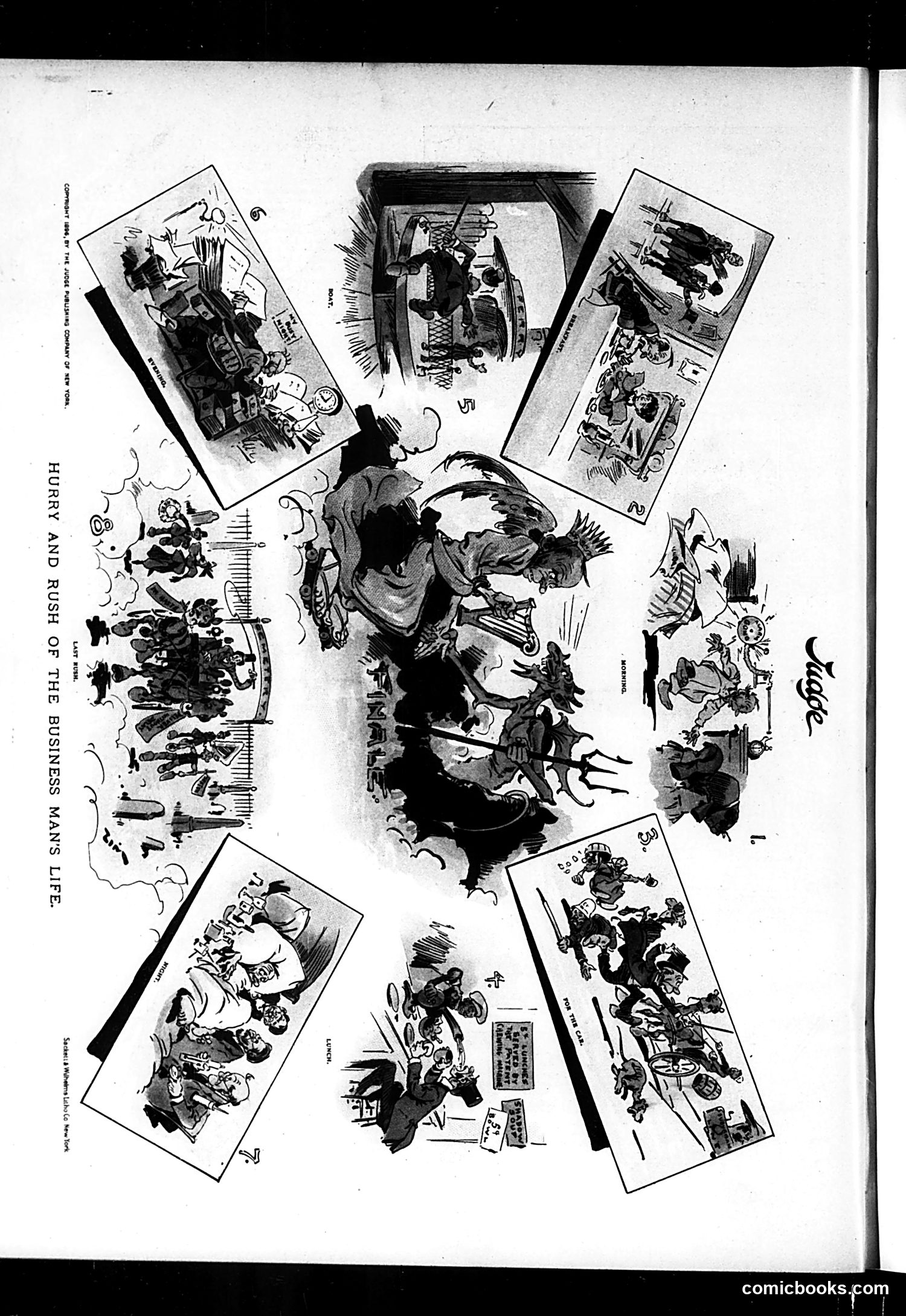
This satirical page from Judge magazine depicts "The Hurry and Rush of the Business Man's Life" through multiple vignettes arranged around a central chaotic scene. The cartoons illustrate the frantic, disorganized nature of late-19th-century commercial activity—businessmen rushing, juggling multiple tasks, dealing with paperwork and correspondence, and generally appearing overwhelmed and harried. The central image shows a businessman caught in a whirlwind of activity, while surrounding panels depict various aspects of business chaos: desk work, meetings, communication, and financial dealings. The satire mocks the frenetic pace and stress of the Gilded Age business world, suggesting that despite claims of progress and efficiency, modern commerce had become absurdly hectic and demanding. This reflects contemporary anxieties about industrialization and the accelerating pace of American commercial life in the 1890s.