
A complete issue · 16 pages · 1896
Judge — February 15, 1896
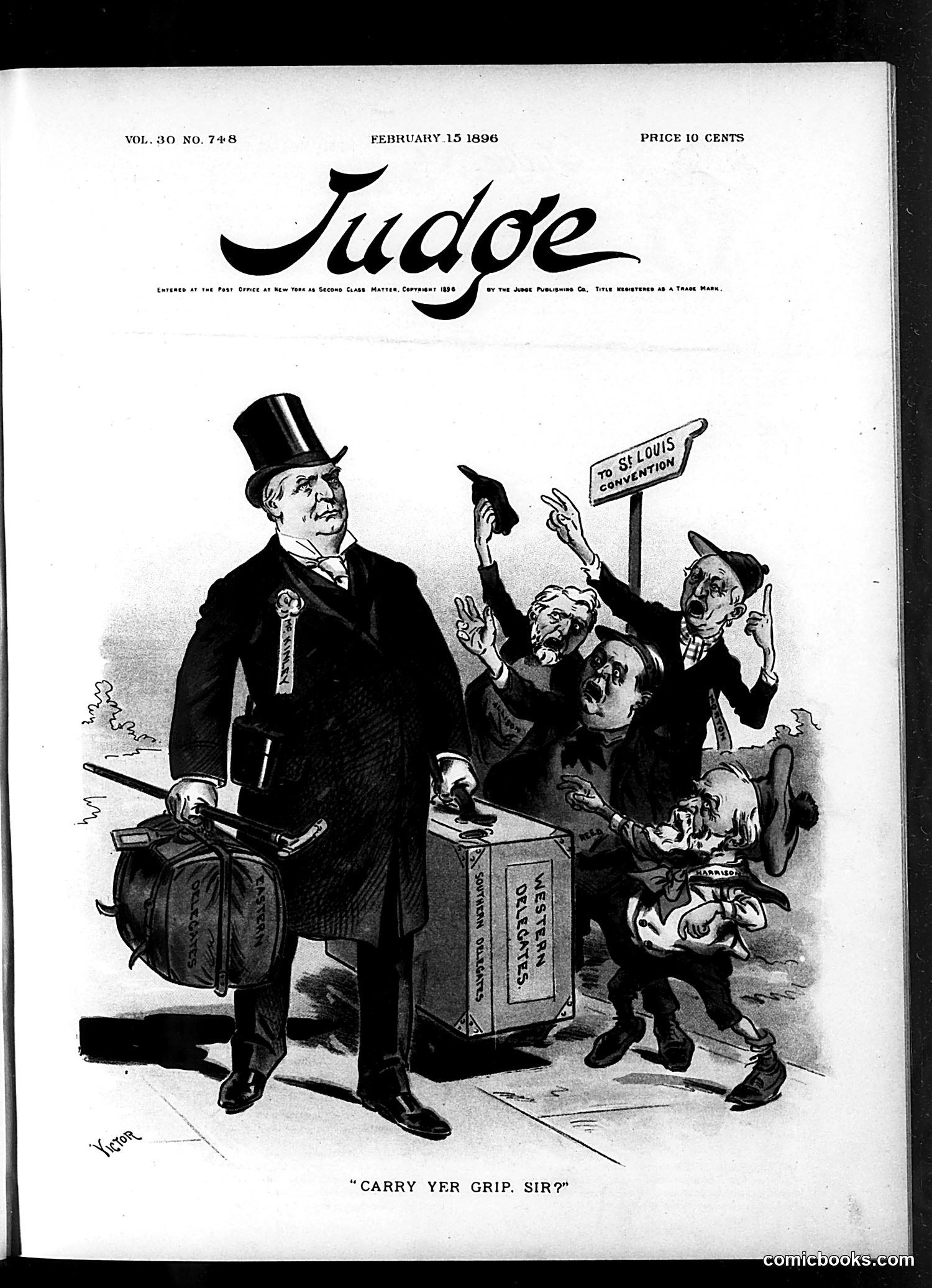
This cartoon, titled "Carry Yer Grip, Sir?", depicts a well-dressed gentleman with a top hat (likely a political figure or wealthy traveler) being approached by several caricatured street urchins or porters offering to carry his luggage. A sign reading "ST LOUIS CONVENTION" appears in the background. The satire likely mocks the 1896 Republican or Democratic National Convention scheduled for St. Louis, suggesting political operatives ("grip men") are eagerly competing to attach themselves to a prominent politician, offering dubious services or making deals. The cartoon critiques the opportunistic nature of convention politics—lowly figures scrambling for proximity to power and influence.
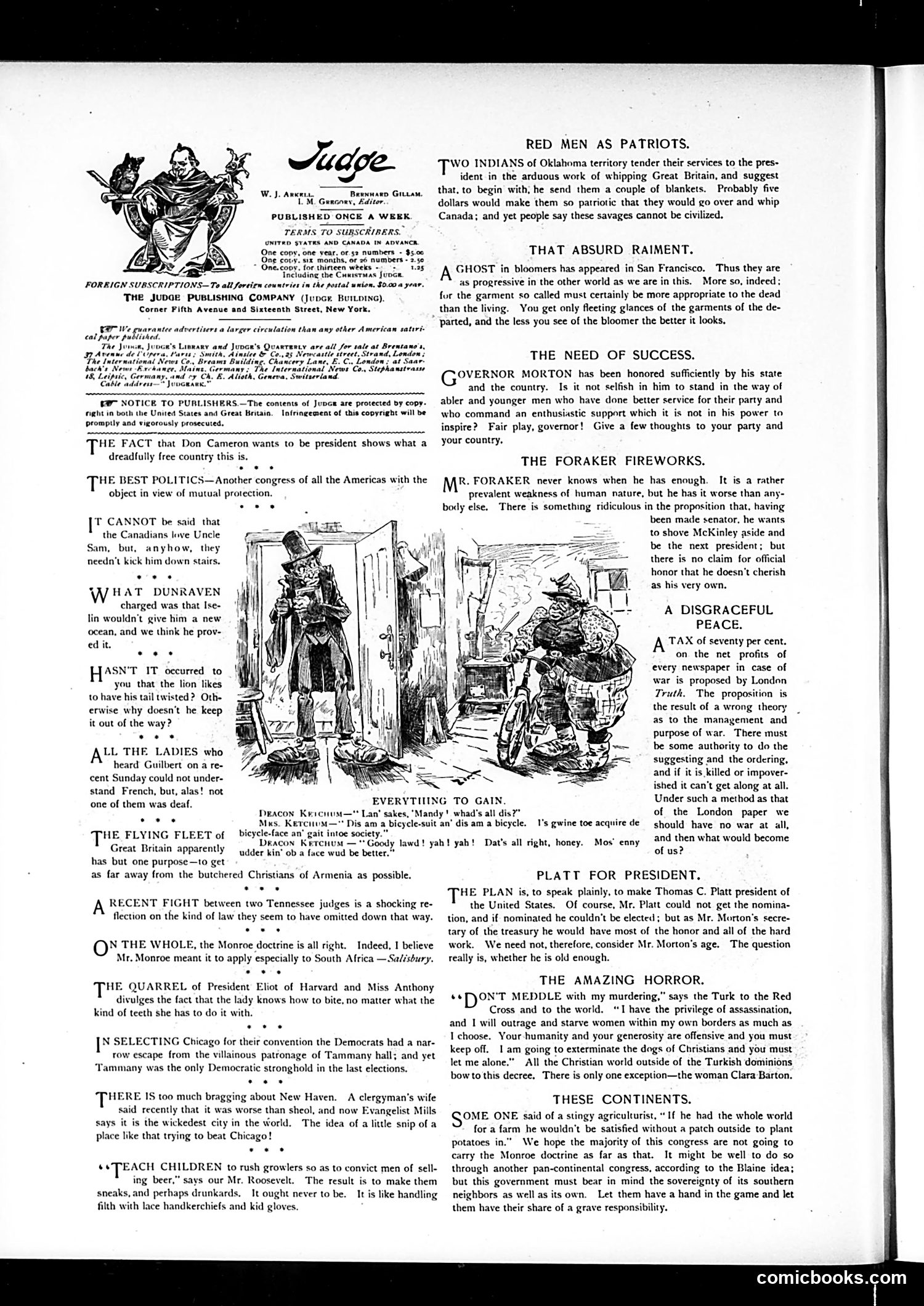
This page contains editorial commentary and one cartoon titled "Everything to Gain." The main cartoon depicts two figures in what appears to be a kitchen or domestic space, with text referencing "Dragon Kitchen" and dialogue about bicycles and acquiring things. The editorial columns discuss contemporary political matters: criticisms of various politicians (references to Governor Morton, President Eliot of Harvard, and Thomas C. Platt as a potential presidential candidate), commentary on the Monroe Doctrine's application to South Africa, and satirical jabs at political figures' ambitions and competence. The cartoon and text together mock political overreach and the endless pursuit of power and profit among public figures. Without clearer identification of the specific figures depicted in the cartoon, precise interpretation of that particular satire remains uncertain.
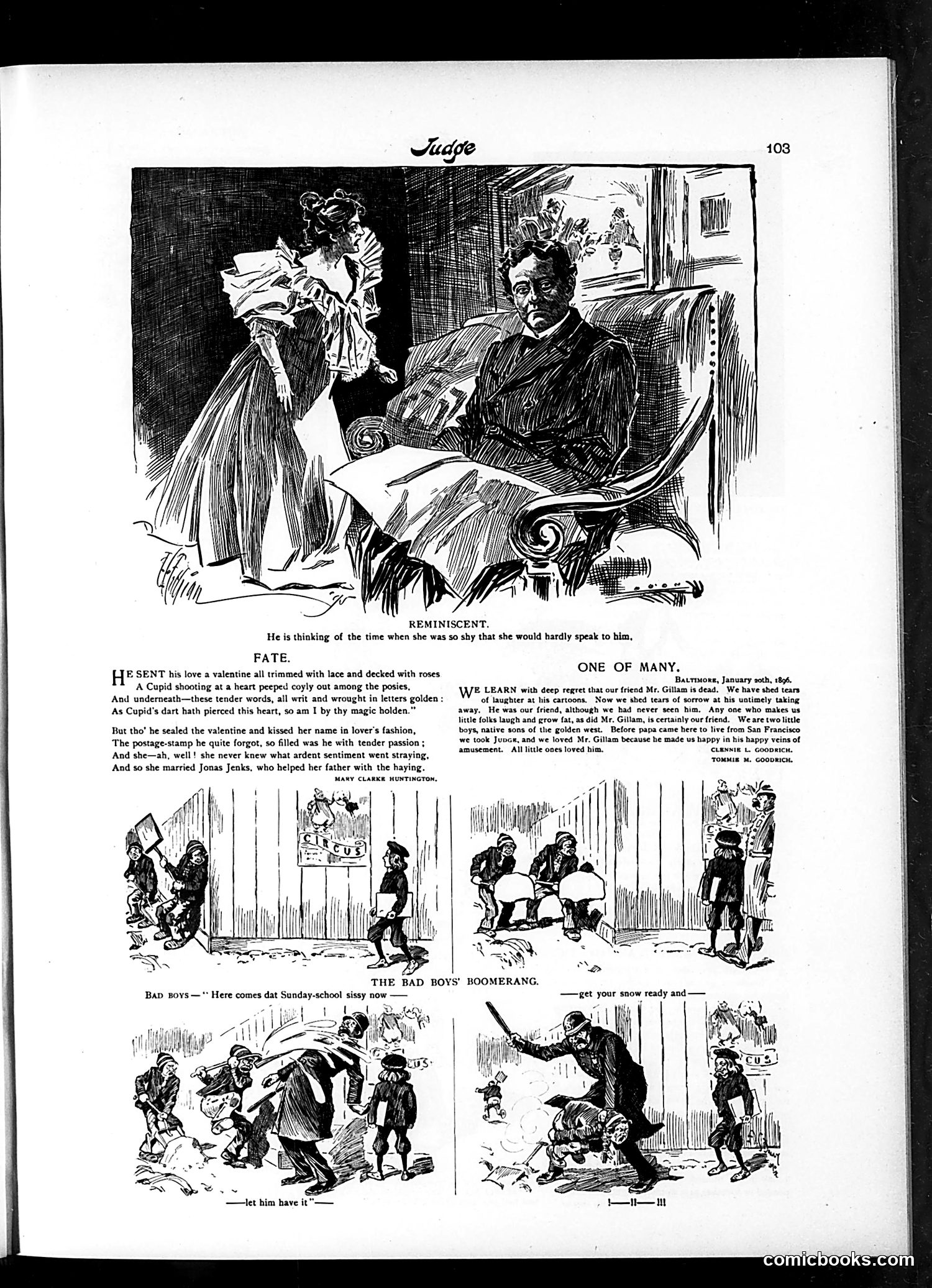
**Top Section ("Reminiscent" and "Fate"):** A man sits reading while a woman enters with flowers—a Valentine's Day scene. The poems reference romantic disappointment, with "Fate" describing a love letter sent long ago that went unreciprocated, and "One of Many" (Baltimore, January 28th) mourning the death of Mr. Gilliam, a childhood friend. **Bottom Section ("The Bad Boys' Boomerang"):** A comic strip sequence showing boys throwing snowballs at a Sunday school student passing by, then experiencing consequences when an adult (appears to be a policeman or authority figure) retaliates forcefully. The caption "let him have it" suggests the moral: bullies receive comeuppance. This reflects period attitudes about discipline and juvenile misbehavior.
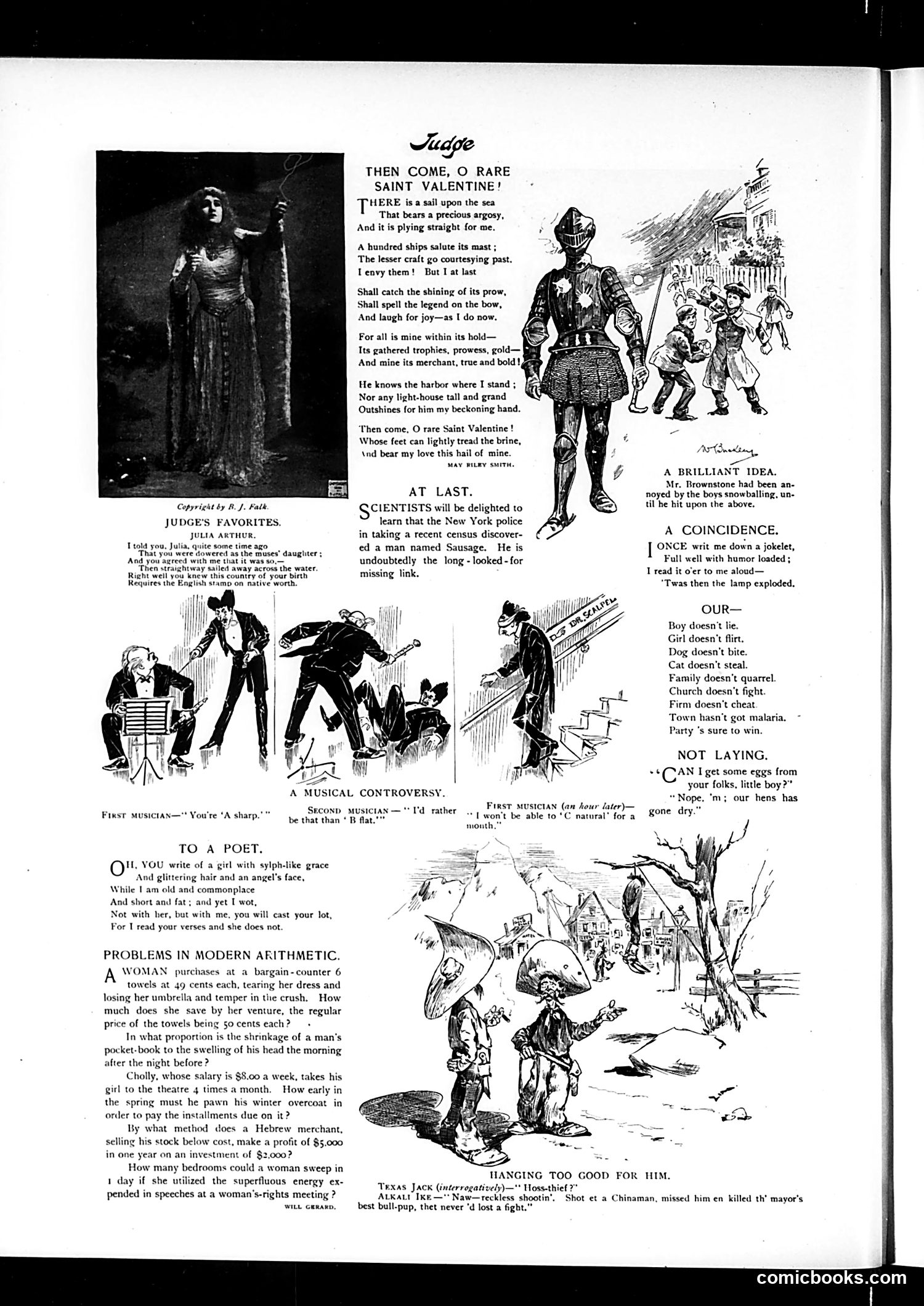
This page from **Judge** (a late 19th/early 20th-century American satirical weekly) contains multiple unrelated humor pieces typical of the era: **"Julia Arthur" poem** mocks the actress for leaving America for England, suggesting Americans need British approval to validate their talents—a jab at American cultural insecurity. **"Problems in Modern Arithmetic"** uses absurdist math problems to satirize contemporary social issues: bargain-hunting women, low wages, Hebrew merchants (invoking antisemitic stereotypes about Jewish business practices), and women's suffrage advocates—reflecting the period's skepticism toward these movements. **"Hanging Too Good for Him"** presents frontier dialect humor contrasting horse theft (serious) with reckless shooting that killed a mayor (played as trivial)—dark comedy typical of period Western humor. Other pieces include romantic verse, musical puns, and observational jokes about human nature. The cartoons feature exaggerated character types and physical comedy. The overall tone is conservative, mocking social change, women's rights, and minority groups through period-typical stereotypes.
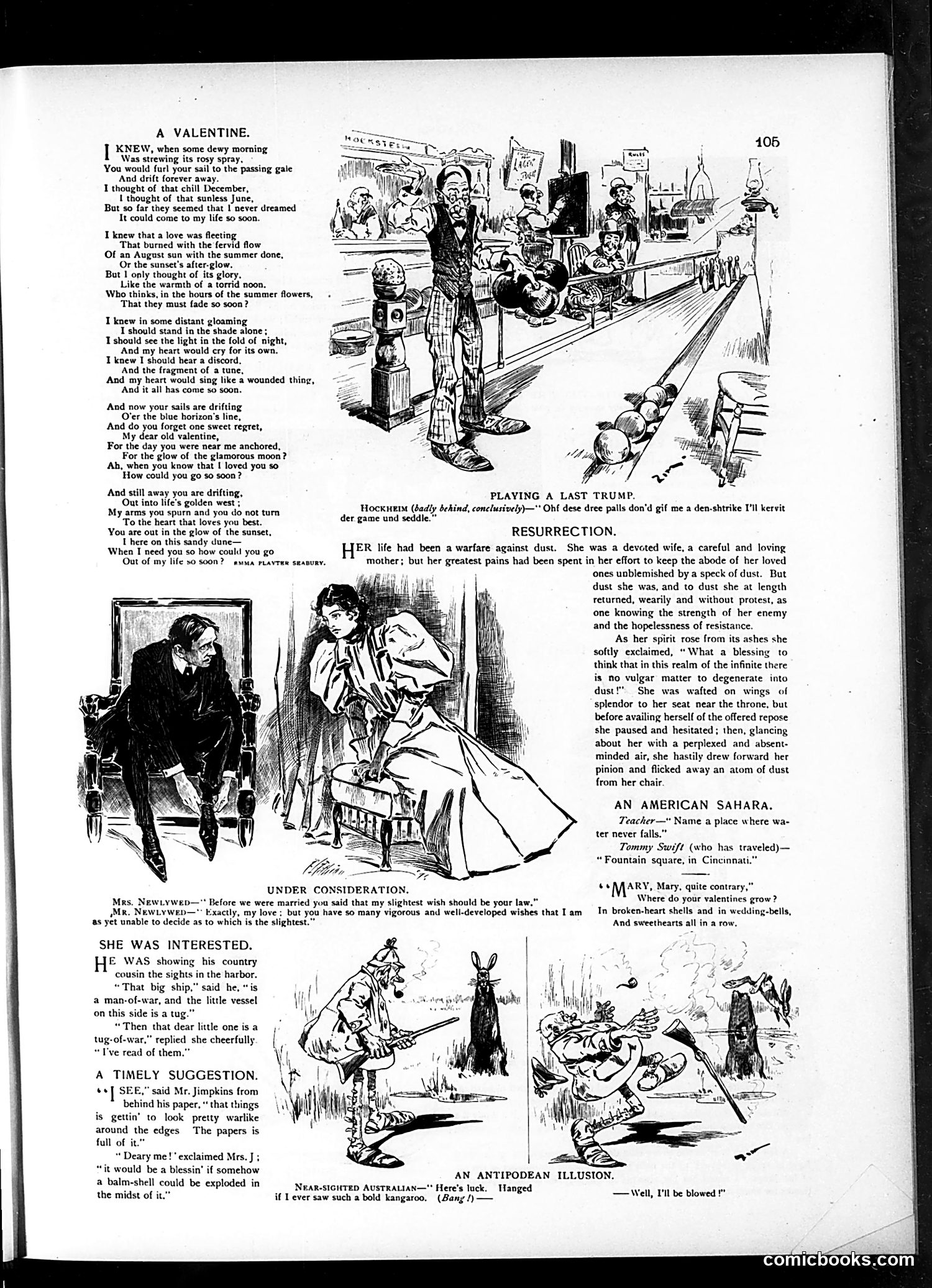
This page from Judge contains romantic and domestic humor pieces typical of early 20th-century American satire. **"A Valentine"** is a sentimental poem about lost love, accompanied by an illustration of a departing lover. **"Playing a Last Trump"** shows a Yiddish-accented card player lamenting his hand—the "den-shtrike" (ten-strike) reference is a pun on bowling terminology mixed with gambling, representing comedic ethnic humor common to the era. **"Resurrection"** is a prose vignette about a housewife obsessed with dust control who, even in the afterlife near heaven's throne, compulsively brushes dust from her chair—satirizing domestic drudgery and feminine anxiety about cleanliness. The remaining pieces are brief joke items: "Under Consideration" mocks newlywed marital dynamics; "She Was Interested" plays on a female visitor's misunderstanding of naval terminology; "A Timely Suggestion" references contemporary wartime anxiety; and "American Sahara" and "Antipodean Illusion" are localized geographic jokes. The page exemplifies Judge's mix of sentimental poetry, domestic satire, and quick humor.
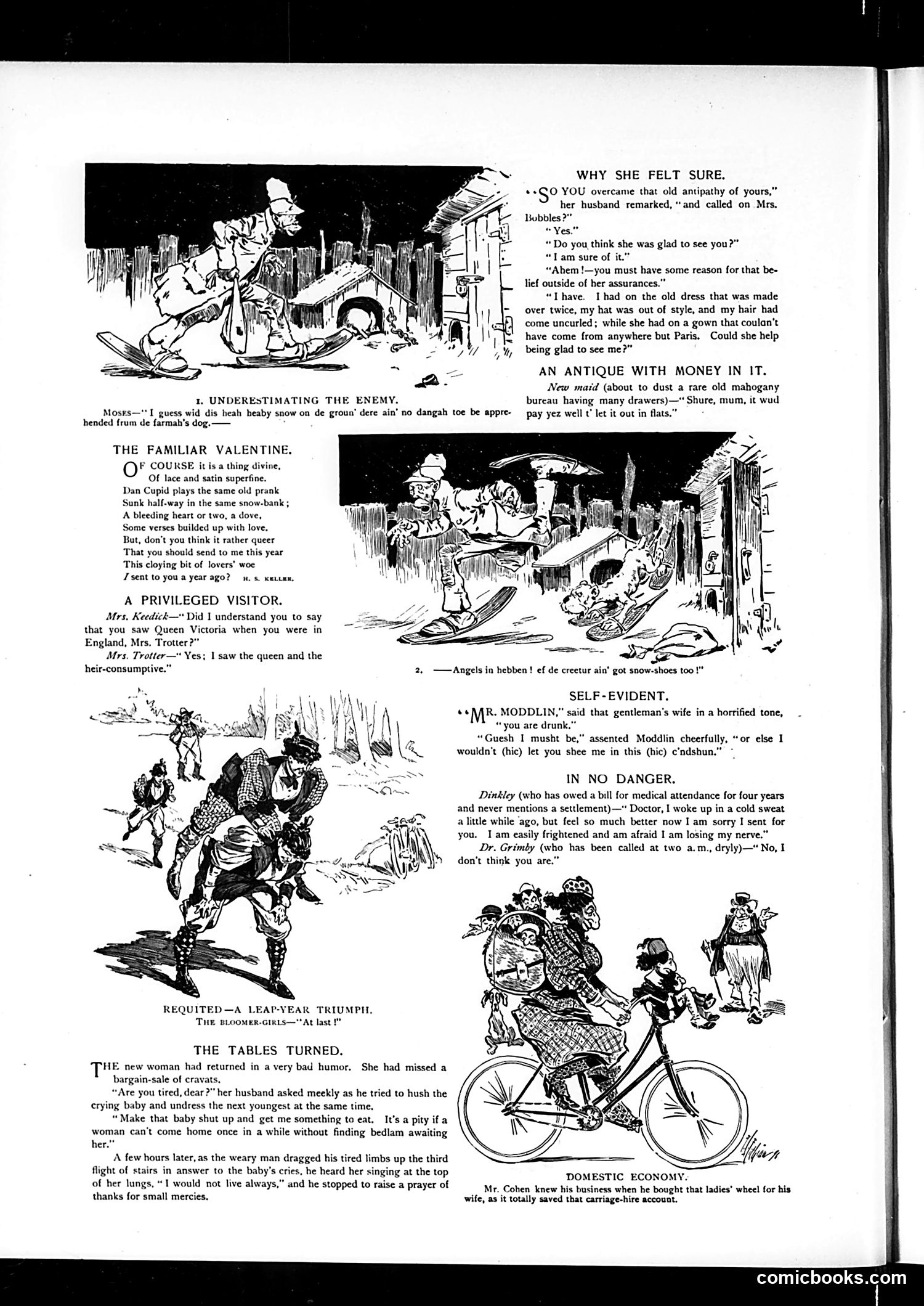
This page contains several satirical vignettes mocking social conventions and gender dynamics of the era (appears to be late 19th century): **"Why She Felt Sure"** jokes about female social competition—a woman concludes her acquaintance was genuinely happy to see her because she herself looked shabby while the hostess wore expensive Paris fashions, making the hostess feel superior. **"The Tables Turned"** satirizes the "New Woman"—a wife neglects her husband and children to attend a bargain sale, then demands service upon returning home. The joke inverts traditional gender roles, suggesting such role-reversal creates chaos. **"Domestic Economy"** depicts Mr. Cohen buying his wife a bicycle to save money on carriage hire—implying women's leisure activities have practical financial value. **"Self-Evident"** is a drunk-husband joke; a man admits his drunkenness because only intoxication would explain tolerating his wife. Other sketches mock servants' malapropisms, medical bill avoidance, and leap-year courtship customs. The humor relies on class distinctions, marital discord, and emerging tensions around women's independence.
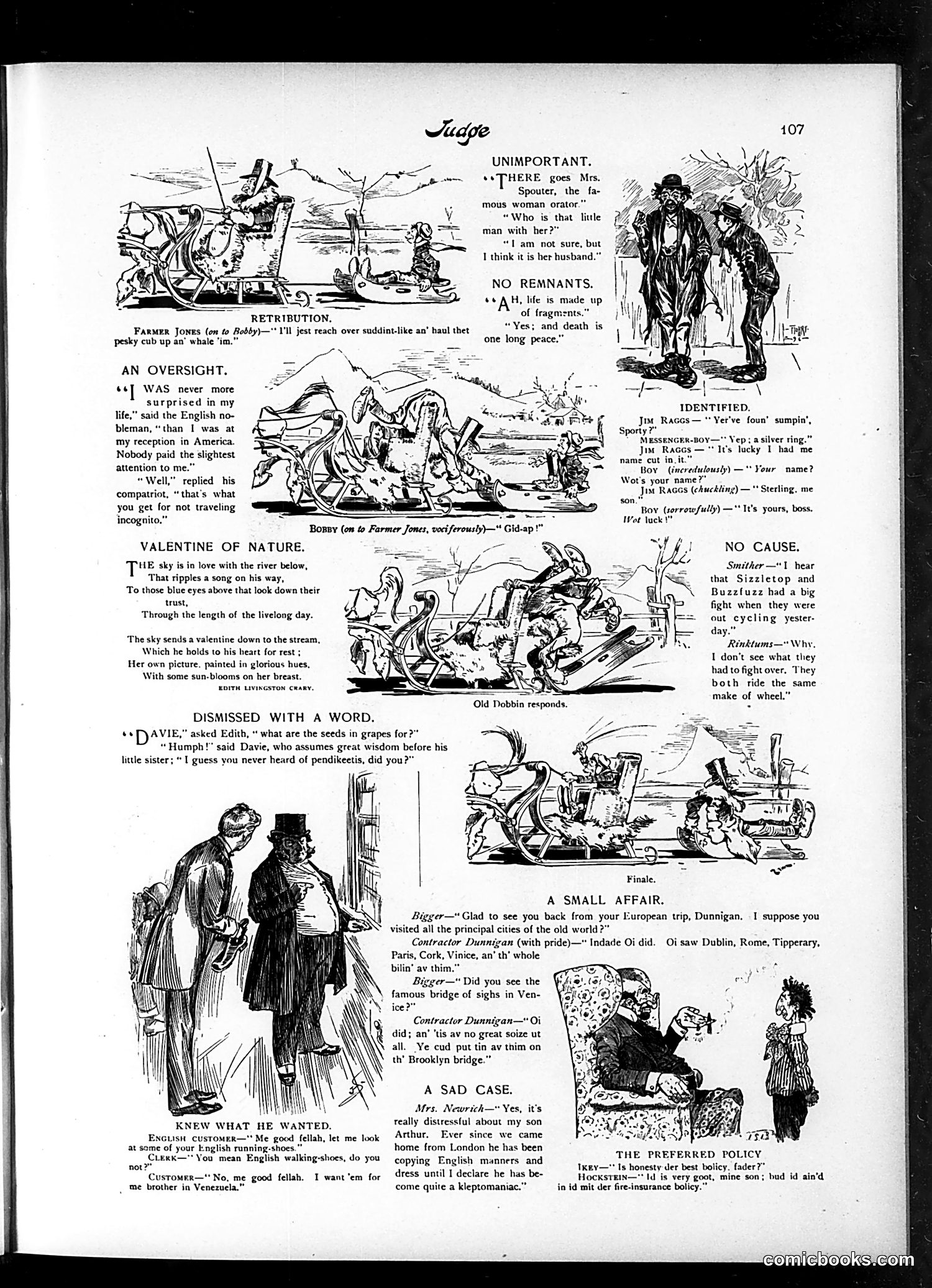
This page contains multiple short satirical pieces typical of Judge's humor: **"Unimportant"** mocks the fame of female speakers (Mrs. Spouter) by suggesting her husband is insignificant—a dig at women orators' prominence. **"An Oversight"** jokes about an English nobleman receiving no attention in America, with the punchline that traveling "incognito" (without revealing his title) would have gotten him better treatment—satire on American reverence for British aristocracy. **"Dismissed with a Word"** shows a boy confidently inventing "pendikeetis" as the purpose of grape seeds, mocking childish pseudo-intellectual bluffing. **"A Small Affair"** features "Contractor Dunnigan" (an Irish immigrant character, evidenced by dialect), bragging that New York's Brooklyn Bridge is larger than Venice's famous Bridge of Sighs—American boastfulness versus Old World culture. **"A Sad Case"** presents ironic social climbing: a wealthy family's son becomes a kleptomaniac after imitating English manners—suggesting English upper-class behavior includes thievery. The ethnic humor, class commentary, and American-versus-European themes reflect late 19th/early 20th-century Judge magazine's satirical sensibilities.
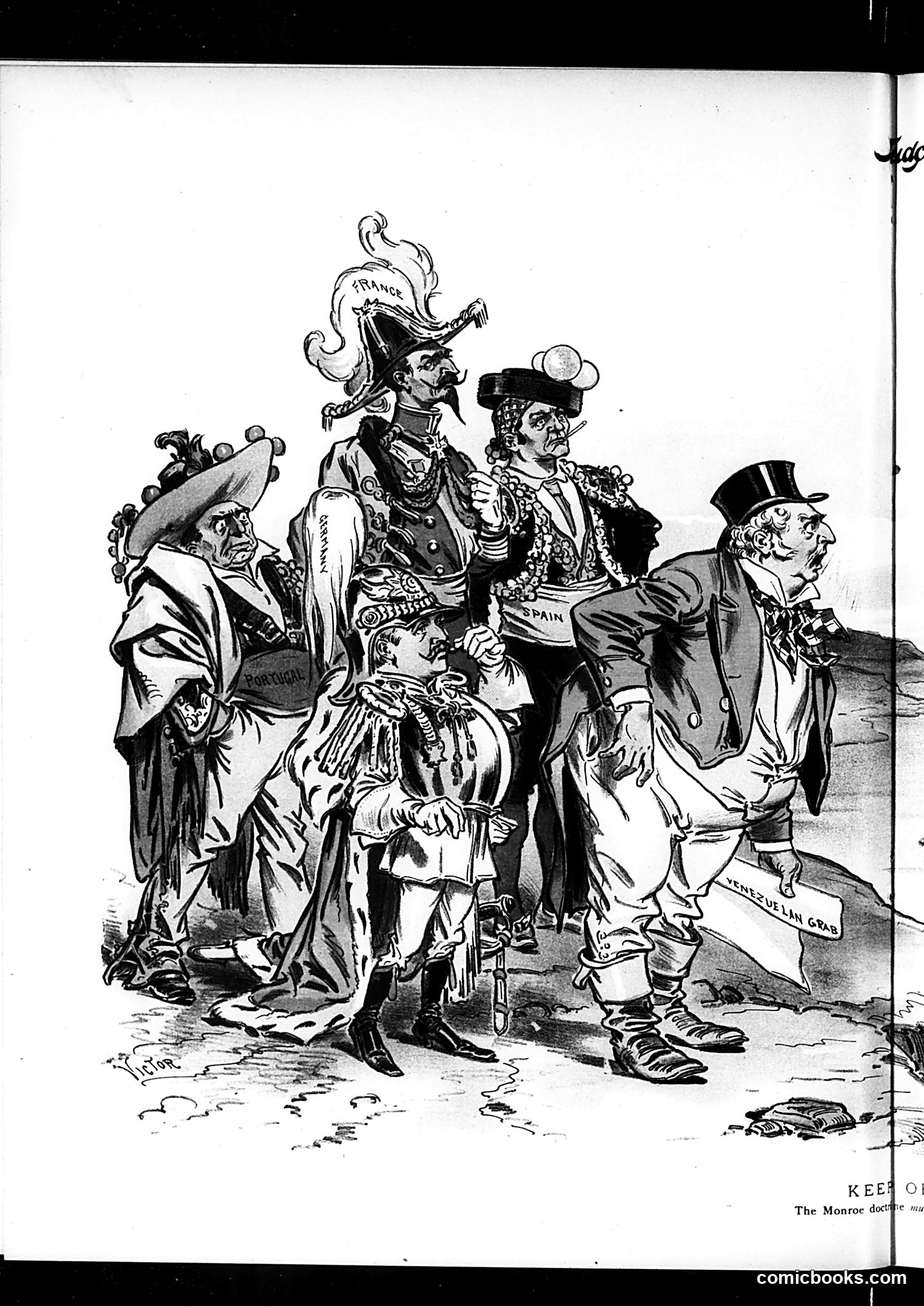
This appears to be a satirical cartoon commenting on the **Monroe Doctrine** — the 1823 U.S. foreign policy opposing European intervention in the Americas. The image shows five caricatured figures representing different nations. Labels visible include "FRANCE," "SPAIN," "PORTUGAL," and "PAIN" (possibly representing Spain again or a pun on "pain"). A figure on the right labeled "VENTE ET UN GRAD" (unclear reference) wears a top hat, likely representing an American or British figure. The cartoon satirizes international relationships and competing claims in the Americas, showing these European powers crowded together, suggesting tension over territorial or political influence. The Monroe Doctrine's assertion of American dominance in hemispheric affairs is the underlying political reference, though the exact historical moment requires additional context to pinpoint precisely.
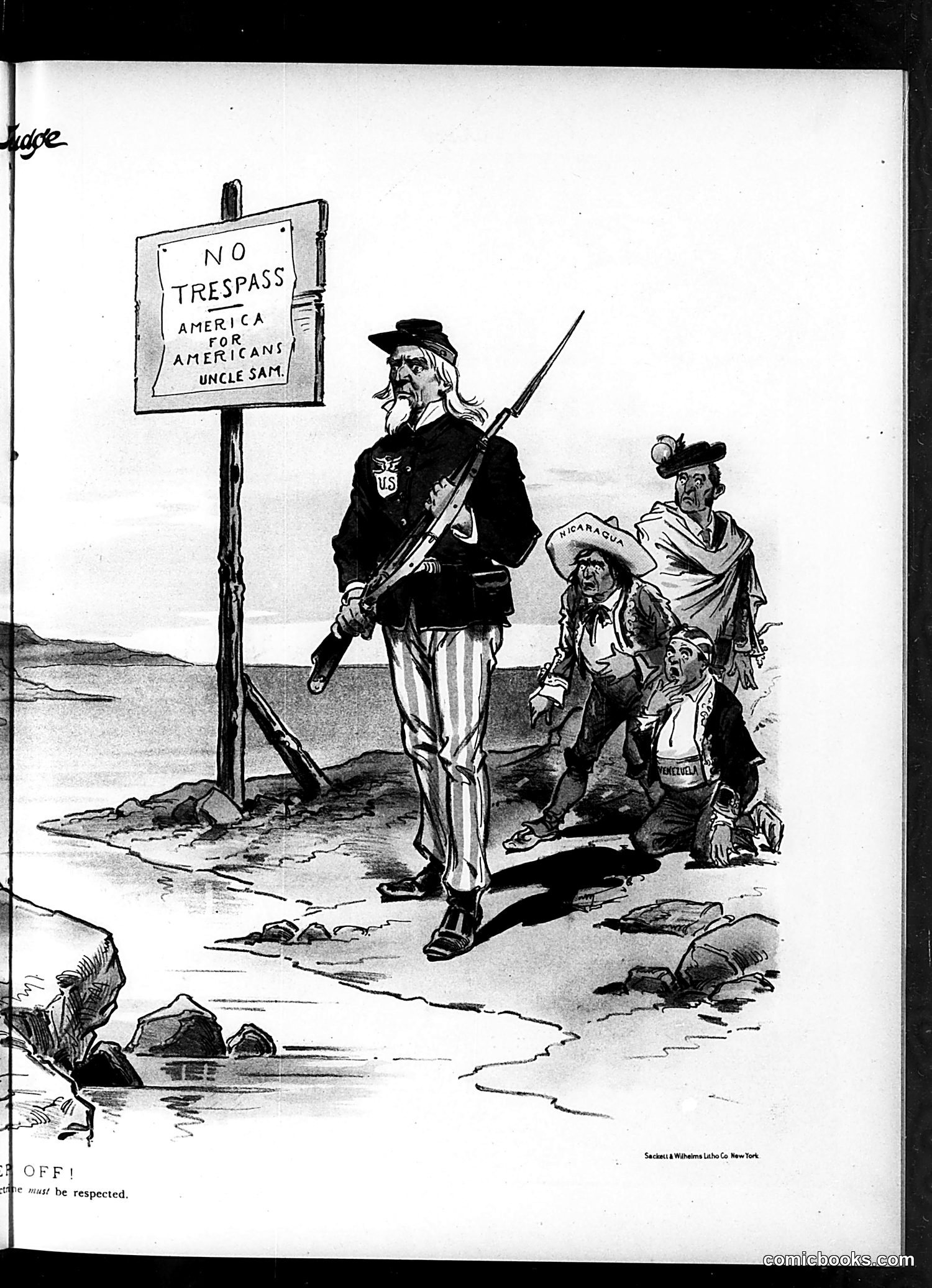
This Judge magazine cartoon depicts Uncle Sam as a stern sentinel guarding American territory with a rifle, posting a "No Trespass" sign. Three figures labeled "Nicaragua," "Venezuela," and what appears to be other Latin American nations approach as trespassers. The satire comments on U.S. interventionist foreign policy in Latin America, suggesting America was aggressively defending its sphere of influence in the region—treating Central and South American nations as forbidden territory under American control rather than sovereign nations. The cartoon critiques American imperialism, portraying Uncle Sam's protective posture as territorial domination. The gun and warning sign mock the notion that the U.S. had the right to exclude other powers from—or control activity in—neighboring American republics, likely referencing debates over American military interventions in Central America during the early 20th century.
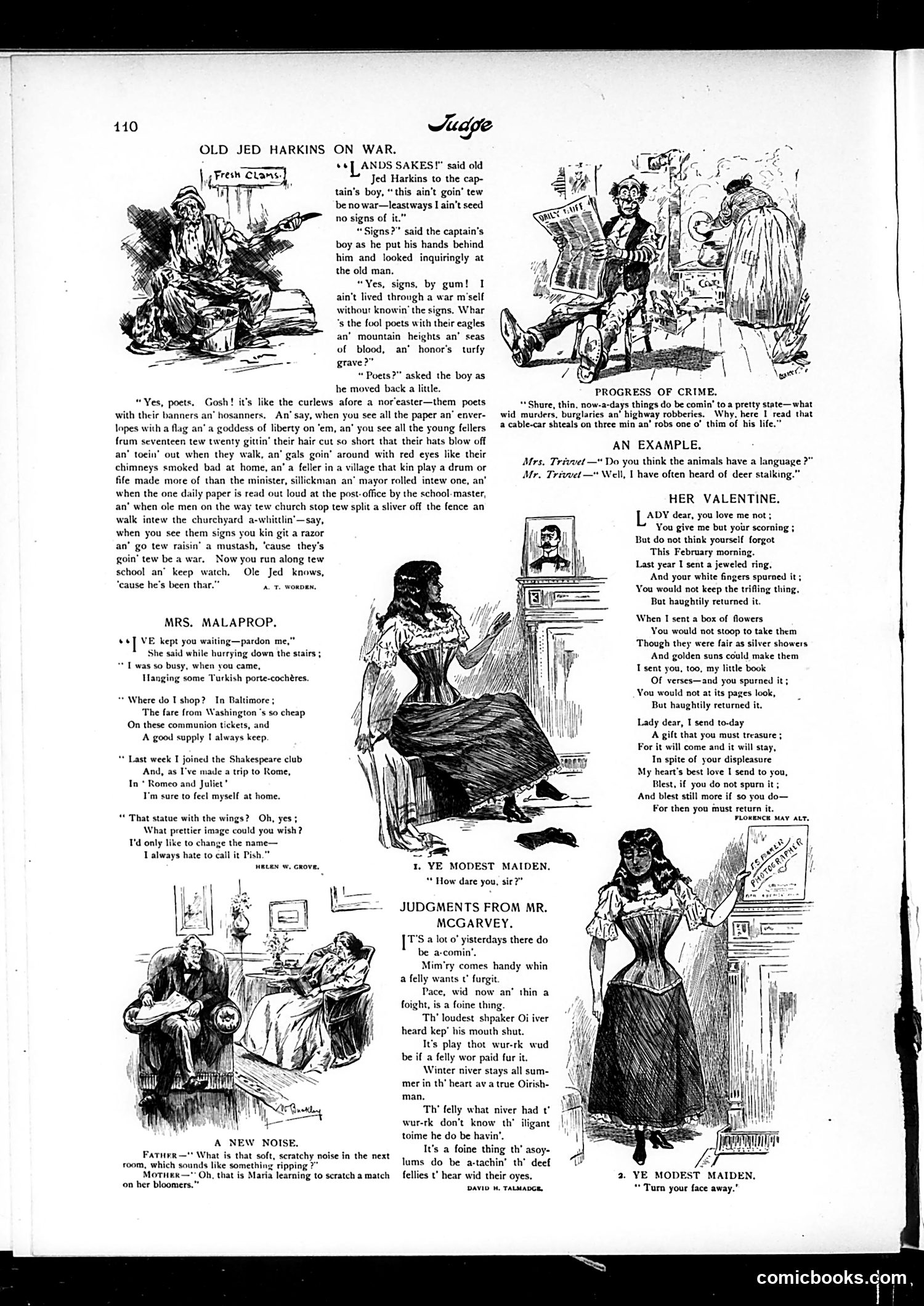
This satirical piece mocks American war enthusiasm through an elderly man's folk wisdom. Jed Harkins, a grizzled veteran, tells a ship's captain's boy that he sees no signs of impending war—specifically, he's missing the theatrical indicators: patriotic poets, eager young men getting military haircuts, emotional women, and community excitement that precede actual conflict. The satire targets American society's romanticization of war. Harkins catalogs the superficial, performative signs of war fever rather than substantive preparation: flags, goddesses of liberty, young men strutting about, and villages obsessing over military news at the post office. His cynical conclusion suggests that Americans mistake patriotic pageantry and emotional display for genuine readiness. The humor derives from Harkins' plain-spoken, rural vernacular contrasting with the elaborate machinery of war propaganda that mobilizes public opinion.
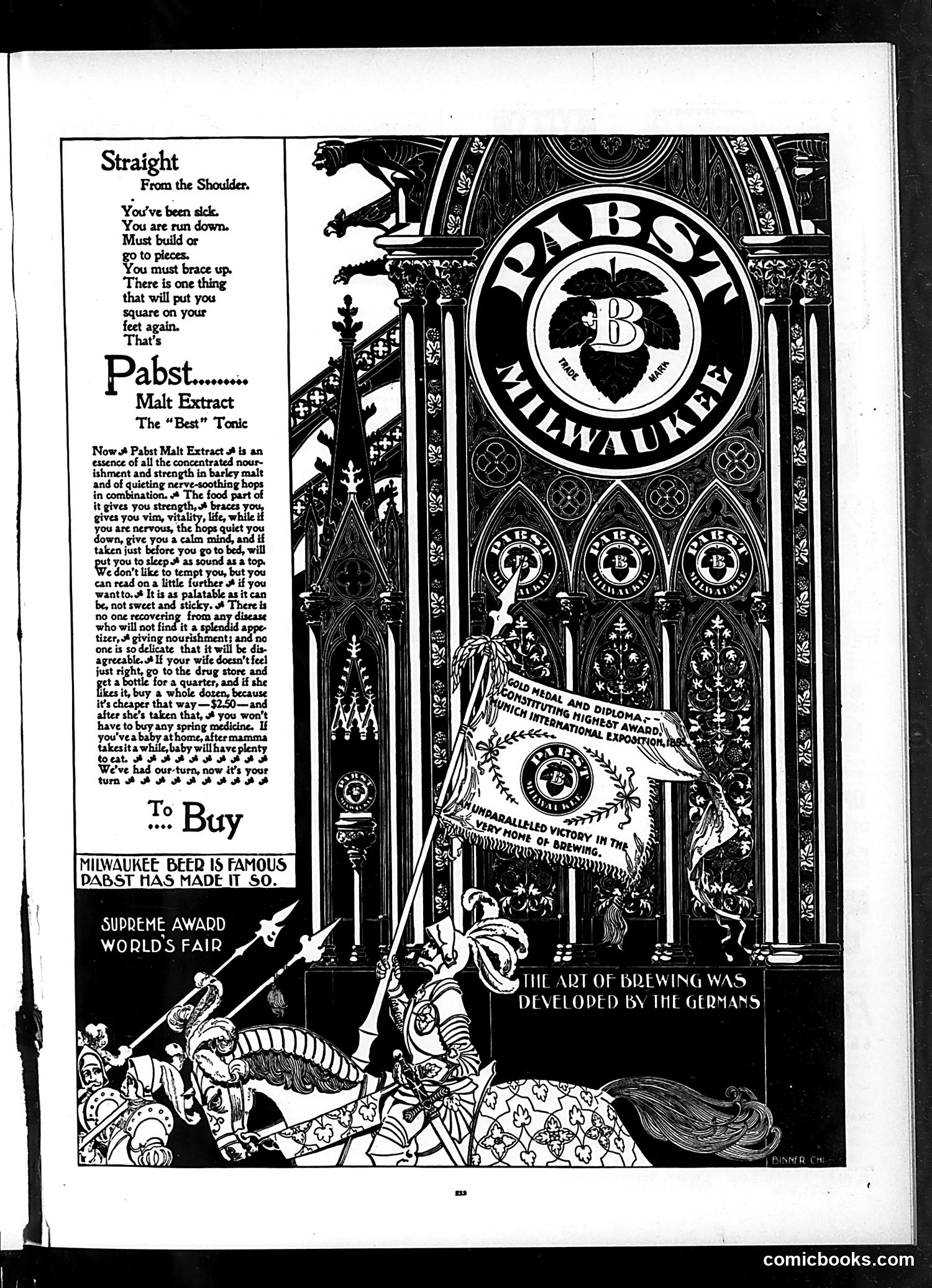
This page is primarily a **vintage advertisement** for Pabst Malt Extract, not political satire. The elaborate decorative border features German architectural and cultural imagery—reflecting the product's German brewing heritage, as stated at the bottom: "The Art of Brewing Was Developed by the Germans." The left column contains marketing copy claiming the tonic provides strength, vitality, and health benefits—typical of early 20th-century patent medicine advertising. The ornate right-side illustration shows the Pabst Milwaukee beer label within an elaborate Gothic cathedral-like frame, emphasizing quality and tradition. The small notation of a "Supreme Award" at the World's Fair references competitive recognition, a common advertising claim of the era. This reflects the pre-FDA era when such products made broad health claims without regulation. The German emphasis would become problematic after WWI, but here it's presented as a mark of authenticity and superior brewing knowledge.
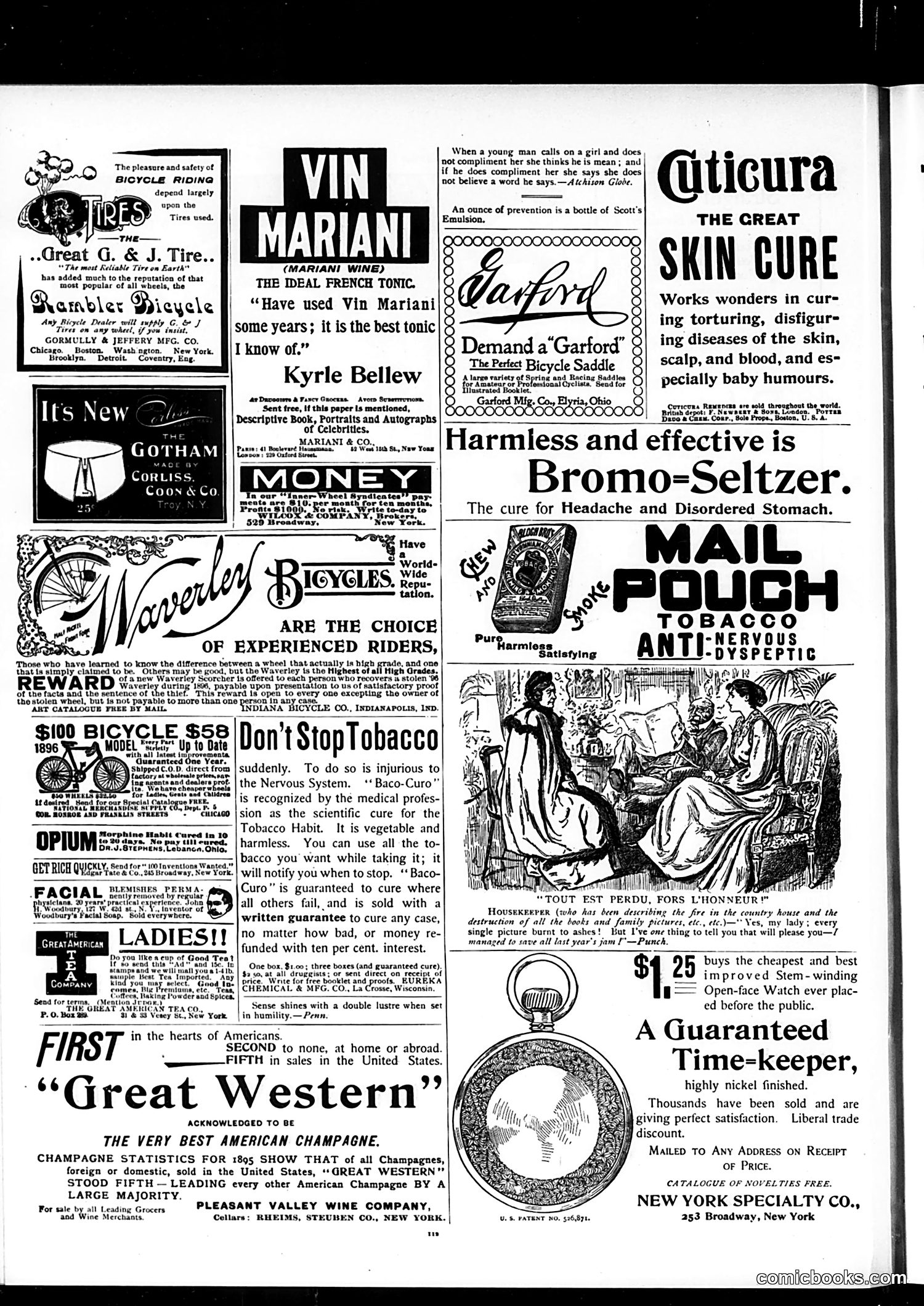
This is predominantly a page of **advertisements** from Judge magazine, with minimal editorial content or political satire. The few notable elements: **The Brief Joke**: A small text box contains a mild observation about courtship etiquette—a young man cannot win: if he compliments a girl, she thinks he's insincere; if he doesn't, she thinks he's mean. This is gentle social commentary on gender relations, not political satire. **The Advertisements**: The page is dominated by product endorsements typical of the era—bicycles (Rambler, Waverley, Diana), patent medicines (Vin Mariani wine tonic, Bromo-Seltzer, Baco-Curo tobacco cessation), skin remedies (Cuticura), and champagne. Many feature celebrity testimonials or pseudo-medical claims now considered fraudulent. **Historical Context**: These ads reveal turn-of-the-century consumer culture and the widespread marketing of ineffective or harmful "cures"—before FDA regulation. The prominence of tobacco cessation ads suggests growing concern about the habit. There is no identifiable political cartoon on this page.
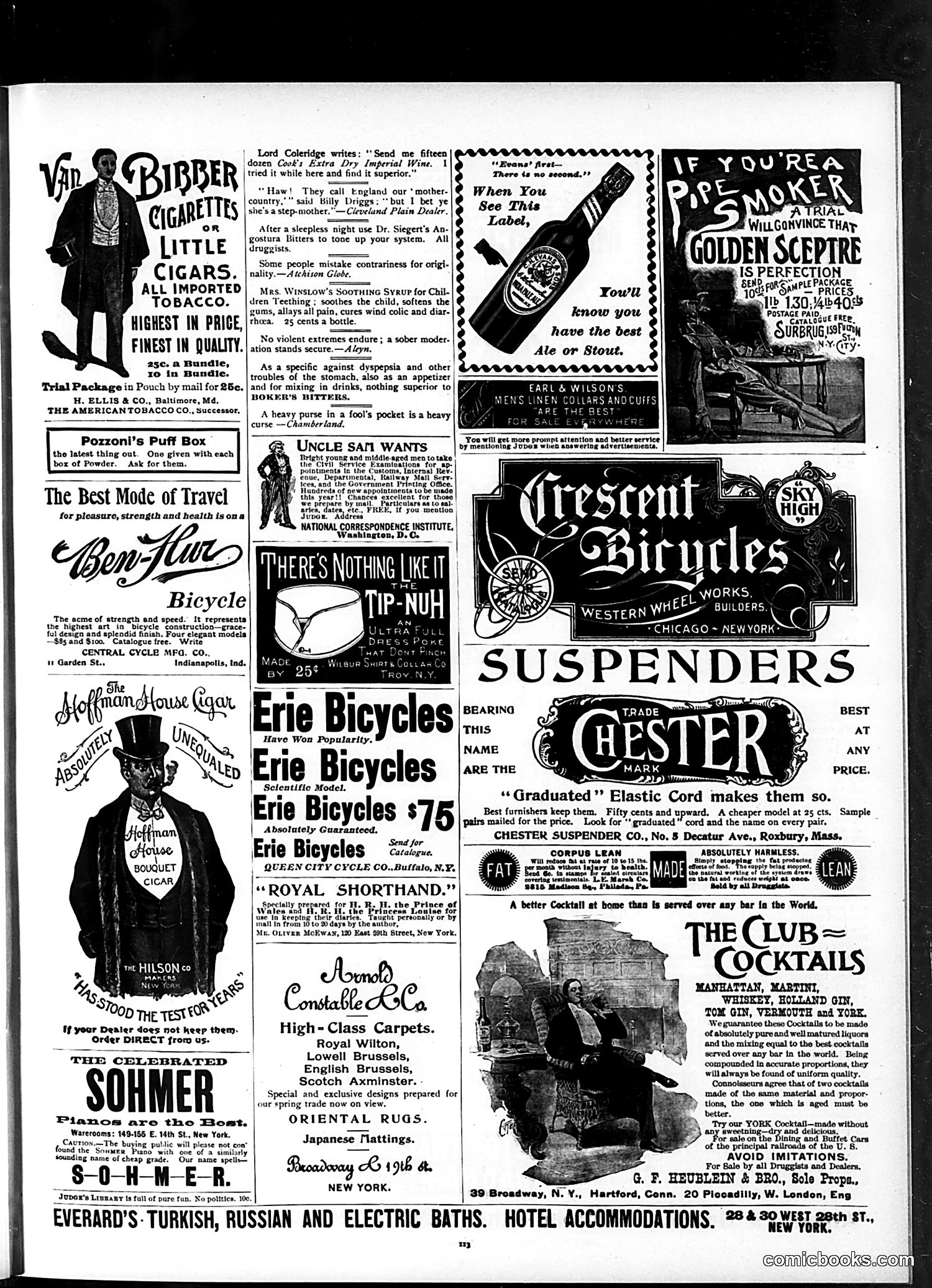
This is primarily an **advertising page**, not a satirical cartoon page. Judge magazine mixed editorial content with paid advertisements. The few editorial elements present are minor: - **Brief quoted jokes** scattered among ads (e.g., Lord Coleridge's comment about England as "mother country," Billy Driggs's response) — these are typical period humor about Anglo-American relations, playing on the phrase that England was America's "mother country." - **"Uncle Sam Wants"** section — appears to advertise government civil service positions, using the iconic Uncle Sam figure. The page is dominated by **late-19th/early-20th century product advertisements**: bicycles (Erie, Ben-Hur, Crescent brands), cigars, suspenders, carpets, cocktail ingredients, and medicinal products (Angostura Bitters, soothing syrups). **No significant political satire is present.** The page represents Judge's business model: wrapping light humor and small jokes around lucrative advertising to subsidize the magazine's publication.
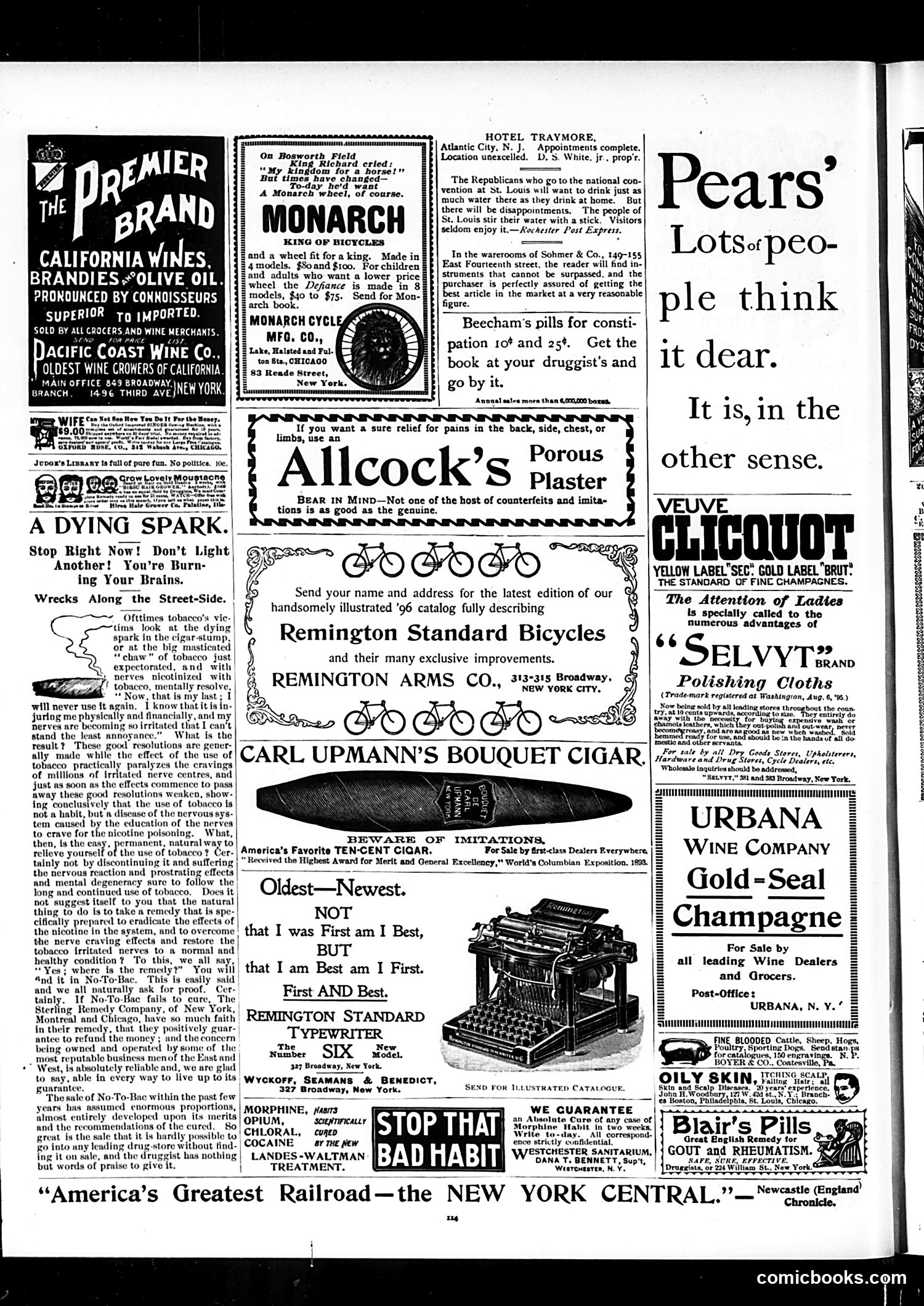
This page is primarily **advertising**, not political satire. It contains no coherent political cartoon or satirical content by Judge's standards. The one substantive editorial piece is "A Dying Spark," a lengthy anti-tobacco screed arguing that smoking is a disease of the nervous system requiring medical treatment—not merely a habit to quit through willpower. The "dying spark" metaphor refers to smokers' failed resolutions as they watch their cigarettes burn down. The rest of the page consists entirely of commercial advertisements: wines, bicycles (Remington, Monarch), cigars (Carl Upmann's, Remington Standard typewriters), patent medicines (Allcock's Porous Plaster, Beecham's Pills, Selvyt polishing cloths), and champagne. There are no identifiable political figures, caricatures, or social commentary requiring historical context. This appears to be a filler or revenue-generation page typical of late-19th-century magazine publishing.
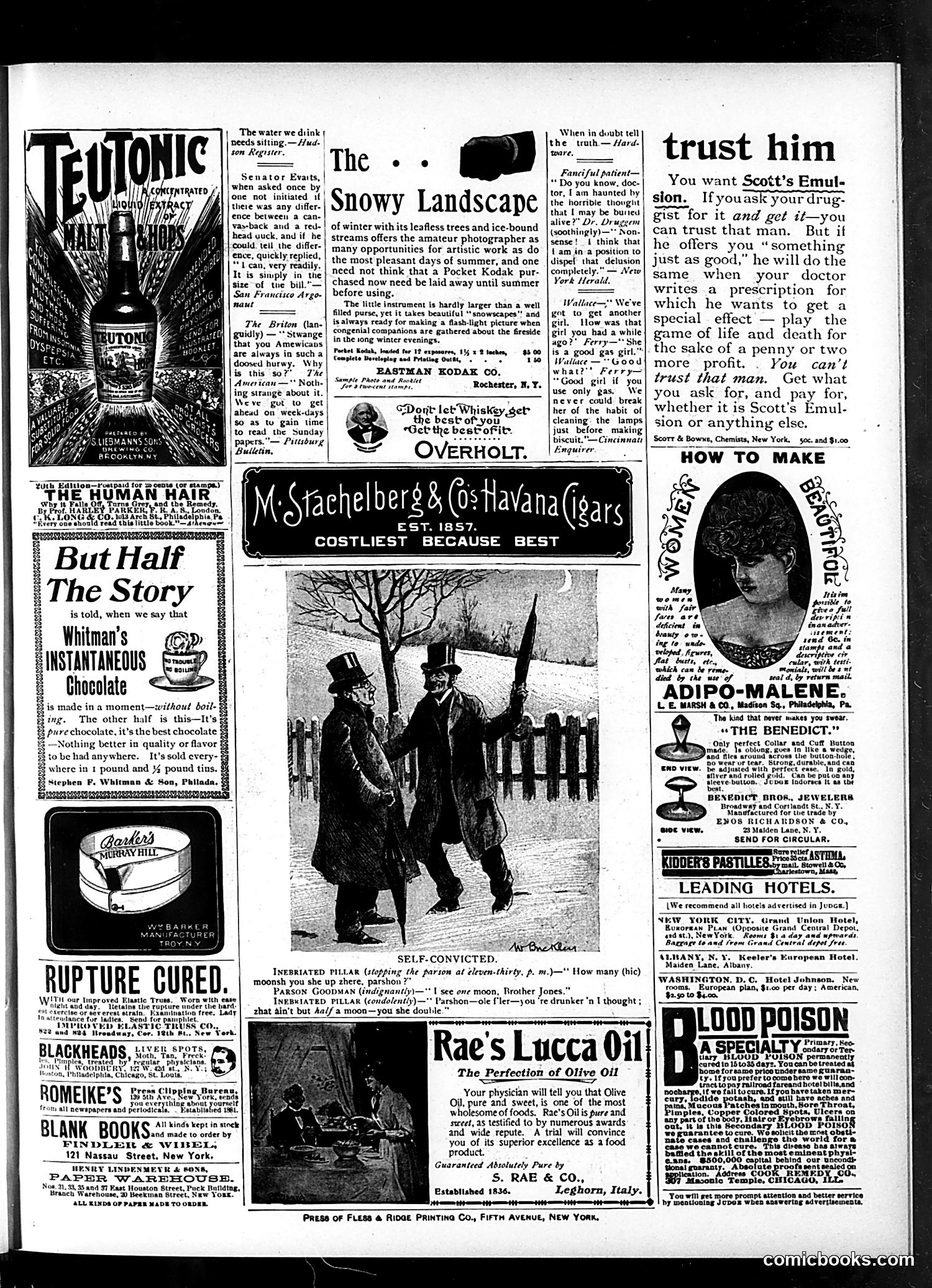
This page primarily contains **advertisements** rather than political cartoons, though it includes humorous vignettes typical of Judge magazine's satirical style. **"The Snowy Landscape"** promotes Eastman Kodak cameras by suggesting winter photography offers artistic opportunities equal to summer work—a straightforward product pitch without political content. **The "trust him" section** satirizes the relationship between doctors and pharmacists: it warns readers not to accept substitute medicines when a doctor prescribes something specific, cautioning against untrustworthy druggists who offer cheaper alternatives. This reflects early-20th-century concerns about pharmaceutical fraud and adulteration. **"Self-Convicted"** is a brief comic dialogue where an intoxicated man unwittingly admits his drunkenness to a parson by repeatedly seeing "one moon" instead of two. The remaining content consists of product advertisements (chocolates, cigars, hair treatments, hotels) typical of Judge's revenue model. No major political figures or events are referenced on this page.
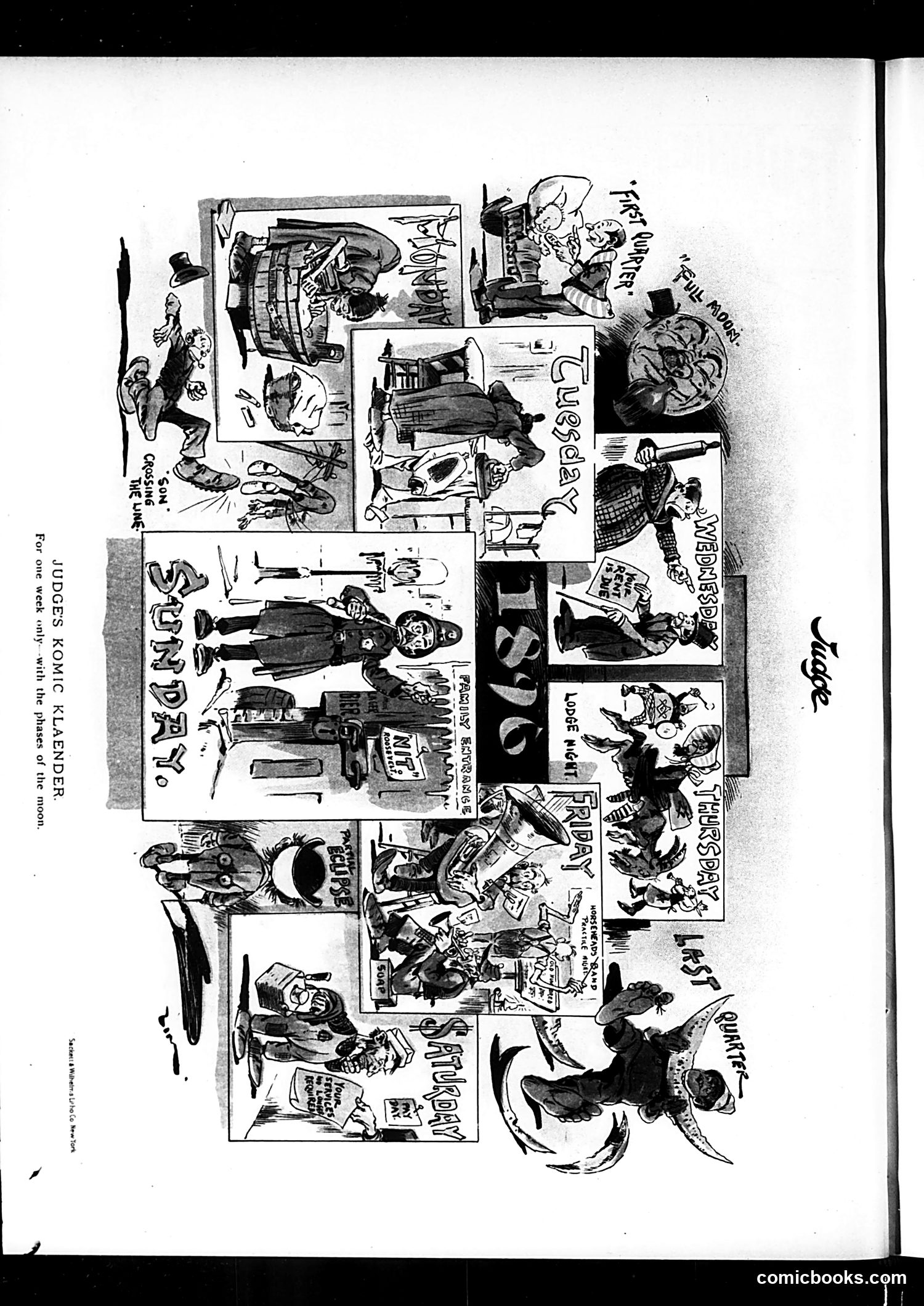
This page appears to be a comic calendar feature from *Judge* magazine showing various humorous domestic and social scenes arranged around a central figure. The layout resembles a kaleidoscope pattern, hence "Komic Klaender." The individual panels depict everyday situations—people in various states of chaos or misadventure at home, work, and social settings. While specific figures aren't clearly identifiable as famous individuals, the satire targets universal themes: marital discord, domestic mishaps, workplace folly, and social pretension. The subtitle references "phases of the moon," suggesting the cartoons mock superstitious beliefs about lunar influence on human behavior—a common satirical target in the era. The overall joke appears to be that life's absurdities follow predictable, cyclical patterns, much like moon phases, implying human foolishness is inevitable and recurring.