
A complete issue · 16 pages · 1896
Judge — February 8, 1896
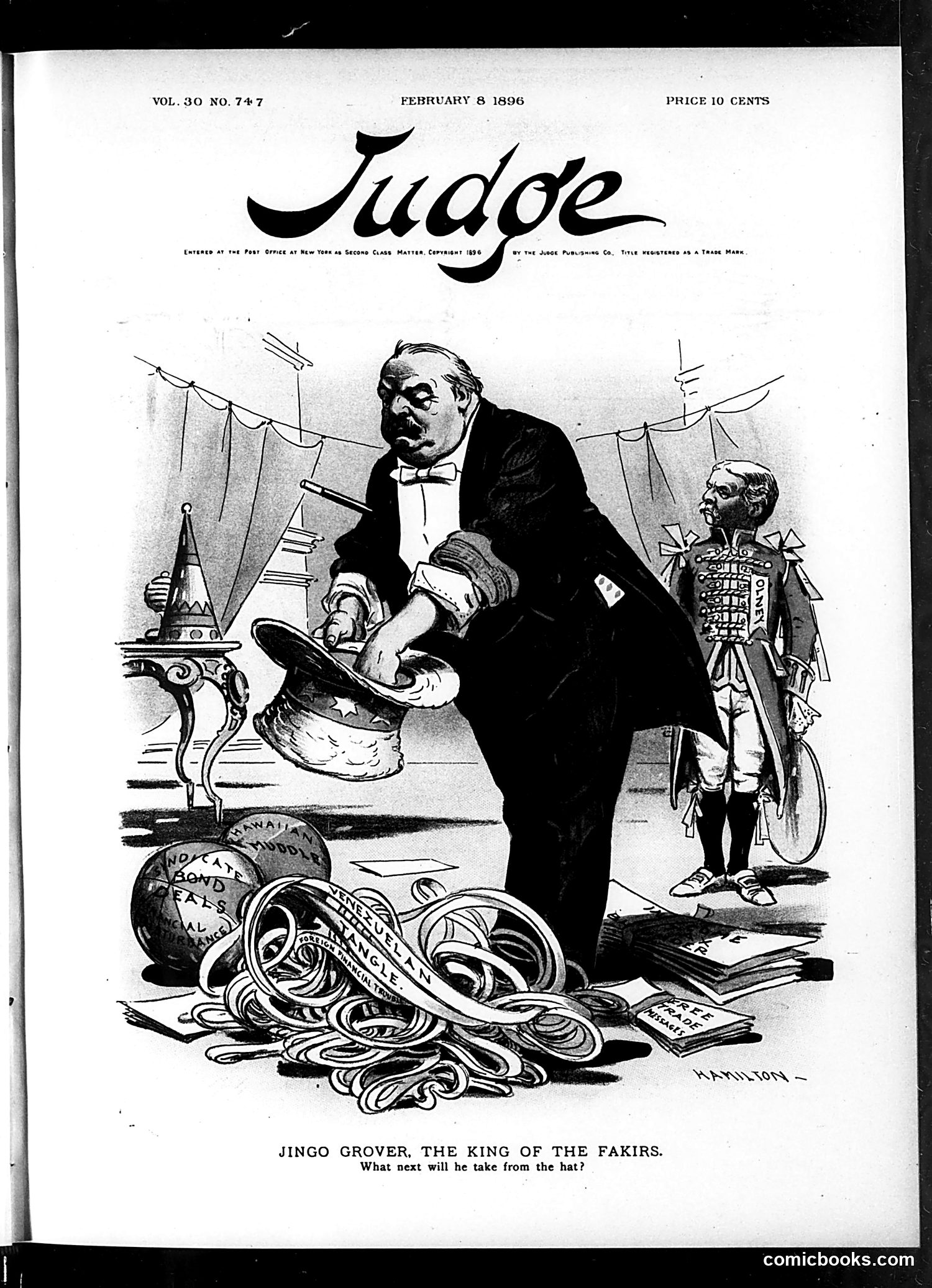
This February 1896 *Judge* cartoon satirizes President Grover Cleveland as "Jingo Grover," a magician producing endless strings of ribbons from a hat. The title's wordplay suggests Cleveland is a "faker"—a charlatan. The tangled ribbons likely represent diplomatic entanglements or fraudulent policies. A military figure (right) observes skeptically while various items at left (appearing to reference bonds and financial instruments) suggest economic schemes. The satire criticizes Cleveland's foreign policy as theatrical deception, particularly his aggressive stance (hence "jingo") combined with what critics saw as economic mismanagement. The hat trick metaphor implies Cleveland is pulling solutions from nothing—all illusion rather than substance—during the economic turmoil of the 1890s depression.
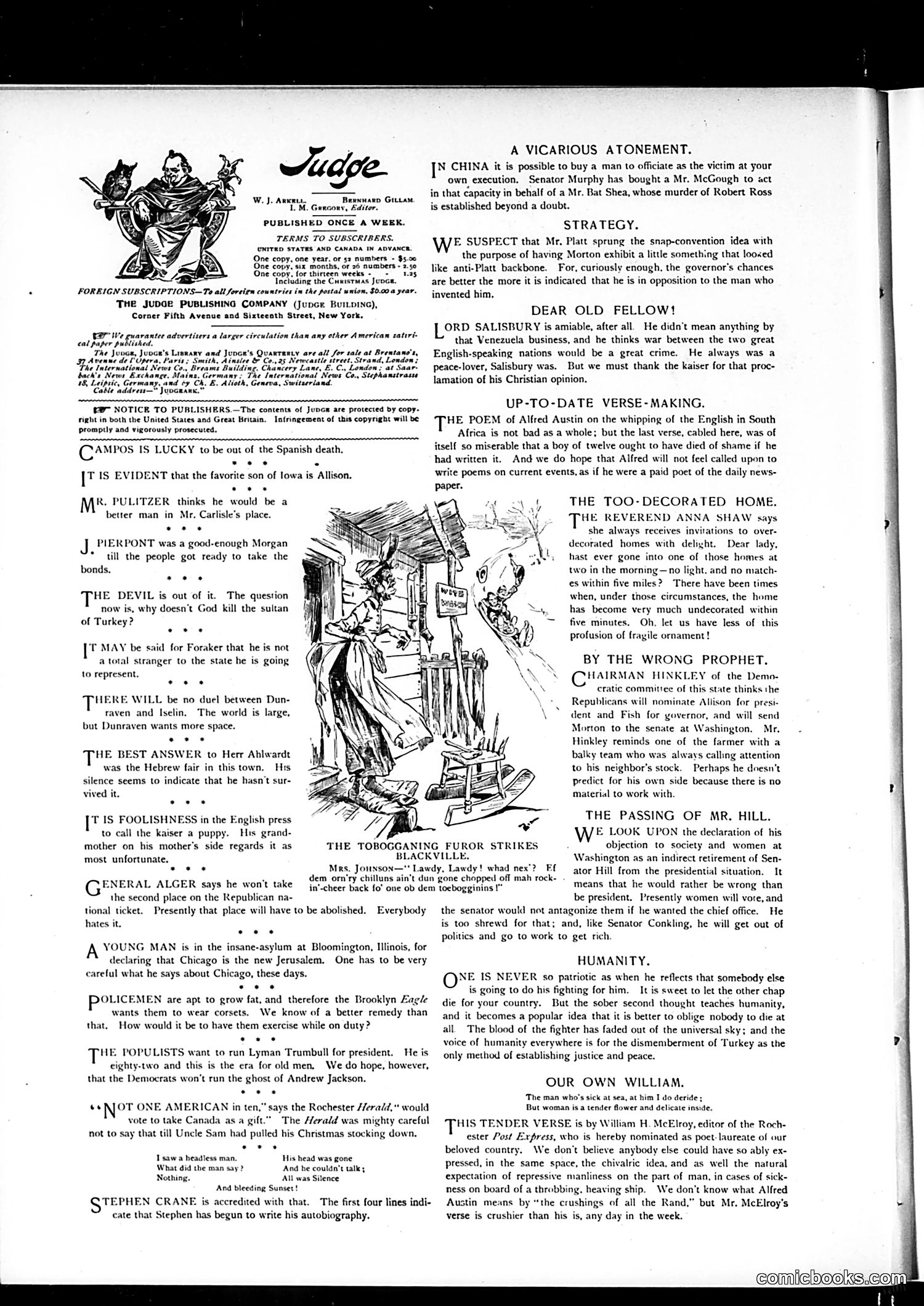
The central cartoon depicts "THE TOBOGGANING FUROR STRIKES BLACKVILLE," showing what appears to be a chaotic domestic scene with furniture and decorative items scattered about. The caption suggests someone has crashed through a home while tobogganing, destroying the interior. The surrounding text columns contain brief satirical comments on contemporary political and social topics, including references to: - China and Senator Murphy - Lord Salisbury - English society criticisms - Various American political figures and situations Without clearer visibility of specific figure identifications in the cartoon itself, the precise political targets remain somewhat unclear, though the overall tone mocks both social pretensions and political figures of the era. The page exemplifies Judge's characteristic format of mixing visual satire with editorial commentary.
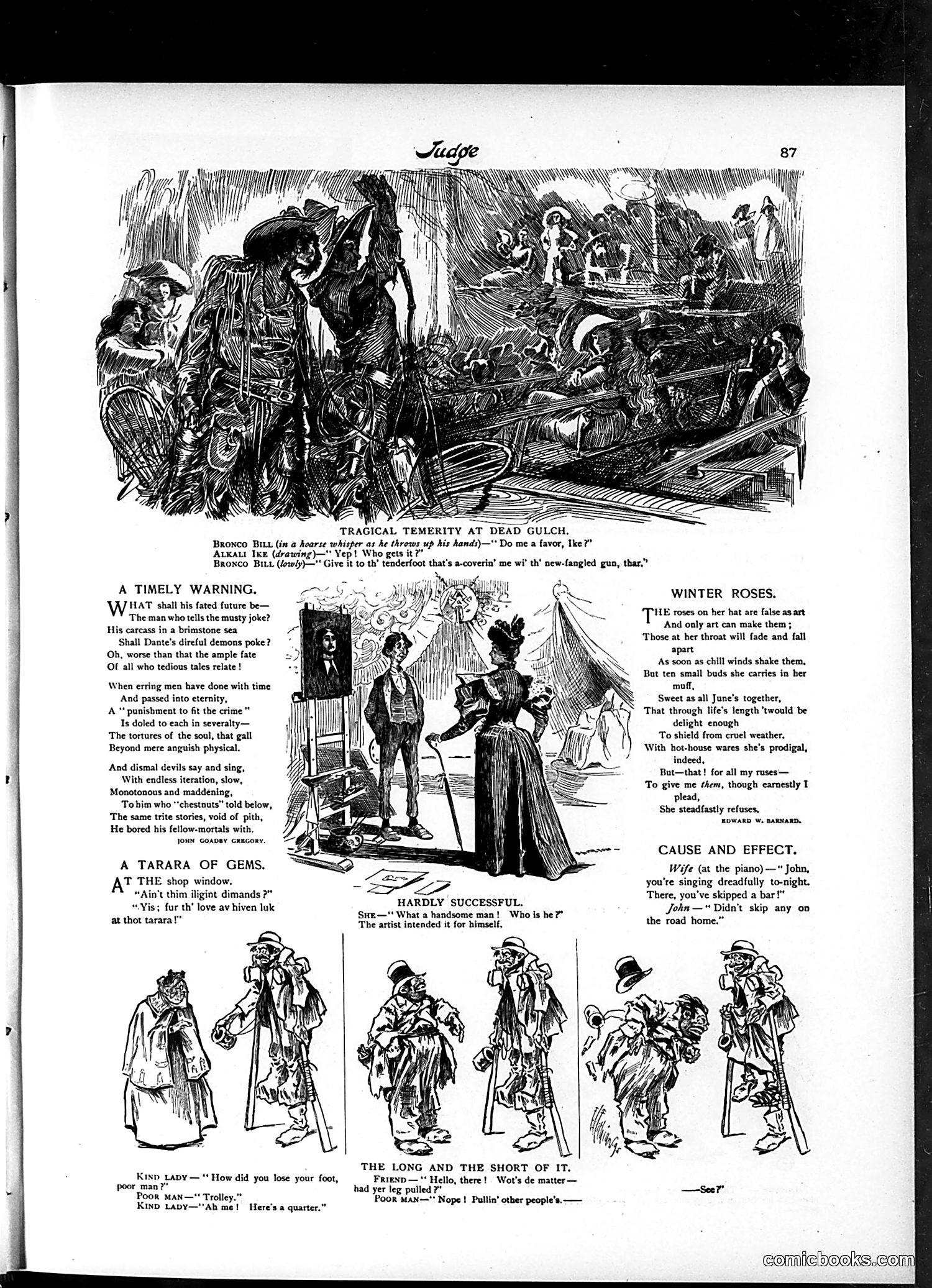
**Top Cartoon**: Depicts "Bronco Bill" at Dead Gulch, apparently a Western character. The dialogue suggests he's offering someone an inferior gun as a "favor," with crude Western dialect humor. **"A Timely Warning"**: A poem warning against crime and punishment's soul-torturing effects, referencing religious damnation. **"A Tarara of Gems"**: A brief joke about diamonds and love, likely a pun on the popular song "Tarantara." **"Hardly Successful"**: A woman rejects an artist's self-portrait, joking he painted it for himself rather than as a genuine gift. **"The Long and the Short of It"**: Comic dialogue between a poor man and woman discussing lost feet and begging, with gentle class-based humor. **"Winter Roses"** and **"Cause and Effect"**: Appear to be separate humorous poems/verses unrelated to the cartoons. The page contains typical satirical content—crude humor, social commentary, and light verse characteristic of late 19th/early 20th-century American satire magazines.
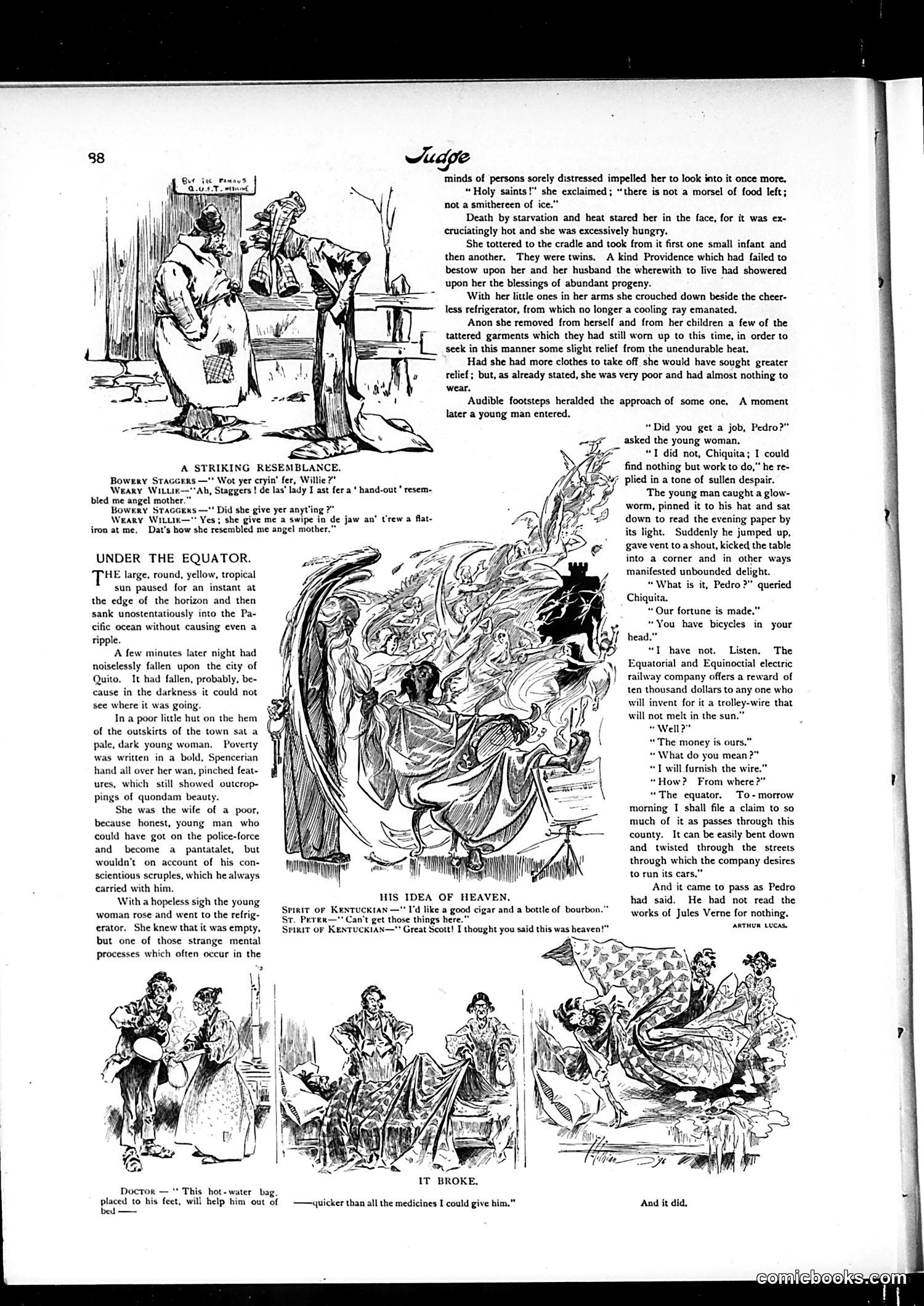
This page contains multiple satirical pieces typical of late 19th-century American humor: **"Under the Equator"** mocks economic desperation and pseudo-scientific foolishness. A poor couple in Quito, Peru—he unemployed due to refusing corrupt police work, she starving with twin infants—finds "fortune" when the husband reads that an electric railway company offers a reward for trolley-wire that won't melt in equatorial heat. His "solution": steal the equator itself and file a legal claim to it. The satire targets both the absurdity of get-rich-quick schemes and the desperation that makes people embrace them. **"A Striking Resemblance"** is a brief Bowery humor sketch: homeless men discuss a woman who gave one of them a beating ("swipe") and threw a flatron after he asked for handouts—he finds this resemblance to his mother touching. The dark joke satirizes poverty and homelessness through grotesque sentiment. **"His Idea of Heaven"** shows two spirits discussing bourbon and cigars, mocking afterlife concepts. The illustrations support these themes with exaggerated, detailed pen work characteristic of Judge's style.
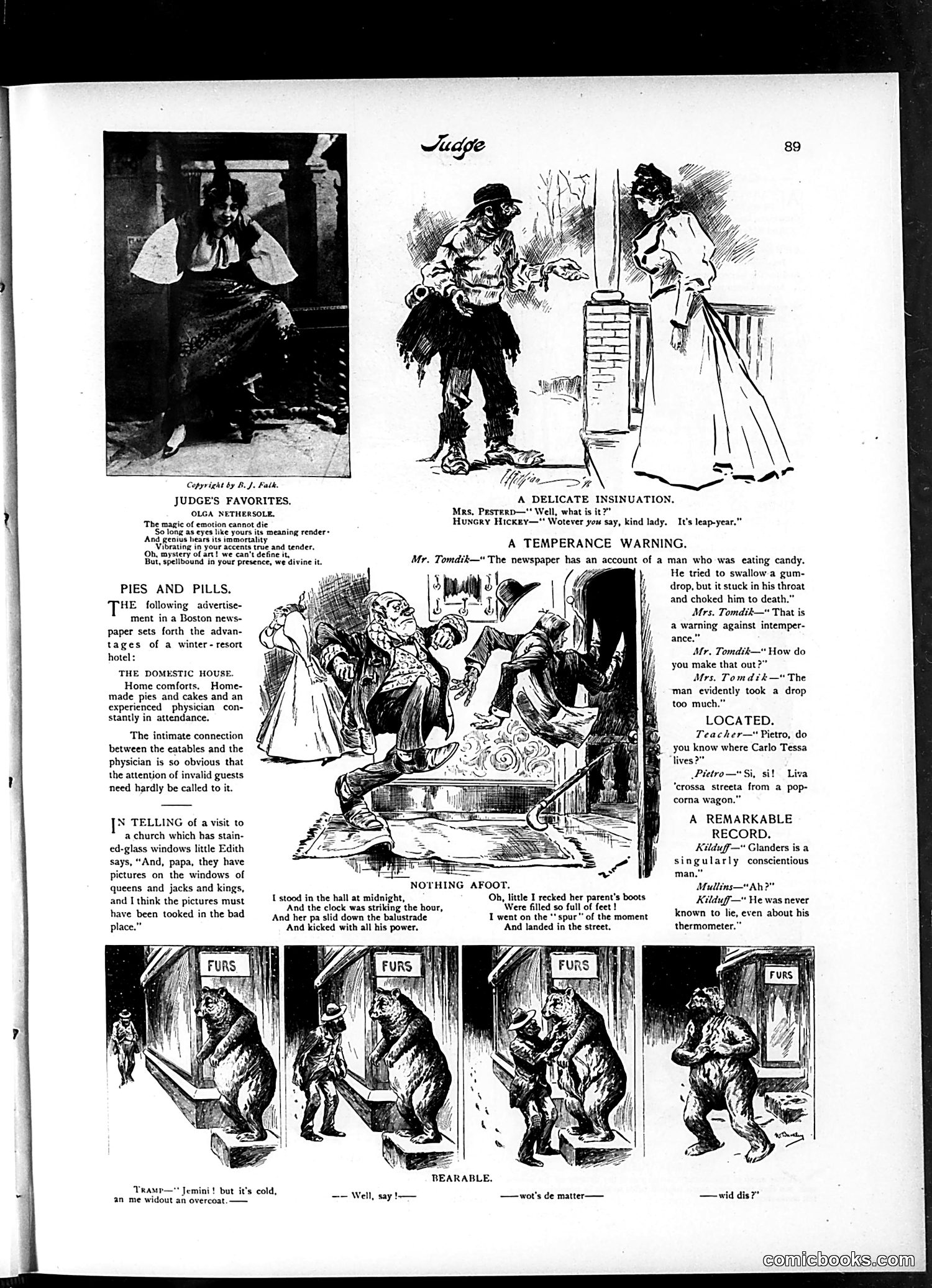
This page contains several satirical pieces typical of Judge's humor: **"Judge's Favorites"** features a tribute to Olga Nethersole, a stage actress of the era known for controversial roles. The poem romanticizes her theatrical talent. **"Pies and Pills"** satirizes a hotel advertisement that boasts of "home-made pies" and an "experienced physician constantly in attendance"—the joke being the obvious implication that guests will need the doctor because the food will make them sick. **Other comic vignettes** include: - A child misidentifying playing cards in church windows as "queens and jacks and kings" - "A Delicate Insinuation": A vagrant hints he's hungry by mentioning it's "leap-year" (when women traditionally propose) - "A Temperance Warning": A wife misinterprets a candy-choking death as a drinking cautionary tale - A series of ape/tramp jokes about winter coats The humor relies on wordplay, double meanings, and social commentary typical of early 20th-century American satire, targeting domestic life, class differences, and contemporary absurdities.
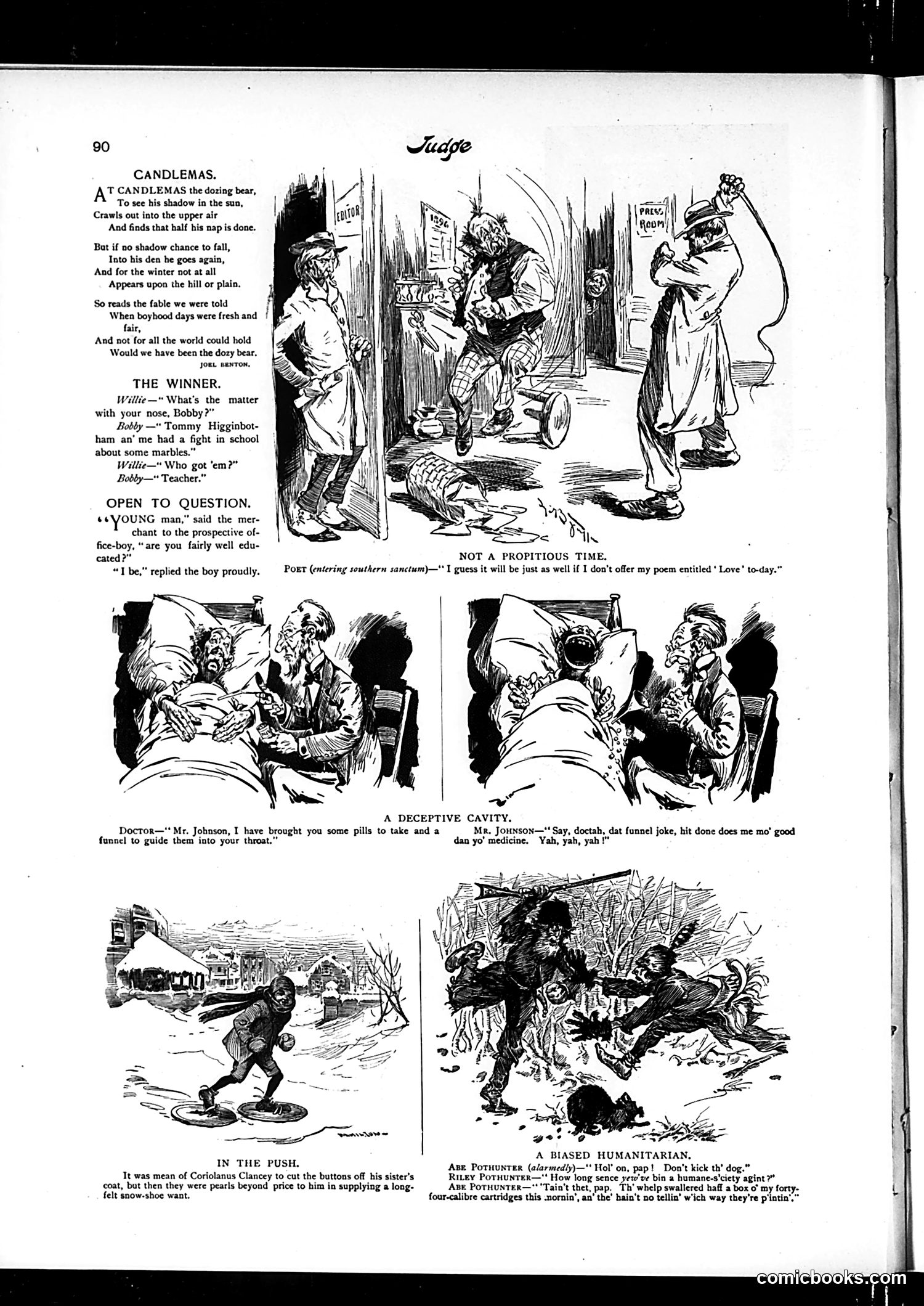
This page contains six separate humorous cartoons and sketches typical of Judge's satirical style: **"Candlemas"** is a poem riffing on the Groundhog Day legend—nostalgia for childhood folklore. **"The Winner"** mocks schoolboy disputes over marbles, with the teacher as the real victor. **"Open to Question"** jokes about hiring an uneducated office boy who ironically claims education. **"Not a Propitious Time"** satirizes a timid poet avoiding a Southern editor—likely referencing sectional tensions, with the poet reluctant to pitch a love poem during a politically/socially charged moment. **"A Deceptive Cavity"** features ethnic dialect humor (common to the era), where a Black patient finds the doctor's funnel joke more therapeutic than medicine. **"In the Push" and "A Biased Humanitarian"** use working-class characters in slapstick scenarios—one involving pearl buttons on a snow-shoe, another featuring a humanitarian protecting a dog that's swallowed ammunition. The page reflects Judge's blend of class commentary, ethnic caricature, and absurdist humor typical of late 19th/early 20th-century American satire.
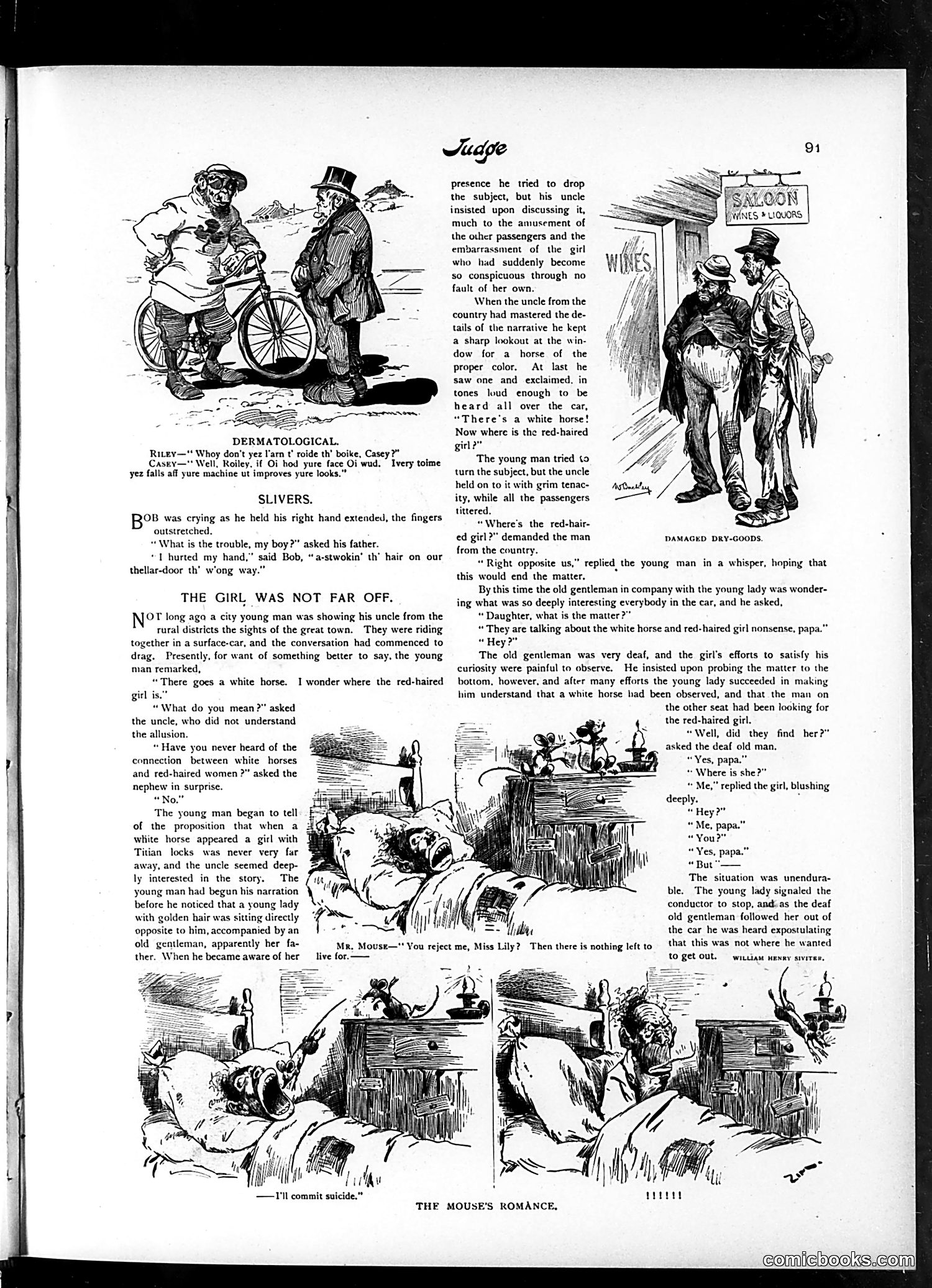
This page contains three distinct humorous pieces typical of late 19th/early 20th-century American satire: **"Dermatological"**: Irish immigrant characters (identifiable by dialect spelling: "Roiley," "yez") joke about a bicycle accident improving someone's appearance—a crude ethnic humor common to the era. **"Slivers"**: A child's innocent misunderstanding about stroking a cat the wrong way provides mild domestic comedy. **"The Girl Was Not Far Off"**: The main story satirizes social embarrassment and class differences. A young city man's romantic superstition (white horses and red-haired girls) backfires when he publicly discusses it near a golden-haired girl on a trolley. A deaf rural uncle repeatedly and loudly demands to know the girl's identity, culminating in the mortified young woman revealing herself as "Me." The satire targets both rural naïveté and urban pretension, while poking fun at the deaf old man's inability to understand the situation. The accompanying illustrations show the trolley scene's progression of embarrassment.
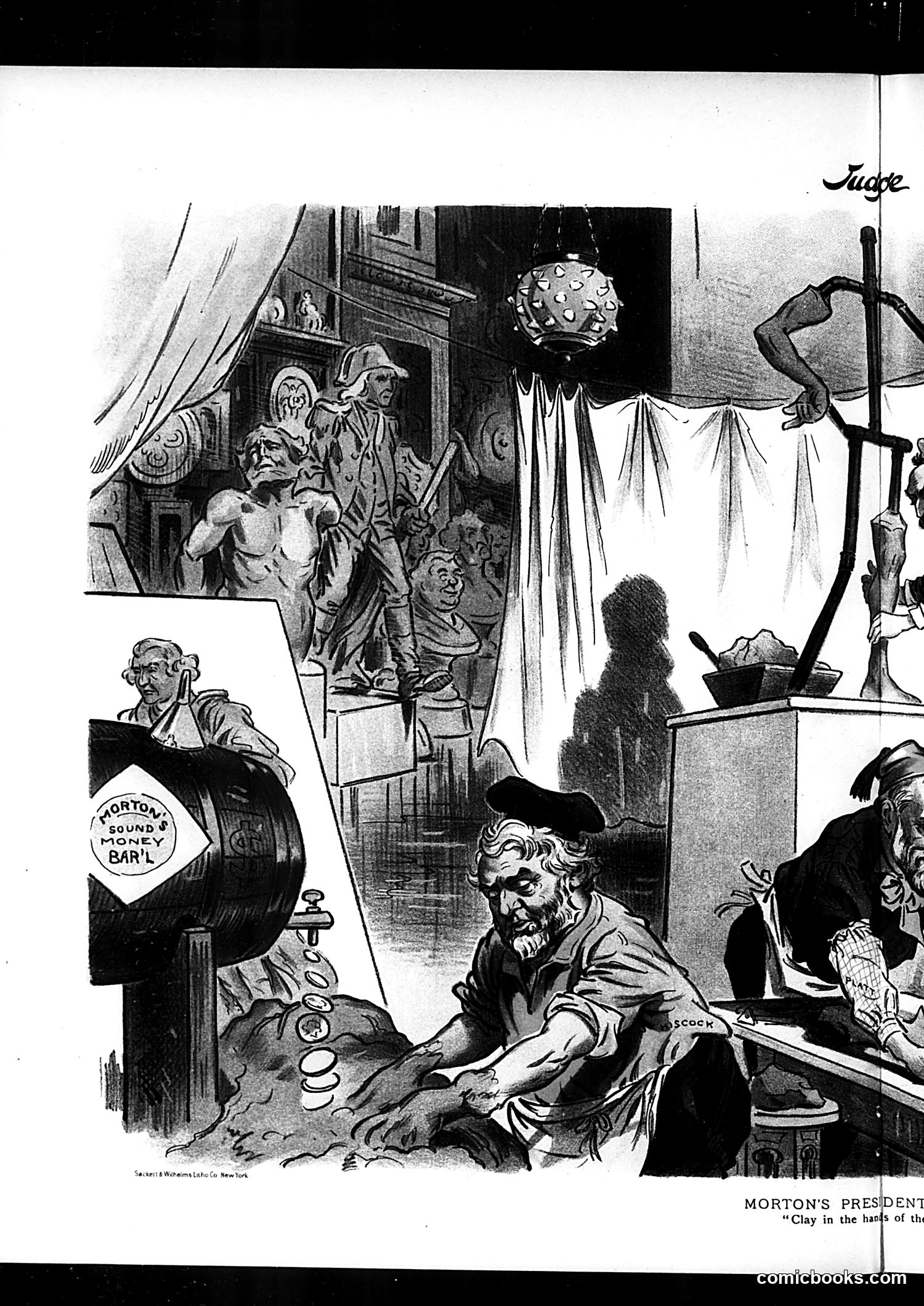
This Judge magazine cartoon satirizes what appears to be a corrupt money-laundering scheme. On the left, a figure operates a large barrel labeled "MORTON'S POUND MONEY RAIN"—suggesting illegitimate funds being processed or "laundered." The barrel's design with a tap mechanism implies systematic conversion of questionable money into acceptable currency. The scene depicts various figures observing or participating in this operation, with what appear to be government or political officials present. The hanging spherical object and draped curtains suggest a formal or institutional setting being used for illicit purposes. The satire targets the conversion of "tainted" money through official-looking channels, likely critiquing political corruption or bribery schemes of the Gilded Age/Progressive Era when Judge was publishing such exposés.
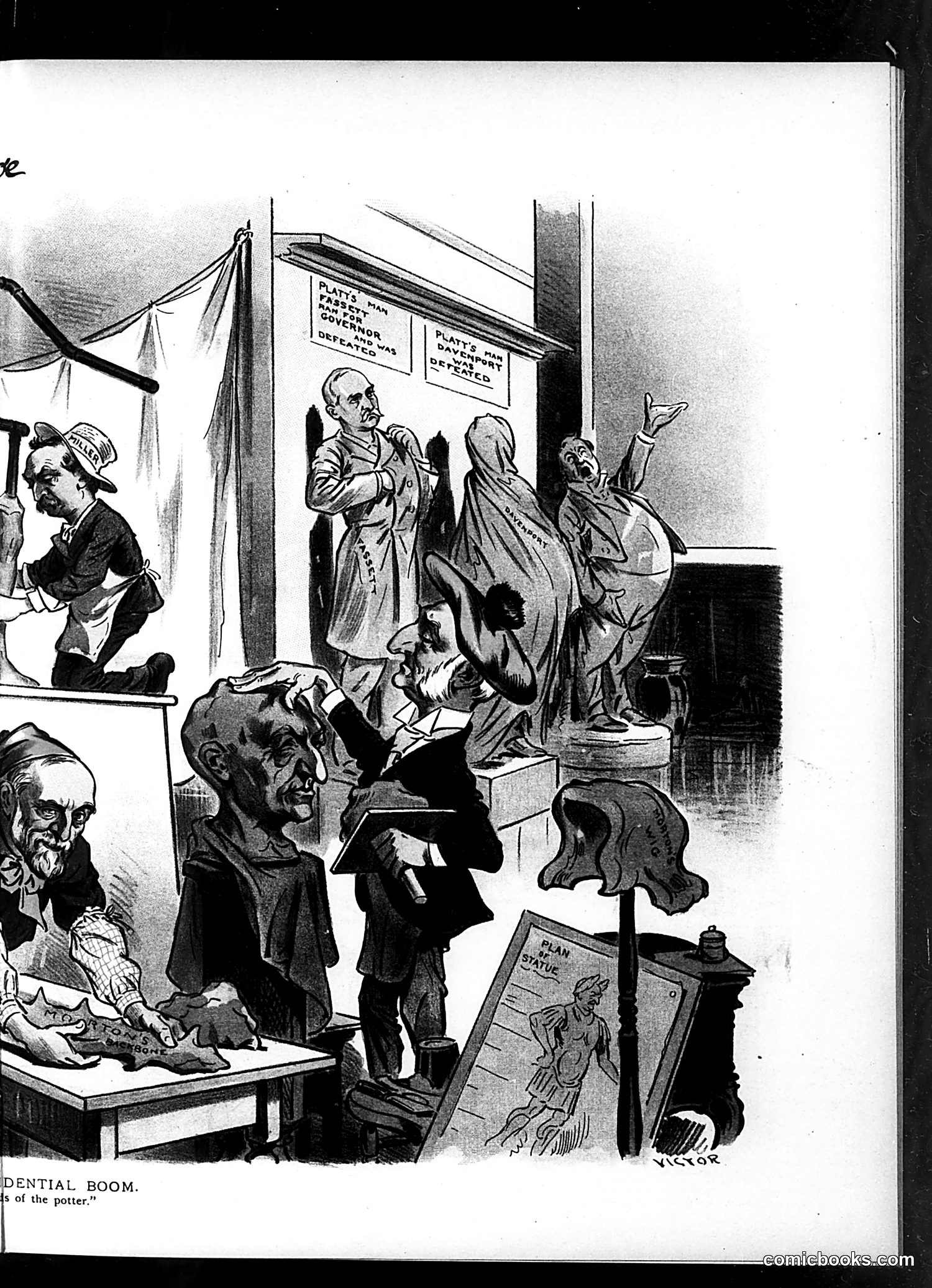
This political cartoon satirizes what appears to be a dental or medical practice scheme. The caption reads "The Potter" (likely referencing a specific practitioner or quack). The image shows a crowded scene with a charlatan-style figure operating what resembles a dental booth or medical stand. Signs visible read "Platt's Painless..." and references to "Platt's Painless Dentistry Defeated" or similar, suggesting the cartoon mocks fraudulent or oversold dental practices. Multiple caricatured patients and onlookers crowd around, some appearing dubious or suffering. The exaggerated expressions and composition suggest satire of either quack medicine, medical fraud, or the gullibility of patients seeking expensive treatments with dubious results. Without the publication date, the specific "Platt" reference remains unclear, but the cartoon clearly ridicules medical hucksterism popular in late-19th/early-20th century America.
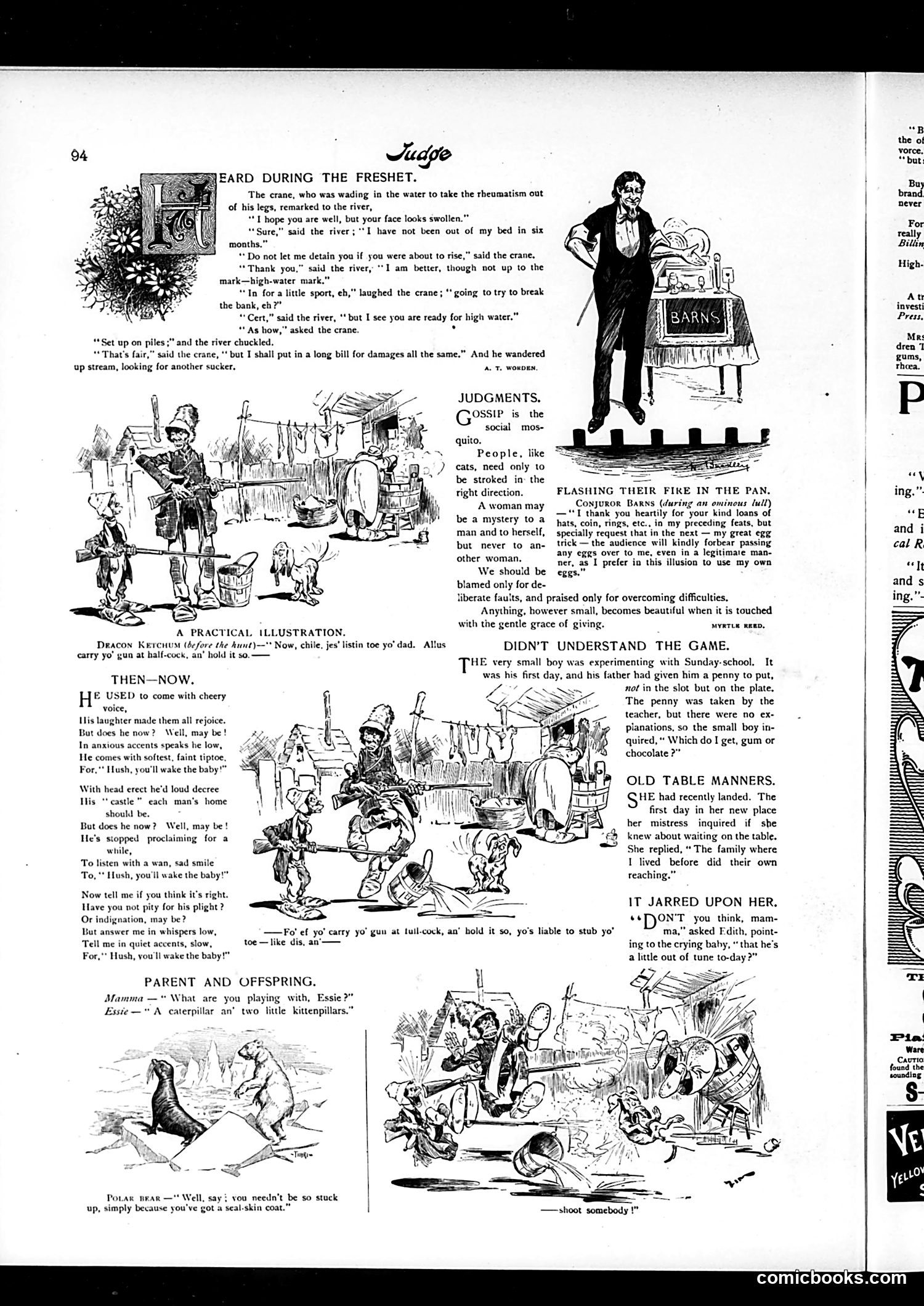
This page contains multiple short humorous pieces typical of Judge magazine's satirical format: **"Heard During the Freshet"** presents a dialogue between a crane and a swollen river during flooding, with puns about "high water" and banking—likely topical commentary on financial instability or riverbank management issues of the era. **"Judgments"** offers brief aphorisms about human nature (gossip, mystery, giving) in the magazine's characteristic moralizing-yet-witty style. **"Then—Now"** contrasts a man's formerly bold public declarations about home ownership with his current hushed, anxious demeanor—satirizing either economic hardship or changed social circumstances that forced silence. Additional short pieces include parental humor ("Parent and Offspring," "Old Table Manners," "Didn't Understand the Game") depicting children's innocent misunderstandings of social conventions—a recurring Judge theme. The cartoons are gentle domestic satire rather than sharp political commentary, typical of the magazine's family-oriented humor content.
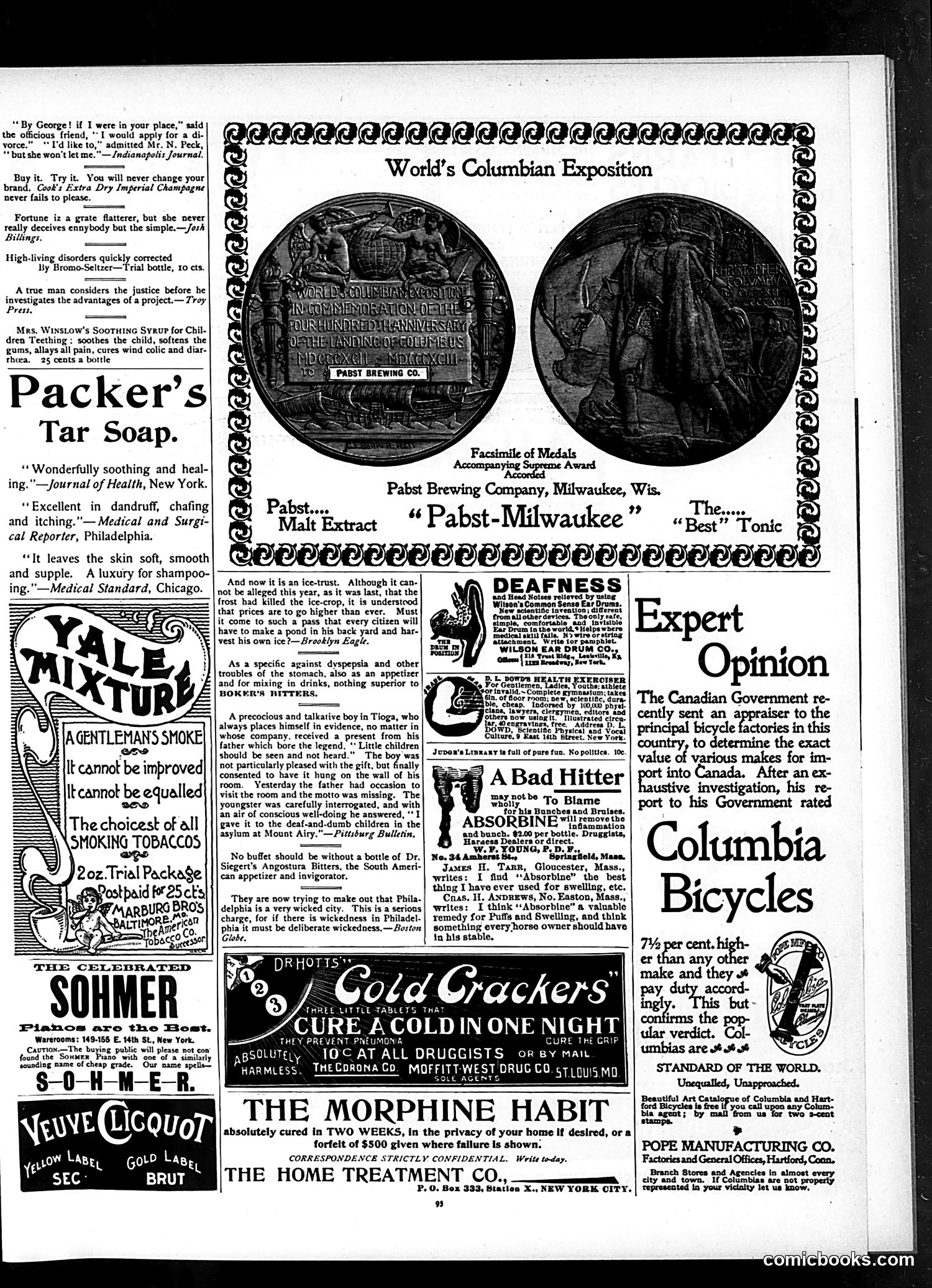
This page is primarily **advertising**, not political satire. Judge magazine (a satirical publication) interweaves humor with commercial notices—typical for late 19th/early 20th-century periodicals. The upper portion features the **World's Columbian Exposition** medals from **Pabst Brewing Company**, celebrating their award at Chicago's 1893 fair. This was significant advertising—world's fair medals legitimized commercial products. Scattered throughout are **short humorous anecdotes** (not cartoons): jokes about marriage, fortune, and a precocious boy's wit with a deaf-and-dumb charity—typical period humor reflecting social attitudes. The remaining content is patent medicines and consumer goods: **Packer's Tar Soap, Sohmer Pianos, Bromo-Seltzer, Absorbine liniment**, etc. Notable: several ads promote remedies for "morphine habit" and "deafness"—conditions treated with dubious 19th-century "cures" now recognized as ineffective or harmful. **Modern context:** This reveals how magazines funded themselves through ads, and how unregulated medicines made bold (often false) health claims.
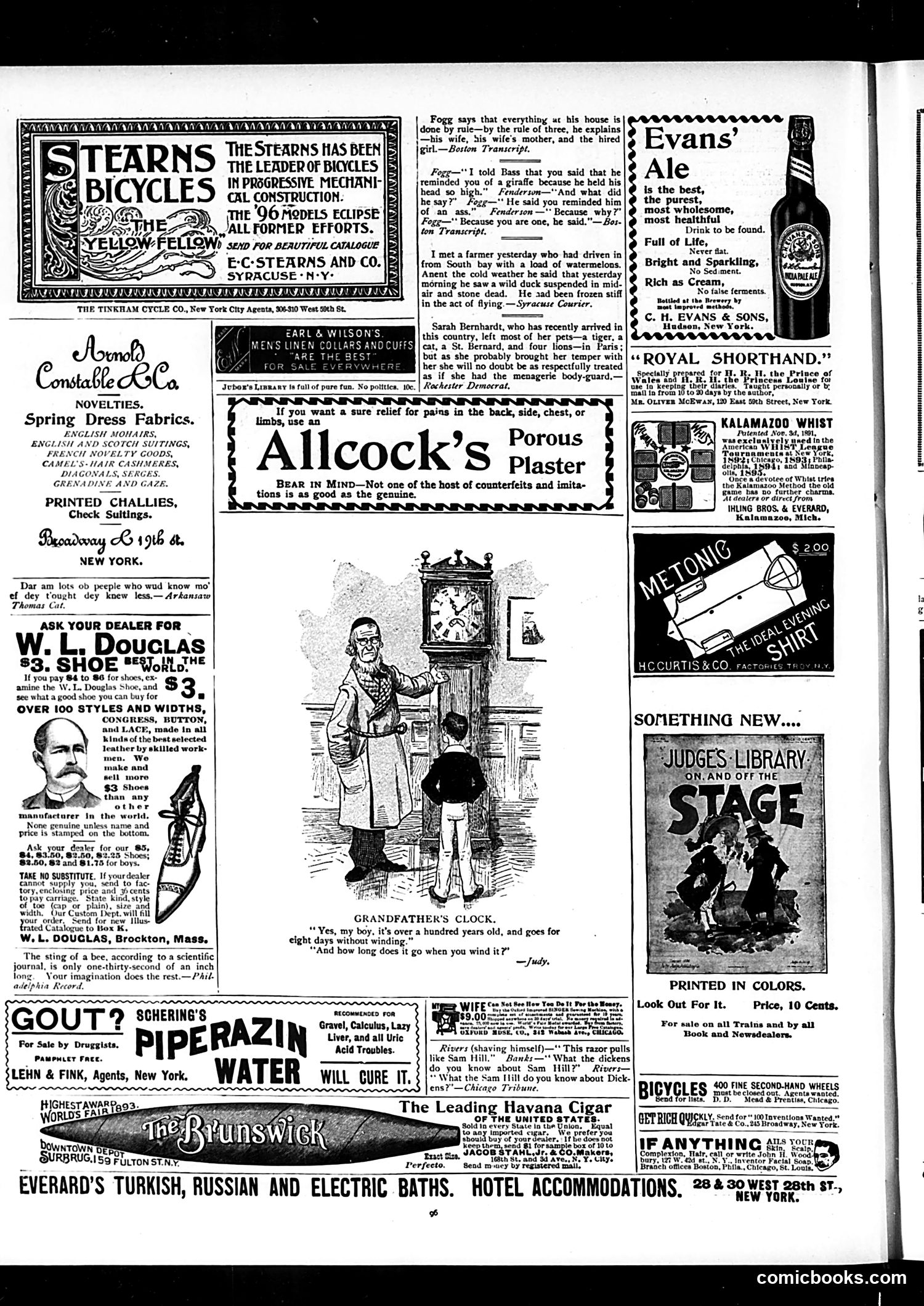
This appears to be a mixed **advertising and humor page** from Judge, primarily featuring period advertisements (bicycles, shoes, patent medicines) rather than political satire. The notable editorial content includes brief **humorous anecdotes** in the "Judge's Library" style—short jokes about wordplay and absurd situations: - A joke about a man whose household is run "by rule" by his wife, mother-in-law, and hired girl - Wordplay involving mistaken comparisons (giraffe/ass insult) - A tall tale about a farmer finding a frozen duck There's mention of **Sarah Bernhardt's** recent arrival in America, with a quip that her temperament makes her a more formidable companion than her actual menagerie in Paris. The **"Grandfather's Clock"** cartoon depicts a mundane domestic joke about a 100-year-old clock's reliability. Overall, this page reflects Judge's dual nature as a satirical magazine heavily dependent on advertising revenue. The humor is **gentle, domestic, and observational**—not overtly political—suggesting this particular page focused on product placement over social commentary.
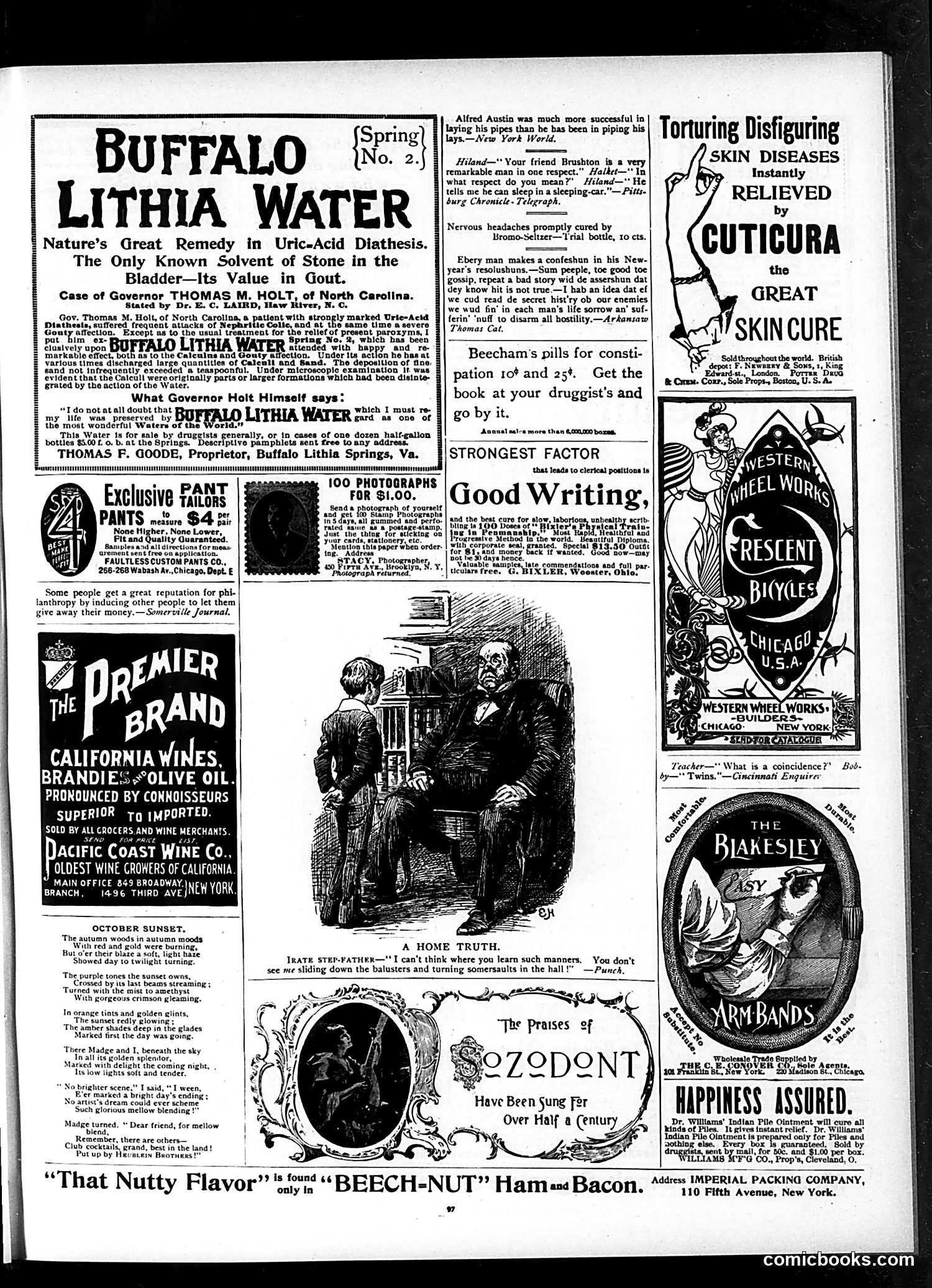
This page is primarily **advertisements and filler content** rather than editorial cartoons, typical for Judge magazine of this era. The main illustrated content includes: 1. **"A Home Truth"** — A sketch showing a stepfather scolding a child about manners, with the caption mocking paternal hypocrisy about proper behavior. 2. **"October Sunset"** — A sentimental poem about autumn, unrelated to satire. 3. **Ozodont advertisement** — Features an ornate oval portrait frame (decorative, not satirical). The page is dominated by **patent medicine and consumer product ads**: Buffalo Lithia Water (for gout/kidney stones), Beecham's pills, Bromo-Seltzer, custom pants, bicycles, and wine. These reflect late 19th-century American advertising practices. There are scattered **brief comic observations** (one-liners about human nature), but no sustained political satire or identifiable caricatures. The page represents Judge's function as both satirical magazine and advertising vehicle rather than focused editorial commentary.
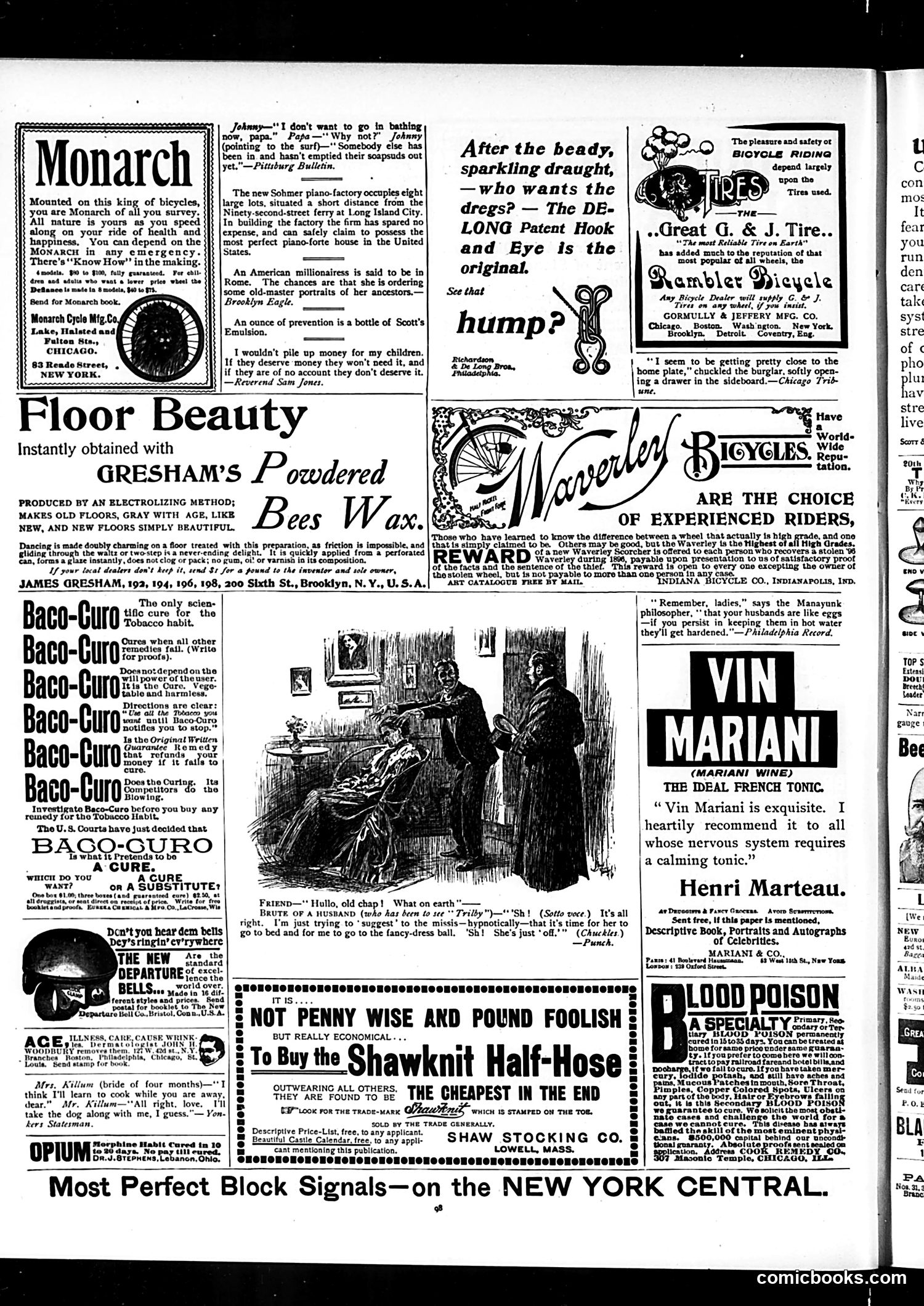
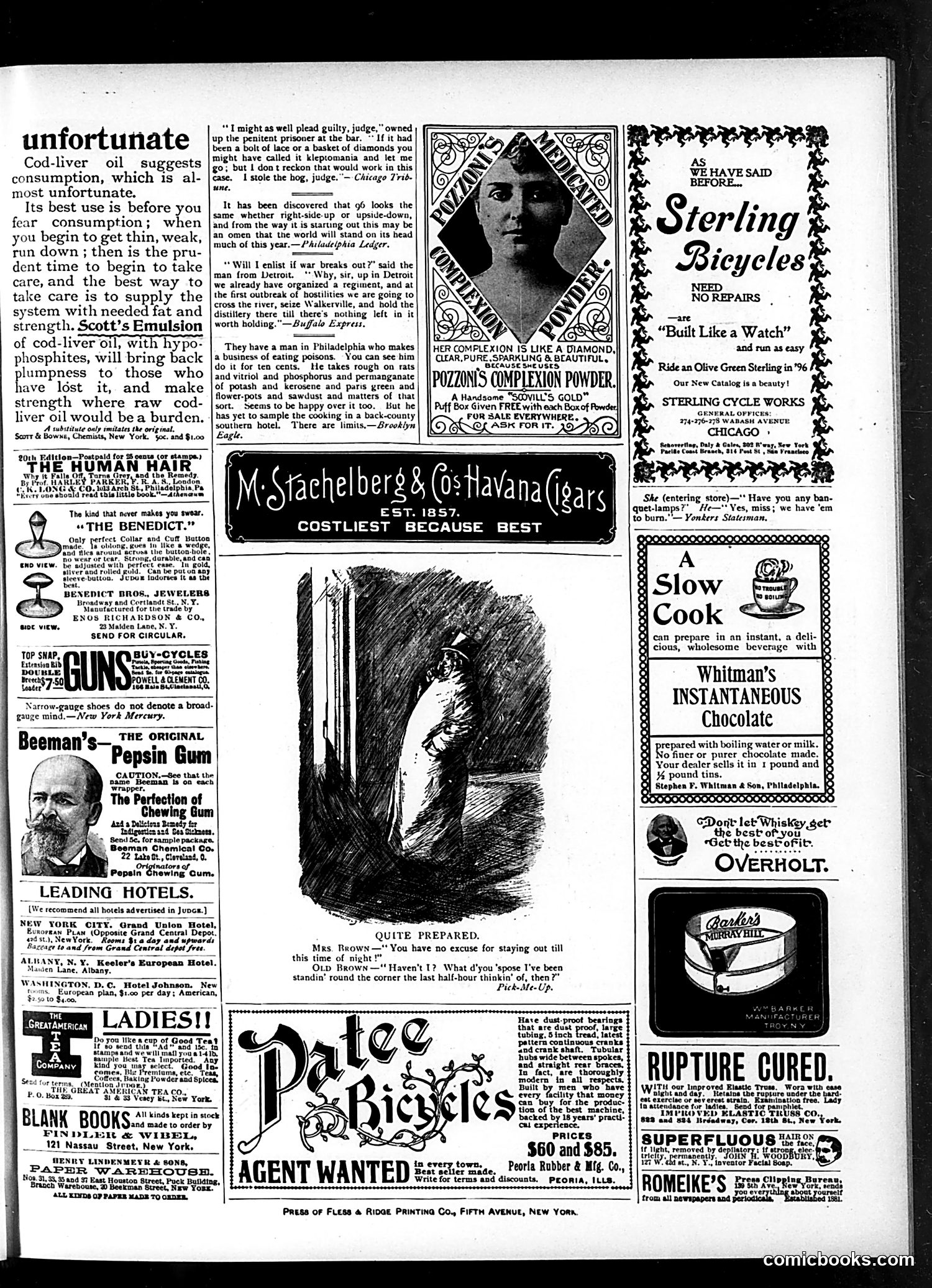
This page is primarily **advertising**, typical of Judge magazine's revenue model. However, it contains two notable editorial items: 1. **Top cartoon** (Pozzoni's Complexion Powder ad): Features a woman's face with decorative border. The accompanying text states "HER COMPLEXION IS LIKE A DIAMOND, CLEAR, PURE, SPARKLING & BEAUTIFUL"—standard beauty product advertising of the era, reflecting period attitudes about women's appearance and cosmetics. 2. **"Quite Prepared" dialogue piece**: A domestic humor sketch where "Old Brown" has stayed out late; his wife Mrs. Brown confronts him. His excuse (cut off in OCR) appears to involve waiting on a street corner—typical sitcom marital comedy of the period. The remaining content consists of product advertisements (cod-liver oil, bicycles, hotels, gum, books) common to late-19th-century American magazines. There is **no significant political satire** on this page.
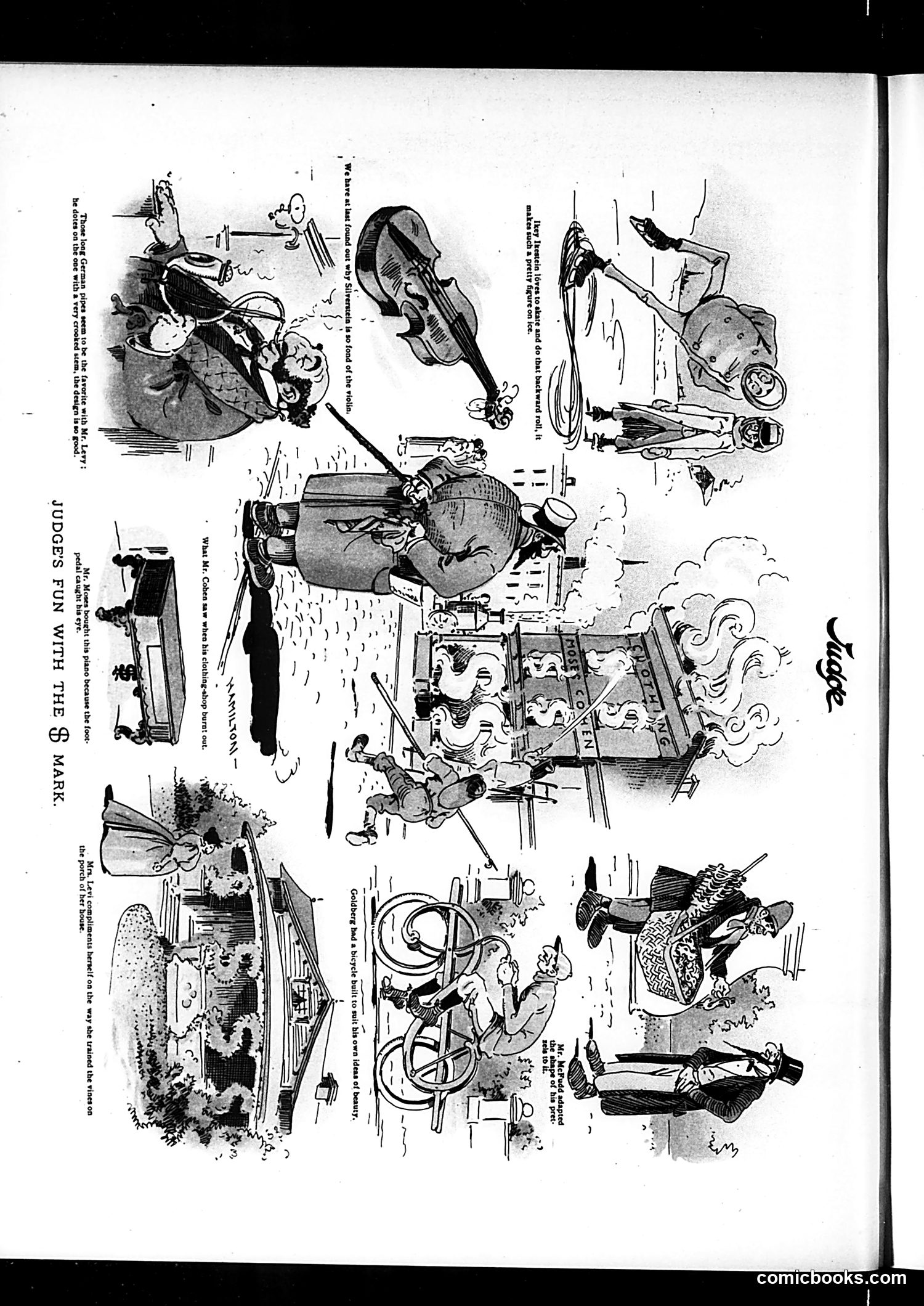
This page from *Judge* contains three separate stereotypical Jewish caricatures, all playing on offensive tropes about Jewish people and money: 1. **"Ikey Ikestein"** — depicts a Jewish boy skating, likely mocking Jewish children's activities or names. 2. **"Mr. Moses"** — shows a man buying a piano because the "foot-pedal caught his eye," suggesting Jewish people are obsessed with material goods or easily distracted by shiny objects. 3. **"Mrs. Levi"** — references training her "vines on" (unclear reference, possibly "sons"), implying Jewish mothers' stereotypical overprotectiveness or materialism. The heading "**JUDGE'S FUN WITH THE $ MARK**" explicitly frames these as jokes about Jewish association with money. This reflects *Judge* magazine's frequent use of crude Jewish stereotypes common to late 19th/early 20th-century American satire—caricatures now recognized as antisemitic propaganda.