
Judge, 1896-02-08 · page 4 of 16
Judge — February 8, 1896 — page 4: what you’re looking at
What you’re looking at
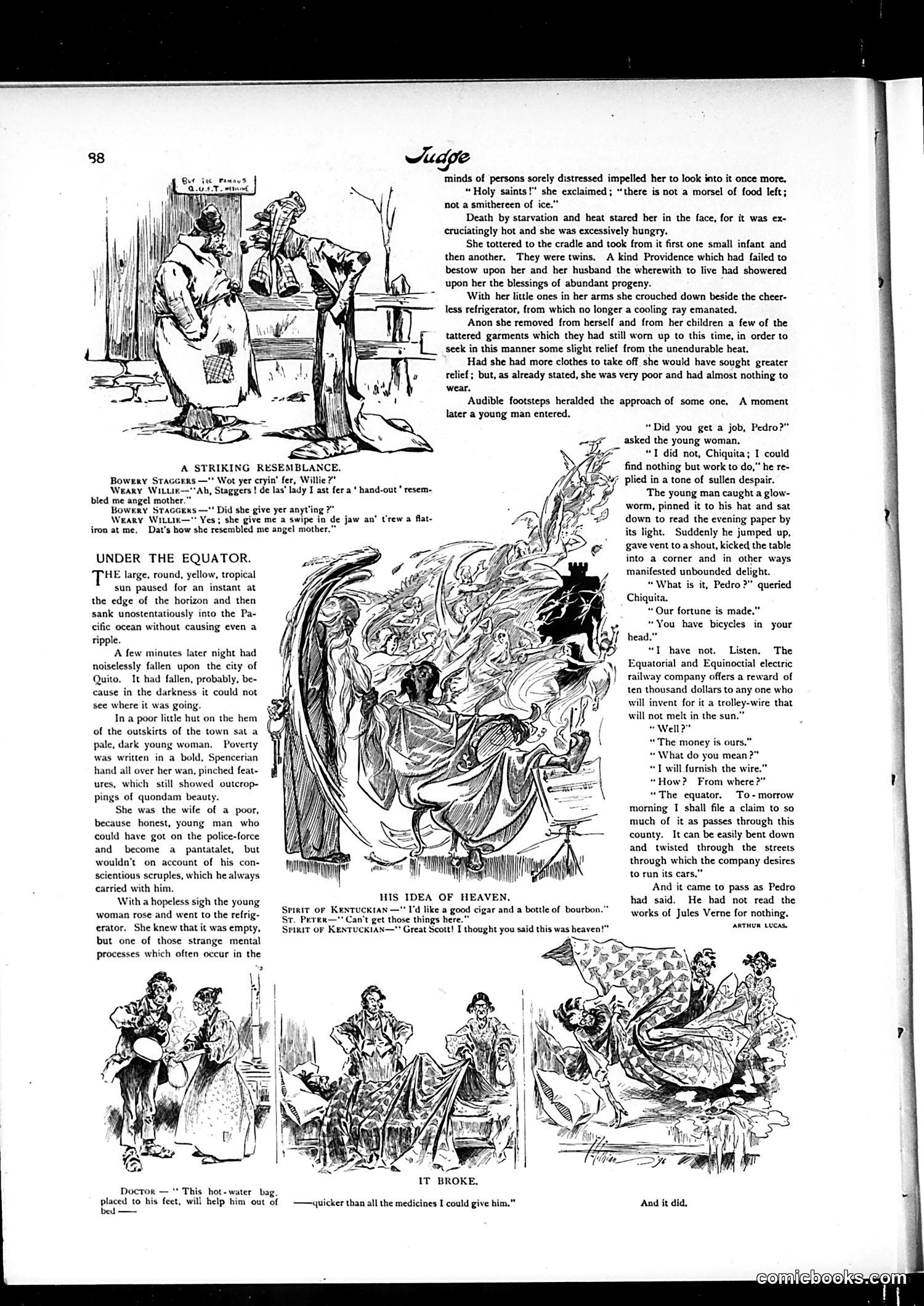
This page contains multiple satirical pieces typical of late 19th-century American humor: **"Under the Equator"** mocks economic desperation and pseudo-scientific foolishness. A poor couple in Quito, Peru—he unemployed due to refusing corrupt police work, she starving with twin infants—finds "fortune" when the husband reads that an electric railway company offers a reward for trolley-wire that won't melt in equatorial heat. His "solution": steal the equator itself and file a legal claim to it. The satire targets both the absurdity of get-rich-quick schemes and the desperation that makes people embrace them. **"A Striking Resemblance"** is a brief Bowery humor sketch: homeless men discuss a woman who gave one of them a beating ("swipe") and threw a flatron after he asked for handouts—he finds this resemblance to his mother touching. The dark joke satirizes poverty and homelessness through grotesque sentiment. **"His Idea of Heaven"** shows two spirits discussing bourbon and cigars, mocking afterlife concepts. The illustrations support these themes with exaggerated, detailed pen work characteristic of Judge's style.
📄 Transcribed text from this page (OCR, searchable)
Machine-transcribed from the original scan — historical spelling and the odd misread are preserved.
Suage minds of persons sorely distressed impelled her to look into it once more. “Holy saints!" she exclaimed; “there is not a morsel of food left; not a smithereen of ice.” Death by starvation and heat stared her in the face, for it was ex- cruciatingly hot and she was excessively hungry. She tottered to the cradle and took from it first one small infant and then another, They were twins. A kind Providence which had failed to bestow upon her and her husband the wherewith to live had showered upon her the blessings of abundant progeny. With her little ones in her arms she crouched down beside the cheer- less refrigerator, from which no longer a cooling ray emanated. Anon she removed from herself and from her children a few of the tattered garments which they had still worn up to this time, in order to seek in this manner some slight relief from the unendurable heat. Had she had more clothes to take off she would have sought greater \ yA i; F relief ; but, as already stated, she was very poor and had almost nothing to = wear. Audible footsteps heralded the approach of some one. A moment later a young man entered. “Did you get a job, Pedro?” asked the young woman. “TI did not, Chiquita; I could find nothing but work to do,” he re- Plied in a tone of sullen despair. The young man caught a glow- worm, pinned it to his hat and sat down to read the evening paper by its light. Suddenly he jumped up, gave vent to ashout, kicked the table into a corner and in other ways manifested unbounded delight. “ What is it, Pedro?” queried Chiquita. “Our fortune is made.” “You have bicycles in your head.” “I have not. Listen, The Equatorial and Equinoctial electric railway company offers a reward of ten thousand dollars to any one who will invent for it a trolley-wire that will not melt in the sun.” “Well?” “The money is ours.” “ What do you mean?” “Twill furnish the wire.” “How? From where?” “The equator. To-morrow morning I shall file a claim to so much of it as passes through this county. It can be easily bent down and twisted through the streets through which the company desires to run its cars.” PRIKING RESEMBLANCE. —'* Wot yer cryin’ Willie?" ‘Ah, Staggers ! de las’ lady I ast fer a ‘ hand-out * resem- Bowery STAGc Weary WILLIE bled me angel mothe Bowery STAGGE! —" Did she give yer anyt'ing ?” Weary WILLIK—" Yes; she give me a swipe in de jaw an’ t'rew a flat- iron at me, Dat's how she resembled me angel mother.” UNDER THE EQUATOR. HE large, round, yellow, tropical sun paused for an instant at the edge of the horizon and then sank unostentatiously into the Pa- cific ocean without causing even a ripple. A few minutes later night had noiselessly fallen upon the city of Quito, It had fallen, probably, be- cause in the darkness it could not see where it was going. In a poor little hut on the hem of the outskirts of the town si pale, dark young woman. Poverty was written in a bold, Spencerian hand all over her wan, pinched feat- ures, which still showed outcrop- pings of quondam beauty. She was the wife of a poor, because honest, young man who could have got on the police-force and become a pantatalet, but wouldn't on account of his con- scientious scruples, which he always carried with him. ‘And it came to pass as Pedro With a hopeless sigh the young 5 % HIS Ipek OF HEAVEN:, ee had said. He had not read the . . i SPIRIT OF UCKIAN —"* I'd like a good cigar and a bottle of bourbon.” e ‘ woman rose and went to the refrig- Pea eta ihore hinge eee works of Jules Verne for nothing. erator. She knew that it was empty, RIT OF KENTUCKIAN—"* Great Scott! I thought you said this was heaven!” bahia Dacca but one of those strange mental processes which often occur in the IT BROKE, Docrok — “* This hot-water bag, placed to his feet, will help him out of | —quicker than all the medicines I could give him.” And it did,