
A complete issue · 48 pages · 1895
Judge — December 7, 1895
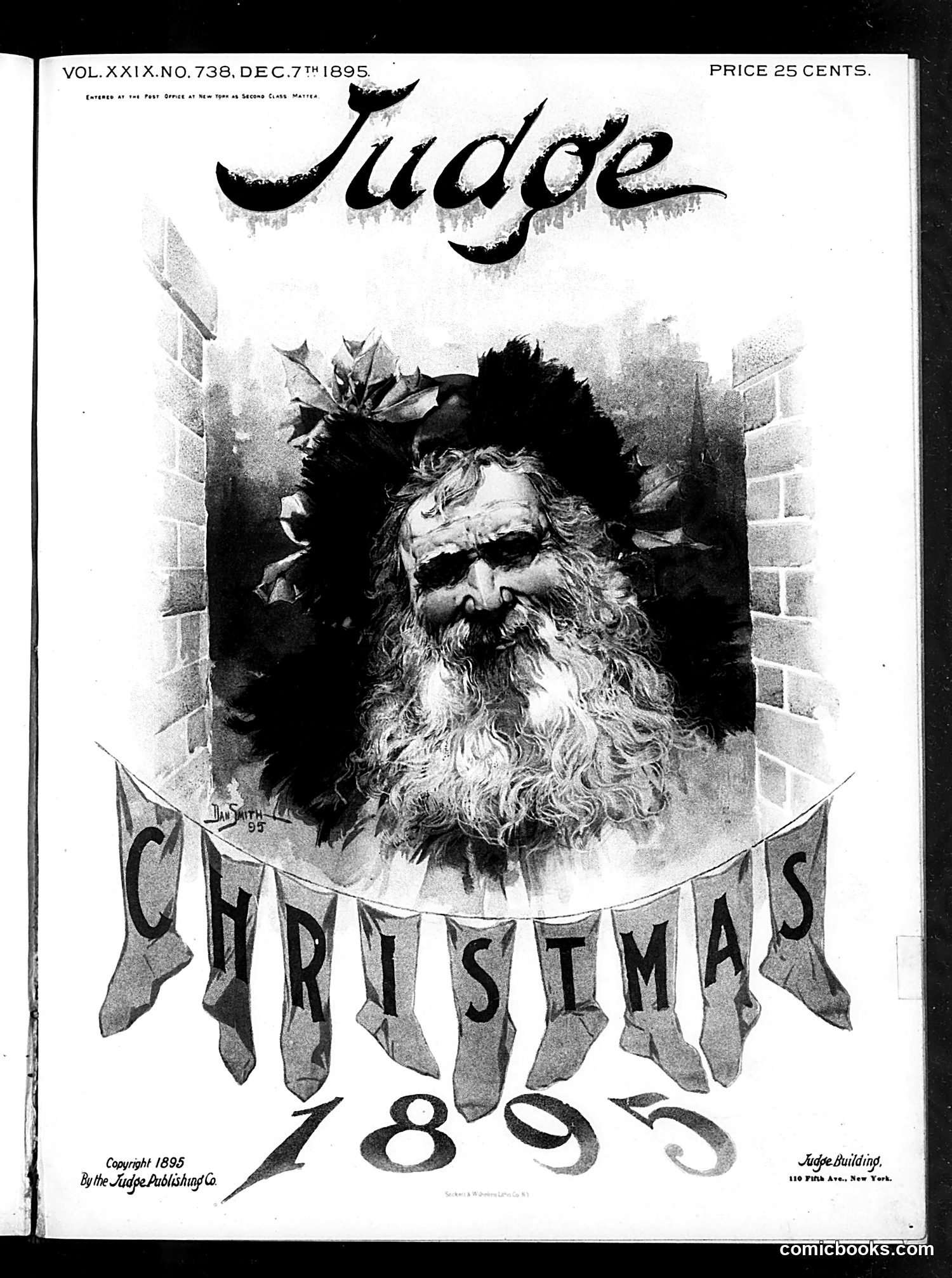
This is a Christmas issue cover (December 7, 1895) featuring Santa Claus with a full beard, blindfold, and festive hat surrounded by Christmas stockings. The figure appears to represent Santa as a blindfolded gift-giver. The satire likely comments on holiday commercialism or consumer deception—the blindfold suggests Santa (and by extension, Christmas shoppers) cannot see clearly what they're purchasing or receiving. The "Judge" masthead and stockings frame this as social commentary on American holiday practices. Without additional text identifying specific political figures or events, the exact satirical target remains unclear, though it likely critiques 1890s American consumer culture or gift-giving practices during the holiday season. The image emphasizes visual spectacle over specific political messaging.
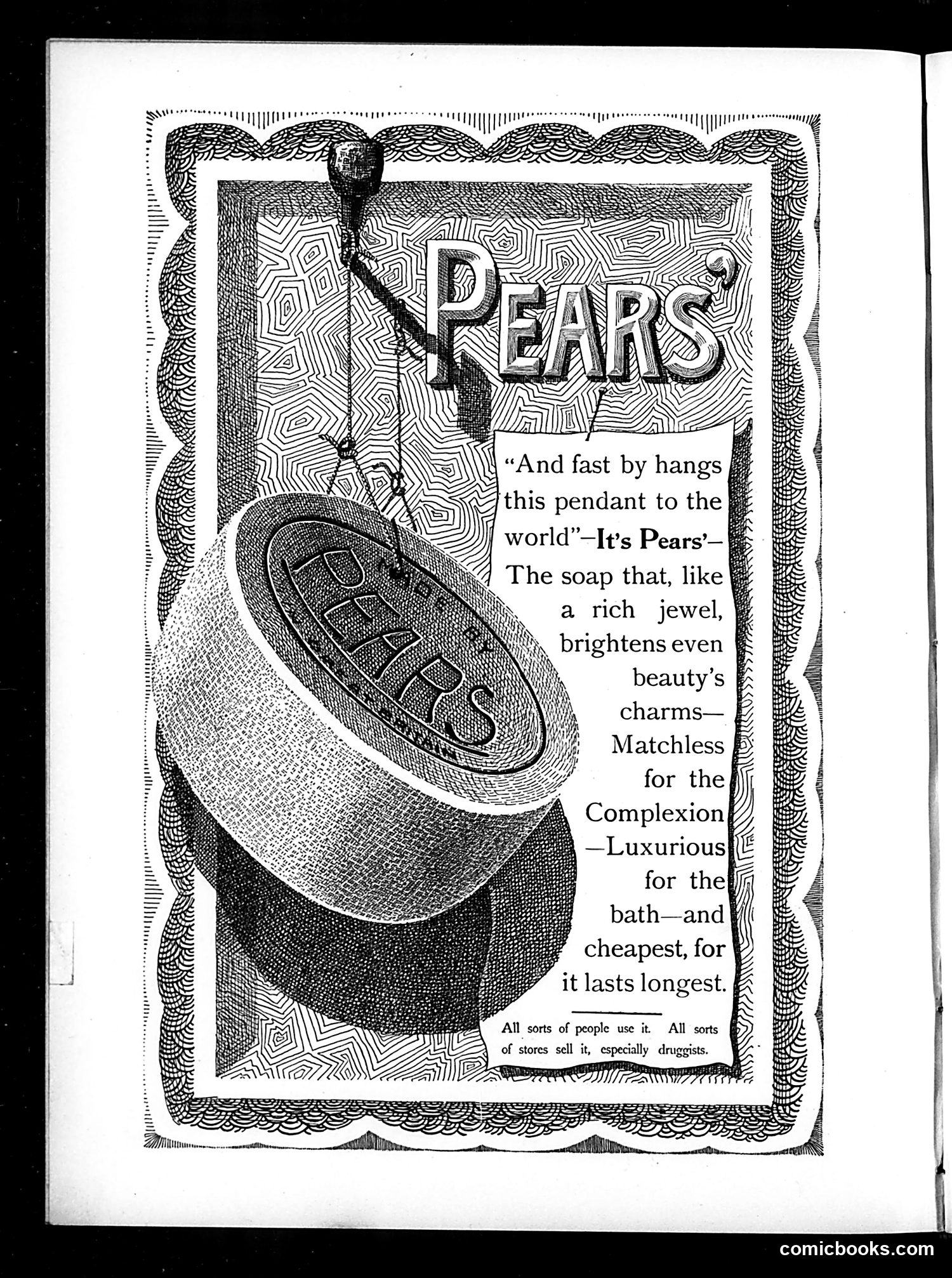
This page is **primarily an advertisement**, not satire or political commentary. It promotes Pears' soap, a luxury beauty product popular in the late 19th/early 20th century. The ad uses decorative engravings showing a bar of soap depicted as a "pendant" or jewel hanging from a chain. The marketing copy emphasizes the product's dual appeal: it claims to be both luxurious ("like a rich jewel," "matchless for the Complexion") yet practical and economical ("cheapest, for it lasts longest"). The key selling point appears to be universal accessibility—the text notes that "all sorts of people use it" and "all sorts of stores sell it, especially druggists," positioning Pears as an affordable luxury rather than an exclusive product.
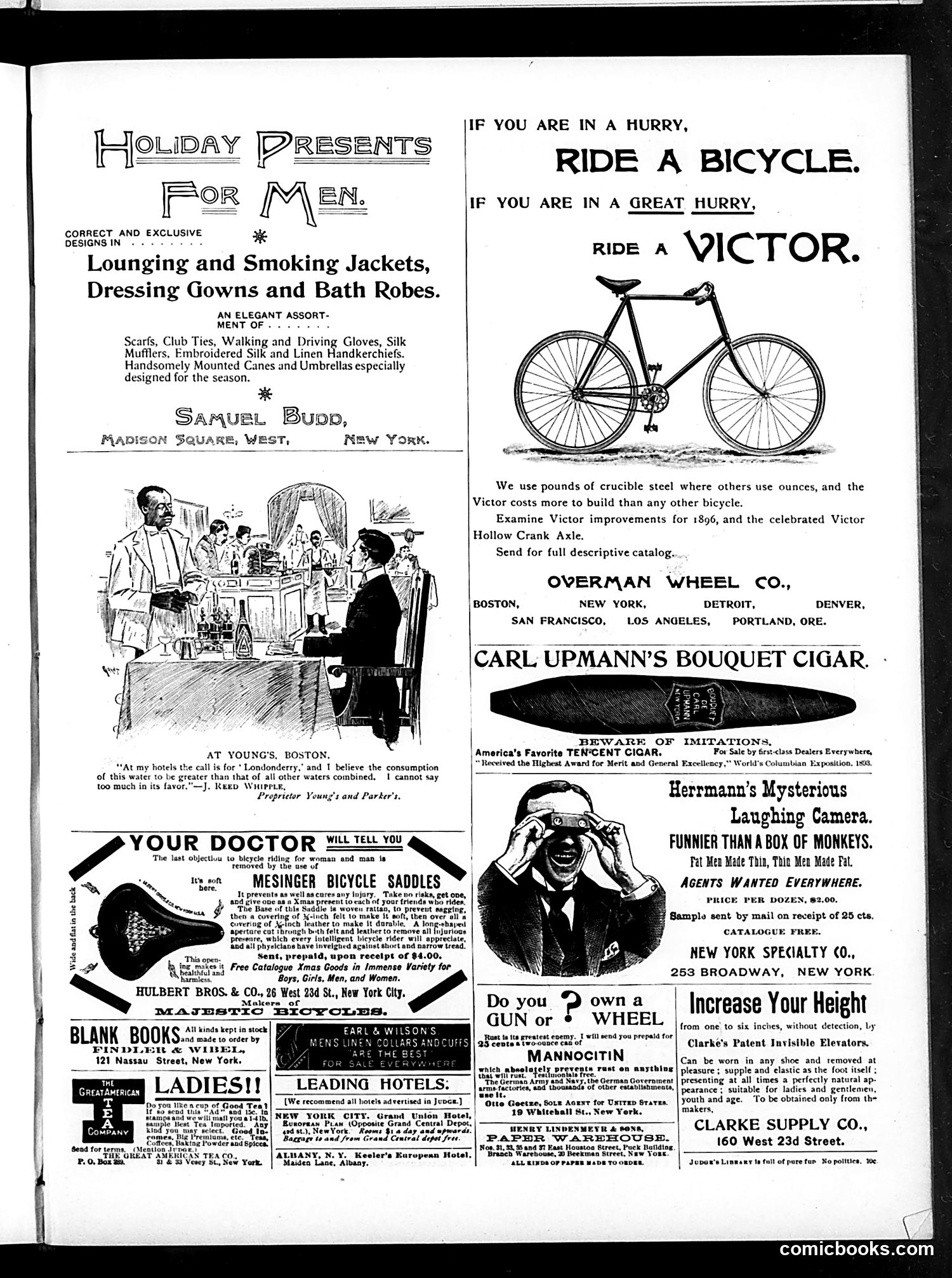
This page is primarily **advertising**, not political satire. It contains multiple product advertisements from the 1890s era, including: - **Samuel Budd** (menswear for holidays) - **Victor bicycles** (Overman Wheel Co.) - **Messinger bicycle saddles** - **Carl Upmann's cigars** - **Herrmann's Laughing Camera** - Various hotels and other goods The one illustration shows a social scene at what appears to be a hotel bar or restaurant, with a quote from "Jared Whipple, Proprietor Young's and Parker's" endorsing the establishment. The page reflects late-19th-century consumer culture and advertising strategies, rather than political commentary. It's representative of Judge magazine's revenue model: satirical editorial content supported by extensive advertising to wealthy male readers interested in luxury goods.
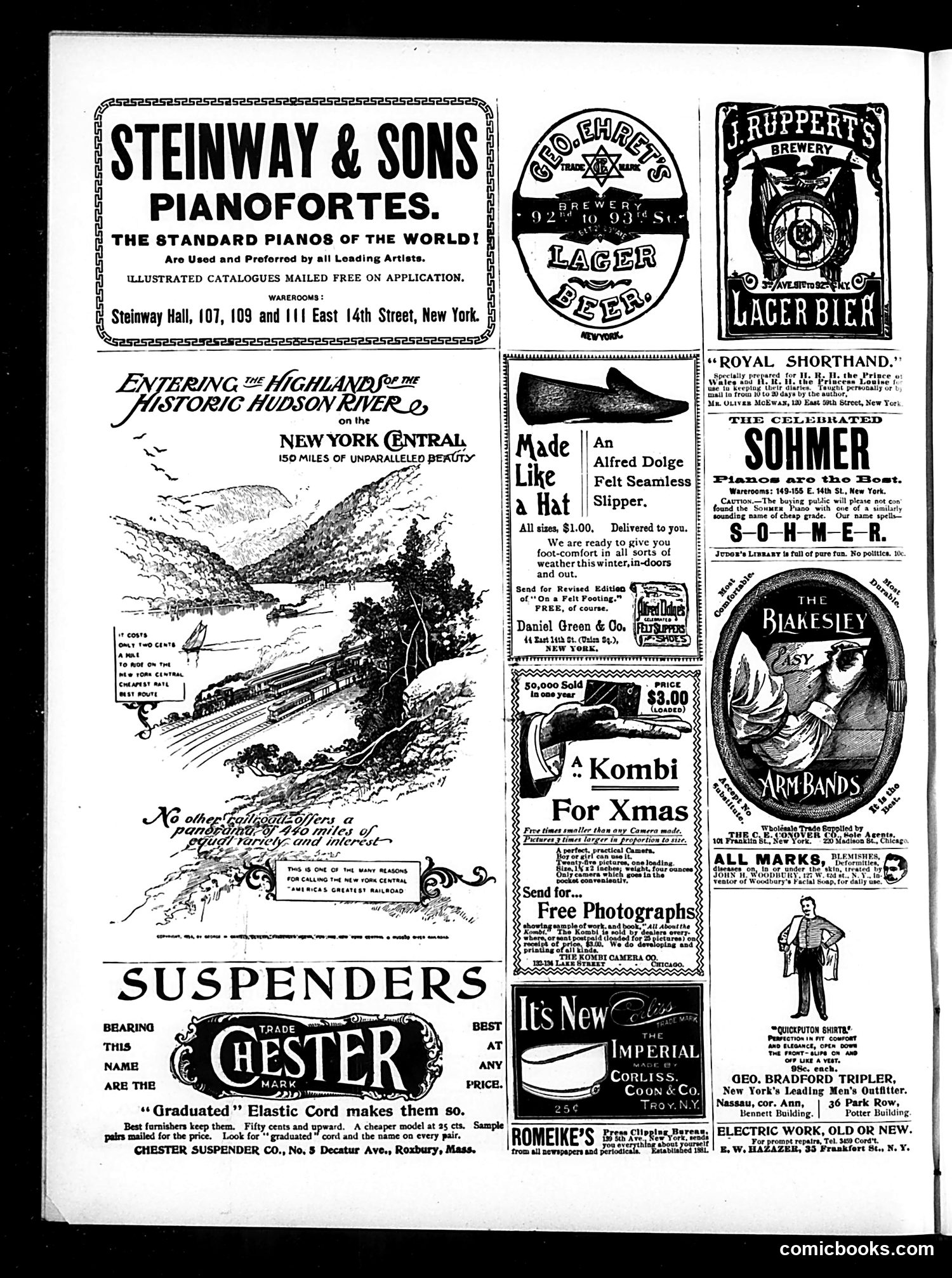
This page is primarily **advertising**, not political satire. It contains commercial advertisements for various products and services typical of early 20th-century America: The largest element is a **New York Central Railroad advertisement** featuring the Hudson River landscape—promoting scenic train travel. Other prominent ads include: - **Steinway & Sons pianos** (luxury instruments) - **Beer labels** (Geo. Ehret's and Ruppert's lager) - **Chester suspenders** (elastic cord undergarments) - **Alfred Dolge felt slippers** ("Made Like a Hat") - **Sohmer pianos** (competing brand) - Various smaller product advertisements The page reflects consumer goods and services available to affluent urban readers. The only potentially humorous element is the suspender ad's pun about "graduated elastic cord," but this is gentle product marketing rather than political commentary. **No identifiable satirical cartoons or political references appear here.** This is a straightforward commercial page from Judge magazine's advertising section.
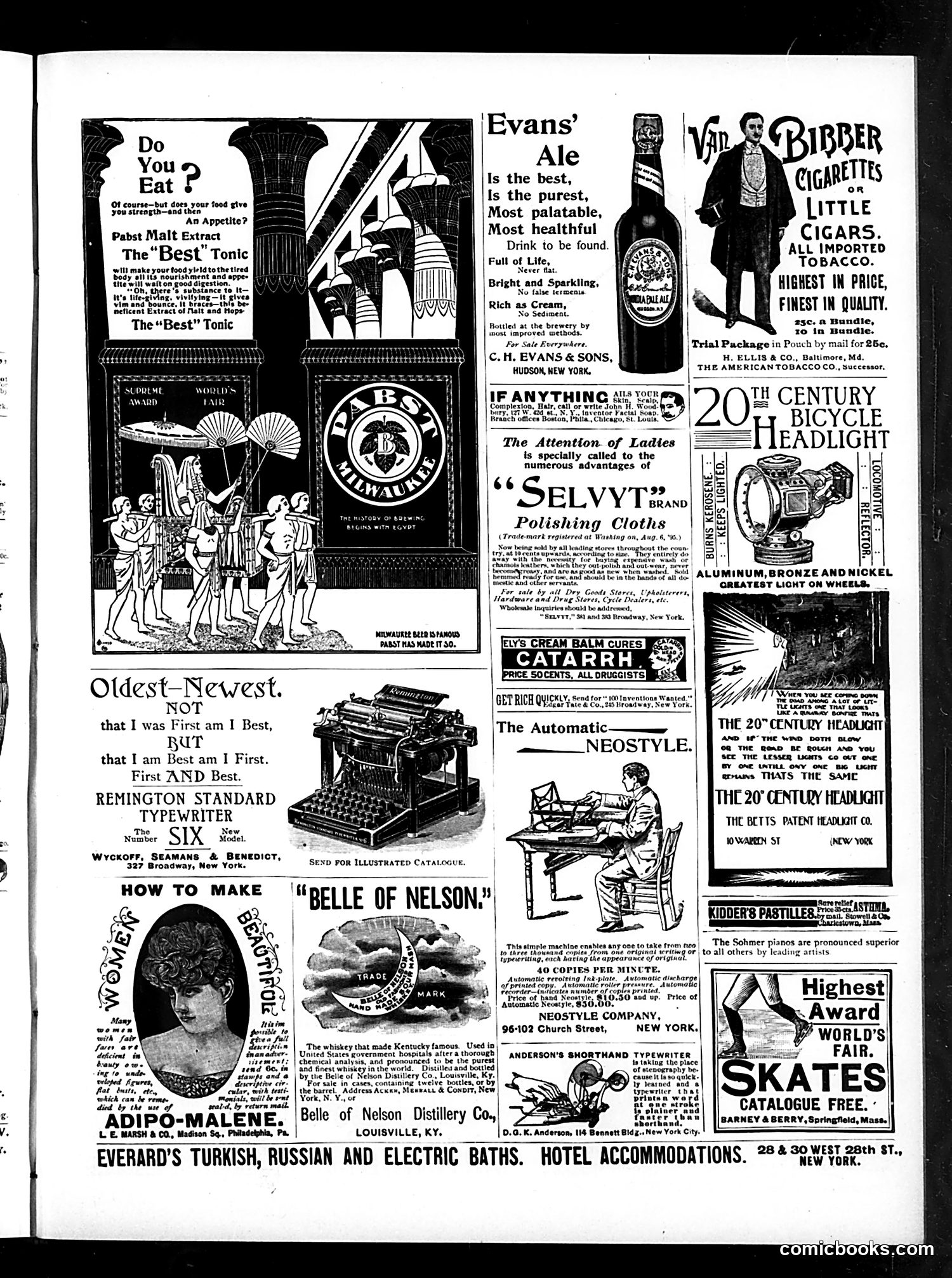
This page is **primarily advertising**, typical of Judge magazine's business model. The satirical content is minimal and confined to one small section. ## The Satire: The **"Oldest-Newest"** section (Remington Standard Typewriter ad) contains the page's only apparent satirical commentary. It plays on a logical paradox: "NOT that I was First am I Best, BUT that I am Best am I First." This mocks competitive advertising claims of the era—companies boasting simultaneously about being "first to market" *and* "best quality." Remington's typewriter was indeed an established product, and this appears to be tongue-in-cheek commentary on how manufacturers justify market dominance through circular logic. ## Advertisements: The remainder consists of period product ads: patent medicines (Pabst Malt Extract as "tonic," Adipo-Malene for weight loss), alcohol (Evans' Ale, Belle of Nelson whiskey), tobacco (Vail Bibber cigars), office equipment (Neostyle copying machine, Anderson's typewriter), and miscellaneous goods (bicycle headlights, skates, polishing cloths). These reflect contemporary consumer culture and medical attitudes (alcohol and unknown tonics marketed as health products).
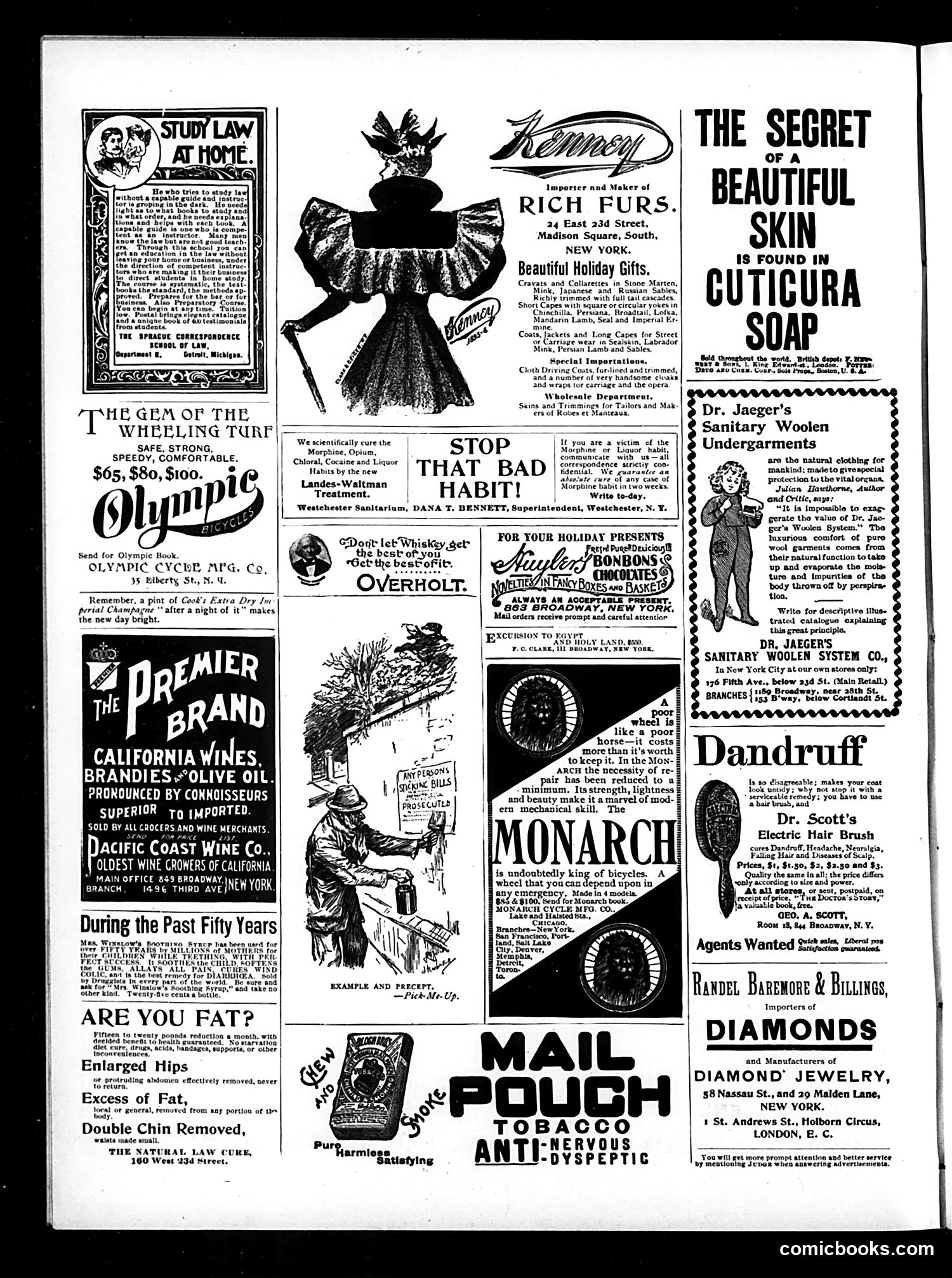
This is primarily an **advertising page** from Judge magazine, with minimal editorial satire. The content reflects turn-of-the-century American consumer culture, circa 1890s-1900s. The advertisements reveal period anxieties and dubious medical claims common to the era: **Health/Body Products**: Ads promise removal of "excess fat," "enlarged hips," and "double chin"—reflecting Victorian beauty standards emphasizing thinness. The Landes-Waltman sanitarium advertises a "cure" for morphine and cocaine addiction, typical of when these were unregulated substances. **Luxury goods**: Kenney furs, Olympic bicycles, California wines, and Monarch bicycles target wealthy consumers. **Pseudo-scientific remedies**: Dr. Scott's electric hair brush and Cuticura soap exemplify period "scientific" marketing—using electricity or vague chemistry to justify products' efficacy. The page shows an era before FDA regulation, when extravagant health claims were standard advertising. The content is historically valuable primarily as *documentation of period consumer culture* rather than as satire or social commentary.
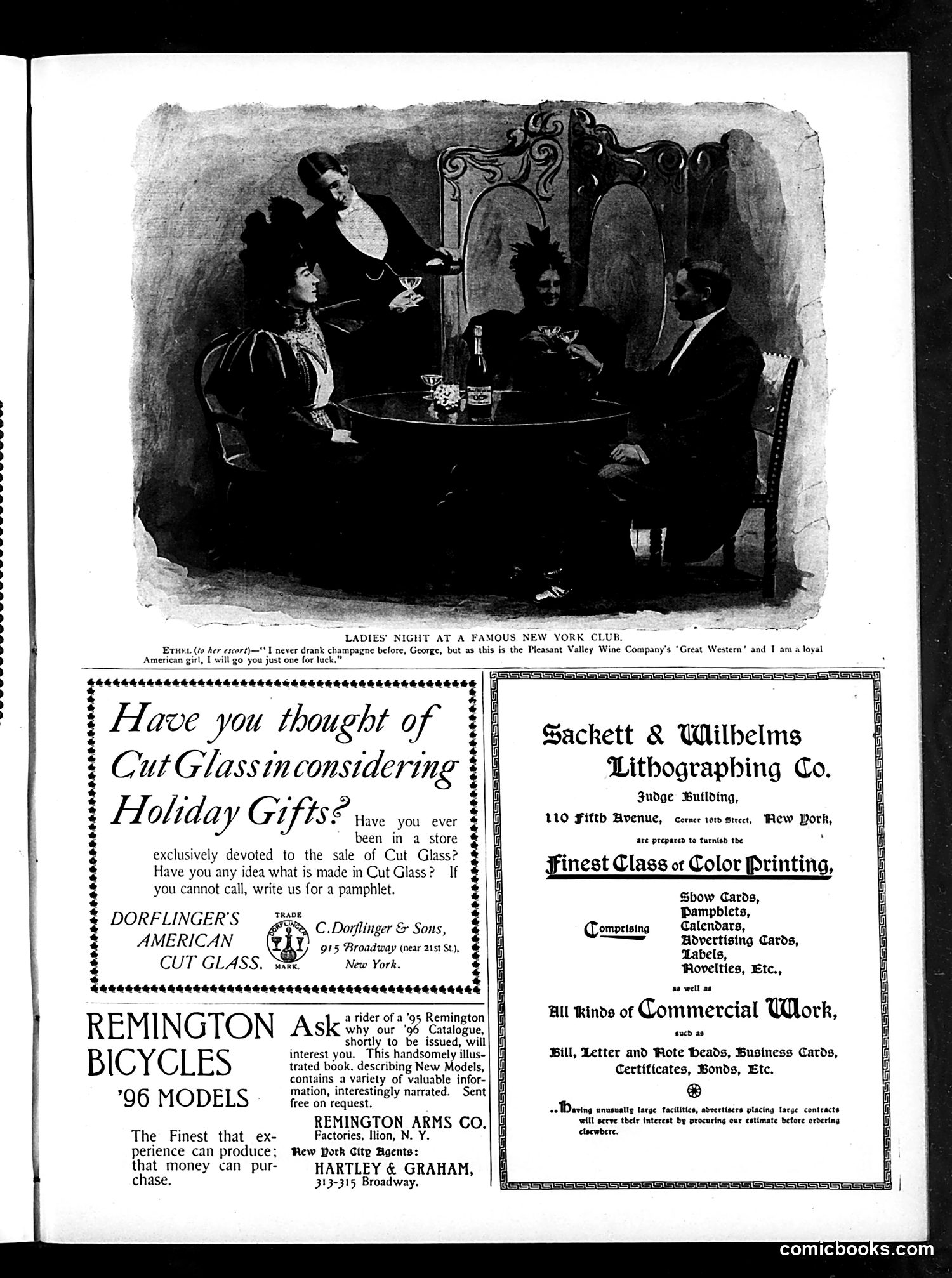
This cartoon satirizes women's patriotic consumption during the early 1900s. The scene depicts a woman at a nightclub asserting her loyalty to American products by drinking Pleasant Valley Wine Company's "Great Western" champagne—despite never having drunk champagne before. The humor lies in the contradiction: she's performing patriotism through brand loyalty rather than genuine preference or experience. By framing her choice as "loyal American" duty, the cartoon gently mocks both corporate marketing that appeals to nationalism and women's susceptibility to such appeals. The setting—a ladies' night at a famous New York club—positions this as upscale urban entertainment, suggesting the affluent women Judge's readership would recognize. The satire targets how consumers (particularly women) could be persuaded to adopt new habits through appeals to patriotism rather than merit.
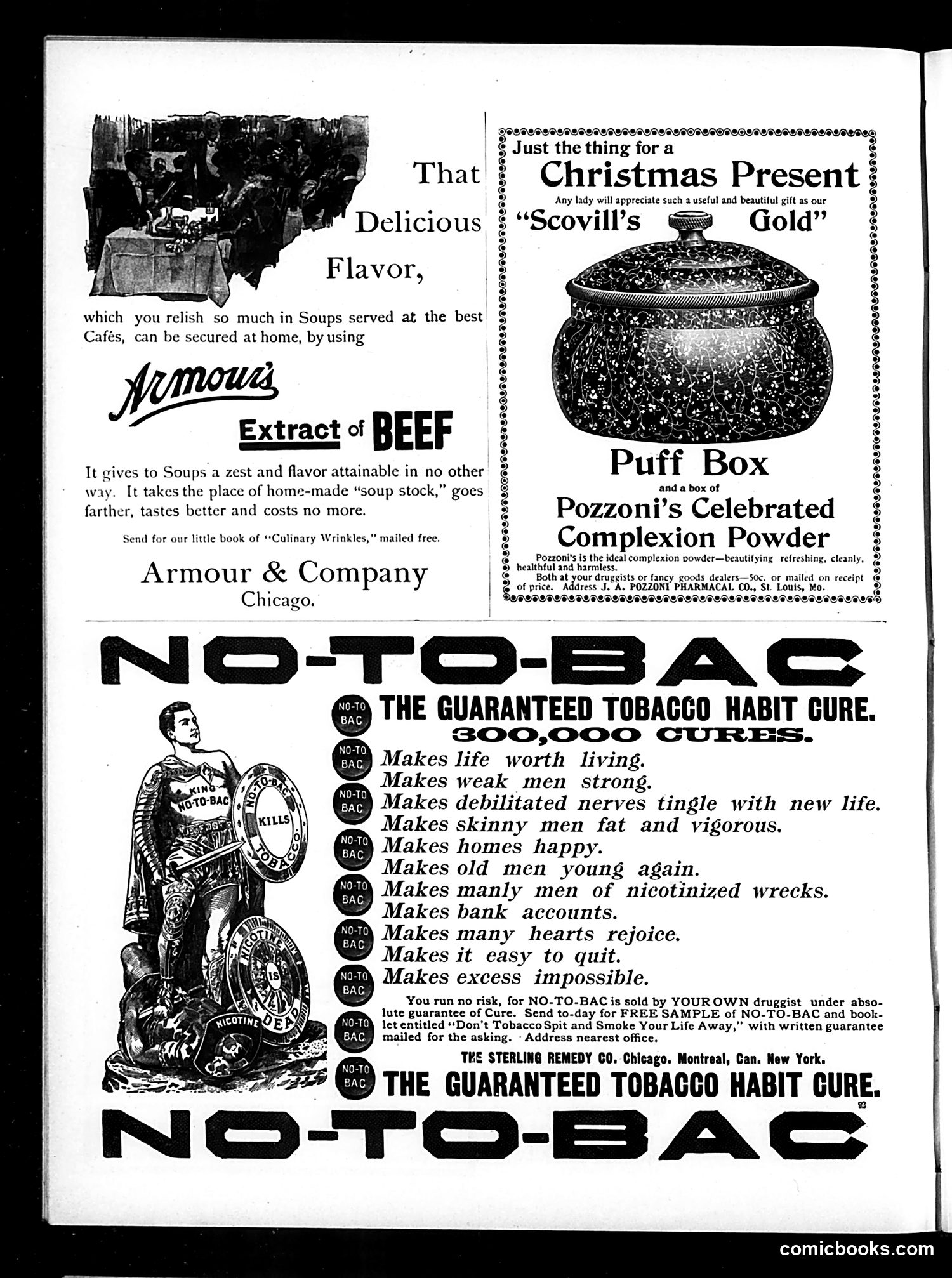
This page consists entirely of period advertisements with no political satire or editorial cartoons. **Top section:** Armour & Company promotes beef extract for home soup-making, positioning it as an economical alternative to restaurant dining. **Right column:** Two luxury gift advertisements—Scovill's decorative puff box and Pozzoni's complexion powder—target wealthy female consumers during the Christmas shopping season. **Dominant feature:** A large NO-TO-BAC advertisement claims to cure tobacco addiction, promising 300,000 successful treatments. The copy employs hyperbolic language typical of patent medicine advertising ("Makes old men young again," "Makes manly men of nicotinized wrecks"), reflecting early-20th-century advertising's unregulated medical claims. The product offered free samples and carried a money-back guarantee. **Historical context:** These advertisements reveal period consumer culture, gender marketing strategies, and the prevalence of dubious health remedies before FDA regulation.
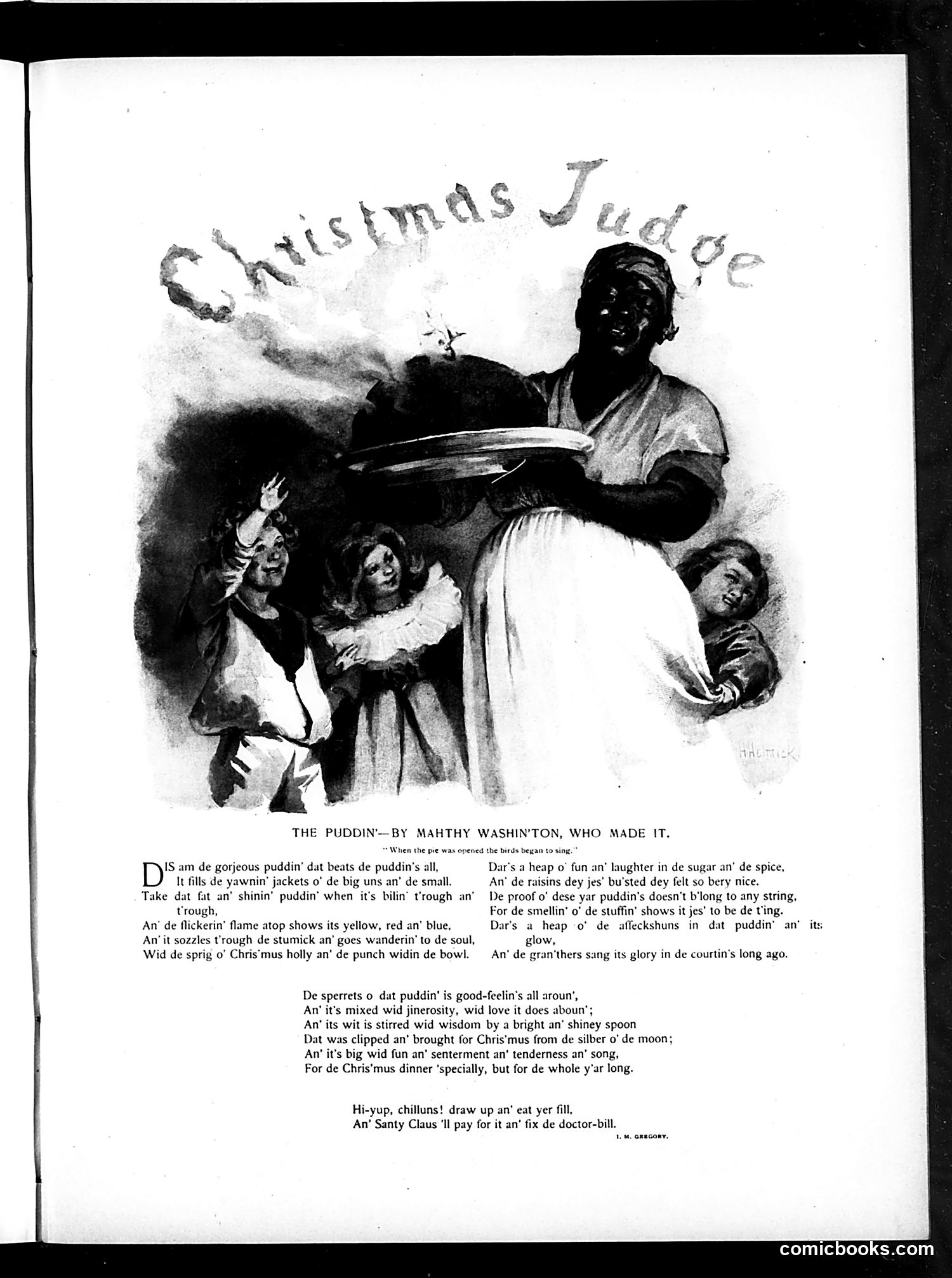
This is a humorous Christmas poem illustrated with a domestic scene. The text is written in exaggerated African American dialect popular in late-19th-century American humor magazines—a style now recognized as reflecting period racial stereotypes. The poem celebrates a Christmas pudding in flowery, sentimental language, personifying the dessert as embodying joy, generosity, and family tradition. The illustration shows an adult (likely a cook or servant) presenting a large pudding to delighted children gathered around. The joke's appeal lay in the contrast between the grandiose, romantic language applied to a simple dessert and the humble dialect voice delivering it. The closing lines add comedic absurdity: children are invited to eat freely because "Santy Claus'll pay for it an' fix de doctor-bill"—implying the pudding's richness will cause indigestion requiring medical treatment. The piece reflects Judge magazine's taste for sentimental, dialect-heavy holiday humor.
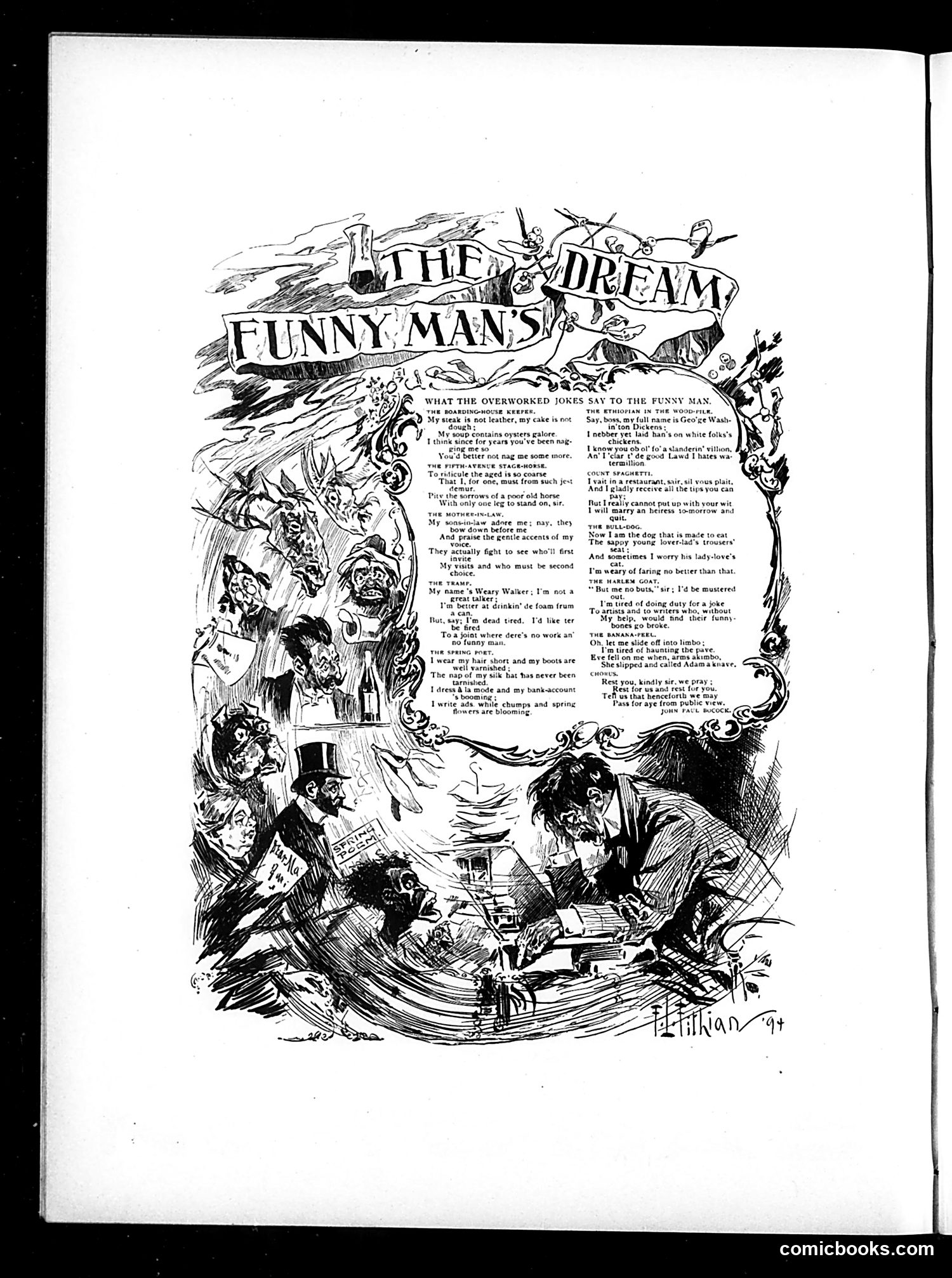
This satirical piece presents various characters complaining to an overworked comedian, depicted in the ornate border. The jokes reference popular entertainment figures and tropes of the era—including references to "George M. Cohan" (a famous theatrical performer), "Weary Walker," and "The Harlem Goat," suggesting vaudeville and stage comedy were the satirical targets. The central illustration shows two men at a desk, likely representing a comedy writer and performer struggling under demands from multiple character types seeking material. The satire mocks how comedians face endless requests from different social types—the businessman, the broke person, the romantic—each wanting jokes tailored to their situations. The piece criticizes the relentless pressure on entertainers to produce fresh material while satisfying diverse audiences with competing interests.
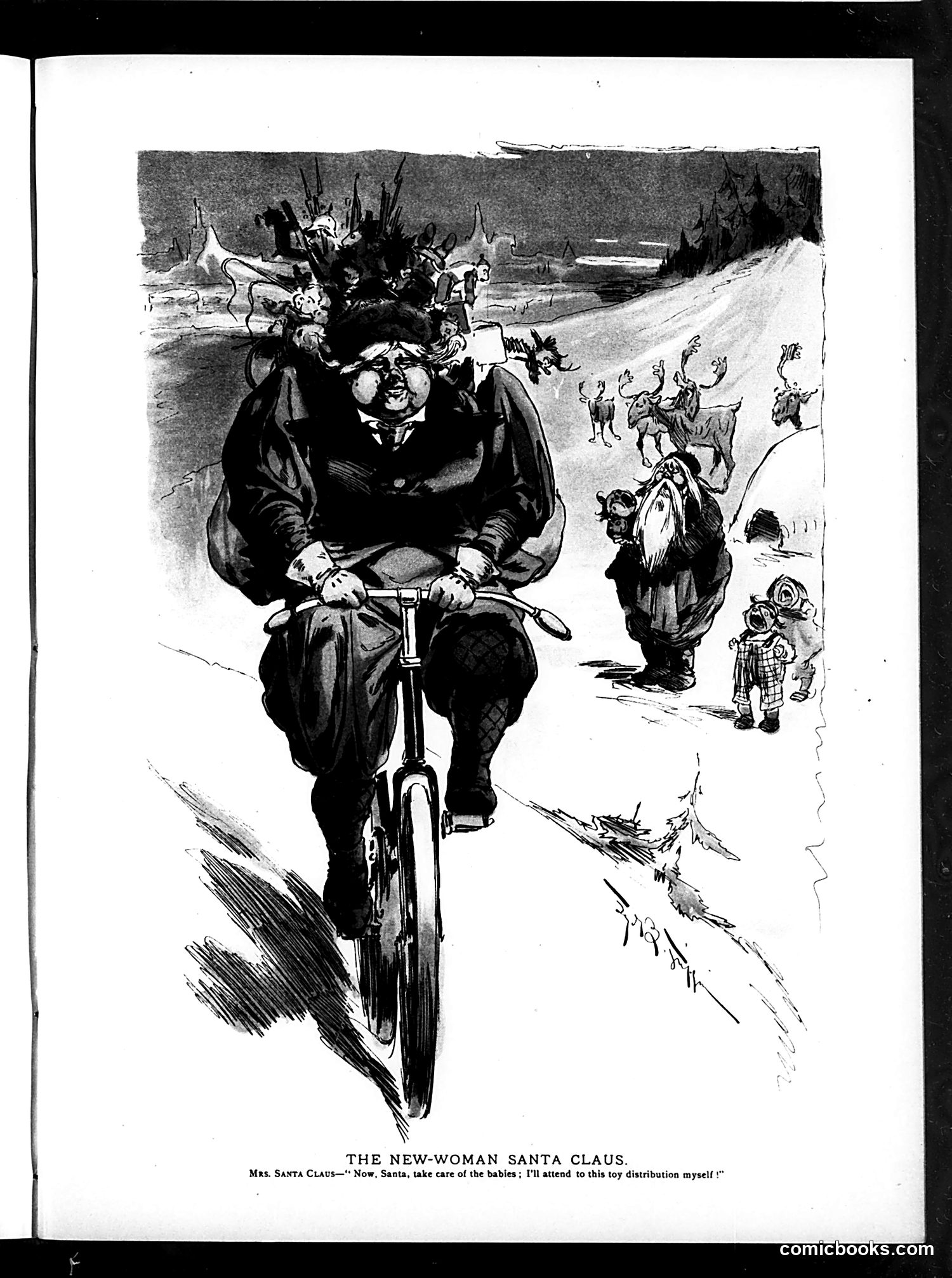
This satirical cartoon mocks the "New Woman" movement of the late 19th/early 20th century—women seeking expanded roles beyond domestic life. The image shows a large, muscular woman on a bicycle, dressed as Santa Claus, delivering toys herself while instructing the traditional male Santa to stay home and mind babies. The caption presents her declaring she'll handle "this toy distribution" while he tends domestic childcare. The satire ridicules the idea of gender role reversal, depicting the New Woman as aggressively masculine and physically imposing. The watching crowd's reactions—appearing startled or confused—emphasize contemporary discomfort with women claiming traditionally male activities and authority. Judge magazine used such cartoons to mock feminist ambitions as unnatural and socially disruptive.
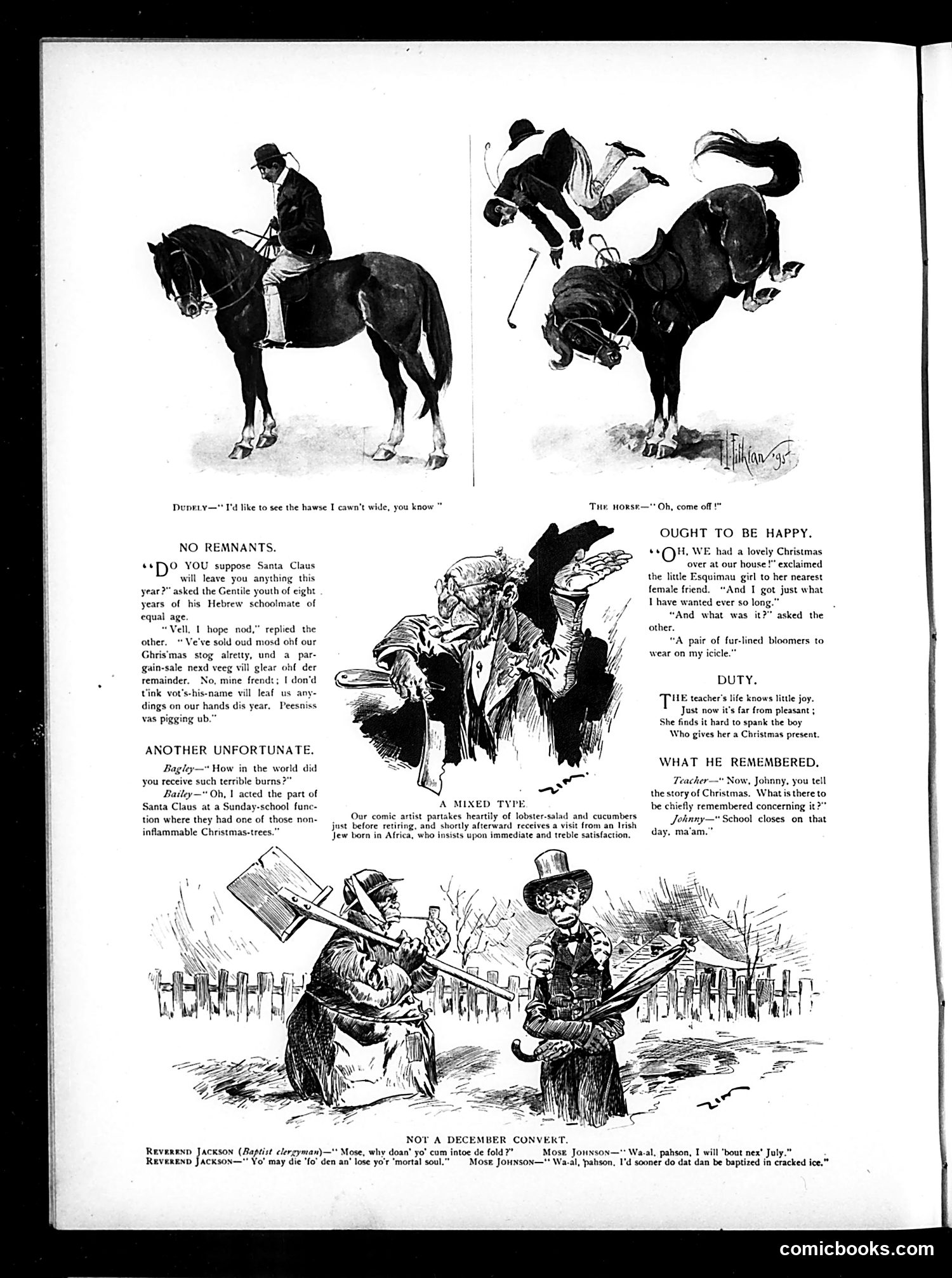
This page from *Judge* magazine presents multiple satirical cartoons about Christmas, using ethnic and racial stereotypes common to late 19th/early 20th-century American humor. **Key sketches:** - **"No Remnants"** mocks Jewish characters for their mercenary nature, depicting a Hebrew schoolboy who expects no Christmas gifts because his family sells merchandise rather than celebrates holidays. - **"Another Unfortunate"** jokes about non-flammable Christmas trees—apparently a real safety innovation—with a man claiming he was burned playing Santa at a church event using one. - **"Not a December Convert"** features a Black character ("Mose") refusing baptism, using exaggerated dialect. A white clergyman attempts conversion using fear of damnation. - **"Mixed Type"** depicts an "Irish Jew born in Africa" as comedic confusion. The humor relies on ethnic caricature, religious prejudice, and minstrelsy-style dialect to amuse primarily white Protestant readers. The satire targets non-assimilating immigrants and racial minorities rather than punching up at power.
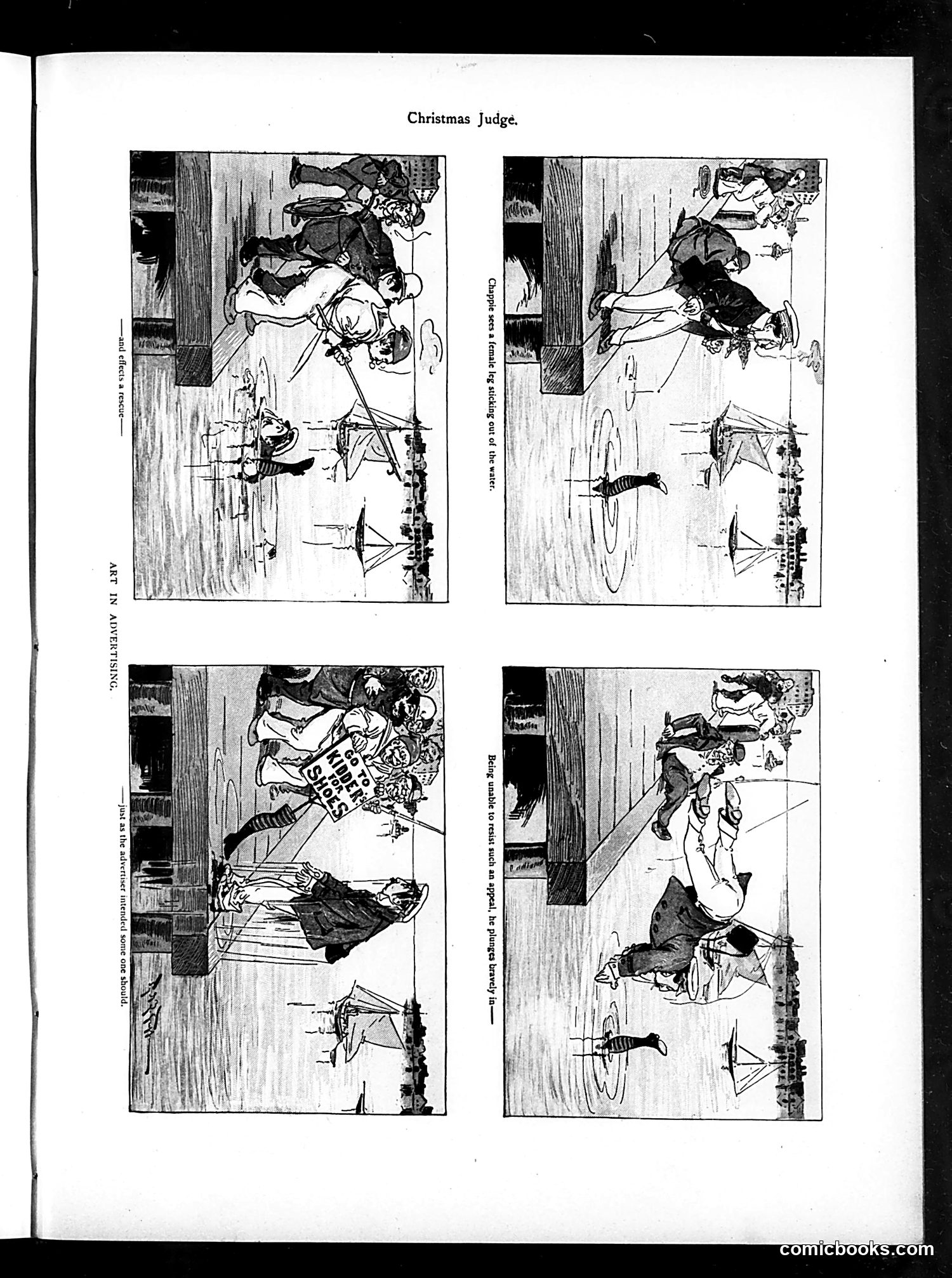
This appears to be a four-panel Christmas-themed comic strip titled "Christmas Judge" depicting a narrative sequence. The OCR text fragment "Being unable to resist such an appeal, he plunges bravely in—" suggests a character responding to some persuasion or temptation. The phrase "ART IN ADVERTISING" at the bottom indicates this may be satirizing commercial advertising practices during the Christmas season. The sequential panels likely show the consequences of the character's decision, building toward a humorous or ironic conclusion typical of Judge magazine's satirical style. Without clearer image resolution, the specific figures and exact satirical target remain unclear, though the setup suggests commentary on holiday consumerism or advertising manipulation—common Judge themes.
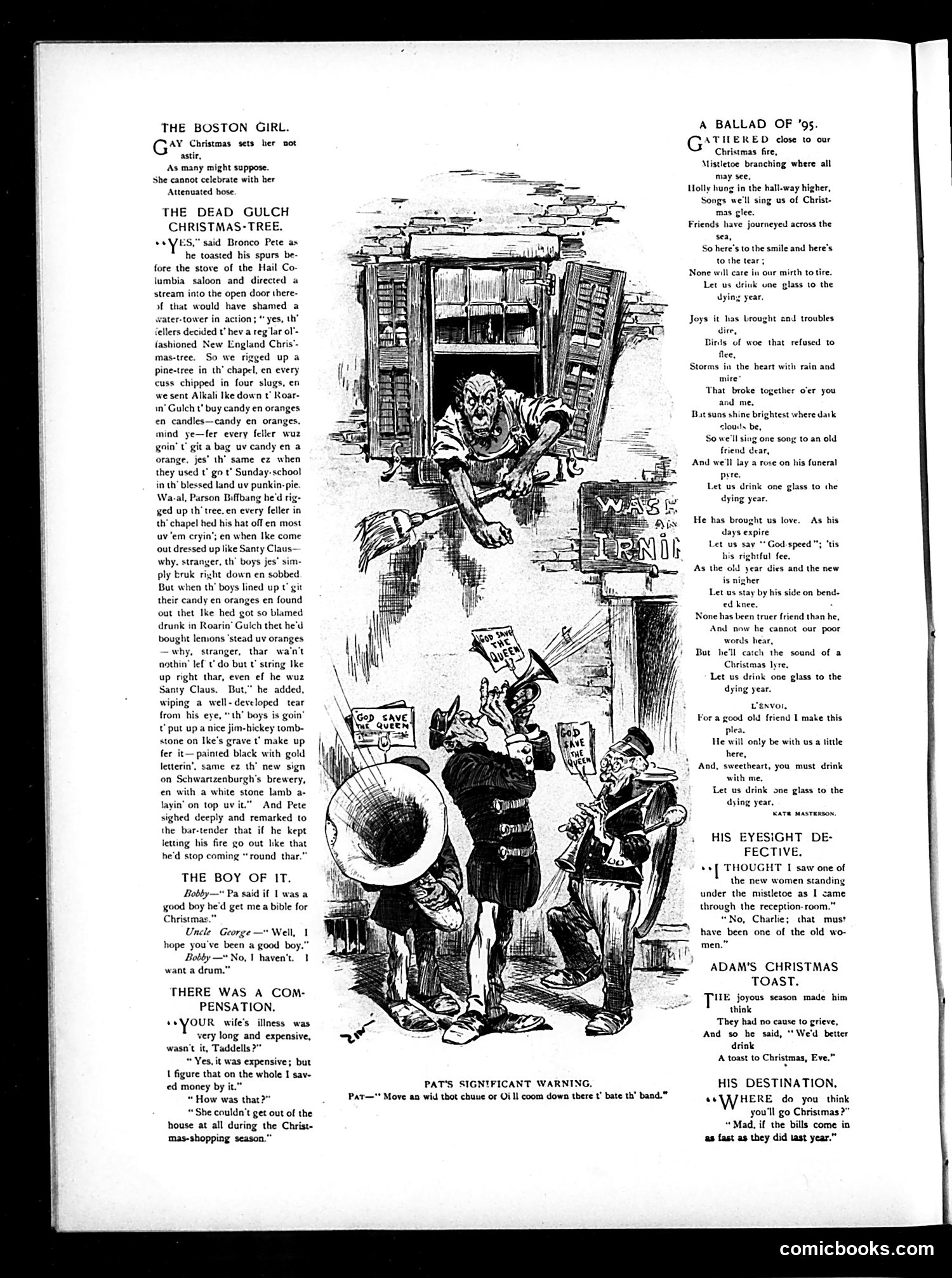
This Judge magazine page contains several satirical pieces mocking 1890s American society and customs. **The main cartoon** depicts a Western saloon Christmas scene where drunk "Alkali Ike" was supposed to buy candy and oranges for a frontier chapel's Christmas tree but instead purchased lemons while intoxicated. The cowboys lynch him in response—presented darkly comedic, reflecting Judge's cynical frontier humor. **Other sketches** include: a Boston girl who can't celebrate Christmas due to thin stockings (mocking fashion constraints); a child preferring a drum to a Bible (satirizing parental hypocrisy); and a husband relieved his wife's illness prevented Christmas shopping (mocking domestic annoyance). **"Pat's Significant Warning"** appears to mock Irish immigrants through dialect humor. The sentimental ballad and remaining pieces provide tonal contrast with conventional Christmas sentiment. The overall effect is Judge's trademark blend of crude social satire, frontier humor, and gentle domestic mockery aimed at 1890s readers.
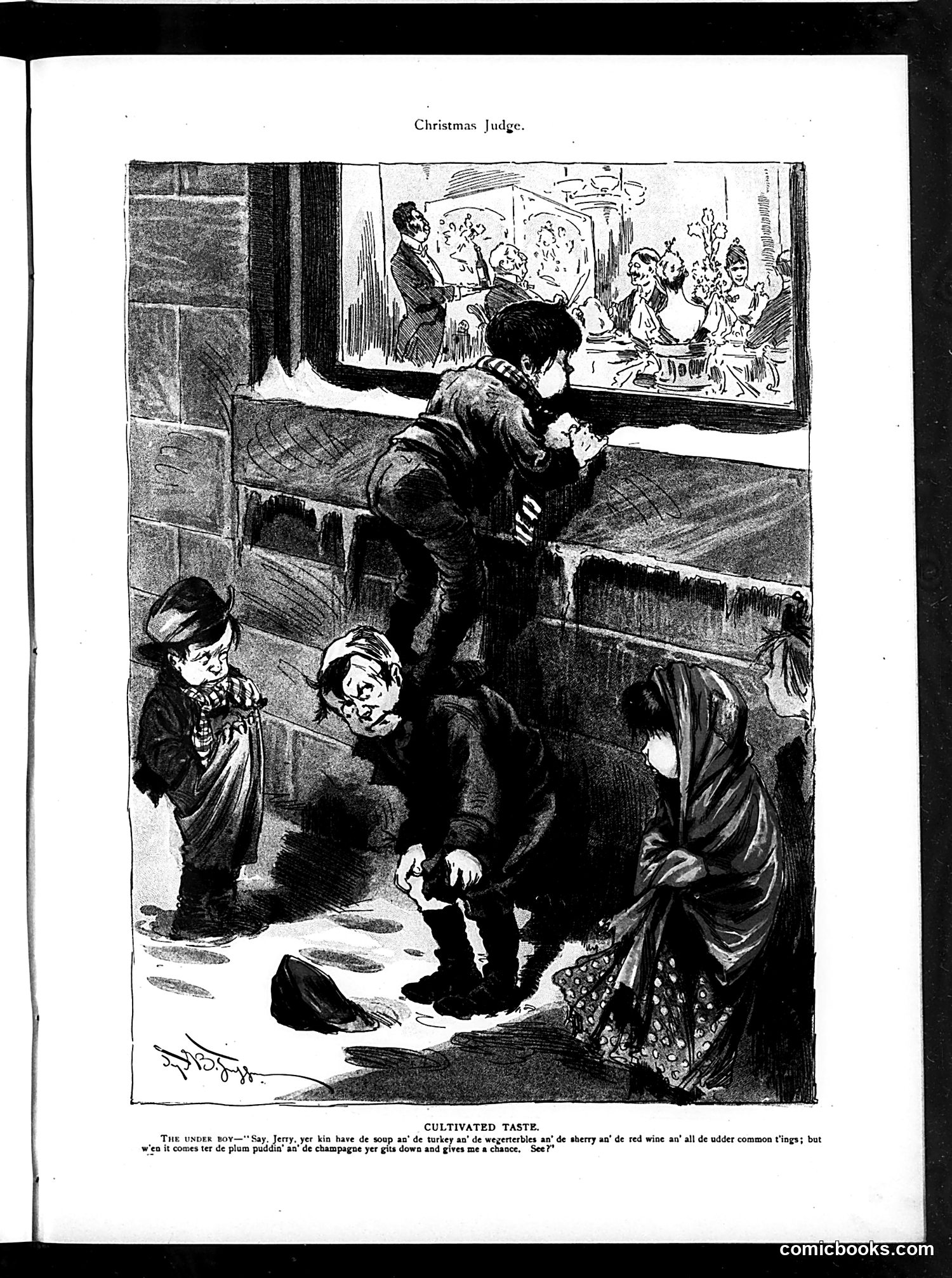
This satire depicts a street urchin ("the under boy") instructing another poor child on dining etiquette—ironically claiming refined taste. The humor lies in the contradiction: a barefoot street child lecturing about sophisticated foods (plum pudding and champagne) while speaking in exaggerated working-class dialect ("yer kin have," "wegerterbles," "t'ings"). The cartoon mocks pretension and affectation among the poor, suggesting that cultural aspirations to "cultivated taste" were absurd when one lacked basic resources. It's also likely satirizing class mobility anxieties of the era—the idea that anyone might claim sophistication regardless of their actual station. The window display visible above contrasts the elegance the children admire with their street reality.
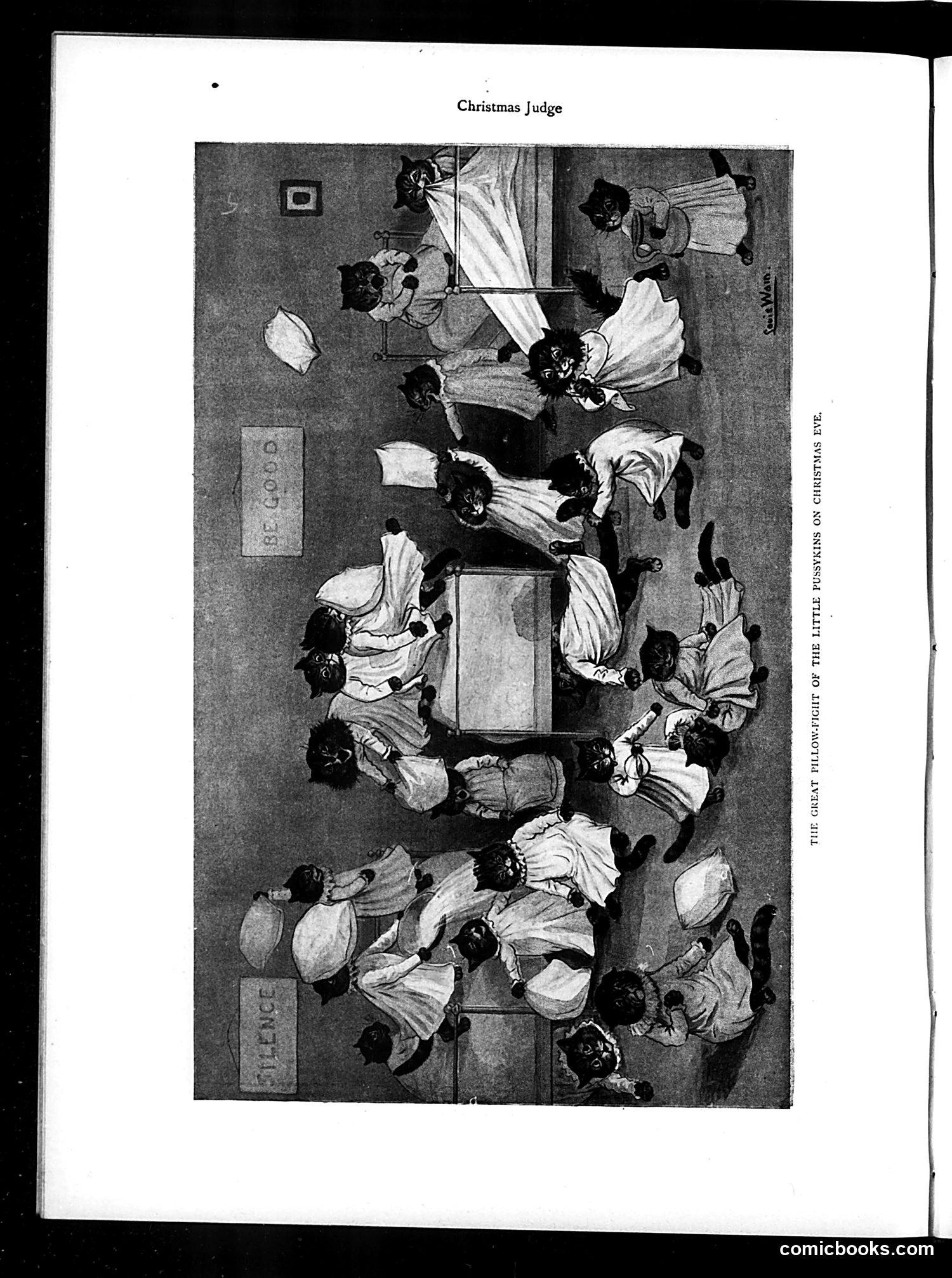
This image shows what appears to be a Christmas-themed illustration titled "The Greedy Disbursement of the Little Pensioners on Christmas Eve," though the OCR text is largely illegible. The illustration depicts multiple figures (appearing to be children or "little pensioners" as referenced) arranged around what seem to be gift boxes or distribution points, wearing light-colored clothing with wings or white fabric. The composition suggests a charitable Christmas distribution scene—likely satirizing how such charity was administered or received. Without clearer text, the specific satirical target is unclear, though Judge magazine typically mocked corruption, inequality, or hypocrisy in social institutions. The scene may critique the inadequacy of Christmas charity, unfair distribution of aid, or institutional mismanagement of relief for impoverished children.
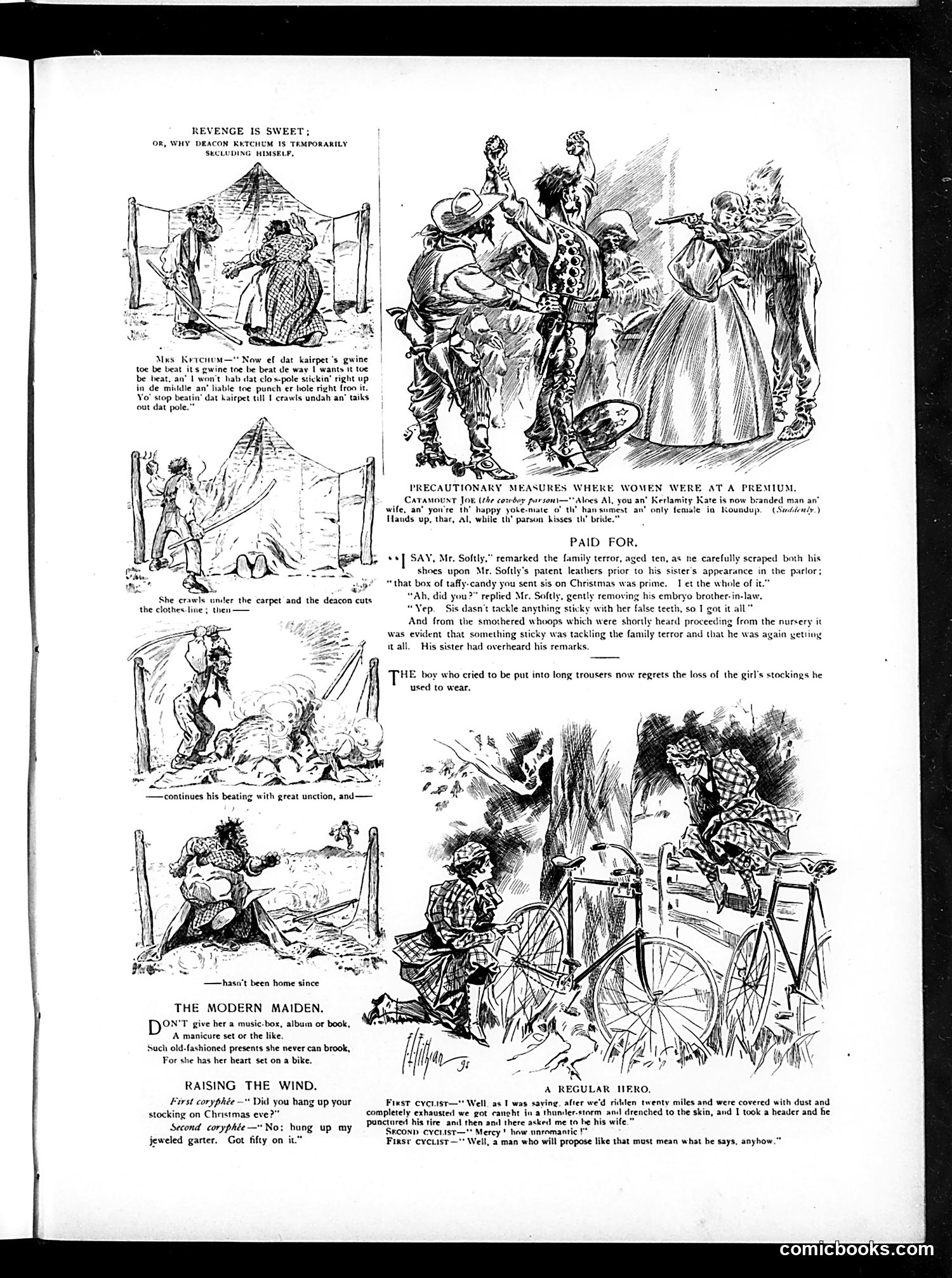
This page contains several unrelated humorous sketches targeting late-19th/early-20th-century social attitudes: **"Revenge is Sweet"**: A domestic comedy where Mrs. Ketchum insists on beating a carpet her way, forcing Deacon Ketchum to crawl underneath. When he cuts the clothesline, she becomes trapped, giving him petty domestic revenge. The dialect suggests working-class characters. **"The Modern Maiden"**: Mocks young women's newfound independence, suggesting they prefer bicycles (symbol of female mobility and freedom) over traditional gifts like music boxes or jewelry. **"Raising the Wind"**: Two women discuss betting their jewelry on Christmas Eve—satirizing female gambling or financial recklessness. **"Where Women Were at a Premium"** and **"Paid For"**: Western/frontier humor about women's scarcity and value in remote areas; a boy's manipulation of gift-giving. **"A Regular Hero"**: Cyclists discussing a man's proposal made after a disaster—questioning whether romantic sincerity matters if the sentiment is genuine. The overall theme: satirizing changing social norms around women's autonomy, consumer habits, and courtship customs.
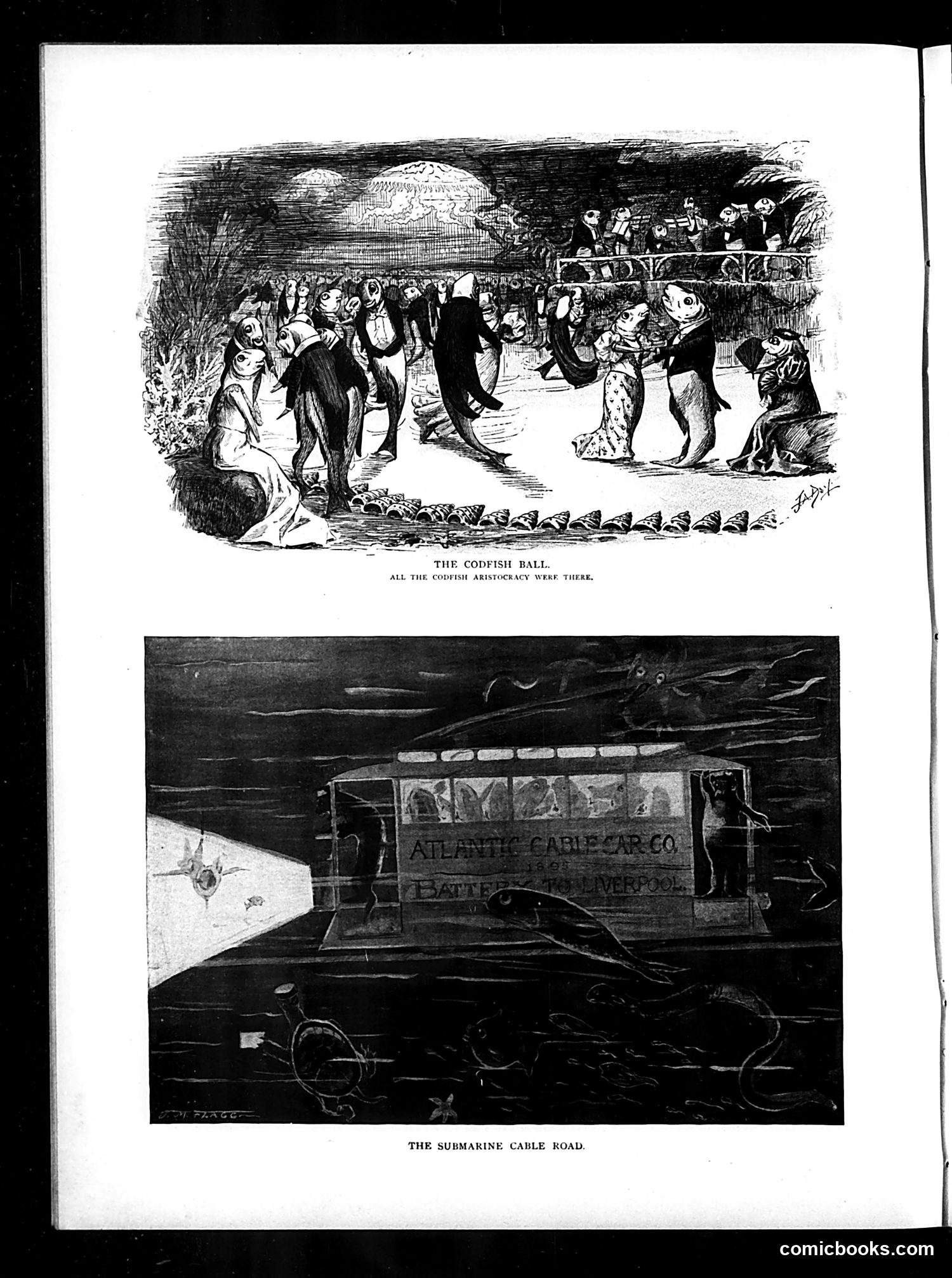
This page contains two satirical cartoons from *Judge* magazine. **"The Codfish Ball"** (top): A sketch showing aristocratic figures at a formal ball, with the caption "All the codfish aristocracy were there." This is likely a satirical jab at Boston's upper class, playing on the city's historical association with the cod fishing industry. The joke suggests that Boston's elite pretend to refined aristocratic status despite their origins in commerce. **"The Submarine Cable Road"** (bottom): A photograph or detailed illustration showing the Atlantic Cable Car Company cable apparatus. This appears to reference the transatlantic telegraph cable infrastructure, possibly satirizing the technological marvel or the commercial interests involved in submarine cable operations between Europe and Liverpool. Both items mock social pretension and modern technological/industrial developments of the era.
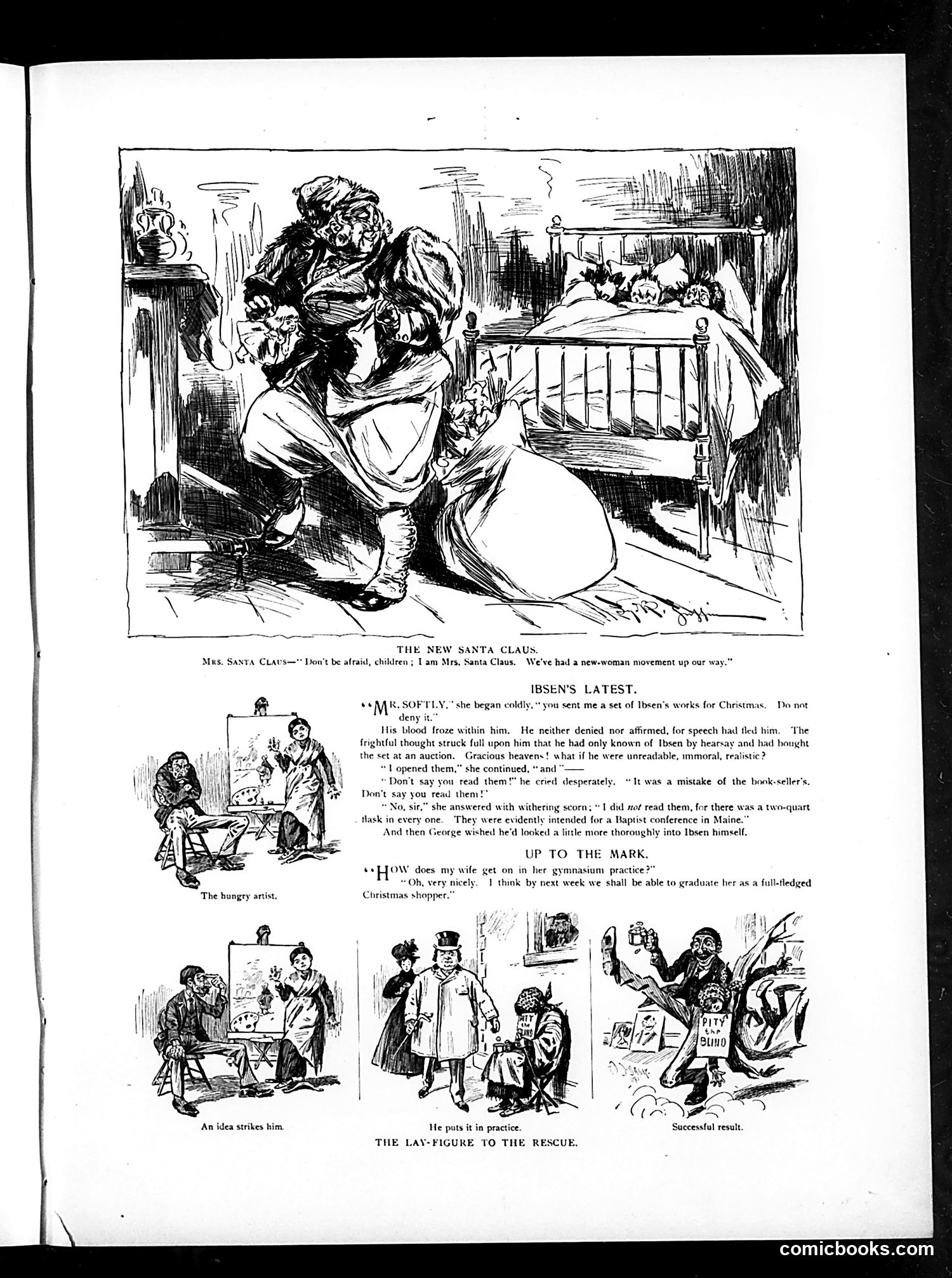
This Judge magazine page contains three separate satirical pieces mocking late 19th-century social trends: **"The New Santa Claus"** ridicules the "New Woman" movement—the emerging feminist push for women's independence and equality. Mrs. Santa Claus replaces the traditional male figure, representing anxieties about changing gender roles. **"Ibsen's Latest"** satirizes both Henrik Ibsen's then-controversial plays (seen as immoral and realistic) and gift-giving gone wrong. A husband buys an expensive Ibsen set at auction without reading it; his wife discovers it was mislabeled whiskey flasks intended for a Baptist conference. The joke: Ibsen's works were considered so unreadable that whiskey bottles were hidden inside them. **"Up to the Mark"** and **"Lay-Figure to the Rescue"** mock wives' aggressive Christmas shopping, suggesting gymnasium training prepares women for the "full-fledged" consumer behavior required during the holiday season—treating shopping as athletic competition. All three pieces express skepticism toward women's changing roles and modernizing society.
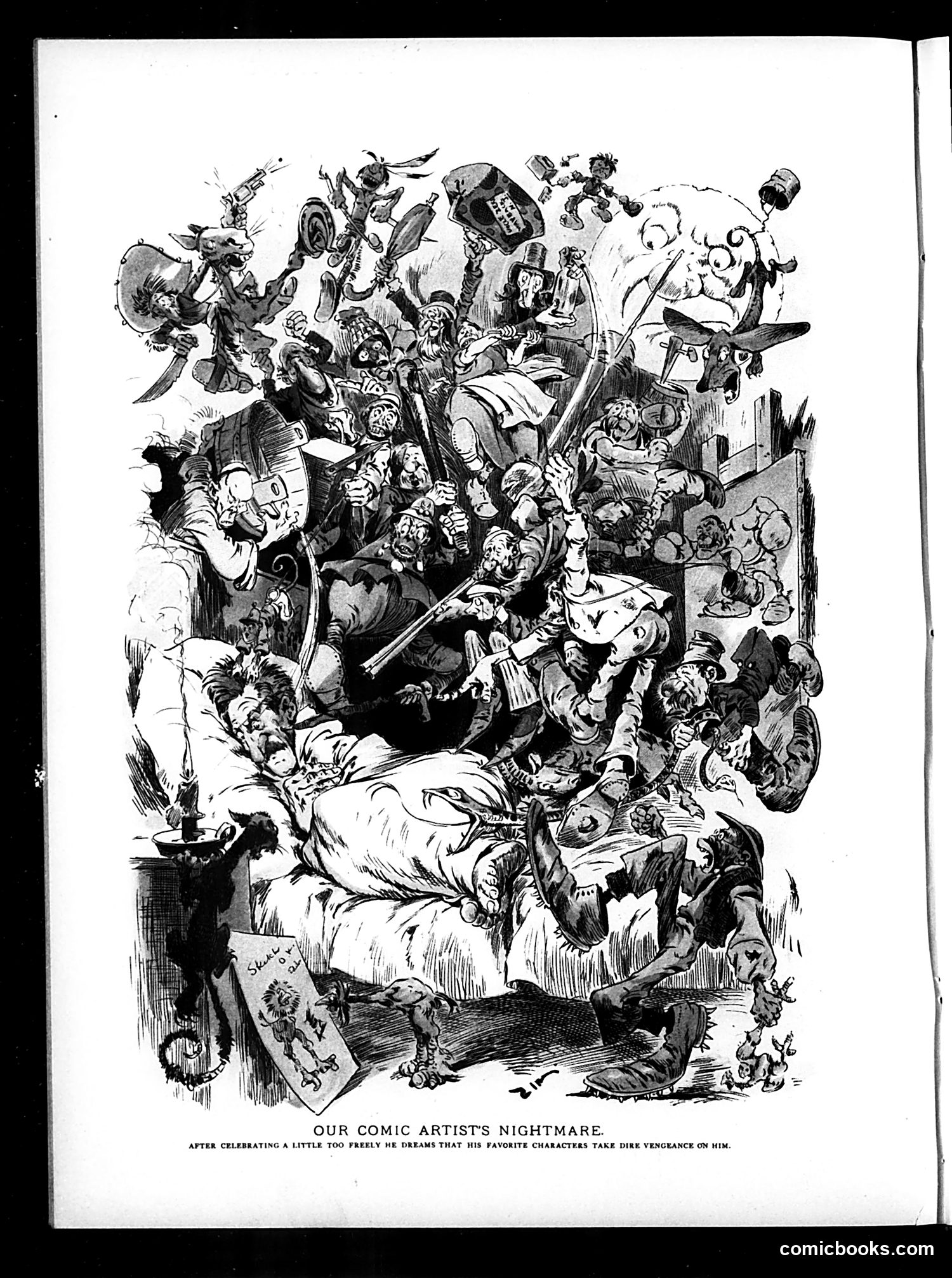
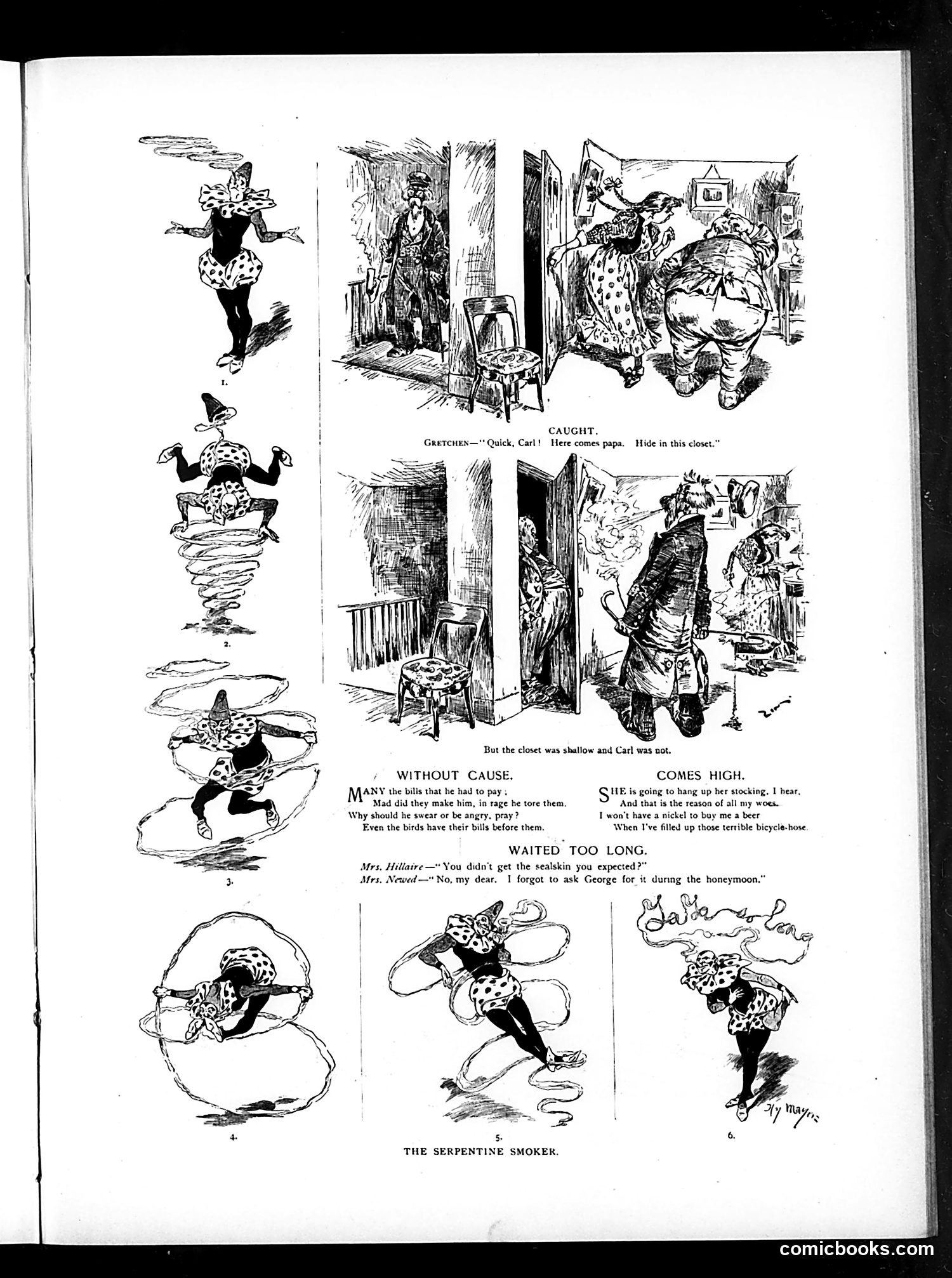
This is a chaotic dream-sequence cartoon depicting an artist's imaginary punishment by his own creations. The caption explains the artist celebrated "a little too freely" (drank too much) and now dreams his favorite characters take vengeance on him. The central sleeping figure at bottom represents the intoxicated artist. Surrounding him is a swirling mob of grotesque, exaggerated cartoon characters—likely his own inventions—attacking him from all directions. They're shown as violent, menacing versions of typical comic-strip figures: diminutive creatures, absurdly proportioned beings, and caricatured humans wielding various weapons and implements in what appears to be chaotic assault. The satire mocks both the artist's excess drinking and, implicitly, the wild nature of his own comic creations turning hostile. It's a visual pun on artistic responsibility—his exaggerated characters literally come back to haunt him.
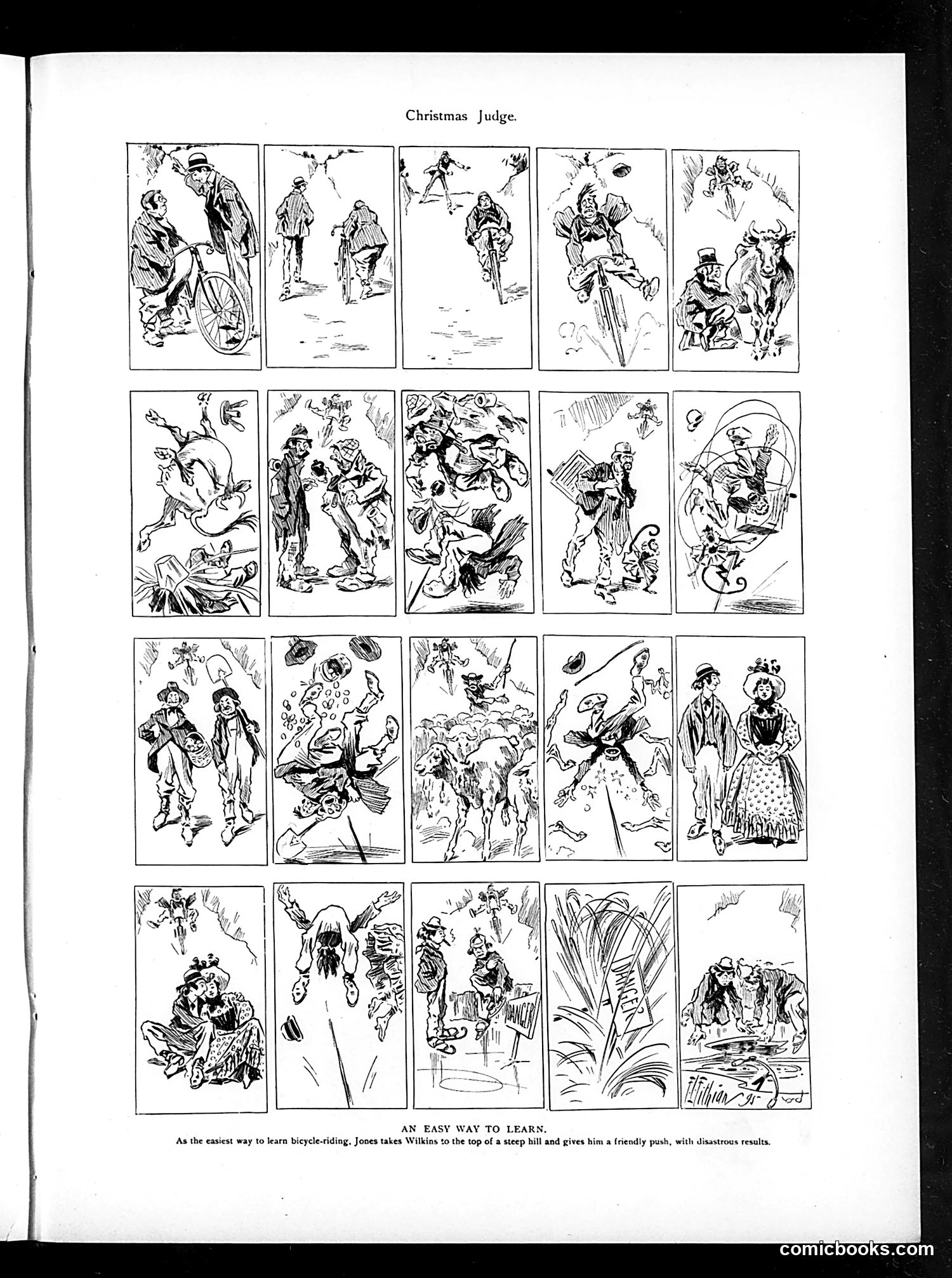
This comic strip satirizes a dangerous "teaching method" for bicycle riding. The narrative follows Jones taking his friend Wilkins to a steep hill and pushing him off—supposedly to teach him to ride. The twenty-panel sequence depicts the predictable chaos: Wilkins tumbling down the hillside on his bicycle, crashing repeatedly, colliding with various obstacles (trees, animals, other people), and generally experiencing comedic disaster. Each panel escalates the mayhem. The joke is the absurdity of the premise—that throwing someone down a hill would teach bicycle skills. It's slapstick humor mocking both the "learn by doing" philosophy and the foolish friend who agrees to such a scheme. The satire works through exaggeration: what begins as a dubious idea becomes increasingly ridiculous visual comedy across the strip's progression.
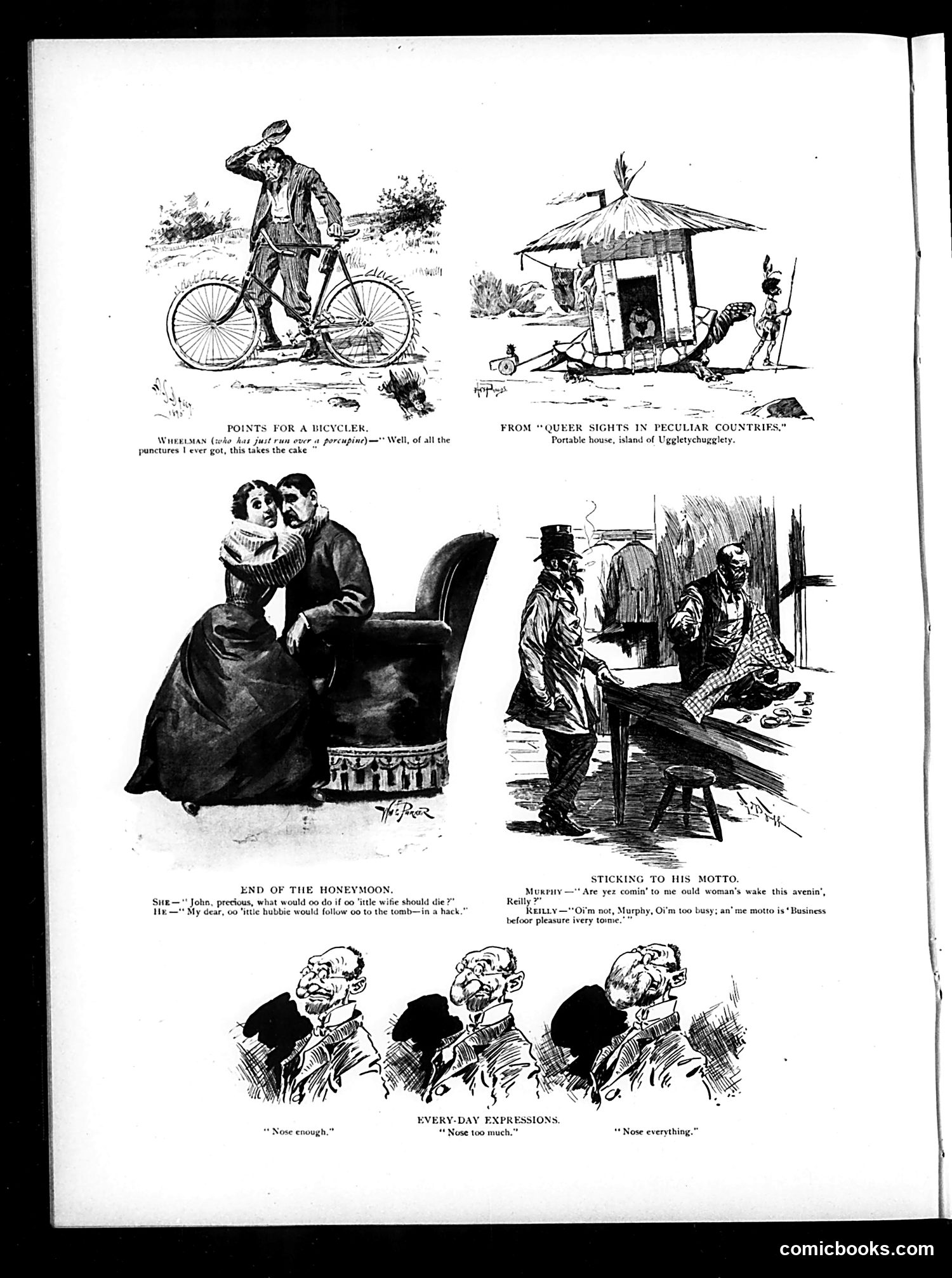
This page contains five separate comic sketches satirizing Victorian-era social conventions and manners: **Top left:** "Points for a Bicycler" mocks cycling enthusiasts with a pratfall joke—a man has hit a porcupine while riding, creating an ironic "puncture" pun. **Top right:** References exotic travel literature, showing a portable house in an imaginary "Uggletychugglety" island, satirizing the period's fascination with colonial oddities and strange foreign customs. **Middle left:** "End of the Honeymoon" depicts newlyweds, with the husband making melodramatic promises to follow his wife to death, while she cynically responds he'd only follow "in a hack" (taxi)—mocking the gap between romantic ideals and marital reality. **Middle right:** "Sticking to His Motto" shows working-class characters (Murphy and Reilly, Irish names suggesting ethnic humor) prioritizing business over social obligations, satirizing the era's tension between leisure and capitalist work ethics. **Bottom:** "Everyday Expressions" shows three identical profiles of a man's nose in different positions, likely satirizing physiognomy pseudoscience or simply mocking obsessive attention to minor physical details.
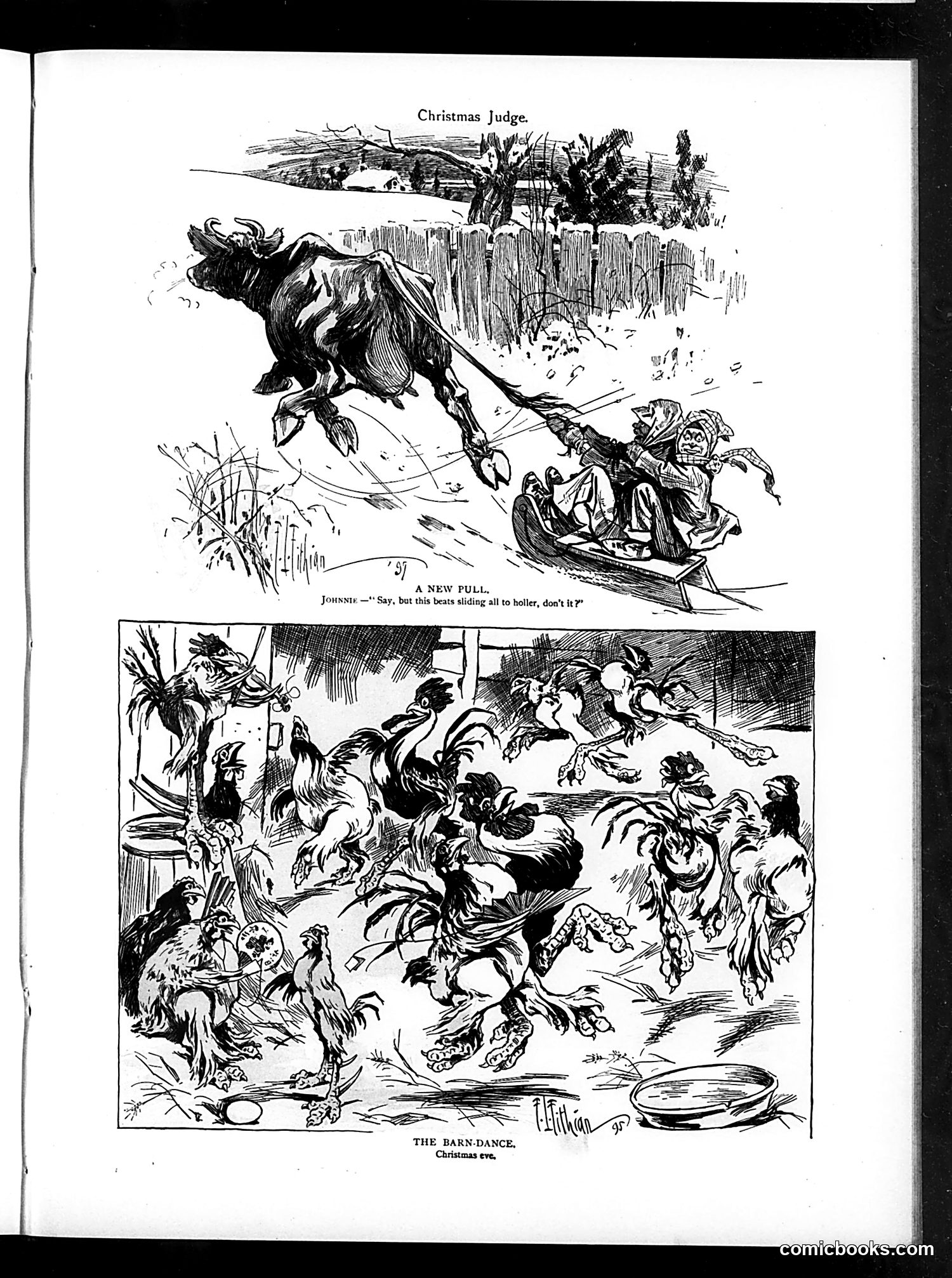
This page contains two seasonal cartoons with animal characters: **"A New Pull"** (top): Shows horses pulling a sleigh with children, captioned with dialogue where "Johnnie" comments that this "beats sliding all to holler." The joke plays on children's winter activities—sleigh-riding versus sledding—presenting the horse-drawn sleigh as superior entertainment. **"The Barn-Dance, Christmas Eve"** (bottom): Depicts a chaotic gathering of animals (roosters, dogs, and other farm creatures) apparently dancing or fighting in a barn. The humor derives from the absurdity of farm animals mimicking human social customs—a Christmas Eve barn dance—which was a common rural entertainment. Both cartoons use anthropomorphized animals for gentle, family-friendly holiday humor typical of *Judge* magazine's satirical approach. The caricatures mock rural life and seasonal traditions rather than specific political figures.
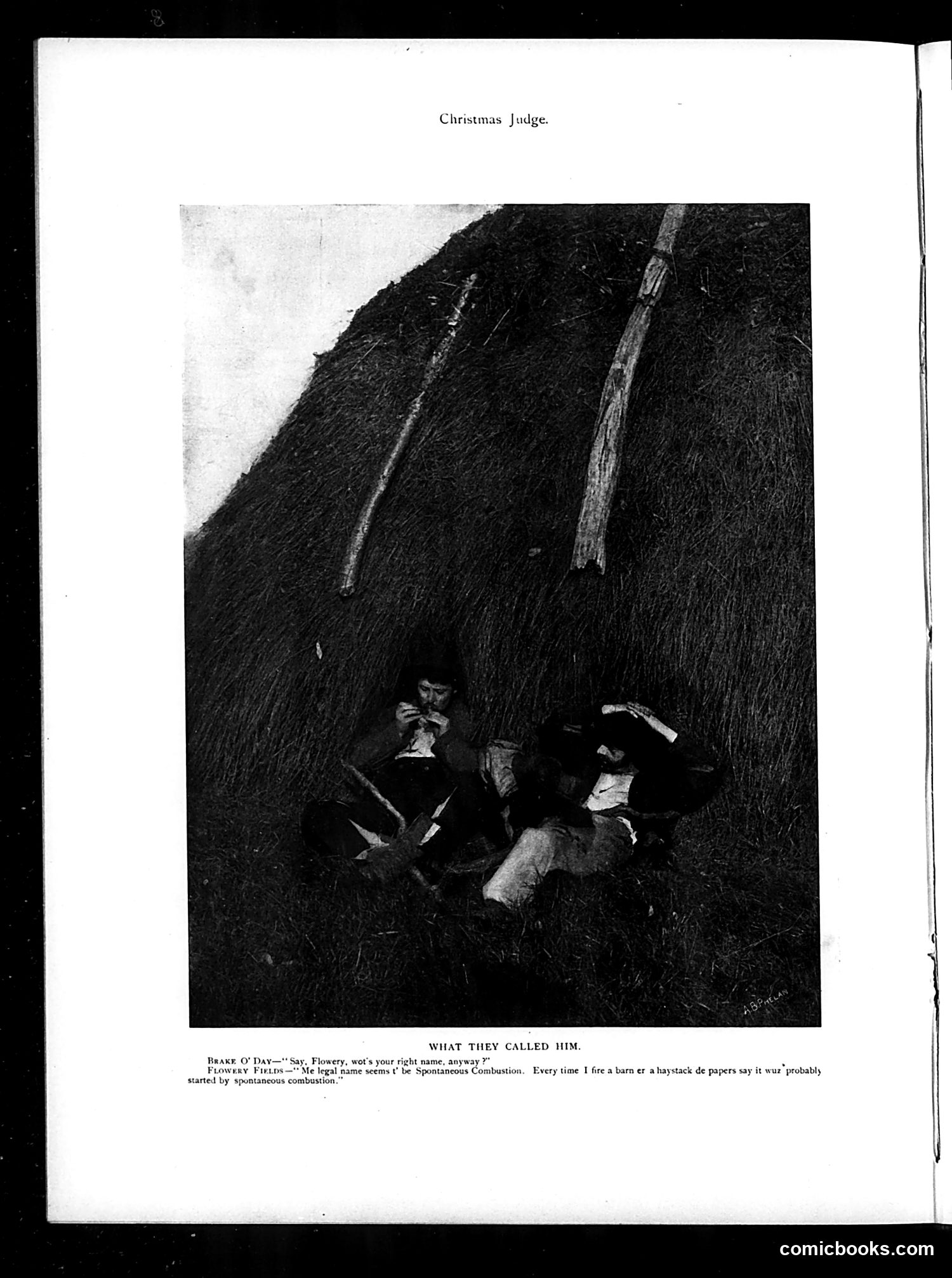
This Judge cartoon satirizes a figure known by the nickname "Brake O'Day" (likely a play on words for an arsonist who operates at dawn). The piece mocks someone whose frequent barn fires and haystack fires are so numerous that newspapers routinely attribute them to "spontaneous combustion" rather than deliberate arson. The joke hinges on the absurdity: the character's legal name has apparently become "Spontaneous Combustion" because that's what the press always reports. It's social satire about either actual serial arson being overlooked due to convenient explanations, or possibly about a public figure whose destructive actions are consistently excused by authorities and media through implausible explanations. The crude woodcut style is typical of Judge's satirical imagery of this era.
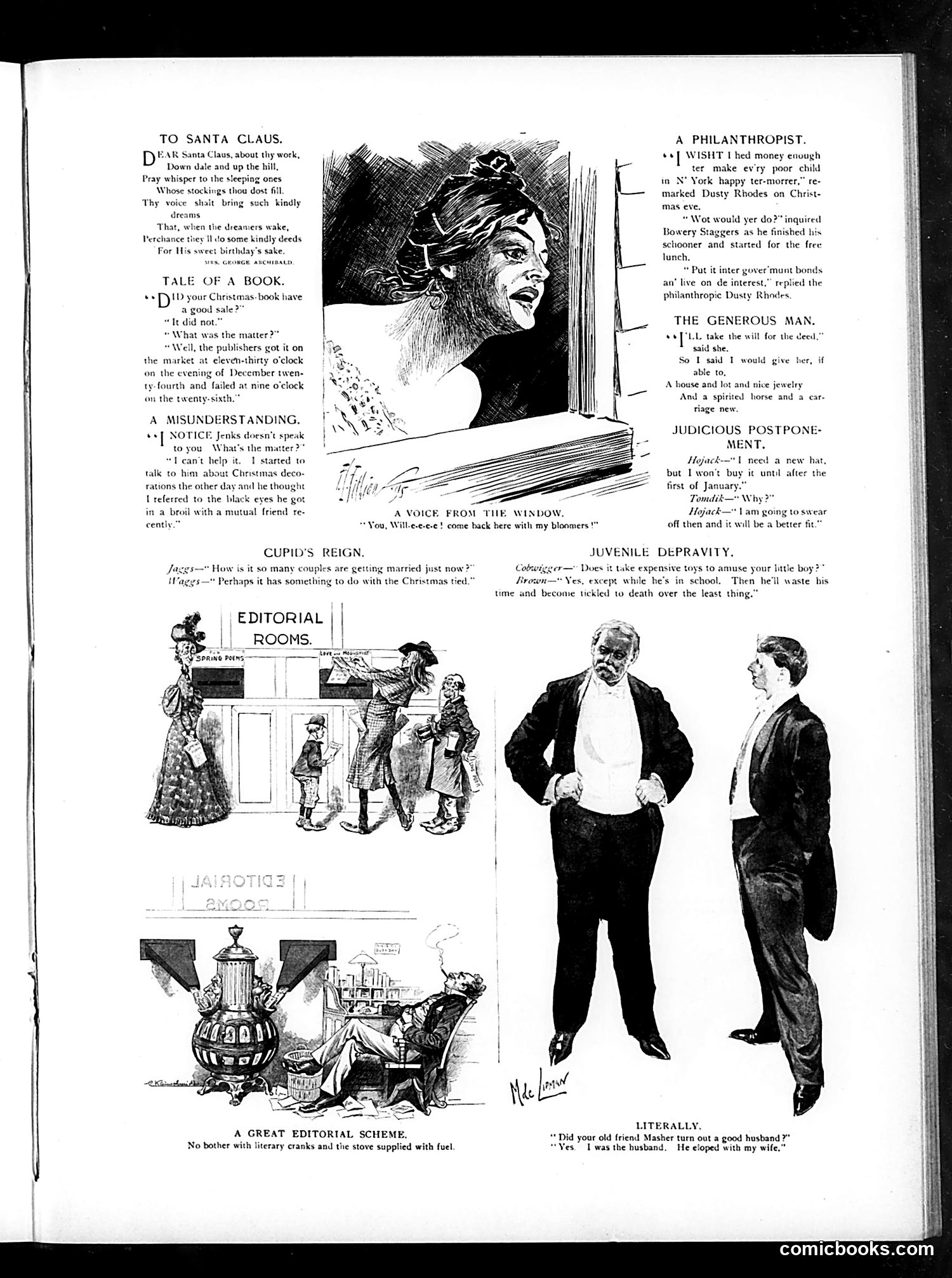
This page contains several brief satirical sketches typical of Judge magazine's humor: **"A Philanthropist"** mocks wealthy charitable pretense: Dusty Rhodes claims he'd make poor children happy by investing their money in government bonds and living off the interest—prioritizing personal profit over actual aid. **"Cupid's Reign"** jokes about Christmas wedding trends, suggesting marriage timing relates to holiday season rather than genuine romance. **"The Generous Man"** satirizes insincere romantic promises: a man offers extravagant gifts (house, jewelry, carriage) he has no intention of providing. **"Judicious Postponement"** humorously depicts marital avoidance—a man plans to quit swearing specifically so his wife won't buy him a new hat (avoiding the expense). **"A Voice from the Window"** appears to show a woman reclaiming her bloomers (undergarments), suggesting either infidelity or theft humor. **"Literally"** presents dark marital humor: a man became a "good husband" by absconding with someone else's wife. The page emphasizes late-19th-century themes: hypocrisy, failed romance, and marital discord, all delivered through punchy dialogue and illustrations.
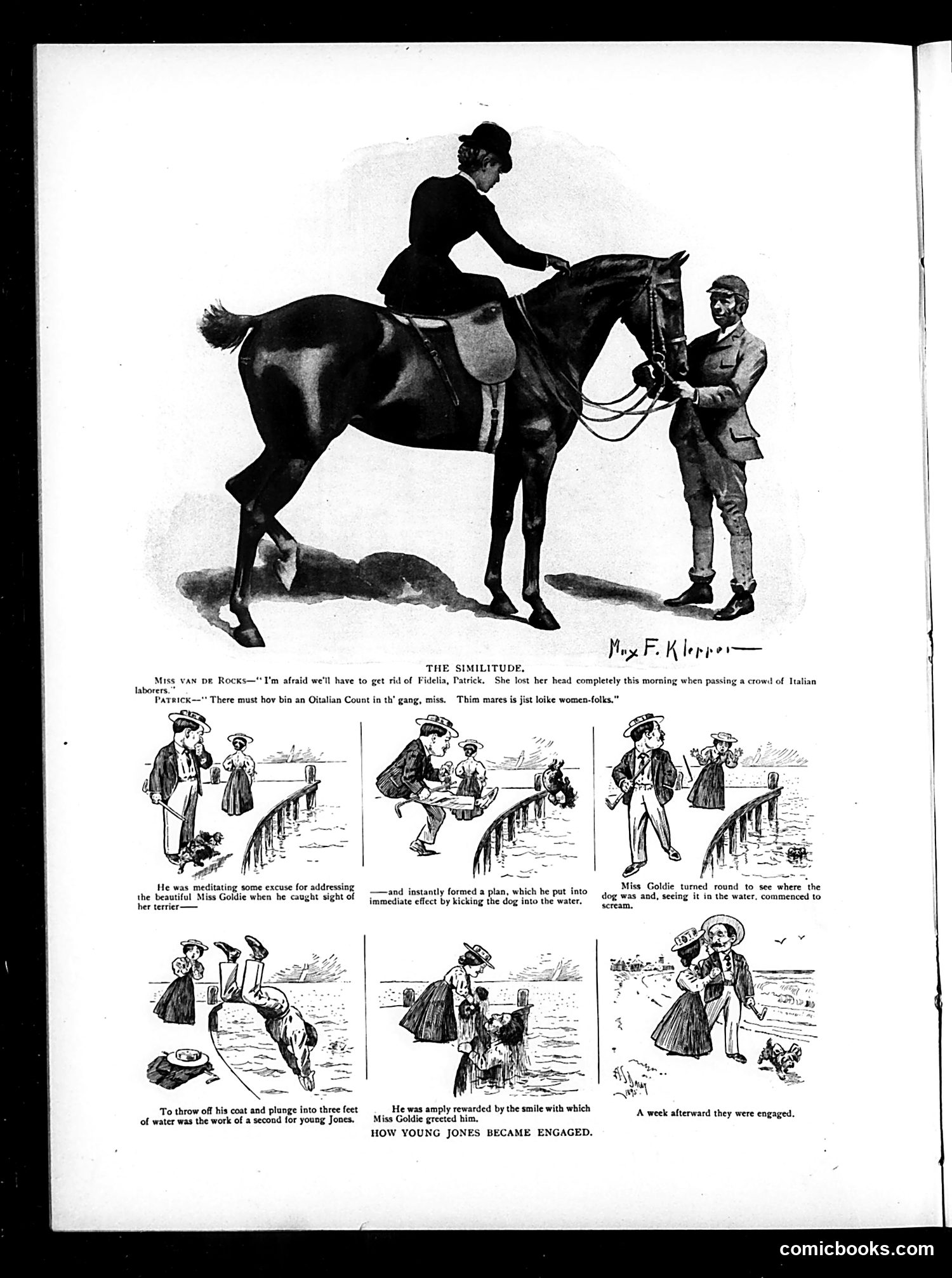
This two-part satirical piece mocks both women and Irish servants through ethnic stereotyping. **Top cartoon**: Miss Van de Rocks complains her horse "Fidelia" became distracted seeing Italian laborers. Her Irish servant Patrick responds that horses are "just like women-folks"—suggesting both are irrational and susceptible to romantic distraction from foreign men. The joke relies on period prejudice against Italian immigrants and sexist assumptions about women's judgment. **Bottom sequence**: A young man named Jones impresses Miss Goldie by dramatically rescuing her small dog from water (which he himself kicked in). She rewards him with romantic interest, leading to engagement within a week. The satire suggests women are so easily manipulated by grand gestures and superficial chivalry that a transparent ploy succeeds instantly. Both narratives reinforce contemporary stereotypes: women lack reason, servants speak in exaggerated dialect, and immigrant labor is viewed with suspicion.
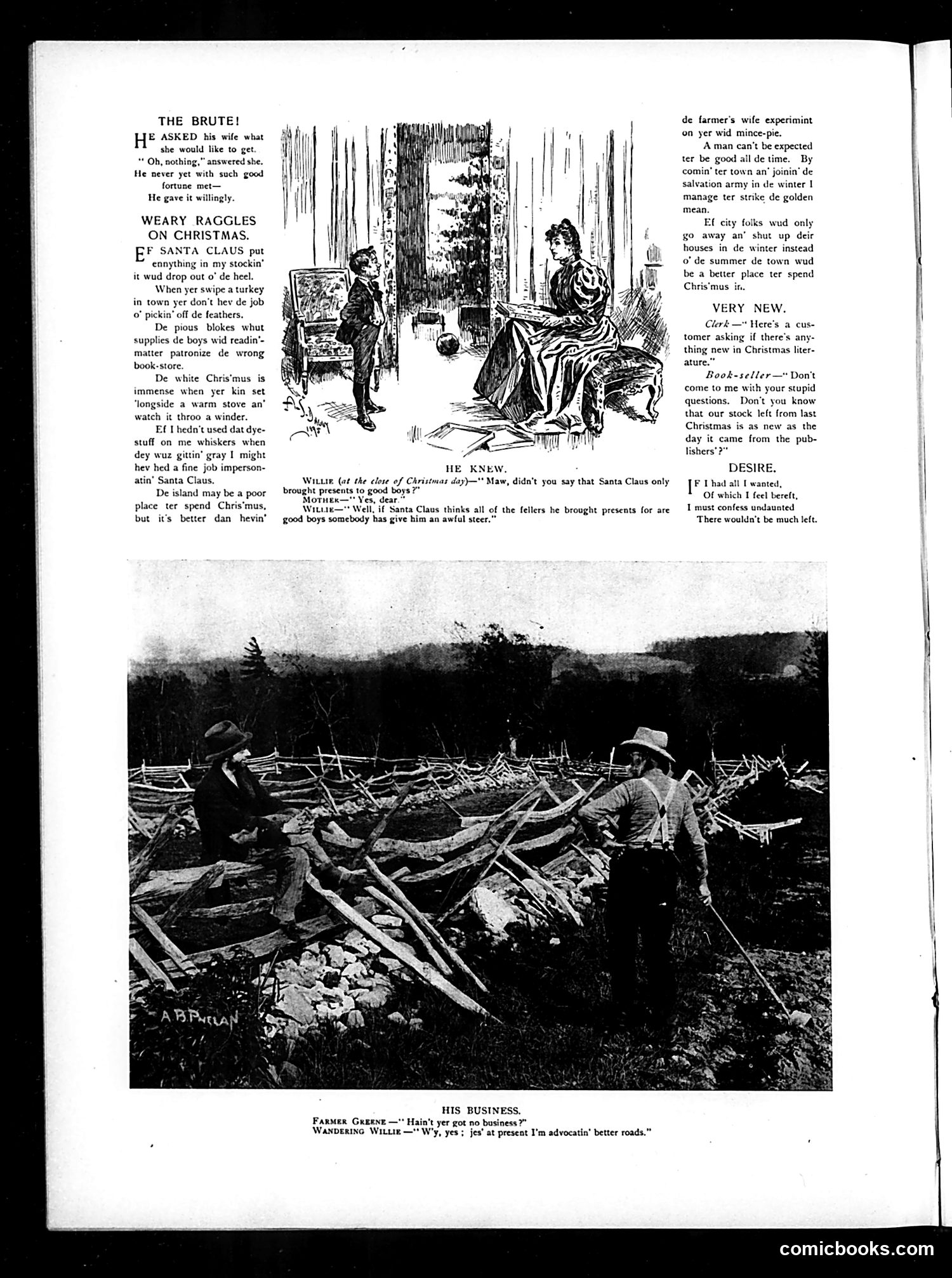
This page contains multiple brief satirical pieces on Christmas themes, typical of Judge's style: **"The Brute"** mocks a stingy husband who, asked by his wife what she wants for Christmas, gives her "nothing" because she said she wanted nothing—playing on masculine literalism and cheapness. **"Weary Raggles on Christmas"** features a vagrant character reflecting that island poorhouses beat homelessness, and that he'd impersonate Santa if his dyed whiskers hadn't worked out—satirizing urban poverty and the disconnect between holiday cheer and actual hardship. **"He Knew"** shows a child catching Santa in a moral inconsistency: if Santa only rewards good boys, why did he bring presents to obviously bad ones? **"His Business"** depicts a wandering tramp claiming to "advocate better roads" as his occupation—satirizing vagrants' excuses and, likely, actual 1890s-era road-improvement activism. The bottom photograph appears unrelated editorial content showing manual laborers.
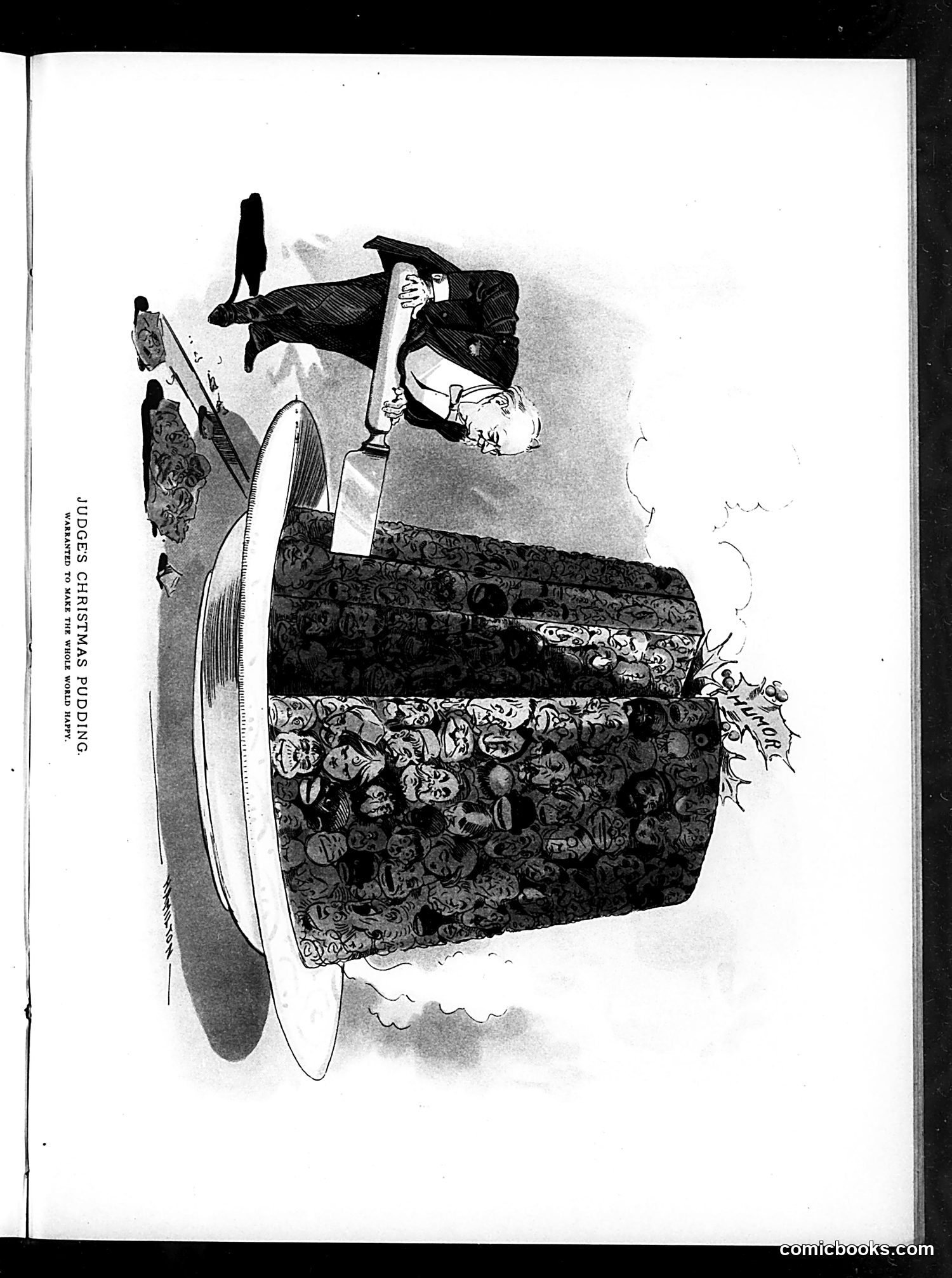
This satirical cartoon depicts a massive Christmas pudding labeled "Judge's Christmas Pudding" — "Warranted to Make the Whole World Happy." The pudding's interior is packed with caricatured faces of what appear to be political figures and public personalities of the era, rendered in intricate detail. A well-dressed man in formal attire stands atop the pudding, wielding a large spoon or ladle as if to serve it. Small figures stand in the background, observing the scene. The satire suggests that *Judge* magazine offers its readers a satirical "recipe" containing commentary on contemporary political and social figures. By packaging these caricatures into a festive pudding, the cartoon humorously proposes that exposure to the magazine's satirical content on prominent people constitutes wholesome holiday entertainment for the public.
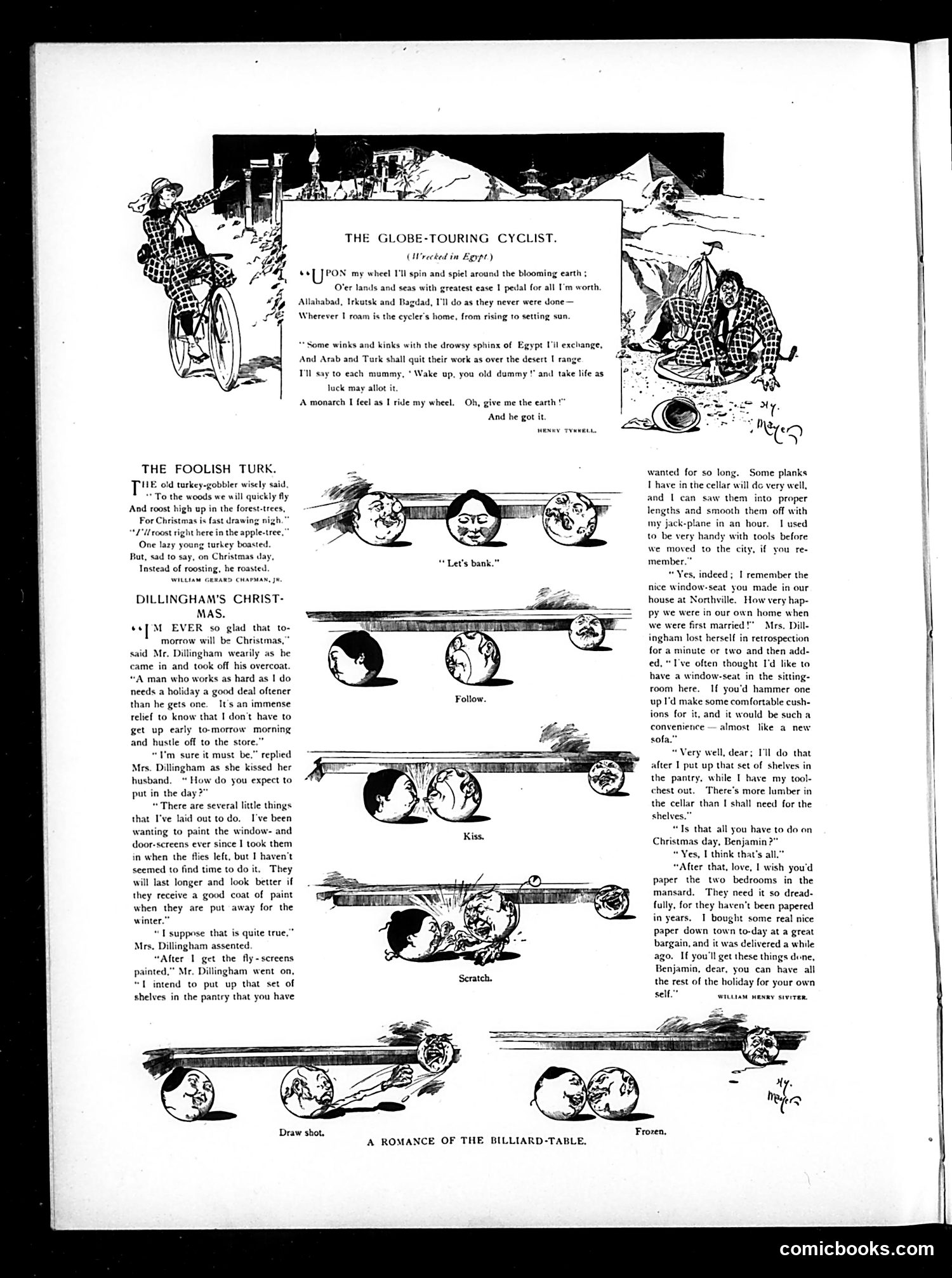
This page from *Judge* magazine contains three separate pieces of satirical humor: **"The Globe-Touring Cyclist"** mocks the era's adventurous cyclists who claimed they could travel anywhere by bicycle. The poem's boastful cyclist vows to tour the world on his wheel, but the title reveals he gets "wrecked in Egypt"—a deflating punchline about the gap between grandiose ambition and reality. **"The Foolish Turk"** is a brief fable: a turkey foolishly refuses to flee for Christmas, boasting he'll stay safe in an apple tree. He ends up roasted instead—a darkly humorous moral tale. **"Dillingham's Christmas"** satirizes a working-class husband's holiday plans. Rather than rest, Mr. Dillingham spends Christmas doing home repairs: painting screens, building shelves, papering bedrooms. His wife keeps adding tasks. The joke exposes the exhausting reality of working-class life—even holidays mean labor, not leisure. The billiard-table illustrations at bottom appear to be a separate comic strip using ball personifications.
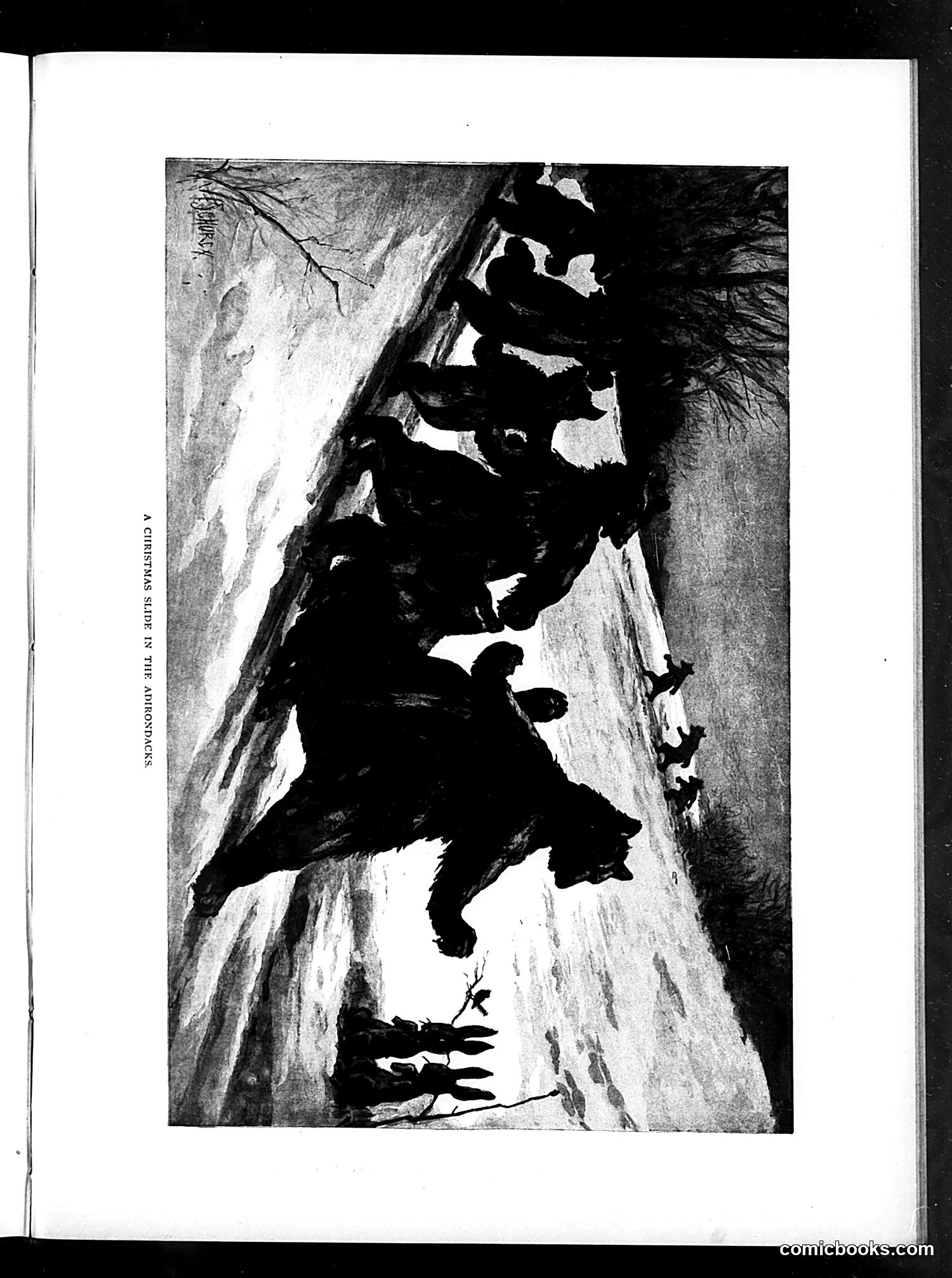
This appears to be a winter sports illustration titled "A Christmas Slide in the Adirondacks," showing figures sledding down a snowy slope. The Adirondacks were a popular wealthy resort destination in upstate New York during this era. The image depicts what seems to be people enjoying recreational sledding—a leisure activity associated with affluent Americans who could afford winter vacations. The dramatic black and white composition emphasizes the speed and excitement of the descent down the mountainside. Without additional context or visible text identifying specific figures, I cannot determine if this contains political satire or social commentary. It may simply be illustrating contemporary winter recreation among Judge magazine's middle-to-upper-class readership.
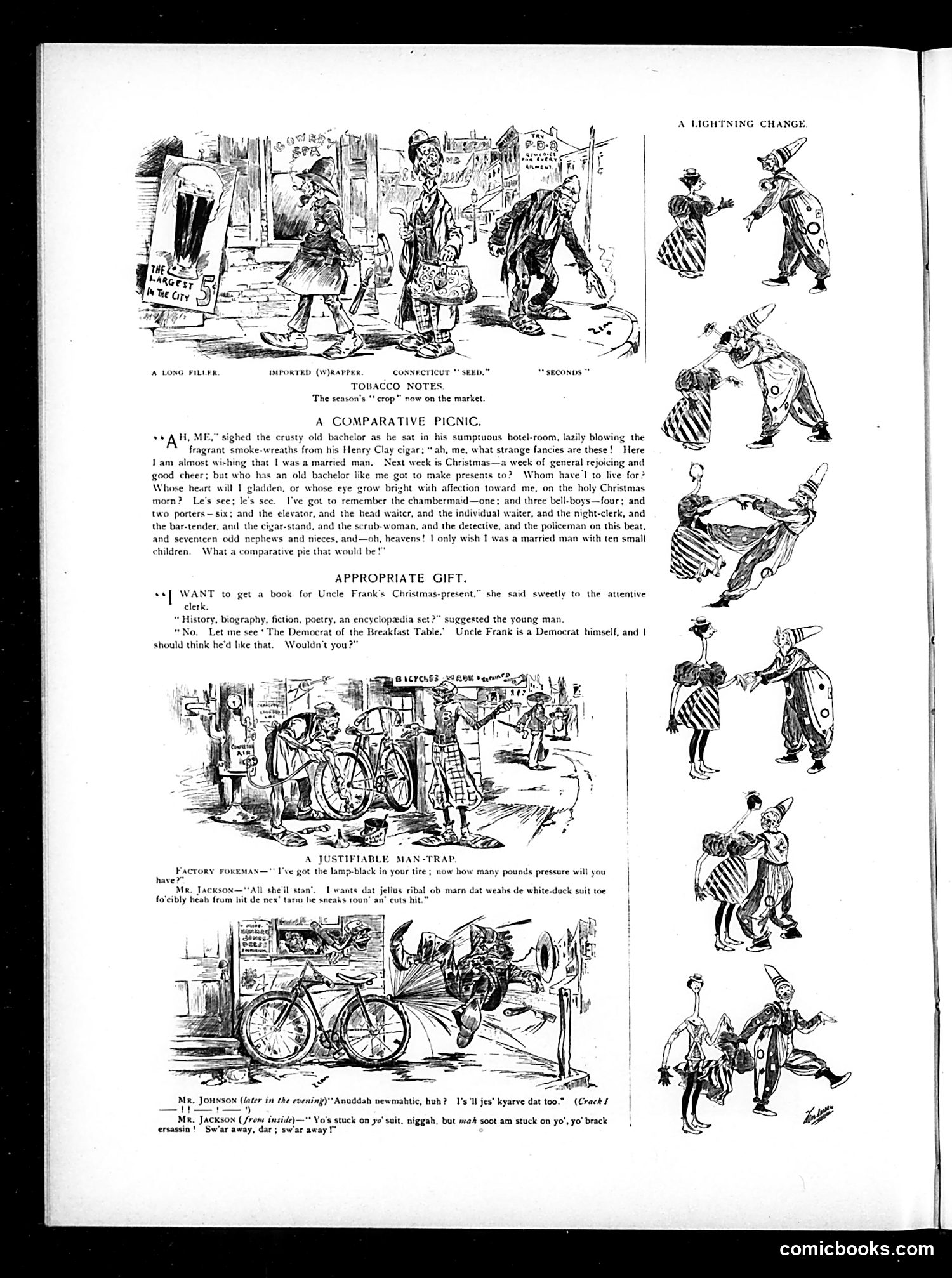
This page contains three distinct humorous pieces typical of *Judge* magazine's satirical content: **"A Comparative Picnic"** mocks the lonely bachelor who must give Christmas gifts to hotel staff (chambermaid, bell-boys, porters, elevator operator, waiters, etc.)—seventeen people total—yet envies married men with only ten children. The joke satirizes both urban hotel life's servile obligations and the Victorian idealization of family. **"Appropriate Gift"** is a brief joke about giving a Democrat a book titled "The Democrat of the Breakfast Table"—a pun on Oliver Wendell Holmes' popular essay collection. The humor relies on recognizing this literary reference. **"A Justifiable Man-Trap"** depicts racist dialect humor (common in period publications) showing a Black man wanting to trap a white man in a bicycle tire to punish him for stealing his suit. The "man-trap" is presented as justified revenge. **"A Lightning Change"** (right side) shows sequential cartoon panels of figures in costume changes—likely theatrical or magical transformation jokes, though context is minimal. The tobacco notes reference seasonal cigar varieties then available.
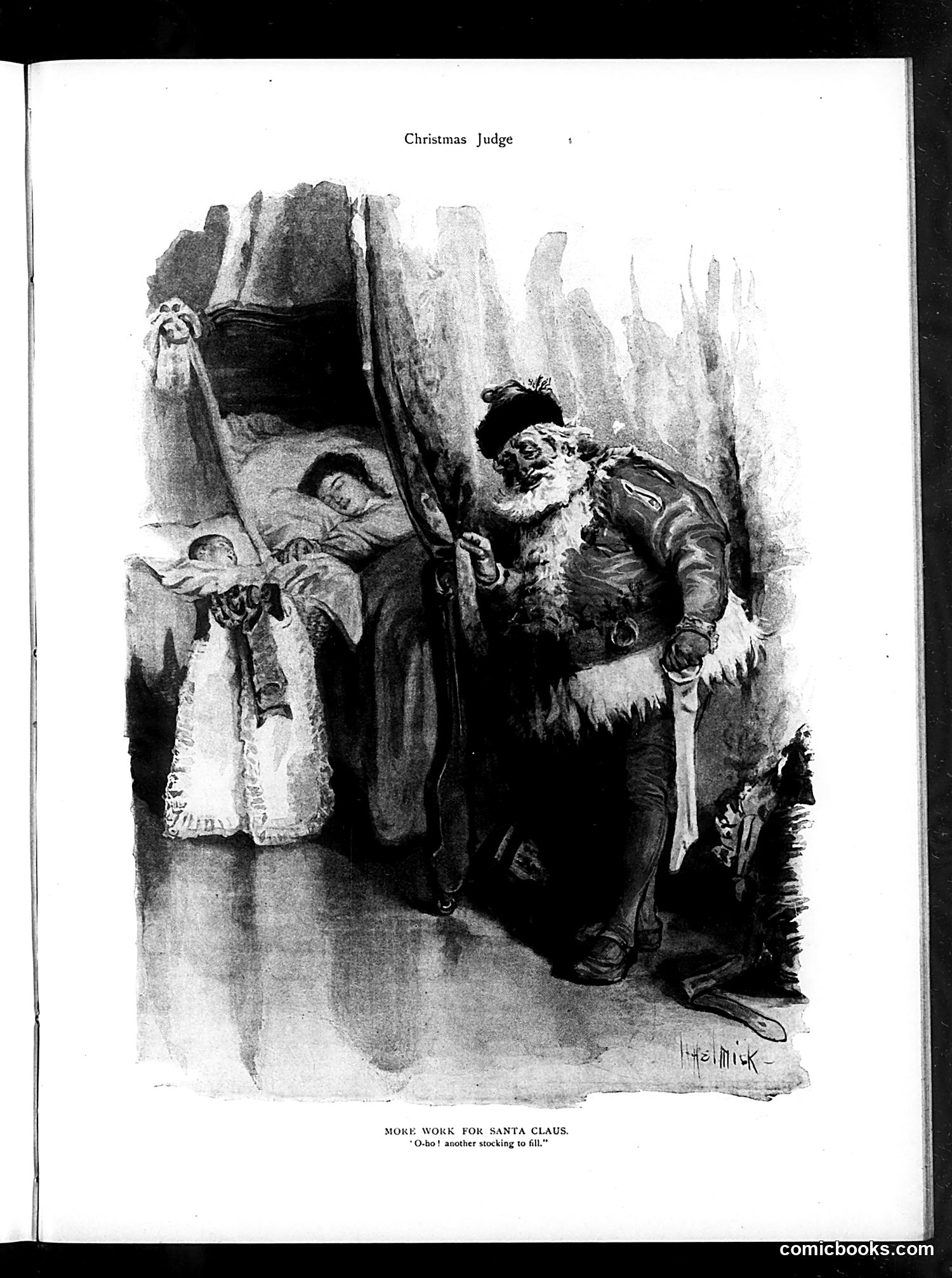
This cartoon depicts Santa Claus (the bearded figure in traditional costume) surveying a bed where multiple children sleep. The caption "O-ho! another stocking to fill" suggests Santa is overwhelmed by the quantity of children requiring gifts. The satire likely critiques either: - **Population growth** or immigration, with the sleeping children representing newly arrived residents Santa must provide for - **Commercialism and consumerism**, mocking how Christmas gift-giving burdens have multiplied The cartoon's tone is humorous rather than overtly hostile, presenting Santa as good-naturedly accepting this expanded workload. Without additional Judge context from the specific publication date, the exact social critique remains somewhat unclear, though the image clearly suggests anxieties about increasing demands on resources or changing demographics during the Gilded Age or Progressive Era.
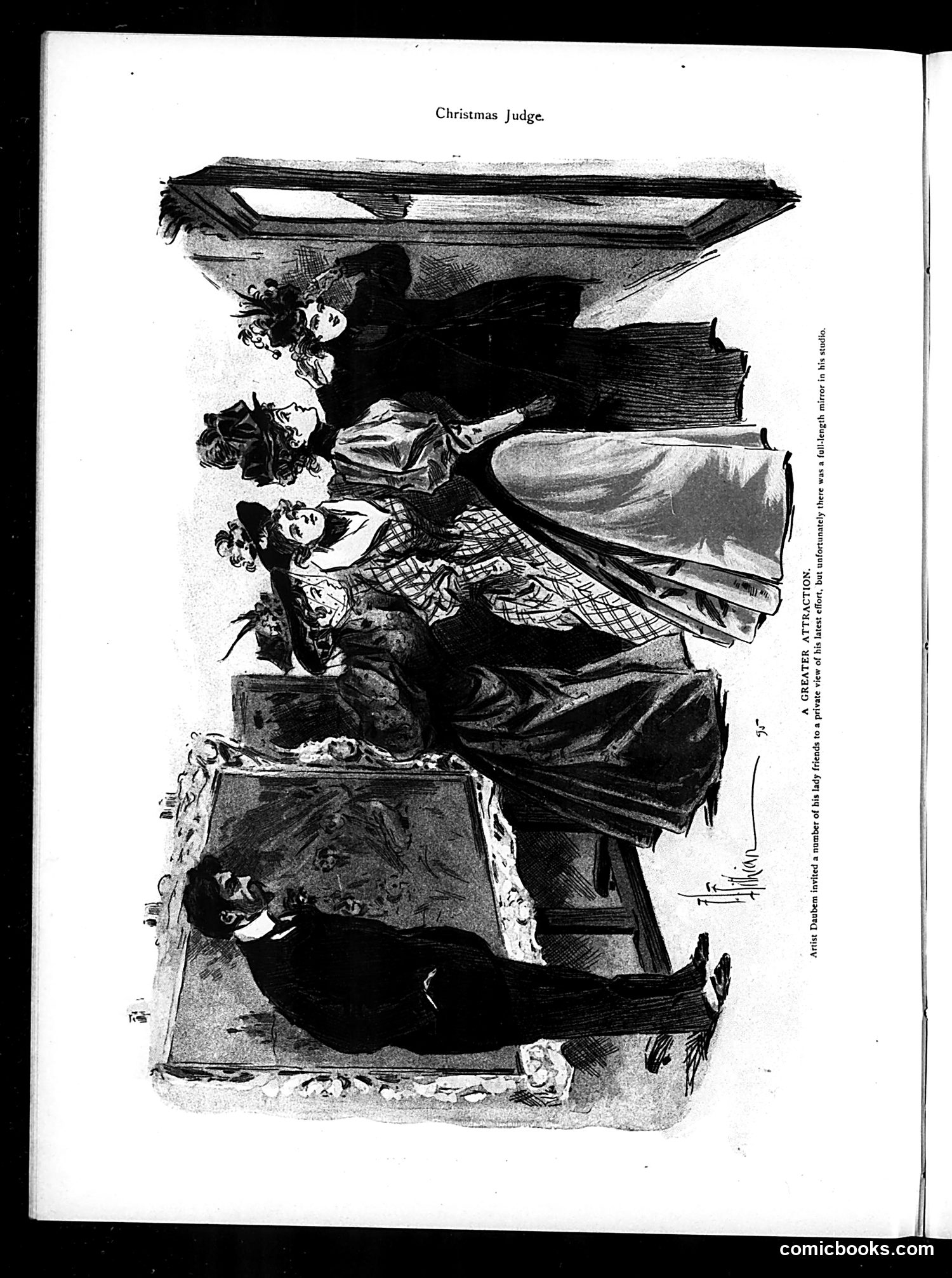
This illustration depicts a Victorian-era scene titled "A Bereaved Attraction." The image shows multiple figures arranged vertically around what appears to be a coffin or funeral bier. The composition suggests a darkly comic commentary on grief and mourning practices. The scene includes well-dressed Victorian mourners in formal attire, with particular emphasis on a woman in an elaborate dress with a large skirt. The arrangement and the title suggest this is satirizing either insincere mourning, the theatrical nature of Victorian funeral customs, or perhaps the morbid fascination some displayed toward death and mourning rituals during the period. Without clearer OCR text or additional context, the specific political or social target remains unclear, though Judge magazine typically mocked hypocrisy, social pretension, and contemporary scandals. The "Bereaved Attraction" likely critiques the performative aspects of mourning in Victorian society.
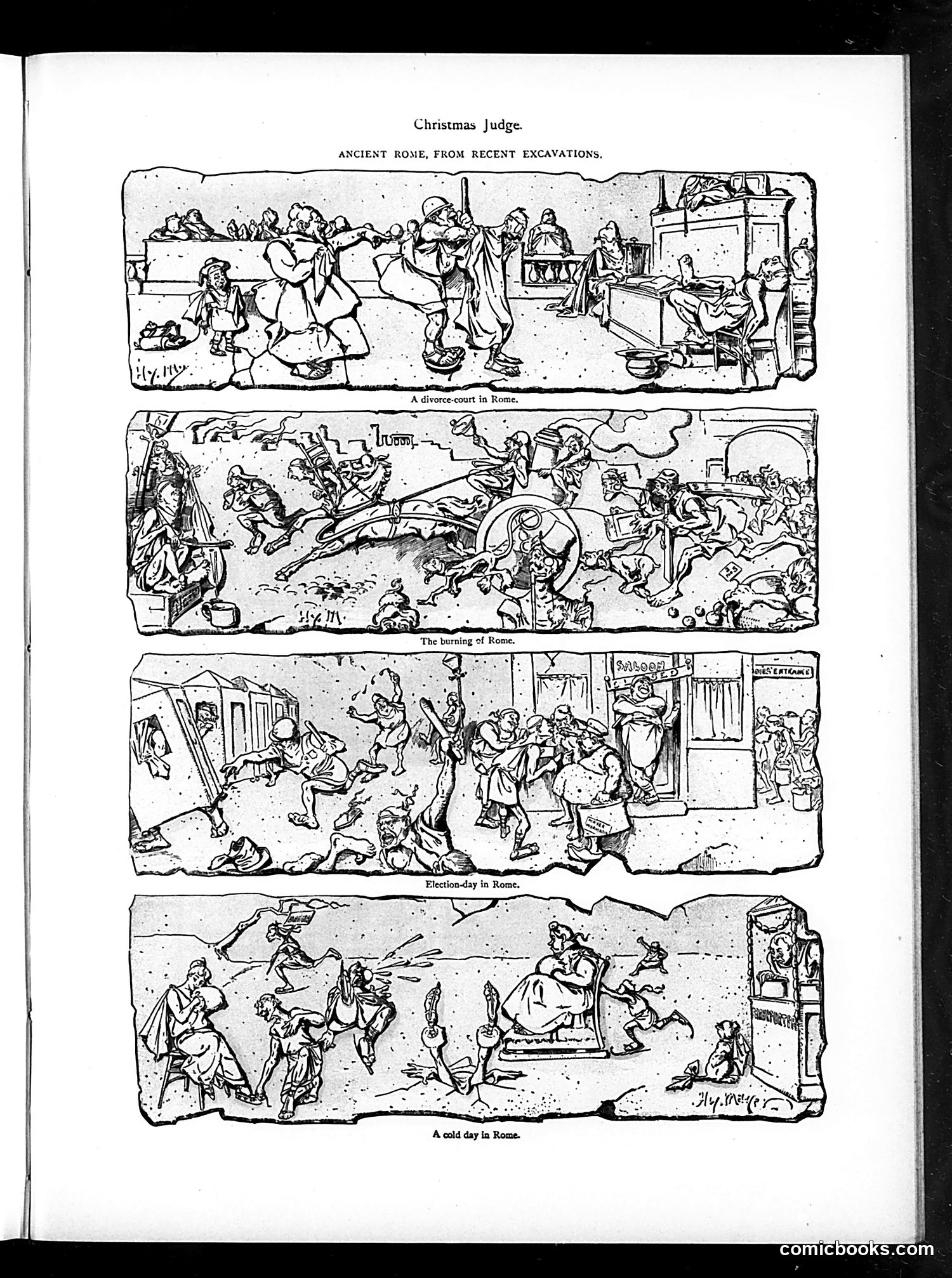
This is a humorous four-panel comparative satire comparing ancient Roman life to contemporary American society (likely late 19th century). Each panel depicts Roman scenes—"A divorce-court in Rome," "The burning of Rome," "Election-day in Rome," and "A cold day in Rome"—rendered in archaeological/excavation style. The joke appears to satirize American politics and society by suggesting modern America mirrors ancient Rome's corruption, chaos, and violence. The "recent excavations" framing treats these Roman scenes as if newly discovered artifacts, implying American problems—contentious courts, political violence, fraudulent elections, hardship—are equally ancient and timeless. The satire suggests American society hasn't progressed beyond Roman-era dysfunction.
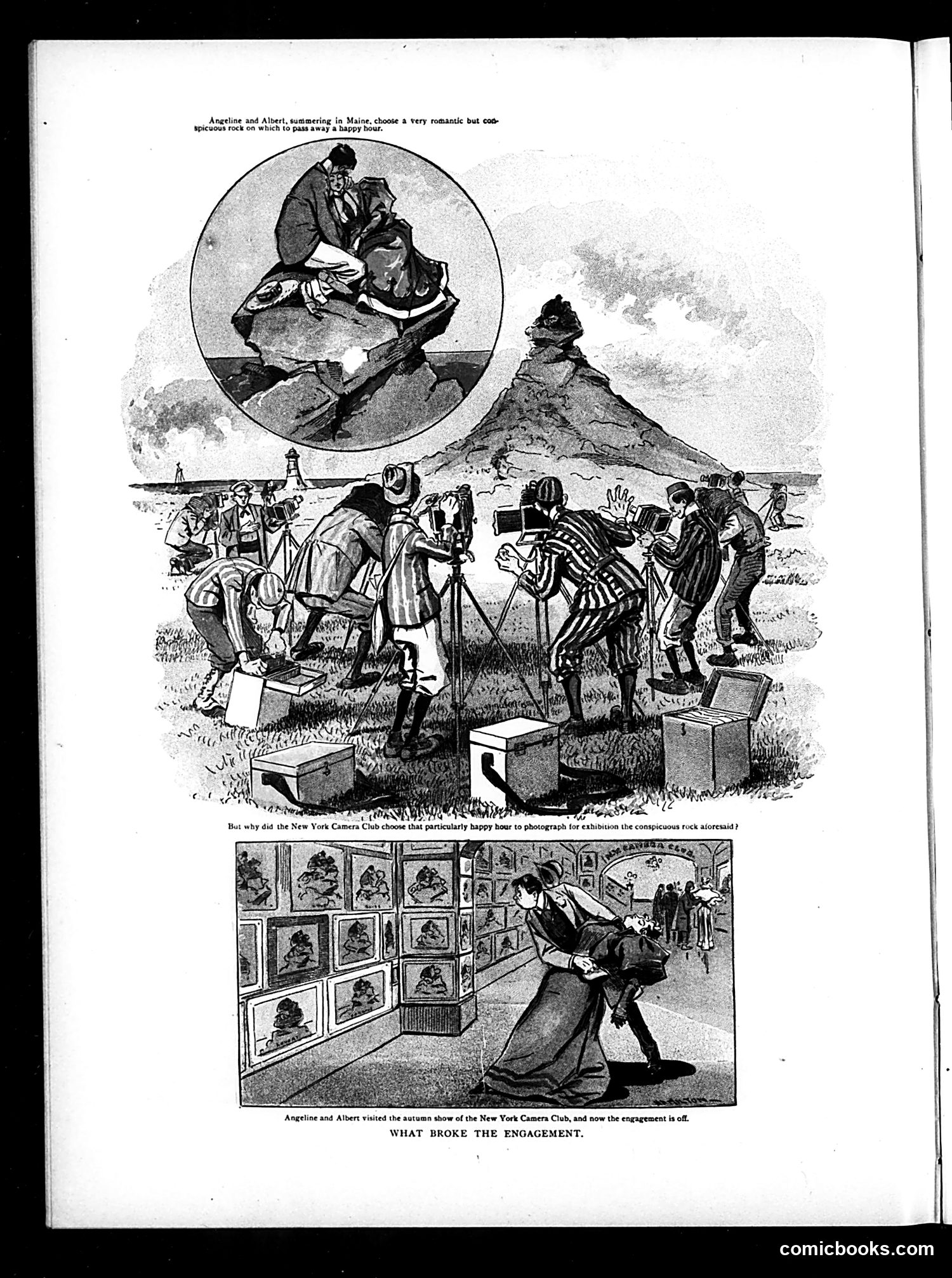
This is a three-panel satirical sequence about a broken engagement. **The Setup:** A couple named Angeline and Albert choose a romantic spot—a conspicuous rock in Maine—for a private romantic moment (the circular inset shows them embracing). **The Twist:** The New York Camera Club happens to photograph that same rock at that exact moment, capturing the couple unknowingly. **The Payoff:** The couple later sees the photograph displayed at the Camera Club's autumn exhibition. Apparently, seeing themselves publicly exposed in this intimate moment—displayed for public viewing—causes them to break their engagement. The humor comes from the clash between their private romantic intentions and the involuntary public humiliation that results. This satirizes both the invasiveness of photography as an emerging technology and the Victorian concern with propriety and public reputation.
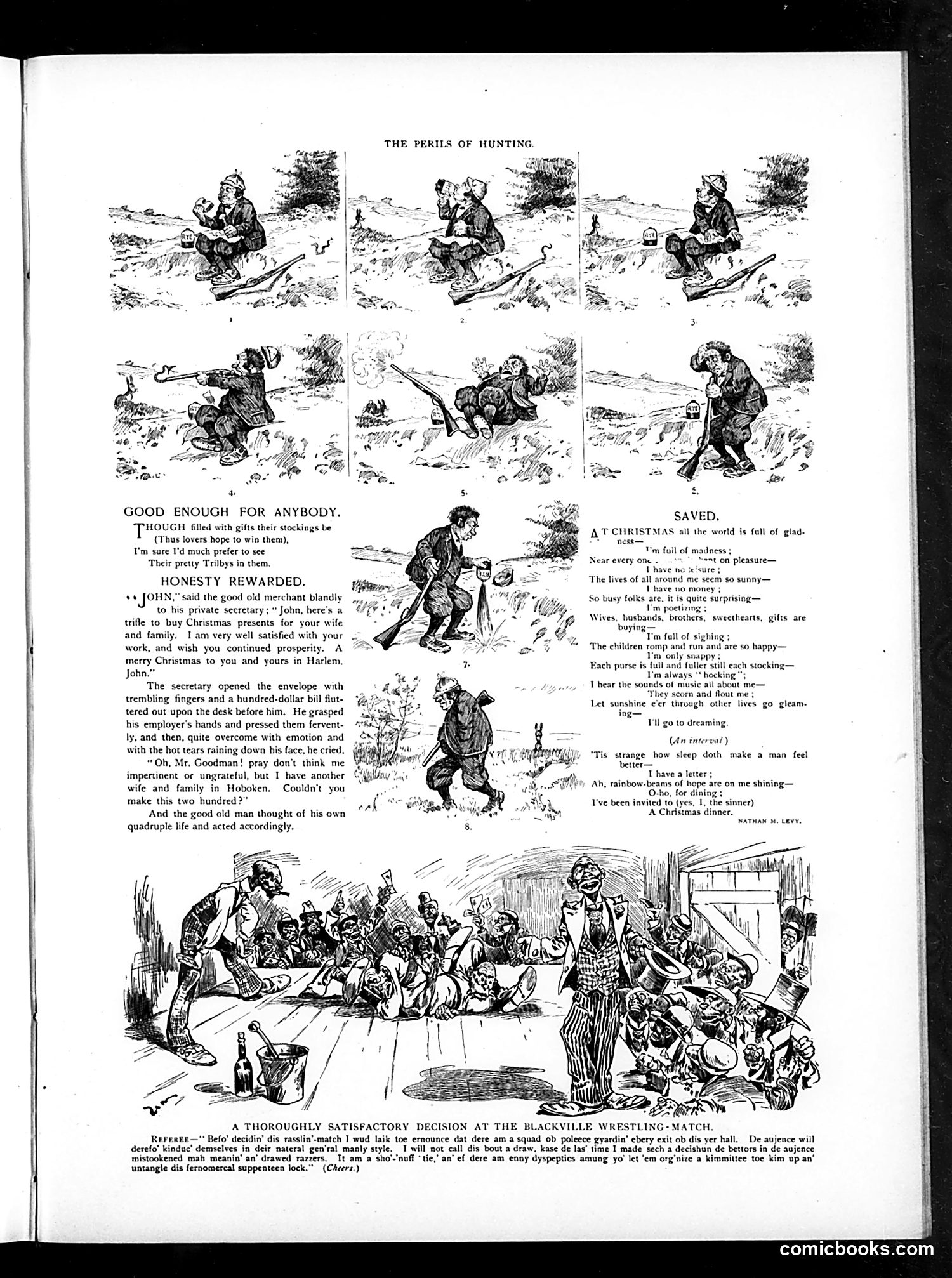
This page contains three distinct satirical pieces satirizing American social hypocrisy and racial attitudes circa early-to-mid 20th century. **"The Perils of Hunting"** (top panels) appears to be a visual gag sequence showing mishaps during a hunt. **"Good Enough for Anybody" and "Honesty Rewarded"** mock wealthy employers' Christmas generosity. The first story presents a merchant who gives his secretary a bonus, then admits he maintains multiple families (in both Harlem and Hoboken), rewarding the secretary's request for double pay. The satire targets hypocrisy—the employer's moral posturing about Christmas virtue while maintaining secret dual families. **"Saved"** is a poem contrasting others' holiday joy against the speaker's misery and poverty, ending with dreaming as escape. **"A Thoroughly Satisfactory Decision at the Blackville Wrestling Match"** uses heavy dialect to depict a Black referee making a predetermined wrestling decision, satirizing corruption in sporting events and possibly stereotyping Black participants and officials. The racial caricatures and dialect throughout reflect the magazine's period attitudes.
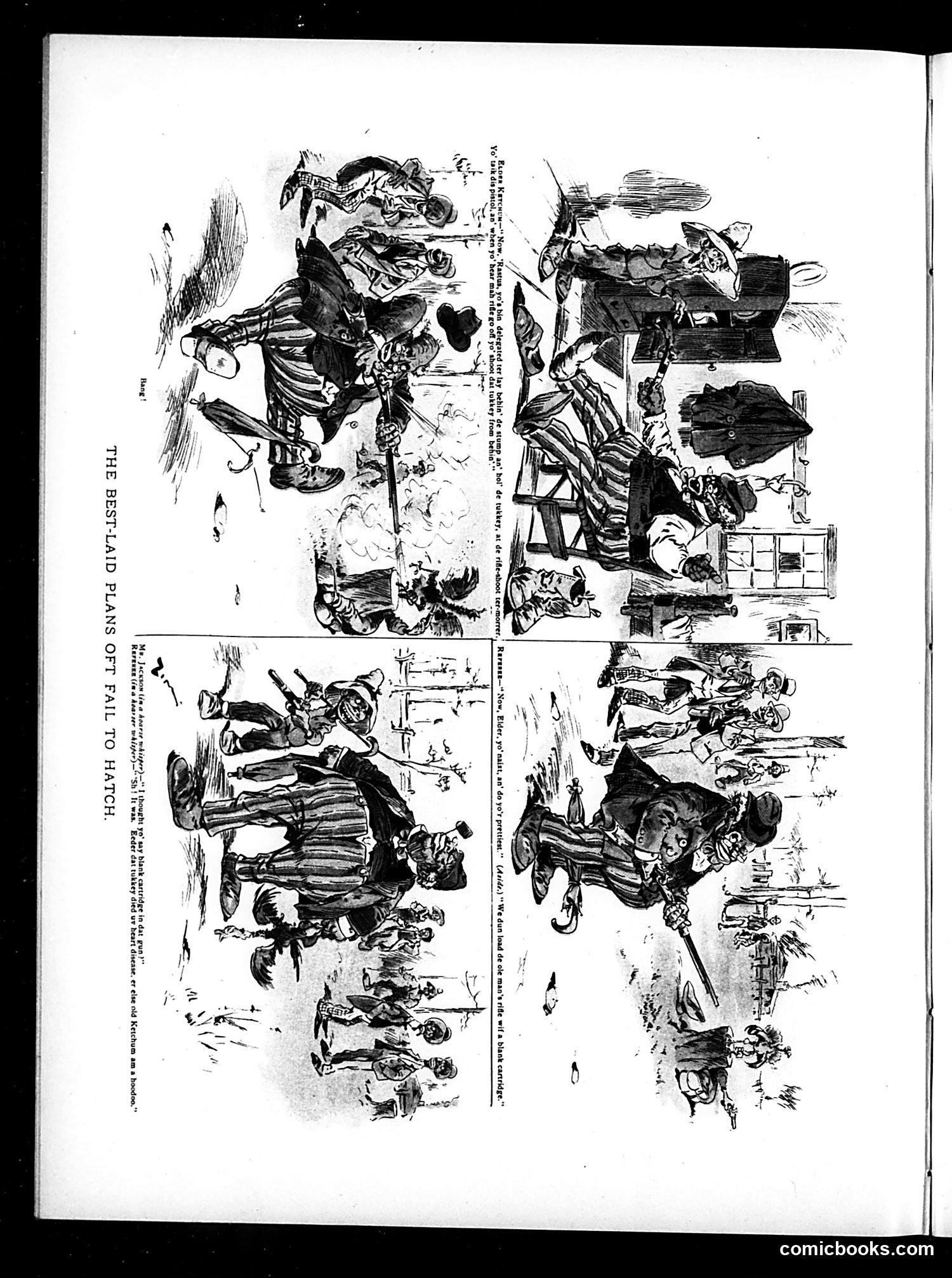
This page contains four satirical cartoon panels printed upside-down and sideways (typical of Judge magazine's layout), depicting what appears to be political scheming or conspiracy. The cartoons show figures in 19th-century dress engaged in various dramatic poses—some appearing to conspire, others in conflict or distress. The title "The Desland Plans of Tail to Hatch" suggests a failed or absurd plot, though the specific political figures and events referenced are unclear from the degraded OCR text and image quality. The cartoons employ exaggerated physical comedy and caricature typical of Judge's satirical style, likely mocking politicians' machinations or a contemporary scandal. Without clearer text or visible identifying labels, I cannot definitively identify the specific figures or historical event being satirized. The artwork style and composition suggest late 19th-century American political satire.
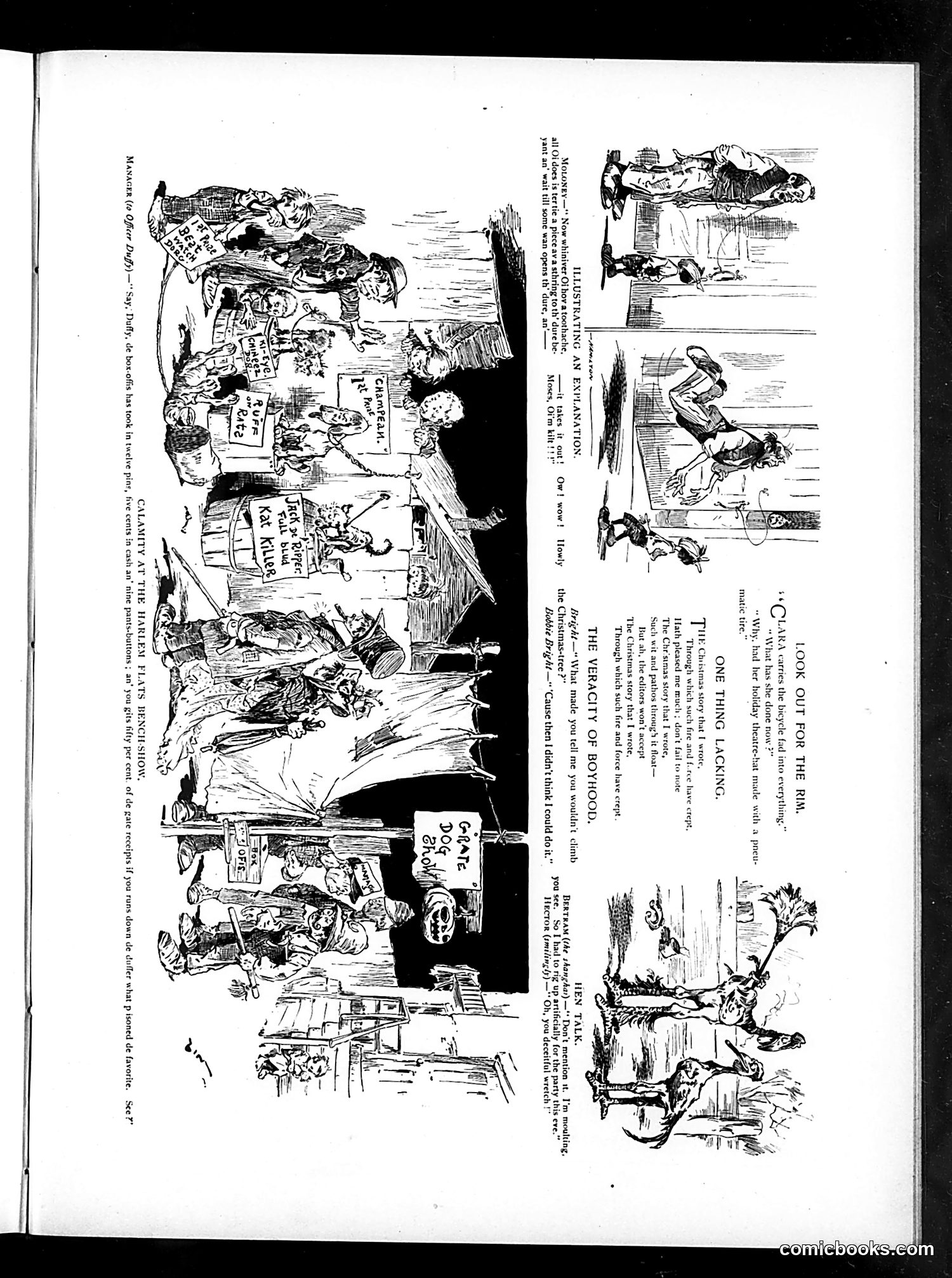
This appears to be a Judge magazine comic depicting a corrupt horse racing scheme. The manager instructs Officer Duffy to pursue and "run down" (arrest) whoever poisoned the favorite racehorse, with a clear quid pro quo: Duffy will receive a cut of the gate receipts if he does so. The satire targets police corruption and complicity in gambling fraud. Rather than pursuing justice for the poisoned horse on principle, the officer is incentivized by profit-sharing. The "rim" likely refers to the racetrack itself. This reflects late 19th/early 20th-century concerns about organized crime at racetracks, police bribery, and the intersection of gambling, violence, and law enforcement—suggesting that authorities were more interested in protecting betting interests than preventing actual crimes.
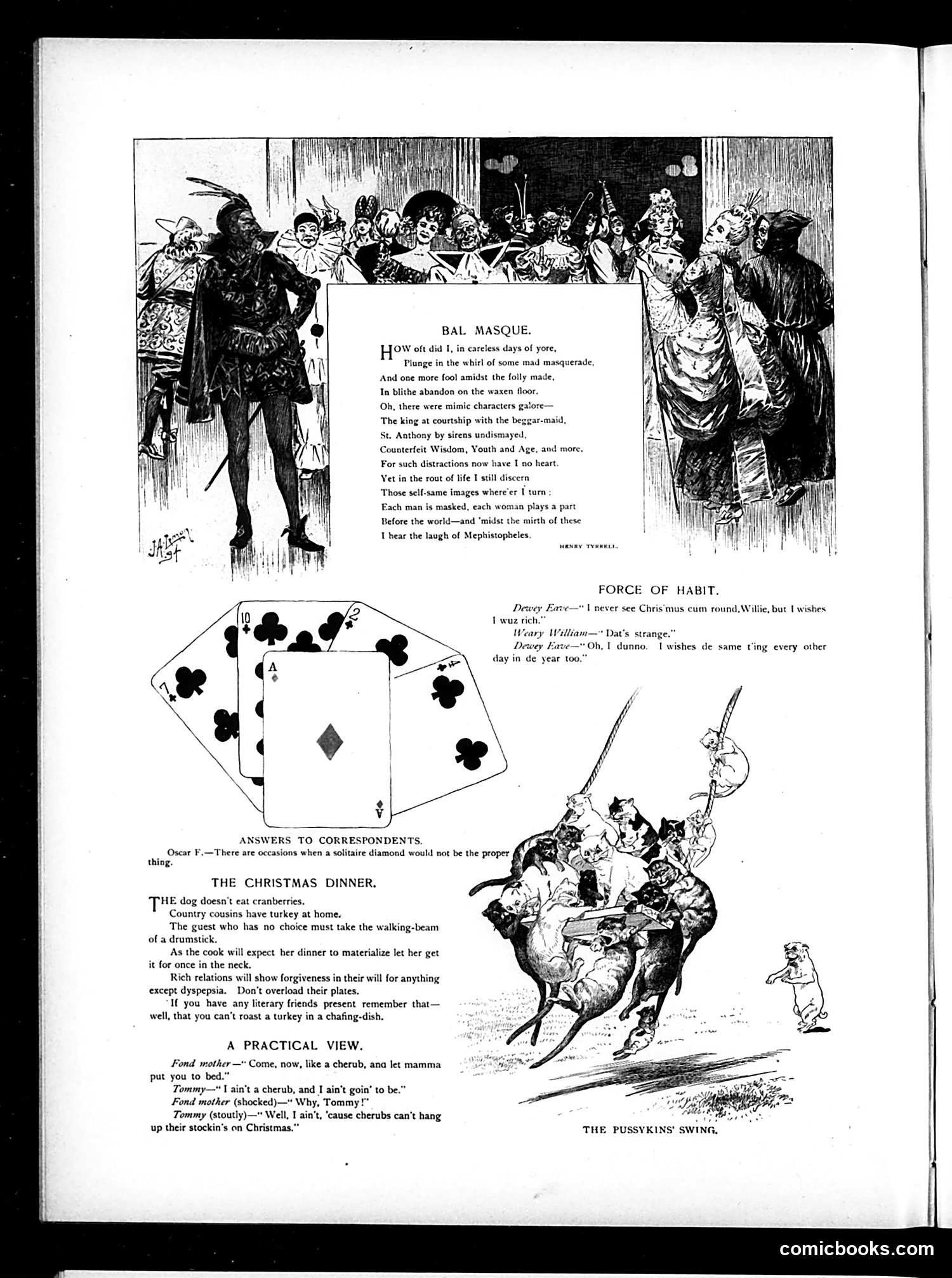
This page contains several satirical pieces typical of turn-of-the-century American humor: **"Bal Masque"** is a poem by Henry Tyrrell contrasting carefree masquerade balls of youth with life's masks in adulthood—a philosophical meditation on society's artificiality and hypocrisy. **"Force of Habit"** satirizes working-class characters (depicted with ethnic dialect) who perpetually wish to be wealthy, suggesting desire for wealth is constant rather than holiday-specific. **"The Christmas Dinner"** offers humorous etiquette advice for holiday dining—joking about overeating, managing difficult relatives, and social pretense around food. **"A Practical View"** shows a child rejecting the "cherub" identity his mother wants, logically noting cherubs can't hang stockings—innocent humor about childhood pragmatism versus parental sentimentality. The illustrations include a masked ball scene, playing cards, and "The Pussykins' Swing" (a whimsical animal drawing). Overall, the page mixes holiday satire with social commentary on class, hypocrisy, and domestic life.
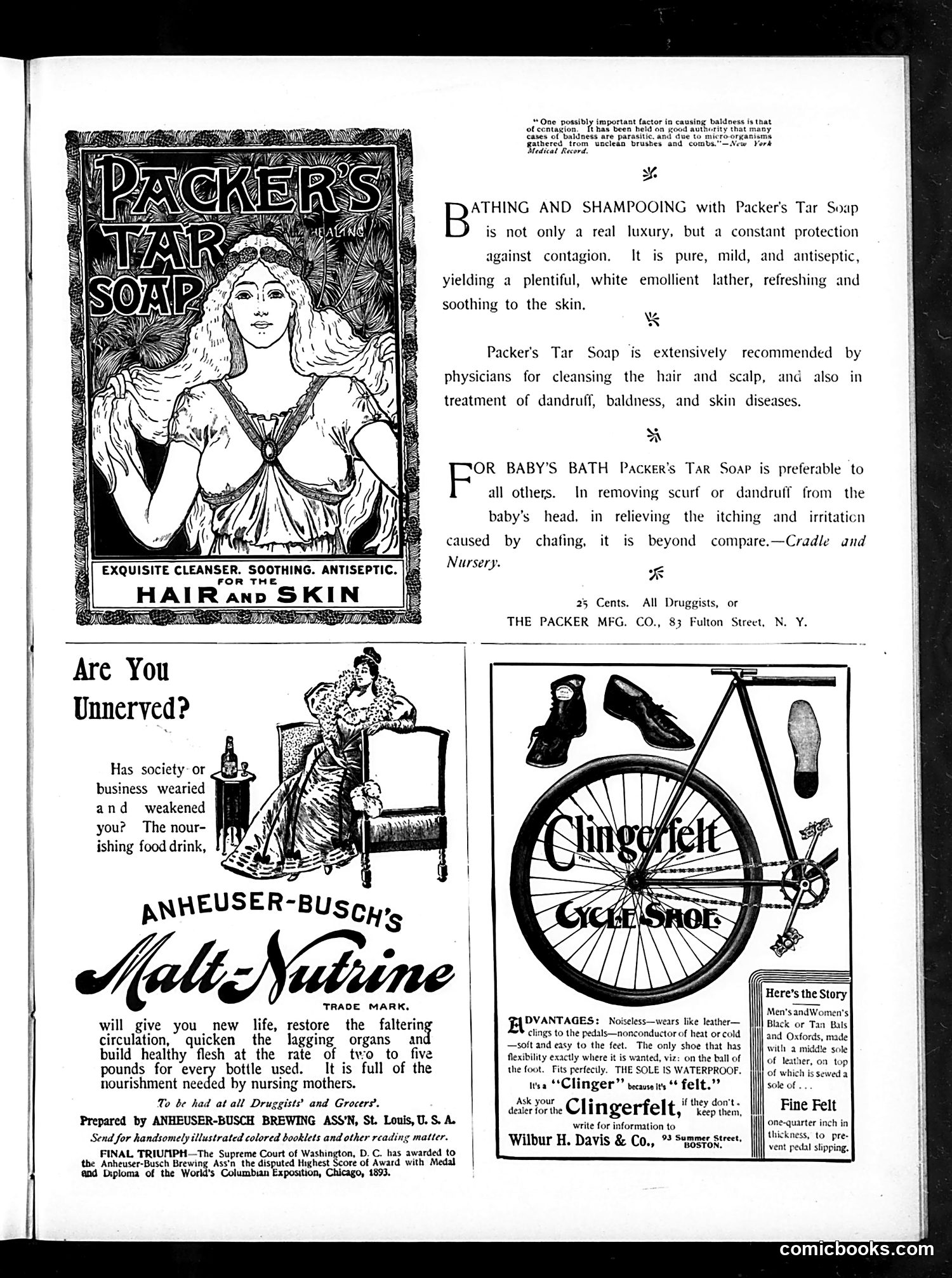
This page is primarily **advertising**, not satire or political commentary. It contains four product advertisements from the early 1900s: 1. **Packer's Tar Soap** — Claims to treat baldness, dandruff, and skin diseases through antiseptic cleansing. The ad cites medical authority suggesting baldness may be contagious, transmitted via "unclean brushes and combs." 2. **Anheuser-Busch Malt Nutrine** — A nutritional drink marketed to restore vigor to those weakened by society or business stress, promising to build healthy flesh. It references winning the 1893 World's Columbian Exposition award. 3. **Clingerfelt Cycle Shoe** — Advertises a waterproof shoe with flexible felt sole designed specifically for bicycle riders. The page reflects early 1900s advertising conventions: medical pseudo-science, appeals to health anxiety, and gender-specific marketing (the Malt Nutrine targets exhausted professionals). No political cartoons or satire are present.
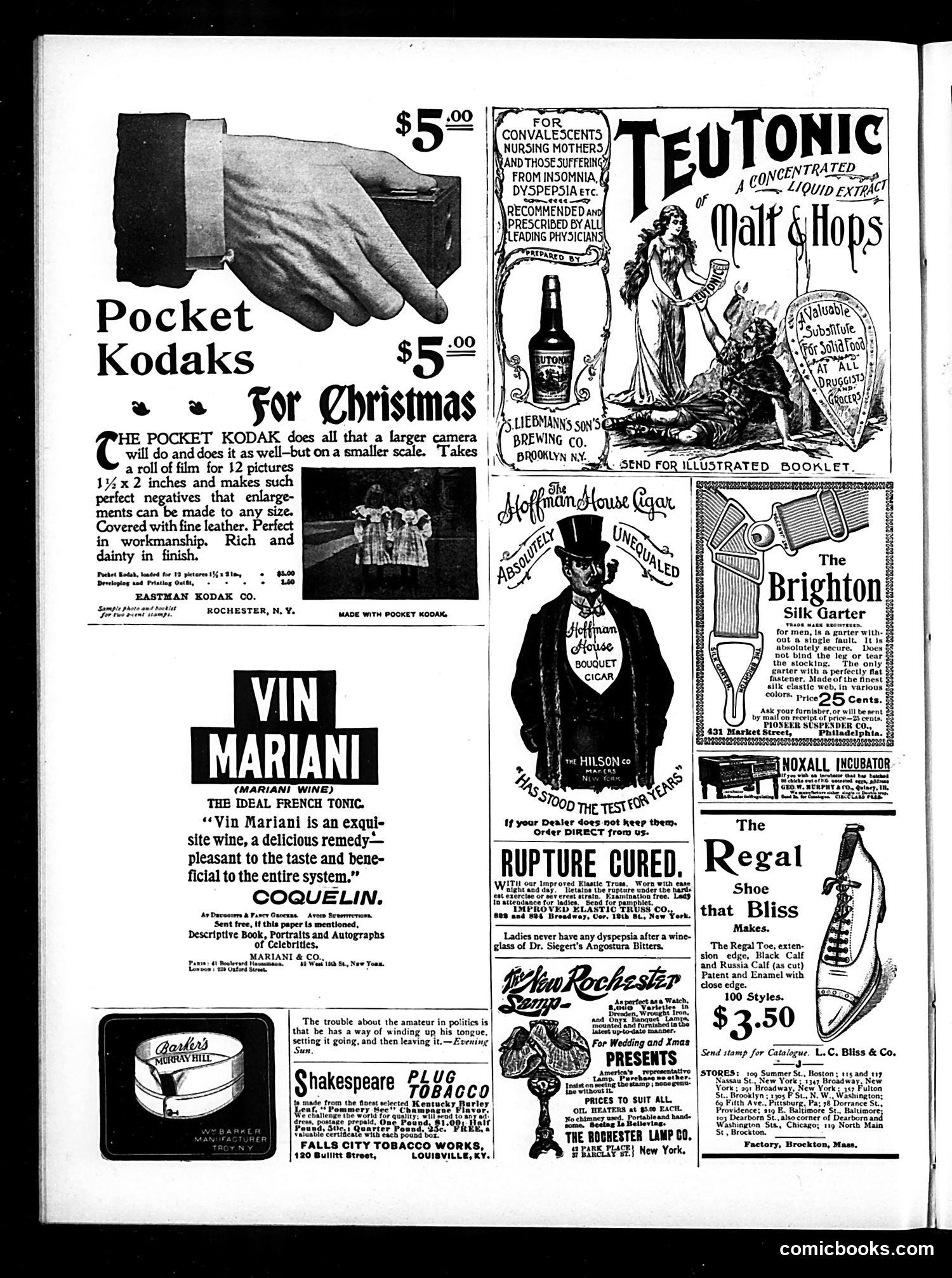
This is primarily an **advertising page** from an early 20th-century American magazine, not a political cartoon page. The content reflects period attitudes and available products rather than satire. **Notable advertisements include:** - **Pocket Kodak**: Christmas gift promoting portable photography technology - **Teutonic Malt & Hops**: Patent medicine marketed to "nursing mothers" and insomniacs—typical of an era before FDA regulation when such tonics made unverified health claims - **Vin Mariani**: French wine tonic endorsed by celebrity (Coquelin), another unregulated medicinal product - **Rupture Cured/Elastic Truss**: Medical device ads common in period publications - **Regal Shoe**: Footwear marketed with "100 Styles" - **Shakespeare Plug Tobacco**: Tobacco product with promotional certificates **The single text joke** about amateur politicians ("winding up his tongue") is mild political commentary, not developed satire. The page documents consumer culture and patent medicine marketing practices now considered fraudulent—historically significant for showing what was openly advertised before modern consumer protection regulations.
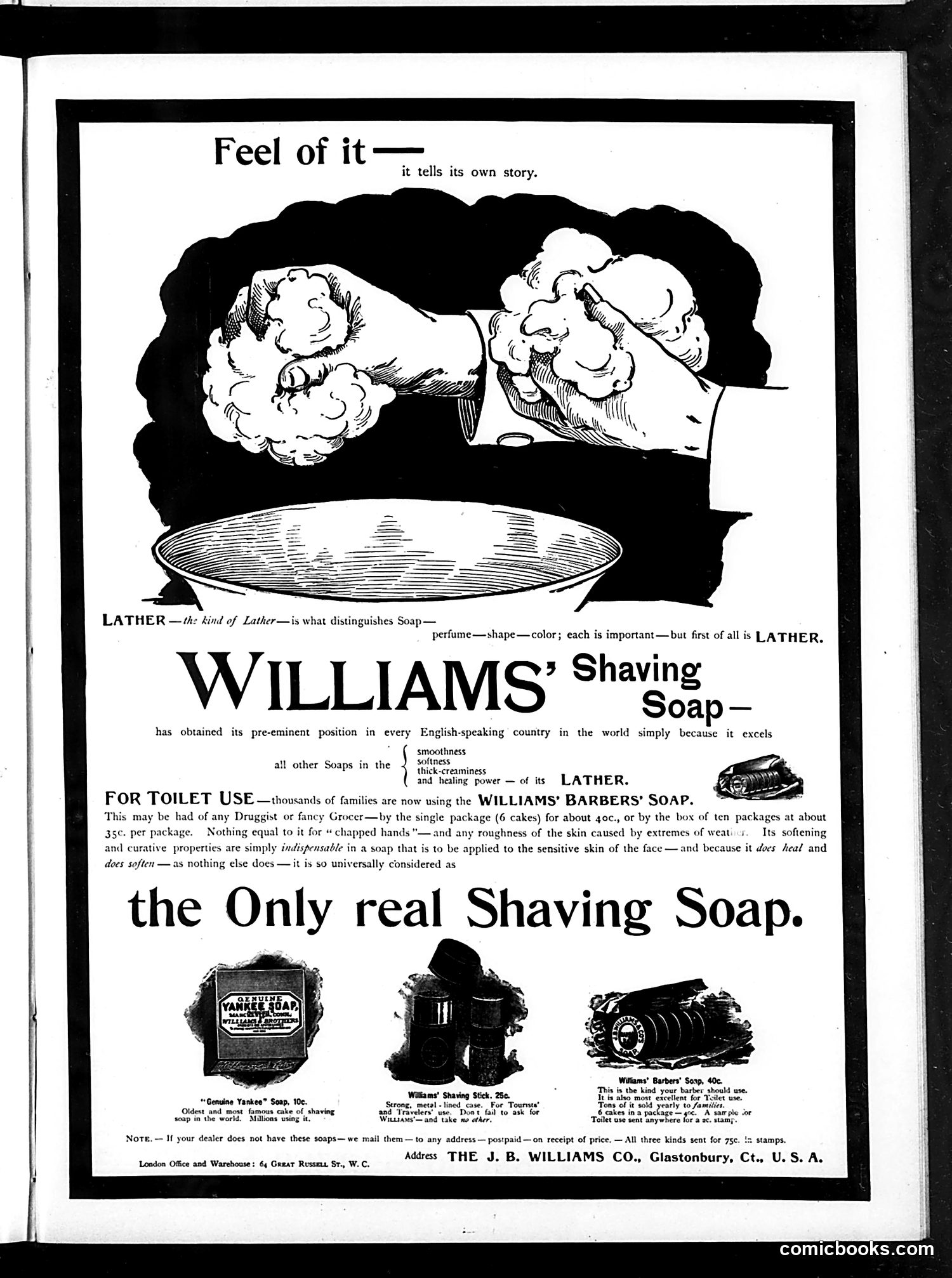
This page is **primarily an advertisement**, not political satire. It promotes Williams' Shaving Soap products, emphasizing the importance of lather quality. The illustration at top shows hands demonstrating lather—the central marketing claim. The ad targets both barbers (professional use) and consumers for home toiletry, highlighting the soap's softness and healing properties for sensitive facial skin. The page showcases three product variants: "Genuine Yankee" Soap (traditional cake), Shaving Stick (modern convenience), and Barbers' Soap. The copy stresses Williams' established reputation across "every English-speaking country" and claims superiority over competitors based on superior lather. This reflects early 20th-century advertising strategy: positioning products through quality comparisons and practical benefits. The Judge magazine context suggests this premium product advertisement appeared alongside satirical content for affluent readers.
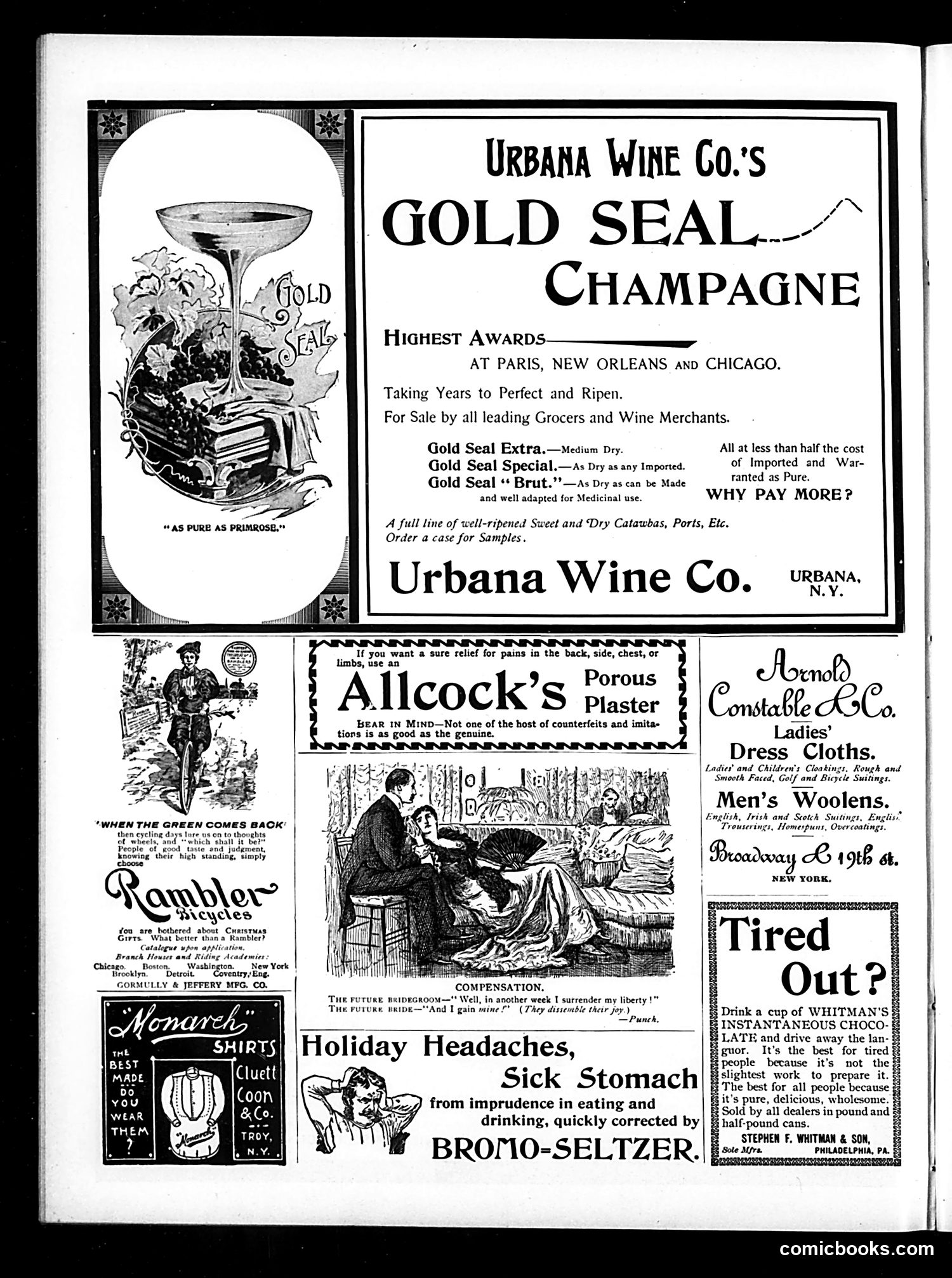
This page is primarily **advertising**, not political satire. It contains multiple product advertisements typical of early 1900s magazines: **Main content:** Urbana Wine Co.'s "Gold Seal Champagne" advertisement, emphasizing awards and affordability ("less than half the cost of imported"). **Other ads include:** Allcock's Porous Plaster (pain relief), Rambler bicycles, Monarch shirts, Arnold Constable clothing, and Bromo-Seltzer (stomach remedy). **The single cartoon** (credited to Punch) depicts a couple's engagement with ironic dialogue: the groom says he "surrenders liberty" while the bride says she "gains" it—a commentary on Victorian marriage dynamics where wives gained legal status but lost independence. The caption notes they "dissemble their joy." The page reflects early 1900s consumer culture and gender attitudes rather than political commentary.
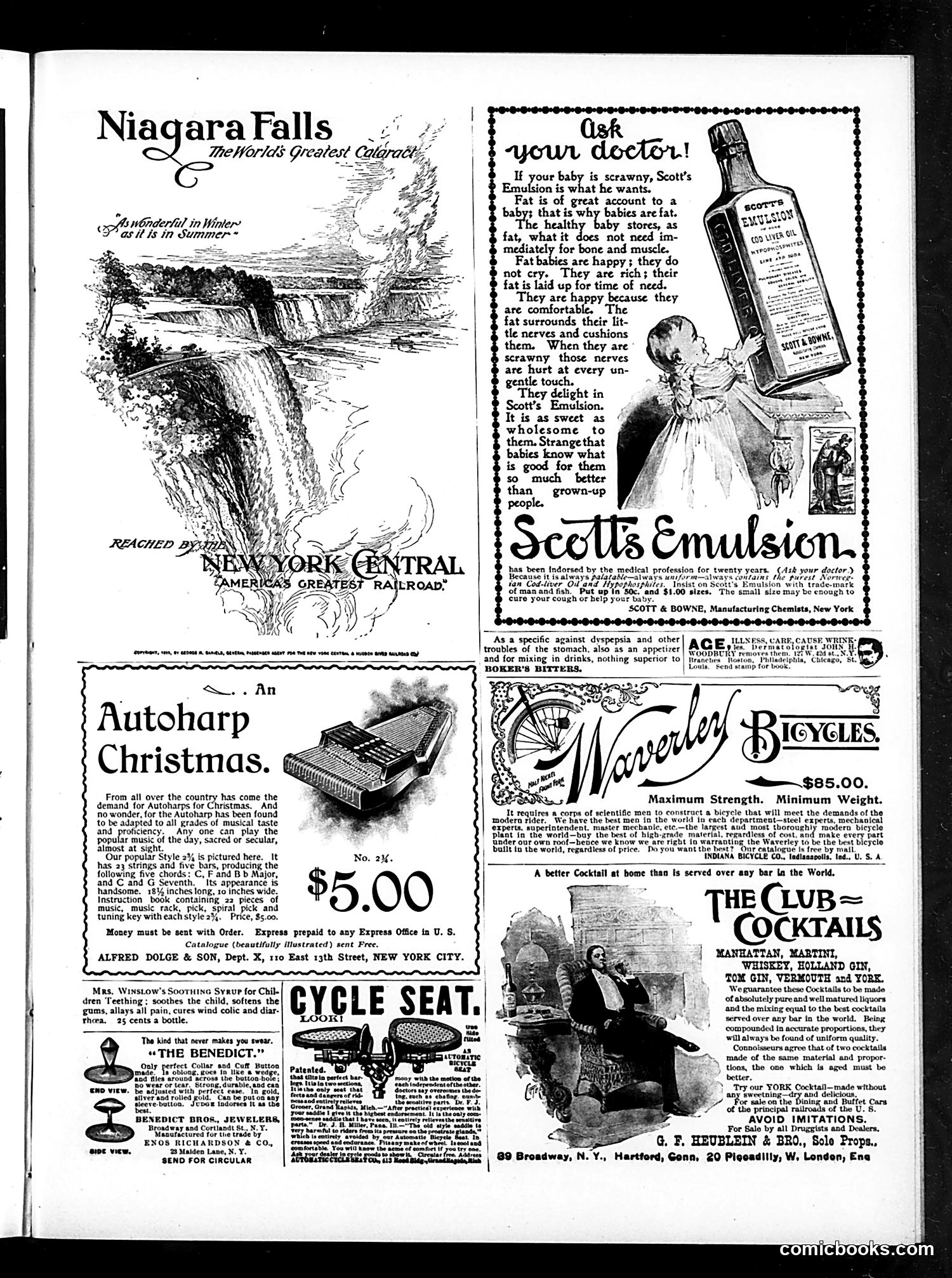
This page is primarily **advertising, not satire or political cartoons**. It contains product advertisements typical of an early 20th-century magazine: - **Niagara Falls tourism** promotion (top left) - **Autoharp** musical instrument ($5.00) - **Scott's Emulsion** (cod liver oil health supplement) with a doctor endorsement - **Waverley Bicycles** ($85.00, emphasizing quality construction) - **The Club Cocktails** (premixed drinks) - Various smaller product ads (Mrs. Winslow's Soothing Syrup, cycle seats, Boker's Bitters) The Scott's Emulsion ad uses period-typical health marketing claiming fat babies are "happy" and healthy, with a mother figure seeking doctor approval—reflecting early 1900s attitudes about infant nutrition and medical authority. No political commentary or satire is evident. The page demonstrates how Judge magazine supported itself through advertisements targeting middle and upper-class consumers of the era.
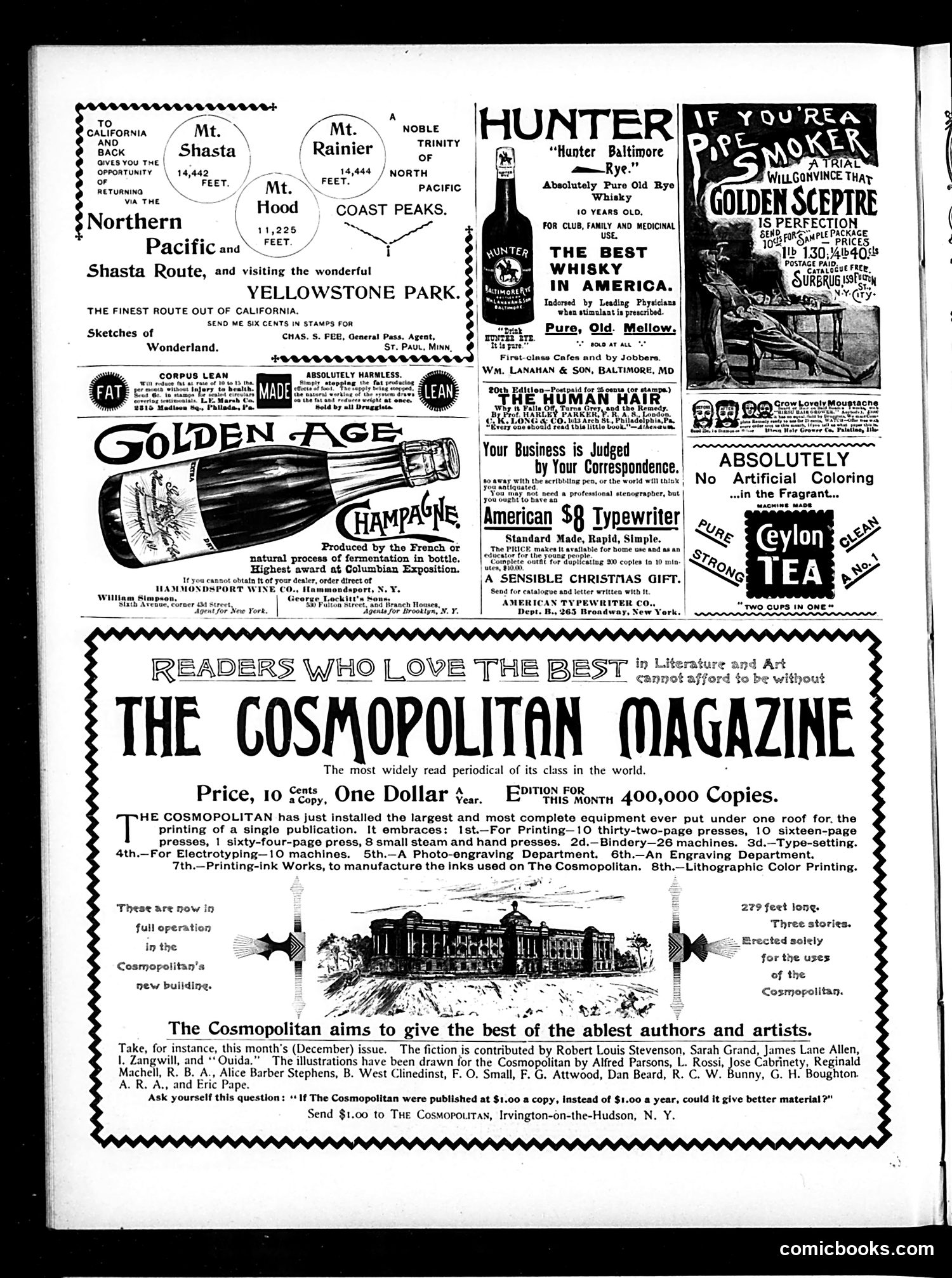
This is primarily an **advertising page**, not a satirical cartoon section. It contains mostly product advertisements typical of the era (circa 1890s-1900s), including whiskey, champagne, typewriters, tea, and hair products. The notable exception is a **large advertisement for The Cosmopolitan Magazine** at the bottom, which boasts about its printing facilities and literary contributors (Robert Louis Stevenson, James Lane Allen, etc.). This reflects the magazine's competition for readership during the "magazine wars" of that era—a period when publications competed aggressively on production quality and famous author contributions. The Cosmopolitan ad notably emphasizes its *industrial capability*—detailed descriptions of printing presses, binderies, and specialized departments—suggesting readers would be impressed by manufacturing scale as a proxy for content quality. The rhetorical question at the end ("could it give better material?") is a sales pitch implying superior production equals superior editorial value. The other ads reflect contemporary consumer goods and services with no obvious satire.
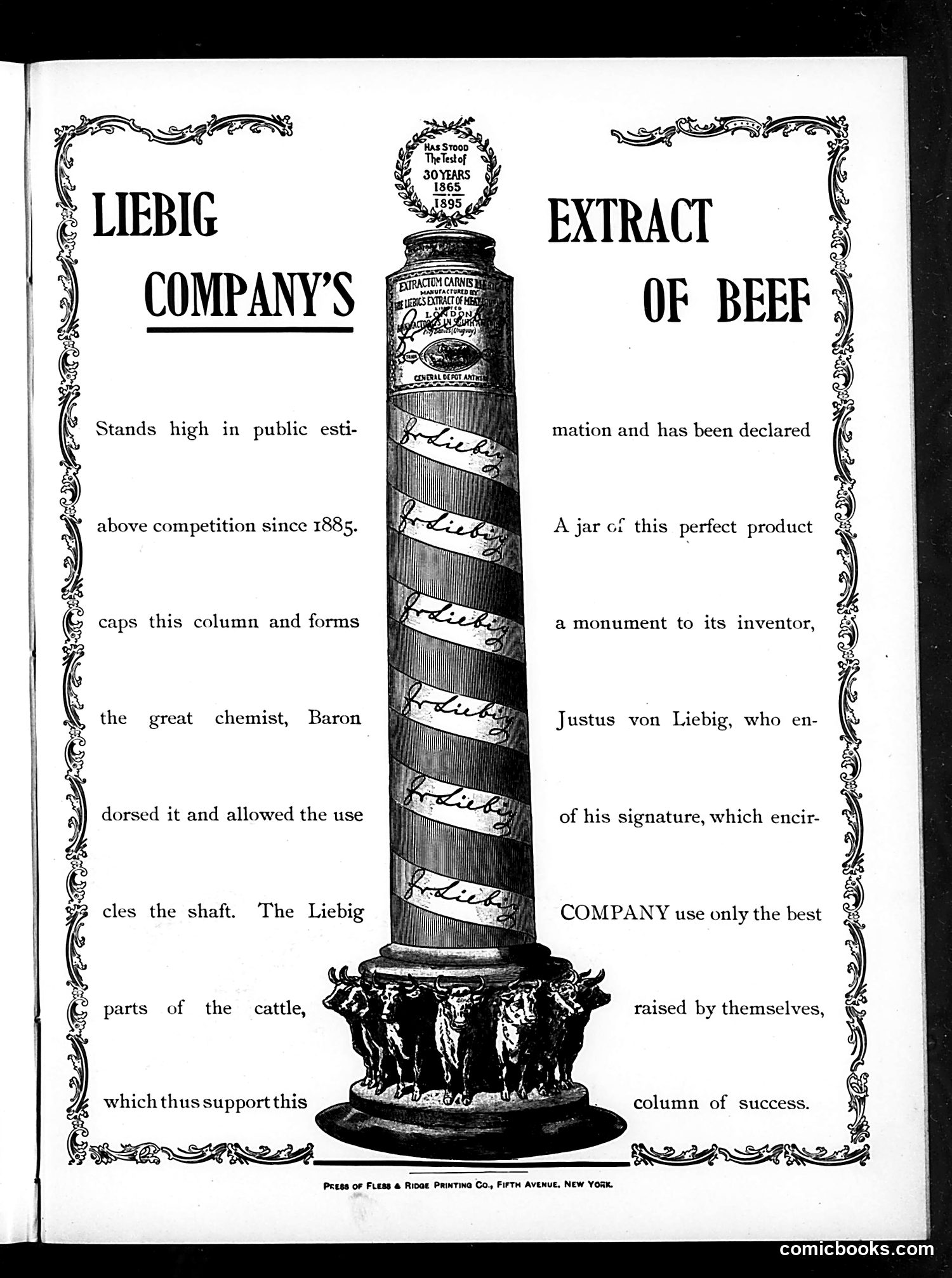
This is a **full-page advertisement**, not satire. It promotes Liebig Company's beef extract by depicting an ornamental column topped with a jar of product, supported by classical figures representing cattle. The ad claims the extract has been "above competition since 1885" and emphasizes its inventor, **Baron Justus von Liebig**, a real 19th-century German chemist who pioneered meat extract production. The column's base features cattle, visually pun on "supporting" the product's success. The page uses decorative borders and classical imagery to convey prestige and scientific legitimacy—common marketing tactics of the era. This appeared in *Judge* magazine, suggesting advertisements subsidized satirical publications. The text emphasizes quality ingredients and the founder's endorsement as selling points to affluent readers.
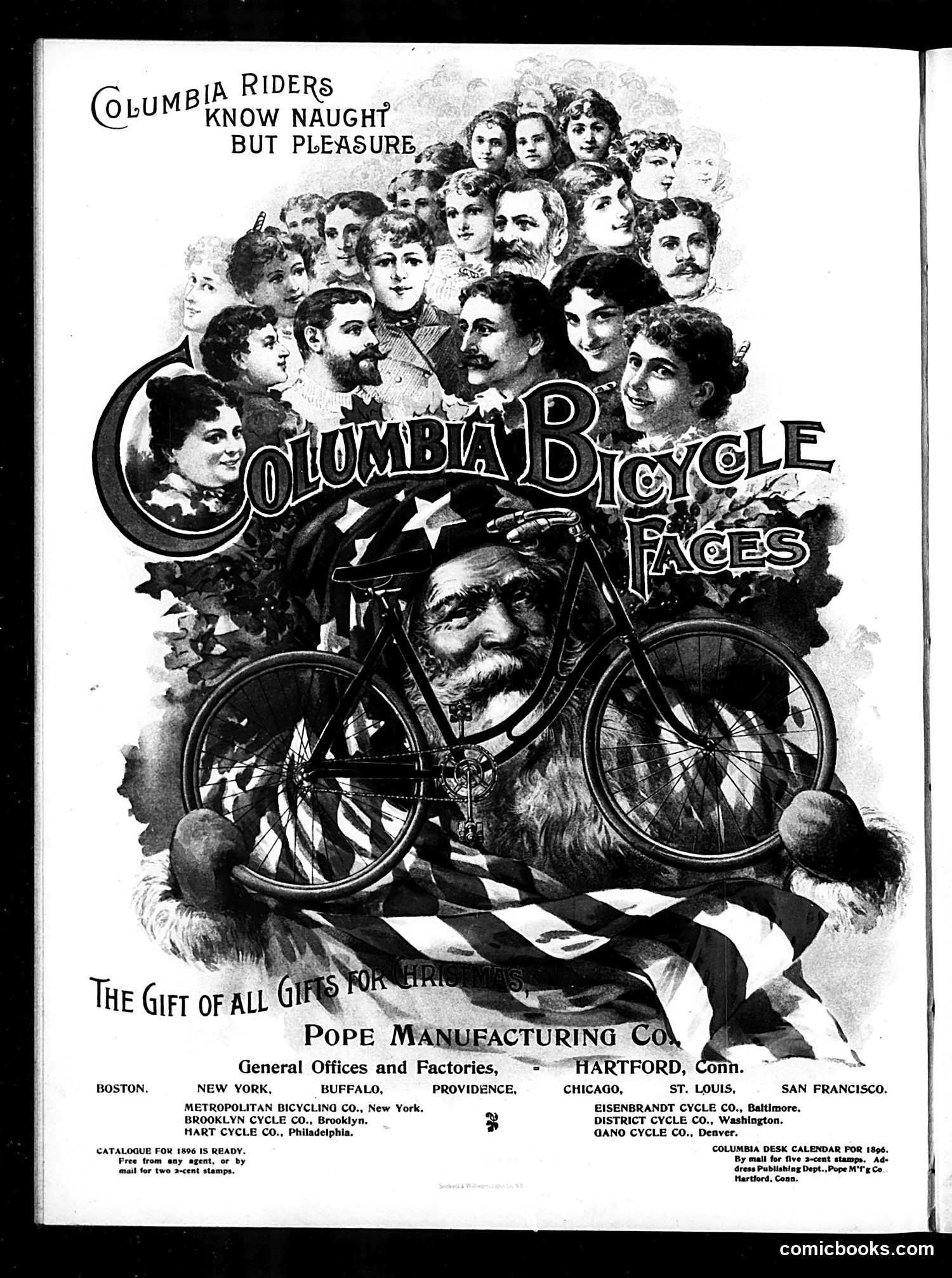
This is primarily a **bicycle advertisement**, not political satire. It promotes Columbia brand bicycles made by Pope Manufacturing Company of Hartford, Connecticut. The visual composition features a bearded man (likely Pope, the company founder) prominently displayed with a bicycle, surrounded by numerous faces of women and men—presenting bicycles as "the gift of all gifts for girls" and broadly appealing to riders. The tagline "Columbia Riders Know Naught But Pleasure" emphasizes recreational enjoyment. The 1896 date is significant: this represents the height of the **bicycle craze**, when bicycles were marketed as enabling female independence and mobility. The emphasis on female riders reflects this period's cultural shift. The advertisement lists numerous regional distributors and offers a free catalog and desk calendar—typical promotional tactics of the era. This is essentially a full-page commercial announcement in Judge magazine.