
A complete issue · 16 pages · 1895
Judge — November 2, 1895
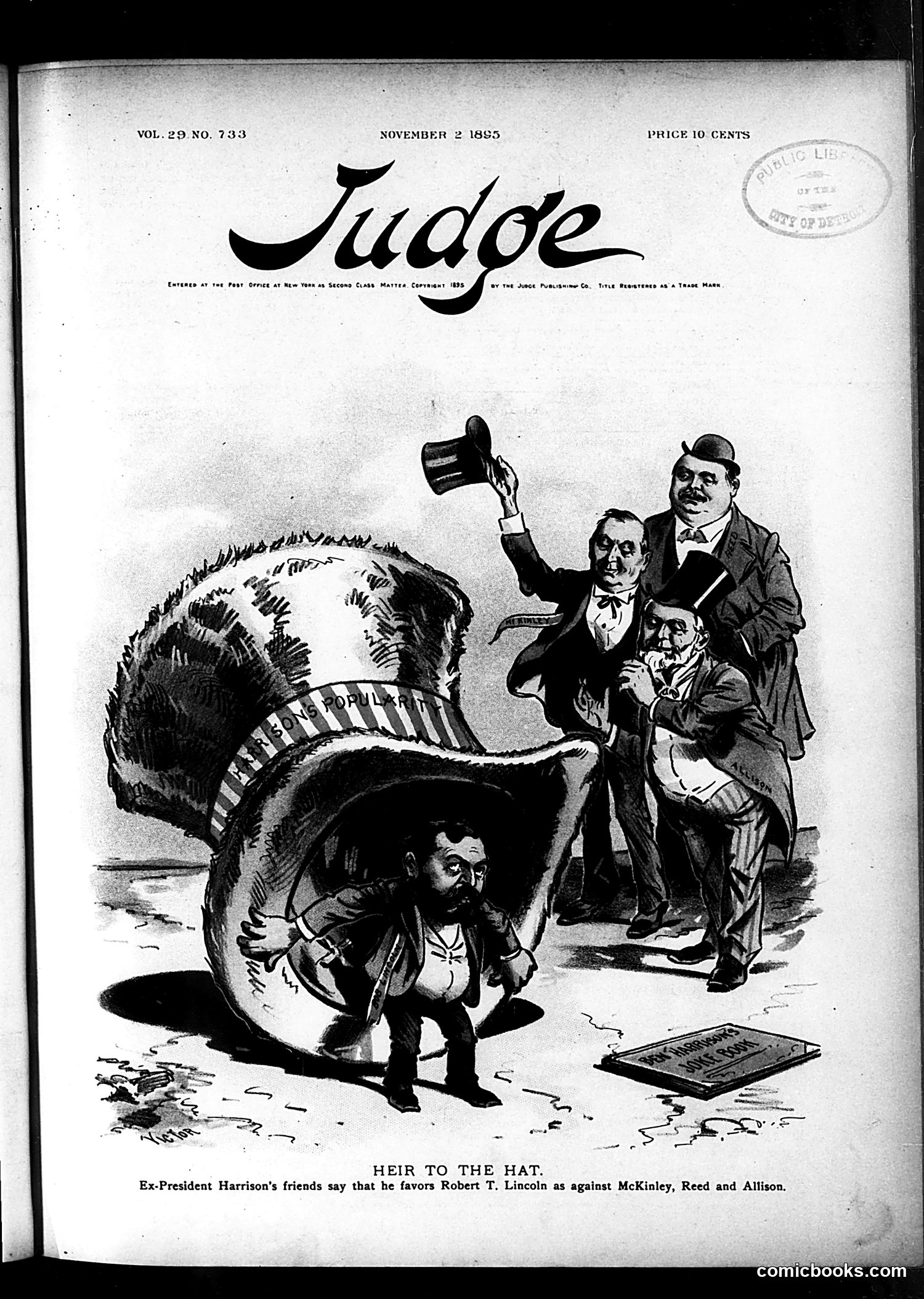
This political cartoon satirizes succession speculation within the Republican Party. The large hat (representing the presidency) is being carried by a small figure, while three well-dressed men behind gesture and compete for attention—one raising a top hat in celebration. The caption states: "Ex-President Harrison's friends say that he favors Robert T. Lincoln as against McKinley, Reed and Allison." This references former President Benjamin Harrison's purported preference for Robert Todd Lincoln (son of Abraham Lincoln) as the next Republican presidential nominee, positioning him against other potential candidates: William McKinley, Thomas Brackett Reed, and William Boyd Allison. The cartoon mocks how political insiders jockey for the presidency while the office itself appears burdened or unstable beneath the weight of these competing ambitions.
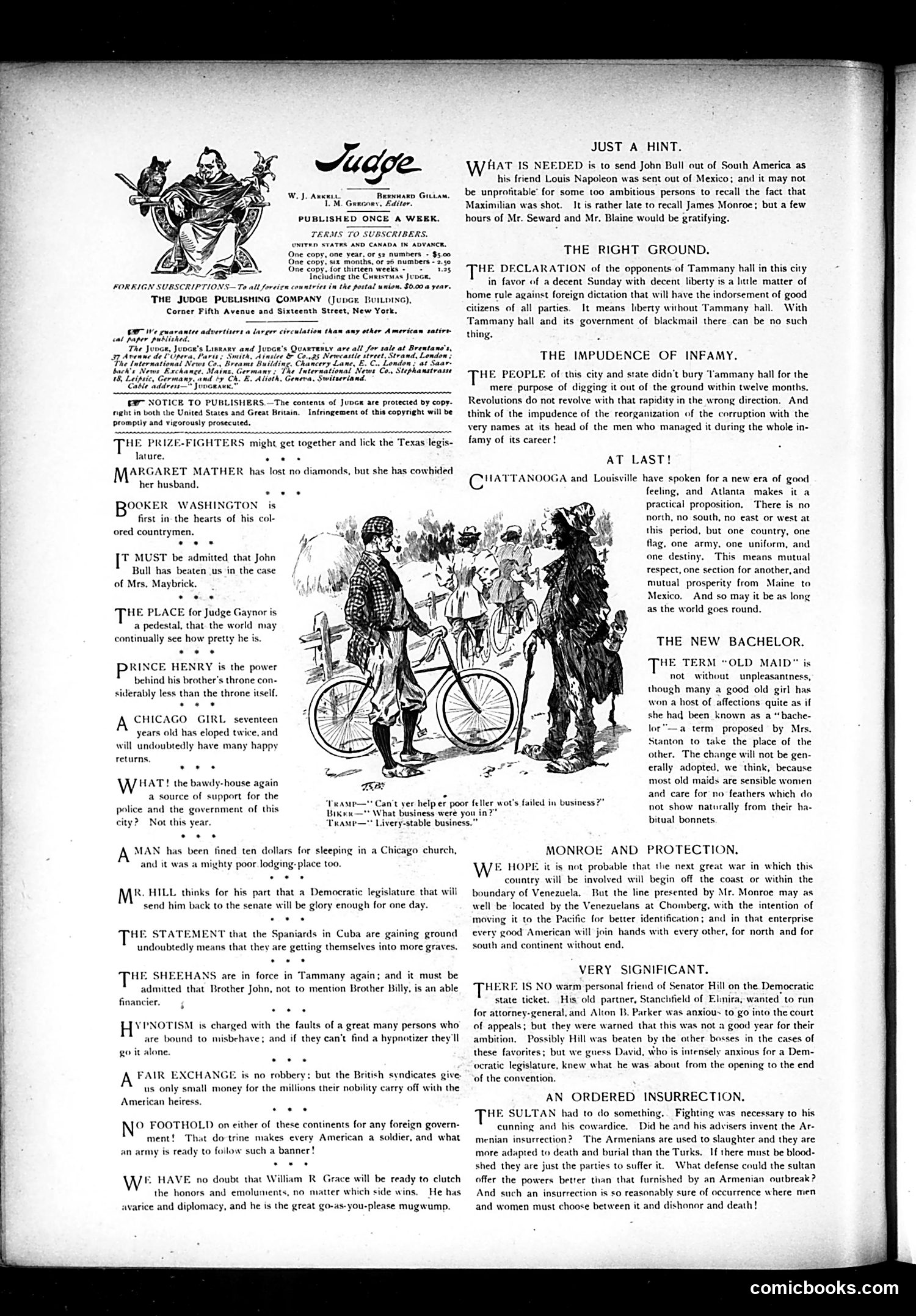
The main cartoon depicts a figure on a bicycle encountering what appears to be military or law enforcement personnel. The caption reads: "I can't—let me help of poor filter, who's failed in business?" / "likes—What business were you in?" / "I can't—Unstable business." This appears to satirize someone attempting to avoid or escape authority, possibly referencing labor unrest or political upheaval of the era. The bicycle as an escape vehicle and the "unstable business" quip suggest commentary on social instability or failed commercial ventures during periods of American political tension. The surrounding text discusses various political figures and social issues (Tammany Hall, Cuban affairs, Senator Hill), indicating this reflects turn-of-the-century American political discourse, though the specific cartoon's exact historical reference remains unclear without additional dating or context.
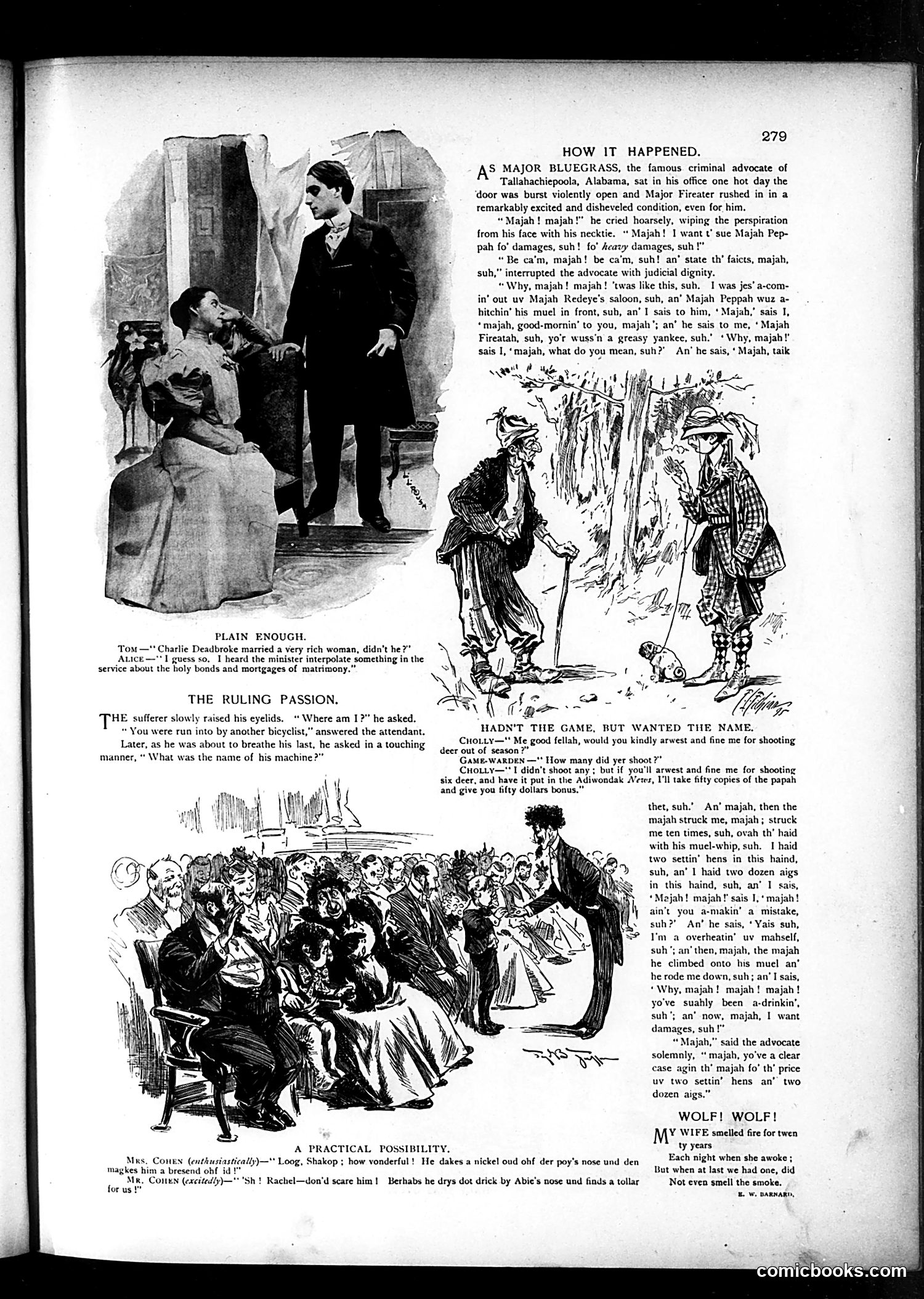
This page contains several humorous anecdotes and satirical cartoons typical of Judge's early 20th-century style. The top section "How It Happened" mocks Major Bluegrass, "a famous criminal advocate" from Tallahassee, Alabama, through exaggerated dialect humor—a common (though cringe-worthy) comedic device of the era. The joke plays on his theatrical courtroom demeanor. The middle cartoon "The Ruling Passion" depicts a bicycle accident case, satirizing how lawyers and judges focus on technicalities rather than justice. Lower sections include "Plain Enough," "A Practical Possibility," and "Hadn't the Game, But Wanted the Name"—short joke pieces mocking social pretension, domestic situations, and hunter braggadocio. The cartoons use exaggerated character types and dialectal speech for comedic effect, reflecting period attitudes toward class, profession, and regional differences.
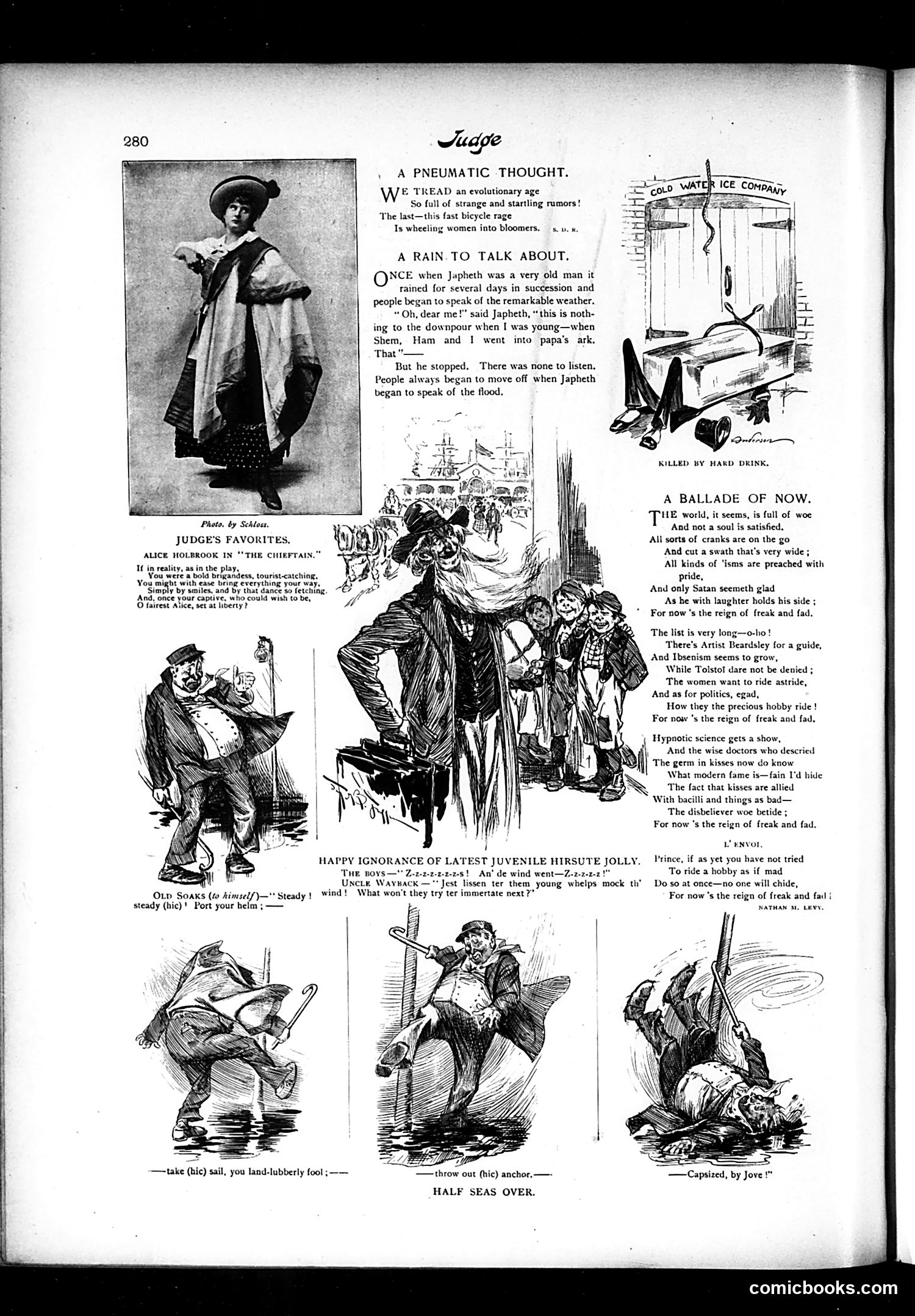
This page satirizes late-19th-century social anxieties and fads. The opening poems mock the bicycle craze—specifically women adopting practical "bloomers" (split skirts) to ride bicycles, which shocked Victorian sensibilities about female dress and mobility. "A Rain to Talk About" uses biblical humor: elderly Japheth bores people with nostalgic flood stories until they leave, satirizing tedious old-timers. "A Ballad of Now" is the page's centerpiece, mocking contemporary "crazes" and progressive movements: Ibsenism (modern drama), Tolstoy's philosophy, women's activism, artistic movements (Beardsley's decadent aesthetics), and "isms" generally. The refrain "the reign of freak and fad" dismisses these trends as passing obsessions rather than serious reform. The bottom cartoons about drunk sailors ("Half Seas Over") provide comedic relief. Overall, Judge presents itself as sensible observer mocking both radical reformers and old-fashioned relics, positioning readers as rational moderates.
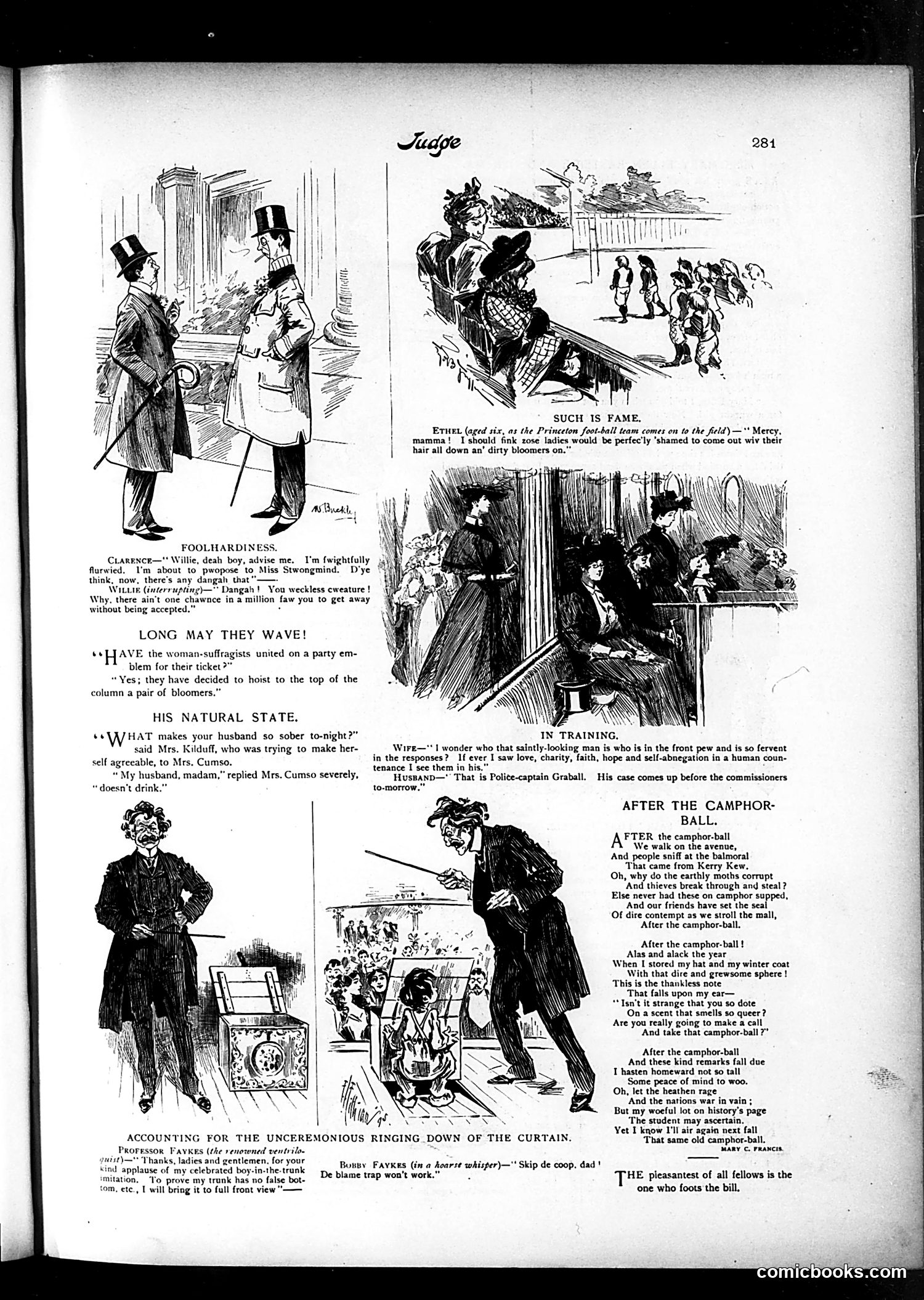
This page contains multiple short satirical pieces mocking Victorian-era social conventions: **"Foolhardiness"** ridicules upper-class men's fear of rejection—a waiter warns a gentleman proposing to "Miss Strongmind" is foolish because she'll definitely accept. **"Long May They Wave"** mocks women's suffrage advocates, suggesting their political emblem would be "bloomers" (reform dress)—implying suffragists are ridiculous. **"Such Is Fame"** shows a child shocked that Princeton football players appear with disheveled hair and "dirty bloomers," conflating athletes with suffragists. **"His Natural State"** jokes that a sober husband is unnatural—implying drinking is men's "natural" condition. **"After the Camphor-Ball"** is a humorous poem about the social embarrassment of mothballs' smell clinging to winter clothes stored with camphor. **"In Training"** appears to reference a "Police-captain Graball" under investigation. Throughout, the magazine ridicules women's rights activists, celebrates drinking, and mocks social pretension typical of Gilded Age satire.
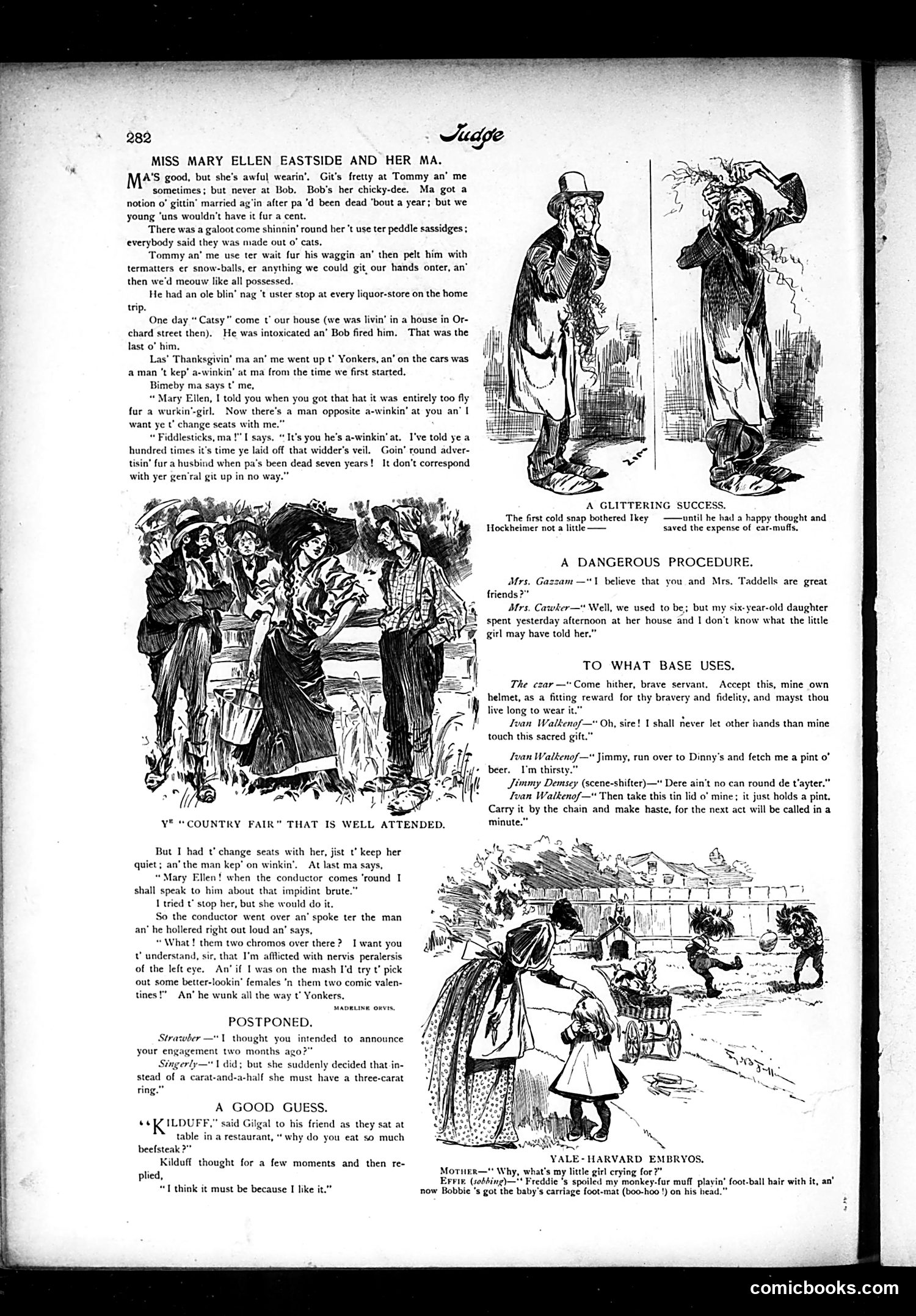
This page contains several brief satirical pieces and cartoons typical of Judge's humor: **Main story ("Miss Mary Ellen Eastside")**: A working-class girl recounts embarrassing incidents with her widowed mother, who's seeking remarriage. The satire mocks both the mother's desperate husband-hunting (advertising herself via fashionable dress) and the daughter's snobbish embarrassment. The "winking man" twist—he's actually afflicted with a nervous condition, not flirting—undercuts the mother's vanity. **Other items** include brief jokes about engagement rings, beefsteak consumption, and childhood mishaps. The "Czar" piece satirizes Russian servility: a servant receives an "honor" but immediately degrades it by using the sacred helmet as a beer container, highlighting the absurdity of autocratic reward systems. The cartoons depict working-class and immigrant characters in everyday situations. The humor relies on dialect, class stereotypes, and situational irony rather than political commentary. This represents Judge's lighter satirical content—social mockery rather than hard political satire.
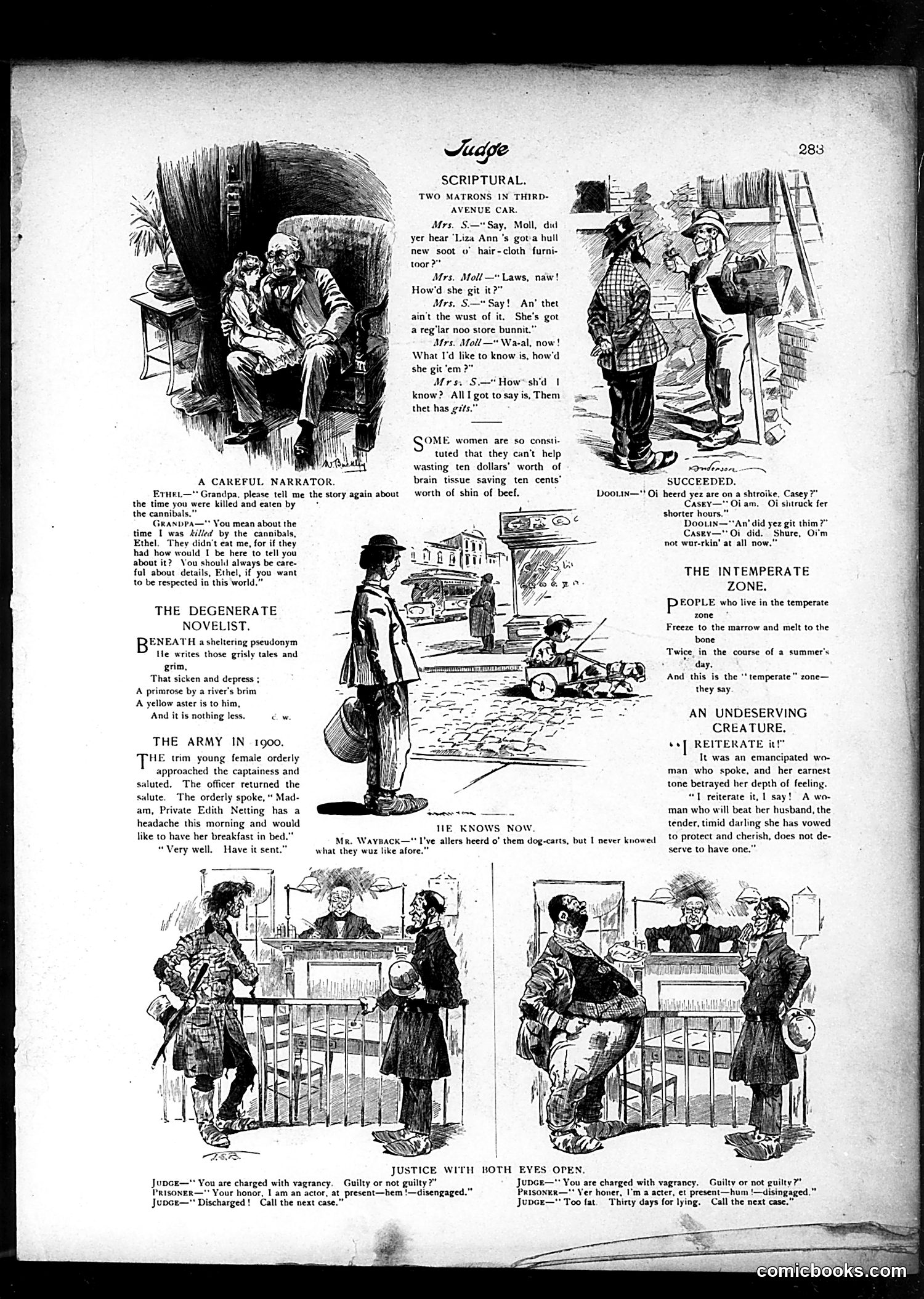
This page from Judge magazine contains several satirical pieces mocking early 1900s society and manners: **"A Careful Narrator"** jokes about pedantic correction—a grandfather insists on precise language when recounting being killed (but not eaten) by cannibals, preaching accuracy to his granddaughter. **"The Degenerate Novelist"** criticizes overly dark, morbid fiction writers who see beauty only as depressing rather than uplifting. **"The Army in 1900"** satirizes women entering military service—a female orderly requests breakfast in bed for a sick soldier, mocking the incongruity of women in supposedly "tough" military roles. **"Scriptural"** and **"He Knows Now"** feature working-class Irish characters (identified by dialect) discussing consumer goods and labor strikes. **"Justice with Both Eyes Open"** presents two courtroom scenes where judges discharge an actor for vagrancy but convict another for "lying" about being an actor—satirizing inconsistent judicial logic. Overall, the page reflects period anxieties about social change, women's roles, immigration, and labor movements.
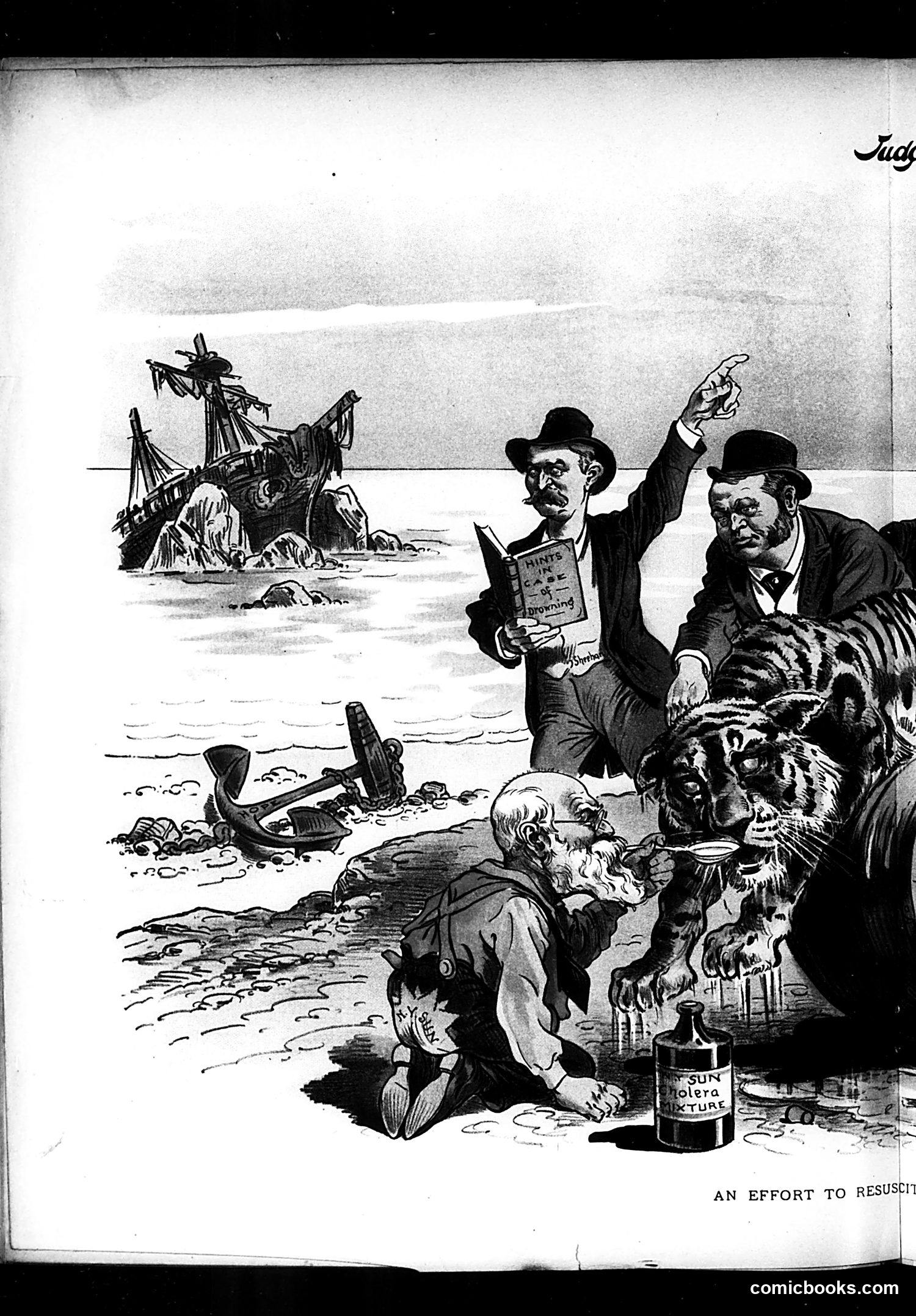
This political cartoon depicts three well-dressed men attempting to revive an elderly, skeletal figure on a beach near a wrecked ship. One man holds a book labeled "How to" (text unclear), another points upward dramatically, while a third administers what appears to be medicine labeled "Sun Cholera Mixture." The satire likely concerns attempts to restore something dead or dying—possibly a failed business venture, political movement, or social institution. The skeletal corpse, shipwreck setting, and the medicine bottle suggest either literal revival of commerce/trade or metaphorical resurrection of a discredited policy or regime. The cartoon's tone is darkly comic, questioning whether such "resuscitation" efforts are futile or absurd. Without the magazine's date or fuller context, the specific target remains unclear.
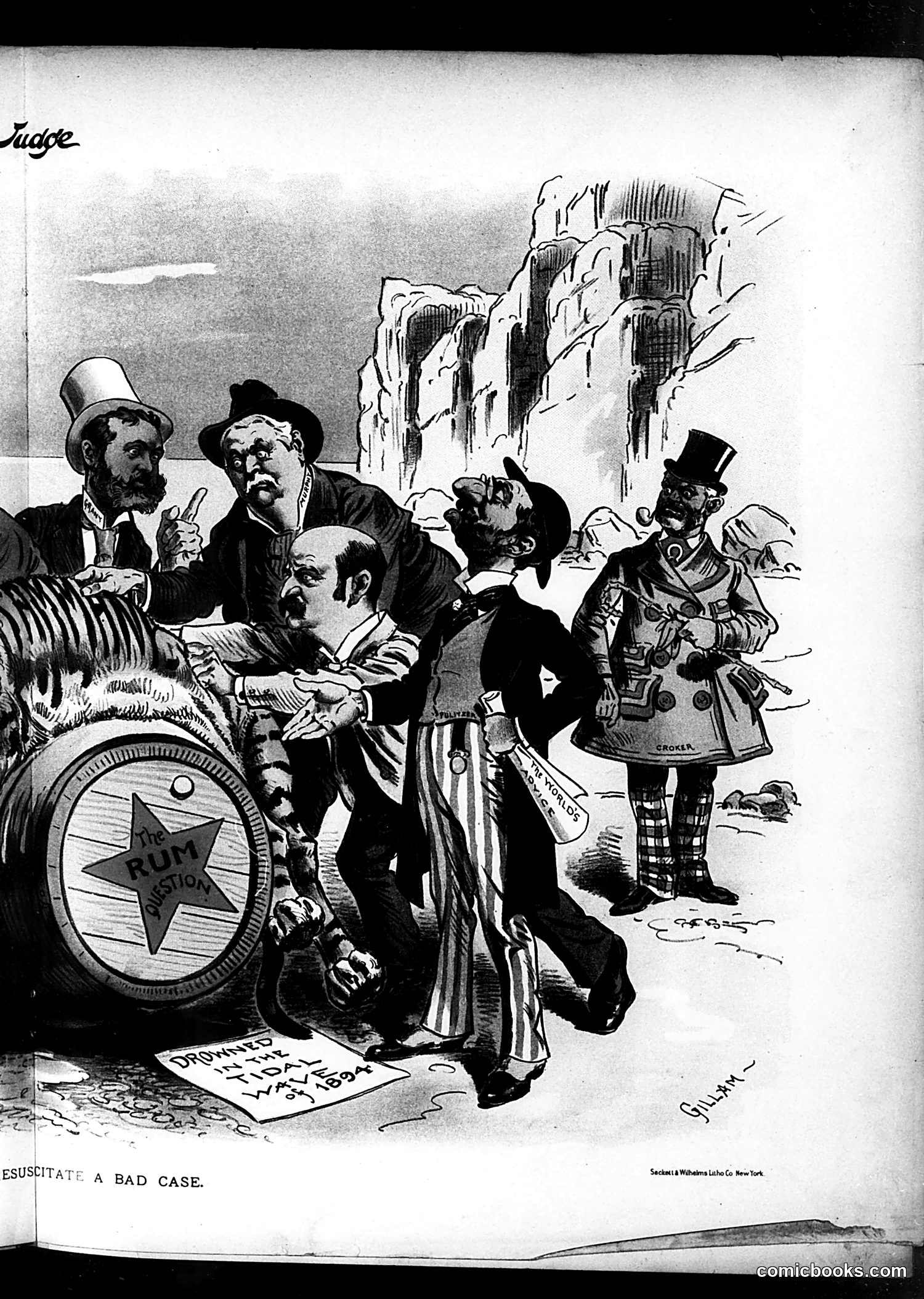
This political cartoon depicts figures attempting to revive what appears to be a failed legal or political matter. A barrel labeled "RUM PROHIBITION" sits prominently in the foreground, suggesting the subject concerns alcohol regulation policy. The figures—rendered with caricatured features typical of late 19th/early 20th-century satirical art—appear to be politicians or officials trying to resurrect a controversial issue. The cartoon's title and composition suggest satire about efforts to revive a "bad case"—likely a failed prohibition initiative or similar legislation that had died in courts or public opinion. The use of rum and the formal dress of the figures implies this concerns alcohol policy debates that were prominent during the Prohibition era. The "Judge" magazine context confirms this is political commentary on contemporary policy struggles.
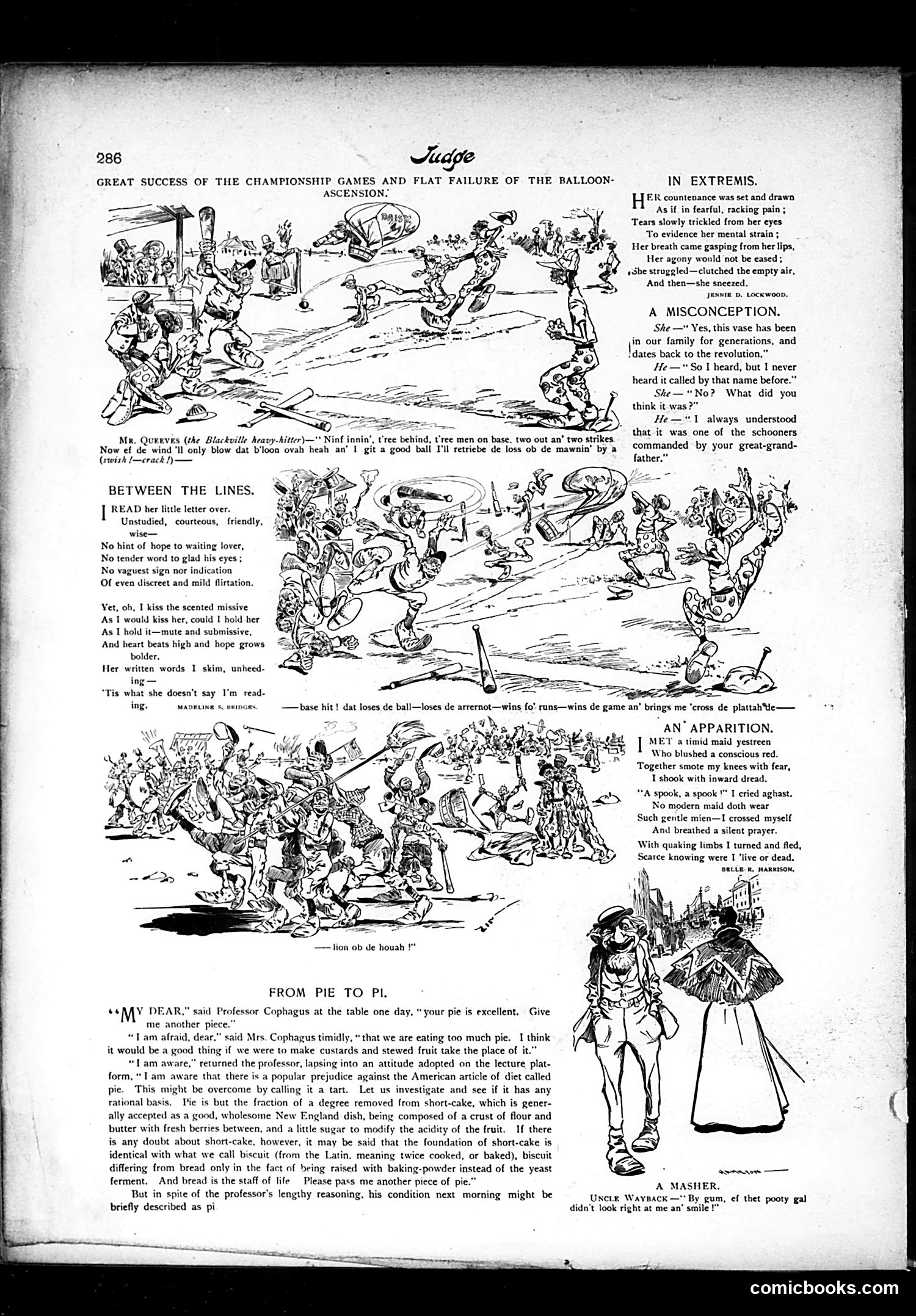
This page contains multiple satirical pieces typical of Judge magazine's humor: **"In Extremis"** depicts a woman in dramatic distress—gasping, tearful, clutching the air—whose crisis resolves anticlimactically: she simply sneezes. The satire mocks overwrought emotional expression. **"A Misconception"** plays on a woman's family vase "dating to the revolution," which her husband misunderstood as being called by a disrespectful name—likely a crude joke about the object's appearance or purpose. **Baseball cartoon** shows a Black player in dialect speech, typical of the era's racist caricature humor common in Judge. **"From Pie to Pi"** features Professor Cophagus delivering pedantic lectures defending American pie as nutritionally equivalent to shortcake and biscuit, ending with the punchline that despite his reasoning, his digestive condition next morning was simply "pi" (implying digestive distress). These pieces reflect Judge's focus on domestic humor, romantic sentimentality played for laughs, and intellectual pomposity undercut by physical reality.
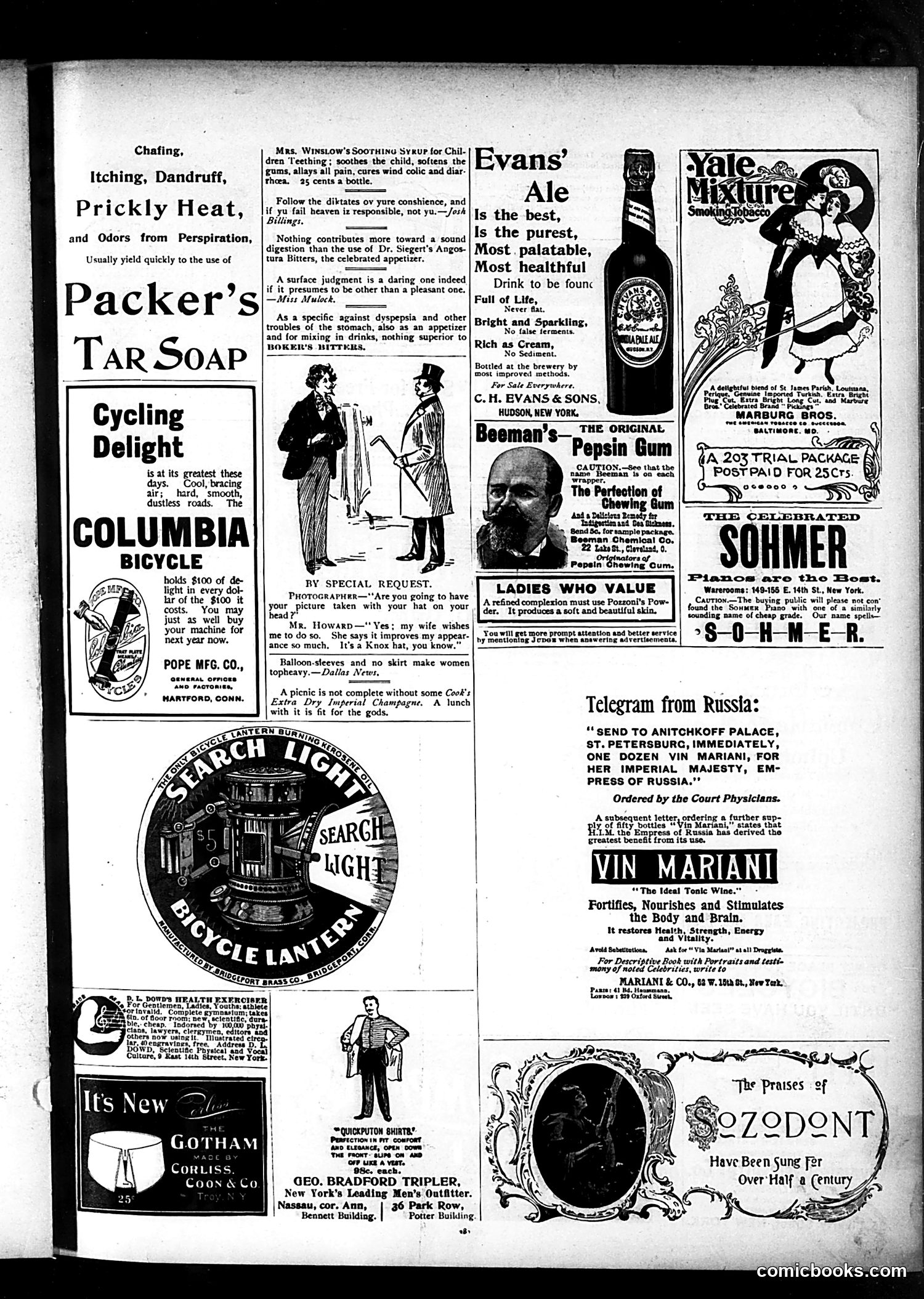
This is primarily an **advertising page** from Judge magazine, not a political cartoon. The page contains various product advertisements typical of late 19th/early 20th-century publications: **Notable ads include:** - Patent medicines (Mrs. Winslow's Soothing Syrup, Angostura Bitters, Beeman's Pepsin Gum) - Consumer goods (Columbia Bicycle, Sohmer Pianos, Gotham Corsets) - **A striking advertisement for "Vin Mariani"** wine, featuring a fabricated telegram claiming the Russian Empress ordered it for health benefits—a common marketing tactic exploiting royal endorsement **The small dialogue snippets** are humorous vignettes about everyday life: a man being photographed in his hat, a woman wanting her husband's appearance improved by hat-wearing. The "Sozodon" toothpaste ad at bottom references a product's longevity through an ornamental frame. **Context for modern readers:** This reflects an era when patent medicines made extravagant health claims, and fake celebrity/royal endorsements were standard advertising practice—predating modern consumer protection laws.
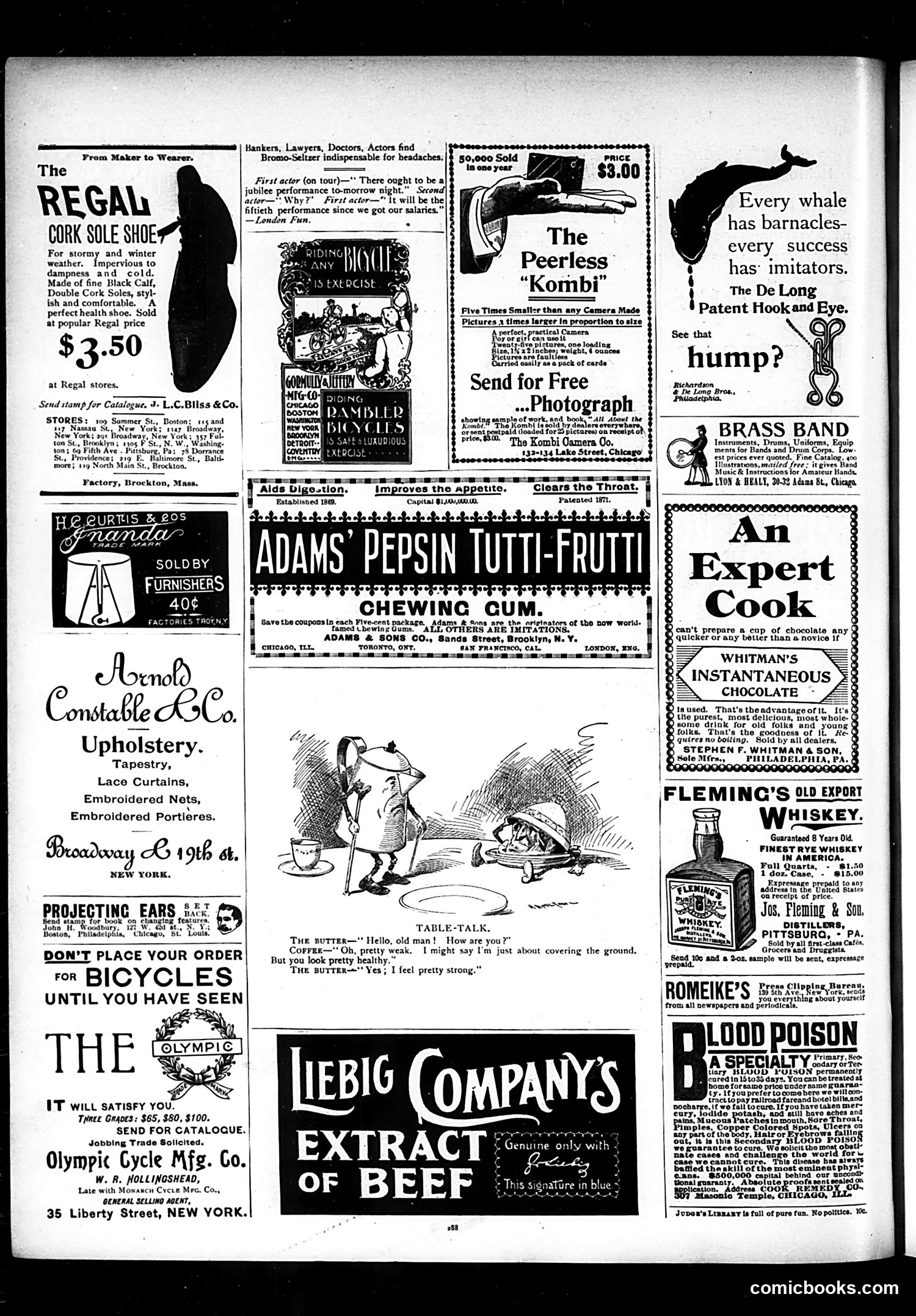
This is primarily an **advertising page** from Judge magazine, with one small cartoon joke embedded among product advertisements. The single cartoon ("TABLE-TALK") depicts a conversation between personified **Butter and Coffee**—anthropomorphized food items. Butter complains of feeling "weak" while Coffee boasts of feeling "strong," yet Butter observes that Coffee "look[s] pretty healthy" despite its weakness. Coffee responds it feels "pretty strong" and is "just about covering the ground." The joke relies on **food puns**: weak/strong refer to the beverages' literal qualities (weak coffee, strong butter/dairy fat), while their physical appearances contradict their self-assessments—a gentle absurdist humor typical of period magazines. The remainder is commercial advertising for shoes, bicycles, cameras, chewing gum, chocolate, whiskey, and other products—standard Judge content used to finance the publication. The small Bromo-Seltzer advertisement at top includes a brief theatrical joke about actors' delayed salary payment.
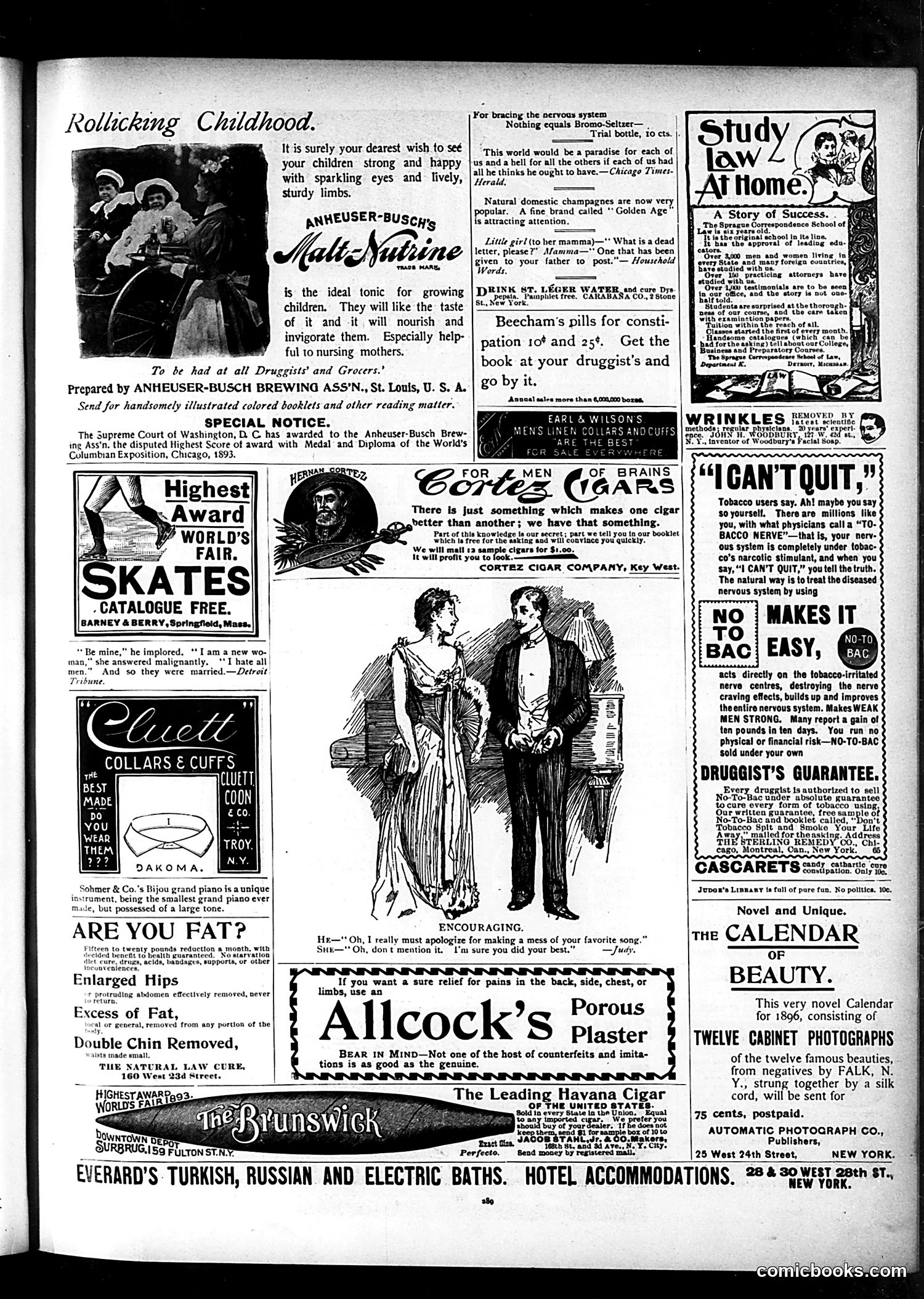
This page is primarily **advertisements and filler content**, typical of late-19th-century magazines. Key elements: **Main Advertisements:** - Anheuser-Busch's malt beverage for children's health - Bromo-Seltzer (nervous system tonic) - Beecham's Pills (constipation relief) - Cortez Cigars - "No-To-Bac" (tobacco addiction cure) - Various other patent medicines and products **Humor Content:** The small jokes ("Rolling Childhood," "Encouraging") are mild domestic humor—a girl misunderstanding "dead letter," a couple's musical mishap. Nothing politically satirical. **Social Context:** The advertisements reveal period attitudes: marketing tobacco products and addictive remedies freely, treating children's tonics casually, promoting "cures" for weight and tobacco addiction without regulation. **Assessment:** This is a **typical Judge page mixing advertisements with light humor**—not satirical commentary. The real content is commercial, reflecting the magazine's revenue model and late-1890s consumer culture, patent medicine era, and unregulated advertising practices.
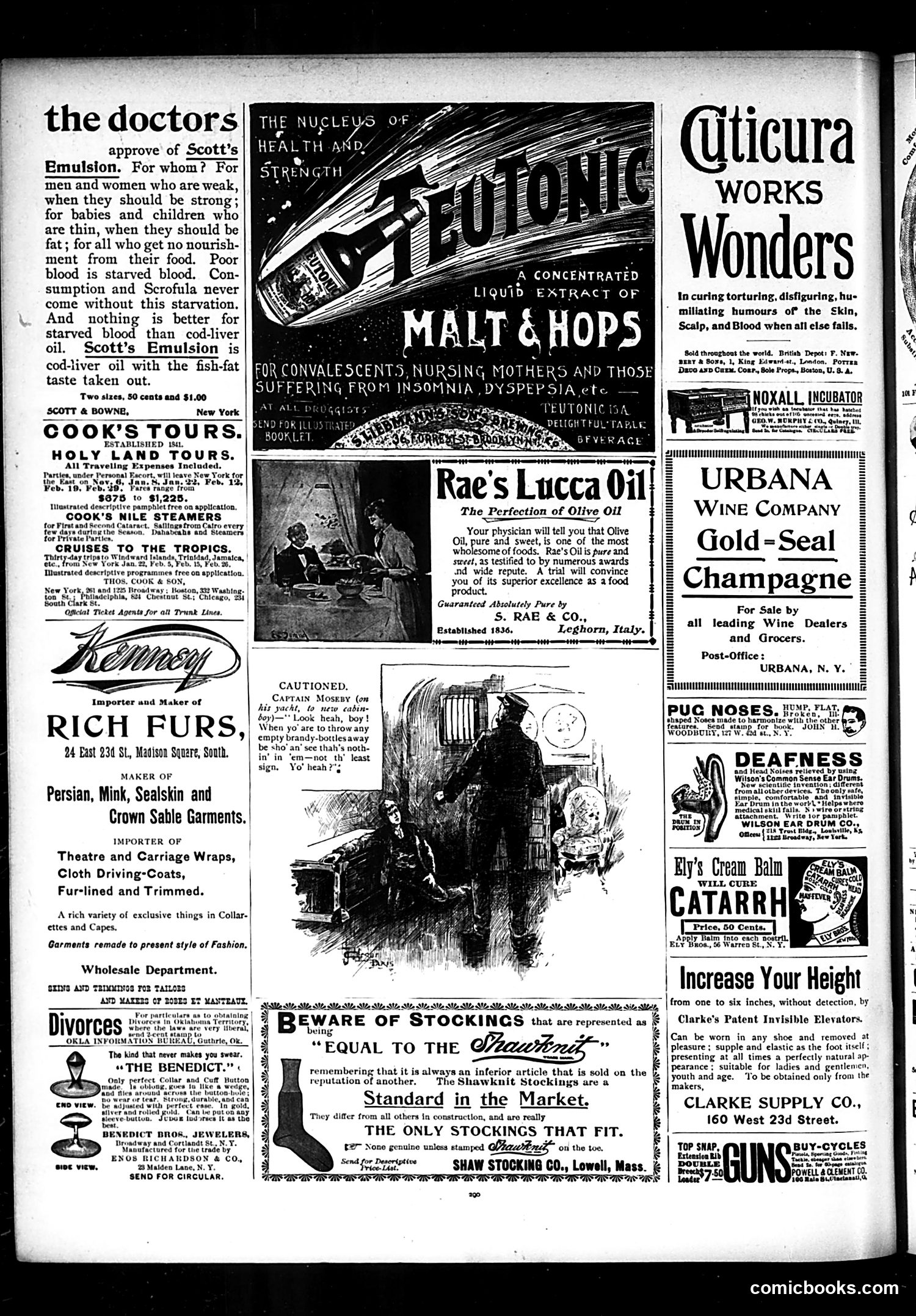
This page is primarily **advertising with one cartoon**. **The main cartoon** (center-left) shows a yacht captain instructing a cabin boy: "When yo' are to throw any empty brandy-bottles away be sho' an' see thah's nothing in 'em—not th' least sign." The humor plays on the servant's assumed temptation to secretly drink the dregs from discarded bottles—a joke about working-class drinking habits and masters needing explicit instructions to prevent theft. The page contains dozens of period advertisements: patent medicines (Scott's Emulsion cod-liver oil, Cuticura skin treatment), travel services (Cook's Tours), luxury goods (Rich Furs), and consumer products (Shawknit Stockings, Ely's Cream Balm for catarrh). The stocking ad warns against counterfeits—a common concern when brand reputation mattered greatly to consumers.
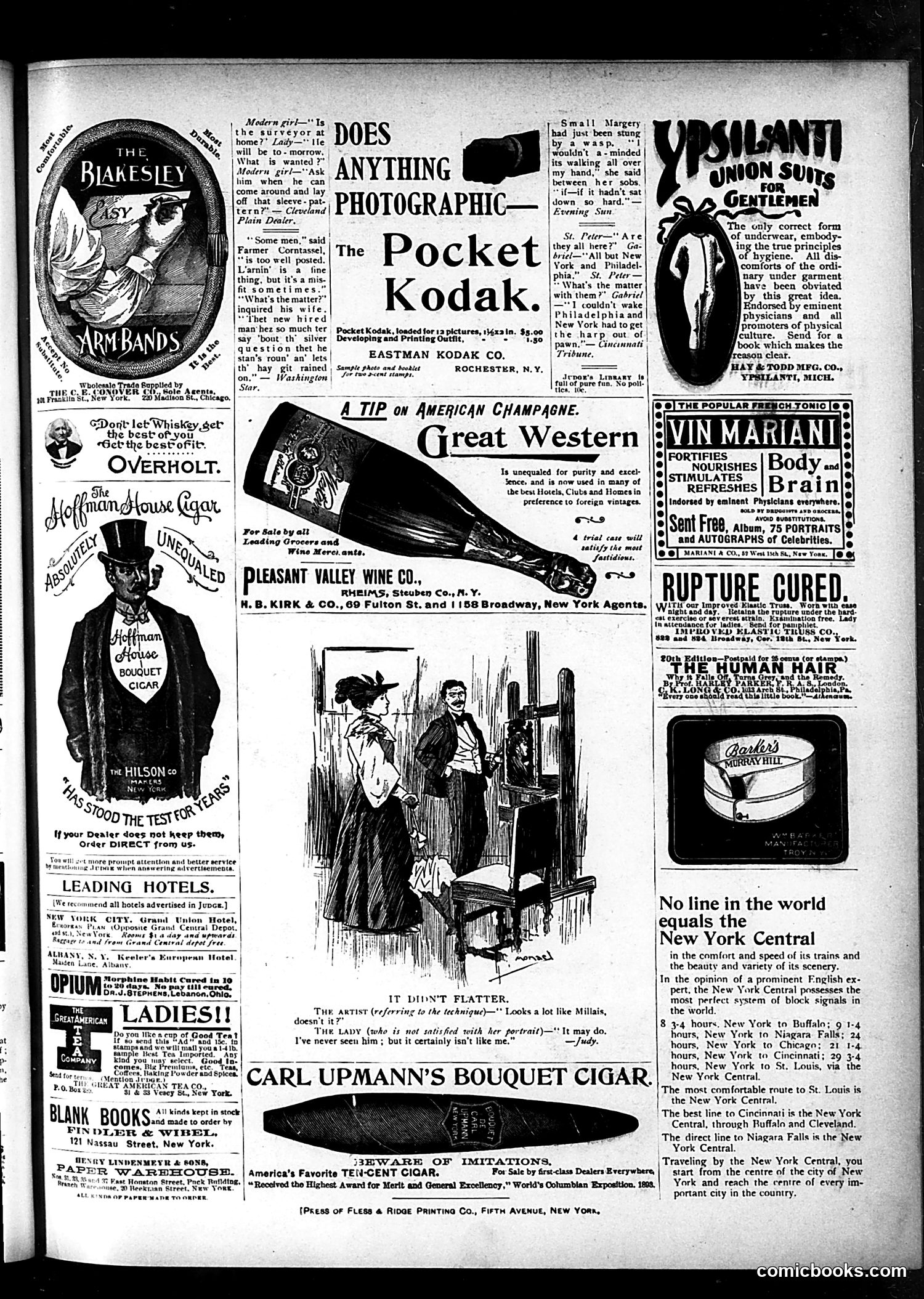
This is primarily an **advertising page** from Judge magazine, not a political cartoon page. The content consists of commercial advertisements for various products and services popular in the early 1900s. Notable ads include: - **Blakesley Arm Bands** and **Overholt Whiskey** (left side) - **Eastman Kodak's Pocket Kodak** camera (center) - **Upmann's Bouquet Cigar** and **Pleasant Valley Wine** (liquor ads) - **New York Central Railroad** (right side, emphasizing speed and comfort) - Patent medicines like **Rupture Cured** and remedies The page also contains **brief humorous jokes** rather than editorial cartoons—including one about a modern girl asking a surveyor to "lay off that sleeve pattern" and another about New York and Philadelphia being asleep in heaven. The single illustration shows two figures in what appears to be a domestic scene, captioned "It Didn't Flatter," a joke about an unflattering portrait. This represents Judge's mixed content of advertising, product endorsements, and light humor typical of early 20th-century magazines.
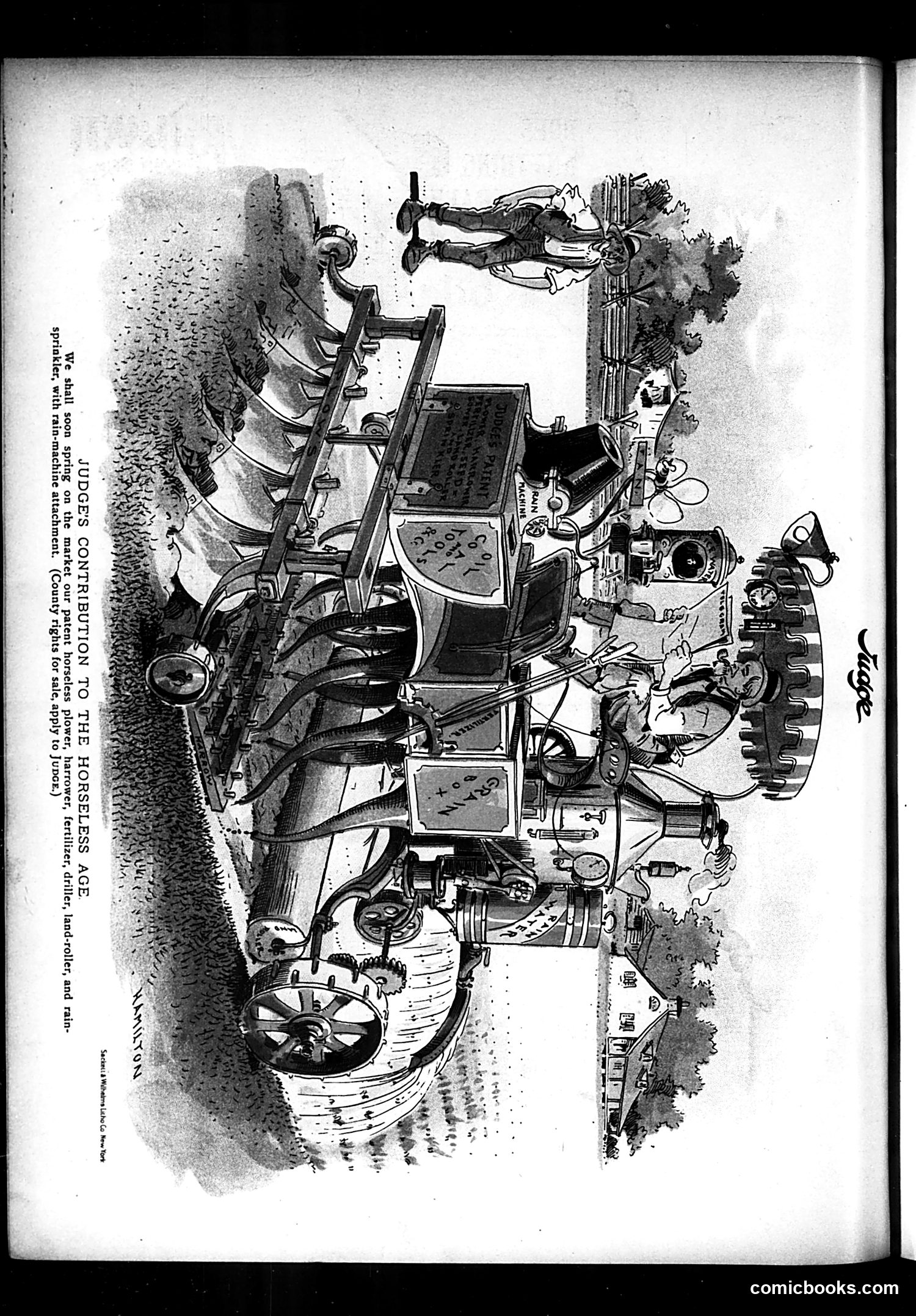
This is a satirical illustration mocking the early automobile era's wild optimism about mechanization. The cartoon depicts an absurdly over-engineered contraption—a horseless vehicle supposedly combining multiple farm implements (plow, harrow, fertilizer spreader, drill, roller, and rain machine) into one improbable machine. The satire targets the "horseless age" craze of the 1890s-1900s, when inventors promoted fantastical mechanical solutions to replace horse labor. Judge magazine ridicules this excessive enthusiasm by showing an impractical, Rube Goldberg-like creation that tries to do everything simultaneously—suggesting such multi-purpose machines are technically impossible and commercially absurd. The humor relies on contemporary readers' awareness of actual horseless carriage development and farmers' genuine need for mechanization, contrasted against this obviously unworkable fantasy.