
A complete issue · 16 pages · 1895
Judge — August 17, 1895
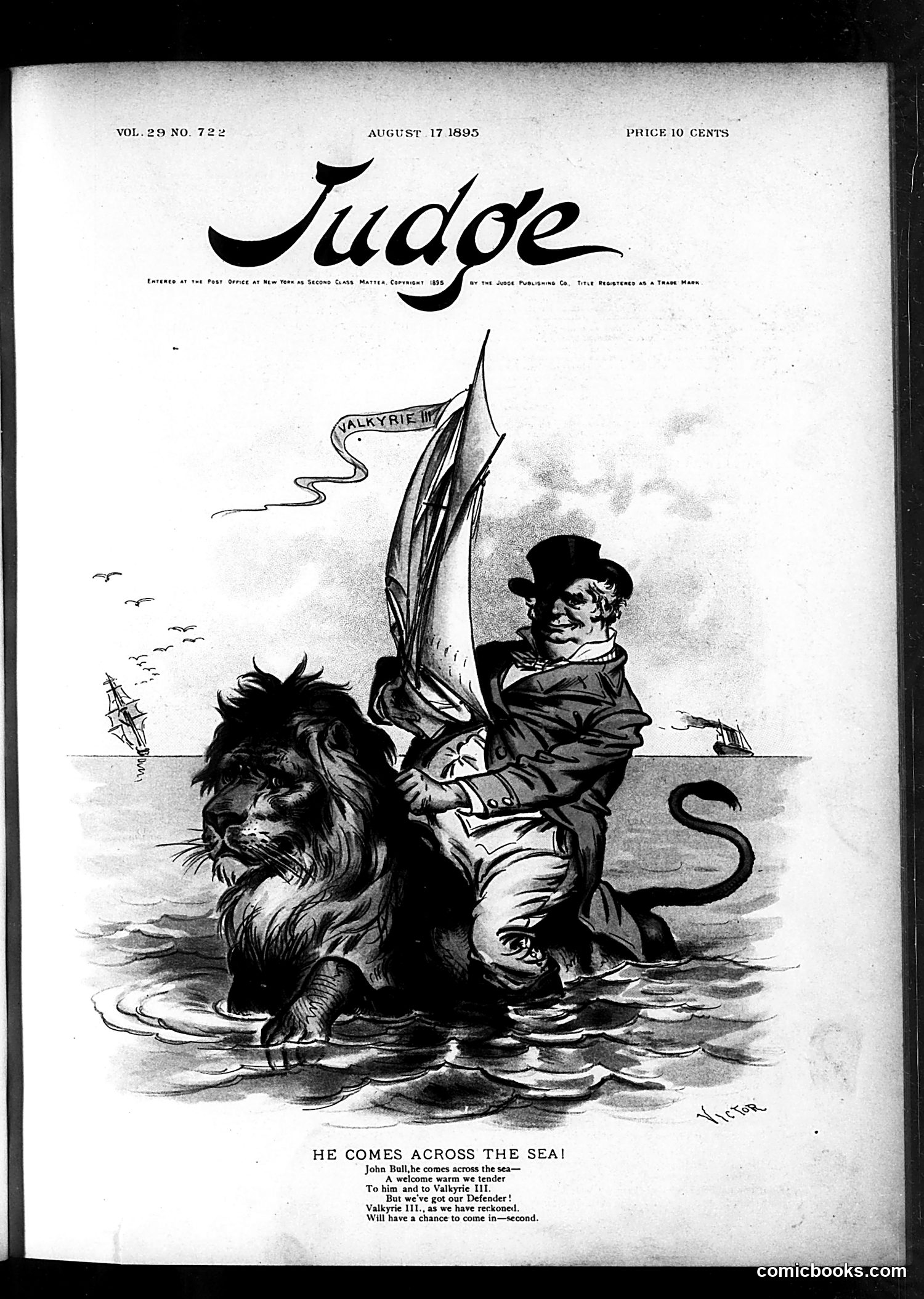
This satirical cartoon depicts a figure riding a lion across the sea on a ship labeled "Valkyrie III." The caption reads "HE COMES ACROSS THE SEA!" with reference to "John Bull" (personification of Britain) welcoming someone to Valkyrie III. The cartoon appears to reference the America's Cup yacht race, as Valkyrie III was a famous British challenger yacht. The figure riding the lion likely represents a British competitor or dignitary arriving for the competition. The lion symbolizes Britain itself. The satire seems to mock either British ambitions in the race or the grandiose nature of international sporting competition. However, without additional context about who the specific figure represents or the particular 1895 events referenced, the precise political target remains unclear.
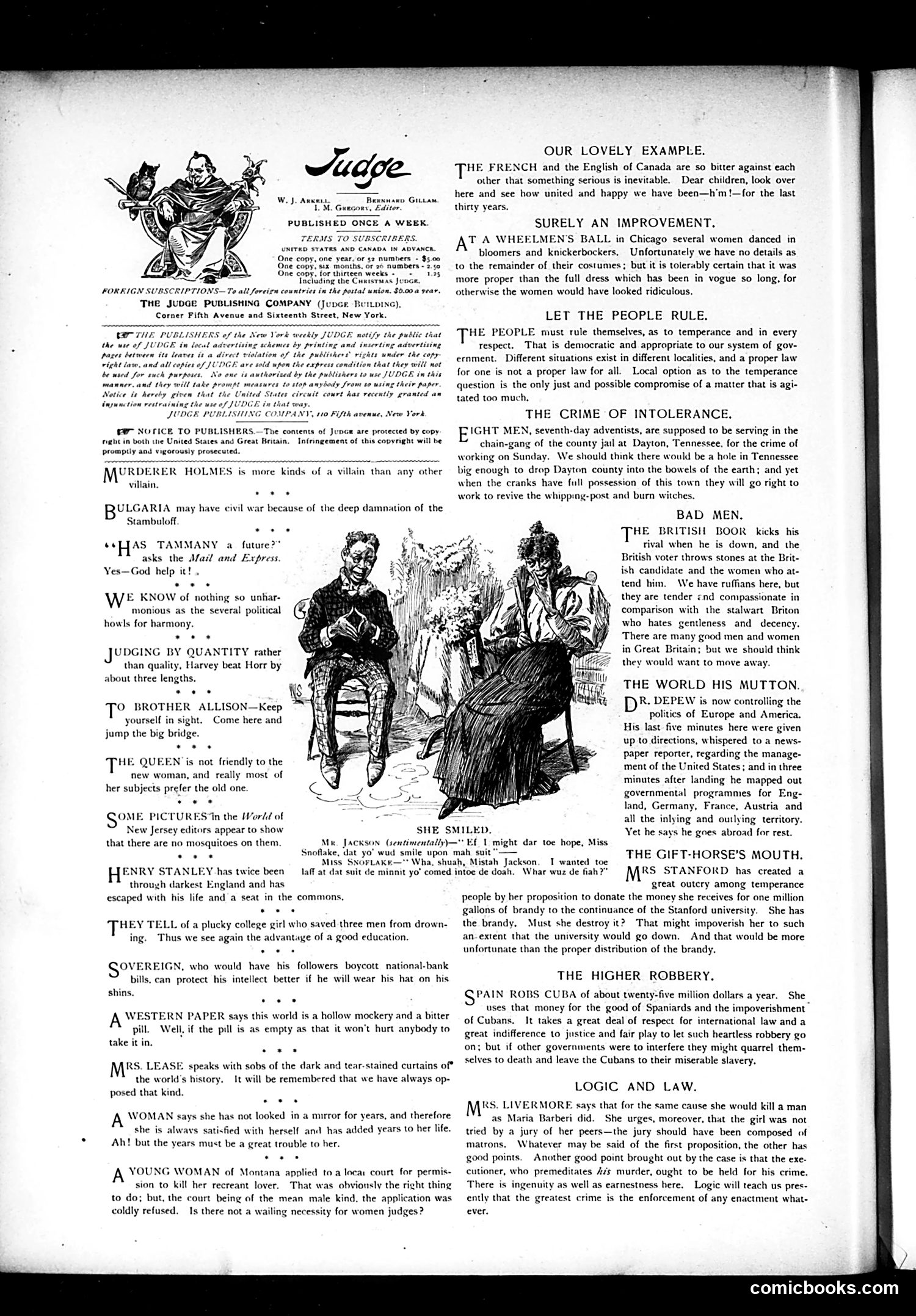
The main cartoon titled "SHE SMILED" depicts two figures in conversation, likely satirizing social commentary of the era. Without clearer identifying marks, I cannot definitively name the specific individuals portrayed. The page's text sections are short opinion pieces on various social and political topics: women's behavior at social events, local temperance laws, religious intolerance (referencing Seventh-day Adventists), British literary rivals, European politics under Dr. Depew, temperance funding, and colonial affairs in Cuba and Spain. The overall tone is characteristic of Judge's satirical approach to contemporary American social issues, politics, and manners. However, the specific identities of figures and exact events referenced remain unclear from the image and OCR text alone without additional historical context.
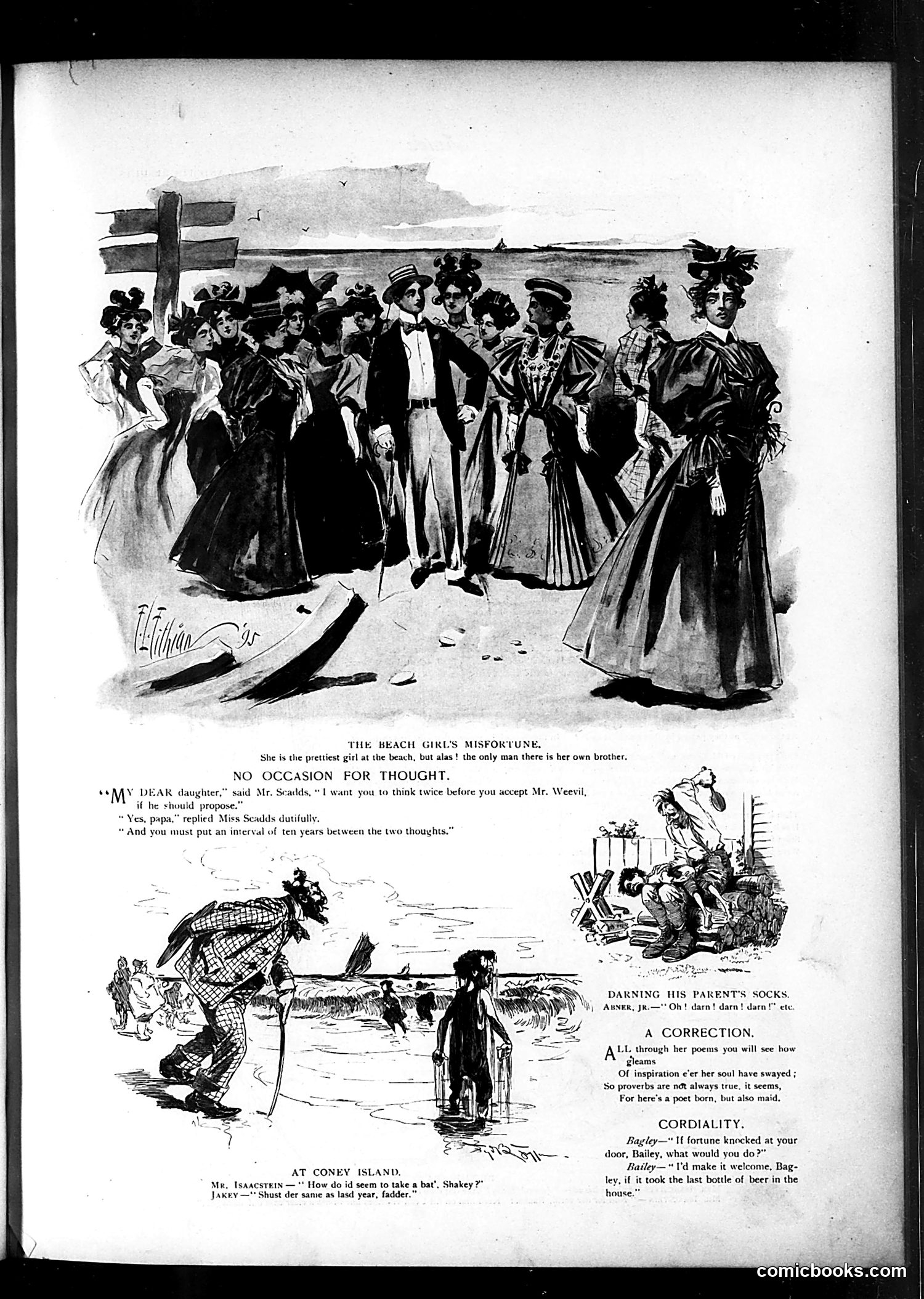
This page contains three separate satirical pieces: **"The Beach Girl's Misfortune"** (top): A cartoon about a young woman at the beach who must choose between two suitors. The satire mocks the social conventions of courtship and marriage proposals, with her father pressuring acceptance of a proposal from someone named Weevil. **"At Coney Island"** (bottom left): A beach scene showing someone attempting to rent a boat, with dialogue poking fun at working-class leisure activities and nautical incompetence. **"Correction" and "Cordiality"** (right): Two brief humorous poems and a joke about poets and hospitality—likely satirizing pretentious literary culture and the tension between politeness and practicality. The overall page reflects turn-of-the-century American satire targeting courtship rituals, class distinctions, and social pretensions through gentle humor rather than harsh political critique.
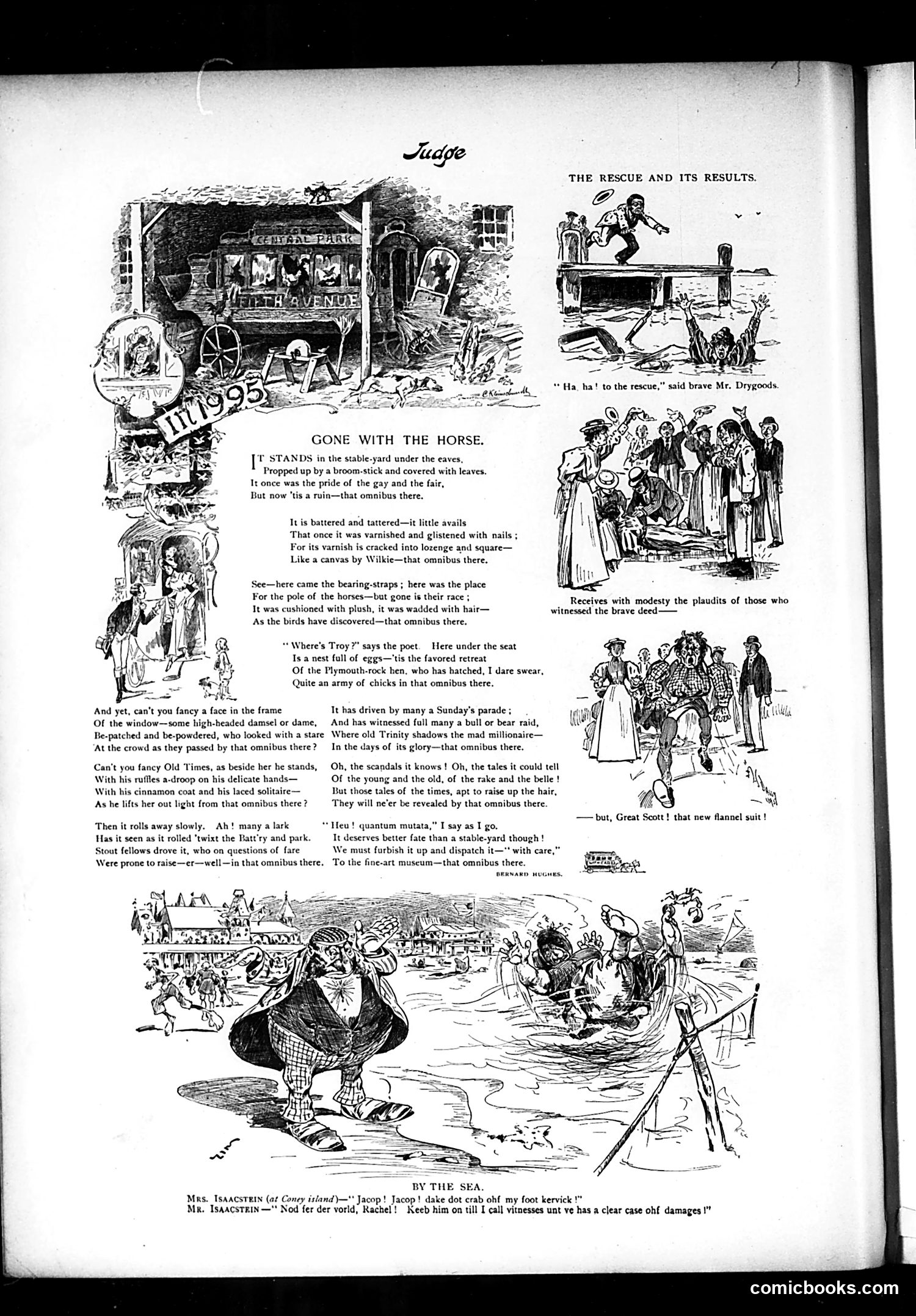
This page satirizes the decline of horse-drawn omnibuses (public carriages) with nostalgic humor. "Gone with the Horse" is a lengthy poem lamenting an old omnibus now abandoned in a stable yard, once prestigious but now battered, its varnish cracked, serving as a hen's nest. The poem evokes vanished urban life—Sunday parades, wealthy passengers, scandals—before suggesting it deserves museum preservation rather than decay. The right-side cartoons titled "The Rescue and Its Results" appear unrelated, showing scenes of social gatherings and rescue scenarios with dialogue, likely satirizing sentimental Victorian rescue narratives or specific contemporary incidents. The bottom cartoon "By the Sea" depicts immigrants (suggested by accents in dialect speech) arguing over a crab injury, threatening legal action—satirizing frivolous damage claims or immigrant litigation culture. The magazine date (1893) places this during America's transition from horse-powered to mechanical urban transportation.
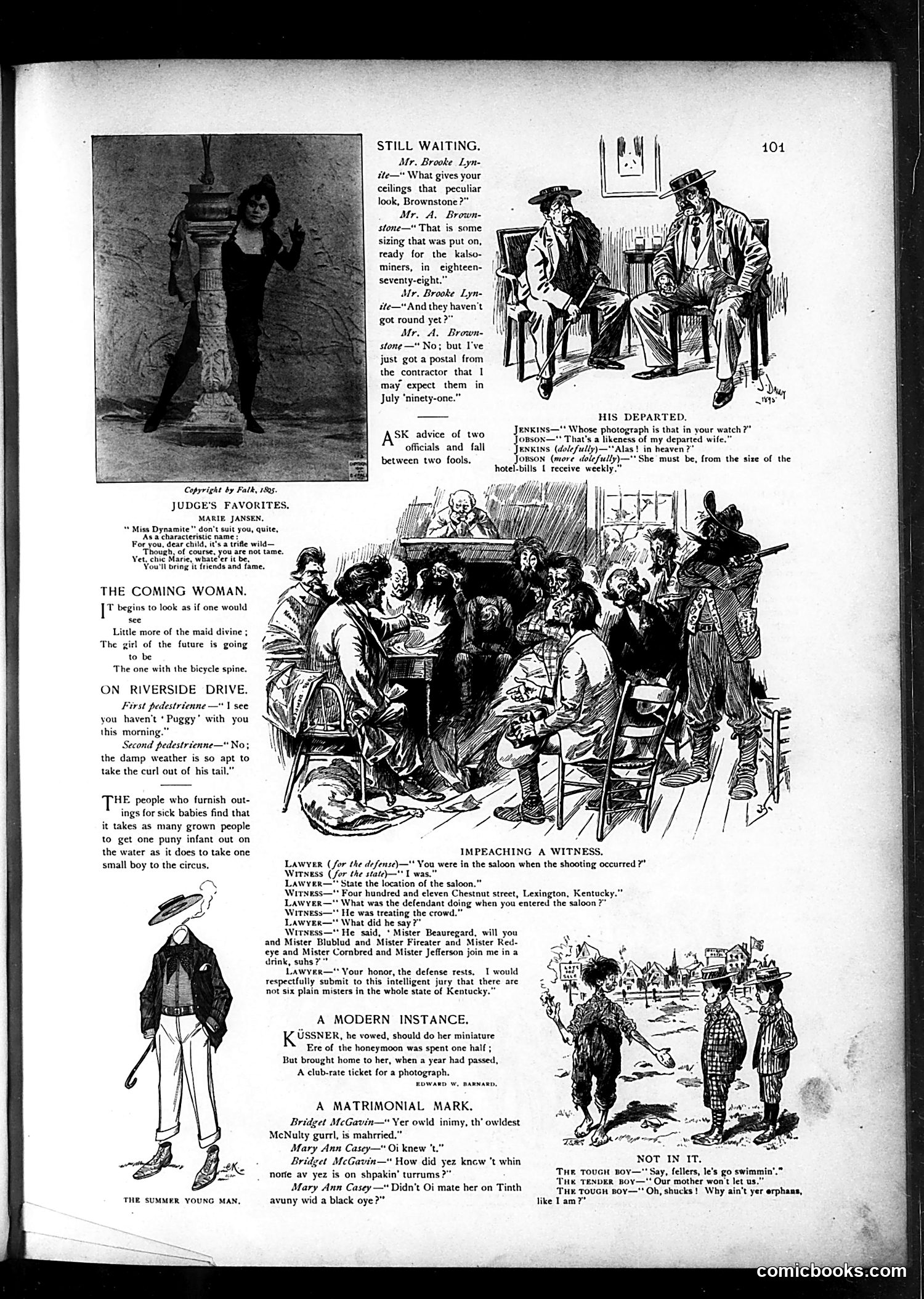
This page from the satirical magazine *Judge* contains several humor pieces mocking contemporary American life circa 1880s-90s: **"Still Waiting"** satirizes slow contractors: a brownstone owner has waited since 1878 for kalsomine workers, now expecting them in 1891—a jab at perpetual delays in home renovation. **"His Departed"** is a dark joke: a widower carries his departed wife's photograph, but reveals she's "in heaven"—and hotel bills arrive weekly, implying she ran up debts before death or the marriage was troubled. **"The Coming Woman"** mocks the "New Woman" movement, suggesting future women will have "bicycle spines" from riding bicycles, which were controversial for female independence and physical activity. **"Impeaching a Witness"** parodies courtroom testimony from Kentucky, using exaggerated Southern names ("Beauregard," "Cornbred," "Jefferson") to mock regional dialect and suggest unreliable witnesses in rural areas. The remaining pieces target marriage delays, baby outings, and Irish immigrant speech patterns. Overall, the page reflects 1880s-90s anxieties about modernization, women's changing roles, and regional/ethnic stereotypes.
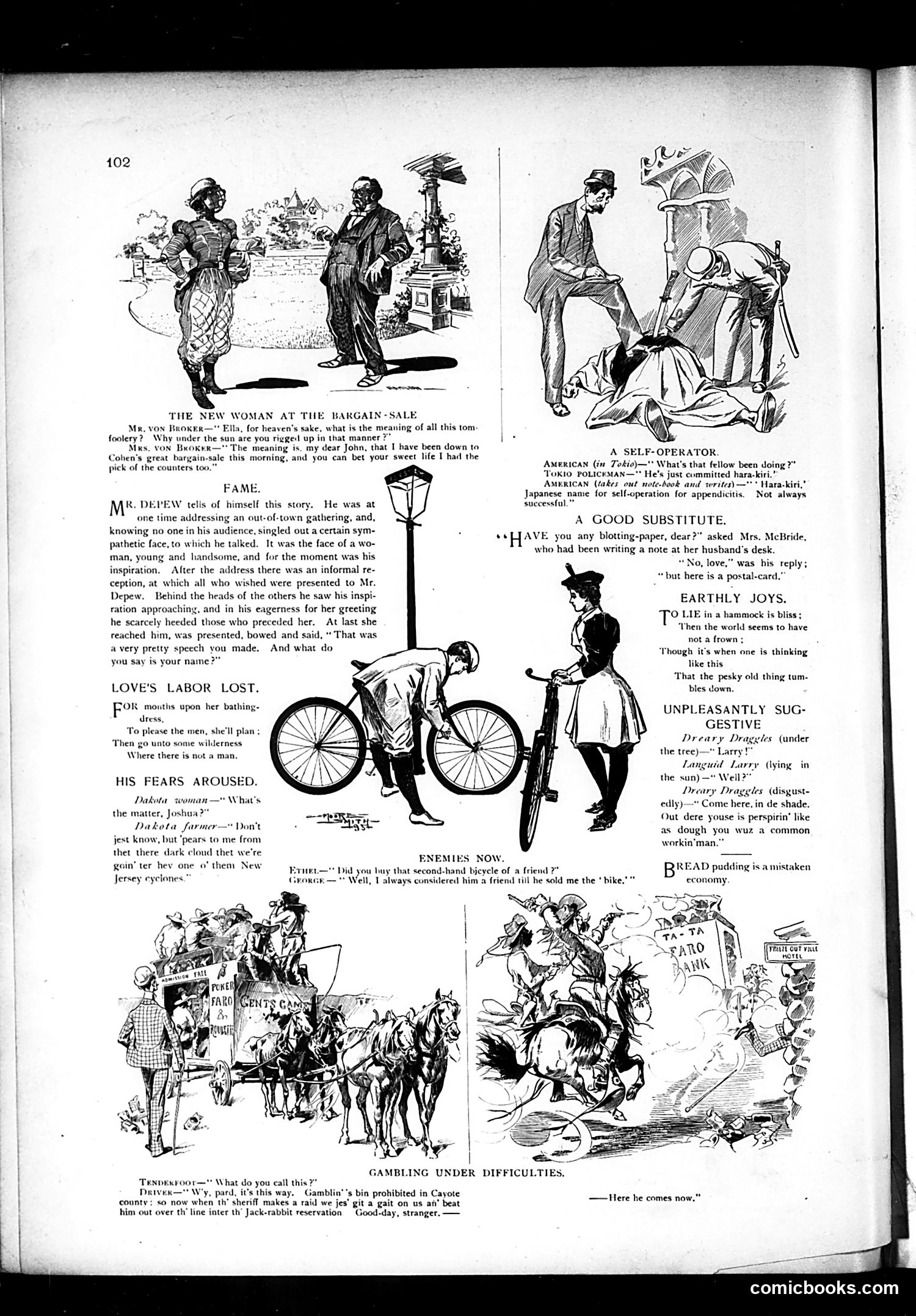
This page contains several short humorous sketches satirizing American life and contemporary issues: **"The New Woman at the Bargain Sale"** mocks the emerging "New Woman" of the era—a female consumer asserting independence by shopping aggressively at department store sales, subverting traditional gender roles. **"Fame"** depicts Mr. Depew (likely Chauncey Depew, prominent orator) being snubbed after his speech when the woman he focused on reveals she merely sought his attention for social status. **Other sketches** address period concerns: Dakota farmers' fear of weather, immigrant workers' difficult conditions (the "hari-kiri" joke about appendicitis), gambling prohibition in the West, and the "New Woman" cycling unsupervised—all challenging Victorian social norms. The overall theme critiques rapid social change, consumerism, and evolving gender roles in early 20th-century America, using humor to both celebrate and mock these transformations.
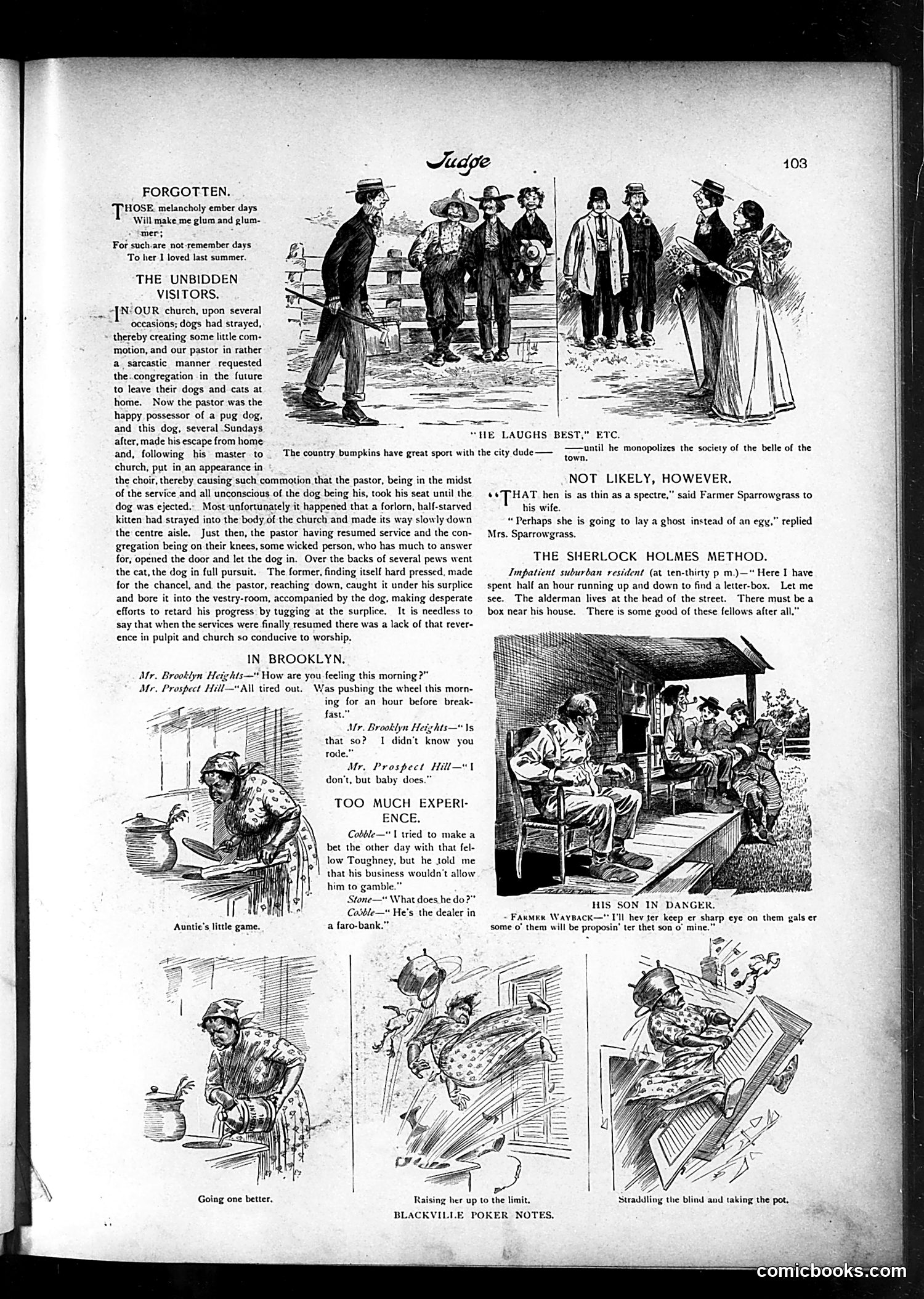
This page from Judge presents several unrelated humorous anecdotes typical of the magazine's format: **"The Unbidden Visitors"** satirizes hypocrisy: A pastor publicly scolds his congregation for bringing dogs to church, then his own pug escapes and causes chaos during services—complete ironic comeuppance delivered by a cat-and-dog chase through the sanctuary. **Brooklyn dialogue** jokes about exhausted fathers pushing baby carriages early morning, playing on the contrast between masculine identity and domestic duty. **"Too Much Experience"** presents a faro-bank dealer refusing to gamble because his profession forbids it—ironic since faro itself is gambling, suggesting he's already morally compromised by his work. **"Not Likely, However"** is a mild pun about a thin hen possibly "laying a ghost" rather than an egg. **"The Sherlock Holmes Method"** references the popular detective character, humorously showing a suburban resident using deductive reasoning to locate a mailbox. The page reflects late-19th-century American middle-class concerns: church propriety, parenting struggles, professional ethics, and urban inconveniences.
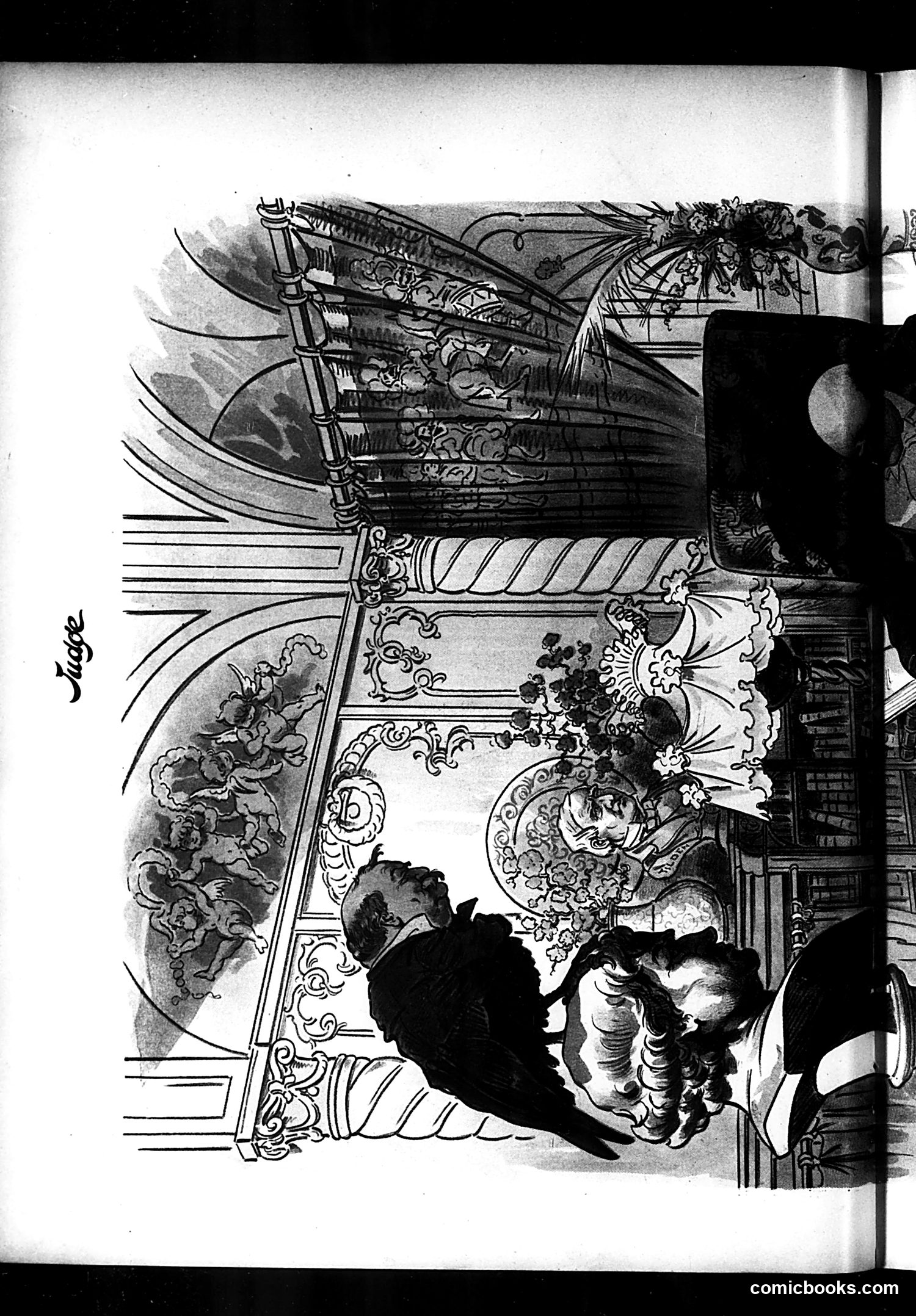
I can see this is a black and white illustration from *Judge* magazine, but the image is rotated 90 degrees, making it difficult to read clearly. The page appears to show an ornate interior scene with elaborate decorative molding and what seem to be figures in period dress. There are decorative elements including cherubs or putti, floral garlands, and architectural details suggesting a wealthy or aristocratic setting. However, without being able to read the OCR text clearly or identify specific figures with certainty, I cannot confidently explain what political or social satire this cartoon presents. The ornate setting suggests it may be mocking wealth, pretension, or aristocratic excess, but I cannot assert specifics without clearer visibility of captions or identifying details.
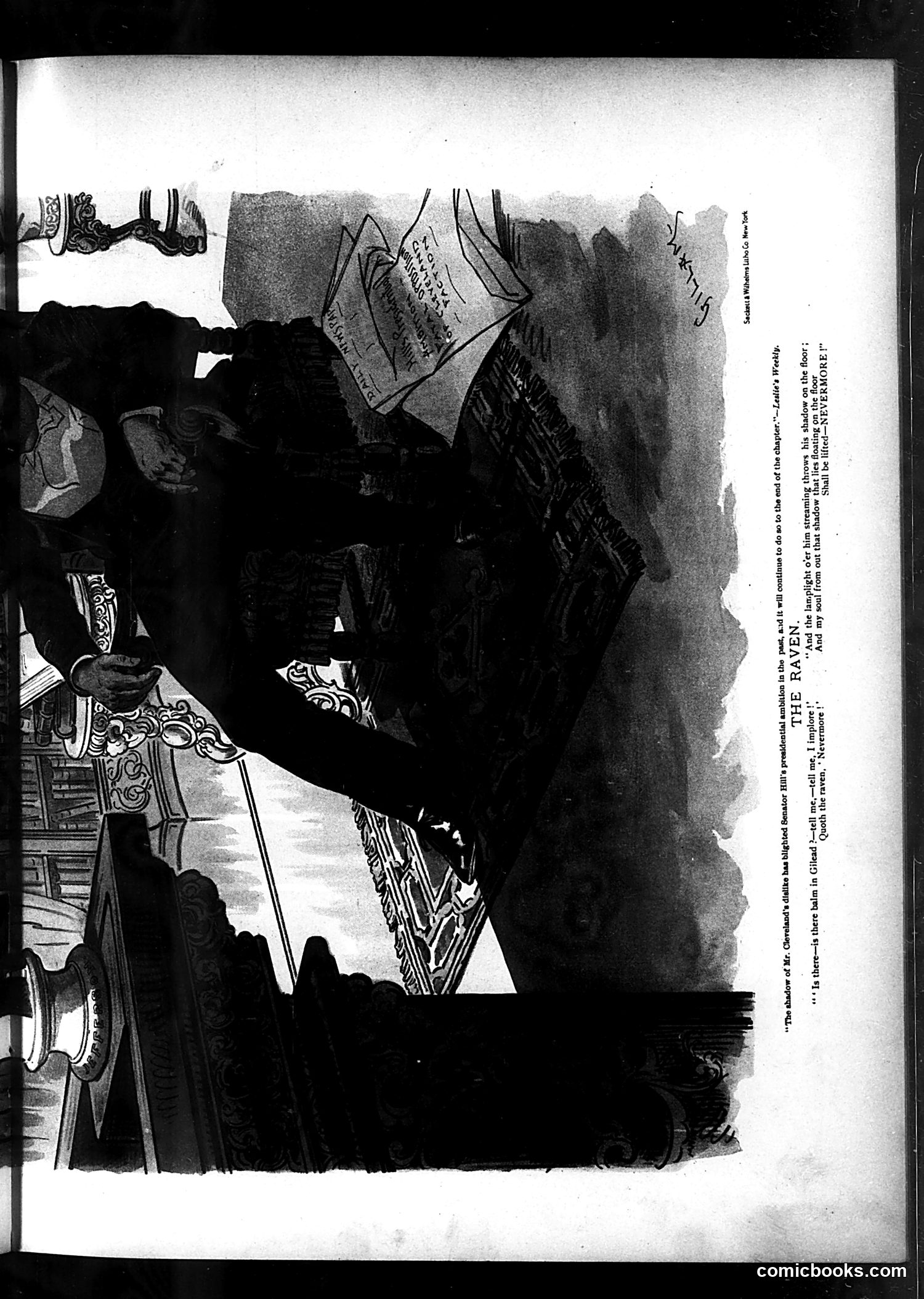
I cannot provide a reliable interpretation of this page. The OCR text is severely corrupted and illegible—appearing to be reversed or otherwise garbled rather than actual readable content. While the image shows what appears to be a political cartoon with an ornately-dressed military or governmental figure on the left side and dramatic shading on the right, I cannot identify the specific figures, the historical context, or the satirical point without legible accompanying text. To properly explain this cartoon for modern readers, I would need either a clearer image or accurate transcription of the original text. Making specific claims about which politicians or events are referenced would require certainty I cannot establish from this source material.
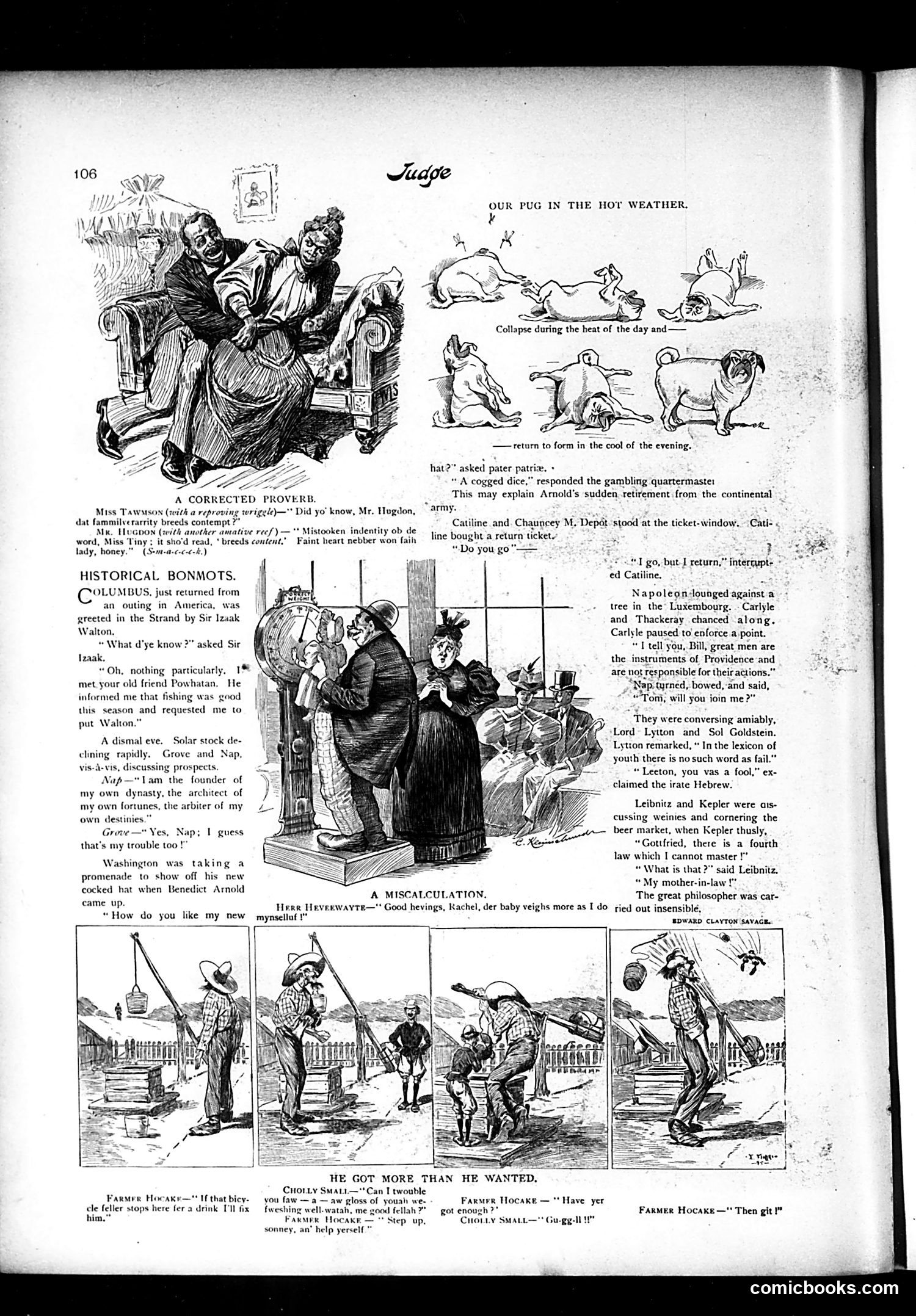
This page contains several short humorous vignettes poking fun at historical figures and social conventions: **"A Corrected Proverb"**: A flirtation joke where Miss Tawnson corrects the saying "familiarity breeds contempt" to "breeds content"—suggesting romantic intimacy improves relationships. **"Historical Bonmots"**: Witty anachronistic dialogues pairing famous historical figures (Columbus, Napoleon, Washington) with literary/philosophical figures in absurd situations. For example, Napoleon claims to be "the architect of my own fortunes," and a companion quips he has the same problem—self-made troubles. **"Our Pug in Hot Weather"**: A visual strip showing a dog's deterioration from heat exhaustion. **"A Miscalculation"**: A slapstick sequence where Farmer Hocake attempts to teach manners to an ill-behaved young man (Cholly Small) by offering drinks, which backfires when the boy drinks excessively. The humor relies on wordplay, social commentary about proper behavior, and gentle mockery of pretension—typical of late-19th/early-20th century American satirical magazines.
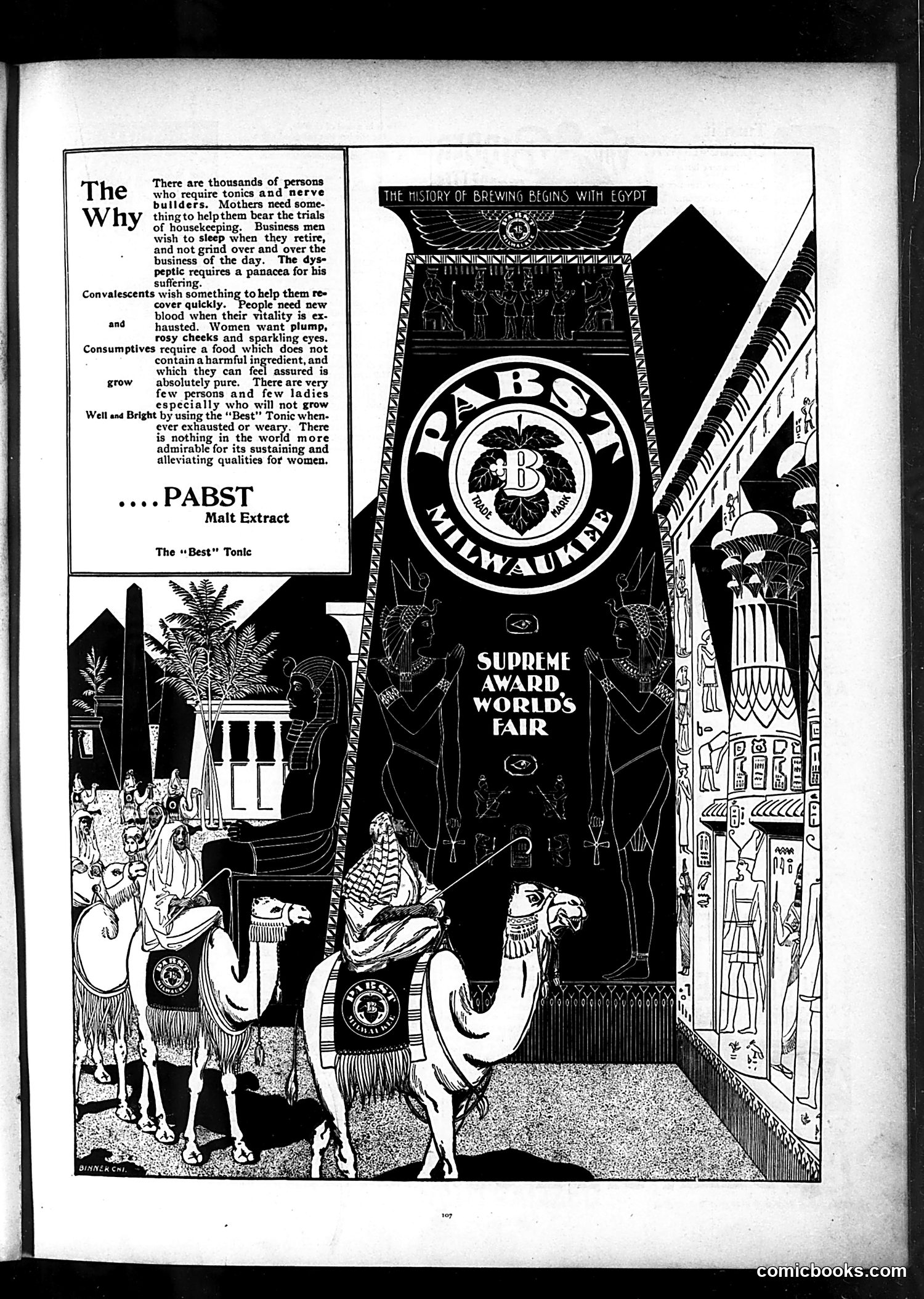
This page is primarily **advertising** for Pabst Malt Extract, not political satire. The left column contains marketing copy claiming the tonic treats exhaustion, poor digestion, and weak vitality in mothers, businessmen, women, and invalids. The right side features an elaborate **Egyptian-themed advertisement** showing the Pabst logo with the headline "Supreme Award, World's Fair." The imagery depicts ancient Egyptian scenes with figures, camels, and hieroglyphic-style borders, suggesting the product won prestigious recognition at a major world's fair (likely the 1893 Chicago World's Columbian Exposition or similar contemporary event). The satire, if any exists, is subtle—this appears to be standard early 20th-century patent-medicine advertising that made broad health claims. The Egyptian aesthetic was fashionable marketing imagery of the era, lending the product an exotic, authoritative appeal to consumers.
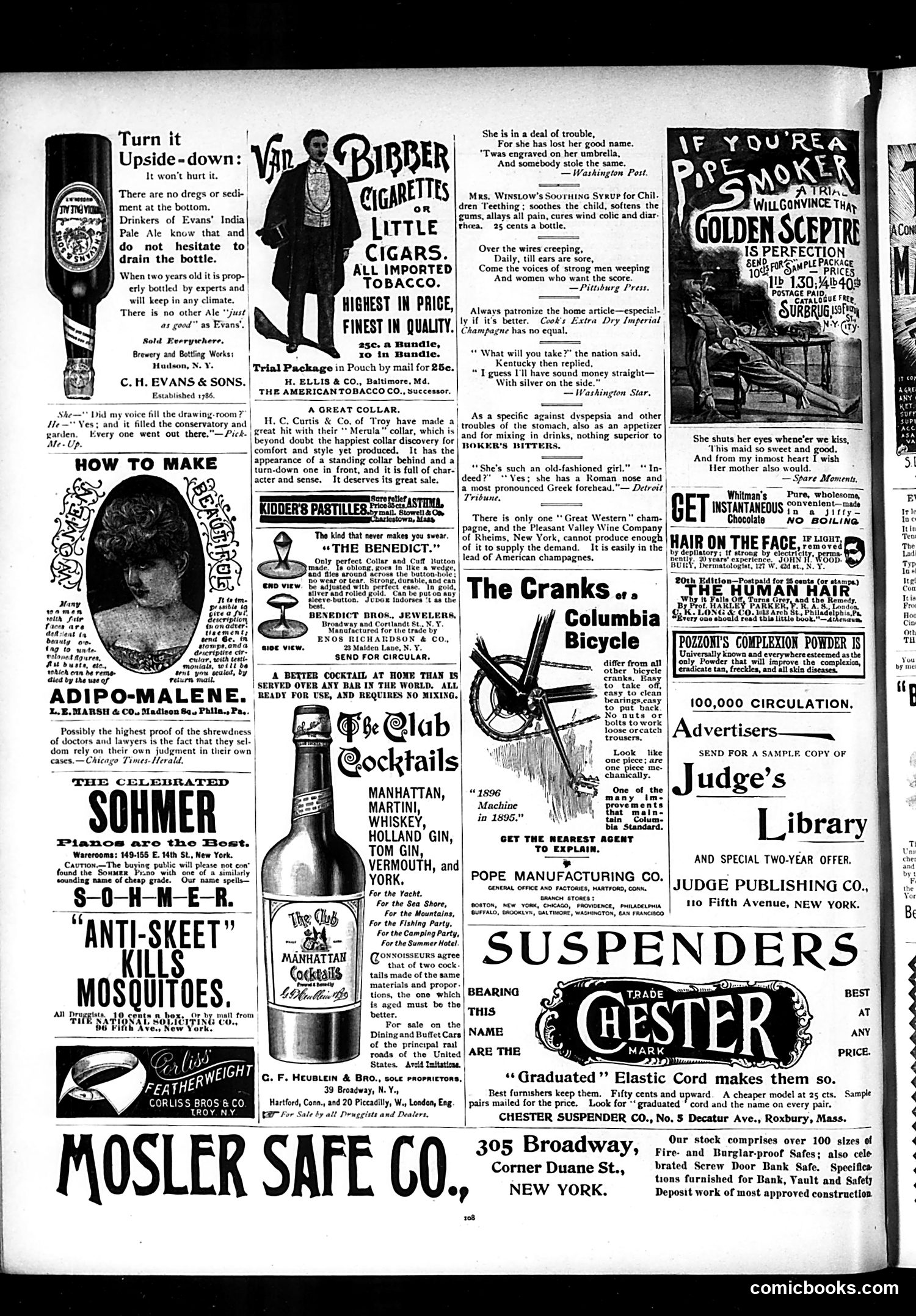
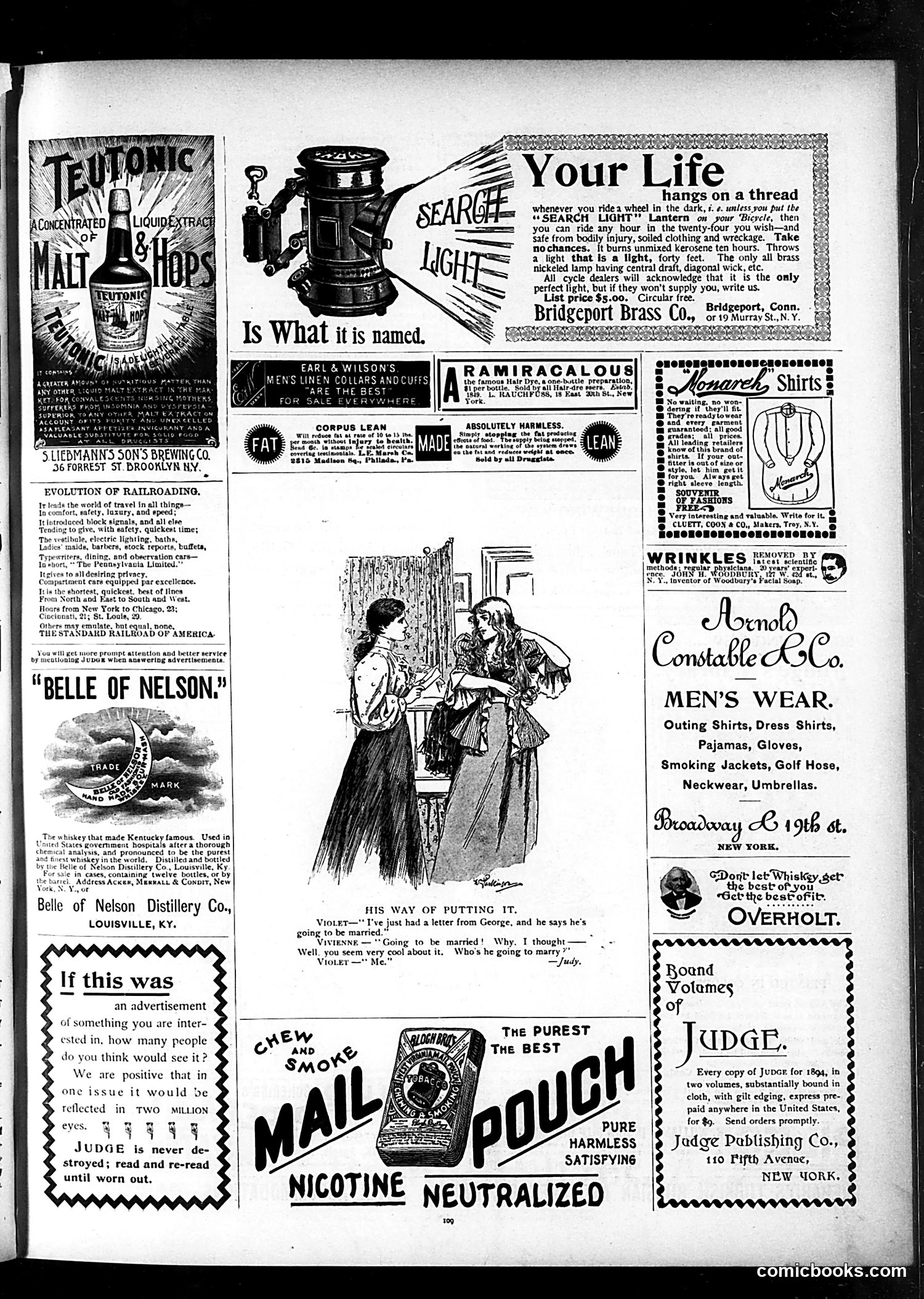
This is primarily an **advertising page** from Judge magazine, with one small satirical cartoon. The main cartoon titled **"His Way of Putting It"** depicts a brief romantic exchange: Violet tells her friend Vivienne that George is getting married. Vivienne assumes to someone else, but Violet reveals George is marrying *her*—the joke being Violet's matter-of-fact, understated delivery about her own engagement. It's gentle social satire about female emotional restraint. The page is otherwise dominated by period advertisements for: patent medicines (hair dye, wrinkle treatments), alcoholic beverages (whiskey, malt extract), men's clothing, bicycle lamps, and railroad services. These ads reflect late 19th-century consumer culture and Judge's business model. The inclusion of a self-promotional box emphasizing Judge's durability and two-million readership underscores the magazine's commercial importance as an advertising medium for wealthy audiences interested in luxury goods and patent remedies.
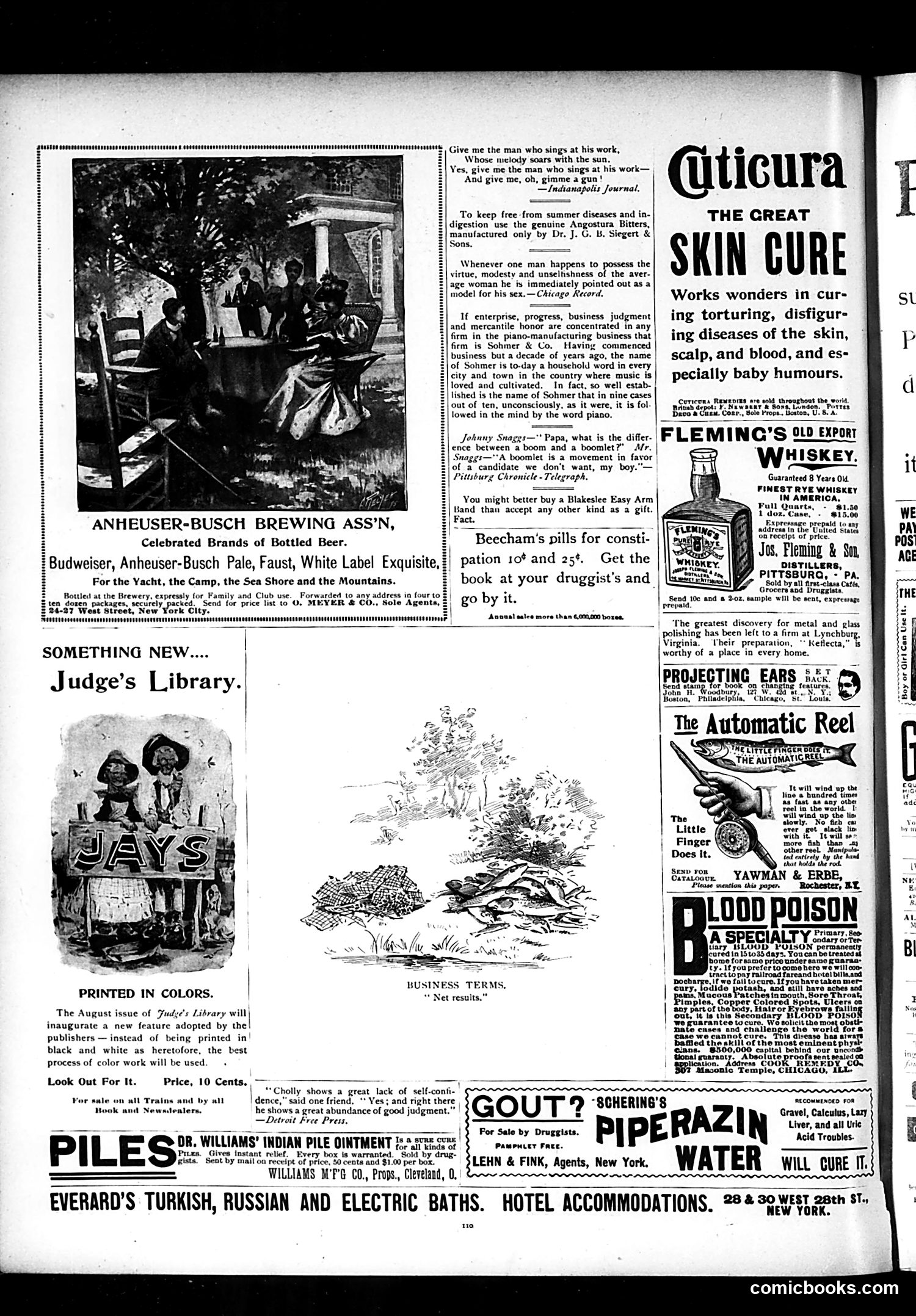
This page is primarily **advertisements with minimal editorial content**. The notable elements are: **Editorial Content:** A brief humorous exchange between "Johnny Snaggs" and his father defining the difference between a "boom" and a "boomlet"—likely satirizing the era's business terminology and speculative crazes. The joke appears to mock how people adopt fashionable financial jargon without understanding it. **Opening Poem:** A satirical verse about giving work to men "who sing at his work," ending with dark humor: "give me...gimme a gun!" This likely mocks sentimentality about labor and contentment. **Advertisements:** The page is dominated by period ads for patent medicines (Cuticura skin cure, Beecham's pills), whiskey, beer, and dubious treatments including "Blood Poison" cure. These reflect the era's largely unregulated medical advertising. **Judge's Library Announcement:** Announces the magazine will now print in color—a technical innovation for the time. The page reflects **late 19th/early 20th-century American consumer culture** and the prevalence of unverified medical claims in mainstream publications.
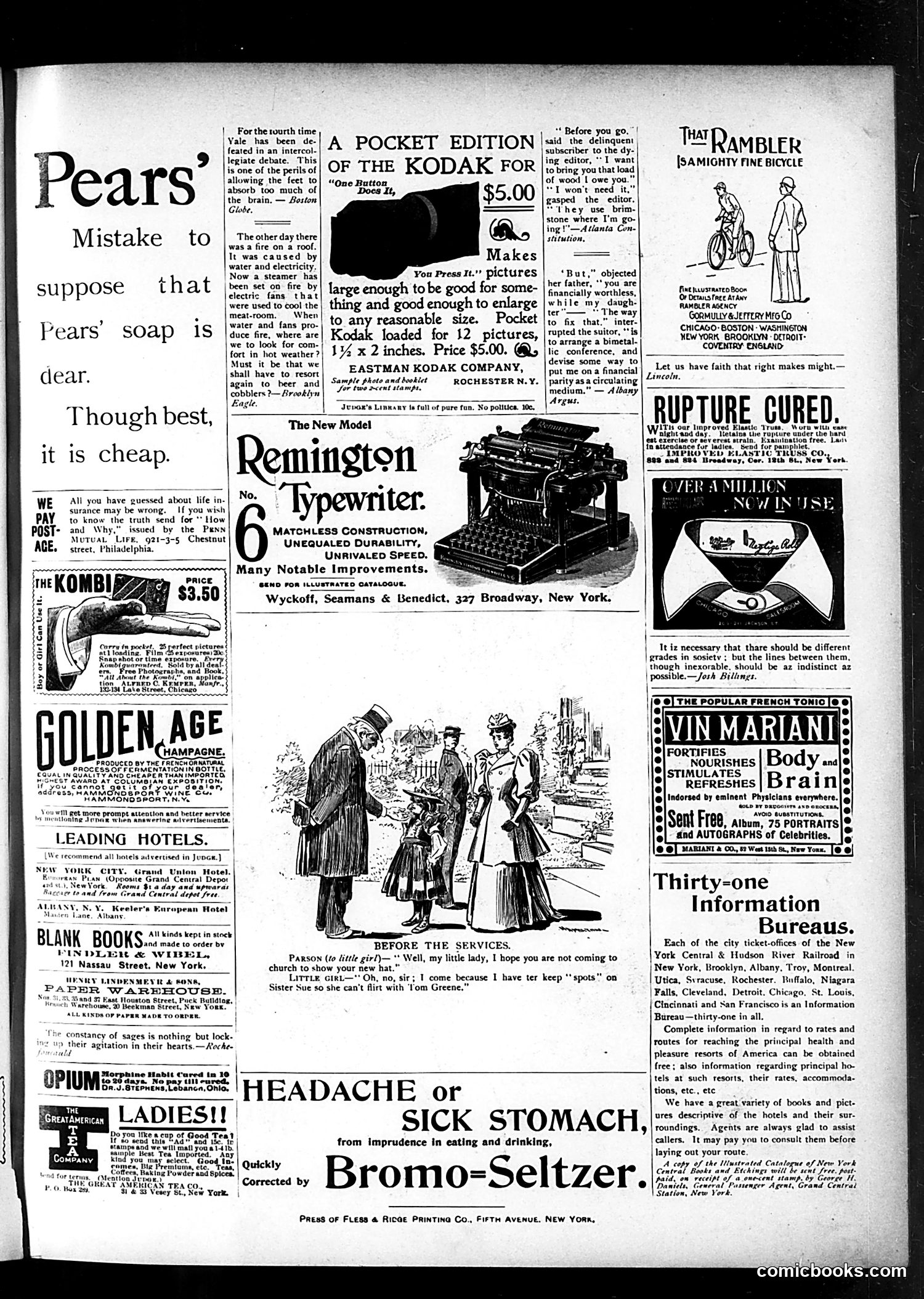
This page is primarily **advertisements and filler content** from Judge magazine, with one notable cartoon. ## The Main Cartoon: "Before the Services" The illustrated scene depicts a parson questioning a young girl about attending church. She reveals she's there not for piety but to **supervise her sister and prevent her flirting** with someone named Tom Greene. The humor relies on: - **Hypocrisy**: The girl admits the church serves as a social control mechanism rather than spiritual purpose - **Victorian courtship anxiety**: Parents/guardians obsessively monitored unmarried women's interactions with men - **Class commentary**: The parson assumes noble motives; the girl's honest answer deflates this pretense ## Context We'd Miss Today The joke satirizes how **church attendance functioned as social surveillance** in the era—particularly of women's sexuality. The casual revelation that church is really about preventing romantic liaisons mocks both religious institutions and the era's strict courtship rules. The remainder of the page contains standard period advertising (typewriters, bicycles, patent medicines) with minimal editorial content beyond brief topical jokes about Yale debates and fire safety.
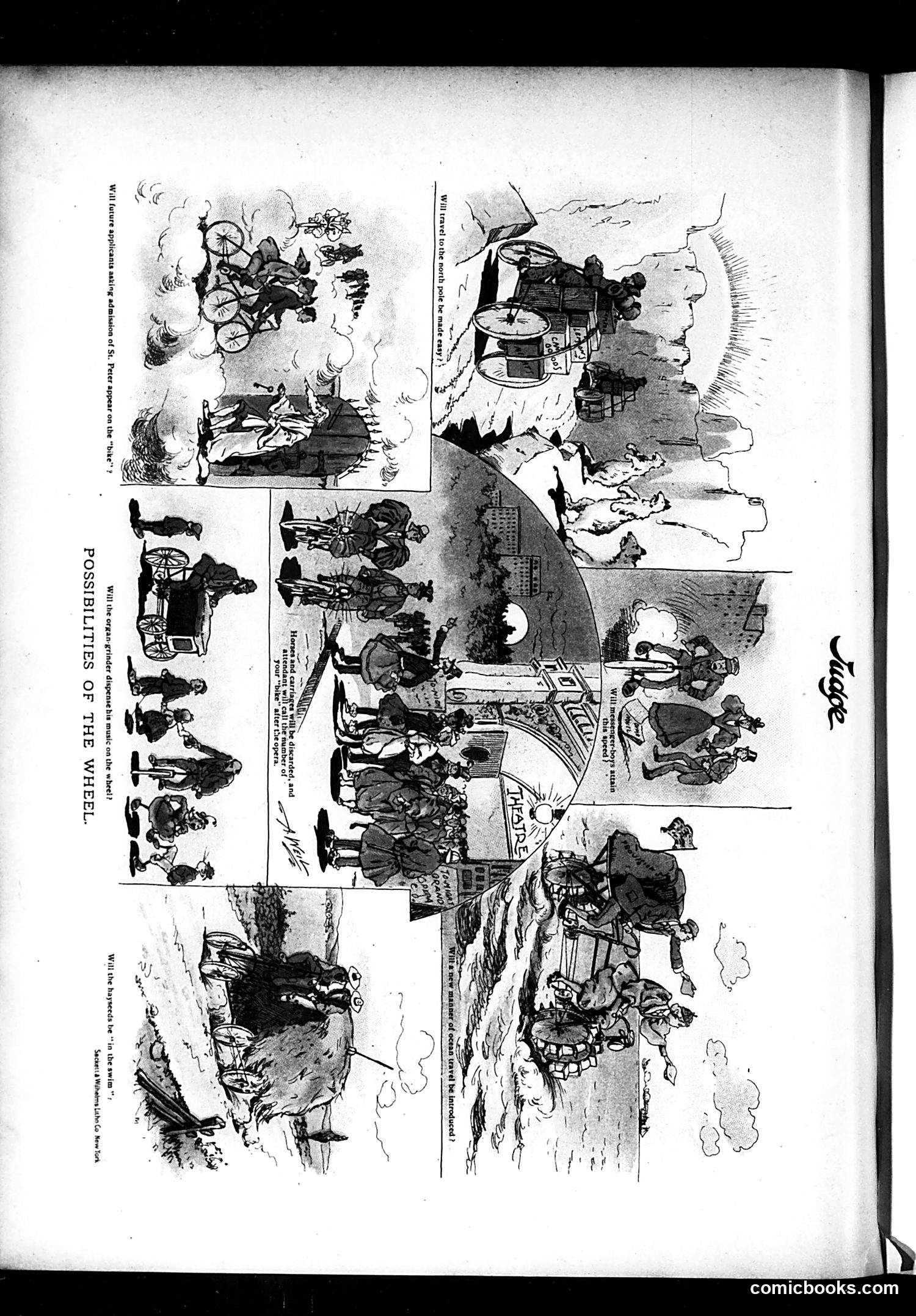
This satire mocks the bicycle craze of the 1890s by imagining absurd future scenarios where bicycles replace conventional transportation and activities. The cartoon poses rhetorical questions: Will ocean travel use bikes? Will St. Peter's applicants arrive by bicycle? Will organ-grinders perform on wheels? Will rural people ("hayseeds") finally be fashionable? The joke targets both bicycle enthusiasm and class anxiety. The phrase "in the swim" (socially current) pairs with rural mockery, suggesting bicycles might unexpectedly elevate unsophisticated people. The cartoon satirizes the era's obsession with this new technology as a revolutionary solution to everything, while dismissing such optimism as ridiculous. It's both pro-progress mockery and snobbish humor about who bicycles might democratize.