
A complete issue · 16 pages · 1895
Judge — August 10, 1895
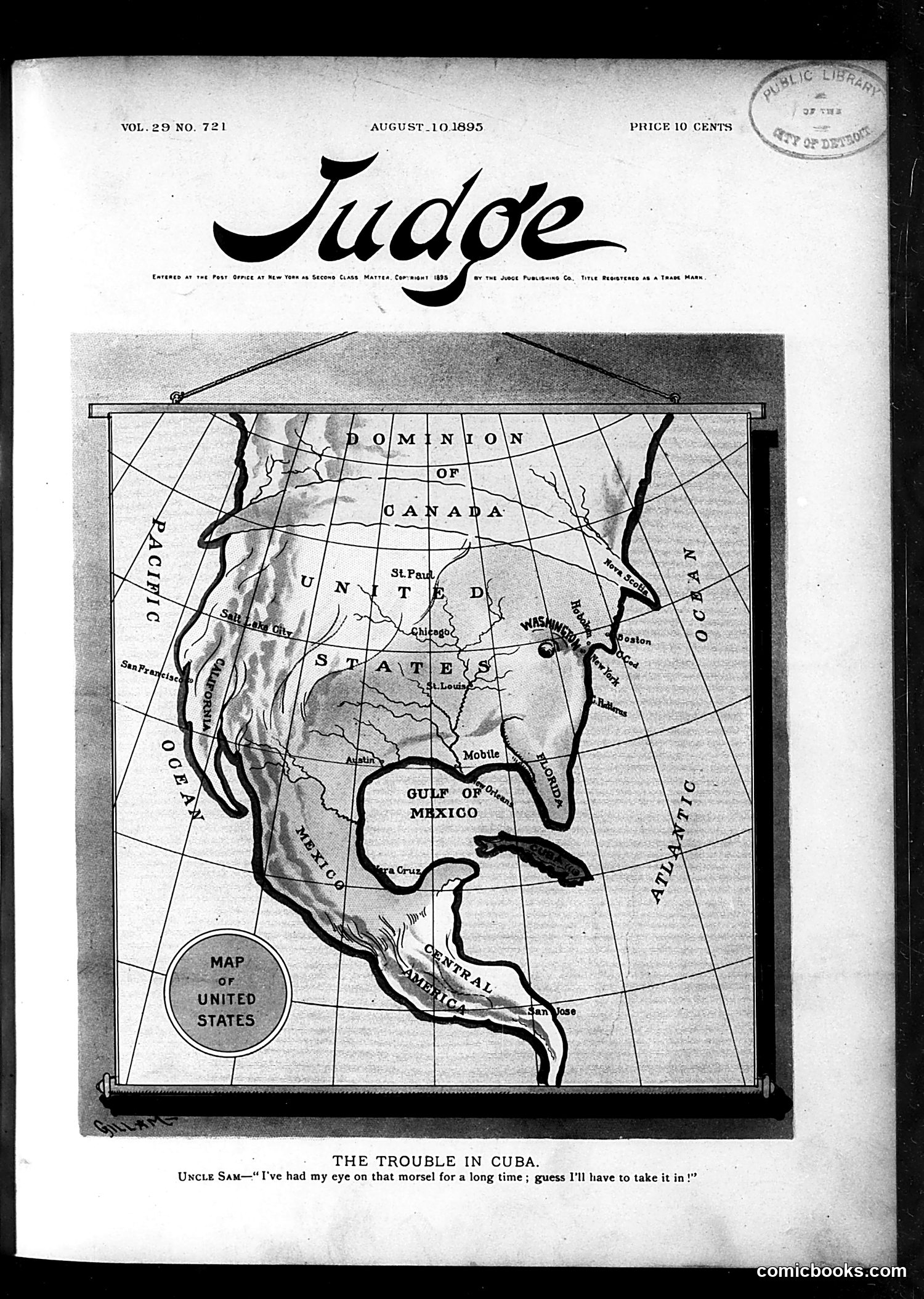
This cartoon depicts Uncle Sam eyeing Cuba as a desirable acquisition. The map shows Cuba positioned near the Gulf of Mexico, with bold lines emphasizing its proximity to U.S. territory. The caption—"I've had my eye on that morsel for a long time; guess I'll have to take it in!"—expresses American imperial ambitions. This reflects the 1895 Cuban independence struggle against Spanish colonial rule. The "morsel" metaphor suggests Cuba as territory ripe for U.S. expansion. This cartoon satirizes American imperialism and interventionist desires that would culminate in the Spanish-American War (1898), after which the U.S. gained control of Cuba and other Spanish territories.
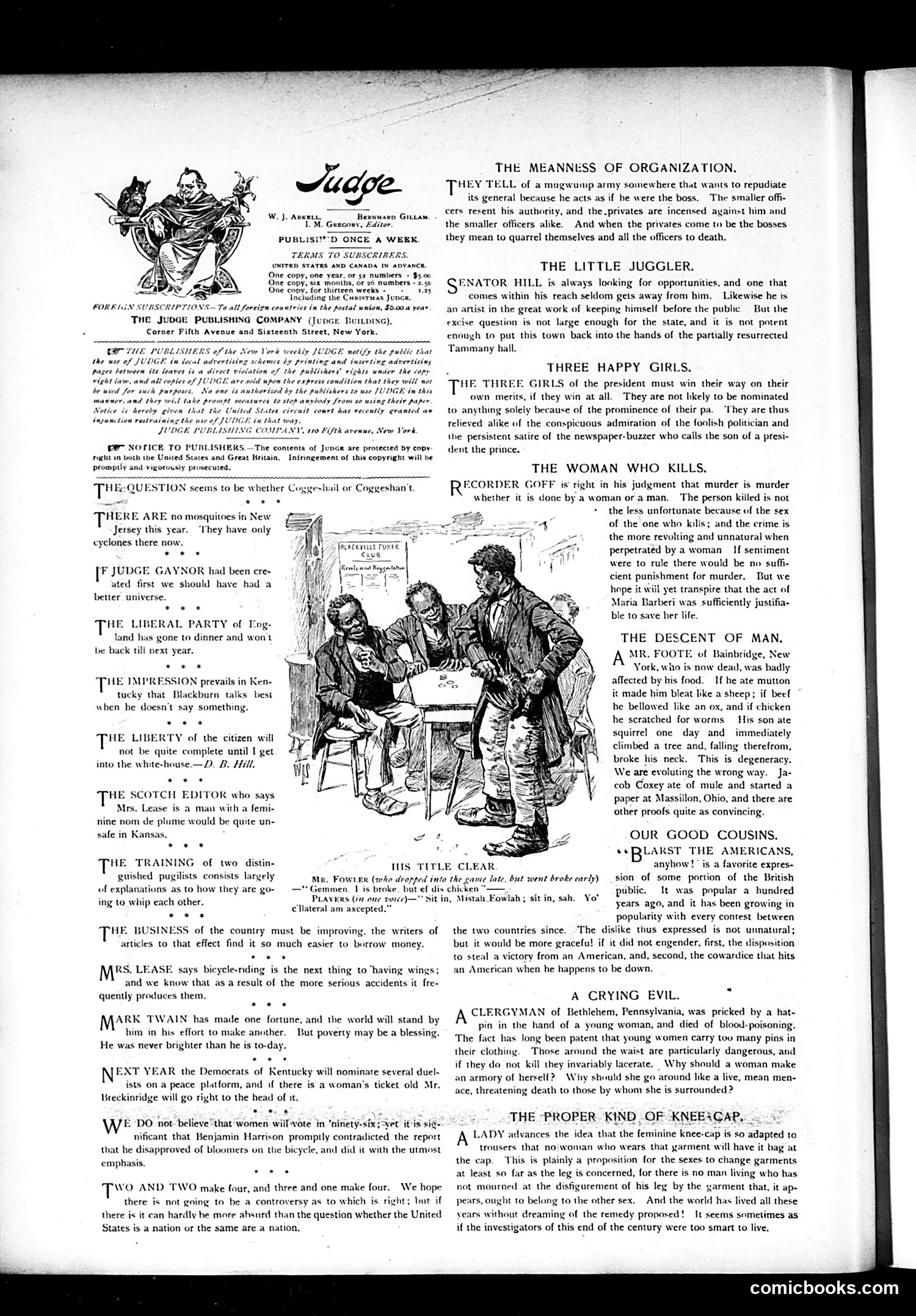
The main cartoon depicts three figures around a table labeled "INTERSTATE COMMERCE," with one figure saying "Ms. Fowles (who slipped into the game late, but spent broke early)— 'Gentlemen, I broke but o' six chicken—'" and another responding "'Sit in, Mistah Foollah; sit in, sah. Yo' cillared an monopoly!'" This satirizes late-19th-century monopoly practices and interstate commerce debates. The figures appear to represent different business interests or political actors engaging in what's characterized as an unfair "game." The reference to someone "broke but o' six chicken" and accusations of monopoly suggest commentary on unequal competition and corporate concentration during the Gilded Age—a major political issue of Judge's era. The cartoon critiques how wealthy players dominate economic competition.
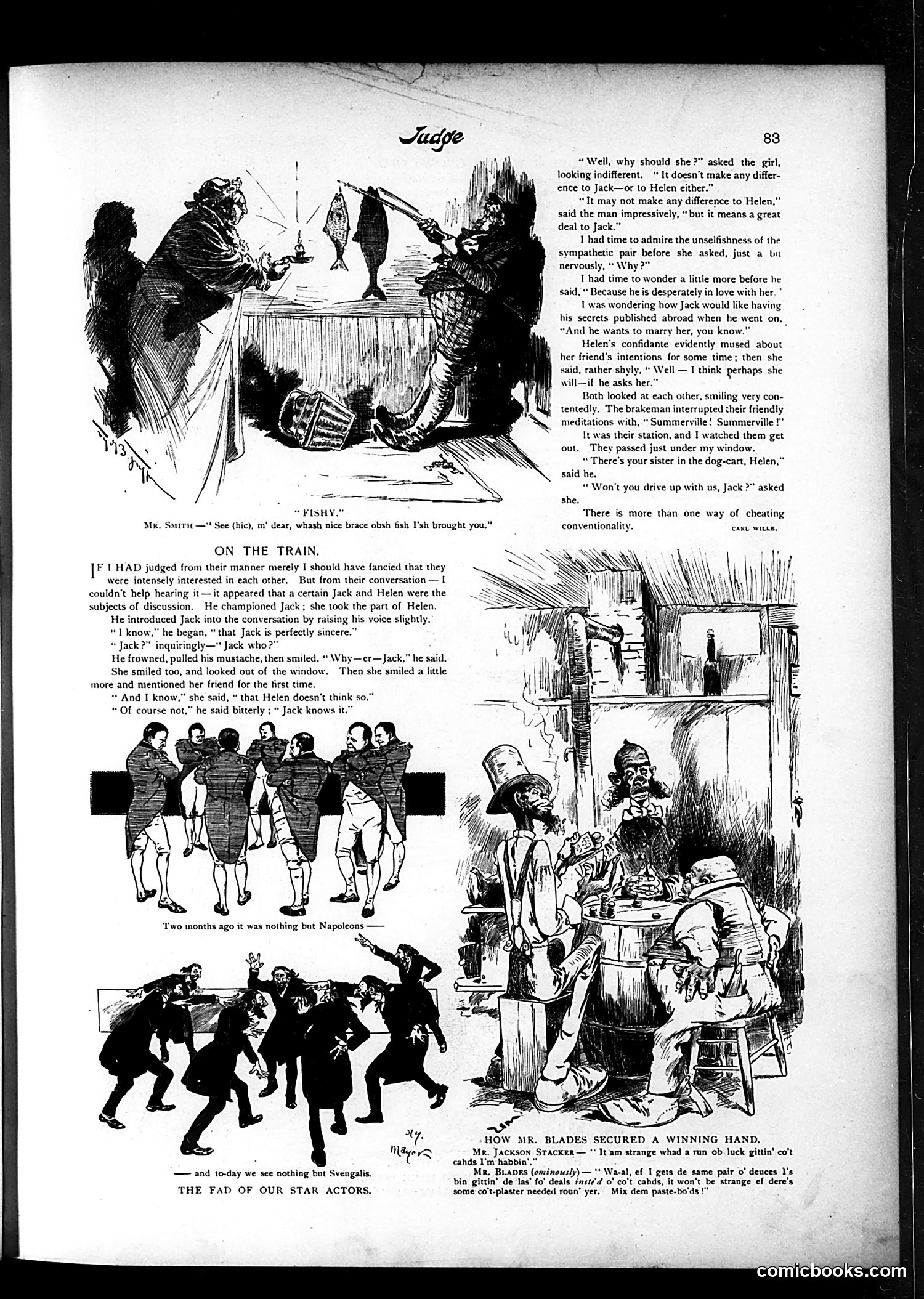
This page contains three satirical cartoons mocking theatrical performers of the era. **"Fishy"** (top): Shows two figures discussing a woman's romantic choices between "Jack" and "Helen." The satire appears to mock theatrical gossip and romantic entanglements among actors. **"On the Train"** (middle): Depicts a conversation between characters, with accompanying illustrations showing dancers described as "nothing but Napoleons" and "The Fad of Our Star Actors." This likely satirizes a theatrical trend where performers frequently adopted similar styles or roles. **"How Mr. Blades Secured a Winning Hand"** (bottom right): Shows card-playing, with dialogue about gambling and cheating at cards—apparently ridiculing an actor named Mr. Blades (or Jackson Stackes). All three target theatrical performers' scandals, romantic affairs, and questionable behavior, reflecting Judge magazine's focus on entertainment-world satire.
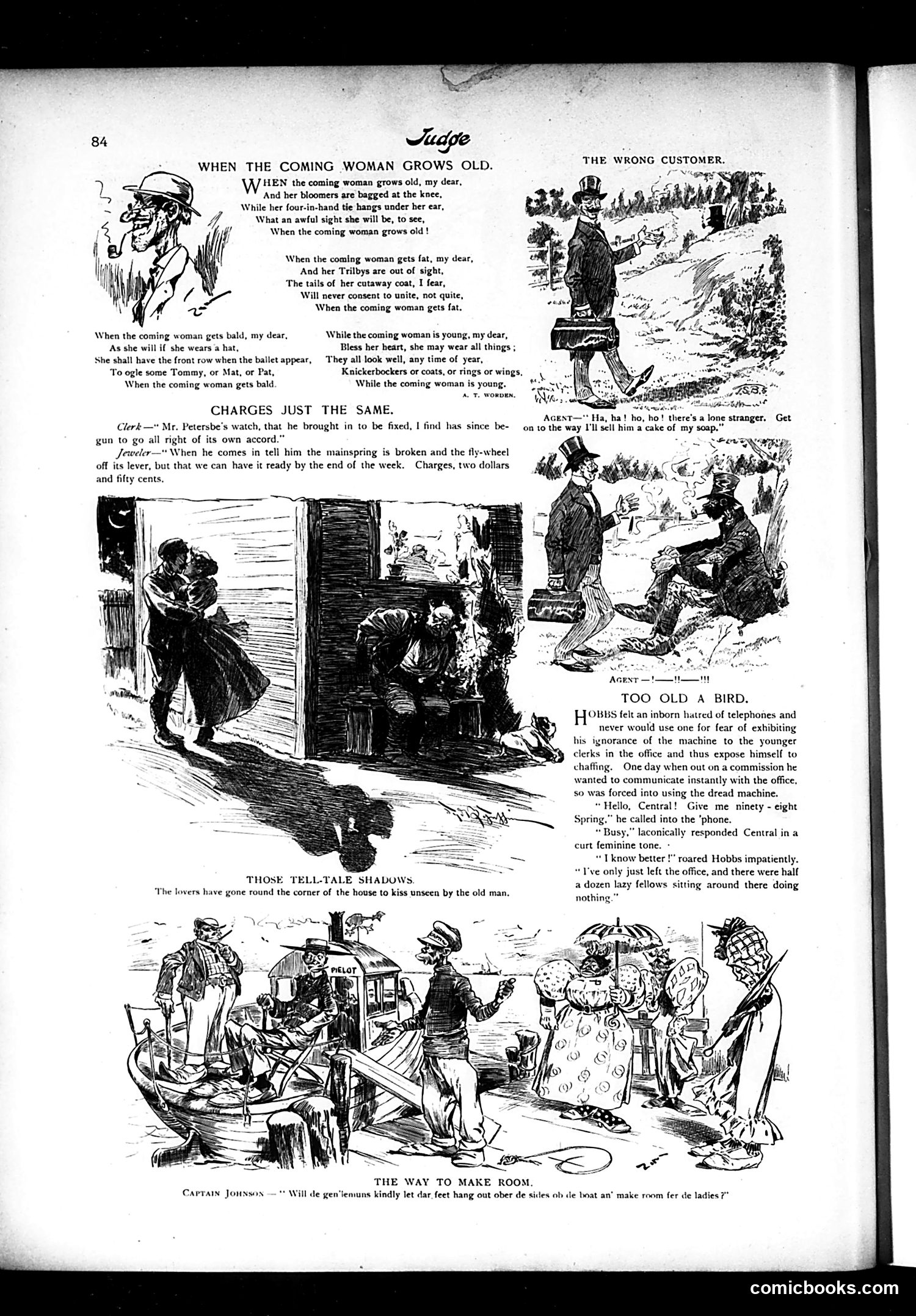
This page satirizes late-19th-century anxieties about women's changing roles and modernization. **"When the Coming Woman Grows Old"** mocks the "New Woman"—advocates of female independence who wore practical clothing like bloomers, four-in-hand ties, and short hair instead of corsets and bonnets. The poem ridicules how these modern fashions will look unattractive as women age, implying their independence is foolish vanity. **"Charges Just the Same"** jokes about a jeweler's dishonesty—he'll lie to a customer about broken watch parts to charge full repair fees regardless. **"Too Old a Bird"** satirizes an old man's stubbornness. Hobbs refuses telephone use from pride, then irrationally argues with the operator, believing his outdated knowledge superior to modern technology. **"The Way to Make Room"** depicts a boat captain asking men to dangle their feet overboard so ladies have space—gentle satire on gallantry and crowded conditions. These cartoons reflect period tensions: resistance to women's liberation, dishonest commerce, generational conflict over technology, and traditional gender courtesy norms.
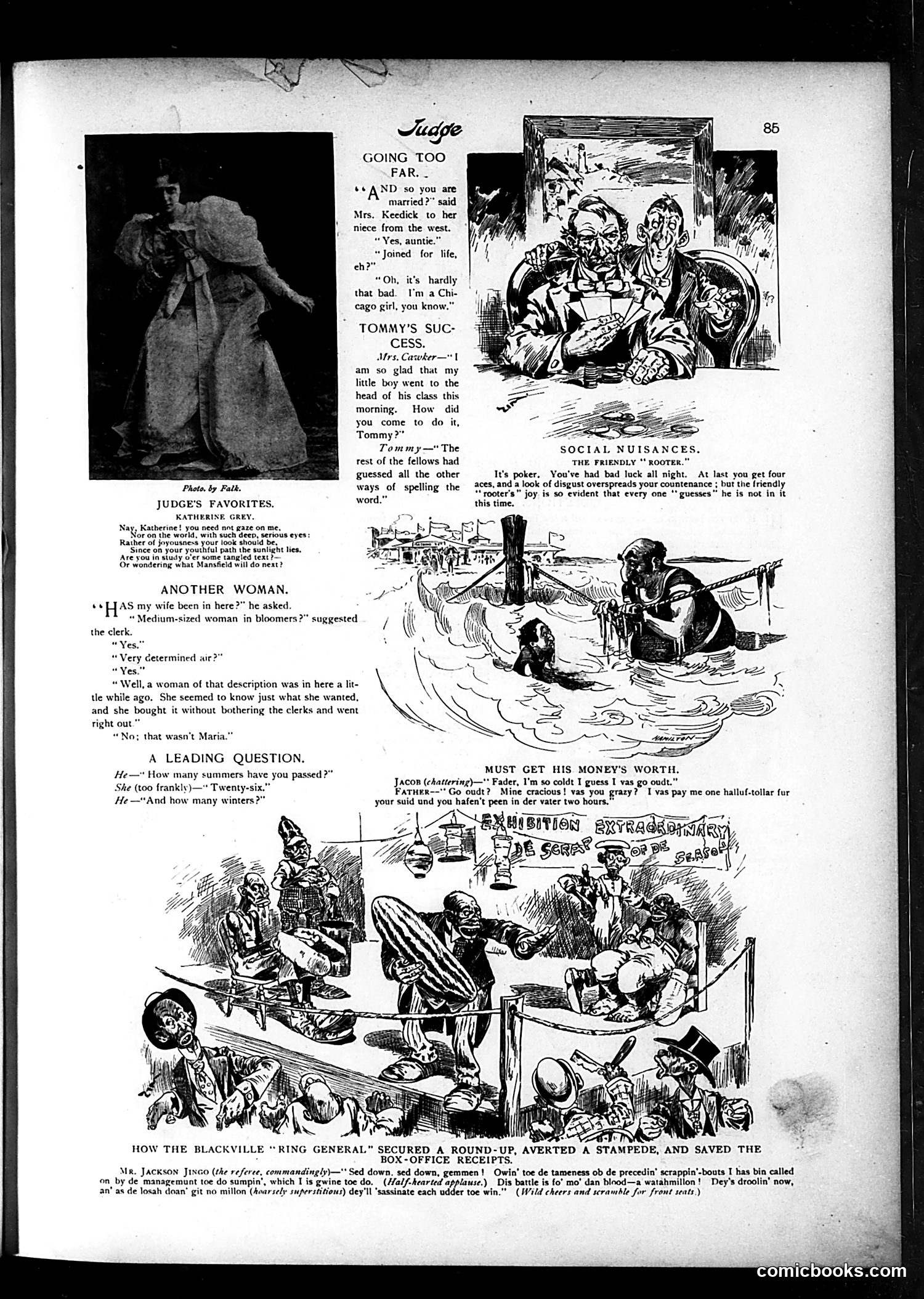
This page contains several humorous sketches satirizing American social conventions and behavior circa early 1900s. **"Going Too Far"** mocks Eastern attitudes toward Western women—a Chicago bride's dismissal of "joined for life" marriage as hyperbole reflects contemporary anxieties about changing marital expectations and regional differences. **"Another Woman"** jokes about a woman shopper so competent and self-directed that her husband doesn't recognize her described behavior as typical of his wife Maria—satirizing both female independence and domestic ignorance. **"Tommy's Success"** uses a child's academic achievement to mock spelling inconsistencies in English education. **"Social Nuisances"** depicts the annoying "friendly rooter"—someone whose obvious enthusiasm at poker reveals he's not actually playing, mocking false camaraderie. **"Must Get His Money's Worth"** uses Yiddish-inflected dialect comedy (common in period Judge content) to mock immigrant fathers' penny-pinching and their children's complaints. The bottom illustration appears to reference boxing/prizefighting spectacles, likely mocking sensationalism in sports entertainment.
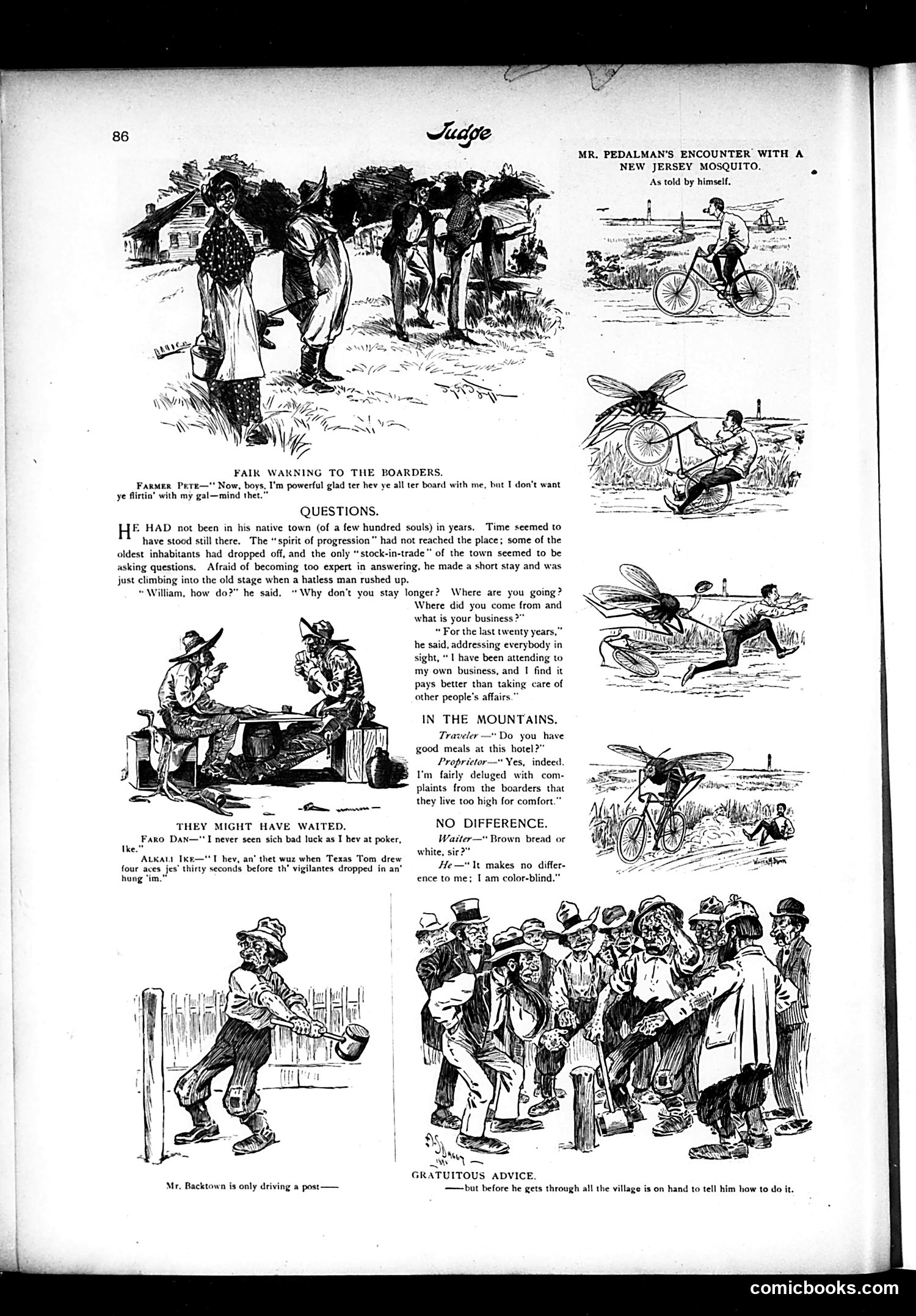
This page collects rural American humor from the late 19th/early 20th century, satirizing small-town life and frontier character types. **Main themes:** The "Questions" and "Gratuitous Advice" sketches mock small-town nosiness and unsolicited interference—a returning visitor is bombarded with personal questions; a man driving a post attracts a crowd of "helpers." This reflects urban magazine readers' stereotypes about provincial life as intrusive and backward. **Regional humor:** "In the Mountains" jokes about frontier hotel proprietors; "Faro Dan" and "Alkali Ike" reference rough Western gamblers and frontier violence (vigilante justice). "Mr. Pedalman's Encounter with a New Jersey Mosquito" (illustrated on the right) exaggerates the mosquito as comically oversized—a common regional boast about regional pests. **Social commentary:** The opening "Fair Warning" depicts a farmer protecting his daughter from boarders—reflecting rural anxieties about outside influence and courting customs. Overall, the page presents rural America as quaint, meddlesome, and slightly backward—entertainment for urban readers.
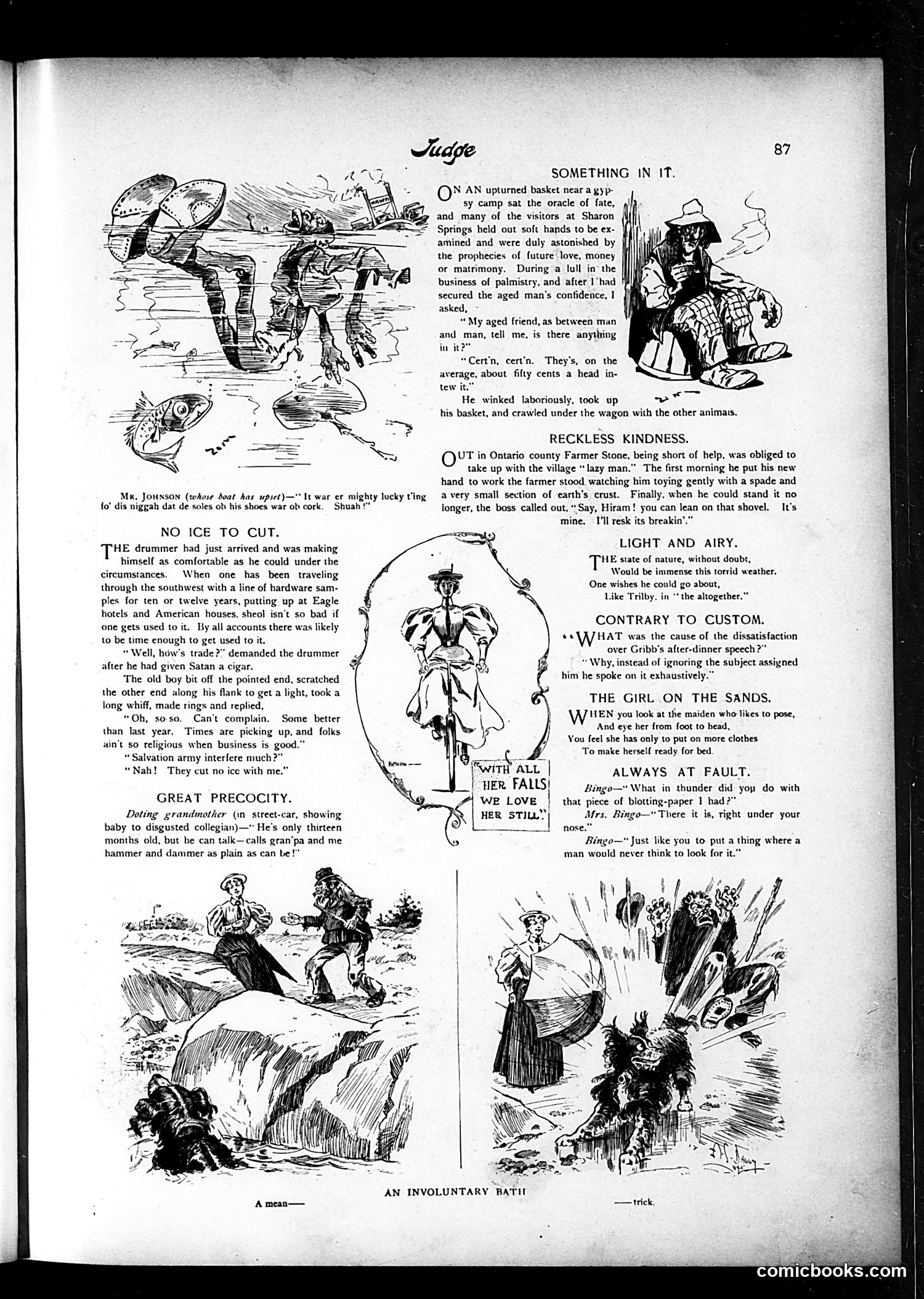
This page contains multiple short satirical pieces typical of late-19th-century American humor magazines: **"No Ice to Cut"**: A drummer (traveling salesman) discusses business with the Devil. The joke relies on the phrase "cut no ice" (have no effect)—the Devil claims the Salvation Army doesn't interfere with his work because times are good and people abandon morality for profit. **"Something in It"**: A gypsy fortune-teller admits his profession is a con, charging "fifty cents a head" for fake prophecies. The satire mocks both fortune-telling and gullible tourists. **"Reckless Kindness"**: A farmer sarcastically tells his lazy new worker to lean on the shovel—it's the farmer's, so he doesn't worry about breaking it. The humor comes from the farmer's exasperation with incompetence. The page also includes brief domestic humor pieces ("Always at Fault," "The Girl on the Sands") mocking marriage and courtship conventions. Note: The first cartoon contains a racial slur in its caption, reflecting period attitudes.
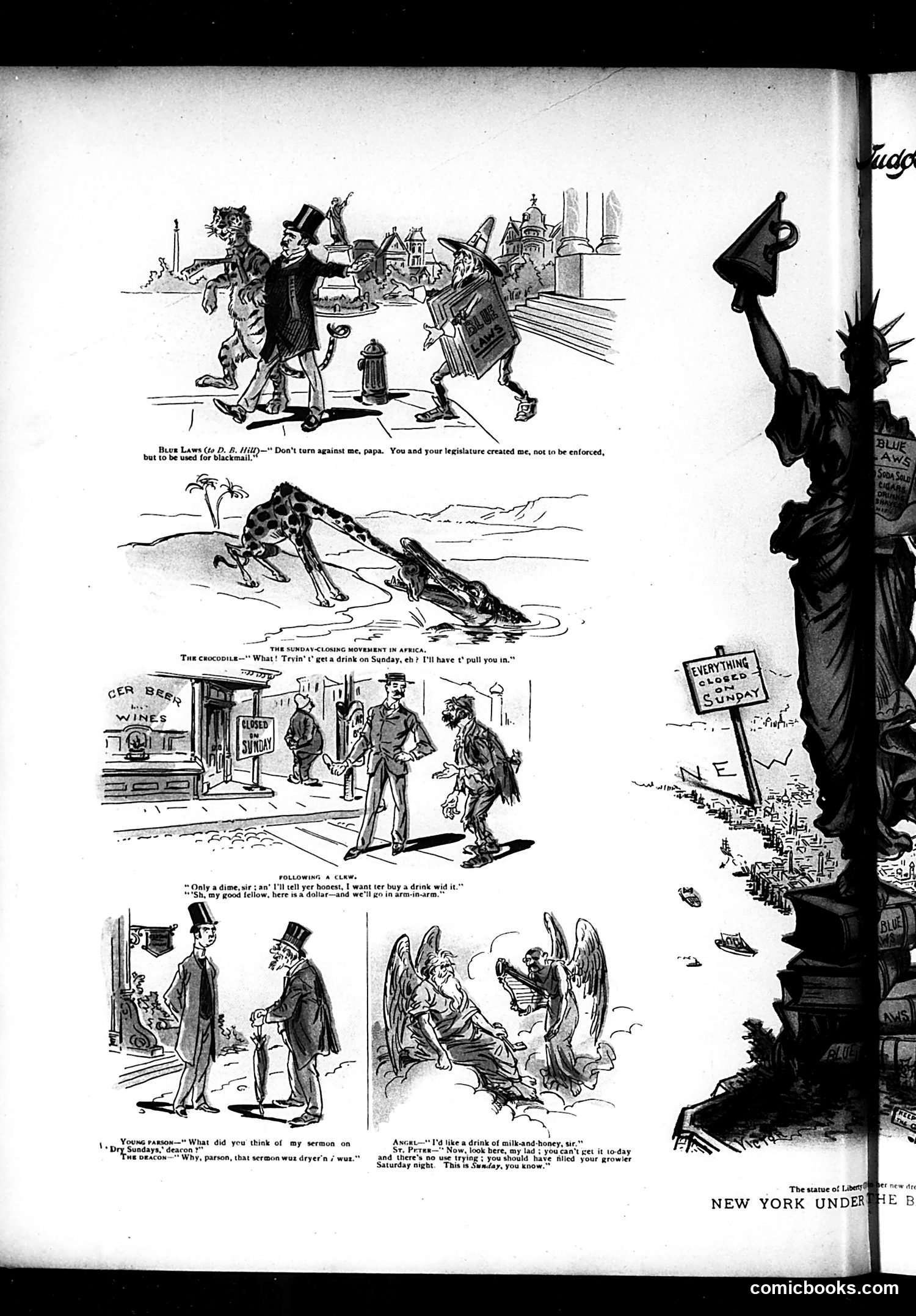
This Judge page satirizes Sunday closing laws—statutes prohibiting alcohol sales on Sundays that were common in American cities during the late 19th/early 20th century. **The satire's points:** The top cartoon shows "Buyer Laws" as a corrupt offspring, suggesting legislators created these laws not to enforce morality but as tools for **blackmail and bribery**—police could selectively enforce them against businesses that didn't pay. The subsequent cartoons mock the **hypocrisy and unenforceability** of such laws: a crocodile enforces rules arbitrarily; a deacon gives a dollar to a poor man to buy alcohol on Sunday while publicly preaching temperance; an angel and demon debate whether the law actually works. The satire suggests these laws were **ineffective, corrupt, and morally hollow**—creating criminal opportunity rather than genuine virtue. The "Sunday-closing movement in Africa" comparison implies American "civilization" was exporting its hypocritical practices.
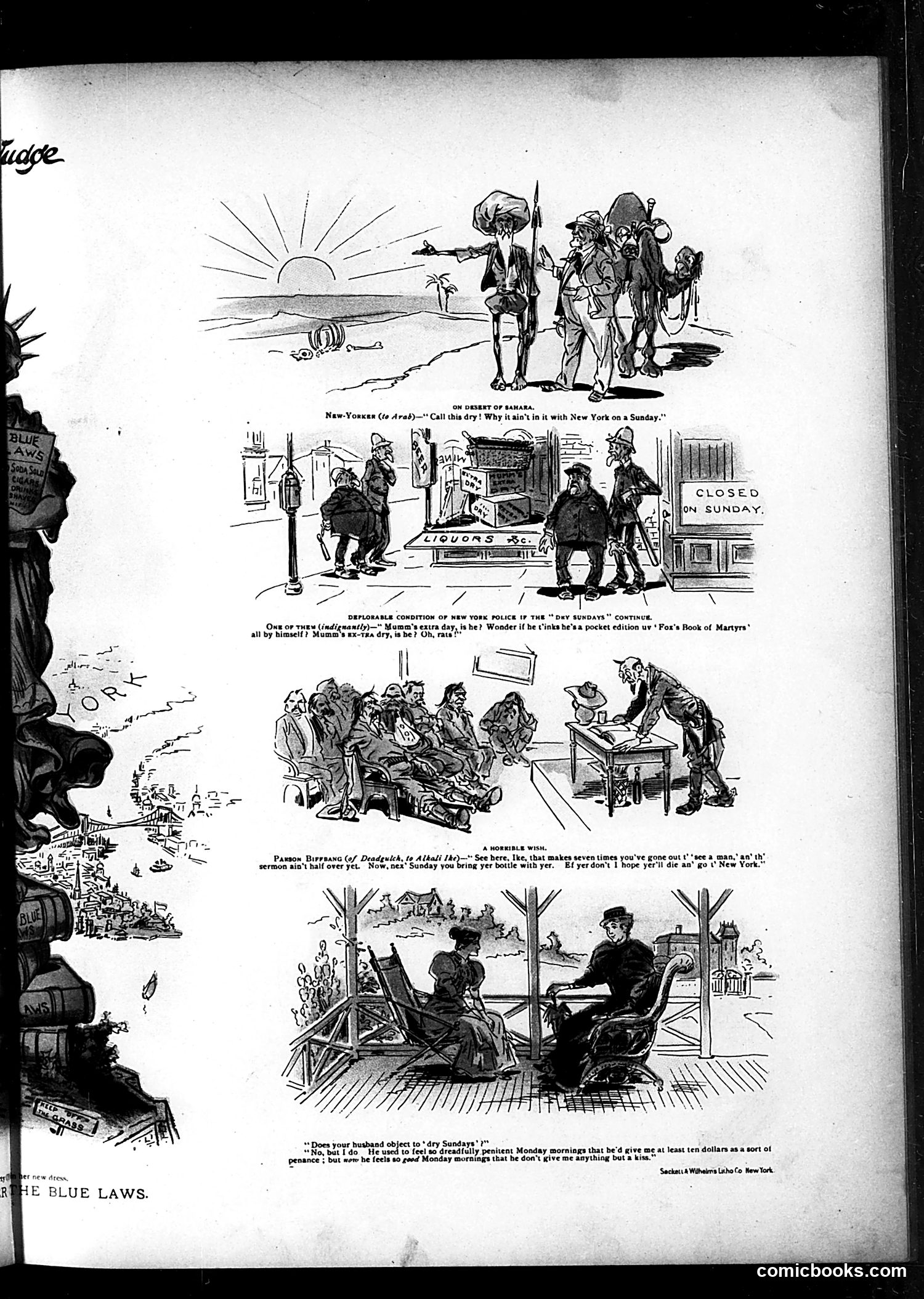
This Judge page satirizes New York's "dry Sunday" laws (prohibition of alcohol sales on Sundays), likely from the early 1900s. The cartoons mock the laws' ineffectiveness and hypocrisy: **Top panel**: A New Yorker claims New York's "dry" Sundays are drier than the Sahara Desert—exaggerated boasting about the law's strictness. **Middle panels**: Show the law's absurd consequences—police unable to enforce it, a clergyman frustrated by parishioners sneaking out for drinks during services, and workers circumventing restrictions. **Bottom panel**: A woman reveals her husband uses "dry Sundays" strategically: he gets drunk Saturday, feels guilty Monday morning, and bribes her with money. Now sober, he gives only kisses—implying the law backfired financially for wives. The overall message: these blue laws are unenforceable, breed hypocrisy, and fail to achieve moral reform. The satire targets both the laws themselves and New Yorkers' smug self-righteousness about them.
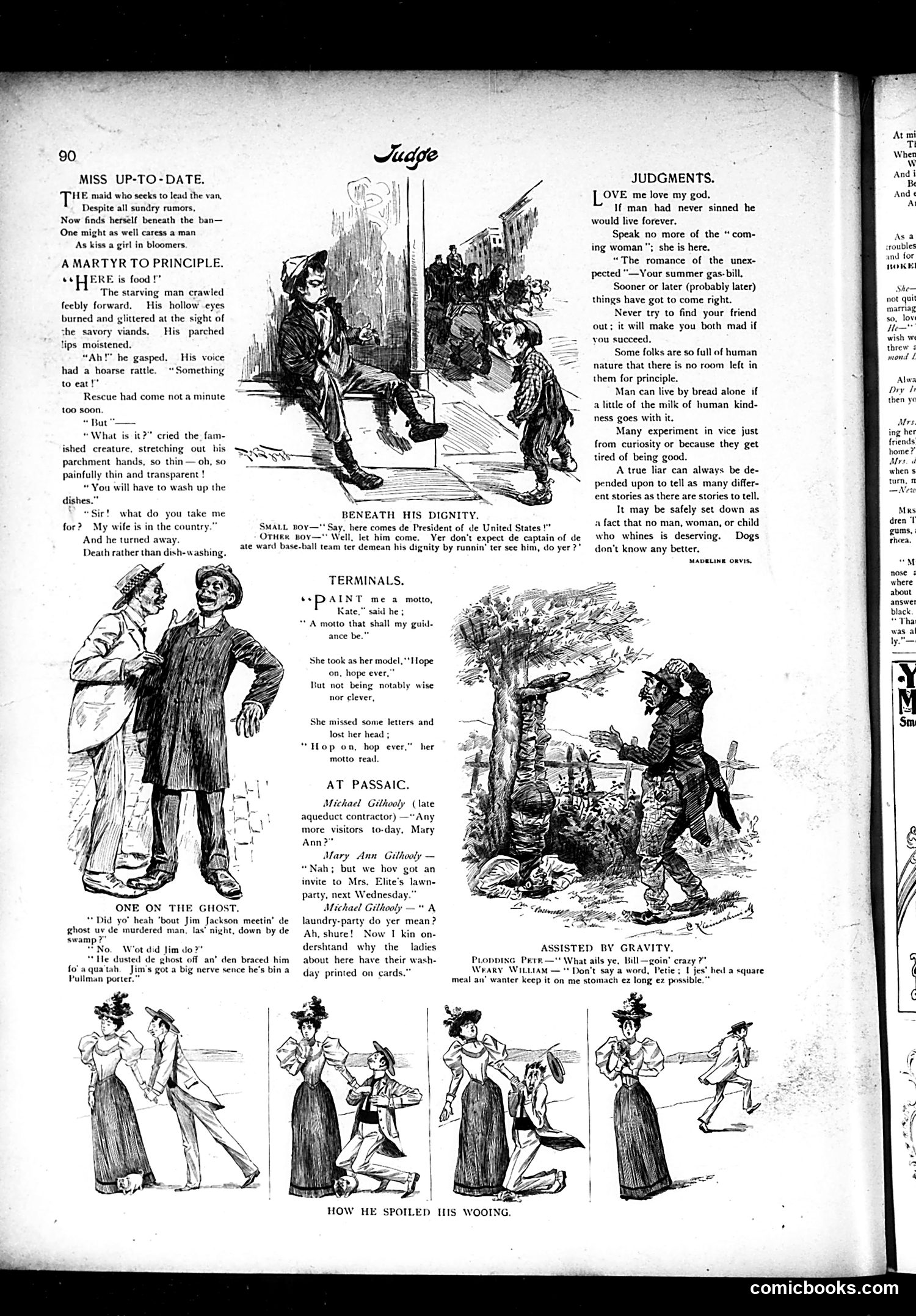
This page contains multiple satirical pieces typical of late-19th/early-20th-century American humor: **"Miss Up-to-Date"** mocks the "New Woman"—women in bloomers (loose pants), considered scandalous. The joke: respectable men won't even kiss such women. **"A Martyr to Principle"** satirizes class snobbery: a starving man refuses food because accepting it requires washing dishes, which he considers beneath his dignity as a Pullman porter (a prestigious job for Black workers). **"One on the Ghost"** is a racial dialect joke featuring Black characters ("Jim Jackson") in a supernatural scenario—typical of period humor that relied on stereotypes. **"Terminals"** plays on a woman mishearing "Hope on, hope ever" as "Hop on, hop ever." **"At Passaic"** jokes about Irish working-class immigrants (Gilhooly), mocking their confusion about "wash day" printed on society ladies' cards. **"Beneath His Dignity"** shows a baseball captain refusing to acknowledge the U.S. President—inverted social deference for comedic effect. The page reflects period attitudes toward gender, class, ethnicity, and social pretension.
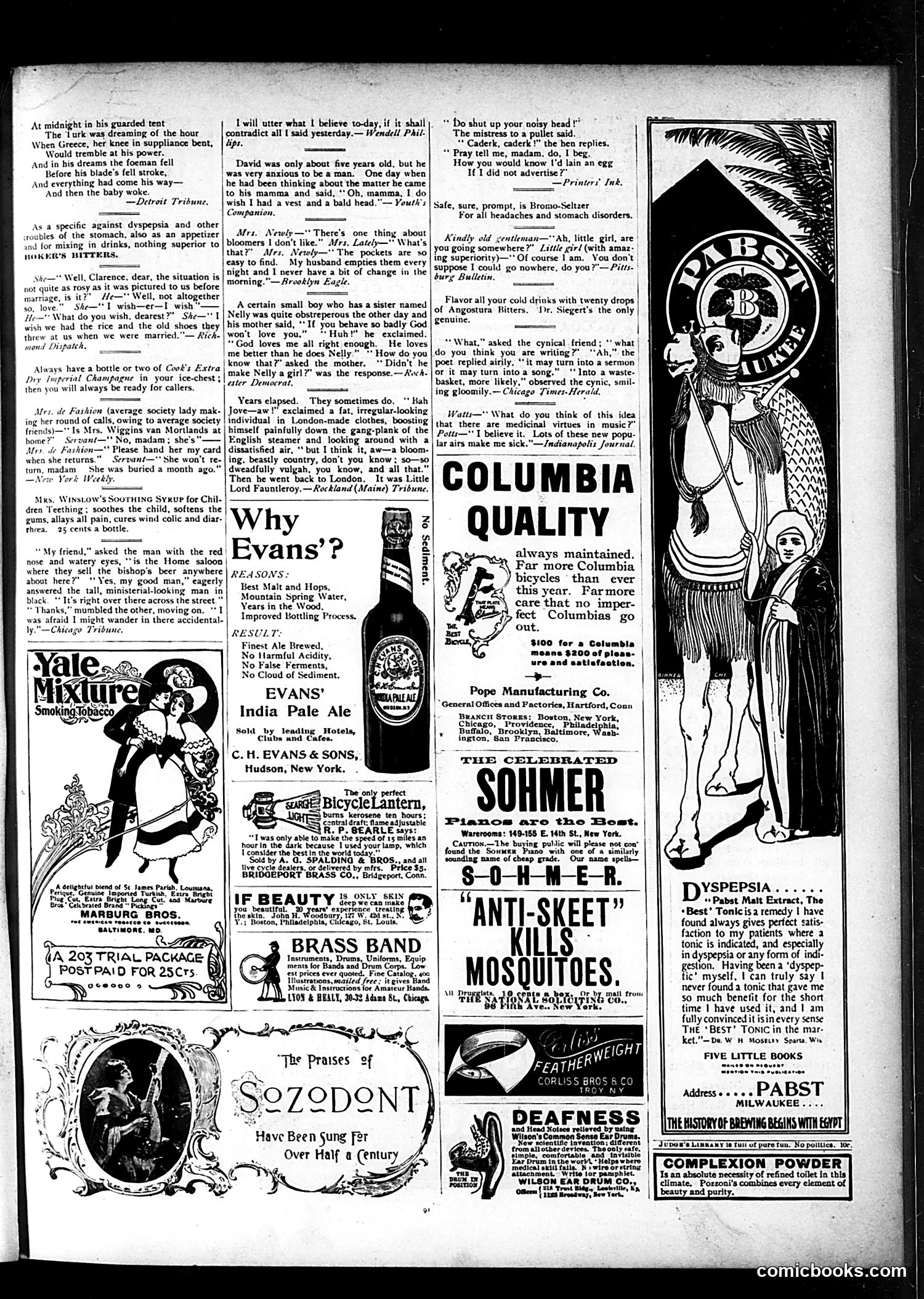
This page is primarily **advertising**, not political cartoons. The advertisements promote various consumer products including Evans' India Pale Ale, Yale Mixture smoking tobacco, Columbia bicycles, Sohmer pianos, and patent medicines like Bromo-Seltzer and "Anti-Skeet" mosquito killer. The small humorous items scattered throughout are **light social humor** rather than political satire—typical filler content for magazines of this era. They include jokes about marriage dynamics, children's behavior, and social pretension (like the "Little Lord Fauntleroy" reference mocking affected British mannerisms). The only potentially satirical element is a brief opening verse about "the Turk" dreaming of conquest before being awakened by a baby—likely commentary on Turkish imperial ambitions, though the reference is vague without additional historical context. **Overall:** This is a commercial magazine page from the early 20th century, dominated by product advertisements with minimal editorial content.
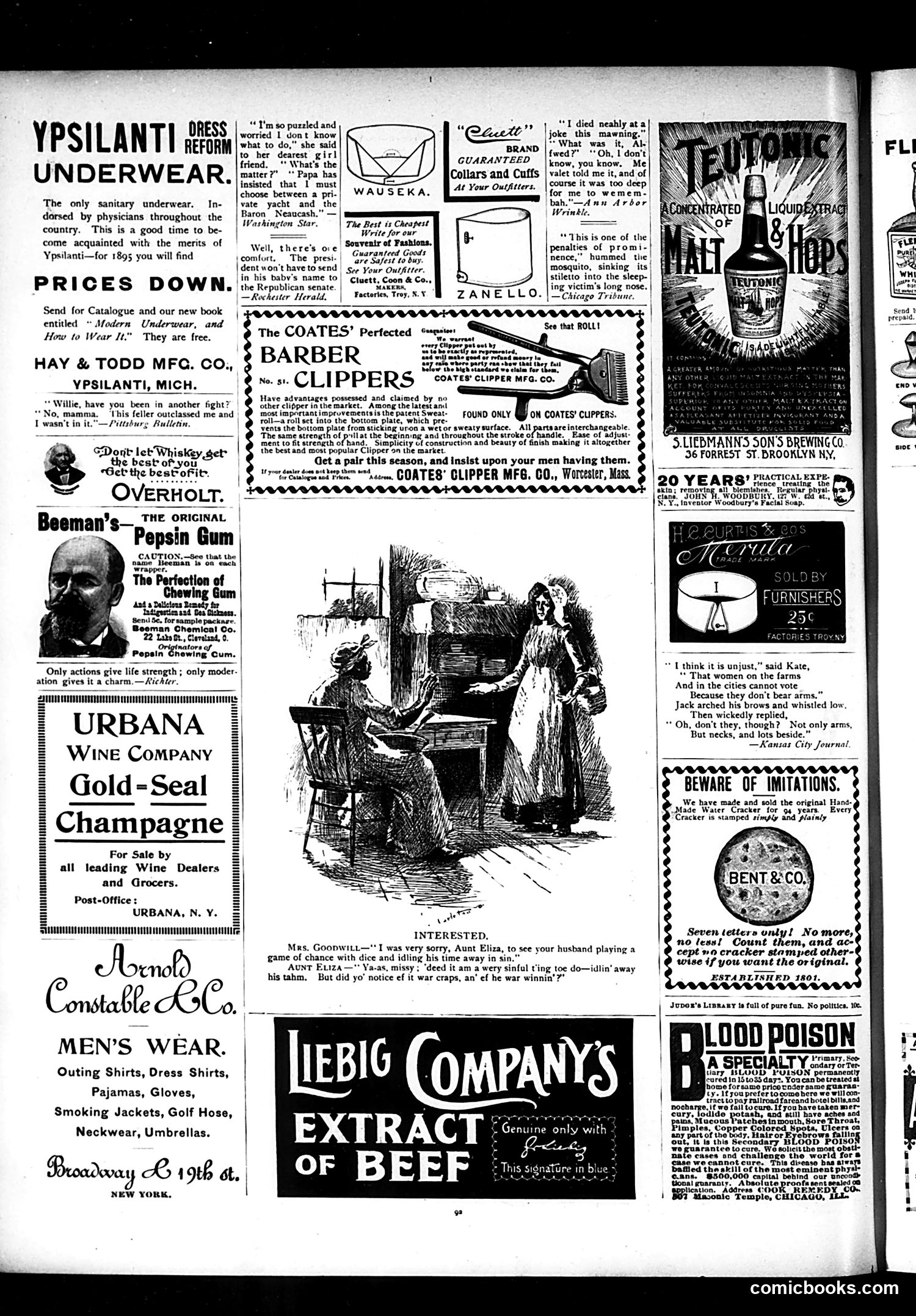
This is primarily a **advertisements page** from Judge magazine (circa 1895). The main cartoon—titled "INTERESTED"—depicts a domestic scene where Mrs. Goodwill questions Aunt Eliza about her husband playing dice. Aunt Eliza's response reveals period racial dialect humor: she admits the gambling is sinful, but her real concern is whether he's playing "craps" and winning—suggesting practical acceptance of vice if profitable. The page also includes a brief satirical poem "Kate" mocking women's suffrage arguments. Kate claims women deserve voting rights; Jack sarcastically replies women already have "power"—not just through arms (military service) but through "necks" (likely a crude reference to physical attractiveness or manipulation). The advertisements promote era-typical products: underwear, barber clippers, champagne, beef extract, and men's clothing. These ads reflect late-Victorian consumer culture and gender norms emphasizing male grooming and domestic consumption.
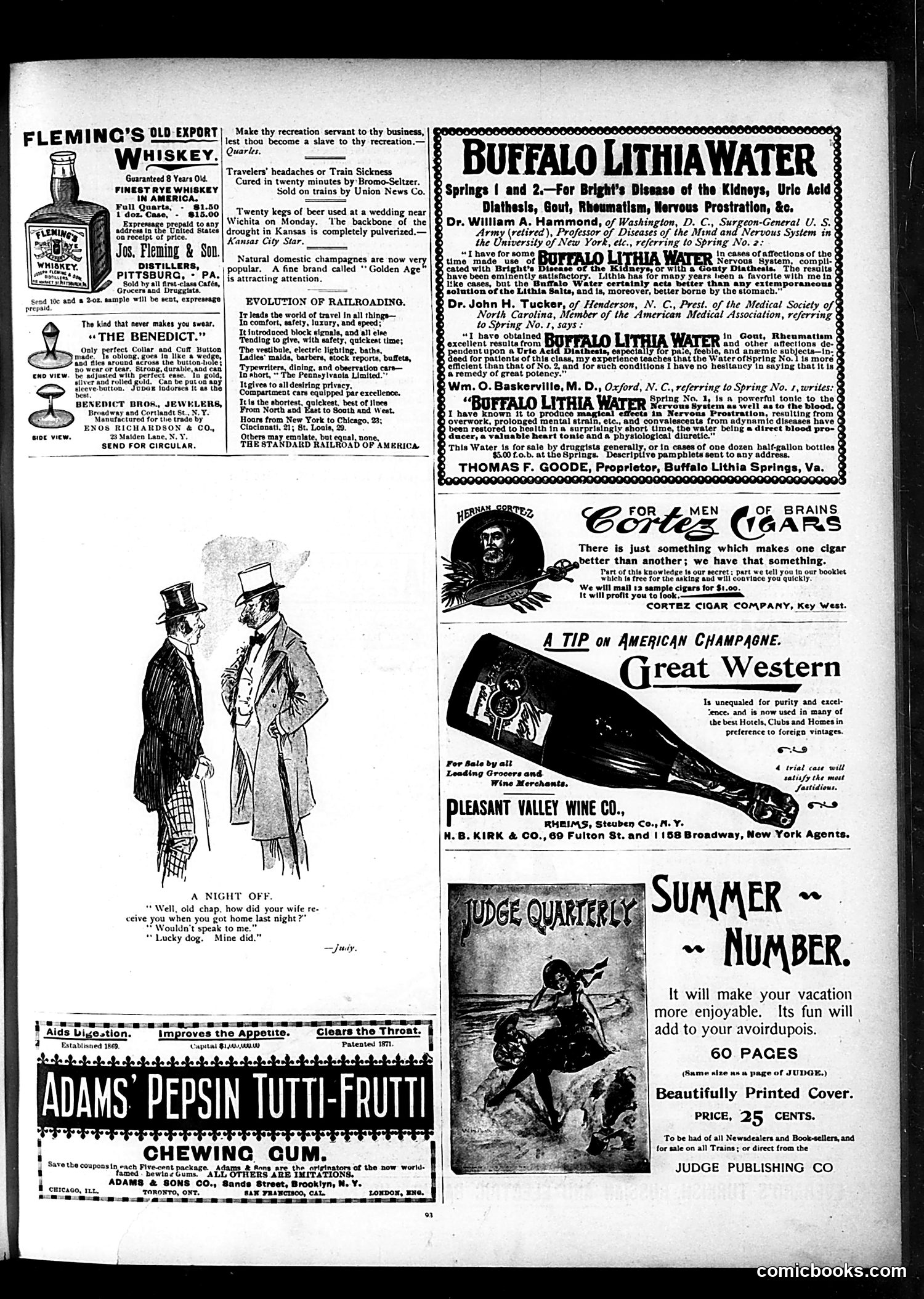
This page is primarily **advertising** with one small cartoon that exemplifies Judge magazine's satire tradition. **The Main Cartoon ("A Night Off"):** The joke satirizes marriage and domestic unhappiness. A husband boasts that his wife wouldn't speak to him after he came home late—he considers her silent treatment fortunate ("Lucky dog"). His companion replies that his own wife *did* speak to him, implying endless nagging is the worse fate. The humor targets the common trope of marital discord and women's domestic complaints, playing on period attitudes that saw women as either coldly punishing or annoyingly talkative—neither choice being appealing to men. **Surrounding Content:** The page is dominated by patent medicine advertisements—prominently Buffalo Lithia Water (for kidney disease, gout, rheumatism), endorsed by medical authorities. This reflects late-19th-century American consumer culture where such "cure-all" mineral waters and tonics were aggressively marketed with medical testimonials (often dubious by modern standards). Also advertised: whiskey, jewelry, cigars, chewing gum, and wine—typical mass-market goods of the period.
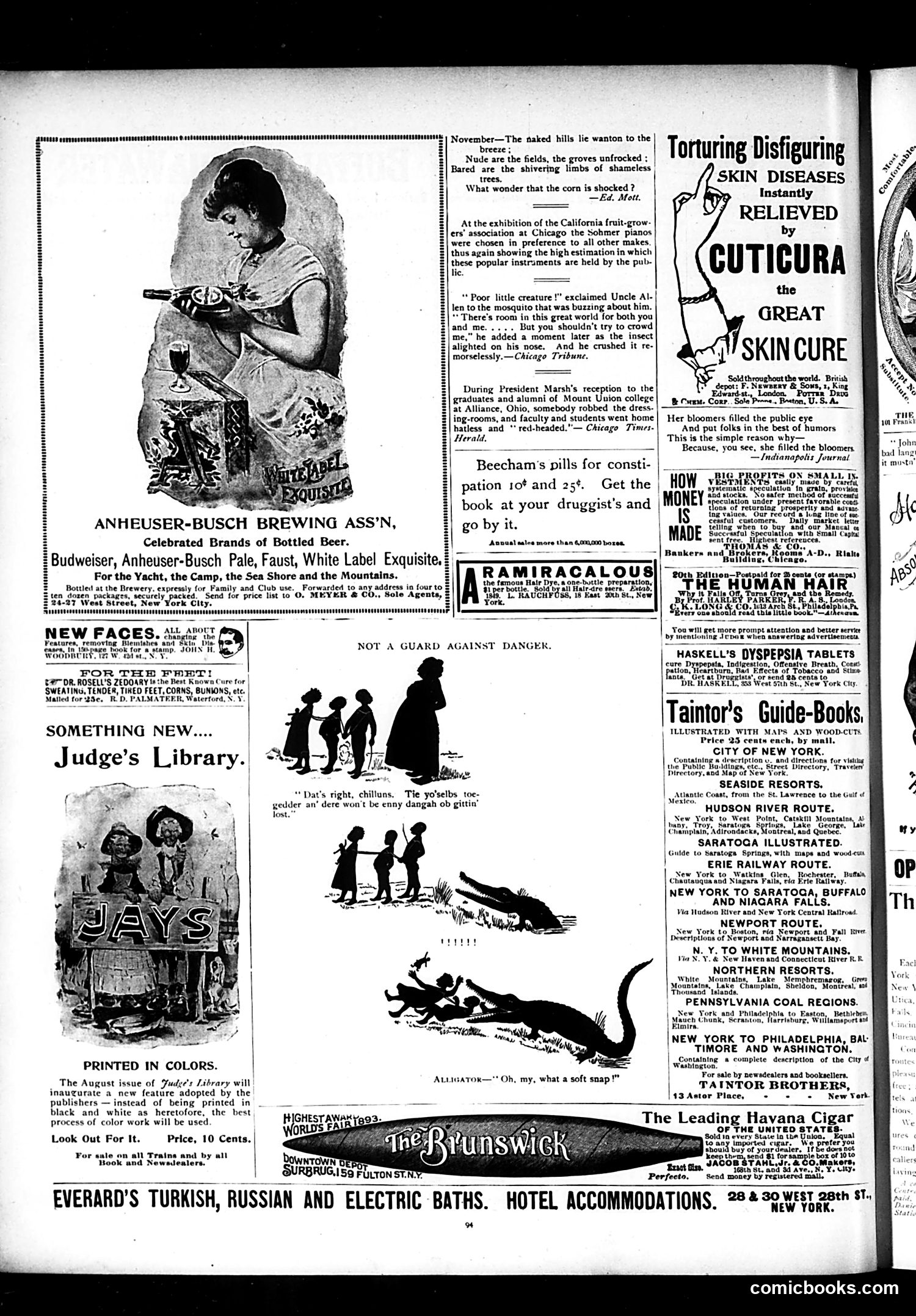
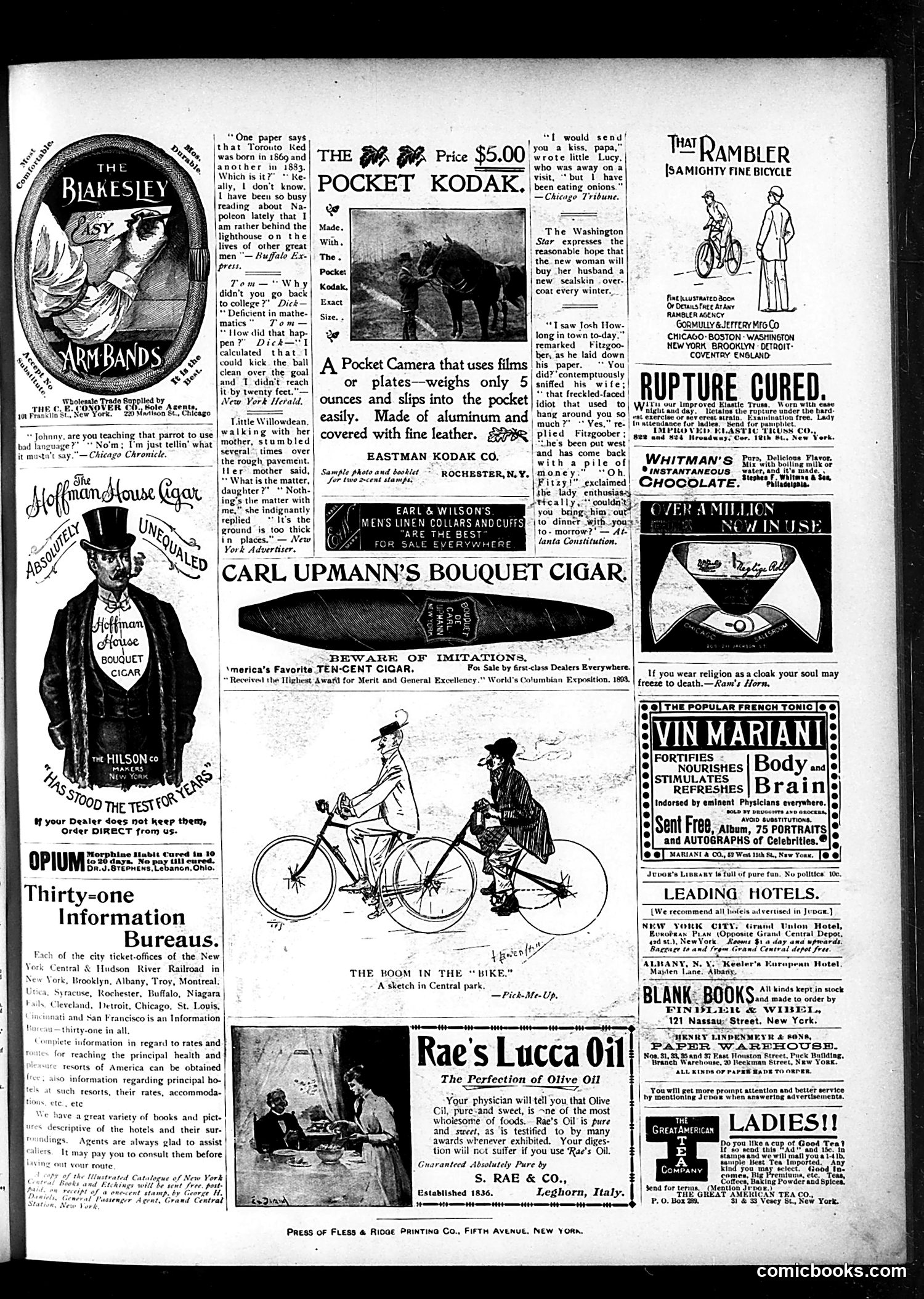
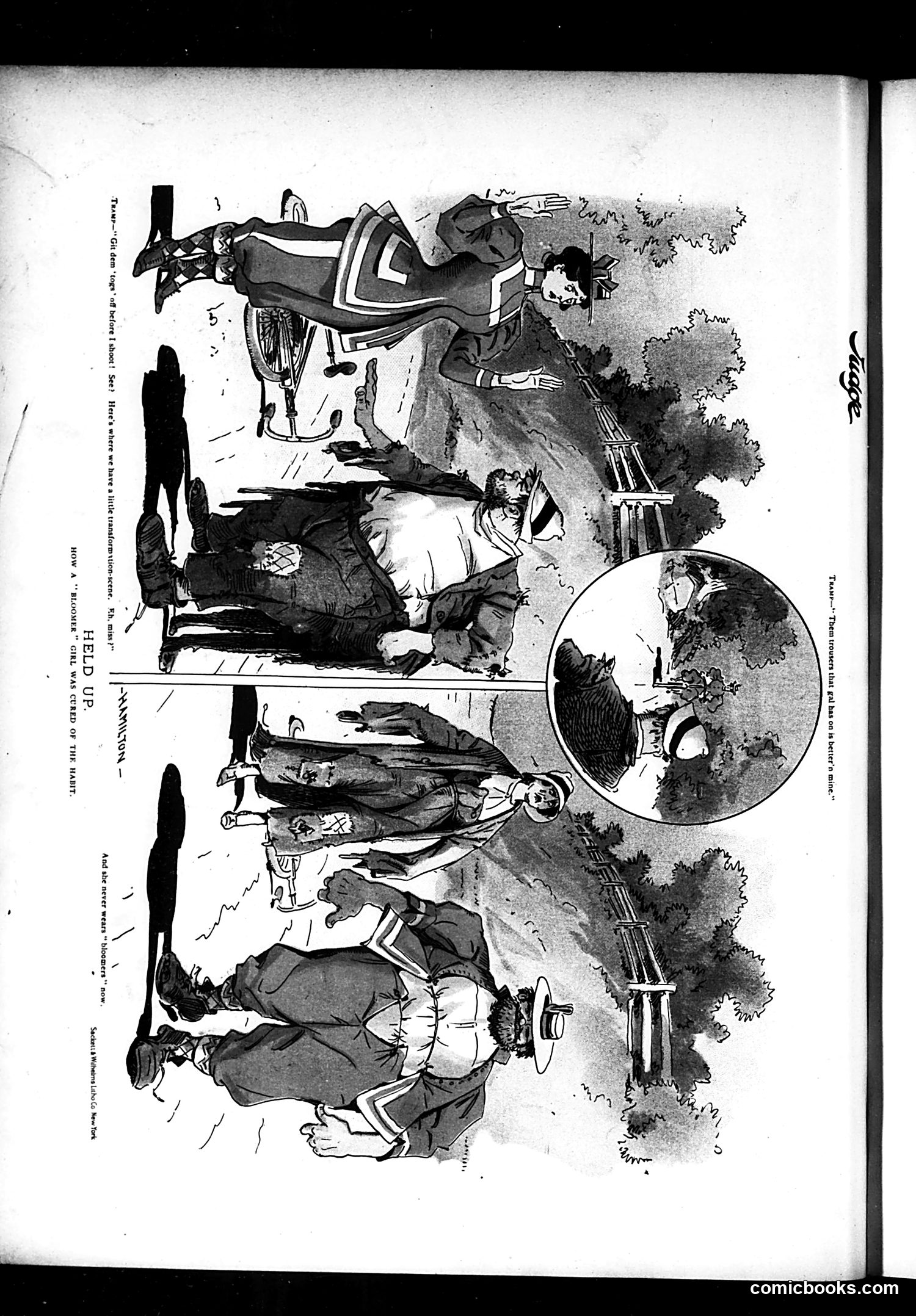
This cartoon satirizes the "bloomer" controversy of the 1890s, when women wearing loose-fitting trousers (bloomers) for practical reasons faced social ridicule and moral panic. The scene depicts a highway robbery where a male bandit, seeing a woman in bloomers, threatens to shoot her unless she removes them—treating the garment as more scandalous than theft itself. The "transformation scene" caption suggests she abandons bloomers after this encounter. The joke mocks both the absurdity of Victorian attitudes toward women's clothing reform and contemporary anxieties about changing gender norms. For modern readers: bloomers represented early feminist challenges to restrictive dress codes, but were widely condemned as immodest and "unladylike." The cartoon suggests that masculine authority (even criminal) could enforce traditional clothing standards, reflecting real social pressure women faced for daring to wear practical attire.