
A complete issue · 16 pages · 1895
Judge — July 13, 1895
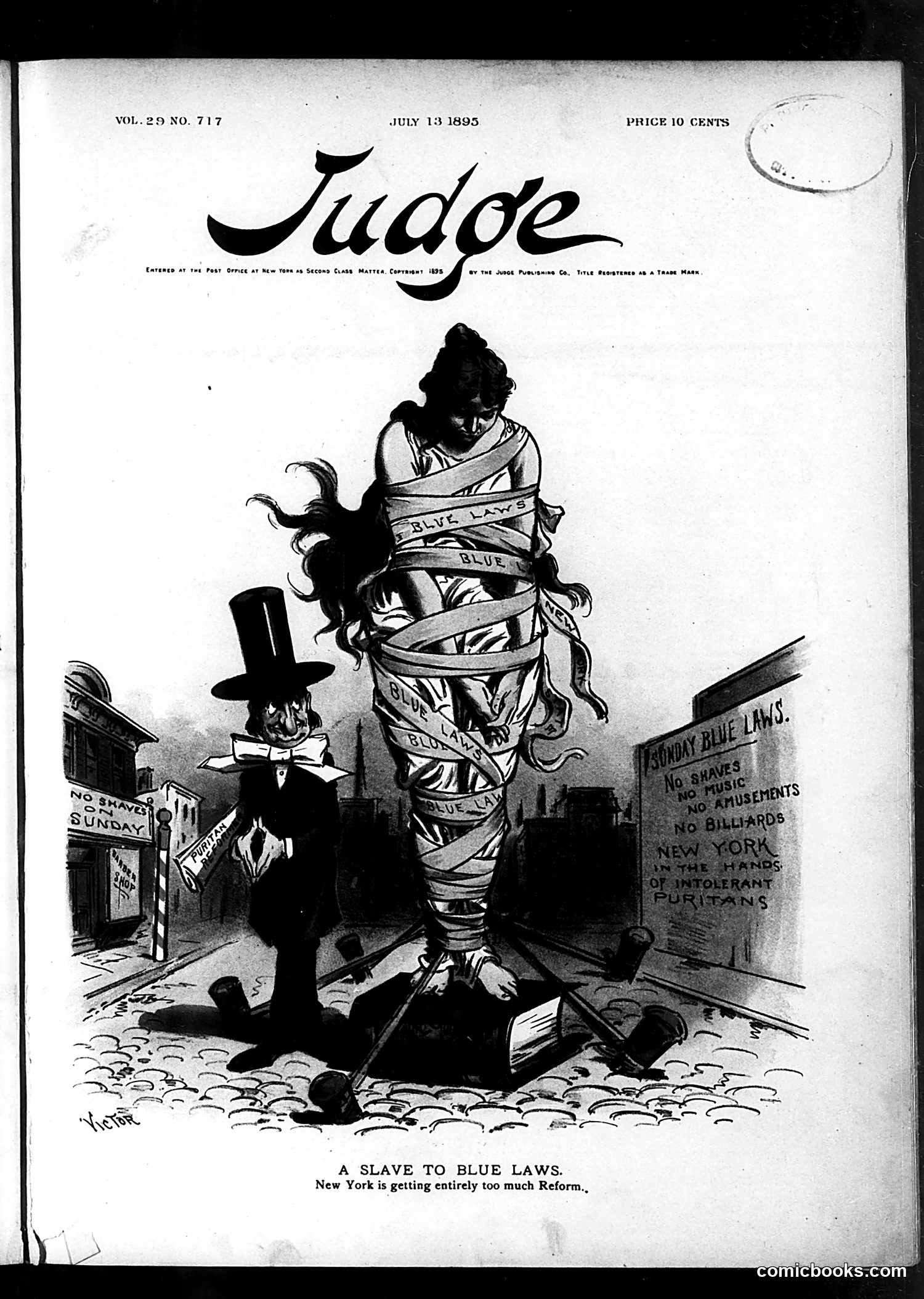
This political cartoon critiques New York's "Blue Laws"—strict Sunday regulations prohibiting various activities. The central figure represents Liberty or New York itself, wrapped in chains labeled "BLUE LAWS," appearing enslaved and contorted. Flanking the figure are signs listing prohibited Sunday activities: "NO SHAVING," "NO MUSIC, NO AMUSEMENTS, NO BILLIARDS" and "SUNDAY BLUE LAWS / NO SHAVES / NO MUSIC / NO AMUSEMENTS / NO BILLIARDS / NEW YORK / IN THE HANDS / OF INTOLERANT PURITANS." A skeletal figure in a top hat (likely representing rigid Puritanism or religious extremism) stands nearby. The cartoonist argues that New York's reform-minded Blue Law enforcement has become oppressive, excessively restricting personal freedoms under the guise of moral righteousness.
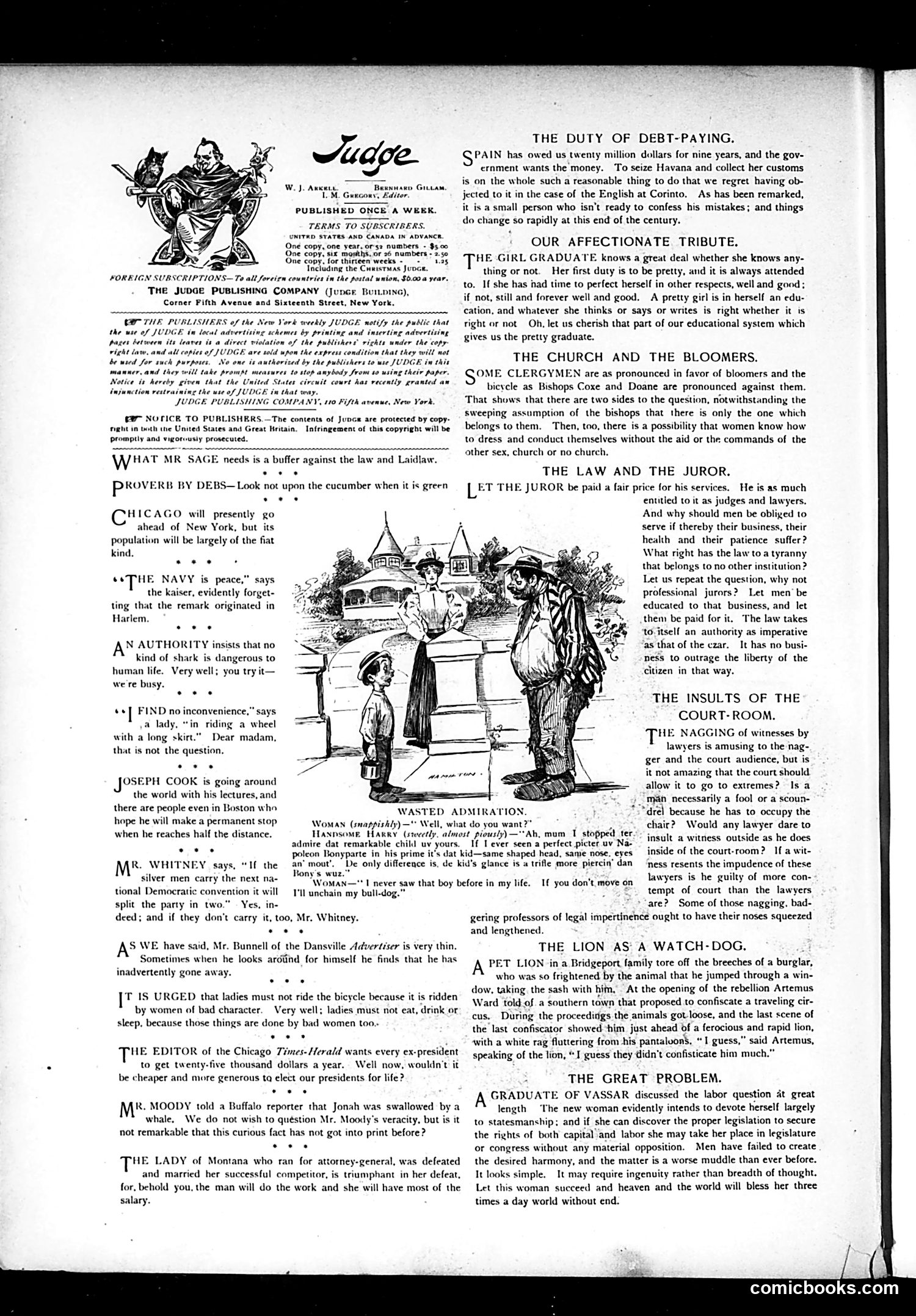
This page contains satirical editorial commentary rather than a political cartoon. The pieces mock various contemporary social issues: **"The Duty of Debt-Paying"** critiques Spain's financial irresponsibility regarding Cuban customs revenues. **"Our Affectionate Tribute"** sarcastically praises female graduates, suggesting their education is superficial. **"The Church and the Bloomers"** satirizes clergy opposition to women wearing bloomers (practical divided skirts), noting the hypocrisy of religious institutions dictating women's dress. **"The Law and the Juror"** argues jurors deserve compensation equal to lawyers, questioning why citizens sacrifice time and health for unpaid jury duty. The main illustration depicts a woman in bloomers confronting a disapproving man, embodying the dress-reform controversy. The page reflects 1890s debates about women's rights, including practical clothing and legal equality.
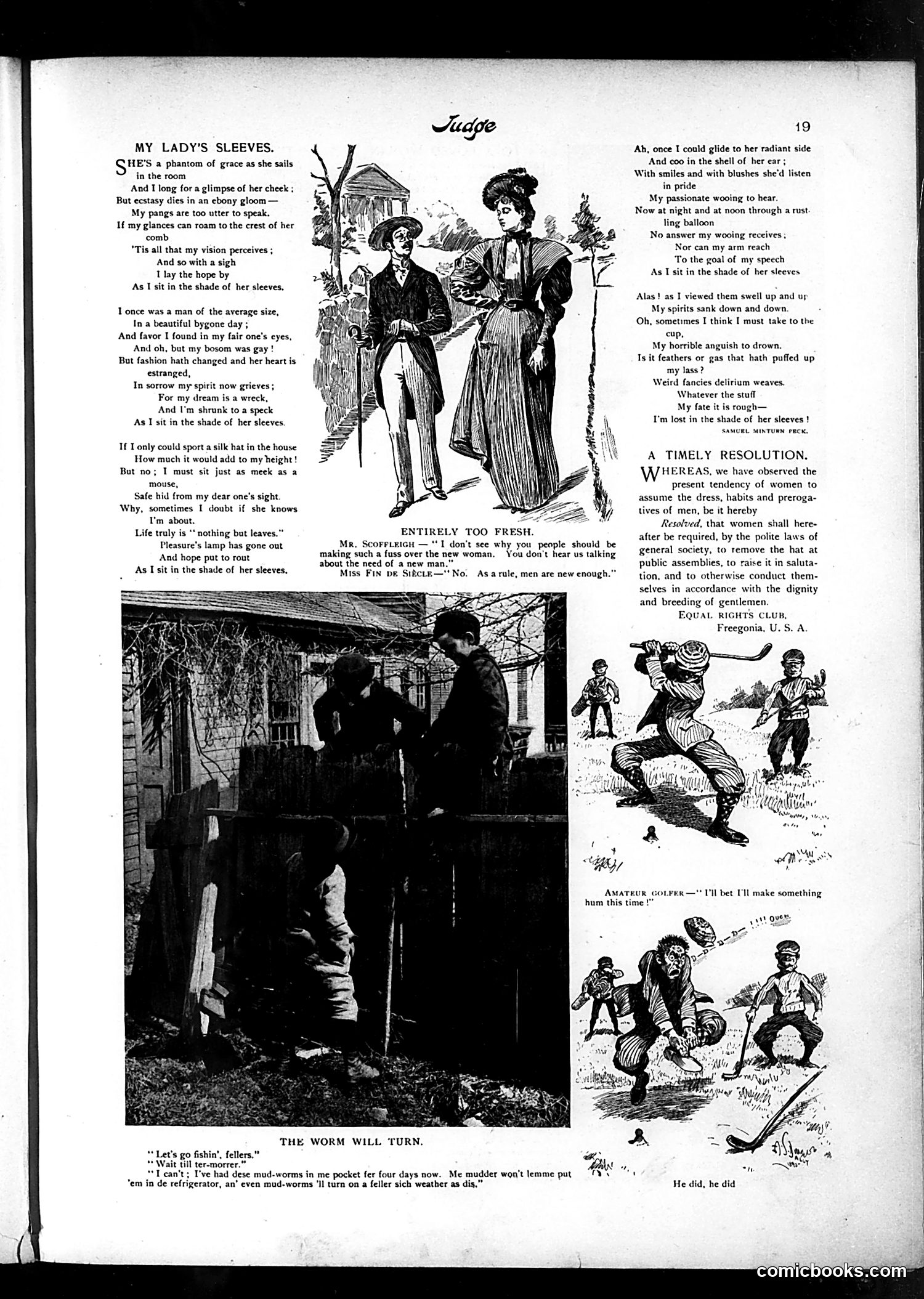
The upper section is a romantic poem about a man pining for a woman, using her "sleeves" as a metaphor for her presence and affection—conventional Victorian sentimentality. Below, "A Timely Resolution" mocks women's activism. The "Equal Rights Club" in Fregonia proposes that women should adopt men's "dress, habits and prerogatives" and conduct themselves with "dignity and breeding of gentlemen." The satirical point: the magazine ridicules women's equality movements by suggesting they should literally become men to gain rights—implying women's activism is absurd rather than legitimate. The fishing scene ("The Worm Will Turn") appears unrelated comic relief, showing fishermen's mishaps. This reflects Judge's conservative stance opposing women's suffrage and equality movements of the era.
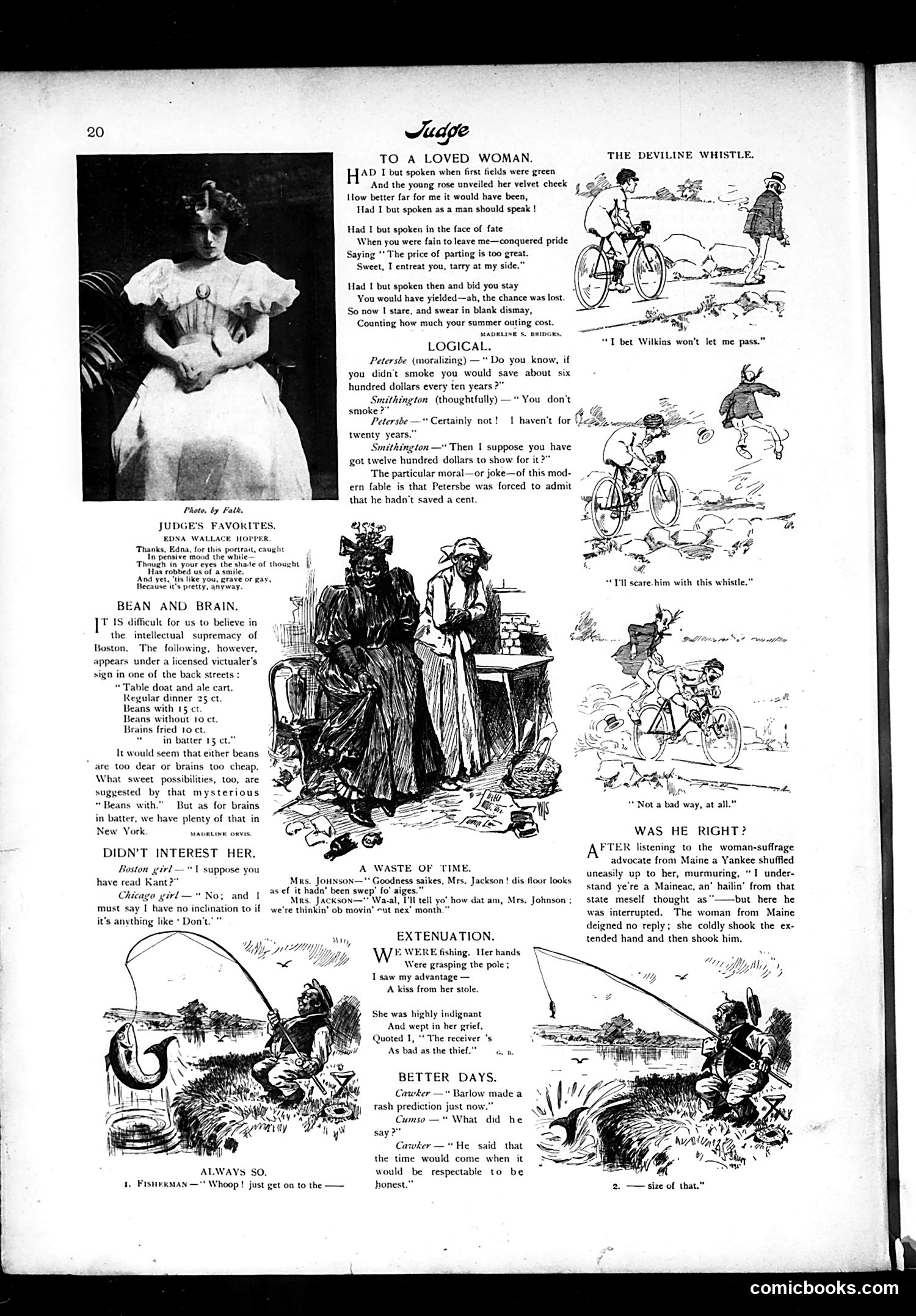
This page contains multiple satirical pieces typical of early Judge magazine: **"The Deviline Whistle"** (top right): A comic strip mocking a man's failed attempt to prevent his lover's departure. The humor relies on the ironic twist that his real concern isn't romantic—it's the cost of her summer outing, suggesting mercenary rather than passionate motives. **"Logical"**: A morality joke where a man who boasts of never smoking for twenty years is forced to admit he has no savings to show for it, undermining his self-righteous claim. **"Bean and Brain"**: Satire on Boston's intellectual pretensions. A Boston restaurant's menu listing "Brains fried" alongside beans suggests either beans are overpriced or Bostonians lack intelligence—mocking the city's reputation for superiority. **"Didn't Interest Her"**: Contrasts a Boston girl unfamiliar with Kant against a Chicago girl equally uninterested, suggesting intellectual pretension is geographically universal and ultimately hollow. The remaining pieces use similar quick-joke formats about romance, domestic life, and social hypocrisy typical of Judge's humor.
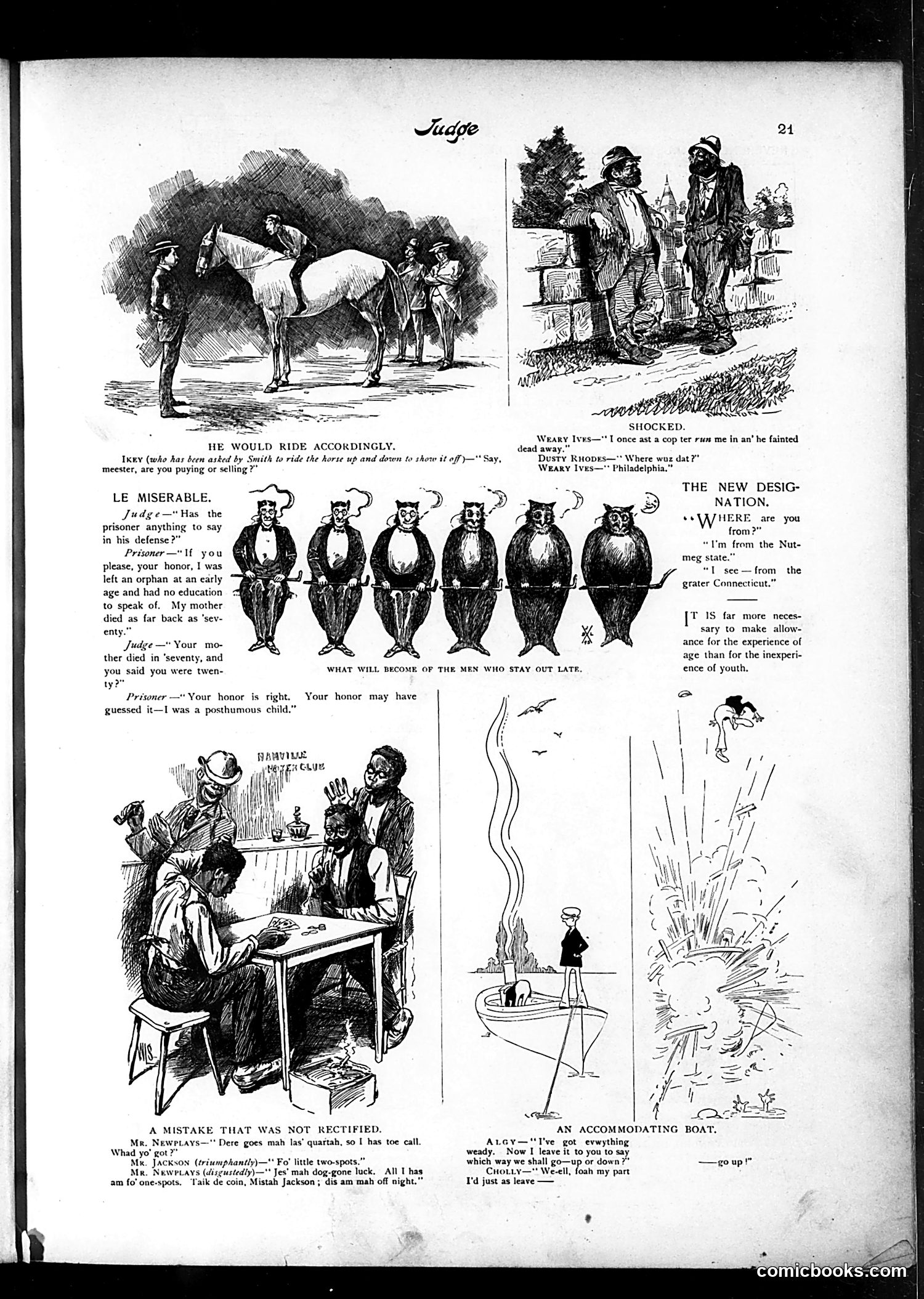
This page contains six separate comic sketches mocking working-class and marginalized figures—typical of Judge's satirical approach. **"He Would Ride Accordingly"** ridicules Irish immigrants, shown through thick dialect mocking a horse-seller. **"Le Miserable"** parodies melodramatic courtroom scenes, where a prisoner's absurd claim of being orphaned at "seventy" yet being "twenty" exposes logical inconsistency—likely satirizing both sentimental criminal defenses and judicial gullibility. **"Shocked"** features two tramps (labeled "Weary Ives" and "Dusty Rhoades") in crude dialect, joking that a Philadelphia cop fainted rather than arrest someone—mocking both vagrants and urban police. The remaining sketches—card games, a boat scene—use similar ethnic caricature and lower-class stereotypes. The overall tone reflects late-19th/early-20th-century American humor: heavily reliant on racial/ethnic mockery, immigrant dialects rendered as illiterate, and poverty portrayed as comical rather than sympathetic.
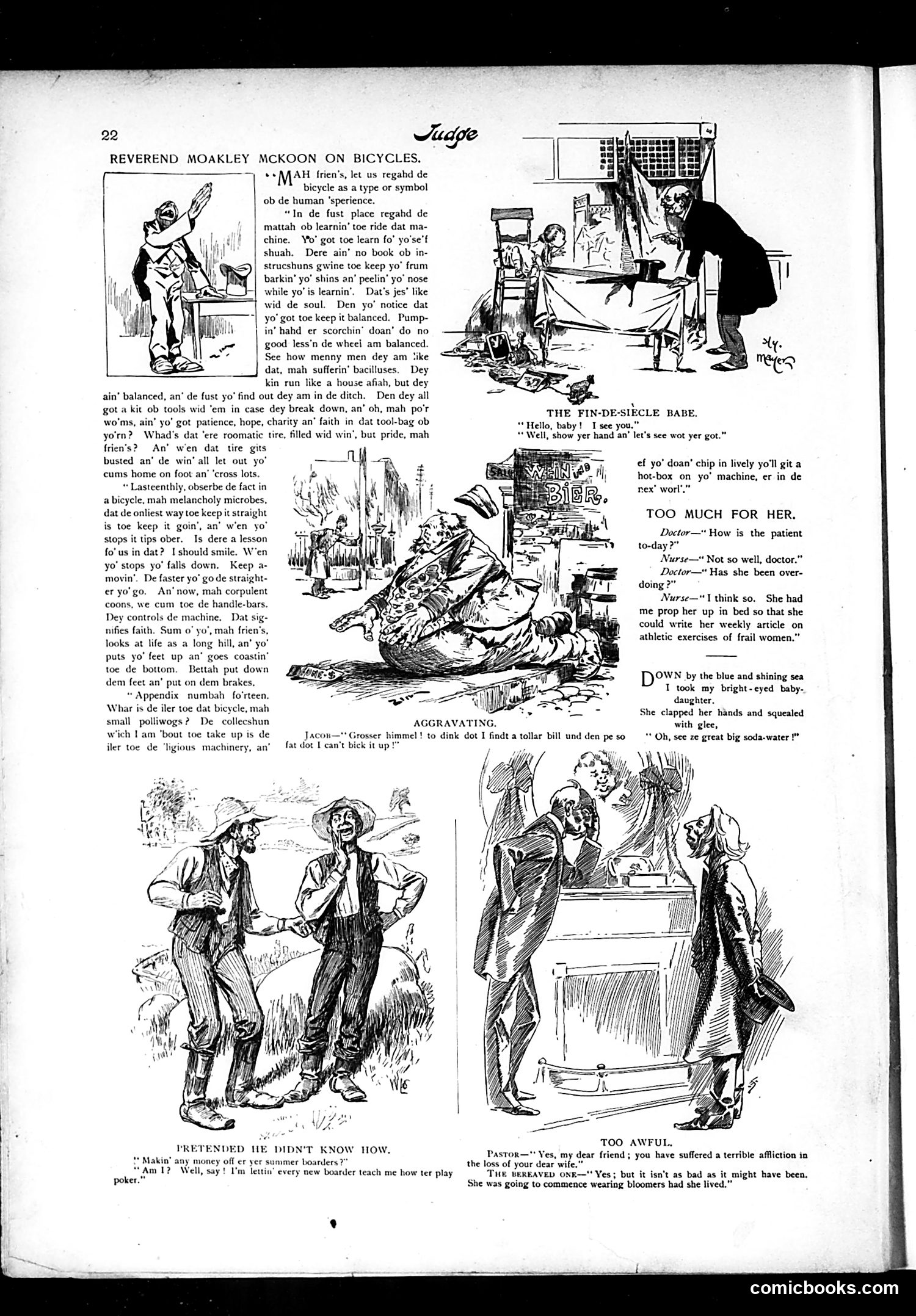
This Judge magazine page (circa early 1900s) contains several satirical pieces: **"Reverend Moakley McKoon on Bicycles"**: A dialect sermon using a bicycle as moral metaphor. The reverend (depicted in stereotypical minstrel-show dialect) preaches that cycling teaches life lessons—balance, persistence, faith in "handles" (divine guidance), and maintenance of one's spiritual machinery. This reflects the bicycle craze's cultural moment and uses religious rhetoric for humorous effect. **Other cartoons** mock contemporary social situations: a woman overseer who works too hard ("athletic exercises of frail women"), a grieving widower receiving condolences, and a child mistaking the ocean for "soda-water." The final joke references "bloomers"—the controversial divided skirts worn by some women cyclists and activists, which conservative society found scandalous. The bereaved man considers his wife's death almost merciful since she won't embarrass the family by wearing them. The satire targets both religious pretension and anxieties about women's changing social roles and independence.
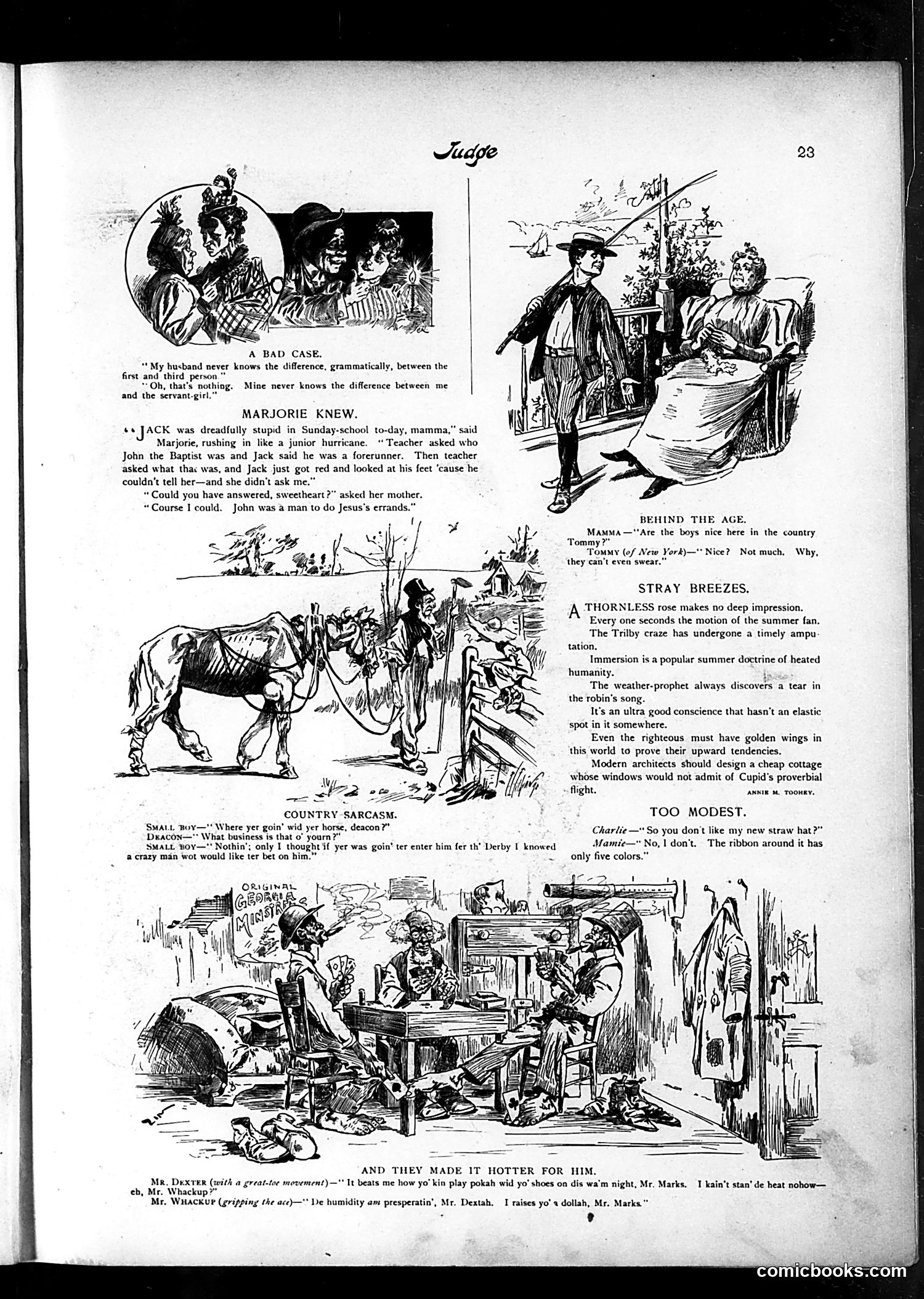
This page collects brief satirical sketches mocking everyday American life: **"A Bad Case"** and **"Marjorie Knew"** ridicule class anxieties and childhood precocity—wives complaining husbands can't distinguish grammar or people, and a girl boasting she'd answer Sunday school questions correctly (defining John the Baptist as "a man to do Jesus's errands"). **"Country Sarcasm"** depicts rural humor: a boy mocking a deacon for entering a horse in the Derby. **"Behind the Age"** contrasts rural and urban boys—country children apparently can't swear like New Yorkers. **"Stray Breezes"** offers scattered aphorisms about roses, fans, and social hypocrisy. **"Too Modest"** jokes about a woman's hat with only five colors in its ribbon. **"And They Made It Hotter for Him"** shows Black dialect humor (common then, offensive now), depicting men playing poker while complaining about heat and humidity. The page reflects Judge's typical mix: domestic satire, class commentary, and period racial stereotypes presented as entertainment.
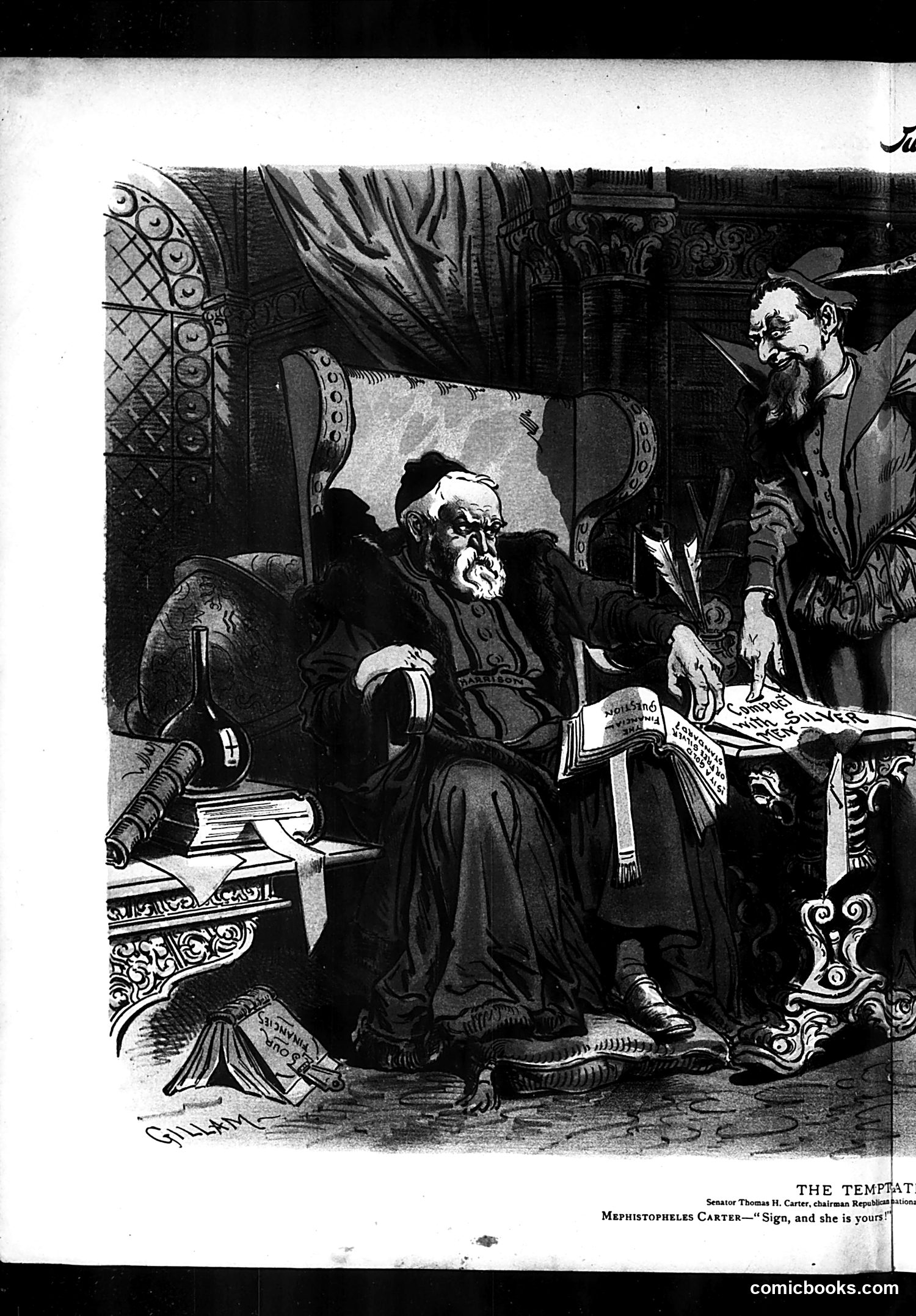
This political cartoon depicts Senator Thomas H. Carter (Republican National Committee chairman) being tempted by Mephistopheles (the devil figure), who offers him a document in exchange for his signature. The classical literary reference to Faust—the scholar who sold his soul to the devil—suggests Carter is being portrayed as compromising his principles for political gain or power. The cartoon satirizes Carter's position as party chairman, implying he faces moral temptation in pursuit of political objectives. The "she" referenced in the caption likely refers to political power or electoral victory personified as a woman. The elaborate period setting and classical imagery elevate the satire, treating mundane political dealings as a Faustian bargain worthy of serious moral scrutiny.
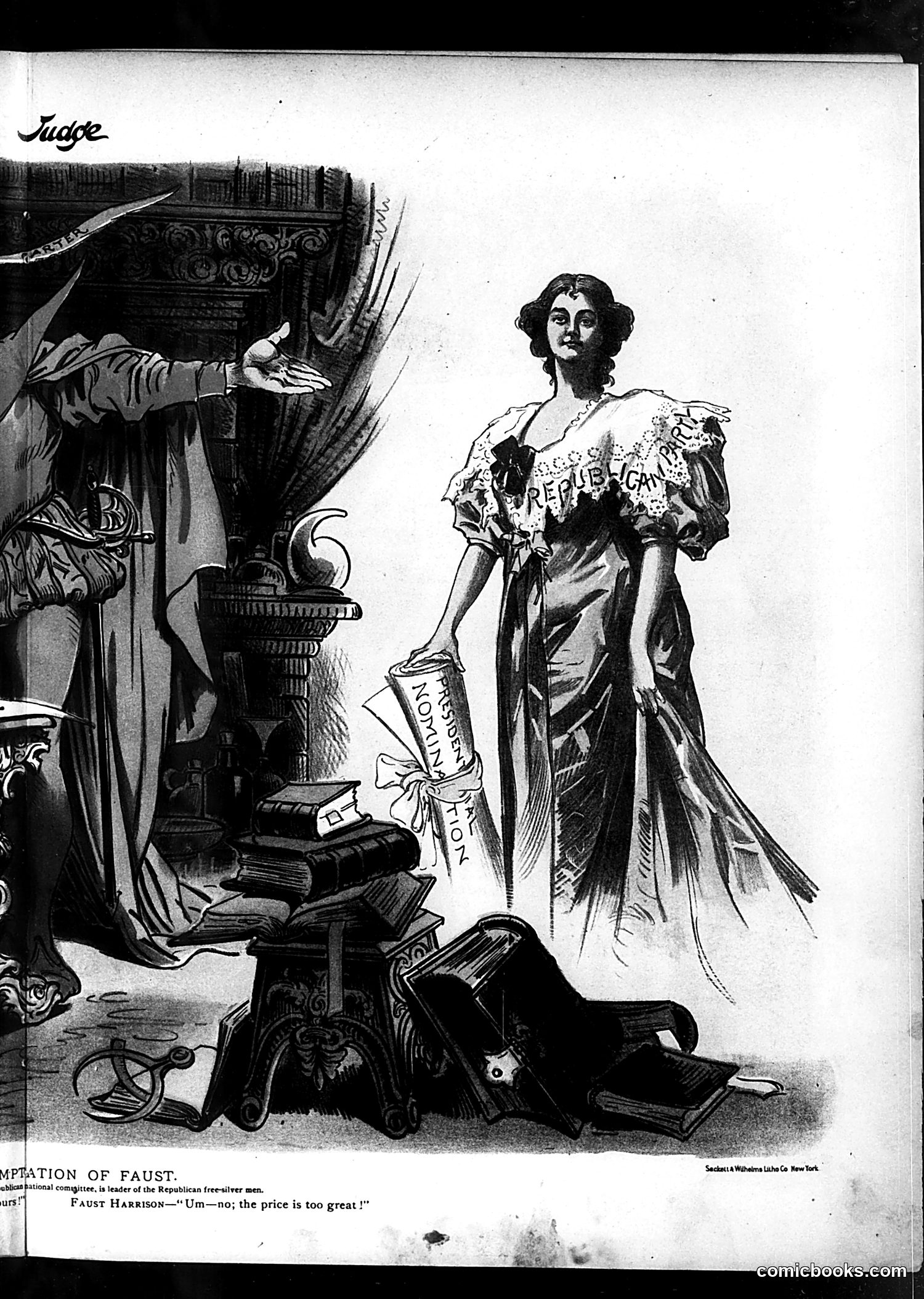
This satirical cartoon depicts a woman labeled "Republican" offering a scroll to "Faust Harrison" (likely referring to Benjamin Harrison or another Republican political figure). The woman represents the Republican Party tempting a politician with what appears to be a document or agreement. The classical "Faust" reference invokes the legend of a man who sold his soul to the devil—here suggesting the Republicans are offering a Faustian bargain. The setting includes classical elements (ornate furniture, curtains) emphasizing the grandiose nature of the temptation. The dialogue reads: "Um—no; the price is too great!"—indicating the politician is refusing the Republican offer, despite its allure. The cartoon satirizes political corruption and the compromises politicians face when offered party support or benefits.
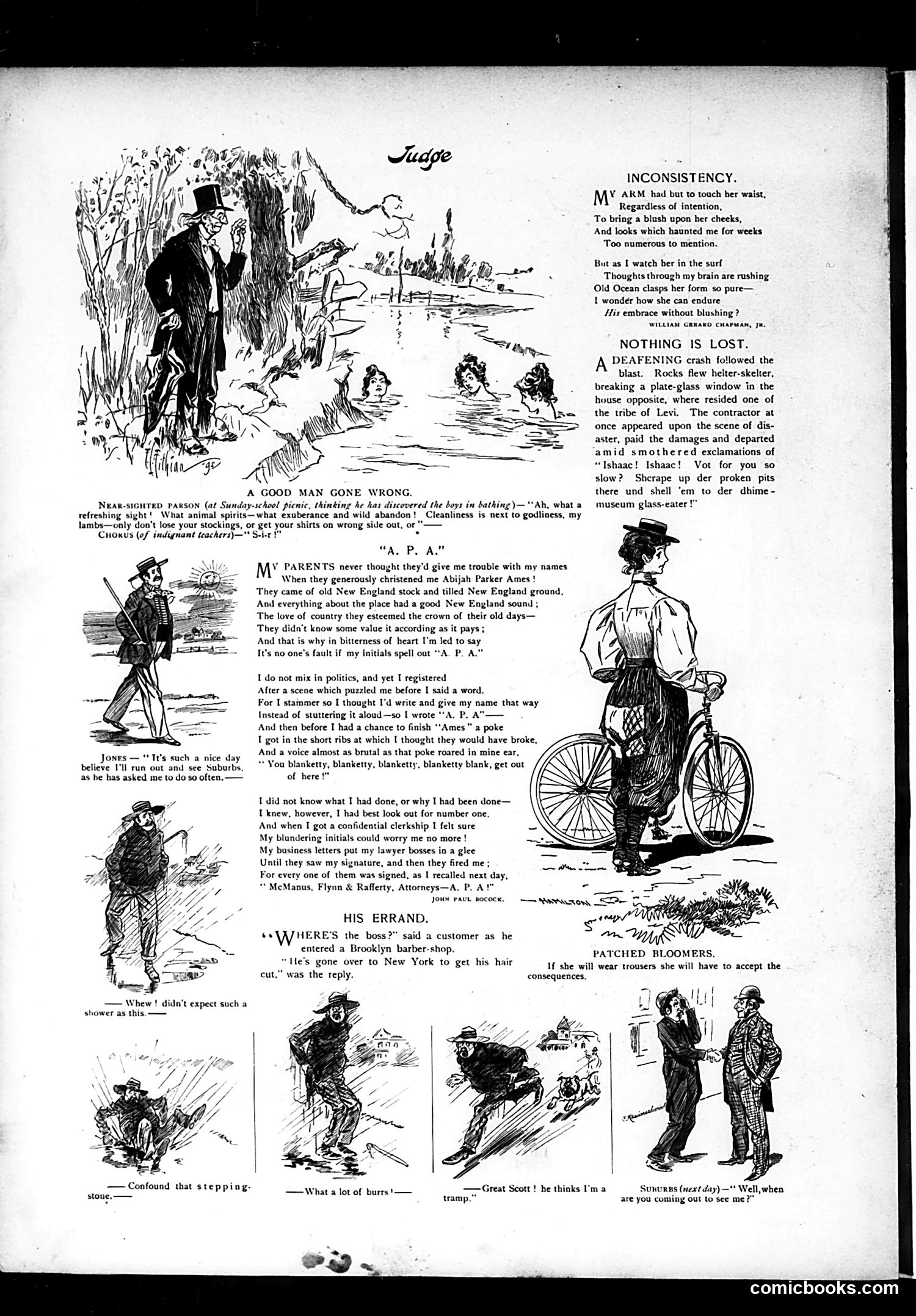
This page contains several satirical pieces typical of late 19th-century American humor: **"A Good Man Gone Wrong"** mocks a nearsighted parson at a Sunday school picnic who mistakes bathing boys for virtuous children enjoying "cleanliness." **"A.P.A."** is the longest piece, satirizing the American Protective Association (a real anti-Catholic, anti-immigrant organization of the 1890s). The narrator's initials spell "A.P.A.," and he's repeatedly attacked for this accident—people assume he's a member. The joke critiques both the organization's hostility and mob mentality against it. **"Inconsistency"** humorously contrasts a woman's modesty when touched by a man versus her comfort being embraced by ocean waves. **"Nothing Is Lost"** uses Yiddish-dialect humor (common in Judge) about a Jewish man pragmatically repurposing broken glass from an explosion. **"His Errand"** and **"Patched Bloomers"** are brief visual gags about a barber's absence and women wearing bloomers (then-controversial split-leg garments). The illustrations use period caricature styles throughout.
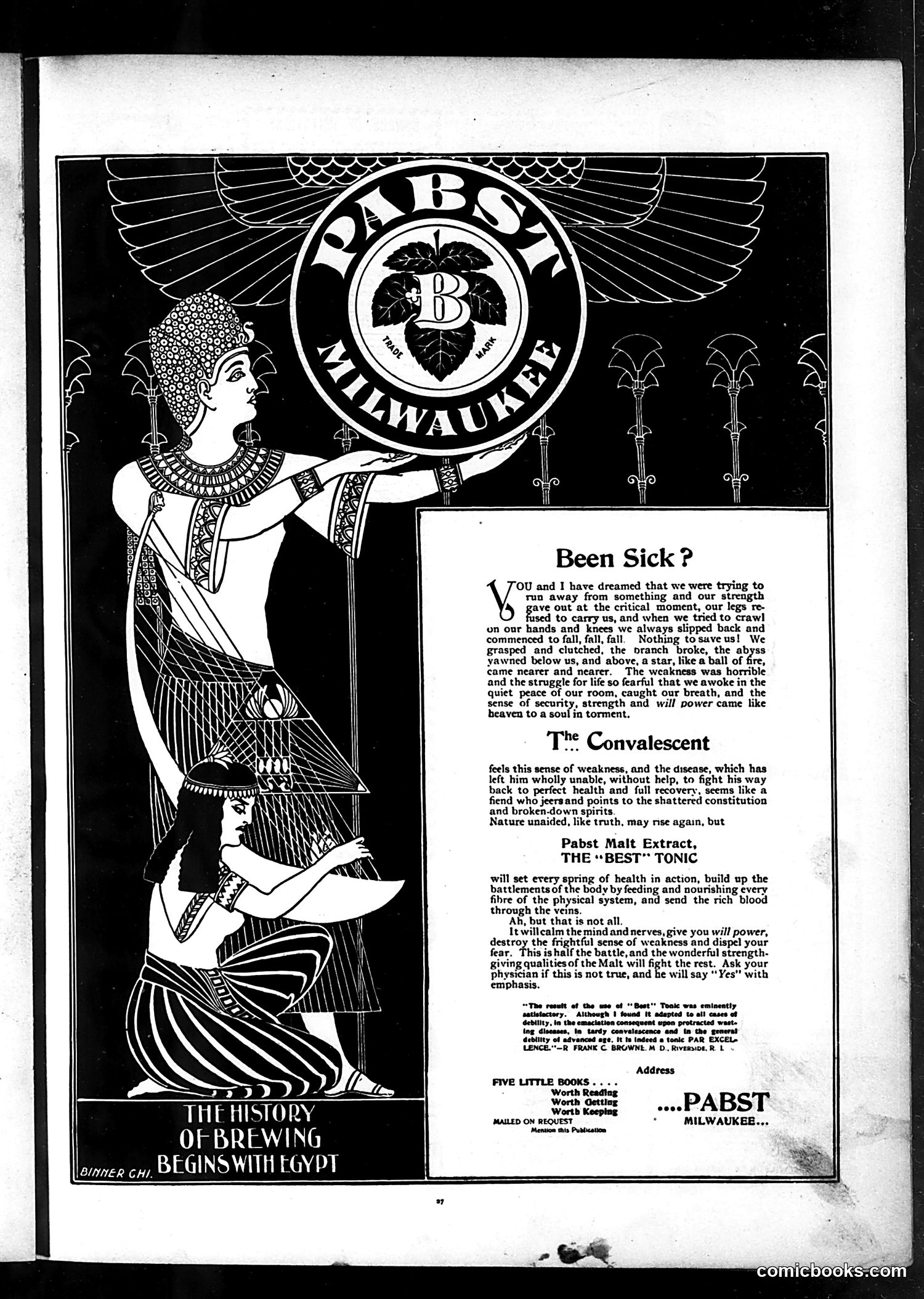
This page is primarily a **Pabst Malt Extract advertisement** disguised as editorial content in Judge magazine. The left side features an Art Deco illustration of an Egyptian figure (likely representing antiquity) holding the Pabst logo, with text claiming "The History of Brewing Begins with Egypt"—a marketing claim linking the product to ancient prestige. The right side uses psychological language to sell the tonic: it describes the universal anxiety dream of falling helplessly, then repositions Pabst as the cure for post-illness weakness and despair. The copy promises the extract will restore not just physical strength but mental fortitude and "will power." A fake medical endorsement from "Frank C. Browne, M.D." legitimizes claims about treating debility and convalescence—a common advertising tactic of the era before FDA regulations. **The satire/joke**: Judge is allowing blatant patent-medicine advertising masquerading as health advice, exploiting reader anxieties about weakness and recovery.
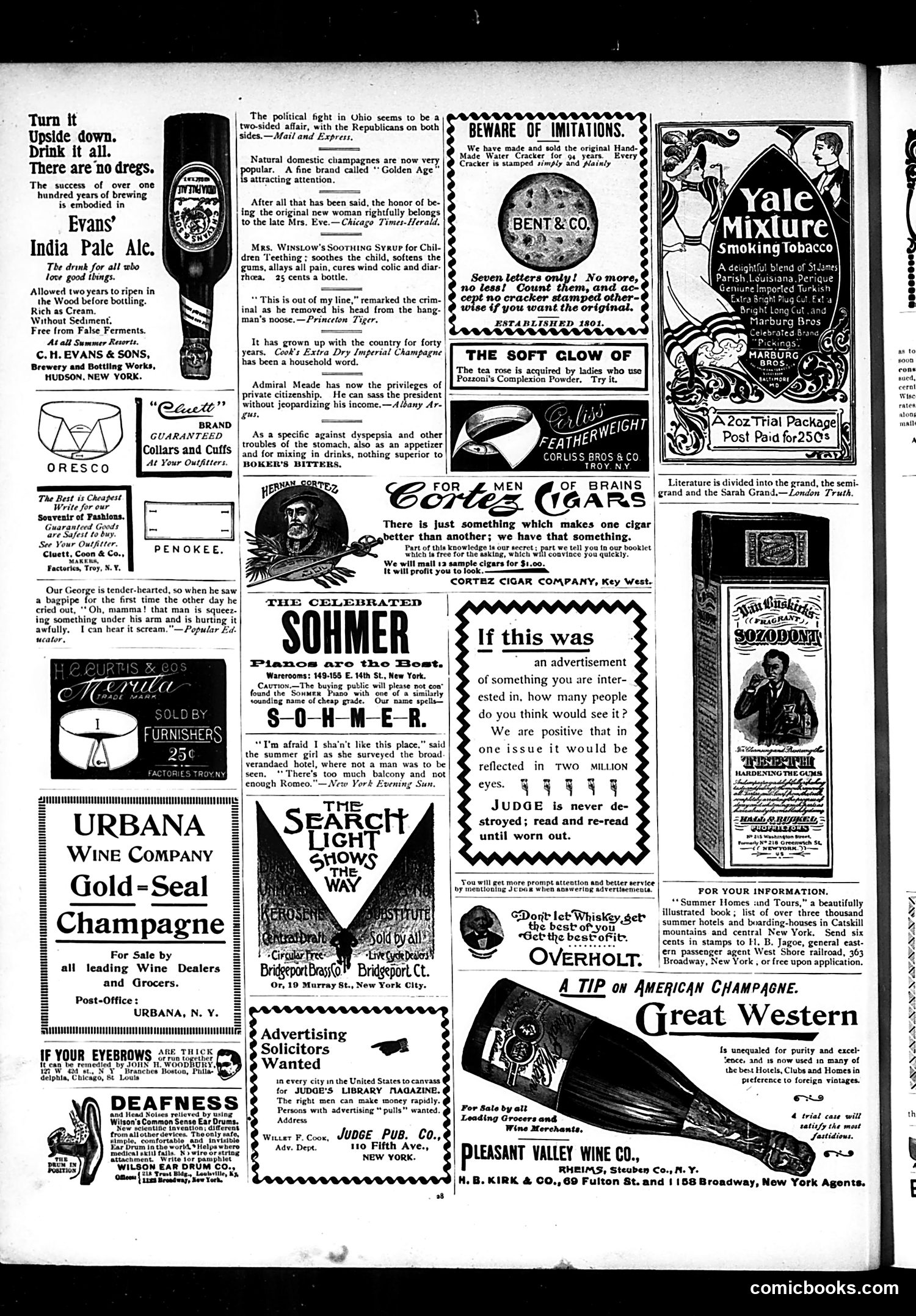
This page is predominantly **advertising**, not political satire. It contains product ads for beer, wine, cigars, pianos, collars, and patent medicines—typical for Judge magazine of the era. The only satirical content appears as brief **jokes** interspersed among ads: 1. **Ohio politics joke**: References Republicans splitting into factions within the same state—likely commentary on intraparty division. 2. **"Original new woman" joke**: References Mrs. Eve (from Genesis), sarcastically claiming she was the first "new woman"—mocking the contemporary "New Woman" movement of the era. 3. **Bagpipe joke**: A child mistakes a bagpipe for animal abuse, reflecting period attitudes toward the instrument as foreign/unpleasant. 4. **Admiral Meade joke**: Suggests retirement grants him freedom to criticize the president without losing income. These are mild observational humor rather than substantive political commentary. The page primarily documents **consumer culture** and advertising from this period.
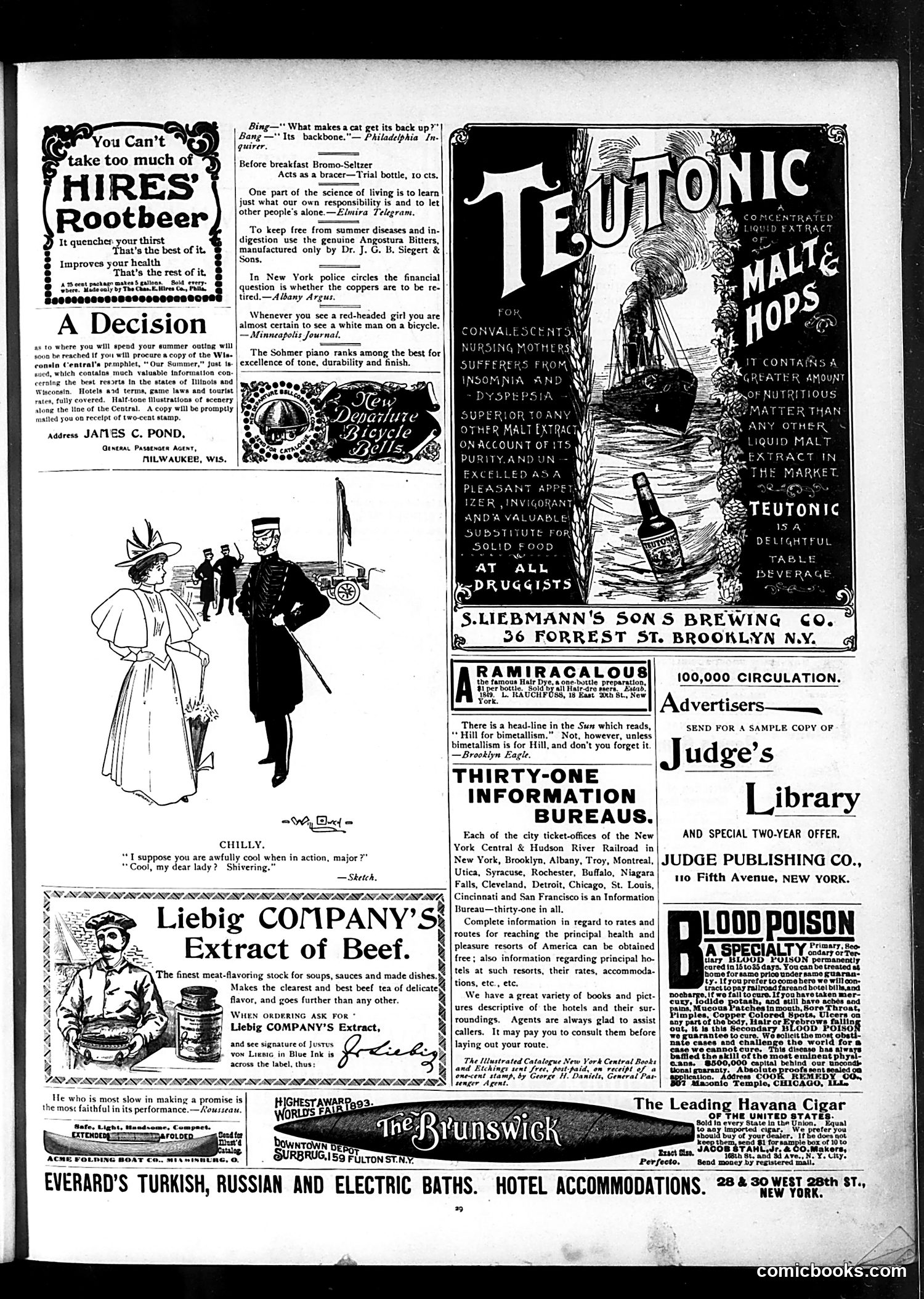
This is primarily a **advertisements and light humor page** from Judge magazine, with minimal political content. ## Key Content: **The main cartoon** ("Chilly") shows a military major and a woman. The woman asks if he's "awfully cool when in action." He replies he's "Shivering"—a joke playing on the double meaning of "cool" (composed vs. cold temperature). **The humor snippets** are mild observations: a cat's backbone makes it arch its back; red-headed girls often accompany white men on bicycles; New York police debate whether to retire officers ("coppers"). **The reference to "Hill for bimetallism"** (a monetary policy debate of the era) sarcastically suggests New York politician David B. Hill supports bimetallism only if it benefits Hill himself—typical political satire mocking self-interest. **Remainder**: The page consists entirely of period advertisements for patent medicines (Bromo-Seltzer, Liebig's Extract), beverages, railroads, and other consumer products typical of early-1900s publications. The page lacks substantive political satire or caricature.
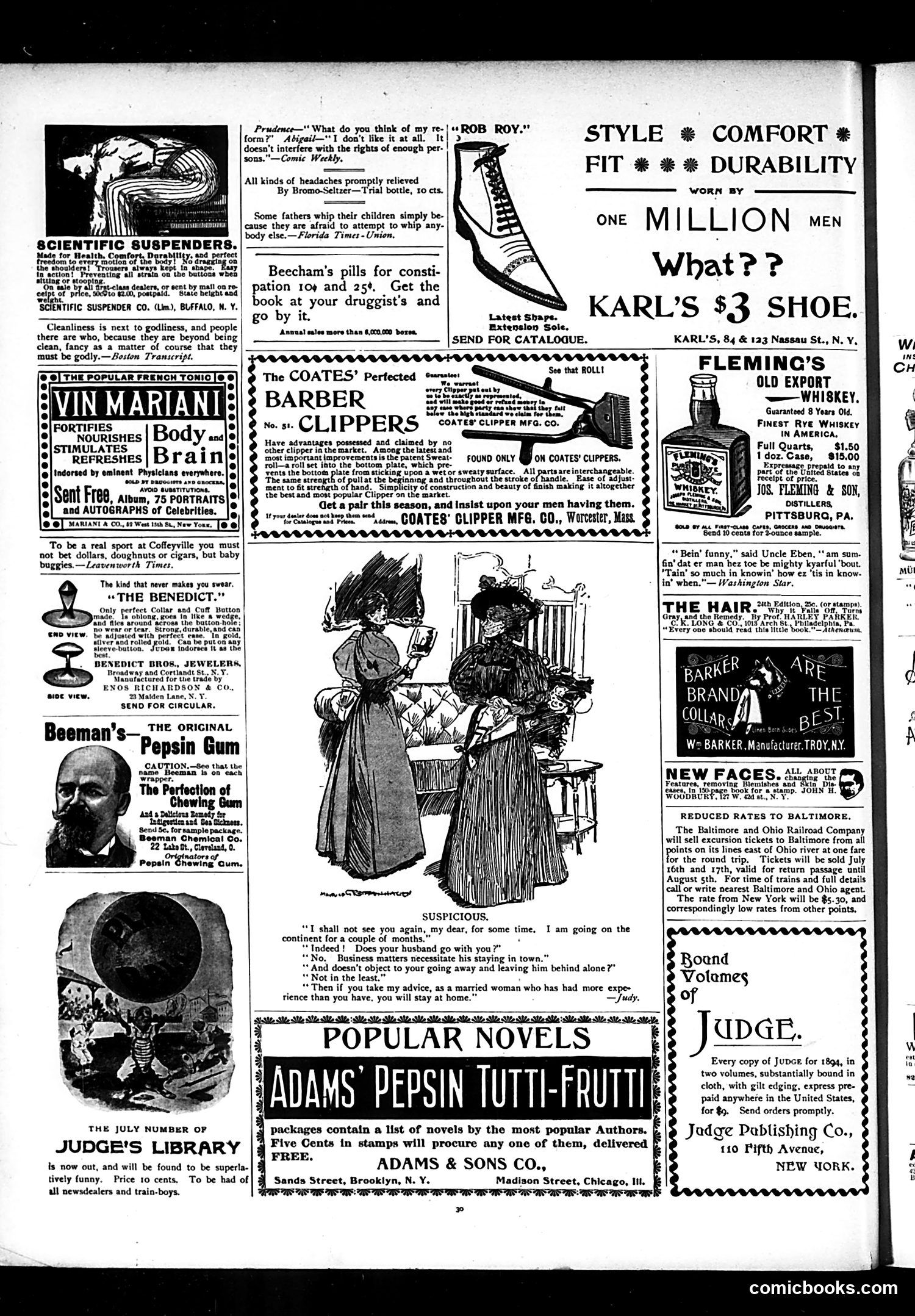
This page is primarily **advertising**, featuring product endorsements typical of early 20th-century American magazines. Key advertisers include Karl's $3 Shoe (worn by "one million men"), Coates' Barber Clippers, Fleming's Old Export Whiskey, and Beecham's pills for constipation. **The cartoon** ("Suspicious") depicts a woman telling her husband she's going away, with him suspicious she's leaving him. It's a domestic humor piece about marital mistrust—common satirical fodder for the era. **The social humor** includes brief quips about parenting (fathers whipping children), cleanliness, and racial dialect humor ("Bein' funny," attributed to "Uncle Eben"). These reflect period attitudes now considered offensive. The page exemplifies Judge's mixed content: satirical commentary alongside commercial advertising, with product placement disguised as editorial endorsement—a standard magazine practice of the era.
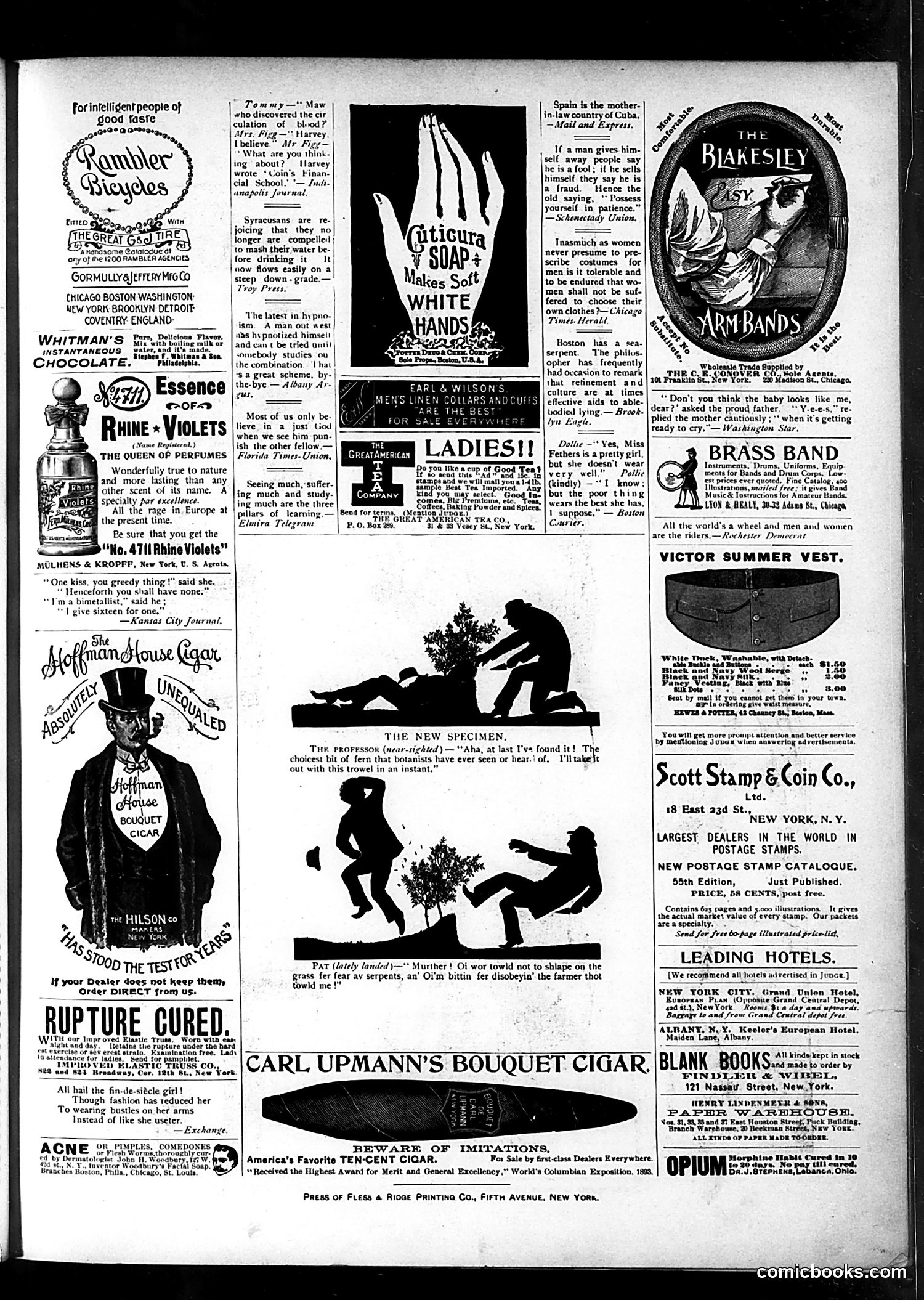
This page consists primarily of advertisements and brief humor pieces typical of Judge magazine's satirical style. The main cartoon depicts two silhouetted figures discovering what appears to be a botanical specimen. A near-sighted professor announces finding a rare fern, while "Pat (lately landed)"—an Irish immigrant indicated by dialect ("Murther," "towld")—panics, having been warned about snakes in the grass. The joke plays on miscommunication and ethnic stereotyping common to 1890s humor. Other brief satirical pieces mock contemporary topics: a joke about "bimetallism" (currency debate), women's fashion ("bustles on her arms"), hypnotism fads, and women's autonomy in dress. One piece references Harvey (likely William Harvey, the circulation-of-blood discoverer) being confused with "Coin's Financial School," a popular monetary reform tract. The page is dominated by product advertisements for bicycles, cigars, perfume, chocolates, and medical devices—typical of Judge's revenue model. The overall tone reflects fin-de-siècle American preoccupations with fashion, science, immigration, and consumer goods.
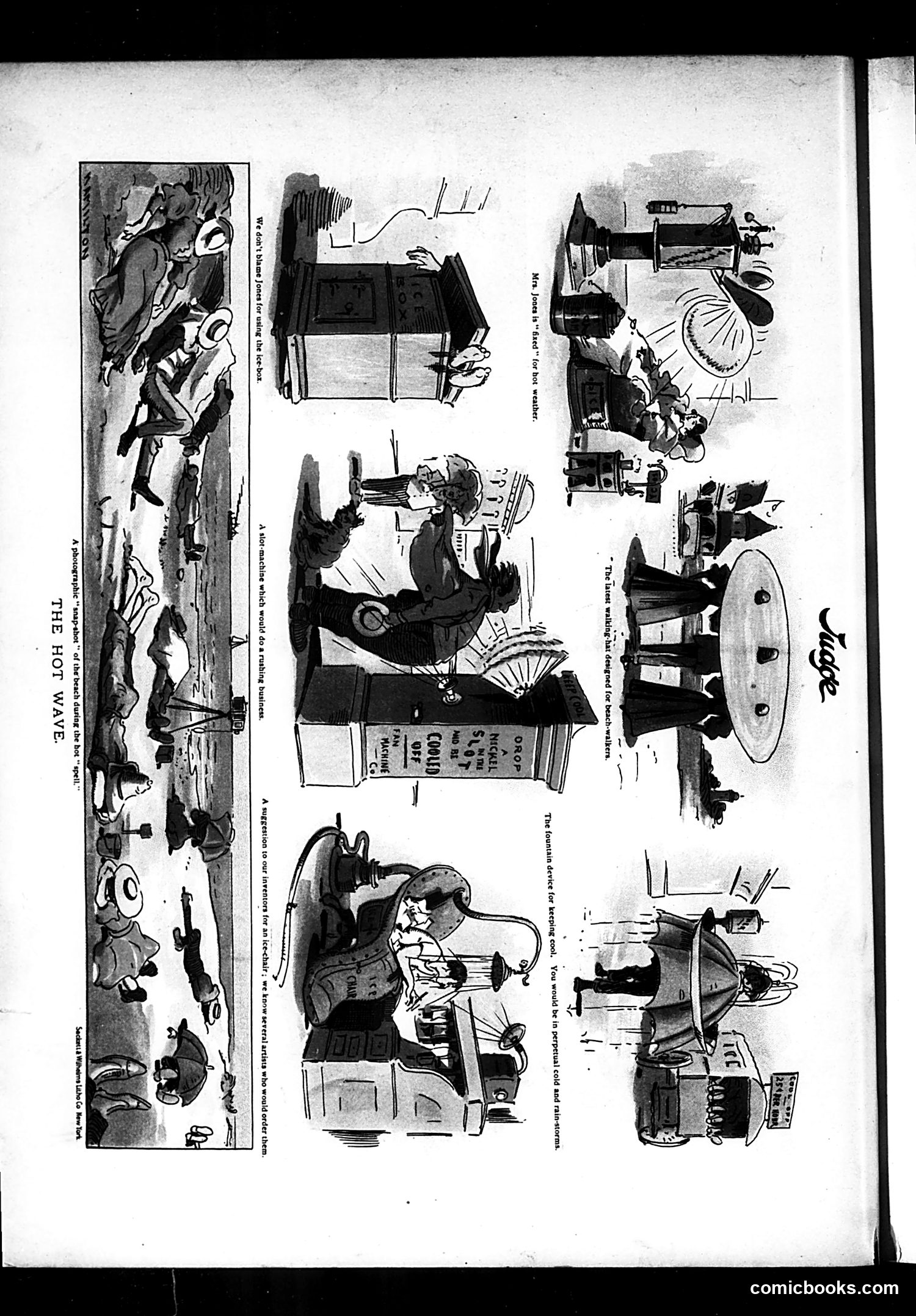
This page depicts the discomfort of a severe heat wave through multiple cartoon vignettes showing how extreme summer heat affects daily life. The sketches illustrate various scenarios: people seeking relief through fans, ice, and unconventional cooling methods; someone collapsing from heat exhaustion; individuals in various states of misery during oppressive temperatures. The satire lies in exaggerating the physical toll and behavioral changes heat induces—people abandoning normal decorum, becoming lethargic, or adopting desperate measures for comfort. The title "THE HOT WAVE" signals this is commentary on a contemporaneous weather event that impacted public life. The cartoons use humor to mock how environmental conditions force civilized society into undignified responses, a common Judge magazine approach to social observation.