
A complete issue · 16 pages · 1895
Judge — July 6, 1895
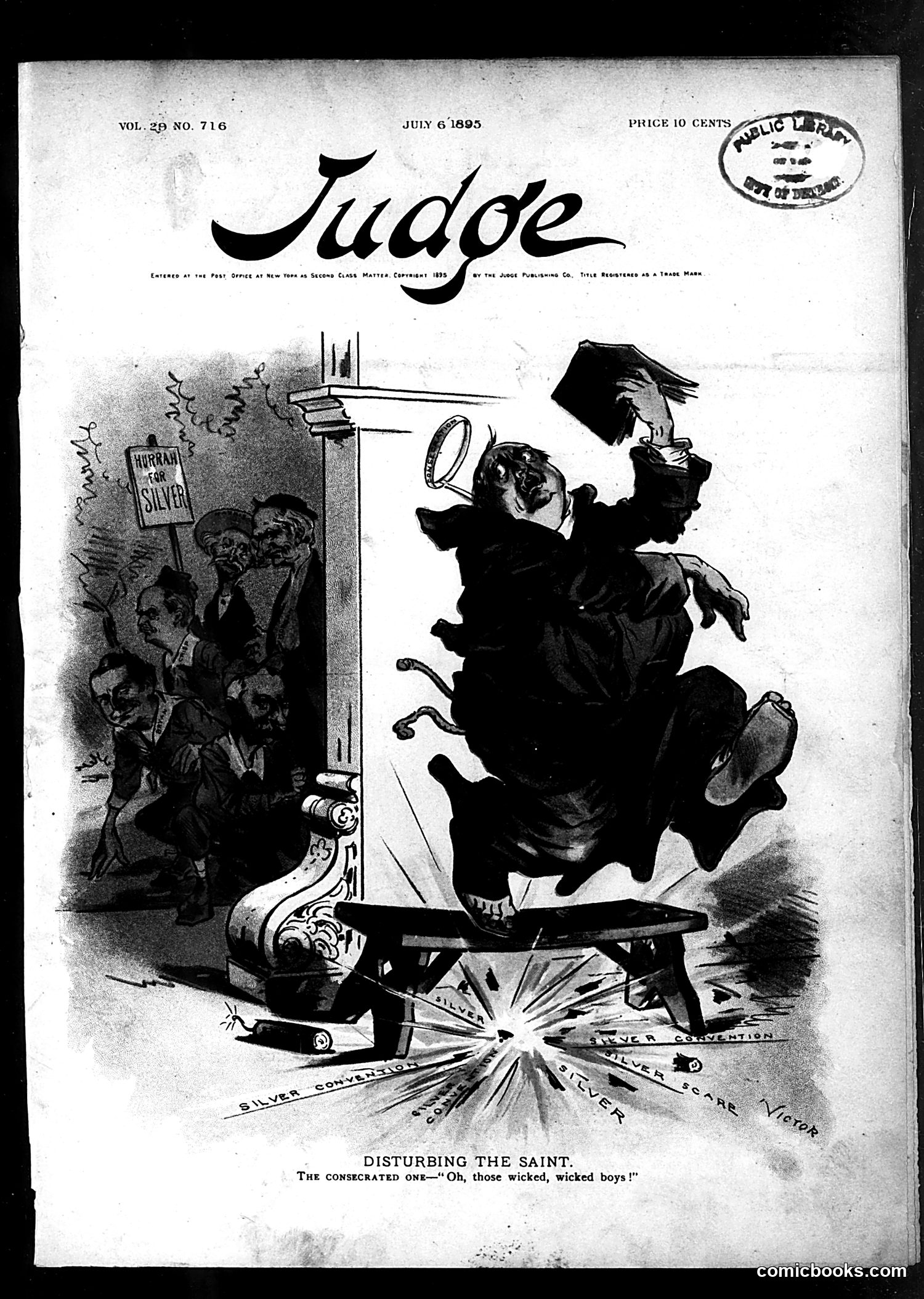
This political cartoon satirizes controversy over the **Silver Convention** (referenced in the radiating lines at the cartoon's base). The image shows "wicked boys" disturbing a sanctified figure—likely representing either the Catholic Church or traditional religious/moral authority being disrupted by silver-currency advocates. The left panel shows a mob holding a sign reading "Hurrah for Silver," while the right depicts demons or devils emerging energetically, suggesting silver advocates were viewed by critics as chaotic or morally corrupting forces. The consecrated figure's exclamation—"Oh, those wicked, wicked boys!"—expresses disapproval. This reflects 1890s political polarization over monetary policy, where silver coinage proponents were often portrayed by opponents as dangerous agitators threatening established institutions.
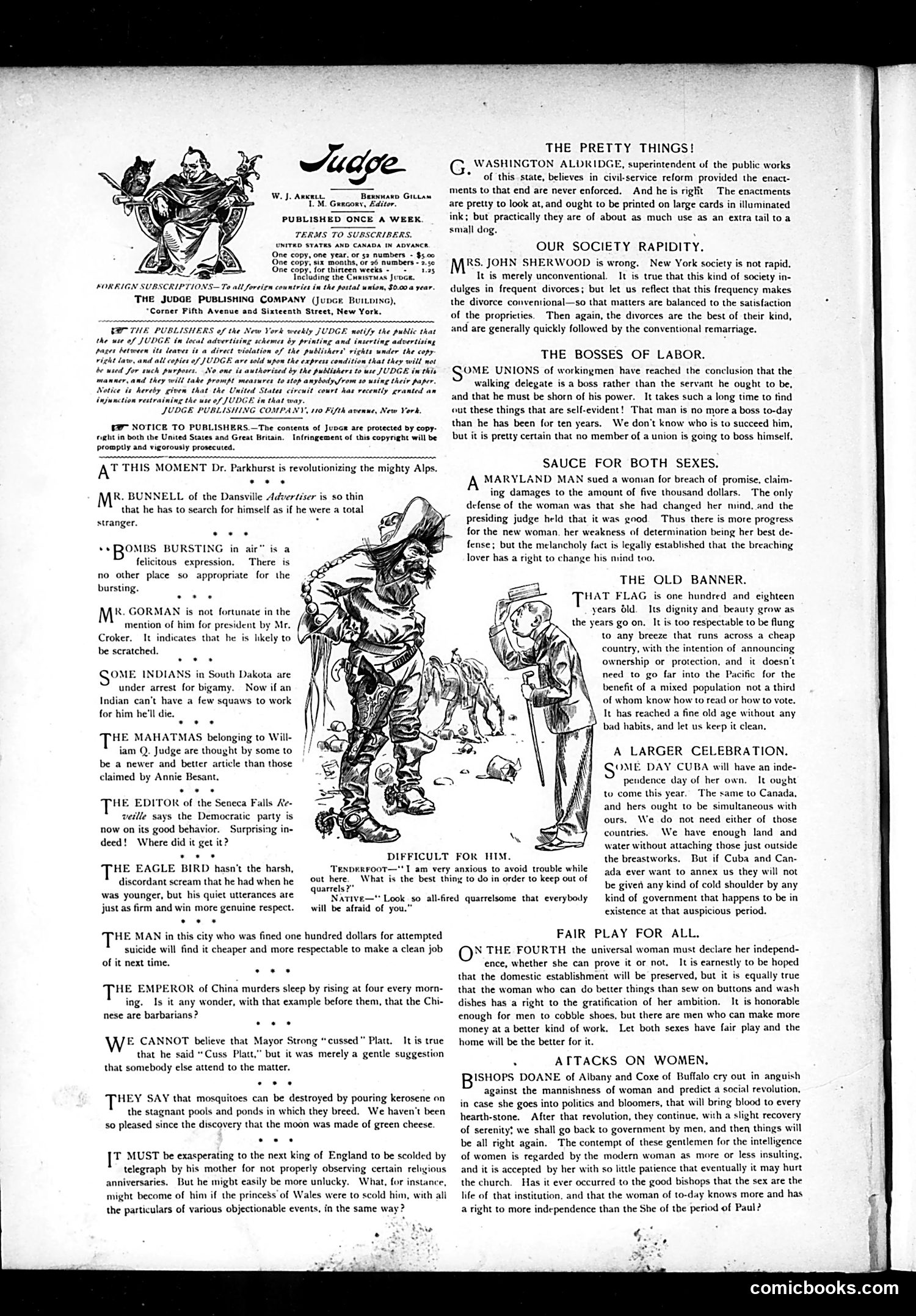
The main cartoon labeled "DIFFICULT FOR HIM" depicts a figure struggling under an enormous burden of objects labeled with social issues. Based on the accompanying text snippet mentioning "I am very anxious to avoid trouble while out here," this appears to satirize political or administrative difficulty managing multiple competing demands or crises simultaneously. The page contains several short editorial commentary pieces critiquing various contemporary issues: civil-service reform, labor unions, women's rights, and colonial administration. One section titled "ATTACKS ON WOMEN" addresses criticism of women's independence and their expanding social roles. Without clearer identification of specific figures or dates visible in the image, I cannot definitively name the cartoon's subject, but the satire targets institutional leadership struggling with modern social change.
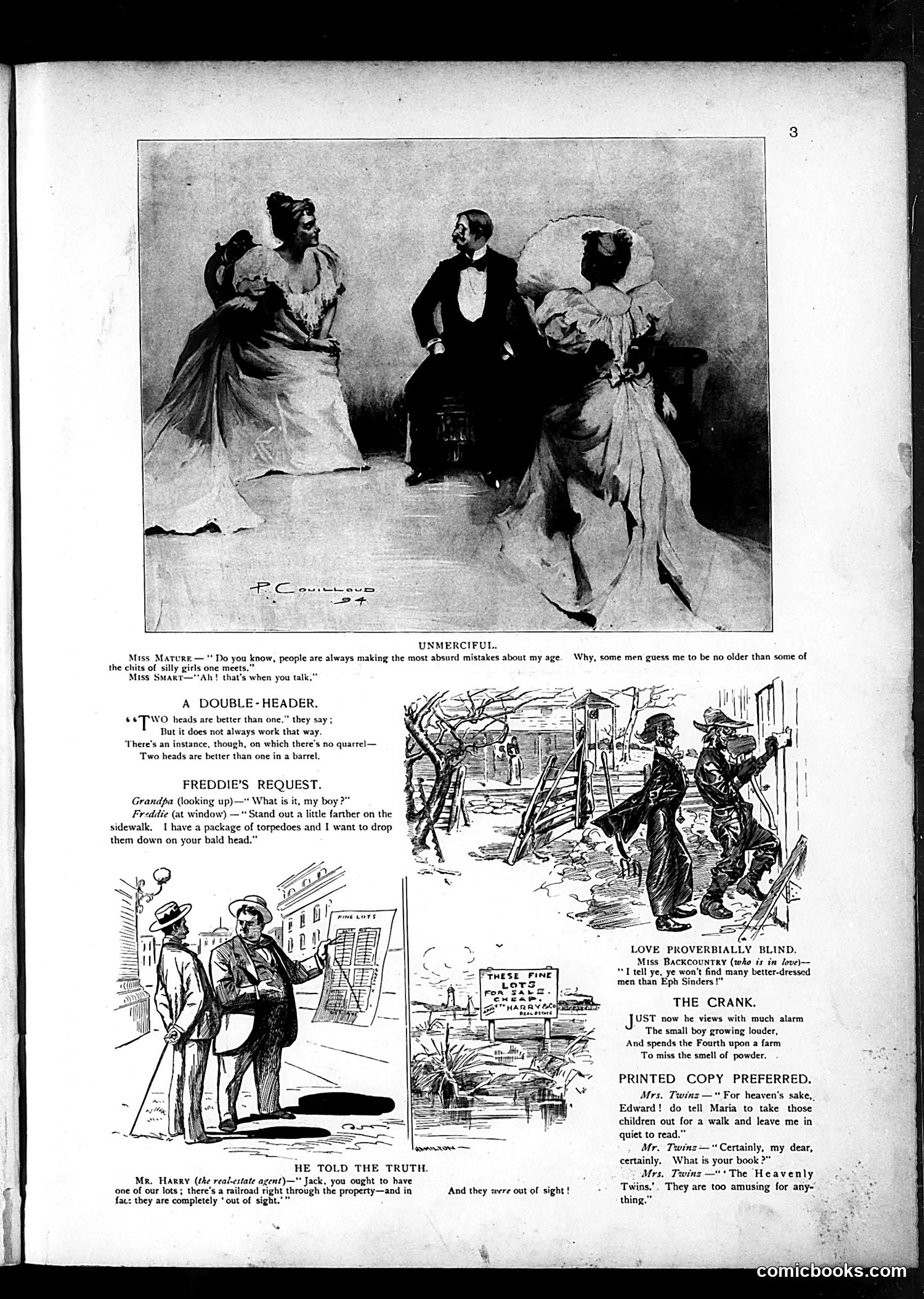
This page contains several brief satirical pieces and illustrations typical of Judge's humor: **"Unmerciful"** depicts a social scene mocking age-related vanity—Miss Mayme complains people discuss her age, while Miss Smart notes "that's when talk" happens, suggesting women of a certain age become gossip fodder. **"A Double-Header"** uses a barrel metaphor for crowded conditions, implying two heads in one space creates unavoidable conflict. **"Freddie's Request"** shows a child asking his grandfather to stand on the sidewalk so he can drop torpedoes on his "bald head"—likely WWI-era humor playing on children's innocent cruelty. The remaining pieces—"He Told the Truth," "Love Triumphantly Blind," "The Crank," and "Printed Copy Preferred"—appear to be short domestic humor sketches about marital and family situations, typical of the magazine's lighthearted social commentary.
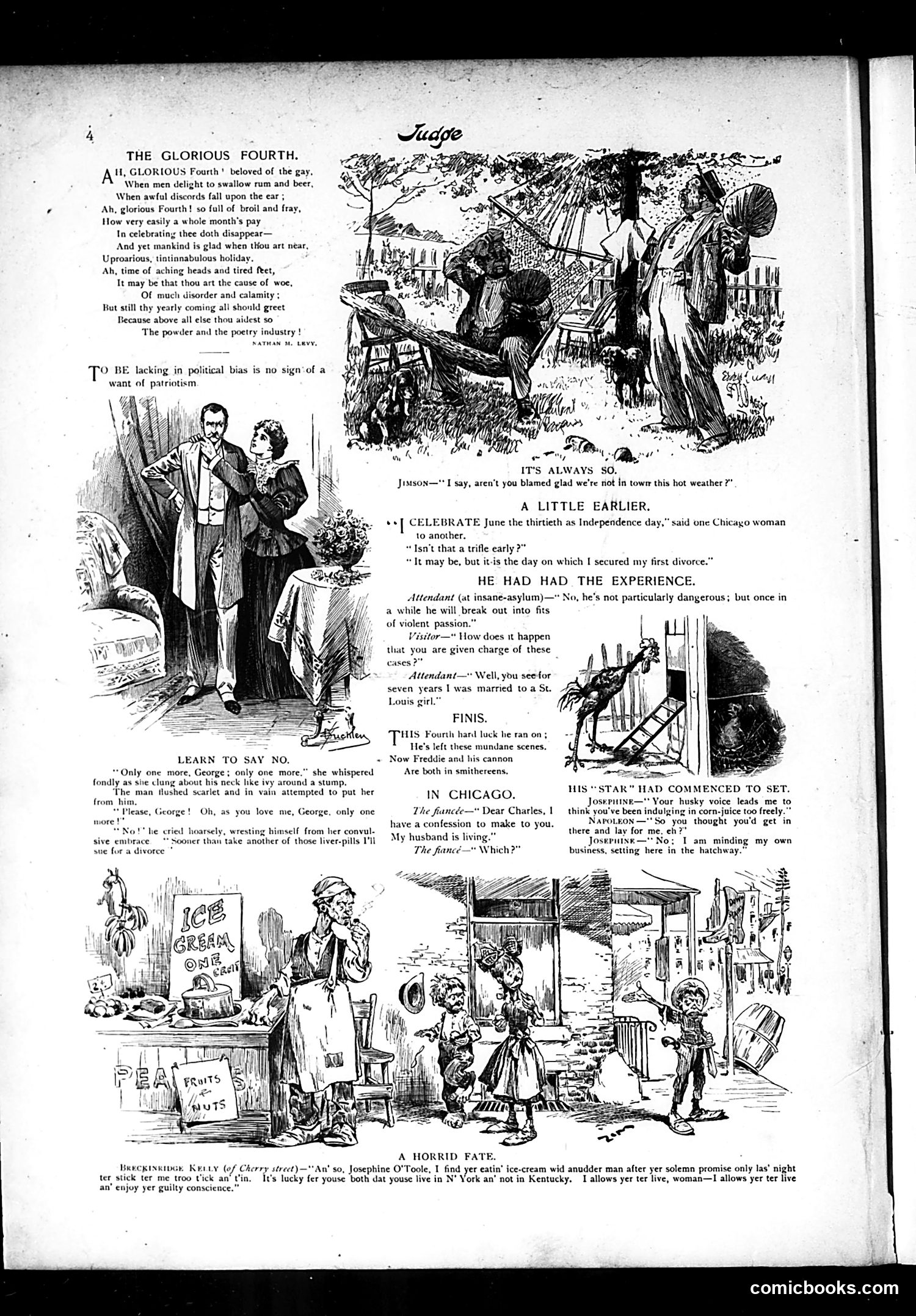
This page from Judge magazine (likely 1880s-90s based on style) contains multiple satirical commentaries on American life: **"The Glorious Fourth"** mocks Independence Day celebrations—satirizing how Americans use July 4th as an excuse for drunkenness, fireworks injuries, and general disorder, while ironically noting it benefits the "powder and poetry industry." **"Learn to Say No"** depicts a man refusing his persistent girlfriend another liver pill—a joke about Victorian-era patent medicines and masculine resistance to nagging women. **The remaining vignettes** mock marriage and divorce: a woman celebrating her divorce anniversary instead of Independence Day; an asylum attendant's qualification being previous marriage to a difficult woman; a man with a cannon accident; a woman discovering her fiancé's infidelity; and dialect humor about Irish-American jealousy. The humor targets Victorian anxieties: marriage difficulties, substance abuse via "medicines," gender conflict, and working-class immigrant stereotypes. The overall tone is cynical about American respectability and domestic life.
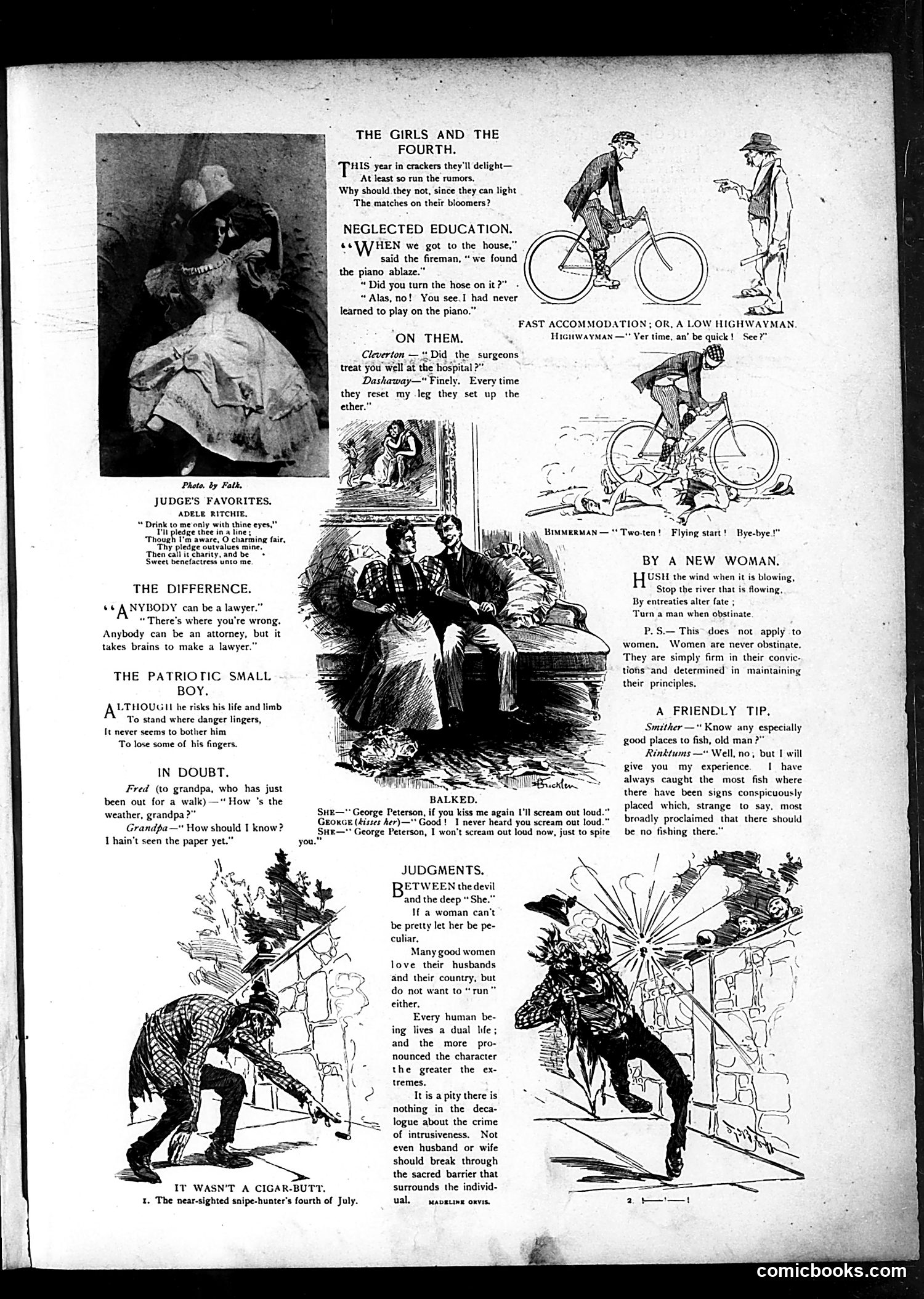
This page from the satirical magazine *Judge* contains multiple short jokes and observations about contemporary American life, likely from the early 1900s based on style and references. The main targets of satire include: **Gender and social roles**: "The Girls and the Fourth" mocks women's independence (lighting firecrackers using their bloomers—scandalous undergarments). "By a New Woman" satirizes feminist rhetoric about controlling nature and men, then undercuts it with the postscript that women aren't "obstinate," merely "firm." **Class and competence**: "Neglected Education" jokes about a fireman unable to play piano (suggesting education gaps). The lawyer joke contrasts attorneys with mere legal practitioners. **Romantic dynamics**: "Balked" depicts a woman's empty threat—she won't scream to spite her suitor, undercutting her own ultimatum. **General human folly**: Cartoons depict a near-sighted hunter and a child losing fingers on Independence Day, plus observations on hypocrisy and human nature. The humor relies on period attitudes about gender, class, and propriety that modern readers would find dated or offensive.
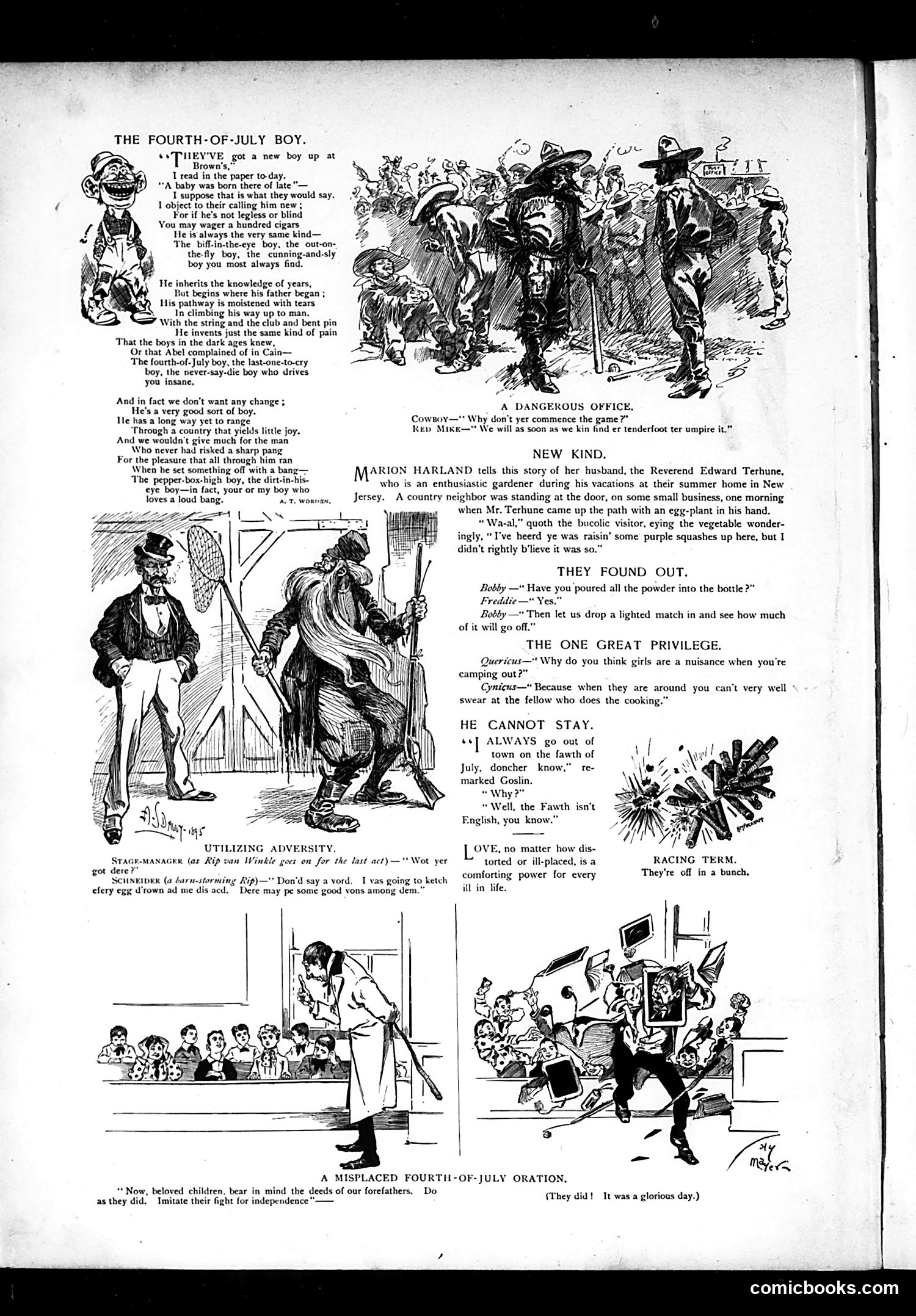
This page satirizes American boyhood and Independence Day traditions. The central poem celebrates the archetypal "Fourth-of-July boy"—mischievous, reckless, fond of explosives and pranks. The author argues this behavior is inherent and unchanging across generations, not a flaw but a necessary rite of passage. Boys "risk sharp pangs" and love "a loud bang," connecting youthful rowdiness to American independence itself. The surrounding cartoons extend this theme: one depicts a misplaced Fourth-of-July oration where a speaker's patriotic invocation to "imitate their fight for independence" is undercut by children's actual chaos. Another shows boys about to ignite gunpowder—literally embodying reckless Fourth-of-July traditions. A rural character mistakes an eggplant for a purple squash, satirizing rural simplicity. The humor throughout blends affection for American boyish chaos with gentle mockery of the day's explosive traditions and their cultural persistence.
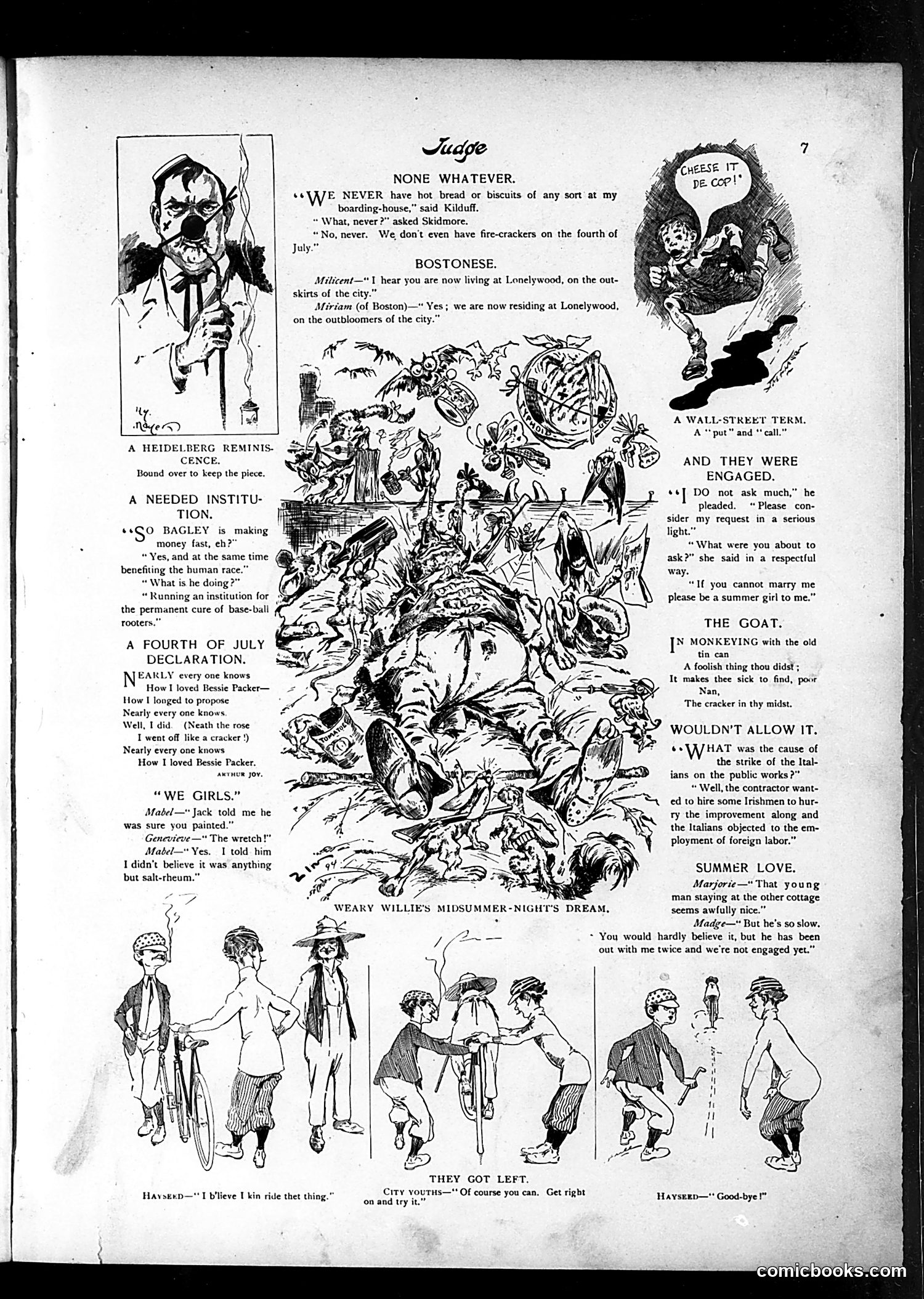
This page contains multiple satirical sketches and jokes typical of early-20th-century American humor. **"A Needed Institution"** mocks baseball fans ("rooters") by suggesting someone profits from "curing" their obsessive fandom—reflecting contemporary anxiety about rowdy sports culture. **"A Fourth of July Declaration"** is a sentimental poem about proposing to "Bessie Packer," with a pun on firecrackers exploding ("went off like a cracker"). **"Bostonese"** satirizes Boston dialect, exaggerating Brahmin pronunciation ("outbloomers of the city"). **"We Girls"** is a joke about women's vanity—one woman tells another that a man thinks she paints, and she angrily denies it, claiming it's just "salt-rheum" (a skin condition). **"And They Were Engaged"** mocks courtship expectations: a man proposes being a woman's "summer girl" as a compromise proposal. The remaining sketches are light domestic humor about engagements, street slang, and mishaps. Overall, the page reflects Edwardian-era preoccupations with courtship, class distinctions, and emerging urban culture.
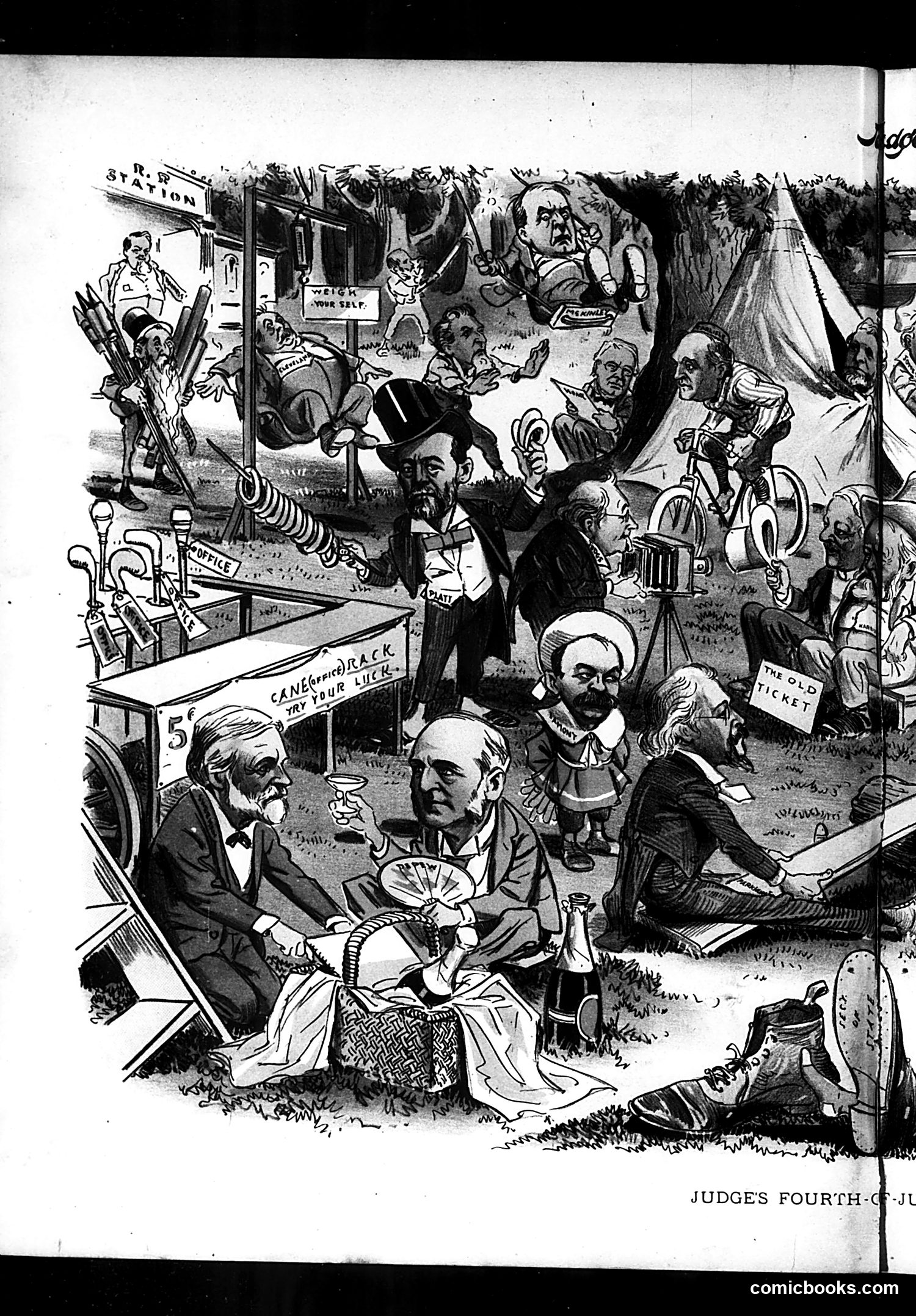
This satirical cartoon depicts a chaotic Fourth of July carnival or fair, titled "Judges Fourth" (a play on Independence Day celebrations). The scene shows well-dressed gentlemen and various carnival attractions including bicycles, game booths, and performers. Visible text includes references to "Cane for a Crack" and "Try Your Luck," suggesting gambling or game-of-chance attractions. The crowded, frenzied composition satirizes American commercialism and excess during patriotic holidays. The caricatured figures appear to represent wealthy or prominent individuals engaged in frivolous pursuits rather than genuine civic reflection. Without clearer identification of specific figures or readable text labels, the precise political targets remain unclear, though the overall mockery targets how Independence Day celebrations had become commercialized entertainment spectacles dominated by the well-to-do.
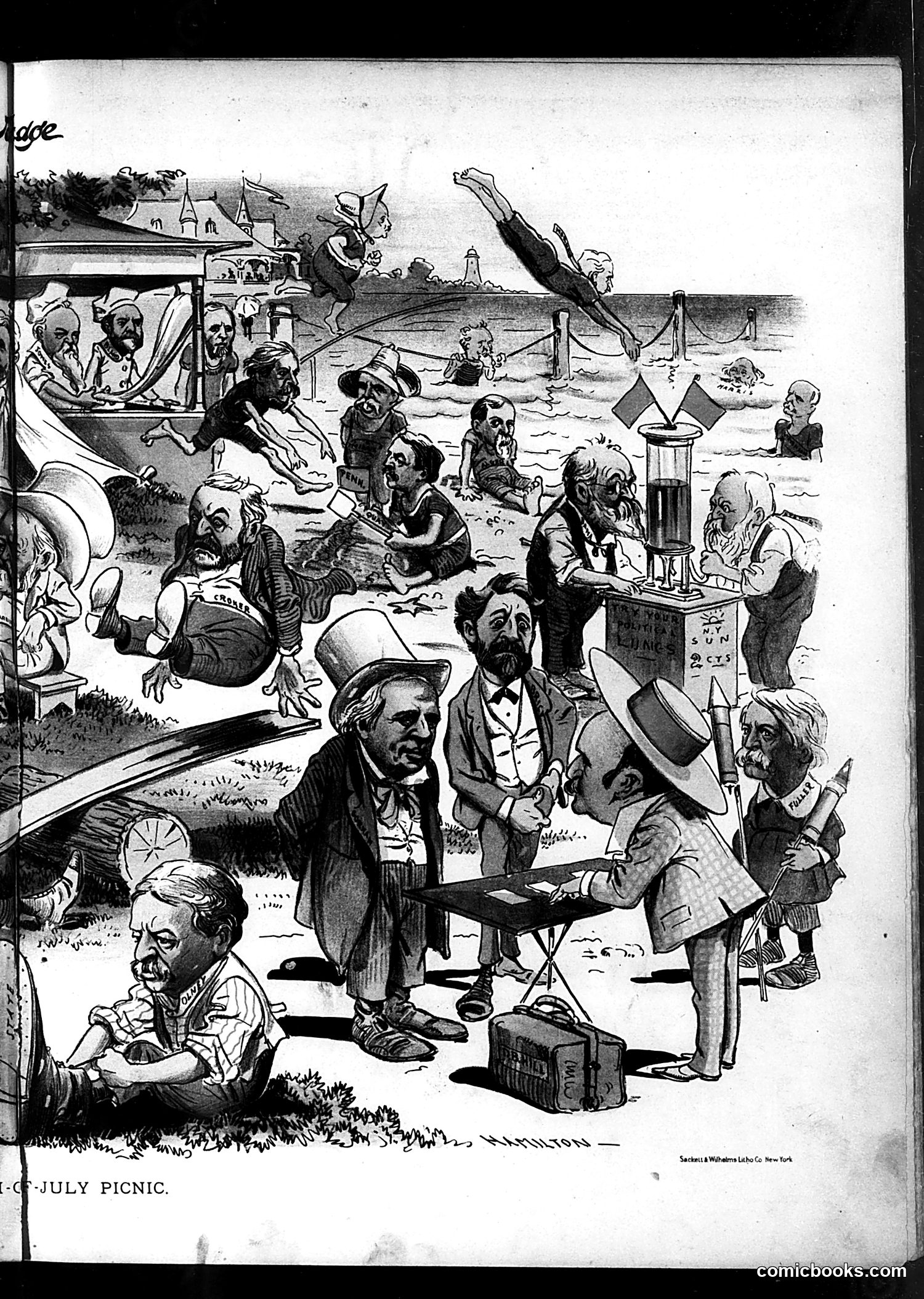
This satirical cartoon depicts a beach picnic gathering of caricatured figures, likely representing American political or social leaders of the period. The exaggerated facial features—prominent beards, distinctive noses, and period clothing—suggest these are recognizable contemporaries meant to be identified by the magazine's readers. The scene appears to mock a specific political gathering or social event, with figures lounging, conversing, and engaging in leisure activities while others work (note the people diving/swimming in background). The title "July Picnic" suggests this references an actual Fourth of July celebration or summer political convention. Without clearer identification of the specific figures, the exact political point remains unclear, but the overall tone suggests criticism of political elites enjoying leisure while others labor.
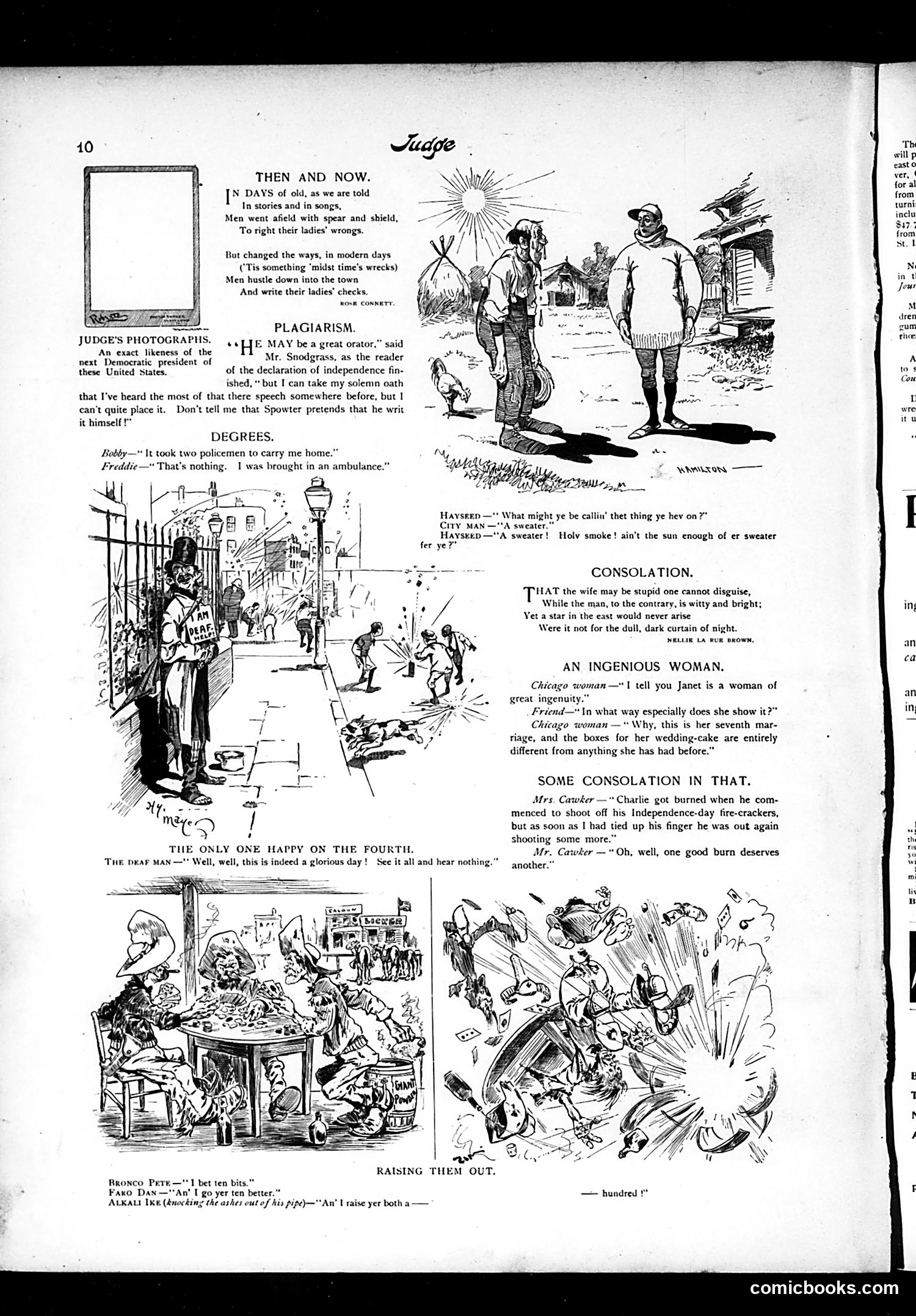
This *Judge* magazine page (page 10) contains several satirical cartoons mocking American social customs and behavior: **"Then and Now"** contrasts medieval chivalry with modern romance—men once fought for ladies' honor; now they simply pay their bills. **"Plagiarism"** jokes that a speaker delivering the Declaration of Independence sounds suspiciously familiar, implying politicians steal rhetoric without acknowledgment. **"The Only One Happy on the Fourth"** depicts a deaf man as the sole person enjoying Independence Day—because he escapes hearing others' noise and (likely) their patriotic speeches. **"Hayseeds" dialogue** mocks rural characters misunderstanding a sweater, confusing clothing with weather. **"An Ingenious Woman"** sarcastically praises a Chicago woman's ingenuity—she's been married seven times and merely uses different wedding-cake boxes each time, treating serial marriage as a joke. The cartoons generally satirize American pretension, hypocrisy, rural ignorance, and women's behavior, reflecting early-20th-century Judge magazine's satirical sensibilities.
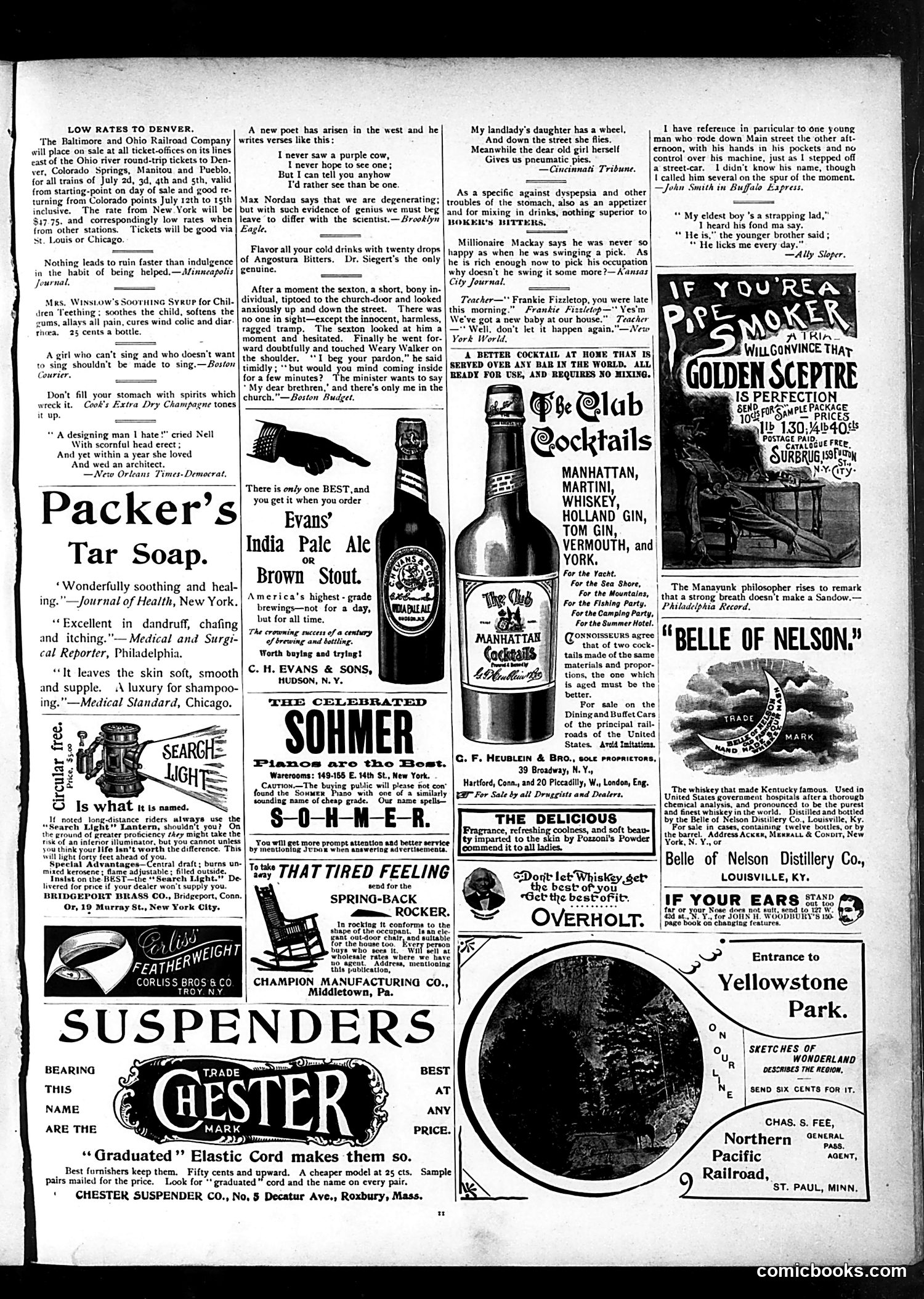
This page is primarily **advertisements and filler content** rather than political cartoons. The visible satirical elements are brief humorous quotes and observations scattered throughout, typical of Judge magazine's format. For example, one poem mocks a pretentious new Western poet who writes overwrought verse ("I never saw a purple cow"). Another jab notes that millionaire Mackay claims he was happiest swinging a pick, yet won't return to manual labor now that he's wealthy—social commentary on the contradictions of the wealthy. A short anecdote about a sexton inviting a ragged tramp into church as the sole congregant appears to be gentle humor about either institutional desperation or democratic inclusion. The page is dominated by late-19th-century product advertisements: Packer's Tar Soap, Evans' India Pale Ale and Brown Stout, Sohmer Pianos, Chester Suspenders, and various patent medicines and railway services. This was standard magazine practice of the era.
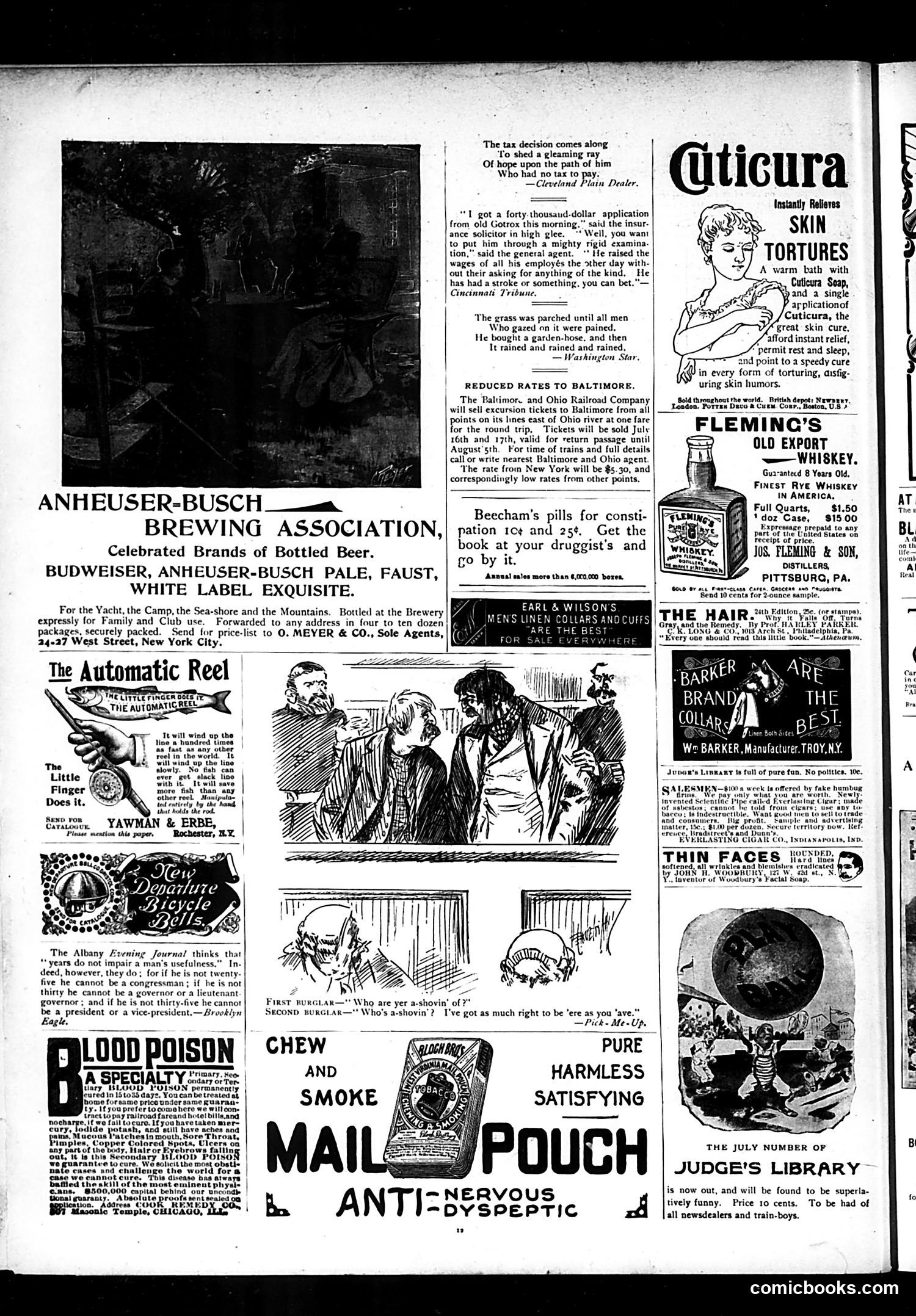
This page is primarily **advertising**, typical of Judge magazine. While several small comic illustrations appear (burglars arguing, etc.), the dominant content is commercial announcements for beer, whiskey, hair products, skin remedies, and other goods. The few visible cartoon jokes are light domestic humor: one depicts two burglars disputing who has "the right" to rob a house. There's also editorial commentary mocking politicians' age requirements in government—suggesting The Albany Evening Journal's claim that age doesn't impair usefulness is false, since Congress, governor, and lieutenant governor positions all have minimum age requirements. The page reflects a period when satirical magazines like Judge funded themselves heavily through advertising, and ads often shared space with editorial content. No major political figures or contemporary events appear to be explicitly referenced in the visible portions.
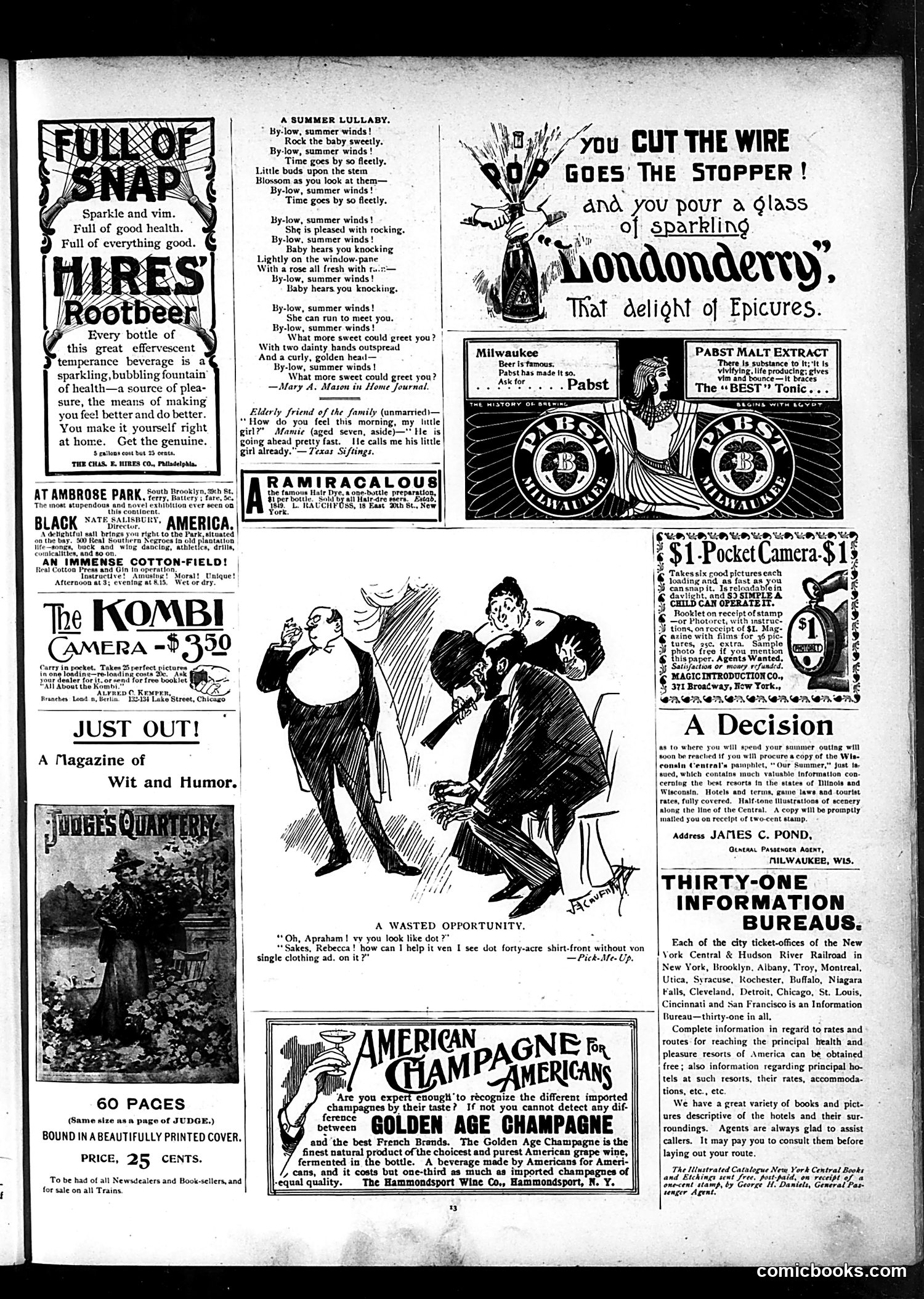
This Judge magazine page primarily contains **advertising** rather than political satire. The key content includes: **Main Cartoon:** "A Wasted Opportunity" depicts two men (appears to be Jewish immigrants based on dialect humor) where one criticizes the other for wearing a large shirt-front without purchasing advertising. This reflects turn-of-the-century ethnic stereotyping and class commentary on laborers. **Advertised Products:** The page promotes temperance beverages (Hires Root Beer, sparkling cider), cameras (Kombi, Pocket Camera), champagne, beer, and travel information. The "Mondonderry" beverage ad emphasizes its appeal to wealthy consumers ("Epicures"). **Social Context:** The humor relies on ethnic caricature ("Sakes, Rebecca!") and mocks immigrant accents—standard for 1900s American publications. The advertisements reflect consumer culture expansion and early photography technology marketing. The page demonstrates how Judge blended satirical commentary with consumer advertising targeting middle and upper-class readers.
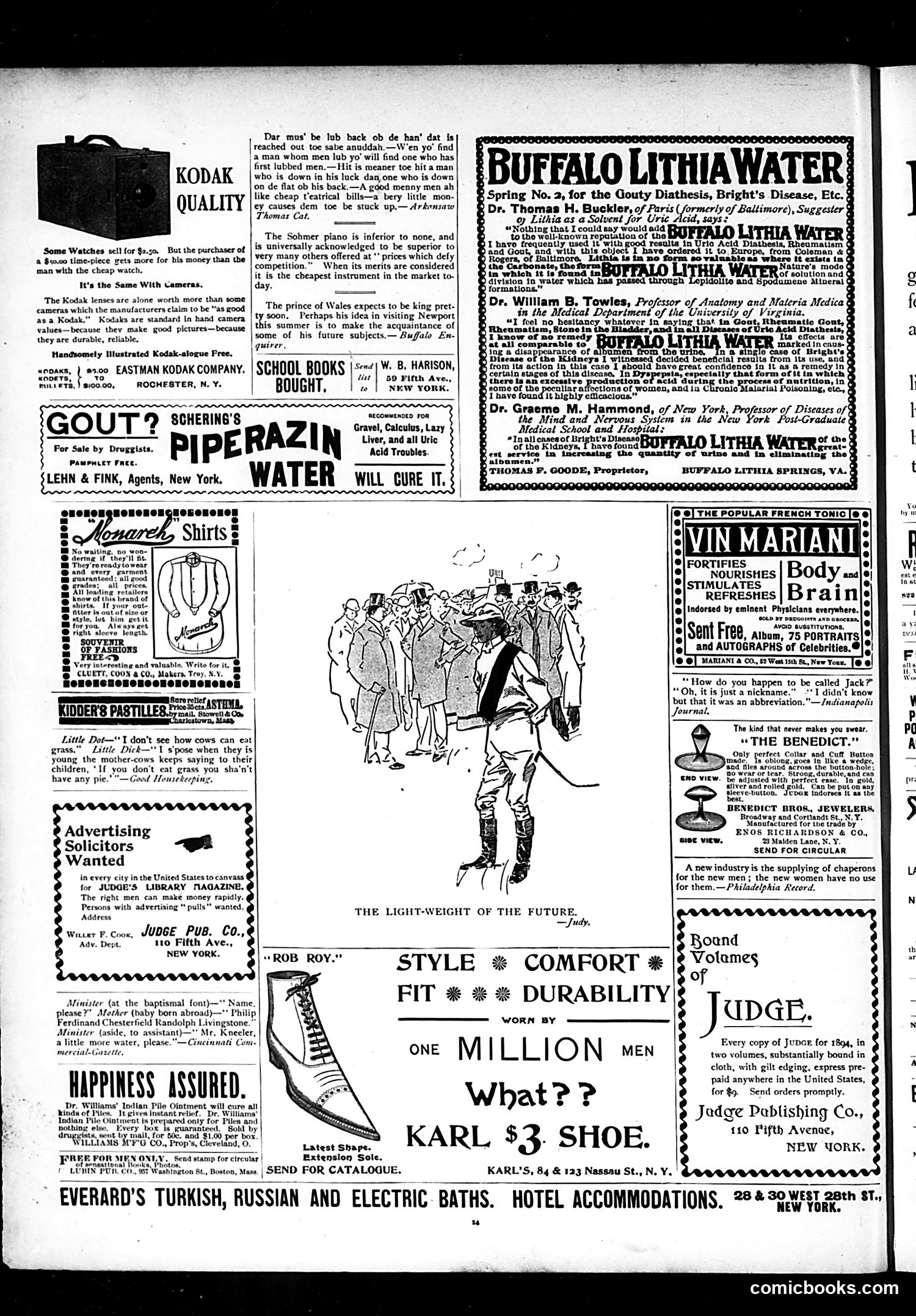
This is primarily an **advertising-heavy page** from Judge magazine, with one significant political cartoon titled "The Light-Weight of the Future" by Jude (presumably the cartoonist). **The Main Cartoon:** The central cartoon depicts a figure in military dress among crowds of everyday people. The caption "The Light-Weight of the Future" appears to satirize the **Prince of Wales** (mentioned in adjacent text), who was expected to become king. One article jokes that his Newport visit aims to "make the acquaintance of some of his future subjects." The cartoon mocks him as a frivolous, lightweight heir apparent—a common 19th-century critique of royalty. **Context for Modern Readers:** Judge was satirizing the British royal succession and aristocratic pretension. The "light-weight" reference suggests intellectual or moral inadequacy for kingship. **Remainder:** The page contains mostly period advertisements for cameras, pianos, patent medicines (including dubious remedies like "Piperrazin Water" for gout), shirts, and books—typical of the era's magazine format.
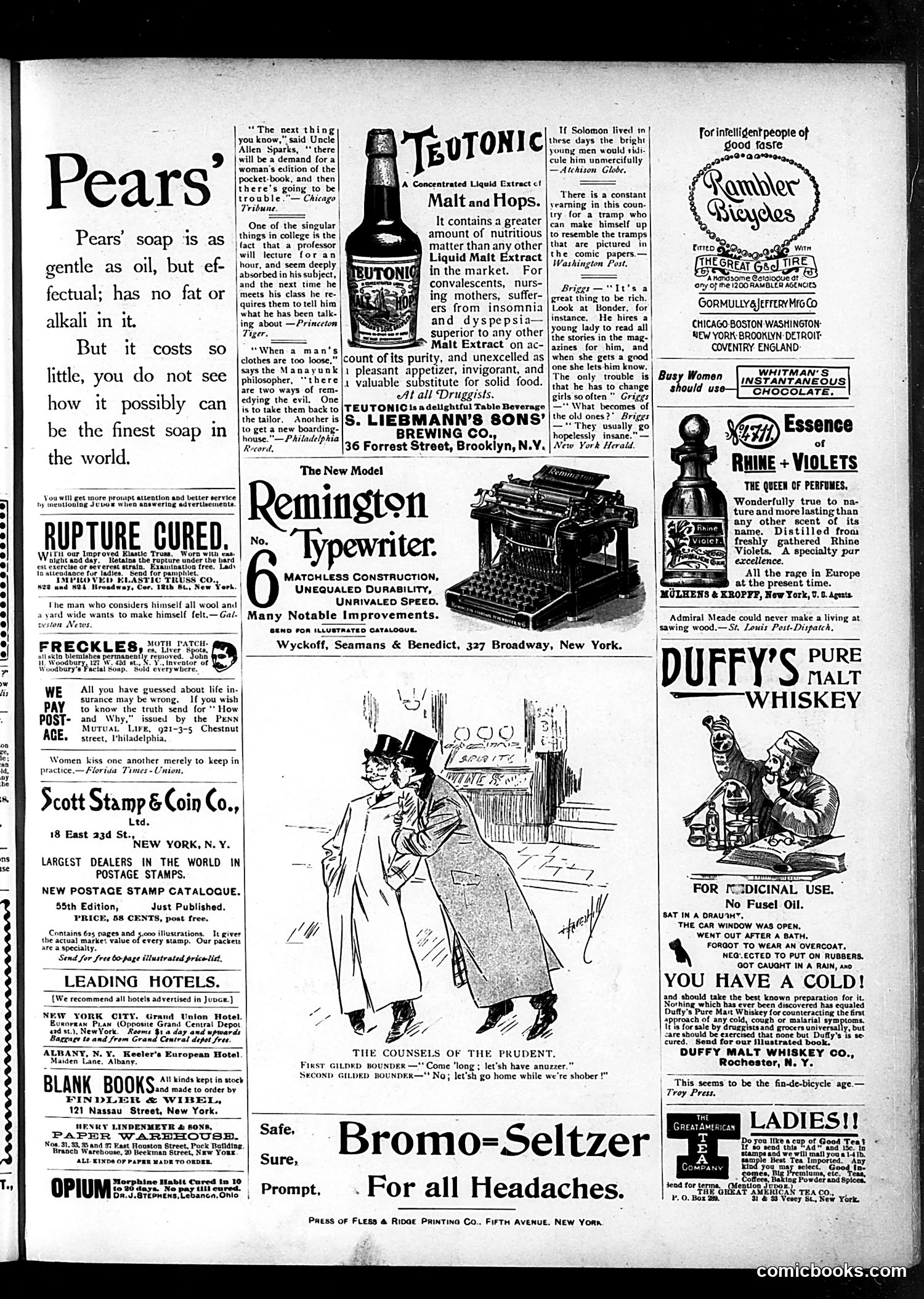
This page is primarily **advertisements** with one small cartoon titled "The Counsels of the Prudent" (lower center). The cartoon depicts two men in top hats having a conversation. The dialogue reads: - **First gilded bounder**: "Come long; let'sh have snoozer." - **Second gilded bounder**: "No; let's go home while we're sober!" The satire mocks wealthy, aristocratic men ("gilded bounders"—a term for idle rich gentlemen) debating whether to continue drinking at a bar or go home while still able. The humor lies in the irony: suggesting going home "while we're sober" implies they're already quite drunk, making the claim to sobriety absurd. It satirizes the behavior and limited judgment of the leisure class—their casual approach to excess alcohol consumption and the weak willpower required to resist further indulgence. This fits *Judge* magazine's typical satirical targets: the wealthy and their social pretensions.
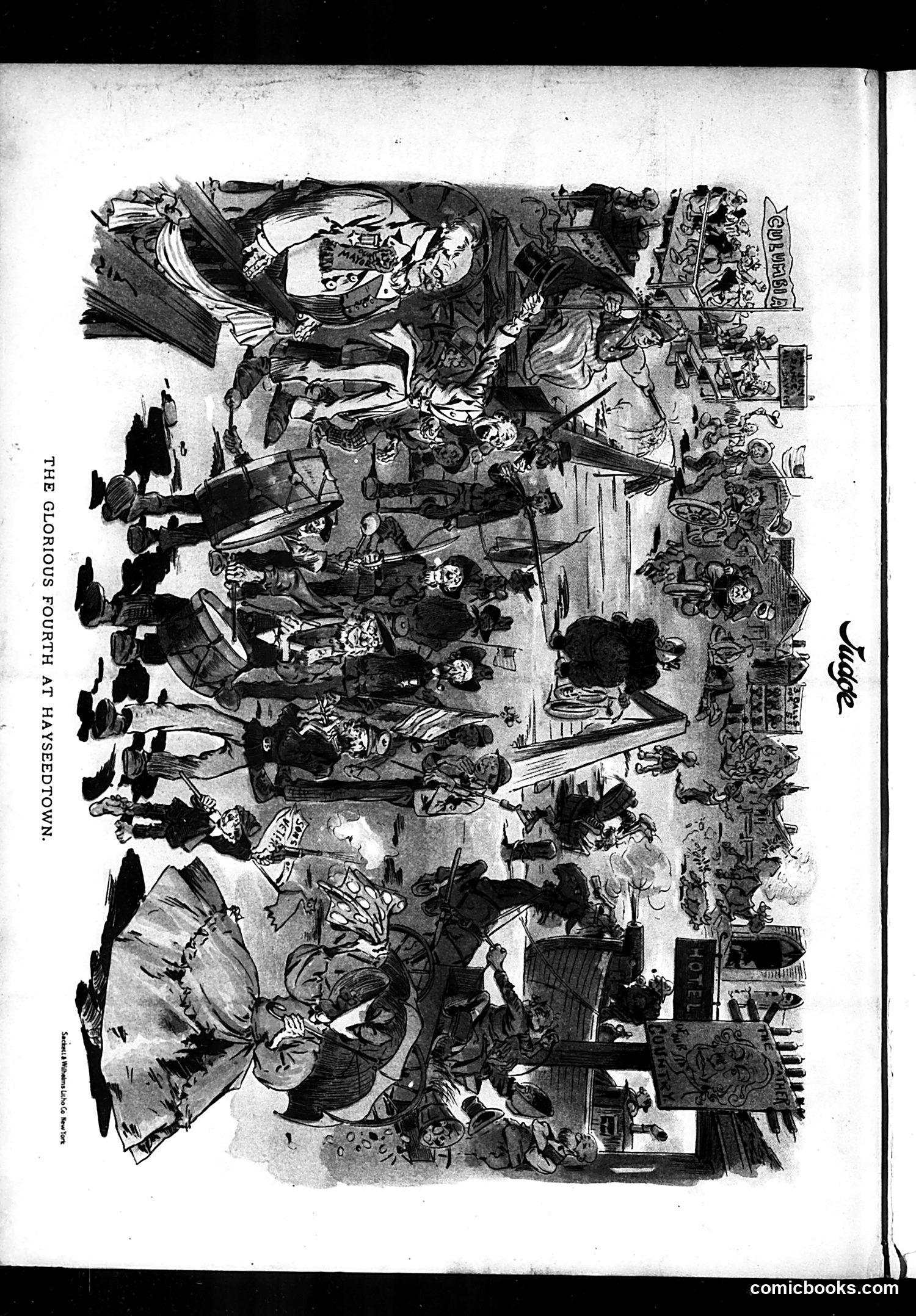
This is a satirical illustration depicting Independence Day celebrations in a rural American town. The crowded, chaotic scene shows townspeople engaged in various Fourth of July activities—likely including fireworks, parades, and festivities—rendered in a deliberately crude, exaggerated style to mock small-town life. The title "Hayseedtown" uses period slang ("hayseed" = unsophisticated rural person) to signal the cartoon's condescending humor toward rural Americans and their patriotic celebrations. The dense, somewhat disorganized composition emphasizes the chaotic enthusiasm of common folk, a typical Judge magazine approach to satirizing working-class and rural culture for its educated, urban readership. The lithograph credit indicates professional production by Sackett & Wilhelms in New York, a major publisher of such satirical imagery during the Gilded Age.