
A complete issue · 16 pages · 1895
Judge — May 25, 1895
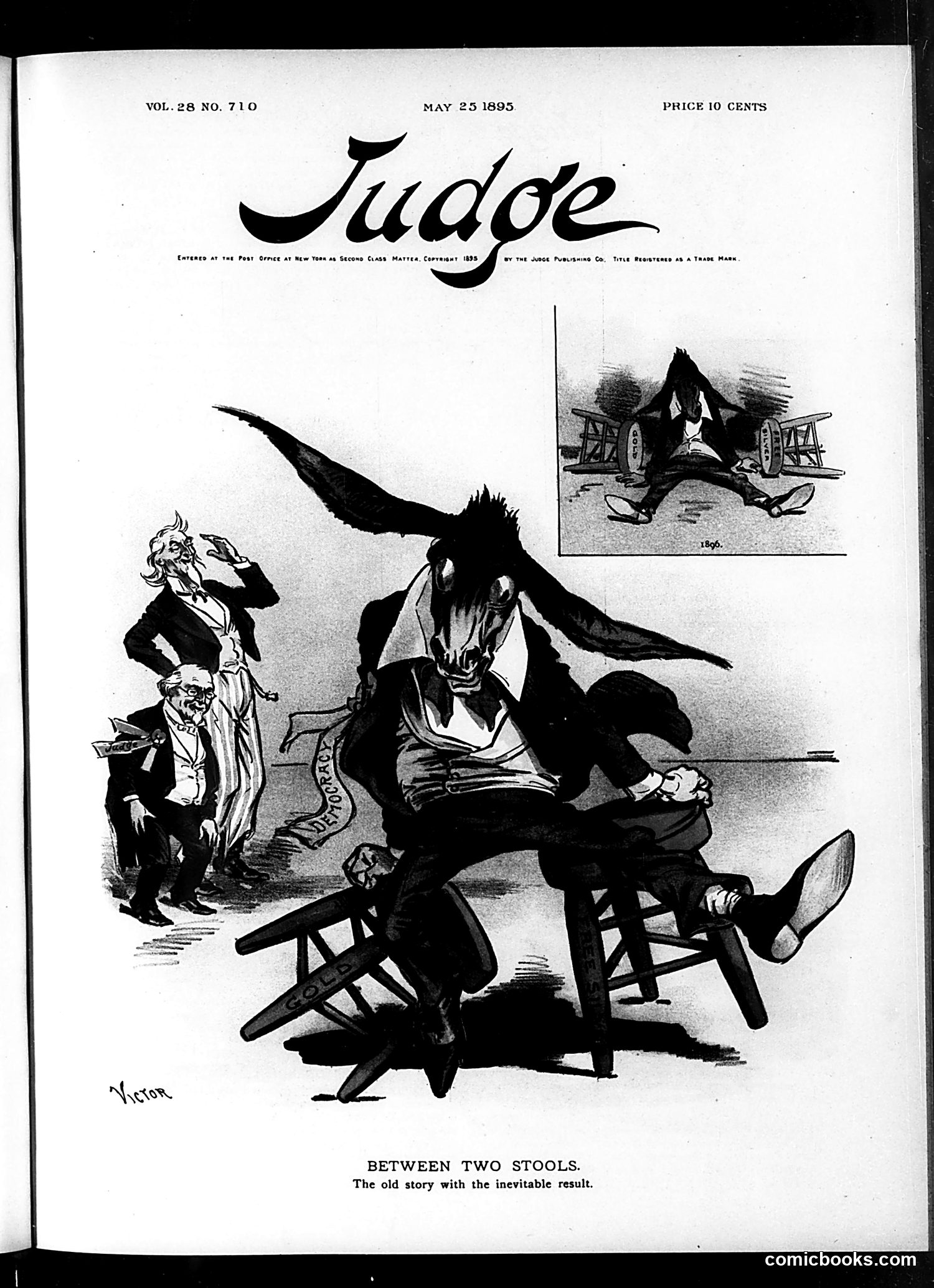
**Main Cartoon: "Between Two Stools"** This political cartoon depicts a demonic or devilish figure seated precariously between two chairs, with smaller caricatured figures (appearing to be politicians or public figures) watching from the left. The title references the common proverb about sitting between two stools—meaning indecision or being caught between opposing positions with disastrous results. The satire appears to critique a political figure or policy trapped in an impossible middle position, unable to satisfy either side. The devilish characterization suggests moral or political corruption. The small inset image in the upper right remains unclear but likely reinforces the theme. The artwork is credited to "Victor" (the cartoonist's signature).
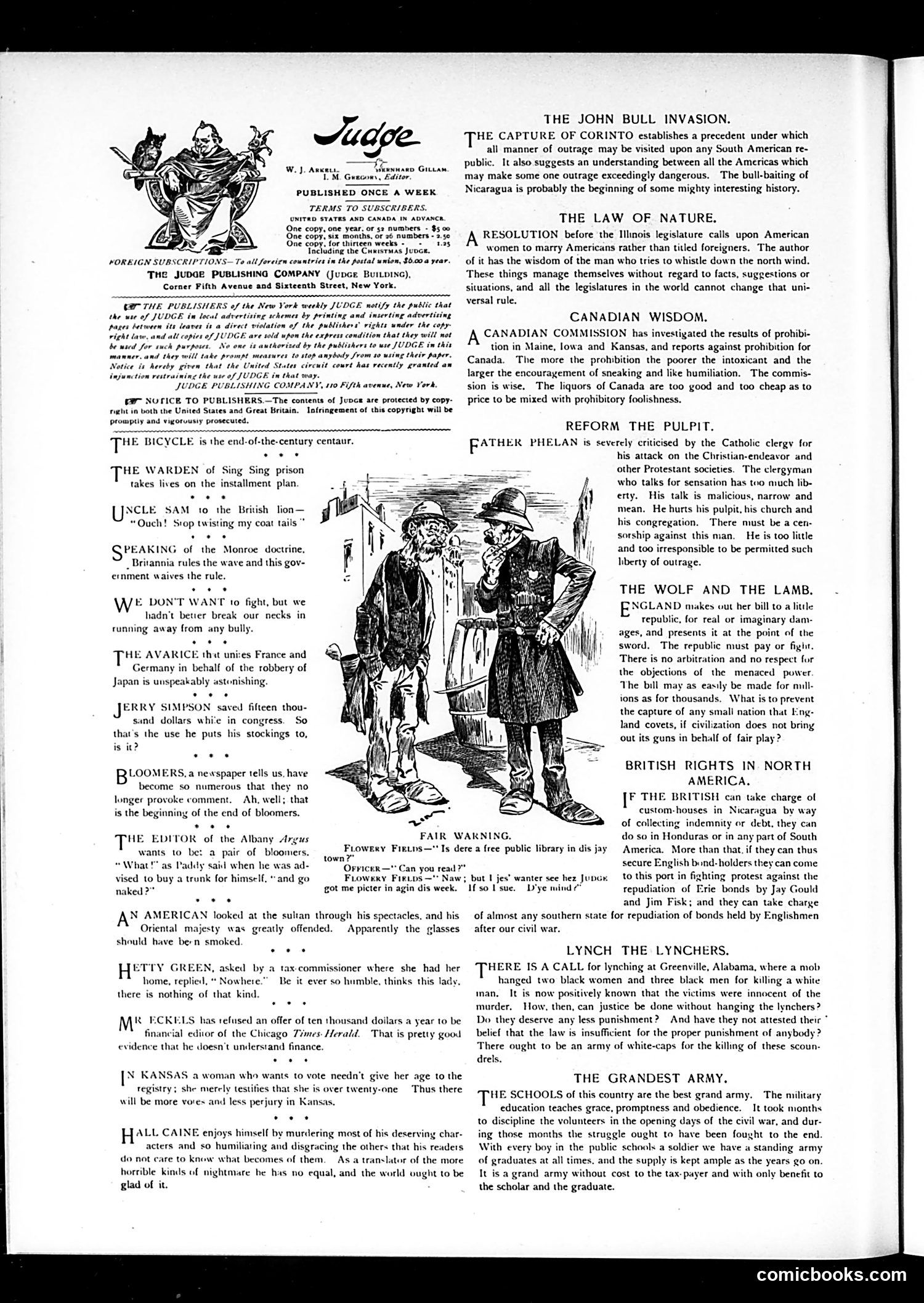
The main cartoon depicts two figures in period dress discussing a "free public library" in "Flowery Fields." The dialogue suggests one character (appearing to be a rural or working-class figure) is skeptical about accessing library services, while the other promotes them—likely satirizing debates about public education access and literacy programs in the late 19th or early 20th century. The surrounding text includes brief satirical commentaries on contemporary issues: the John Bull invasion (likely referencing British-American relations), prohibition debates, Catholic clergy criticism, and lynch law in Alabama. These short pieces represent Judge's typical format of sharp political and social commentary targeting current events, though specific dates and figures remain unclear without additional historical context.
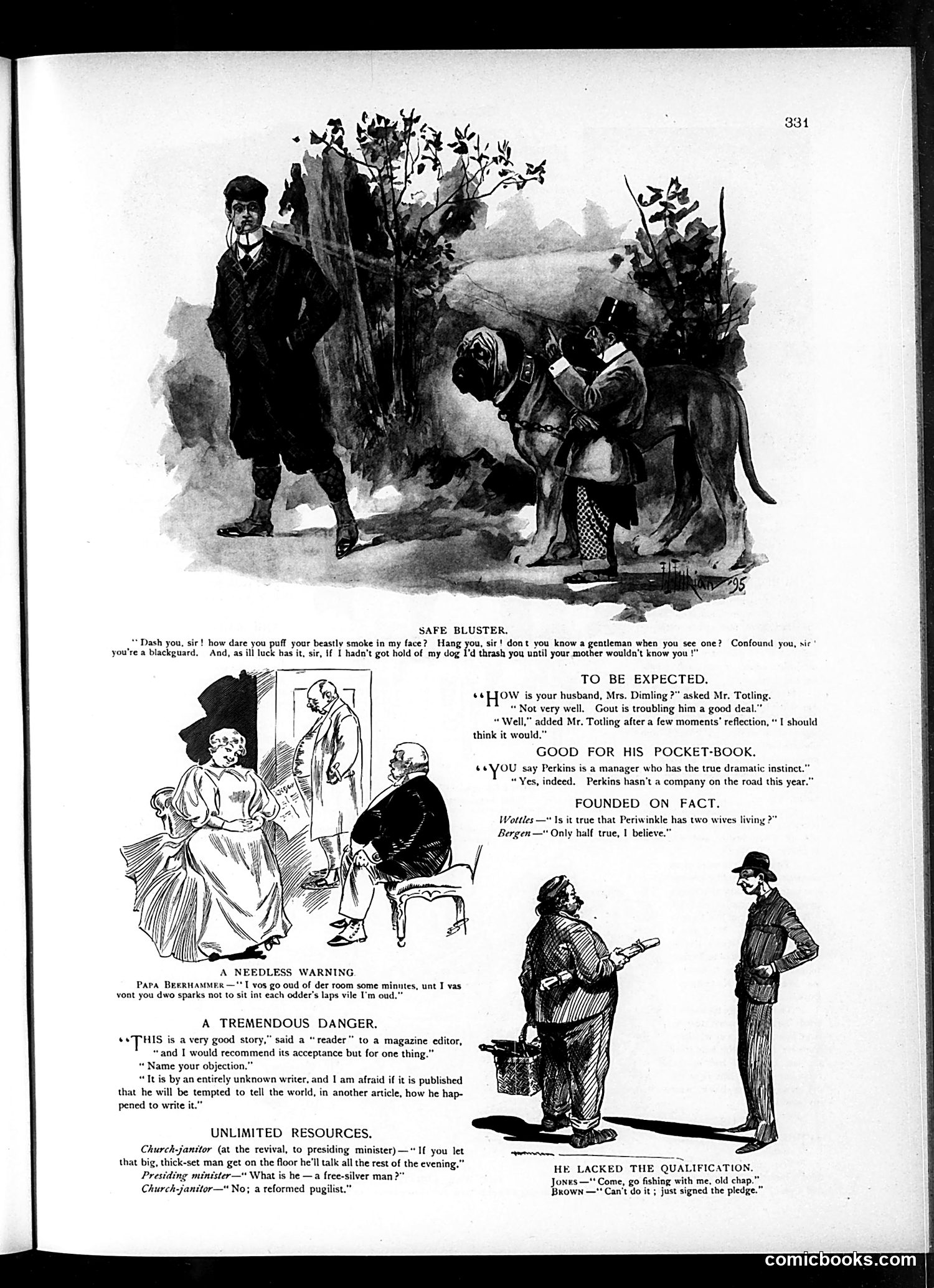
This page contains several satirical sketches mocking Victorian-era social pretensions and theatrical life. "Safe Bluster" depicts a confrontation where a gentleman's threat loses force when exposed as baseless—satire on male bravado. "To Be Expected" jokes about marital discord and a husband's business troubles. "Good for His Pocket-Book" appears to reference theatrical management, likely Perkins, a real theatrical figure. "Founded on Fact" mocks rumors about Periwinkle having two wives. "A Needless Warning" satirizes overly cautious parenting. "A Tremendous Danger" jokes about editors rejecting plagiarized stories. "Unlimited Resources" depicts church ministers exploiting congregants. The bottom sketch, "He Lacked the Qualification," appears to mock someone unfit for a position, possibly fishing-related. These reflect Judge's typical focus on urban, middle-class social comedy and workplace absurdities.
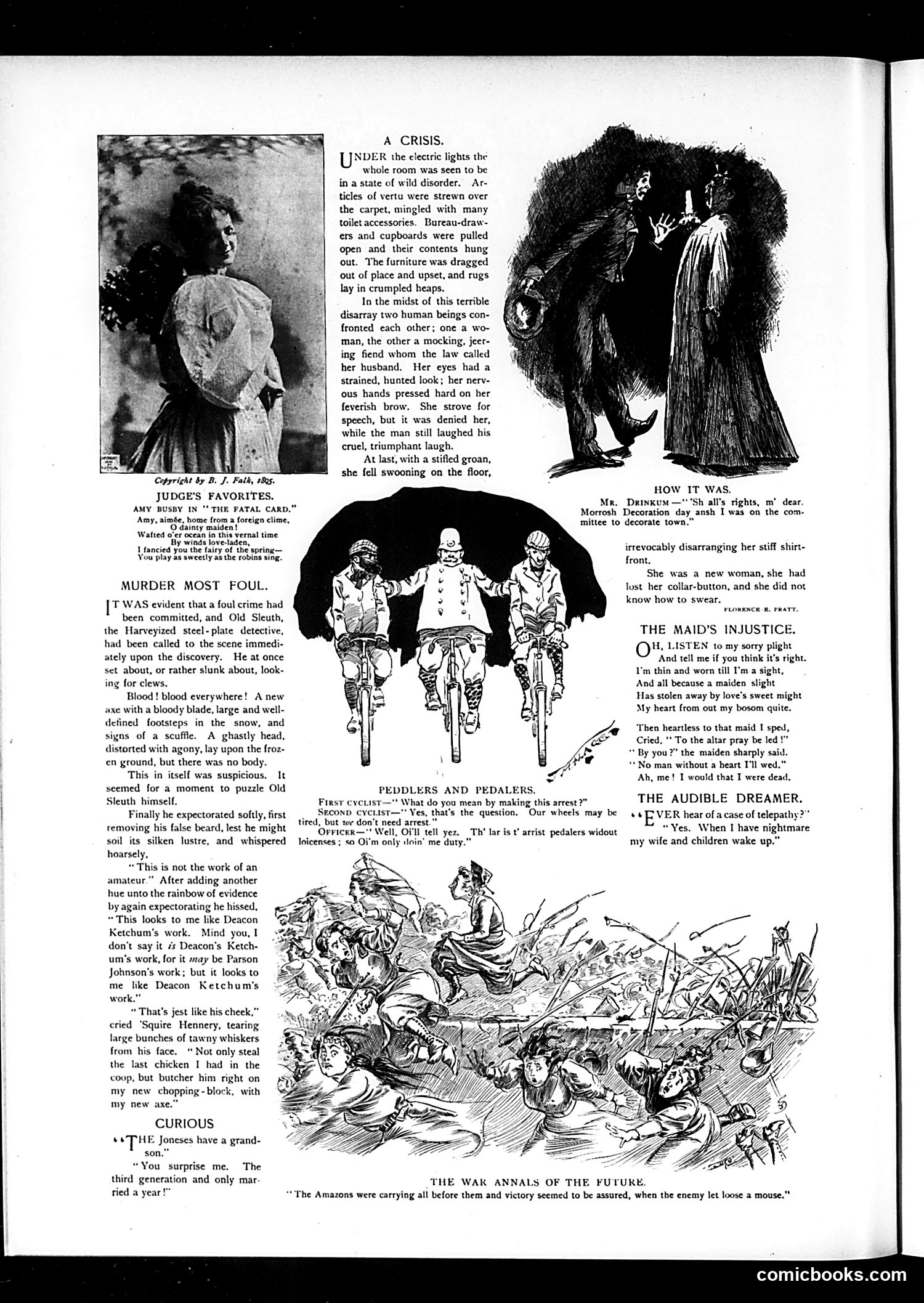
This page from Judge magazine (circa 1896, based on copyright mark) contains several satirical sketches mocking popular Victorian literary and social conventions: **"Murder Most Foul"** parodies detective fiction, specifically the "Old Sleuth" mystery genre. The humor lies in the detective's absurd deductions—finding blood, footprints, and a severed head but no body, then attributing the crime to either "Deacon Ketchum" or "Parson Johnson" without actual evidence. The exaggerated spitting and theatrical dialogue mock overwrought mystery stories. **"A Crisis"** satirizes melodramatic domestic fiction—a disheveled room, distressed woman, cruel husband—but the punchline deflates it: she's a "new woman" who lost a collar-button and doesn't know how to swear, mocking both sentimental marriage narratives and the emerging "New Woman" movement. **"Peddlers and Pedalers"** makes a simple pun about cyclists ("pedalers") needing licenses like street vendors ("peddlers"). **Other sketches** include light domestic humor about marital telepathy and a grandfather joke. The page reflects Judge's satirical focus on contemporary literary trends and social pretension.
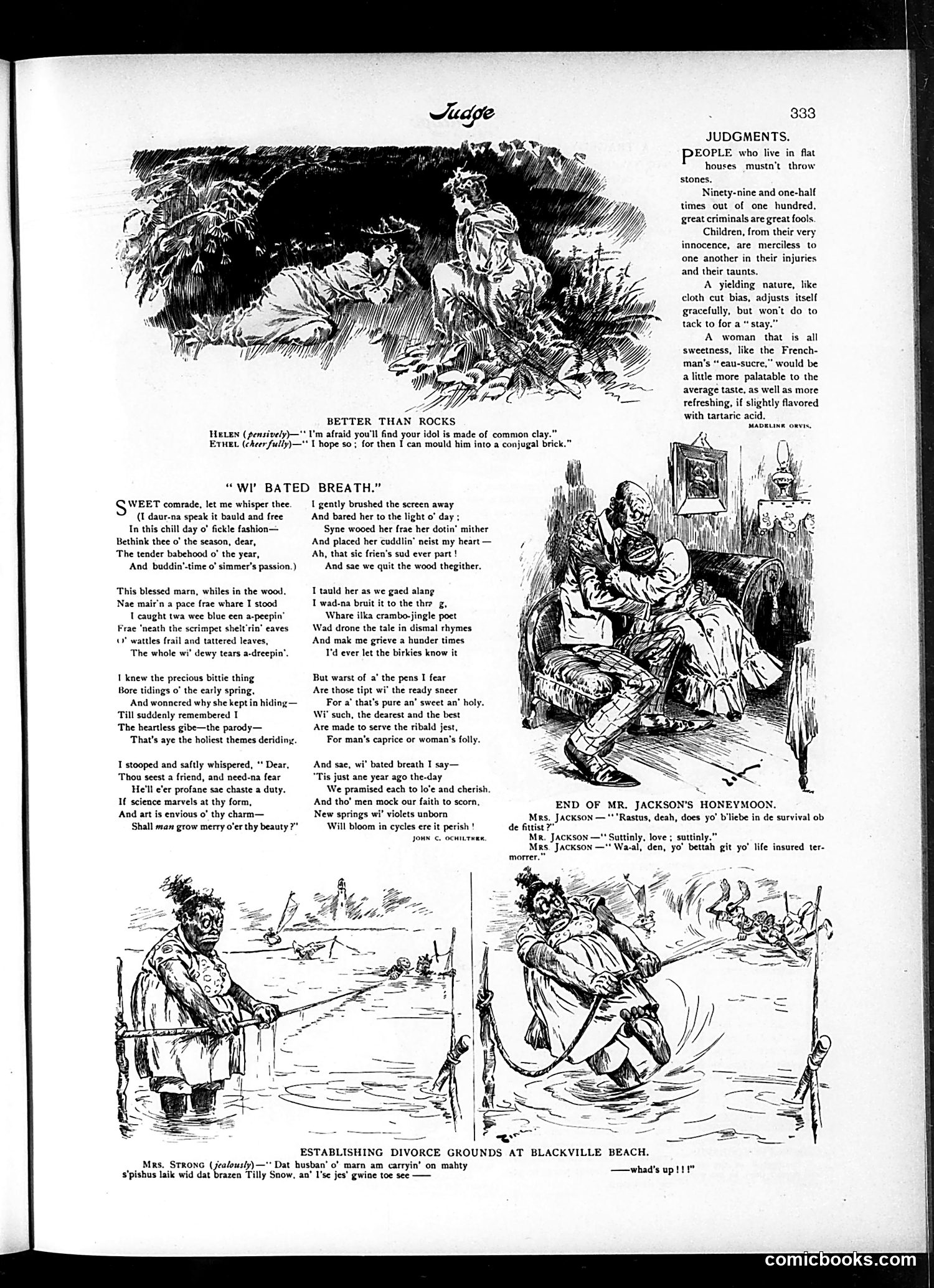
This page contains three satirical pieces typical of Judge's humor circa early 1900s: **"Better Than Rocks"**: A brief dialogue joke about marriage—a woman warns her fiancé his idealized image will crumble, but he cheerfully responds he'll reshape him into a "conjugal brick" (husband material). It's commentary on romantic illusions versus practical marriage. **"Wi' Bated Breath"**: A Scottish dialect poem about discovering a bird's nest in spring. The author protects the delicate scene from mockery, reflecting on how cynical society corrupts innocent beauty. It's sentimental nature writing with social critique about how "ribald jest" ruins precious things. **"End of Mr. Jackson's Honeymoon" and "Establishing Divorce Grounds"**: Two cartoons featuring African American characters in racist dialect, depicting marital discord—wives asking about "survival of the fittest" and suspecting infidelity. These reflect Judge's frequent use of crude racial caricature for domestic comedy, typical of the era's deeply offensive editorial approach.
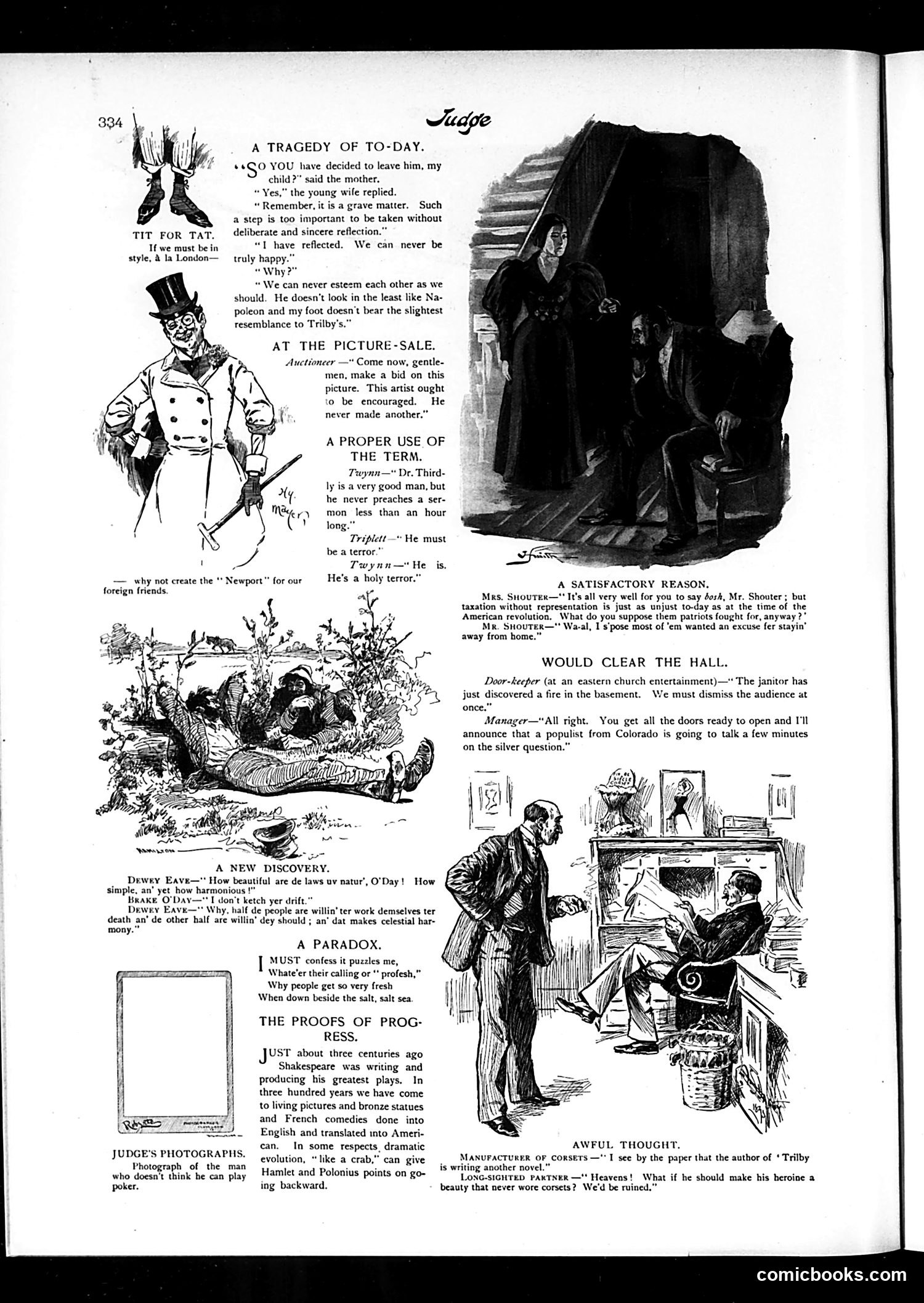
This page collects brief satirical vignettes mocking contemporary society and literature: **"A Tragedy of To-Day"** ridicules the fashionable obsession with literary/artistic allusions—a wife leaves her husband because he doesn't resemble Napoleon and her foot doesn't match Trilby's (the heroine of a popular novel), missing genuine compatibility for superficial aesthetic pretensions. **"Would Clear the Hall"** satirizes American populism and the "free silver" debate of the 1890s—announcing a Colorado populist speaker on monetary policy is guaranteed to empty a church hall faster than a fire alarm. **"The Proofs of Progress"** employs ironic comparison: Shakespeare's genius three centuries ago versus modern mediocrity (living pictures, translated French comedies), suggesting cultural decline despite technological advancement. **"Awful Thought"** mocks corset-dependent beauty standards—publishers panic that if a novel's heroine wasn't artificially shaped by corsetry, readers won't find her beautiful. These pieces target literary pretension, political movements, and Victorian social conventions with characteristic Judge-magazine brevity and cynicism.
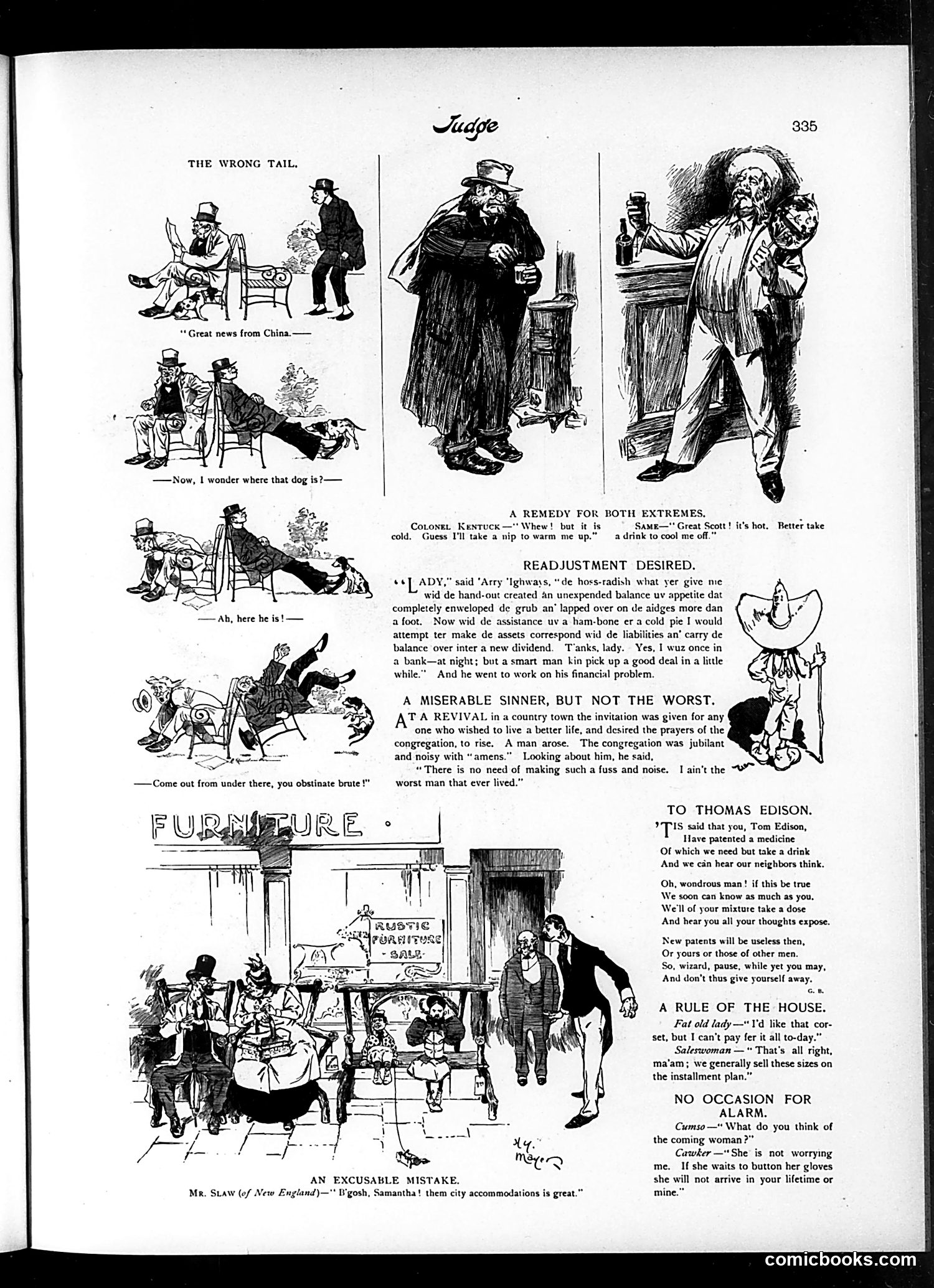
This page contains multiple short humorous sketches typical of late-19th-century American satire: **"The Wrong Tail"** depicts a man chasing a dog through various scenes, a visual gag about mistaken identity or pursuing the wrong target. **"A Remedy for Both Extremes"** jokes about Colonel Kentuck addressing temperature discomfort—he wants liquor to warm up when cold, but also to cool down when hot, satirizing alcoholic excess as a "cure-all." **Other sketches** include commentary on homelessness and financial desperation ("Readjustment Desired"), religious hypocrisy at revivals, and period anxieties about women's rights ("the coming woman"). **The Edison reference** satirizes Thomas Edison's celebrity status and proliferation of patents by humorously imagining a "mind-reading" medicine—mocking both technological utopianism and invasion-of-privacy concerns. The furniture sale sketch and "Rule of the House" offer mild social humor about consumer culture and domestic negotiations. These are lightweight, observational jokes reflecting working-class and middle-class American life concerns.
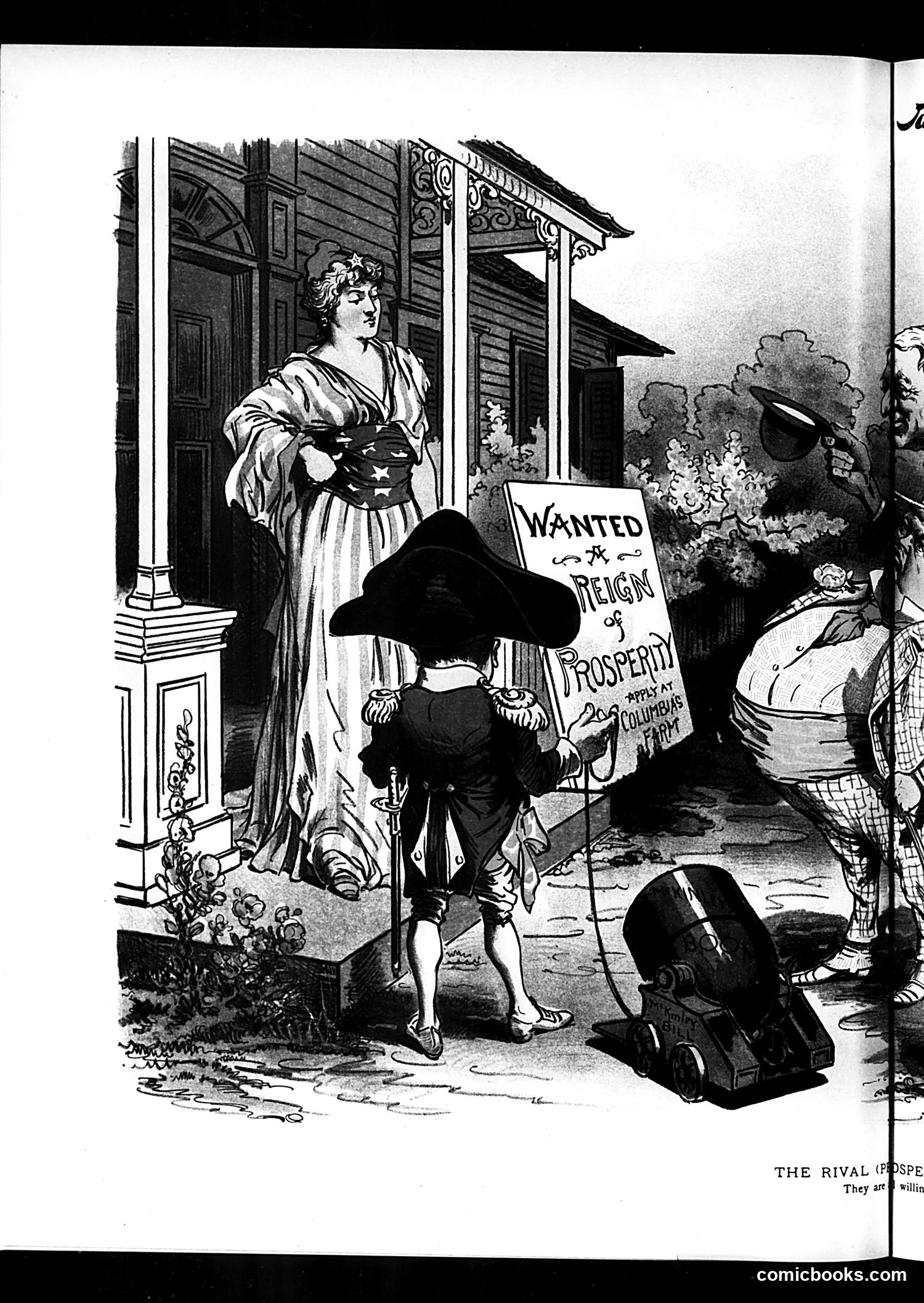
This appears to be a satirical cartoon from *Judge* magazine depicting an allegorical scene. A classical female figure (likely representing America or a virtue like Liberty or Prosperity) stands on a classical portico holding a sign reading "WANTED — A REIGN OF PROSPERITY" with what appears to be "COLUMBIA FIRST" below it. A small figure in military dress (possibly representing a political candidate or leader) stands before her with a sword. Other figures observe from the right side of the composition. The satire appears to criticize political rivals competing for power by promising prosperity to the nation. However, without the full OCR text or publication date visible, the specific political context—which election, candidates, or policy debate this references—remains unclear.
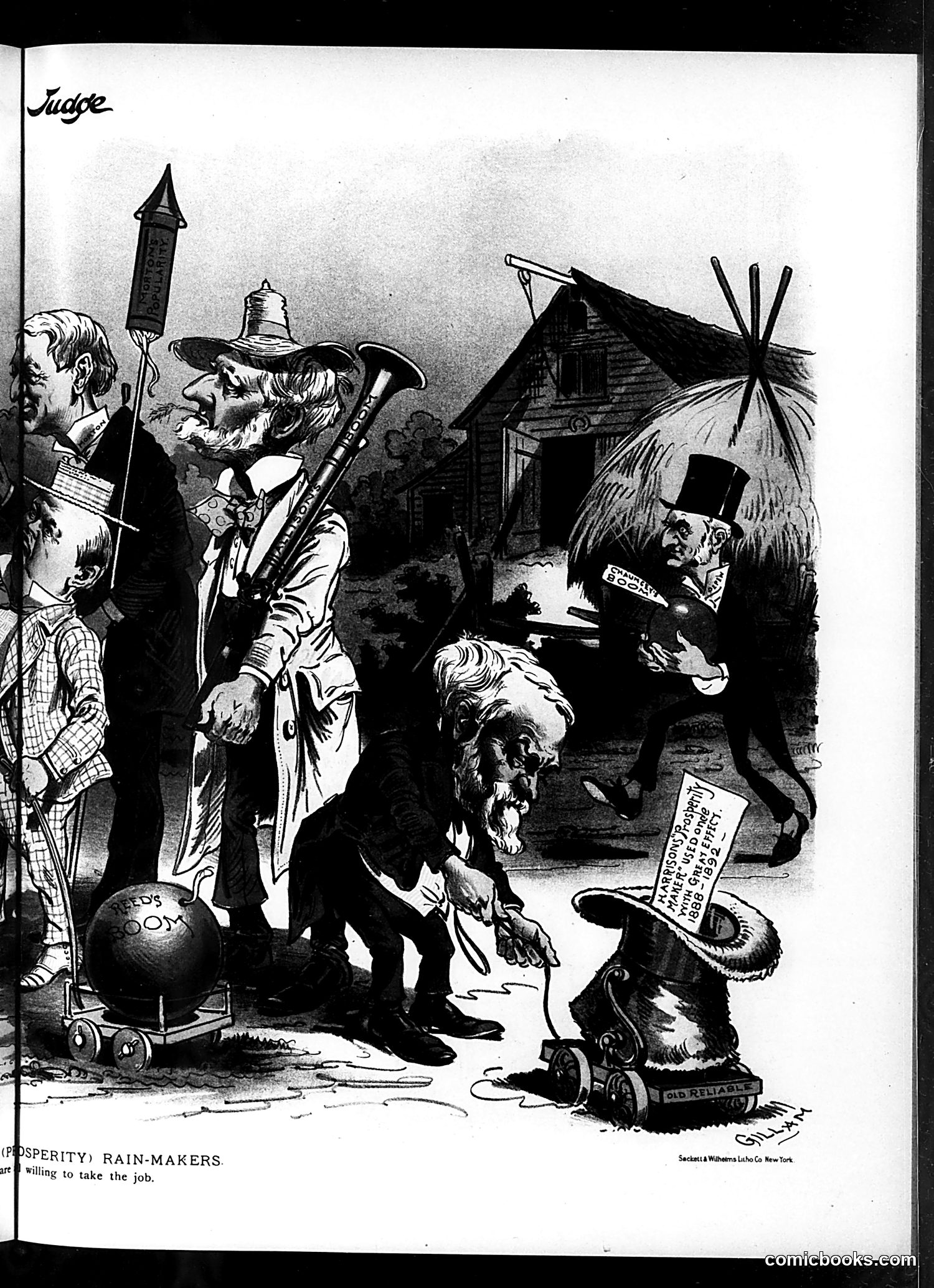
This political cartoon satirizes various figures willing to manufacture artificial "prosperity" during what appears to be an economic drought. The title references "rain-makers"—charlatans who falsely claimed to control weather. The cartoon depicts caricatured politicians or business leaders in exaggerated dress (including military uniforms and formal wear) displaying various dubious instruments and schemes—rockets, balloons, and other contraptions—meant to create prosperity artificially. An elderly bearded figure in the foreground appears skeptical or weary. The satire mocks politicians and promoters who promise economic solutions through questionable methods or empty rhetoric, comparing their claims to the fraudulent promises of literal rain-makers. The subtitle "are willing to take the job" suggests these figures will attempt anything, however absurd, to appear to solve economic problems—particularly relevant during economic downturns when desperation makes people vulnerable to false promises.
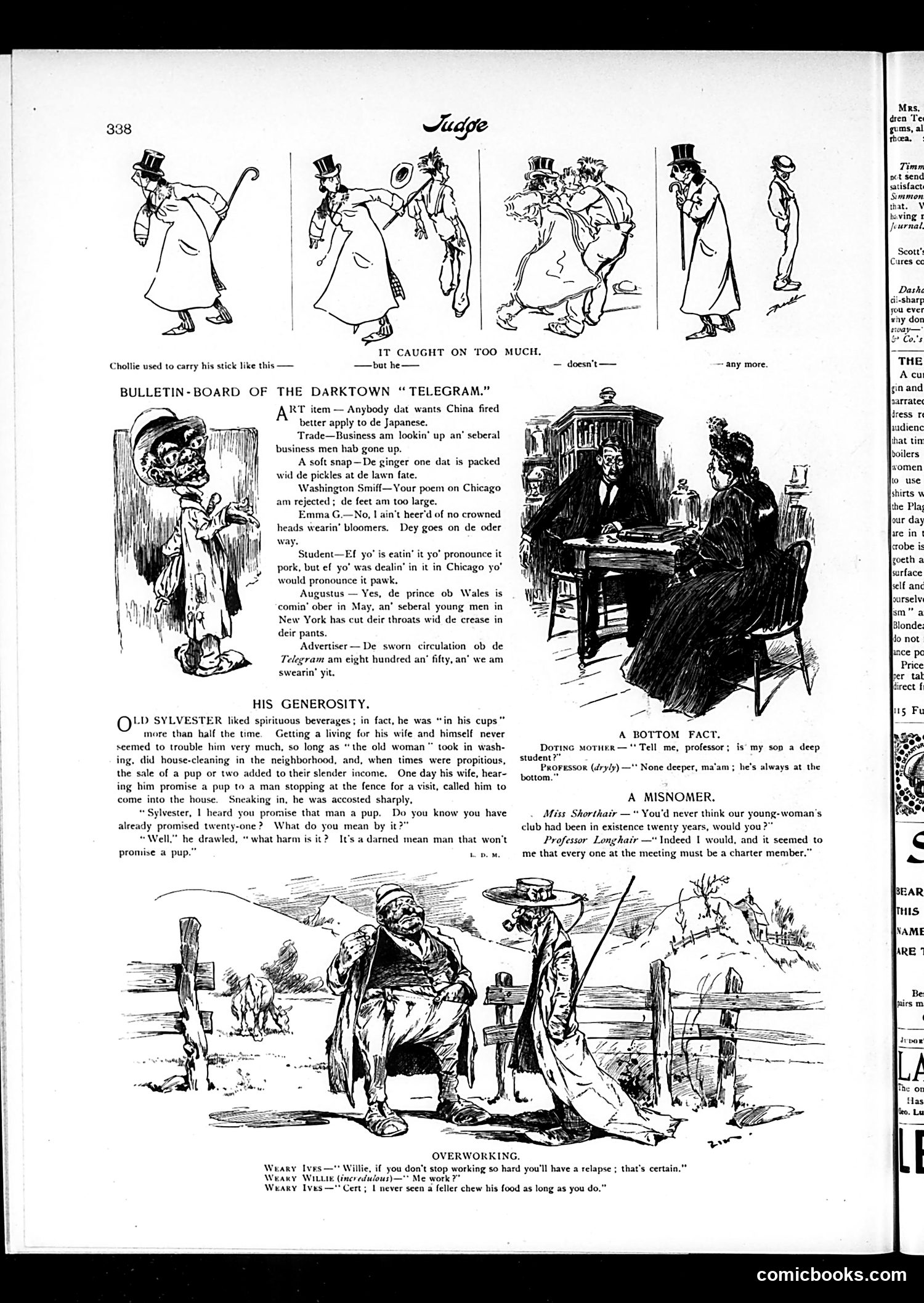
This page contains multiple satirical items typical of early Judge magazine: **Top comic:** "It Caught On Too Much" mocks a fashionable gentleman ("Chollie") whose affectation of carrying a walking stick became so popular that he abandoned it—a joke about trend-chasing vanity. **"Darktown Telegram" section:** Racist humor using dialect stereotypes. The "bulletin board" format parodies newspaper notices with jokes about Black life, including references to China (likely the Boxer Rebellion), social climbing, and mispronunciation of words. **"His Generosity":** A working-class morality tale about a drunk man promising puppies he doesn't own, illustrating irresponsibility and his wife's burden supporting the household. **Other brief pieces:** "A Bottom Fact" jokes about a professor assuming students are charter club members; "A Misnomer" plays on names; "Overworking" depicts Weary Willie and Weary Ives (recurring tramp characters) with humor about laziness and eating slowly. The page reflects Judge's mix of class commentary, ethnic caricature, and slapstick humor typical of American magazines circa 1900s-1910s.
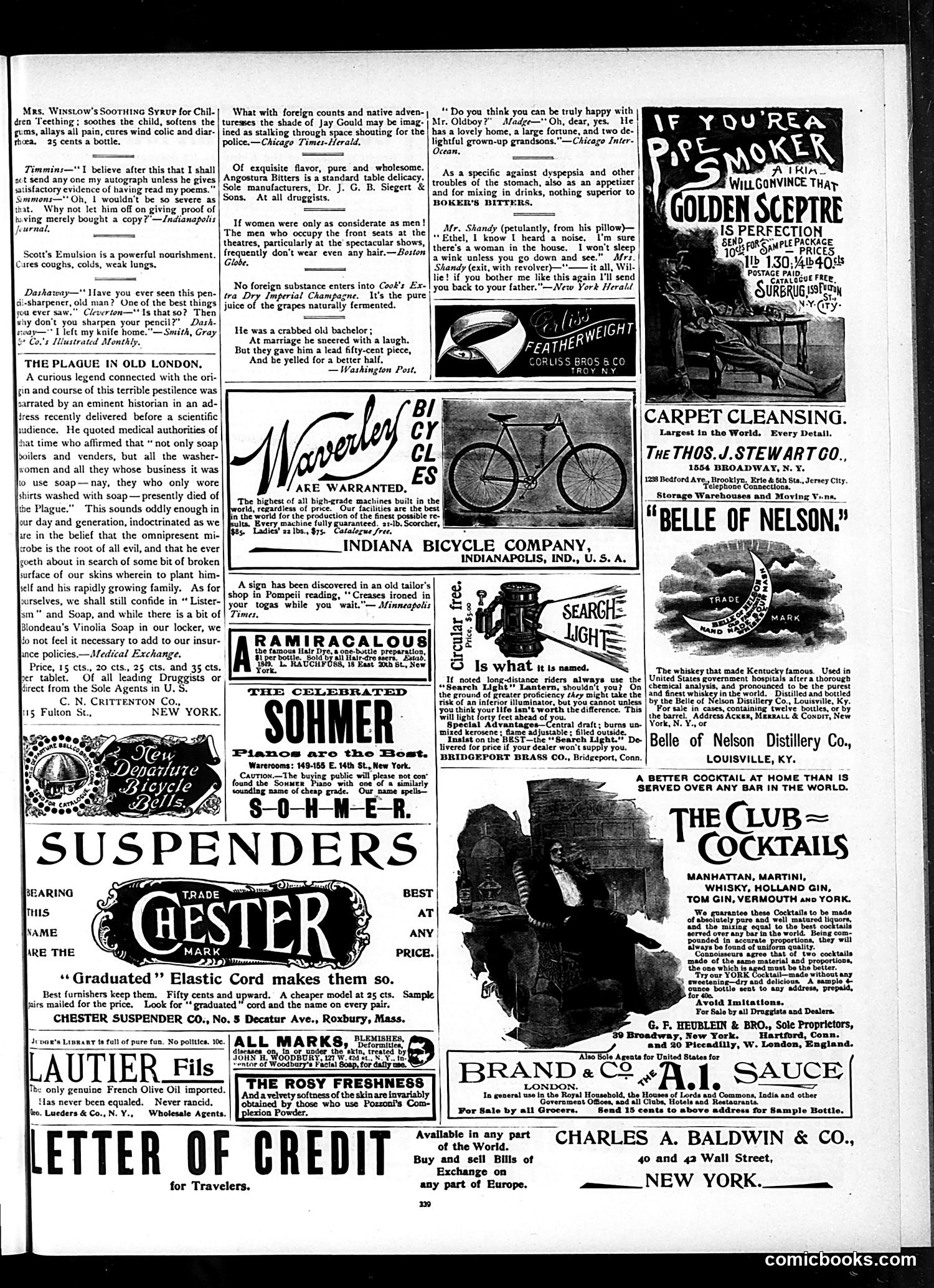
This page is primarily **advertisements**, not editorial content or cartoons. It's a typical late-19th/early-20th-century Judge magazine page filled with product pitches (patent medicines, bicycles, suspenders) interspersed with brief humorous anecdotes—short jokes rather than political satire. The few comic bits that appear are lightweight social humor: one joke mocks a pompous poet refusing autographs; another mocks an unmarried bachelor who becomes obsessed with marrying once offered money ("better half"); a third jokes about a husband suspicious of his wife. These reflect Victorian-era domestic comedy conventions—no political commentary. The page demonstrates how magazines of this era monetized content through dense advertising, with editorial material squeezed between pitches for products like Sohmer bicycles, Boker's Bitters (whiskey), and patent medicines. The overall content is mercenary and commercial rather than satirical.
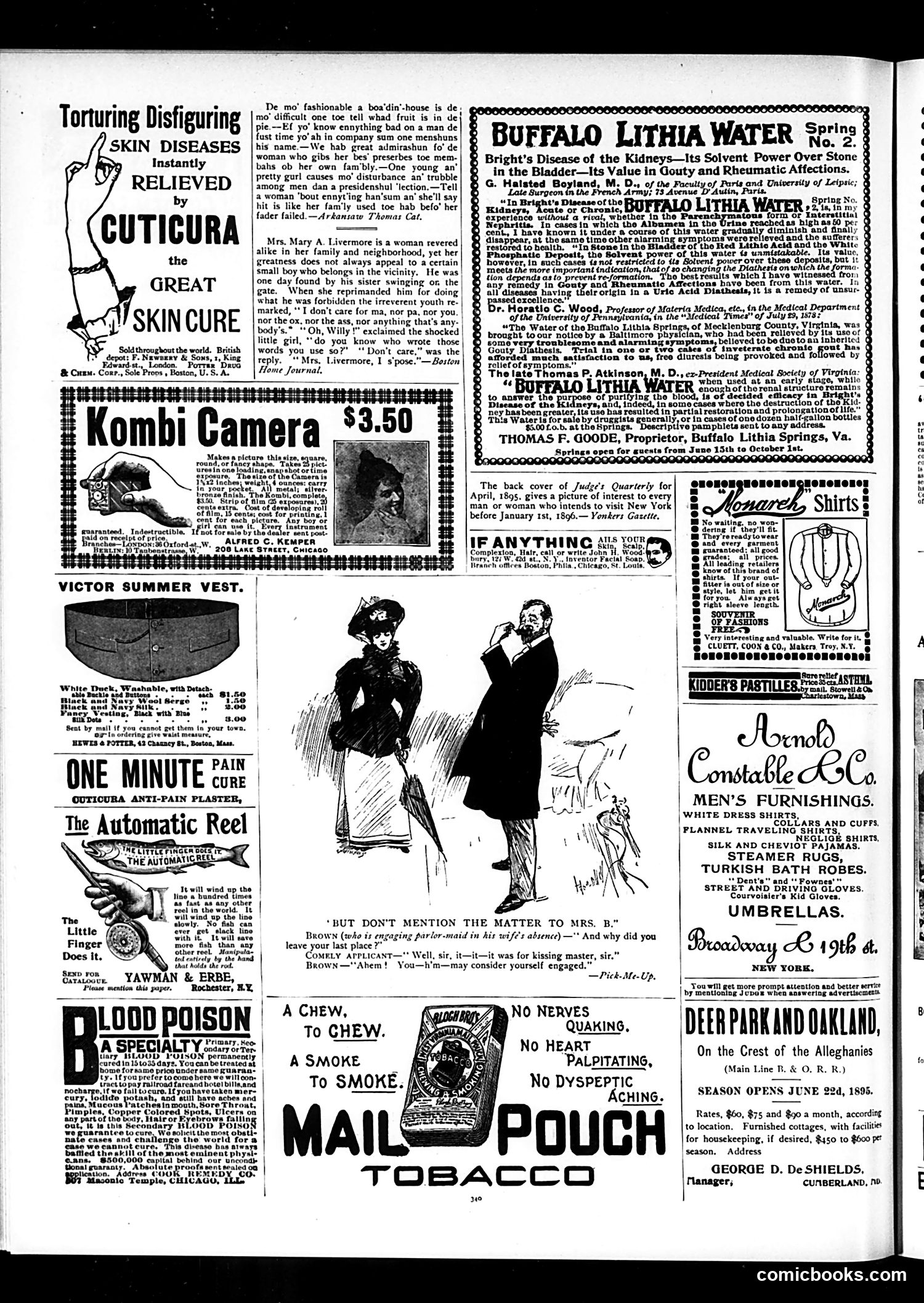
This is primarily an **advertising page** from Judge magazine, with one notable **satirical anecdote** embedded among product advertisements. ## The Cartoon/Satire Content The only substantive humor piece is a brief anecdote about **Mrs. Mary A. Livermore**, a real 19th-century women's suffrage activist and writer. A young boy is caught swinging on a forbidden gate and irreverently declares he cares nothing for his mother, father, animals, or "anything that's anybody's"—quoting biblical language he's learned. When his shocked sister asks who taught him such words, he dismissively replies: "Mrs. Livermore, I s'pose." **The joke**: This mocks Livermore's public prominence and influence, suggesting her radical ideas (women's rights/independence) are corrupting youth and undermining traditional family authority—a common criticism leveled at suffragists by conservative opponents. The page is otherwise filled with period medical advertisements (Buffalo Lithia Water, Cuticura skin treatments) and men's clothing ads, typical of Judge's revenue model.
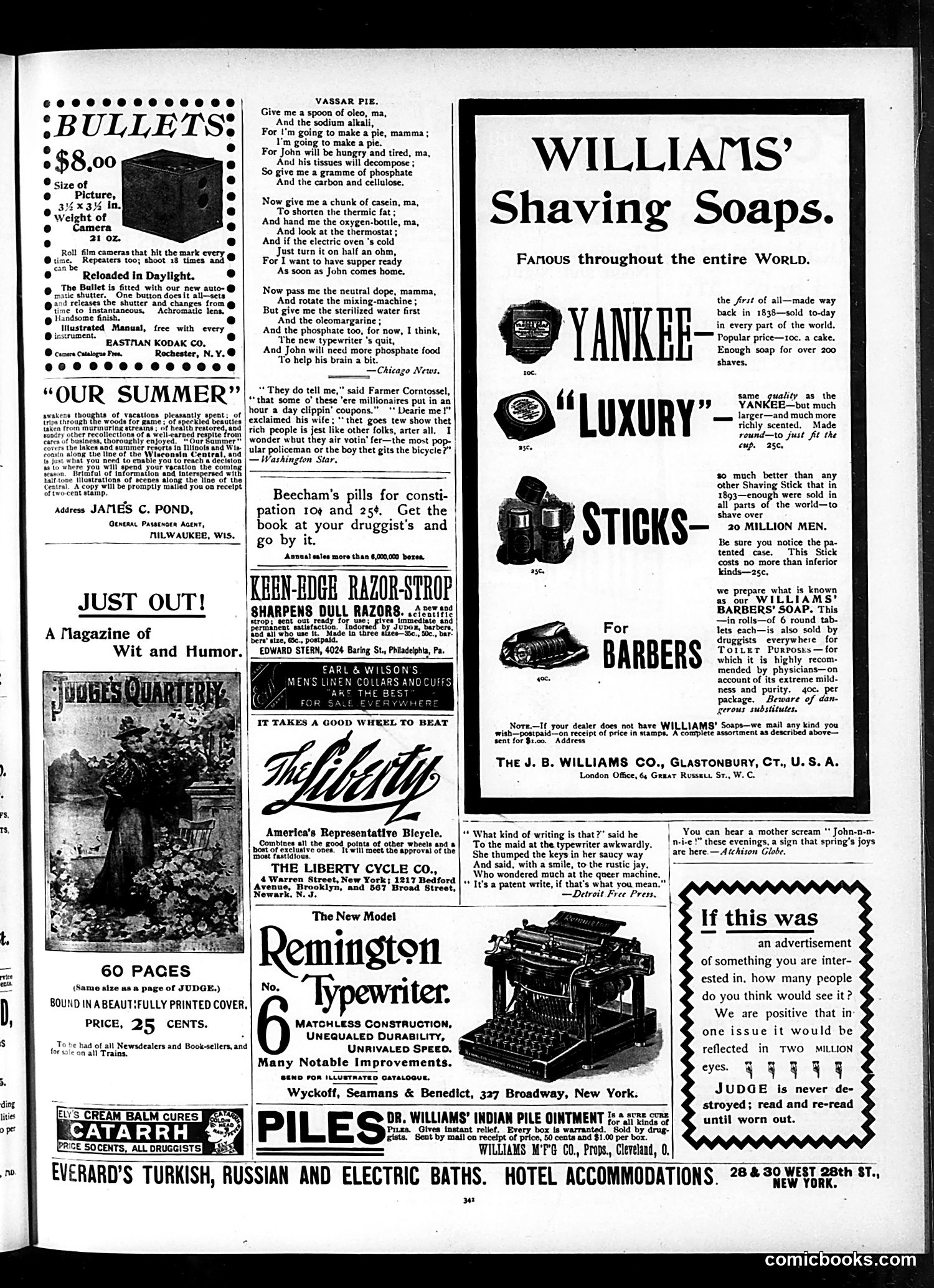
This page is primarily **advertising**, with one notable satirical poem titled "Vassar Pie" at the top. ## "Vassar Pie" Satire The poem mocks early 20th-century scientific rationalism and women's education. It depicts a Vassar College student (an elite women's school) preparing dinner using pseudo-scientific jargon—requesting "oleo," "sodium alkali," "casein," "phosphate," and "cellulose" instead of normal cooking ingredients. The satire suggests that higher education for women makes them absurdly pretentious and disconnected from practical domestic skills. References to "typewriter" and "electric oven" indicate technological modernity. The humor targets both educated women and contemporary obsession with chemistry and mechanization as sources of household modernization—reflecting period anxieties about changing gender roles and scientific progress. The remainder of the page consists of period advertisements for bullets, cameras, bicycles, typewriters, shaving soaps, and medical remedies—typical of Judge's revenue model and the products marketed to its readership.
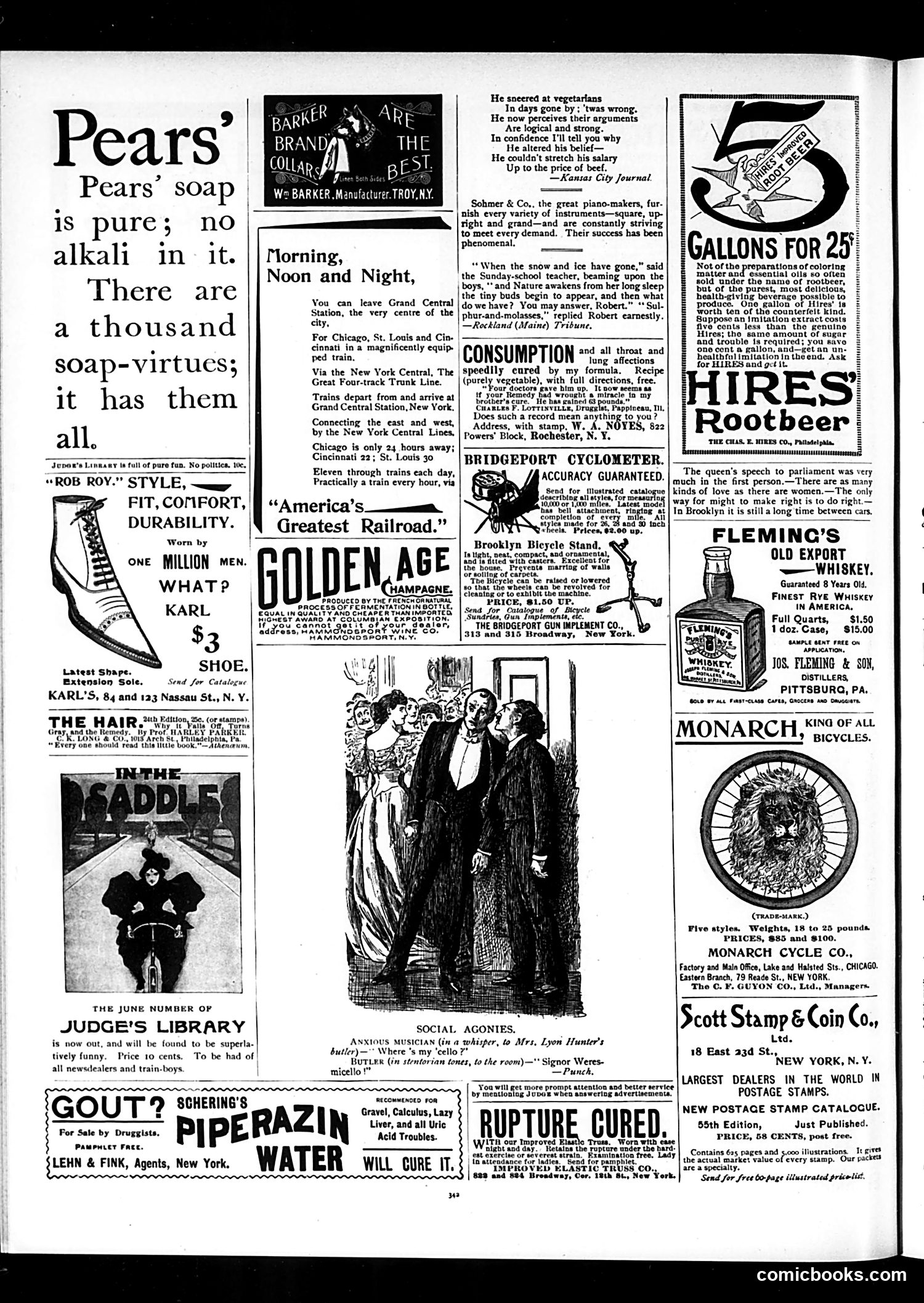
This single-panel cartoon depicts a humorous social misunderstanding at what appears to be an upper-class gathering. An anxious musician whispers urgently to a butler asking, "Where's my 'cello?" The butler, mishearing or misinterpreting the question, loudly announces to the entire room: "Signor Where's-my 'cello'!"—treating it as the musician's name rather than a question. The satire targets the pretensions of both the servant class (the butler's obliviousness) and wealthy society (the musicians and guests who would find such confusion embarrassing). The joke relies on the social anxiety of public misstatement in formal settings—a staple of Victorian-era humor. The attribution to *Punch* (a British satirical magazine) indicates this was reprinted from that publication.
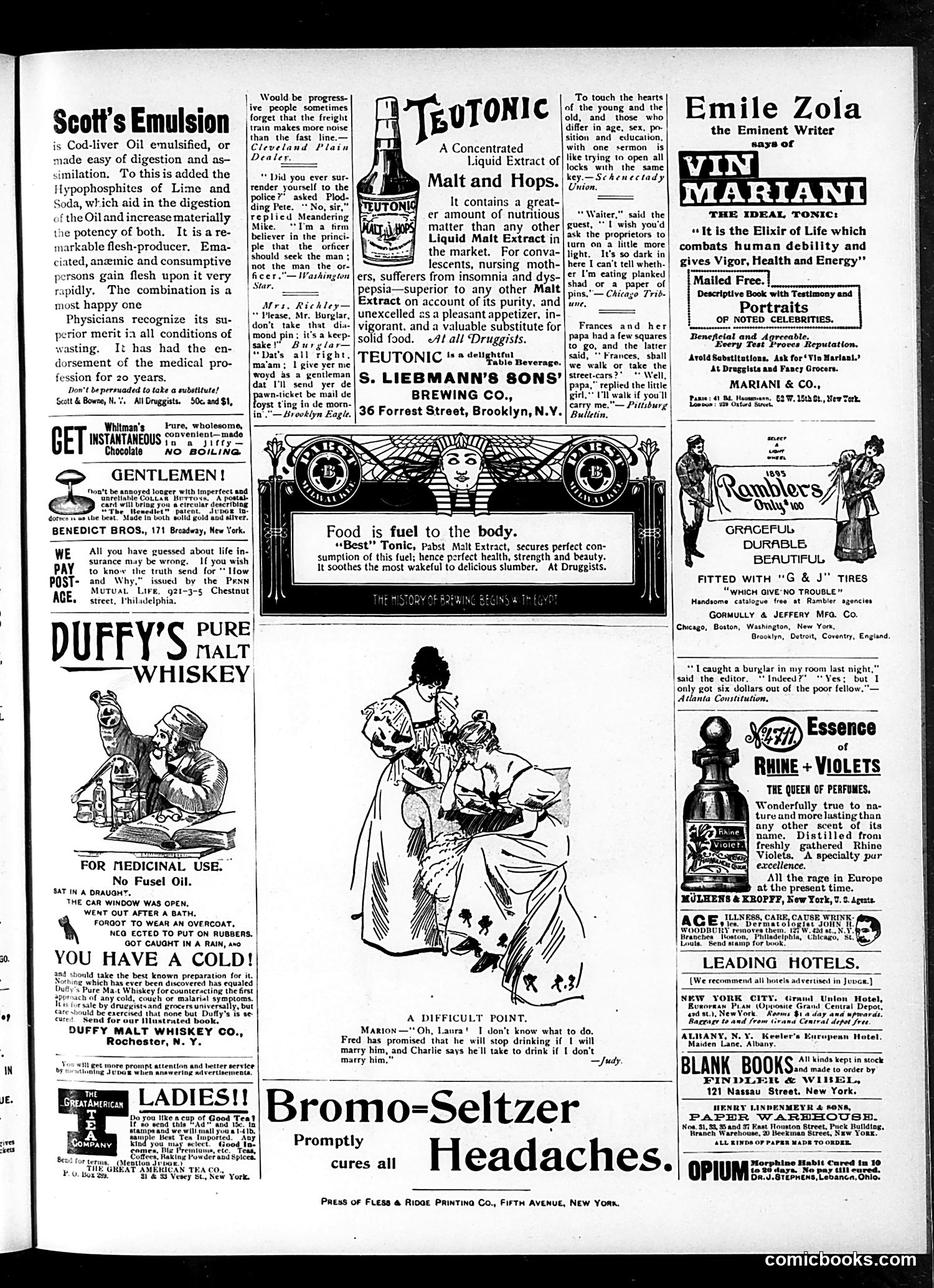
This is primarily an **advertising page** from the satirical magazine Judge, filled with period product advertisements (Scott's Emulsion, Duffy's Malt Whiskey, Bromo-Seltzer) interspersed with small joke items and cartoons. The notable satirical content includes: **Brief Jokes:** - A "poor logic" joke contrasting noisy freight trains with fast lines (suggesting loud people aren't always impressive) - A burglar promising to return a pawn ticket by mail - A waiter unable to distinguish between planked shad and a paper of pins (food criticism) - A child's joke about walking versus being carried **The Main Cartoon** (center) depicts a woman entertaining children with an elaborate drawing, captioned "A Difficult Point" — the joke concerns Fred and Charlie's dispute over whether drinking will solve relationship problems (likely marital satire). The page reflects **turn-of-century American humor**: mildly cynical, domestic-focused, and relatively gentle. The advertisements for medicinal whiskey, patent tonics, and headache cures reveal period attitudes toward health and marketing.
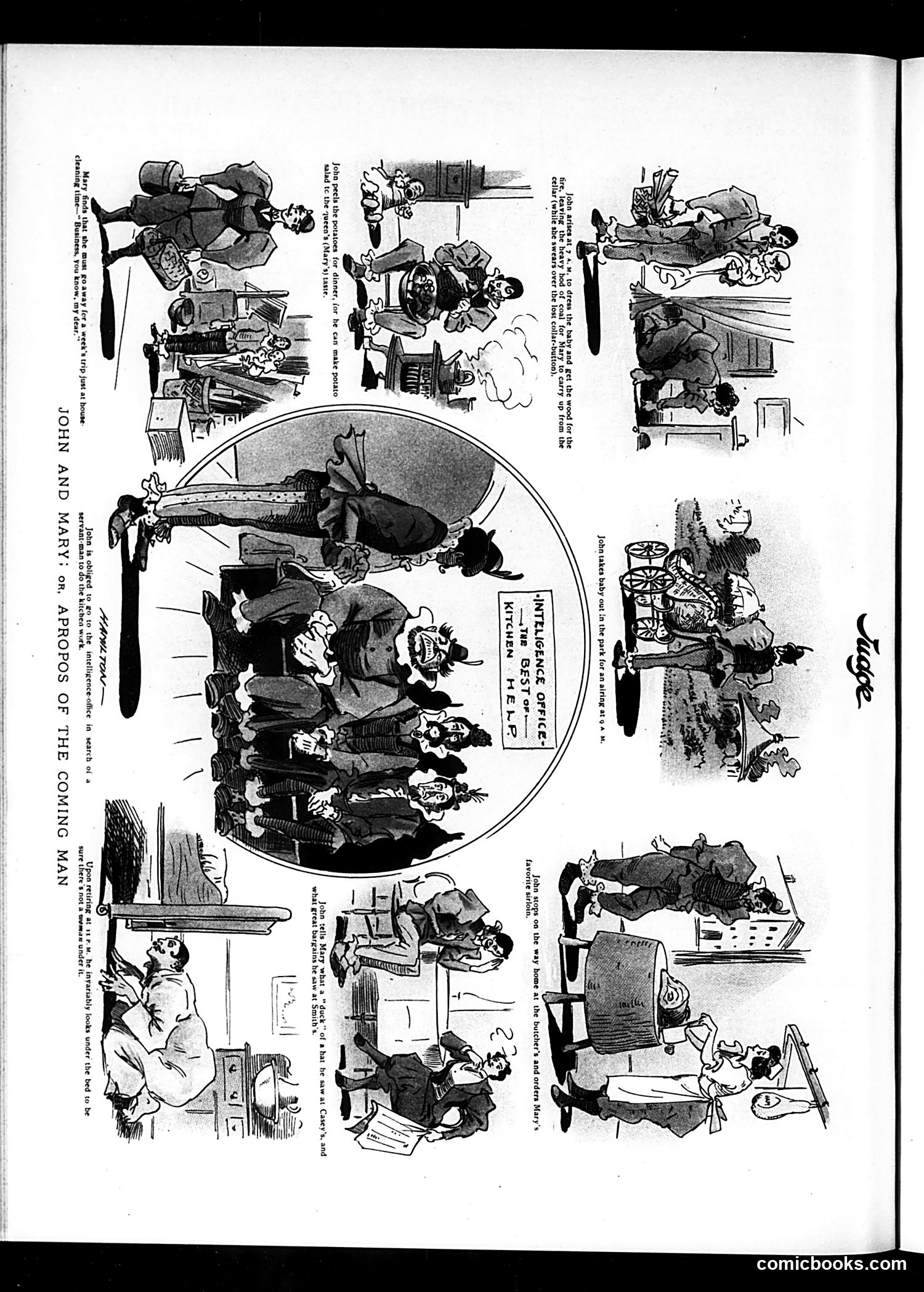
This satirical comic strip mocks gender role reversals and anxieties about changing domestic arrangements. The narrative follows "John," who performs traditionally feminine household tasks—peeling potatoes, visiting the butcher, doing kitchen work—while "Mary" abandons domestic duties for a week's trip, citing "business." The humor targets contemporary fears about the "coming man" (likely referencing discussions of evolving masculinity and women's independence in late 19th/early 20th-century America). The final panel's joke about John checking under the bed suggests emasculation anxiety—he's become so domestic that he's paranoid like a worried housewife. The satire works on two levels: it ridicules both the absurdity of men doing "women's work" and the discomfort this prospect caused traditional audiences. The strip's tone suggests the cartoonist finds such role reversals laughable rather than progressive.