
A complete issue · 16 pages · 1894
Judge — October 20, 1894
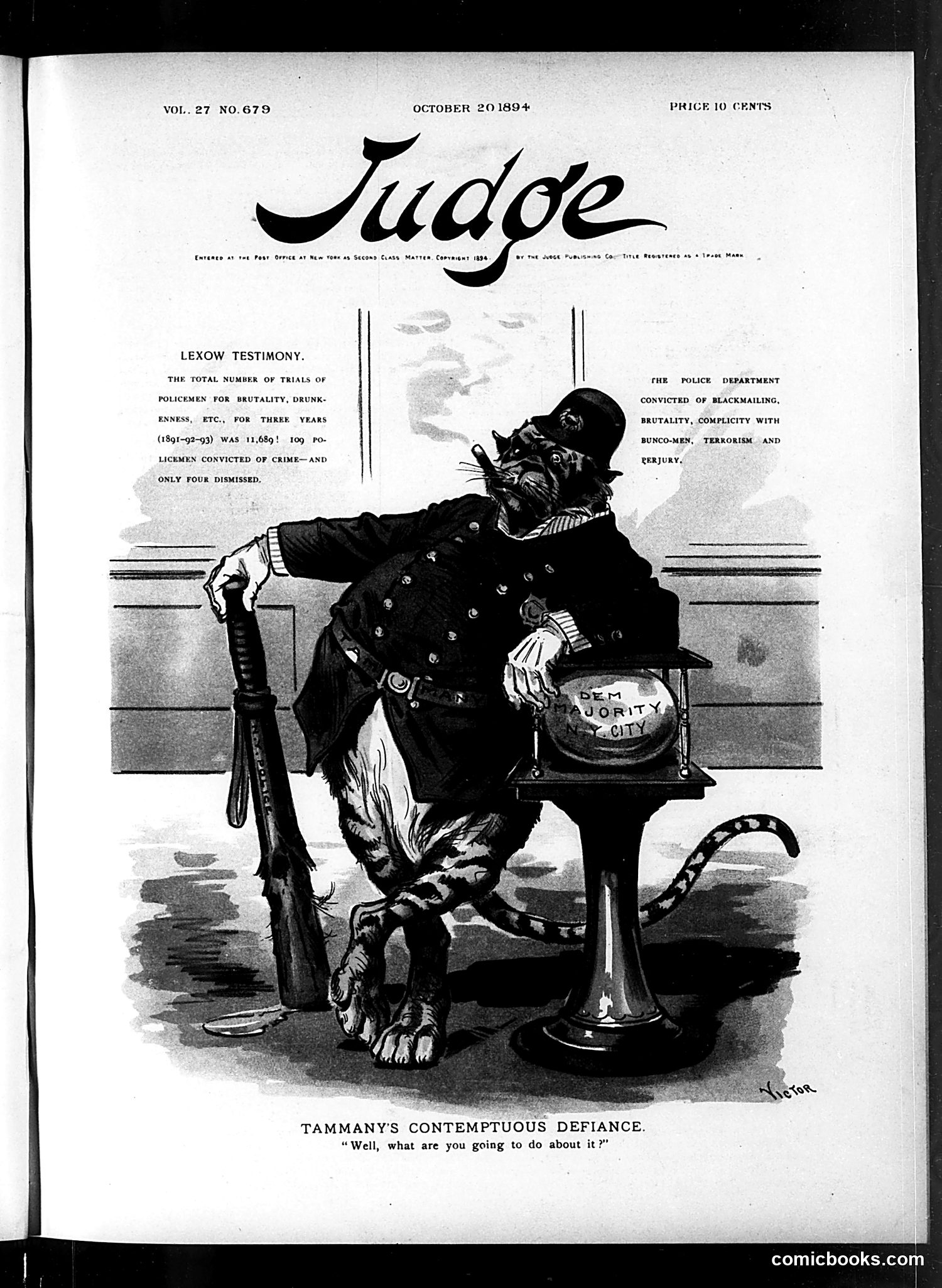
This political cartoon satirizes Tammany Hall, the Democratic political machine that controlled New York City politics. The anthropomorphic rat figure—a common symbol for Tammany corruption—sits defiantly atop a barrel labeled "Liquor Authority" while wielding a club. The accompanying text critiques police department corruption: trials of officers accused of brutality, drunkenness, and related crimes resulted in only four dismissals among numerous convictions over three years (1851-1893). The cartoon's caption, "Well, what are you going to do about it?" captures Tammany's arrogant dismissal of accountability. The rat's aggressive posture and control of the liquor authority barrel suggest the organization's stranglehold on municipal institutions despite documented criminal conduct among police.
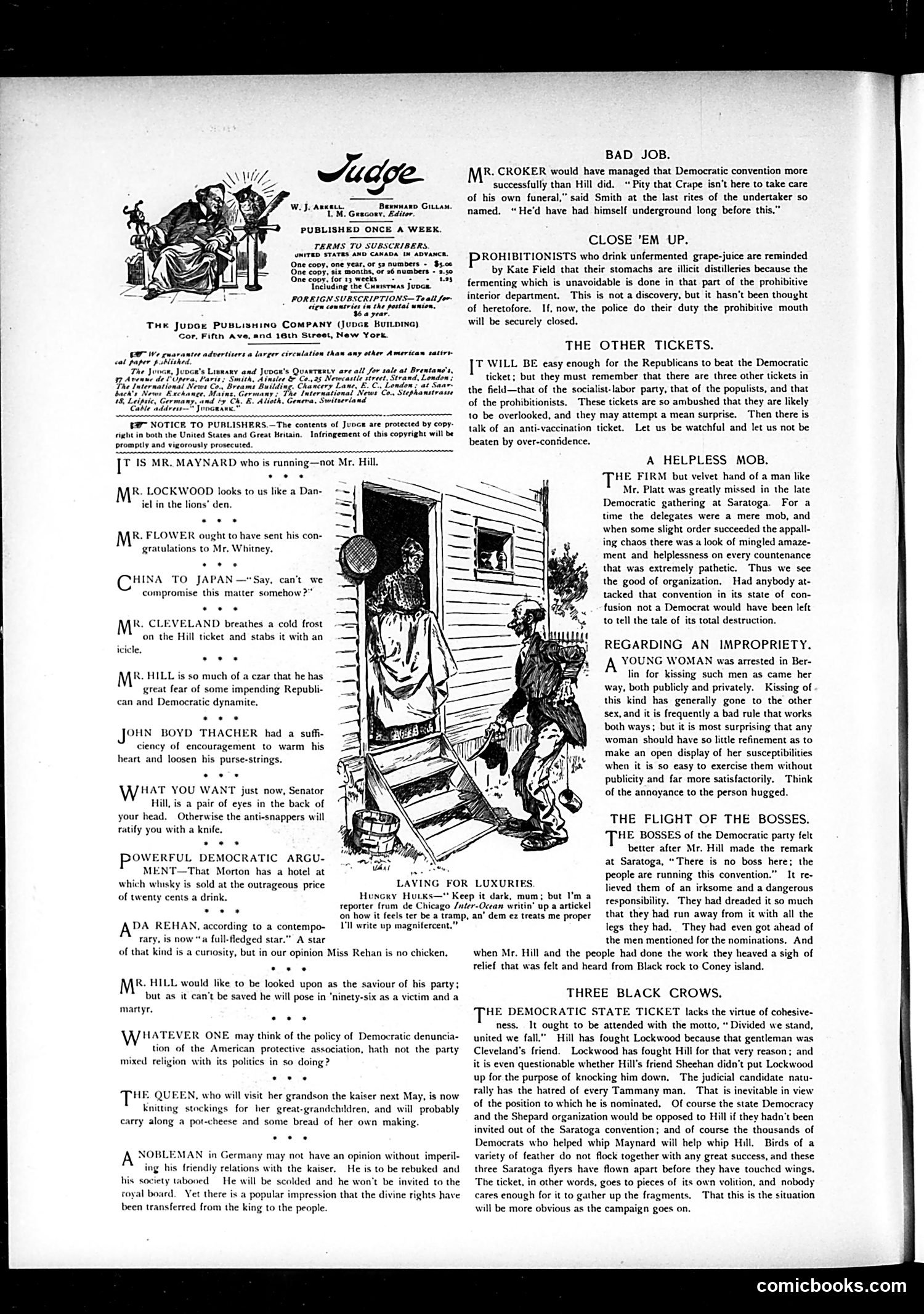
This page satirizes the 1904 Democratic National Convention at Saratoga. The central cartoon depicts chaos at the convention—delegates in disarray outside a building, suggesting organizational failure. The text attacks Democratic leadership, particularly mentioning Mr. Hill and Mr. Lockwood. The satire criticizes: 1. **"A Helpless Mob"** — the convention lacked coherent direction or strong leadership 2. **"The Flight of the Bosses"** — party leaders abandoned responsibility, with Hill's quote ("There is no boss here") mocked as obviously false 3. **"Three Black Crows"** — the state ticket lacks unity and coherence The satirists argue Democrats are fractured and leaderless, contrasting with Republican organization. The overall message: the Democratic party is in chaos, its bosses are fleeing responsibility, and the convention demonstrates their inability to govern effectively.
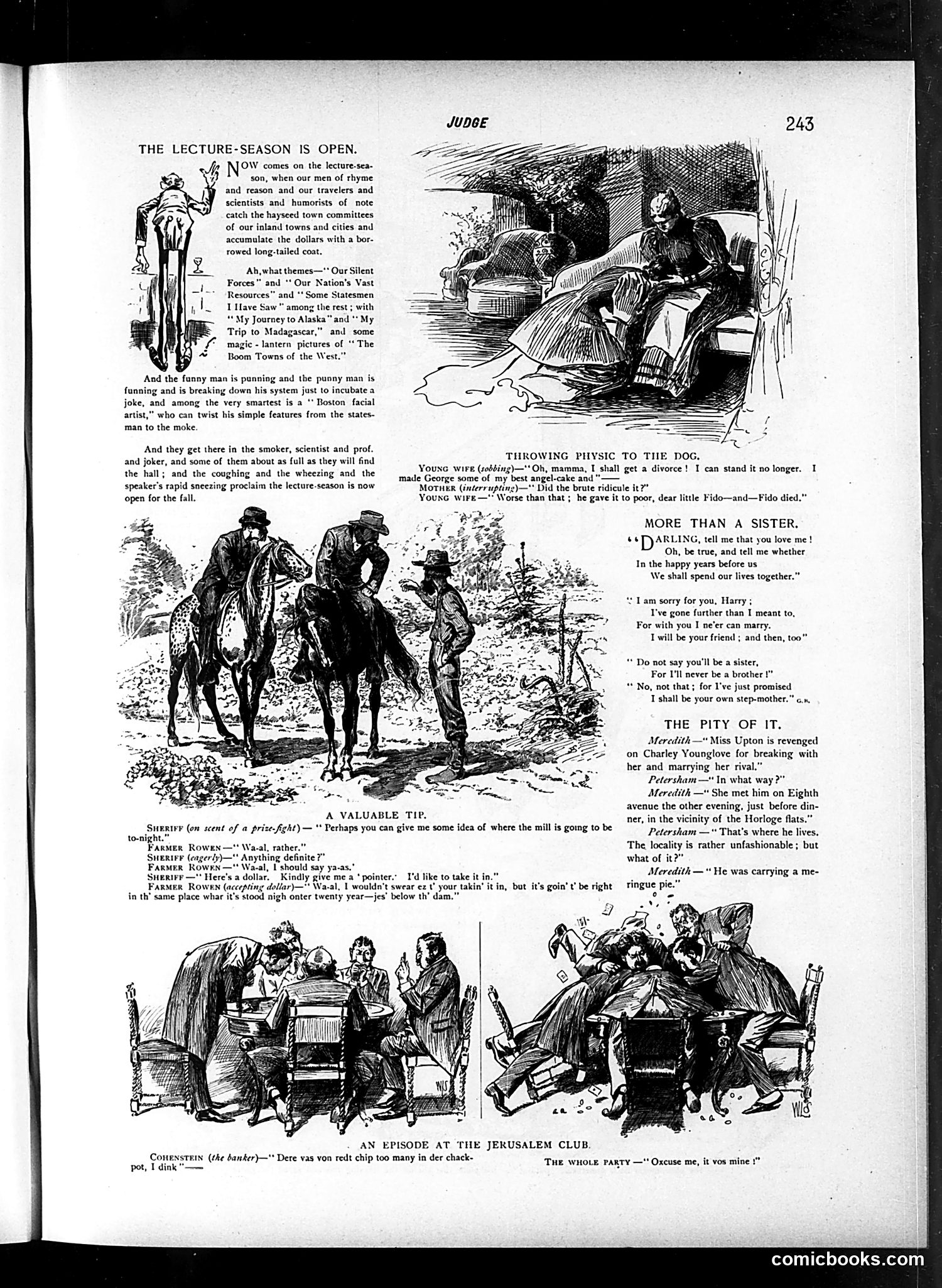
This page contains several satirical sketches and comedic pieces typical of Judge magazine's humor. The main content includes: **"The Lecture-Season is Open"**: A commentary on the winter lecture circuit, mocking the types of speakers and topics—from scientists to humorists—that populated American lecture halls. The satire targets both the speakers' pretensions and audiences' gullibility. **"A Valuable Tip"**: A rural comedy sketch between a sheriff and farmer about locating a mill, playing on miscommunication and dialect humor. **"More Than a Sister"** and **"The Pity of It"**: Sentimental narrative verses about romance and social class distinctions. The illustrations depict period scenes—travelers on horseback, domestic interiors, club gatherings—rendered in Judge's characteristic detailed engraving style. The humor is primarily social satire rather than overtly political.
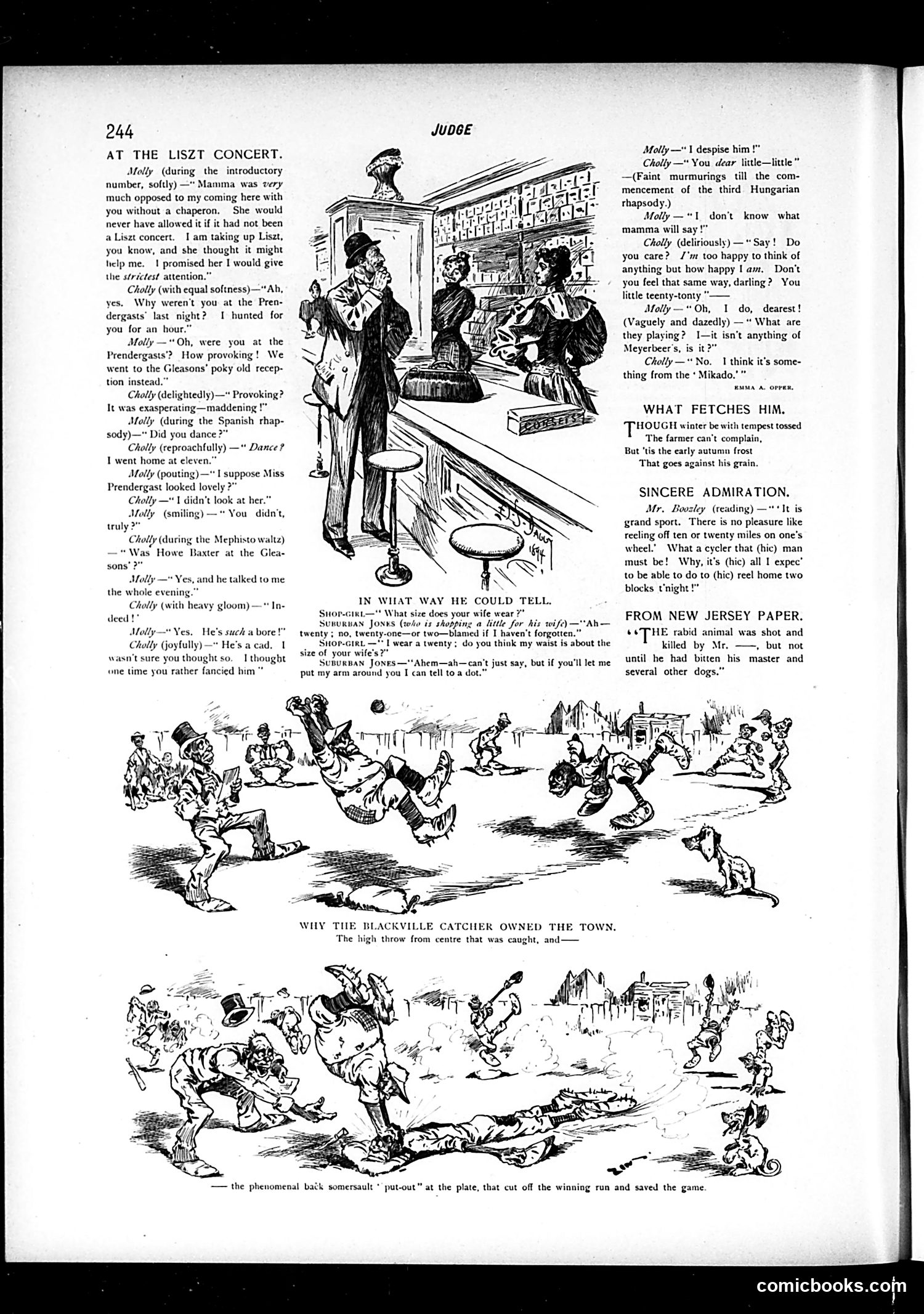
This page contains three satirical pieces typical of late-19th/early-20th-century humor: **"At the Liszt Concert"** mocks upper-class courtship rituals. A young woman claims she's attending the classical music concert to study composer Franz Liszt (with her mother's approval), but she and her date spend the entire performance gossiping about other parties, flirting, and discussing rivals—completely ignoring the music. The joke exposes the pretense: she's using "high culture" as social cover for a romantic outing. **The baseball cartoons** ("Why the Blackville Catcher Owned the Town") appear to depict African American players in exaggerated style—typical of the era's racist imagery in mainstream publications. **"Sincere Admiration"** and other brief jokes use wordplay and situational humor common to the period. The page reflects Judge's focus on satirizing social pretension, particularly among the urban upper-middle classes navigating courtship and cultural respectability in the Gilded Age.
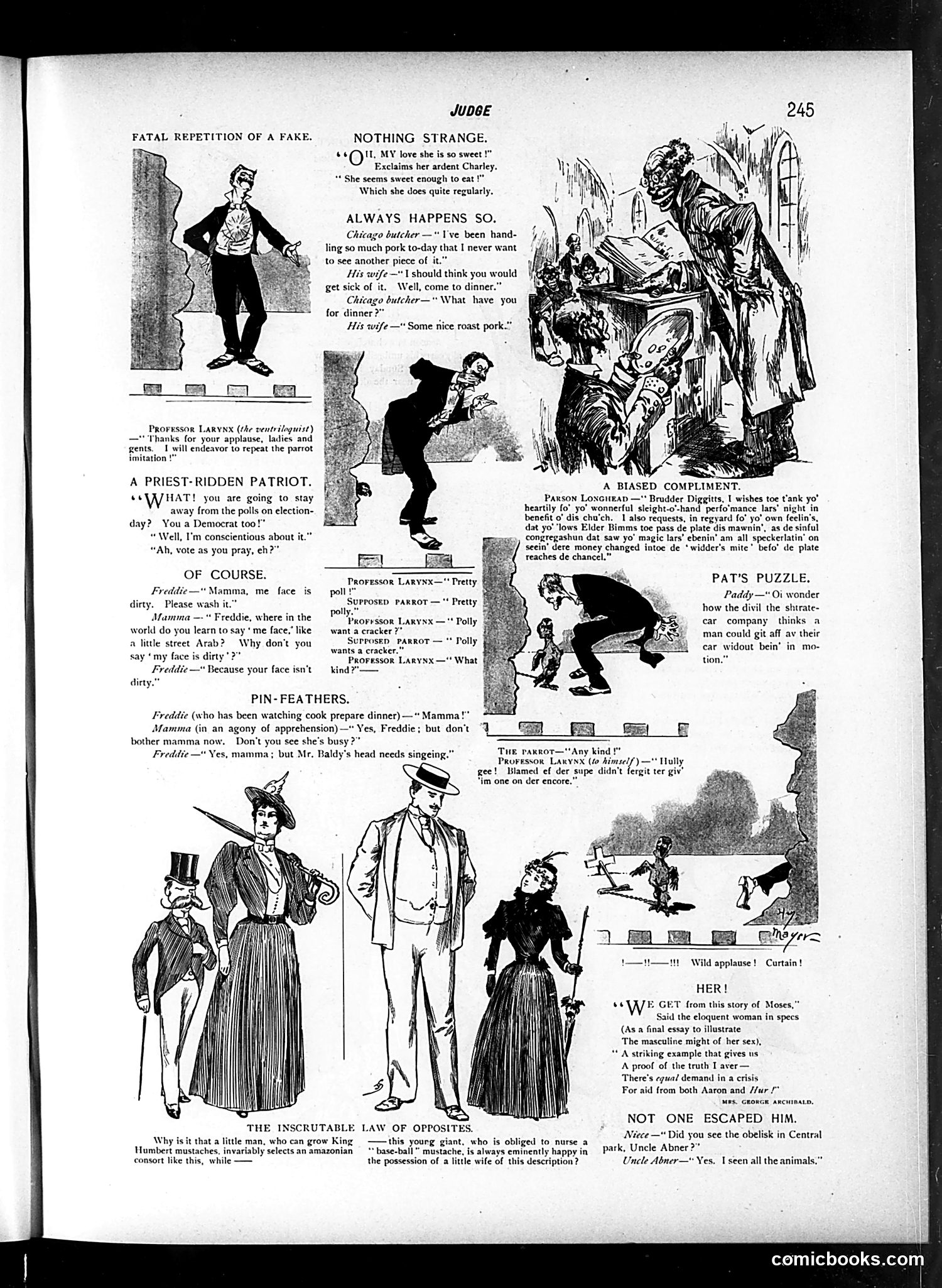
This page collects humorous short pieces typical of Judge's satirical format. Key items include: **"A Priest-Ridden Patriot"**: Satirizes Irish-Catholic Democrats, suggesting priests discourage voting. The phrase "vote as you pray" mocks the stereotype of Catholic clergy controlling parishioners' political behavior. **"Always Happens So"**: A domestic humor piece where a Chicago butcher, exhausted from handling pork, comes home to pork for dinner—ironic repetition played for laughs. **"Pin-Feathers"**: A child-rearing joke where young Freddie, watching dinner prep, innocently suggests the bald cook's head needs singeing like a chicken. **"A Biased Compliment"**: Features dialect humor with a Black minister (Parson Longlegs) whose compliment about parishioner magic tricks is undercut by implying the congregation suspects sleight-of-hand during collection plate passing. **Minor pieces** mock ventriloquists, street children's accents, Irish laborers ("Pat's Puzzle"), and gender roles. The page reflects early 1900s mainstream humor: ethnic/racial caricature, class-based satire, and domestic comedy typical of the era's popular magazines.
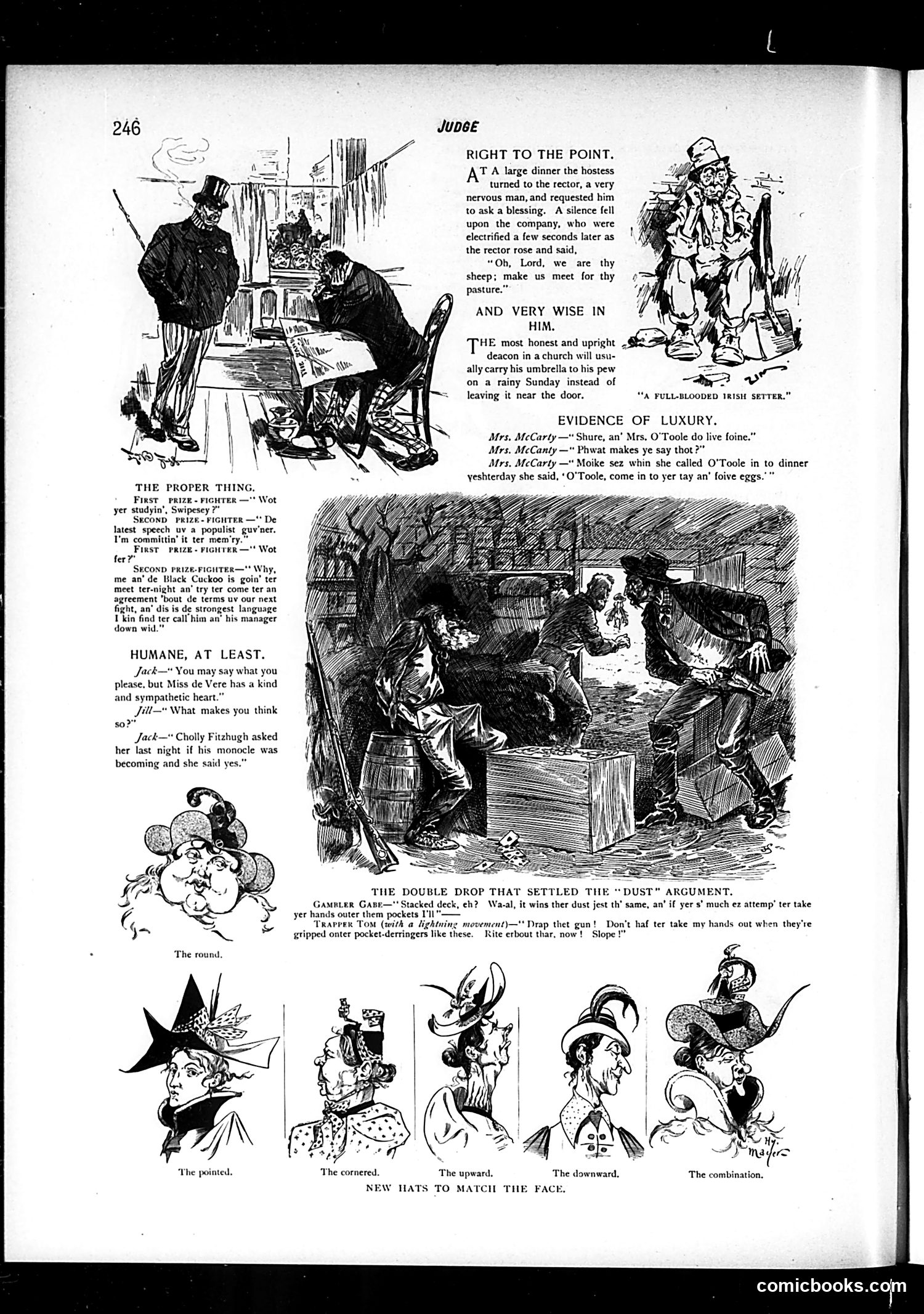
This page contains several short satirical items typical of late-19th-century American humor: **Top sections** mock social pretense: a nervous rector's malapropism about sheep at a formal dinner; hypocrisy about umbrellas; and Irish working-class characters ("Mrs. McCarty," "O'Toole") mispronouncing "tea" as "tay" to suggest they're imitating wealth they can't afford. **Middle sections** include prize-fighters memorizing populist political speeches to use as insults (referencing the Populist movement's inflammatory rhetoric), and a sentimental joke about a woman's kindness. **"The Double Drop"** depicts a Wild West card-game shooting, with pocket derringers settling a cheating dispute—typical Old West frontier humor. **Bottom section** shows five hat designs captioned as matching different face types—visual satire on fashion trends. The overall tone reflects Judge's standard late-1800s formula: mocking immigrants' speech patterns, working-class pretension, populist politics, and contemporary fashions.
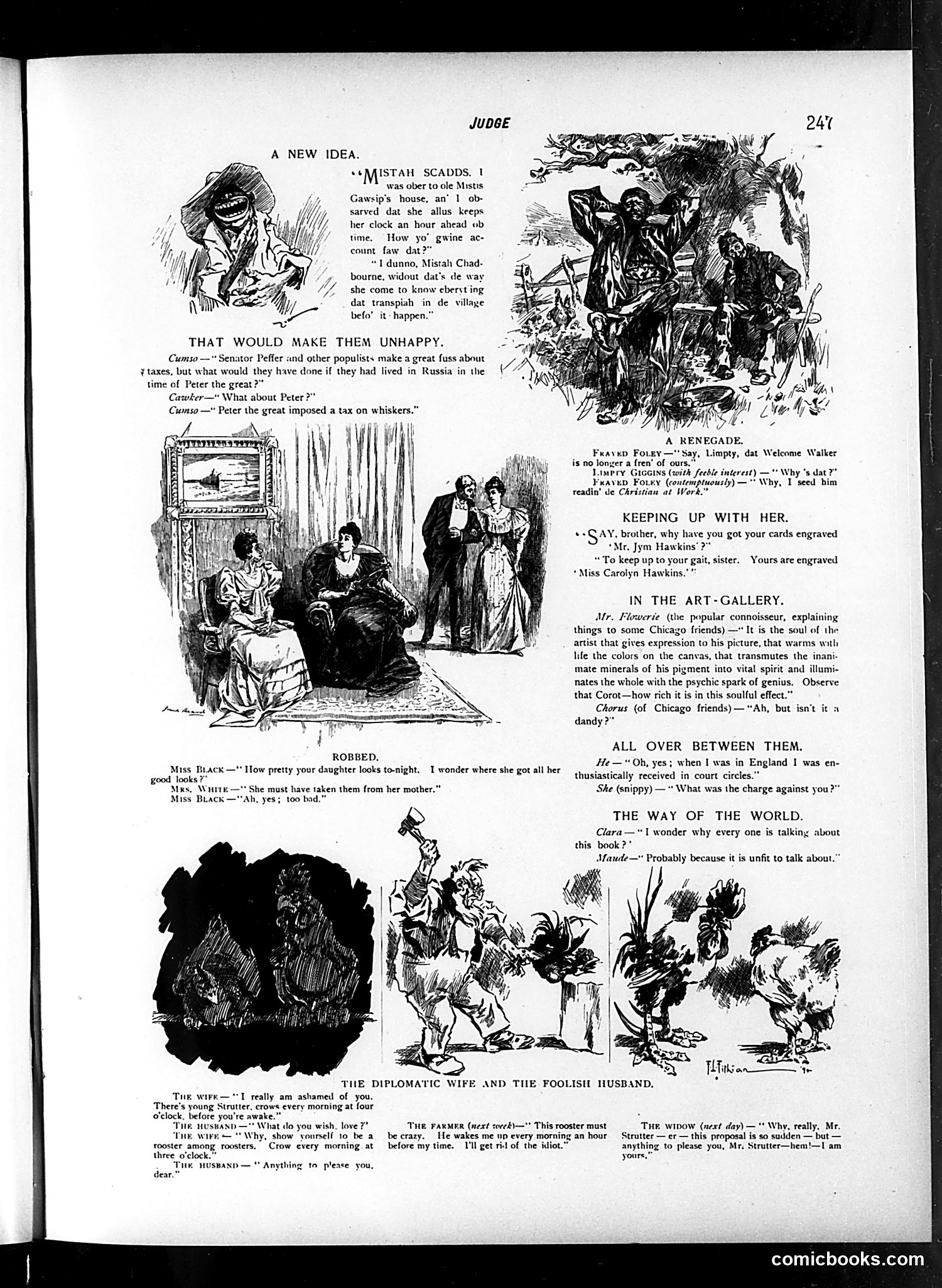
This page contains multiple disconnected satirical vignettes typical of Judge's humor circa the 1890s-1900s. **"A New Idea"** mocks African American dialect and gossip culture—a woman keeps her clock fast to seem informed about village events. **"That Would Make Them Unhappy"** references Senator Peffer and Populist Party complaints about taxes, sarcastically suggesting historical Russian taxation (Peter the Great's whisker tax) as worse. **"A Renegade"** jokes that reading *Christian at Work* magazine marks someone as a traitor to their social group. **"Keeping Up with Her"** satirizes middle-class status anxiety—a brother engraves his cards to match his sister's pretensions. **"In the Art-Gallery"** ridicules pretentious art criticism contrasted with Chicago's plain-spoken pragmatism. **"The Diplomatic Wife/Foolish Husband"** and related cartoons depict marital dynamics and social embarrassment through exaggerated situations (crowing roosters, courtroom scandals). The humor relies on period class consciousness, regional stereotypes, and domestic comedy conventions now largely dated.
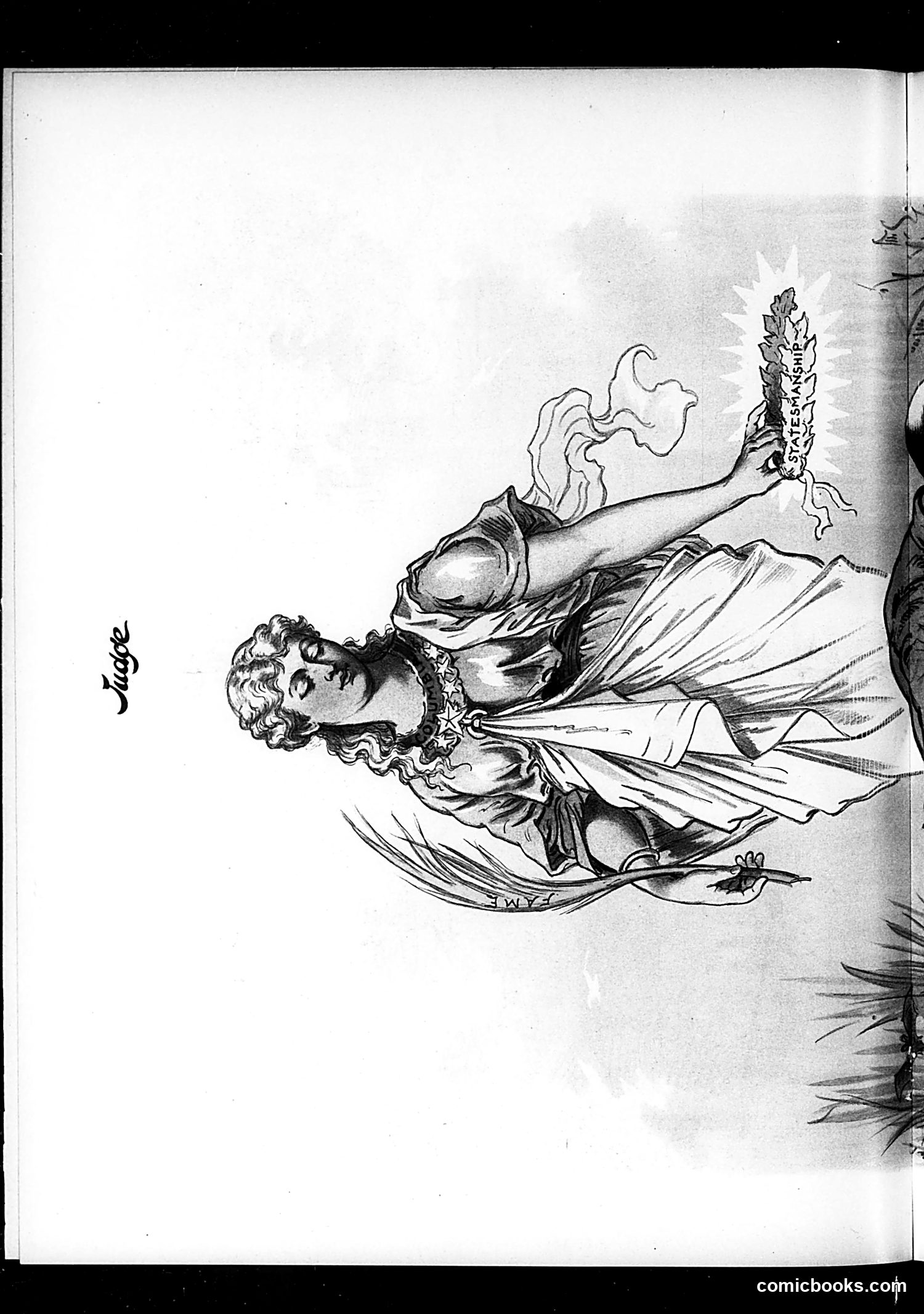
This page is largely illegible due to OCR errors and image quality. However, the illustration is clearly visible: it shows a classical female allegorical figure (likely representing Liberty, Justice, or similar American virtue) in flowing robes, holding what appears to be a torch or flame aloft. She's rendered in the style typical of Judge magazine's satirical engravings. Without legible text, I cannot definitively identify the cartoon's specific political or social target. The classical female figure format suggests commentary on American ideals or institutional values, but determining the precise satirical point—what aspect of American politics or society is being critiqued—requires readable accompanying text or captions that aren't decipherable here. The artistic quality and composition indicate this was a significant editorial cartoon from Judge's heyday.
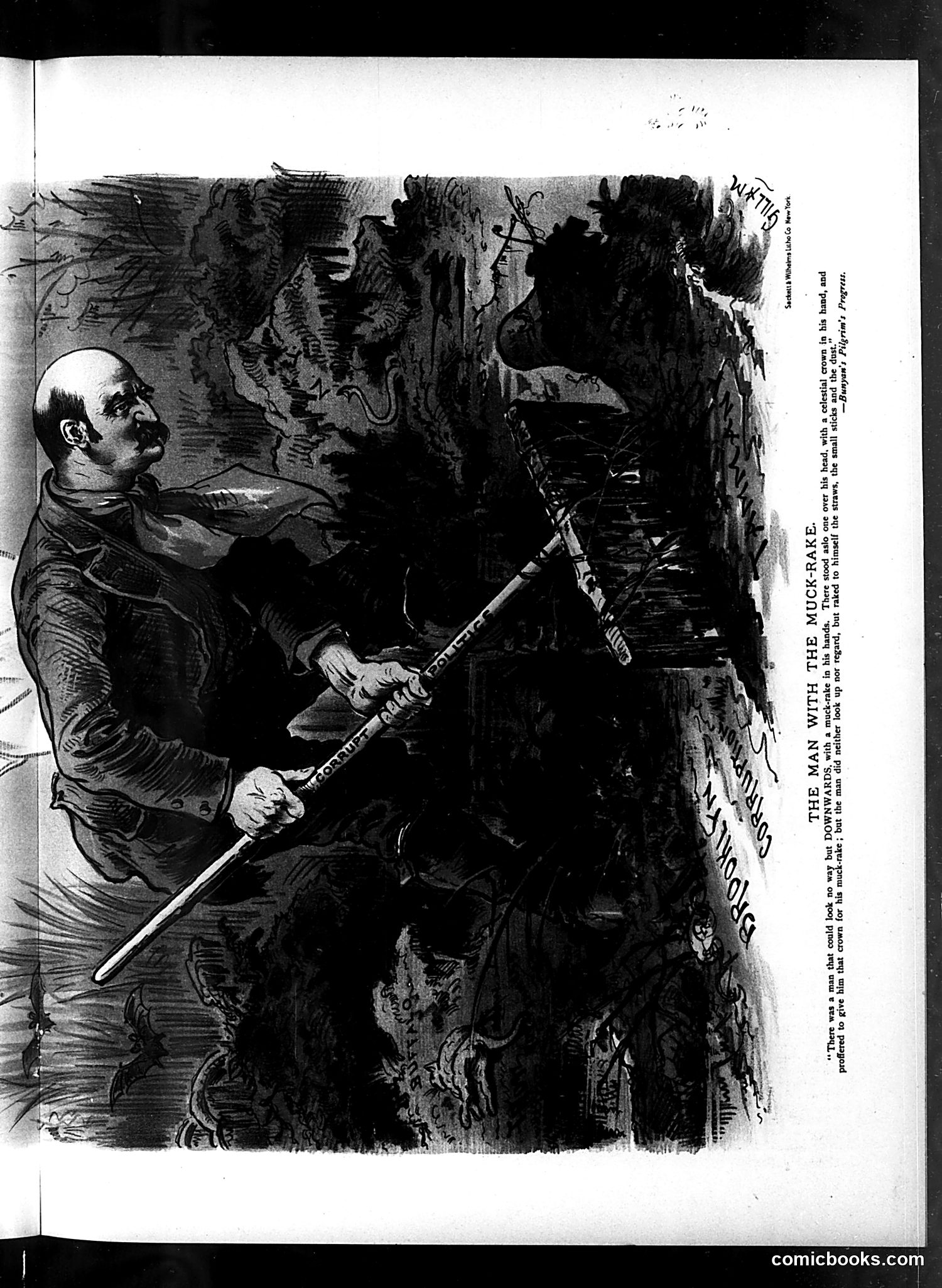
This political cartoon depicts a man wielding a pickaxe, apparently attacking or breaking through what appears to be a fortified structure or wall. The title references "the man with the pickaxe," suggesting this is commentary on labor disputes or destructive agitation. The OCR text is heavily corrupted and largely unreadable, making precise identification difficult. However, based on *Judge* magazine's typical content from the late 19th/early 20th century, this likely satirizes labor unrest, anarchist or radical movements, or social upheaval of that era. The pickaxe as a weapon/tool is probably symbolic of working-class violence or revolutionary destruction. Without clearer text or additional context, I cannot confidently identify the specific figure, political event, or satire target. The cartoon's message appears critical of destructive protest or radicalism, but the exact historical reference remains unclear.
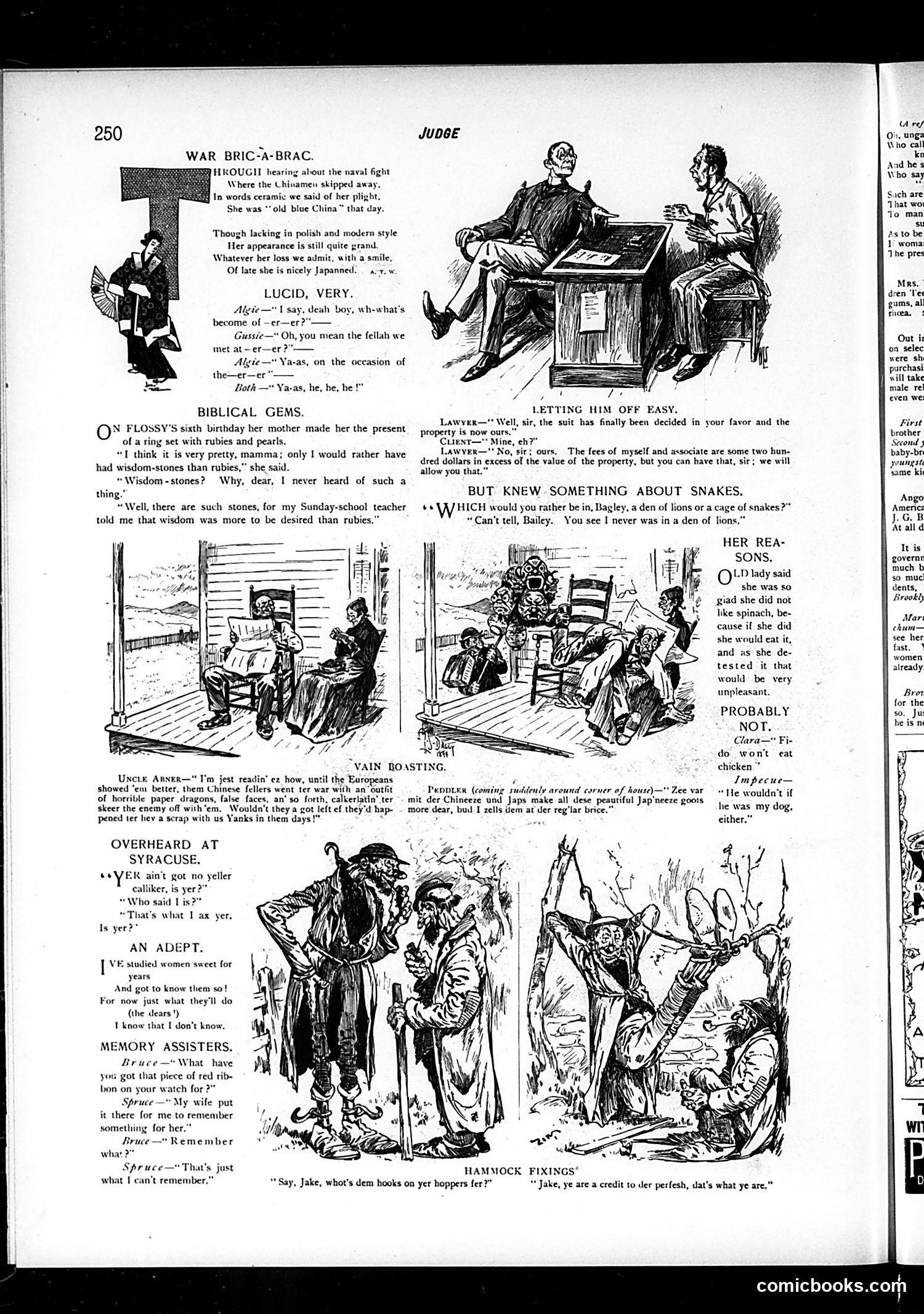
This Judge magazine page (circa early 1900s) contains satirical commentary on the Russo-Japanese War and various humorous observations: **"War Bric-à-Brac"** mocks China ("old blue China") as damaged and outdated following the naval conflict, while she's been "Japanned" (finished like lacquerware by Japan's victories). **"Letting Him Off Easy"** satirizes lawyers as greedy—they charge fees exceeding the property value they supposedly won. **"But Knew Something About Snakes"** is wordplay: the character never visited a lion's den, so cannot compare dangers. **"Vain Roasting"** contrasts China's "horrible paper dragons" in warfare with a German immigrant boasting American military superiority, ironically as if the U.S. would have dominated China in combat. The other sketches ("Lucid, Very," "Biblical Gems," "Memory Assisters," "Hammock Fixings") are generic social humor about absent-minded men and domestic absurdities—timeless comedy not requiring historical context.
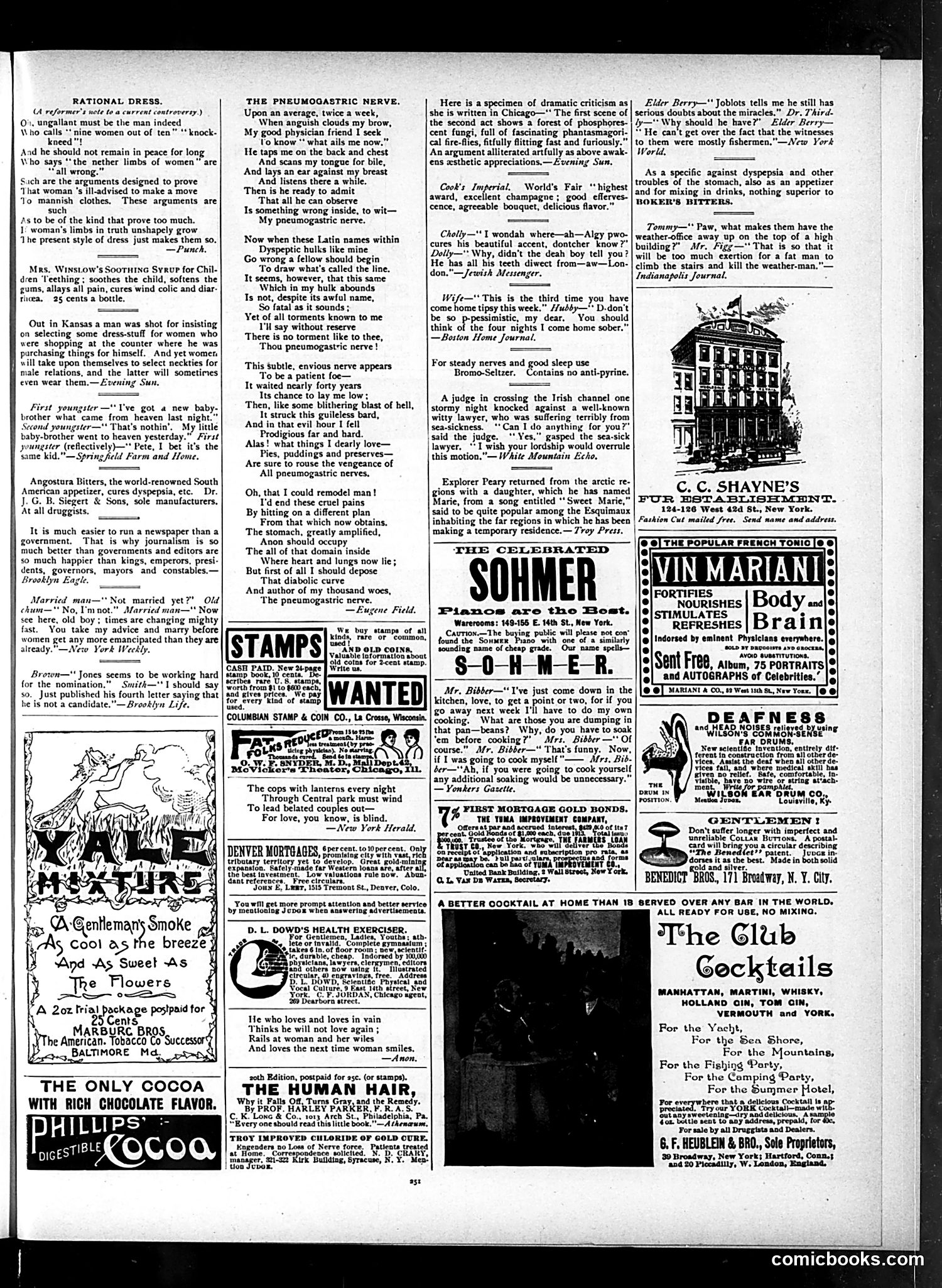
This page contains primarily **advertising and miscellaneous short humor pieces**, not political cartoons with sustained satirical messaging. The notable content includes: **"Rational Dress"** — A brief poem defending women wearing practical clothing against critics who claim women's limbs are "unshapely." It's satirizing anti-feminist arguments by pointing out that restrictive Victorian dress actually *creates* the supposed problems it claims to address. **"The Pneumogastric Nerve"** — A humorous poem about a man's chronic digestive complaints, blaming his vagus nerve (the "pneumogastric"). It's self-deprecating medical humor, common to the era. **Surrounding material** consists entirely of **patent medicine ads** (Angostura Bitters, Mrs. Winslow's Soothing Syrup), tobacco advertising, cocoa promotions, and various small jokes and notices—typical of Judge magazine's revenue model. The page reflects early 1900s concerns about women's fashion reform and contemporary preoccupations with digestive health, but lacks sustained political satire.
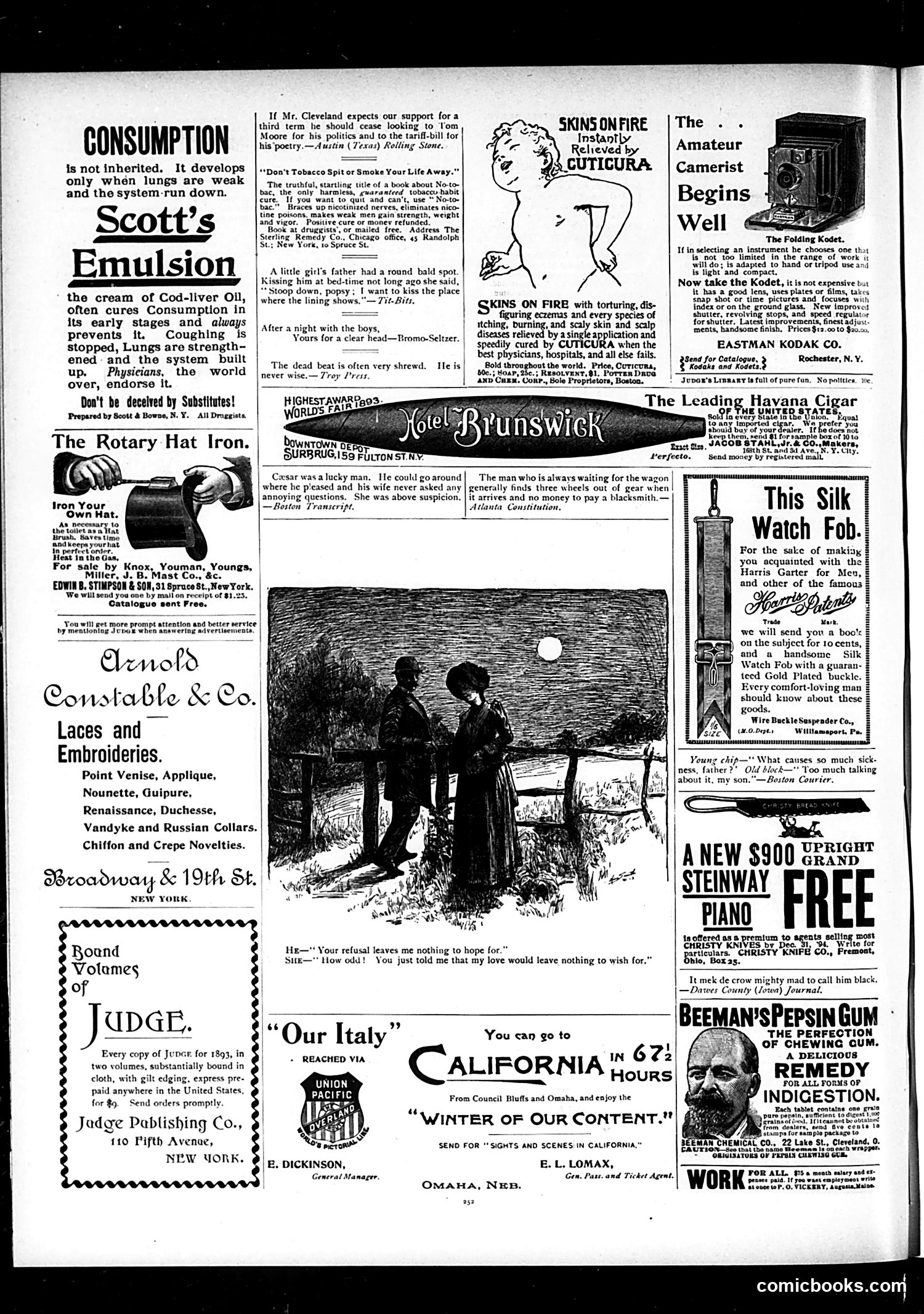
This is primarily a **advertisements page** from Judge magazine, circa 1893, with one prominent political cartoon and various product ads. The **main cartoon** (center) depicts two figures in silhouette against a moonlit landscape with the caption: "He: 'Your refusal leaves me nothing to hope for.' She: 'How old! You just told me that my love would leave nothing to wish for.'" This is a **romantic satire**—a gentleman's logic is exposed as contradictory. He claims rejection leaves him hopeless, yet moments before claimed her love was perfectly fulfilling. The joke mocks male inconsistency in courtship rhetoric. At the **top left**, there's a brief political jab at President Cleveland, suggesting he abandon tariff politics for "Tom Moore" (likely a reference to Irish poet/politics) if seeking support for a third term—essentially dismissive criticism. The remainder consists of period **patent medicines and products** (Scott's Emulsion for consumption, No-to-bac tobacco cure, Cuticura for skin conditions) typical of 1890s magazine advertising—many making dubious health claims by modern standards.
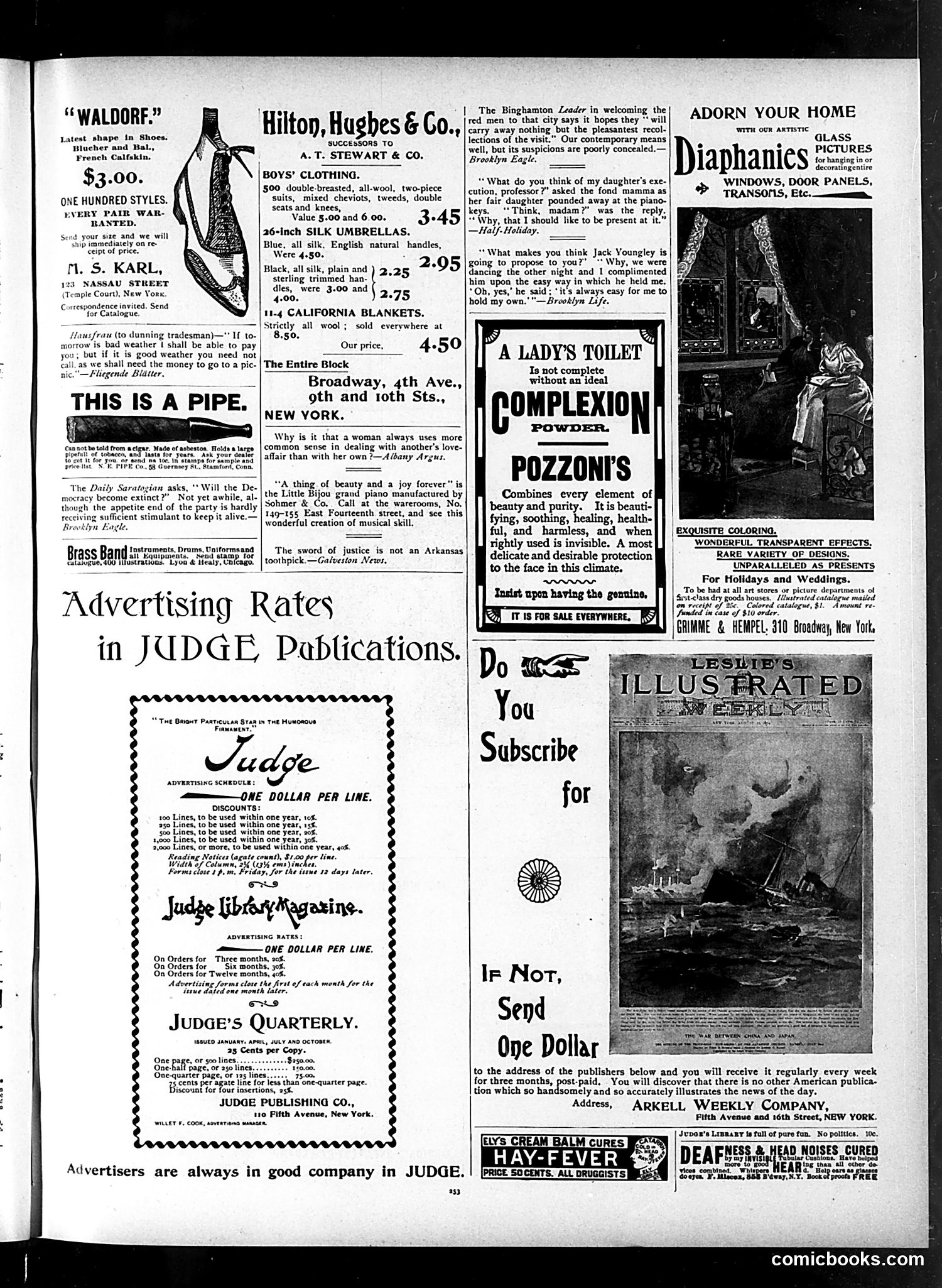
This page is primarily **advertising** for Judge Publications, with various retail and product advertisements scattered throughout. The few editorial/satirical elements include: 1. **"THIS IS A PIPE"** – A brief quip from the Daily Democracy suggesting the Democratic Party remains alive only through appeasing its appetite for patronage/spoils, barely receiving enough "stimulant" to survive. 2. **Three short humorous observations** on the page margins: - A joke about why women handle others' romantic affairs better than their own (attributed to Albany Argus) - A comment that "the sword of justice is not an Arkansas toothpick" (Galveston News) - A quip about a housewife telling a tradesman she can only pay if tomorrow is bad weather, otherwise she's going to the pictures—satirizing household financial priorities These are light, domestic humor pieces rather than sharp political satire. The page reflects Judge's typical format: mixing advertising revenue with brief comedic observations and social commentary.
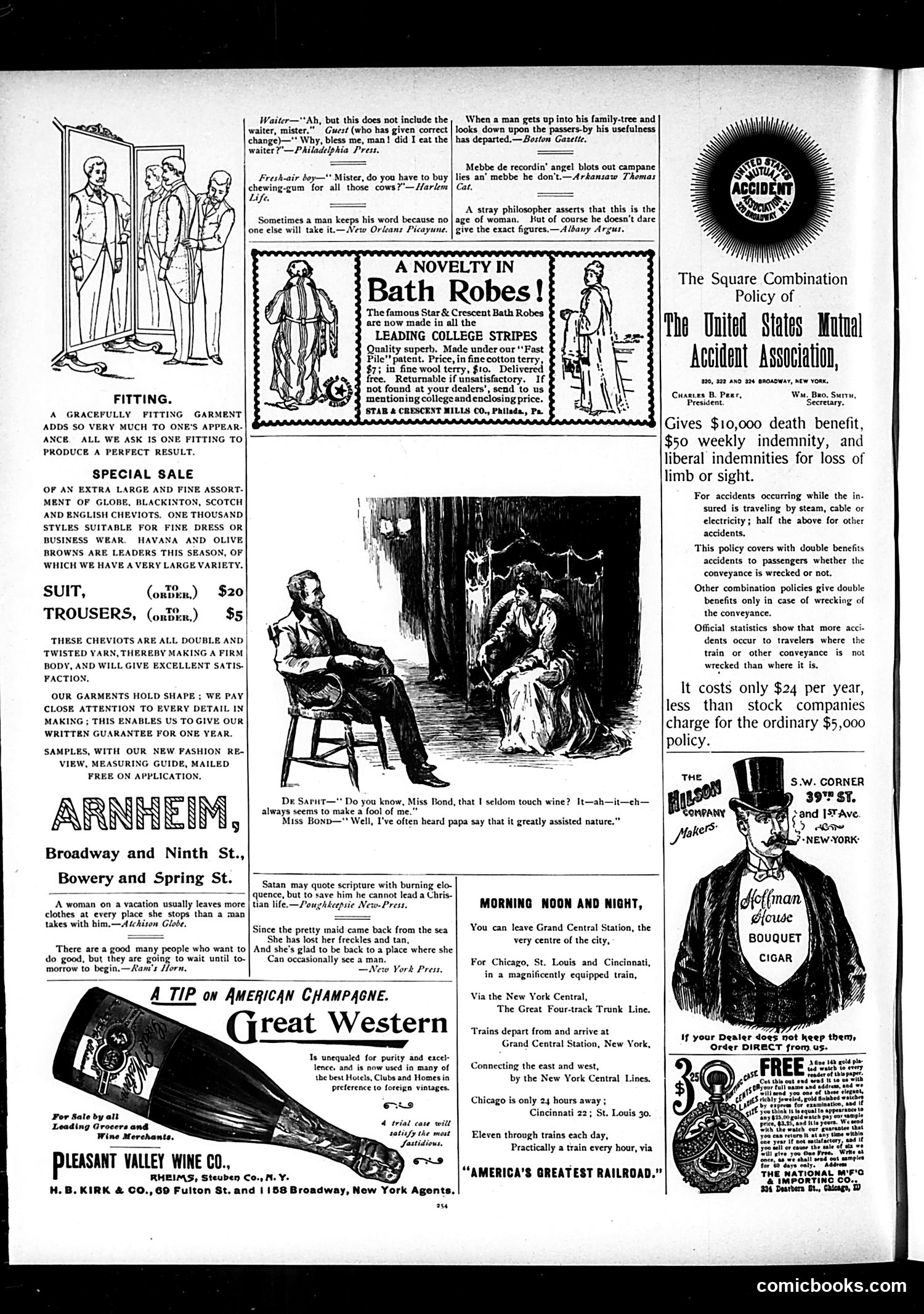
This page is primarily **advertising and filler content** rather than political satire. It contains: **Main content:** Multiple commercial advertisements for clothing (Arnheim suits), bath robes, wine, cigars, and railroad services (New York Central). **Small humor pieces:** Brief, attributed jokes from various newspapers about everyday situations—a waiter confusion, a fresh-air boy, marital dynamics, and religious hypocrisy. These appear to be reprinted wit from other publications rather than original satire. **Visual elements:** A pen-and-ink cartoon labeled "FITTING" showing three men in formal wear (likely discussing tailoring), and a separate sketch of two figures in conversation about wine. The page reflects Judge's mixed editorial approach: combining satirical cartoons with reprinted humor and substantial advertising revenue. The jokes target no specific political figures or events—they're generic observations about human behavior meant for broad appeal.
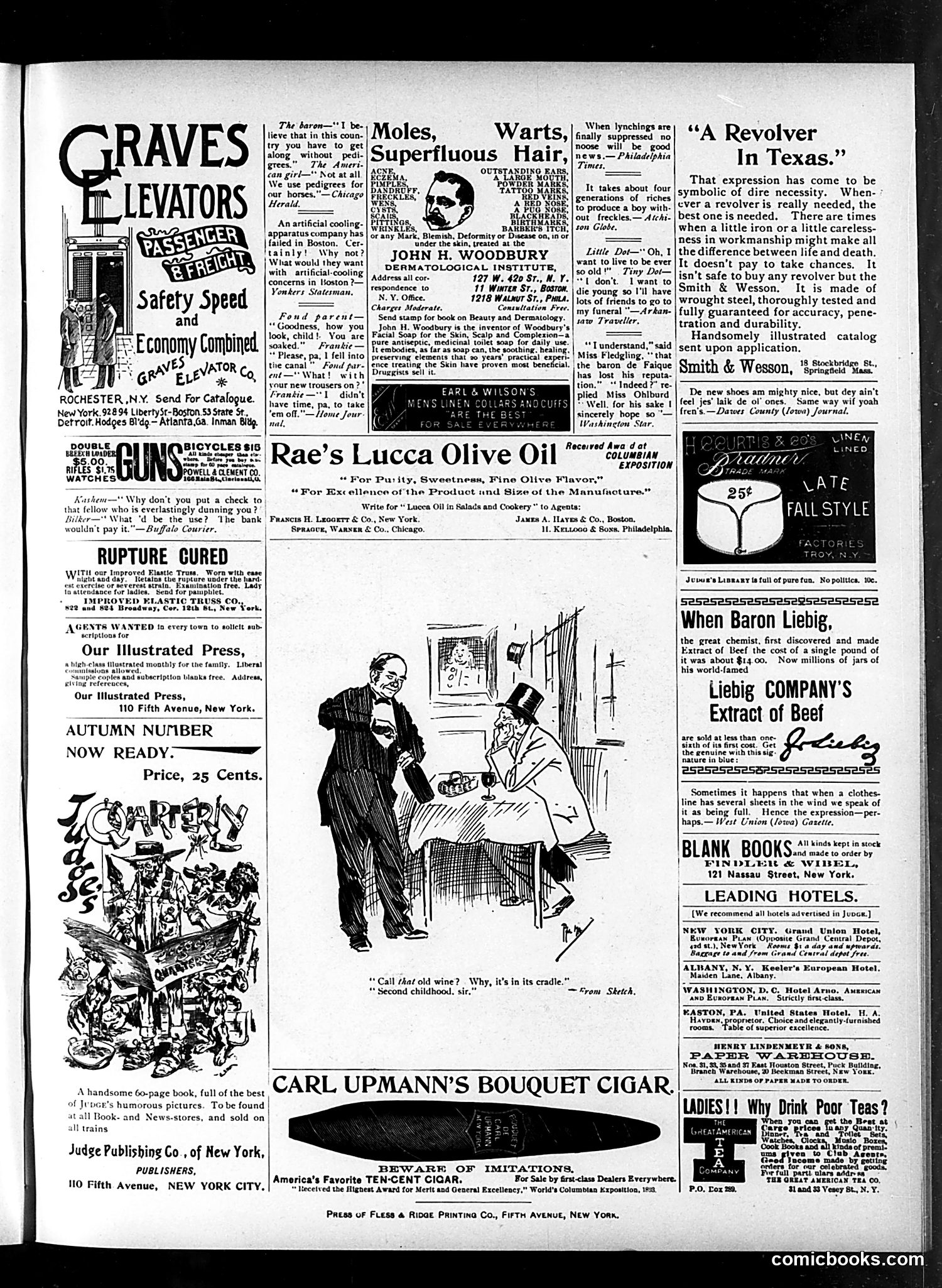
The main cartoon depicts a social interaction between two men at a dining table. An elegantly dressed waiter or servant presents a wine bottle to a well-dressed gentleman customer. The man examining the bottle skeptically says, "Call that old wine? Why, it's in its cradle" — meaning the wine is far too young. The second man replies, "Second childhood, sir," a witty rejoinder suggesting the first man is senile or foolish for complaining about genuinely old wine, or perhaps critiquing his gullibility. **The satire targets**: consumer fraud and pretension. The joke likely plays on the period's wine-selling practices, where restaurants or sellers might pass off cheap, young wines as expensive aged varieties to wealthy customers. The rest of the page comprises period advertisements (cigars, dermatology services, olive oil, elevators) and shorter humorous quips on topics like lynching, death, and banking.
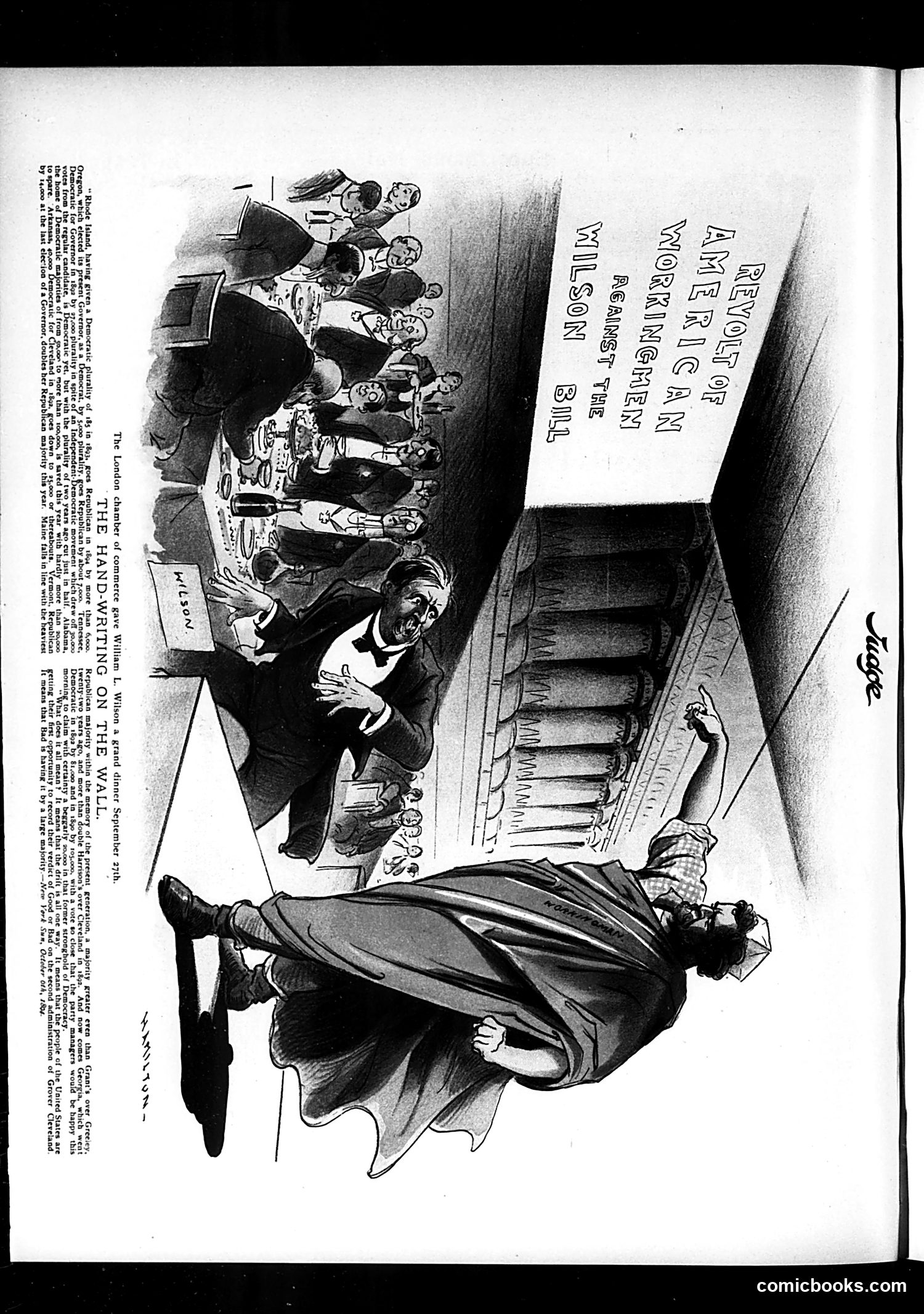
This cartoon satirizes **William L. Wilson**, apparently a Democratic politician who received a grand dinner from the London Chamber of Commerce on September 27th. The title references the biblical "writing on the wall"—an omen of doom. The satire suggests that Wilson's acceptance of honors from British business interests signals trouble for the Democratic Party. The OCR'd text references electoral data comparing votes to previous elections (Grant vs. Greeley, Cleveland in 1852), implying this foreign endorsement represents a political liability rather than achievement. The figure in the lower right appears distressed, possibly representing the Democratic Party or American interests harmed by what's depicted as unpatriotic fraternization with British commerce. The cartoon likely criticizes Wilson for appearing too aligned with British business concerns during a period of American protectionist sentiment, or for prioritizing foreign relations over domestic party interests.