
A complete issue · 16 pages · 1894
Judge — October 6, 1894
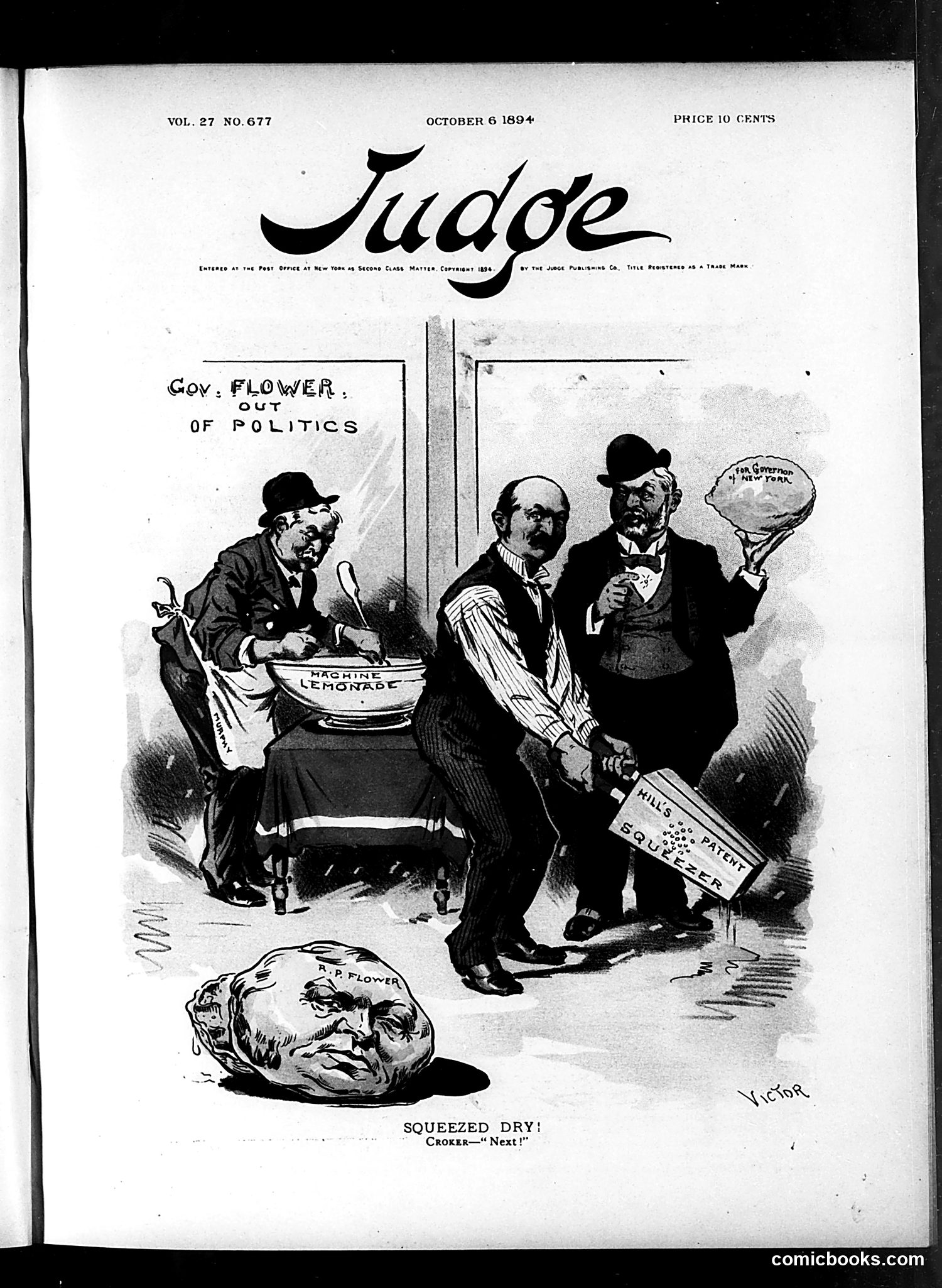
This 1894 Judge cartoon satirizes Governor Roswell P. Flower of New York stepping away from politics. The image shows three men operating a "machine lemonade" stand, with one figure squeezed dry at the bottom, labeled "squeezed dry! Croker—Next!" The satire equates politics to a lemonade machine that extracts and discards politicians. Flower appears to be the squeezed-out figure, while the standing men hold signs referencing "for Governor of N.Y." and "Mills's Patent Squeezed Squeezer"—apparently mocking the mechanical, exploitative nature of the political machine run by Boss Croker (likely Richard Croker of Tammany Hall). The cartoon suggests politicians are used up and discarded by party machinery.
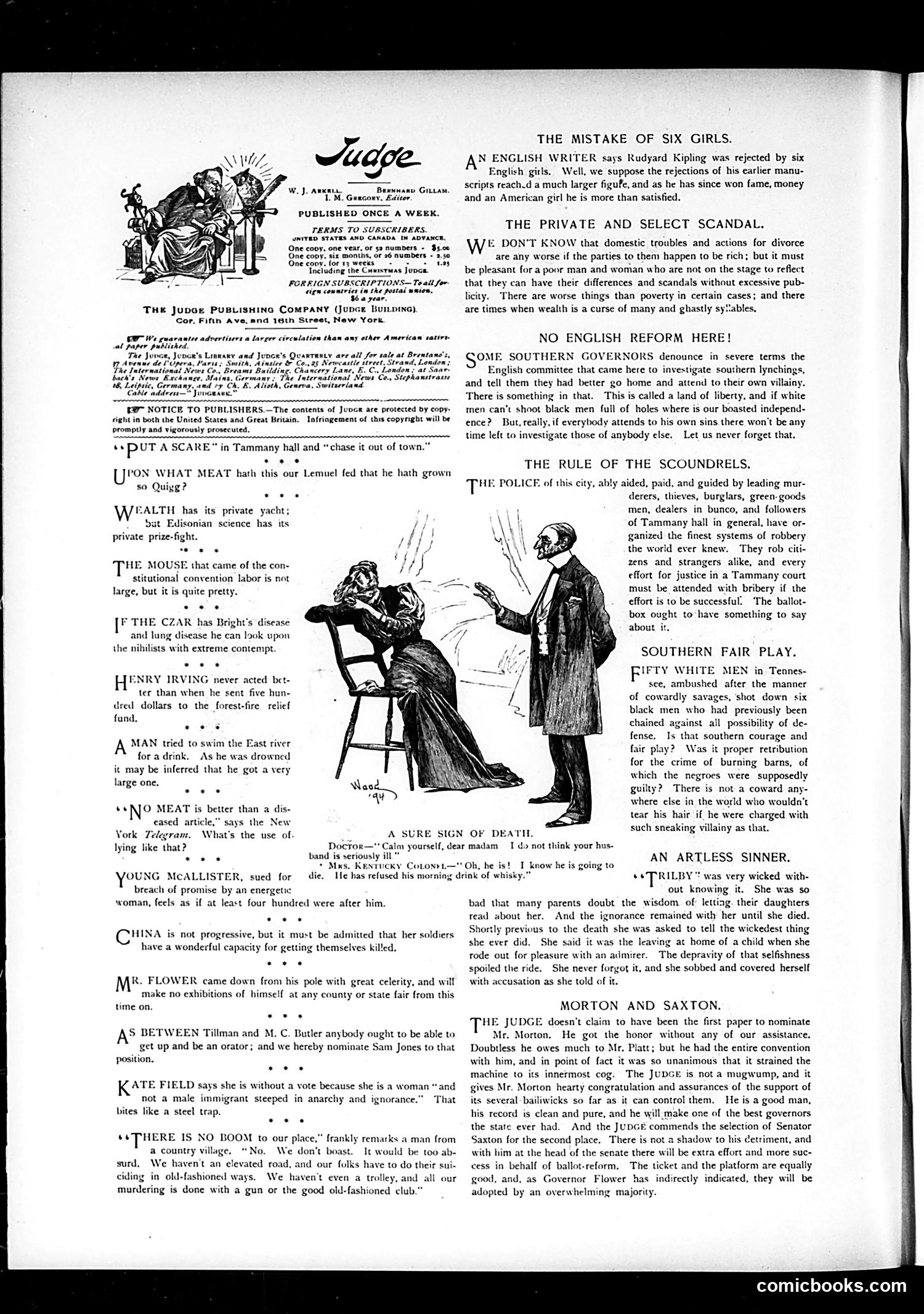
The main cartoon, titled "A Sure Sign of Death," depicts a doctor telling a woman patient to "Calm yourself, dear madam" while she sits distressed in a chair. The joke appears to be about a patient's dire prognosis—the doctor's reassurance itself signals hopelessness, as if his platitudes confirm the worst outcome. Below are several brief satirical items mocking contemporary figures and situations: criticisms of political reform efforts, commentary on police corruption in Tammany Hall (New York's notorious Democratic machine), and jabs at Southern violence and lynching. The page reflects Judge's late-19th/early-20th century focus: attacking urban political corruption, social hypocrisy, and racial violence through sharp wit and visual humor.
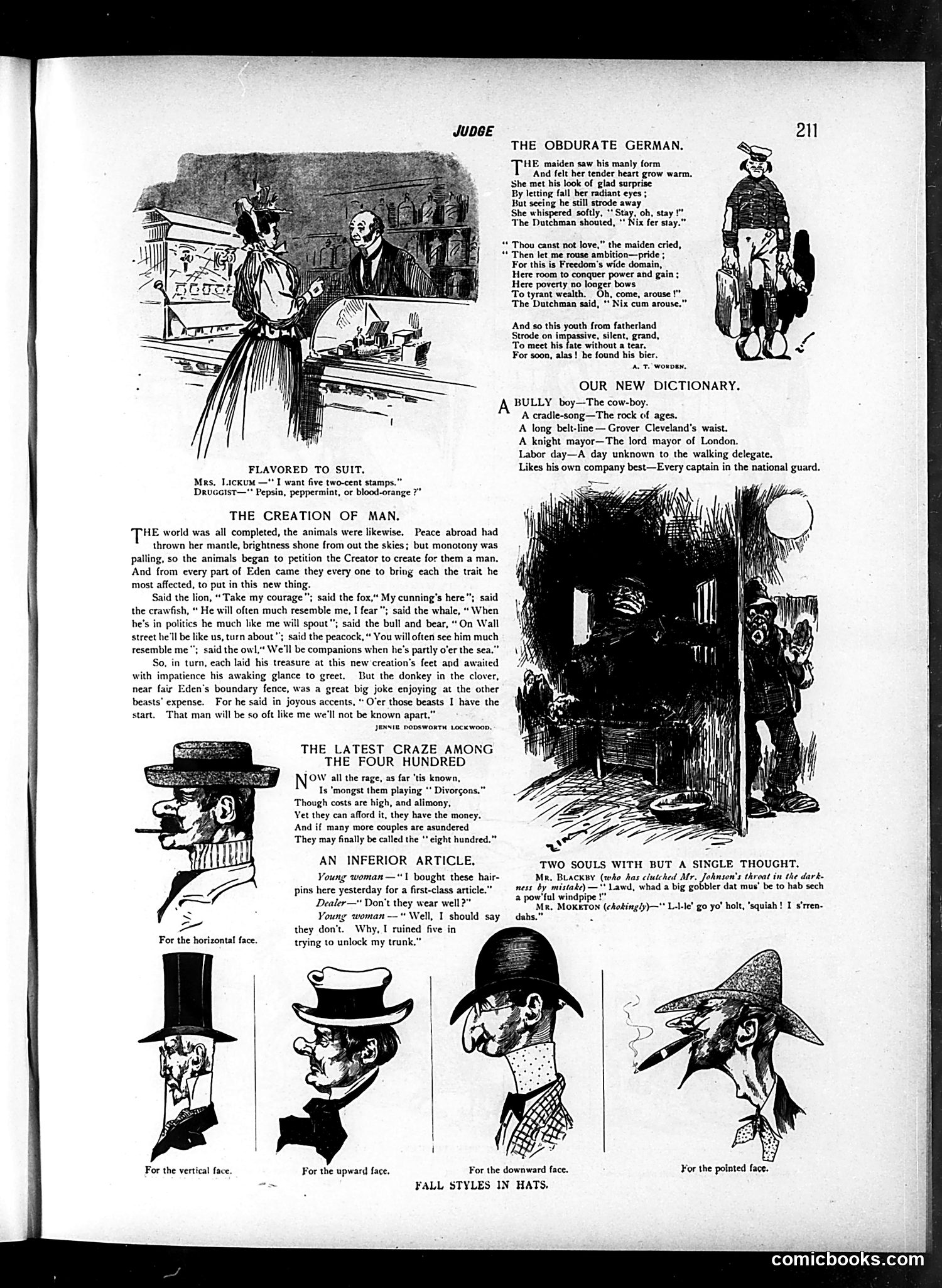
The top illustration depicts "The Obdurate German"—a romantic poem about a maiden and a Teuton youth. The accompanying sketch shows a German soldier figure, likely referencing contemporary German militarism or immigration debates. Below are humorous dictionary definitions ("Our New Dictionary") mocking contemporary slang and social figures, including references to "Grover Cleveland's waist" (the U.S. president's weight). The page includes various satirical pieces: "The Creation of Man" (a fable about animal traits), commentary on "The Four Hundred" (New York's wealthy elite), and fashion satire with "Fall Styles in Hats" showing exaggerated hat designs for different face shapes. The overall tone is typical late-19th century American satire—mixing political commentary, social mockery, and visual humor targeting the wealthy, immigrants, and contemporary figures.
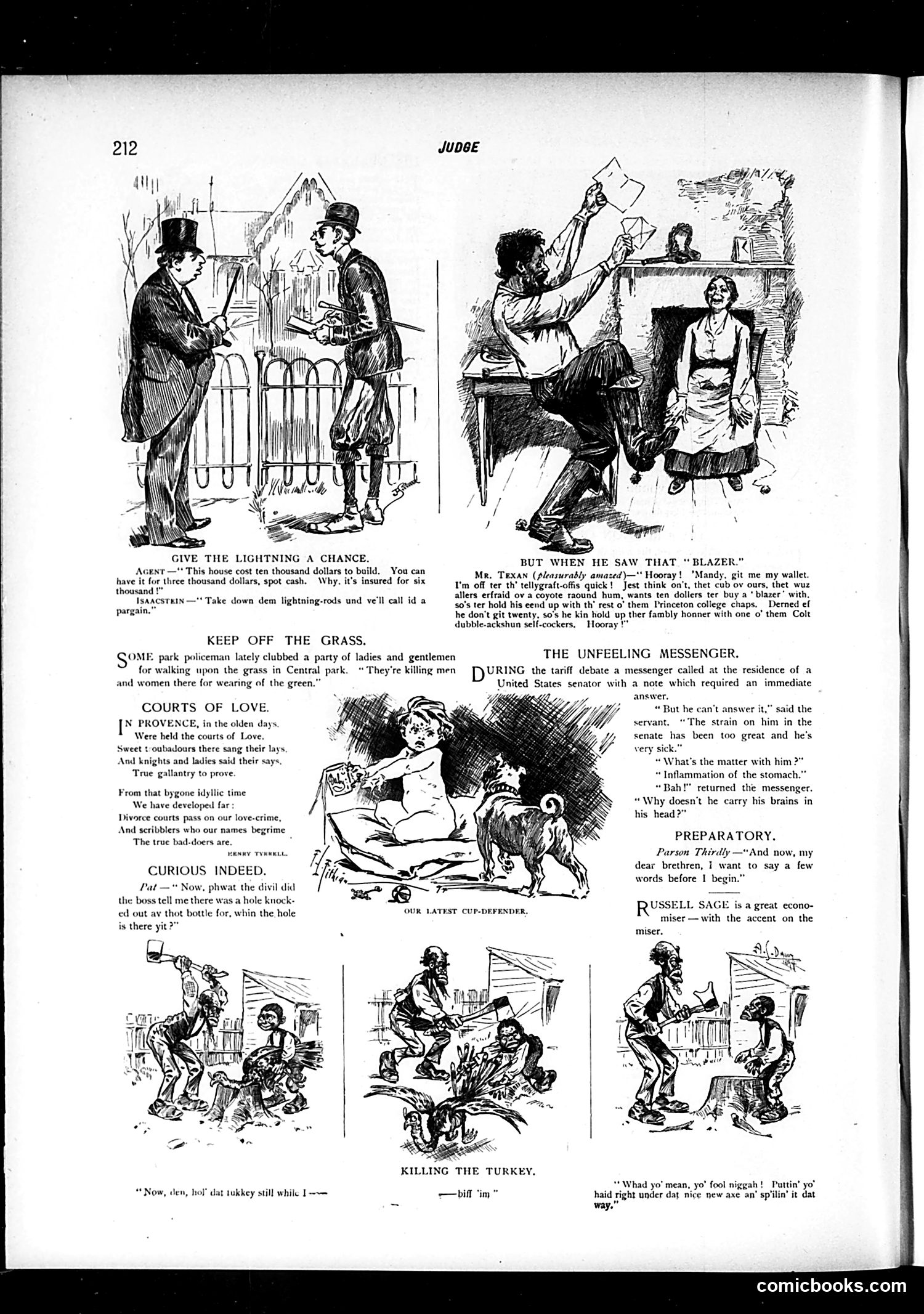
This page contains multiple satirical sketches mocking contemporary social issues and stereotypes circa the 1880s-90s: **"Give the Lightning a Rod"**: Depicts Jewish characters (Isaacstein) allegedly trying to defraud insurance by removing lightning rods from a house, playing on antisemitic stereotypes about Jewish financial dishonesty. **"Keep Off the Grass"**: References a real incident where Central Park police allegedly clubbed park visitors; the reference to "wearing of the green" suggests Irish immigrants were targets. **"But When He Saw That 'Blazer'"**: Mocks a wealthy Texan's son wanting a college blazer—satire on nouveau-riche pretension and status anxiety. **"The Unfeeling Messenger"**: Jokes about a senator's convenient illness during tariff debates, suggesting cowardice. **"Killing the Turkey"**: Contains racist dialect humor with Black characters, typical of the era's deeply offensive caricature comedy. The page reflects Judge's use of ethnic and racial stereotyping as standard satirical tools of the period.
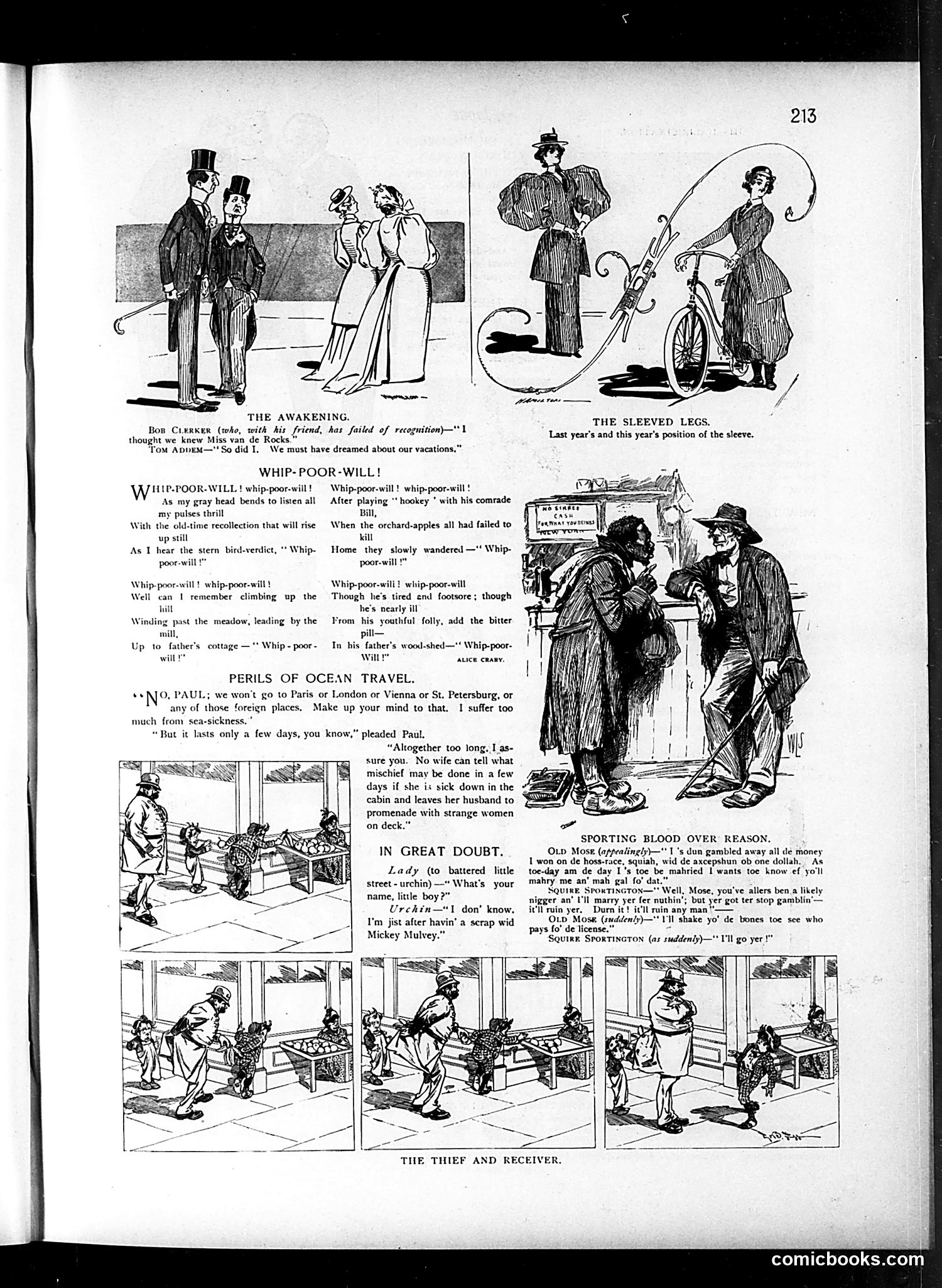
**"The Awakening"** satirizes social pretension. Two men who believed they recognized Miss van de Rocks during vacation realize they were mistaken—suggesting either poor memory or that the woman deliberately avoided them. The joke targets how people fabricate social connections. **"Whip-Poor-Will"** is nostalgic poetry evoking rural childhood memories triggered by the bird's call. **"Perils of Ocean Travel"** jokes about a wife's jealousy: she refuses European travel because she fears her husband will flirt with women on deck while she's seasick below. It satirizes both marital suspicion and the social dynamics of ocean liner travel. **"Sporting Blood Over Reason"** depicts Old Mose, depicted in period-typical dialect as a Black man, who gambled away wedding money. Rather than reform, he suggests betting on dice to determine who pays the marriage license fee—the Squire absurdly agrees. The satire targets gambling addiction and impulsive behavior. **"The Thief and Receiver"** comic strips show a street urchin stealing from an elderly woman's purse while she questions him—illustrating criminal exploitation.
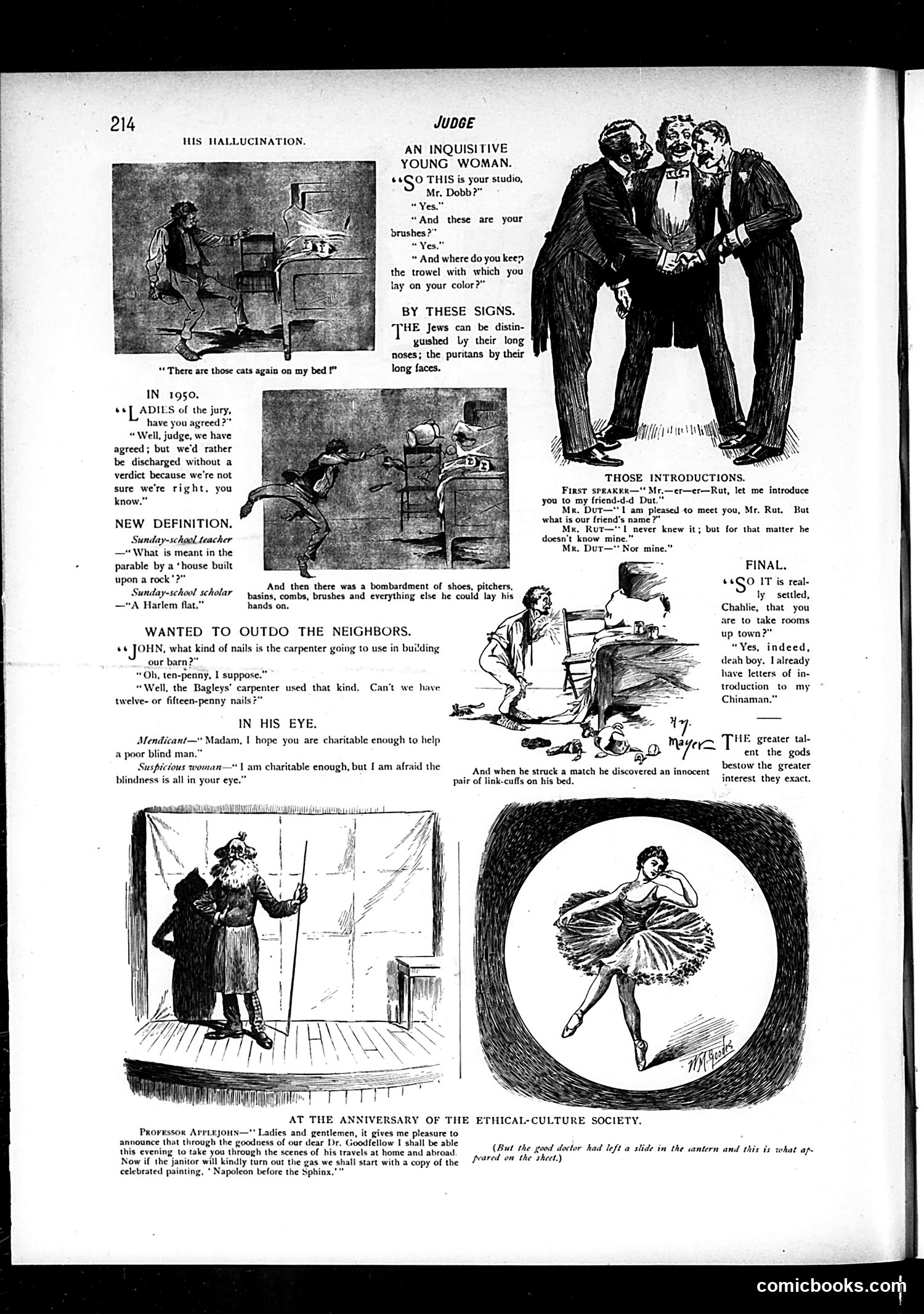
This page contains multiple brief satirical items typical of Judge's format: **"By These Signs"** mocks ethnic and religious stereotyping, listing supposedly identifying physical characteristics of Jews (long noses) and Puritans (long faces)—presenting bigoted caricatures as absurd "signs." **"In 1950"** satirizes jury deliberation, with jurors admitting they've agreed on a verdict but want discharge anyway because they're uncertain—mocking legal proceedings and juror competence. **"Those Introductions"** jokes about social awkwardness when introducing strangers who don't actually know each other's names. **"Final"** depicts domestic chaos after a bombardment of household objects. **"In His Eye"** presents a beggar with link-cuffs (shackles), suggesting he's not genuinely disabled—playing on suspicions about panhandlers' authenticity. **"Anniversary of the Ethical-Culture Society"** features a lecture mishap where a risqué slide remained in the projector instead of the intended Napoleon image—humor based on accidental indecency. The page reflects early-to-mid 20th-century American satire: casual ethnic stereotyping, domestic comedy, and institutional critique.
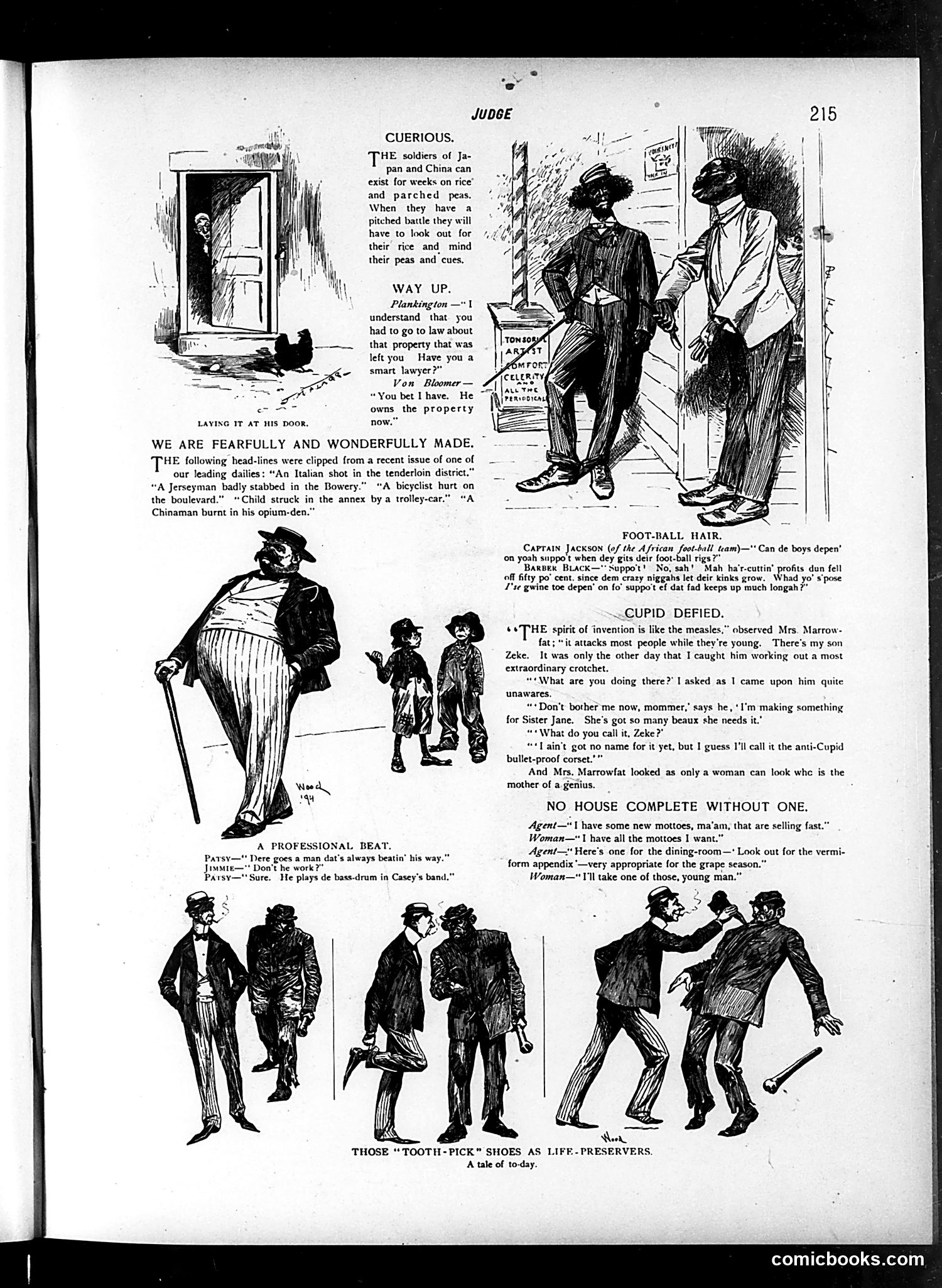
This page contains multiple satirical cartoons and jokes typical of early 20th-century American humor: **"Curious"** mocks the Russo-Japanese War by punning that soldiers eating rice and peas should "mind their peas and cues" during battle—a play on billiards terminology. **"Way Up"** jokes about a corrupt lawyer who has become so successful he now owns his client's inherited property, satirizing dishonest legal practices. **"We Are Fearfully and Wonderfully Made"** lists sensational newspaper headlines about urban violence, suggesting American cities are as dangerous as the war zones mentioned earlier. **"Foot-Ball Hair"** uses racist dialect to joke that a Black barber's business has declined because football players have stopped getting haircuts, affecting his profits. **"Cupid Defied"** describes an "anti-Cupid bullet-proof corset" invention—satirizing women's fashion and protective devices against unwanted male attention. **"No House Complete Without One"** advertises humorous household mottoes, including one warning about "vermin" during grape season. The page reflects period attitudes including xenophobia, racism, and satirical commentary on American social follies.
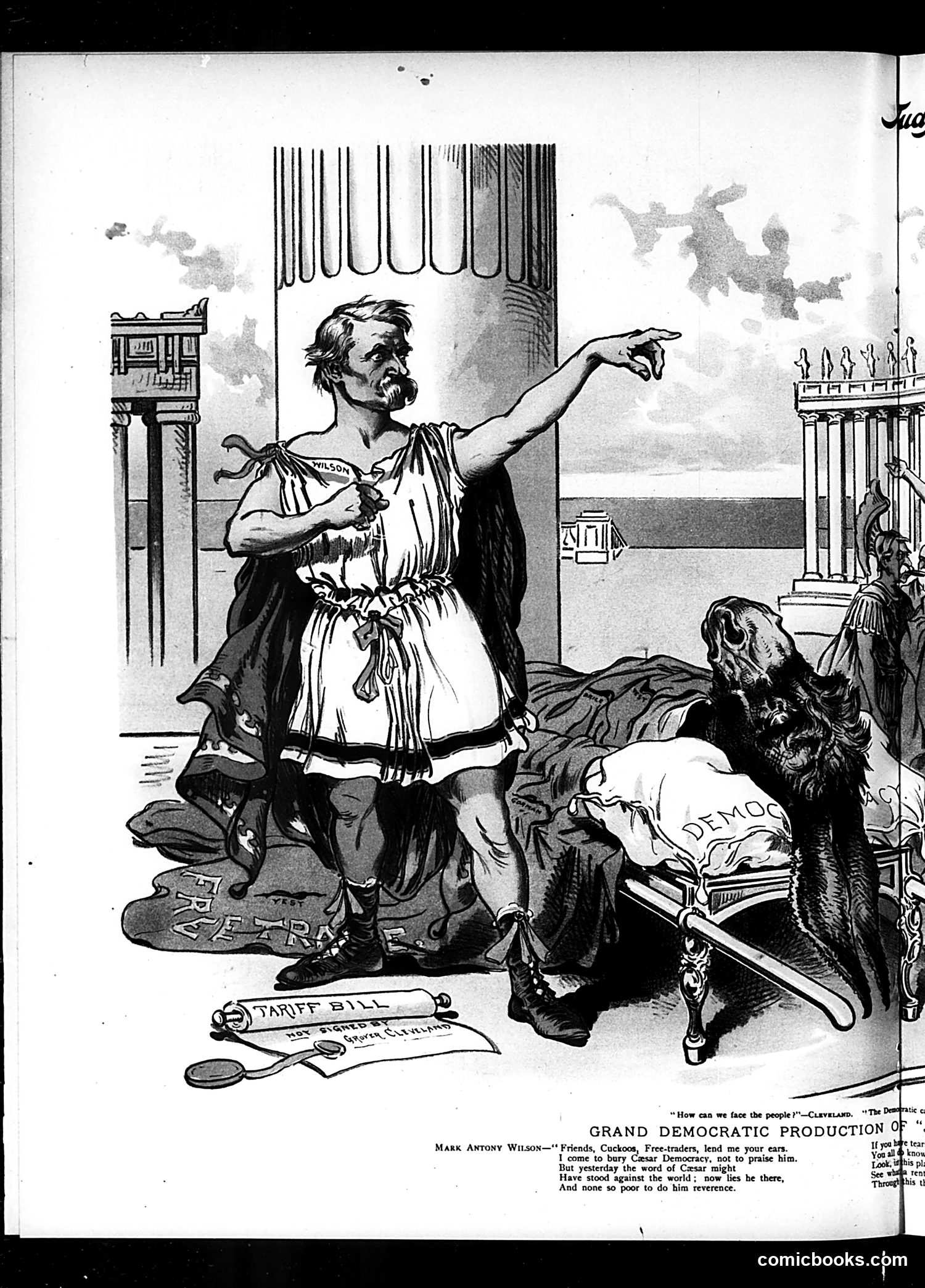
This is a satirical cartoon titled "Grand Democratic Production," referencing Shakespeare's *Julius Caesar*. The central figure appears to be a Democratic politician (likely President Cleveland, based on the speech attribution) dressed as Mark Antony, delivering a funeral oration over "Democracy"—depicted as a dead figure labeled "DEMOS." The satire mocks the Democratic Party's apparent demise or failure, using classical theatrical language to suggest the party has betrayed or failed its own principles. Scattered documents labeled "Tariff Bill" and "Fraude" (likely "Fraud") lie at the base, suggesting specific policy failures or corruption contributed to Democracy's downfall. A donkey—the Democratic Party symbol—kneels nearby in mourning. The cartoon's point: the Democratic leadership has killed or abandoned the party's democratic ideals through failed policies and corruption, ironically using grand rhetoric to mourn what they themselves destroyed.
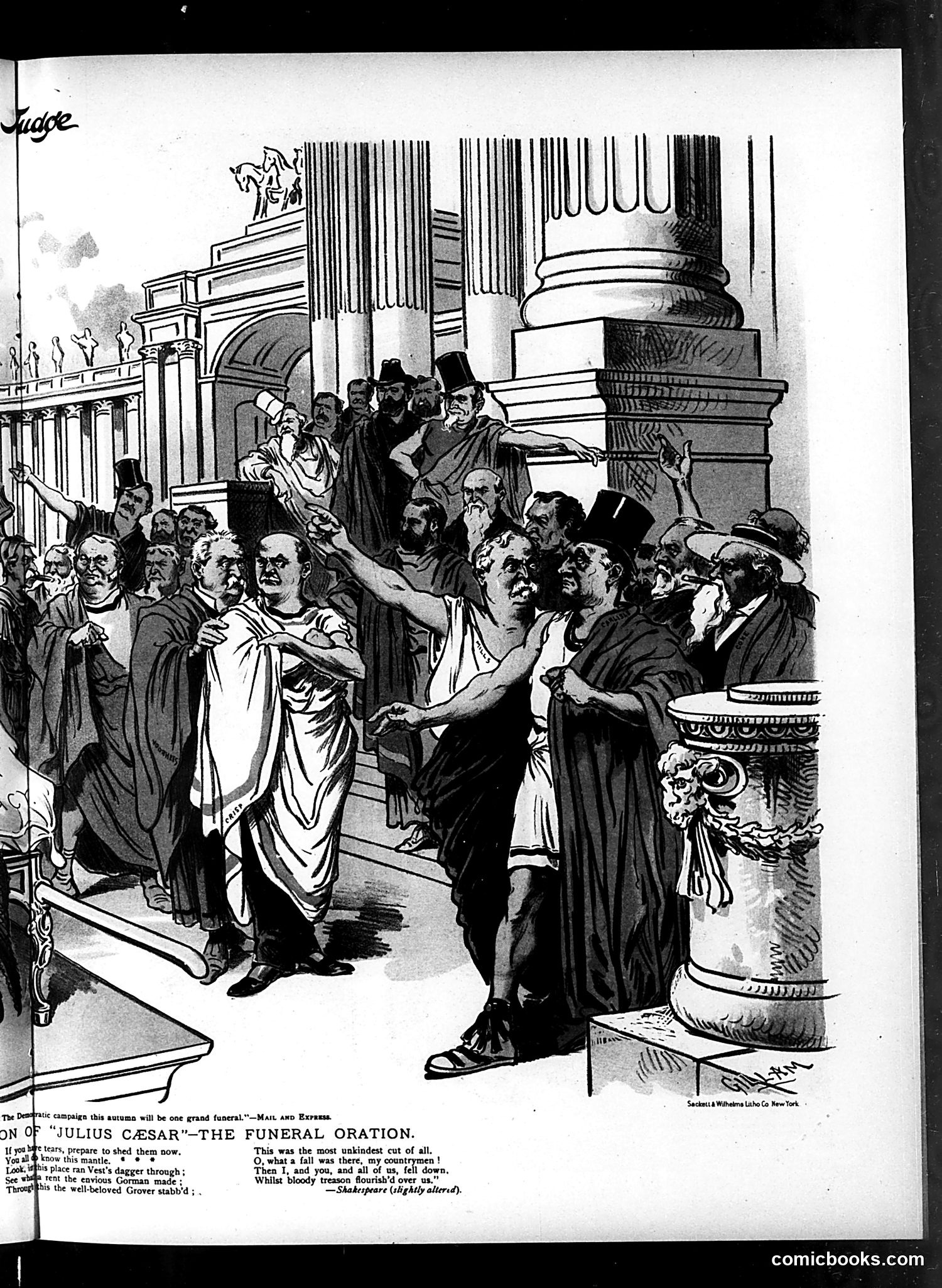
This cartoon adapts Shakespeare's *Julius Caesar* to satirize American politics, likely from the 1880s-90s. The text references a newspaper prediction that the "autumn campaign will be one grand funeral." The cartoon depicts a funeral oration scene with classical Roman architecture. It appears to represent "Grover" (likely President Grover Cleveland) as the fallen Caesar, "stabbed" by political enemies. The altered Shakespeare quotes—referencing daggers, betrayal, and "bloody treason"—mock the dramatic political turmoil of the era. The crowded, gesturing figures suggest public outcry and political upheaval. The satire mocks either Cleveland's political downfall or the vicious nature of contemporary campaign politics by comparing it to Caesar's assassination—suggesting American political conflict had reached tragic, Shakespearean proportions.
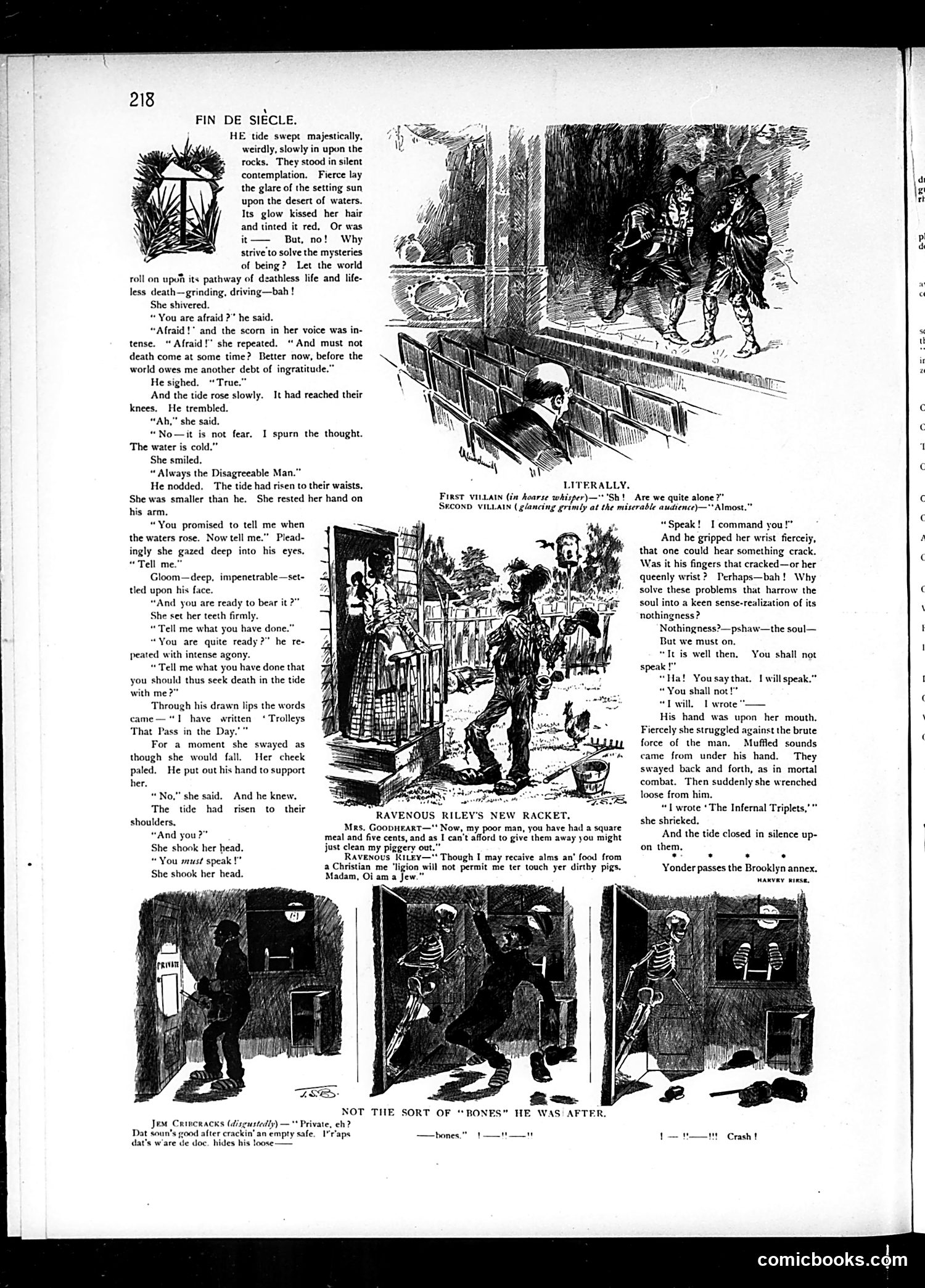
This page satirizes fin-de-siècle (end-of-century) literary affectation—particularly the overwrought melodrama and existential angst popular in 1890s aestheticism. The main story mocks this style mercilessly: two characters contemplate suicide by drowning while indulging in pretentious philosophical musings about death and meaning. The satire peaks when the man's terrible confession is revealed—he wrote "Trolleys That Pass in the Day" (a pompous parody of contemporary literary titles). The woman's equally pretentious counter-confession about writing "The Infernal Triplets" completes the joke. The subsidiary cartoons mock other contemporary absurdities: a character unwilling to touch pigs because he's Jewish, and slapstick violence presented as philosophical drama ("Not the Sort of Bones He Was After"). Judge magazine is ridiculing how serious, self-important artistic types of the 1890s treated trivial creative output as deeply meaningful while adopting melodramatic affectations about existence itself.
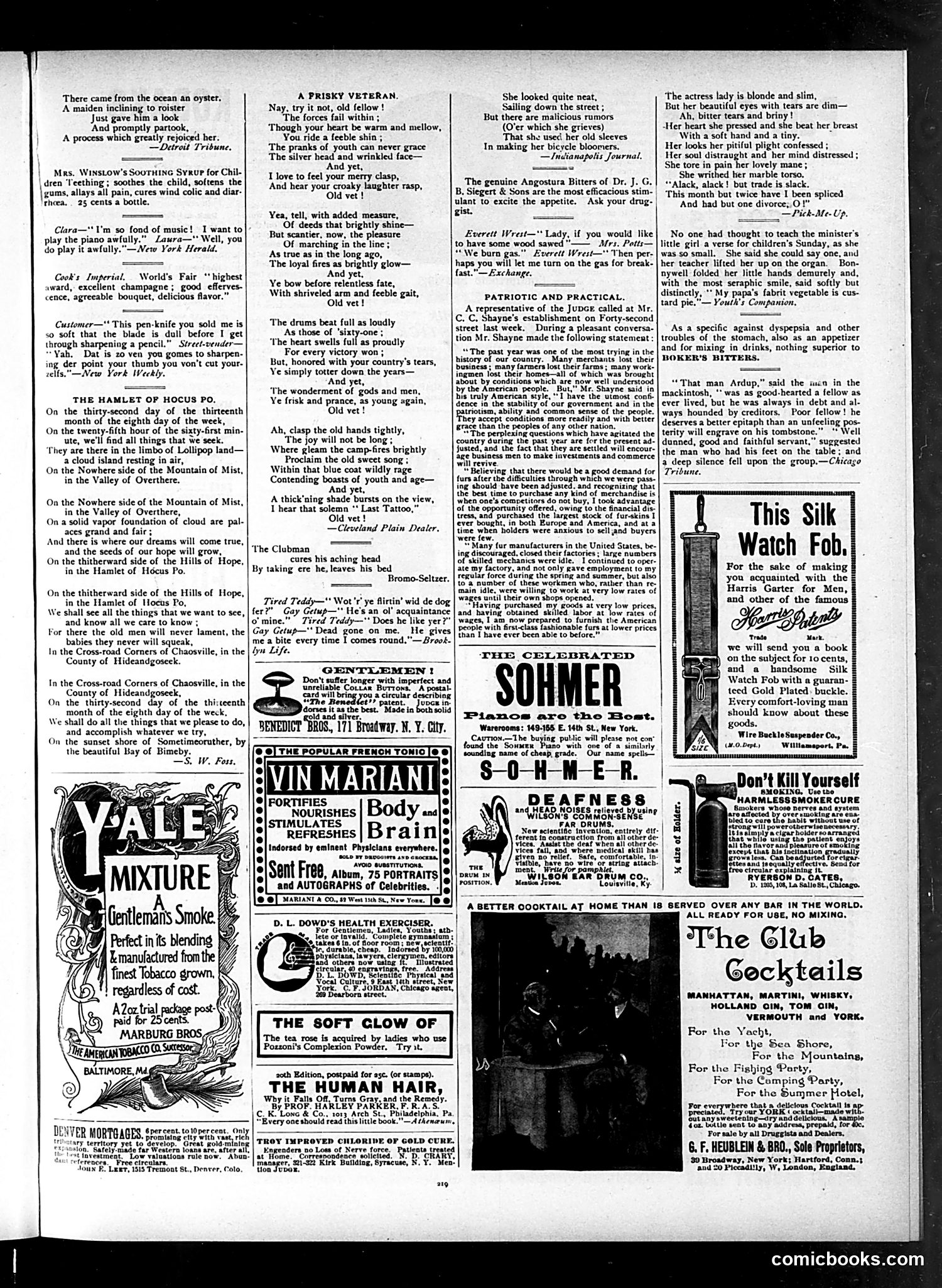
This page is primarily **advertising and light verse**, not political satire. The content includes: **Poetry & Humor:** Various short poems and joke items, including "A Prisky Veteran"—a sentimental tribute to aging Civil War soldiers who remain spirited despite physical decline. The poem celebrates their enduring patriotism and vigor despite age. **Advertisements:** The page is dominated by commercial ads for patent medicines (Mrs. Winslow's Soothing Syrup), champagne, pens, and other products typical of late 19th/early 20th-century periodicals. **Social Humor:** Brief jokes about music, penknives, and courtship reflect genteel, middle-class concerns of the era. The "frisky veteran" reference appears to praise aging Civil War veterans for maintaining youthful spirits—reflecting post-war nostalgia and respect for aging soldiers. There is **no clear political cartoon** visible on this page; it's a mixed-content magazine page typical of the period.
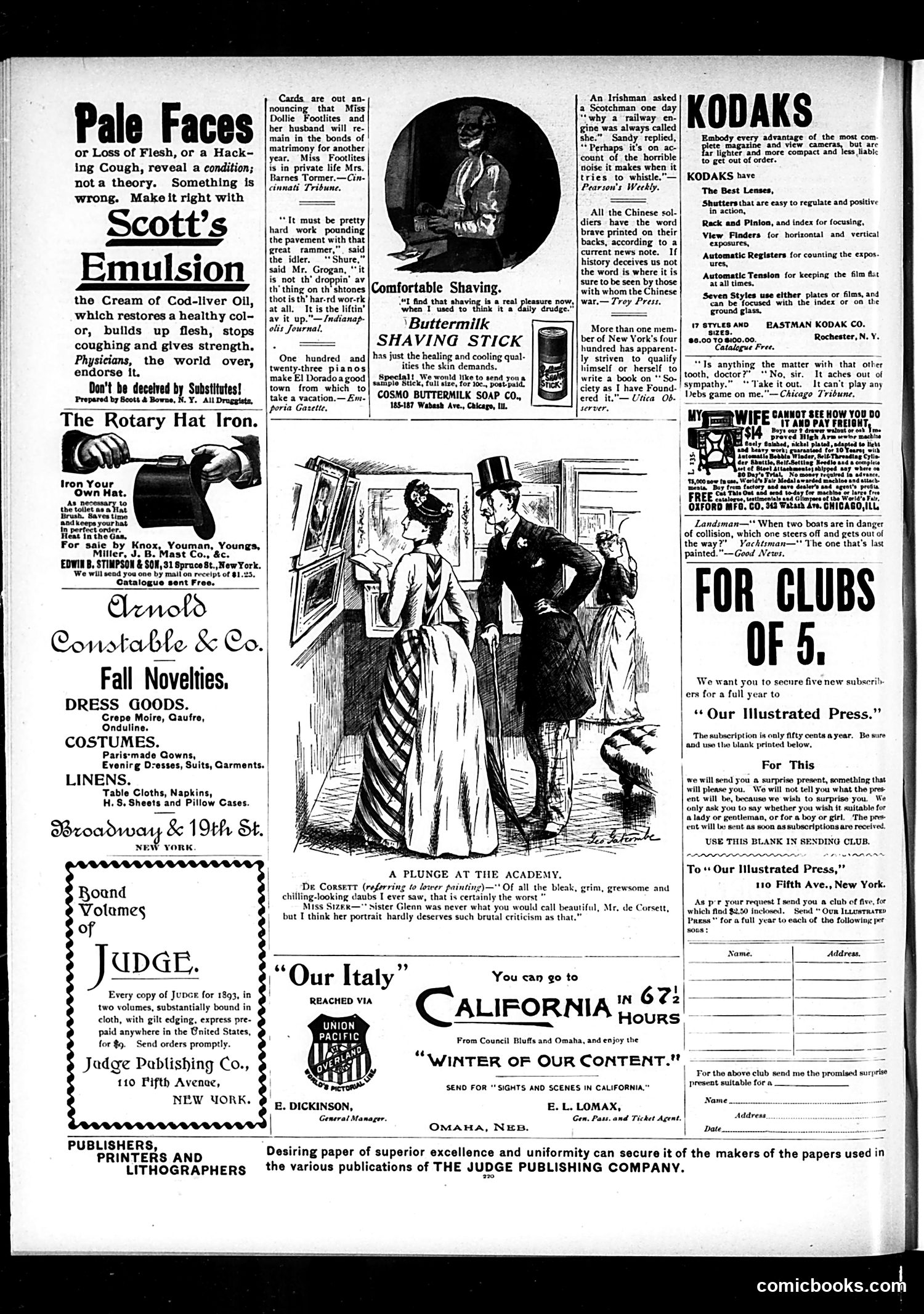
This page is primarily devoted to period advertisements and light humor columns, with minimal political content. The main visual element is a sketch titled "A PLUNGE AT THE ACADEMY," depicting a fashionably dressed woman at what appears to be an art academy, likely satirizing Victorian-era attitudes toward women and art education. Most of the page comprises product ads (Scott's Emulsion, Kodaks, shaving products) and magazine subscription offerings. The humor items are brief, genteel jokes—an Irish/Scottish dialect exchange about railway engines, a pun about a tooth aching "in sympathy," and anecdotes about pianos and society women writing books. There is no discernible political satire or commentary. This appears to be a relatively typical late-19th-century Judge magazine page blending consumer advertising with light social humor aimed at upper-middle-class readers.
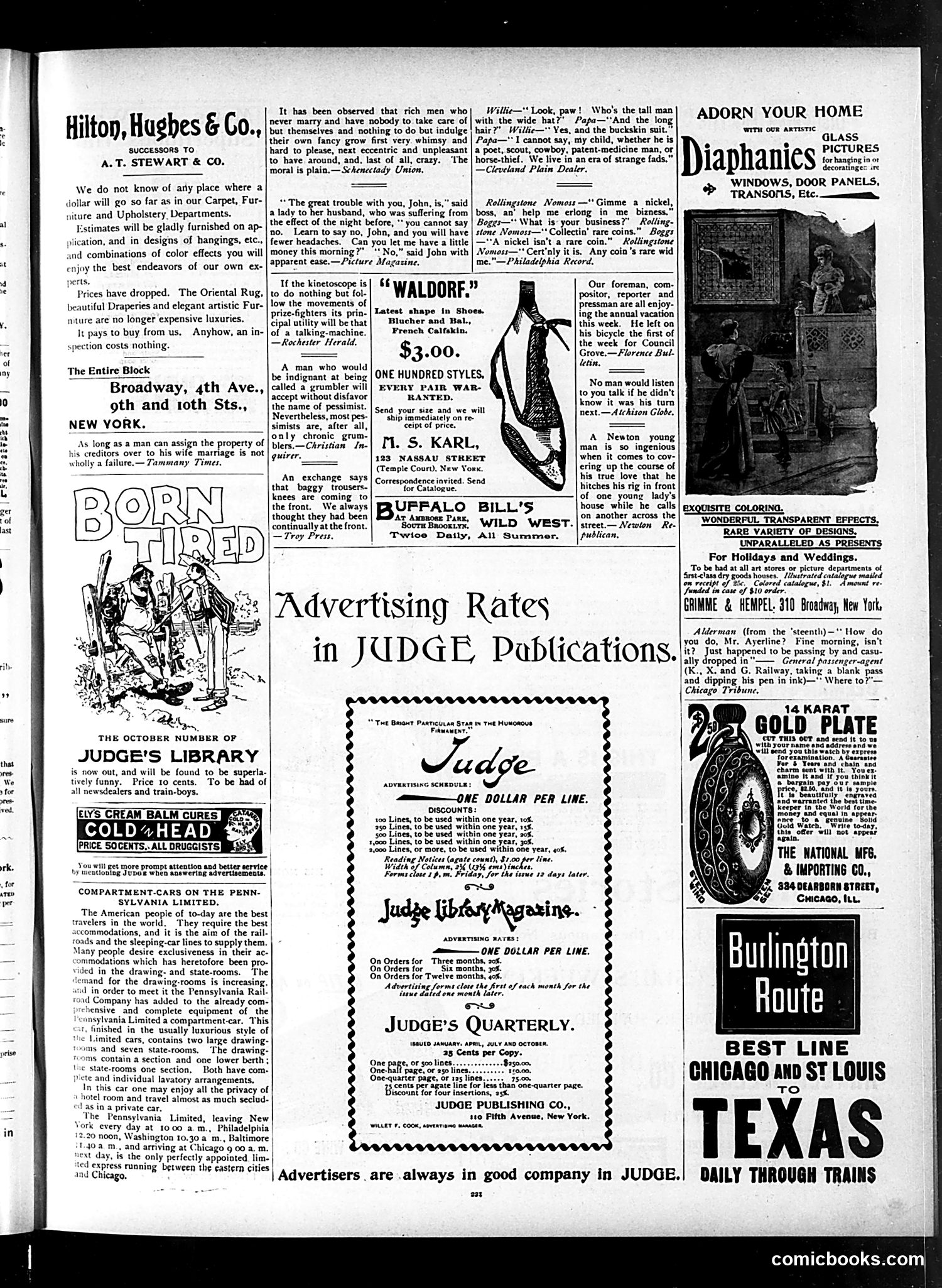
This page is primarily **advertising and commercial announcements** rather than political satire. The dominant content consists of department store ads (Hilton, Hughes & Co.), railroad promotions (Pennsylvania Limited), and product advertisements (shoes, gold plate, etc.). The few humor pieces present are **gentle domestic comedy**, not political satire: - A joke about a wealthy man becoming eccentric without family obligations - A dialog where a husband learns to say "no" to his wife's requests - A sketch about a vagrant ("Rollingstone Nomoss") claiming a nickel is "rare" coin—mild humor about poverty and hustling The cartoon titled "BORN TIRED" appears whimsical rather than satirical. **No identifiable political figures or events** are referenced. This appears to be a general-interest humor magazine page focused on selling advertising space, with light comedic content filling gaps between ads.
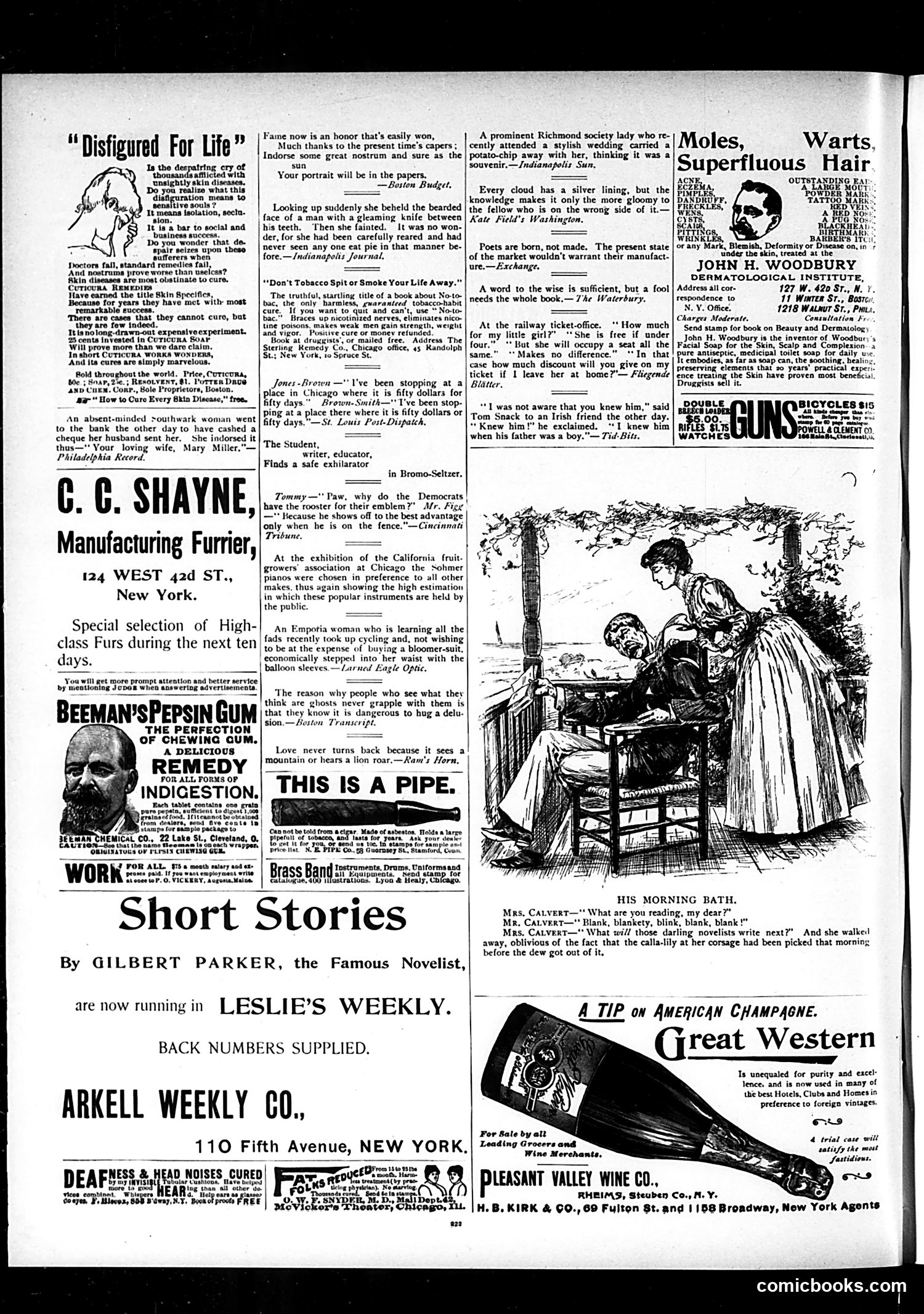
This page is primarily **advertising and filler content** rather than political satire. However, it contains several notable elements: The main cartoon, "His Morning Bath," depicts a domestic scene of a man eating pie messily at a table while a woman faints—illustrating a joke about refined Victorian sensibilities being shocked by crude eating habits. The text snippets are mostly **humorous anecdotes** and light social commentary typical of the era: - A satirical piece mocking how easily one can achieve fame by endorsing patent medicines - Political humor about Democrats' choice of a rooster as their emblem (a fence reference, suggesting political fence-sitting) - Various jokes about tobacco cessation, cycling fads, and romantic sentimentality The **advertisements dominate**—promoting Cuticura remedies for skin diseases, Beeman's Pepsin Gum for indigestion, and other patent medicines common to early 1900s publications. Overall, this page reflects Judge's lighter content: gentle domestic humor, consumer advertising, and mild political ribbing rather than sharp satirical commentary.
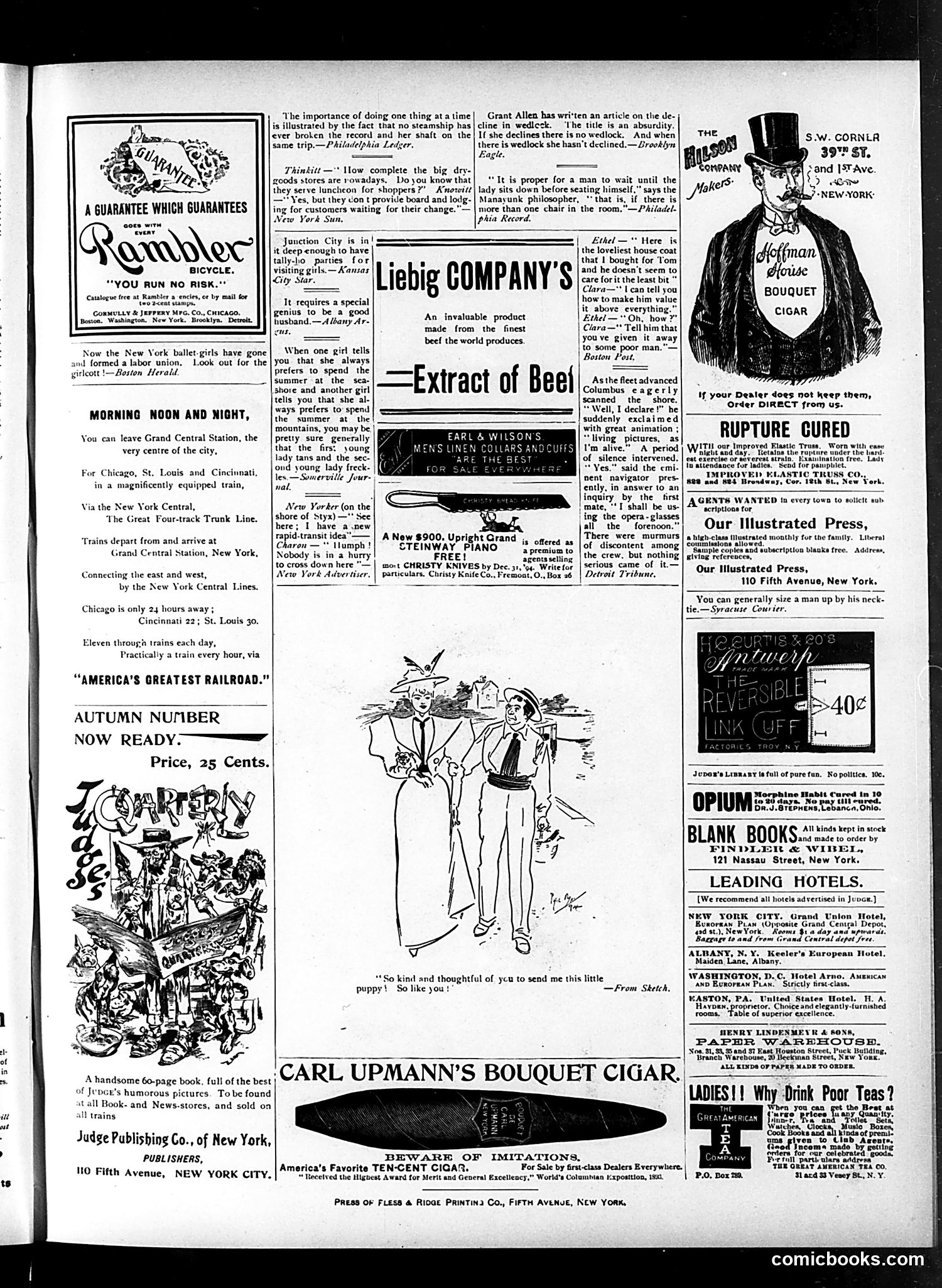
This page consists primarily of **advertisements and brief humor items** rather than political cartoons. The content reflects early 1890s American life: **Notable Elements:** The largest cartoon (center) shows a couple in period dress with the caption about sending a "little poppy"—likely referencing **opium**, a legal product then, suggesting dark humor about dangerous gifts. **Humor pieces** satirize everyday observations: a dry goods store offering luncheon but not lodging; girls with different vacation preferences actually tanning vs. freckling; a man finally getting his opera glasses during a ship disaster. **Advertisements** dominate: Rambler bicycles, Liebig's beef extract, Steinway pianos, Upmann cigars, and services for treating rupture—common 1890s concerns. The **New York Central Railroad ad** emphasizes rail travel convenience, reflecting that era's transportation infrastructure pride. The page reflects **late Victorian consumer culture** and mild social observation humor rather than sharp political satire.
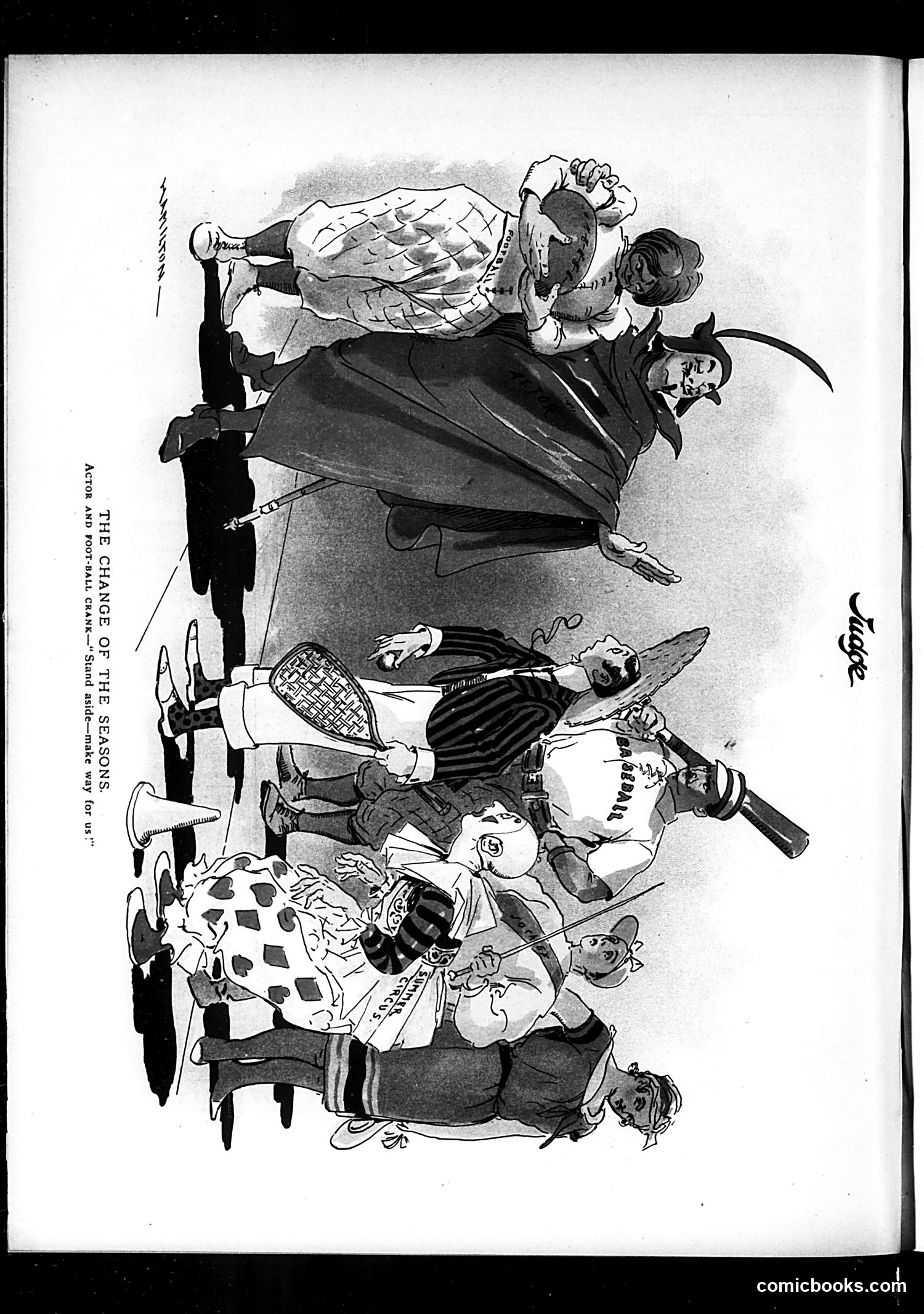
This cartoon depicts seasonal fashion changes through exaggerated character types. The image shows figures wearing progressively different clothing as one moves through the composition, likely illustrating how American society (particularly women) adopts new fashions with each season. The satire appears to mock the fickleness of fashion-consciousness and consumer culture—the idea that people mindlessly follow seasonal dress codes despite practical considerations. The cartoonist uses caricatured figures to ridicule what was evidently seen as wasteful or absurd fashion compliance. Without clearer date markers visible, the specific historical moment is uncertain, but Judge magazine regularly satirized contemporary social trends. The exaggerated poses and clothing styles suggest this critiques early-to-mid 20th century American fashion obsession and the commercial forces driving seasonal wardrobe changes.