
Judge, 1894-10-06 · page 10 of 16
Judge — October 6, 1894 — page 10: what you’re looking at
What you’re looking at
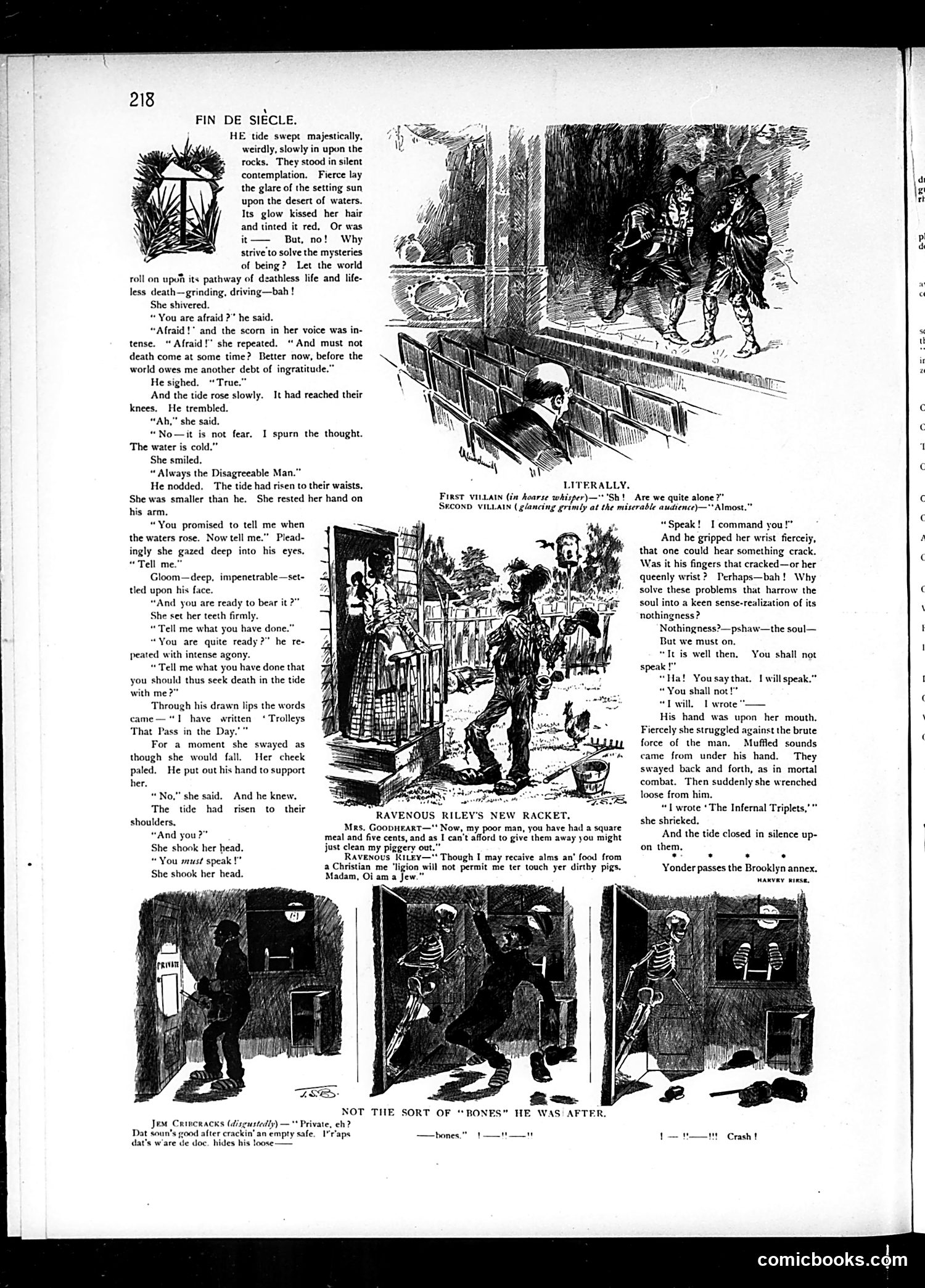
This page satirizes fin-de-siècle (end-of-century) literary affectation—particularly the overwrought melodrama and existential angst popular in 1890s aestheticism. The main story mocks this style mercilessly: two characters contemplate suicide by drowning while indulging in pretentious philosophical musings about death and meaning. The satire peaks when the man's terrible confession is revealed—he wrote "Trolleys That Pass in the Day" (a pompous parody of contemporary literary titles). The woman's equally pretentious counter-confession about writing "The Infernal Triplets" completes the joke. The subsidiary cartoons mock other contemporary absurdities: a character unwilling to touch pigs because he's Jewish, and slapstick violence presented as philosophical drama ("Not the Sort of Bones He Was After"). Judge magazine is ridiculing how serious, self-important artistic types of the 1890s treated trivial creative output as deeply meaningful while adopting melodramatic affectations about existence itself.
📄 Transcribed text from this page (OCR, searchable)
Machine-transcribed from the original scan — historical spelling and the odd misread are preserved.
FIN DE SIECLE. less death—grinding, driving—bah ! She shivered. “ You are afraid ?” he said. “Afraid!* and the scorn in her voice was in- 1" she repeated. “And must not death come at some time? Better now, before the world owes me another debt of ingratitude.” tense.“ Afrai He sighed. “True.” And the tide rose slowly. It had reached their knees, He trembled. “Ab,” she said, “No—it is not fear. I spurn the thought. ‘The water is cold.” She smiled. “ Always the Disagreeable Man.” He nodded. The tide had risen to their waists, She was smaller than he. She rested her hand on his arm. “You promised to tell me when the waters rose. Now tell me.” Plead- ingly she gazed deep into his eyes. “Tell me.” Gloom—deep. impenetrable—set- tled upon his face. “And you are ready to bear it?” She set her teeth firmly. “ Tell me what you have done.” “You are quite ready?” he re- peated with intense agony. “ Tell me what you have done that you should thus seek death in the tide with me?” Through his drawn lips the words came— “I have written ‘Trolleys That Pass in the Day.’ For a moment she swayed as though she would fall. Her cheek paled. He put out his hand to support her. “No,” she s And he knew, The tide had risen to their shoulders, “And you?” She shook her head. e “You must speak ! She shook her head. Jest Crincrackss (diseustedly) — dat's w'are de doc. hides his loose — HE tide swept majestically, weirdly, slowly in upon the rocks. They stood in silent contemplation. the glare of the setting sun upon the desert of waters. Its glow kissed her hair and tinted it red. Or was it—— But, no! Why strive'to solve the mysteries of being? Let the world roll on upoh its pathway of deathless life and life- rivate, eh? Dat Soun’s ood after crackin’ an empty safe. Fierce lay LITERALLY, First vit.atn (in hoarse whisper)—"* ‘Sh! Are we quite alone ?” SECOND VILLAIN (glancing grimly at the miserable audience)—"* Almost.” jig RAVENOUS RILEY'S NEW RACKET. Mrs. Goopueart—'* Now, my poor man, you have had a square meal and five cents, and as I can't afford to give them away you might just clean my piggery out. Ravenous Kitey—* Though I may recaive alms an’ food from a Christian me ‘ligion will not permit me ter touch yer dirthy pigs. Madam, Oi am a Jew. NOT THE SORT OF “BONES” HE WAS AFTER. Wraps — bones.” 1 “Speak! I command you! And he gripped her wrist fierceiy, that one could hear something crack. Was it his fingers that cracked—or her queenly wrist? Perhaps—bah ! Why solve these problems that harrow the soul into a keen sense-realization of its nothingness? Nothingness?—pshaw—the soul— But we must on. “It is well then, You shall not speak ! Ha! You say that. 1 will speak.” “You shall not “Twill, 1 wrote "— His hand was upon her mouth. Fiercely she struggled against the brute force of the man. Muffled sounds came from under his hand. They swayed back and forth, as in mortal combat. Then suddenly she wrenched loose from him. “I wrote ‘The Infernal Triplets,’ she shrieked. And the tide closed in silence up- on them, . . Yonder passes the Brooklyn annex. 1—'!——!! Crash! : 1 comicbooks.com