
A complete issue · 16 pages · 1894
Judge — August 25, 1894
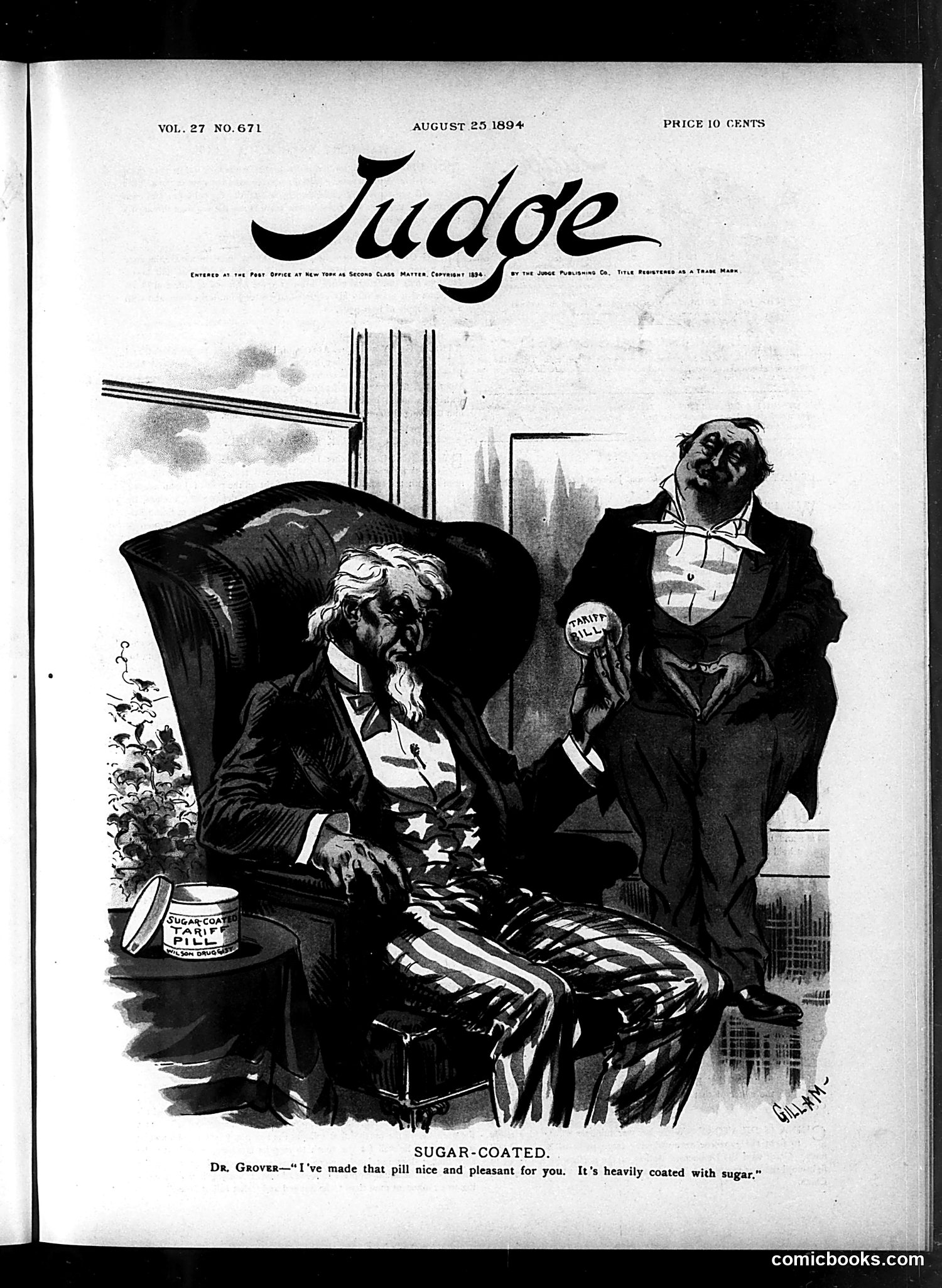
This cartoon satirizes Dr. Grover—likely **President Grover Cleveland**—who is depicted as a physician presenting a bitter political pill to an anxious patient (representing the American public or a specific constituency). The joke plays on "sugar-coating": Cleveland claims he's made the pill "nice and pleasant" and "heavily coated with sugar," but the patient appears deeply skeptical and uncomfortable. The satire likely references Cleveland's unpopular economic policies during the severe **Panic of 1893**, when his administration's handling of the financial crisis caused widespread suffering. The cartoon suggests Cleveland is trying to make painful policies seem palatable to the public—but the patient clearly isn't fooled by the "sugar-coating."
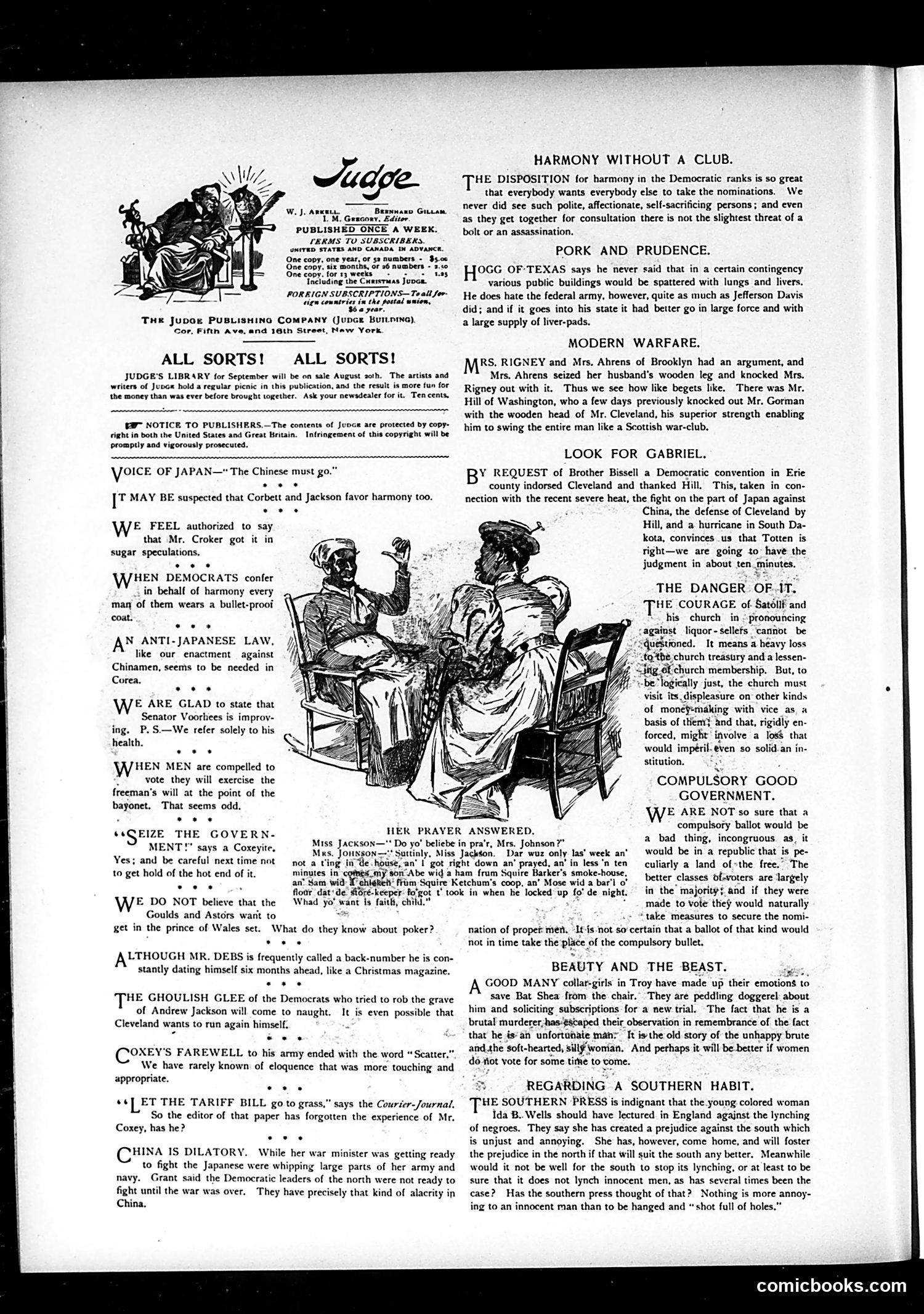
This page contains multiple political commentary pieces rather than a single cartoon. The main illustrated section, "HER PRAYER ANSWERED," shows two figures in conversation—likely representing a woman petitioning a politician or authority figure about a social issue. The surrounding text discusses contemporary Democratic politics, the Chinese Exclusion issue, and debates over governmental power. References include critiques of Democratic "harmony," commentary on Senator Voorhees, and discussion of anti-Chinese sentiment and proposed legislation. The page reflects late 19th-century American political debates: internal Democratic Party conflicts, xenophobic immigration policy, and tensions between civil liberties and governmental authority. The satire targets both Democratic Party disunity and broader social prejudices of the era.
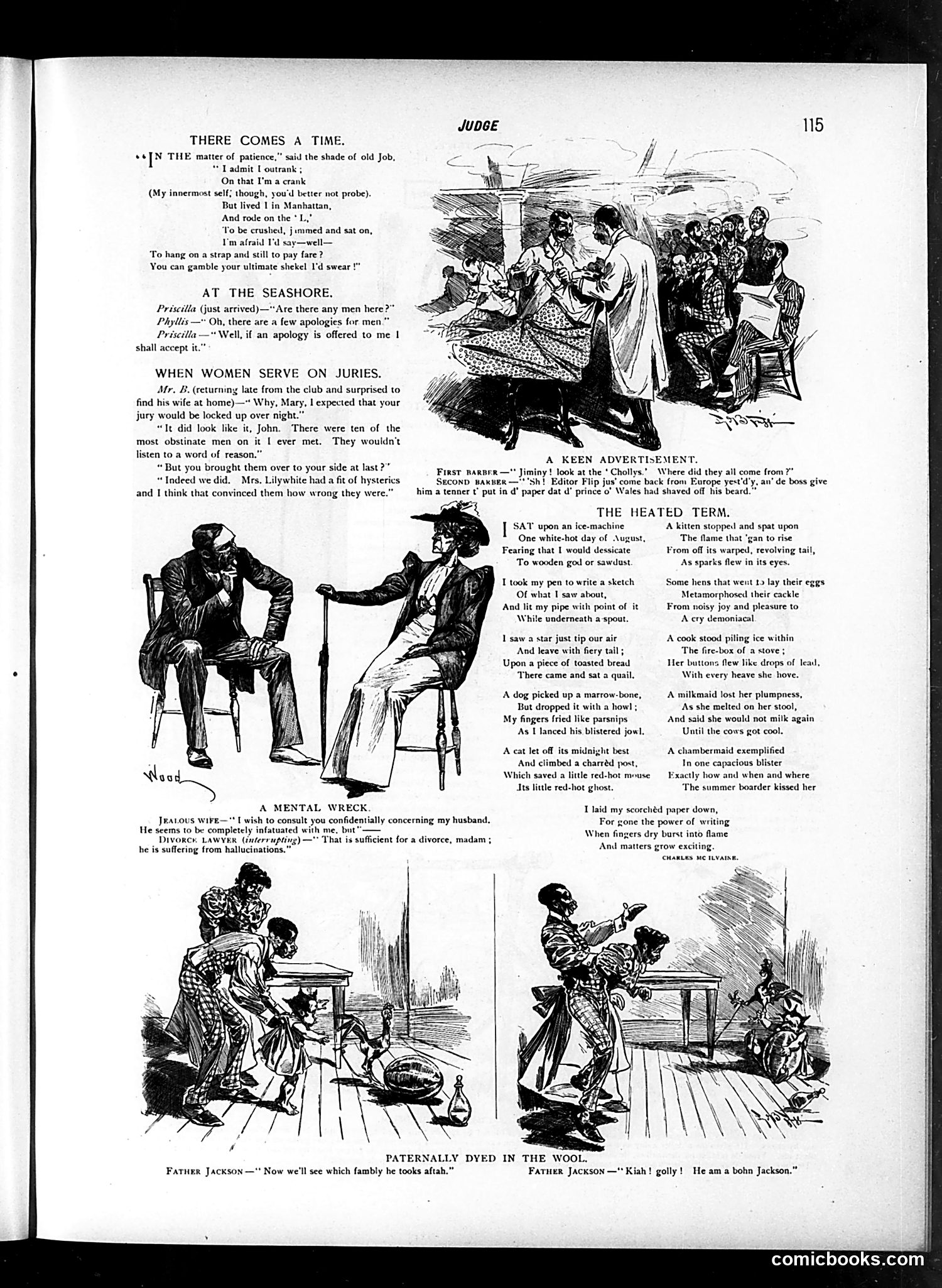
This page contains several satirical pieces mocking domestic life and gender relations of the era: **"There Comes a Time"** and **"At the Seashore"** are brief humorous vignettes about marital discord and social awkwardness. **"When Women Serve on Juries"** satirizes women's recent jury participation, suggesting they're emotionally unstable and irrational—a common anti-suffrage argument of the period. The joke implies women jurors are hysterical and unreliable witnesses to justice. **"A Keen Advertisement"** and **"The Heated Term"** are lighter humor pieces. **"A Mental Wreck"** and **"Paternally Dyed in the Wool"** depict domestic disputes and parenting challenges through illustrations. The overall tone reflects early 20th-century attitudes toward women's expanding public roles, expressing skepticism through ridicule rather than serious argument.
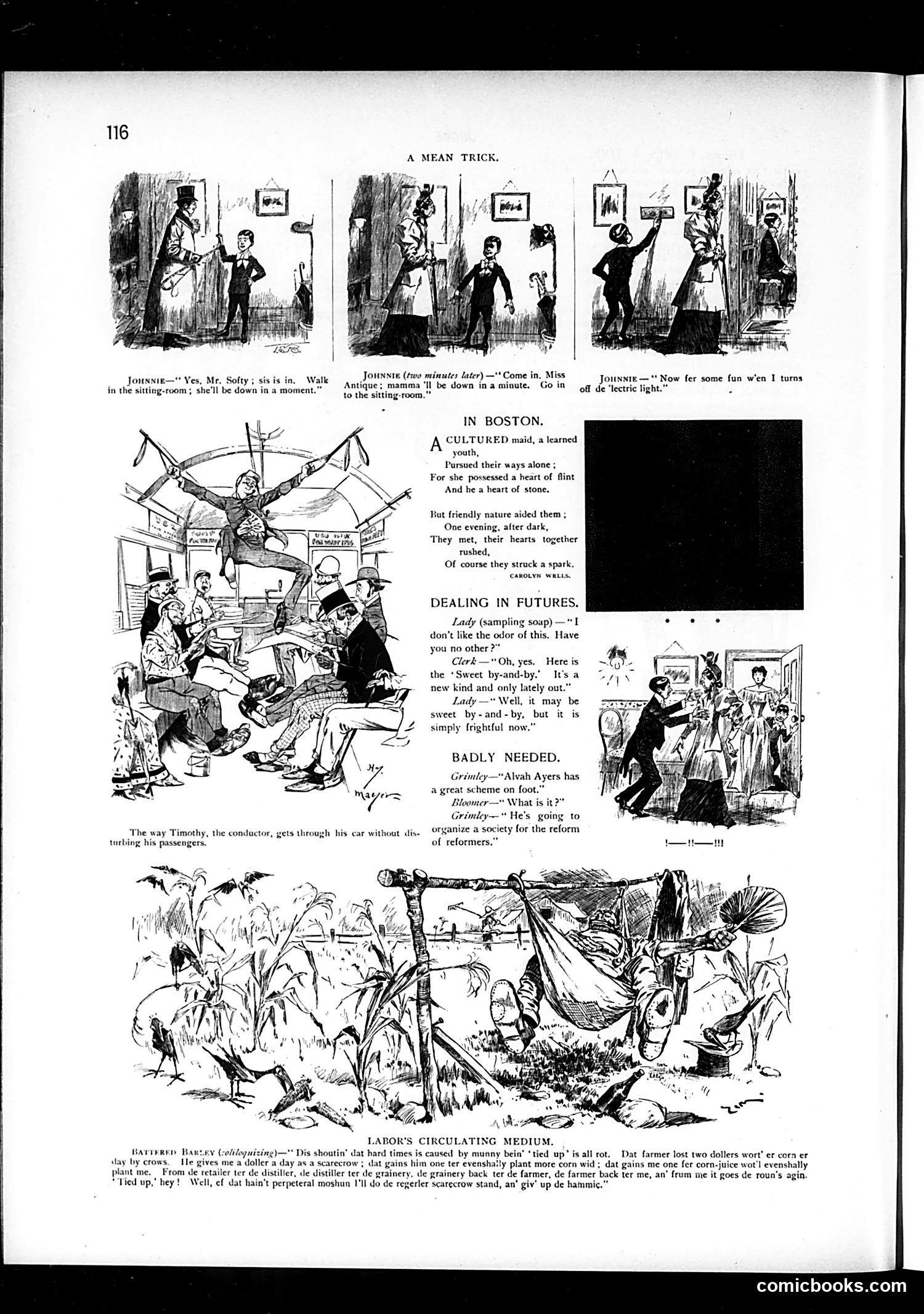
**"A Mean Trick"** shows a boy tricking his sister: he promises to entertain her visiting friend, then turns off the electric light to leave them in darkness—a prank on the guest. **"In Boston"** is a humorous poem about a reserved maid and youth who, despite their cold personalities, fall in love when circumstance brings them together. **"Dealing in Futures"** satirizes a store clerk selling soap by name alone ("Sweet by-and-by")—promising future appeal while the product smells bad now, mocking deceptive marketing. **"Badly Needed"** jokes that reformer Aylah Ayers should organize "a society for the reform of reformers"—implying reformers themselves need improvement. **"Labor's Circulating Medium"** features a scarecrow named Rafferty arguing that money isn't "tied up" but constantly circulates through labor—from farmer to worker to distiller to his own consumption and back—a commentary on working-class economic cycles and perpetual poverty.
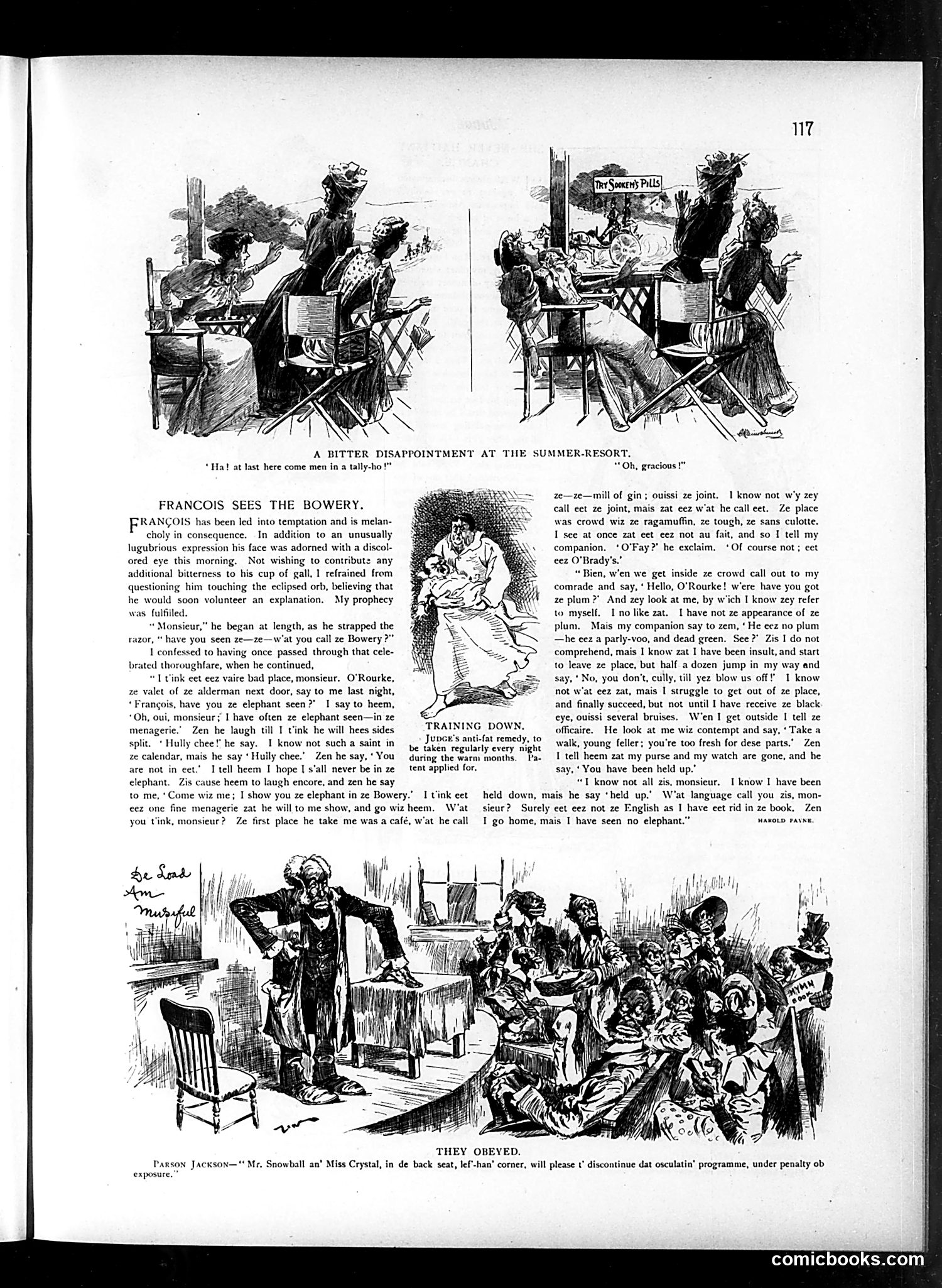
This 1890s Judge magazine page contains two distinct satirical pieces: **"François Sees the Bowery"** is a comedic monologue by a French visitor recounting his misadventure in New York's notorious Bowery district. François, speaking in exaggerated French-accented English, describes being taken to a saloon ("mill of gin") where he's mistaken for someone named "the plum," gets into a fight, and is robbed—what locals call being "held up." The humor derives from his confusion over American slang and violent urban culture, contrasting Continental sophistication with rough American street life. **Top cartoons** satirize summer resort social disappointment—women eagerly awaiting fashionable male visitors, only to be let down. **"They Obeyed"** (bottom) appears to depict Parson Jackson ordering respectably-dressed African Americans to stop kissing in a theater's back seat, invoking segregation-era racial control. The satire's exact point is unclear from context alone, but likely comments on racial attitudes or church authority of the period.
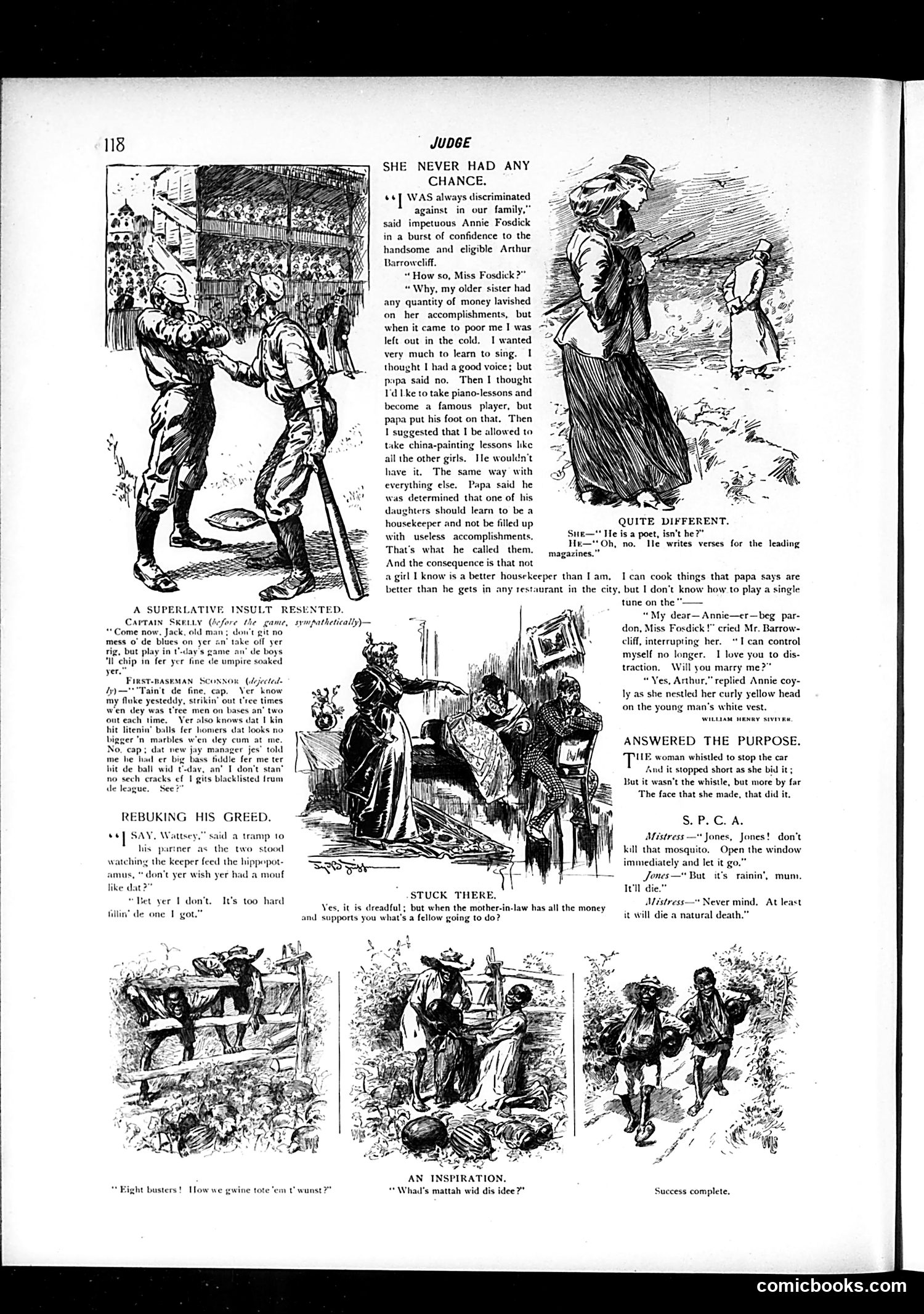
This page contains several unrelated humorous sketches typical of Judge's satirical style: **"A Superlative Insult Resented"** depicts a baseball captain and player arguing, with the player upset at being compared unfavorably to a hippopotamus—establishing the crude, physical humor common to the era. **"She Never Had Any Chance"** satirizes class attitudes about women's education. Annie Fosdick complains her father denied her music and art lessons to make her a housekeeper, yet she became excellent at domestic work anyway. The sketch mocks both patriarchal restrictions on women and the ironic outcome. **"Rebuking His Greed"** is a brief tramp joke about poverty and appetite. **"Quite Different"** plays on the distinction between "poet" and "verse-writer for magazines"—mocking commercial versus serious literature. **"S.P.C.A."** and **"Answered the Purpose"** are brief social vignettes about mosquito-killing and a woman stopping a streetcar—minor observations of everyday life treated as comedy. The cartoons reflect Victorian-era attitudes toward class, gender, and labor with gentle, domestic humor rather than sharp political critique.
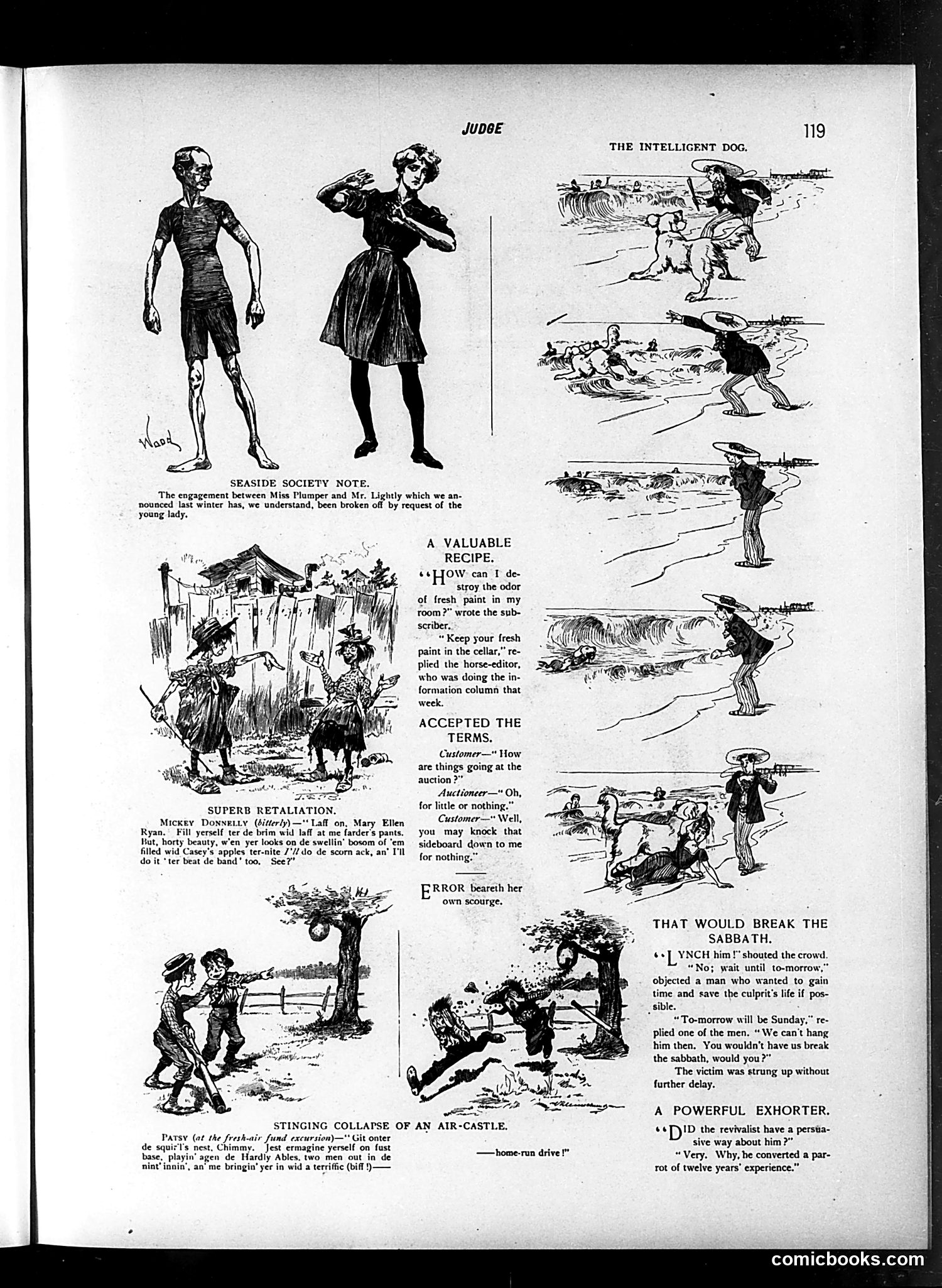
This page contains multiple satirical vignettes typical of early 20th-century Judge magazine: **"Seaside Society Note"**: A brief joke mocking romantic engagements among wealthy seaside vacationers—the humor lies in a woman breaking an engagement, inverting typical social expectations. **"Valuable Recipe"**: Dry humor where an advice columnist dismisses a practical question with absurdist non-advice. **"That Would Break the Sabbath"**: Dark satire criticizing religious hypocrisy. A lynch mob refuses to execute their victim on Sunday, claiming religious scruples, then executes him anyway. This bitterly mocks how people invoke religion selectively to justify immoral acts. **"Stinging Collapse of an Air-Castle"**: Working-class boys fantasizing about baseball during a charitable "fresh air fund" excursion, their daydreams comically deflating when reality intrudes. Other sections include wordplay, immigrant dialect humor (common in Judge), and commentary on auctions and revival meetings. The overall tone is satirical commentary on American society across class lines.
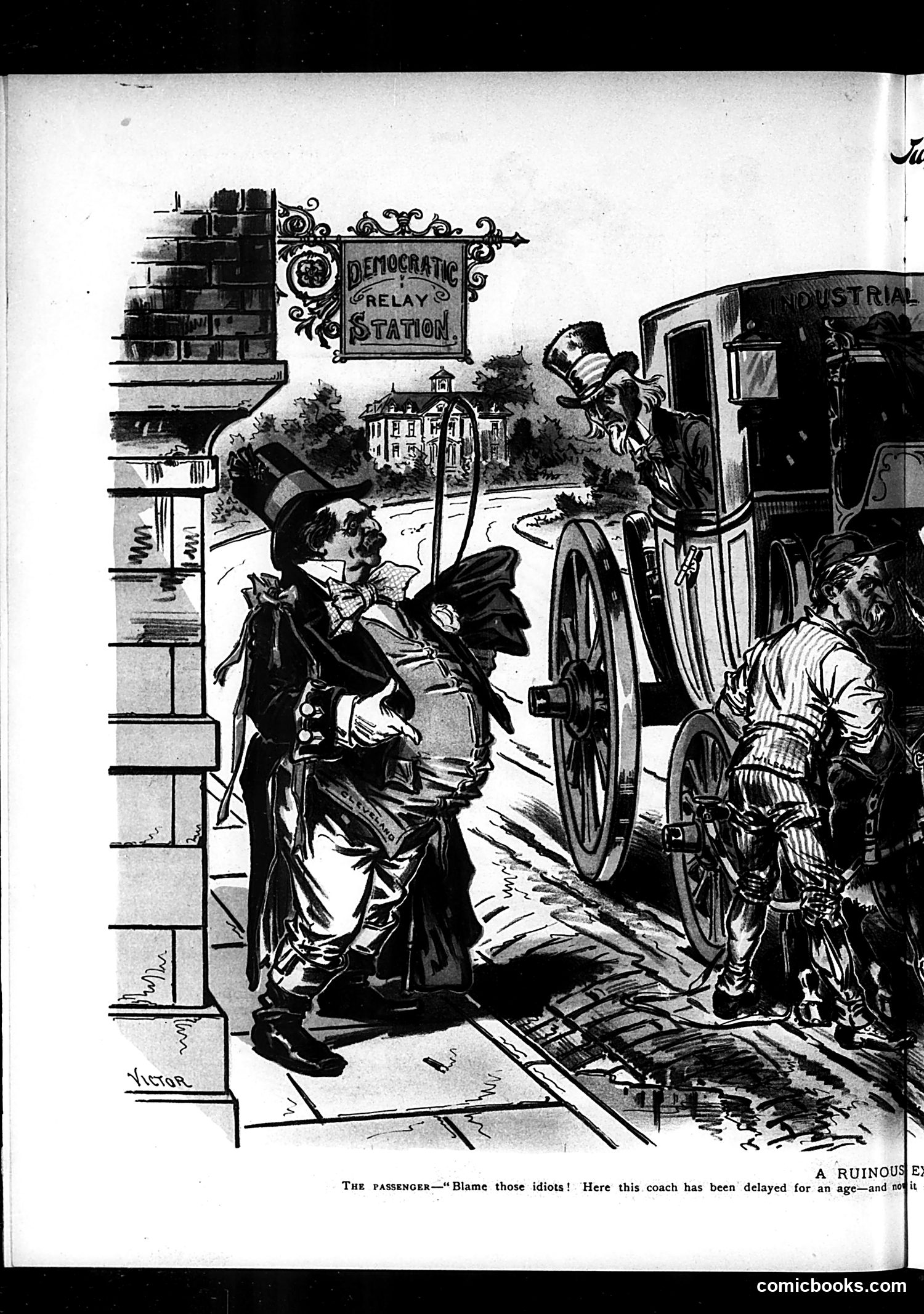
This political cartoon depicts a frustrated passenger at a "Democratic Relay Station" complaining about coach delays. The sign above references the Democratic Party, while the "relay station" suggests a transfer point or organizational hub. The satire appears to critique Democratic Party inefficiency or leadership failures—the passenger blames "idiots" for delays, suggesting the party has bungled its operations or agenda. The various figures (officials, workers) represent Democratic operatives or politicians responsible for managing the party's direction. The cartoon's point: the Democratic Party is dysfunctional and unable to deliver results promptly, frustrating its supporters. Without the magazine's date or broader context visible, the specific political moment remains unclear, but this reflects typical Judge magazine satirizing one political party's competence.
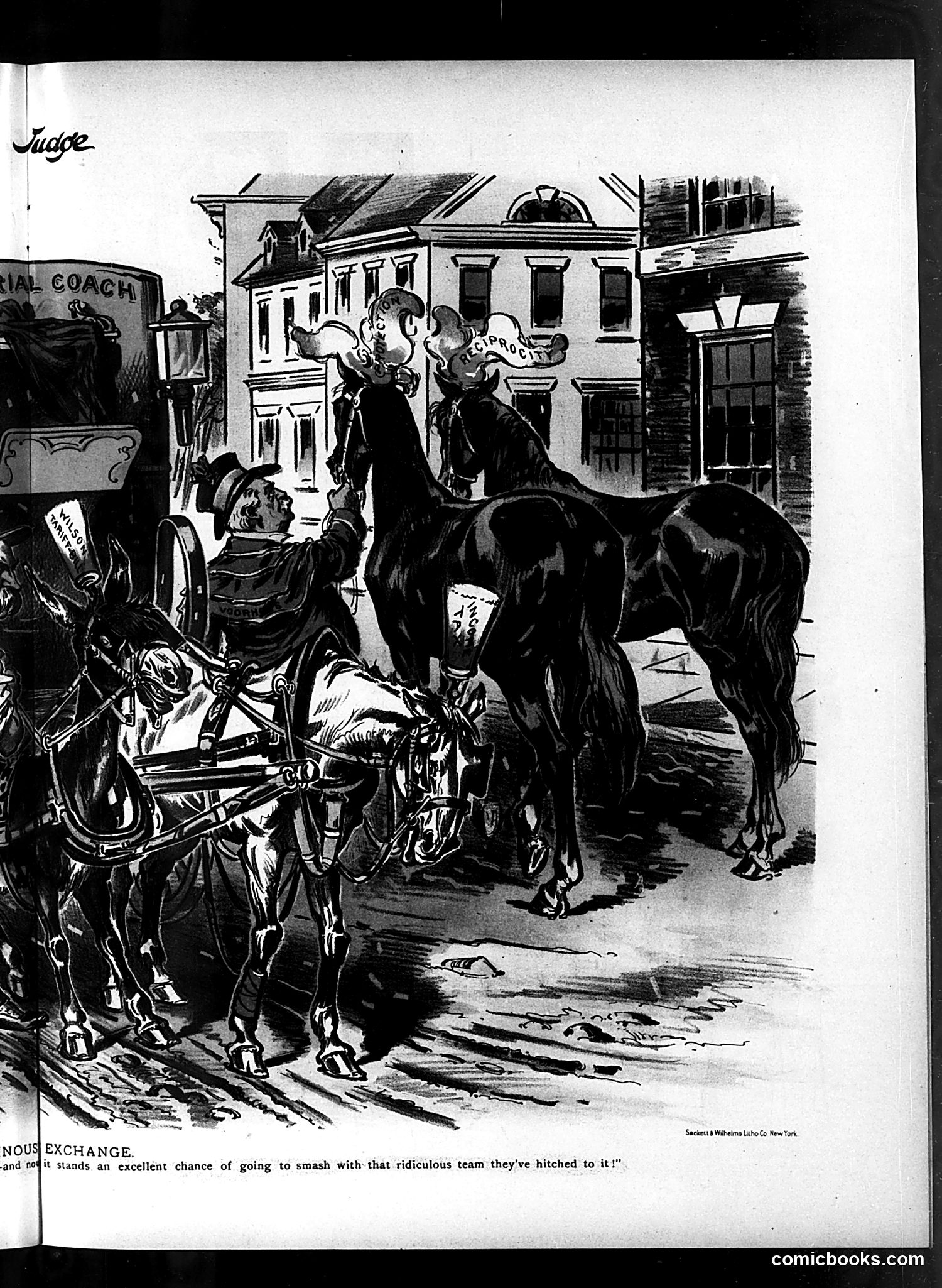
This Judge cartoon titled "Exchange" depicts a coach or manager (left) examining a team of horses hitched to a wagon. The caption reads: "and so it stands an excellent chance of going to smash with that ridiculous team they've hitched to it!" The satire critiques a political administration or leadership by comparing it to a poorly assembled team of inferior horses—a metaphor for incompetent officials or cabinet members. The "coach" represents someone evaluating whether this mismatched group can successfully manage the "wagon" (government or a major initiative). The humor lies in the absurdity of expecting success when burdened with inadequate personnel. Without knowing the specific publication date, the exact political figures remain unclear, but this represents typical Judge-era criticism of government competence and personnel selection.
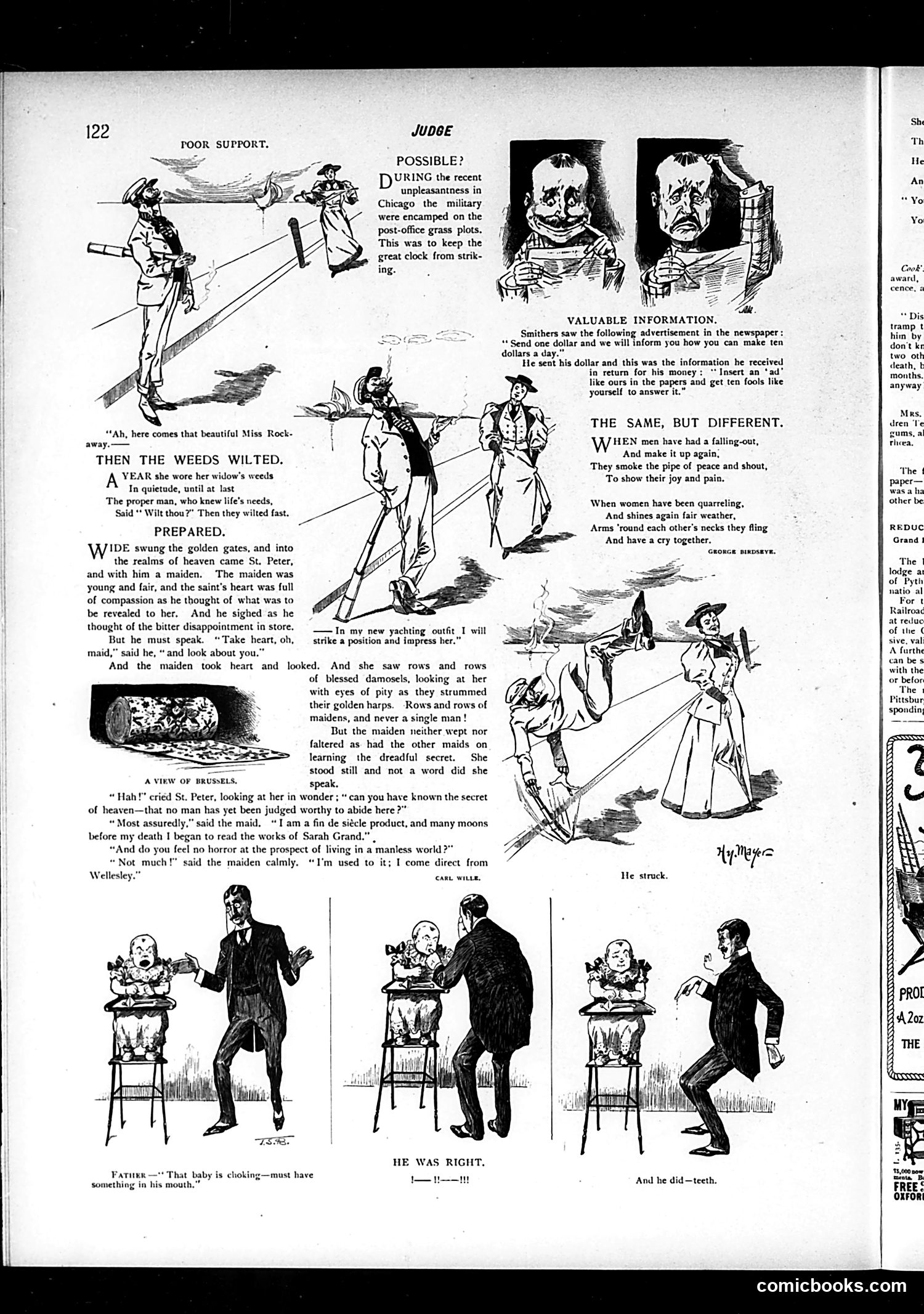
This page contains several satirical pieces typical of Judge magazine's social commentary: **"Poor Support"** mocks Chicago's military presence during recent civil unrest, claiming they camped on post-office grounds to prevent the clock from striking—absurdist humor suggesting the military's stated purpose was ridiculous. **"Valuable Information"** satirizes get-rich-quick schemes: a man pays for secret wealth-making advice and receives instructions to place identical ads and defraud others like himself—exposing pyramid scheme fraud. **"The Same, But Different"** contrasts male and female reconciliation rituals: men dramatically "smoke the pipe of peace," while women embrace and cry together—suggesting gender differences in emotional expression. **"Then the Weeds Wilted"** is a pun: a widow in mourning clothes ("weeds") agrees to marry, and her "weeds wilted"—both her mourning garb and her grief disappear with marriage. **"Prepared"** features a Wellesley College graduate arriving in heaven, unfazed by learning no men are present, claiming she's "used to it"—contemporary satire on women's education and suffrage-era discussions about female independence. The bottom panels show slapstick domestic humor about infant teething.
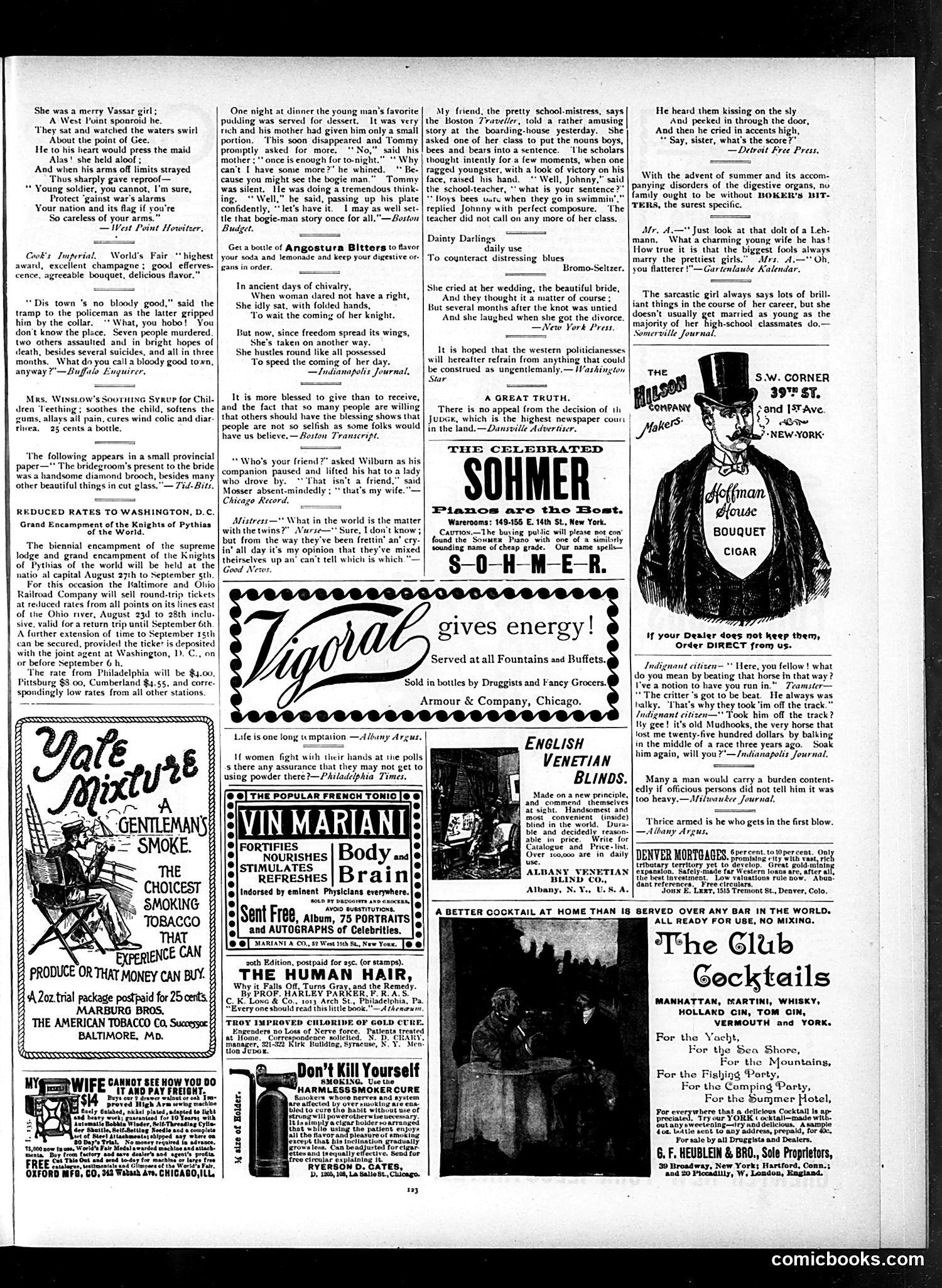
This page is primarily **advertisements and light humor columns** rather than political cartoons. The content reflects early 20th-century American attitudes and products. **Notable content:** The humor pieces are gentle domestic jokes—a West Point cadet being rebuked by his Vassar girlfriend for "carelessness of his arms," and a boy negotiating with his mother over pudding portions. **Advertisements dominate**, hawking period products: tobacco (Yale Mixture), sewing machines (mail-order), champagne, teething syrup, and cocktail mixers. The Sohmer piano ad and various patent medicines reflect consumer culture of the era. **Social context:** References to "the bogie man," women's emerging freedoms ("since freedom spread its wings"), and Knights of Pythias gatherings indicate concerns about modernity, gender roles, and fraternal organizations. The "Don't Kill Yourself" advice column warns against patent medicines and quackery—suggesting contemporary anxiety about medical fraud. Overall, this page reveals early-1900s anxieties about modernization, gender, and consumer products rather than sharp political satire.
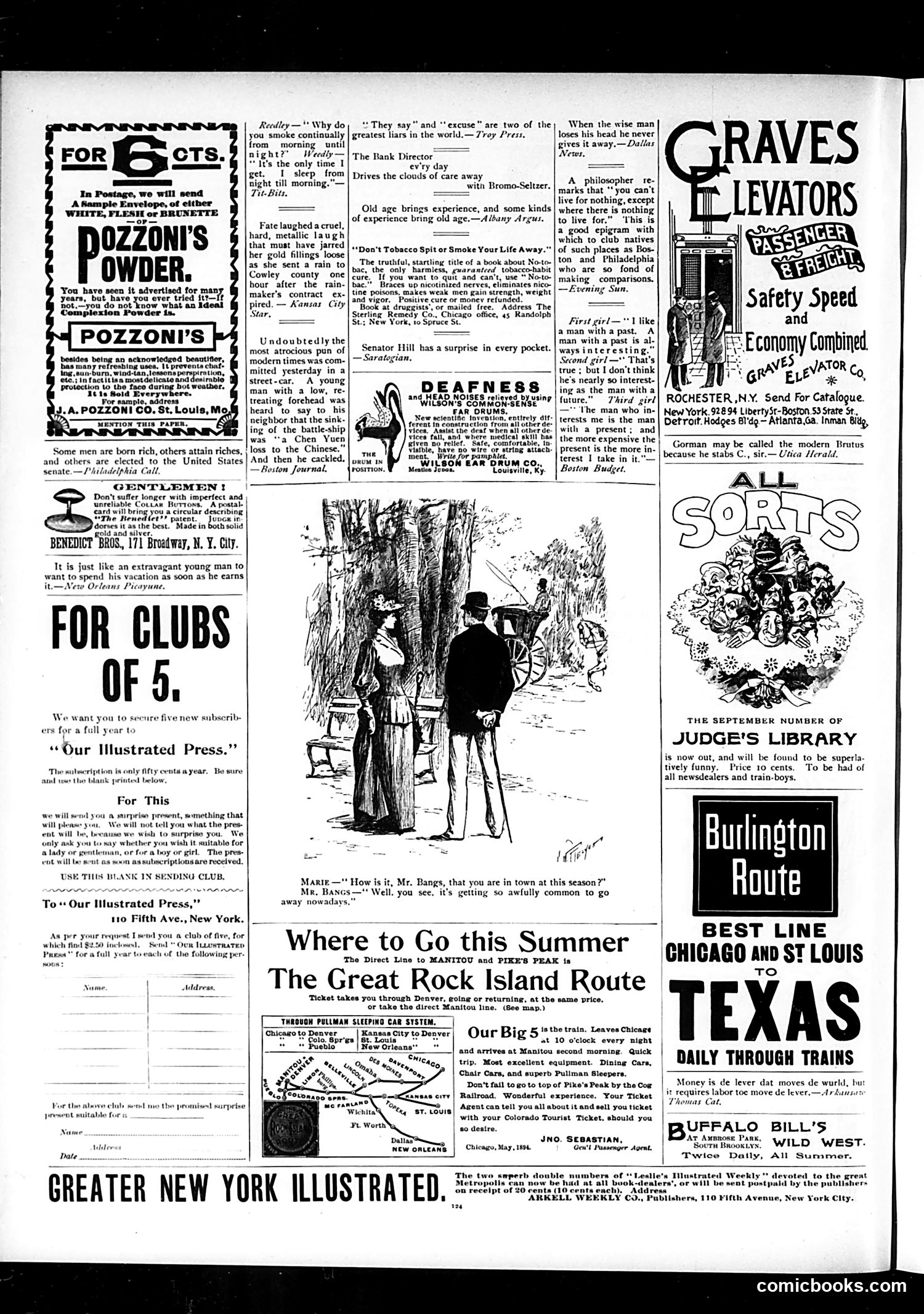
This page is primarily **advertising and promotional material** rather than political satire. The main cartoon depicts two well-dressed men on a country road; one appears to be a banker or businessman leaving town, with the caption "How is it, Mr. Hangs, that you are in town at this season?" suggesting commentary on wealthy people's summer migration patterns. The page is dominated by advertisements for consumer products (Pozzoni's face powder, tobacco-cessation remedies, ear drums, patent buttons) and travel promotions (Great Rock Island Route, Burlington Route, Buffalo Bill's Wild West show). Scattered quotations mock social pretensions and romantic entanglements—topics typical of Judge's light satirical humor. The text jokes about liars, aging, tobacco habits, and unmarried women's romantic prospects, reflecting period attitudes rather than specific political commentary. This appears to be a typical Judge issue page: **light humor mixed with commerce**.
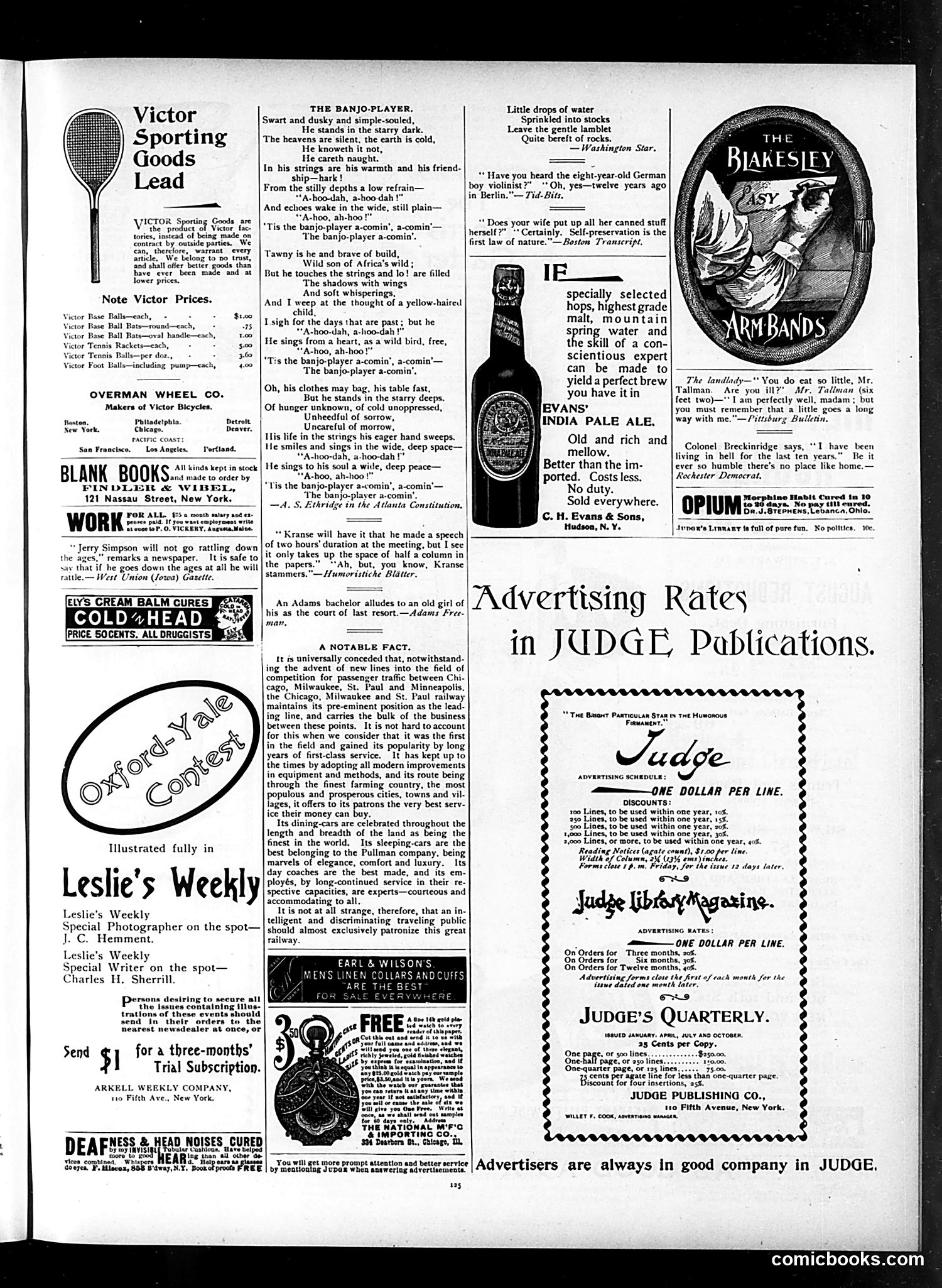
This page is primarily **advertising and filler content** rather than political satire. The main elements include: **"The Banjo-Player"** poem depicts a romanticized, racially stereotyped portrayal of an African American musician—the "swart and dusky" figure singing in the darkness. This reflects late-19th/early-20th-century minstrelsy traditions and racial attitudes common in mainstream publications of the era. The page contains numerous product advertisements (Victor Sporting Goods, Evans India Pale Ale, Leslie's Weekly) and small humorous snippets about various topics (a boy violinist, a wife's canned goods, a tall man's appetite). **Notable context:** The racial imagery in "The Banjo-Player" would be considered deeply offensive today, representing the casual racial stereotyping that permeated even "sophisticated" American publications during this period. The poem romanticizes both the musician and poverty/hardship, typical of sentimental treatments of Black characters in this era. The page is essentially a standard magazine layout mixing entertainment, poetry, and commerce.
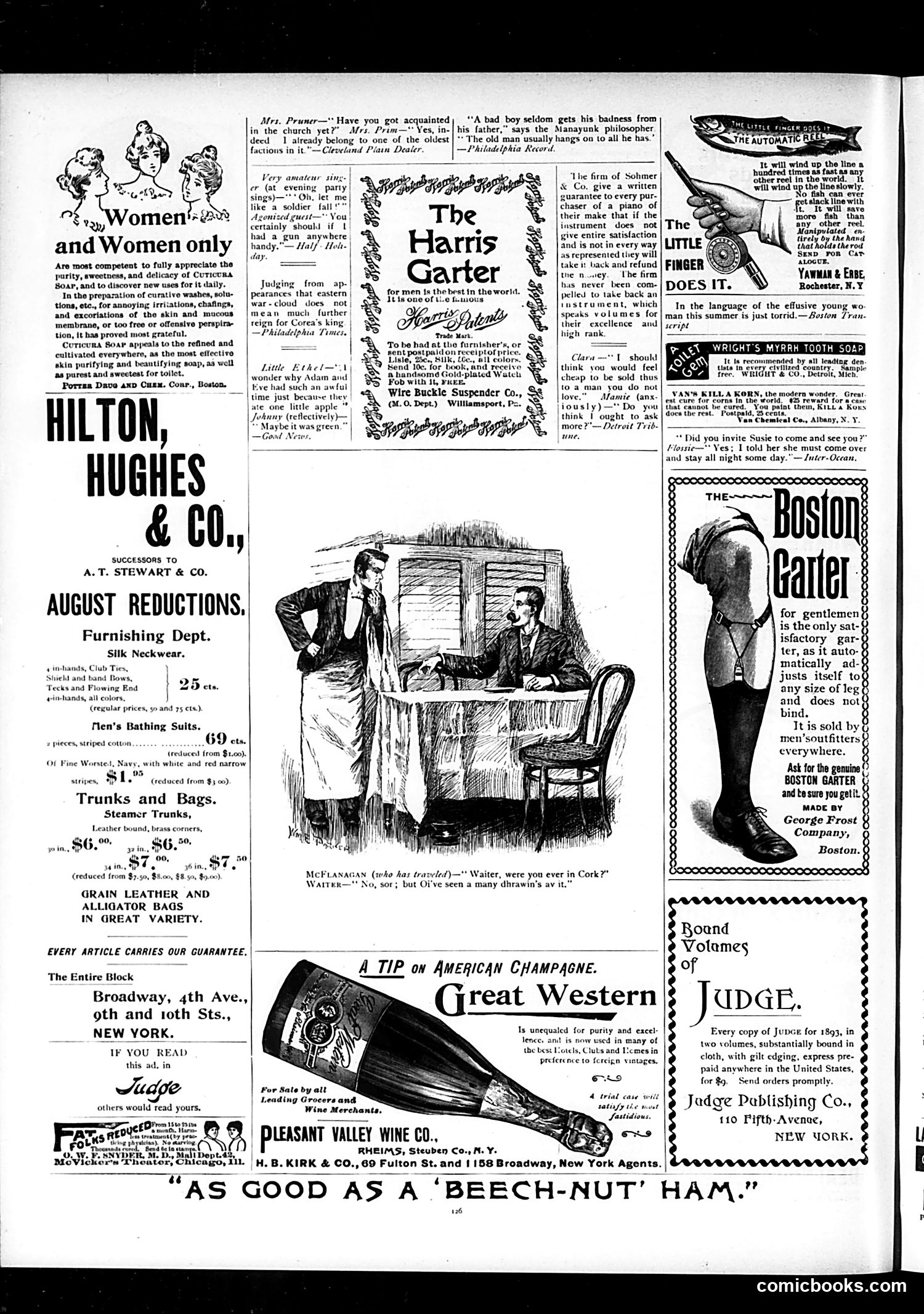
This page is primarily **advertising**, typical of Judge magazine's revenue model. The content mixes commercial ads with brief humor pieces. **Main cartoon/joke**: A dialogue between two men at a desk depicts "McFlanagan" asking a waiter if he's ever been to Cork. The waiter's response—that he's "seen a many drawin's av it"—is a pun playing on Irish dialect and the word "drawing" (likely referring to illustrations or depictions rather than actual travel). It's gentle ethnic humor common to the period. **Other humor snippets** scattered throughout are brief quips about church factions, bad boys inheriting traits, piano quality guarantees, and whether Adam regretted Eve eating the apple—standard light comedy of the era. **Advertisements** dominate, hawking Cuticura soap (targeting women), Hilton Hughes department store clearance sale, the Harris Garter (suspenders), Boston Carter garters, and Great Western champagne—typical merchandise of early 1900s America. The page reflects Judge's formula: satirical magazine format with substantial advertising revenue supporting occasional humor content.
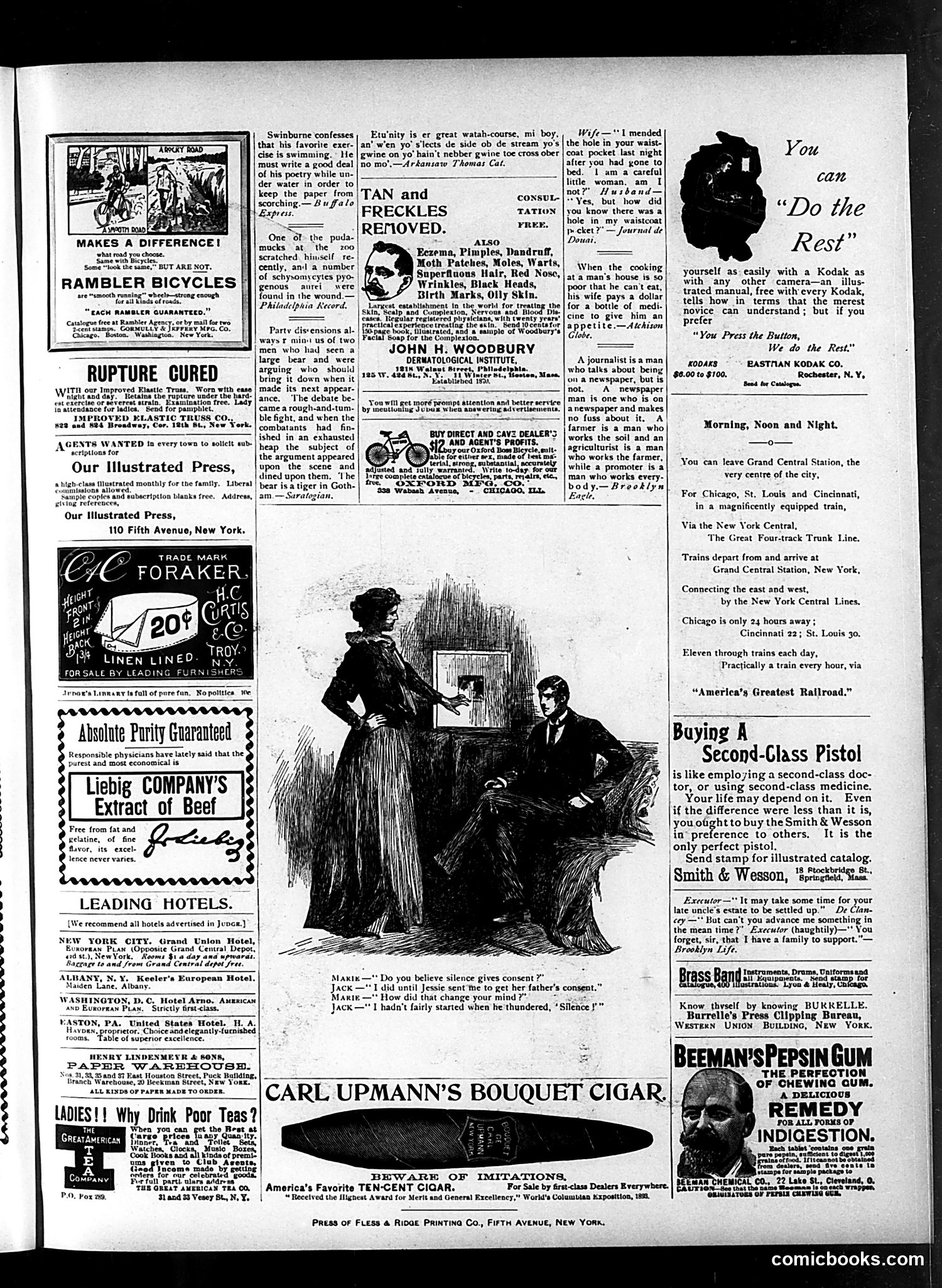
This page is primarily **advertisements and filler content** rather than political satire. The main illustrated cartoon depicts a domestic scene: a wife discussing a mended waistcoat pocket with her husband, who questions how she knew about the hole. The joke is simple marital humor—he hadn't told her, implying she discovered it through suspicious circumstances (perhaps finding evidence of infidelity or dishonest behavior). The rest of the page consists of commercial ads for bicycles, trusses, beef extract, hotels, cigars, and patent medicines—typical of period magazines. One small text anecdote humorously contrasts a "journalist" (who talks about newspaper work) with a "promoter" and "farmer," but this appears to be light social commentary rather than serious political satire. The page lacks significant political content or caricature of public figures.
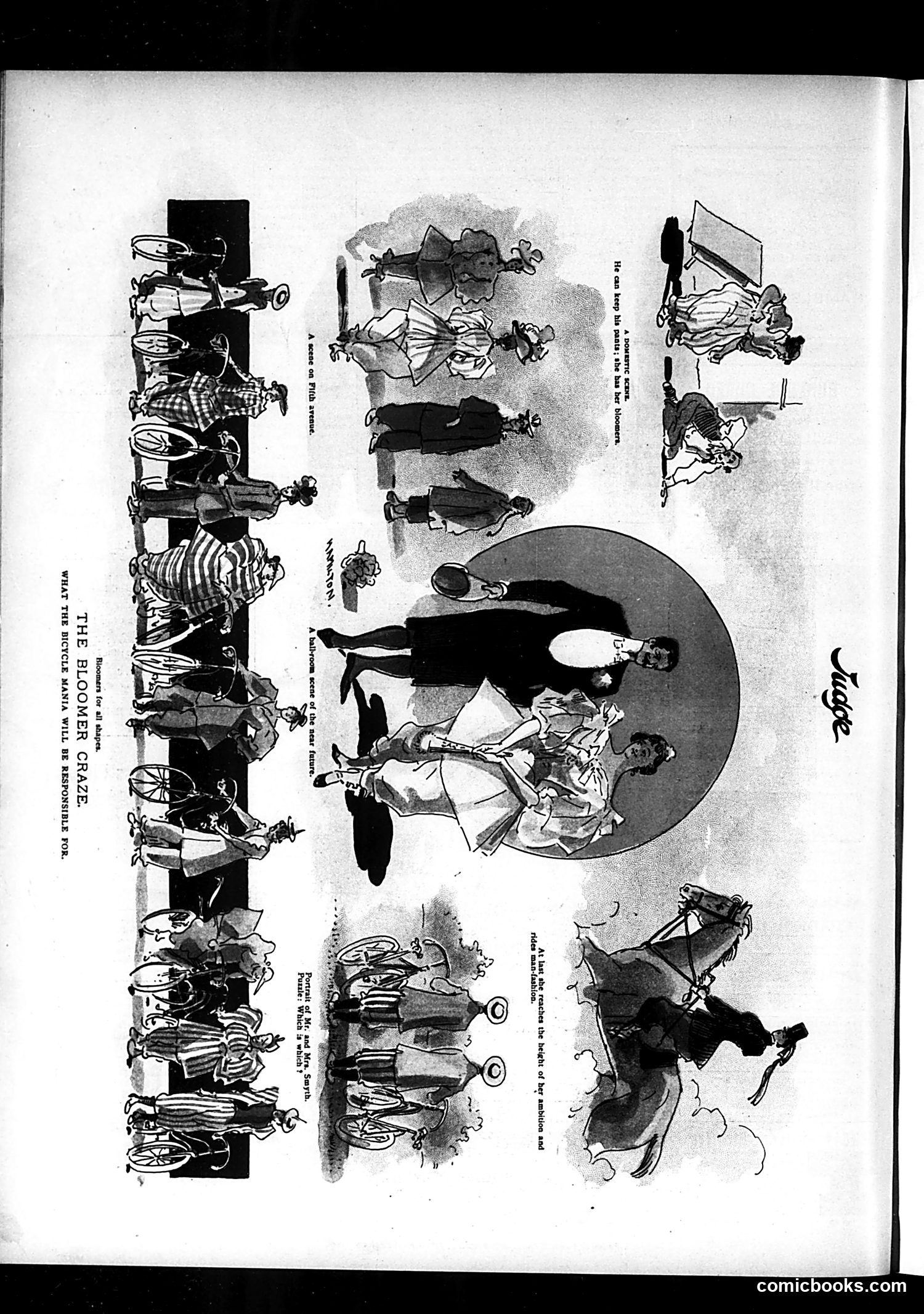
This satirical page mocks the "bloomer craze"—women wearing loose, pants-like garments that became associated with the bicycle boom of the 1890s. The central image shows a woman in bloomers standing triumphantly in a circle, having achieved her "ambition" to "ride man-fashion" (sitting astride rather than sidesaddle, as was then expected). The left column depicts various women's body types in bloomers, labeled "Bloomers for all shapes," suggesting the garment's universal adoption. The title warns that bicycle mania will cause women to abandon traditional dress. The cartoon satirizes both the women's cycling movement and contemporary anxieties about gender roles—mocking women's athletic freedom while treating bloomers as ridiculous and unfeminine. This reflects 1890s conservative resistance to women's independence and changing social norms.