
A complete issue · 16 pages · 1894
Judge — August 18, 1894
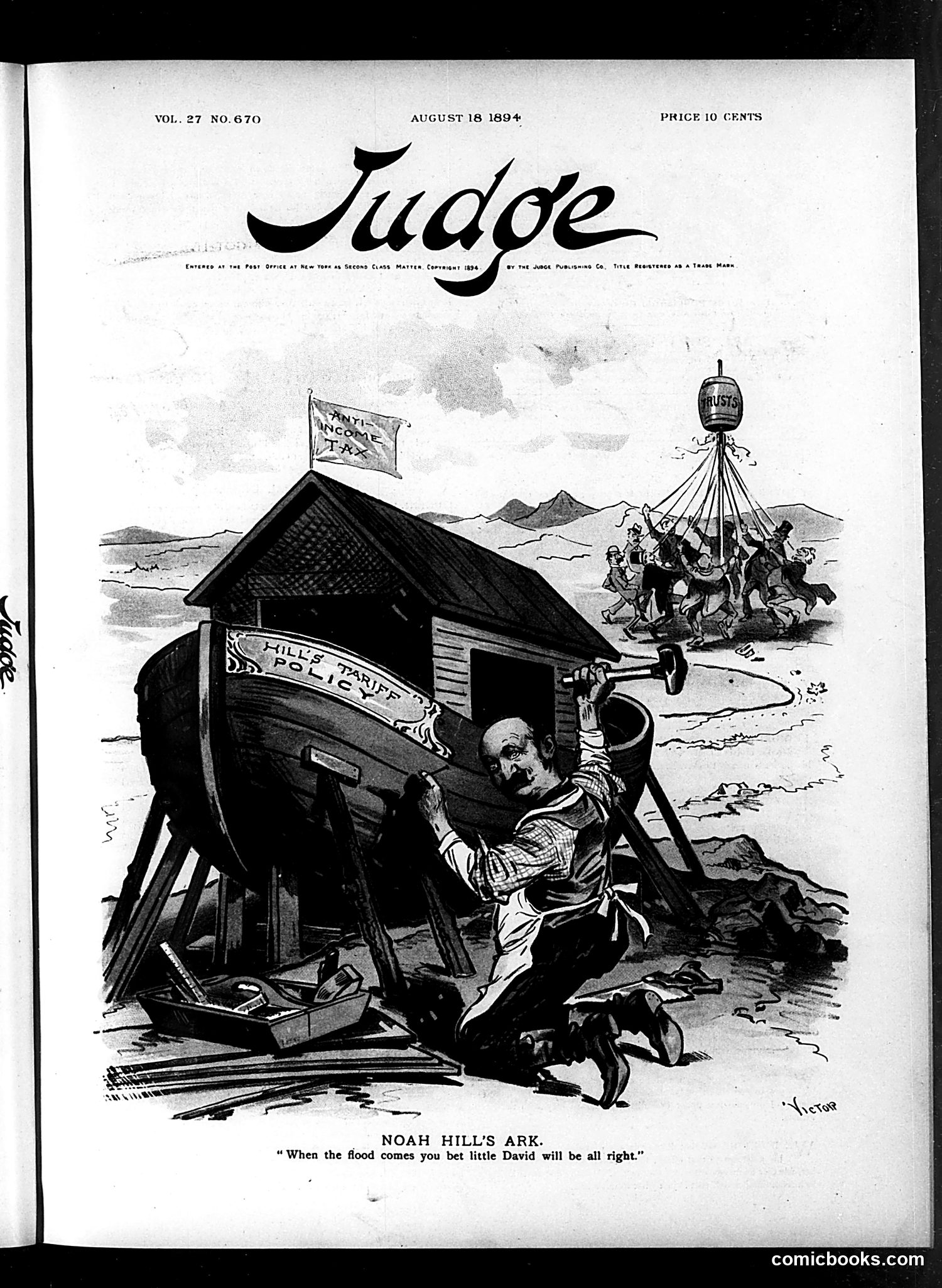
This political cartoon satirizes **Noah Hill's Tariff Police**—likely referring to a contemporary tariff enforcement policy or official. The image depicts Hill as Noah, constructing an "ark" (a small police structure) while claiming "When the flood comes you bet little David will be all right." The satire appears to mock Hill's protective tariff measures as inadequate preparation for economic crisis, using the Noah's Ark biblical metaphor ironically. The "flood" likely references feared economic turmoil or financial collapse. The cartoon suggests Hill's tariff policies won't actually protect vulnerable citizens ("little David"—perhaps representing ordinary workers or small businesses) when disaster strikes. The distant crowd gathered around a "Trusts" structure on the right may represent monopolistic forces looming in the background.
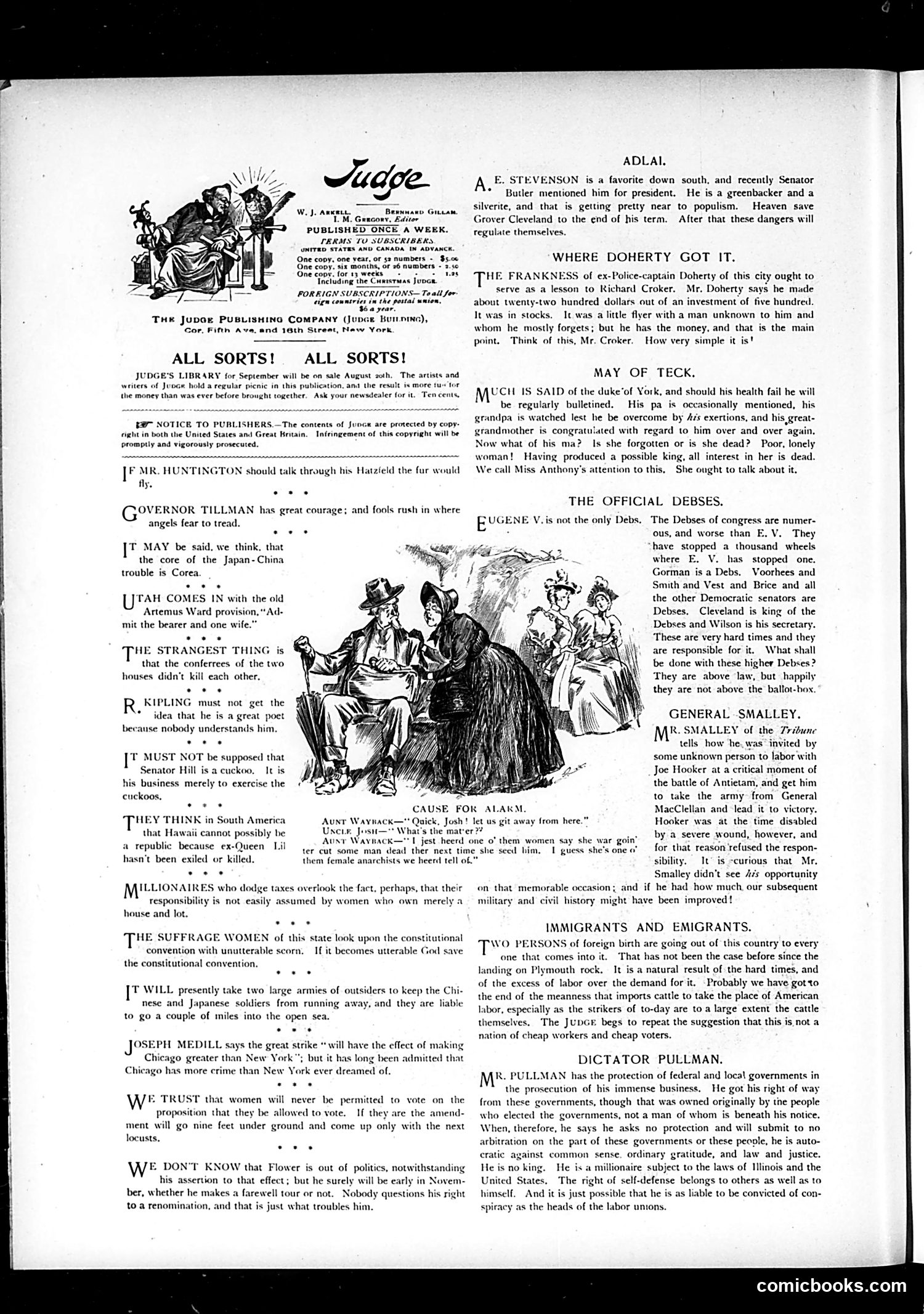
This page contains satirical commentary on early 20th-century political figures and issues. The main cartoon depicts what appears to be a social gathering with figures in period dress, likely satirizing debates or controversies of the era. The text references include commentary on Senator Butler, Governor Tillman, and discussions of Congressional debates. There's satire directed at political figures termed "Debses" (likely referring to Eugene V. Debs, the Socialist politician), with Cleveland mentioned as "king of the Debses." The page also contains commentary on labor immigration, strikes, and the "suffrage women" debate—suggesting this is from the Progressive Era (early 1900s) when these issues dominated American politics. The overall tone mocks political pretension and incompetence across party lines while addressing contemporary labor and women's rights controversies.
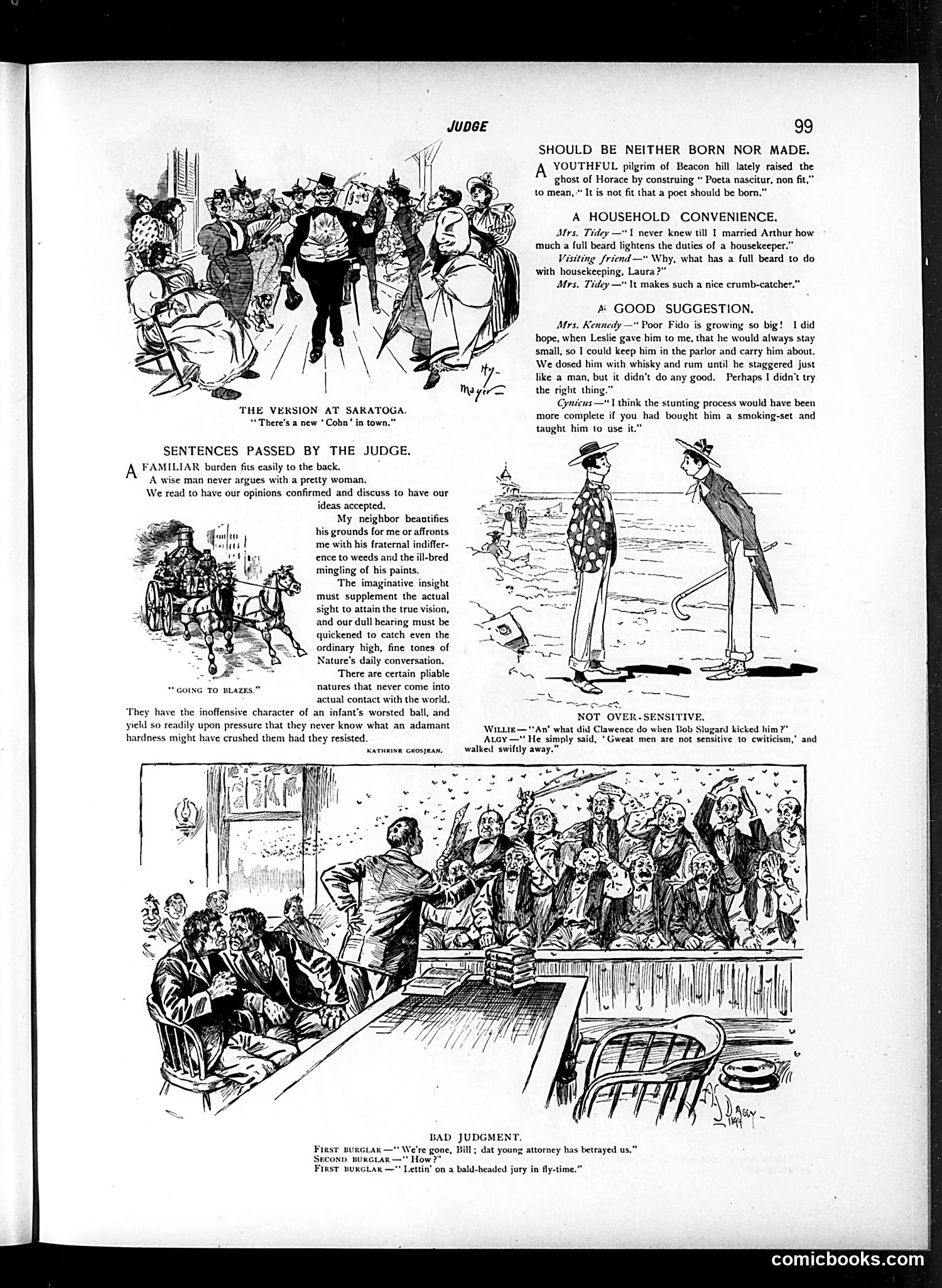
This page contains several satirical vignettes mocking social conventions and legal proceedings of the era (appears to be late 19th or early 20th century). **"A Familiar Burden"** jokes about marriage and domestic life—comparing a husband to a donkey carrying his wife's opinions and ideas. **"A Household Convenience"** satirizes the impracticality of full beards, suggesting they're only useful as "crumb-catchers" during meals. **"Sentences Passed by the Judge"** offers aphoristic observations about human nature and social behavior—wisdom disguised as legal pronouncements. **"Bad Judgment"** (bottom cartoon) depicts a courtroom scene where a burglar complains that a young attorney "betrayed" them, likely satirizing incompetent legal defense or corruption in the justice system. The overall tone mocks everyday frustrations, marriage dynamics, and institutional failures through humorous caricature and dialogue.
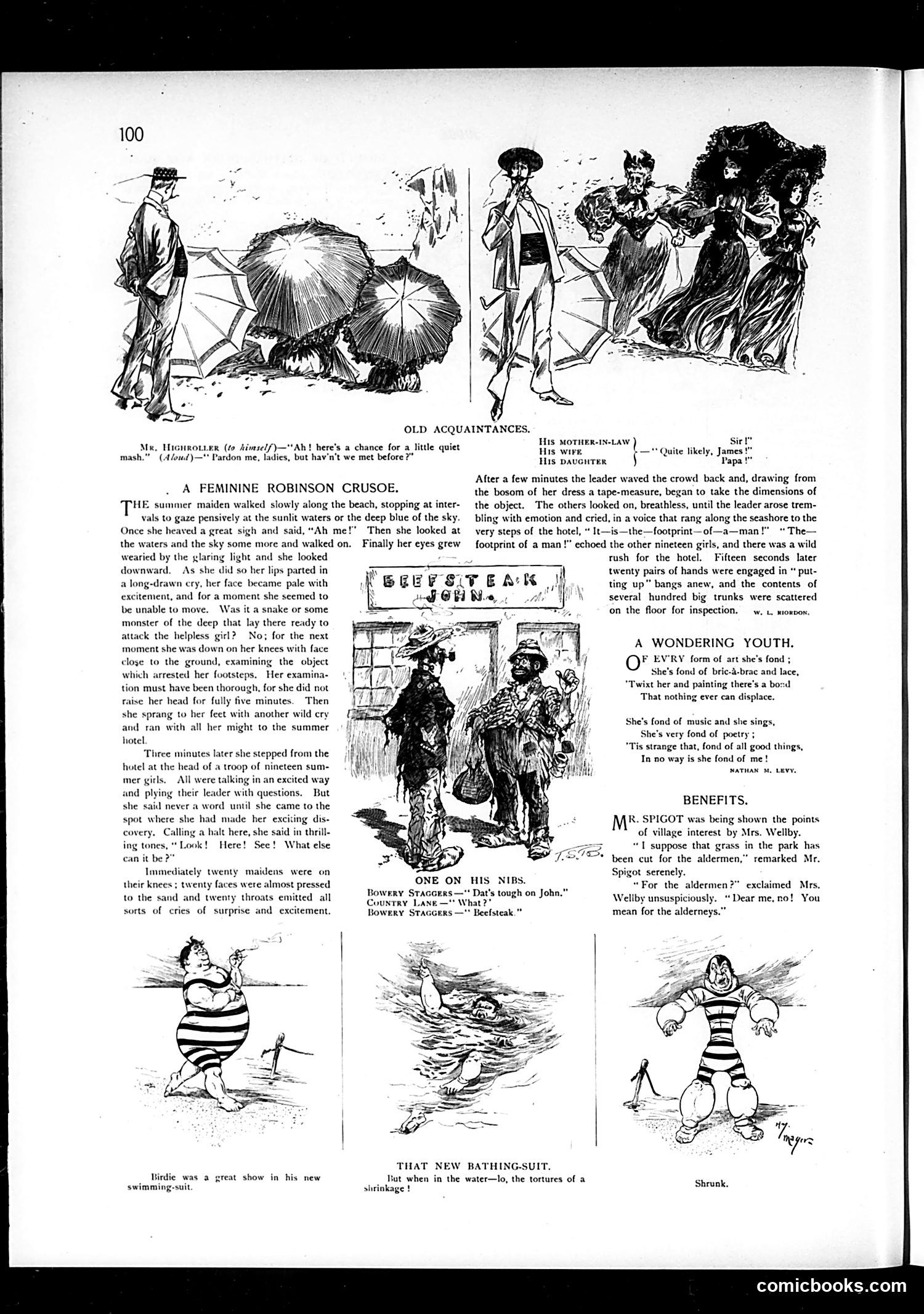
This page contains several unrelated satirical sketches typical of Judge's humor circa early 1900s: **"Old Acquaintances"**: A man attempts to seduce women by feigning prior meetings—standard Victorian-era "mashing" (flirtation) satire mocking predatory male behavior. **"A Feminine Robinson Crusoe"**: Twenty summer-resort maidens become hysterical upon discovering a man's footprint on the beach. The satire mocks women's obsession with romance and their tendency toward collective hysteria—a common period stereotype. **"One on His Nibs"** and **"That New Bathing-Suit"**: Brief jokes about working-class characters and bathing suit shrinkage when wet. **"A Wondering Youth"**: A young man puzzles why a woman fond of all refinements (art, poetry, music) won't love *him*—gentle self-deprecating humor. **"Benefits"**: Wordplay on "aldermen" versus "alderneys" (a goat breed), mocking rural misunderstandings. The page is primarily entertainment with light social commentary on romance, class, and gender stereotypes rather than serious political satire.
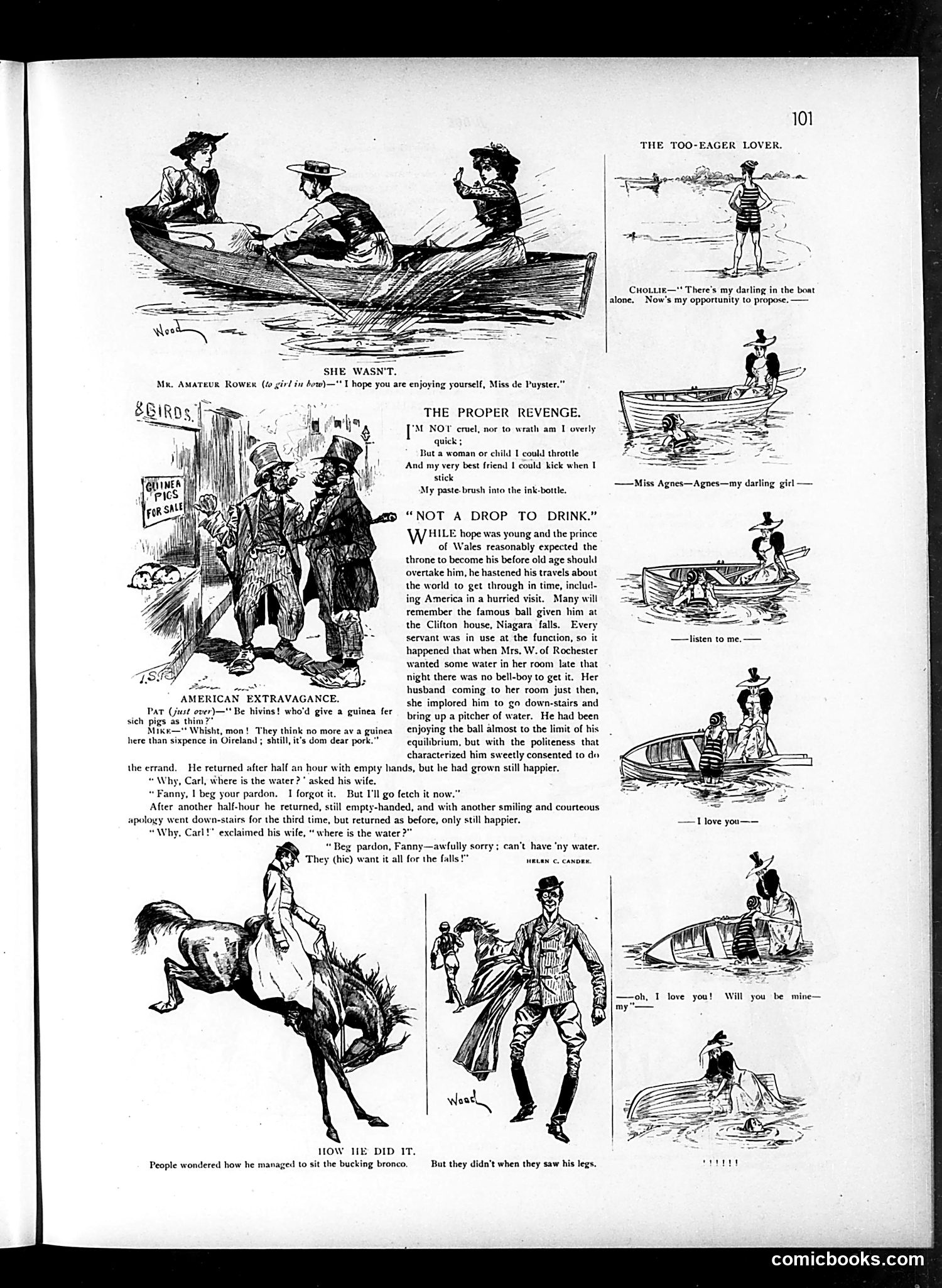
This page from *Judge* contains multiple brief comedic sketches mocking romantic mishaps and social awkwardness. The main feature, "The Too-Eager Lover," depicts a man (Chollie) repeatedly attempting to propose to a woman (Agnes) in a boat, only to accidentally capsize or bungle each effort. The repeated failures—shown through sequential boat illustrations—satirize overeager suitors who sabotage their own romantic intentions through clumsiness. Other sketches mock: a man repeatedly forgetting to fetch water (remaining drunk and cheerful); a woman exacting "proper revenge" by sabotaging someone's inkwell; and a rider's success on a bucking bronco explained by his distinctive leg appearance—all playing on themes of incompetence, domestic frustration, and social pretension typical of *Judge's* humor. The satire targets male foolishness in romantic and domestic contexts, reflecting Victorian-era attitudes about courtship and marriage.
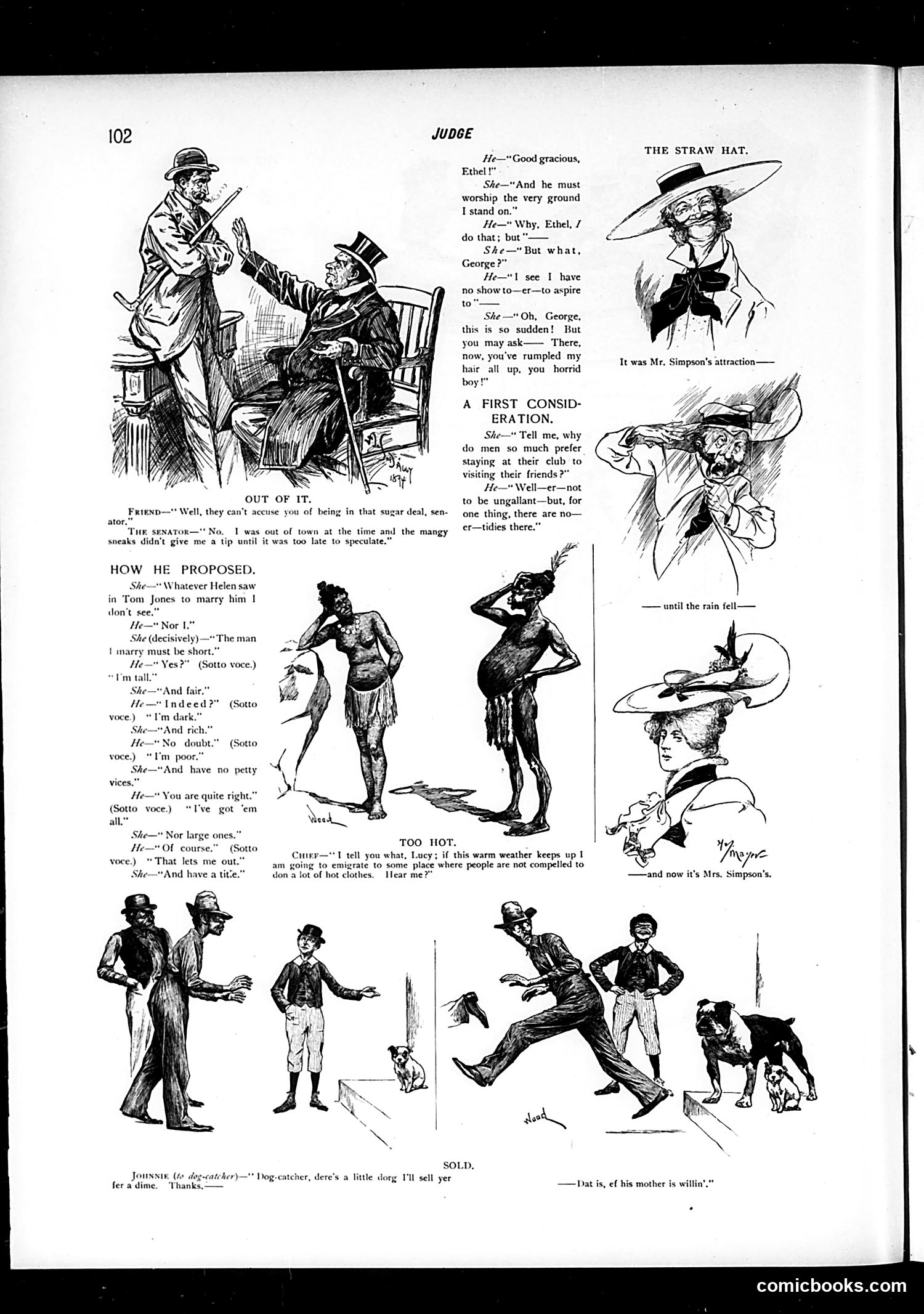
This page collects several brief satirical sketches typical of Judge's humor: **"Out of It"** mocks political corruption—a senator complains he missed out on the "sugar deal" (likely referring to tariff manipulation or stock speculation) because he was conveniently absent and received no advance tip. The satire targets politicians' casual acceptance of insider trading. **"How He Proposed"** presents a courtship where the couple's whispered asides (sotto voce) reveal they're lying to each other. She demands he be short, poor, and worship her; his muttered responses admit he's tall, rich, and vain. The joke satirizes insincere romantic performance. **"Too Hot"** jokes about summer heat and minimal clothing. **"A First Consideration"** humorously suggests men prefer clubs because there are no "tidies"—decorative antimacassars (chair coverings), implying domestic spaces are overly fussy. **"Sold"** depicts a street vendor and various lower-class characters in working-class dialect humor. The overall tone targets hypocrisy, romantic pretense, and social pretension among the middle and upper classes.
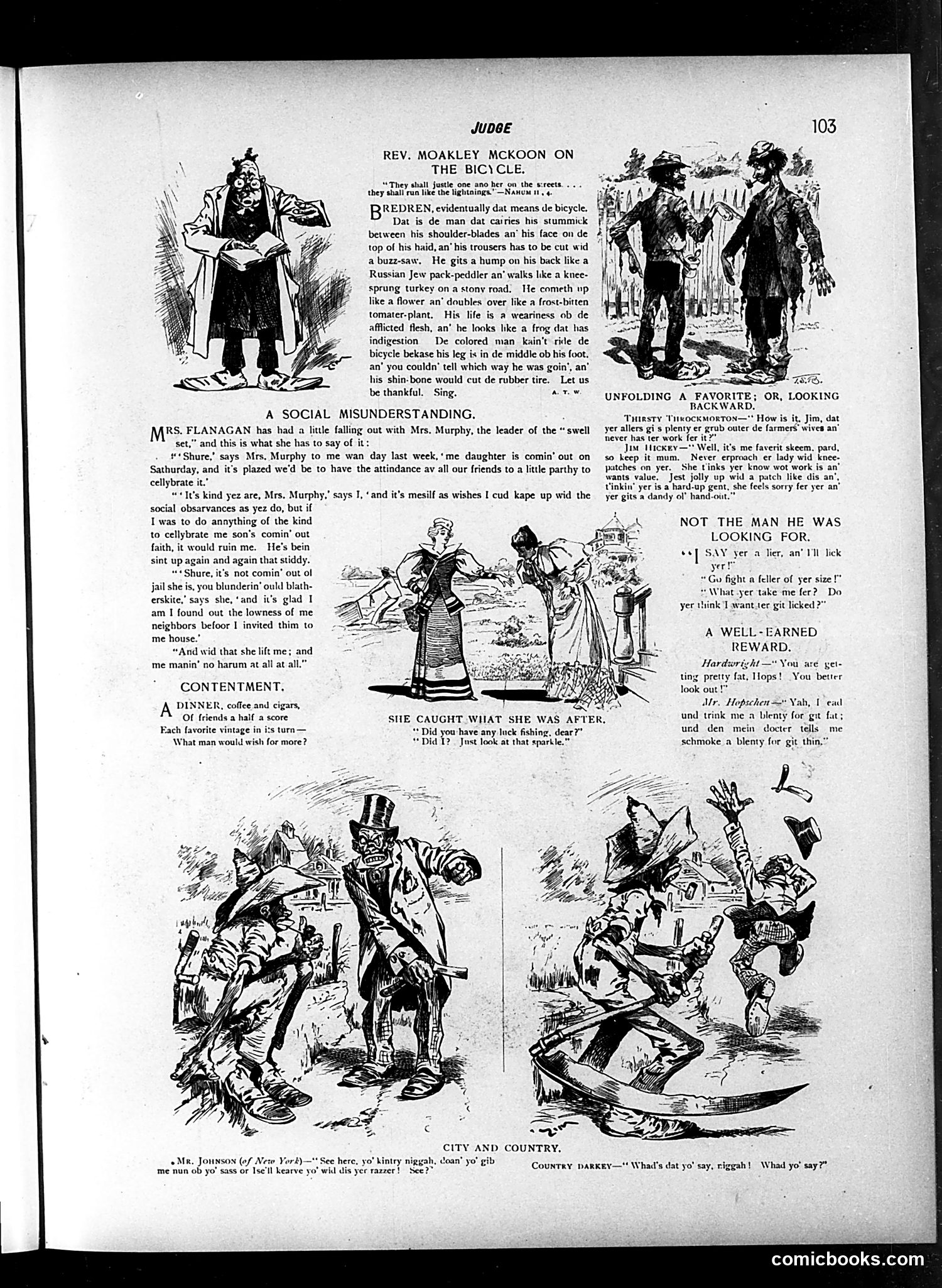
This page contains several satirical pieces mocking contemporary social issues: **"Rev. Moakley McKoon on the Bicycle"** ridicules cyclists' awkward appearance and posture, using a mock-sermon delivered in exaggerated dialect. It includes a racist jab at Black Americans, claiming they physically cannot ride bicycles. **"A Social Misunderstanding"** satirizes Irish-American social pretensions, depicting Mrs. Flanagan and Mrs. Murphy as working-class women obsessed with social climbing and "coming out" celebrations—mocking their aspirations. The remaining sketches use ethnic caricatures and dialect humor (German "Hopschen," rural Black "Country Parkey," Irish immigrants) to create jokes about class differences, obesity, and courtship. The page reflects Judge's consistent approach: mocking bicycles as a fad, targeting immigrant groups and ethnic communities, and satirizing class-consciousness among working people—typical late-Victorian upper-class humor that would be considered offensive today.
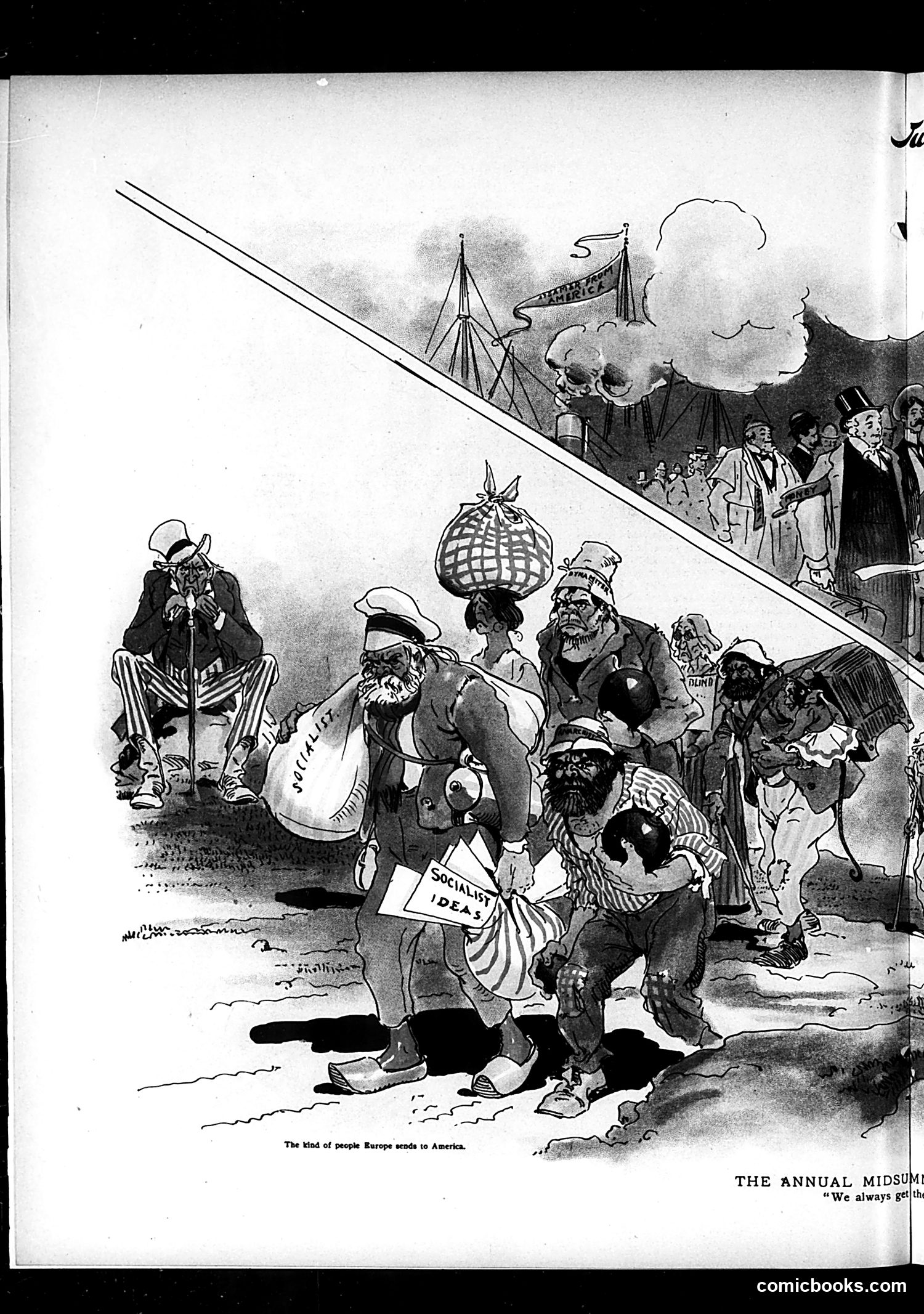
This Judge magazine cartoon satirizes European immigration to America. The caption reads "The kind of people Europe sends to America," depicting caricatured immigrants arriving by ship (visible at top right). The left figure sits dejected, labeled with what appears to be "SKILL" on a bag—suggesting skilled workers Europe was exporting. The central figures carry symbols including a globe marked with a grid pattern and a sign reading "SOCIALIST IDEAS," suggesting fears about radical political ideology accompanying immigration. The cartoon reflects late 19th/early 20th-century American anxieties about immigration's social and political consequences. The exaggerated facial features and stereotypical depictions were typical of this era's editorial cartooning, though deeply offensive by modern standards. The satire targets both European nations allegedly "dumping" undesirable populations and American concerns about foreign radicalism.
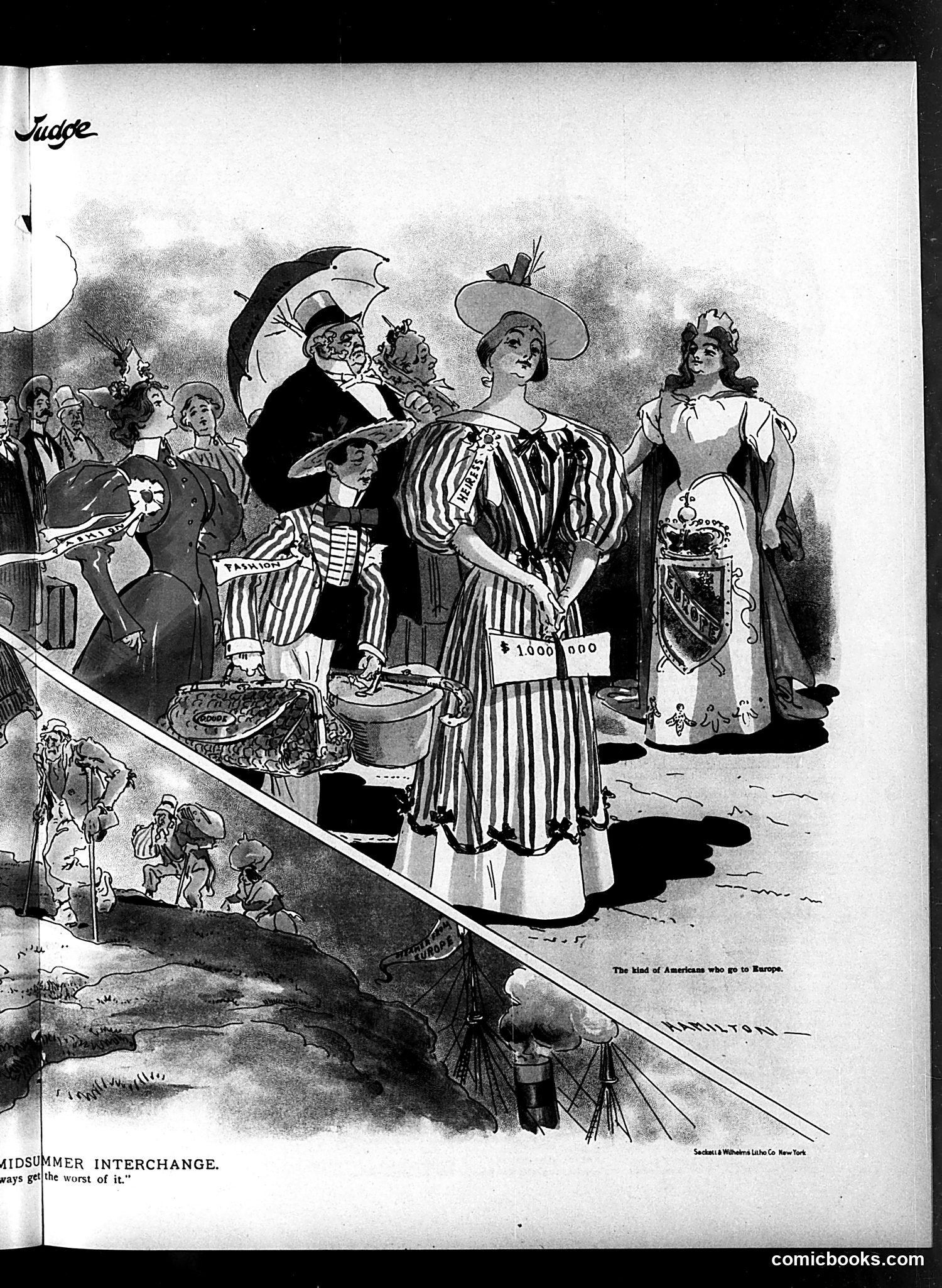
This appears to be a Judge magazine cartoon titled "Midsummer Interchange," depicting American tourists abroad in Europe. The caption "The kind of Americans who go to Europe" and the partial text "ways get the worst of it" suggest satire about American travelers' behavior or reputation. The illustration shows well-dressed women with elaborate hats and fashionable striped clothing, accompanied by an older gentleman with an umbrella. A sign reading "$1,000,000" appears visible, likely referencing excessive American spending. The cartoon satirizes wealthy American tourists—a common Judge subject—mocking their ostentatious dress, spending habits, and presence in Europe. The "interchange" likely refers to cultural or social exchanges between Americans and Europeans, with the implication that Americans emerge poorly from such comparisons due to their perceived vulgarity or poor behavior abroad.
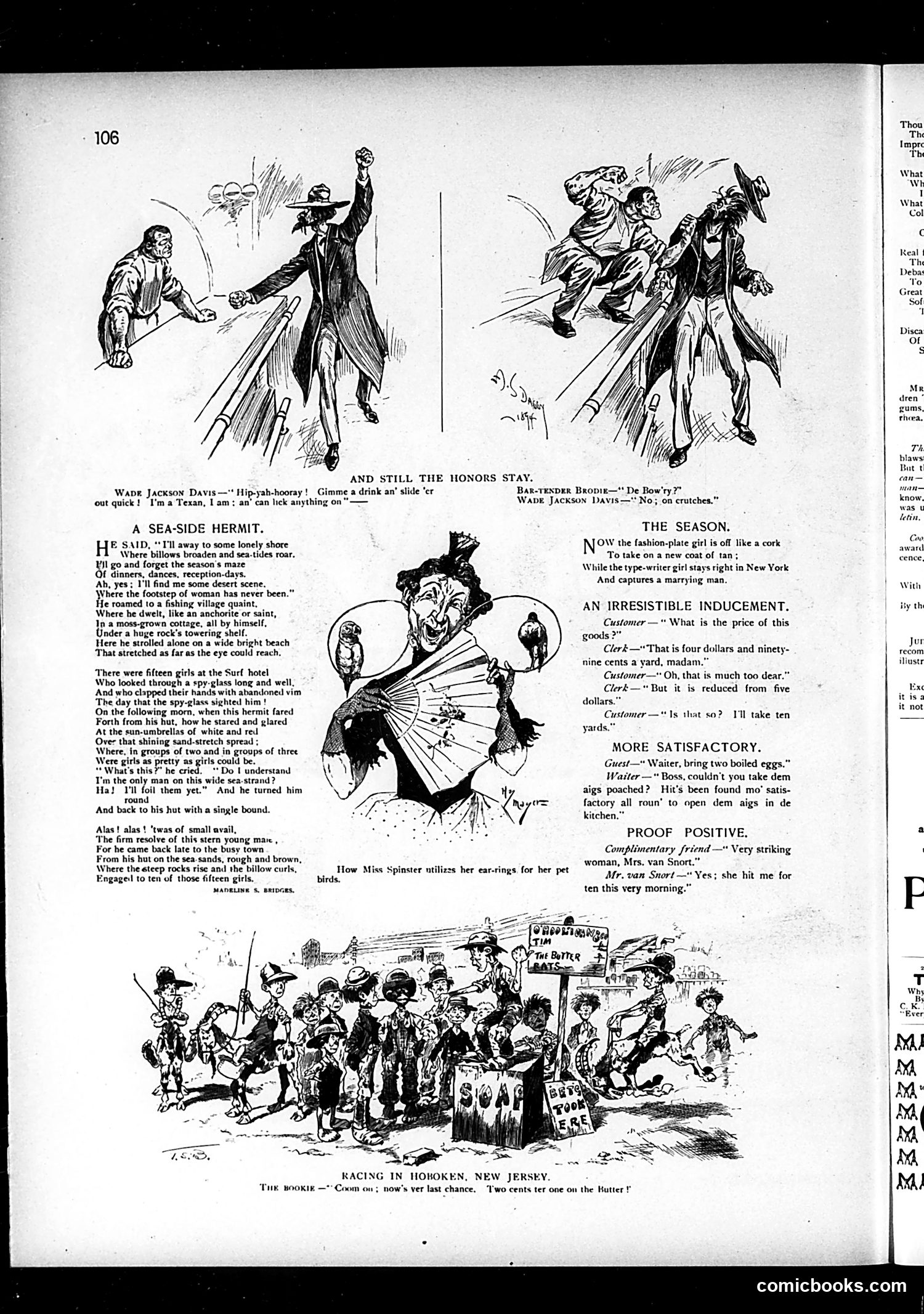
This page contains several satirical vignettes typical of Judge's humor: **"And Still the Honors Stay"**: Depicts Wade Jackson Davis (apparently a recognizable Texas figure) boasting about his prowess while a "Bar-Tender Brodie" questions his abilities, suggesting deflated claims. **"A Sea-Side Hermit"**: A man seeks solitude away from society women, but fifteen girls at a nearby hotel spot him through a spyglass. Despite his resistance, he returns to town engaged to ten of them—satirizing male resistance to matrimony as ultimately futile against female persistence. **Short comedic sketches** follow: customer psychology ("reduced from five dollars" makes an item suddenly desirable), a waiter's dialect humor, and marital conflict presented as proof of a woman's striking nature. **"Racing in Hoboken, New Jersey"**: Shows street gambling with crude caricatures, satirizing working-class leisure activities. The page reflects Judge's focus on romantic/gender dynamics, class-based humor, and ethnic dialect comedy typical of early 20th-century American satire.
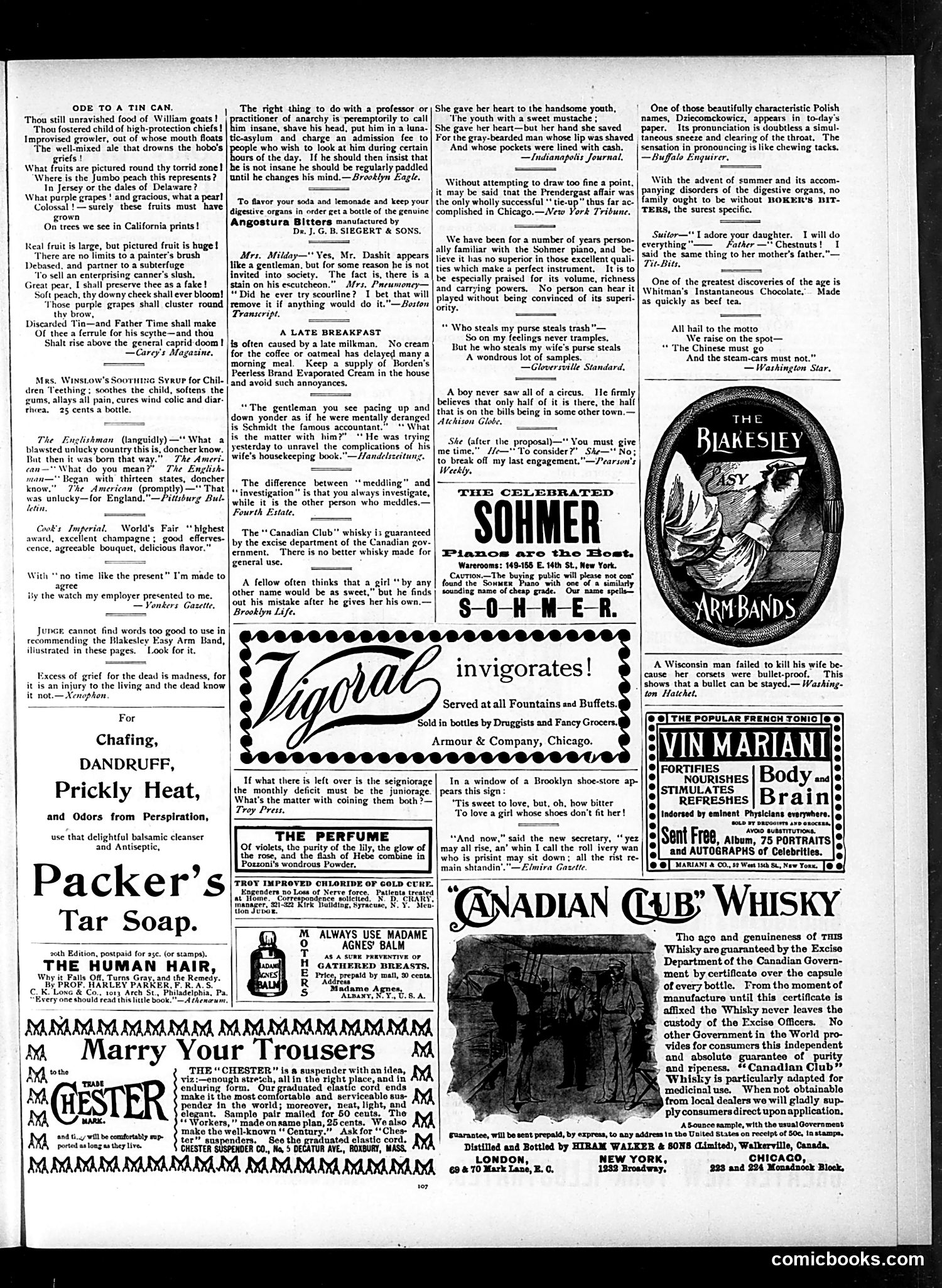
This page is primarily **advertisements and light satirical verses** rather than political cartoons. The main satirical content includes: 1. **"Ode to a Tin Can"** — Mock-heroic verse mocking deceptive food labeling. The satire critiques canned goods that display impossibly large, perfect fruit illustrations on their labels while containing inferior contents. It's commentary on **consumer fraud through misleading packaging**. 2. **Brief witty exchanges** about social topics: - An English/American joke about luck and colonialism - A joke about anarchists/radicals (contemporary to the Progressive Era) - Marital humor about wives' spending habits The rest is **period advertising** for products like champagne, hair tonics, Angostura Bitters, and evaporated cream—typical of Judge's revenue model. The canned goods satire reflects genuine **Progressive Era concerns about food safety and fraudulent labeling**, predating modern consumer protection laws. The imagery gap between packaging promises and reality was a real consumer problem of this era.
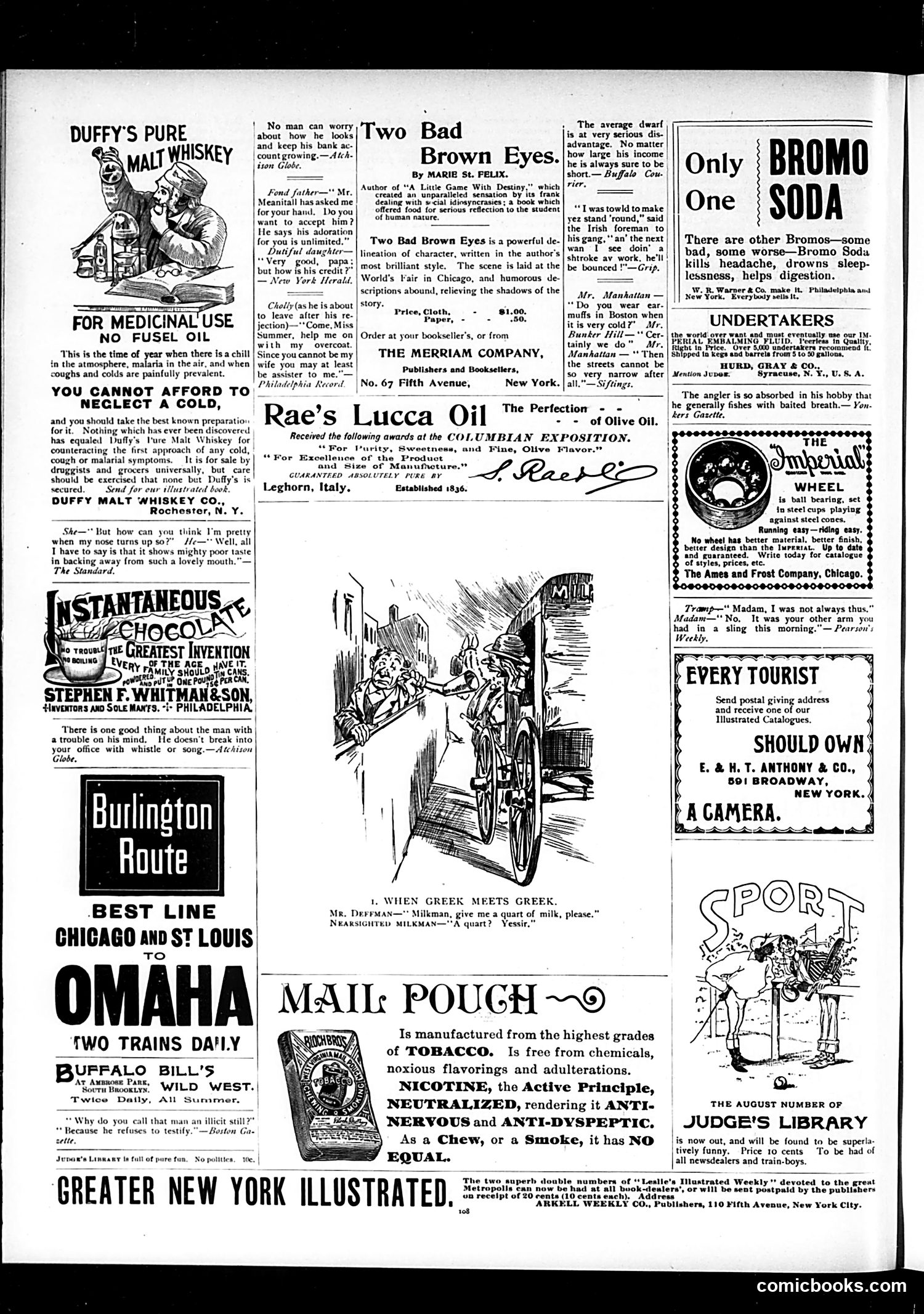
This page is primarily **advertising and humor snippets** rather than political satire. The main content includes: **Advertisements:** - Duffy's Pure Malt Whiskey (marketed as medicinal for colds) - Rae's Lucca Oil (olive oil) - Bromo Soda (headache remedy) - Burlington Route railroad - Buffalo Bill's Wild West show - Various other products **Humor Content:** Short jokes and one-liners on social topics: a woman worrying about her appearance and bank account, a suitor's creditworthiness, a foreman's Irish accent, Boston ear-muffs, and fishing metaphors. **The Cartoon:** A sketch showing what appears to be a street scene with a person in a carriage, labeled "When Greek Meets Greek" with a milk-related punchline. **Context:** This reflects early 1900s American consumer culture and period comedy relying on ethnic humor (Irish accents) and domestic courtship jokes. The page demonstrates Judge's mixed advertising-and-humor format typical of the era.
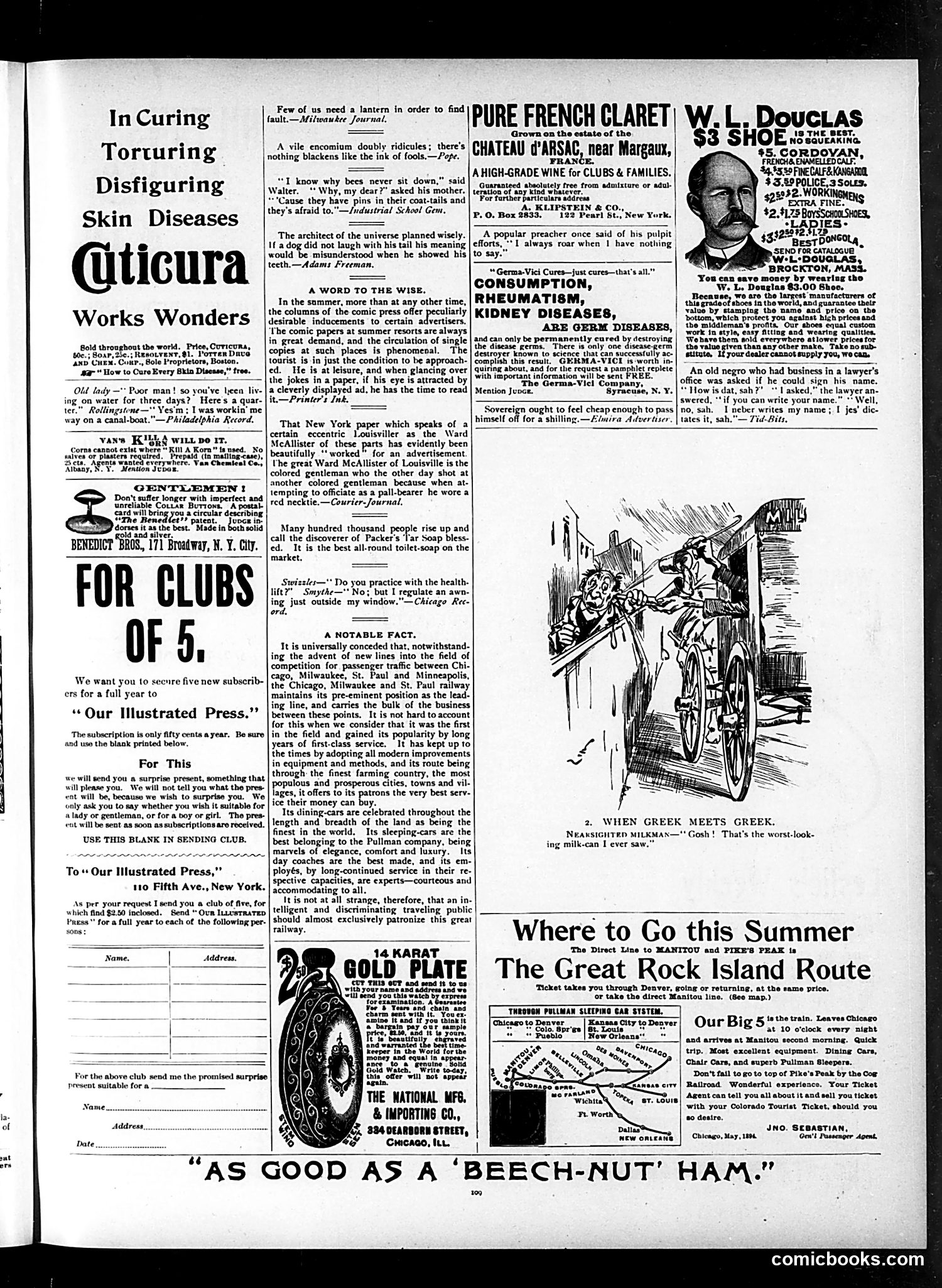
This page is primarily **advertising and filler content** rather than political satire. It consists of: 1. **Product advertisements** (Cuticura skin treatment, Benedicт patent buttons, Packer's Tar Soap) 2. **A subscription solicitation** for "Our Illustrated Press" offering a mystery gift for recruiting five subscribers at 50 cents/year 3. **A small cartoon** titled "When Greek Meets Greek" showing two figures in a wagon or cart with dialogue about "worst-looking milk-can I ever saw"—a mild visual joke about encountering poor quality goods 4. **Travel advertisements** for the Great Rock Island Route railroad 5. **Miscellaneous filler**: brief jokes and aphorisms from various newspapers (Philadelphia Record, Milwaukee Journal, etc.) **No significant political commentary** is present. The page reflects typical late 19th/early 20th-century magazine layout, mixing paid advertising with light humor and editorial content—standard practice for satirical publications needing revenue.
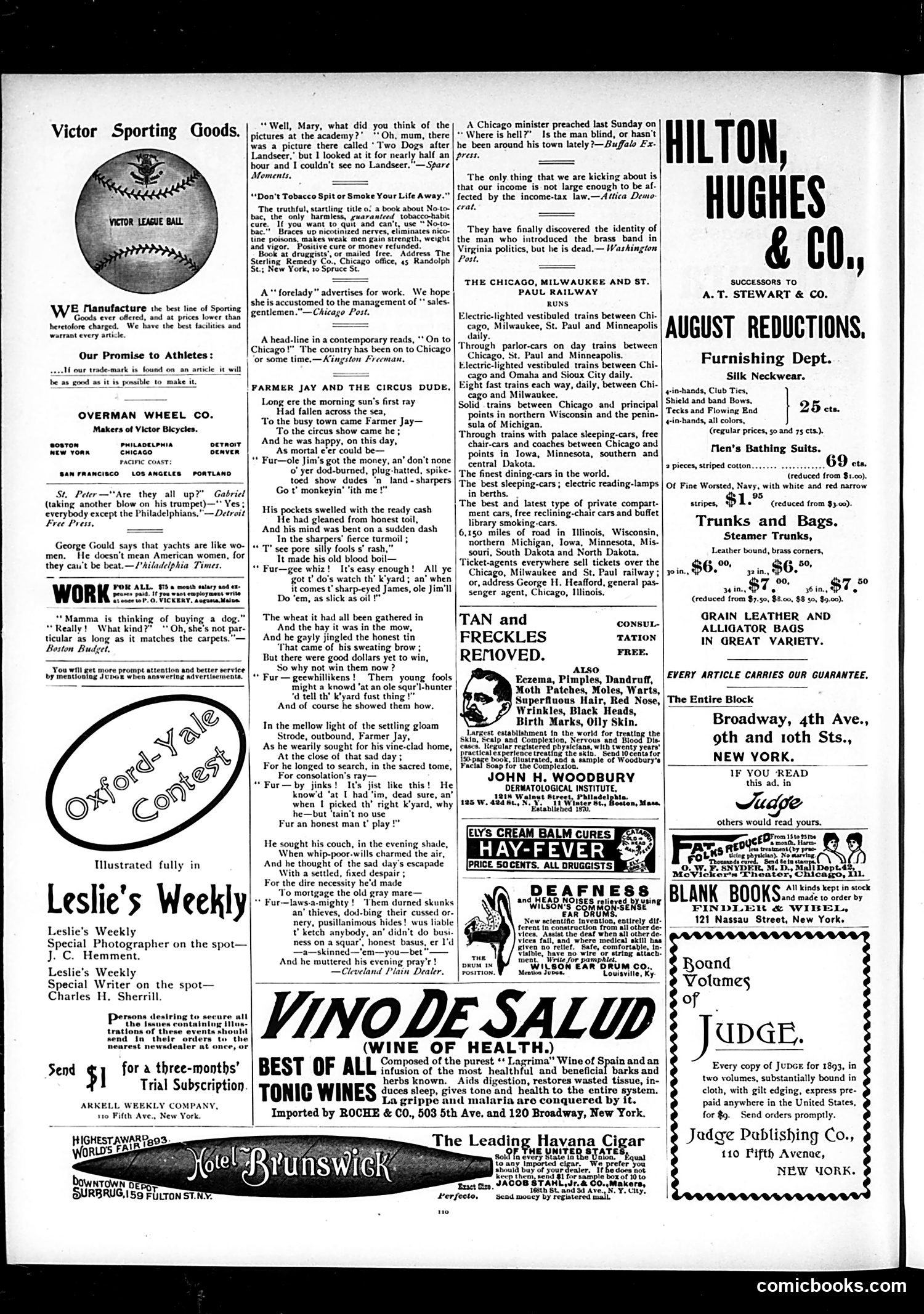
This page is primarily **advertising and humor**, not political cartooning. The main satirical content is "Farmer Jay and the Circus Dude," a narrative poem mocking rural gullibility. Farmer Jay arrives at the circus with money from his harvest, confident he's too clever to be swindled by city con artists. He boasts he'll spot their card-game tricks ("the k'yard"). The poem's ironic conclusion—he leaves "wearily" at day's end, implying he's been thoroughly fleeced—satirizes the clash between rural self-confidence and urban sophistication. The humor targets the farmer's overconfidence and the timeless con of believing oneself immune to classic scams. Other brief jokes mock Philadelphians, women, and failed dog-purchasing logic. The page is otherwise dominated by **sporting goods advertisements** (Victor bicycles, baseball equipment) and patent medicine ads (tobacco-cessation products, hay-fever remedies).
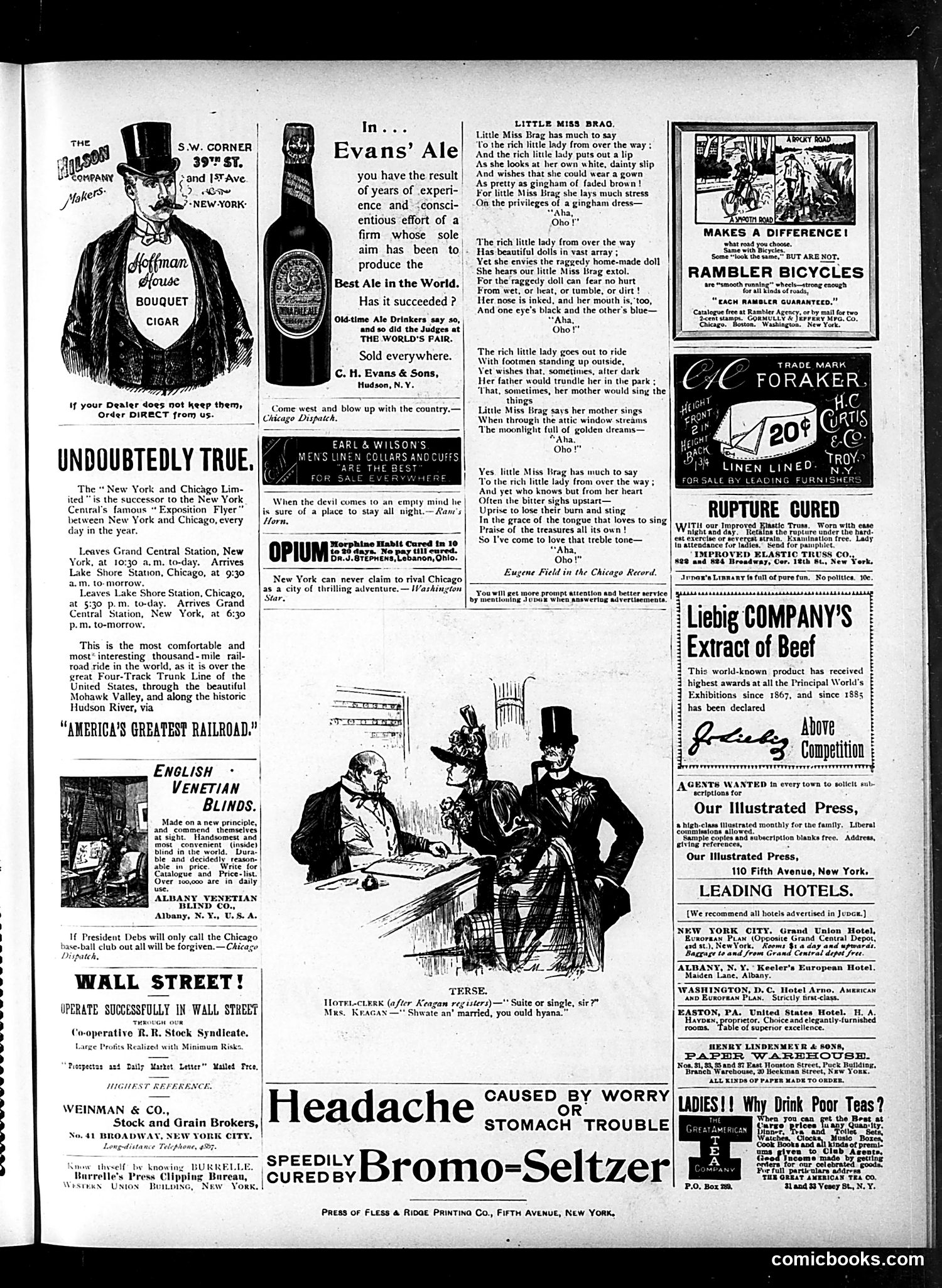
This page is primarily **advertising and light verse**, not political satire. The main content is Eugene Field's poem "Little Miss Brag"—a sentimental children's story contrasting a poor girl who boasts about her simple possessions with a rich girl who envies them. The poem's moral: happiness comes from appreciating what you have, not coveting wealth. The sole cartoon appears at bottom center, showing two men in top hats discussing lodging with a hotel clerk. The caption jokes about marital status ("Sheats an' married, you could hyana"), apparently mocking pretentious or evasive speech—likely a mild jab at social affectation. The rest is period advertising: railroad travel, Evans' Ale (winners at "The World's Fair"), bicycles, Bromo-Seltzer, and financial services. No significant political content is evident on this page.
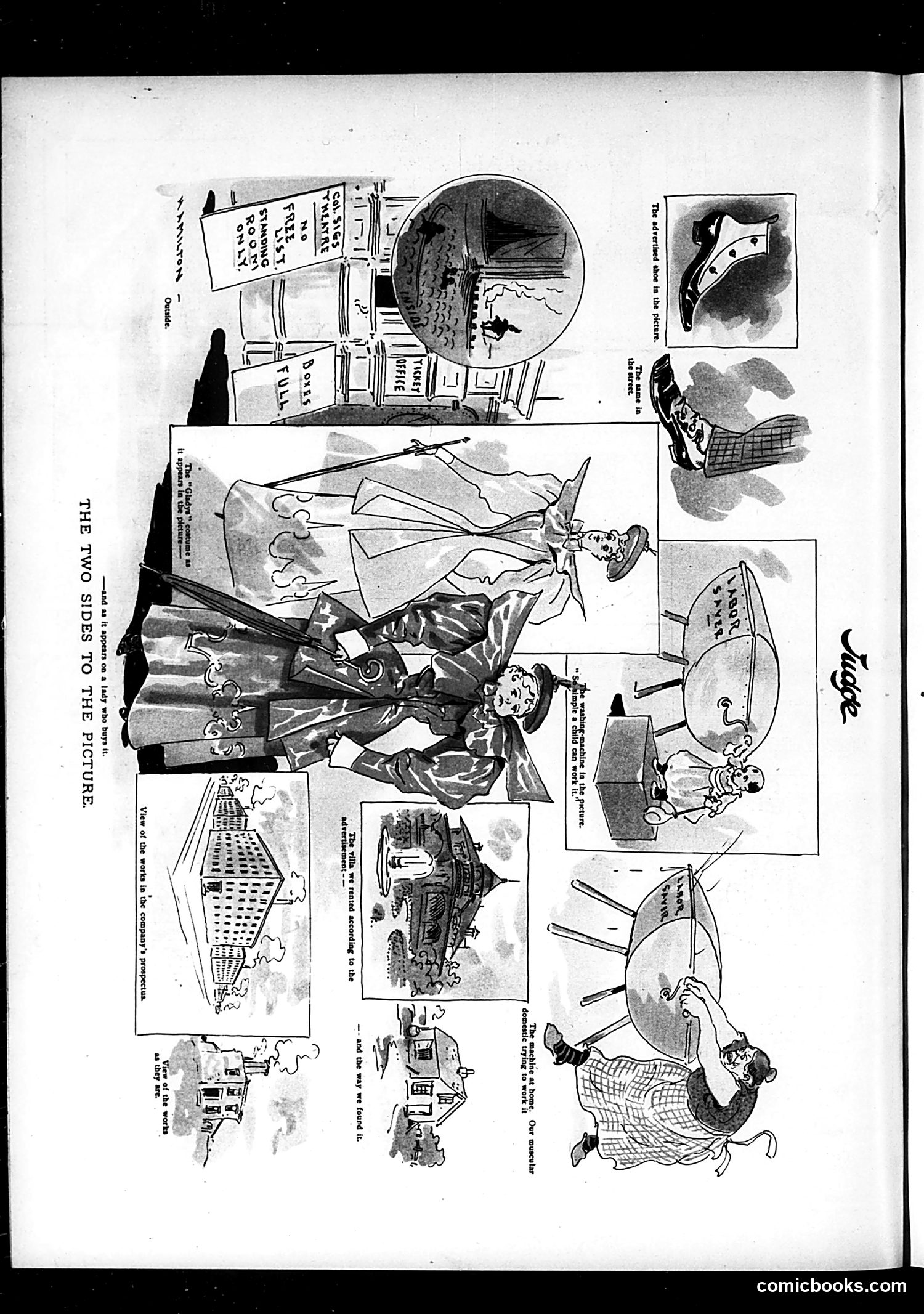
This Judge cartoon satirizes deceptive advertising, specifically for washing machines. The central joke compares promises versus reality: **Left side**: Shows an idealized villa and gleaming washing machine as depicted in company advertisements—clean, efficient, and functional. **Right side**: Shows the actual experience—a frustrated domestic worker (likely a maid) struggling with a broken-down, malfunctioning machine in a shabby rental house that looks nothing like the advertised property. The smaller panels contrast the manufacturer's prospectus drawings with what the machine "actually works" like. The title "Two Sides to the Picture" sarcastically highlights the gap between marketing claims and consumer reality. This reflects early 20th-century consumer frustration with misleading advertisements—a timeless complaint about false product claims and dishonest real-estate listings that modern readers would immediately recognize.