
A complete issue · 16 pages · 1894
Judge — August 4, 1894
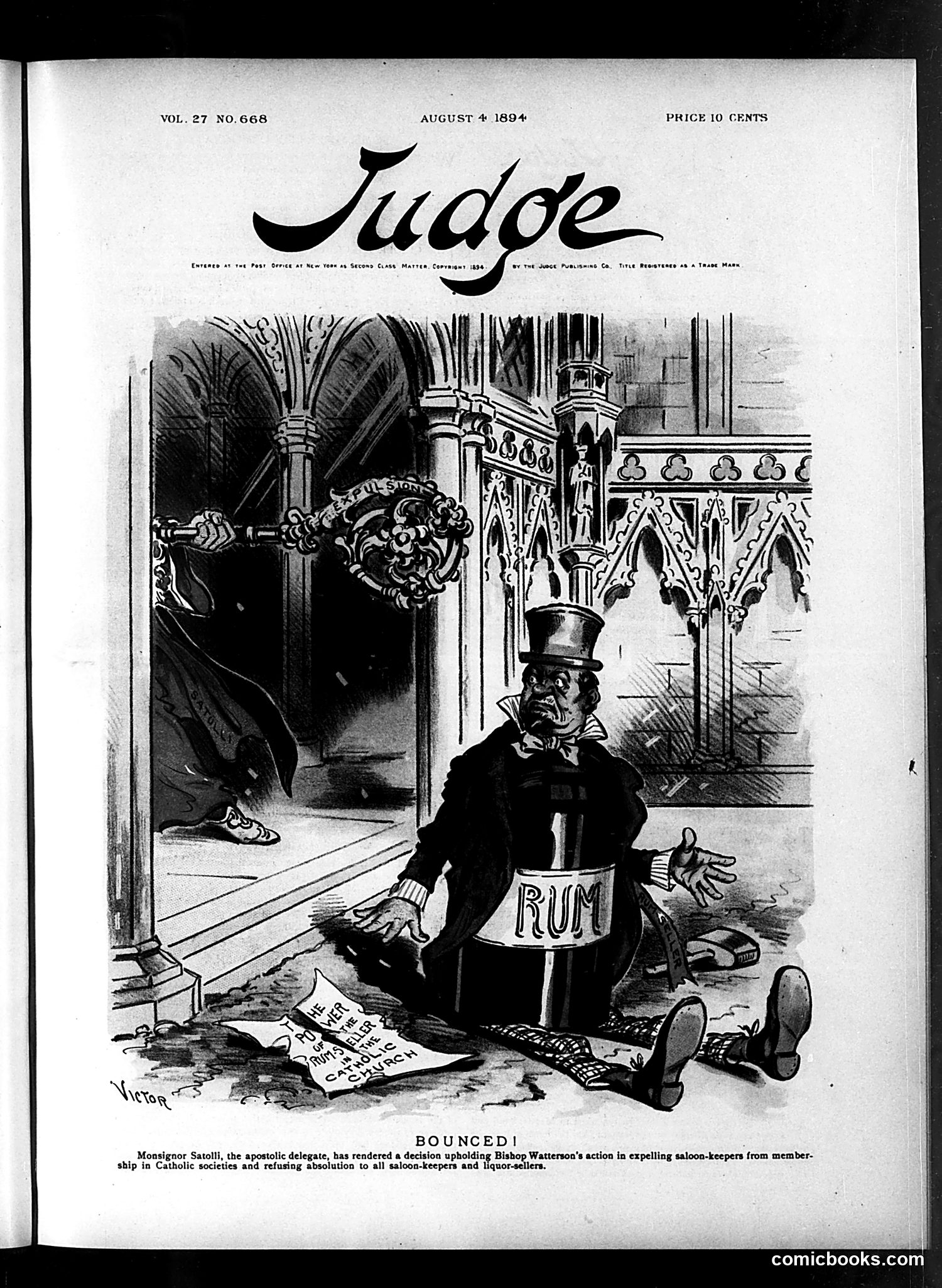
This cartoon satirizes Monsignor Satolli, described in the caption as an "apostolic delegate" who made a decision regarding Bishop Waterson's action expelling saloon-keepers from Catholic societies and refusing absolution to liquor-sellers. The figure, dressed formally with a top hat, is depicted as literally "bounced" out of an ornate church doorway—shown sitting on a barrel labeled "RUM" surrounded by scattered papers. The visual pun suggests Satolli himself has been ejected or discredited by his ruling. The satire critiques either Satolli's decision or his authority, likely commenting on temperance debates within the Catholic Church during the 1890s. The cartoon's sympathies appear to favor Bishop Waterson's strict anti-alcohol stance.
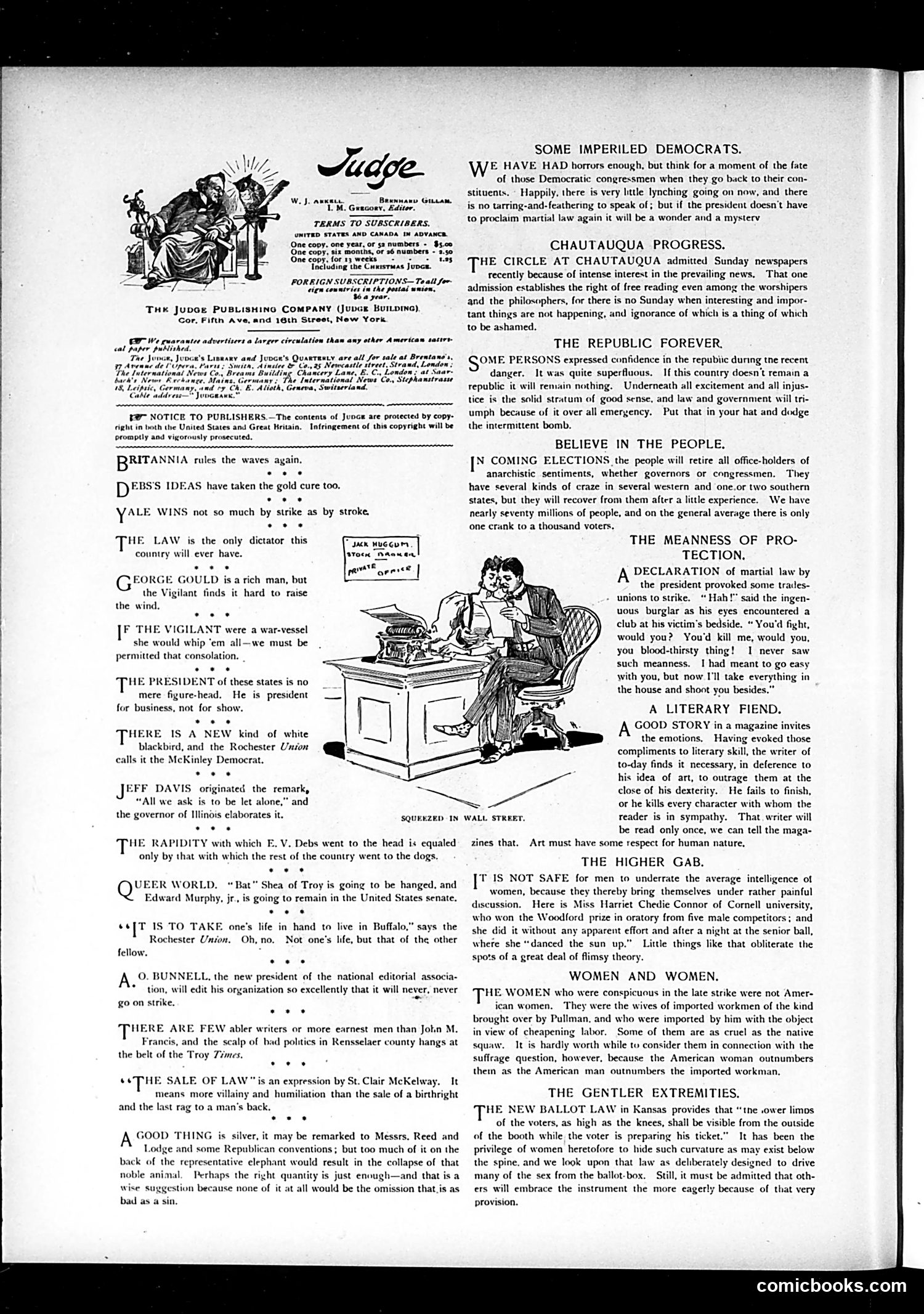
This page contains editorial commentary and one political cartoon titled "SQUEEZED IN WALL STREET." The cartoon depicts a figure at a desk being confronted by what appears to be a burglar or criminal demanding money, illustrating the article "THE MEANNESS OF PROTECTION" — likely critiquing tariff policies that "protected" American industries while allegedly squeezing consumers and workers. The editorial snippets mock various political figures and policies: Democratic vulnerabilities, President Theodore Roosevelt's vigor, George Gould's wealth, and labor union declarations of martial law. References to McKinley Democrats and F.V. Debs suggest this dates to the early 1900s. The overall tone is Republican-leaning satirical commentary on Democratic and labor movement politics of that era.
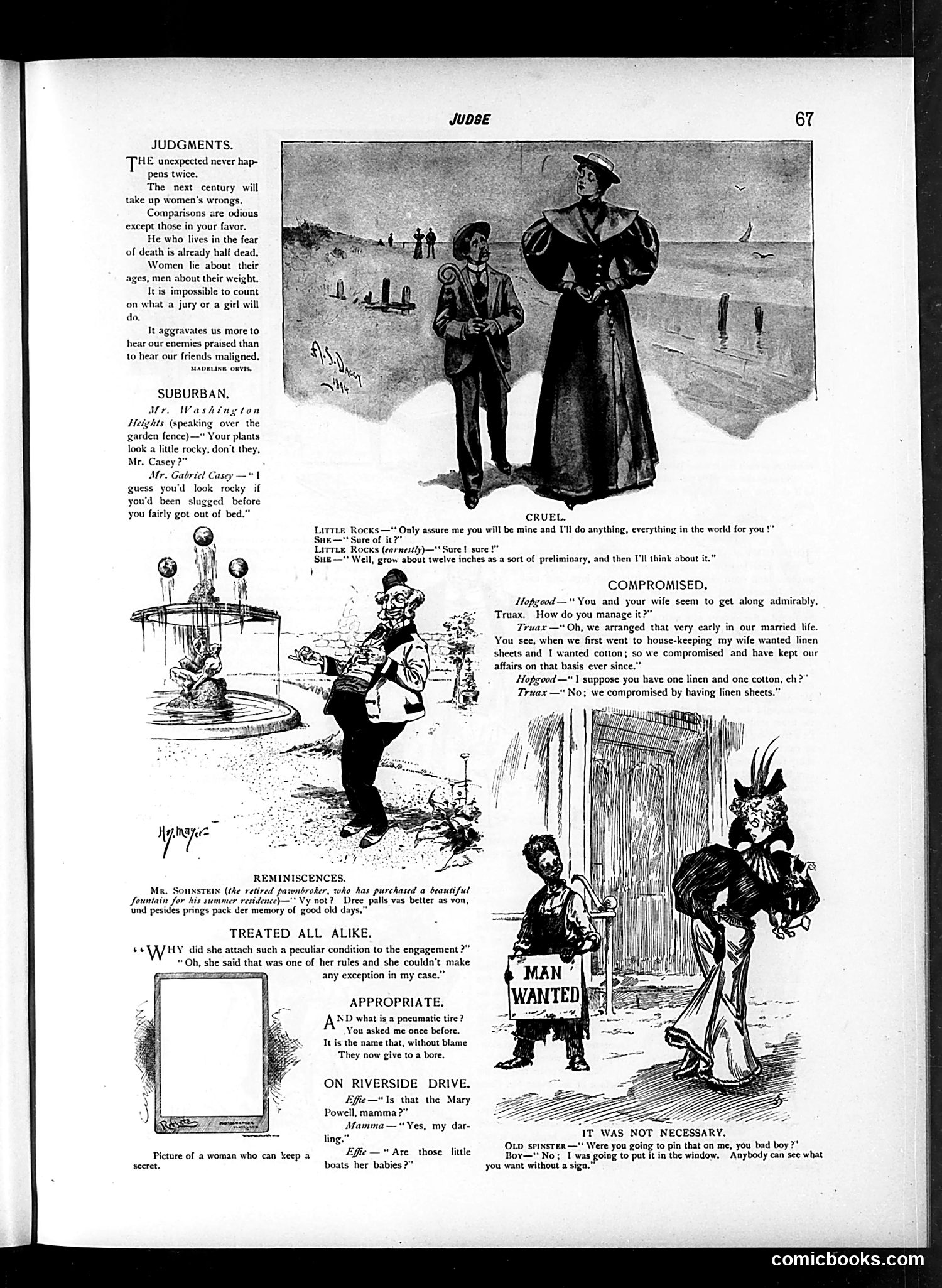
This page contains several standalone humorous sketches rather than unified political commentary. **"Cruel"** depicts a man and woman at the seaside; he promises her everything, but she demands he grow "twelve inches as a preliminary" before she'll consider marriage—a joke about physical inadequacy. **"Compromised"** presents a domestic dispute where a husband admits he and his wife settled their early married disagreements by compromising on household linens. **"Man Wanted"** shows a woman posting an employment notice, satirizing the difficulty of finding reliable help. **"It Was Not Necessary"** depicts a would-be burglar abandoning his plan when he realizes he can see inside the window without breaking in. These are primarily domestic and social comedy sketches typical of Judge's humor, lacking specific political references. The satire targets everyday marital tensions and servant-hiring frustrations common to middle-class readers.
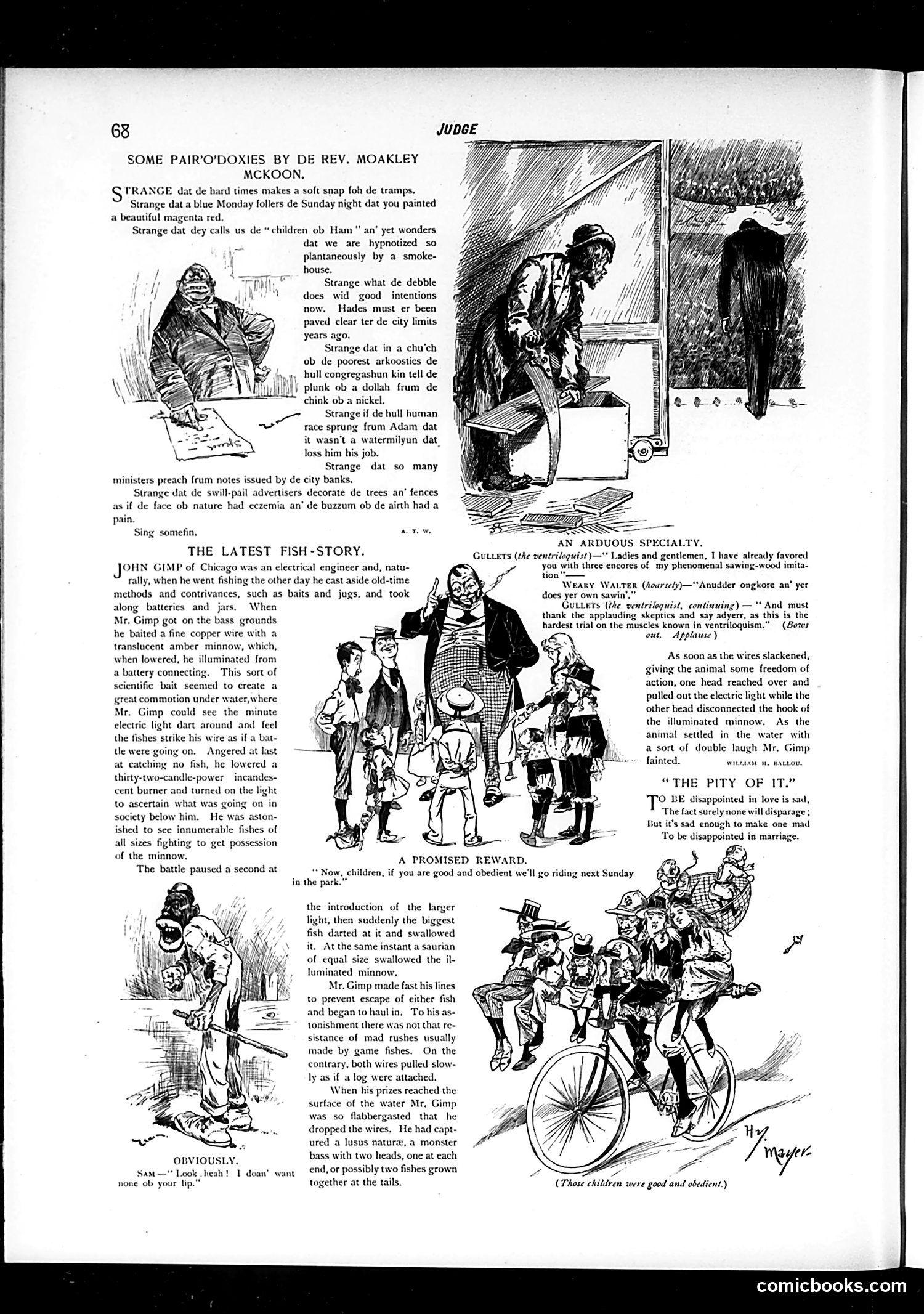
This page contains three distinct satirical pieces: **"Some Pair'o'doxies"** uses dialect humor (stereotypical African American speech) to mock social contradictions—hard times benefiting tramps, ministers following bank instructions, and the irony of human ancestry traced to Adam yet lost over a watermelon. **"The Latest Fish-Story"** satirizes pseudoscientific pretension. A Chicago engineer uses electrical equipment for fishing instead of traditional methods, catching an absurd two-headed bass. The joke mocks over-intellectualization of simple tasks. **"An Arduous Specialty"** ridicules ventriloquism performance, with the puppet character so lifelike it interferes with the act—the dummy steals the show by sabotaging the performance. **"The Pity of It"** offers a brief joke: disappointment in love is sad, but disappointment in marriage is maddening. The page represents typical Judge content: genteel satirical humor targeting pretension, pseudo-science, and social absurdities, with crude racial stereotyping reflecting period attitudes.
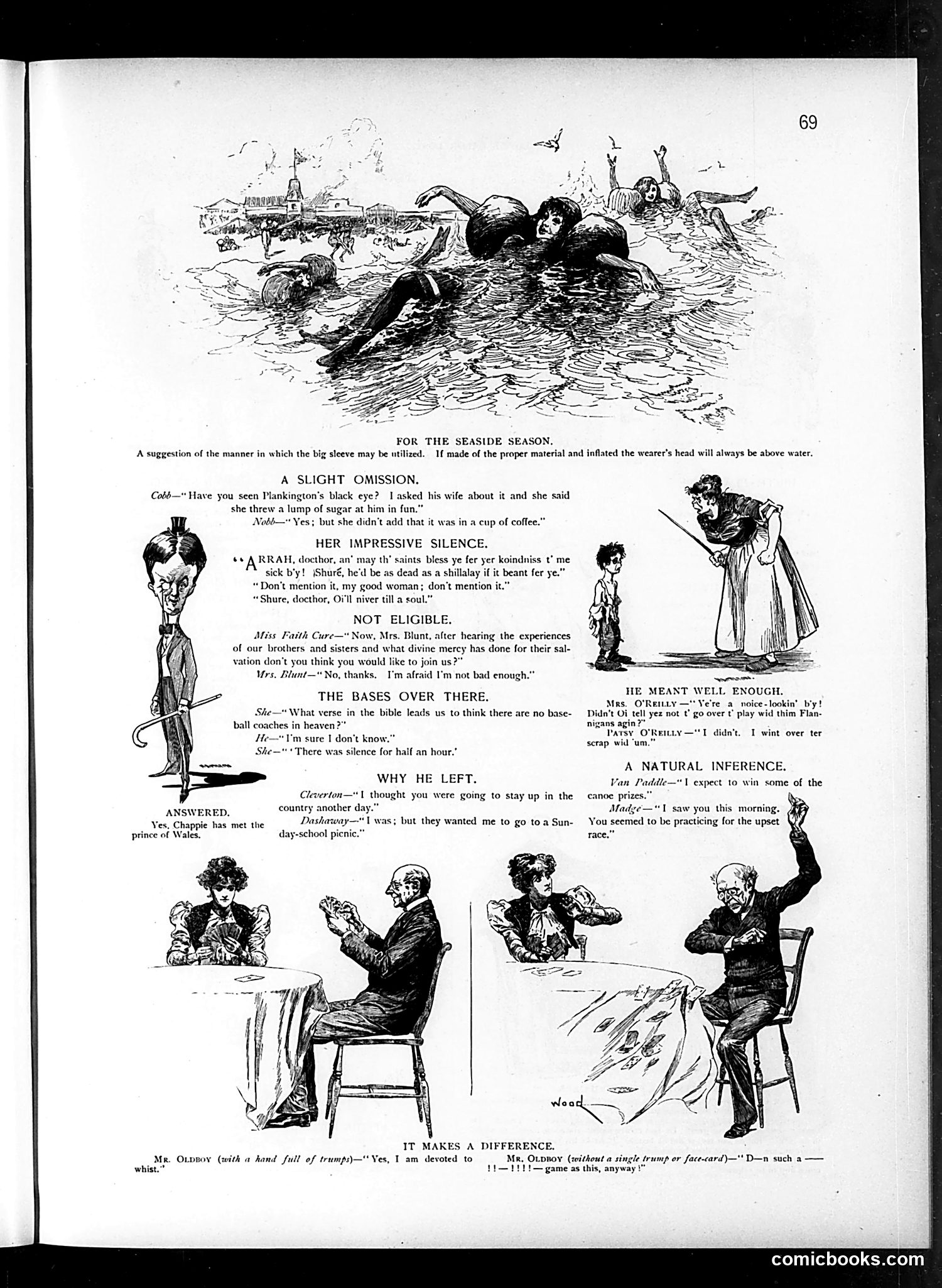
This page collects humorous vignettes satirizing everyday social situations and fashions of the era (appears to be late 19th century). **Key content:** - **Top illustration**: A fashion joke about oversized "big sleeves" (then fashionable), suggesting they could serve as flotation devices for seaside swimming—mocking the impracticality of contemporary women's fashion. - **Social humor**: Multiple brief comedic dialogues mock various types—a man meeting the Prince of Wales and getting a black eye; a card player boasting about devotion to whist; an Irishwoman's religious silence; a woman ineligible for a "faith cure" group because she's "not bad enough"; a man leaving the country to avoid a Sunday school picnic. - **Satire targets**: Class pretension, fashion absurdity, Irish dialect humor (period-typical but offensive by modern standards), religious hypocrisy, and masculine incompetence. The cartoons employ visual caricature paired with dialogue to satirize contemporary manners and social foibles common to Judge's readership.
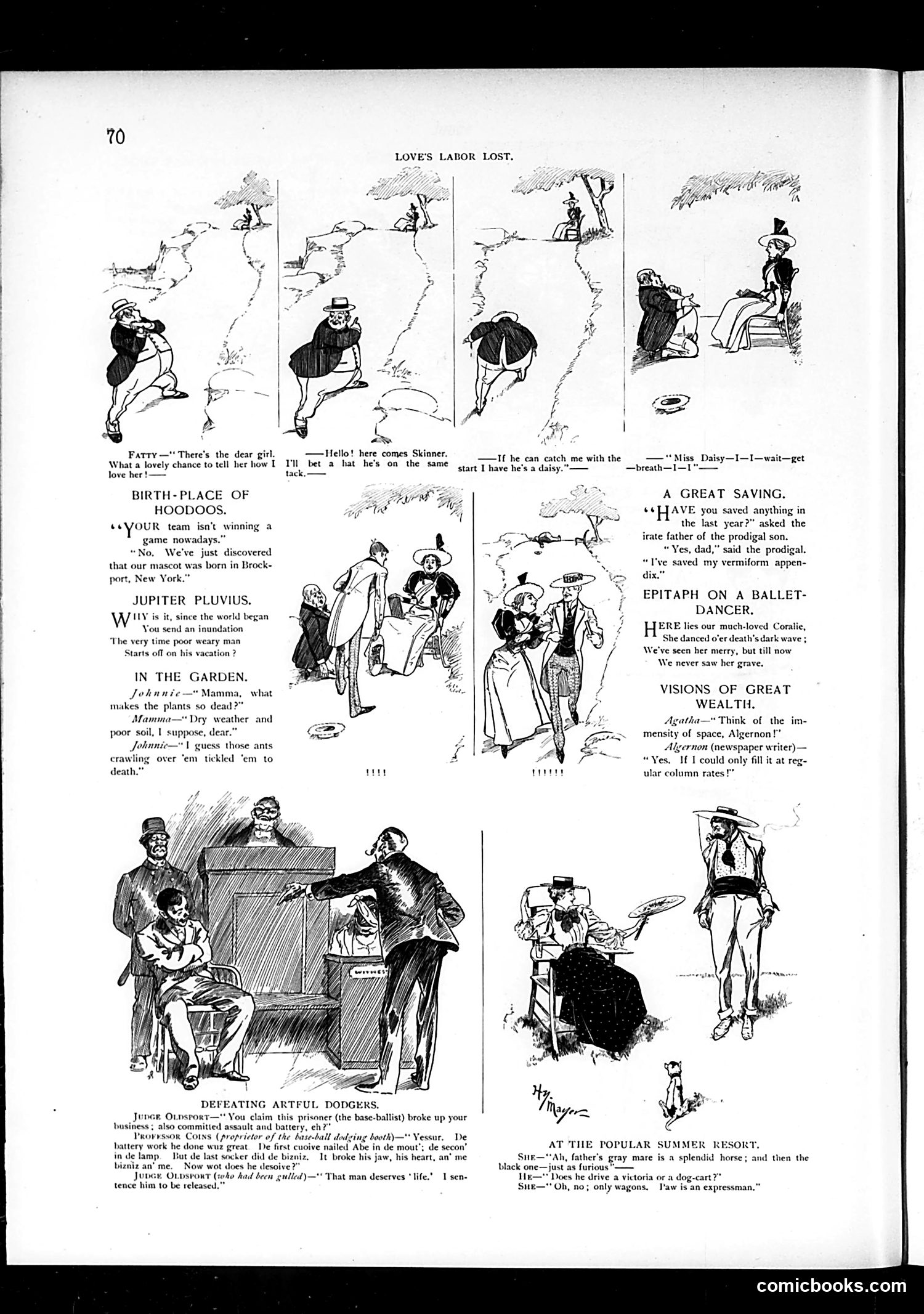
This page contains multiple unrelated humor pieces typical of 1890s-era satirical magazines: **"Love's Labor Lost"** (top): A sequential comic showing a man chasing a woman uphill, with dialogue suggesting romantic pursuit and flirtation. **"Birth-place of Hoodoos"**: A joke about a sports team's losing streak allegedly caused by discovering their mascot was born in Brockport, New York—mocking superstitious thinking about talismans. **"Jupiter Pluvius"**: A complaint about rain always arriving during vacations, personifying the Roman rain god. **"In the Garden"**: A child's joke about ants tickling plants to death, playing on innocent misunderstanding. **"Defeating Artful Dodgers"**: A baseball-themed piece where a carnival "dodging booth" operator describes hitting a man's jaw and heart, with a judge awarding "life" as punishment—dark humor mixing baseball slang with criminal justice. **Other items**: Brief quips about newspaper columnists wanting vast space to fill, a prodigal son's joke about saving his appendix, and a ballet dancer's epitaph. The page reflects period humor: sporting references, wordplay, and crude satire.
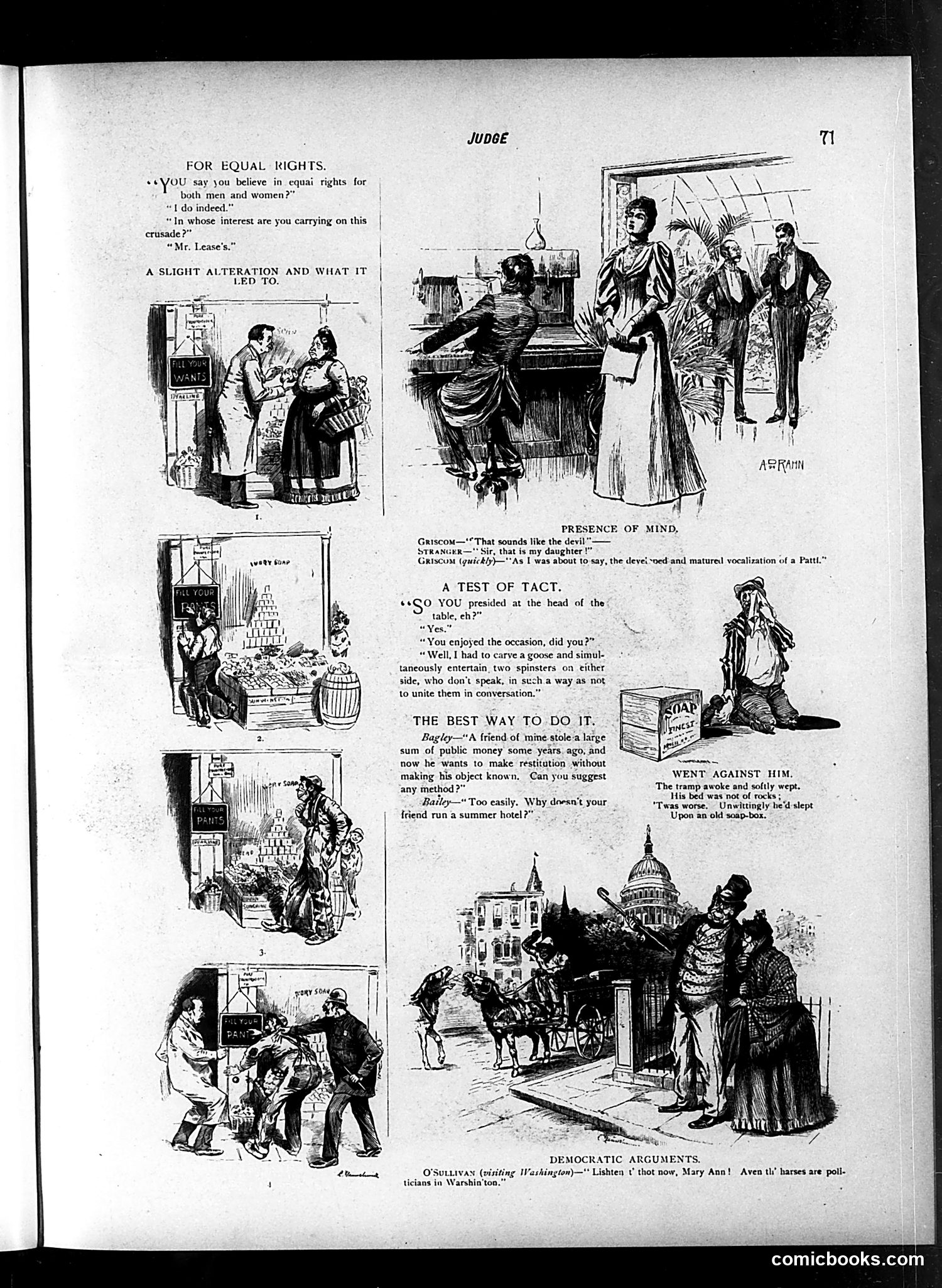
This page from *Judge* contains several short satirical pieces mocking late-19th-century political and social issues: **"For Equal Rights"** ridicules women's suffrage advocates by suggesting they're motivated by self-interest rather than principle—specifically referencing "Mr. Lease," likely Mary Elizabeth Lease, a prominent Kansas Populist lecturer on women's rights. **"A Test of Tact"** mocks the social burden of entertaining unmarried women at dinner—satirizing Victorian social conventions as tedious. **"The Best Way to Do It"** sarcastically suggests running a summer hotel as a money-laundering scheme, implying such establishments were associated with financial fraud. **"Democratic Arguments"** depicts an Irish immigrant using crude logic to equate horses with politicians—ethnic caricature humor common to the era, mocking working-class political understanding. The cartoons collectively reflect *Judge*'s conservative stance against reform movements (women's suffrage, Populism) while also mocking corruption and ethnic stereotypes typical of Gilded Age satirical publications.
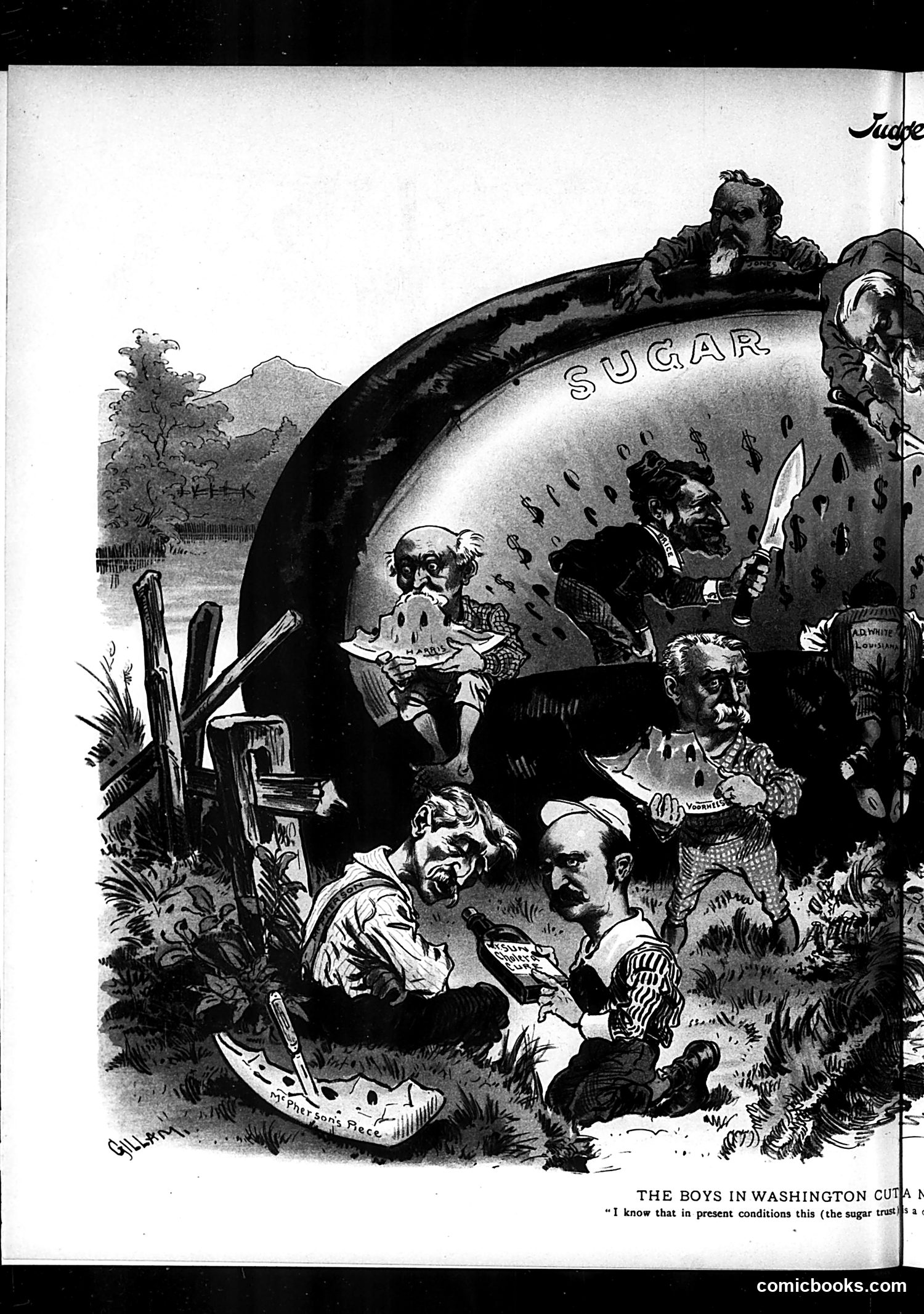
This political cartoon satirizes Washington politicians' handling of the **Sugar Trust** — a major monopoly that controlled American sugar production and pricing. The scene depicts government officials inside a massive sugar bowl, depicted as parasites or corrupt beneficiaries feasting on sugar while ordinary citizens suffer outside. The figures appear to represent politicians colluding with or enabling the trust's monopolistic practices. The caption's incomplete quote suggests a politician acknowledging the trust's problematic nature while doing nothing to stop it — embodying the era's widespread criticism of government corruption and corporate collusion. This reflects the **Progressive Era** (early 1900s) when **Judge** magazine frequently attacked trusts and monopolies as threats to fair competition and public welfare. The cartoon mocks the gap between politicians' awareness of wrongdoing and their actual inaction.
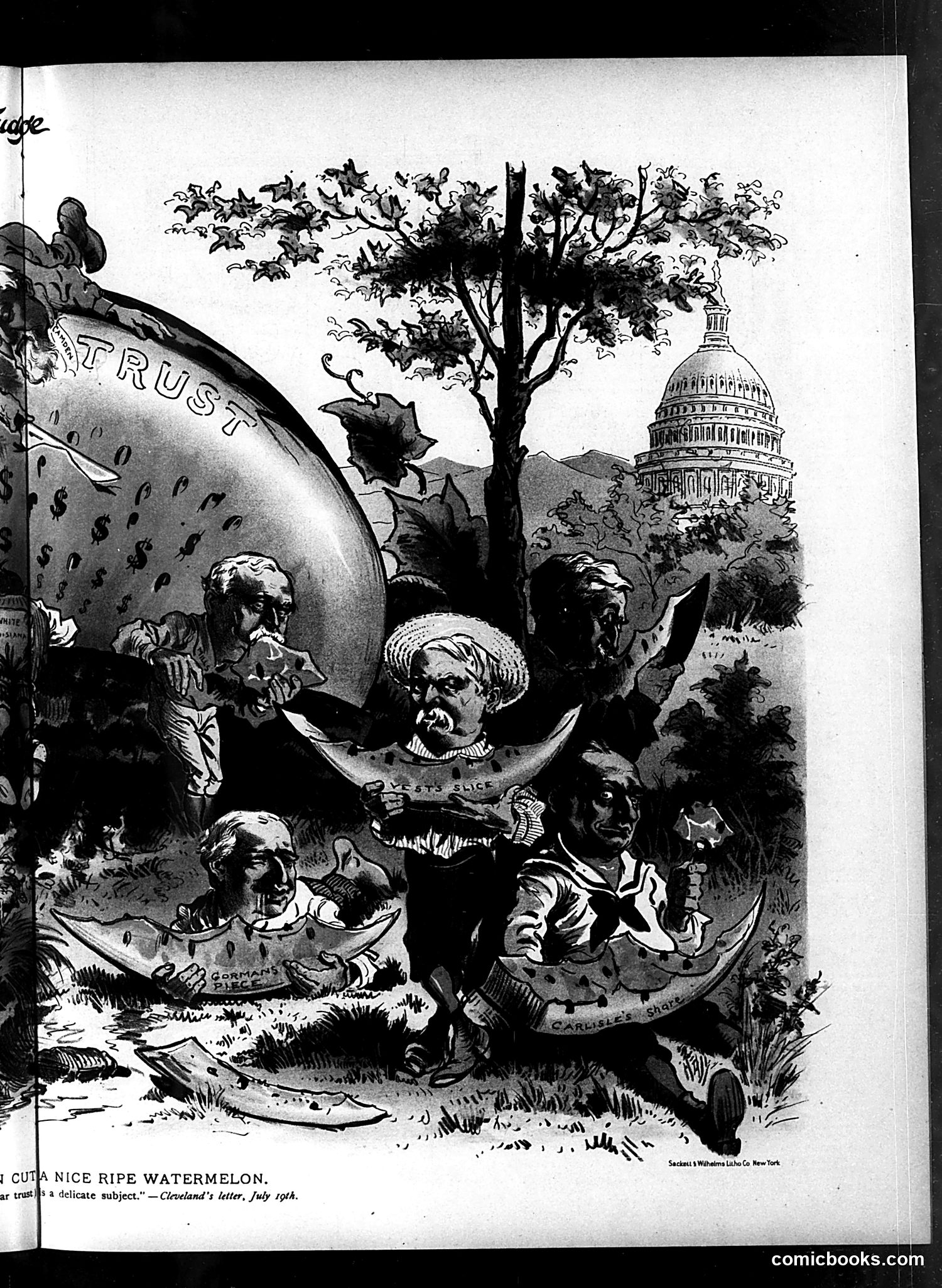
This Judge magazine cartoon satirizes President Cleveland's reluctance to address a politically sensitive issue—represented as a "nice ripe watermelon." The figures appear to be politicians or political figures gathered around an enormous watermelon labeled "TRUST," with the U.S. Capitol visible in the background. The watermelon serves as a metaphor for monopolistic business trusts, a major political controversy of the Gilded Age. Cleveland's quoted letter ("a delicate subject") suggests he was avoiding taking a firm stance on trust-busting—a key reform issue. The cartoon mocks his caution by depicting the "trust problem" as an obvious, ripe issue demanding attention that politicians were reluctant to grasp. The various figures likely represent different political factions disagreeing on how to handle corporate monopolies.
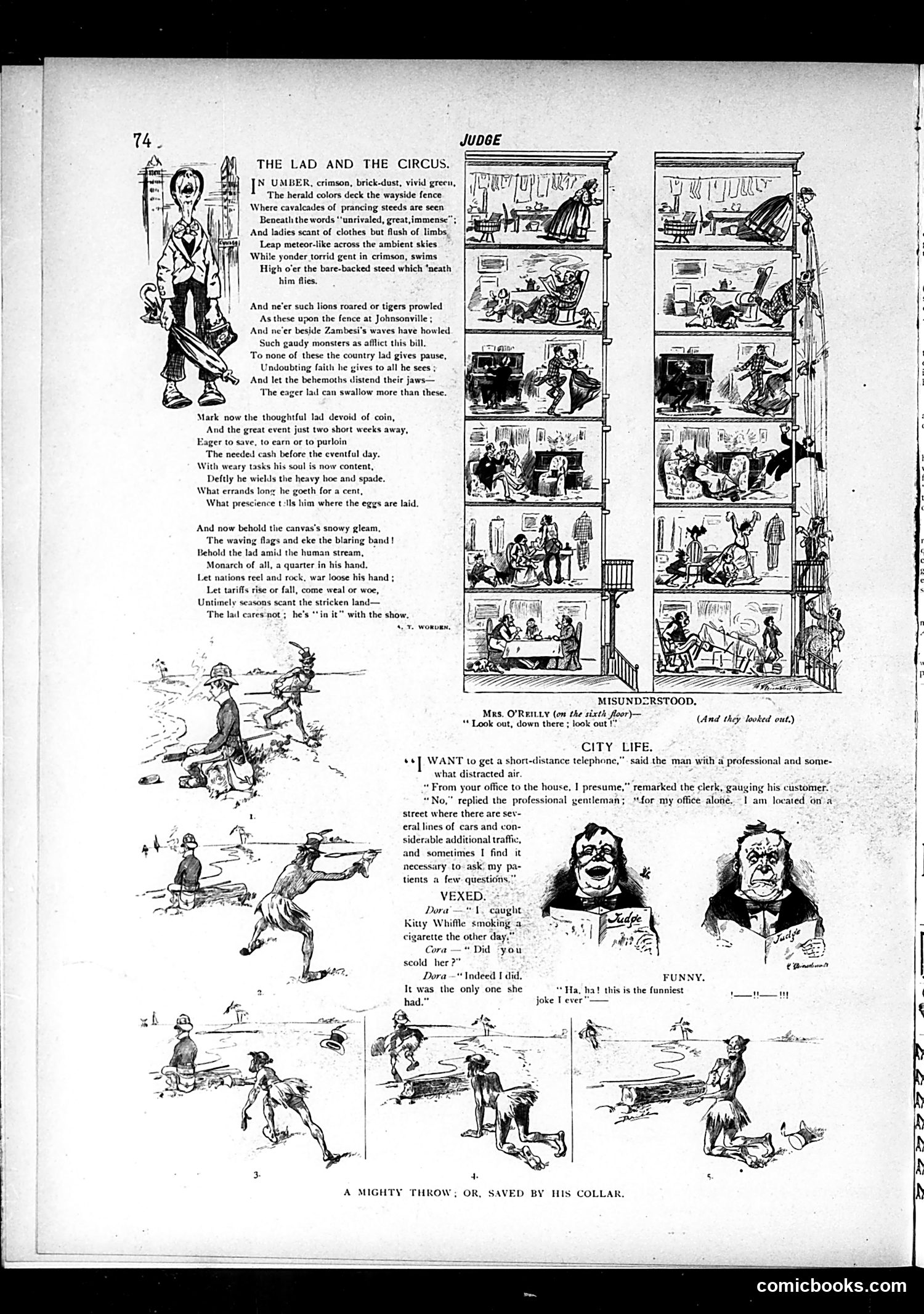
This page contains multiple satirical pieces. **"The Lad and the Circus"** is a narrative poem with illustrations mocking rural naivety. It depicts a country boy saving his meager earnings for weeks to attend a circus, mesmerized by exaggerated billboard advertisements (the "gaudy monsters" and impossibly skilled performers). The satire targets how circus promotions exploit simple folk with false promises of spectacle, while the lad's utter faith in the advertisements' claims shows rural credulity. The **"City Life"** section contains brief humorous vignettes about urban life: a professional unable to conduct private phone calls due to street noise; a woman scolding a friend for smoking, only to admit it was her only joke; and a series of illustrations titled "A Mighty Throw; or, Saved by His Collar," depicting physical comedy (appears to show someone thrown and saved by their collar). The overall theme satirizes contrasts between rural innocence and urban sophistication, alongside general social absurdities of the era.
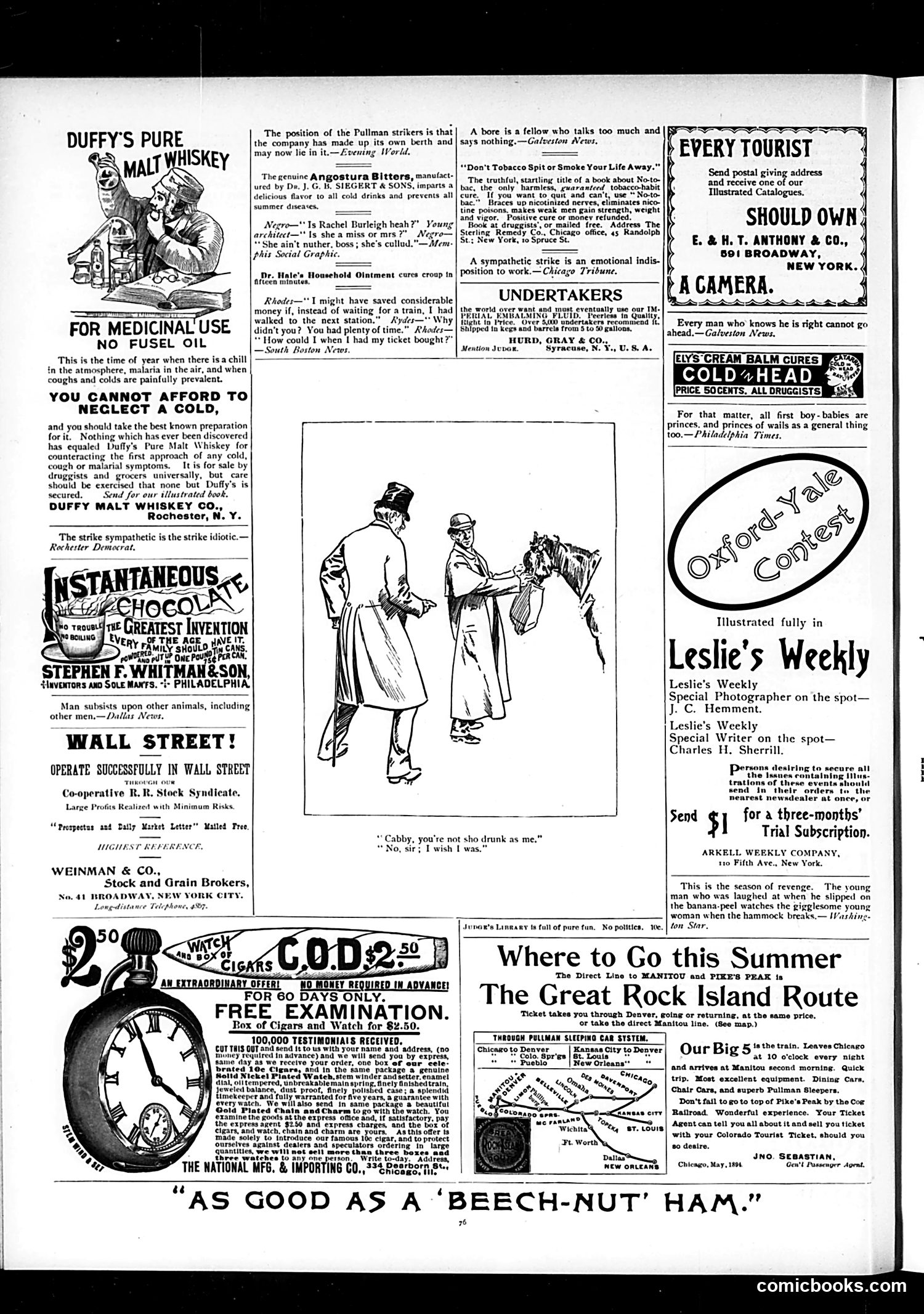
This page is primarily **advertising**, not editorial or political satire. It contains multiple product advertisements typical of early 1900s magazines: **Notable ads include:** - **Duffy's Malt Whiskey** — marketed as medicinal remedy for colds and malaria - **Instantaneous Chocolate** by Stephen F. Whitman & Son - **Wall Street investment schemes** promising large profits with minimal risk - **Various patent medicines** (Angostura Bitters, Hale's Household Ointment, No-to-bac tobacco cure) - **Undertaking fluid** and **cigar/watch promotional offers** **The cartoon** shows two working men (one appears intoxicated), with dialogue about drunkenness—likely satirizing labor conditions or working-class life. **Historical context**: References to the **Pullman Strike** appear in quoted text, reflecting contemporary labor disputes. The page reflects how magazines monetized through dubious medical claims and get-rich-quick schemes now considered fraudulent. The ads reveal period attitudes toward alcohol, tobacco, and unregulated pharmaceuticals.
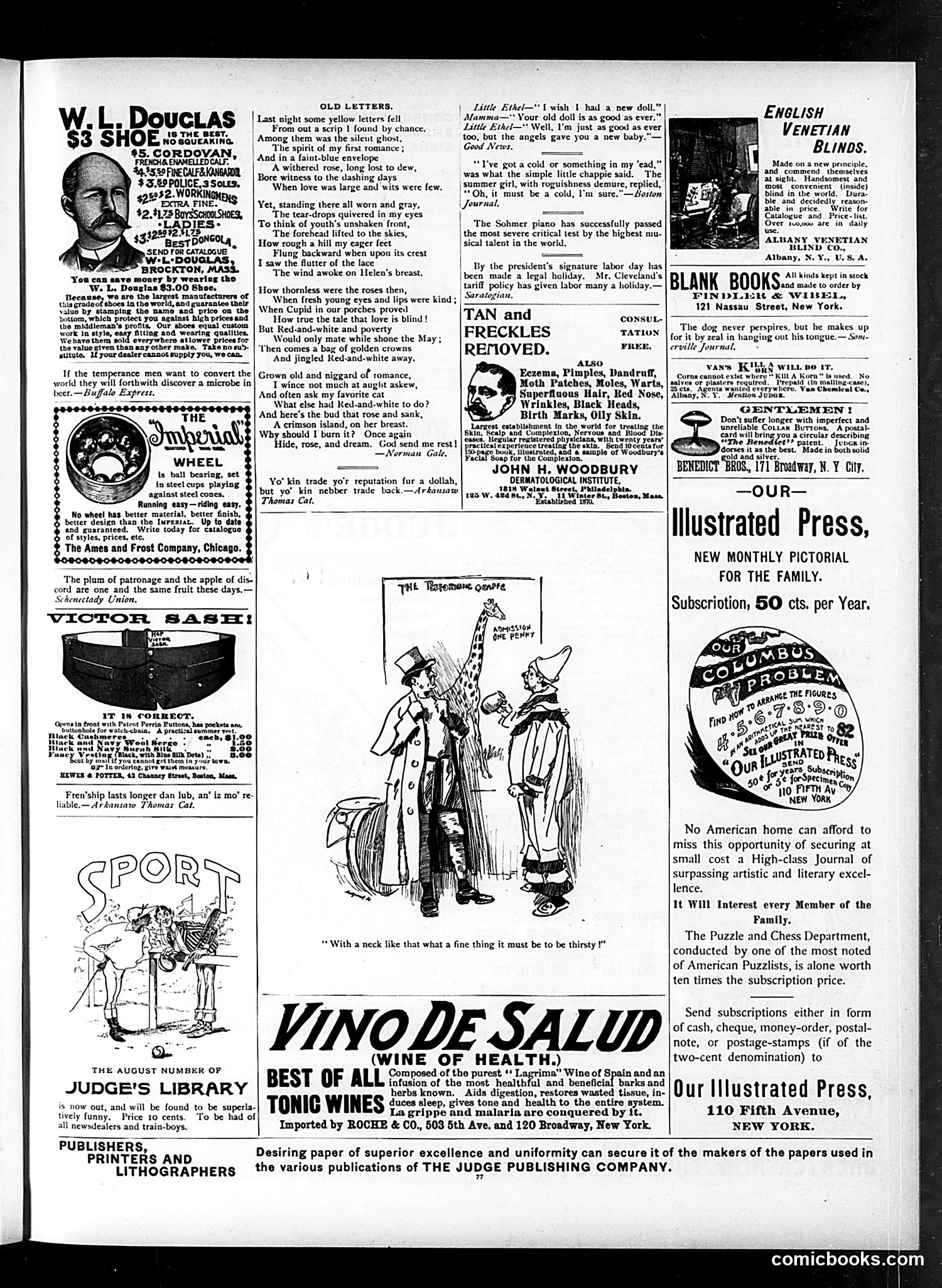
This page from Judge (a major American satirical magazine) mixes advertising with humor columns and one notable cartoon. **The Main Cartoon:** "With a neck like that what a fine thing it must be to be thirsty!" depicts a caricatured figure with an exaggerated long neck—likely a giraffe or giraffe-like creature—being offered a drink. The joke plays on the physical advantage: a long neck would allow extended drinking, making thirst almost enjoyable. **Context:** The page is primarily **advertising**—shoe companies (W.L. Douglas), wheels, beauty treatments (Woodbury's dermatological services), wine (Vino de Salud), and publications. The satirical content is minimal and scattered. **Poetry & Humor:** "Old Letters" is romantic nostalgia verse. Brief quips mock patronage politics ("plum of patronage and apple of discord are one and the same") and President Cleveland's tariff policies affecting labor. The page reflects late-19th-century American middle-class concerns: consumer goods, beauty treatments, and light political commentary alongside sentimental literature.
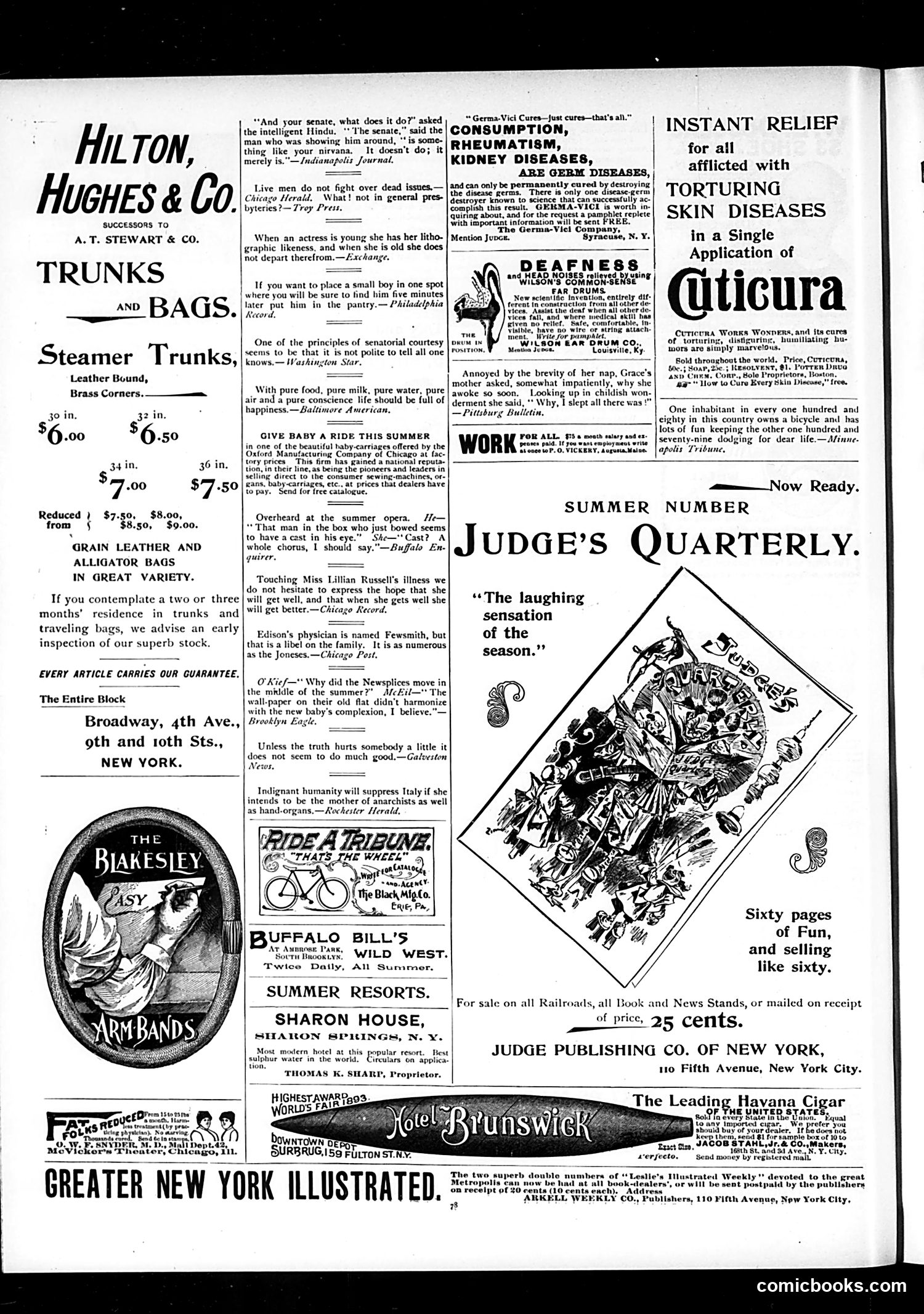
This page is primarily **advertising with brief satirical commentary**, typical of Judge's format. The main content consists of: **Advertisements:** Hilton, Hughes & Co. trunks/bags, Oxford Manufacturing baby carriages, Sharon House resort, Buffalo Bill's Wild West show, and patent medicines (Germa-Vici for "germ diseases," Wilson's ear drums for deafness, Cuticura for skin conditions). **Satirical Snippets:** Short humorous quotes mocking American institutions and social types: - The Senate as useless ("merely is") - Theatrical vanity (actresses' unchanging photographs) - Summer opera pretension - Baby naming trends (reflecting on social anxieties) **Judge's Judge's Quarterly Advertisement:** Promotes the magazine's summer issue as "the laughing sensation of the season"—60 pages for 25 cents. The satire is **light and domestic** rather than political, targeting social behaviors (parental anxiety, theatrical affectation, senatorial incompetence) rather than specific politicians or events. This reflects Judge's general audience appeal in the early 1900s.
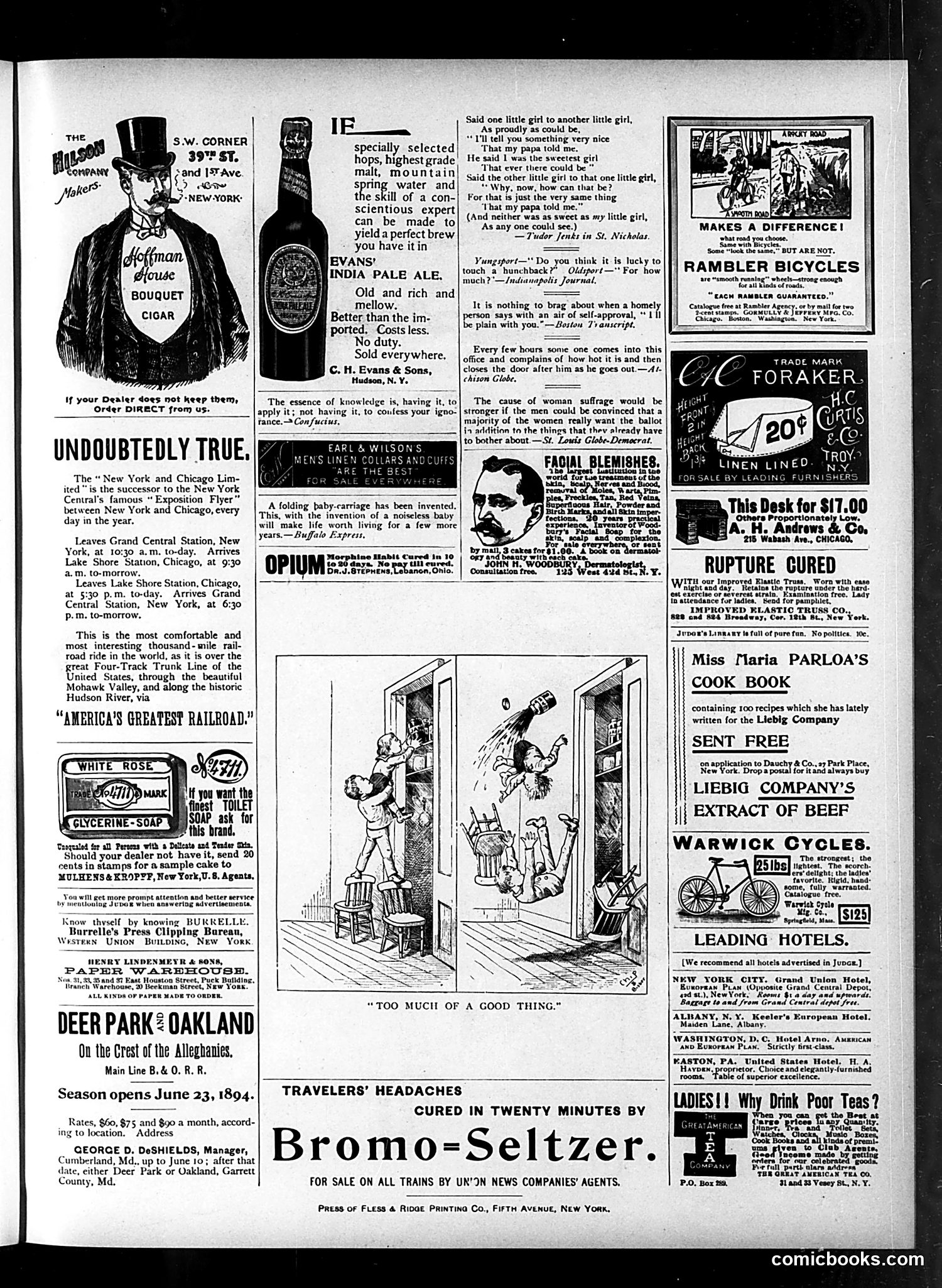
This is primarily an **advertising page** from Judge magazine (circa 1894, based on the Deer Park resort ad). The page contains numerous product advertisements rather than satirical cartoons. The one cartoon present—"Too Much of a Good Thing"—depicts a domestic scene where a person sprays what appears to be an insecticide or cleaning product indiscriminately throughout a home, creating chaos. Children and household items are caught in the spray. The joke satirizes **excessive use of consumer products**, a common theme as mass-produced goods proliferated in the 1890s. The advertisements themselves reveal period concerns: opium and morphine addiction treatments, "facial blemishes" remedies, rupture cures, and patent medicines like Bromo-Seltzer for travelers' ailments. These ads tacitly acknowledge widespread health issues of the era. The page reflects **turn-of-the-century consumer culture** and the magazine's reliance on advertising revenue, with minimal editorial satirical content.
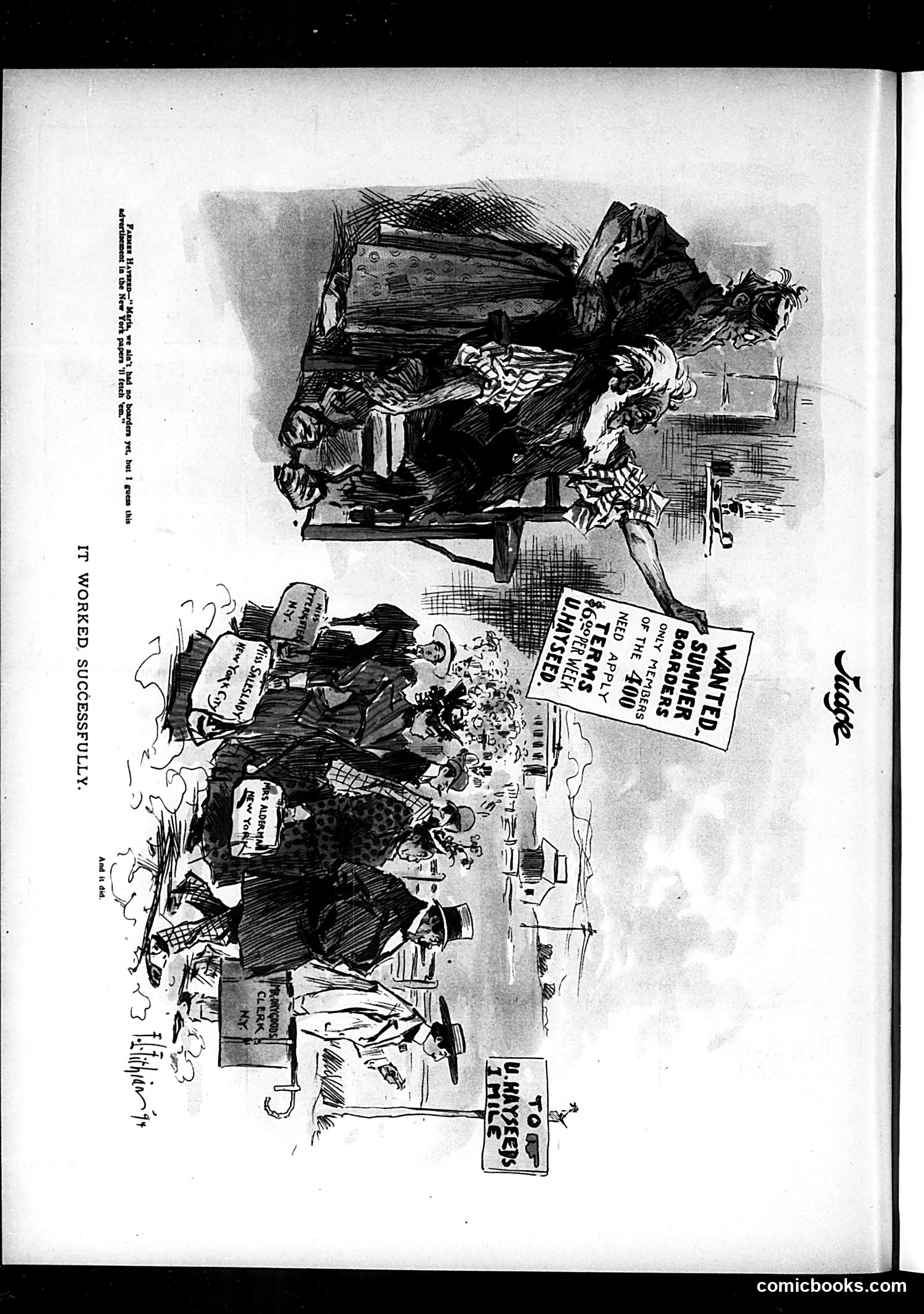
This Judge magazine cartoon satirizes the effectiveness of newspaper advertising for attracting boarders (rental tenants). The top panel shows a landlord placing an ad in New York papers, confidently predicting results. The bottom panel reveals the "successful" outcome: the landlord is overwhelmed by a chaotic flood of prospective boarders crowding around the building, each wearing signs identifying their professions or backgrounds. The satire mocks both the landlord's naive optimism and the desperation of working-class New Yorkers seeking housing. The joke's humor derives from the ironic contrast between the hoped-for "success" and the overwhelming, unmanageable reality—suggesting that even modest advertisements could attract throngs of desperate renters in urban America.