
A complete issue · 16 pages · 1894
Judge — June 9, 1894
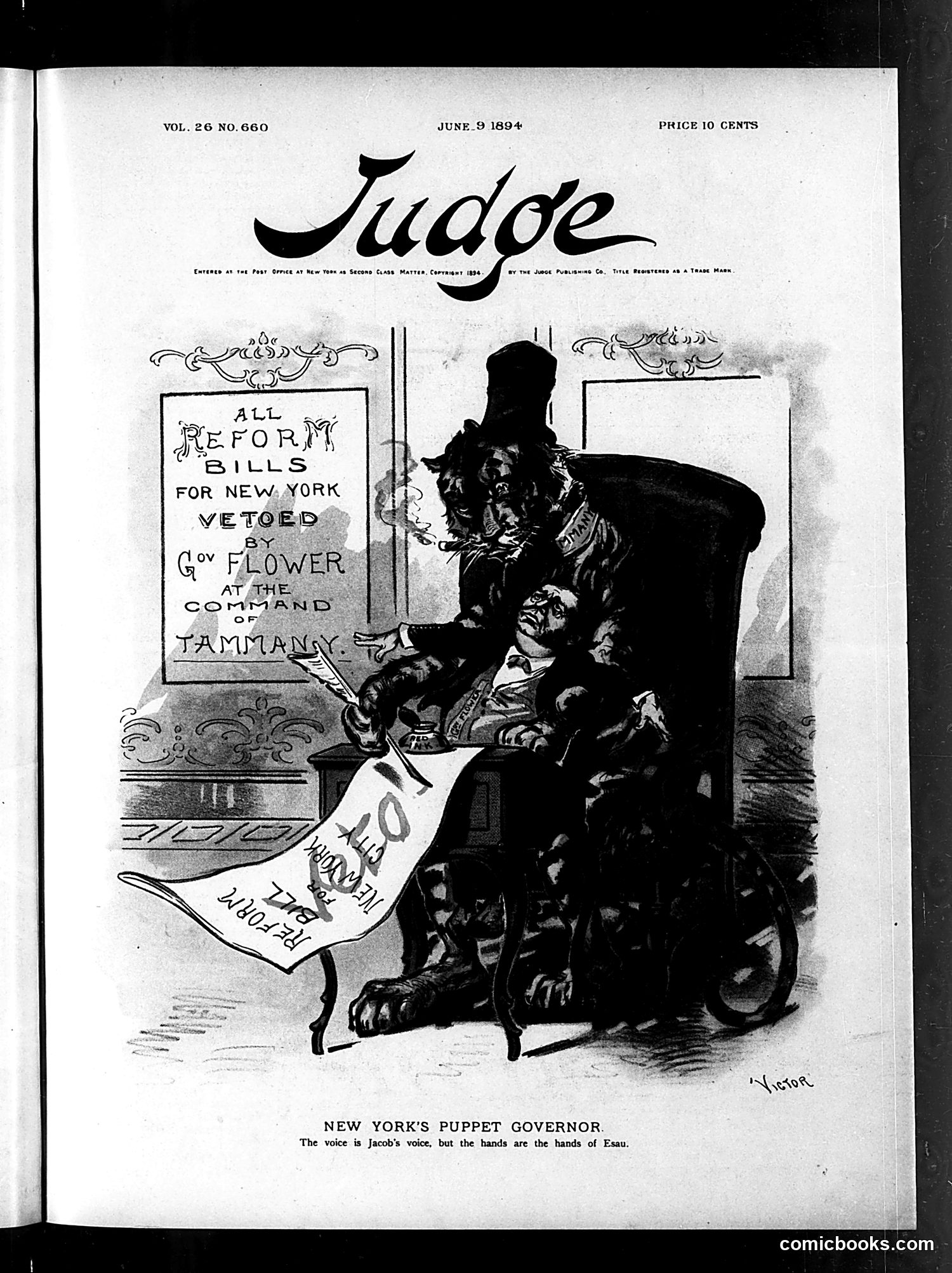
This 1894 *Judge* cartoon satirizes Governor Roswell Flower of New York, depicting him as a puppet controlled by someone else—likely a political boss or machine politician. The caption "The voice is Jacob's voice, but the hands are the hands of Esau" references the biblical story of Jacob deceiving his father Isaac by impersonating his brother Esau, suggesting Flower is being manipulated while appearing to act independently. The sign shows reform bills being "vetoed," implying Flower blocks progressive legislation despite his public persona. The cartoon criticizes him as merely a figurehead for hidden political powers rather than a genuine leader. This reflects broader 1890s concerns about political corruption and machine control in New York politics.
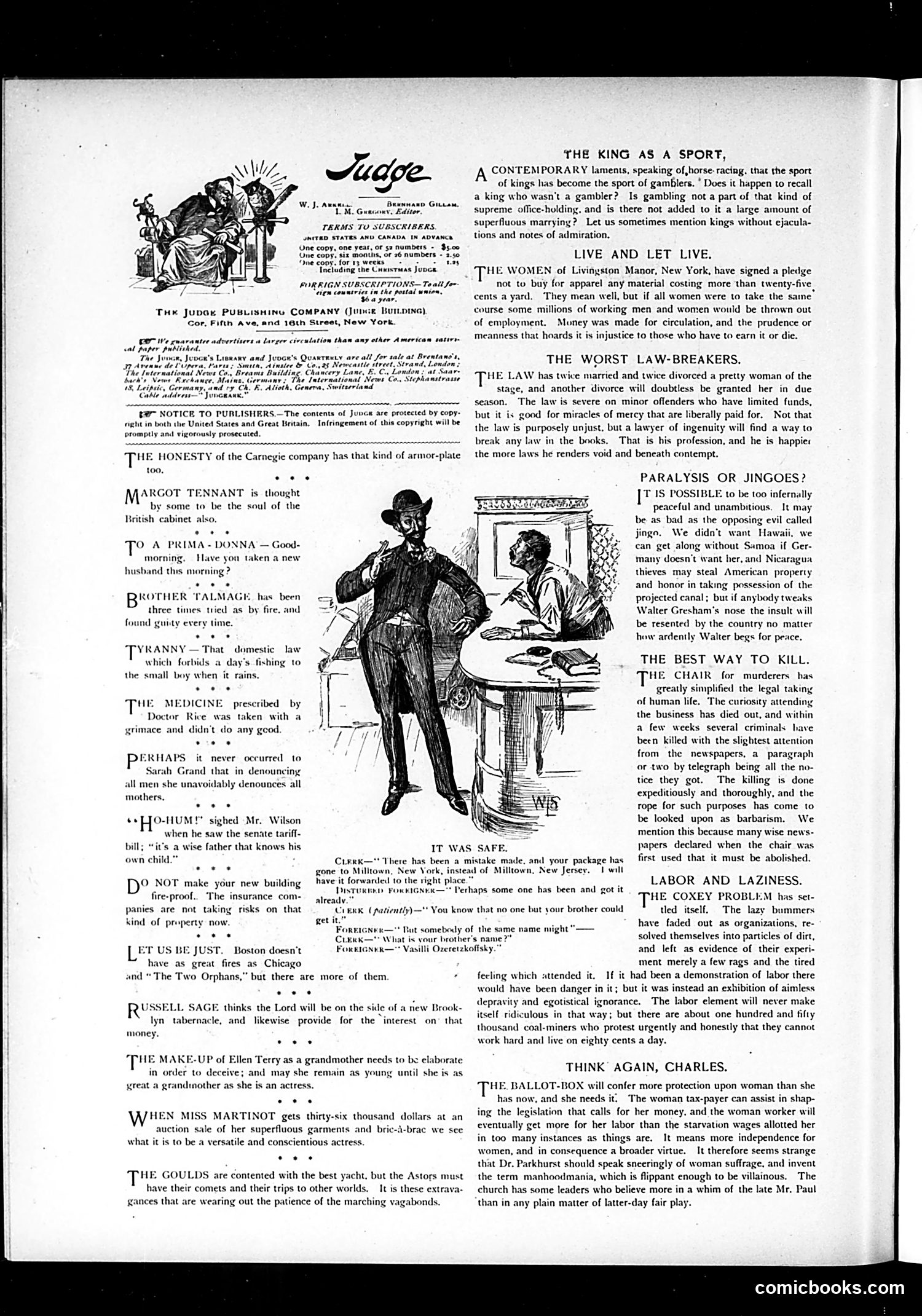
This page contains satirical commentary rather than a single unified cartoon. The main illustration shows a man in a bowler hat presenting documents to a seated clerk—likely depicting a bureaucratic or legal transaction, though the specific context isn't entirely clear from the image alone. The text columns include social commentary on topics like gambling among royalty ("The King as a Sport"), women's labor activism (the Livingston Manor pledge), divorce law, and capital punishment ("The Best Way to Kill"). The pieces appear to target upper-class hypocrisy and legal absurdities of the era. Without clearer identification of specific contemporary figures or events referenced, the exact satirical targets remain somewhat ambiguous, though the overall tone criticizes wealth, privilege, and legal inconsistency.
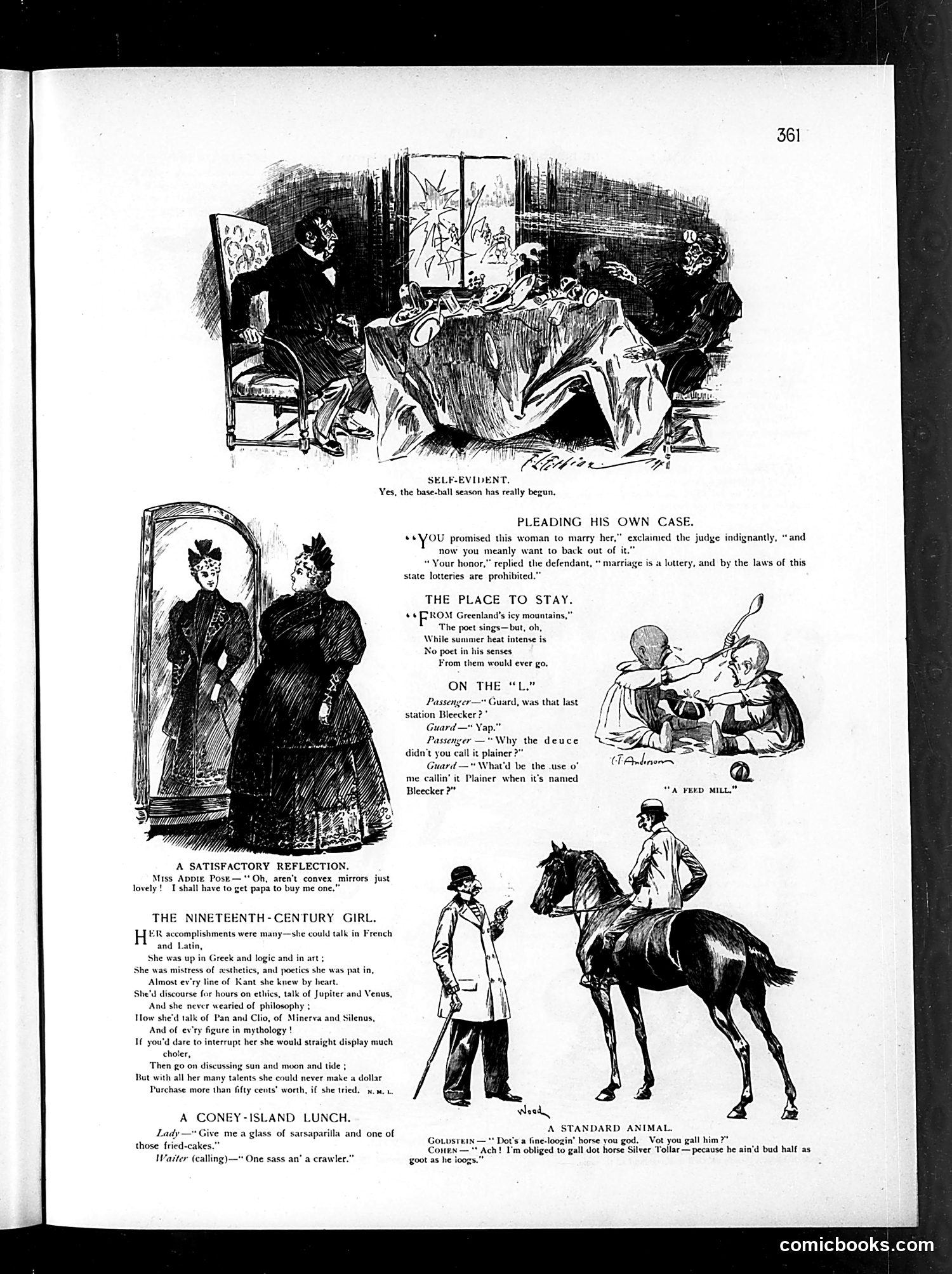
This page from *Judge* contains multiple satirical sketches and humorous vignettes rather than a unified political cartoon. The content includes: **"Self-Evident"**: A courtroom scene mocking baseball season's beginning. **"Pleading His Own Case"**: A judge criticizes a man for promising marriage then backing out, noting "marriage is a lottery." **"The Nineteenth-Century Girl"**: Verse satirizing educated women's pretentious learning in French, Latin, Greek philosophy, and classical references while remaining impractical. **"British Reflections"**: A fashion/mirror joke about women's hat sizes. Various other sketches mock topics like horse-trading, train stations, and social conventions. The humor targets gender roles, education, class pretension, and everyday absurdities typical of 1890s-era satirical magazines.
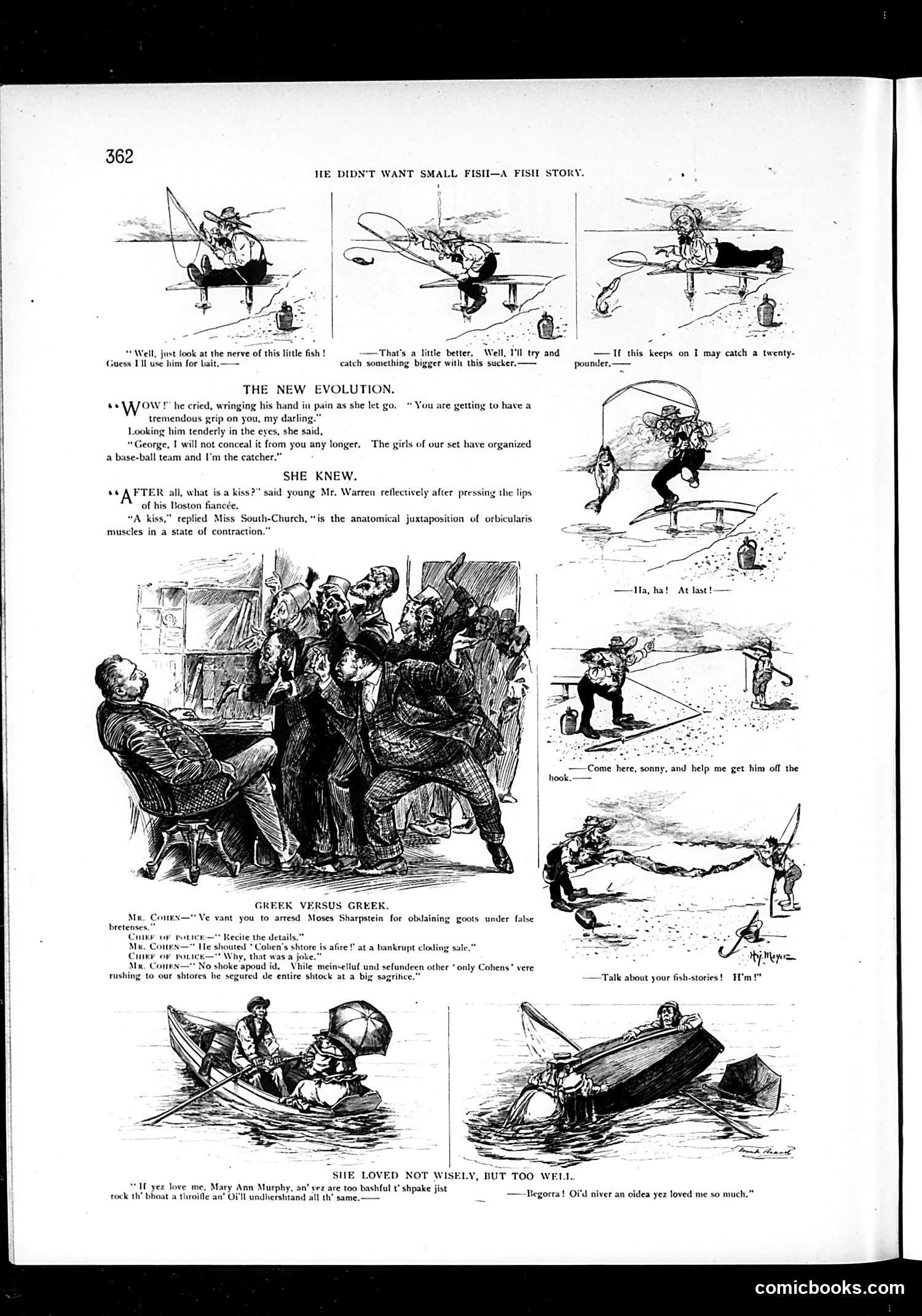
This page collects several unrelated comic sketches typical of Judge's satirical humor: **"He Didn't Want Small Fish"** (top): A fisherman's joke about using a small fish as bait, then catching a larger sucker—the humor turns on the double meaning of "sucker" (the fish and the fool). **"The New Evolution"** mocks women's expanding roles through a girlfriend who joins a baseball team as catcher, developing a strong grip that surprises her boyfriend—satirizing anxieties about "new women" gaining physical strength and independence. **"She Knew"** ridicules overly intellectual Boston society: a woman reduces a romantic kiss to dry anatomical terminology, deflating sentimentality with pedantry. **"Greek Versus Greek"** parodies immigrant speech (Jewish dialect) and insurance fraud: a merchant falsely claims goods were stolen to collect insurance. **"She Loved Not Wisely"** uses Irish dialect humor in a romantic boat scene. The page reflects Judge's blend of class anxiety, ethnic stereotyping, and commentary on changing gender roles typical of early 20th-century American humor.
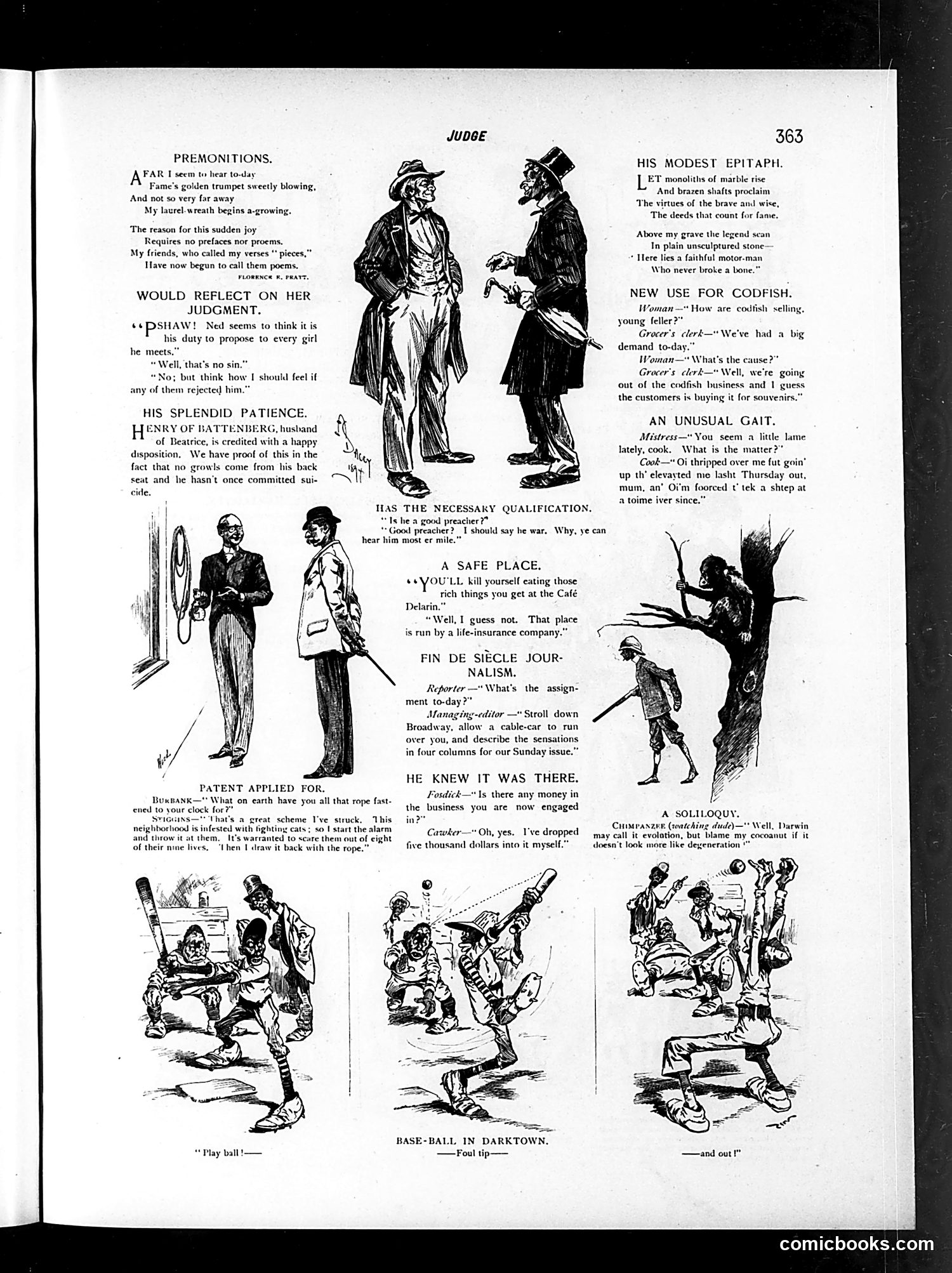
This page collects brief satirical humor pieces typical of late-19th-century Judge magazine: **Premonitions** mocks vanity—a poet celebrates friends calling his work "poems" instead of "pieces," treating this minor validation as profound success. **His Splendid Patience** offers dry commentary on Henry of Battenberg (Prince Beatrice's husband), praising him for not complaining about his subordinate position in the royal hierarchy. **Patent Applied For** satirizes urban problem-solving: a man ties a rope to his clock to fling it at fighting cats, retrieving it afterward—absurd "innovation." **Fin de Siècle Journalism** mocks sensationalist newspaper practices, with an editor assigning a reporter to get hit by a cable-car and describe sensations for the Sunday edition. **Base-Ball in Darktown** uses racist caricature (common in period Judge), depicting Black children playing baseball. The remaining items include light social satire about proposals, insurance companies, and business investments, all presented through brief dialogue or single-panel illustrations typical of the magazine's format.
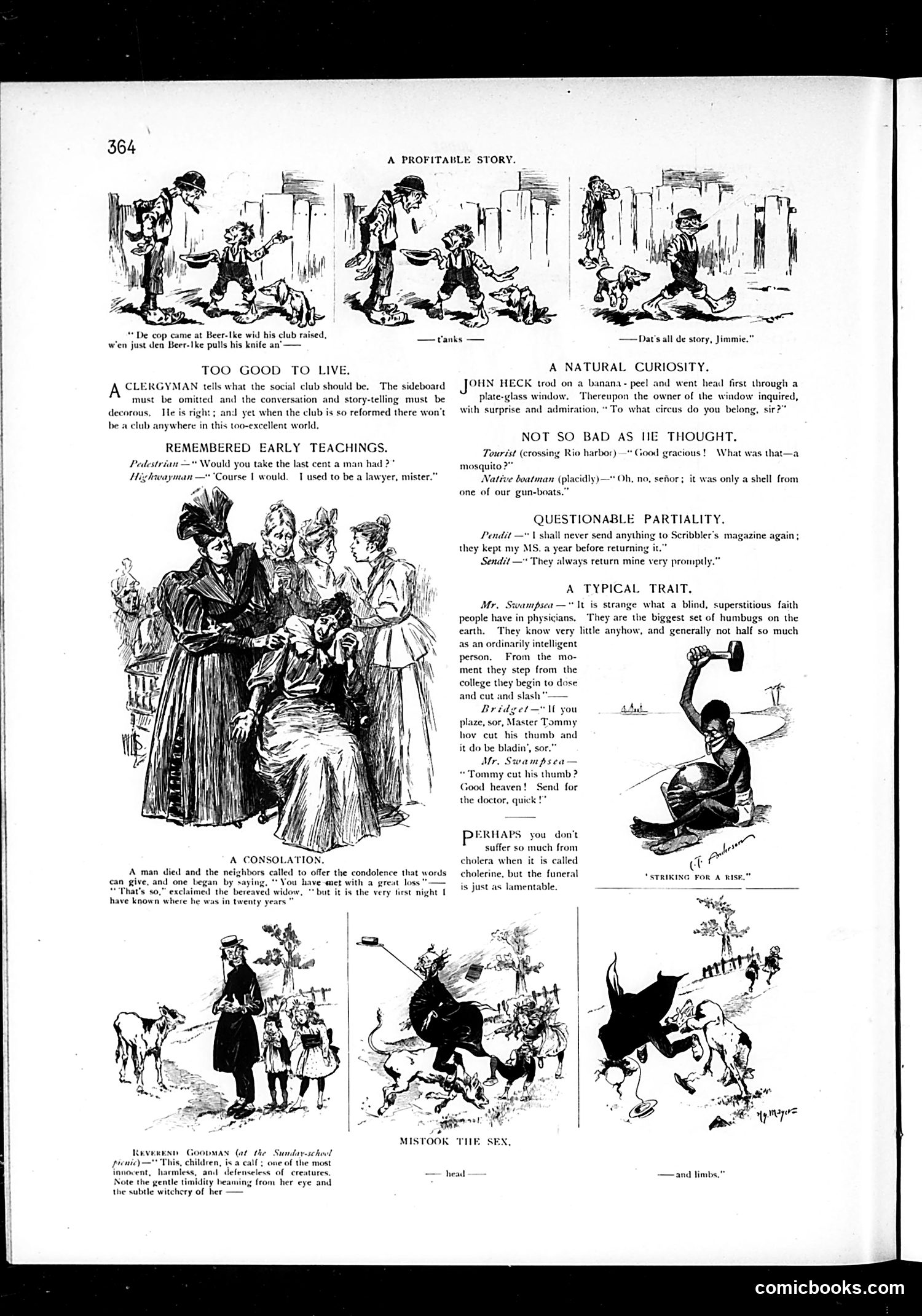
This page contains multiple short satirical pieces typical of late 19th-century American humor: **"A Profitable Story"** depicts a street altercation told in exaggerated ethnic dialect, mocking immigrant speech patterns common in period satire. **"Too Good to Live"** critiques clergy who would reform social clubs by removing alcohol and storytelling—suggesting such "improvement" would destroy the clubs entirely. **"A Natural Curiosity"** jokes about a man falling through a window and being mistaken for a circus performer. **"A Typical Trait"** satirizes Dr. Swampsea, a physician who denounces doctors as "humbugs" while immediately demanding one when his own child is injured—highlighting hypocrisy. Other pieces mock lawyers, magazine editors, tropical diseases, and a clergyman mistaking a cow's sex. The humor relies heavily on ethnic caricature, physical comedy, and character ironies. The artwork features typical period line-drawing style. Most jokes are apolitical, focusing on social foibles and occupational stereotypes rather than current events.
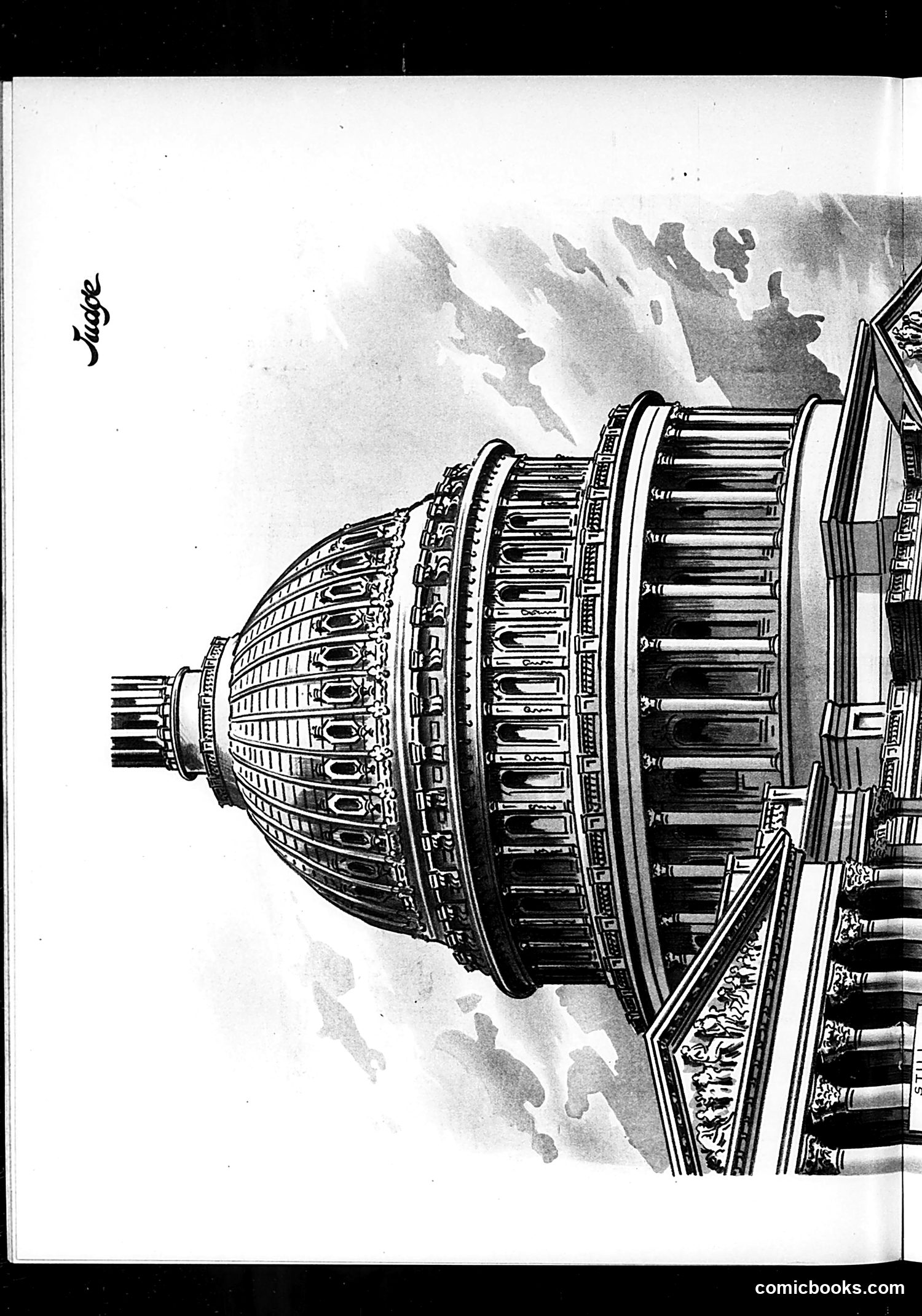
This page appears to be primarily an **architectural or engineering illustration** rather than a political cartoon. The image shows a detailed cross-section of what looks like a large domed structure or building, rendered in black and white with careful attention to decorative elements, columns, and internal mechanisms or support systems. The OCR text is largely illegible and doesn't provide clear context. Without readable text identifying the specific building, event, or political reference, I cannot reliably determine what satire or social commentary this illustration was meant to convey. The "Judge" magazine masthead visible confirms this is from that publication, but the technical nature of the drawing suggests this may be illustrating something related to architecture, engineering, or civic construction rather than serving as traditional satirical commentary.
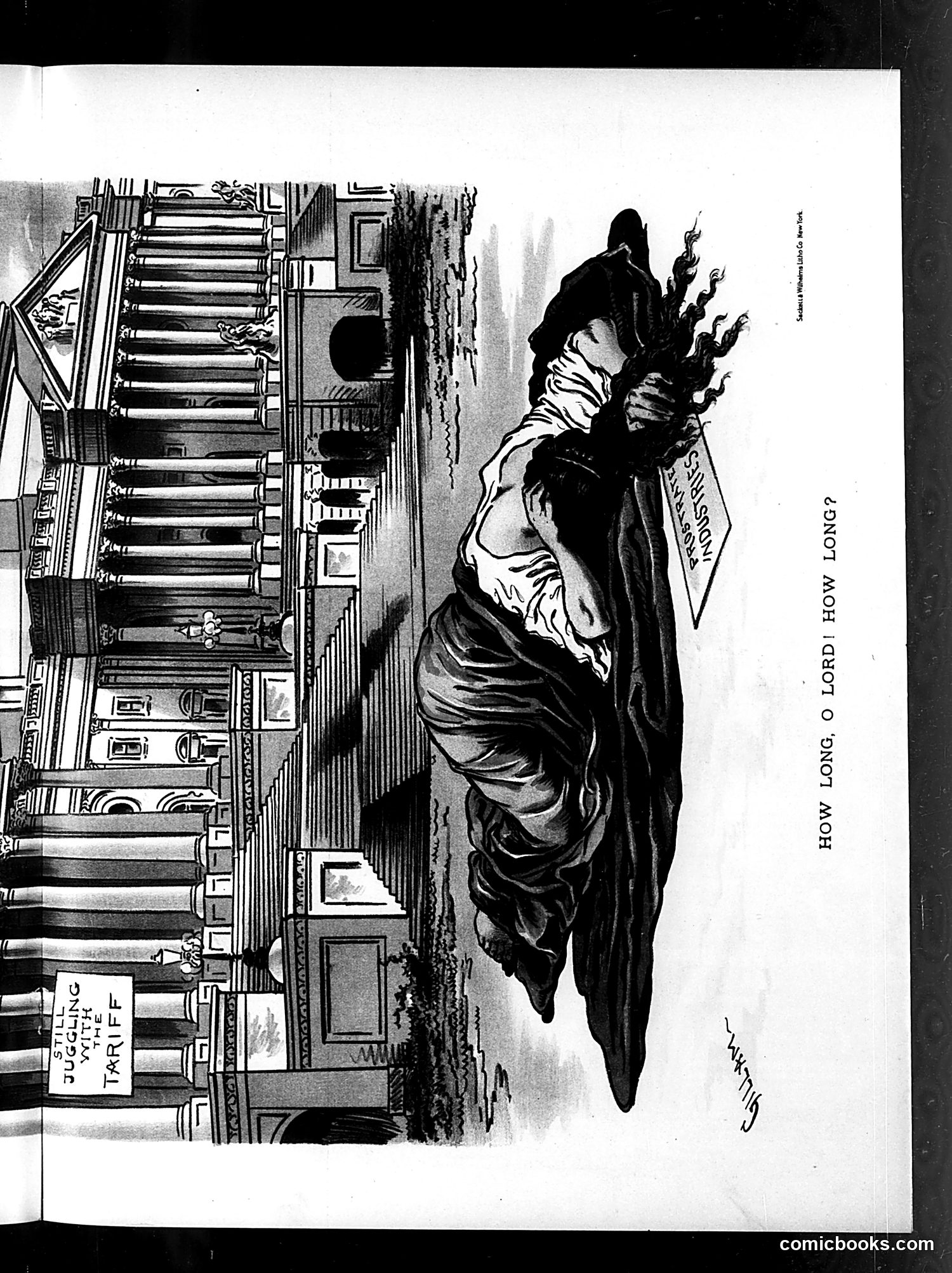
This appears to be a satirical cartoon from *Judge* magazine depicting a figure in robes kneeling in prayer before an elaborate building (likely representing a government institution or courthouse). The figure's posture and the caption "HOW LONG, O LORD! HOW LONG?" suggest desperation or exasperation about a prolonged legal or political situation. The ornate architecture on the left and the formal dress indicate this concerns institutional bureaucracy or the legal system. The prayer-like pose implies the cartoonist is mocking someone's helpless frustration with slow governmental processes or an unresolved case. Without clearer identification of the specific figure or accompanying context, the exact political target remains unclear, though the satire targets institutional inefficiency or delay.
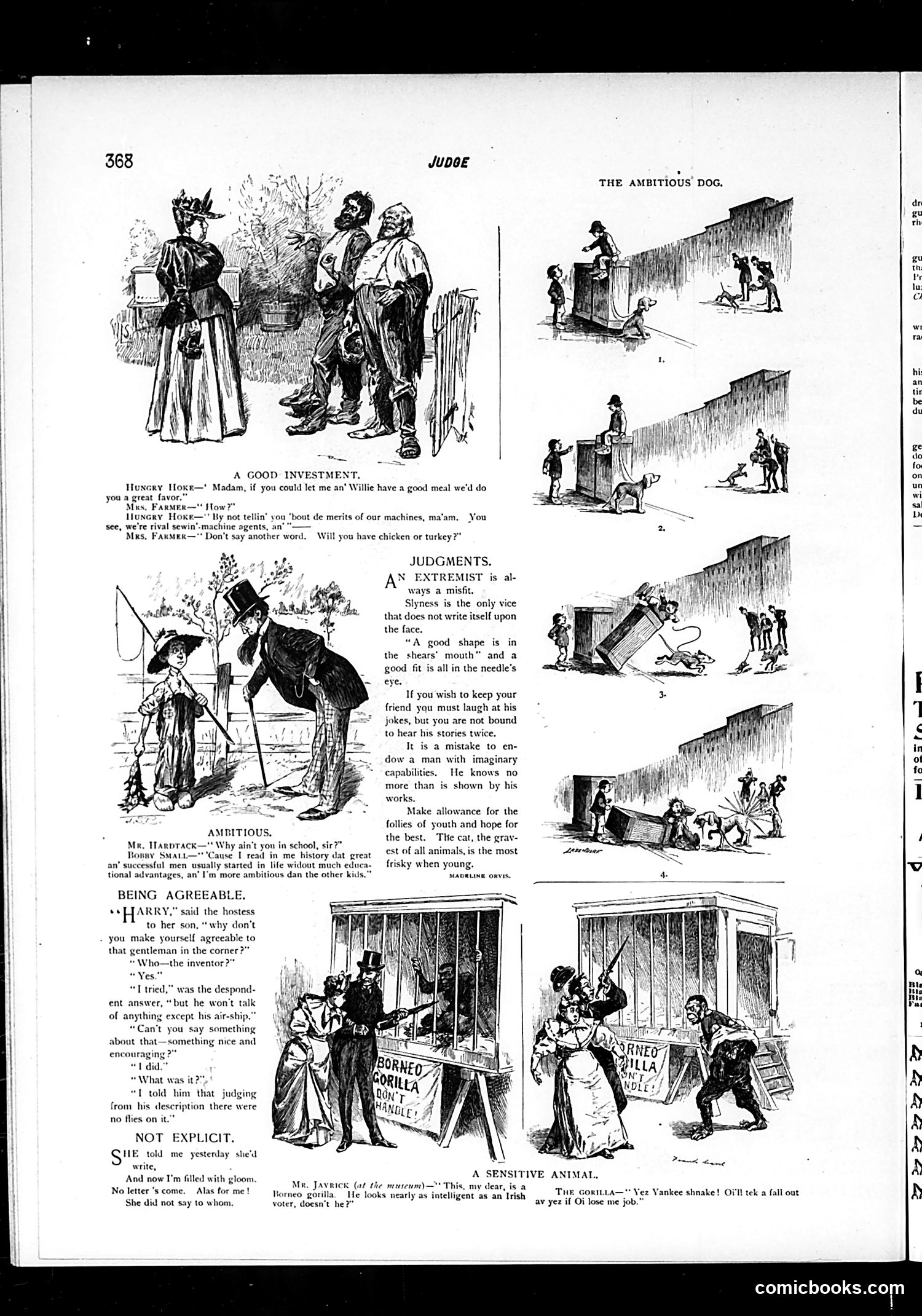
This page contains multiple short satirical comics typical of Judge's style: **"A Good Investment"**: Two hungry homeless men convince a farmer's wife to feed them by claiming they're rival sewing machine salesmen who'll keep quiet about each other's products—a joke about the ubiquity of aggressive door-to-door salesmen in this era. **"Ambitious"**: A boy skips school, claiming successful men didn't need education. The satire mocks both his faulty logic and the era's romanticization of self-made success stories. **"Being Agreeable"**: A guest compliments an inventor's airship by saying "there are no flies on it"—meaning it's excellent, but the inventor takes it literally as criticism. The joke plays on awkward social interactions. **"Not Explicit"**: A man receives an ambiguous love letter without clear intent. **"The Ambitious Dog"** and **"A Sensitive Animal"**: Brief visual gags about animal behavior. The page also includes "Judgments"—philosophical aphorisms about human nature (extremism, slyness, fitting in, friendship). The magazine's blend of social observation, wordplay, and gentle mockery of contemporary life is evident throughout.
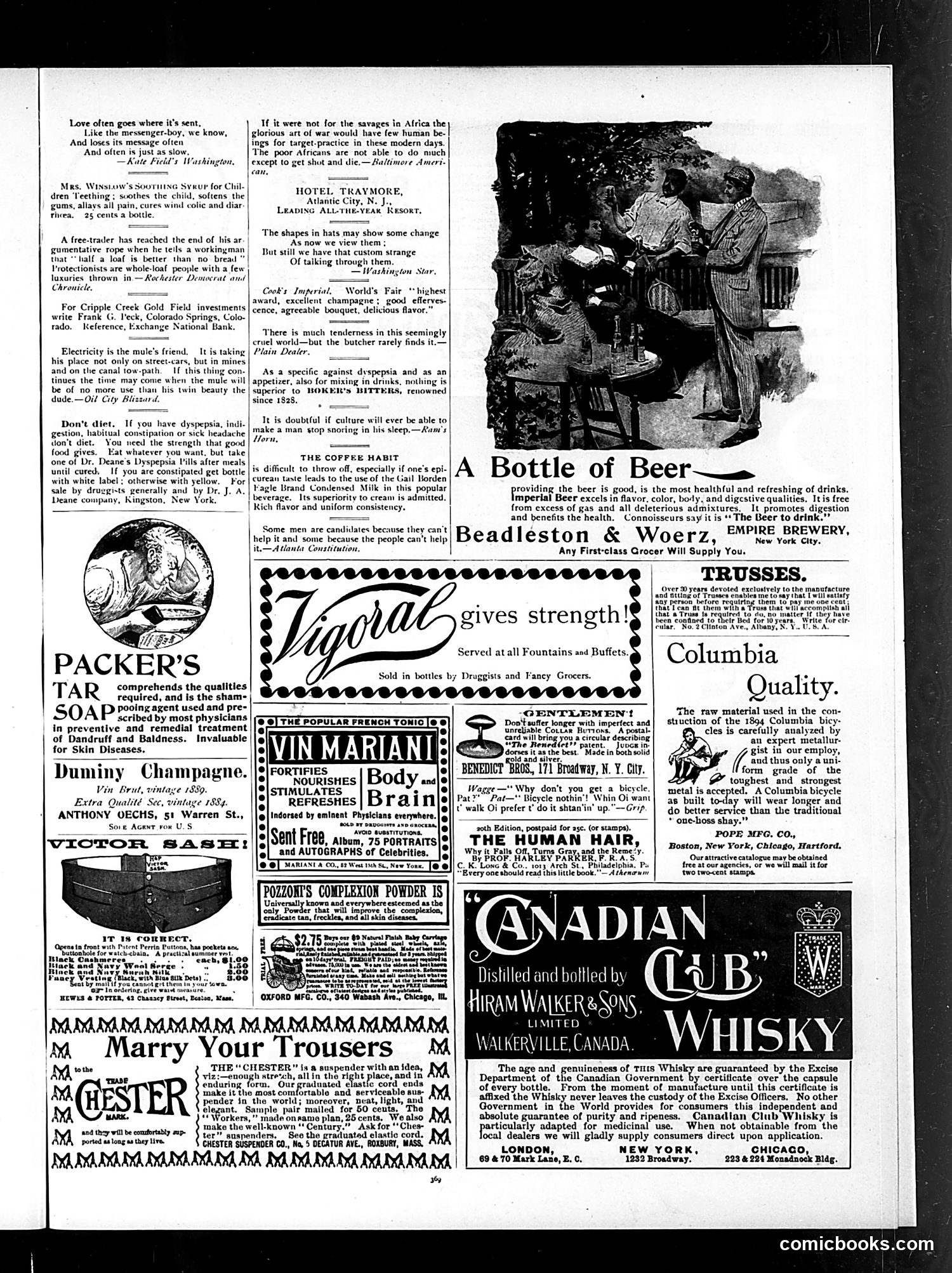
This page is primarily **advertisements and miscellaneous short satirical quotes**, not a coherent political cartoon. The notable satirical content includes: **Colonial/Racial Satire**: A quote mocking African colonialism, suggesting Africans serve only as "target-practice" for European warfare—a dark commentary on imperial conquest and exploitation. **Social Commentary**: Scattered one-liners mock American life: politicians talking without listening ("talking through hats"), free-traders vs. protectionists, dyspepsia remedies, and the inability of culture to stop men from snoring. **Visual Content**: A photograph of what appears to be a hotel or resort scene. The remainder consists of **period advertisements** for patent medicines (Packer's Tar Soap, Dr. Deane's Dyspepsia Pills), alcoholic beverages (Canadian Club Whisky, Imperial Beer), and other commercial products typical of late-19th/early-20th century publications. The page reflects Judge's mix of satirical commentary on contemporary American society and aggressive product marketing, with casual racist references normalized for that era.
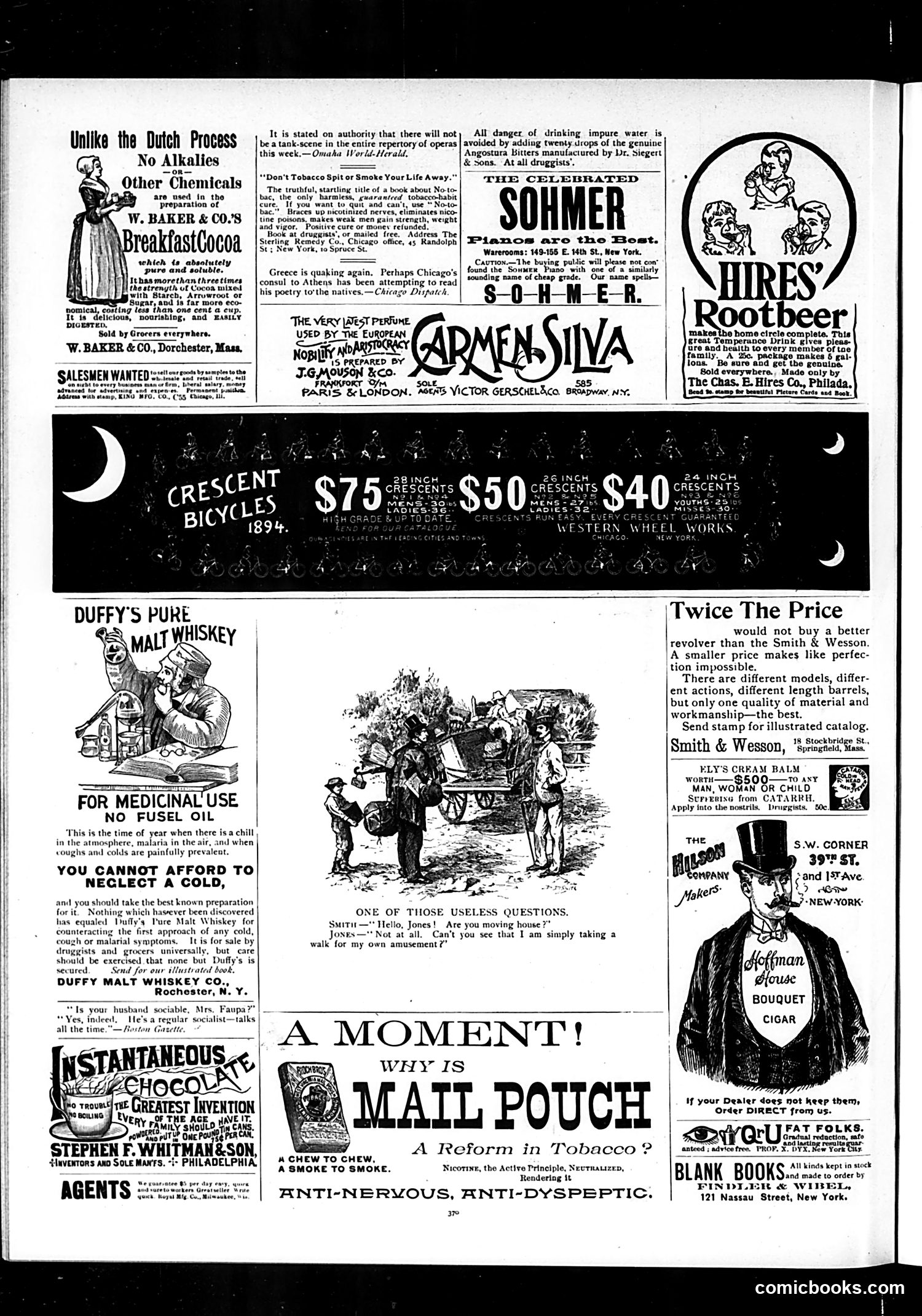
This page is primarily **advertising**, typical of late-19th-century magazines. The ads promote consumer products: breakfast cocoa, bicycles, pianos, perfume, malt whiskey (marketed as medicinal), tobacco cessation products, and firearms. The few **editorial jokes** are brief: - A quip about opera in Omaha having "no tank-scene" (unclear reference, likely topical to 1894) - A joke about Chicago's consul to Athens boring locals with poetry, causing the city to "quake" - A comic dialogue where a man insists he's "simply taking a walk for my own amusement" while moving house—absurdly denying the obvious The page reflects **period attitudes**: whiskey sold as cold medicine, tobacco remedies treating addiction as medical condition, and casual product humor. The ads reveal what 1890s consumers valued and how manufacturers marketed to them, often making dubious health claims now recognized as misleading.
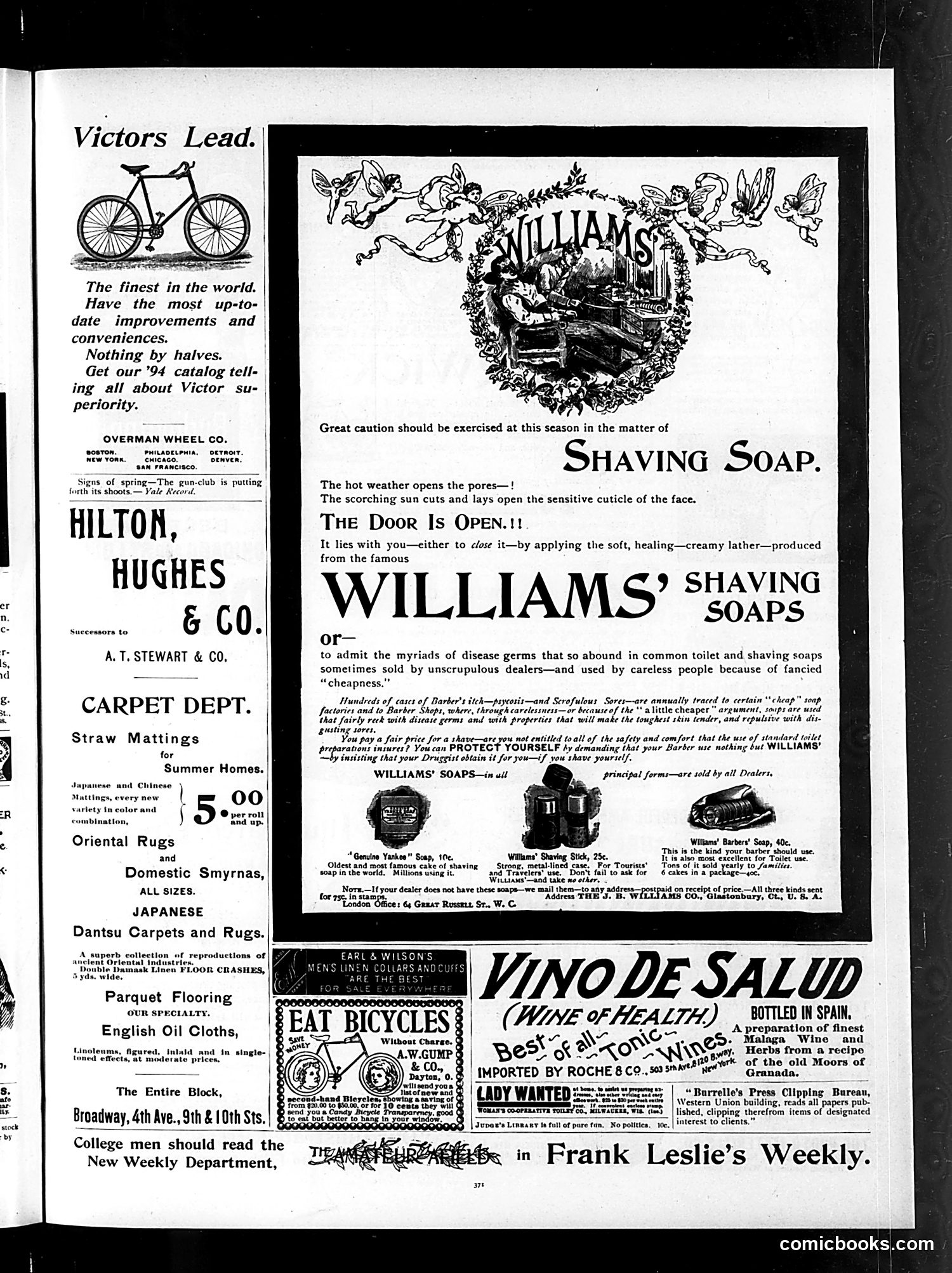
This page is primarily **advertising**, not political satire. It contains no discernible cartoon or political commentary—just commercial notices typical of 1890s periodicals. Key advertisements include: - **Victor bicycles** and other cycle companies, reflecting the 1890s bicycle craze - **Hilton, Hughes & Co.** carpet and home furnishing department - **Williams' Shaving Soaps**, featuring health warnings about cheap competitors spreading "disease germs" and "Barber's itch"—a legitimate concern in an era before modern sanitation - **Eat Bicycles** (another cycle maker) - **Vino de Salud** (Wine of Health), marketed as medicinal—typical of patent medicine advertising The Williams' Soap ad notably uses fear-based marketing, warning readers that inferior soaps cause infections, while positioning their product as the safe, quality choice. The page reflects 1890s consumer culture: bicycles as luxury goods, patent medicines claiming health benefits, and emerging advertising techniques using health anxiety to drive sales.
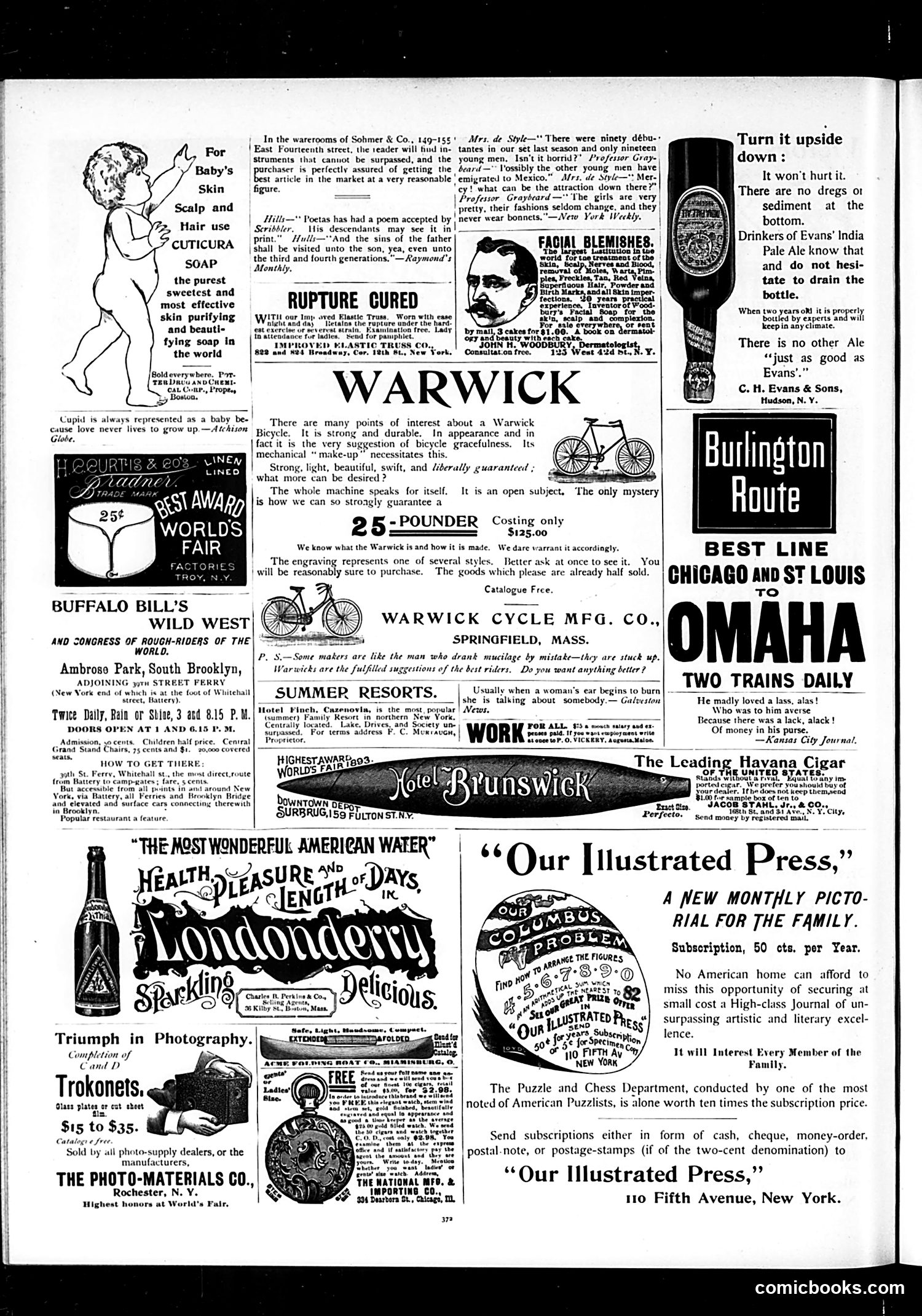
This page is primarily **advertising**, not political satire. It consists of multiple commercial notices for products and services popular in the late 19th/early 20th century. The small comic sketches scattered throughout are mild domestic humor unrelated to politics. One example: "Hulls—'And the sins of the father shall be visited unto the son, yea, even unto the third and fourth generations,'" jokes about a rejected poet's descendants suffering his failure. Another depicts a woman's ear burning when "talking about somebody." **Notable advertisements include:** - Warwick bicycles ("the only mystery is how we can so strongly guarantee" it) - Buffalo Bill's Wild West show - Evans' India Pale Ale ("no other Ale is just as good") - Photo cameras and materials - Various medical remedies (rupture treatments, facial blemishes) - Cuticura soap for babies The page reflects consumer culture and commercial interests of the period rather than political commentary. Any satire is incidental to advertising's dominant purpose.
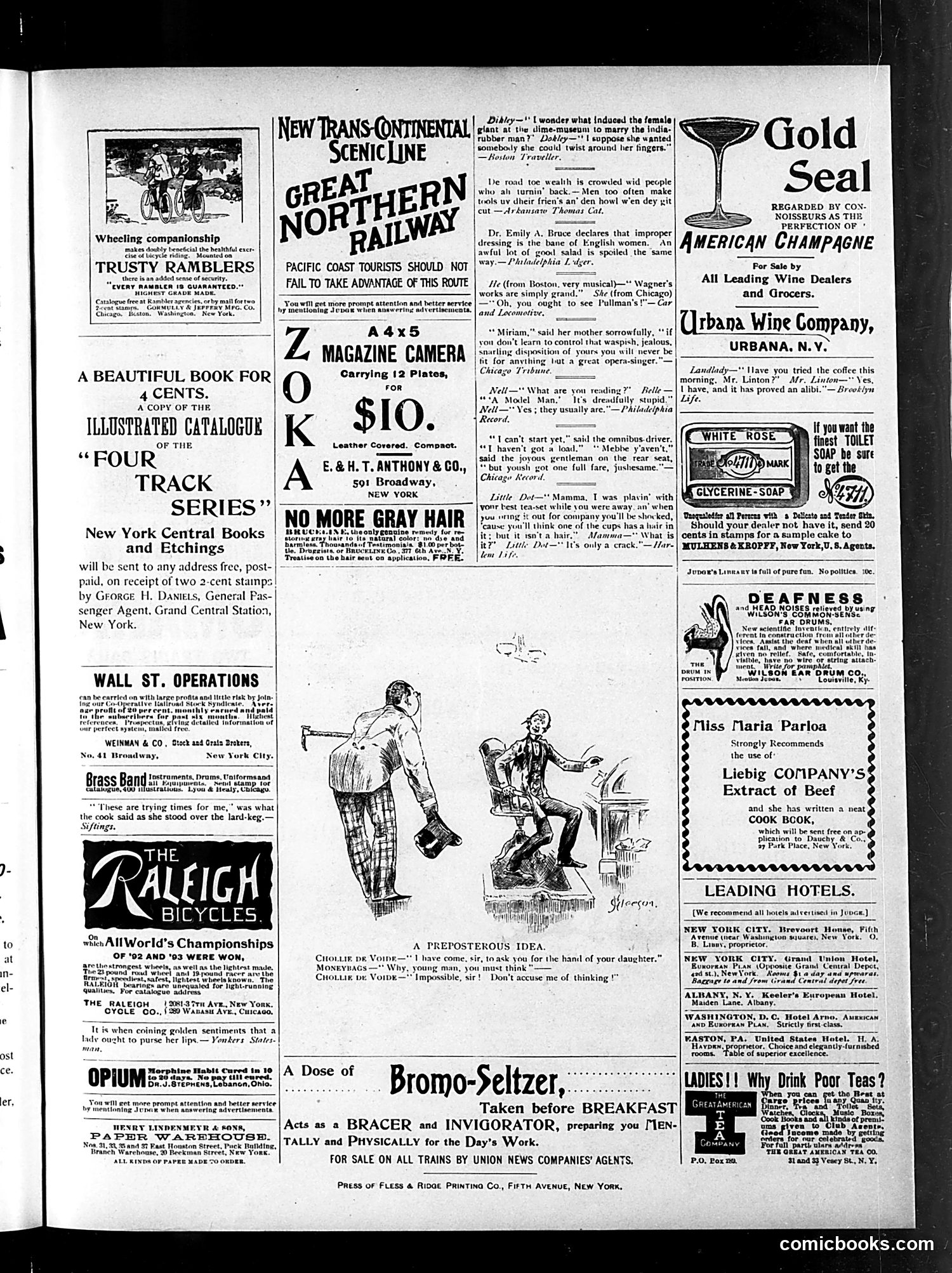
This page is primarily **advertisements and filler humor** rather than political satire. The main cartoon titled "A PREPOSTEROUS IDEA" depicts a suitor asking a father for his daughter's hand in marriage—a conventional romantic scenario presented as absurd, likely playing on class or social pretensions. The page contains numerous **period advertisements** (bicycles, cameras, champagne, hotels, medicines) and short jokes typical of Judge's humor style. These jokes mock domestic life, relationships, and social conventions—for example, one mocks a woman's jealous disposition as suitable only for opera singing; another jokes about a cook standing over lard, creating "trying times." The humor reflects **Victorian-era sensibilities**: concerns about gray hair, proper dress, domestic management, and courtship rituals. Without additional context, the specific social commentary remains vague, though the overall tone suggests mild mockery of bourgeois middle-class anxieties and gender relations of the period.
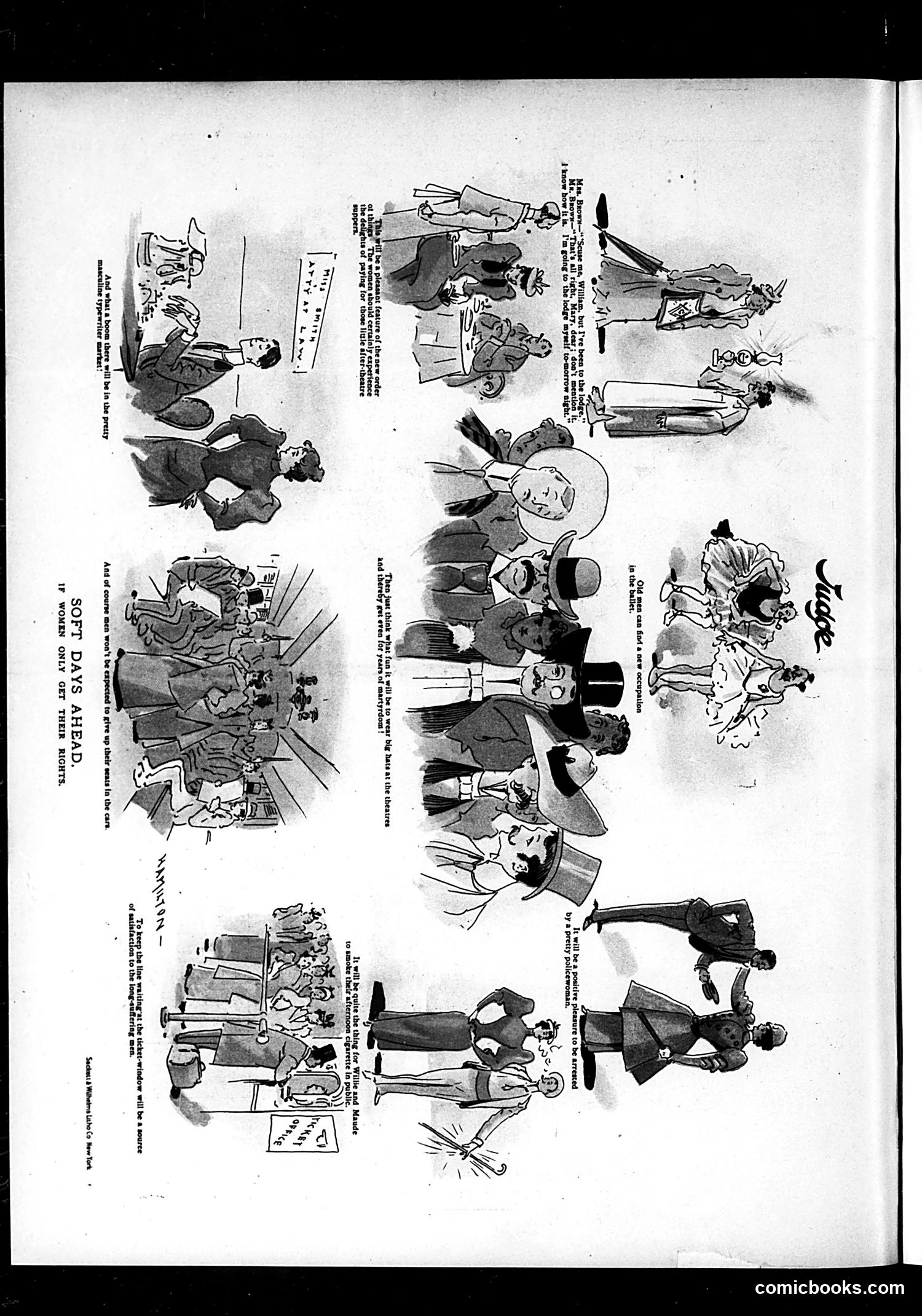
This Judge cartoon satirizes the anticipated consequences of women's suffrage and expanded rights. The comic depicts various "luxuries" women might enjoy—wearing large hats at theaters, smoking cigarettes after shows, paying for their own entertainment—presenting these as absurd or undesirable outcomes. The satire mocks anti-suffrage arguments by exaggerating supposed dangers of women's equality. The final panel's sarcastic reference to men no longer yielding subway seats suggests the cartoonist is ridiculing fears that granting women rights would fundamentally disrupt social conventions and male privilege. Published in Judge (a satirical magazine), this reflects early 20th-century opposition to women's suffrage, presenting women's independence as comic folly rather than legitimate progress. The "soft days" heading ironically suggests comfort, but the cartoon frames women's rights as genuinely threatening to the social order.