
A complete issue · 16 pages · 1894
Judge — May 26, 1894
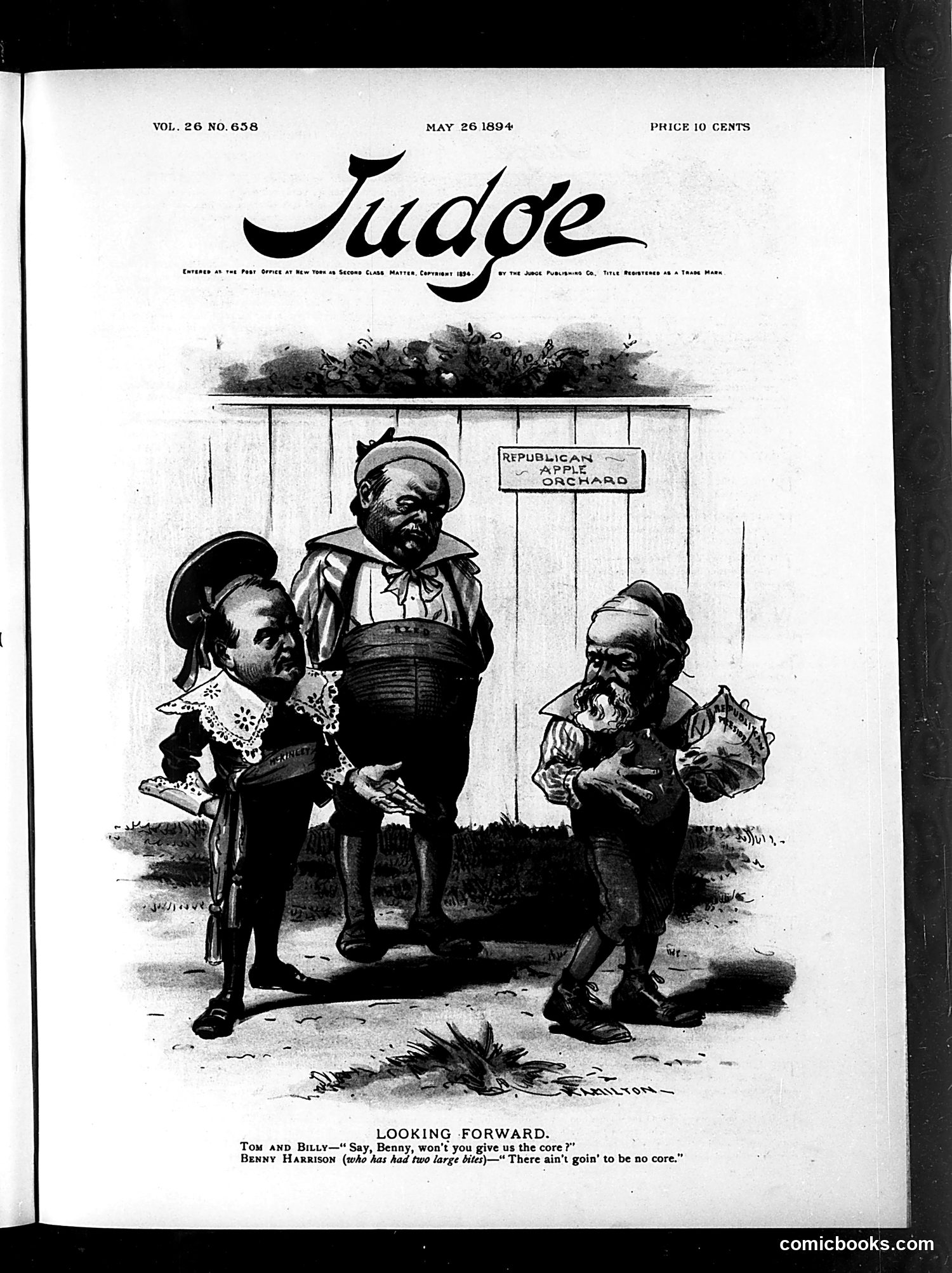
This political cartoon titled "Looking Forward" satirizes Republican prospects for the 1894 elections. The central figure represents Benjamin Harrison (labeled as having "two large ears"), flanked by two other Republican politicians. The "Republican Apple Orchard" sign suggests they're evaluating party assets. The dialogue—"Say, Benny, won't you give us the core?"/"There ain't goin' to be no core"—implies the Republicans fear there will be nothing substantial left of their party to salvage after recent setbacks. This reflects the devastating impact of the 1893 economic depression on Republican electoral viability. The cartoon mocks Republican leadership's pessimism about their political future.
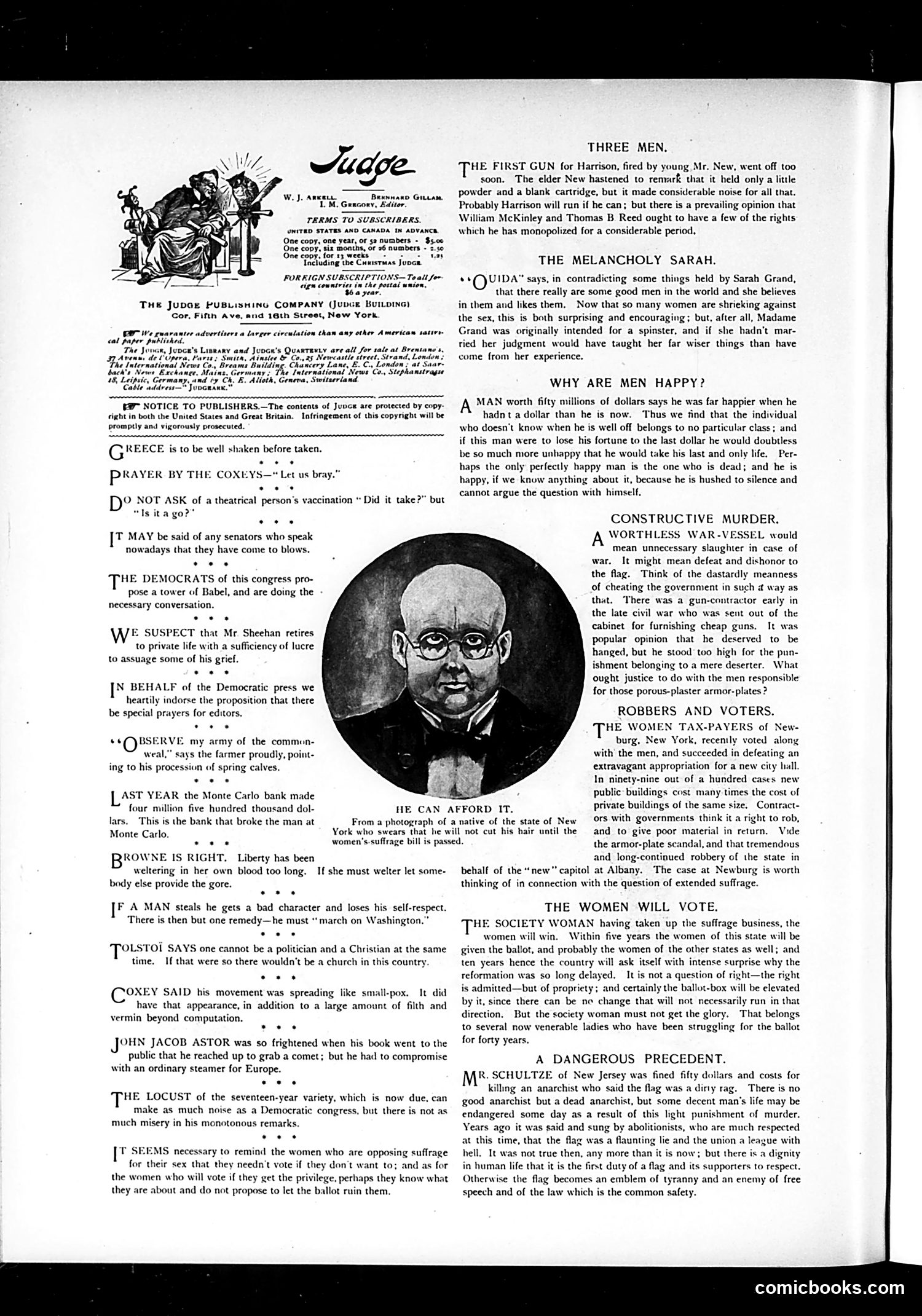
The main image shows a bald man with glasses in a circular portrait labeled "HE CAN AFFORD IT" - a photograph of "a native of the state of New York who swears that he will not cut his hair until the women's suffrage bill is passed." This satirizes the suffrage movement of the early 1900s. The joke mocks both male suffrage opponents and their unusual protest methods. The surrounding text articles address related topics: women's right to vote, tax-payers' concerns about government spending, and anarchist violence. The overall page tone is skeptical toward women's suffrage, presenting it alongside unrelated controversies (bank failures, weapons smuggling) to suggest progressive causes are foolish or dangerous. This reflects Judge magazine's conservative editorial stance on women's voting rights.
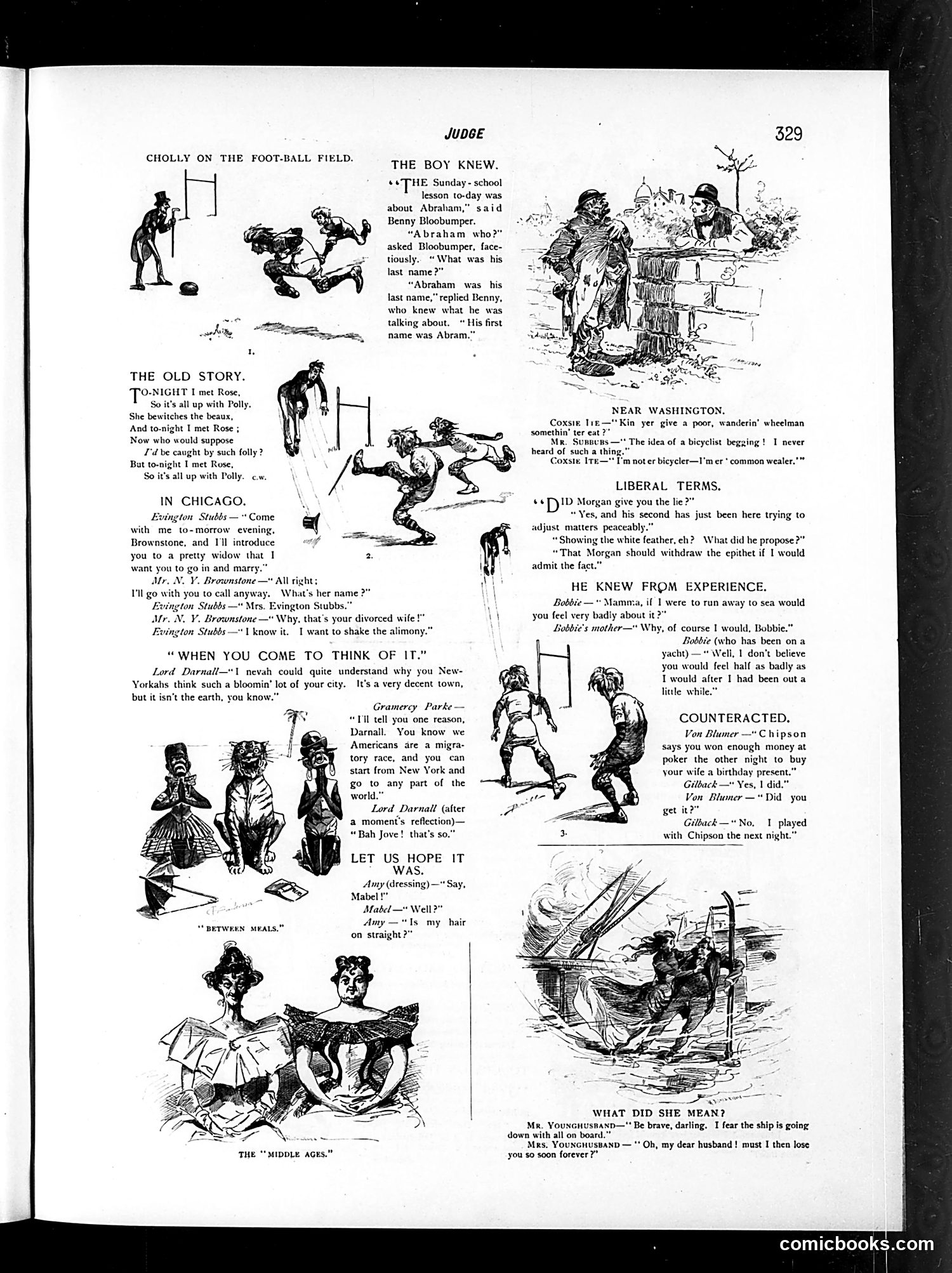
This page contains multiple unrelated satirical sections typical of Judge's format. The cartoons depict: **"Cholly on the Football Field"** and **"The Old Story"**: Visual gags about football and romantic pursuits, using stock characters common to the era. **"In Chicago"** and **"When You Come to Think of It"**: Dialogue-based humor involving divorce and courtship scenarios, reflecting early 20th-century social anxieties about marriage. **"Near Washington"** through **"What Did She Mean?"**: Brief anecdotal humor about bicycles, poker winnings, and shipboard romance—typical domestic comedy. The page lacks overt political satire. Instead, it showcases Judge's characteristic blend of visual jokes, social commentary on relationships and courtship, and genteel humor targeting middle-class readers. The illustrations use caricature but avoid the ethnic stereotyping visible in other Judge content from this period.
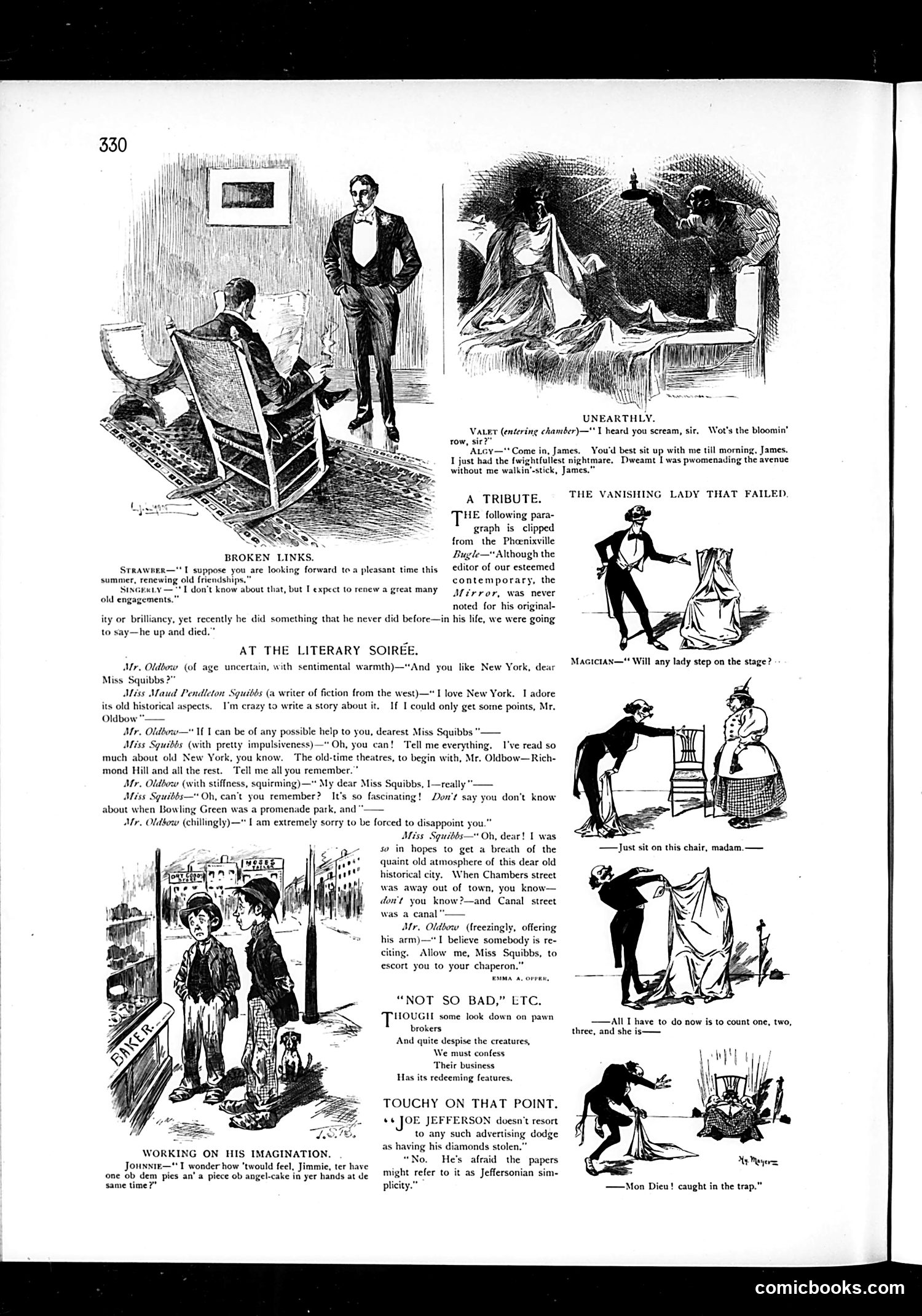
This page contains several unrelated satirical vignettes typical of Judge's humor: **"Unearthly"**: A British gentleman dreams of walking without his walking stick—a status symbol—and is mortified. The joke mocks Victorian class anxiety over appearances. **"At the Literary Soirée"**: An elderly man (Mr. Oldbow) is cornered by a young female writer seeking historical details about old New York. When pressed about specific landmarks, he becomes evasive and uncomfortable, eventually escaping. The satire targets both pretentious literary circles and aging men caught between gallantry and their actual knowledge. **"The Vanishing Lady That Failed"**: A magic trick where a magician asks a woman to step on stage; subsequent panels show her mysteriously vanishing from beneath a cloth—a classic illusion joke. **"Joe Jefferson" reference**: A brief joke about actor Joe Jefferson avoiding publicity stunts involving stolen diamonds. **"Working on His Imagination"**: Two children fantasize about possessing expensive pie and cake simultaneously. The page is mostly lighthearted domestic and social humor without specific political content.
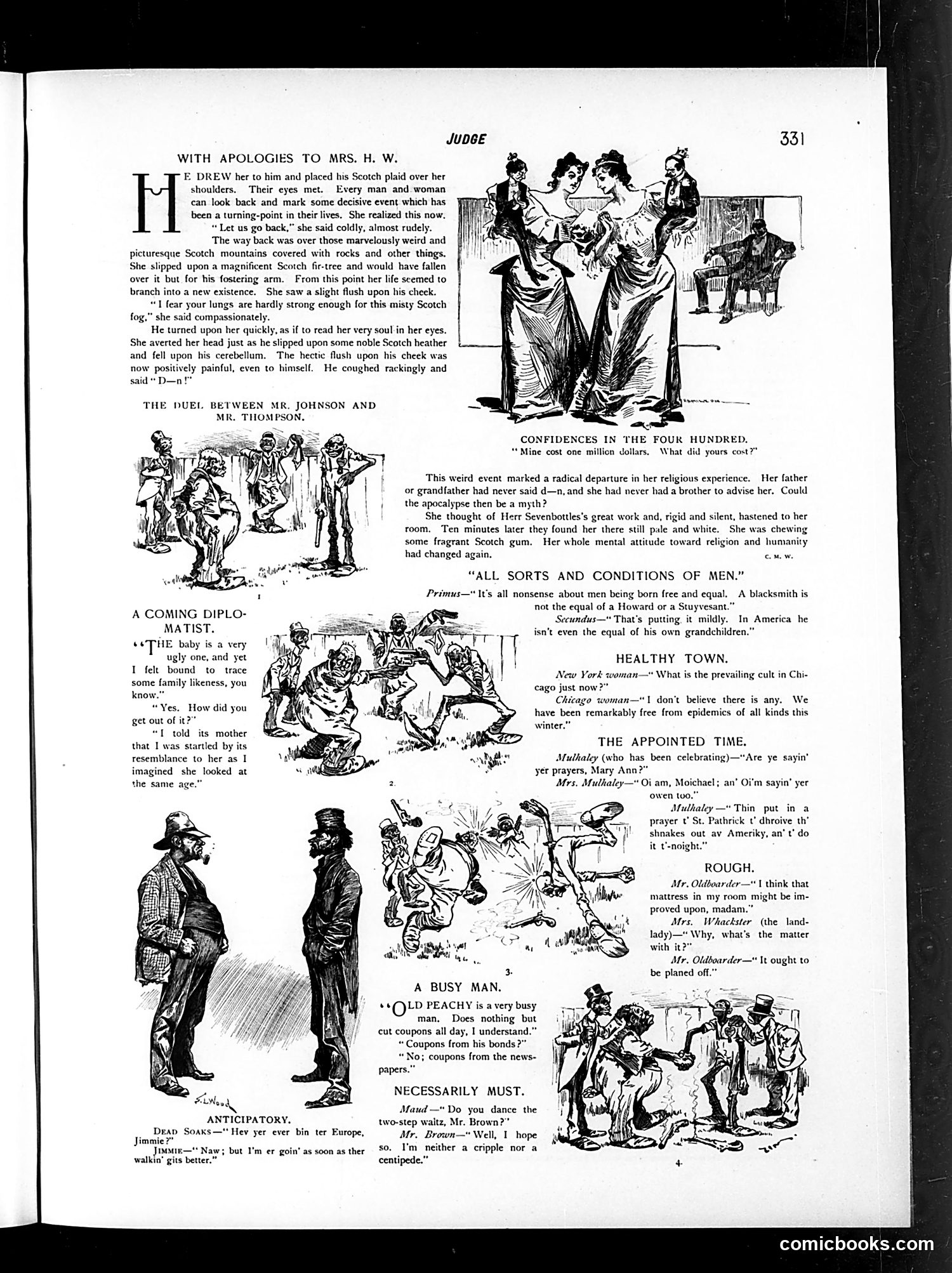
This page contains multiple satirical vignettes mocking various social pretensions and absurdities: **Main story ("With Apologies to Mrs. H. W.")**: A parody of romantic Scottish fiction, where a woman's entire worldview—including religious faith—shifts based on trivial incidents (a man cursing, chewing gum). The satire targets melodramatic literature and shallow moral convictions. **"Confidences in the Four Hundred"**: Mocks wealthy elites' obsession with displays of wealth; the joke is that both speakers spent fortunes on something unspecified. **"All Sorts and Conditions of Men"**: Attacks claims of human equality—characters argue even American workers aren't equal to their own grandchildren, satirizing rigid class hierarchies. **Remaining sketches**: Various jokes about social pretense (a "coming diplomat" whose baby resembles the mother), health fads, Irish-American dialect humor, financial parasitism ("cutting coupons"), and dating reluctance. The overall tone is cynical about American society's class consciousness, materialism, and romantic affectation. The heavy use of dialect humor and caricature reflects late 19th-century satirical conventions.
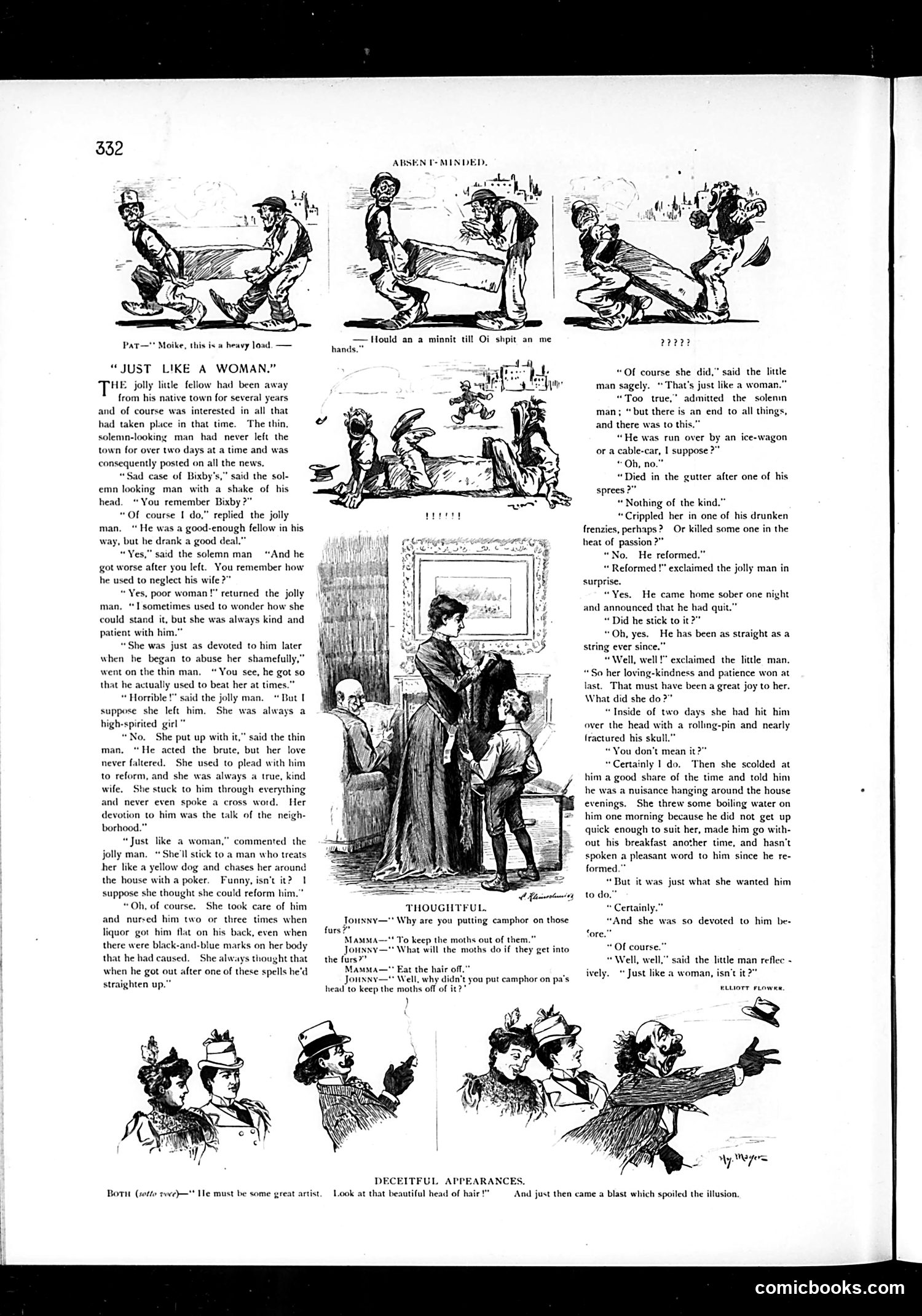
This satirical story mocks gender stereotypes and hypocrisy about women's virtue. The narrative presents a woman who devotedly tolerates her husband's alcoholism and abuse for years—the "ideal" patient, self-sacrificing wife. However, the punchline inverts expectations: once he reforms and stops drinking, she beats him with a rolling pin, scalds him with boiling water, and treats him miserably. The satire targets two audiences: men who praised women's "natural" patience and forgiveness as moral superiority, and women's actual resentment of that impossible standard. The repeated refrain "just like a woman" becomes ironic—the woman's cruelty after reform isn't feminine weakness but justified revenge. The story suggests that praising female tolerance of abuse was never about virtue but about convenient male exploitation. By refusing the reformed husband kindness, she exposes the absurdity of expecting infinite feminine patience.
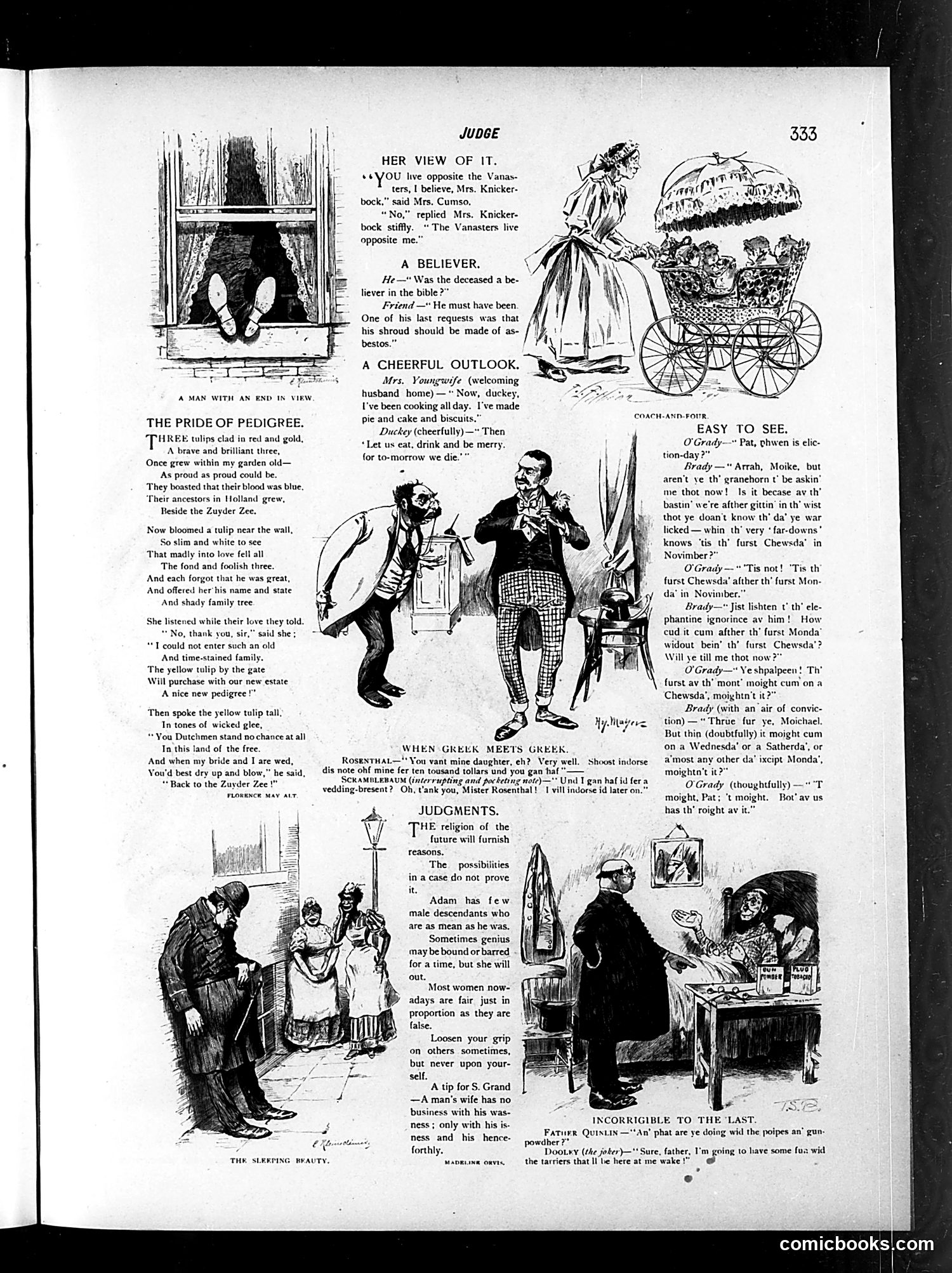
This page contains several satirical pieces typical of late 19th-century American humor: **"The Pride of Pedigree"** mocks European (specifically Dutch) aristocratic pretension. Three blue-blooded tulips boast of their Holland ancestry, but lose a romantic competition to an American yellow tulip who dismisses their lineage. The satire targets Old World snobbery about genealogy, celebrating American egalitarianism. **"Greek Meets Greek"** depicts two Jewish immigrants (indicated by Yiddish dialect) in a con scheme—one "selling" his daughter for a dowry note that the other immediately pockets and endorses fraudulently. It's an ethnic stereotype joke about shrewd Jewish business dealings. Other brief items include domestic humor and philosophical aphorisms typical of Judge's miscellaneous content. The Irish dialect pieces ("Easy to See," "Incorrigible to the Last") use caricatured speech patterns—common period ethnic humor about Irish immigrants' supposed ignorance and troublemaking.
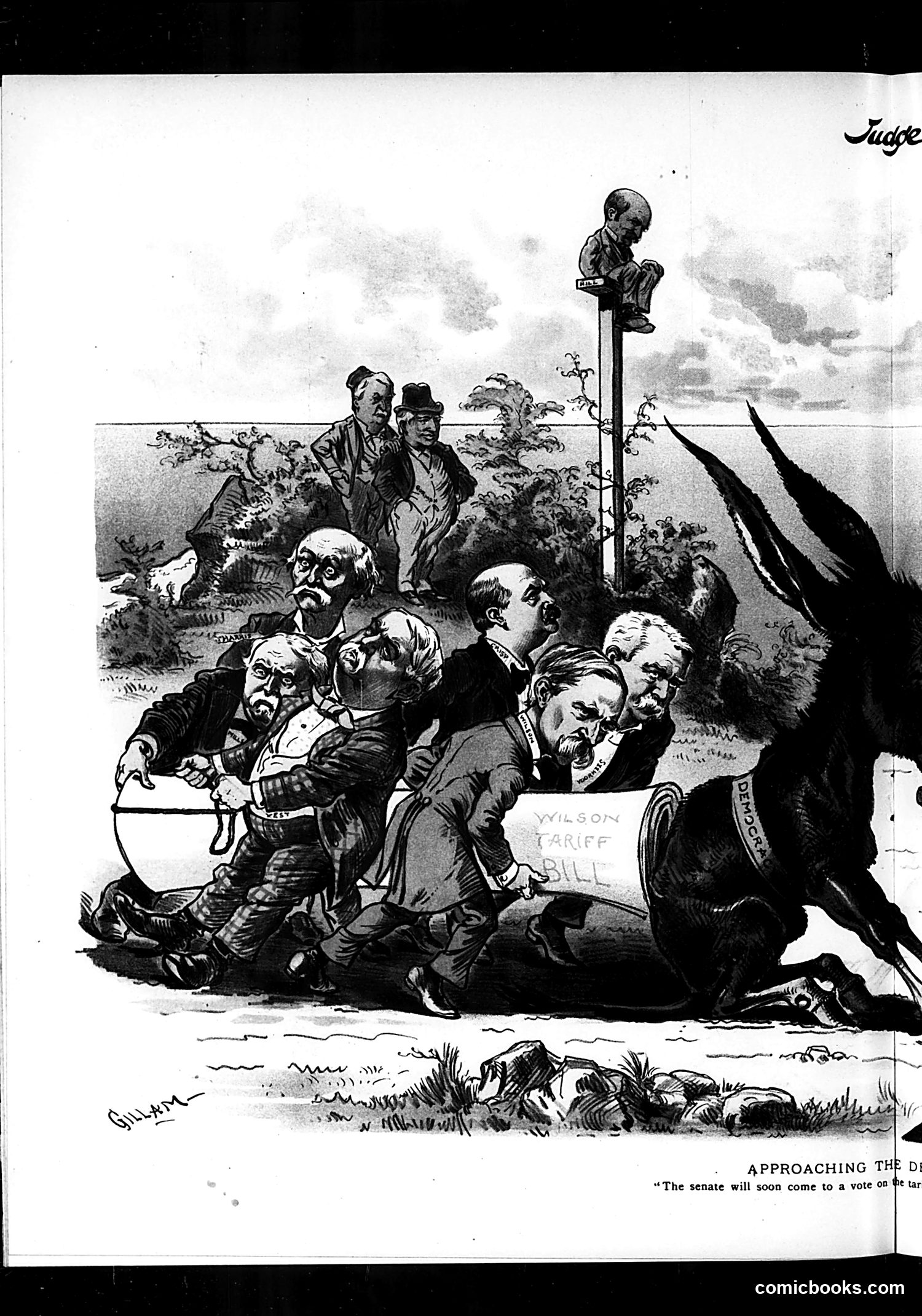
This Judge magazine cartoon satirizes opposition to the **Wilson Tariff Bill**. A group of politicians (appearing distressed and huddled together) clutch a document labeled "WILSON TARIFF BILL," while an ominous figure—likely representing either Death or a political consequence—looms on the right with a scythe. The caption indicates the Senate is approaching a vote on tariff legislation. The cartoon mocks senators opposing the bill, portraying them as fearful of its passage. The grim reaper imagery suggests the satirist views their opposition as misguided or doomed. This reflects late-19th-century American political division over tariffs, with protectionists battling free-trade advocates. The Wilson Tariff of 1894 was a significant Democratic effort to lower tariffs, generating fierce congressional debate.
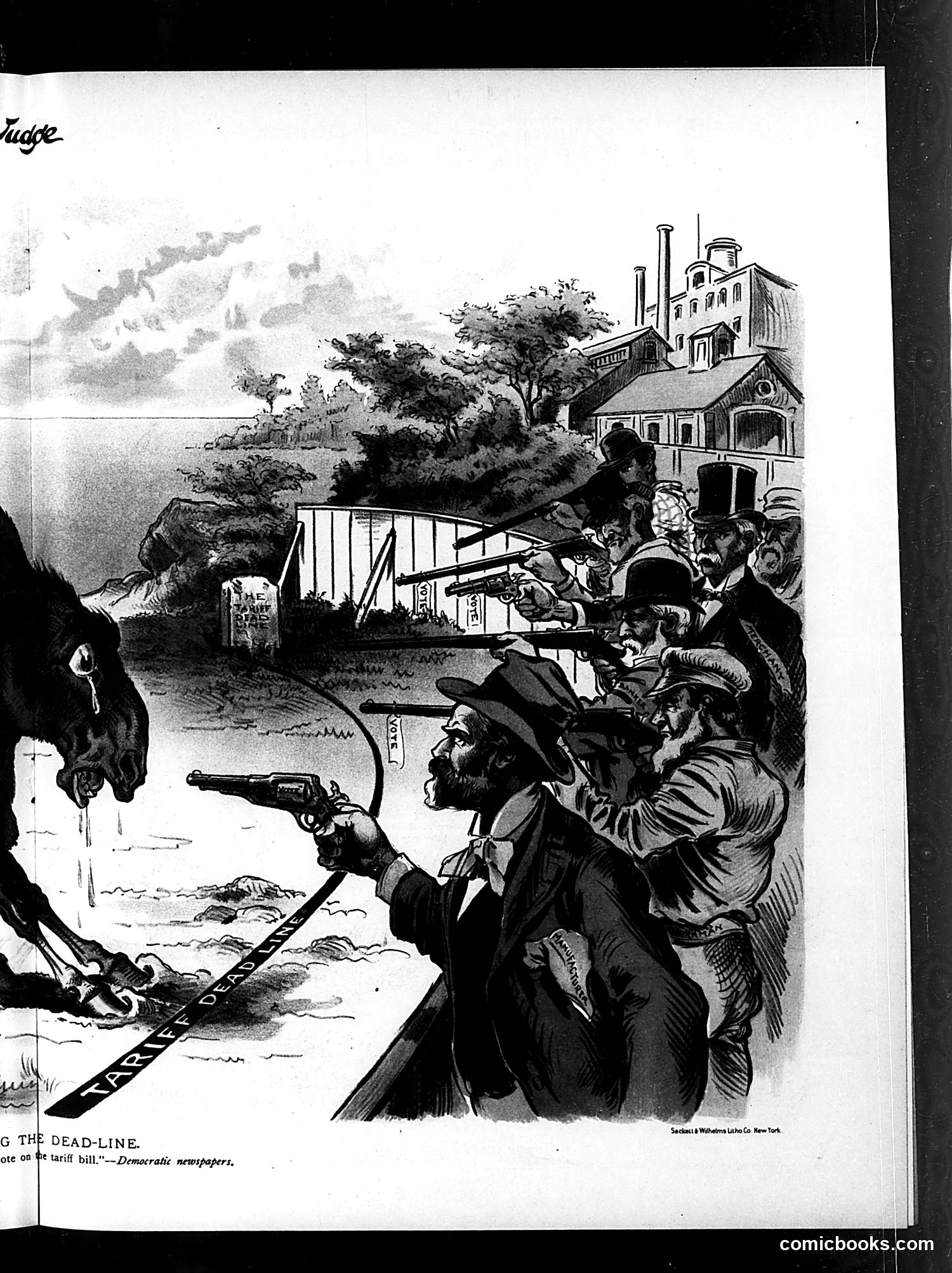
This political cartoon satirizes Democratic opposition to a tariff bill. The image shows armed men at what appears to be a factory or industrial site, with a "dead-line" (barrier) marked on the ground. The cartoon's title and caption suggest Democrats are being depicted as crossing or challenging a dangerous boundary regarding tariff policy. The armed figures and tense scene imply Democrats view the tariff bill as a threat worth violent resistance, or conversely, that supporting it means crossing into dangerous territory. The industrial setting (factory with smokestacks visible) indicates this concerns economic/manufacturing policy. The satire likely mocks Democratic newspapers' inflammatory rhetoric about the tariff bill, portraying their opposition as dangerously extreme or reckless. The specific tariff bill referenced remains unclear without additional context.
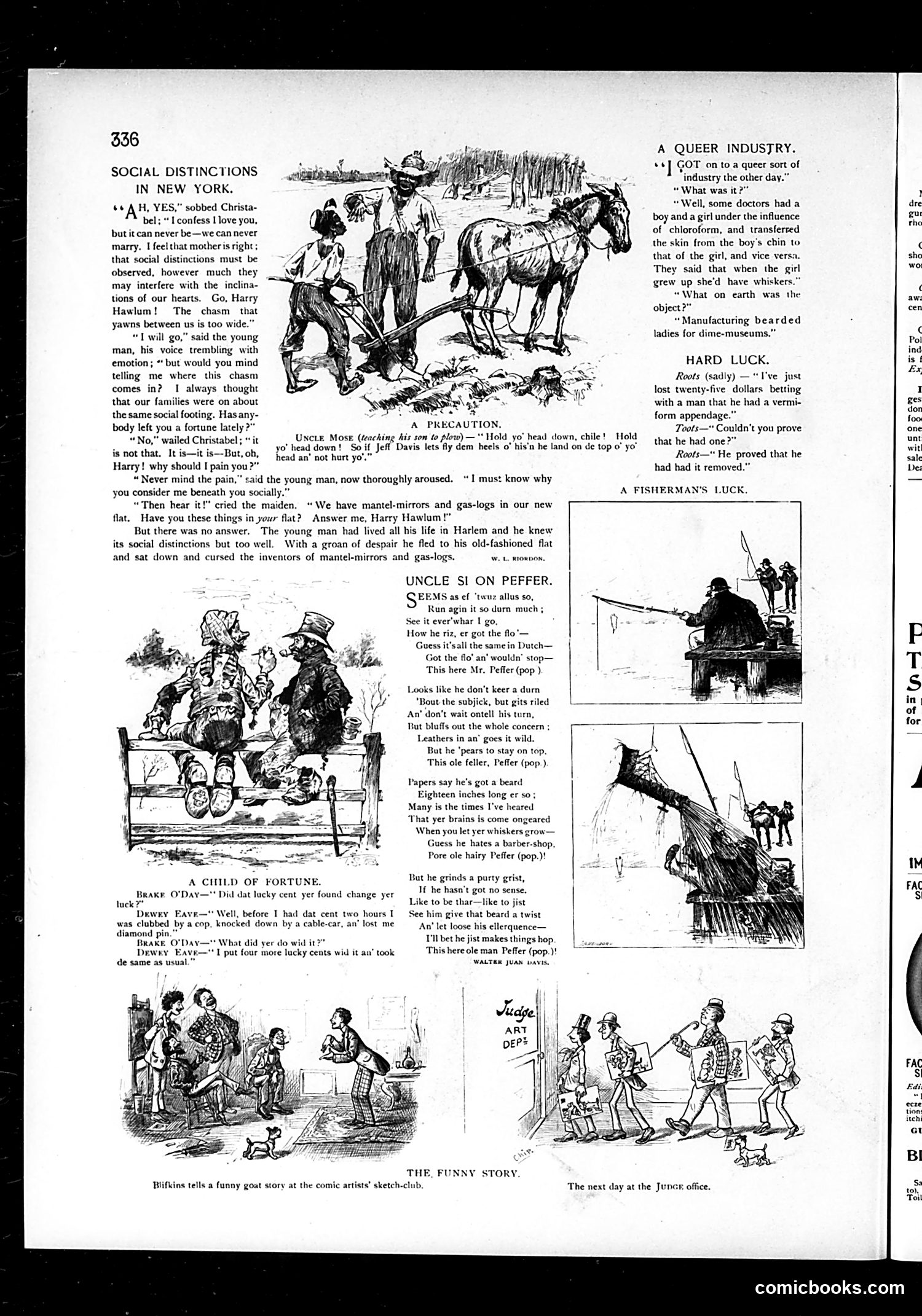
This page from *Judge* contains several satirical pieces mocking late-19th-century American society: **"Social Distinctions in New York"** ridicules the pretentiousness of newly wealthy New Yorkers. A young woman rejects her suitor not for lack of money, but because his apartment lacks fashionable mantel-mirrors and gas-logs—absurdly trivial status symbols. The satire targets how superficial material possessions had become markers of social class. **"Uncle Si on Peffer"** appears to mock a politician (likely Kansas Populist James G. Peffer), describing his long beard and aggressive behavior in rural dialect. The piece suggests he's effective ("grinds a purty grist") despite lacking conventional polish. **"A Child of Fortune"** and **"A Queer Industry"** are brief jokes about misfortune and a fake medical scheme respectively—typical period humor. The cartoons use exaggerated drawings and vernacular speech to mock both urban class-consciousness and political figures.
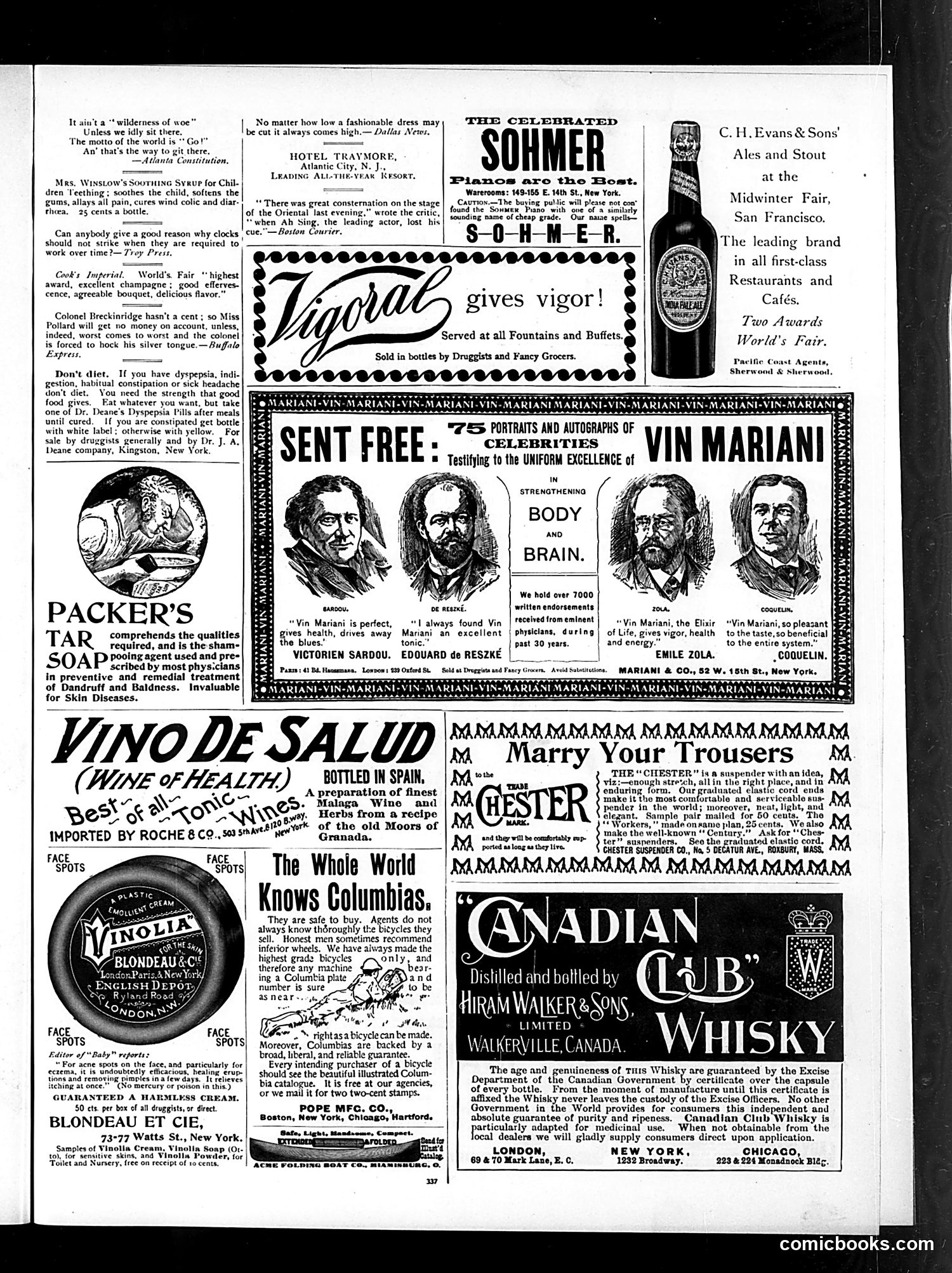
This page is **primarily advertisements** with minimal editorial content. The small text snippets are brief satirical quips typical of Judge's format. **Visible Editorial Content:** - A quote from the Atlanta Constitution about self-improvement ("Go!" spirit) - A joke about Colonel Breckinridge's financial troubles and Miss Pollard (appears to reference a contemporary scandal, but specifics are unclear) - A theatrical anecdote about "Ah Sing" losing composure onstage—likely poking fun at racial stereotypes common in 1890s theater **Advertisements dominate**, featuring: - Patent medicines (Packer's Soap for baldness, Dr. Deane's pills) - Sohmer pianos - Vin Mariani wine (claiming health benefits with celebrity endorsements) - Columbia bicycles - Canadian Club whisky The ads themselves reflect period attitudes: patent medicines with unproven claims, racial caricatures in theatrical references, and luxury goods marketed to wealthy readers. Without a date visible, specific political references remain unclear.
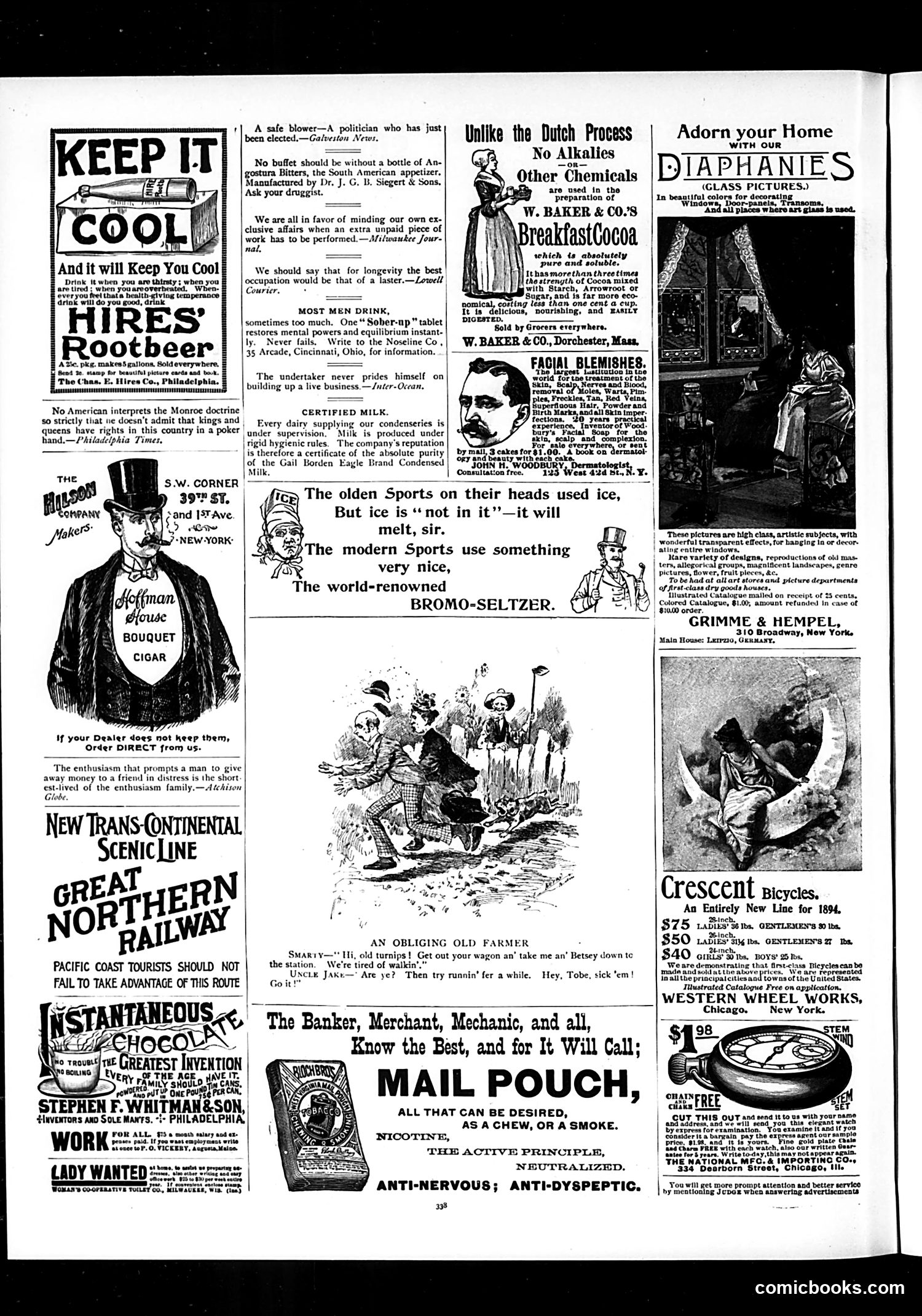
This page is primarily **advertisements with scattered one-liners** rather than editorial cartoons. The content reflects late-19th century consumer culture and attitudes. **Key elements:** The political joke at top defines a "safe blower" as "a politician who has just been elected"—satirizing politicians as temporarily harmless after victory, likely referencing widespread corruption concerns of the era. **The main cartoon** shows an "obliging old farmer" refusing to give townsfolk a wagon ride, telling them to "try running" instead—rural humor about city folk imposing on country people. **Advertisements** dominate: Hires Root Beer, Baker's Cocoa (emphasizing purity), Bromo-Seltzer, cigars, bicycles, and tobacco. One ad promotes "Sober-up" tablets to cure drunkenness—indicating alcoholism was normalized enough to market instant remedies. The "Mail Pouch" tobacco ad claims nicotine is "neutralized" and "anti-nervous"—reflecting pre-regulation medical claims about addictive substances. Overall, this reflects a society marketing solutions to self-inflicted problems while mocking politicians and rural/urban class differences.
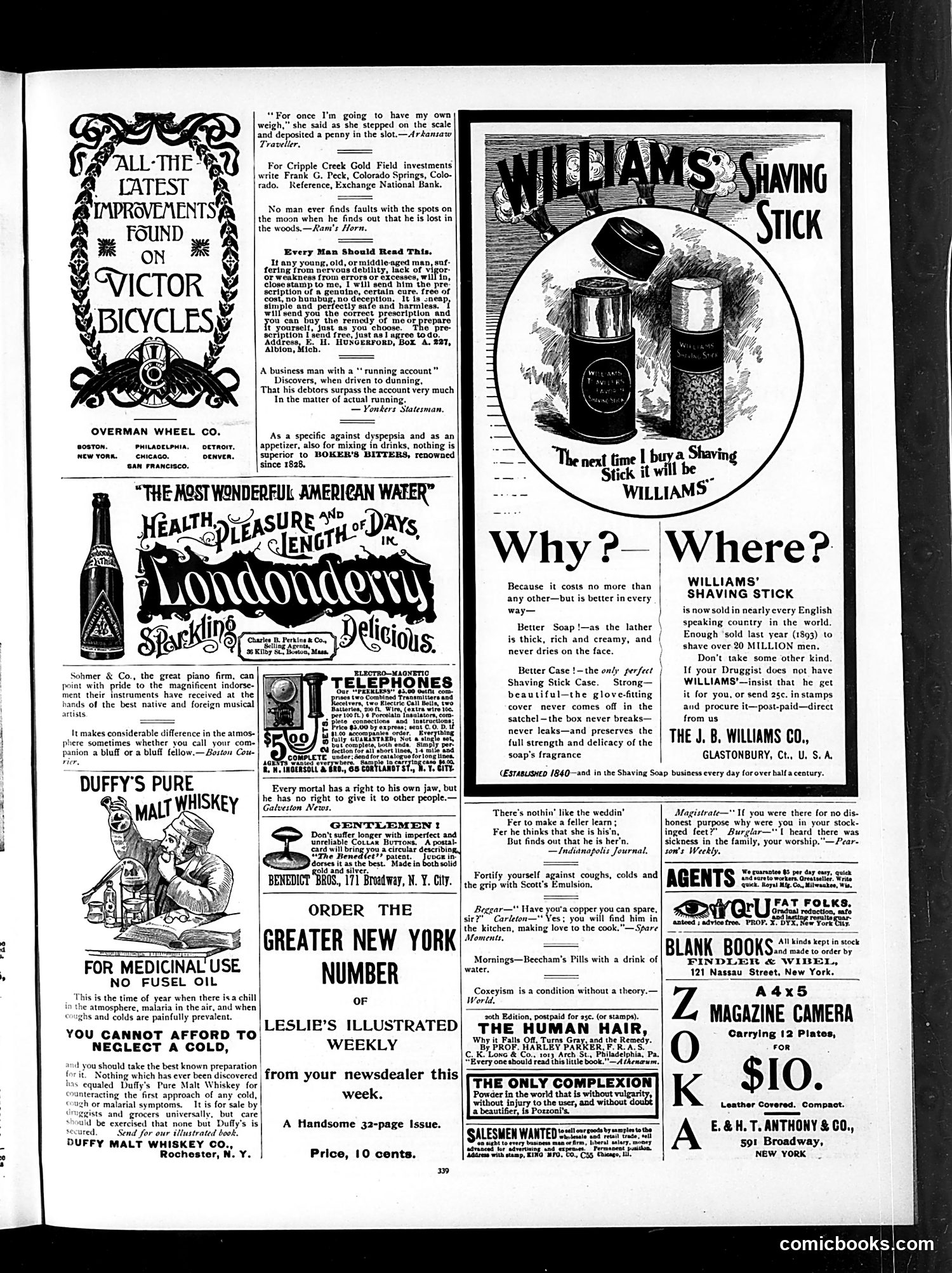
This is primarily an **advertising page** rather than satirical content. The page consists almost entirely of product advertisements typical of the 1890s-1900s era, including: - Victor bicycles, pianos, whiskey, shaving products, and early telephones - Scattered between ads are brief **humorous anecdotes or "quips"** rather than political cartoons—short joke-observations about human nature (women on scales, men with debts, etc.) **No clear political satire or caricatured figures appear** on this page. The "cartoons" are actually simple line illustrations advertising products like Duffy's Malt Whiskey and Williams' Shaving Stick—not satirical commentary. The page reflects **late-Victorian consumer culture**: remedies for "nervous debility," medicinal whiskey (legal then), and emerging technology like magnetic telephones. The humor is genteel and apolitical—observational comedy rather than satirical critique. This appears to be a typical Judge interior advertising spread, not a page featuring the magazine's signature political satire.
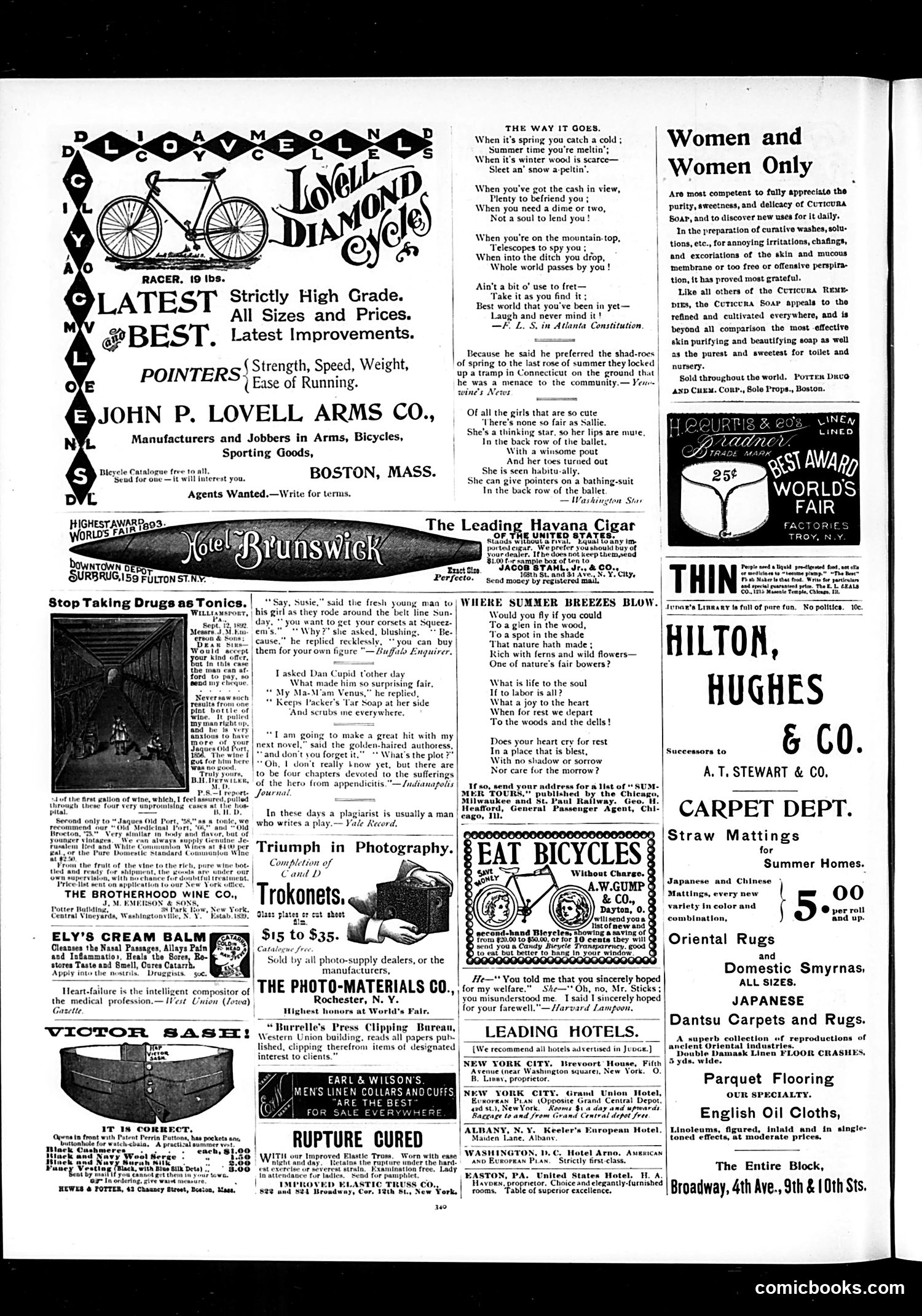
This page is primarily **advertisements with satirical humor**, not political cartoons. The content includes: **Main Features:** - Bicycle and sporting goods ads (John P. Lovell Arms Co., Peat Bicycles) - Cigars, medicines, and household products typical of the era **Satirical Content:** The humor pieces mock everyday frustrations ("The Way It Goes") and social absurdities—like a tramp arrested in Connecticut for preferring spring shad-roe, presented as evidence he's a "menace to the community." This satirizes both arbitrary law enforcement and class prejudice. **Other Jokes:** - A young woman's appeal in the "back row of the ballet" - A fresh young man's clumsy flirtation attempts - Jabs at authors who write melodramatic novels featuring characters' appendicitis **Context:** This reflects turn-of-the-century American humor—lighthearted, domestic, and mildly satirical about courtship, commerce, and social pretension rather than serious political commentary.
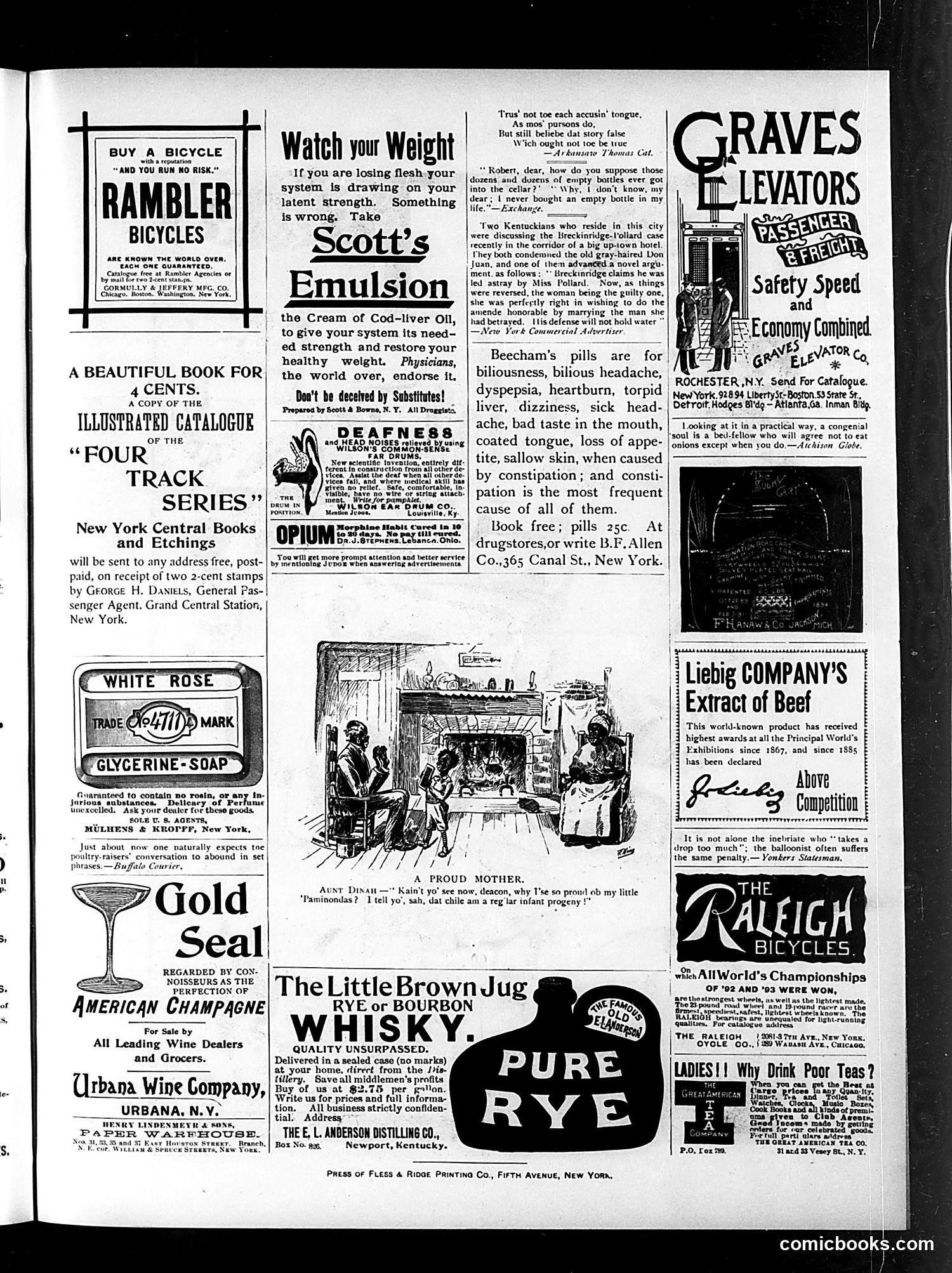
This page is primarily **advertising**, but contains one notable cartoon titled "A Proud Mother" featuring dialogue between "Aunt Dinah" and a "deacon." The cartoon depicts a racist caricature in the minstrel tradition common to late-19th-century American humor. Aunt Dinah boasts about her child being "a reg'lar infant progeny," using exaggerated dialect humor. The joke appears to mock African American speech patterns and parenting—typical of Judge magazine's satirical approach to race during this era. The cartoon reflects period attitudes that modern readers would recognize as deeply offensive stereotyping, using caricature and dialect as comedic devices at the expense of Black Americans. It represents the casual racial mockery that permeated mainstream American publications of this time, presented alongside patent medicine and liquor advertisements targeting the magazine's white, middle-class readership.
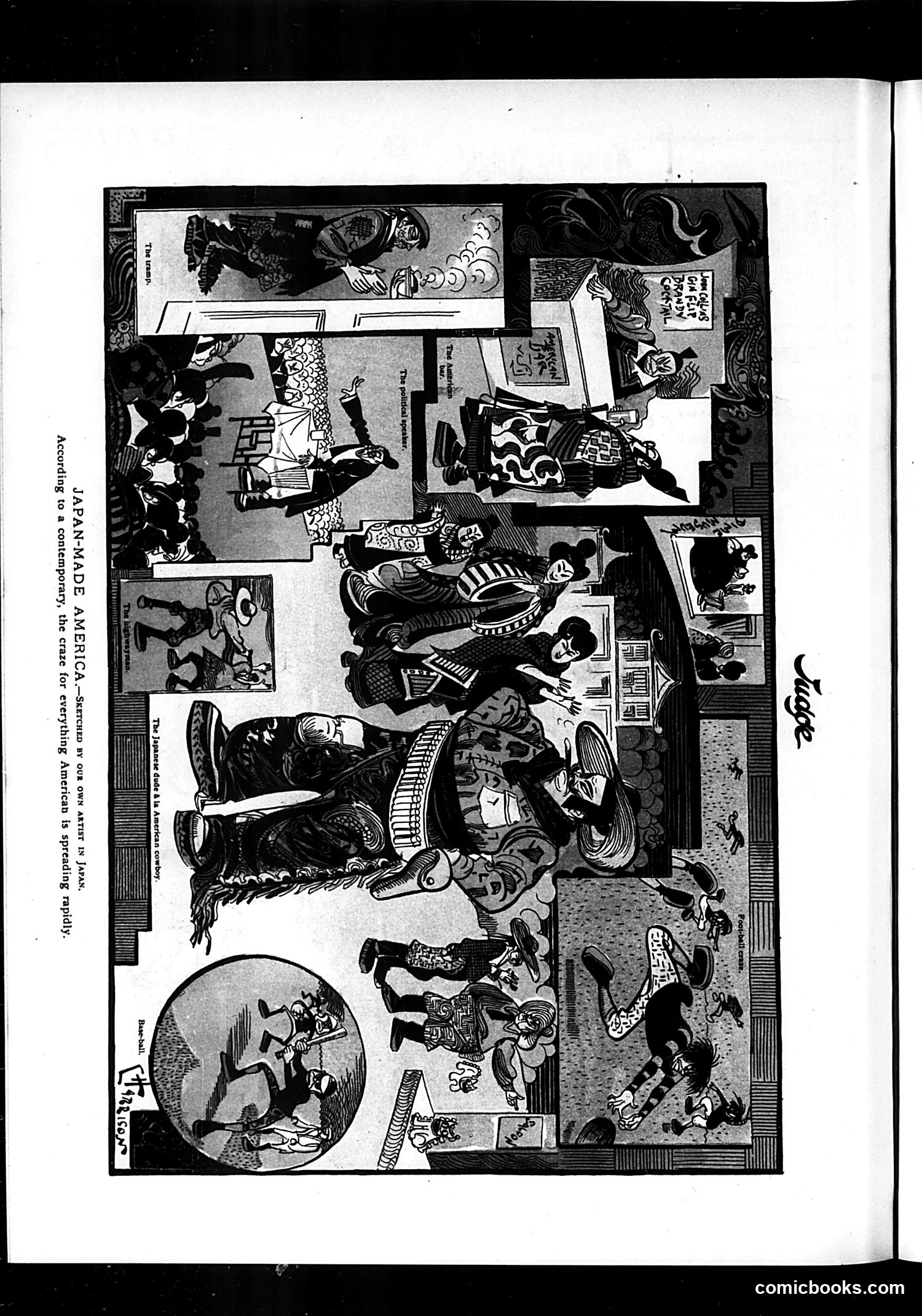
This satirical cartoon depicts the irony of American cultural imperialism backfiring. The caption indicates it's "sketched by our own artist in Japan," suggesting American influence has so thoroughly penetrated Japanese culture that Japan is now imitating American customs and fashions. The multiple vignettes show Japanese people adopting American styles—clothing, hairstyles, and behaviors—while remaining distinctly Japanese in appearance. The satire works on two levels: it mocks both American pride in exporting culture and the Japanese eagerness to adopt foreign ways wholesale. The circular inset at bottom-left appears to emphasize a particular scene of this cultural mimicry. The overall message critiques globalization's homogenizing effects, suggesting that American cultural exports create superficial imitations rather than genuine cultural exchange.