
A complete issue · 16 pages · 1894
Judge — May 12, 1894
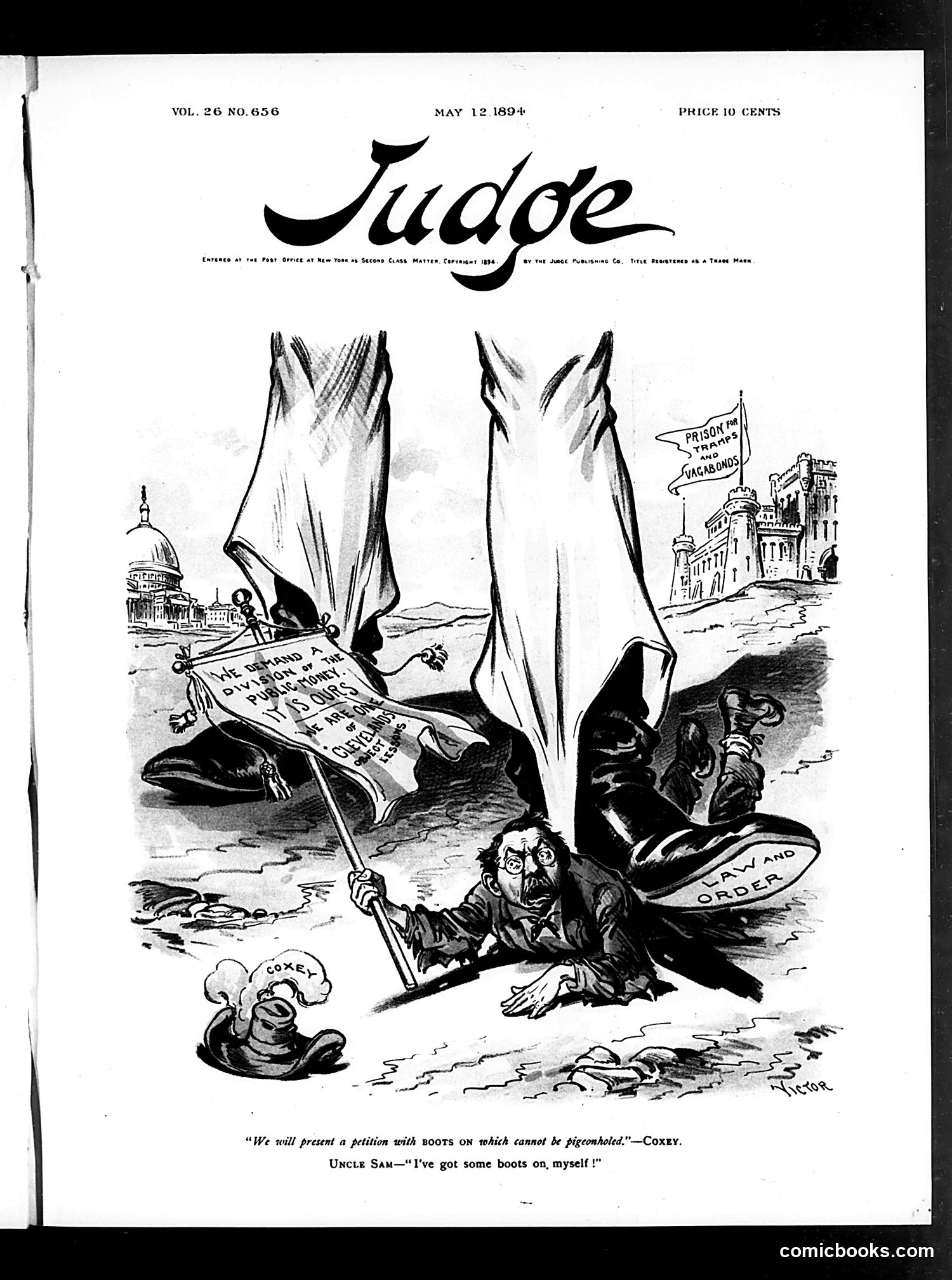
This cartoon satirizes the Pullman Strike crisis of 1894. Uncle Sam (center-right, labeled "Law and Order") attempts to maintain control as chaos erupts around him. A figure labeled "Coxey" (left, in water) represents Jacob Coxey, who led an unemployed workers' march on Washington that spring. The large boot figures likely represent either federal troops or the strikers themselves. The caption quotes Coxey stating he'll present a petition "with boots on which cannot be pigeonholed," while Uncle Sam responds "I've got some boots on, myself!"—suggesting the government will use military force to suppress the movement. The Capitol and "Prison & Barracks" building in the background emphasize the tension between civil unrest and governmental authority during this period of severe economic depression.
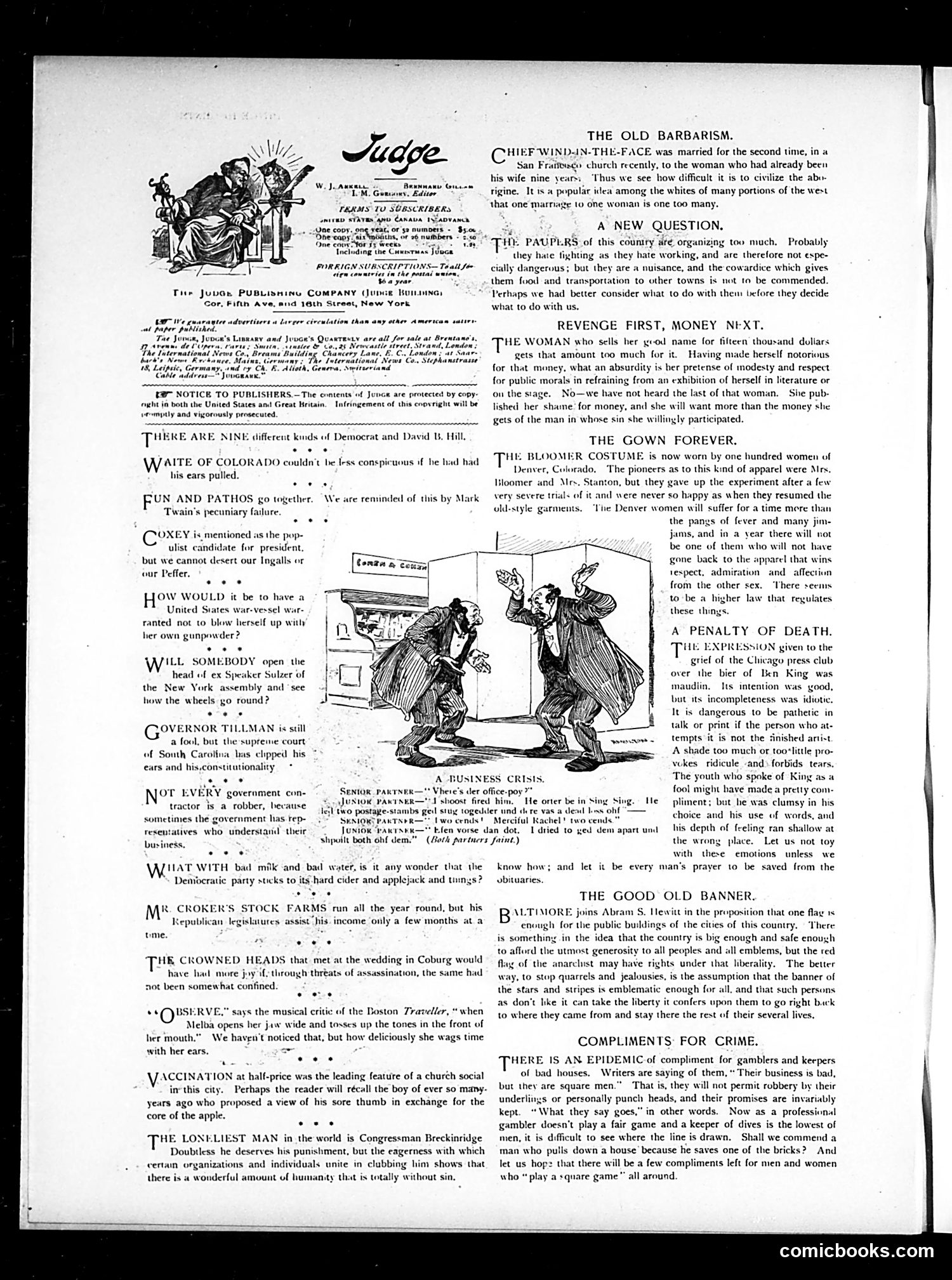
The main cartoon titled "A BUSINESS CRISIS" depicts two men in what appears to be an office, engaged in animated conversation. One says "There's der office-boy?" and the other responds "I sloosh fired him" and "He enter be in Sing Sing." This seems to satirize workplace conflicts, possibly referencing labor disputes or employee misconduct common to the Gilded Age. The surrounding text contains brief satirical observations on various topics: political figures (Congressman Breckinridge, Governor Tillman), social issues (women's suffrage, the Populist party), and cultural criticism (theater reviews). The satire targets hypocrisy and absurdity in American politics and society of the period, though specific historical references are unclear without additional context.
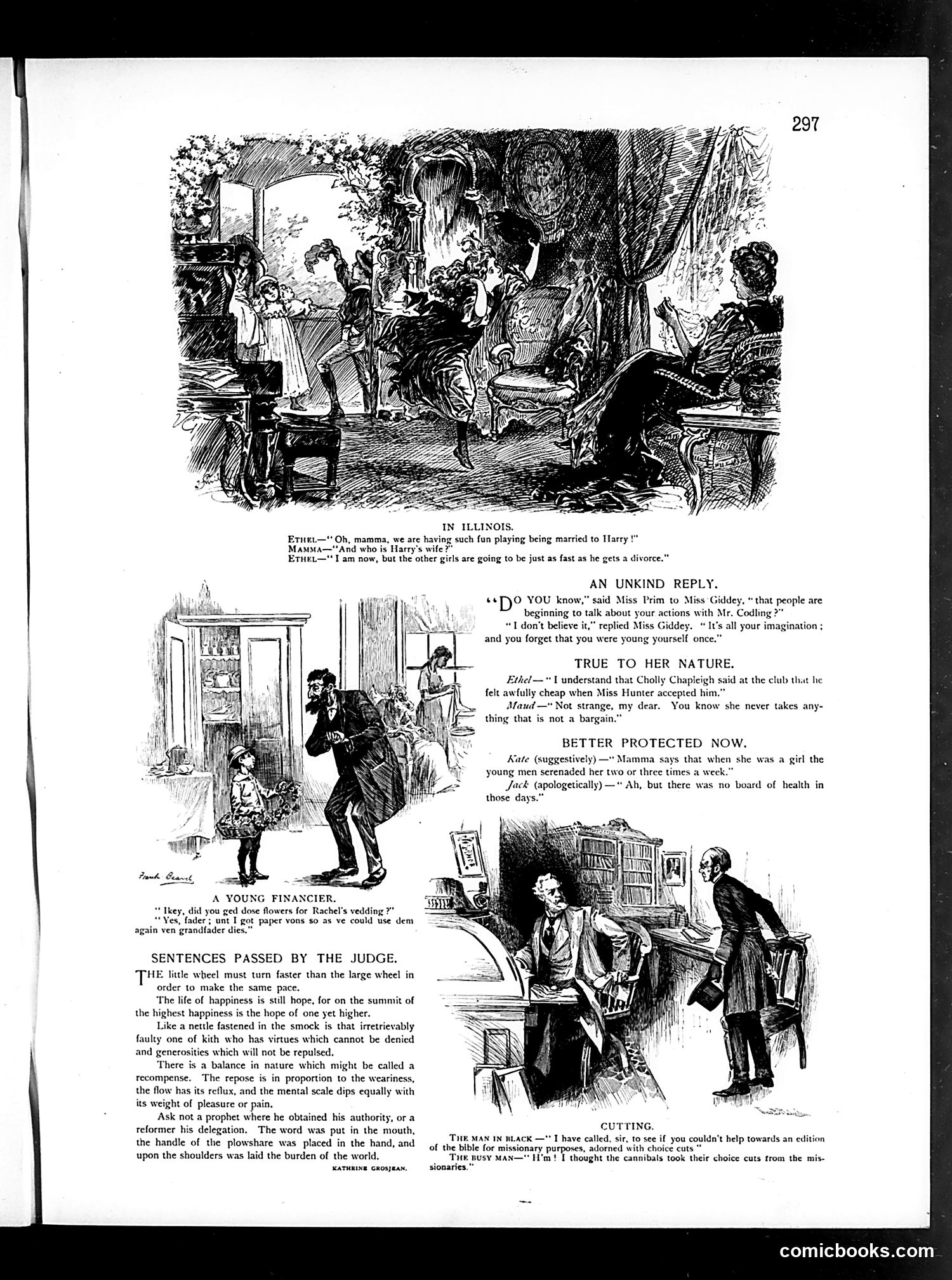
This page contains multiple satirical vignettes on Victorian-era social issues: **"In Illinois"** mocks a woman planning to marry "Harry" while pursuing divorce, with the punchline that other women will similarly rush to divorce once she does—satirizing perceived opportunism in divorce proceedings. **"An Unkind Reply"** and related sections mock young women's gossip and social pretensions, particularly about marriage and propriety. **"A Young Financier"** appears to joke about a father's concern over his daughter's wedding expenses and family financial legacy. **"The Man in Black"** and **"Cutting"** sections contain dialogue about social etiquette and proper behavior among the upper classes. The engravings depict parlor scenes and street encounters typical of Judge's humor targeting Victorian social conventions, particularly women's roles in marriage, divorce, and social status. The satire reflects anxieties about changing gender relations and class mobility in late 19th-century America.
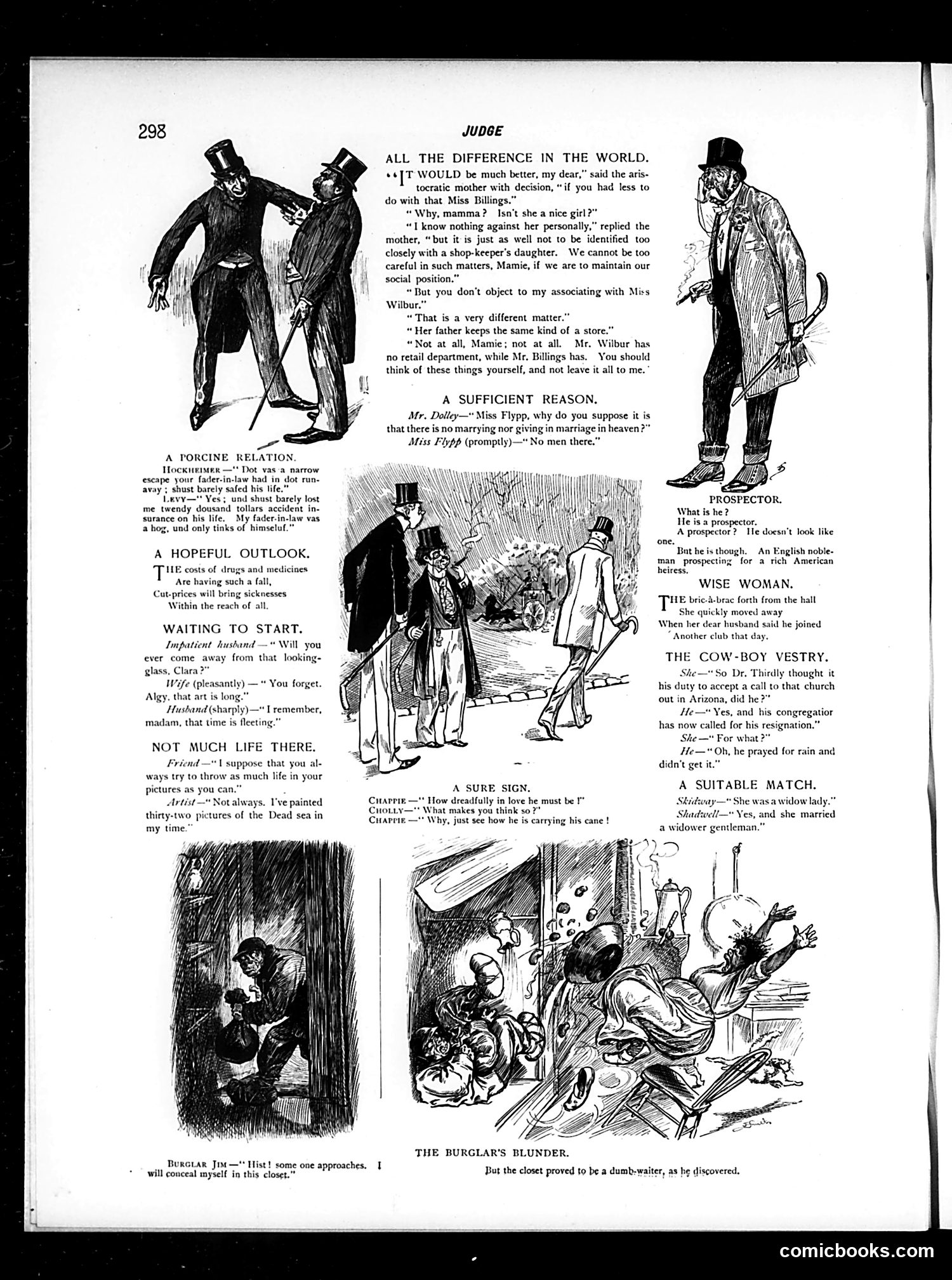
This page contains multiple short satirical comics and jokes typical of early 20th-century American humor: **"All the Difference in the World"** mocks class snobbery: an aristocratic mother forbids her daughter from associating with a shopkeeper's daughter (Miss Billings) to maintain "social position," yet permits friendship with Miss Wilbur—whose father owns the *same kind of store*. The joke exposes arbitrary social prejudice based on superficial distinctions. **"A Porcine Relation"** presents ethnic humor featuring German-accented characters discussing a father-in-law's accident, with dark comedy about lost insurance money. **Other brief jokes** satirize vanity ("Waiting to Start"), pretentiousness (the artist painting 32 Dead Sea pictures), romantic clichés (carrying one's cane as a love sign), and social climbing (an English nobleman prospecting for rich American heiresses). The page is predominantly humor rather than political commentary, reflecting Judge's general satirical approach to everyday American life and manners.
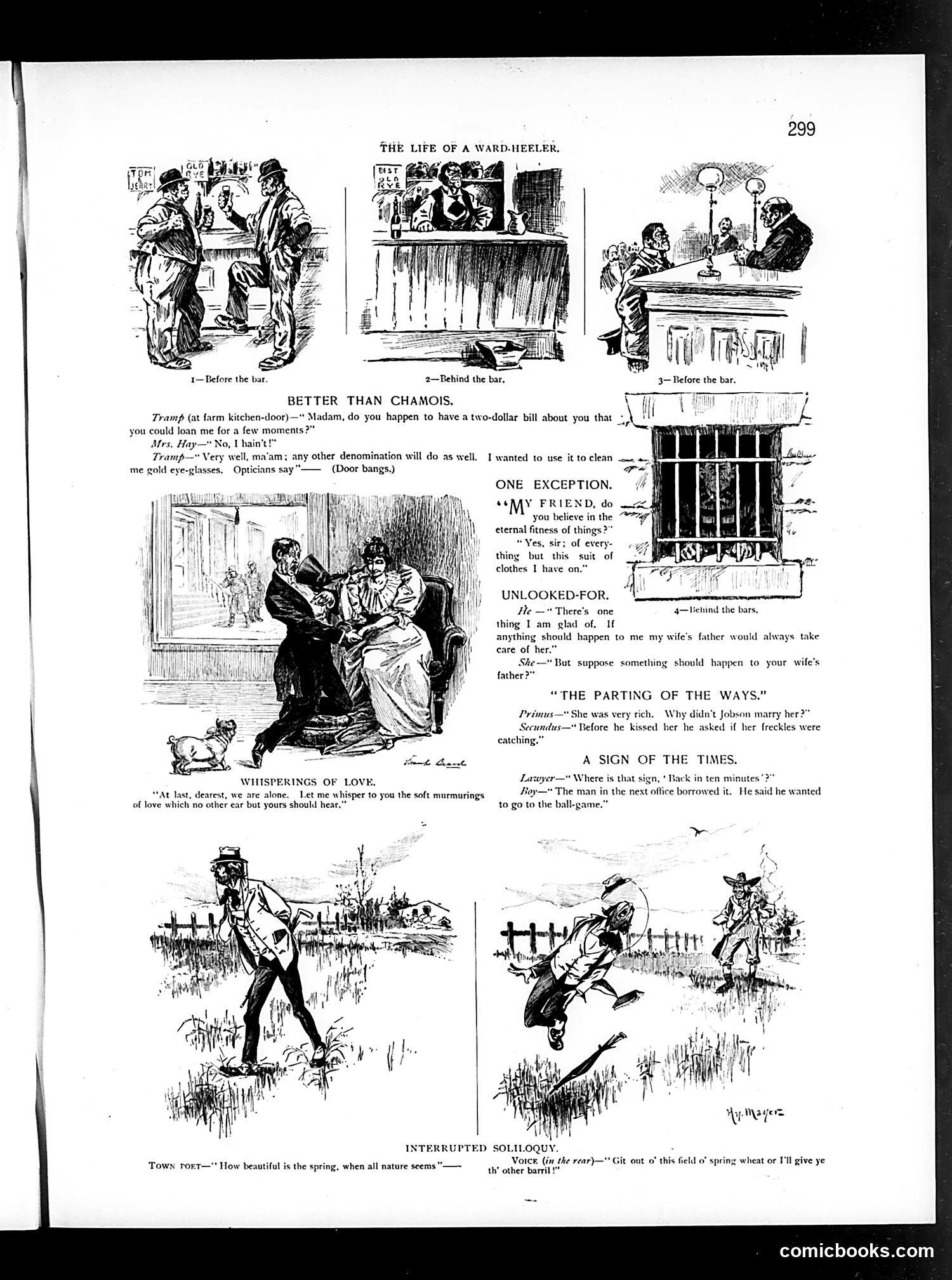
This page contains multiple unrelated satirical sketches typical of Judge's humor: **"Life of a Ward-Heeler"** (top): A three-panel sequence showing a political operative's progression—before a bar (as customer), behind a bar (as bartender), and before the bar (as defendant). This mocks the corrupt urban "ward-heeler," a political intermediary who traded favors for votes, often through saloons. **Other sketches** mock Victorian-era social pretensions and relationships: a tramp claiming to use currency as eyeglass cleaner; a man grateful his wife's father will support her if he dies; a suitor rejecting a wealthy woman over freckles; office workers borrowing signs to skip work. **"Interrupted Soliloquy"** (bottom): A farmer's romantic monologue about spring is cut short by someone yelling about wheat in a barrel—deflating sentimentality with rural practicality. The humor relies on class contrasts, hypocrisy, and unexpected punchlines rather than specific political events. It reflects late 19th/early 20th-century American urban and rural life.
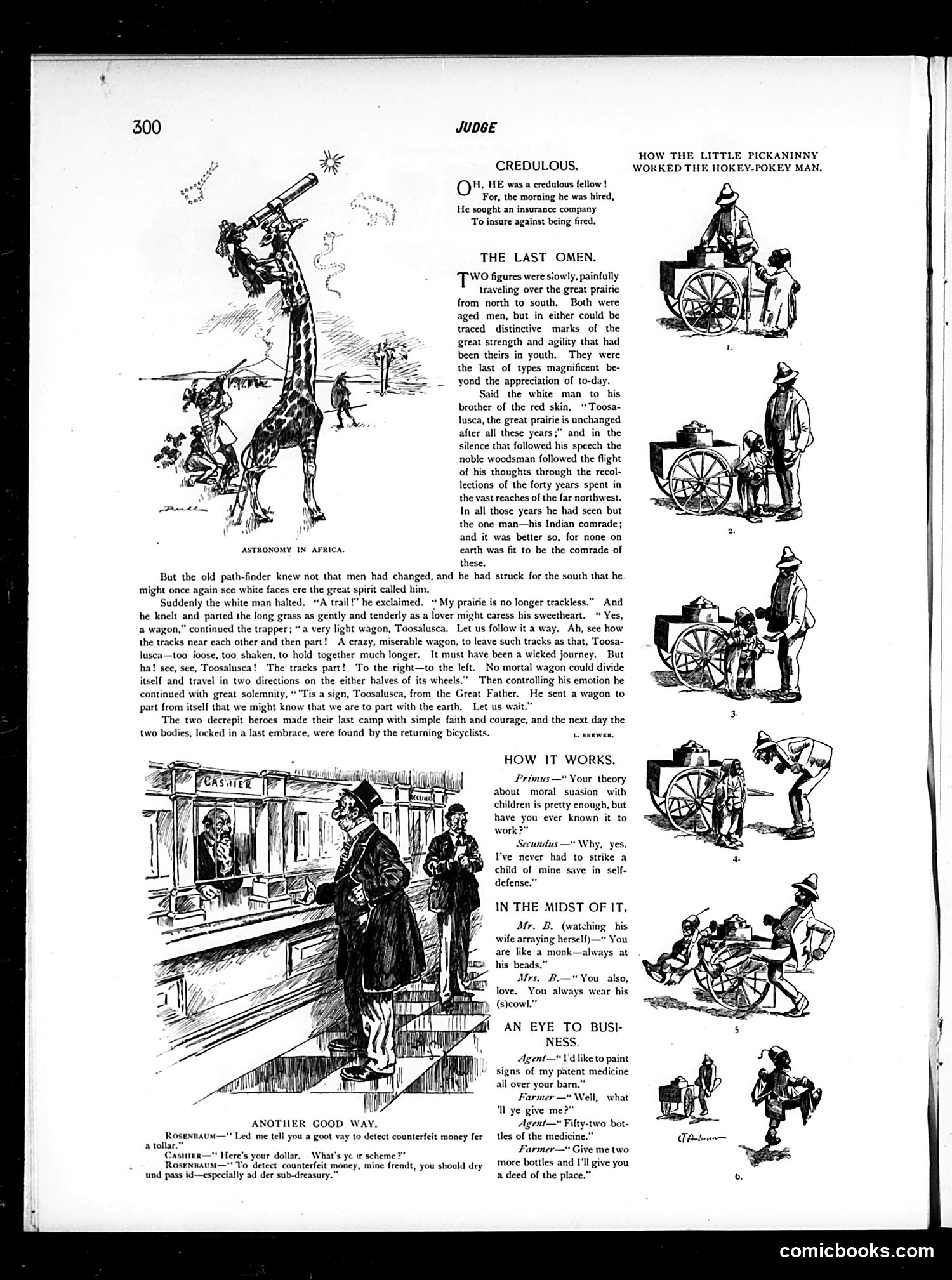
This page contains several satirical pieces typical of late 19th/early 20th-century American humor: **"The Last Omen"** is a melodramatic parody mocking sentimental frontier literature. Two aged men—a white trapper and his Indian companion—interpret wagon tracks as a divine sign they must die. The satire's punchline: they're discovered dead by *bicyclists*, not noble natural forces. This ridicules both romanticized "vanishing frontier" narratives and the intrusion of modern technology into wilderness mythology. **"Credulou"** mocks a newly-hired insurance agent who immediately insures against being fired—suggesting gullibility. **"Astronomy in Africa"** (an illustration) appears to reference colonial-era exoticism, likely satirizing European assumptions about African peoples. The remaining pieces are brief comedic dialogues about counterfeiting, marital life, and patent medicine sales—common Judge fare satirizing commercial fraud and domestic relations. The page uses racist language ("pickaninny") reflecting the era's accepted editorial standards, now offensive.
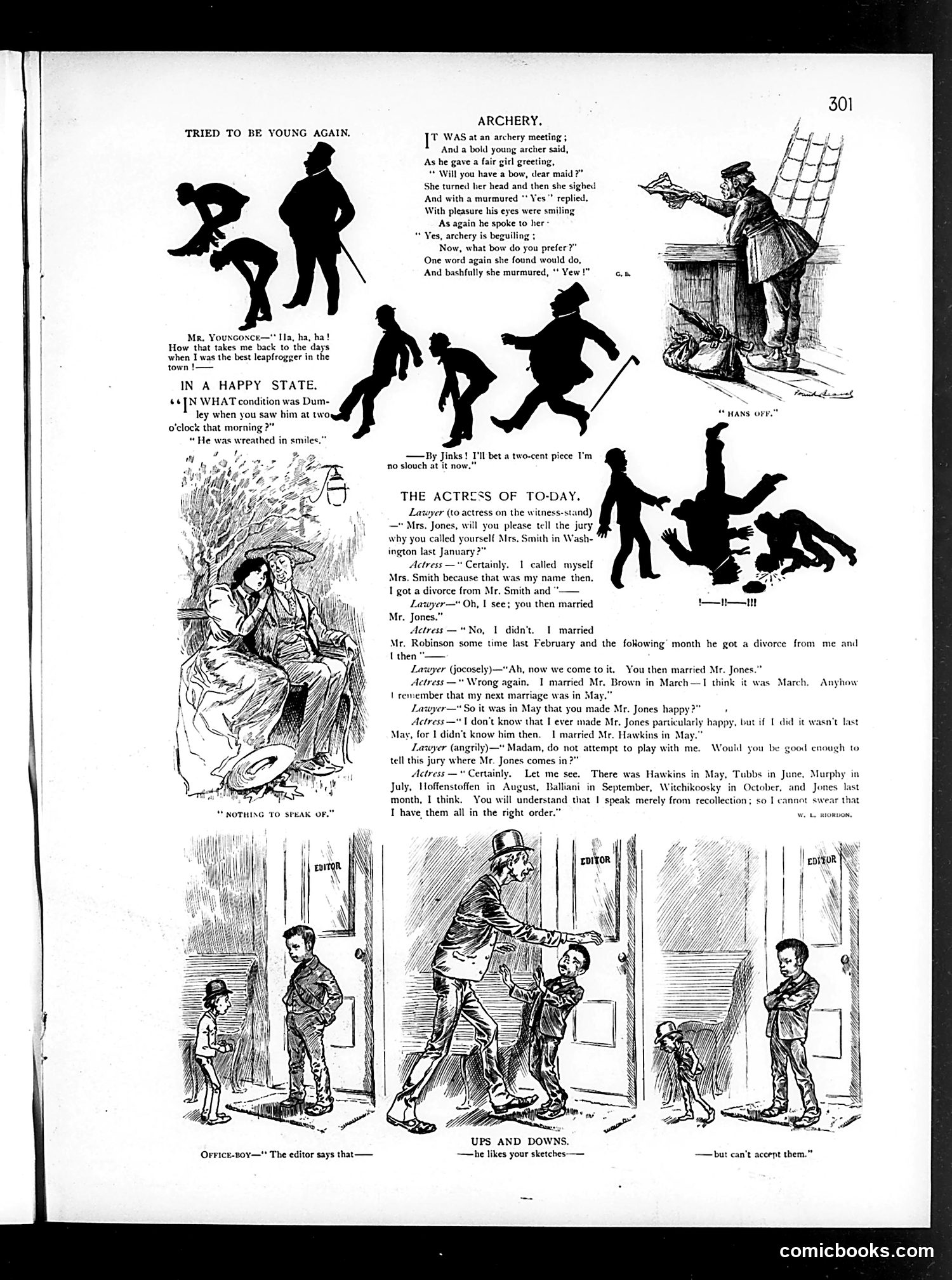
This page contains several unrelated satirical items: **"Tried to Be Young Again"** shows silhouettes of a man attempting acrobatic feats, mocking middle-aged vanity. **"Archery"** depicts a shipboard flirtation where a young man asks a woman for archery lessons as a pretext for courtship—satirizing transparent romantic pretexts. **"In a Happy State"** jokes about a man's cheerfulness at 2 a.m., likely implying drunkenness. **"The Actress of To-Day"** features a lawyer interrogating an actress about her multiple marriages and name changes—satirizing both theatrical women and the era's divorce rates among entertainers. The actress lists numerous husbands (Jones, Robinson, Brown, Hawkins, etc.) with apparent indifference to the chaos. **"Ups and Downs"** mocks an editor's inconsistent feedback to a young office-boy about submitted sketches.
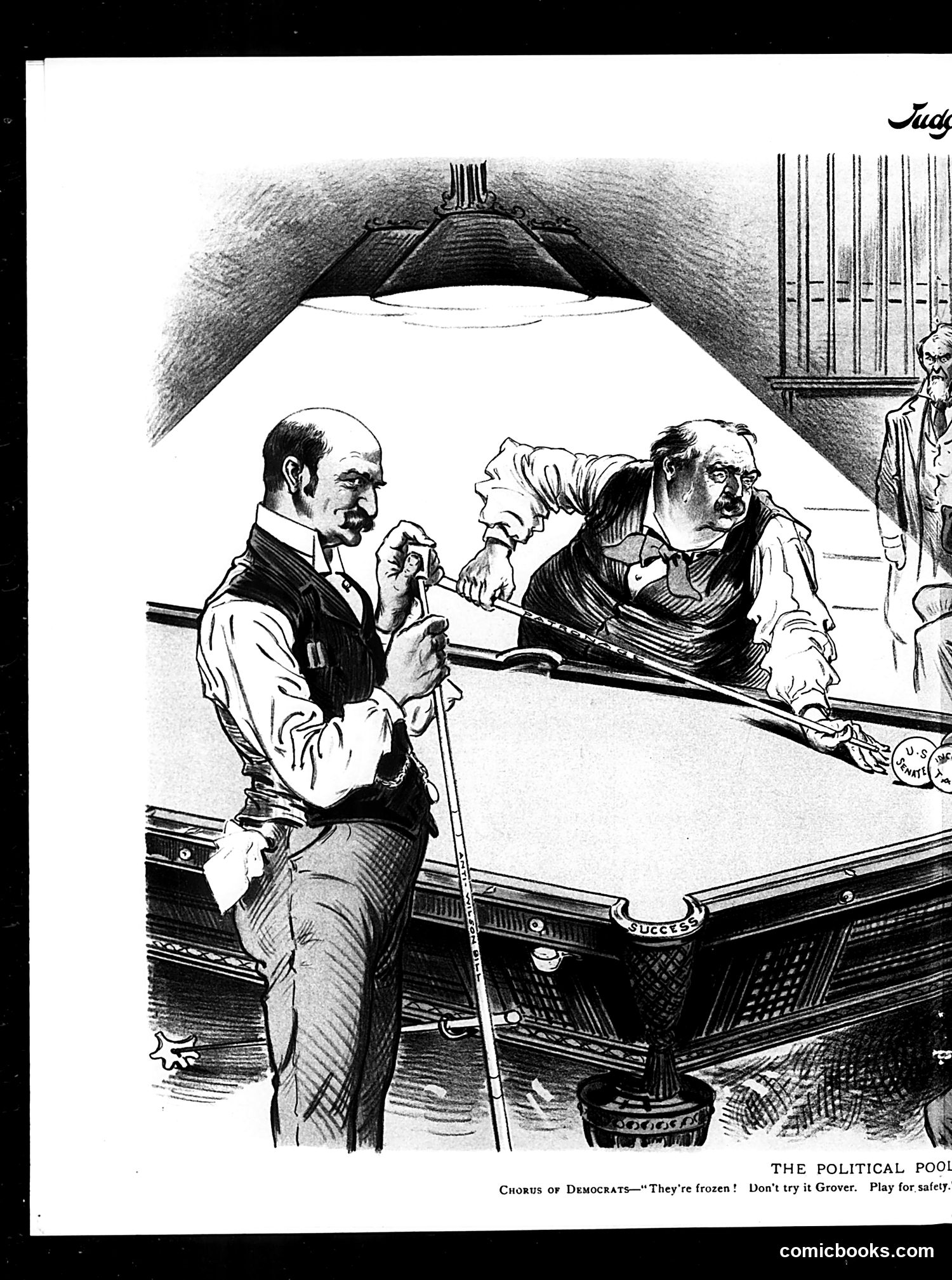
This is a political cartoon titled "The Political Pool" showing a billiards/pool game scene. A man identified as "Grover" (likely President Grover Cleveland) stands ready to take a shot, while other figures labeled as "Democrats" warn him from behind, saying "They're frozen! Don't try it Grover. Play for safety." The cartoon uses the pool game as metaphor for Democratic Party political strategy. The "frozen" balls suggest risky political positions the party wishes to avoid. The Democrats are cautioning their leader against taking aggressive action, instead urging a cautious, defensive approach. Without the publication date visible, the specific political crisis referenced remains unclear, but the cartoon satirizes Democratic hesitation and internal pressure to play it safe rather than risk bold moves.
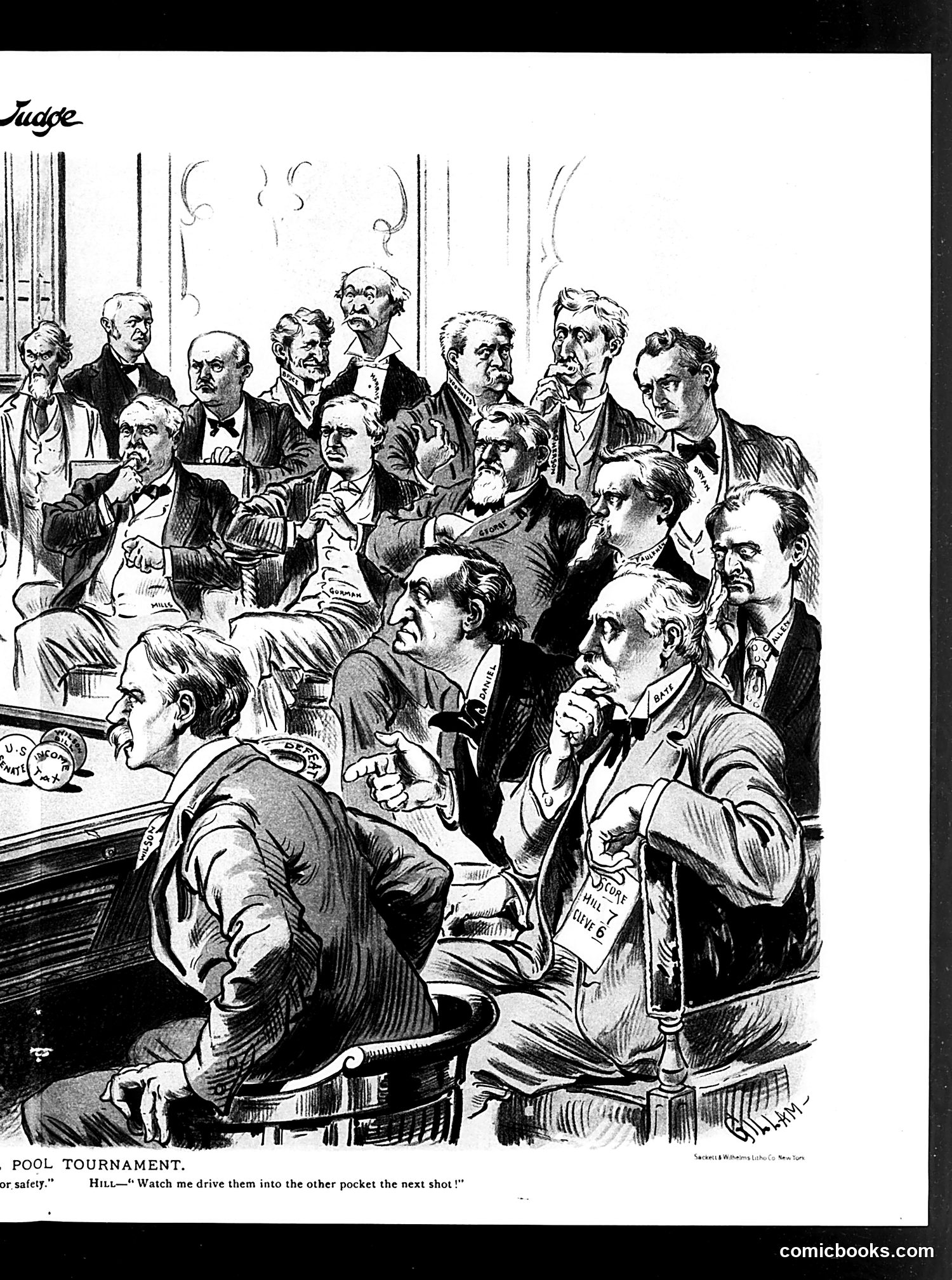
This Judge magazine cartoon satirizes American political figures as players in a pool game. The title "Pool Tournament" uses billiards as a metaphor for political maneuvering and competition. A figure identified as "Hill" (visible in the caption) boasts he'll "drive them into the other pocket the next shot"—suggesting he'll decisively outmaneuver opponents. The crowded scene shows multiple gentlemen observing intently, their expressions ranging from contemplative to concerned, depicting the high stakes of political gamesmanship. The cartoon likely comments on backroom dealing, strategy, and competition among prominent politicians of Judge's era (likely Gilded Age or Progressive period). Without clearer identification of all figures, the specific political context remains unclear, but the satire targets political ambition and tactical maneuvering presented as a calculated "game."
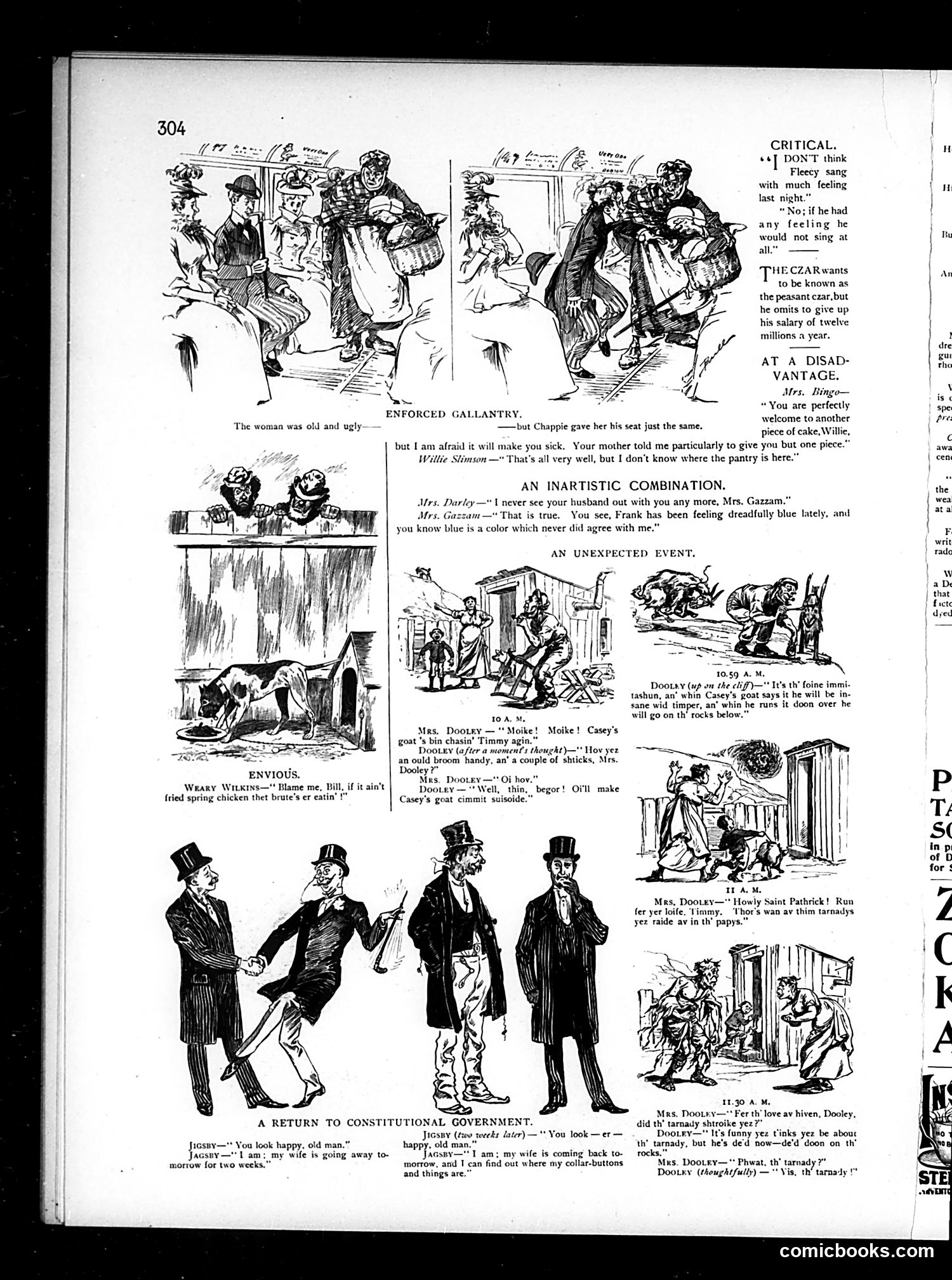
This page from the satirical magazine *Judge* contains several unrelated comic sketches mocking domestic life and Irish immigrant characters (common stereotypes of the era). **Key sketches:** - **"Enforced Gallantry"**: Satirizes forced politeness in courtship—a man gives his seat to a woman despite her being "old and ugly," showing hollow social conventions. - **"An Inartistic Combination"**: Jokes about a wife complaining her husband's depression (being "blue") clashes with her color preferences—absurd domestic logic. - **"An Unexpected Event" / "A Return to Constitutional Government"**: Extended Irish-dialect comedy about the Dooley/Dootsy families. A man's goat chases a child; the family plots to make it commit suicide by driving it off a cliff. The final panel jokes that a husband is "happy" when his wife leaves—celebrating temporary freedom from marriage. These sketches reflect period humor: domestic complaint humor, ethnic stereotype comedy, and cynical views of marriage. The "constitutional government" title ironically compares marital peace to political systems.
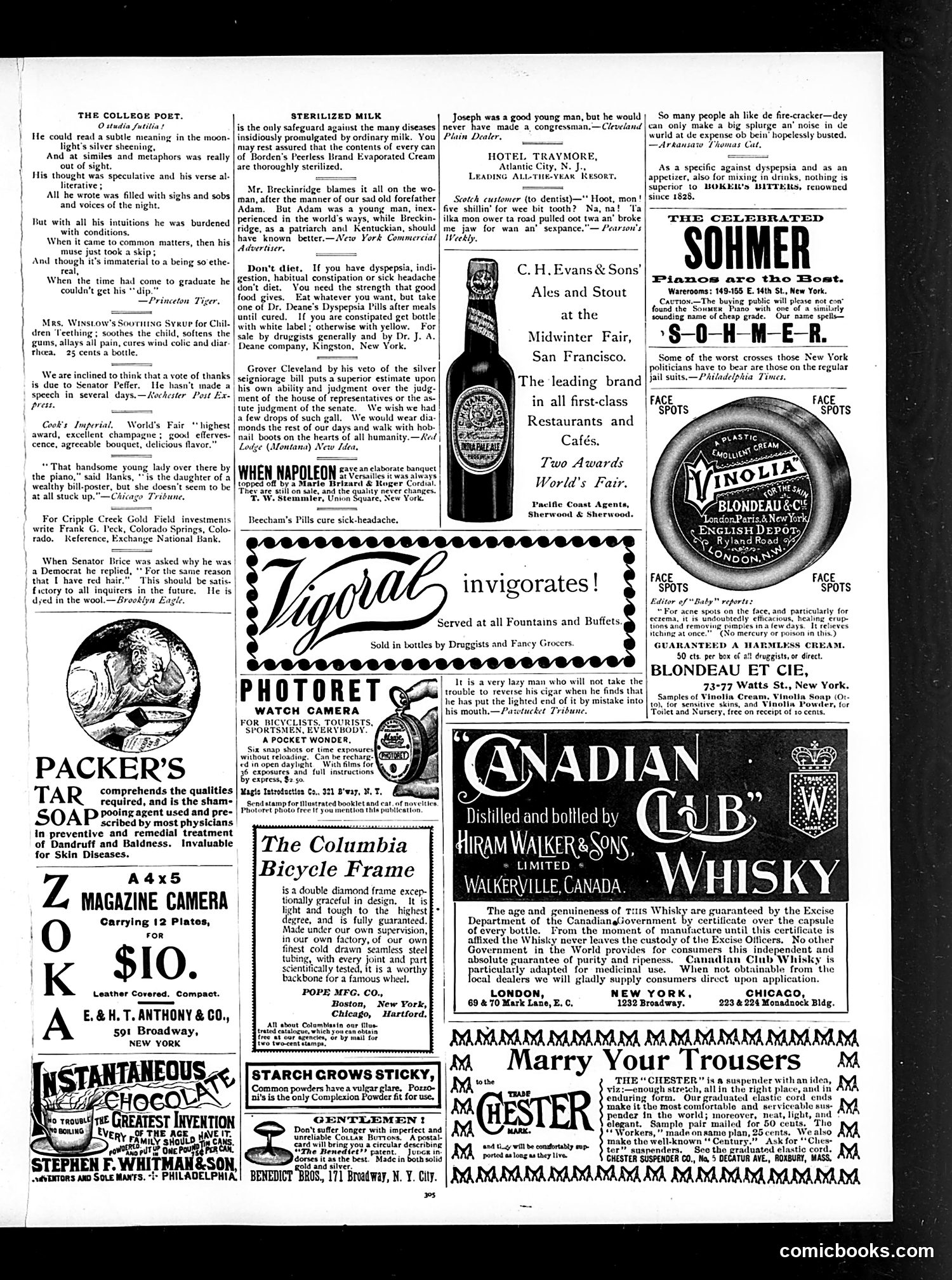
This page contains several short satirical pieces typical of Judge's editorial content: **"The College Poet"** mocks impractical academia—a student gifted at flowery verse and philosophical speculation but unable to handle "common matters," ultimately failing to graduate. It satirizes the disconnect between intellectual pretension and practical competence. **The Breckinridge reference** alludes to a contemporary scandal (likely congressman John C. Breckinridge's marital troubles), with the text sarcastically blaming "the woman" while suggesting his age and experience should have prevented such folly. **The Cleveland jab** criticizes President Cleveland's veto of the silver seigniorage bill as arrogant overreach, suggesting his confidence exceeds his judgment. **"Arkansaw Thomas Cat"** offers folk-philosophy mockery of politicians who make noise and spend recklessly. The page is primarily **advertising**, with products like Packer's Tar Soap, camera equipment, and beverages dominating space. The satirical content is brief, topical commentary aimed at educated readers following current political events and scandals.
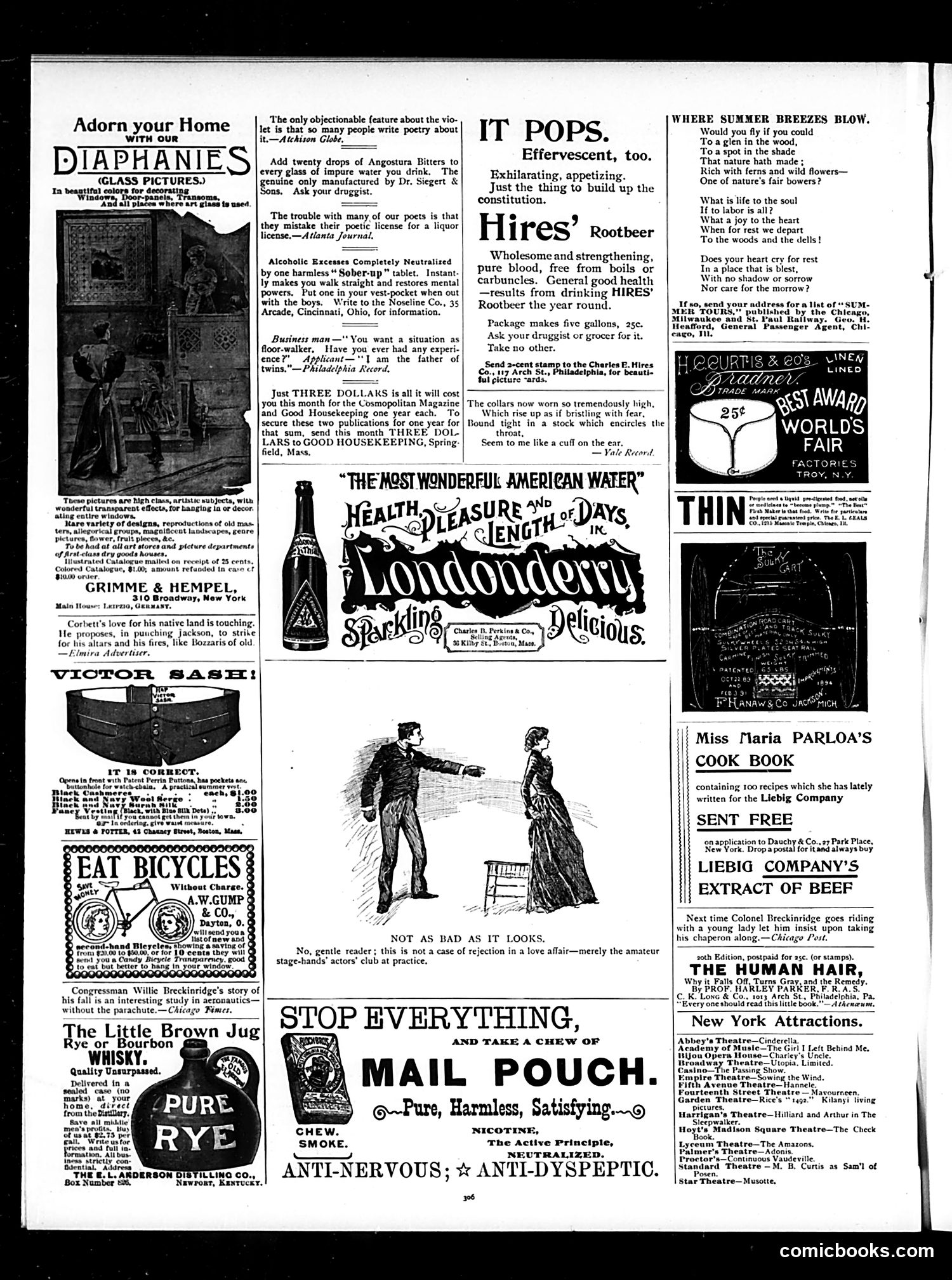
This page is primarily **advertising**, with minimal satirical content. The ads promote products typical of the 1890s-1900s: glass decorative pictures, rootbeer, bicycles, whiskey, and cookbooks. The only notable cartoon appears mid-page: "NOT AS BAD AS IT LOOKS" shows a couple in an apparently romantic pose. The caption references stage-hands' acting practice, suggesting the "rejection" scene is theatrical rather than genuine—a mild joke about amateur dramatics. Scattered throughout are brief satirical quips: one mocks poets who mistake poetic license for drinking licenses; another jokes about a job applicant citing fatherhood of twins as floor-walker experience; a third comments on absurdly high collars fashionable at the time. The page reflects **Judge's** blend of light social commentary with commercial content. Nothing here addresses major political events or figures—it's primarily lifestyle humor and period advertising aimed at middle-class readers.
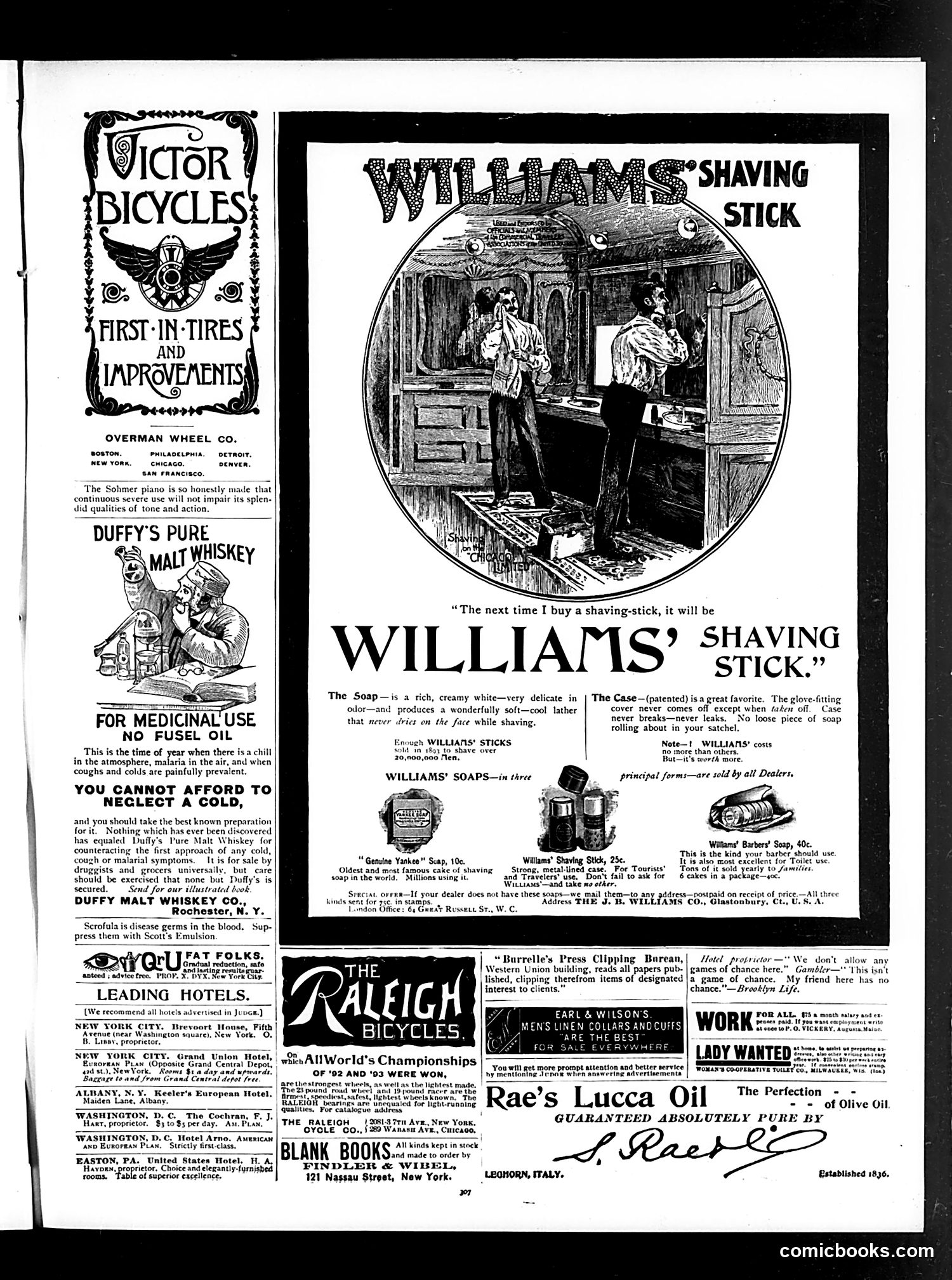
This page is primarily **advertising**, not political satire. It features vintage product advertisements from the late 19th/early 20th century, including: **Main Advertisement:** Williams' Shaving Stick dominates the right side, showing a barbershop scene. The ad emphasizes the product's superior soap quality, patented case design, and widespread use (20 million sticks sold by 1893). It's a straightforward commercial pitch with no satirical intent. **Other Ads Include:** - Victor Bicycles, Raleigh Bicycles, Duffy's Pure Malt Whiskey (marketed for medicinal use against colds—a common claim of the era) - Hotels, Earl & Wilson collars, Rae's Lucca Oil - A small joke about a gambler and hotel proprietor (bottom right)—the only humorous content **For Modern Readers:** The most striking element is Duffy's whiskey advertised as medicine "for colds and malaria," reflecting pre-FDA regulation when alcohol was genuinely marketed as therapeutic. This page demonstrates how advertisements funded Judge magazine and reveals period attitudes toward wellness products.
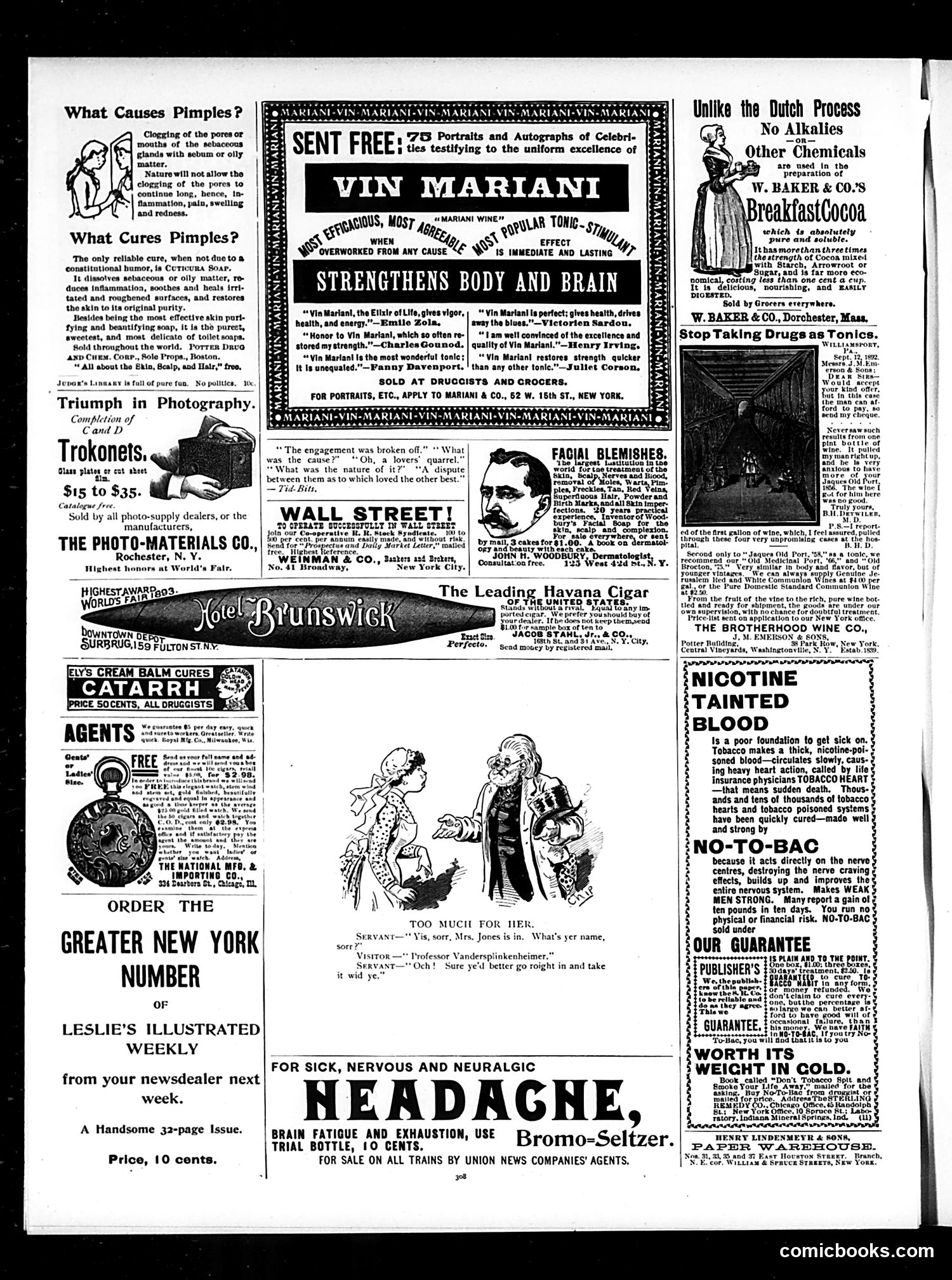
This is primarily an **advertising-heavy page** from a satirical magazine, not a political cartoon page. The only distinct cartoon is titled "TOO MUCH FOR HER," depicting a servant admitting a visitor named "Professor Vandersplinkenheimer" to a woman caller, apparently implying social awkwardness or class-consciousness about the unusual foreign name. The page is dominated by late-19th/early-20th-century **patent medicine and consumer product ads**—Vin Mariani (a coca wine tonic), Cuticura soap, Bromo-Seltzer, and NO-TO-BAC (a nicotine-addiction cure). These ads use exaggerated health claims and celebrity endorsements (Émile Zola, Charles Gounod) typical of the era before FDA regulation. The "NICOTINE TAINTED BLOOD" ad warns of smoking's dangers while promoting NO-TO-BAC as a cure. This reflects genuine public health concern about nicotine, though the "cure" was dubious by modern standards.
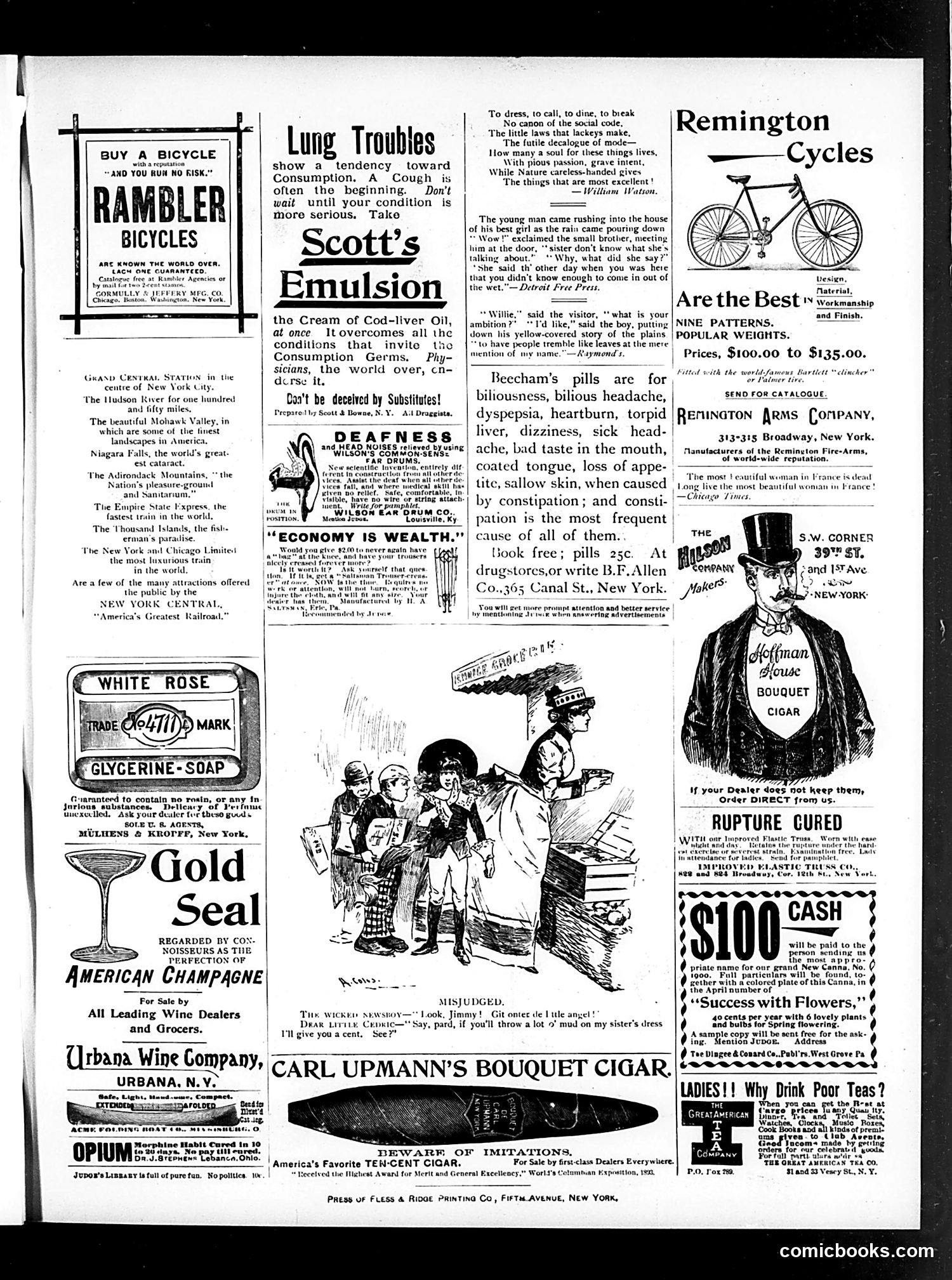
This is primarily an **advertising page** from Judge magazine, circa early 1900s. The central cartoon—titled "MISJUDGED"—is a brief social joke: a young man visits his girlfriend in the rain and gets soaked. Her younger brother reports that the girl had earlier criticized the suitor for lacking common sense, sarcastically quoting her: "you didn't know enough to come in out of the wet"—a period idiom meaning basic stupidity. The joke is that the soaked visitor has now literally proven her point. The surrounding advertisements are typical of the era: patent medicines (Scott's Emulsion for tuberculosis, Beecham's pills for constipation), consumer goods (Rambler bicycles, Remington cycles), luxury items (champagne, cigars), and dubious medical devices (rupture trusses). The page reflects early-20th-century commercial culture and widespread promotion of remedies for commonplace ailments.
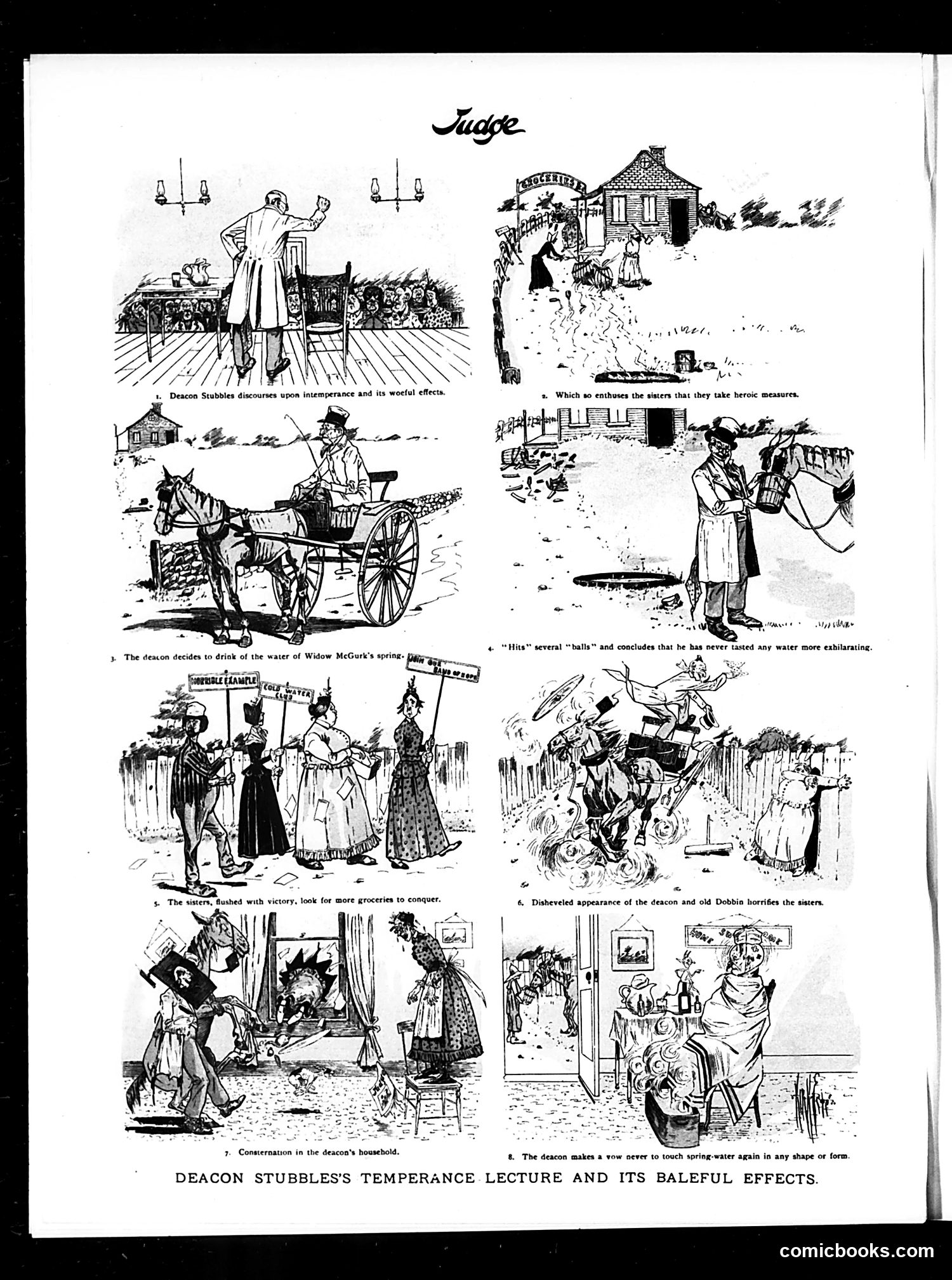
This is an eight-panel satirical narrative about a temperance advocate whose anti-alcohol lecture backfires. Deacon Stubbles delivers an impassioned temperance speech that ironically inspires the townspeople to behave wildly and recklessly—the opposite of his intended message. The comic satirizes temperance movements by showing how the deacon's own household descends into chaos, and concludes with him swearing off spring water (implying he'll turn to alcohol instead). The satire mocks both temperance crusaders' self-righteousness and suggests their messaging may be counterproductive, driving people toward vice rather than virtue. It's a common Judge magazine theme ridiculing reform movements as hypocritical or ineffective.