
Judge, 1894-05-12 · page 6 of 16
Judge — May 12, 1894 — page 6: what you’re looking at
What you’re looking at
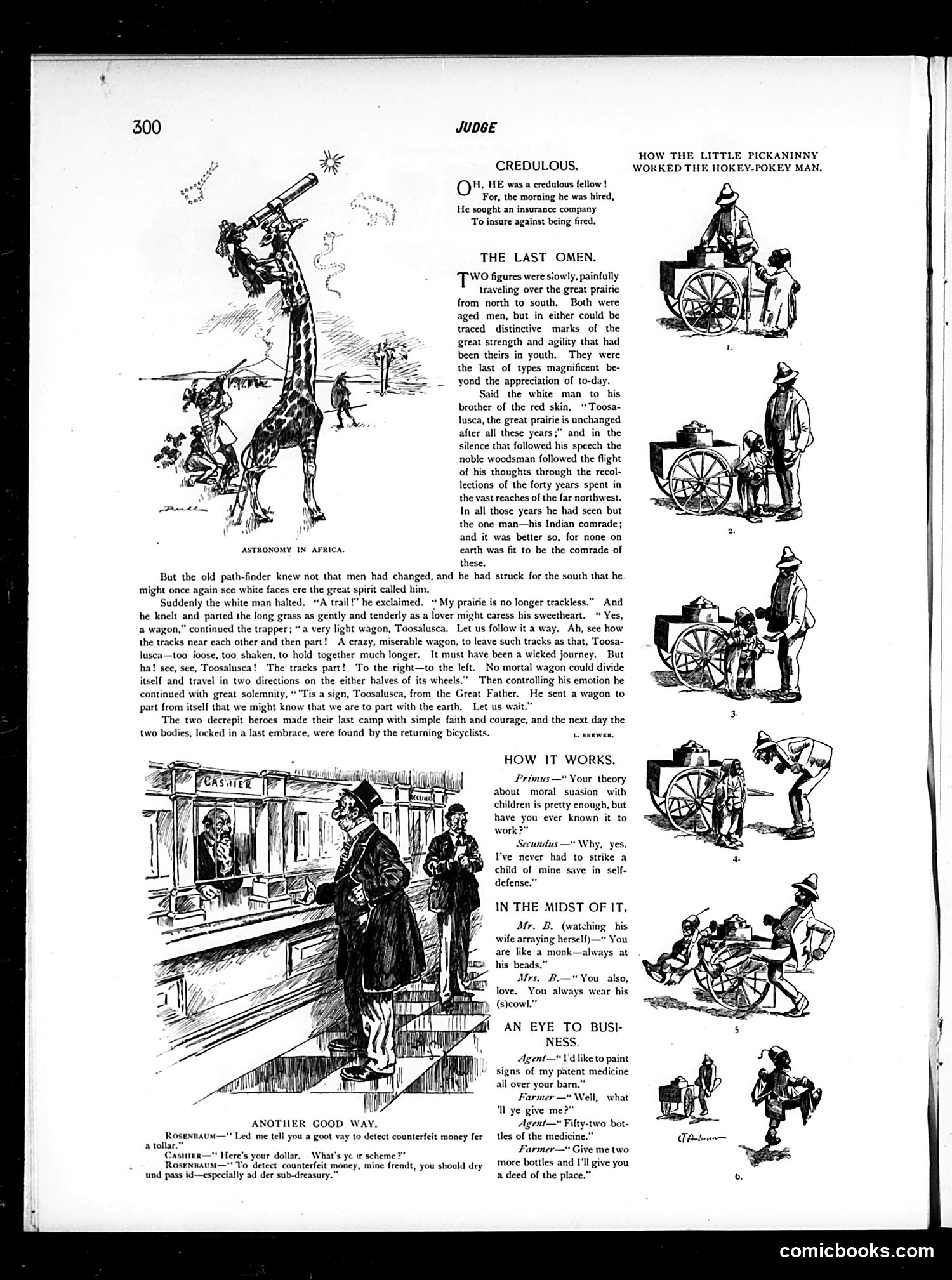
This page contains several satirical pieces typical of late 19th/early 20th-century American humor: **"The Last Omen"** is a melodramatic parody mocking sentimental frontier literature. Two aged men—a white trapper and his Indian companion—interpret wagon tracks as a divine sign they must die. The satire's punchline: they're discovered dead by *bicyclists*, not noble natural forces. This ridicules both romanticized "vanishing frontier" narratives and the intrusion of modern technology into wilderness mythology. **"Credulou"** mocks a newly-hired insurance agent who immediately insures against being fired—suggesting gullibility. **"Astronomy in Africa"** (an illustration) appears to reference colonial-era exoticism, likely satirizing European assumptions about African peoples. The remaining pieces are brief comedic dialogues about counterfeiting, marital life, and patent medicine sales—common Judge fare satirizing commercial fraud and domestic relations. The page uses racist language ("pickaninny") reflecting the era's accepted editorial standards, now offensive.
📄 Transcribed text from this page (OCR, searchable)
Machine-transcribed from the original scan — historical spelling and the odd misread are preserved.
JUDGE HOW THE LITTLE PICKANINNY CREDULOUS. WORKED THE HOKEY-POKEY MAN, H, HE was a credulous fellow ! For, the morning he was hired, He sought an insurance company To insure against being fired. THE LAST OMEN. WO figures were siowly, painfully traveling over the great prairie from north to south, Both were aged men, but in either could be traced distinctive marks of the great strength and agility that had been theirs in youth. They were the last of types magnificent be- yond the appreciation of to-day. Said the white man to his brother of the red skin, “Toosa- lusca, the great prairie is unchanged after all these years;" and in the silence that followed his speech the noble woodsman followed the flight of his thoughts through the recol- lections of the forty years spent in the vast reaches of the far northwest. In all those years he had seen but the one man—his Indian comrade; and it was better so, for none on ASTRONOMY IN AFRICA. earth was fit to be the comrade of these, But the old path-finder knew not that men had changed, and he had struck for the south that he might once again see white faces ere the great spirit called him. Suddenly the white man halted. “A trail!” he exclaimed.“ My prairie is no longer trackles: And he knelt and parted the long grass as gently and tenderly as a lover might caress his sweetheart.“ Yes, a wagon,” continued the trapper; “a very light wagon, Toosalusca. Let us follow it a way. Ah, see how the tracks near each other and then part! A crazy, miserable wagon, to leave such tracks as that, Toosa- lusca—too joose, too shaken, to hold together much longer. It must have been a wicked journey. But ha! see, see, Toosalusca! The tracks part! To the right—to the left. No mortal wagon could divide itself and travel in two directions on the either halves of its wheels.” Then controlling his emotion he continued with great solemnity, s a sign, Toosalusca, from the Great Father. He sent a wagon to part from itself that we might know that we are to part with the earth, Let us wait. The two decrepit heroes made their last camp with simple faith and courage, and the next day the two bodies, locked in a last embrace, were found by the returning bicyclists. HOW IT WORKS, Primus —*Your theory about moral suasion with children is pretty enough, but have you ever known it to work?” Secundus —" Why, yes. I've never had to strike a child of mine save in self- defense.” IN THE MIDST OF IT. Mr. B. (watching his wife arraying herself) —" You are like a monk—always at his beads.” Mrs. B.—"You also, love. You always wear his (s)cowl.” AN EYE TO BUSI- NESS. Agent —" Vd like to paint signs of my patent medicine all over your barn.” Farmer — Well, what ‘ye give me?" ANOTHER GOOD WAY. Agent—" Fifty-two bot- Rogesmaum—" Led me tell you a goot vay to detect counterfeit money fer tes of the medicine.” a tollar.” Casuter—" Here's your dollar, What's yc ir scheme?” Fepner—"Give me two Rosennaum—* To detect counterfeit money, mine frendt, you should dry More bottles and I'll give you und pass id—especially ad der sub-dreasury.” a deed of the place.” comicbooks.com