
A complete issue · 16 pages · 1894
Judge — April 21, 1894
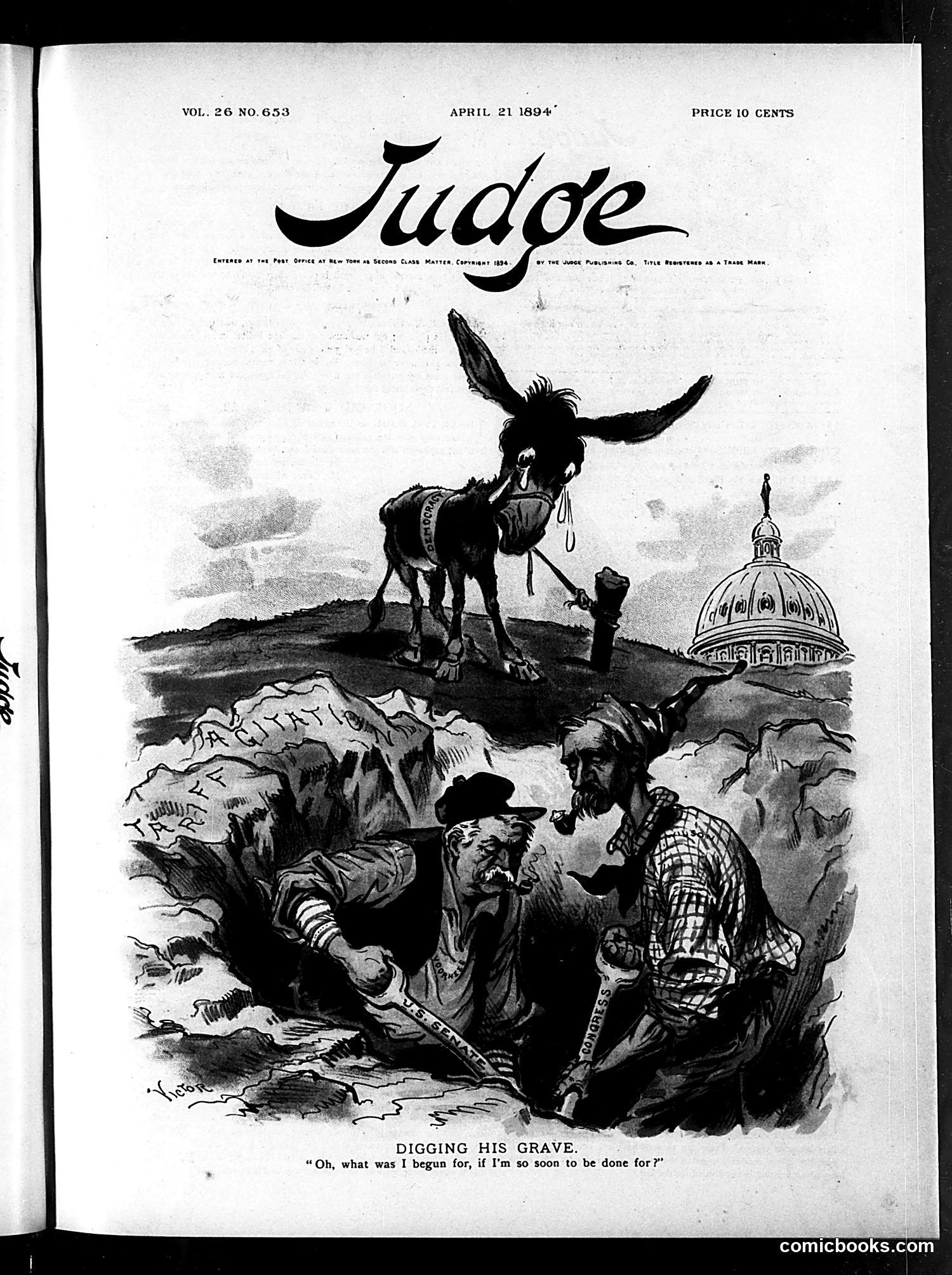
This political cartoon from Judge magazine (April 21, 1894) uses darkly comic symbolism to criticize a political figure. Two men dig a grave while a donkey (symbol of the Democratic Party) stands above, and the U.S. Capitol dome appears in the background—establishing this as commentary on national politics. The caption—"Oh, what was I begun for, if I'm so soon to be done for?"—suggests the subject has failed or is facing political ruin. The grave-digging appears literal-visual satire: the figure's own policies or actions are destroying him politically. Without clearer identifying caricature features visible, the specific target remains unclear, though the 1894 date and Democratic donkey suggest criticism of Cleveland's administration or a related Democratic political figure during that economically troubled period.
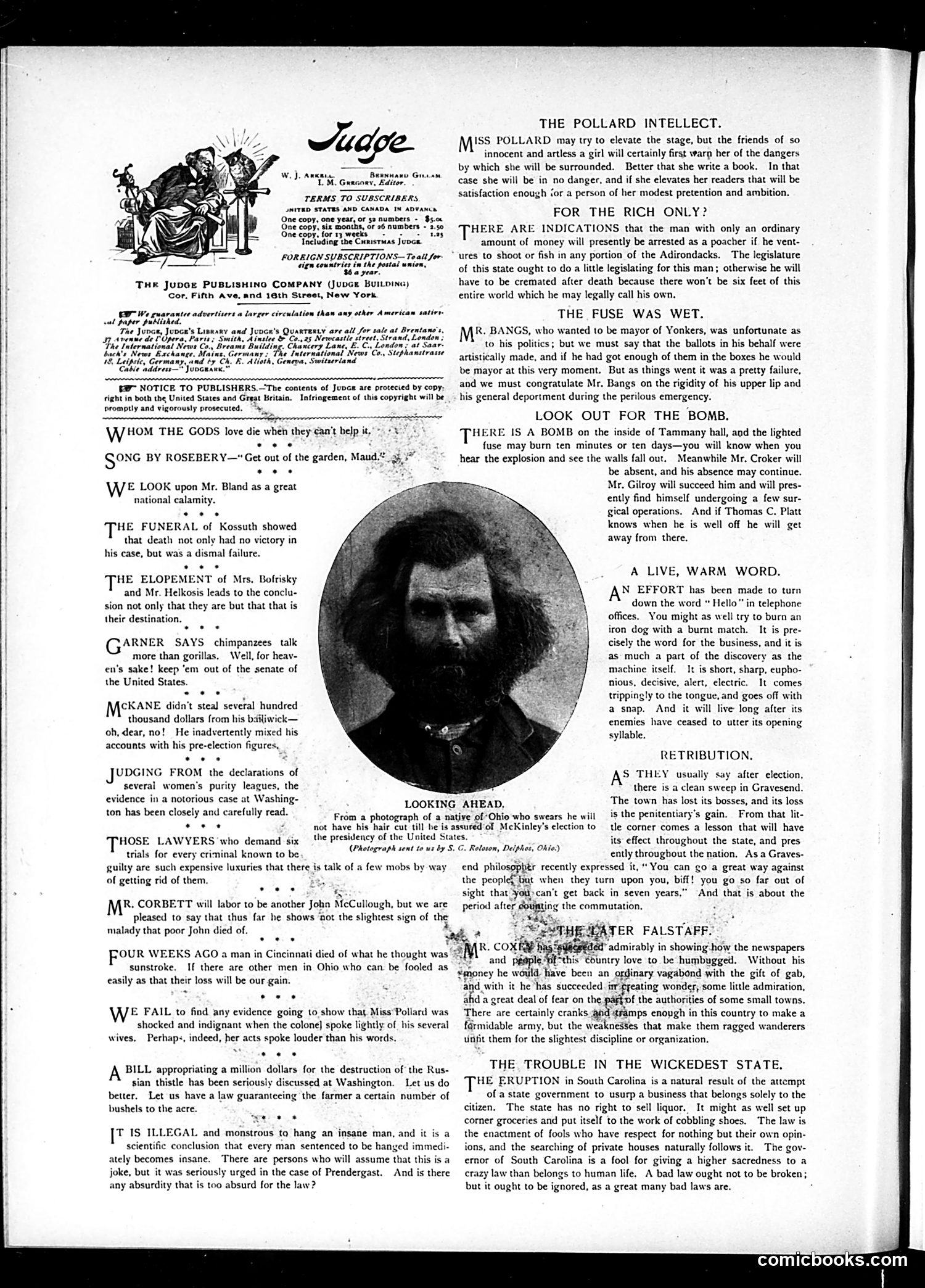
This page contains editorial commentary and satirical notes rather than political cartoons. The main image shows "Looking Ahead," a photograph of an Ohio Native American who purportedly swears he will have his hair cut if McKinley wins the election. The text sections critique contemporary political and social issues: - **"The Pollard Intellect"** mocks actress Miss Pollard's aspirations - **"For the Rich Only"** satirizes wealth inequality and Adirondack hunting regulations - **"The Fuse Was Wet"** jokes about failed municipal politics under Mayor Bangs - **"The Jater Falstaff"** criticizes Cox (unclear which Cox) as unreliable - **"The Trouble in the Wickedest State"** attacks South Carolina's attempt to monopolize liquor sales The overall tone is typical 1890s American satirical journalism—mocking politicians, social pretensions, and regional governance failures.
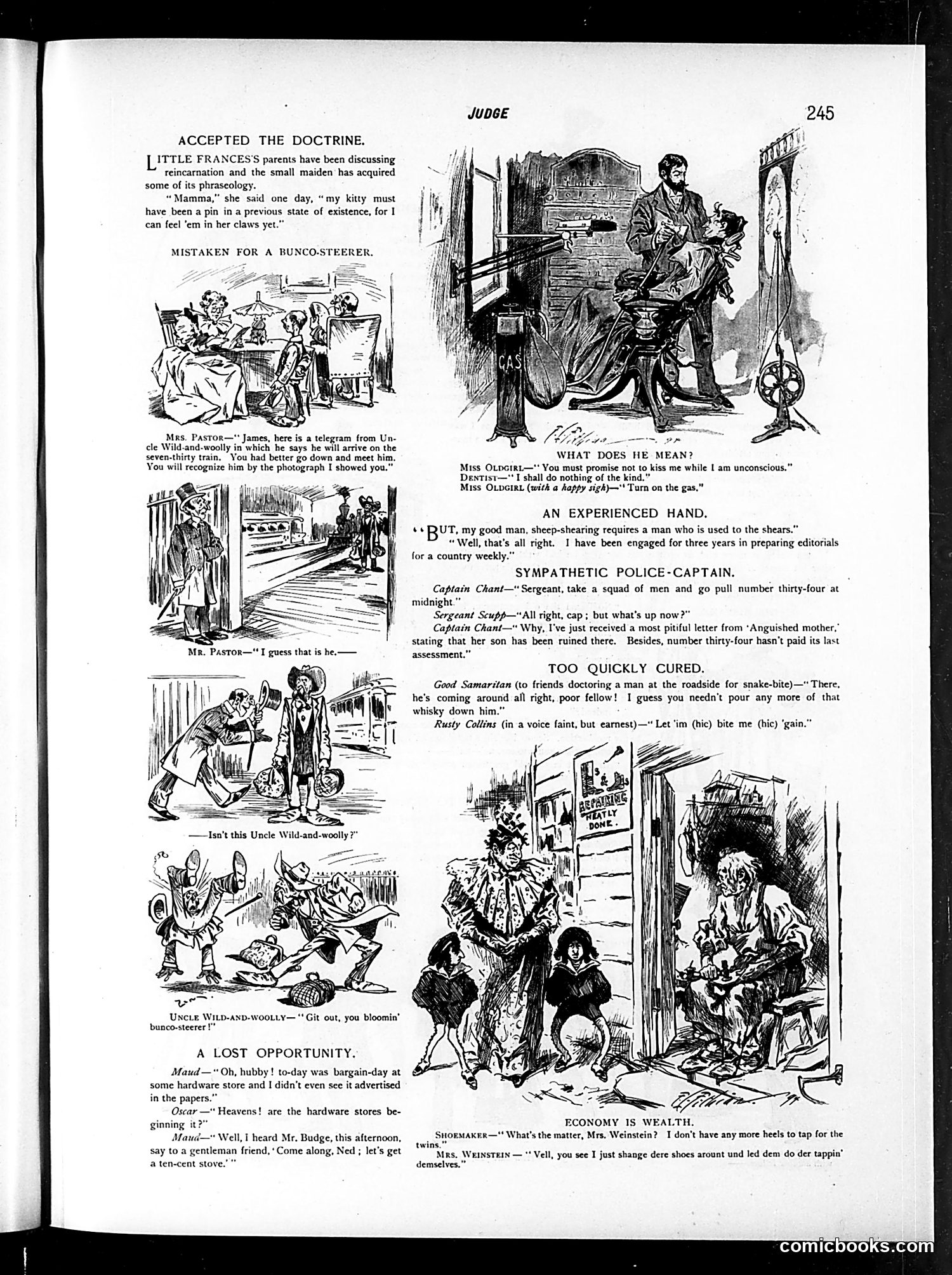
This page contains six unrelated humorous sketches satirizing everyday American life, rather than specific political figures or events. The cartoons mock ordinary social situations: a woman misidentifying a train passenger ("Mistaken for a Bunco-Steerer"), a dental visit where a patient fears being kissed while unconscious ("What Does He Mean?"), a barber's professional pride ("An Experienced Hand"), and police incompetence ("Sympathetic Police-Captain"). Additional sketches ridicule Uncle Wild's rowdy behavior and working-class economic struggles. The final vignette shows a shoemaker and customer negotiating over heel repairs—satirizing how the poor economize by repairing worn shoes rather than buying new ones. These are generic social satires rather than commentary on specific contemporary events or political figures.
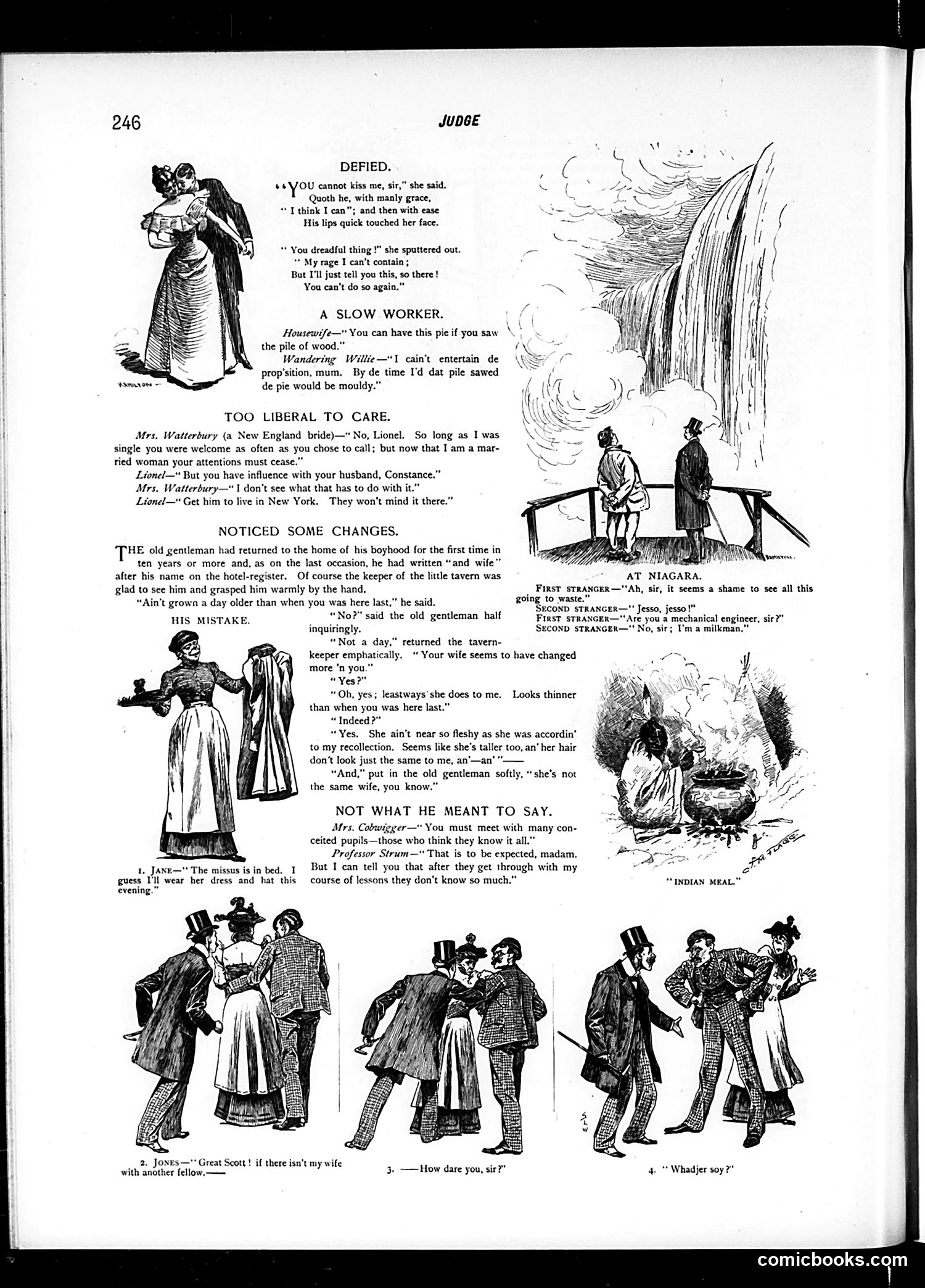
This page contains six unrelated comic sketches typical of Judge's late 19th-century humor: **"Defied"** mocks a woman's hollow protest—she claims outrage at being kissed without permission, then forbids a repeat, implying she actually enjoyed it. **"A Slow Worker"** jokes about a vagrant's laziness: he won't chop wood for pie because by the time he'd finish, the pie would spoil. **"Too Liberal to Care"** satirizes a husband's indifference: a woman warns her suitor his attentions must cease now that she's married, but he suggests moving to New York where husbands "won't mind" such visits. **"Noticed Some Changes"** plays on mistaken identity: an elderly man returns to his childhood home; the innkeeper remarks his "wife" looks thinner and different—revealing she's actually a different woman entirely. **"At Niagara"** contains a mild joke about wasted natural resources and occupational assumptions. **"Not What He Meant to Say"** uses a professor's accidental insult about conceited students unknowingly reflecting on his own teaching. The page emphasizes infidelity, marital discord, and class-based humor common to the era.
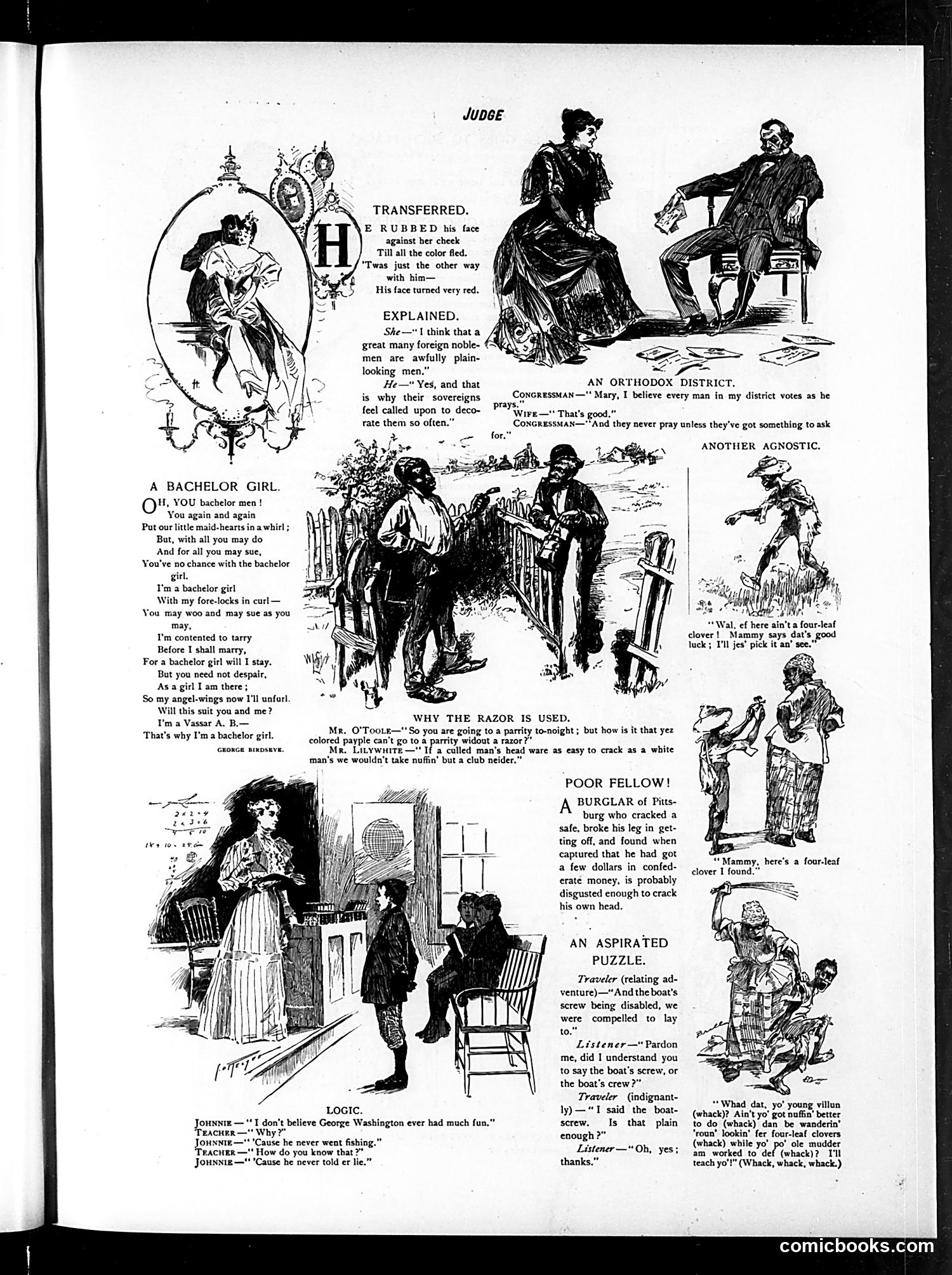
This page contains multiple satirical sketches typical of late-19th-century American humor. Key content includes: **"A Bachelor Girl"**: A poem mocking the "New Woman" ideal—women seeking independence from marriage. The satire suggests such women are delusional about their autonomy. **"An Orthodox District"**: A congressman boasts that all men in his district vote identically and only pray when asking for favors—mocking both blind political loyalty and insincere religiosity. **"Why the Razor Is Used"**: A deeply offensive racial stereotype joke presenting an Irish immigrant and a Black man discussing weapons. It perpetuates harmful caricatures common to the era. **"Poor Fellow!"**: Dark humor about a burglar who stole worthless Confederate money—likely referencing post-Civil War economic chaos. **Other sketches** include wordplay ("Aspirated Puzzle" confusing "screw" and "crew") and a domestic scene with racist dialect humor involving a mother and child. The page reflects Judge's satirical targets: women's independence, political corruption, and uses racist stereotypes typical of 1880s-90s American satire.
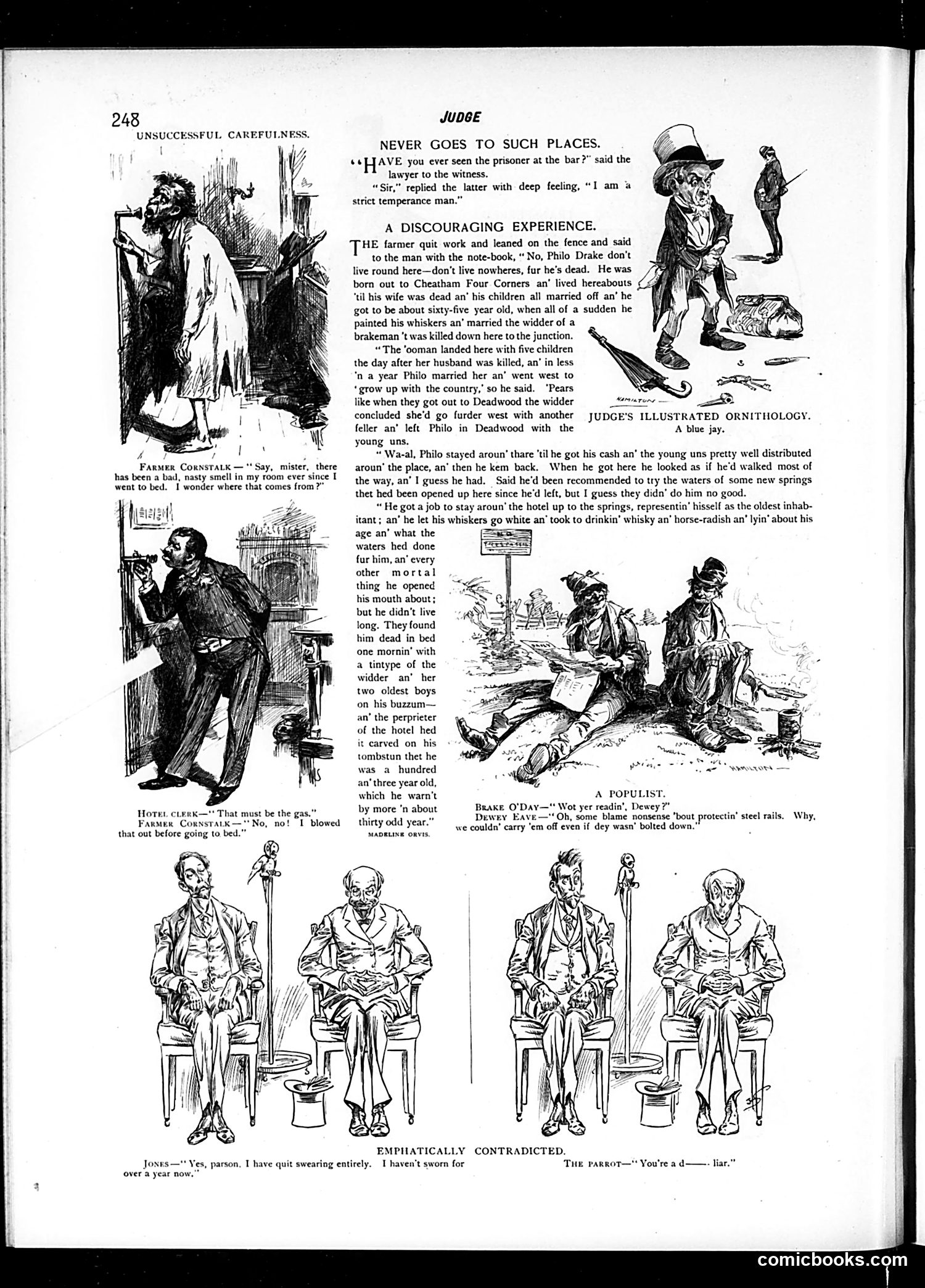
This page contains multiple unrelated satirical sketches typical of Judge's format: **"Never Goes to Such Places"** (top): A lawyer asks a witness if he's seen "the prisoner at the bar," but the temperance advocate misunderstands, thinking "bar" means a saloon—implying strict temperance advocates avoid such establishments. **"A Discouraging Experience"** (center): A farmer recounts the saga of Philo Drake, a man who remarried a widow, moved west, lost his fortune, returned destitute to a local hotel, and died. The satire mocks get-rich-quick schemes and frontier mobility myths. **"Judge's Illustrated Ornithology"** (right): A simple visual pun labeling a blue jay. **Bottom panels**: Four scenes of "Emphatically Contradicted" showing a parrot sarcastically calling a man a liar after he claims to have quit swearing—visual humor about human hypocrisy. These are disconnected gag cartoons rather than unified political commentary, representing Judge's typical miscellaneous humor format.
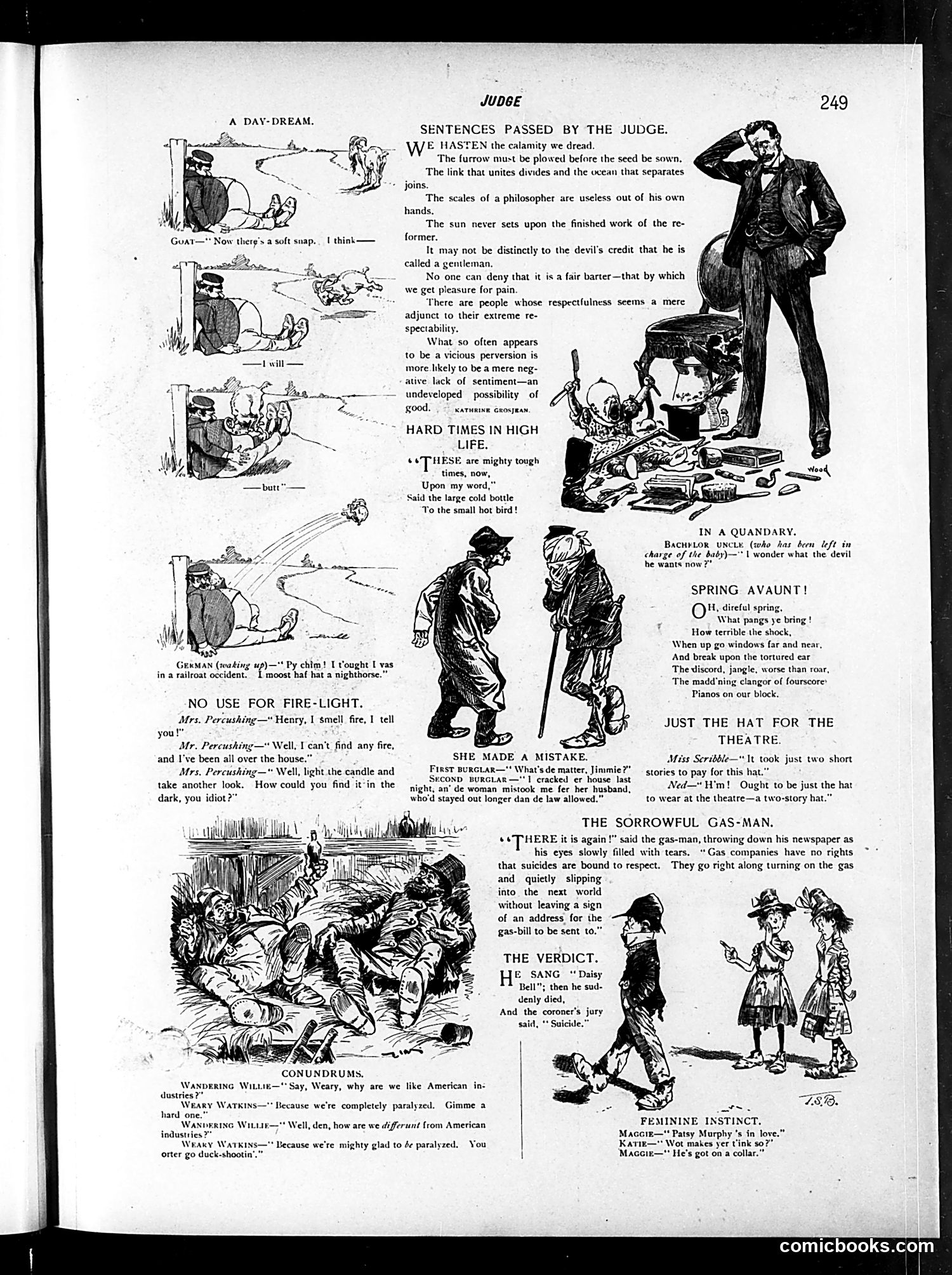
This page collects brief satirical pieces typical of Judge's humor circa early 20th century. The cartoons mock everyday absurdities: **"A Day-Dream"** shows a German immigrant (identified by dialect: "Py chim!") daydreaming about escaping a railroad accident—satirizing the perceived frequency of such disasters and immigrant anxieties. **"No Use for Fire-Light"** jokes on marital stupidity—a wife asks her husband to light a candle to find fire in the dark, mocking male obliviousness. **"Hard Times in High Life"** personifies champagne bottles and hot drinks commiserating about economic hardship, likely referencing the financial anxieties of the wealthy during uncertain times. Other pieces target pretension, romantic incompetence, and urban irritants (pianos). **"The Sorrowful Gas-Man"** darkly satirizes suicide by gas (a common method then), suggesting victims rudely inconvenience gas companies by not paying final bills—gallows humor about a serious social problem. The overall tone: irreverent, focused on class, immigrant, and domestic humor rather than explicit political commentary.
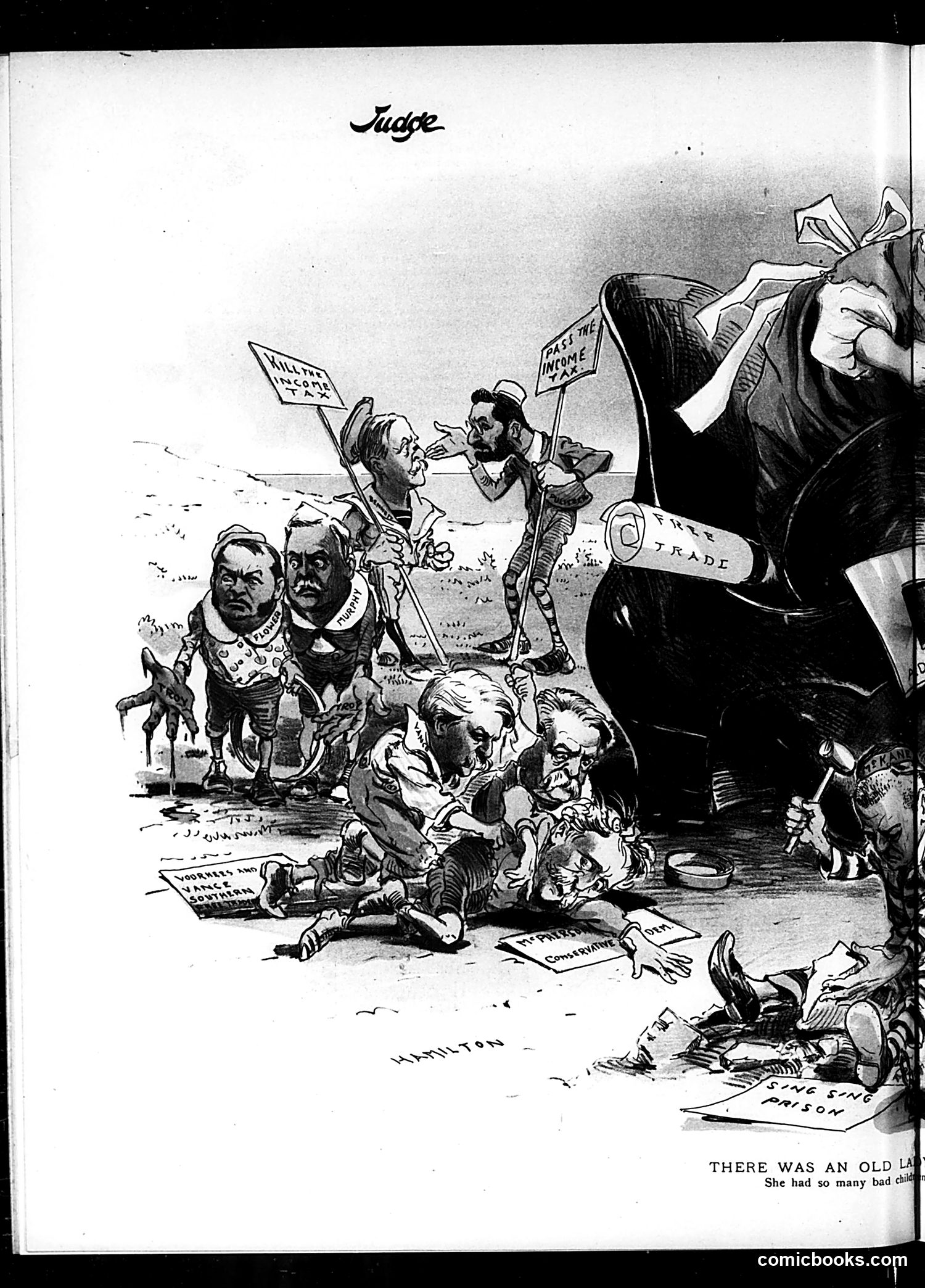
This is a satirical cartoon from *Judge* magazine depicting what appears to be a nursery rhyme reference—"There Was an Old Lady (Who Swallowed a Fly)." The figure on the right, rendered as a large authority figure (likely representing the government or a political body), looms over smaller figures labeled with various economic and social problems: "Class Income Tax," "Trade," "Commerce," and other regulatory issues. The caricatured smaller figures appear to be political actors or institutions scrambling beneath this towering presence. The satire suggests that government has accumulated too many problematic "children" or policies, criticizing governmental overreach or mismanagement of economic matters. The style and labeling indicate this targets Gilded Age or Progressive Era economic regulation debates.
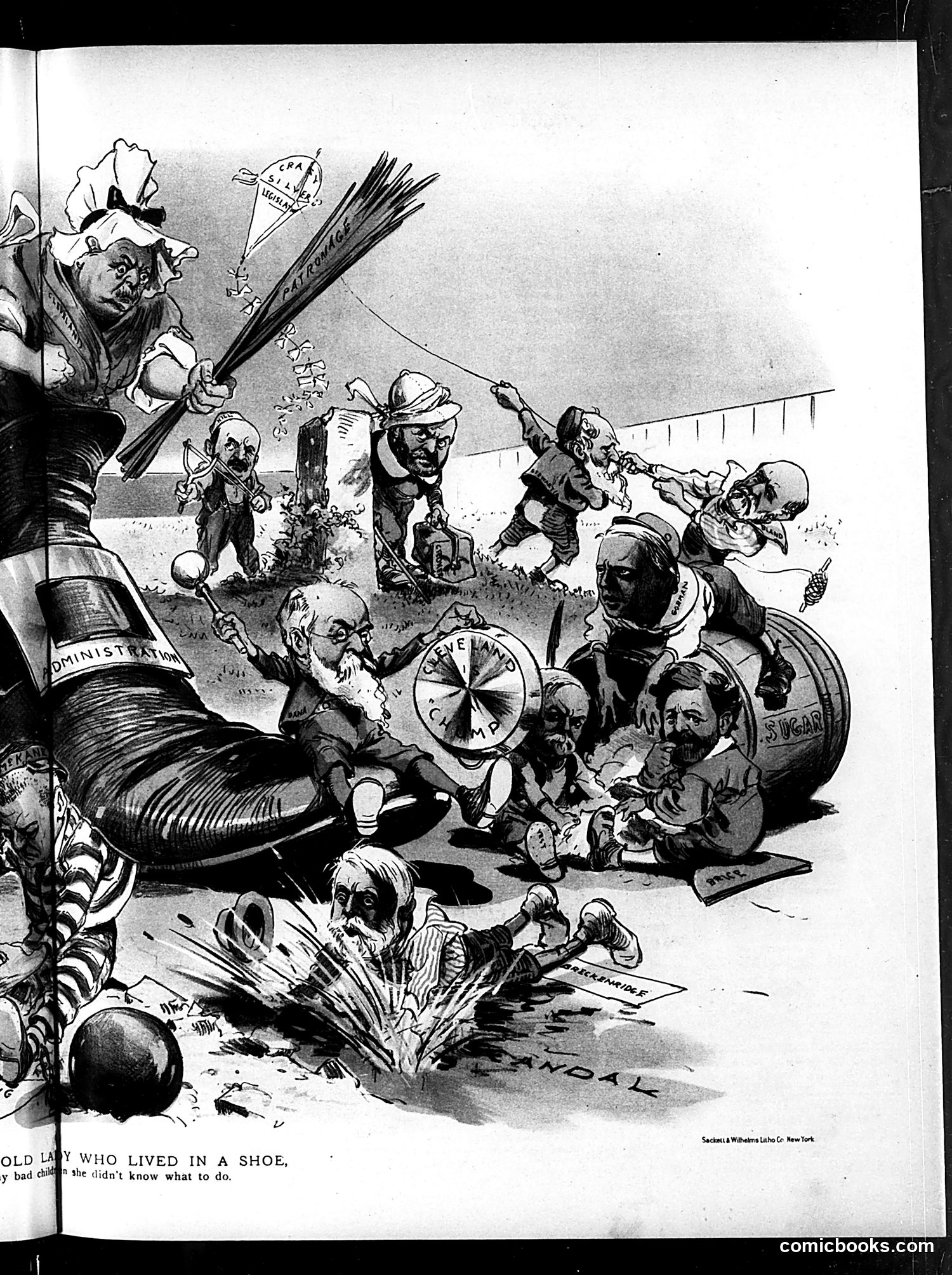
This appears to be a satirical cartoon referencing the nursery rhyme "There Was an Old Lady Who Lived in a Shoe." The oversized shoe represents government administration (labeled on the leg), from which various caricatured figures—appearing to represent politicians or bureaucrats—emerge in chaos. They're depicted as misbehaving "children" being whipped into line by a large figure on the left. The satire critiques government mismanagement and administrative incompetence: the "old lady" (government) has so many unruly "children" (policies, programs, or officials) that she "didn't know what to do," as the caption states. The violent imagery and tumultuous scene suggest the cartoon is mocking either administrative confusion, political corruption, or failed governance during a specific historical period. Without the publication date visible, the exact political context remains unclear.
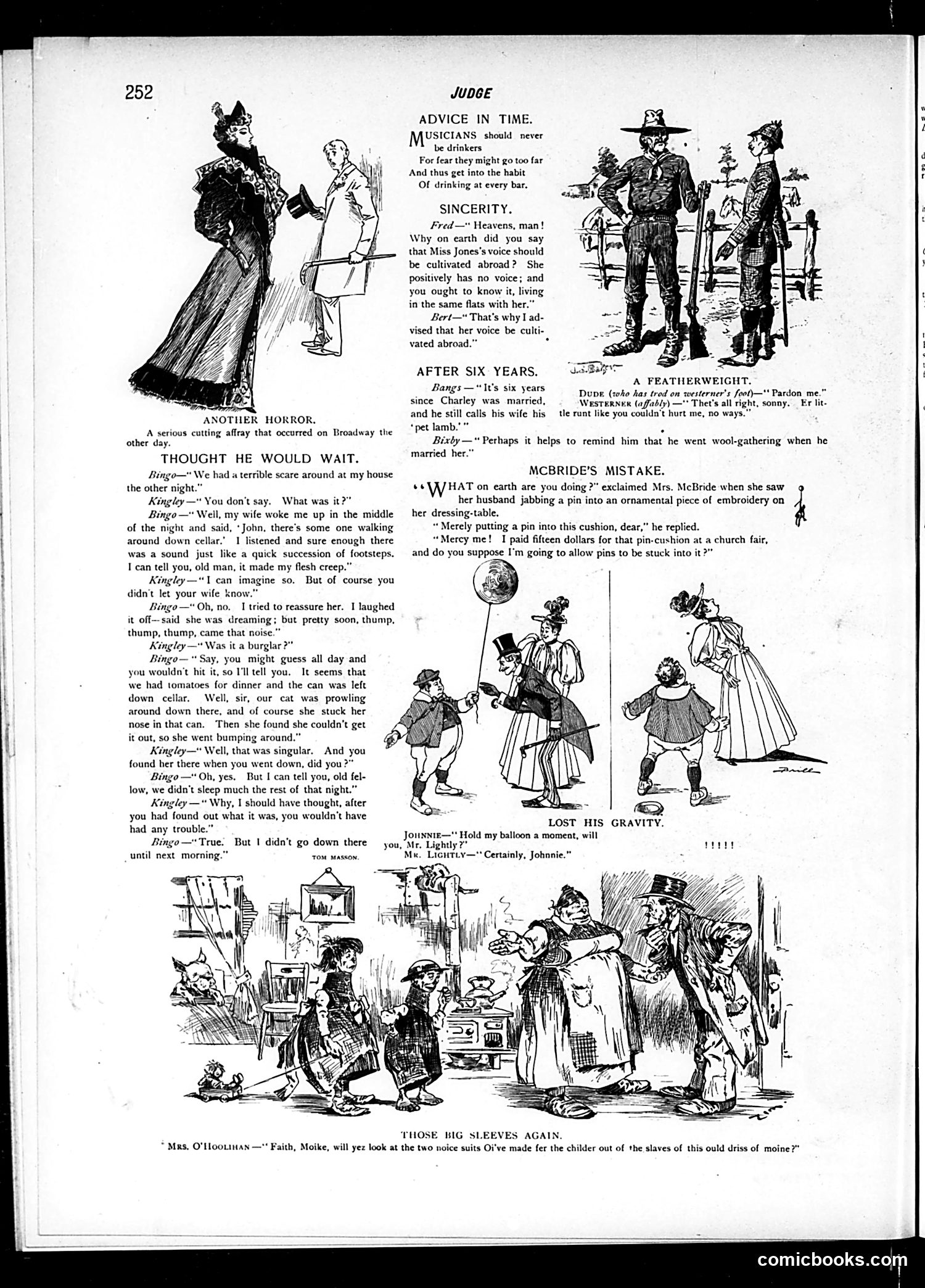
This page contains multiple brief humorous anecdotes typical of early 20th-century Judge magazine. The main recurring themes are domestic mishaps and social awkwardness: **"Thought He Would Wait"** depicts a husband who reassures his frightened wife about mysterious cellar noises—only to discover it's their cat stuck in a tomato can. The humor lies in his excessive caution in not investigating, seemingly afraid of what he might find. **Other sketches** address period concerns: musicians drinking, a woman's unsuitable singing voice, marital affection declining after six years, and a housewife's concern about expensive embroidered cushions being damaged by pins. **"Those Big Sleeves Again"** (bottom) references fashion, showing Irish immigrant Mrs. O'Flaherty recycling an old dress into children's clothing—commenting on either current sleeve fashions or working-class resourcefulness. The cartoons rely on situational comedy and social observation rather than political satire, reflecting Judge's entertainment-focused content for middle-class readers.
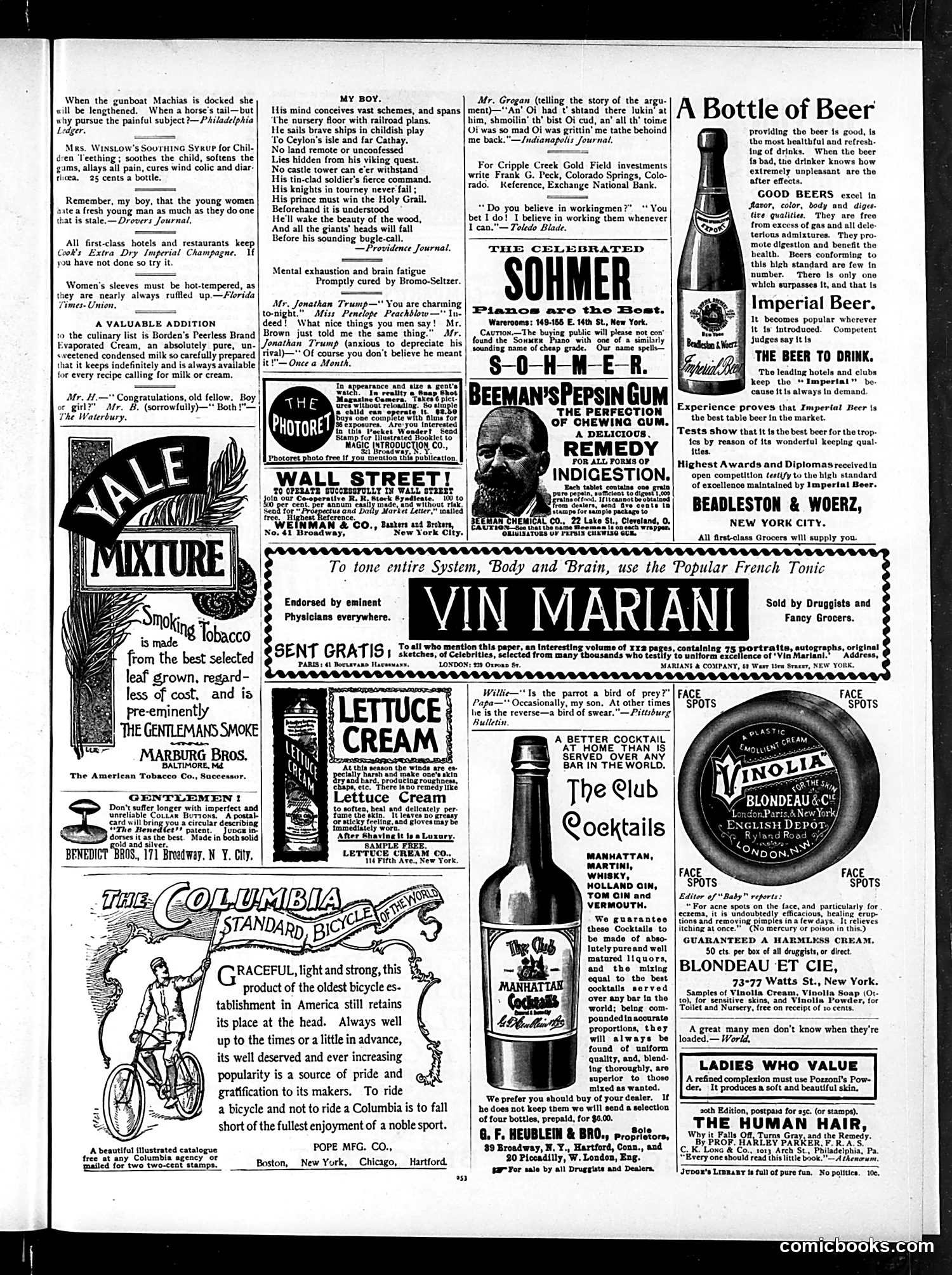
This is primarily an **advertising page** from Judge magazine, not a political cartoon page. The content consists almost entirely of commercial advertisements typical of early 20th-century American publications. The few editorial items present are brief humorous quips—short jokes about everyday topics (women's fashion, children's play, courtship banter, Irish workers). These reflect period stereotypes but lack specific political satire. The advertisements showcase products reflecting contemporary life: Mrs. Winslow's Soothing Syrup for teething children, Sohmer pianos, Beeman's Pepsin Gum, Columbia bicycles, Lettuce Cream cosmetics, and various alcoholic beverages (beer, champagne, cocktails). An ad for Wall Street stock speculation appears alongside these consumer goods. **No identifiable political cartoons or caricatured public figures appear on this page.** It represents the commercial nature of Judge magazine's revenue model rather than its satirical editorial content. The page would be of interest primarily to historians studying early 1900s consumer culture and advertising practices.
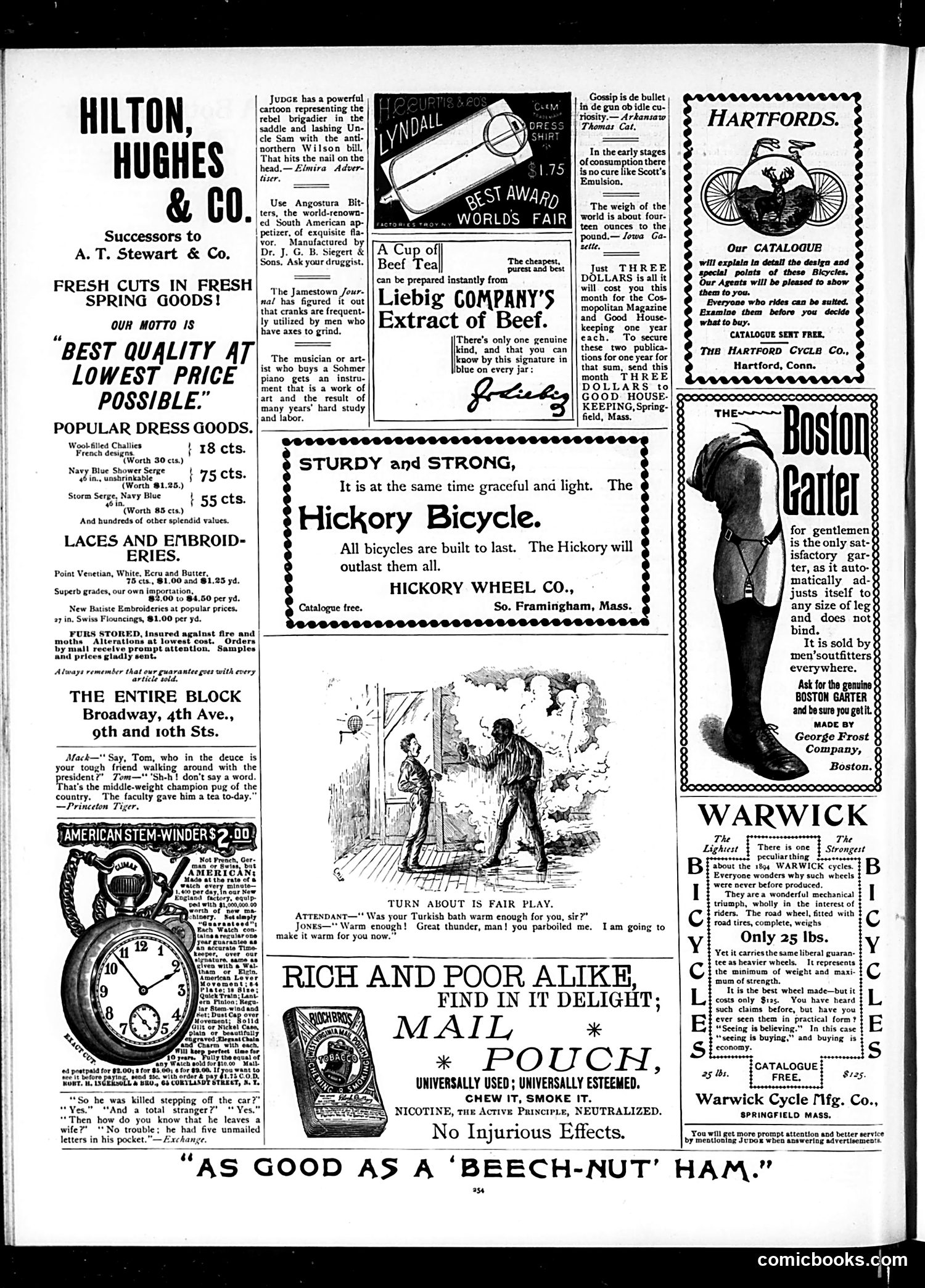
This page is primarily **advertising**, with one cartoon joke at the bottom. The main cartoon, "TURN ABOUT IS FAIR PLAY," depicts a simple comedic exchange: a hotel attendant asks a guest if his Turkish bath was warm enough; the guest responds angrily that it was far too hot—he was "parboiled"—and threatens to "make it warm for you now," implying he'll retaliate against the attendant. The humor relies on wordplay: "warm enough" takes on literal versus figurative meanings, and the guest's threat to reciprocate creates a role reversal. The rest of the page consists of period advertisements for department stores (Hilton, Hughes & Co.), bicycles (Hickory, Hartford, Warwick brands), food products (Liebig's Extract of Beef), apparel, and other goods typical of late-19th-century American magazines. A small anecdote about a boxing champion appears among the ads. There are no significant political or social satire elements on this page—it represents typical *Judge* magazine content mixing light humor with commercial advertising.
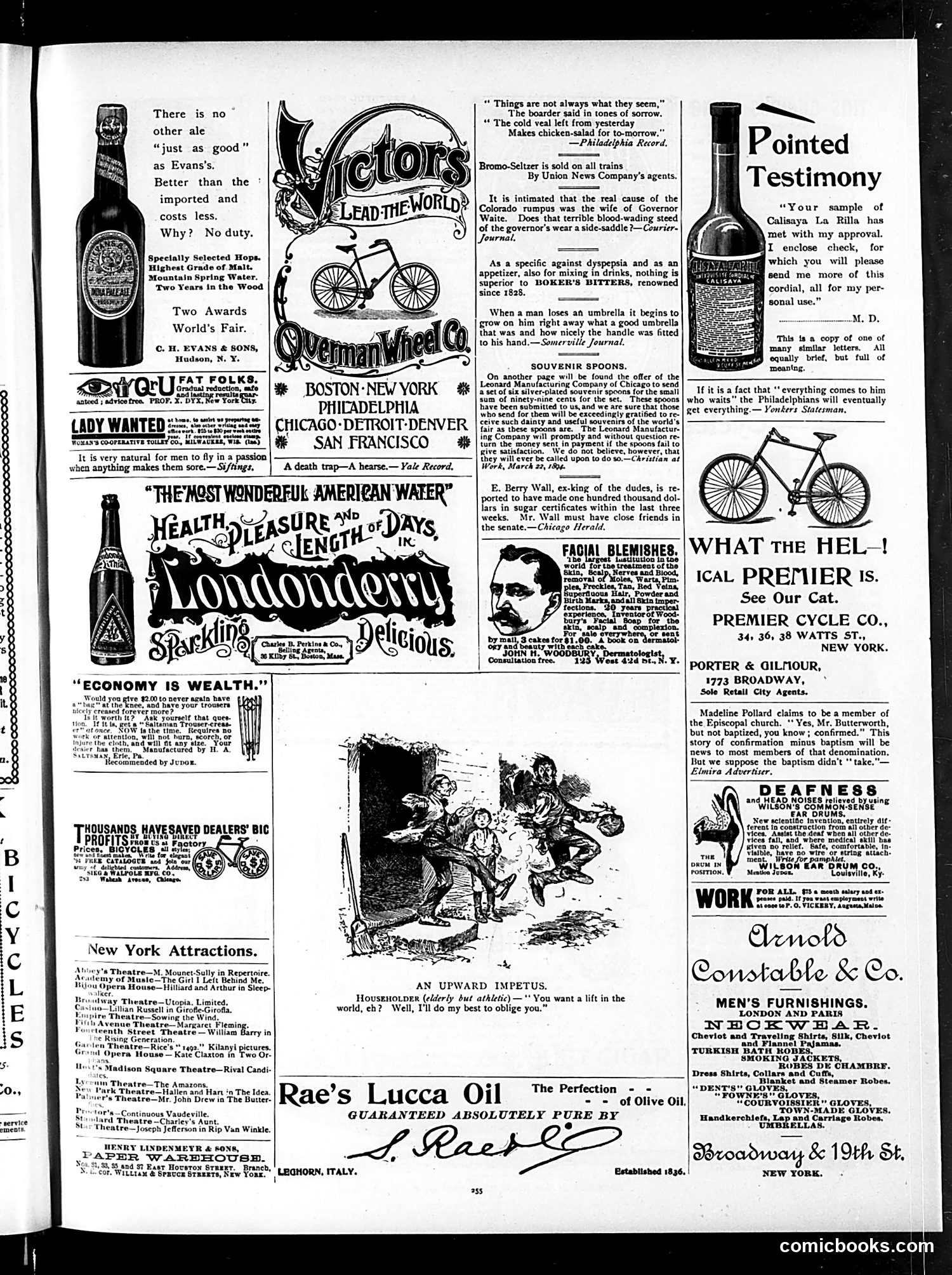
This is primarily an **advertising page** from Judge magazine (circa 1890s), with one notable cartoon. ## The Main Cartoon: "An Upward Impetus" The single illustrated cartoon shows an elderly working man offering to help a younger man climb upward—a visual pun. The joke plays on "lift in the world" (meaning social/financial advancement) versus literal physical lifting. It's gentle social commentary suggesting that working-class people offer practical help but cannot truly provide upward mobility. ## Advertisement Context The page is dominated by consumer ads typical of the era: patent medicines (Bromo-Seltzer, Boker's Bitters), bicycles (Victor, Premier Cycle Co.), souvenir spoons, hair treatments, and men's furnishings. The scattered commentary includes satirical notes—such as mocking Colorado Governor Waite and E. Berry Wall's stock-market gains—but these are brief filler remarks rather than developed satire. **Overall**, this reflects Judge's dual nature as a satirical magazine sustained primarily through advertising revenue, mixing light social commentary with commercial promotion.
This page is primarily **advertising and filler content** rather than political satire. The main elements include: **"Cuticura" advertisement** (left): A dermatological product ad explaining skin pores and promising to cure acne, eczema, and other skin conditions—typical late-19th/early-20th century patent medicine marketing. **"Primley's California Fruit Chewing Gum"** (center): A large advertisement claiming to be "The Sweetest thing on Earth." **Miscellaneous anecdotes and jokes** (right side): These include humorous stories about a girl's lies (referencing Biblical figures Ananias and Sapphira), an actor's concentration, and wordplay about "signify" and slang—general humor without political intent. **Hotel and business advertisements** (bottom): Including Remington Cycles, hotel listings, and other commercial notices. The page's header jokes about reading advertisements for happiness—meta-commentary on the ad-heavy nature of the magazine itself. This appears to be a typical Judge filler page designed primarily for revenue through advertising rather than satirical content.
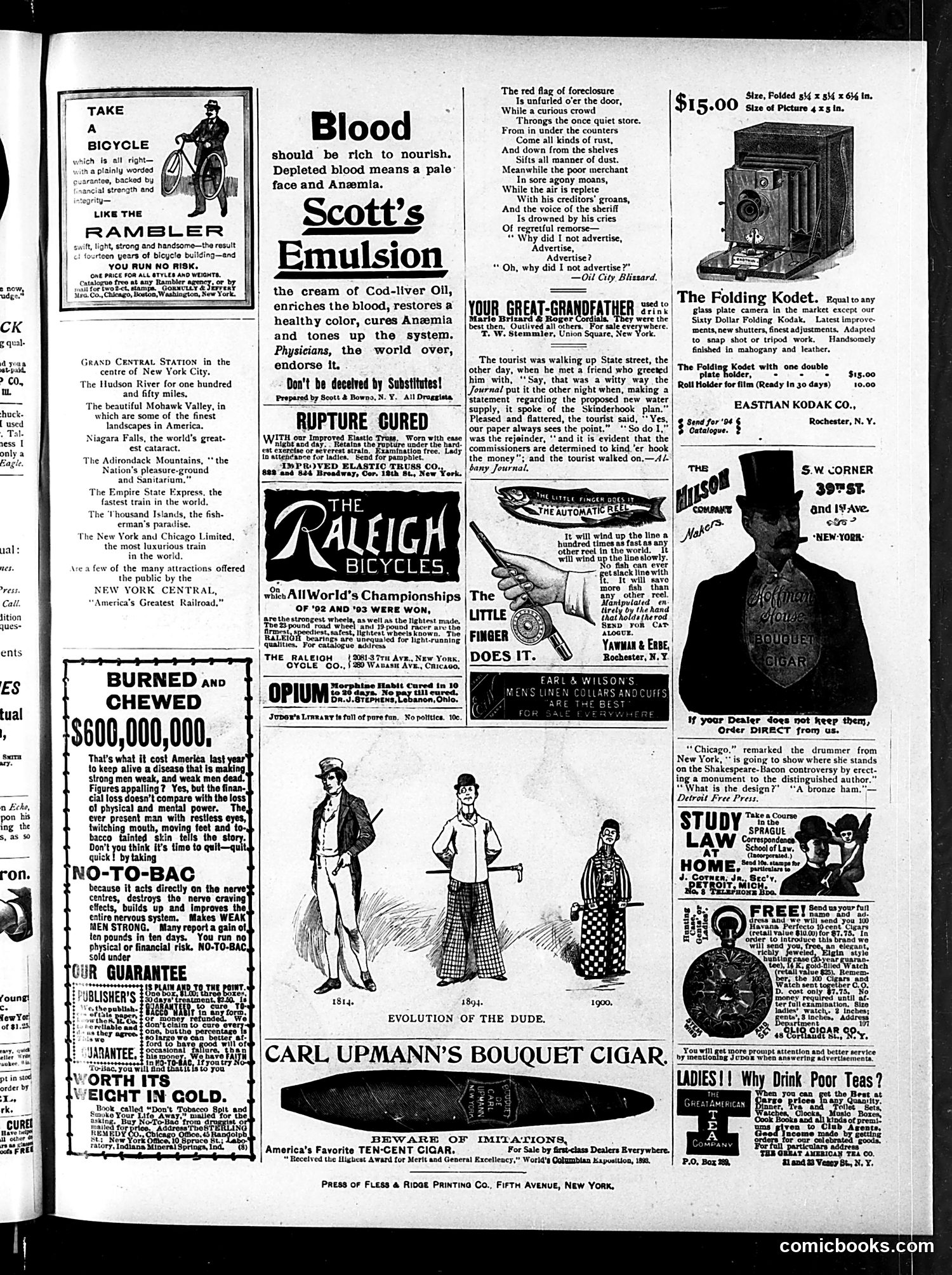
This is primarily an **advertising page** from Judge magazine, with one notable satirical cartoon. ## The Cartoon: "Evolution of the Dude" (1814-1900) The central illustration shows three male figures across roughly a century, depicting changing fashion and social attitudes toward masculinity. The progression appears to mock evolving standards of male appearance and comportment—from a more robust 1814 figure, to a more refined 1851 version, to a 1900 "dude" in tailored clothing. This satirizes contemporary anxiety about American manhood becoming "soft" or overly fashionable. ## Advertising Content The page is dominated by product ads typical of the era: Scott's Emulsion (cod liver oil for anemia), NO-TO-BAC (tobacco cessation), bicycles (Rambler, Raleigh), and medical devices (trusses). One ad's headline—"Why did I not advertise?"—uses a failed merchant's foreclosure as a cautionary tale, itself a form of commercial satire about business failure. The overall page reflects early-1900s concerns about health, masculine vitality, and consumer culture.
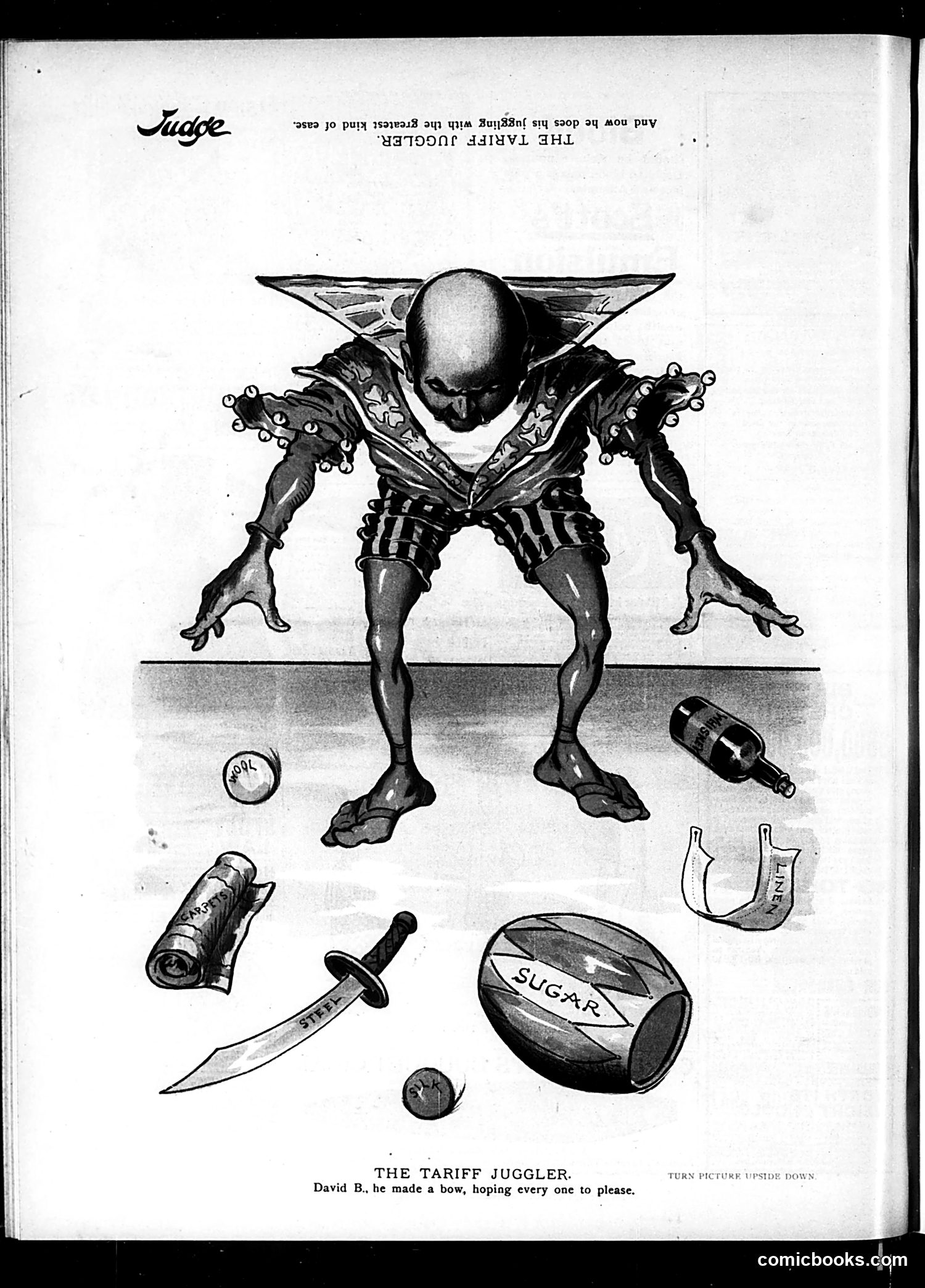
This political cartoon satirizes David B. (likely President David B. Hill or a similar figure) as a juggler performing a precarious balancing act with tariff policy. The juggled objects—a bottle, sword, sugar container, horseshoe, and other items—represent different economic interests and commodities affected by tariff legislation. The caption's instruction to "turn picture upside down" suggests the cartoon works as a reversible image, emphasizing how tariff policy appears unstable regardless of perspective. The juggler "made a bow, hoping every one to please," mocking political attempts to satisfy all factions simultaneously through tariff compromise—an impossible feat. This reflects late 19th-century American debates over protective versus free-trade tariffs, when different industries and regions demanded conflicting policies.