
A complete issue · 16 pages · 1894
Judge — February 17, 1894
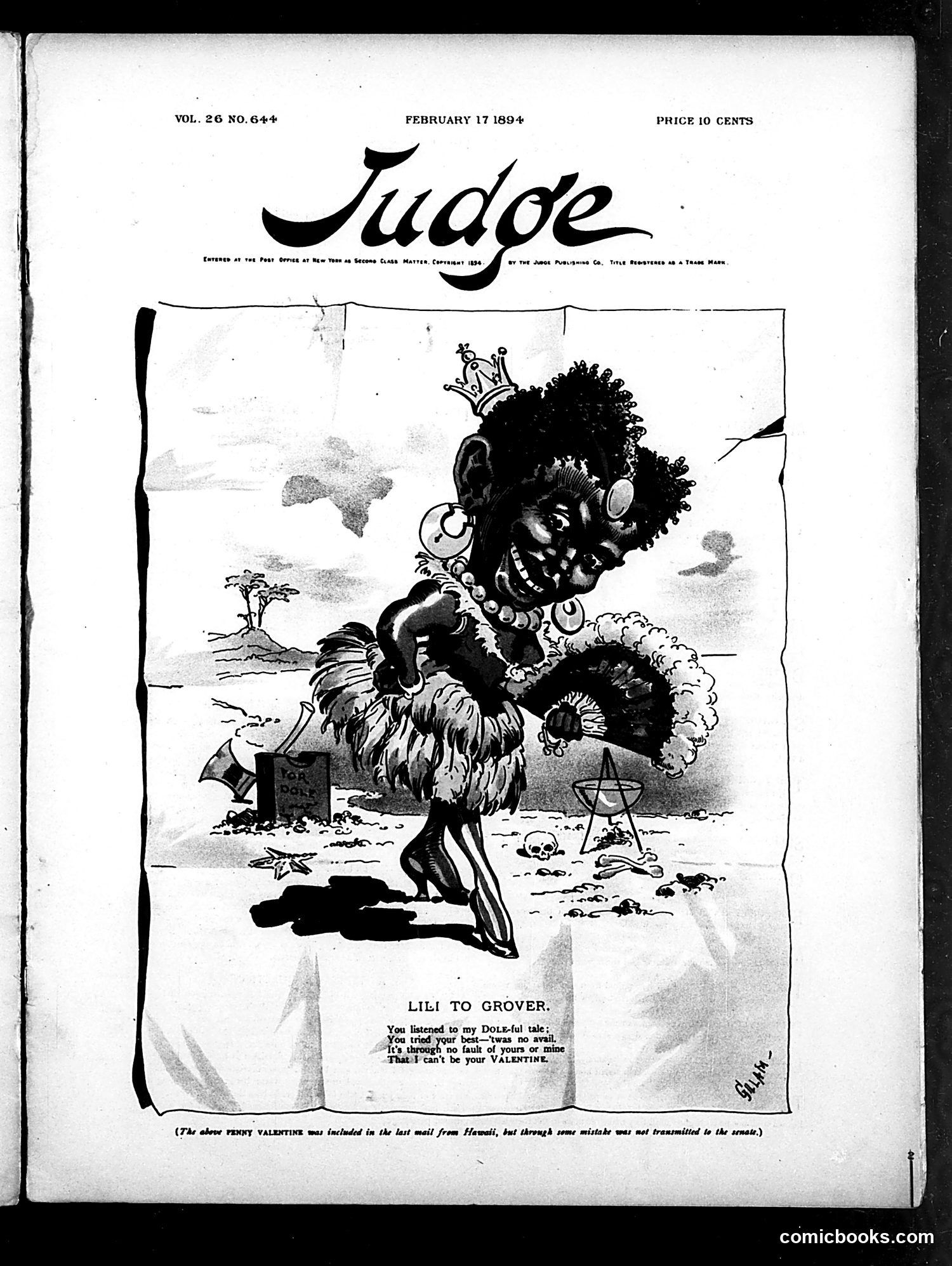
This 1894 Judge cartoon satirizes a failed romantic overture, likely referencing a contemporary scandal. The caricatured female figure "Lili" (depicted with exaggerated racial features typical of the era's offensive stereotyping) addresses "Grover"—almost certainly President Grover Cleveland, who served 1885-1889 and 1893-1897. The text mocks Cleveland's rejection: "You listened to my Doubtful tale; You tried your best—Yes no avail. It's through no fault of yours or mine That I can't be your VALENTINE!" The witchcraft imagery (pentagram, skull, cauldron) suggests supernatural themes. A footnote indicates the original "Penny Valentine" mail from Hawaii was corrupted in transmission—implying scandal or illegitimacy surrounding Cleveland's personal affairs, which were frequently attacked by satirists.
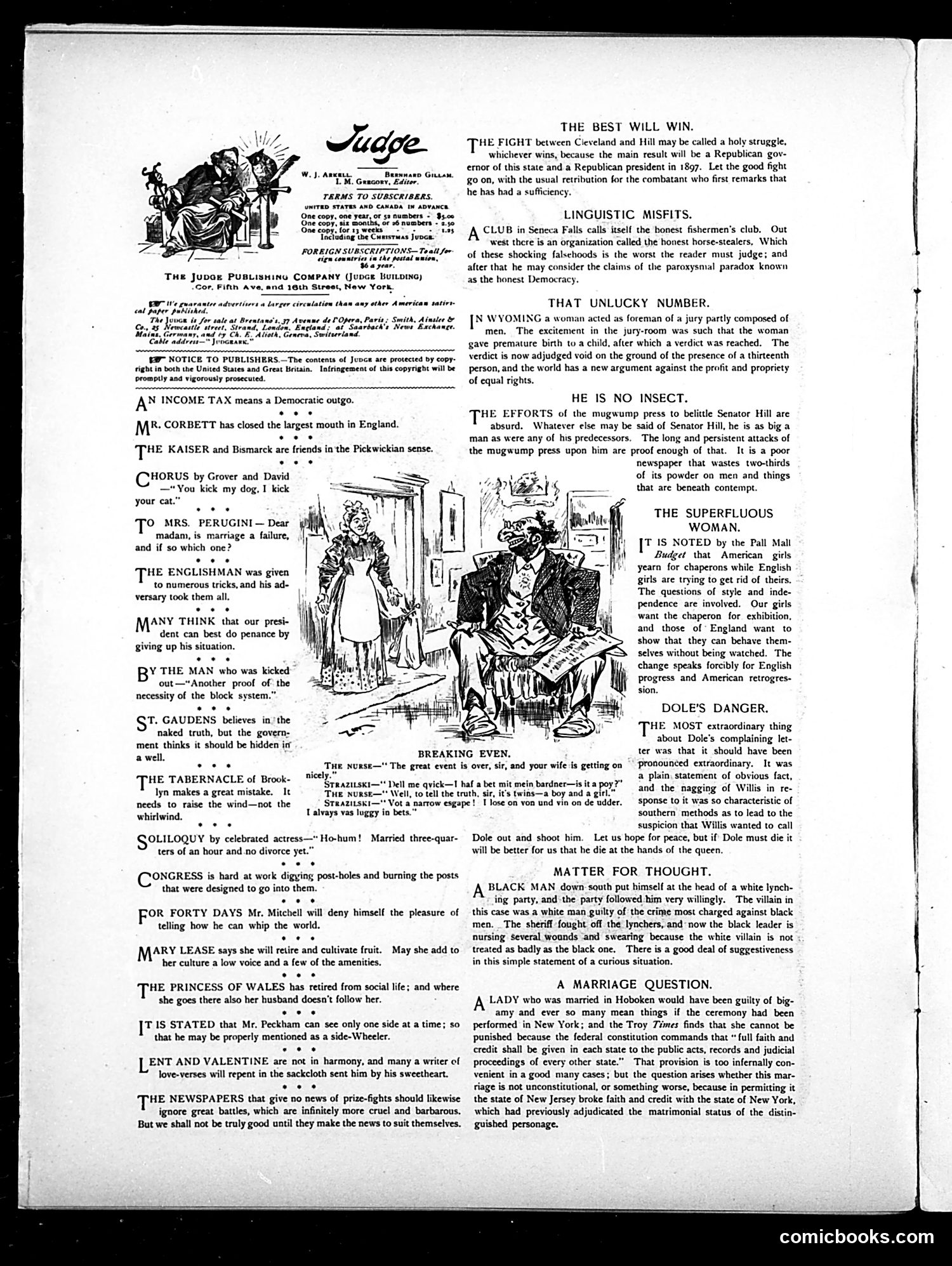
This page contains political commentary and brief satirical items rather than a single cartoon. The main illustrated piece titled "BREAKING EVEN" depicts a domestic scene where a nurse tells a man his wife is "getting on nicely" after childbirth, while he responds about his own troubles—the satire being that both spouses face difficulties simultaneously. The text items mock various political and social targets: an income tax (called "a Democratic outgo"), Senator Hill (compared to a "mugwump"), the Kaiser and Bismarck, and American versus English fashion differences. References to Wyoming women serving as jurors, a senator's unpopularity, and debates about marriage law appear, suggesting this addresses early-1900s Progressive Era politics and gender issues. The overall tone is sardonic commentary on contemporary American society and politics.
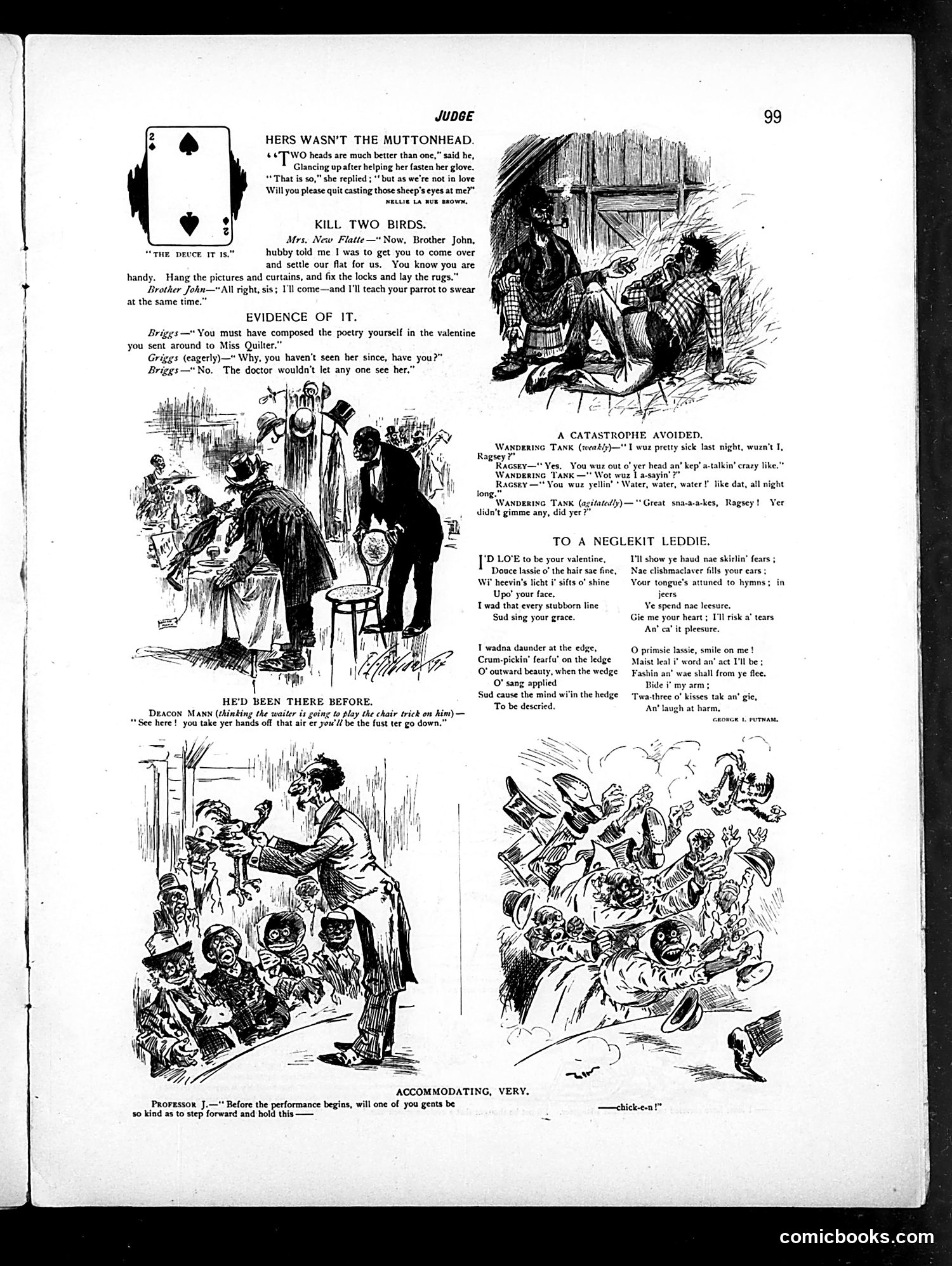
This page contains Victorian-era humor pieces and satirical illustrations typical of Judge magazine's style. The content includes: **"Hers Wasn't the Muttonhead"** - A brief domestic comedy sketch about a husband and wife discussing sheep, playing on the phrase "muttonhead" (a period insult meaning foolish person). **"Kill Two Birds"** - A dialogue joke about teaching a parrot to swear. **"Evidence of It"** - A short piece about a valentine and a doctor. The illustrations depict various social scenes—a domestic interior, a theatrical or public gathering, and chaotic crowd scenes—typical of Judge's satirical commentary on middle-class Victorian life. **"To a Neglect Leddie"** appears to be verse poetry, possibly mocking romanticism. The humor relies on wordplay, domestic situations, and observational comedy rather than explicit political commentary. Without clearer identification of specific contemporary references or named figures, the precise satirical targets remain unclear to modern readers.
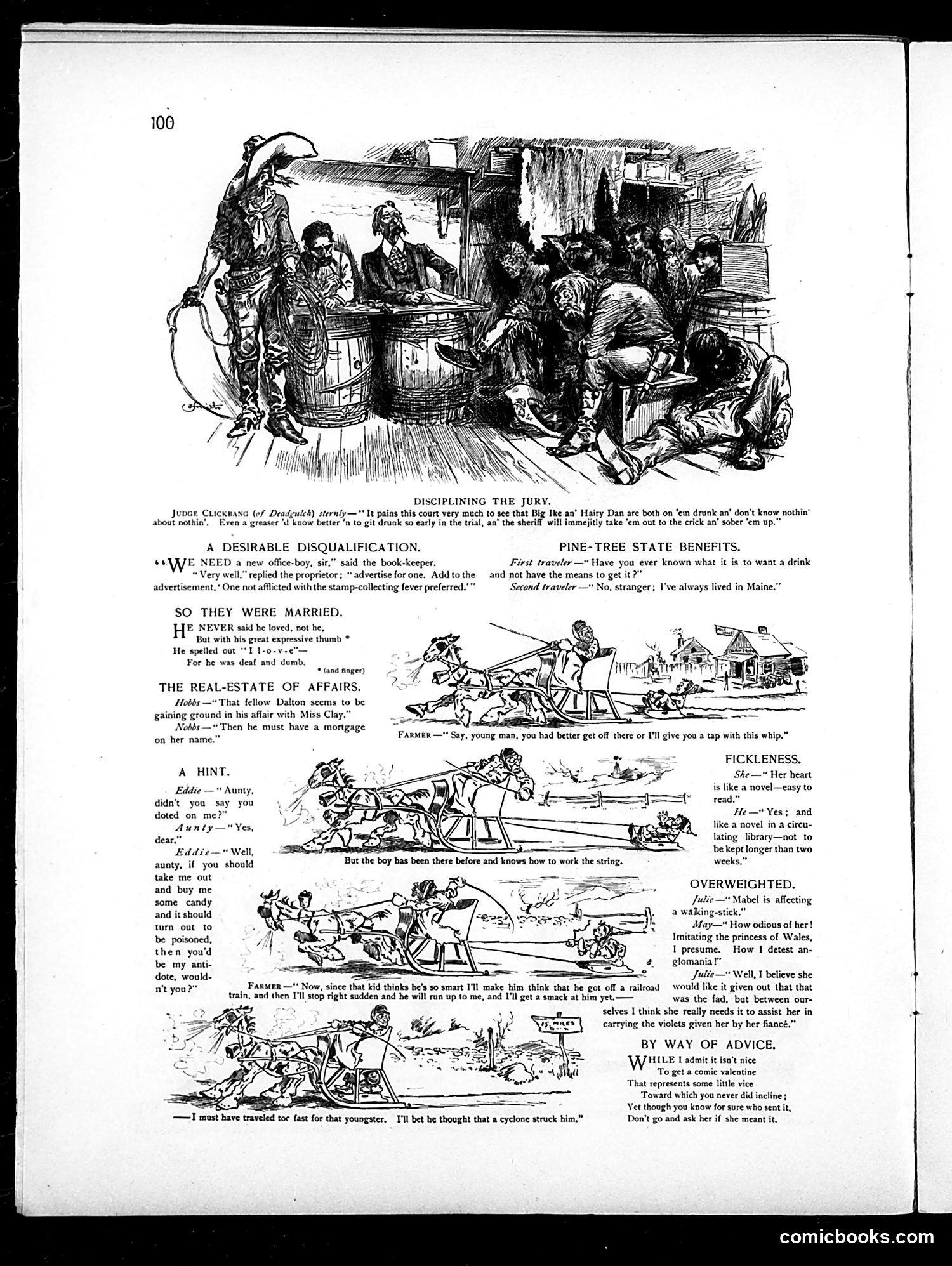
This page contains multiple short humorous sketches typical of late-19th century satirical magazines: **"Disciplining the Jury"** depicts a rural/frontier judge addressing drunk jurors with mock-serious frontier dialect, joking that intoxicated jurors will be "sobered up" at the creek—suggesting incompetence and corruption in backwoods courts. **Other sketches** include workplace humor ("A Desirable Disqualification" about hiring an office boy without stamp-collecting obsession), relationship comedy, and social commentary. "Pine-Tree State Benefits" jokes that Maine residents have never wanted a drink they couldn't get—likely satirizing Maine's temperance reputation or actual prohibition laws. **"Overweighted"** mocks women imitating aristocratic affectations (the Princess of Wales), suggesting vanity and social climbing. The humor relies on dialect, class stereotypes, romantic misunderstandings, and commentary on contemporary social pretensions—typical Judge content mixing political/social satire with lighthearted domestic comedy.
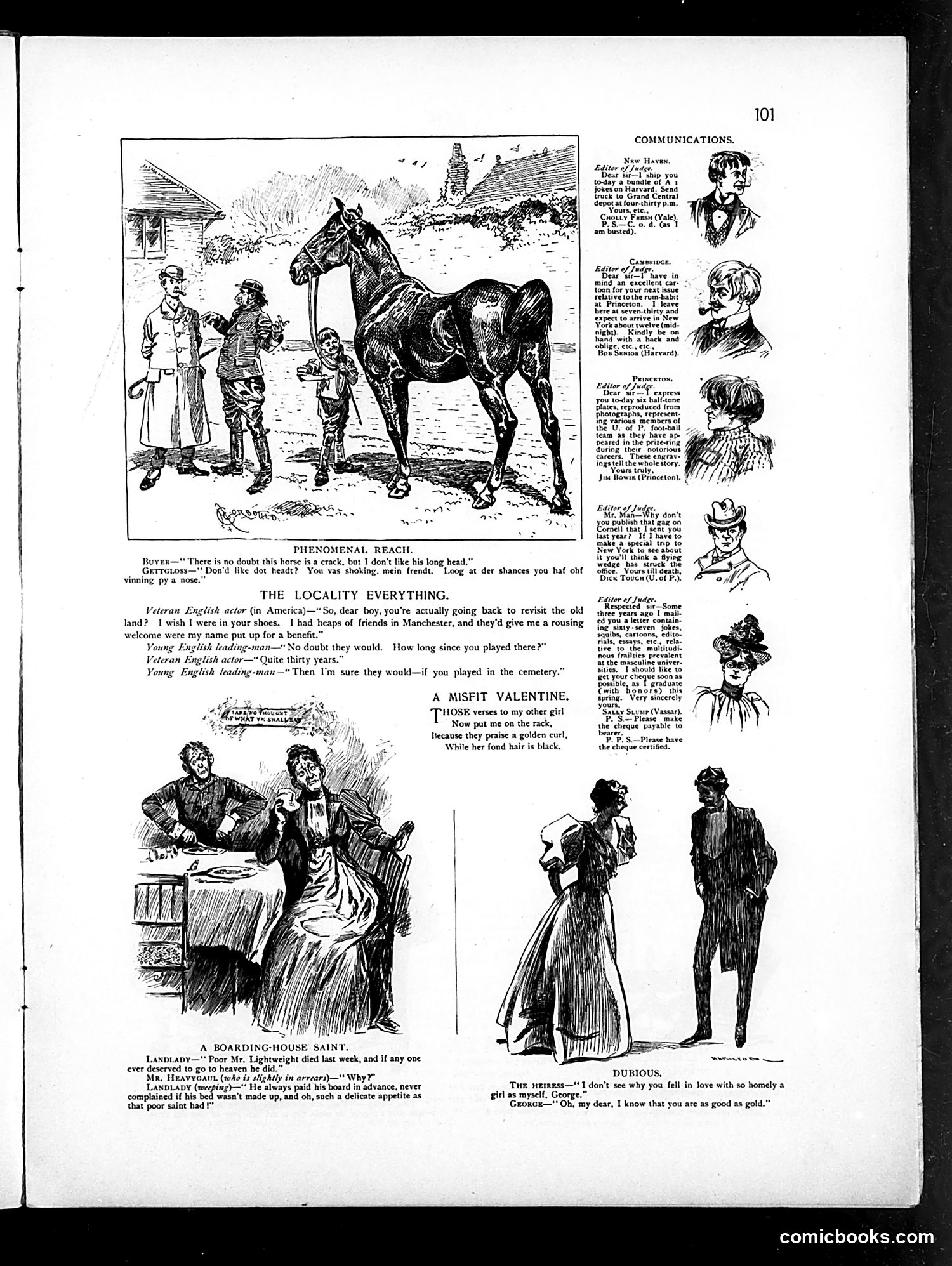
This page contains several Victorian-era jokes and satirical pieces: **"Phenomenal Reach"**: A horse dealer with a German accent jokes that a horse's long head is advantageous—you can "win by a nose," a pun on horse racing. **"The Locality Everything"**: An aging British actor brags about performing in Manchester 30 years ago. A younger actor quips he'd only get a welcome "if you played in the cemetery"—implying he's so old and forgotten he'd be dead by now. **"A Misfit Valentine"**: A man complains his girlfriend praises curly blonde hair while he has black hair—he's literally the wrong type. **"A Boarding-House Saint"**: Dark humor about a poor tenant who died; the landlady praises him, but a wealthy tenant (sarcastically) agrees he "deserved heaven"—because his death means the landlady won't collect overdue rent. **"Communications"**: The right column shows letters from college students (Harvard, Yale, Princeton, Penn, Vassar) submitting content to Judge magazine, humorously establishing the publication's college readership.
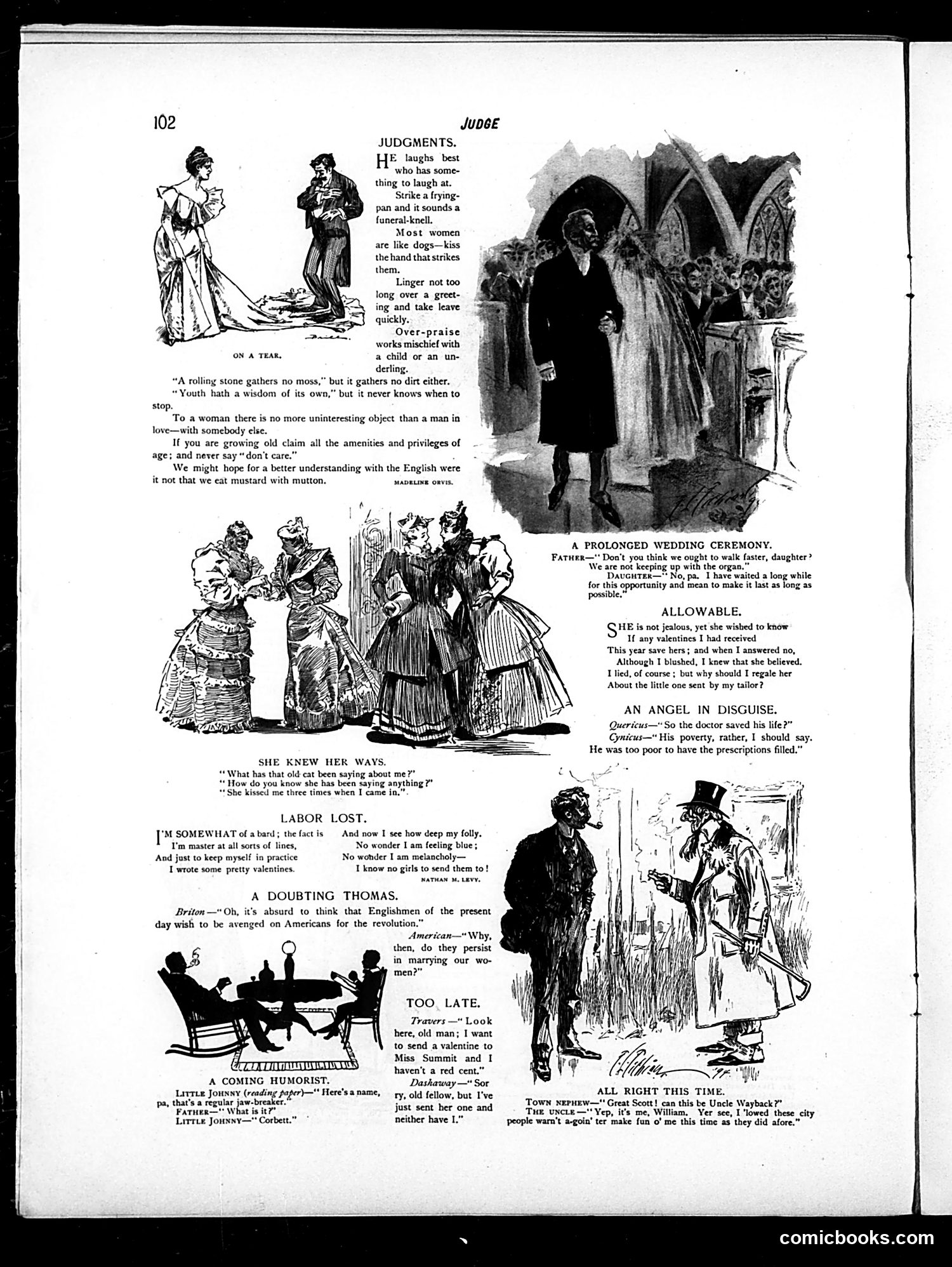
This page collects various short humorous pieces typical of 1890s satirical magazines. The cartoons and quips address social manners, romance, and Anglo-American relations. **Key content:** - **"A Prolonged Wedding Ceremony"**: A bride deliberately walks slowly down the aisle to extend her moment of attention—mocking brides' vanity. - **"A Doubting Thomas"**: An American jokes that Englishmen seek revenge on Americans by marrying American women, suggesting wealthy American heiresses were marrying British aristocrats for titles while British men married for money. This references the common practice of transatlantic marriages among the wealthy. - **Valentine-themed jokes**: Multiple pieces mock Valentine's Day sentiments and romantic disappointments. - **"An Angel in Disguise"**: A doctor's poverty saved a patient's life—he couldn't afford to prescribe expensive treatments. The page emphasizes domestic comedy, courtship anxieties, and gentle mockery of social pretension typical of Judge's humor during the Gilded Age.
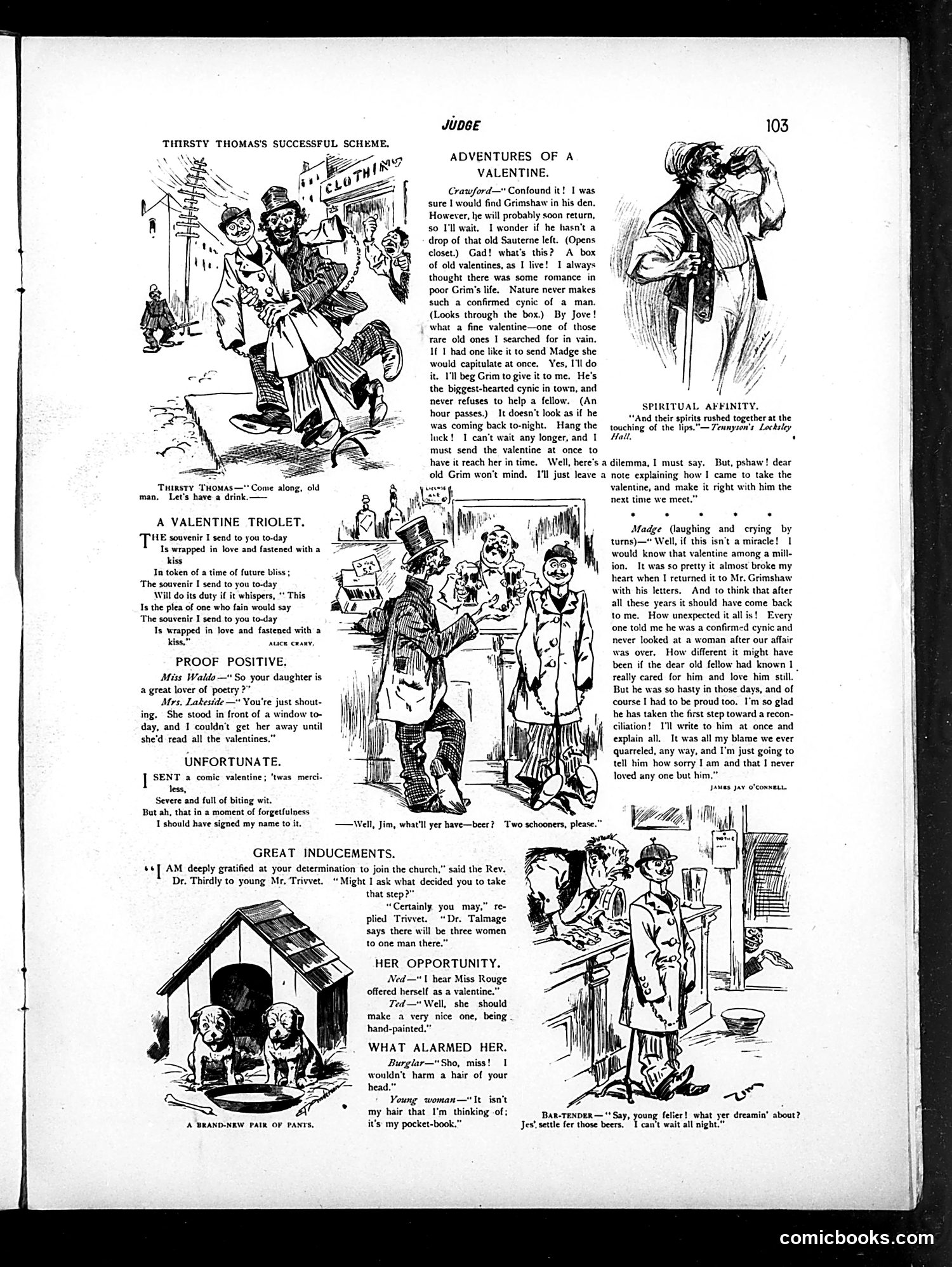
This page from Judge (an American satirical magazine) contains multiple Valentine's Day-themed jokes and comic stories, typical of the publication's humor style. **Main content:** "Adventures of a Valentine" follows a man named Crawford who borrows an old, valuable valentine from his friend Grimshaw to send to a woman named Madge. Years earlier, Madge had rejected Grimshaw's advance. The story suggests the valentine's return sparks reconciliation—Madge realizes Grimshaw still cares and that she was to blame for their past quarrel. **Satirical themes:** The piece gently mocks Victorian romantic conventions and the redemptive power attributed to sentimental gestures. Other brief jokes mock women's poetry obsession, men's church attendance motivated by demographics, and cosmetics ("hand-painted" beauty). **Historical context:** The material reflects late-19th-century attitudes toward courtship, propriety, and the supposed sentimentality of women—humor that relies on stereotypes common to the era's popular magazines.
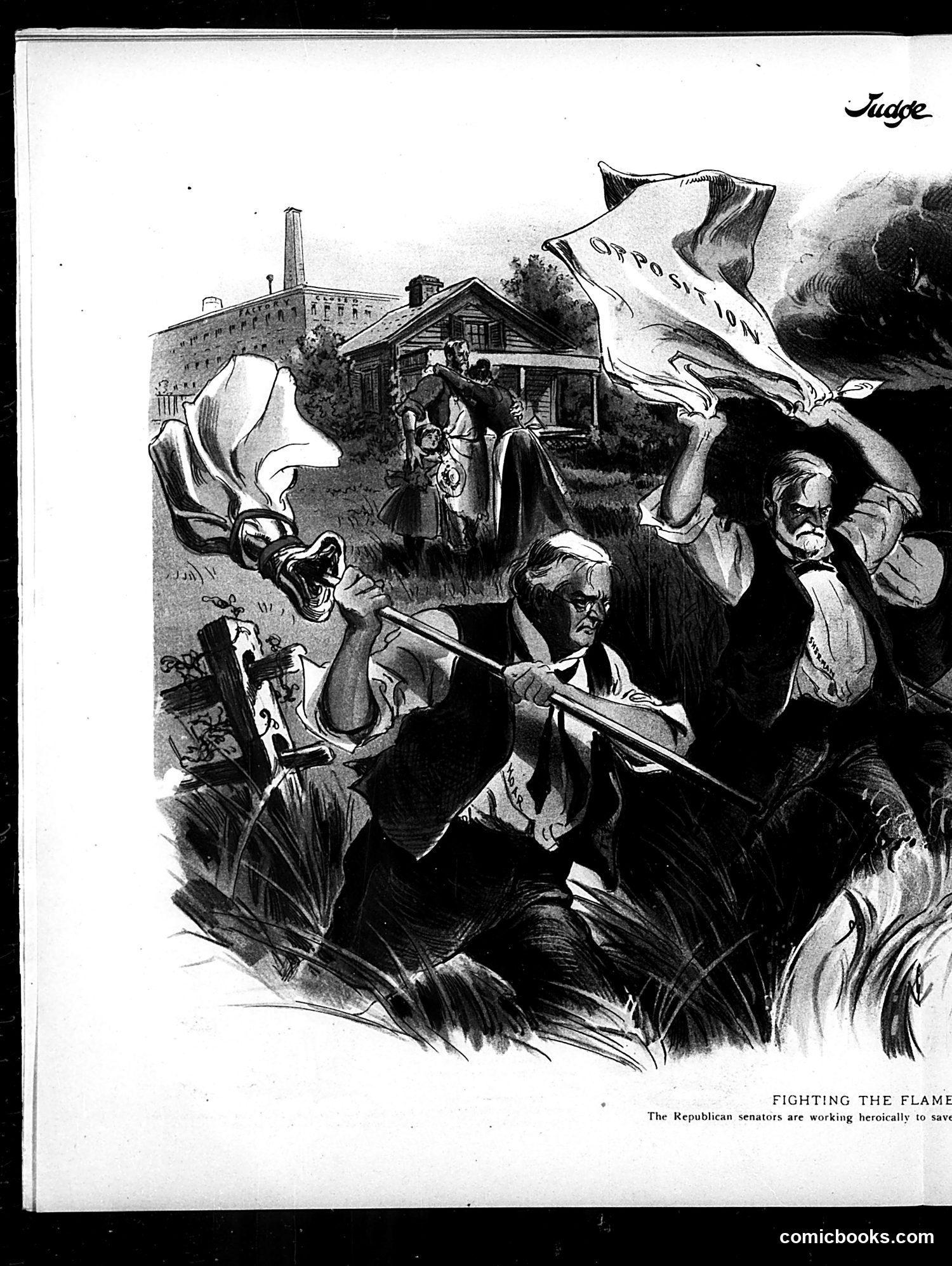
This political cartoon depicts Republican senators as firefighters battling flames to save a building. The caption states they are "working heroically to save" something (the text is cut off, but the image suggests it's the building itself—likely representing an institution or the nation). The cartoon is satirical, using the firefighting metaphor to comment on Republican senators' efforts during a crisis. Without the complete caption, the specific historical event remains unclear, but Judge magazine used such imagery to mock political figures' responses to threats—whether literal disasters, economic crises, or political scandals of their era. The heroic framing is ironic, suggesting the cartoonist doubted their actual effectiveness.
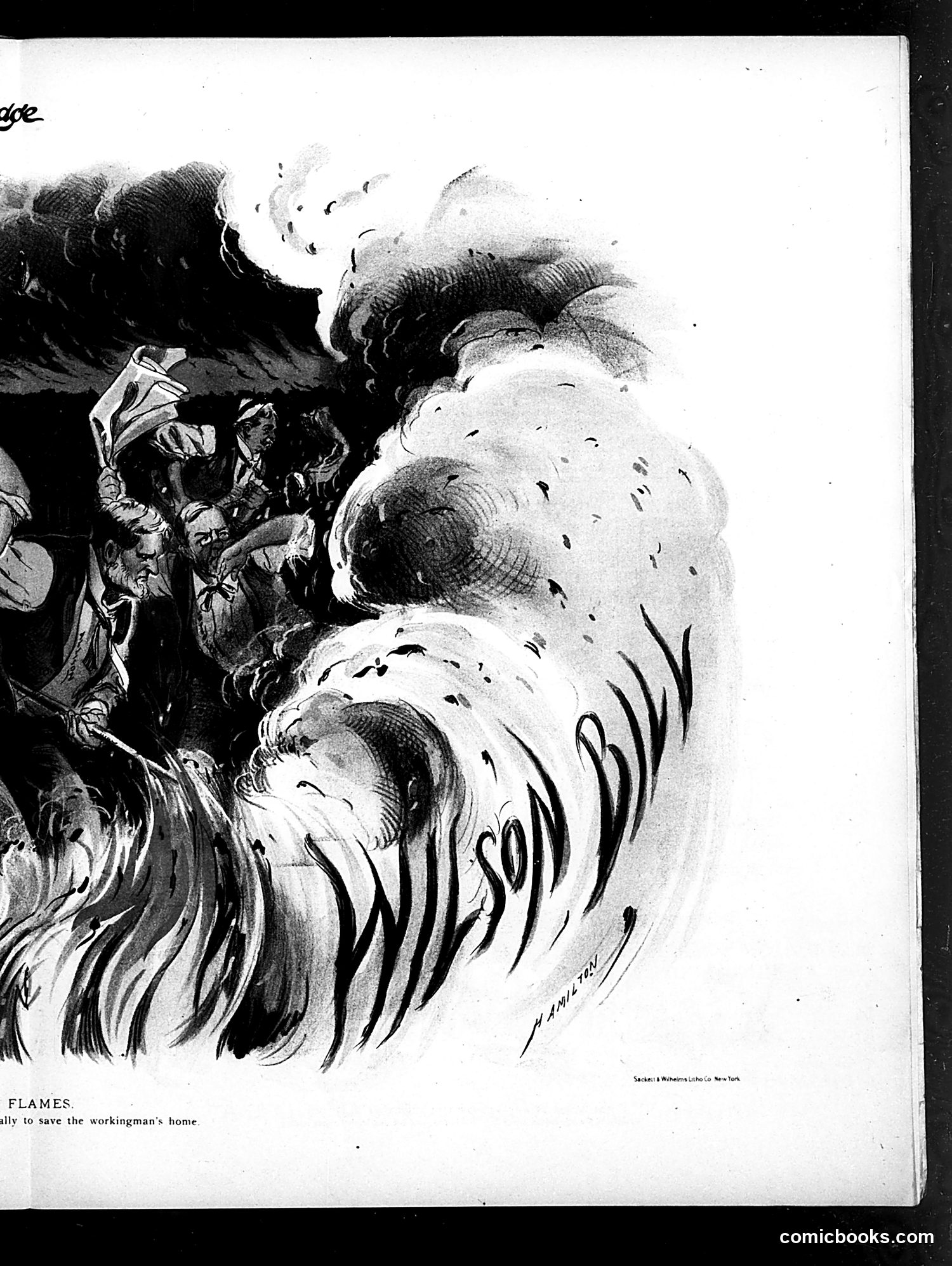
This political cartoon depicts enormous, menacing flames threatening a workingman's home (visible as small figures on the left). The flames are labeled "WILSON'S BILL," clearly referencing a piece of legislation supported by President Woodrow Wilson. The satire criticizes Wilson's policy as catastrophic for working-class Americans and their families. The exaggerated, destructive imagery suggests the cartoon's creator views the bill as economically ruinous rather than helpful—despite any claims it might protect workers. The specific bill remains unclear from this page alone, but the cartoon exemplifies *Judge* magazine's role in partisan political commentary, using dramatic visual metaphors to mobilize reader opposition to government policies deemed harmful to ordinary citizens.
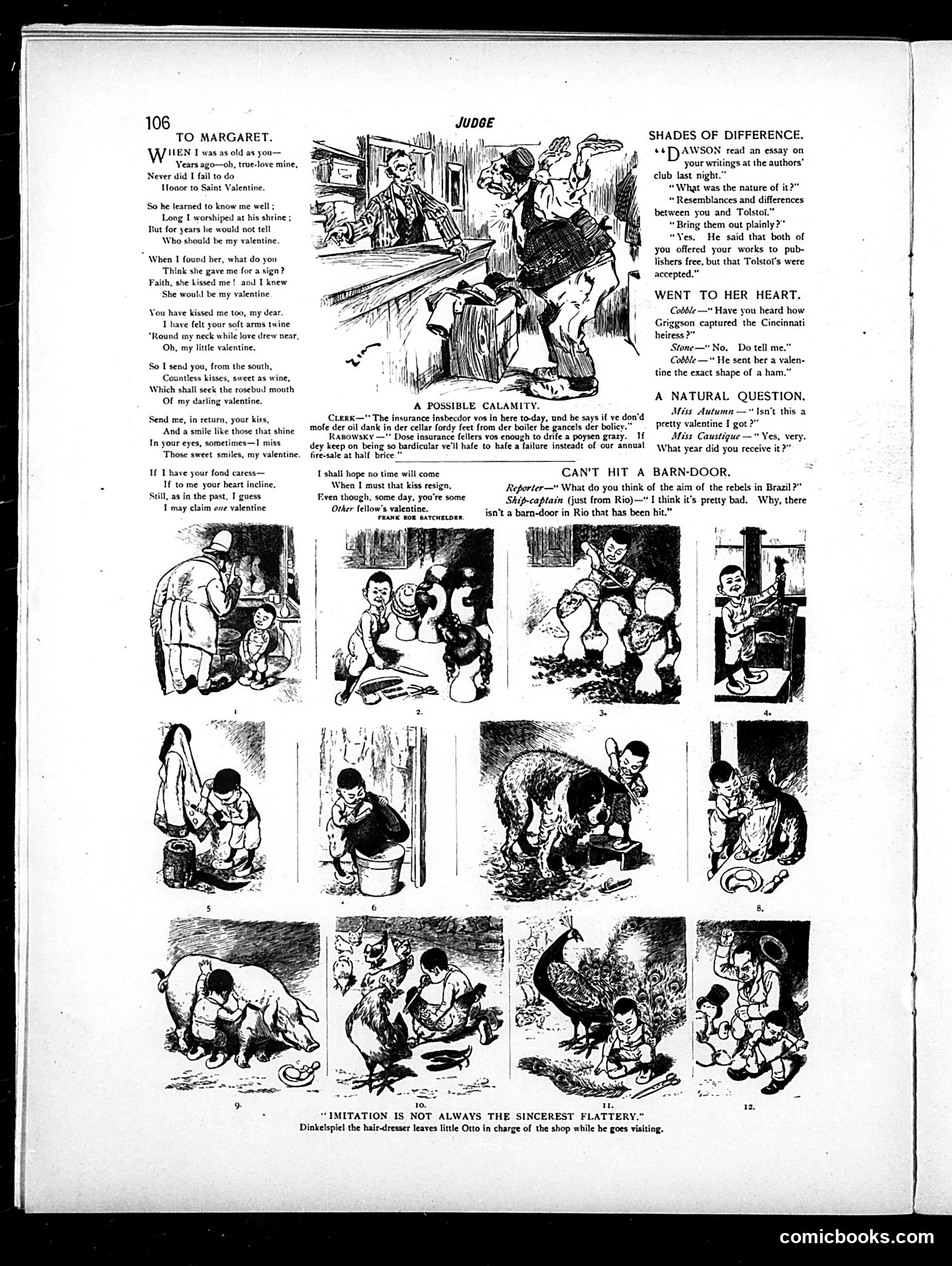
This *Judge* magazine page contains Valentine's Day-themed humor and social satire from the late 19th/early 20th century. **Main content:** A sentimental poem "To Margaret" about courtship traditions, followed by several short comic sketches: - **"A Possible Calamity"**: German-accented characters (Rawowsky, Dinkelspiel) discuss insurance inspectors' demands for safety compliance, humorously suggesting they'd prefer a profitable fire to endless regulations. - **"Shades of Difference"**: An author is insulted when compared to Tolstoy—both offer works free to publishers, but only Tolstoy's get accepted. - **"Went to Her Heart"**: A romantic trick—winning an heiress by sending a ham-shaped valentine (implying she's greedy or materially motivated). - **"Barn-Door"**: A Brazilian ship captain's boast about poor rebel marksmanship, using a colorful exaggeration. The illustrations depict children in various domestic scenarios. The humor relies on ethnic stereotypes, class assumptions, and period-specific social observations about courtship, business, and international affairs.
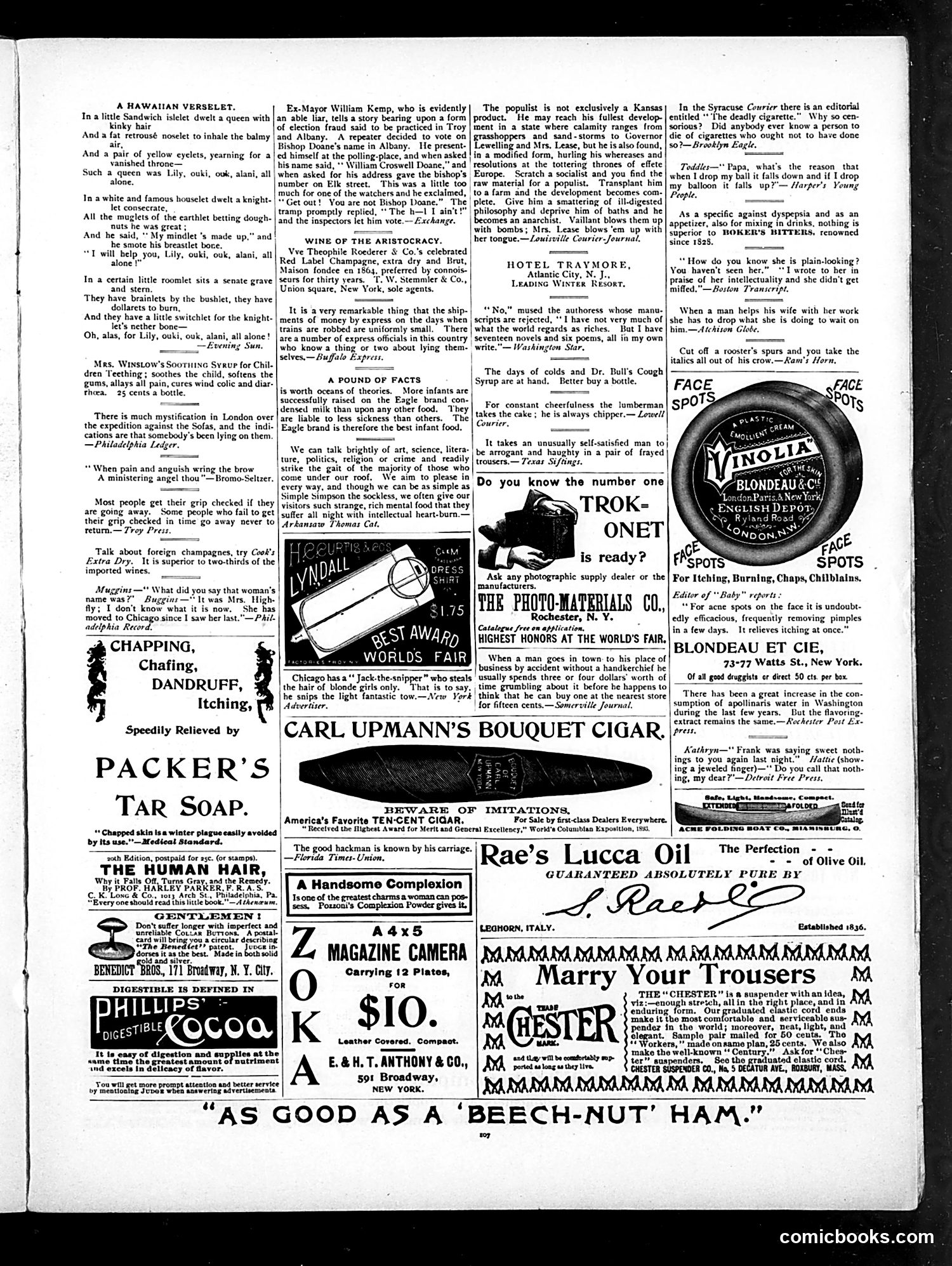
This page from *Judge* magazine contains primarily **literary humor and advertising** rather than political cartoons. The notable political content appears in **"Wine of the Aristocracy"** and scattered remarks about **populism**. One editorial excerpt criticizes populist politicians—particularly referencing Kansas populists and activist Mary Elizabeth Lease (known for her fiery rhetoric). The piece sarcastically notes that populists aren't exclusively Kansans, appearing in various forms across states, including as "anarchists" who resort to violence (referencing Auguste Vaillant, a French anarchist bomber). **"A Hawaiian Verselet"** satirizes **election fraud in New York politics**, describing a repeater voting under Bishop Doane's name in Troy/Albany—exposing corrupt voting practices of the era. The rest is period advertising (cigars, soap, cameras, olive oil) and genteel humor columns typical of *Judge's* satirical approach to American social life.
This page is primarily **advertisements and filler content** rather than substantive satire or political cartoons. The small text-based jokes scattered throughout are mild observations without clear political meaning: - **"Mr. Bull" and "Mr. Bear" dialogue** appears to be a generic market joke about selling before collapse—possibly reflecting 1894 economic anxiety, though unclear if it references specific figures or events. - **The Monte Carlo bank joke** mocks women's frivolous spending habits. - **References to degeneration** allude to contemporary pseudo-scientific anxiety about American decline, but lack specific satirical targets. The page is dominated by **commercial advertisements** for cocoa, chocolate, clothing, railroad travel to Florida, and patent medicines (Cuticura soap, Bromo-Seltzer, Angostura Bitters). This suggests the page served primarily as revenue-generating filler in *Judge* magazine rather than substantive satirical content. The few jokes are conventional period humor about marriage, money, and consumption rather than pointed political satire.
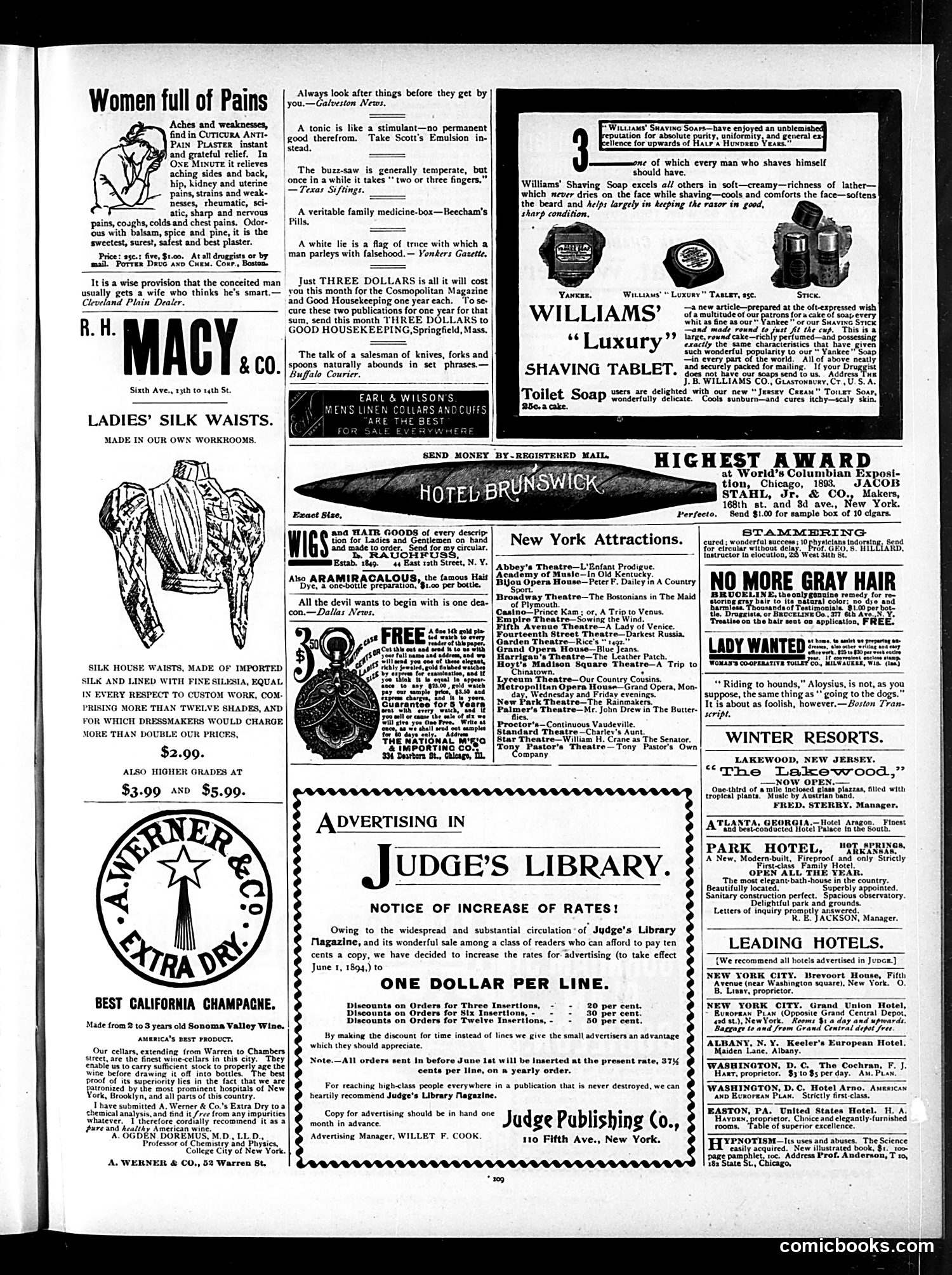
This page is primarily **advertising**, not satire or political commentary. It consists of commercial notices for consumer products popular in the late 19th/early 20th century. The top-left features a cartoon woman in pain, advertising Cuticura Anti-Pain Plaster for "women full of pains"—reflecting period attitudes that women suffered from vague ailments requiring patent medicines. Below are aphorisms (brief humorous quotes from various newspapers) interspersed with ads for silk waists, California champagne, and various toiletries including Williams' Shaving Soap and Beecham's Pills. The page represents Judge magazine's revenue model: satirical content subsidized by extensive advertising for patent medicines, luxury goods, and household products targeting middle-class consumers. The repeated messaging about women's health products reflects contemporary commercialization of women's bodies and perceived medical vulnerabilities—now historically notable as examples of outdated gender stereotyping and medicalization.
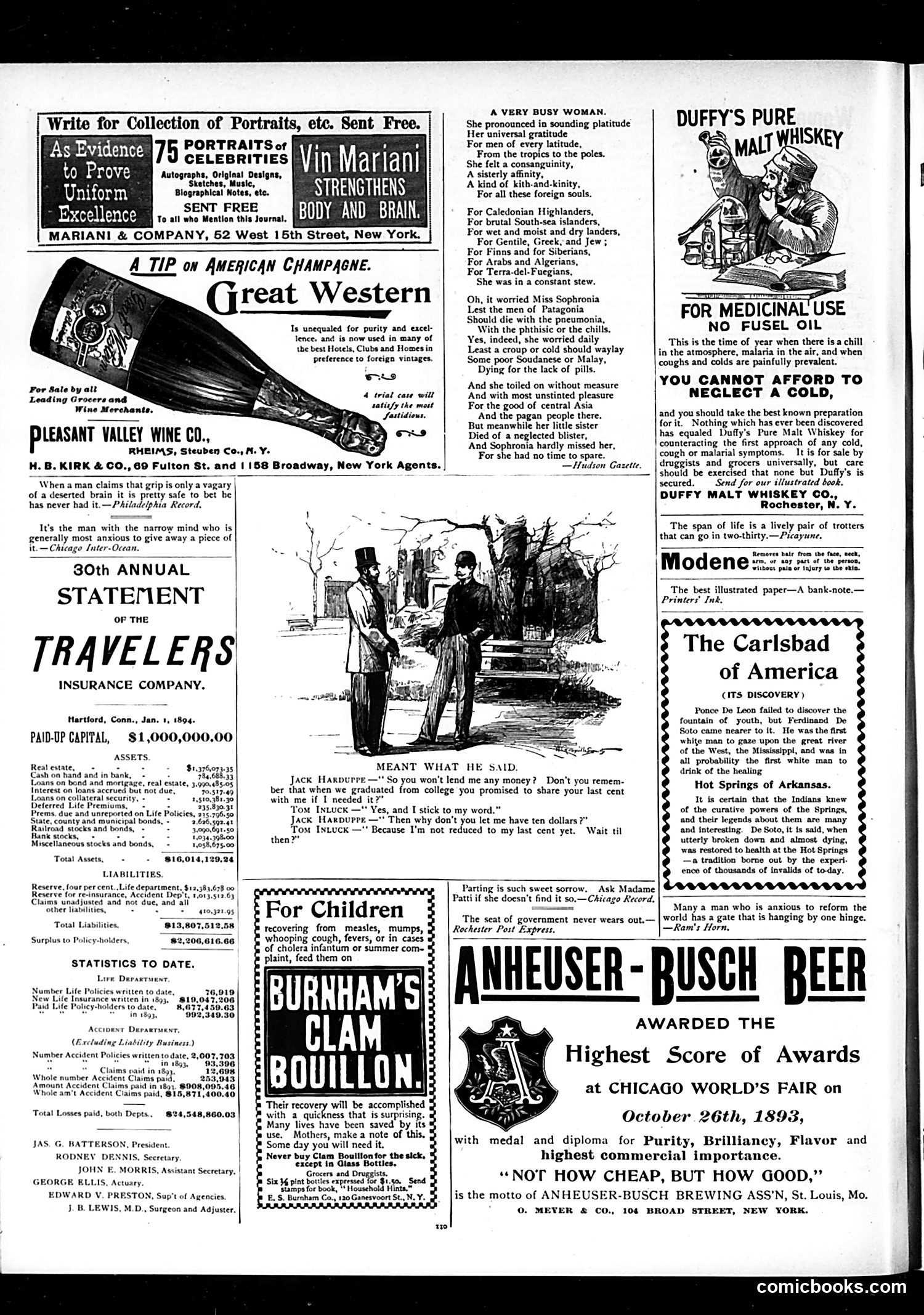
This page is primarily **advertisements and filler content** rather than political satire. The main elements are: **"A Very Busy Woman"** (center): A poem satirizing excessive cosmopolitan sentiment. Miss Sophronia worries obsessively about diseases afflicting distant peoples worldwide—Patagonians, Sudanese, Malayans—yet neglects her own sister, who dies from a simple blister. The joke targets women who performatively express universal humanitarian concern while ignoring immediate family obligations. It's gentle social satire on fashionable international benevolence. **Other content**: The page contains mostly product advertisements (Vin Mariani wine tonic, whiskey, beer), insurance company statements, and generic humorous one-liners unrelated to current events. The cartoon itself (showing two men in conversation, captioned "Meant What He Said") illustrates a joke about broken promises between college friends regarding financial aid—unremarkable period humor. No identifiable political figures or contemporary events appear on this page.
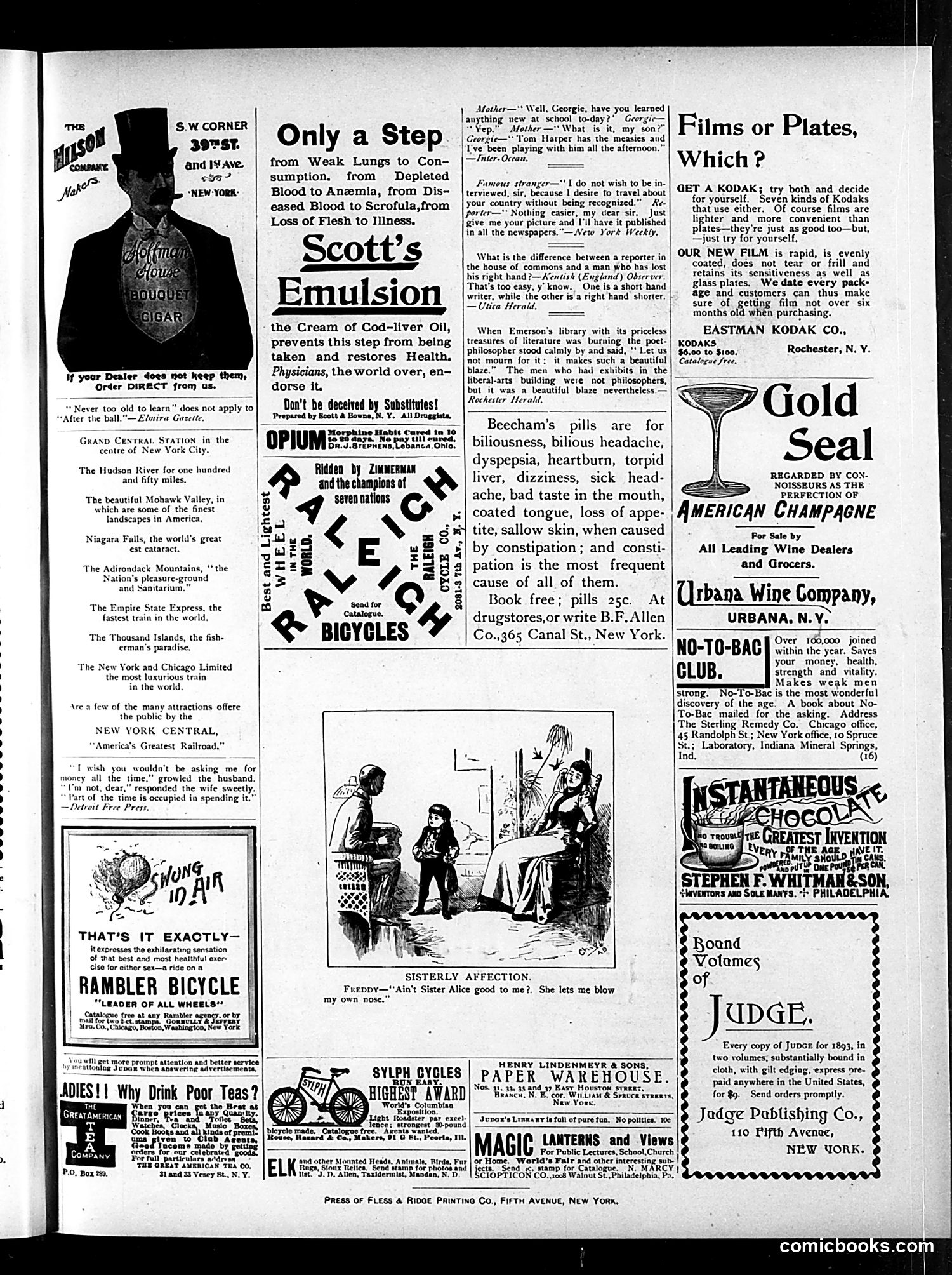
This is primarily an **advertising page** from Judge magazine, with minimal editorial content. The single cartoon present is titled "Sisterly Affection" and depicts a young boy named Freddy saying "Ain't Sister Alice good to me? She lets me blow my own nose"—a simple joke about sibling dynamics and childhood cleanliness habits, with no political significance. The page is dominated by period advertisements for consumer goods: Scott's Emulsion (cod-liver oil tonic), bicycles (Rambler, Sylph), Beecham's pills for digestive ailments, and various other products. There's also promotional content for New York Central Railroad attractions. One brief joke references Emerson's library fire, comparing reporters' reactions to philosophers' calm acceptance. Another involves a husband-wife exchange about money spending. The content reflects **late 19th-century American consumer culture and domestic humor**—nothing politically satirical or requiring historical context beyond recognizing these as period advertisements and gentle family-oriented jokes typical of the era.
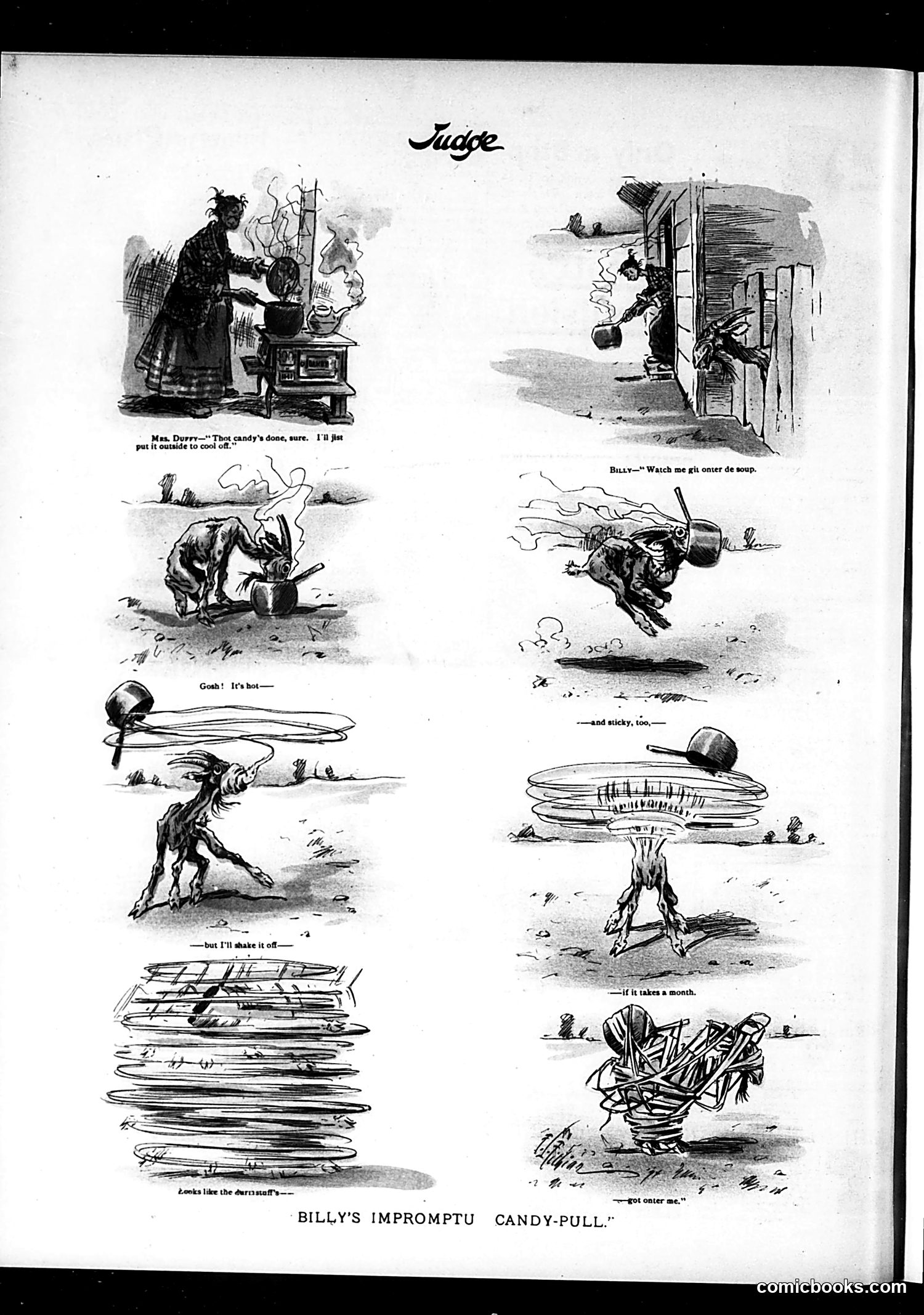
This is a humorous narrative comic strip titled "Billy's Impromptu Candy-Pull." It depicts a domestic disaster when Mrs. Durfey places hot candy outside to cool, and Billy—apparently a mischievous child or young person—interferes with it. The sequence shows the candy being stretched, then used as an impromptu flying device or catapult that launches Billy through the air into various comedic mishaps. The joke relies on slapstick humor: candy-pulling was a genuine Victorian-era confectionery activity, but here the "pull" becomes literal physical comedy as Billy gets caught up in the stretching candy and suffers absurd consequences. The humor targets both the child's mischief and the messy, chaotic results of his interference with household tasks.