
A complete issue · 52 pages · 1893
Judge — December 9, 1893
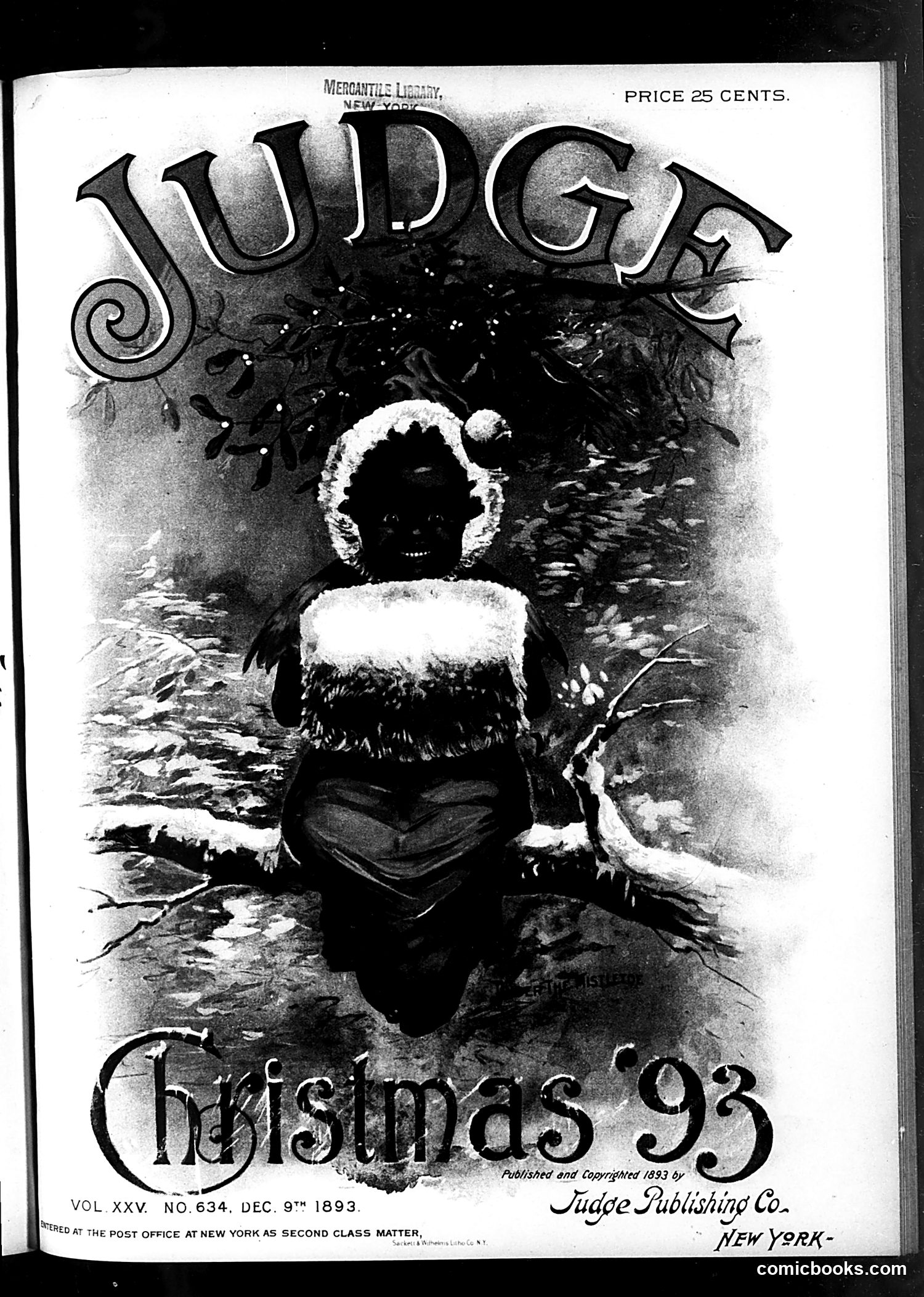
This is the December 9, 1893 Christmas issue of Judge, a satirical weekly. The cover features a grotesque skeletal figure dressed in winter clothing (fur hat and coat) emerging from a snowy, dark landscape. The figure's skull-like face grins menacingly. The imagery likely represents **Death or economic hardship** during the severe 1893 economic depression that devastated America. The "Judge Christmas '93" caption pairs this macabre imagery with the holiday, suggesting satire about grim economic conditions overshadowing Christmas celebrations that year. The stark contrast between cheerful holiday typography and the death-themed imagery creates dark humor typical of Judge's political commentary—using grotesque illustration to critique real suffering.
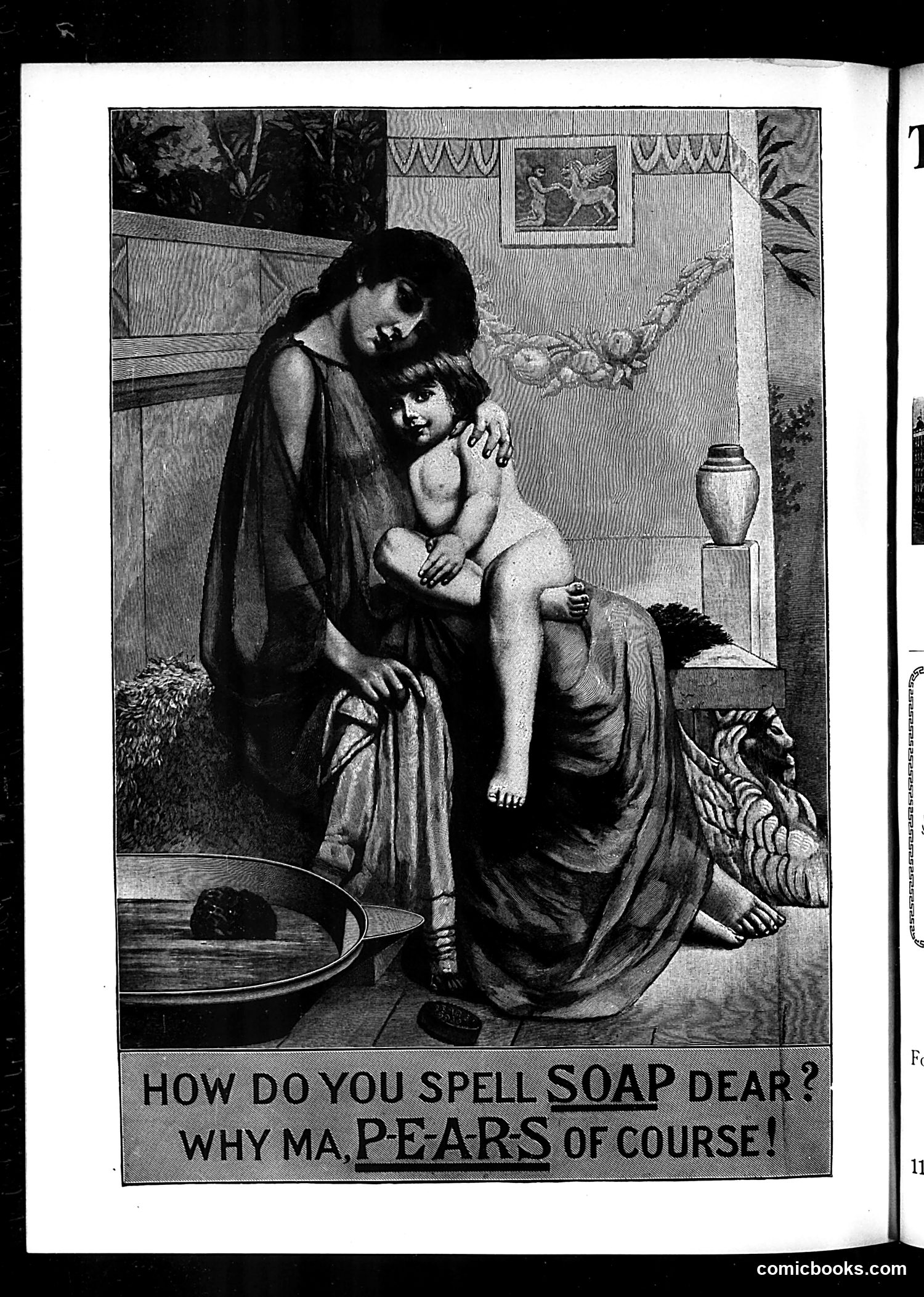
This is a Pears Soap advertisement rather than political satire. It features a classical domestic scene with a woman and child in an ancient Roman or Greek interior setting, complete with decorative urns and wall hangings. The wordplay centers on spelling: "How do you spell SOAP dear? Why Ma, P-E-A-R-S of course!" This pun plays on the product name (Pears) sounding like "pairs," suggesting mothers would naturally associate the brand with proper child-rearing and domestic virtue. The classical aesthetic and idealized figures were common advertising strategies of this era, positioning soap as a civilizing, refined product linked to cleanliness, motherhood, and genteel domesticity. The humor relies on the obvious visual/auditory pun rather than social commentary.
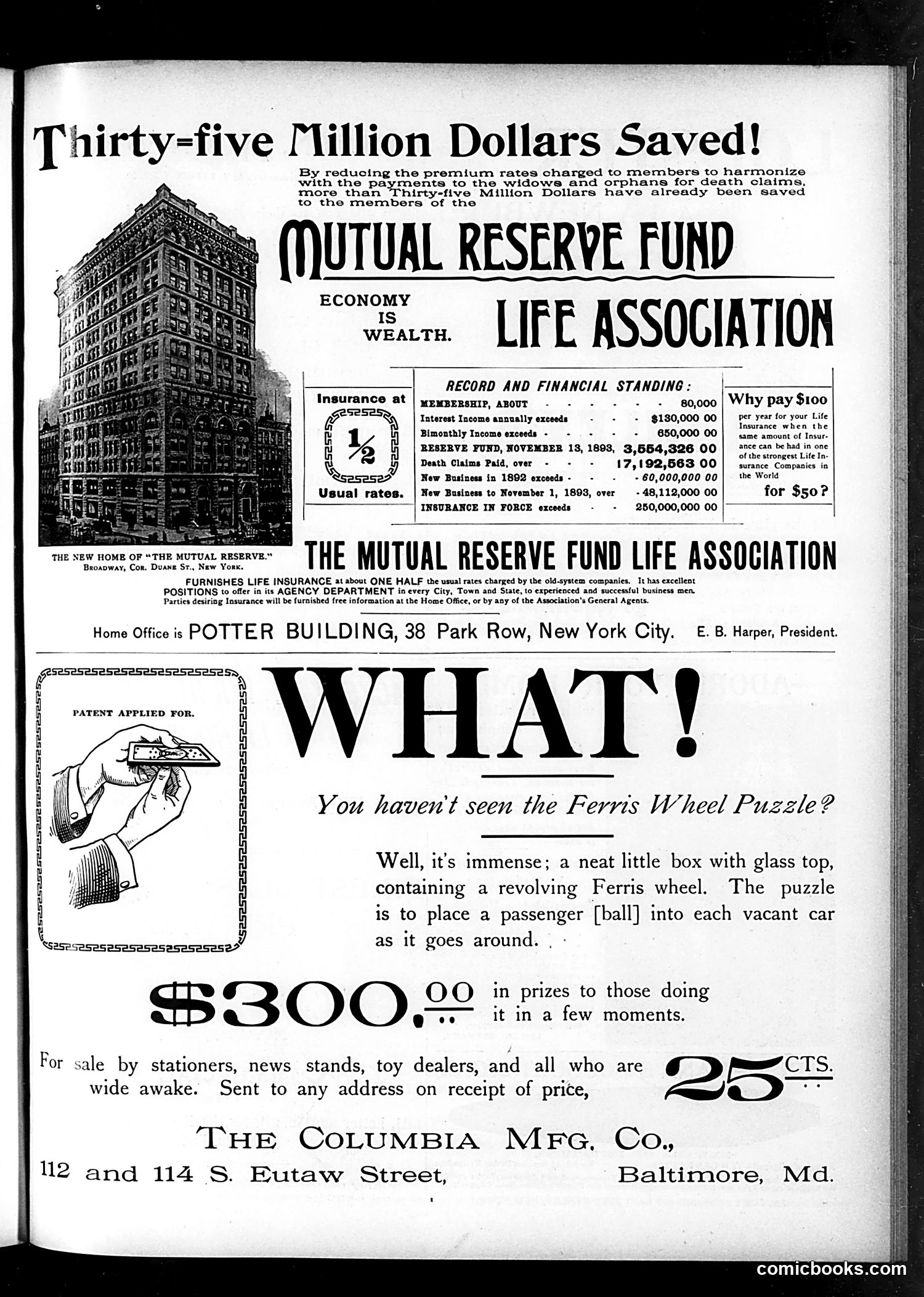
This page contains primarily **advertisements rather than political cartoons**. The dominant content is a full-page ad for the Mutual Reserve Fund Life Association, highlighting "$35 Million Dollars Saved" through reduced insurance premiums. The ad includes their Potter Building headquarters in New York City and financial statistics from November 1893. Below that is a separate advertisement for the **Ferris Wheel Puzzle**—a mechanical toy featuring a revolving Ferris wheel where players place balls in moving cars. Made by Columbia Manufacturing Co. in Baltimore, it sold for 25 cents with $300 in potential prizes. Neither section contains political satire or caricature. This appears to be a typical late-19th-century magazine page mixing insurance marketing with novelty toy promotion.
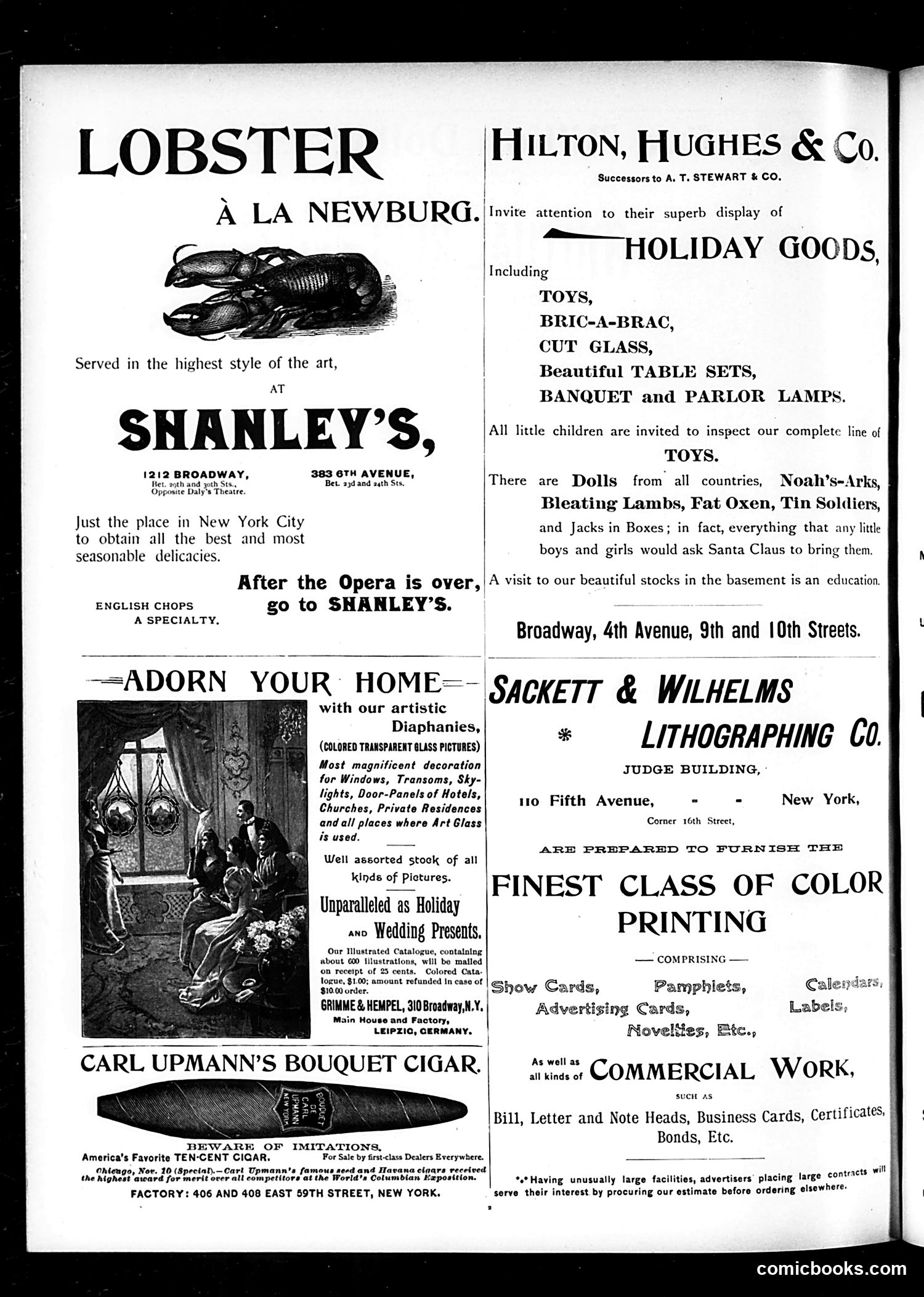
This page is **primarily advertising**, not satirical content. It features commercial advertisements typical of late 19th-century magazines, including: - **Shanley's restaurants** (two locations) promoting lobster and fine dining, with a note to visit "after the opera" - **Grimme & Hempel** selling colored glass decorative panels (diaphanies) for home and institutional use - **Carl Upmann's Cigar** advertising a ten-cent cigar that won awards at the World's Columbian Exposition - **Hilton, Hughes & Co.** (successor to A.T. Stewart department store) promoting holiday toys and home goods - **Sackett & Wilhelms Lithographing** offering color printing services The single illustration shows an ornate interior scene with figures in Victorian dress, likely advertising the glass decorations' aesthetic appeal. **No political satire is evident.** This represents Judge functioning as a commercial vehicle, mixing editorial content with paid advertising—standard magazine practice of the period.
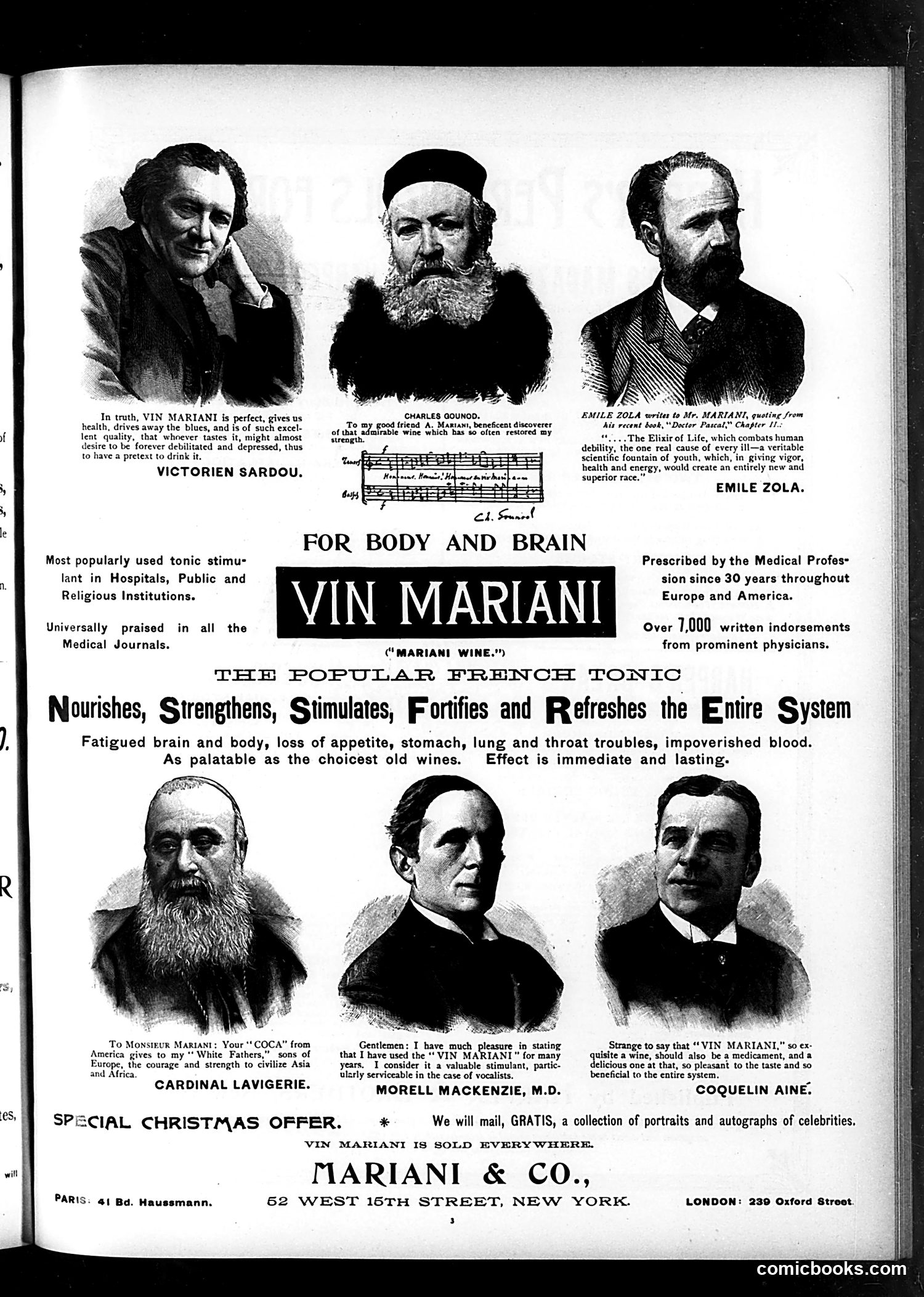
This page is primarily a **patent medicine advertisement**, not political satire. It promotes Vin Mariani, a French wine tonic containing coca leaf extract, popular in the late 19th century. The celebrity endorsements are genuine testimonials from famous figures: composer Charles Gounod, author Émile Zola, playwright Victorien Sardou, Cardinal Lavigerie, opera singer Coquelin Aîné, and physician Morell Mackenzie. Each praises the tonic's supposed medicinal benefits for fatigue, appetite loss, and general vigor. The humor, if any, is unintentional—modern readers recognize this as absurd medical pseudoscience. The product's coca extract would eventually be removed when cocaine's dangers became apparent. What reads as sincere marketing of a "scientific fountain of youth" now appears as comedic quackery, though Judge's audience would have found such endorsements credible.
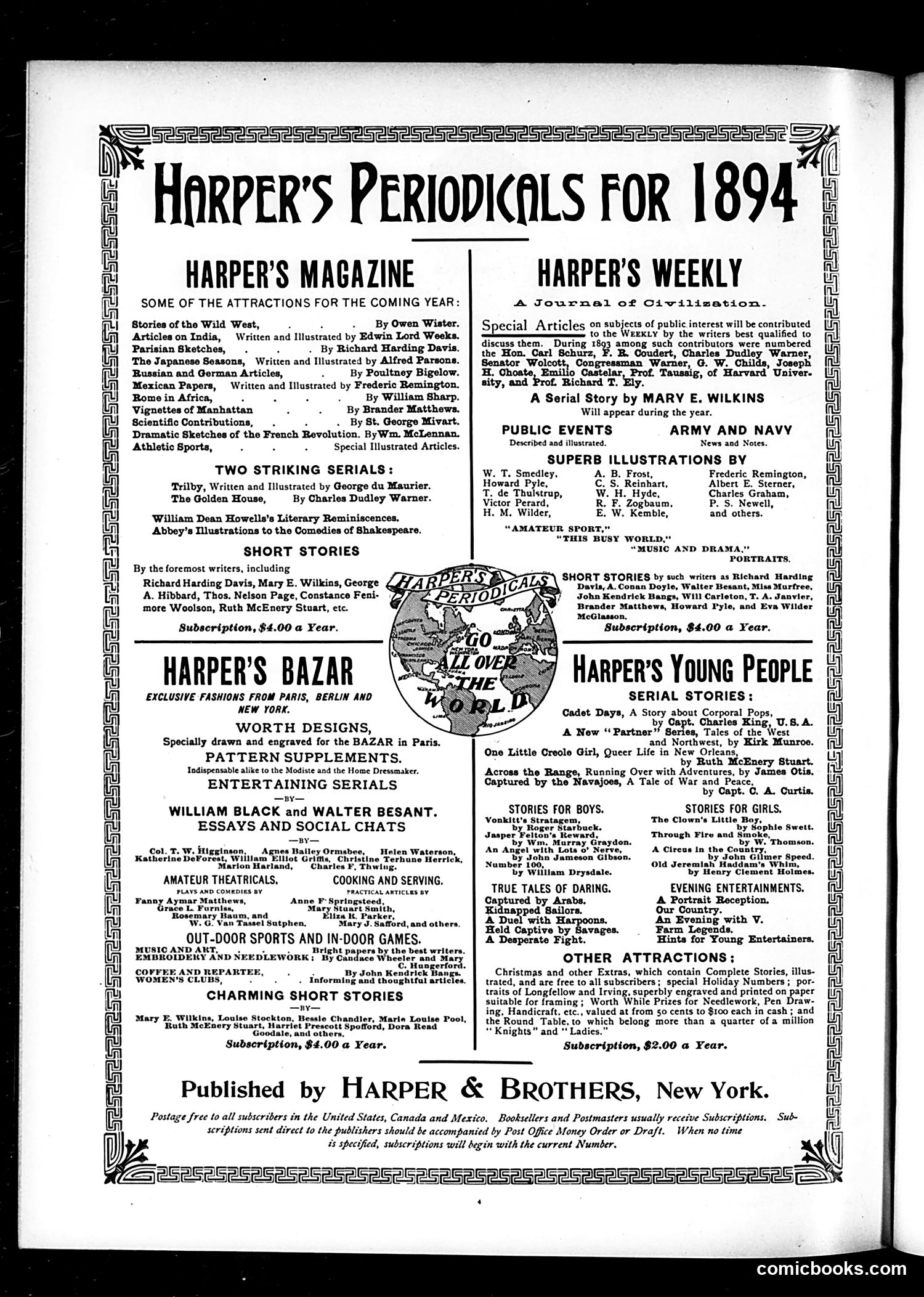
This page is primarily **advertising** rather than political commentary. It's a prospectus for Harper & Brothers' five periodical publications launching in 1894. The content lists prestigious contributors and serialized works to attract subscribers. Notable names include Owen Wister (Western fiction), Richard Harding Davis (foreign correspondence), and George du Maurier (whose serial *Trilby* was a major literary event). The advertisements emphasize Harper's access to elite writers and illustrators. The circular logo reading "Harper's Periodicals All Over the World" suggests the company's global reach. Subscription costs ranged from $2-$4 annually—substantial for the era. This reflects the **"Gilded Age" publishing boom**, when illustrated magazines were primary news and entertainment sources. The emphasis on quality writing, fashion supplements, and illustrated journalism shows how periodicals competed for middle and upper-class readers during the 1890s.
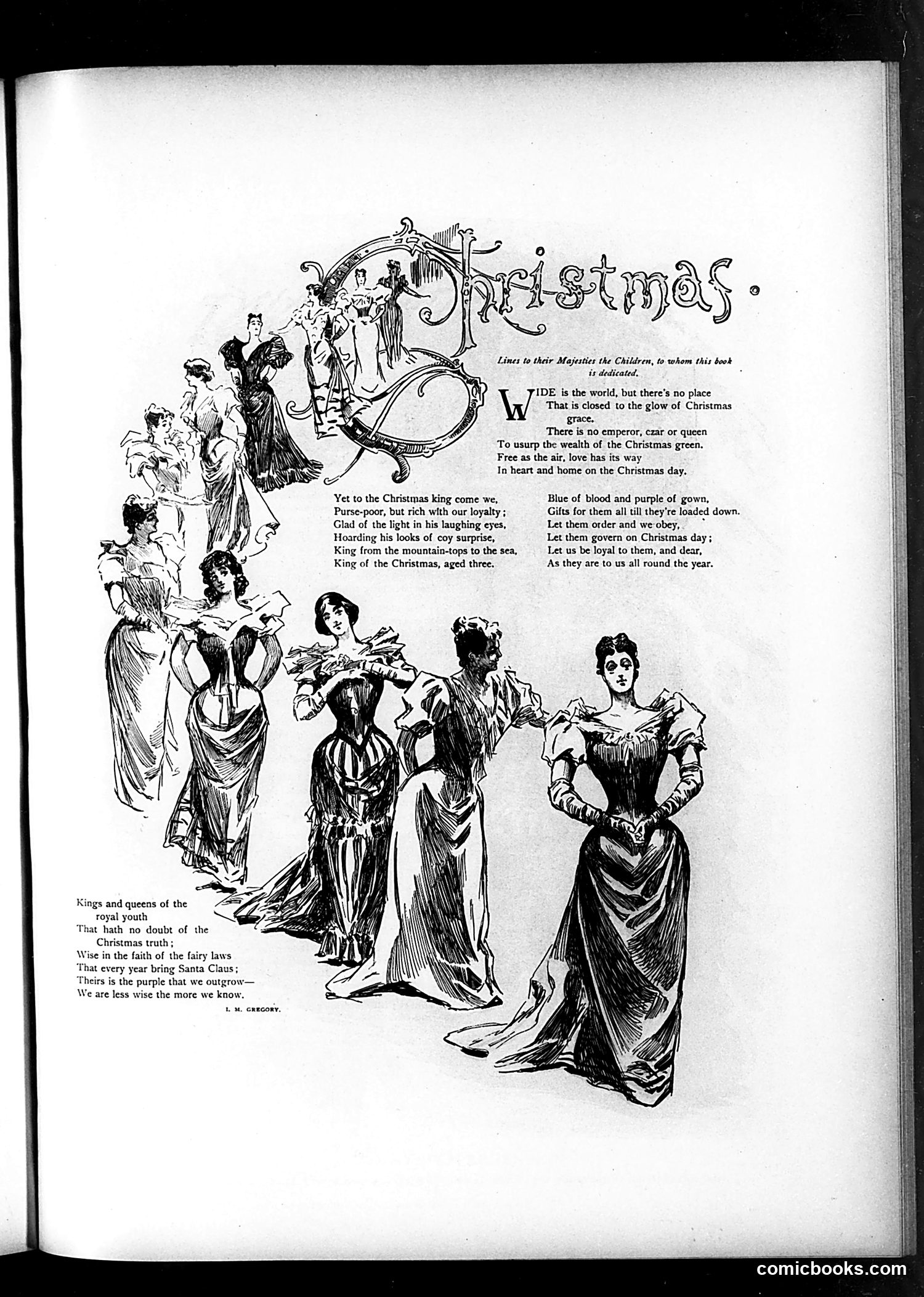
This is a sentimental Christmas poem celebrating childhood innocence, illustrated with elegantly dressed women and children. The text is dedicated to "their Majesties the Children," personifying a young child (apparently aged three) as the "Christmas king." The satire is gentle: it contrasts children's pure faith in Christmas magic—their belief in Santa Claus and fairy tales—with adults' worldly cynicism. The poem argues that children possess a superior wisdom that educated adults have lost ("We are less wise the more we know"). The elegantly gowned female figures surrounding the child-king represent adult society pledging loyalty to childhood's superior moral clarity and wonder. This reflects late Victorian/Edwardian sentimentalism about children as vessels of truth and innocence—a common theme in Judge's holiday content, which often mocked adult pretension while celebrating childlike virtue.
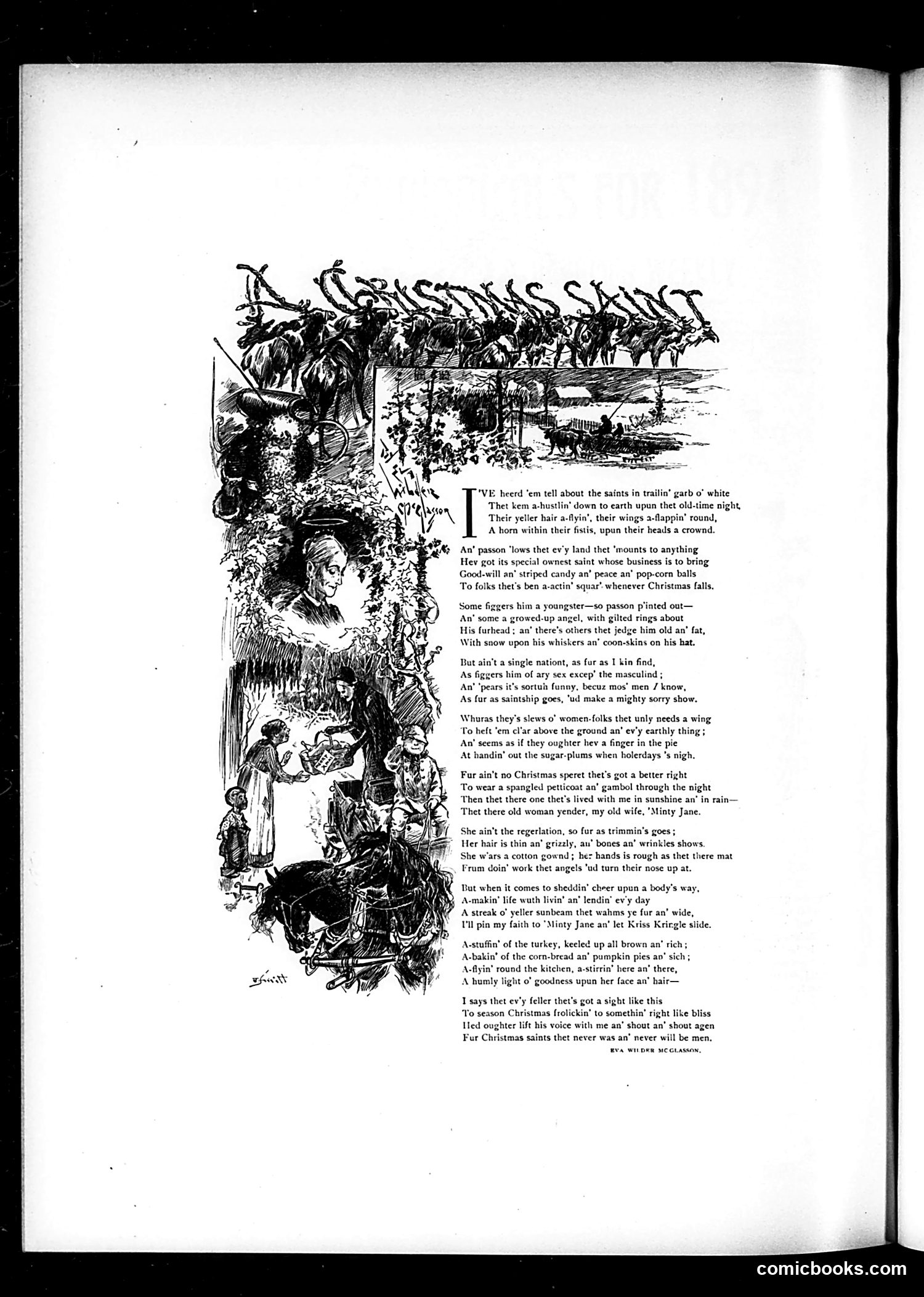
This sentimental poem, illustrated with folksy domestic scenes, makes a social argument about female virtue disguised as rustic humor. The piece critiques the masculine monopoly on saint imagery—every culture depicts Saint Nicholas/Christmas spirits as male, the narrator observes. Yet women, he argues, deserve equal recognition: they perform "saintly" labor daily (cooking, cleaning, spreading cheer) that angels themselves would reject. The satire targets both gender conventions and religious iconography. While mocking formal religion ("passon says"), the author ironizes that women like his wife "Minty Jane"—plain, aged, work-worn—embody genuine Christian virtue more authentically than idealized male saints. Her "humly light o' goodness" surpasses Kris Kringle's theatrical charity. This reflects Progressive-era sentiment: celebrating women's unpaid domestic labor as morally superior while still confining them to the home. The humor masks an unequal bargain—women as unsung moral anchors rather than equal participants.
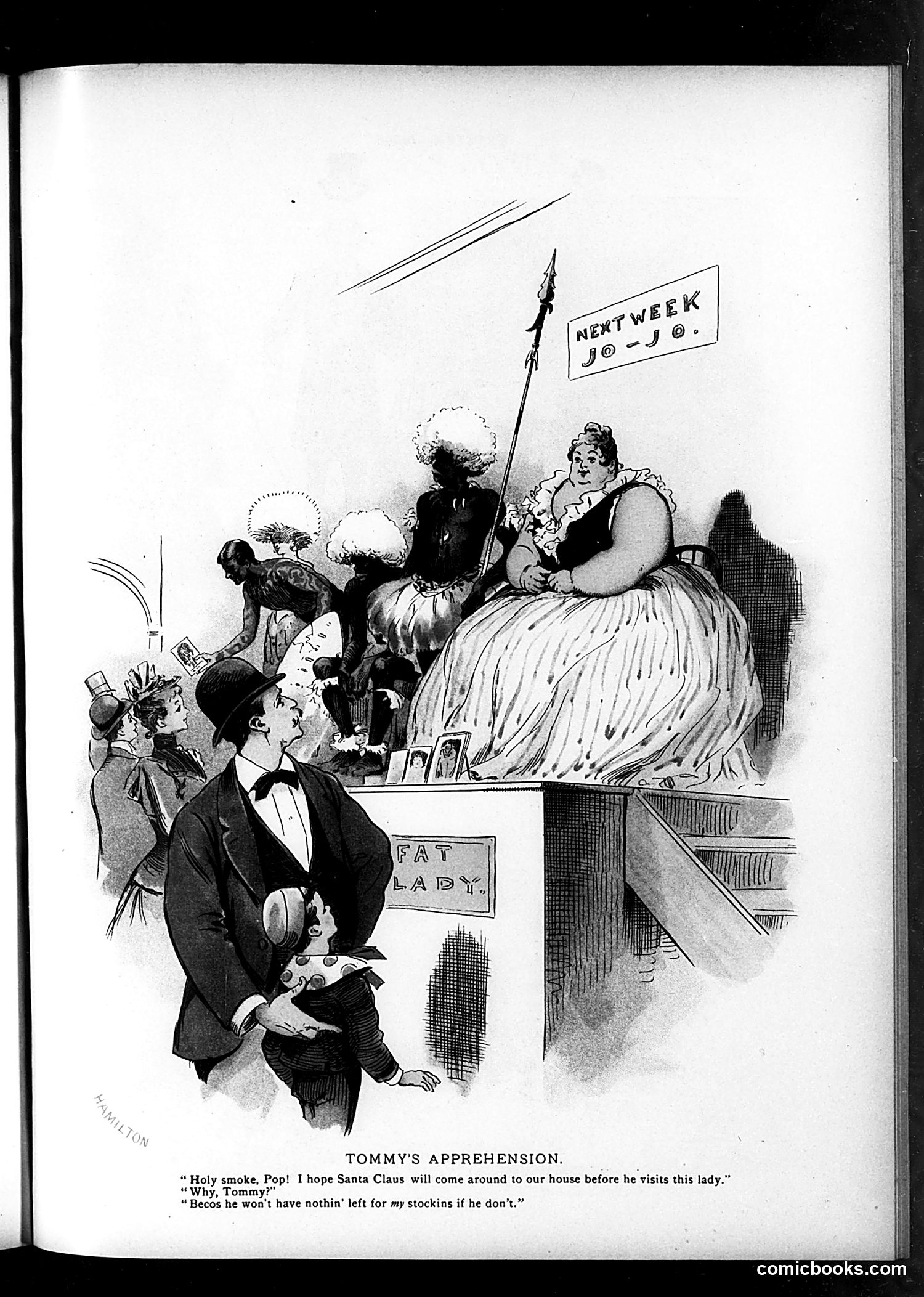
This cartoon satirizes obesity through a child's innocent observation. Young Tommy expresses worry that Santa Claus will deplete his gift supply before reaching their house—because the "Fat Lady" on display (likely a circus or sideshow attraction, as indicated by the booth label) is so enormous she'll consume all available presents. The joke relies on period stereotypes about overweight people being greedy or gluttonous. The humor comes from Tommy's naive logic: he assumes the woman's size means she'll receive so many gifts that none will remain for him. This reflects early-20th-century attitudes toward body diversity and public displays of people with atypical physiques as carnival attractions—now recognized as dehumanizing.
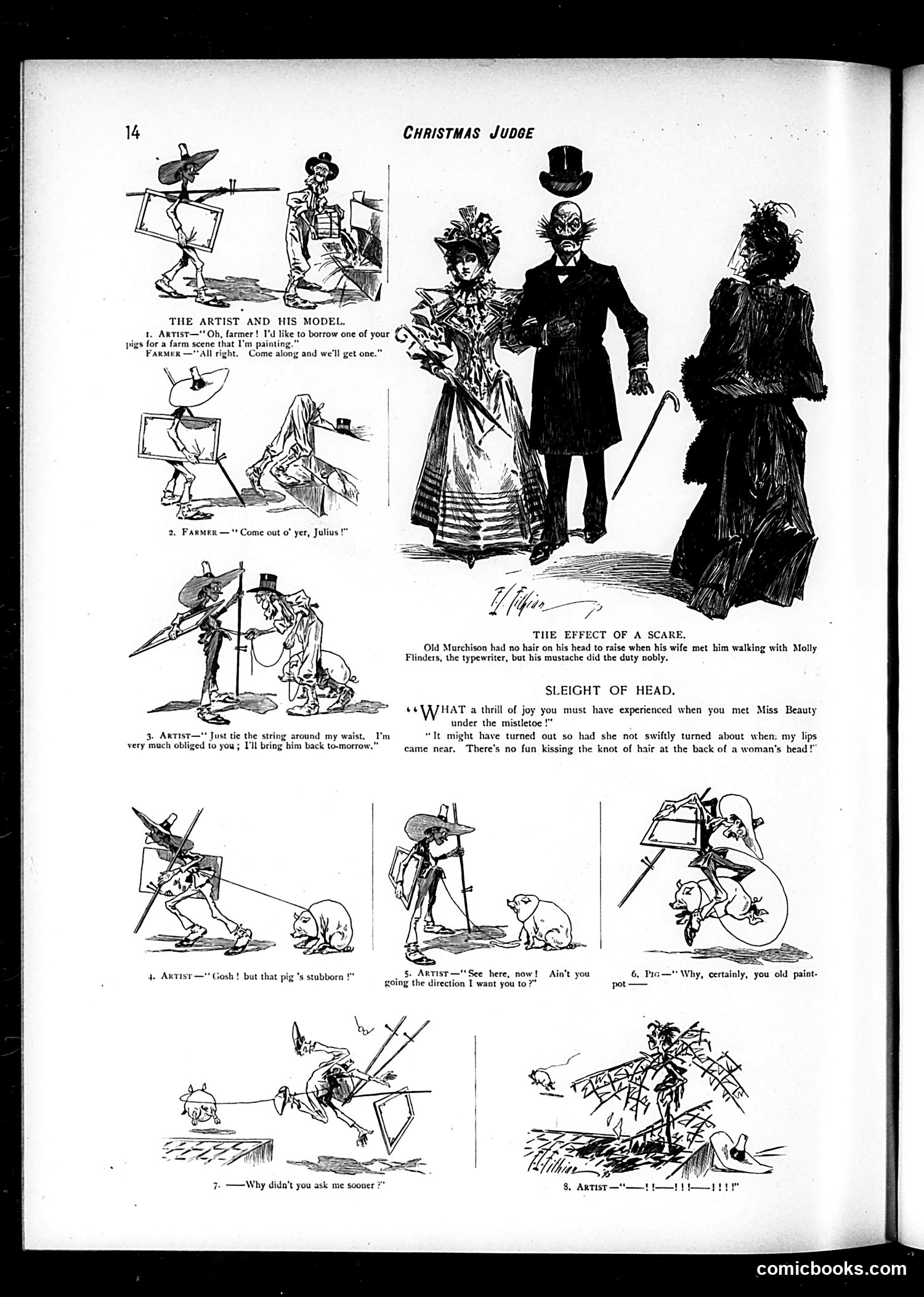
This page contains multiple unrelated comic strips satirizing everyday situations common to the era. **"The Artist and His Model"** mocks artistic pretension. An artist attempts to borrow a farmer's pig as a model for a painting, then struggles comically to control it—the "model" refuses direction, gets tangled in rope, and creates chaos. The satire targets pompous artists who treat their work as high art while dealing with mundane, uncooperative reality. **"The Effect of a Scare"** jokes about a bald man whose mustache rises involuntarily when startled—a visual gag about involuntary physical reactions to shock. **"Sleight of Head"** plays on mistletoe-kissing mishaps: a man complains that his kiss landed on the back of a woman's hair knot rather than her lips because she turned away at the last moment—poking fun at awkward romantic encounters. All strips use slapstick humor and physical comedy typical of early 20th-century American humor magazines aimed at middle-class audiences.
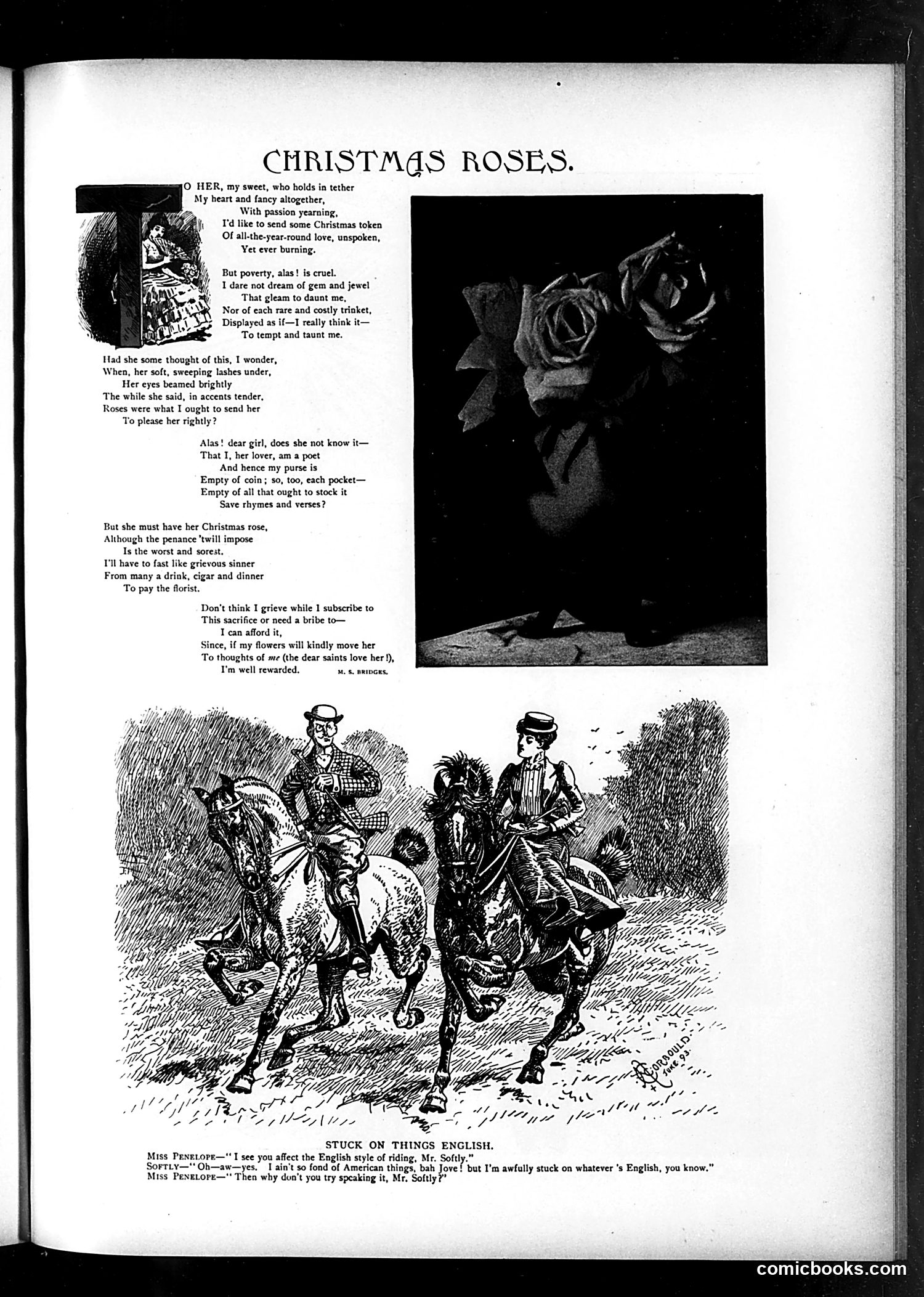
**"Christmas Roses"** (top): A sentimental poem about a poor poet who cannot afford expensive Christmas gifts for his beloved, but manages to send roses by sacrificing meals and luxuries. The satire is gentle—mocking romantic pretension and the poet's elaborate self-pity over modest financial constraints. The accompanying photograph of roses illustrates the gift mentioned. **"Stuck on Things English"** (bottom): This cartoon ridicules an Americanized man (Mr. Softly) who affects English mannerisms and speech ("bah Jove!"). Miss Penelope points out his hypocrisy: he claims to prefer English things yet speaks with an unconvincing or garbled English accent. The satire targets Americans who ape British affectations while failing to authentically adopt them—a common Judge theme mocking cultural pretension and social climbing. Both items exploit class anxiety and romantic/social aspiration for humor.
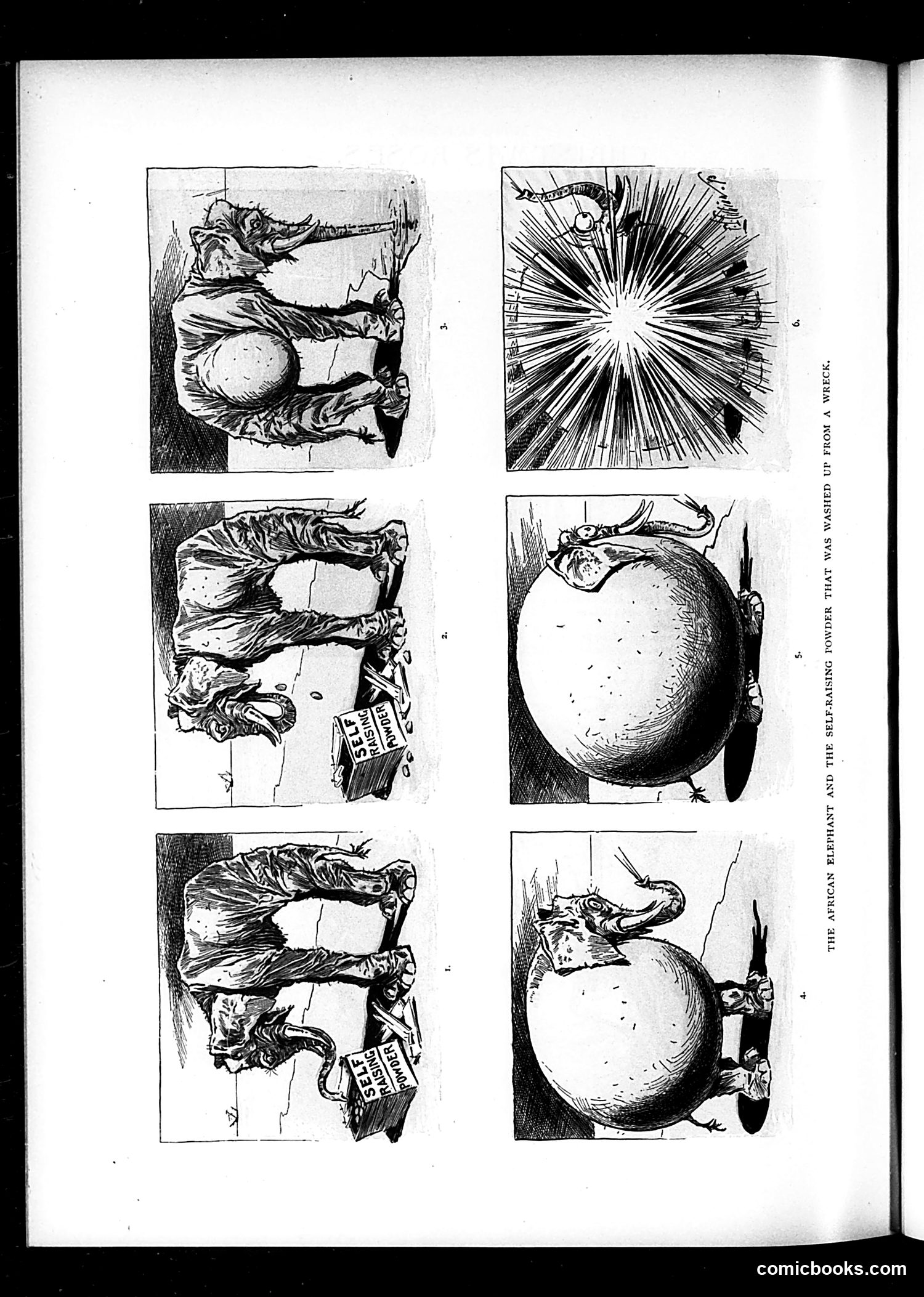
I can see this page contains satirical illustrations, but the OCR text is corrupted/reversed and unreadable, making it impossible to identify the specific political figures, events, or context being referenced. The images show caricatured figures in various poses—some appearing distressed or explosive (note the radiating lines suggesting force or chaos in the upper right), and figures interacting with large spherical objects. The style is consistent with late 19th/early 20th-century American political satire. Without legible text identifying the subjects, dates, or events, I cannot accurately explain what specific political or social commentary this cartoon intended. To properly interpret this Judge magazine page, I would need either clearer OCR text or additional publication information.
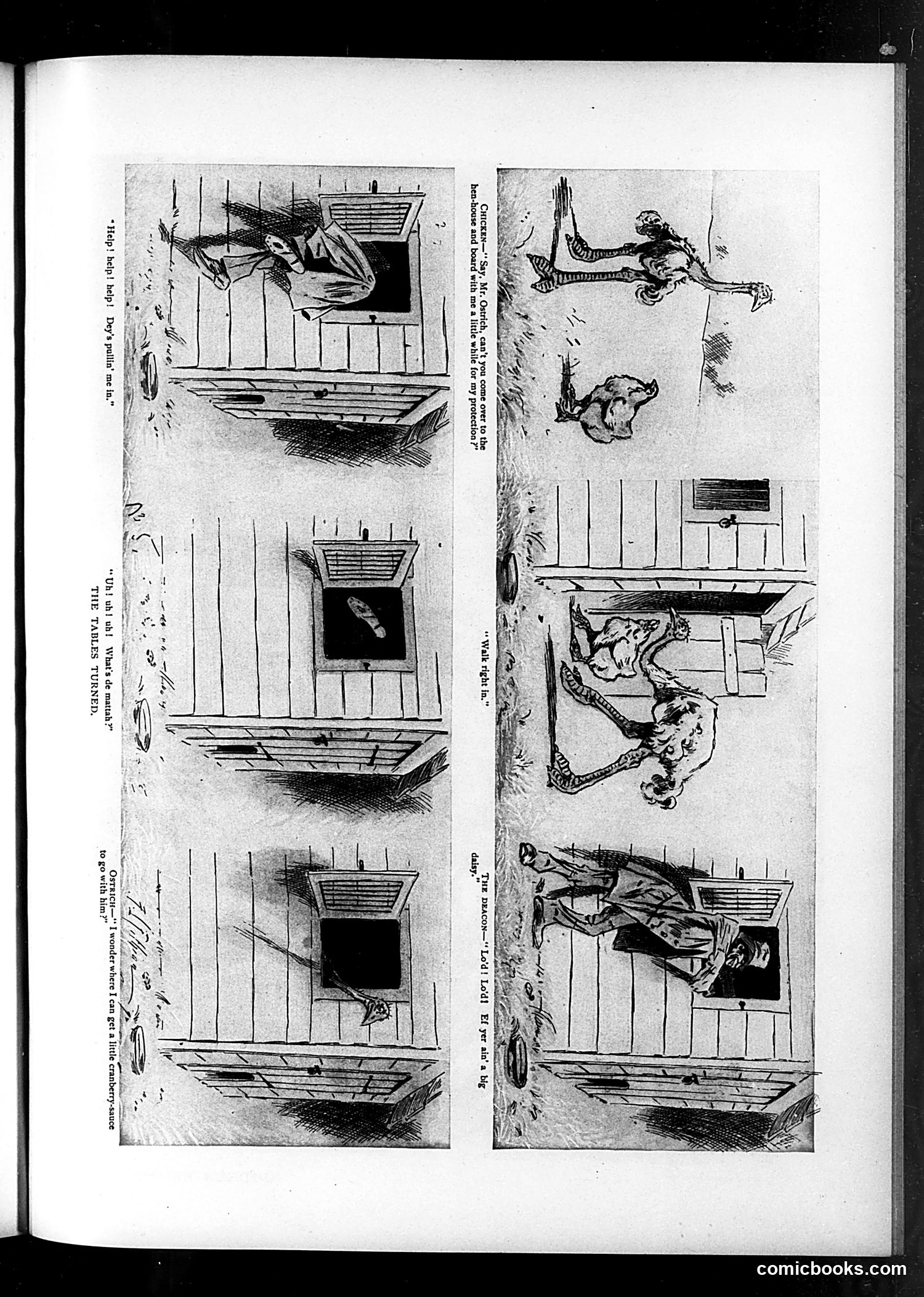
This cartoon satirizes a reversal of power dynamics, likely political. An ostrich (representing a figure of authority or strength) is asked by a chicken (representing someone weaker or subordinate) for protection—a humorous inversion since ostriches are larger birds. The dialogue "Help! help! Dey's pullin' me in" and the physical struggle depicted suggest the ostrich is being forcibly drawn into the hen-house despite its size advantage. "The Tables Turned" reinforces this theme of role reversal. The phonetic dialect ("Dey's," "Uh! uh!") was common in period humor, though reflects offensive stereotyping conventions of early 20th-century American satire. Without clearer identification of the specific political figures or moment referenced, the exact target remains unclear—but the core joke concerns unexpected loss of power or authority by the apparently stronger party.
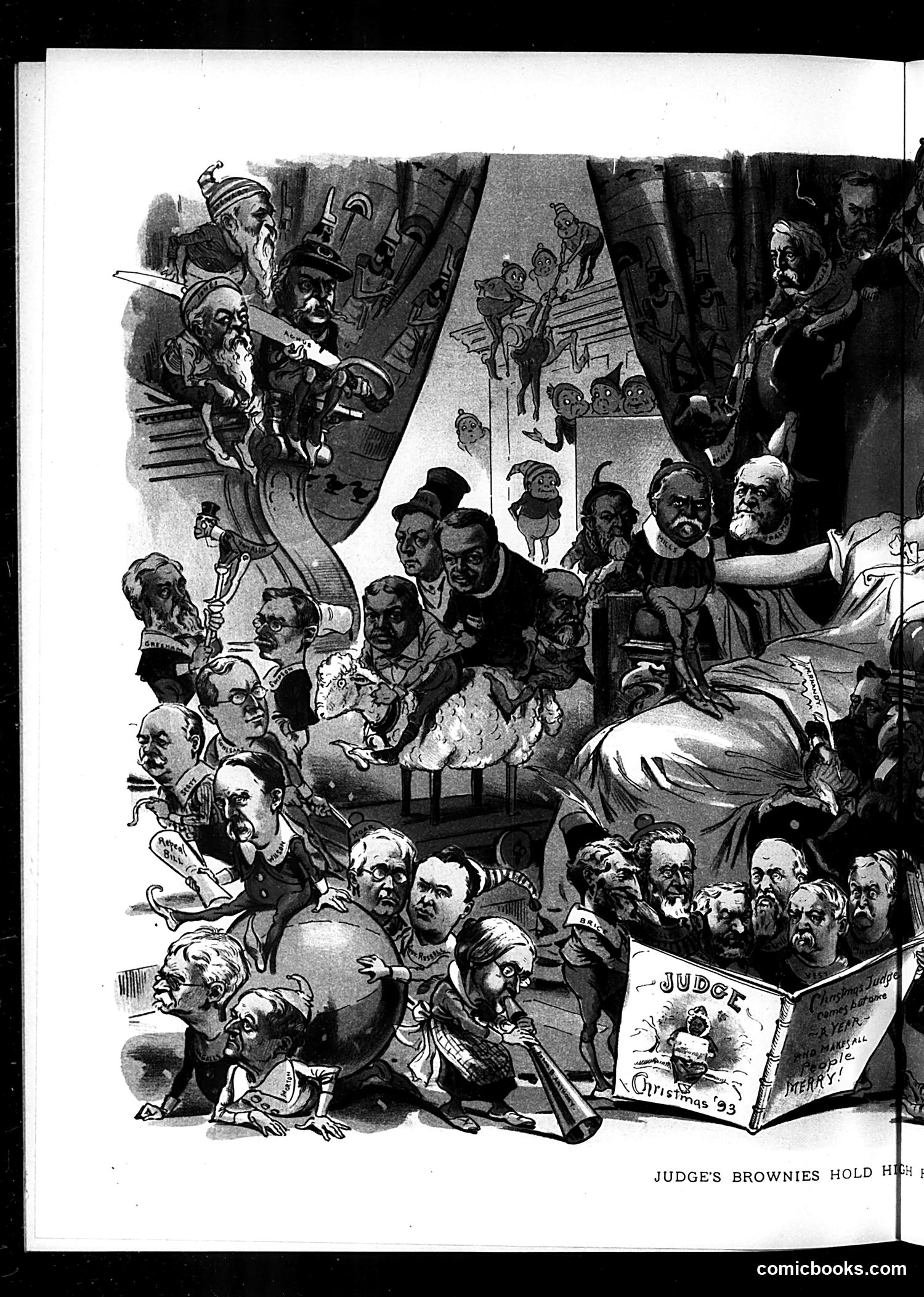
This is a satirical cartoon from *Judge* magazine (Christmas 1893, based on visible text). The composition depicts a chaotic gathering of exaggerated caricatured figures—politicians, military men, and public figures of the era—crowded around what appears to be a central scene or structure. The title "Judge's Brownies Hold High" likely references the popular "brownie" tradition in late Victorian culture (small magical creatures from folklore, popularized in children's literature). The cartoon appears to satirize prominent political or social figures of 1893 America through grotesque caricature and crowded composition—a typical *Judge* approach to mocking contemporary leadership and society. Without clearer identification of specific figures, the exact political targets remain unclear to modern viewers.
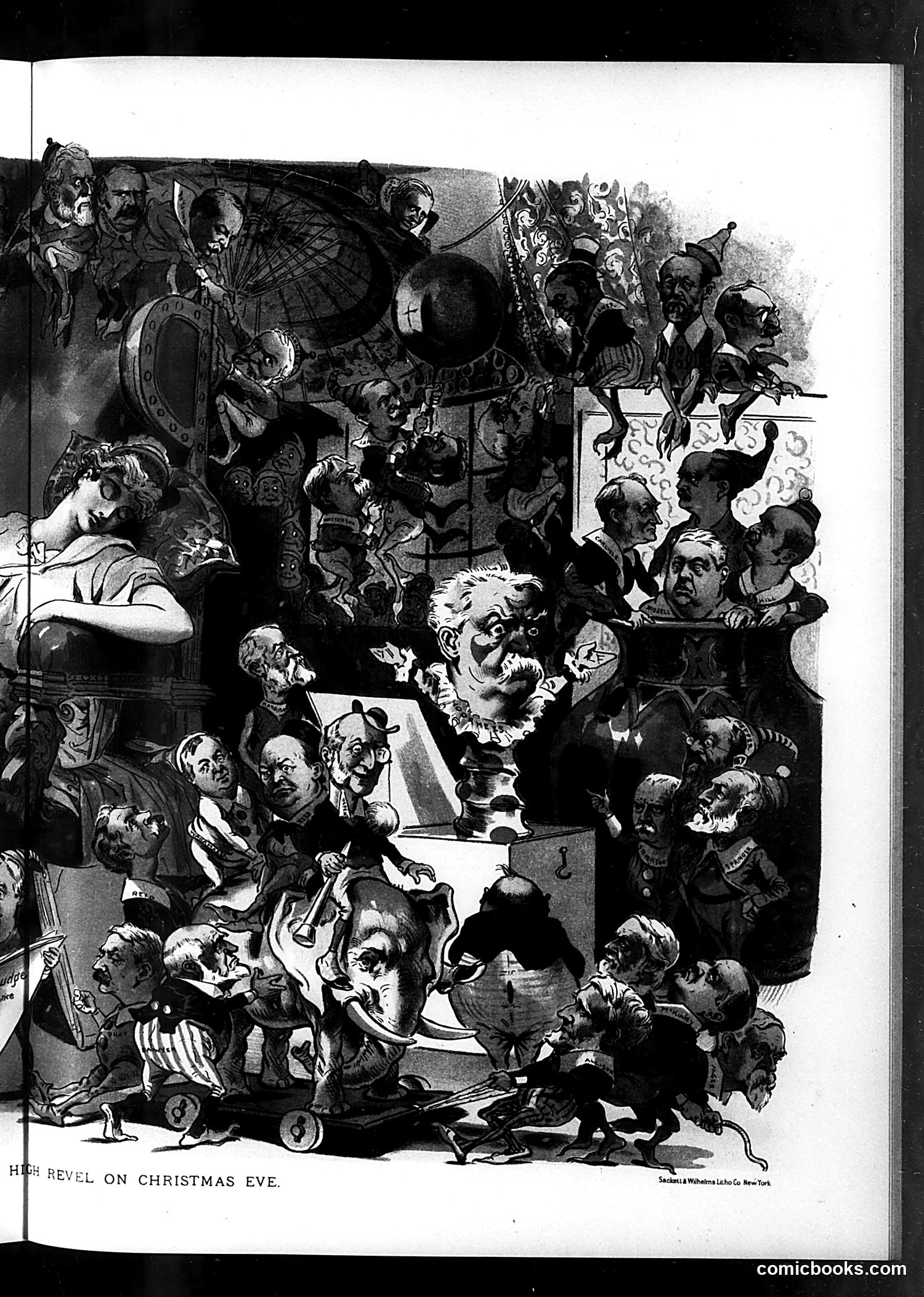
This satirical engraving depicts a chaotic Christmas celebration among what appear to be political and social figures of the era. The densely packed composition shows numerous caricatured faces—some appearing grotesque or exaggerated—engaged in raucous merrymaking around a central scene. The style suggests 19th-century satirical commentary on excess and moral hypocrisy. The title suggests the cartoon mocks how certain elite or political figures celebrate Christmas with unseemly "revelry" rather than the holiday's spiritual values. Without identifying specific individuals, the caricatures and crowded composition typical of Judge magazine indicate this critiques particular politicians, society members, or institutions engaged in undignified behavior. The artistic style and publication origin (Sackett & Wilhelms, New York) confirms this is period American political satire.
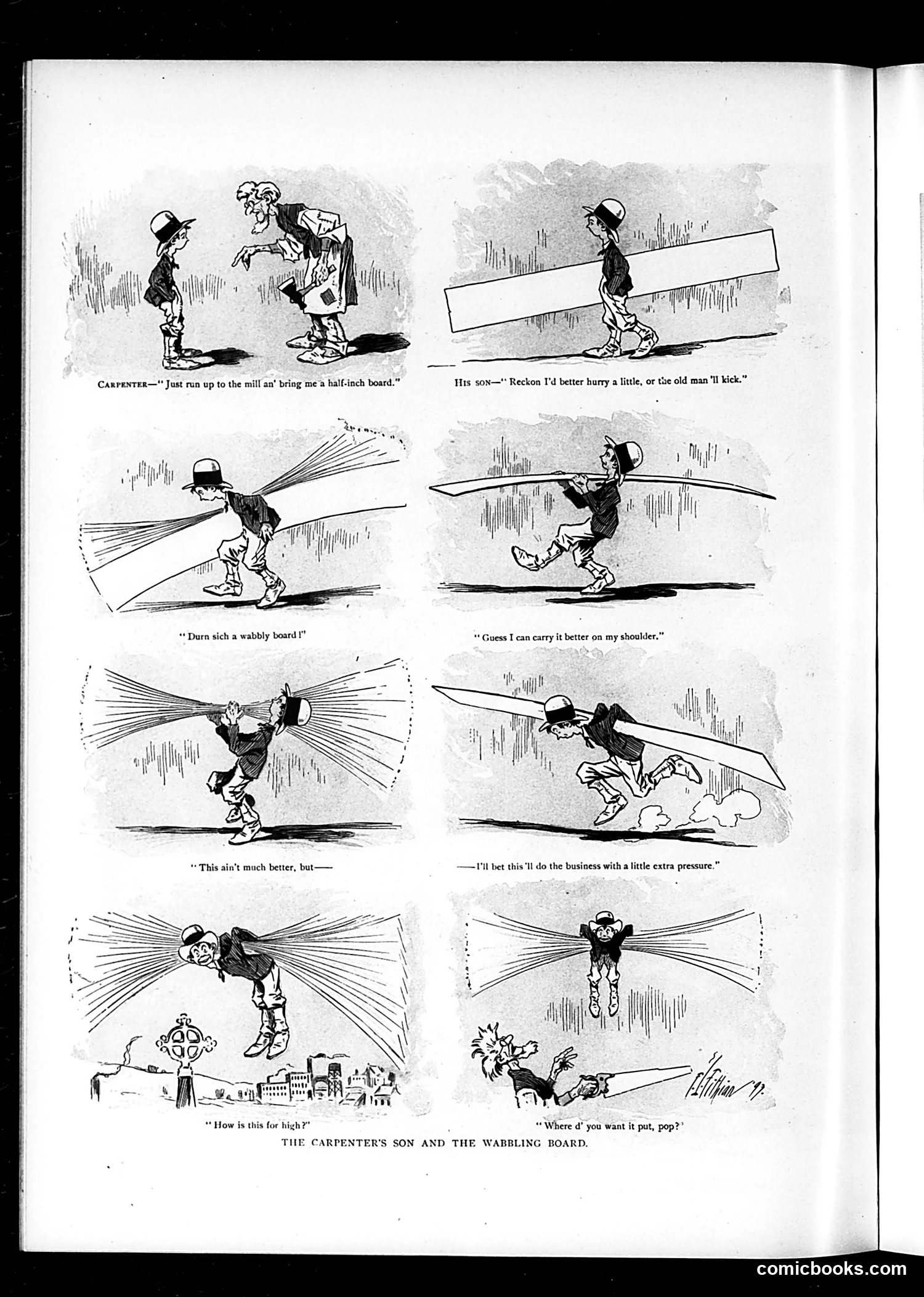
This is a humorous comic strip titled "The Carpenter's Son and the Wabbling Board," depicting a boy attempting to carry a wooden board in increasingly absurd ways. The joke is straightforward slapstick: the carpenter's son tries various methods to transport a wobbly board—as a half-inch board, buried partially, on his shoulder, balanced on his head, with exaggerated pressure, and finally flying through the air—all while struggling with its unwieldy nature. The final panel shows the board airborne with the boy asking his father where to put it. The humor relies on visual comedy and the boy's escalating desperation rather than political satire. The title's reference to "carpenter's son" appears to simply establish the character's background rather than invoke religious allegory. This is entertainment-focused rather than socially or politically pointed.
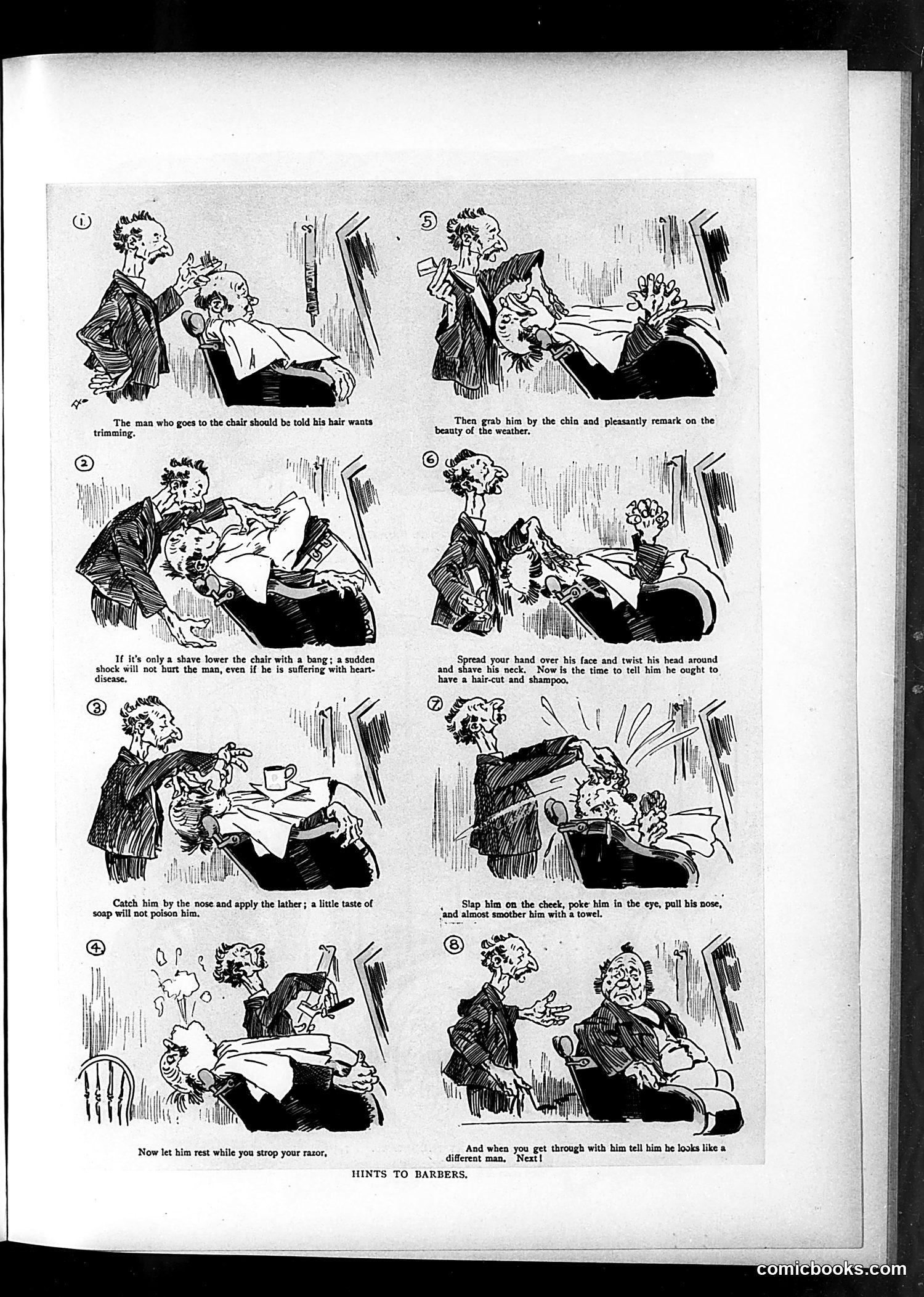
This is a humorous instructional comic mocking barber shop practices of the era. Rather than offering genuine customer service advice, it presents an absurdly rough, aggressive approach to barbering as if it were standard procedure. The eight panels depict increasingly ridiculous and painful "techniques": lowering the chair suddenly to shock customers, forcing soap into mouths, twisting heads violently, poking eyes, and nearly suffocating clients with towels. The final panel shows the barber claiming the mistreated customer looks "like a different man." The satire targets barbers' actual cavalier treatment of customers—suggesting they were often careless, rough, and dismissive. By presenting this brutish behavior as official "hints," Judge magazine ridicules both barbering standards and customers who tolerated such treatment. The joke relies on readers recognizing these exaggerated actions as distortions of genuine complaints about barber shop conduct.
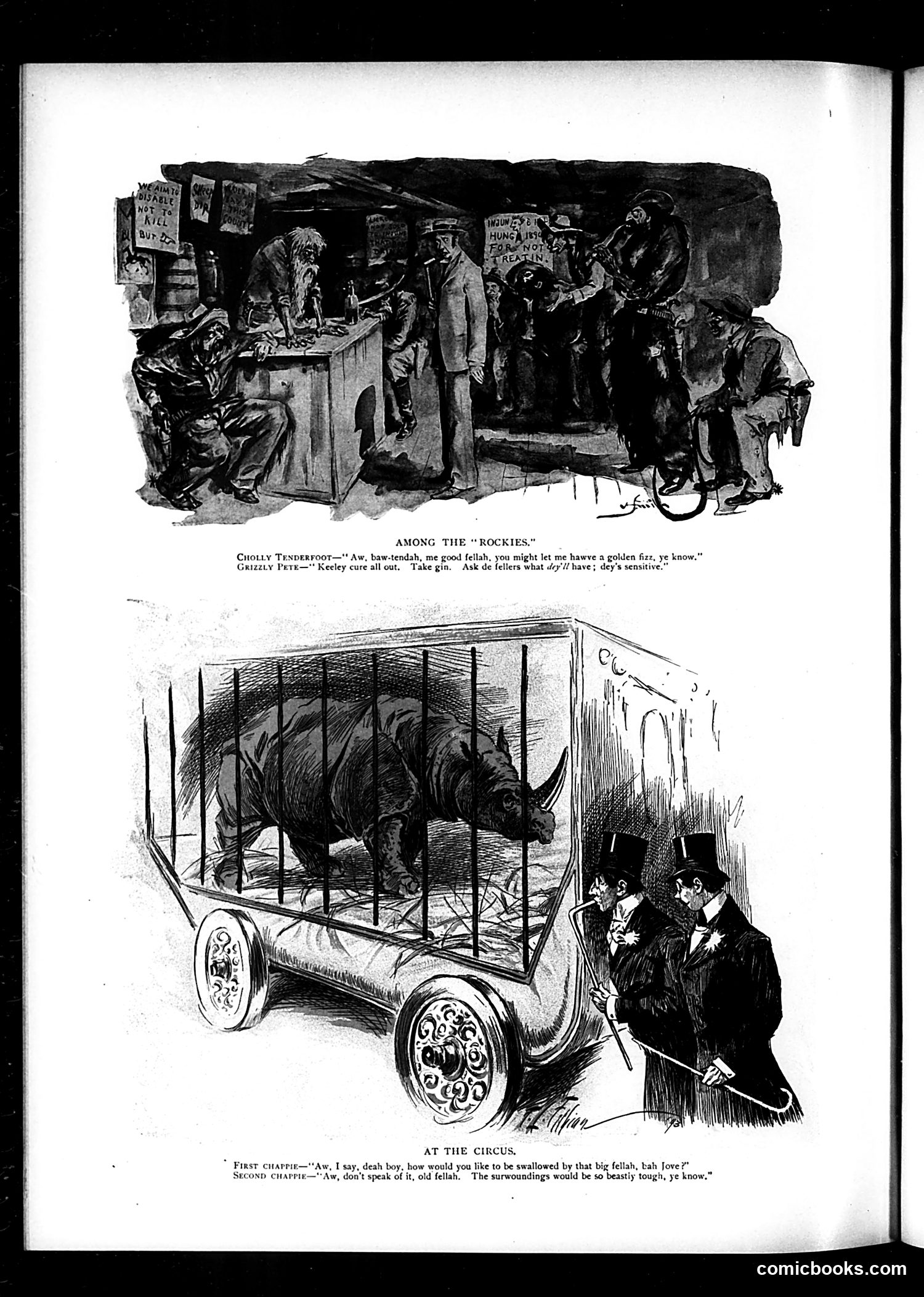
The page contains two satirical sketches mocking wealthy British aristocrats ("toffs" and "charries"—British slang for upper-class men). **Top cartoon ("Among the Rockies"):** Depicts British dandies in a rough Rocky Mountain saloon attempting to maintain their refined mannerisms. One requests a "golden fizz" cocktail in affected speech, while the bartender—representing frontier practicality—offers only gin and directs them to ask other patrons. The satire ridicules their pretension in an uncivilized setting. **Bottom cartoon ("At the Circus"):** Shows two British gentlemen observing a rhinoceros in a circus cage, discussing whether one would consent to being swallowed by the animal—but refuses because the "surroundings would be beastly tough." The joke mocks their obsession with comfort and propriety even when contemplating an absurd, dangerous scenario. Both cartoons satirize British upper-class affectation and their perceived disconnection from practical reality.
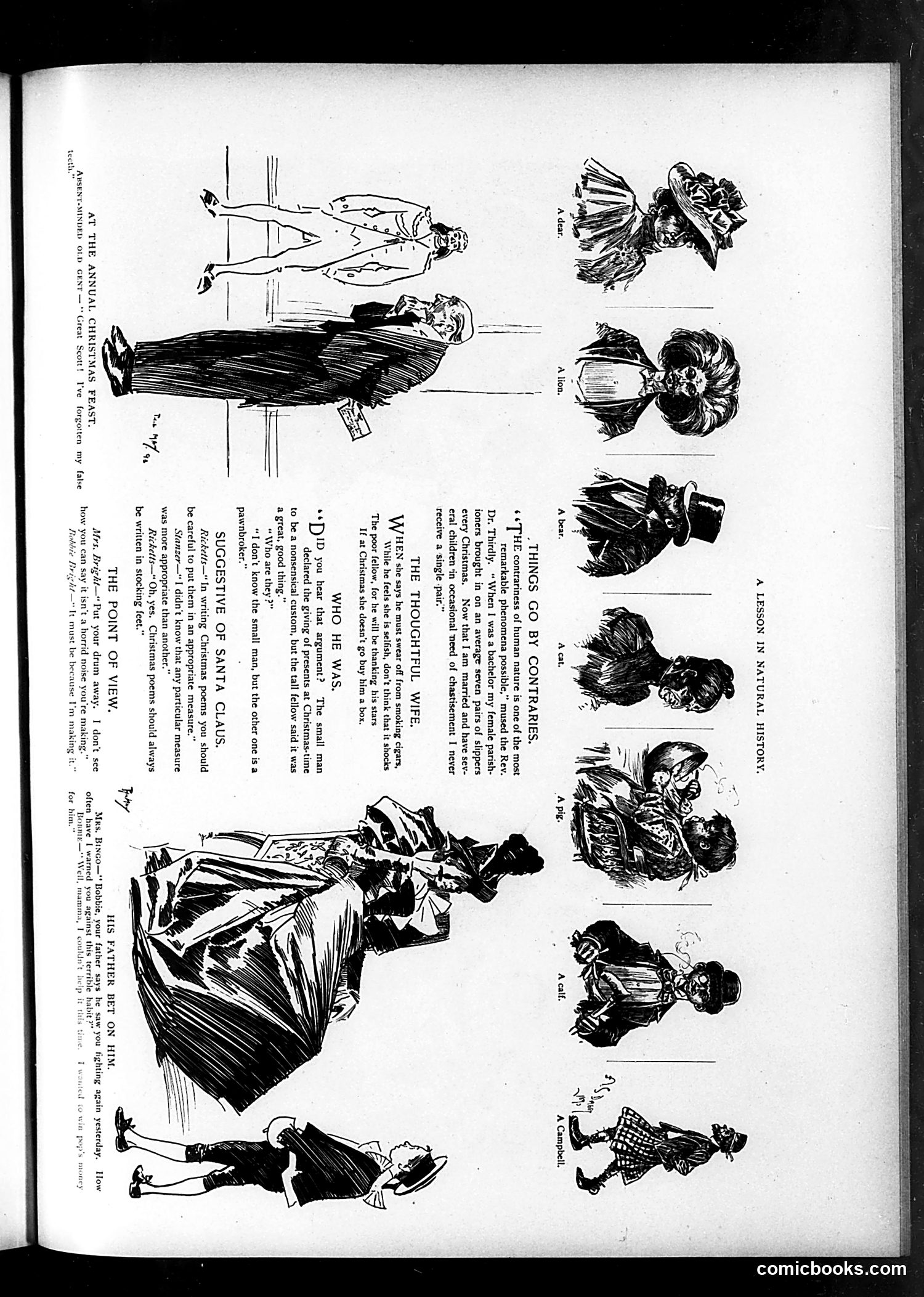
This page contains three satirical pieces about Christmas customs and human nature: **"Things Go By Contraries"** mocks a reverend's complaint that parishioners stopped giving him slippers once he married—suggesting his bachelor status made him seem deserving of gifts, while his actual need (for disciplining children) goes unrecognized. The satire targets the arbitrary nature of charitable giving. **"Who He Was"** plays on economic self-interest: a pawnbroker naturally advocates for Christmas gift-giving (which benefits his business when recipients later need money), while a poorer man opposes the custom as wasteful. **"The Thoughtful Wife"** and "Suggestive of Santa Claus"** are brief quips about Christmas shopping and poetry conventions. The page's title, **"A Lesson in Natural History"** with a cat illustration, likely references human behavior studied as one would study animals—treating people's predictable, self-interested responses to holidays as observable natural phenomena worthy of satirical examination.
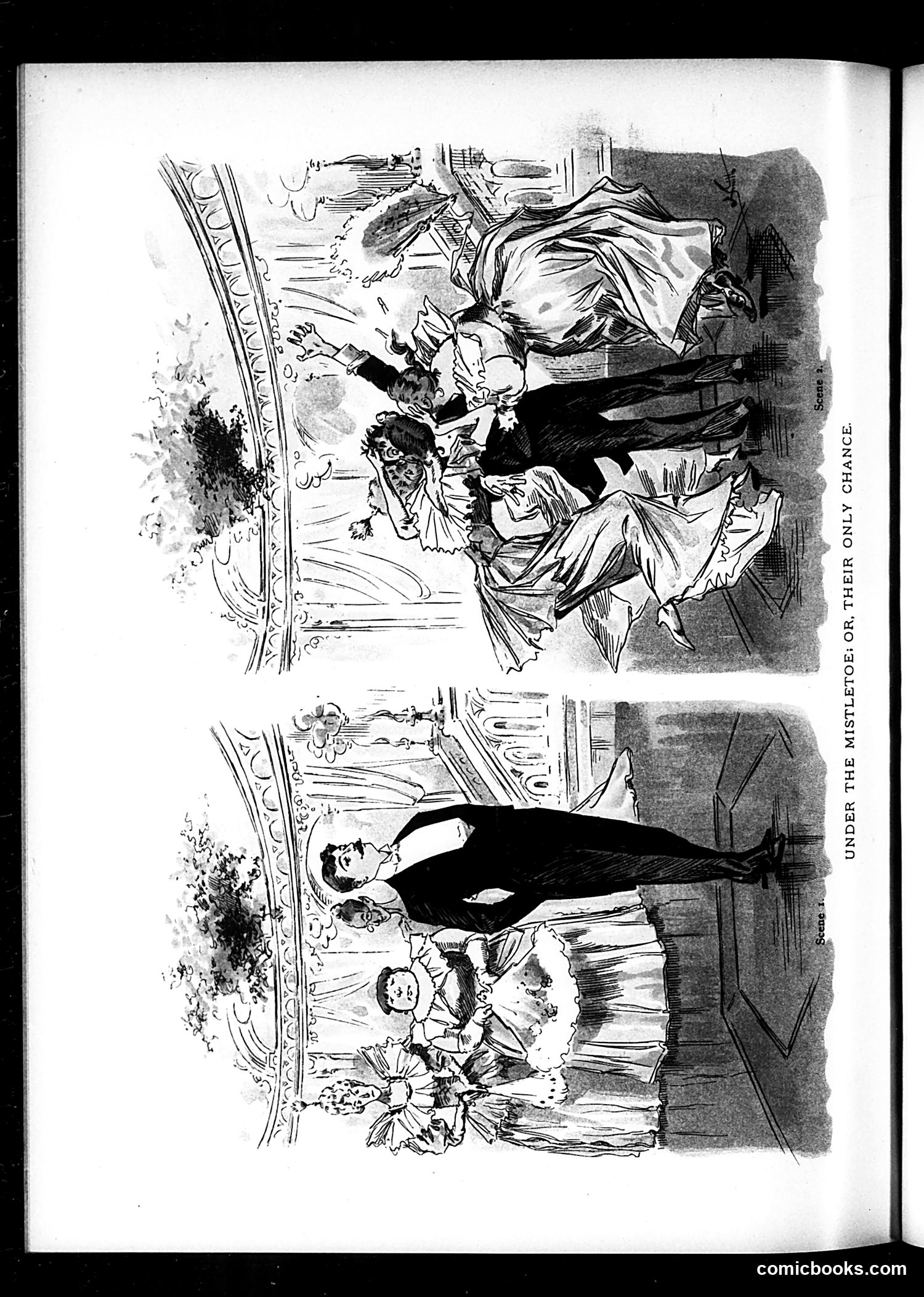
This page contains two related cartoon panels satirizing courtship customs. The caption suggests the cartoons joke about mistletoe—traditionally associated with romantic kissing at Christmas. The upper panel shows what appears to be a chaotic social scene with multiple figures in elaborate dress, possibly depicting a holiday gathering or dance where romantic entanglements occur. The lower panel shows a formal gentleman in dark clothing with two women in white dresses, likely illustrating the "mistletoe moment" the title references. The satire appears to mock Victorian-era courtship rituals and the somewhat artificial "permission" mistletoe provided for otherwise restricted physical affection between unmarried people. The phrase "their only chance" suggests commentary on how limited women's romantic opportunities were without such social conventions providing cover.
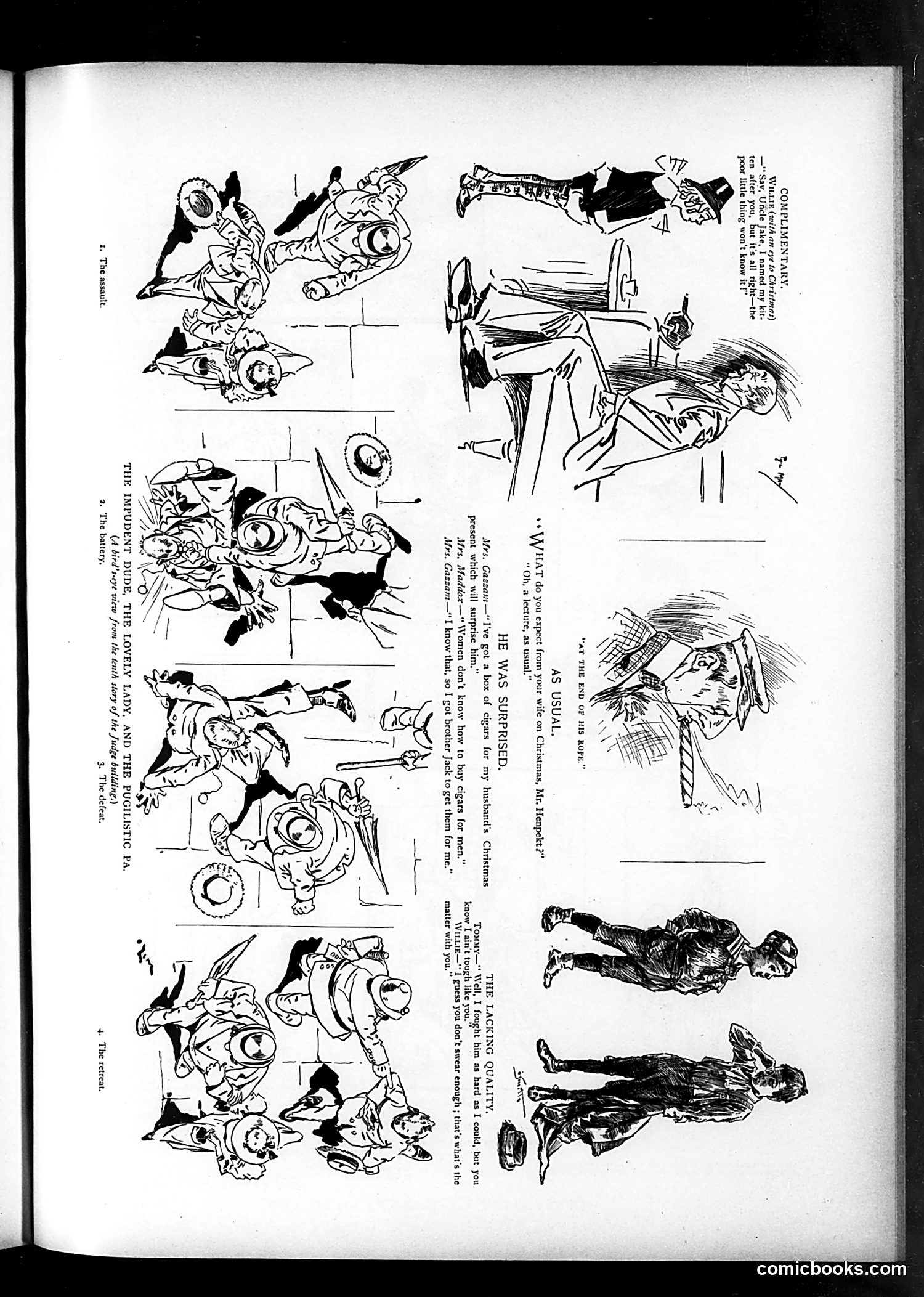
This page contains cartoon vignettes satirizing domestic marital dynamics, specifically henpecked husbands. The main cartoon "As Usual" depicts a husband (Mr. Henpeck—a character type representing submissive men) asked what he expects from his wife at Christmas, responding glumly "a lecture, as usual." The surrounding panels labeled "The Assault" and "The Retreat" appear to illustrate physical confrontations or conflicts between husbands and wives, rendered in exaggerated slapstick style typical of early 20th-century Judge magazine humor. The satire targets the social anxiety around female dominance in marriage—a recurring theme in Gilded Age and Progressive Era American comedy. The humor assumes readers recognize "henpecked husband" as an established, relatable archetype: the emasculated man whose wife controls domestic life through nagging and confrontation.
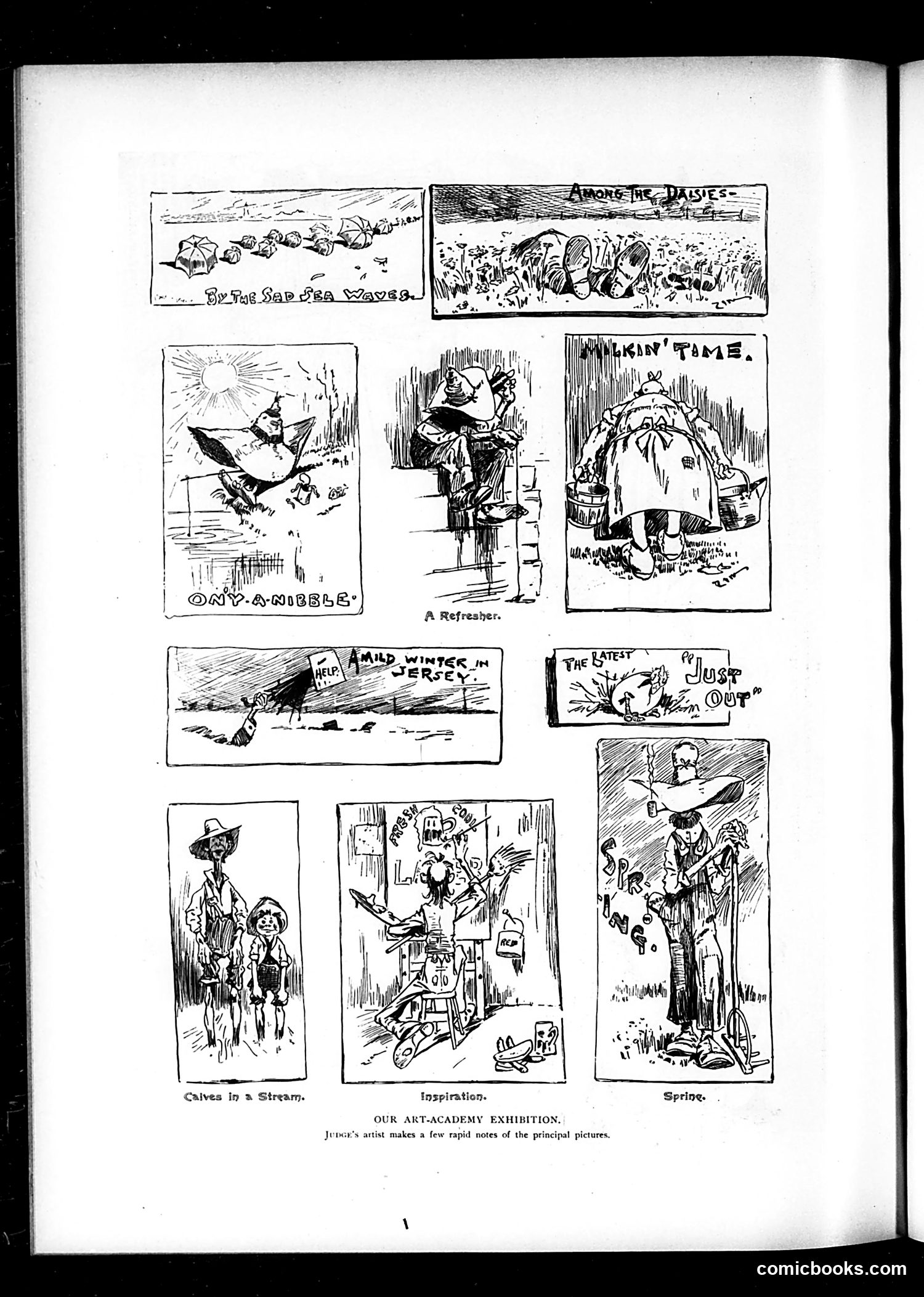
This page presents sketches labeled "Our Art-Academy Exhibition," where an artist has made quick notes on principal pictures. The cartoons appear to be satirical takes on seasonal or thematic artwork, including: - "Among the Daisies" and "By the Sea Waves" (pastoral scenes) - "On-a-Nimble" (a figure with a boat) - "A Refresher" (someone at what appears to be a bar) - "Rain Time" (a figure in rain) - "The Latest 'Just Out'" (unclear reference) - "Mild Winter in Jersey" (snowy scene) - "Calves in a Stream," "Inspiration," and "Spring" (final panels) The satire likely mocks pretentious or overly-sentimental art academy submissions, reducing them to crude, humorous sketches. The titles suggest mock-serious treatment of mundane or absurd subjects typical of art salon exhibitions of the era.
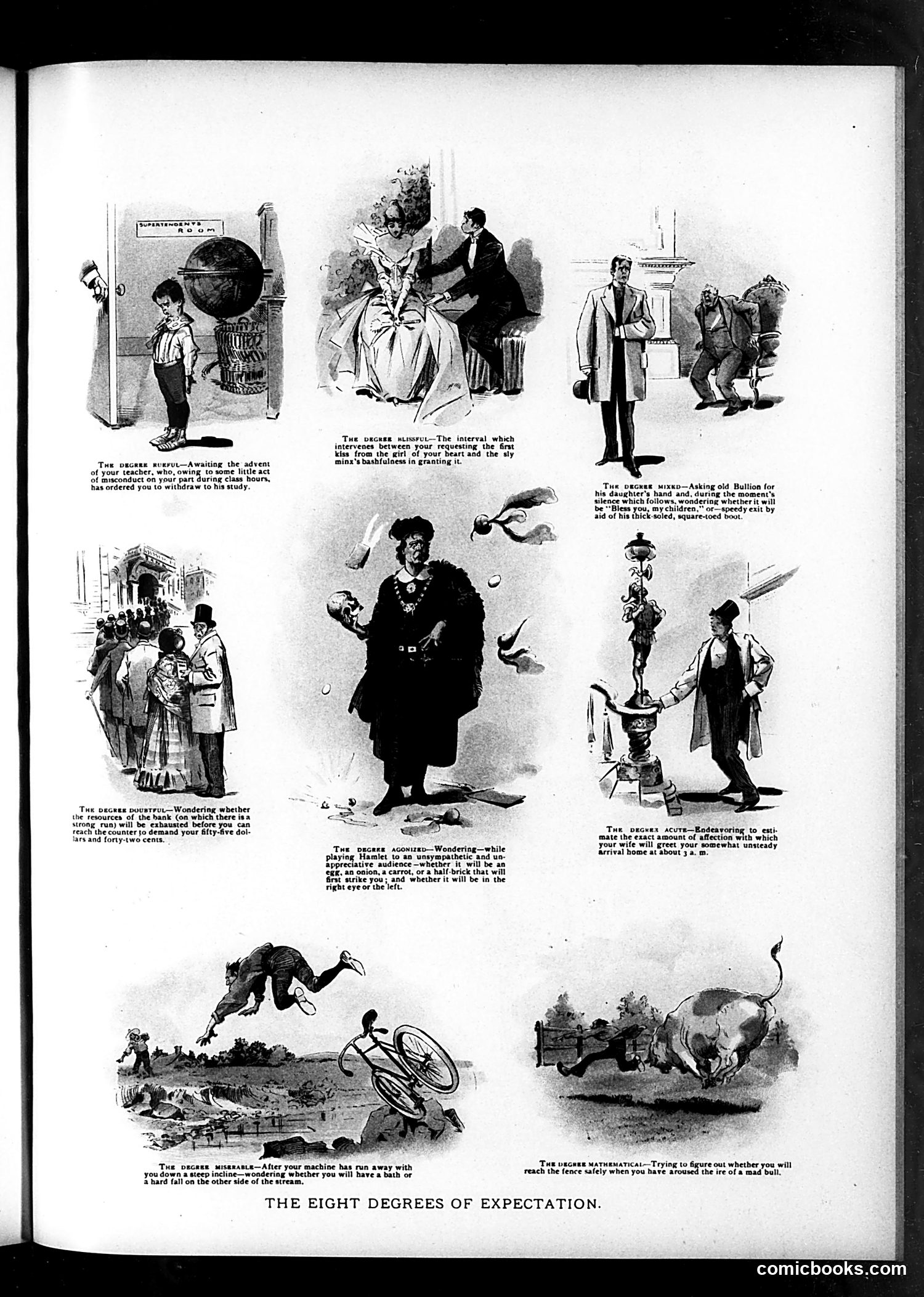
This satirical page illustrates eight common anxious situations men face, presented as humorous "degrees" of anticipation. Each vignette depicts a moment of nerve-wracking uncertainty: 1. **Seeking a first kiss** from a desired woman 2. **Awaiting punishment** from a teacher after misbehavior 3. **Banking anxiety** during a financial crisis ("run on the bank") 4. **Stage fright** wondering what will hit a performer 5. **Bicycle accident** uncertainty about the aftermath 6. **Proposing marriage** to a wealthy man ("old Bullion") 7. **Returning home drunk** at 3 a.m., gauging wife's reaction 8. **Escaping a mad bull** while calculating safe passage The humor targets Victorian-era male anxieties—romantic rejection, authority figures, financial instability, public humiliation, and domestic discord. The cartoons mock masculine vulnerability through exaggerated scenarios, suggesting these "expectations" are universal male experiences worthy of comedic sympathy rather than judgment.
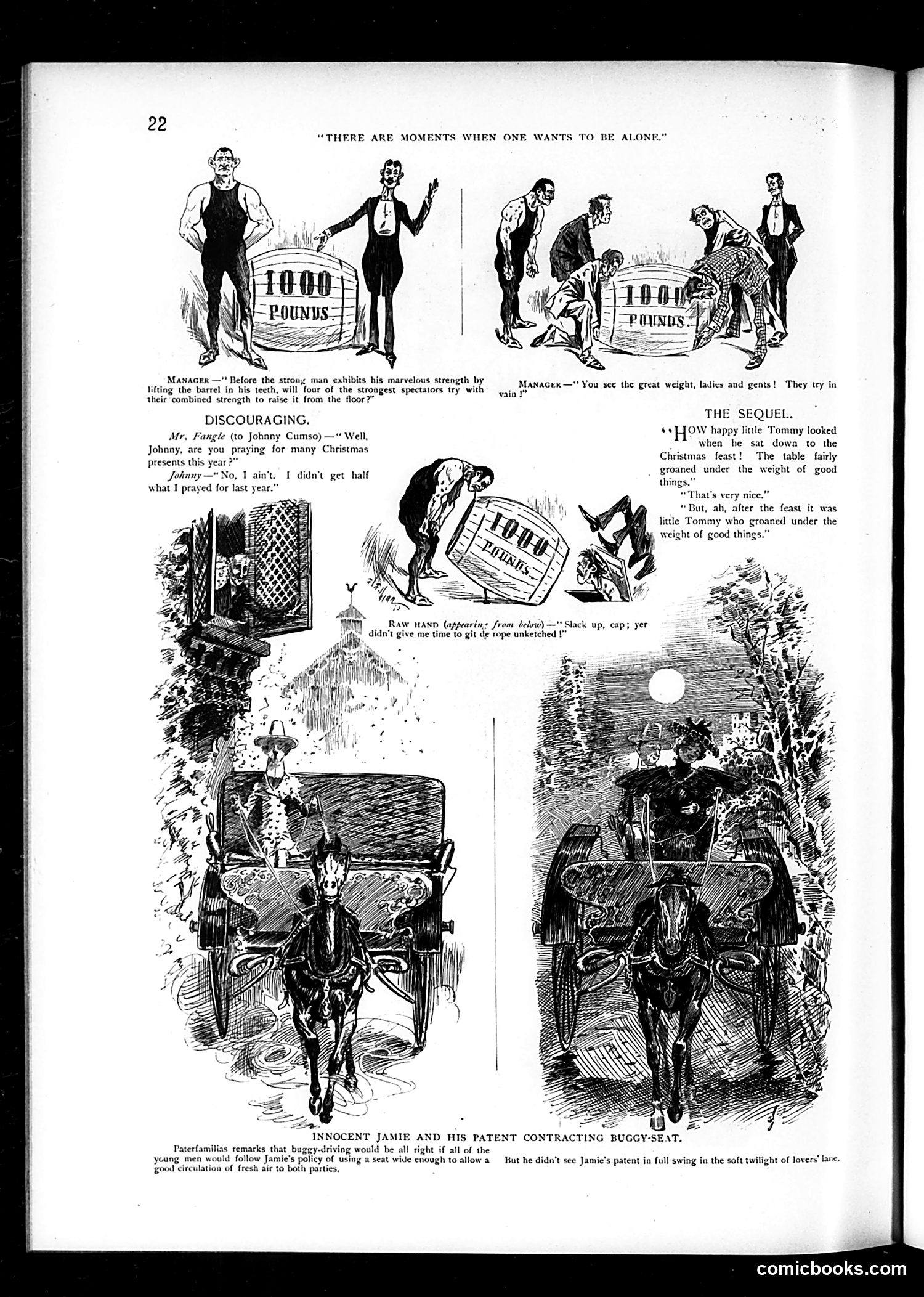
This page contains multiple satirical vignettes typical of late 19th/early 20th-century humor: **Top panels**: Mock a circus strongman's act, where managers recruit audience members to attempt lifting a barrel—the joke being the contrast between the performer's claimed strength and ordinary spectators' inability to budge it. **"Discouraging"**: A father asks a boy about Christmas presents; the boy admits he didn't receive half what he prayed for—cynical commentary on childhood disappointment. **"The Sequel"**: A follow-up joke about a child groaning after overeating at Christmas dinner rather than from the weight of gifts. **"Raw Hand"**: A brief gag about someone being rushed before completing a task (unclear full context). **Bottom illustrations**: "Innocent Jamie and His Patent Contracting Buggy-Seat" satirizes a young man's narrow buggy seat—supposedly designed to promote "fresh air circulation" between couples, but the caption's final line reveals the real purpose: creating romantic closeness in twilight ("lovers' lane"). The page's overall theme plays on deception and hidden motives beneath respectable pretenses.
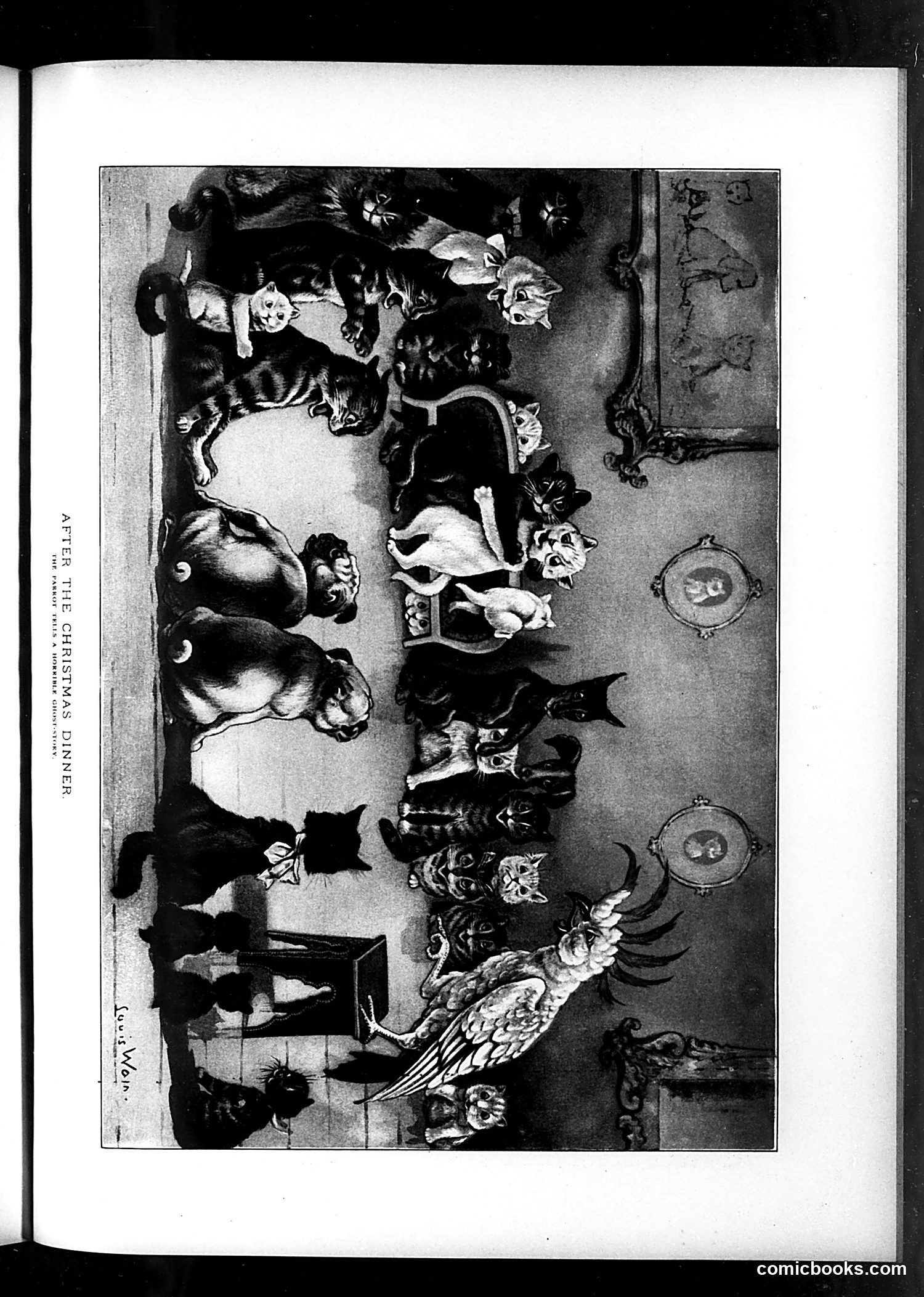
This cartoon depicts a Christmas dinner scene where a parrot is apparently attempting to tell a ghost story to an assembled group. The image shows multiple cats gathered around what appears to be a dining setting, with the parrot as the central figure. The satire likely plays on the Victorian-era parlor tradition of telling ghost stories after holiday meals. The joke appears to be that a parrot—known for mindlessly repeating what it hears—is trying to tell a ghost story, presumably by reciting something it overheard, possibly badly or inappropriately. The assembled cats serve as an audience, creating an absurd domestic scene. The humor derives from anthropomorphizing animals and the contrast between the parrot's limited capacity for original storytelling and the sophisticated social ritual of holiday entertainment.
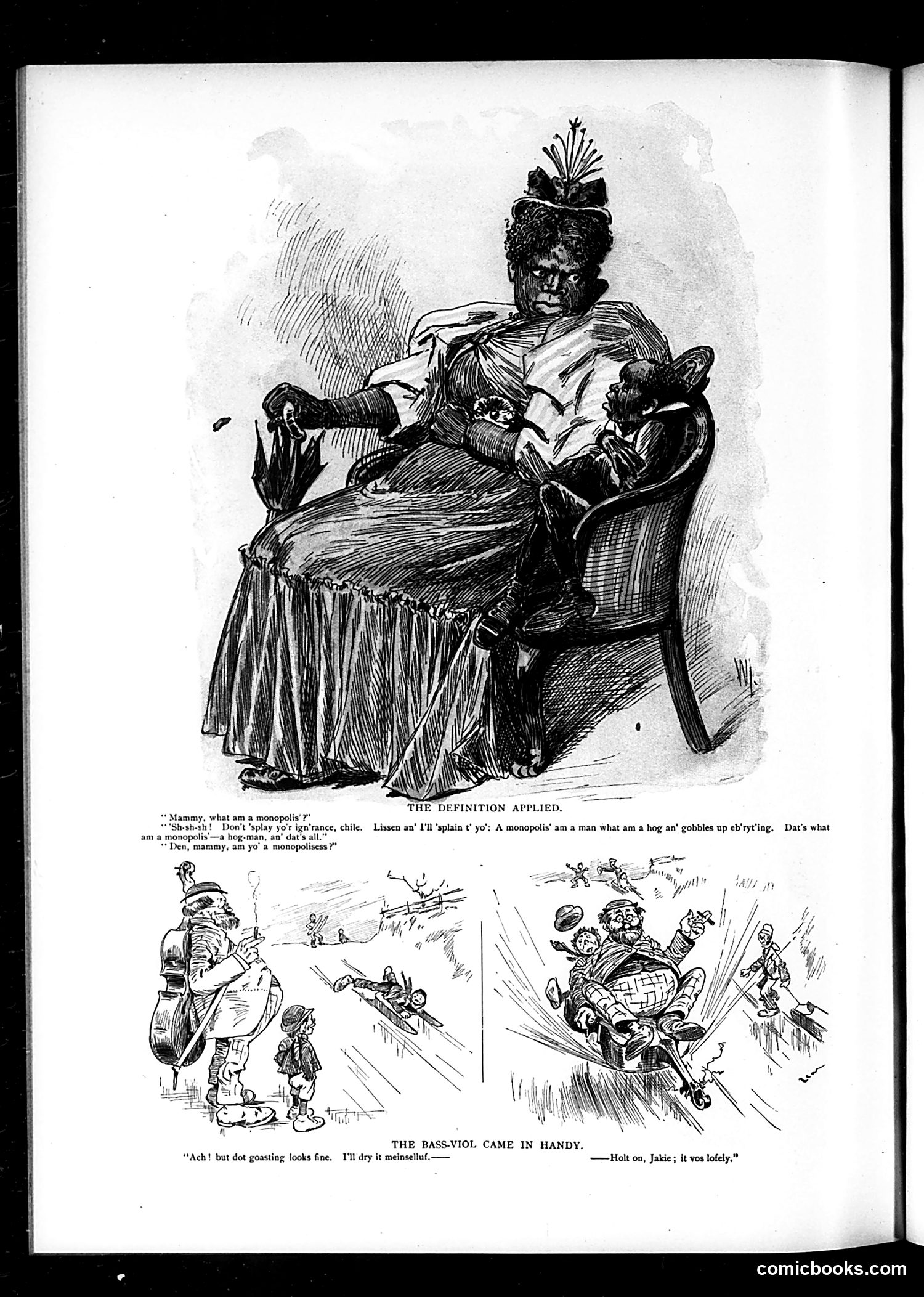
**Top cartoon:** A mother explains "monopolist" to a child using dialect humor. She defines it as a greedy person ("hog") who consumes everything. The child's punchline—asking if the mother is a "monopoless"—suggests she's similarly hoarding or controlling. This satirizes the era's concern with monopolistic business practices, using domestic/family dynamics as metaphor. **Bottom cartoons:** Two separate vignettes with ethnic humor (German and Yiddish dialects). One depicts a character trying to roast something; the other shows someone ("Jakie") apparently using a bass-viol instrument in a domestic mishap. These appear to be unrelated sight-gags typical of Judge's humor style, relying on stereotypical immigrant dialects for comedic effect—reflecting period attitudes toward non-Anglo populations.
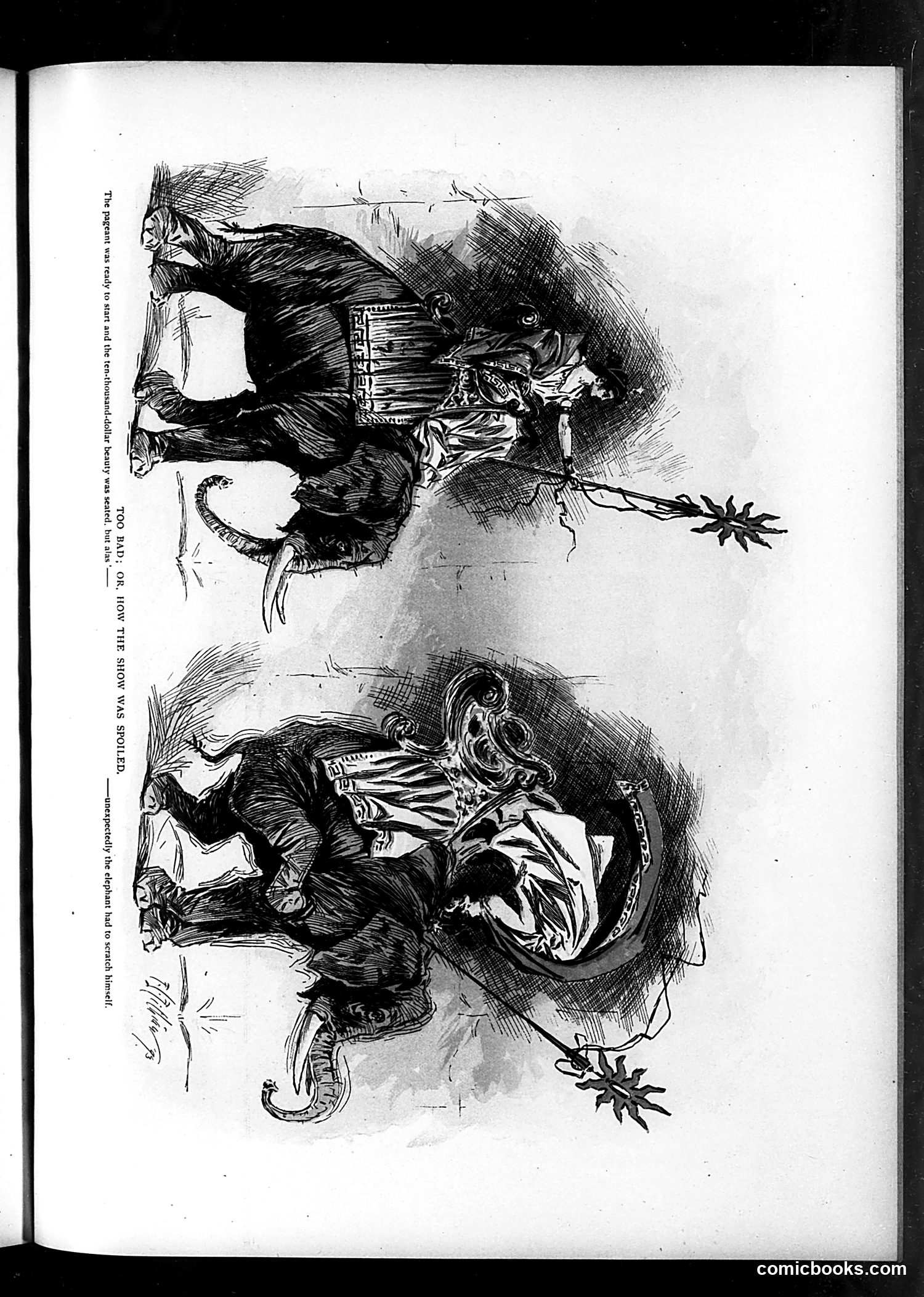
This page contains two satirical drawings depicting an elephant "spoiling" an elaborate pageant or procession. The cartoons mock a high-society event (costing ten thousand dollars, suggesting wealthy pretension) that is disrupted when the elephant—likely a reference to the Republican Party symbol—scratches itself, throwing the carefully orchestrated display into chaos. The satire appears to criticize either Republican political disruption of an important event or, conversely, commentary on how an uncontrollable political force undermines elaborate plans. The elephant's crude, undignified behavior contrasts sharply with the formal pageantry, suggesting Judge magazine's commentary on political vulgarity or unpredictability disrupting respectable society. Without publication date context, the specific political moment remains unclear.
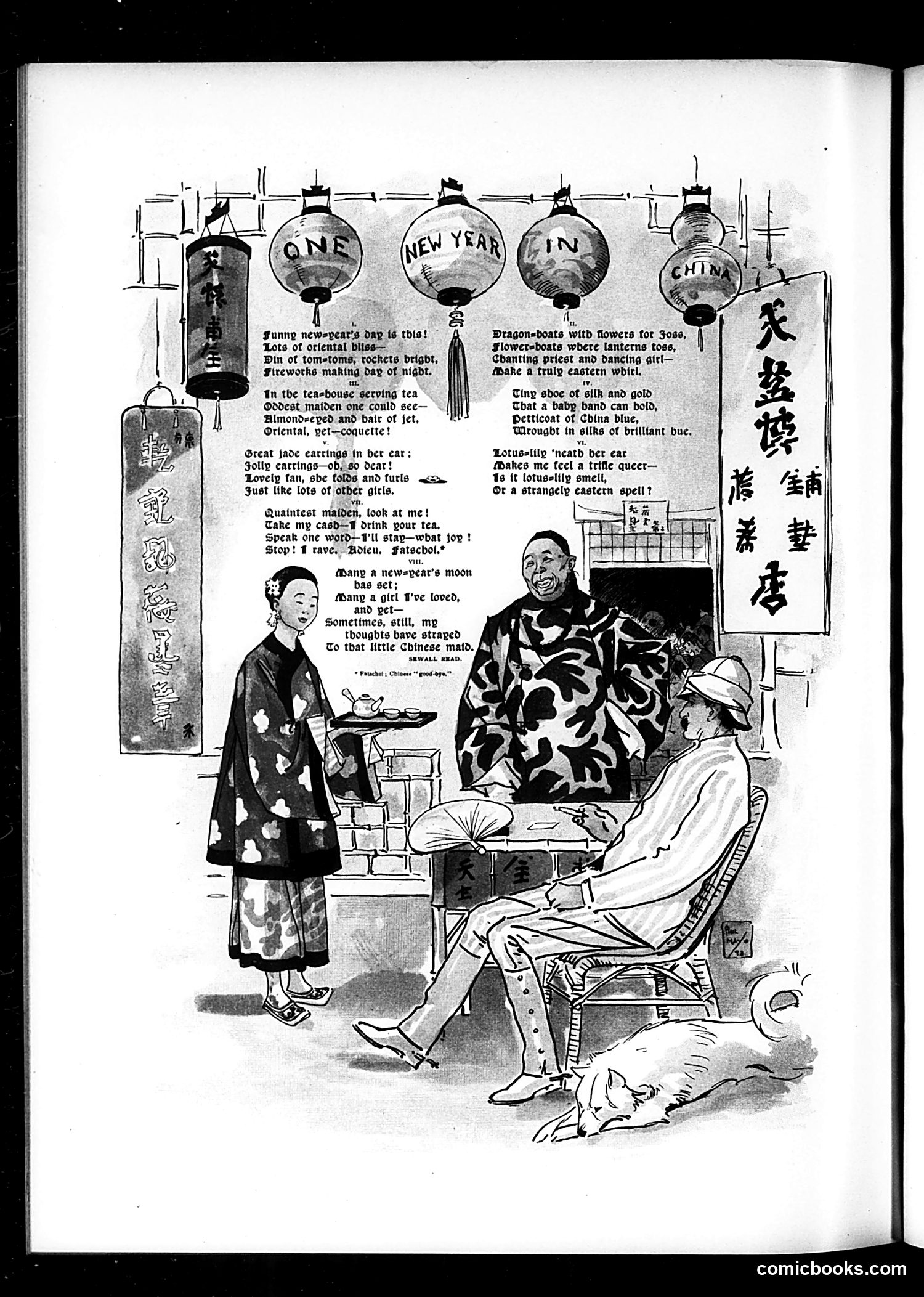
This appears to be an early 20th-century satirical piece from *Judge* magazine depicting a romanticized fantasy of a Chinese teahouse and an encounter with a Chinese woman. The cartoon shows Western male stereotypes about "exotic" Asia. The poem celebrates orientalist tropes: delicate tea service, jade earrings, silk clothing, and a docile, appealing "Chinese maid." Hanging lanterns labeled "ONE," "NEW YEAR," "IN," and "CHINA" establish the setting as an idealized vision of Chinese culture filtered through Western fantasy. The satire targets Western men's obsession with "Oriental" exoticism—the speaker admits years later he still thinks of this girl. The joke critiques both the shallow romanticization of Asian women and Western masculine sentimentality about distant, unattainable "oriental" fantasies. The piece is racist by modern standards, reducing Chinese culture and women to decorative, available stereotypes for Western male consumption.
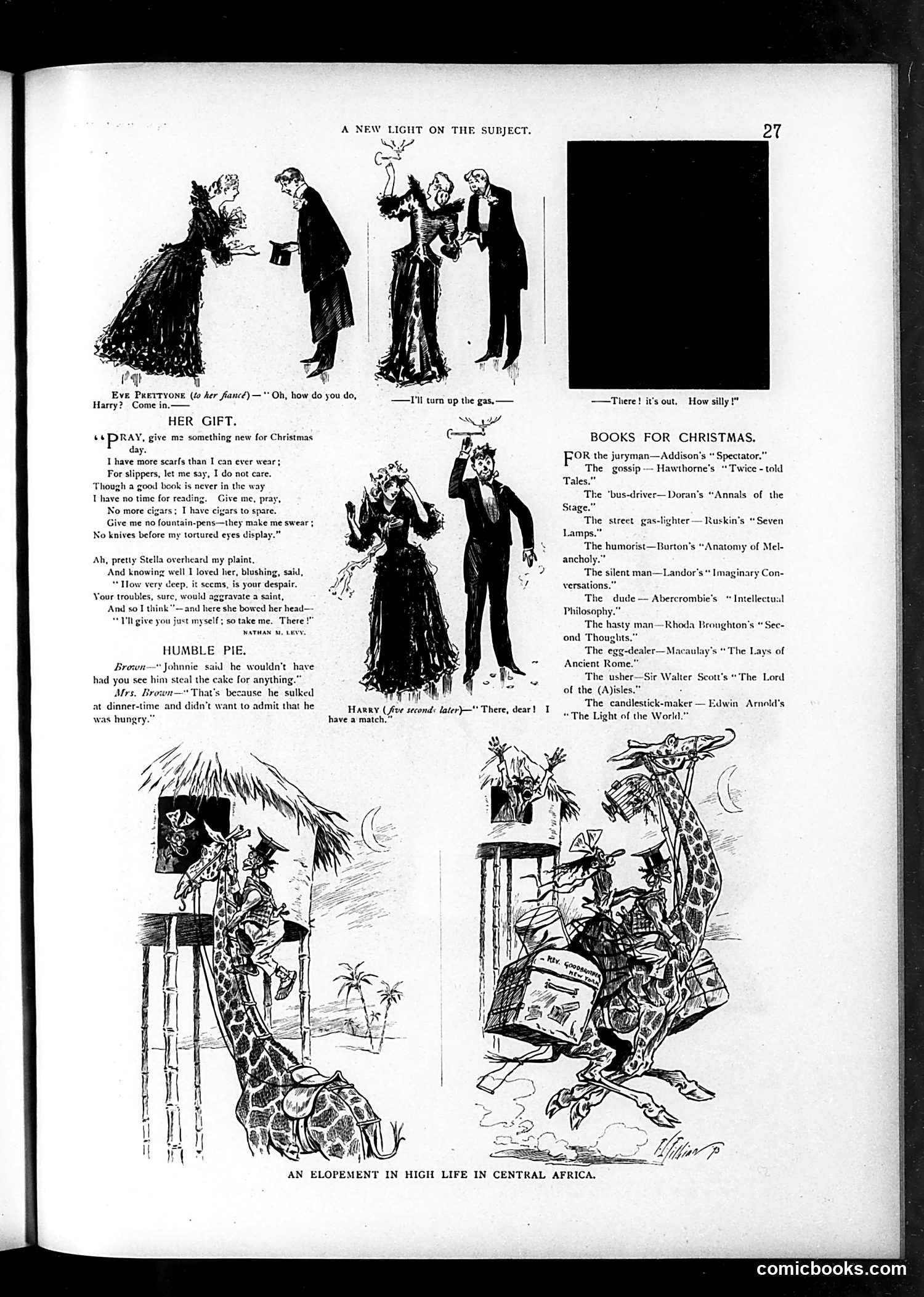
This page contains three satirical pieces typical of early 20th-century American humor. **"Her Gift"** mocks a fiancée (Eve Prettyone) who offers herself as a Christmas present after her wealthy suitor complains he has everything material. The joke satirizes both excessive consumerism and romantic sentimentality. **"Humble Pie"** briefly ridicules a child's pride—a boy steals cake but won't admit hunger at dinner, forcing his mother to serve humble pie (a phrase meaning forced apology/humiliation). **"Books for Christmas"** is a satirical gift-matching list pairing occupations with ironically unsuitable books—a juryman gets philosophy, a gossipy person gets Hawthorne's tales, etc. The humor lies in mismatched expectations. **"An Elopement in High Life in Central Africa"** (bottom illustrations) appears to depict animals in human situations—likely mocking contemporary fascination with African expeditions and "primitive" stereotypes through absurdist animal caricature. The page emphasizes Judge's focus: mocking consumer culture, social pretension, and contemporary obsessions through witty wordplay and exaggerated drawings.
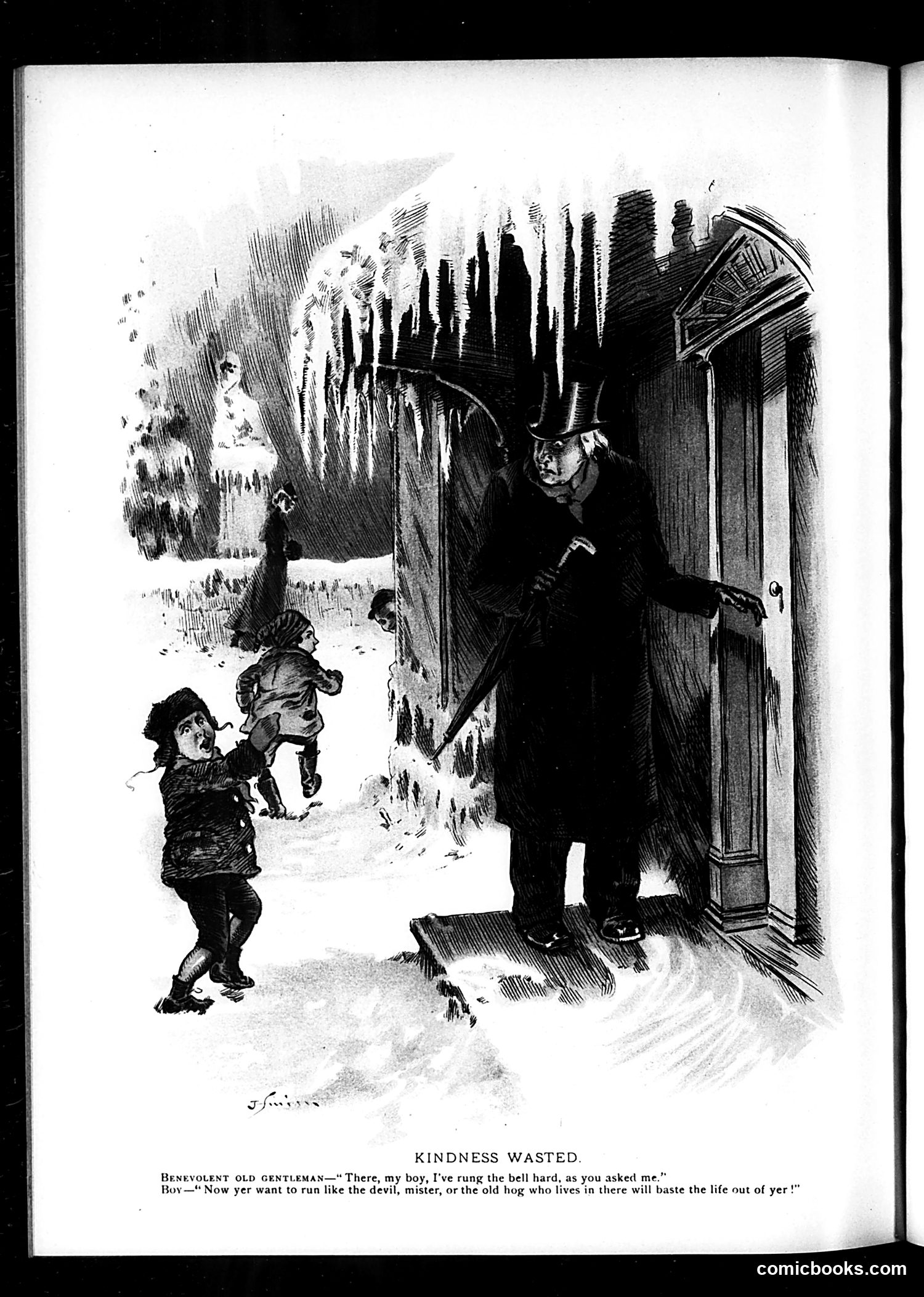
This cartoon satirizes misplaced charity and naive benevolence. A well-dressed elderly gentleman, attempting to be kind to a street boy, rings a doorbell as requested. The boy has duped him: he's actually pranking whoever lives inside—likely an ill-tempered person or landlord (referred to as "the old hog"). The gentleman's kindness becomes a setup for mischief. The satire targets two groups: gullible wealthy people performing token charity without understanding street children's actual motivations, and the street children themselves who exploit such goodwill for pranks rather than genuine assistance. The cartoon suggests charity without wisdom is wasted—the old gentleman's decency accomplishes nothing but trouble for himself.
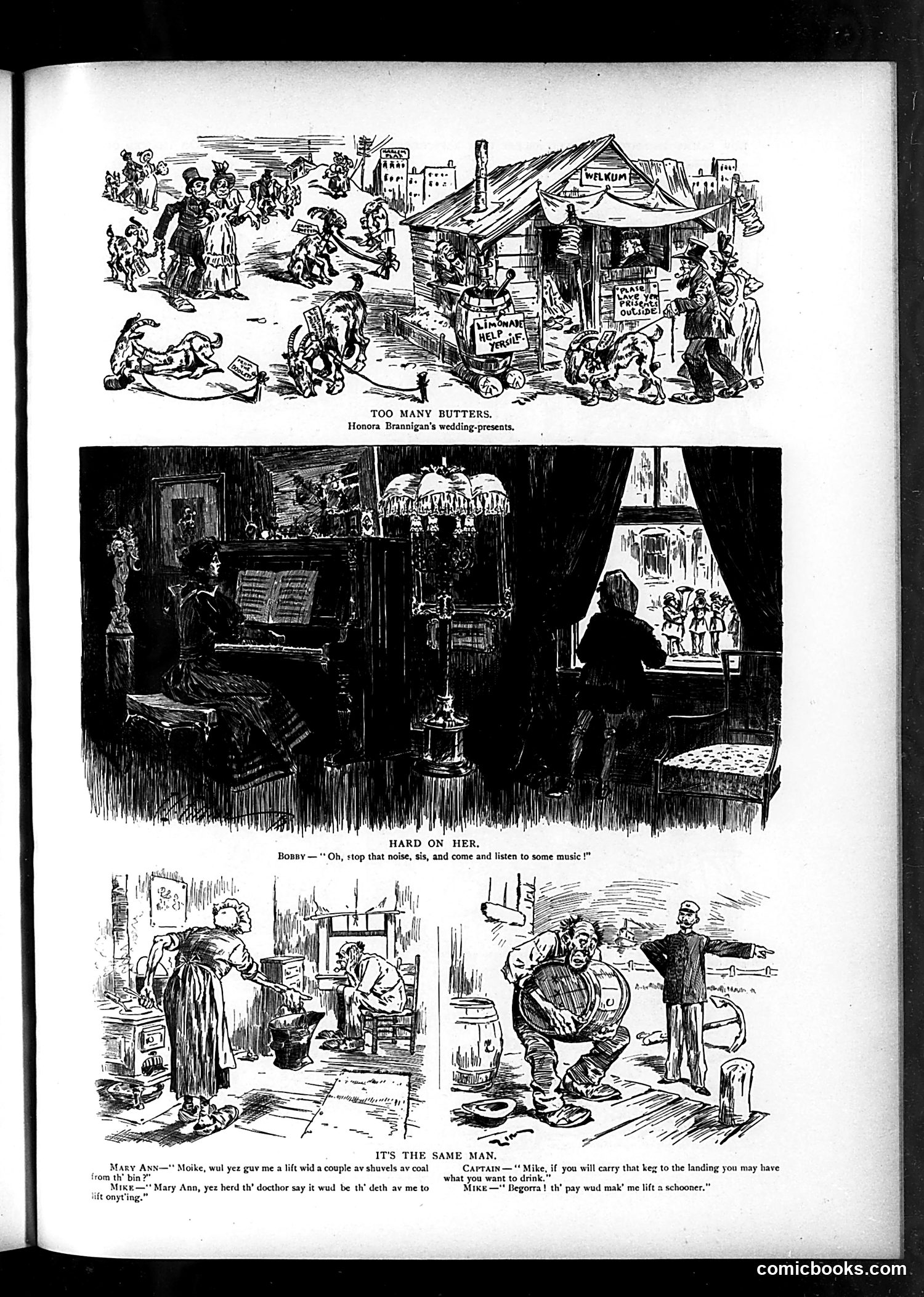
This page contains three Irish-American comedic sketches employing stereotypical dialect and working-class humor typical of late 19th/early 20th-century American satire. **"Too Many Butters"** depicts a chaotic wedding gift scene—likely mocking the practical absurdity of receiving duplicate gifts, particularly butter (a common staple gift). **"Hard on Her"** shows a woman trying to get her brother to stop making noise and listen to music instead—a domestic scene emphasizing female exasperation with male behavior. **"It's the Same Man"** presents three panels featuring Irish characters in working situations. The humor relies on ethnic stereotyping: a woman asking for coal help despite her husband's doctor's orders; a captain offering drink as payment; and the punchline suggesting the man will lift anything for alcohol rather than proper wages—playing on period stereotypes of Irish workers and drinking habits. The crude caricatures and brogue-heavy dialect were considered standard comic fare for this era's mainstream American humor publications.
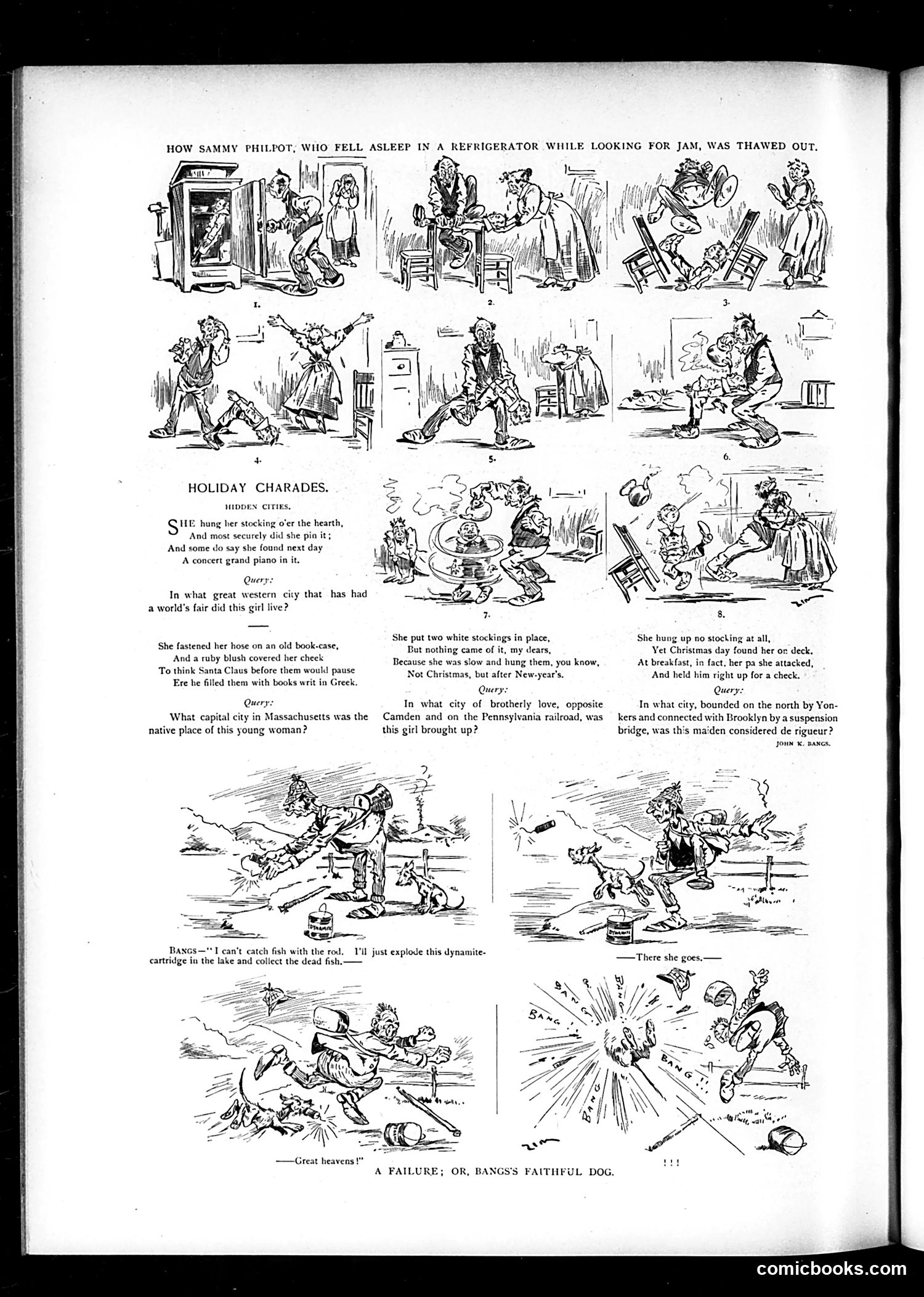
This page presents riddle-style satirical vignettes about young women's Christmas behavior, each designed to identify a major American city through wordplay and cultural stereotypes. The "charades" mock different female character types: a wealthy girl receiving a piano (suggesting a world's fair city—likely Chicago); an intellectual woman getting Greek books (Boston); a lazy girl hanging stockings late (Philadelphia); and a mercenary daughter shaking down her father for money (New York City, referenced through Yonkers and the Brooklyn Bridge). The humor relies on contemporary associations: Boston's intellectual pretensions, Philadelphia's "City of Brotherly Love" slogan, New York's materialism and wealth. The page title joke about Sammy Philpot freezing in a refrigerator adds absurdist comedy. This reflects *Judge*'s satirical tradition of poking fun at regional American stereotypes and female behavior through clever riddles. The drawings are crude comic illustrations typical of 1880s-90s satirical publications.
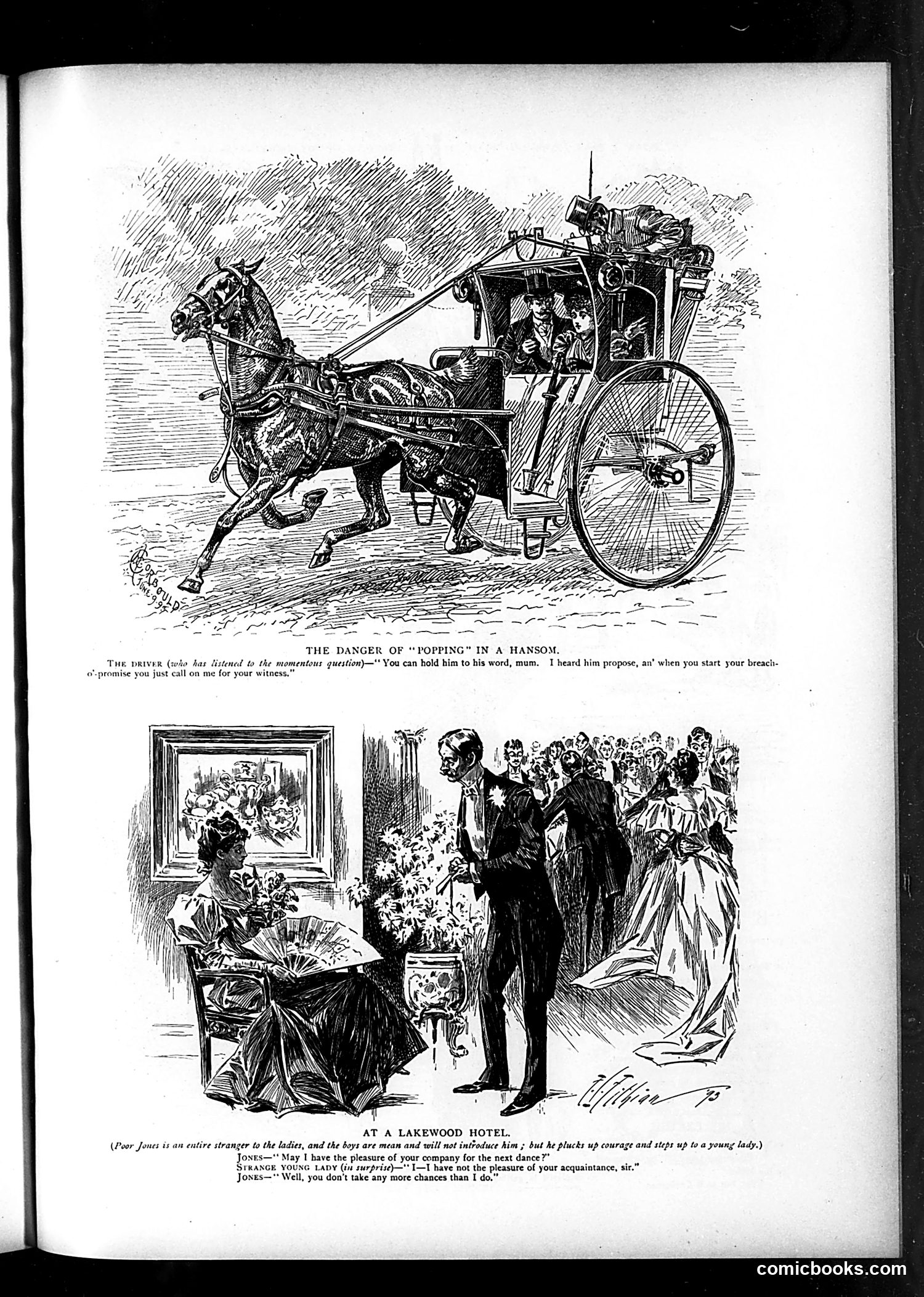
**Top cartoon**: A hansom cab driver overhears a marriage proposal and offers to serve as witness in a potential breach-of-promise lawsuit. The joke mocks the legal vulnerability of men making marriage proposals—a common Victorian concern. If a man proposed and then refused to marry, the woman could sue for damages. The driver's casual willingness to testify treats this serious legal threat as routine street gossip. **Bottom cartoon**: A stranger (Jones) asks an unknown young woman to dance at a hotel. When she protests they haven't been introduced, he replies they're equally taking chances—he's risking rejection, she's risking association with an unknown man. The humor mocks both social etiquette rigidity and Jones's clumsy attempt at gallantry by suggesting their social risks are equivalent (they clearly aren't). Both sketches satirize Victorian courtship anxieties and social formality.
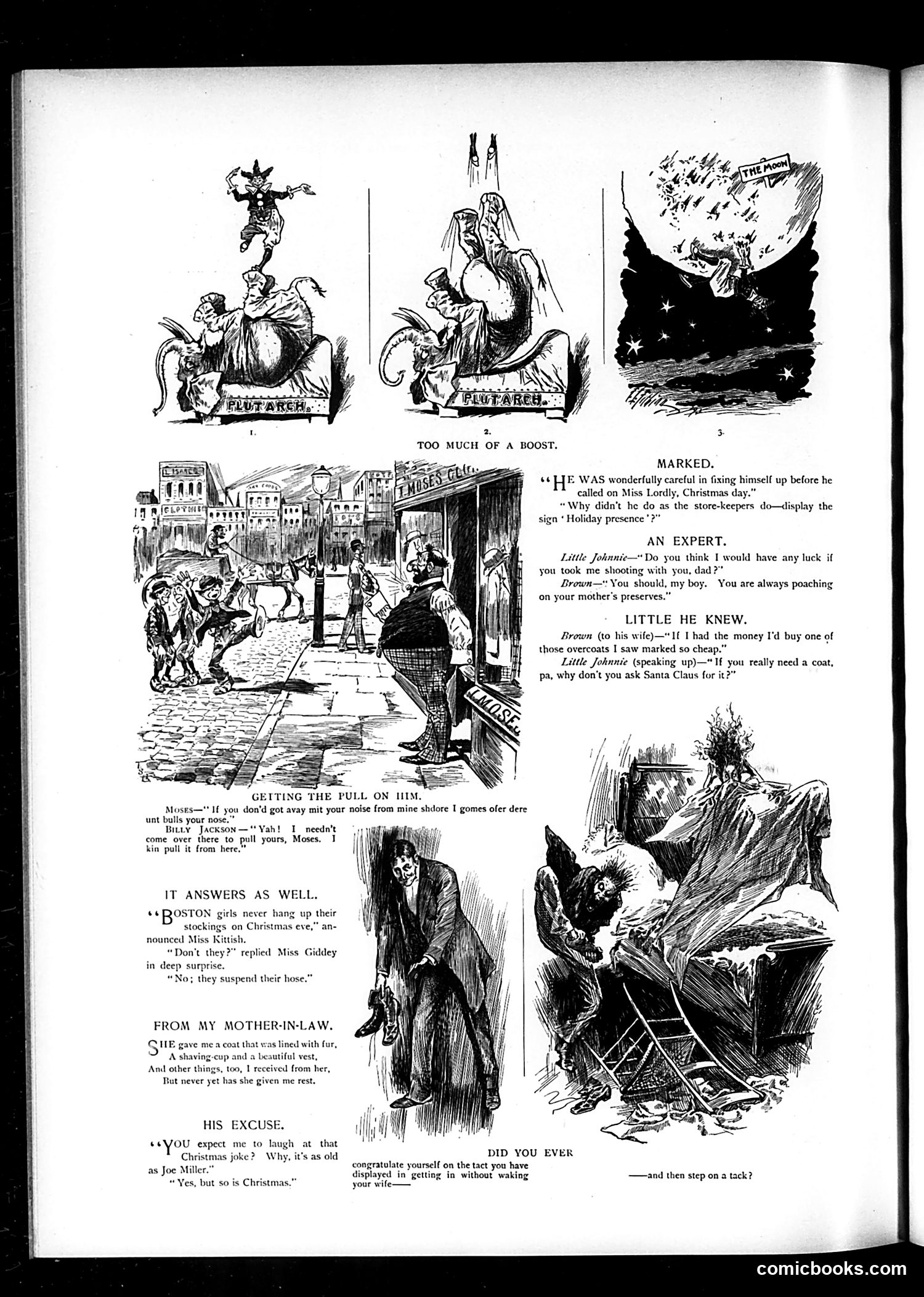
This page from *Judge* collects brief Christmas-themed satirical jokes targeting middle-class social pretense and domestic life, circa late 1800s. **Key satirical targets:** - **"Marked"**: Mocks holiday materialism—a suitor displays himself like store merchandise with false "holiday presence" - **"An Expert"**: Child's innocent logic exposes parental hypocrisy; a father who raids his wife's preserves claims hunting expertise - **"Little He Knew"**: Child naively suggests asking Santa instead of acknowledging financial hardship - **"Getting the Full on Him"**: Ethnic caricature (Yiddish-dialect "Moses" and "Billy Jackson") depicting street vendor conflicts - **"Boston Girls"**: Pun on "stockings/suspend their hose"—jokes about women's fashion and propriety - **"From My Mother-in-Law"**: Classic complaint about ungracious gift-giving - **The final joke**: Dark humor about accidentally stepping on a tack after carefully sneaking past one's wife The humor relies on domestic friction, class anxiety, and ethnic stereotypes typical of Gilded Age American satire.
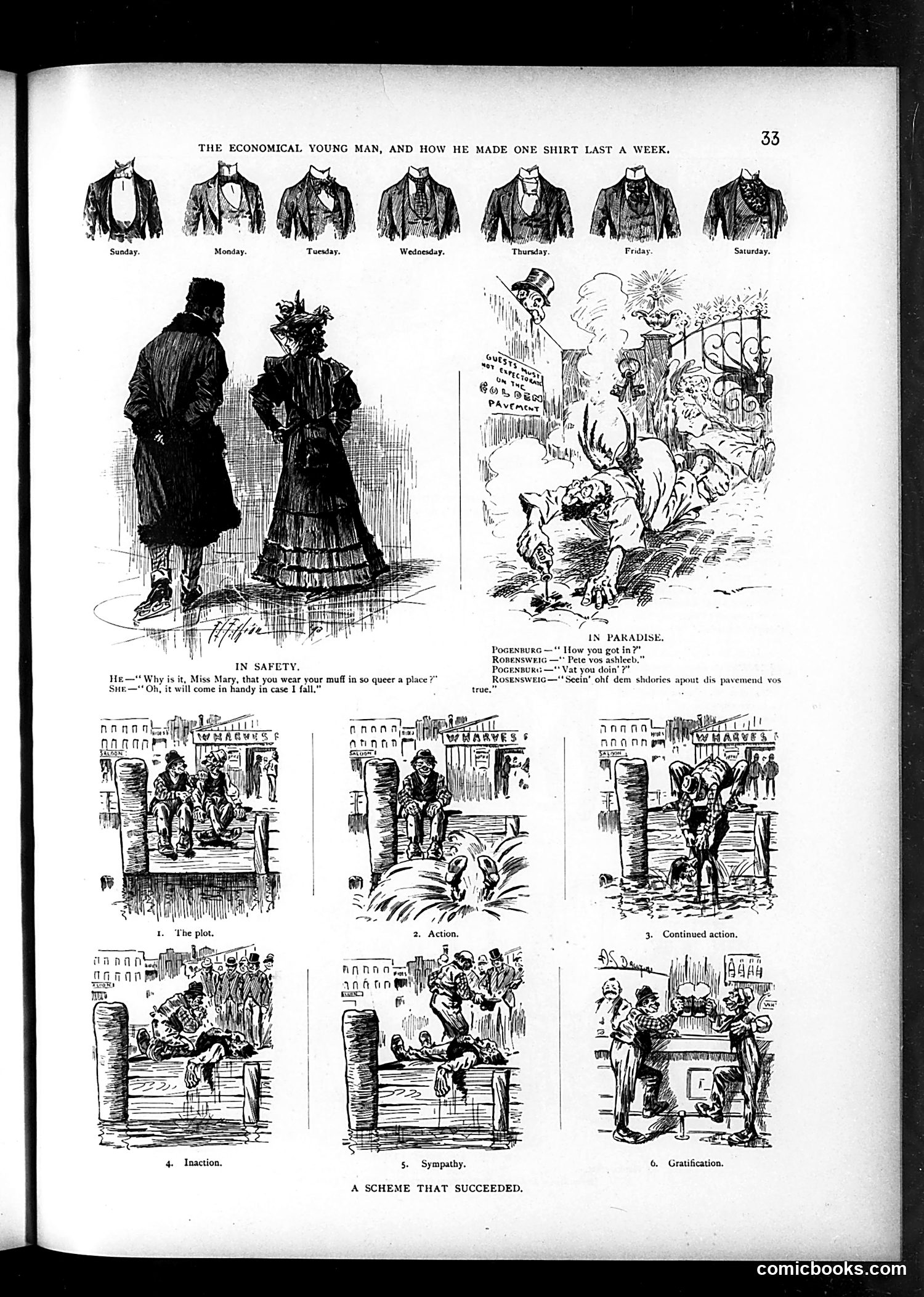
This page satirizes an economical young man who supposedly makes one shirt last a week by wearing different jackets over it (shown in seven variations at top). The humor relies on the absurdity of this "economy" – he still needs multiple jackets, defeating the purpose. The secondary cartoons mock various social pretenses: **"In Safety"** jokes about a woman wearing her muff (a fur hand-warmer) in an impractical location as supposed protection against falling. **"A Scheme That Succeeded"** depicts six sequential panels showing what appears to be a con or manipulation scenario at a dock, building from plotting through action and sympathy to eventual gratification. **"In Paradise"** features two immigrant characters (indicated by dialect) discussing heaven naively, one claiming to have arrived by boat and the other mentioning pavement – satirizing immigrants' unfamiliarity with American life or concepts of the afterlife. The overall tone is Victorian-era mockery of working-class attempts at respectability and immigrant naïveté.
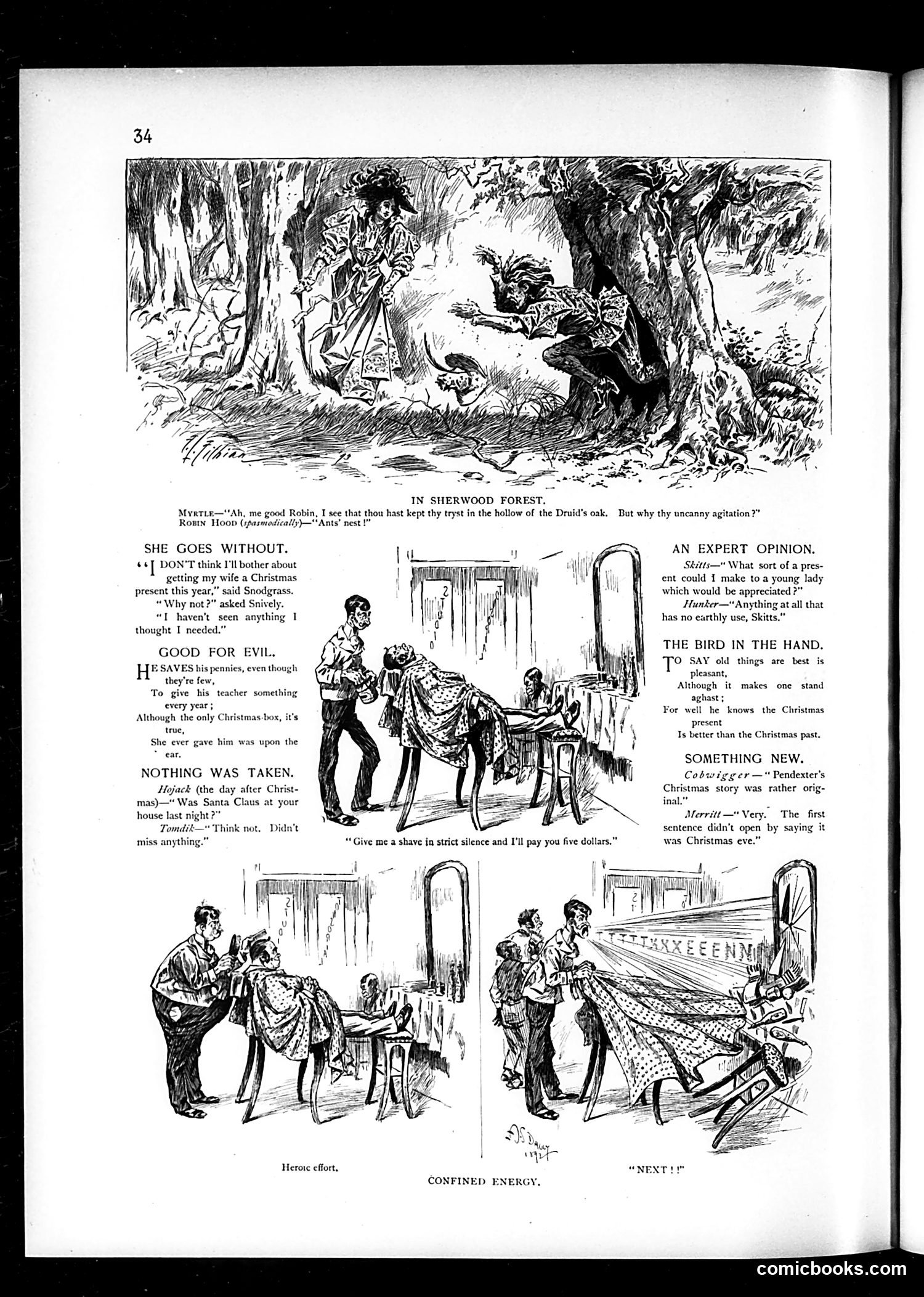
This page collects brief comedic sketches and jokes centered on Christmas themes, typical of Judge's satirical style. **Notable pieces:** - **"She Goes Without"**: A husband won't buy his wife a Christmas present because he hasn't seen anything *he* needs—selfish logic portrayed as absurd. - **"Good for Evil"**: A poor boy gives his teacher an annual gift despite her having struck him ("upon the ear") in return. Satire on misguided generosity or teacher abuse. - **"Nothing Was Taken"**: A child's poverty is revealed humorously—Santa brought nothing because there was nothing to steal. - **"In Sherwood Forest"**: Appears to reference Robin Hood literature with a comedic interruption (ants' nest), though context is unclear. - **"An Expert Opinion"**: Useless gifts are best for impressing young ladies—mocking courtship customs. The page's humor relies on social commentary about poverty, marriage dynamics, education, and gift-giving conventions typical of late Victorian/Edwardian America.
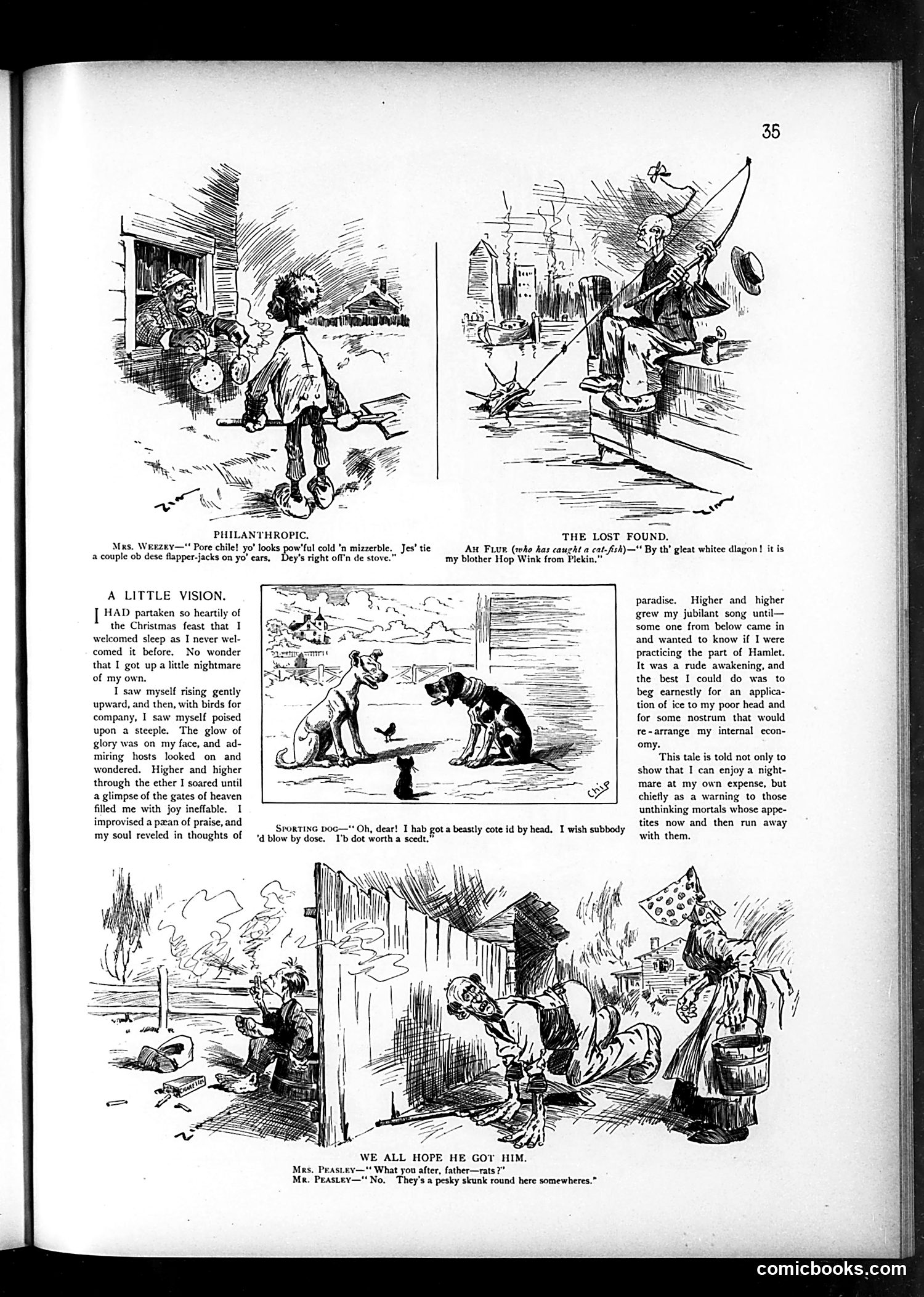
This page contains four separate humorous illustrations typical of early-20th-century Judge magazine: 1. **"Philanthropic"** (top left): A dialect-humor cartoon featuring a Black woman offering "flapper-jacks" (pancakes) to a cold child—playing on contemporary racial stereotypes and working-class speech patterns. 2. **"The Lost Found"** (top right): An Asian character excitedly recognizing a cat-fish as his "brother Hop Wink from Pickin'"—ethnic humor based on broken English and implied unfamiliarity with Western animals. 3. **"A Little Vision"** (center): A prose piece about Christmas overeating causing vivid dreams of ascending to heaven, interrupted by someone asking if he's practicing Hamlet—social humor about excess and pretension. 4. **"Sporting Dog" and "We All Hope He Got Him"** (bottom): Two cartoon vignettes—one showing a dog with a cold, another depicting Mr. and Mrs. Peasley hunting a skunk—gentle domestic humor about rural/suburban life. The page exemplifies Judge's reliance on ethnic stereotypes, dialect humor, and genteel social satire typical of the era.
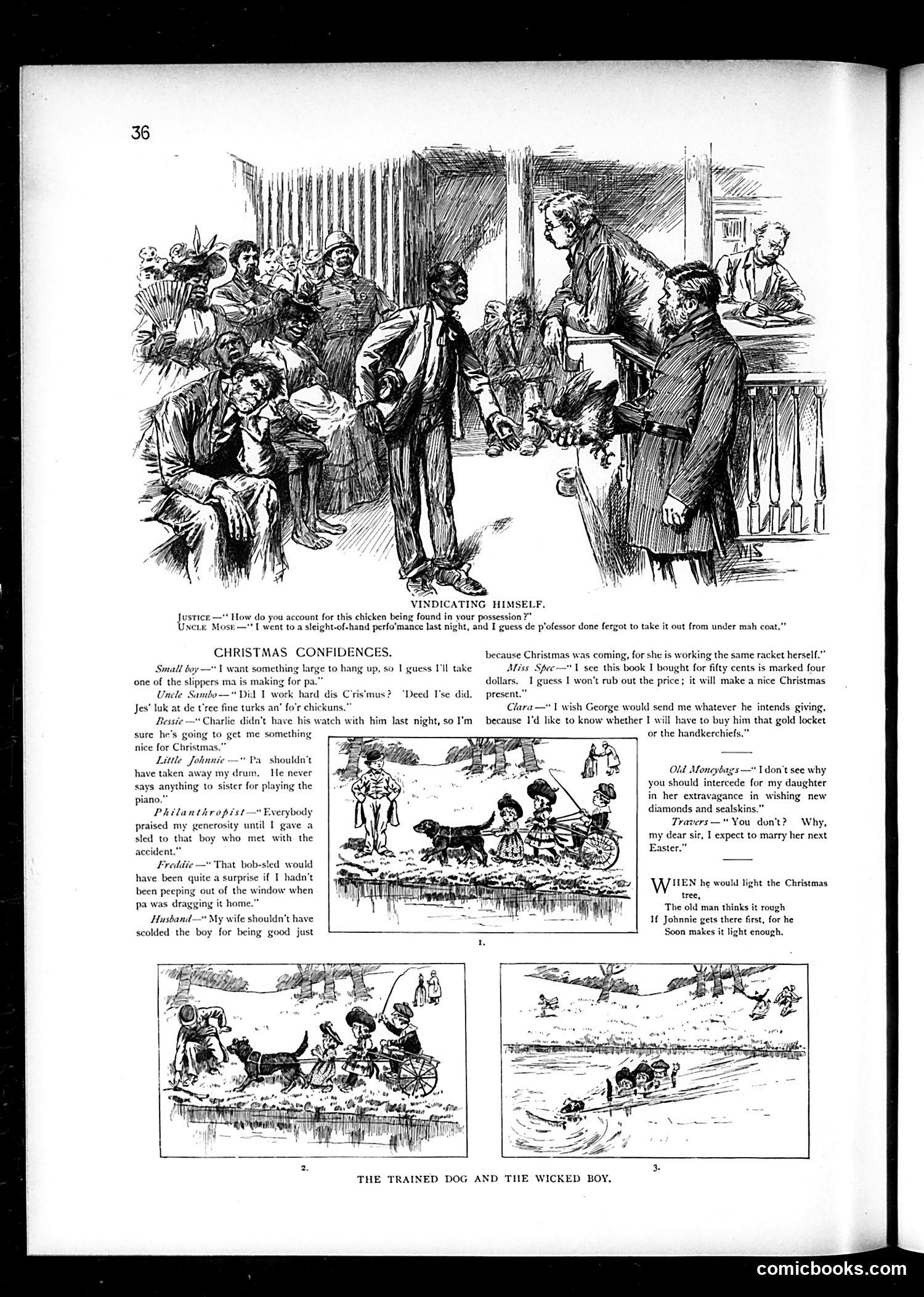
This page satirizes holiday hypocrisy and petty theft among various social classes during Christmas season. The top cartoon shows a Black man caught with a stolen chicken, claiming a magician "forgot" to remove it from under his coat—a transparent lie presented as naive excuse-making. The middle section compiles brief confessions from different characters: servants stealing from employers, children lying about gifts, people inflating prices for resale, women scheming for expensive presents, and a philanthropist seeking credit for charity. The humor targets greed, dishonesty, and self-interest masked by Christmas sentimentality. The final panels depict "The Trained Dog and the Wicked Boy"—apparently a serialized story about mischief during the holidays. The satire's point: Christmas brings out universal selfishness and moral compromise across social strata, from wealthy misers to working-class thieves, suggesting holiday virtue is largely performative.
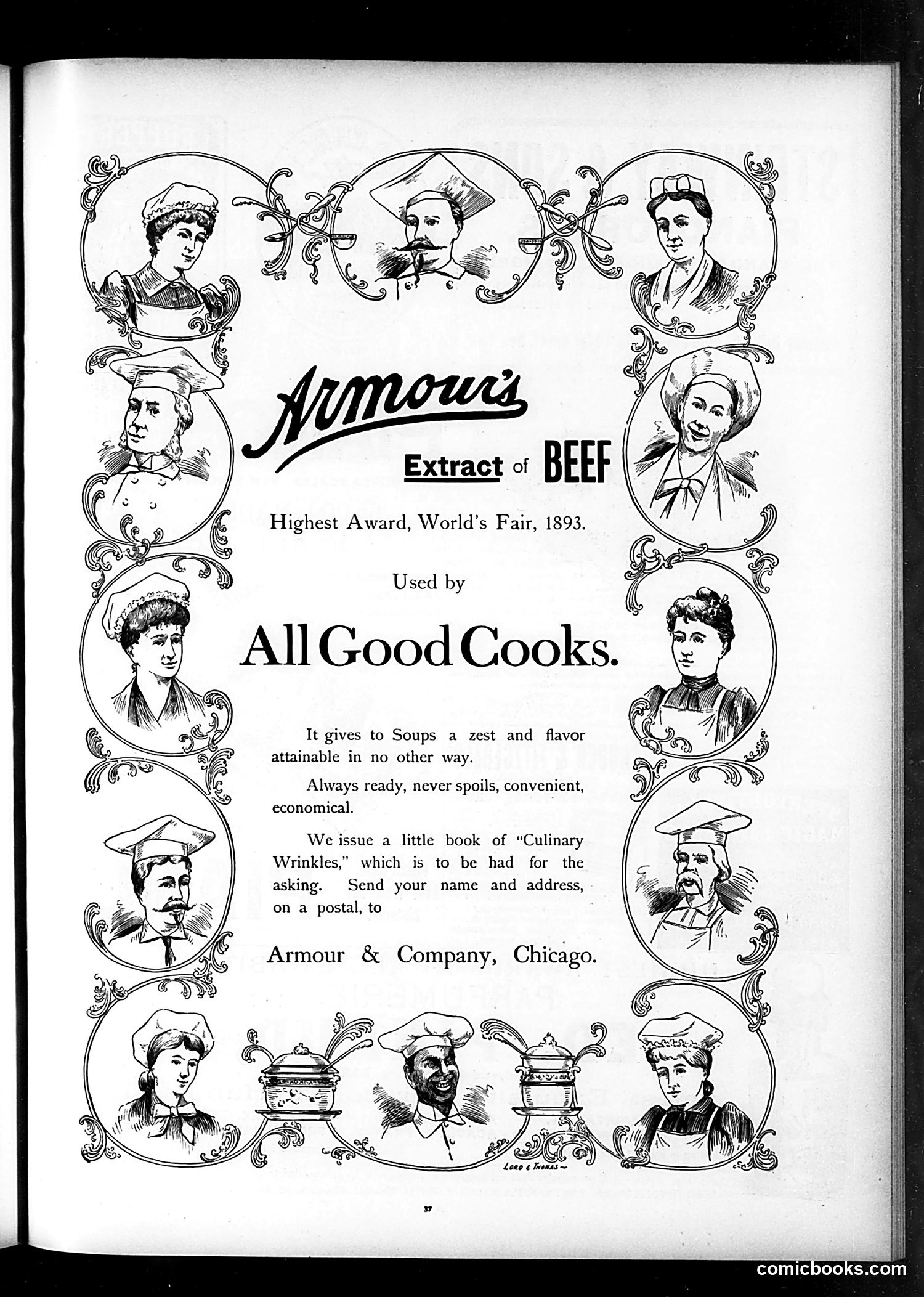
This is primarily a **product advertisement**, not political satire. It promotes Armour & Company's beef extract, a concentrated meat product popular in the late 19th century for flavoring soups and broths. The decorative border features **illustrated heads of various cooks and chefs**—likely representing professional culinary expertise to endorse the product. The reference to "Highest Award, World's Fair, 1893" (the Chicago World's Columbian Exposition) serves as a prestigious credential. The copy emphasizes practical virtues: convenience, economy, and reliability ("never spoils"). The offer of a free "Culinary Wrinkles" booklet was a common marketing tactic of the era to encourage consumer interest. There is **no apparent political satire** on this page—it's straightforward commercial advertising designed to appeal to housewives and cooks through both authority (professional endorsement) and practicality.
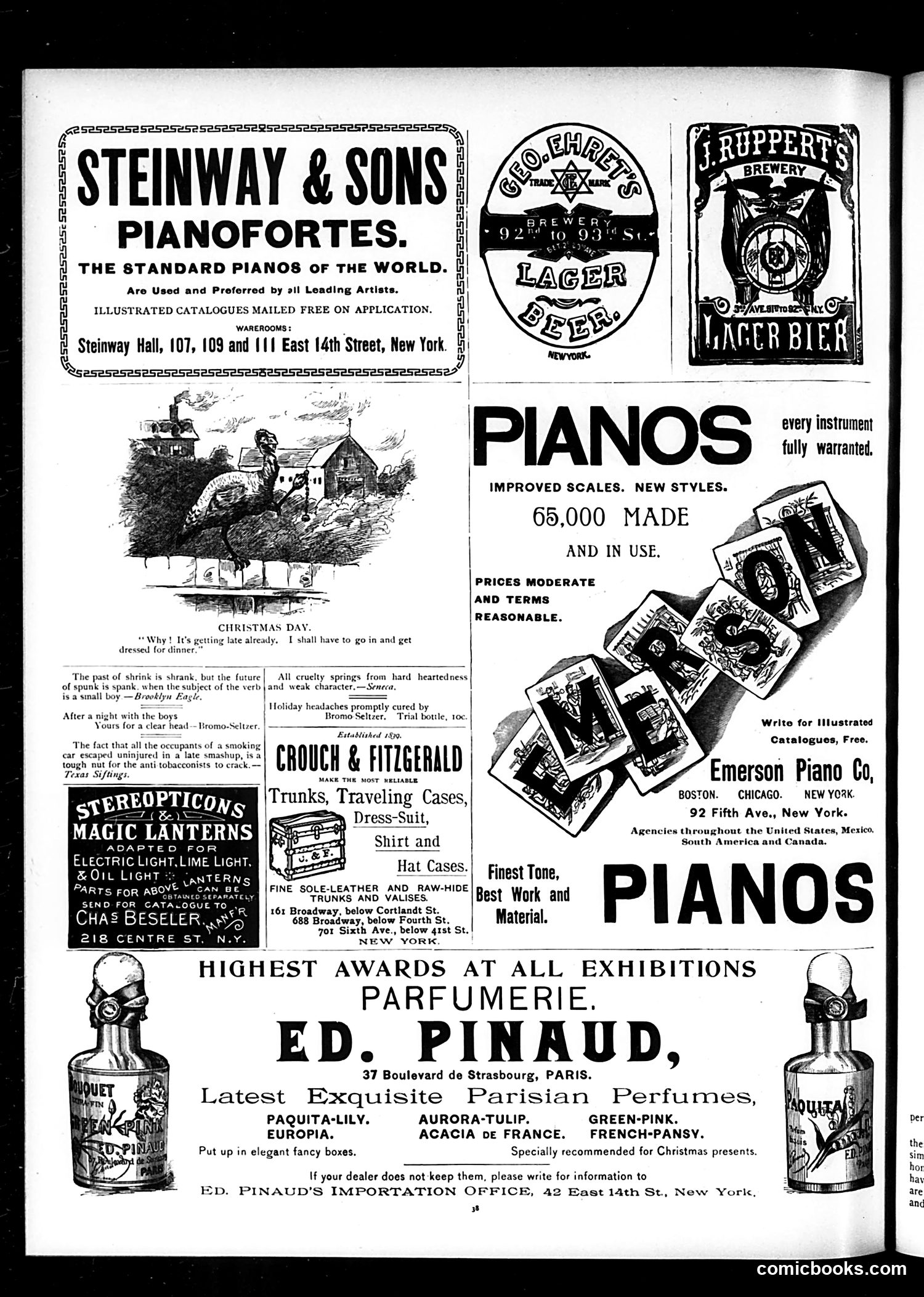
This is primarily an **advertising page** rather than satirical content. The page is dominated by commercial advertisements for luxury goods popular with wealthy Americans circa early 1900s: pianos (Steinway, Emerson), perfume (Ed. Pinaud from Paris), luggage, and novelty items. The only actual cartoon content is titled "CHRISTMAS DAY," showing a domestic scene where a woman tells her husband she must get dressed for dinner because "it's getting late already"—a mild joke about female vanity or the time required for women's grooming before social events. The page includes scattered humorous quotes about topics like grammar ("spunk/spank"), smoking cars, and character, but these are filler material between advertisements. The satirical commentary is minimal and generic social observation rather than political content. The page reflects Judge's function as both entertainment and advertising vehicle for upscale consumer goods.
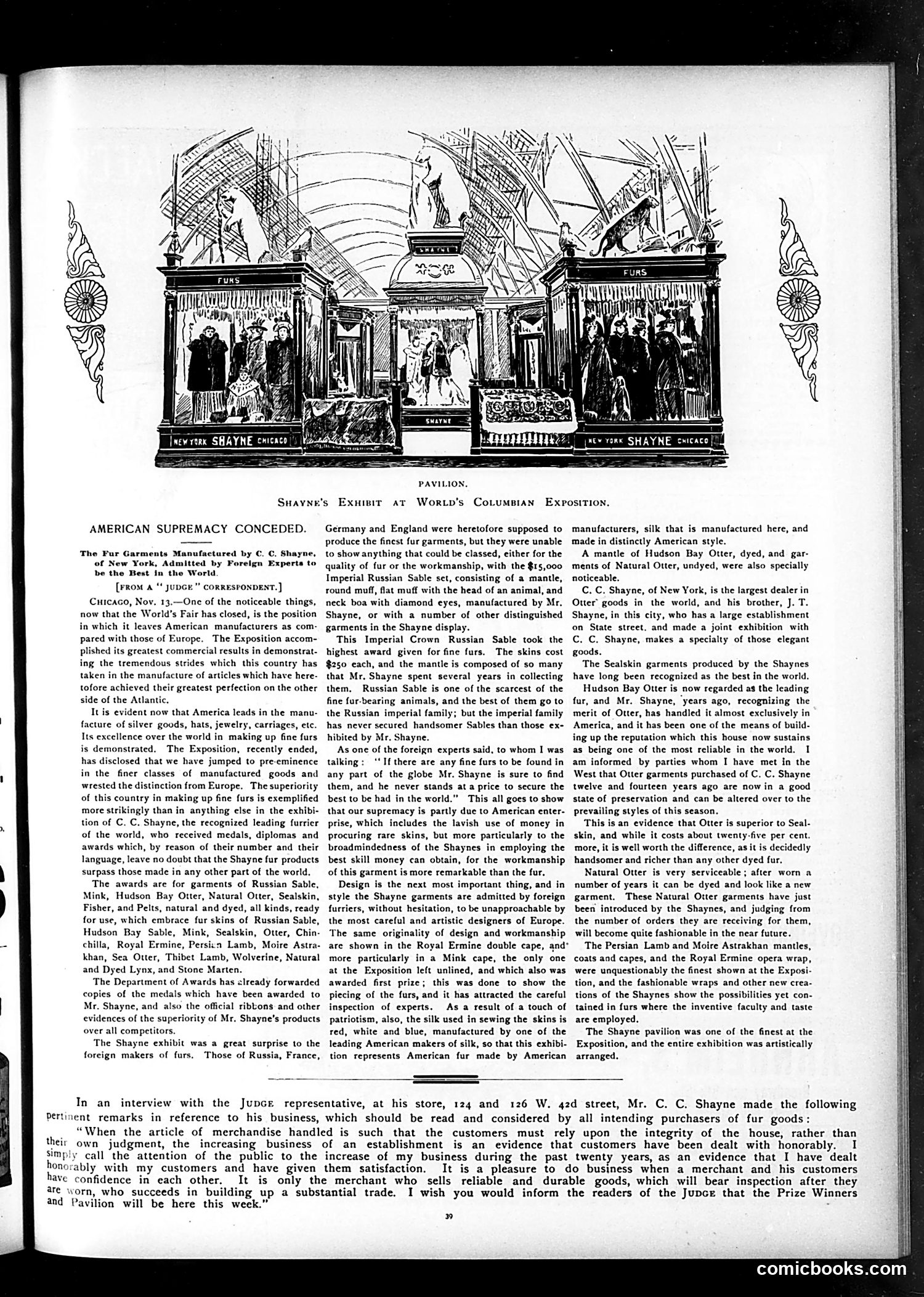
This is primarily **advertising content** disguised as editorial coverage of the 1893 World's Columbian Exposition in Chicago. The illustrated "pavilion" shows C.C. Shayne's fur company display with mannequins modeling garments. The accompanying text—framed as a journalist's report—celebrates American manufacturing supremacy, specifically Shayne's fur craftsmanship over European competitors (Russia, France, Germany, England). The satire (if present) is subtle: *Judge* magazine is showcasing how American businesses used the World's Fair for nationalist propaganda and commercial promotion. The piece emphasizes that Shayne won medals and awards, and includes an interview where Shayne claims his success proves American superiority in luxury goods manufacturing. For modern readers: this represents late-19th-century American boosterism and the blurred line between journalism and advertising in periodicals. The focus on "American supremacy" reflects contemporary industrial competition and national pride during the Gilded Age.
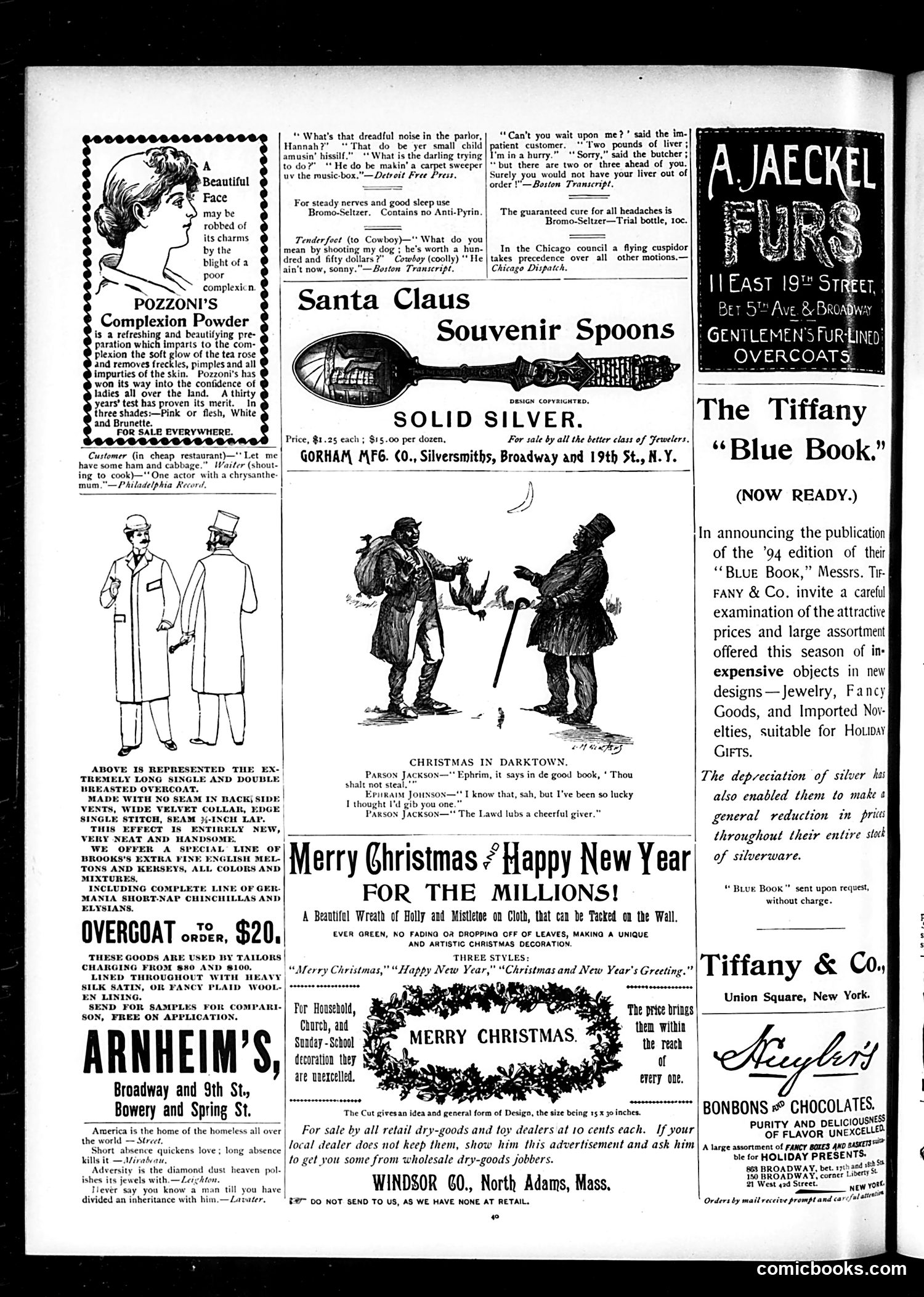
This page is primarily **advertising and holiday greetings** rather than political satire. The notable content includes: **Visual humor**: A cartoon labeled "Christmas in Darktown" features racial stereotypes common to late-19th-century American magazines, depicting Black characters (Parson Jackson and others) in a dialect-heavy exchange about Christian charity. This reflects the deeply racist visual conventions Judge regularly employed. **Small jokes/quips**: Brief humorous observations scattered throughout (a child with a carpet sweeper, an impatient butcher customer, a tenderfoot arguing with a cowboy). These are mild, topical humor rather than political commentary. **Dominant content**: Extensive advertising for overcoats, complexion powder, silverware spoons, Christmas decorations, chocolates, and Tiffany's "Blue Book"—typical of holiday-season magazine issues. The page shows Judge functioning as a *satirical magazine with advertisements*, not primarily delivering pointed political commentary. The racial caricature represents the magazine's casual, normalized bigotry of that era.
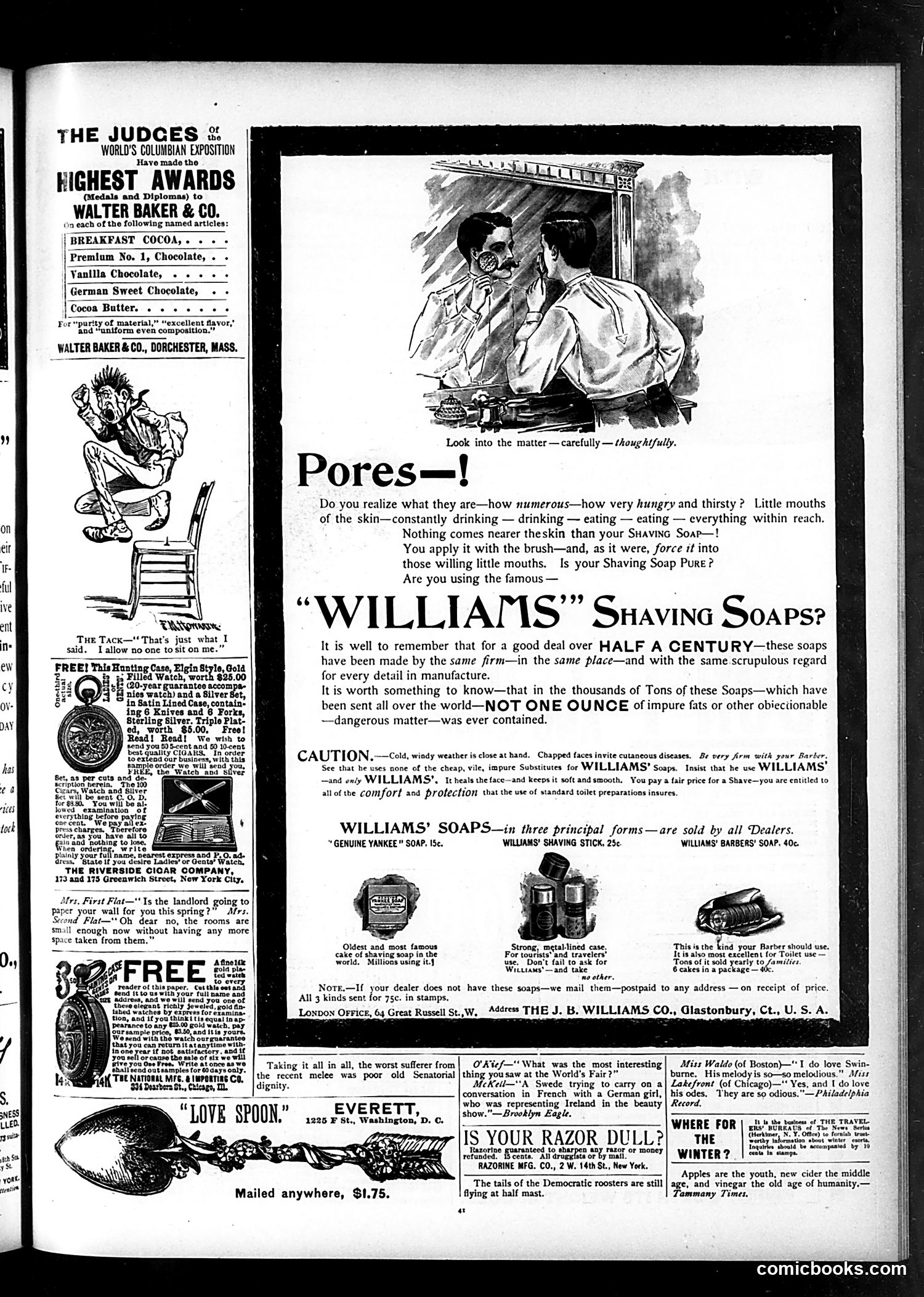
This page is primarily **advertising**, not political satire. The dominant content is a large Williams' Shaving Soaps advertisement using the metaphor of "pores" as "willing little mouths" that consume products applied to skin—making an argument for using pure soap. The page includes several minor comic elements: a Walter Baker & Co. cocoa award notice with a small cartoon of a chef; a "Love Spoon" novelty item advertisement; brief domestic humor ("Mrs. First Flat" discussing wallpapering); and short joke snippets about the World's Columbian Exposition. The Williams' ad includes a cautionary note warning barbers against substituting cheaper soaps, framing product purity as a health/safety issue. The cartoons present are generic domestic humor typical of the era—no identifiable political figures or references. The page reflects late-19th-century advertising conventions and consumer concerns about product authenticity.
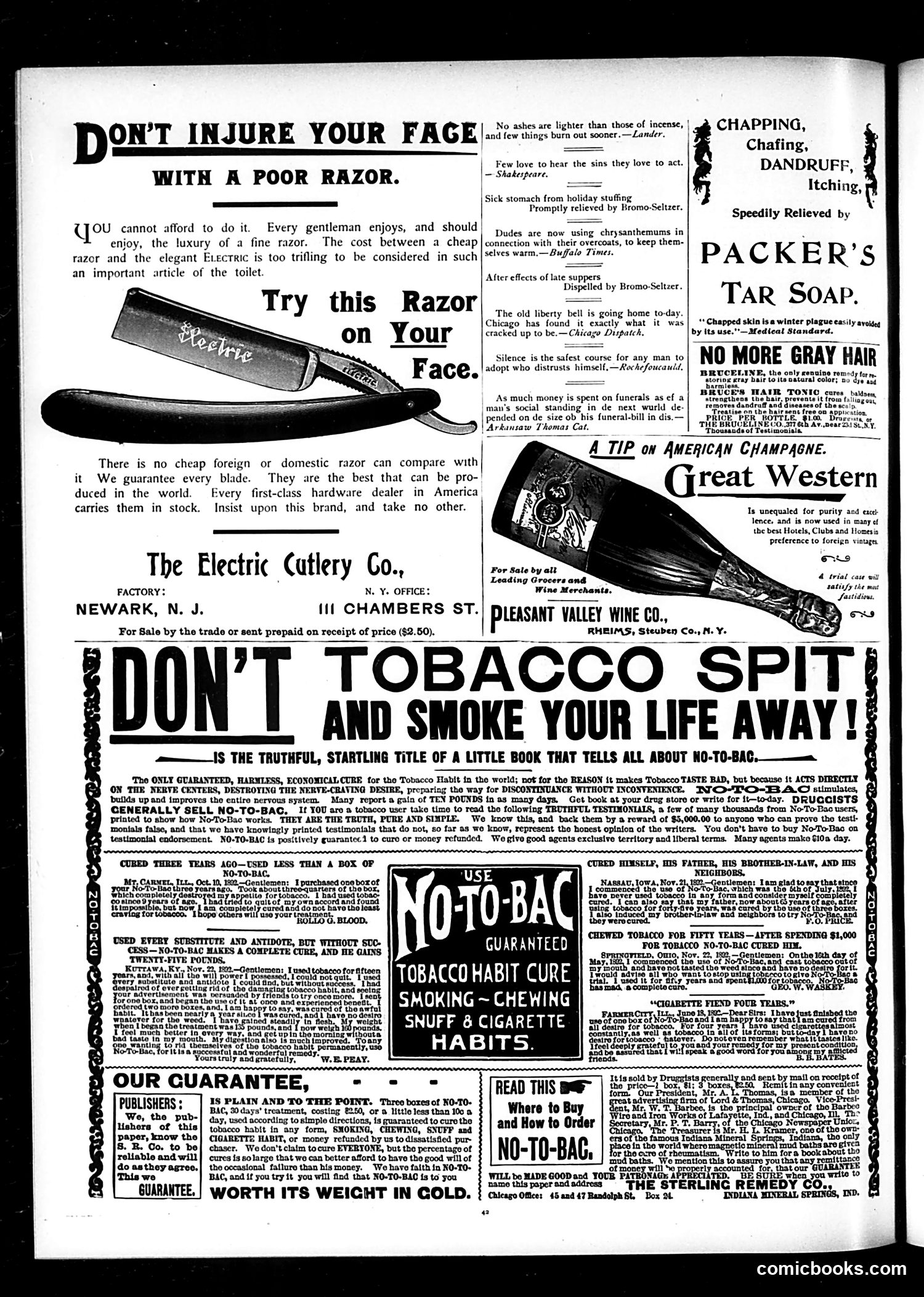
This is primarily an **advertising page** from Judge magazine, not a political cartoon. The page contains multiple product advertisements typical of early 1900s publications. The dominant feature is a large advertisement for **No-To-Bac**, a "tobacco habit cure" claiming to eliminate smoking, chewing, snuff, and cigarette cravings by acting on "nerve centers." The ad uses testimonials from purported users to establish credibility. Supporting advertisements include: - **Electric Cutlery razors** (top left)—promoting quality shaving equipment - **Packer's Tar Soap**—for chapped skin and dandruff - **Bromo-Seltzer**—for digestive relief - **Great Western Champagne**—American wine marketed as superior to foreign imports The scattered quotations throughout reflect period humor and social commentary (references to funerals, the Liberty Bell, etc.), but these are filler rather than coordinated satire. **For modern readers:** This page reflects late 19th/early 20th-century consumer culture, showing how patent medicines and dubious "cures" were marketed with pseudoscientific claims and testimonials—practices now regulated by the FDA.
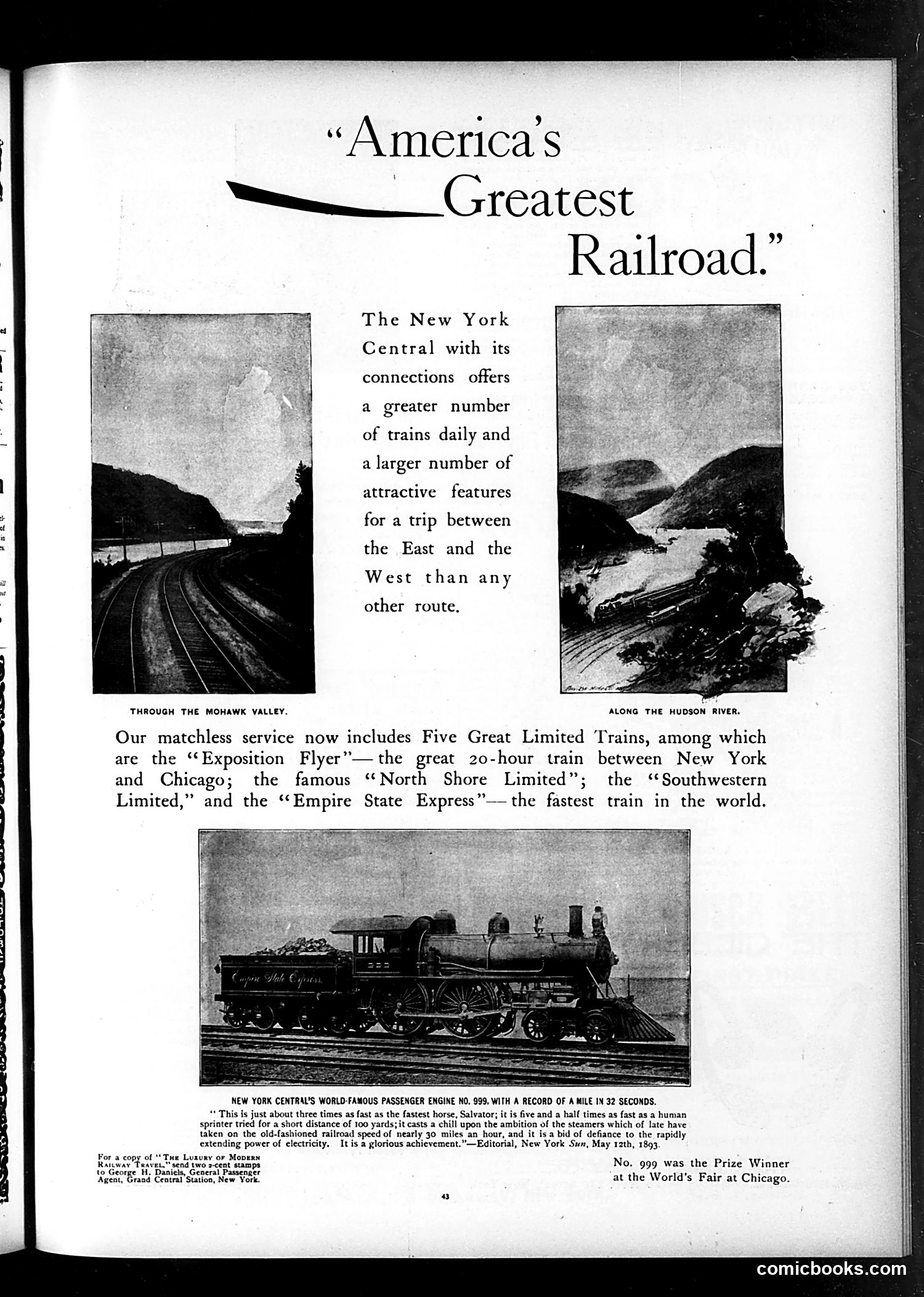
This is **not a political cartoon or satire**—it's a **full-page advertisement** for the New York Central Railroad, likely from the 1890s. The page promotes the railroad as "America's Greatest Railroad" through: - **Scenic photographs** of the Mohawk Valley and Hudson River routes, emphasizing natural beauty - **Claims of superior service**: more daily trains and "attractive features" than competitors - **Five famous limited trains** named (Exposition Flyer, North Shore Limited, etc.) - **Engine No. 999**, highlighted as a speed record-holder completing a mile in 32 seconds The text contains boastful comparisons: the engine runs three times faster than the fastest horse, defies steamship competition, and represents modern technological achievement. The World's Fair prize claim adds prestige. This is straightforward promotional content celebrating railroad innovation and American industrial progress during the Gilded Age—no satire or hidden political message is present.
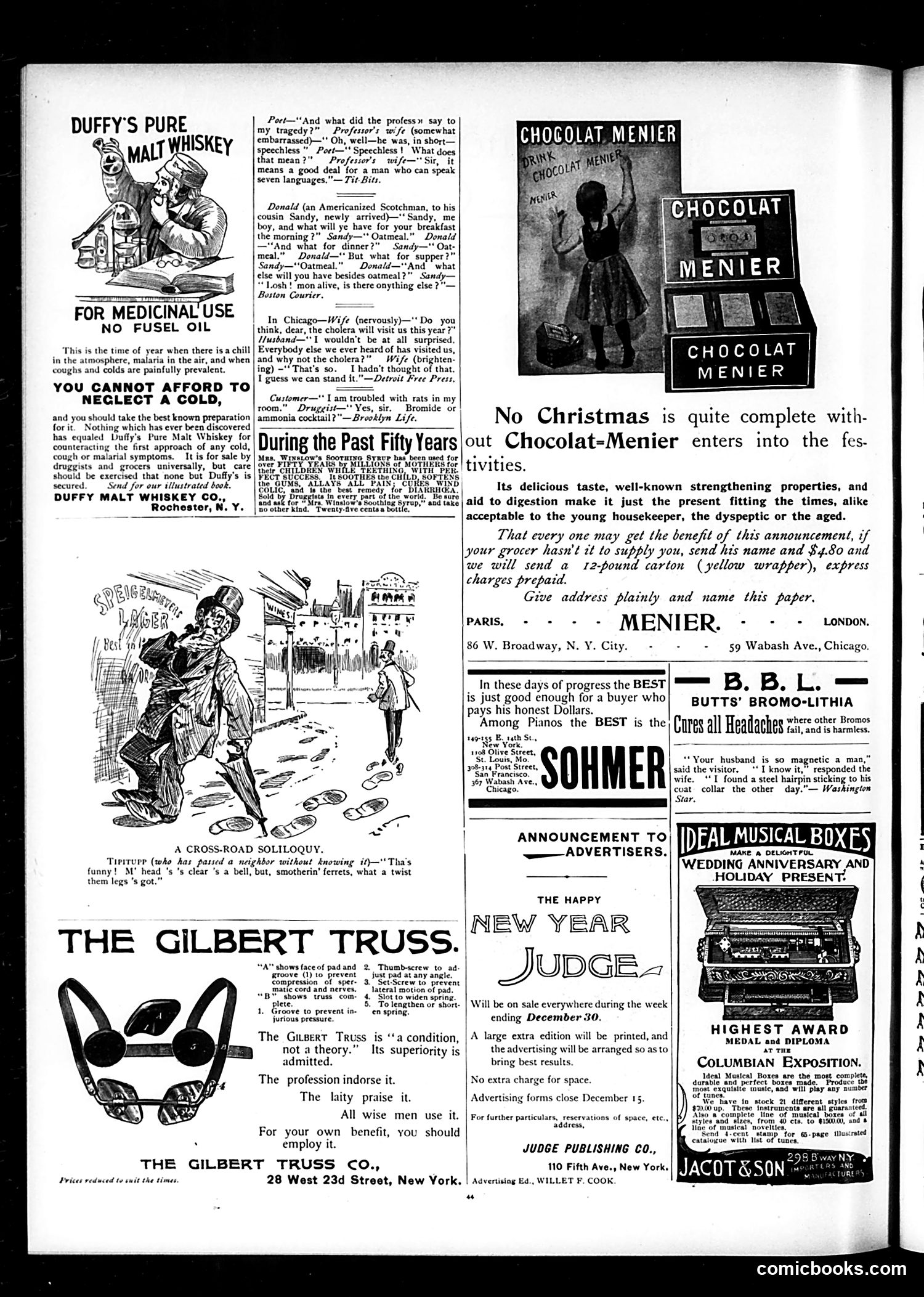
This page is primarily **advertising with minimal editorial cartoons**. The main content consists of nostalgic humor snippets and product advertisements typical of early 20th-century magazines. ## Key Elements: **"A Cross-Road Soliloquy"** (bottom left): A drunk man, depicted with exaggerated unsteady legs, delivers a comic monologue about his clear head despite obvious intoxication—typical period humor about drunkenness. **Duffy's Malt Whiskey ad**: Ironically positioned above jokes about drinking, it advertises whiskey as medicine for colds and malaria—reflecting the era when alcohol was marketed as medicinal, before Prohibition and modern medical standards. **Scattered jokes**: Light ethnic humor (Scottish characters), marital humor, and wordplay typical of Judge's satirical style but lacking political bite. **Product ads**: Gilbert Truss (medical device), Chocolat-Menier, and others reflect turn-of-century consumer culture. The page demonstrates how early 1900s humor magazines blended satire with unironic advertising, including products now recognized as harmful or fraudulent.
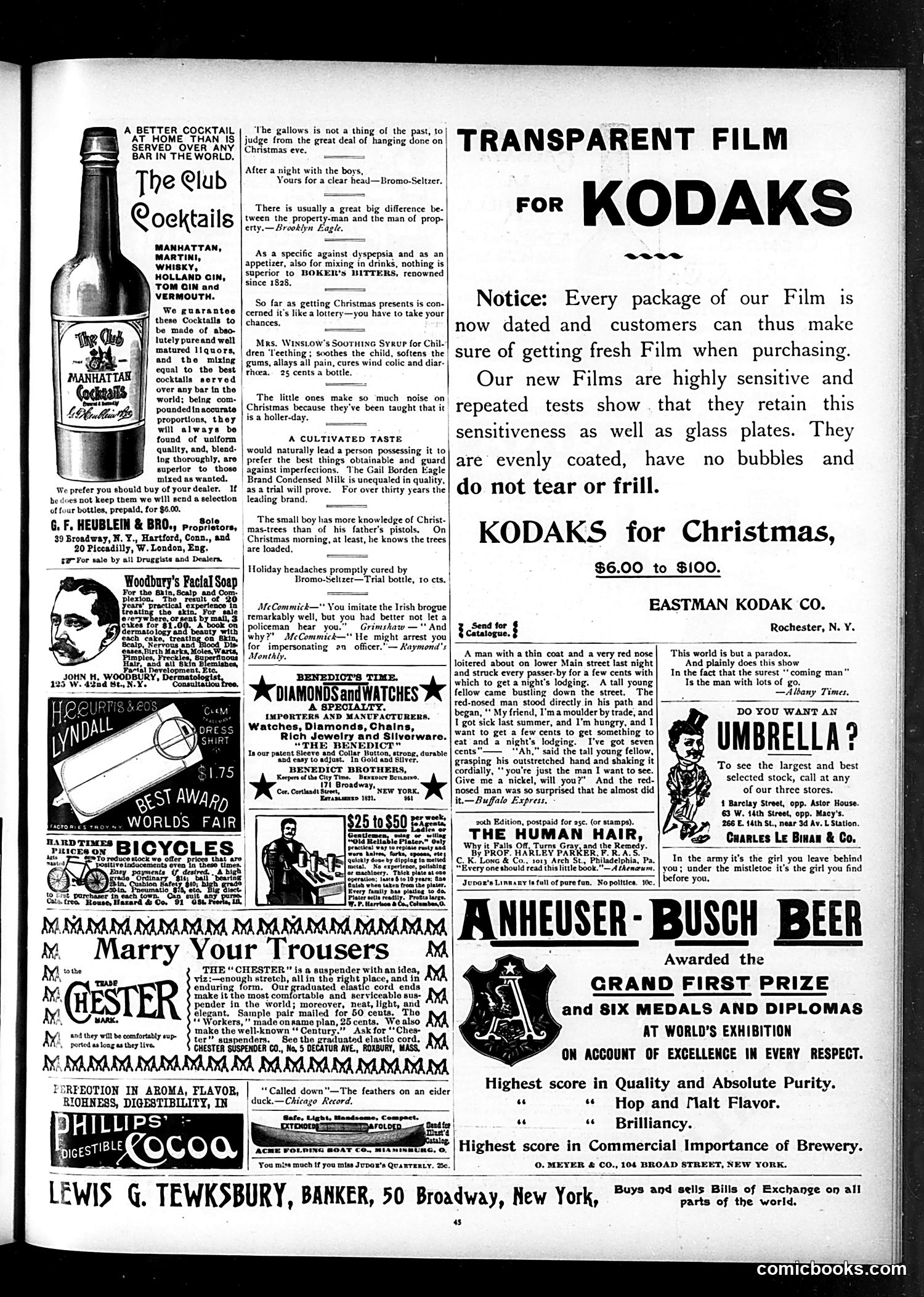
This page is primarily **advertising**, not political satire. It contains multiple commercial advertisements from the early 1900s, including: **Notable ads:** - **Kodak transparent film** (prominent right column): Markets dated film stock, emphasizing freshness and quality—"do not tear or frill" - **Anheuser-Busch Beer**: Announces World's Fair awards, emphasizing "Quality and Absolute Purity" - **Chester Suspenders**: Markets elastic suspenders with humor ("Marry Your Trousers") - **Various patent medicines**: Bromo-Seltzer, Mrs. Winslow's Soothing Syrup, Boker's Bitters **Minor satirical content** includes brief humorous one-liners (jokes about Christmas presents as "lotteries," Irish brogue impersonation) interspersed among ads. The page reflects early 1900s consumer culture: proprietary medicines, photography technology, and gentlemen's goods advertised with both earnest quality claims and light humor. No significant political commentary is present.
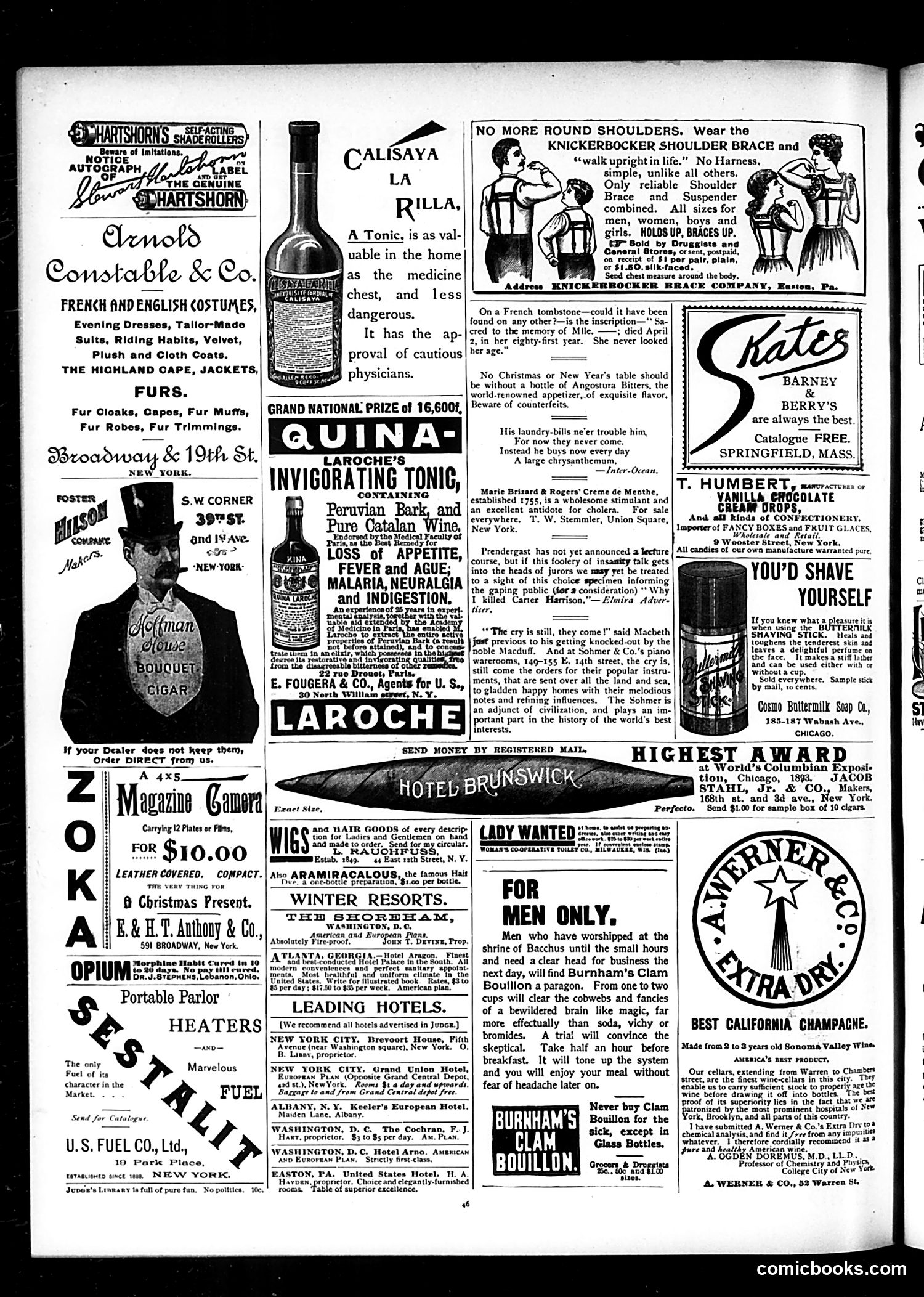
This is primarily an **advertising page** from Judge magazine, with minimal editorial content. The few satirical items present include: 1. **A brief joke about French tombstones**: A mordant quip about a French woman's epitaph claiming she "never looked her age" despite dying at 81—typical Judge humor mocking vanity and mortality. 2. **A reference to Prendergast**: The text mentions someone who "killed Carter Harrison," likely referencing Eugene Prendergast, who assassinated Chicago Mayor Carter Harrison Sr. in 1893. The passage sarcastically suggests he might lecture about his crime for money—dark political satire about sensational crime and commercialization. The page is otherwise dominated by late-Victorian patent medicines (Calisaya, Laroche's tonic, Angostura Bitters), clothing, cameras, and personal grooming products. The ads themselves reflect period anxieties: shoulder braces, invigorating tonics, and shaving products marketed to men concerned with appearance and health.
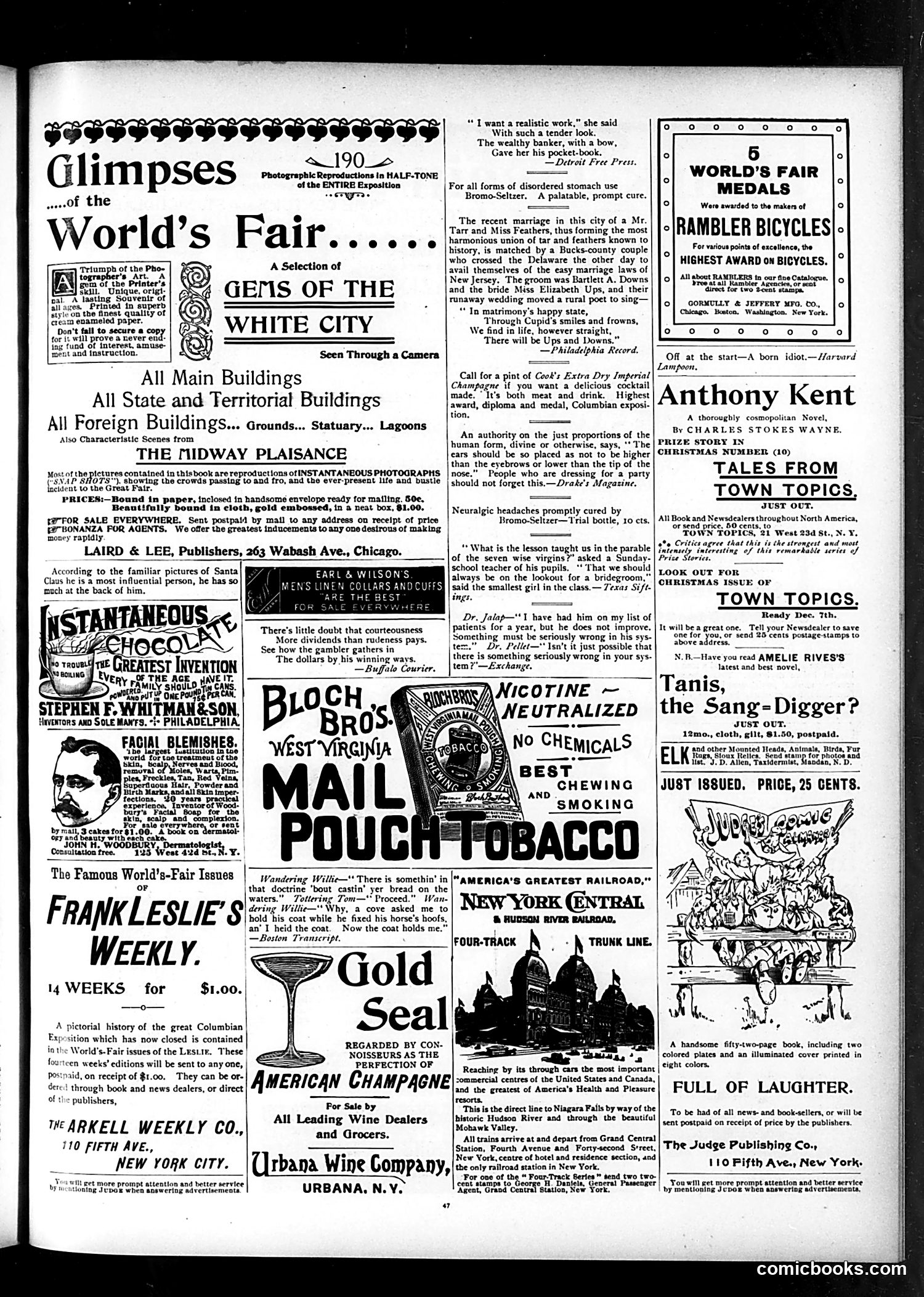
This page is primarily **advertising and promotional content** from Judge magazine, circa 1893, centered on the World's Columbian Exposition (the "White City") in Chicago. The main content consists of: 1. **World's Fair merchandise**: Promotional materials for photographic reproductions and pictorial histories of the exposition's buildings and attractions 2. **Period advertisements**: Products like Bromo-Seltzer (stomach remedy), Bloch's chewing tobacco, Frank Leslie's Weekly magazine, and Ubana Wine Company 3. **Brief humorous anecdotes**: Short jokes about courtship, marriage puns ("Tarrs and Feathers," "Ups and Downs"), and social observations 4. **Consumer goods**: Facial treatments, bicycles (Rambler brand), and books The "cartoons" are minimal—mostly illustrative advertisements. The humor is gentle, domestic satire typical of Gilded Age magazines. The page reflects turn-of-the-century consumer culture and the massive cultural impact of the 1893 World's Fair, which dominated American publishing and advertising.
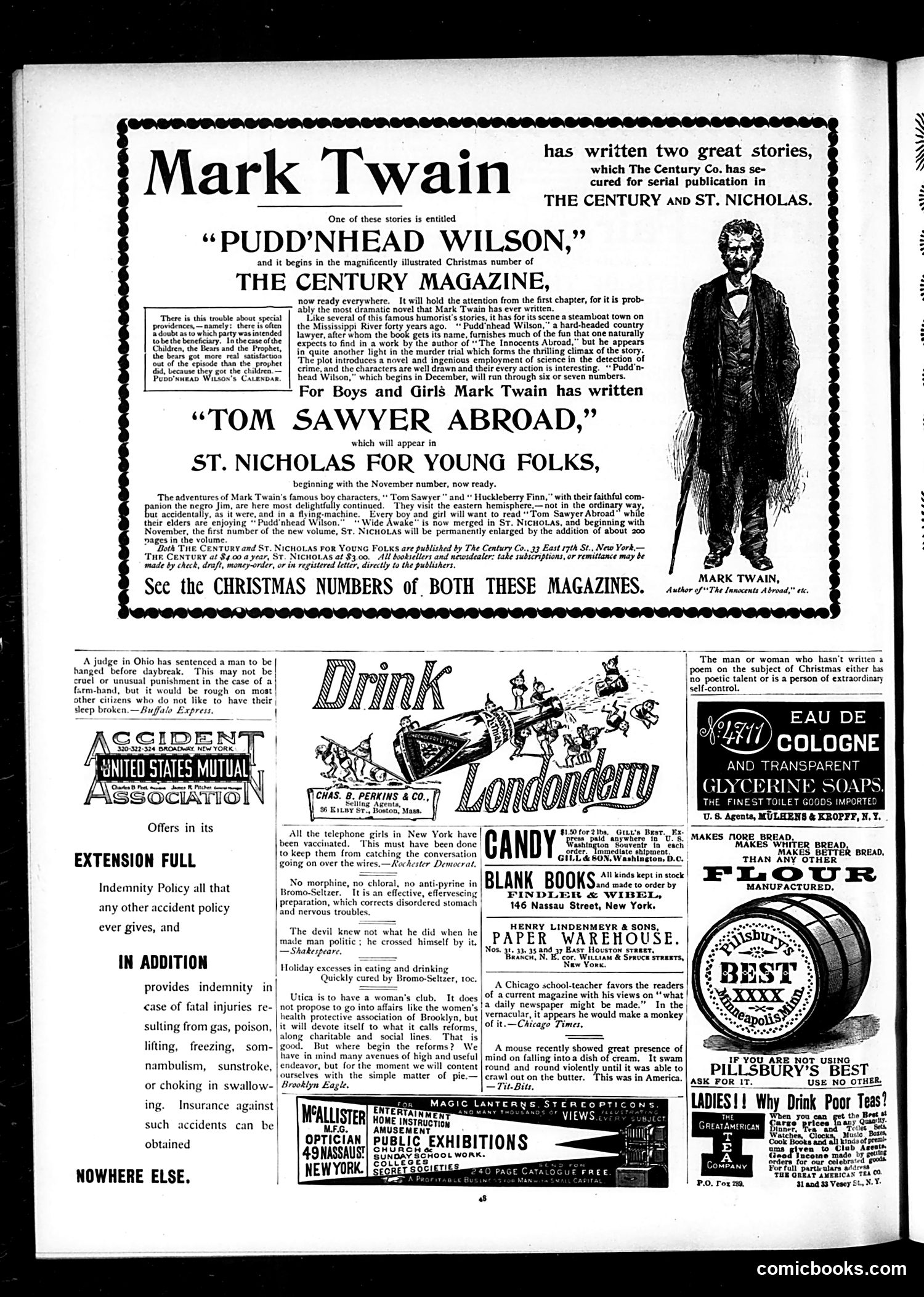
This page is primarily **advertising and promotional content** for Mark Twain's serialized stories in two rival magazines: "Pudd'nhead Wilson" in *The Century* and "Tom Sawyer Abroad" in *St. Nicholas*. The top features a portrait of Mark Twain himself, legitimizing the promotional text. The large central section announces these literary serializations—a common Victorian-era practice where novels appeared in installments. Below are various advertisements typical of 1890s publications: insurance, patent medicines, soaps, blank books, and optical equipment. A recurring joke notes that "all telephone girls in New York have been vaccinated"—likely referencing contemporary health concerns. The small text block about an Ohio judge sentencing someone to hang "before daybreak" is satirical commentary on harsh justice. Overall, this reflects how magazines subsidized content through aggressive advertising, and how major authors like Twain were marketed as draw for competing publications.
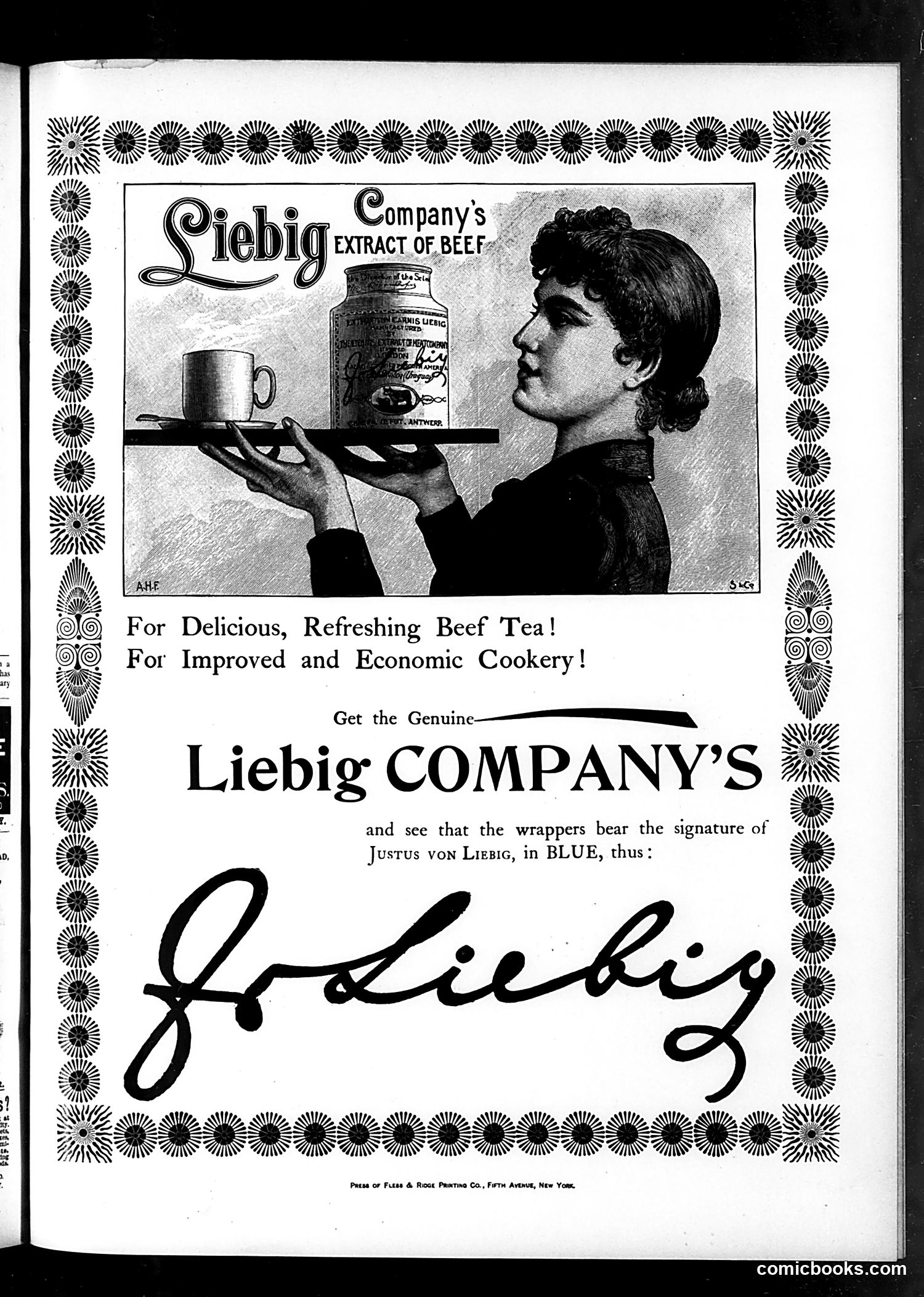
This is a **product advertisement**, not political satire. It promotes Liebig Company's beef extract—a concentrated meat product popular in the late 19th/early 20th century, used to make "beef tea" (a broth consumed for nutrition and health). The advertisement features: - A stylized illustration of a waiter or server presenting the product on a tray - Marketing claims about the extract being "delicious," "refreshing," and enabling "economic cookery" (stretching meat resources) - Emphasis on authenticity: buyers should verify the wrapper bears founder **Justus von Liebig's** signature in blue ink to avoid counterfeits - Ornamental border typical of period advertisements **Context for modern readers**: Liebig's extract was a legitimate food innovation of the era, but counterfeits were apparently common enough to warrant anti-fraud warnings. The "beef tea" concept reflects pre-modern nutrition science and the product's status as a luxury health supplement.
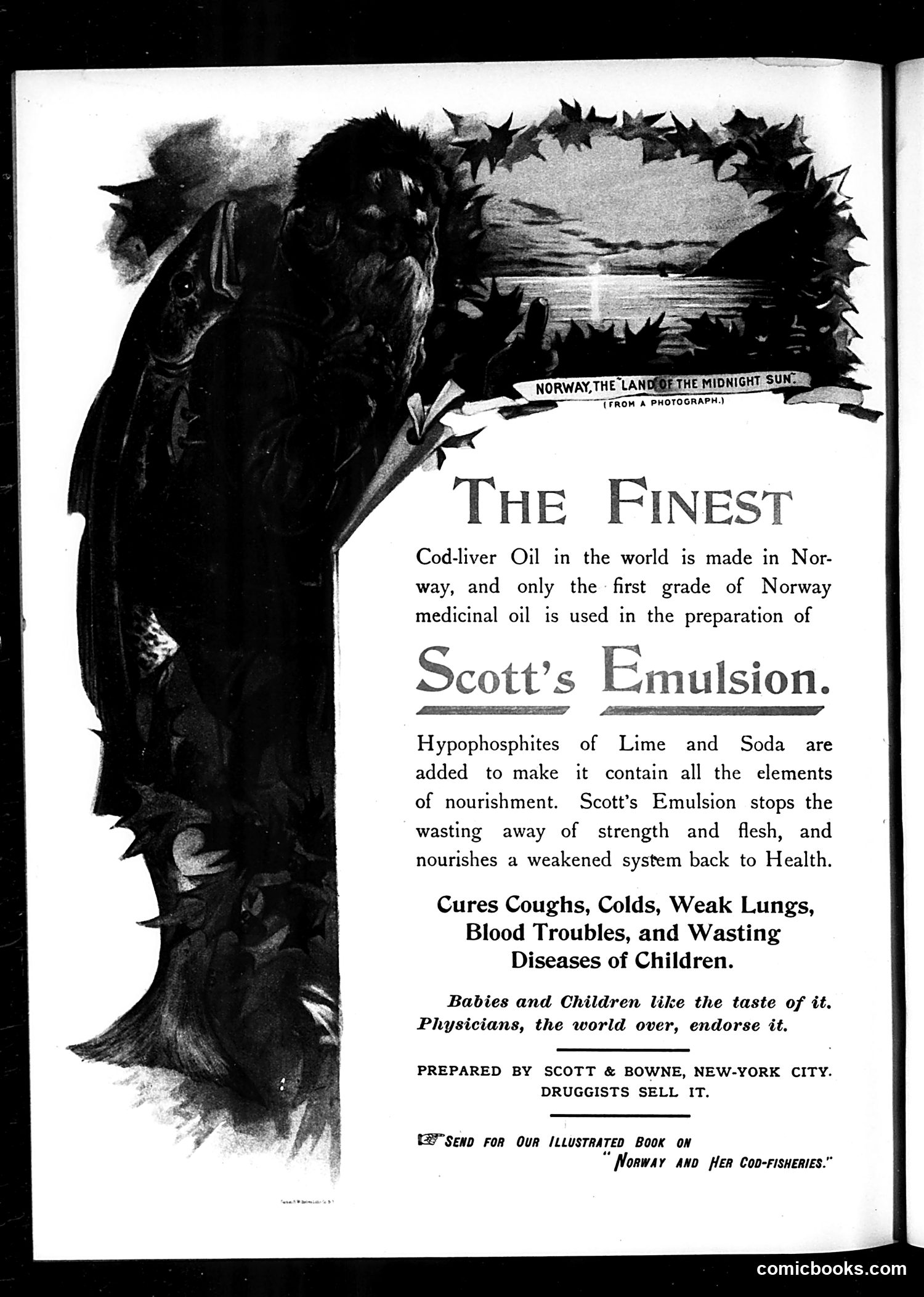
This is primarily a **product advertisement**, not satire. It promotes Scott's Emulsion, a cod-liver oil supplement manufactured by Scott & Bowne of New York. The page features a dramatic illustration of what appears to be a **Norwegian fisherman or sailor** in traditional dress, positioned beside a landscape photograph labeled "Norway, the Land of the Midnight Sun." This imagery serves a marketing purpose: establishing the product's Norwegian origin and legitimacy. The advertisement claims the emulsion cures coughs, colds, weak lungs, blood troubles, and wasting diseases—particularly in children. It emphasizes physician endorsement and palatability for young patients. By modern standards, the health claims are vastly overstated and unsubstantiated, and the product itself (concentrated fish oil) would face strict FDA scrutiny today. The appeal to national origin and medical authority reflects early 20th-century advertising conventions.