
A complete issue · 16 pages · 1893
Judge — November 11, 1893
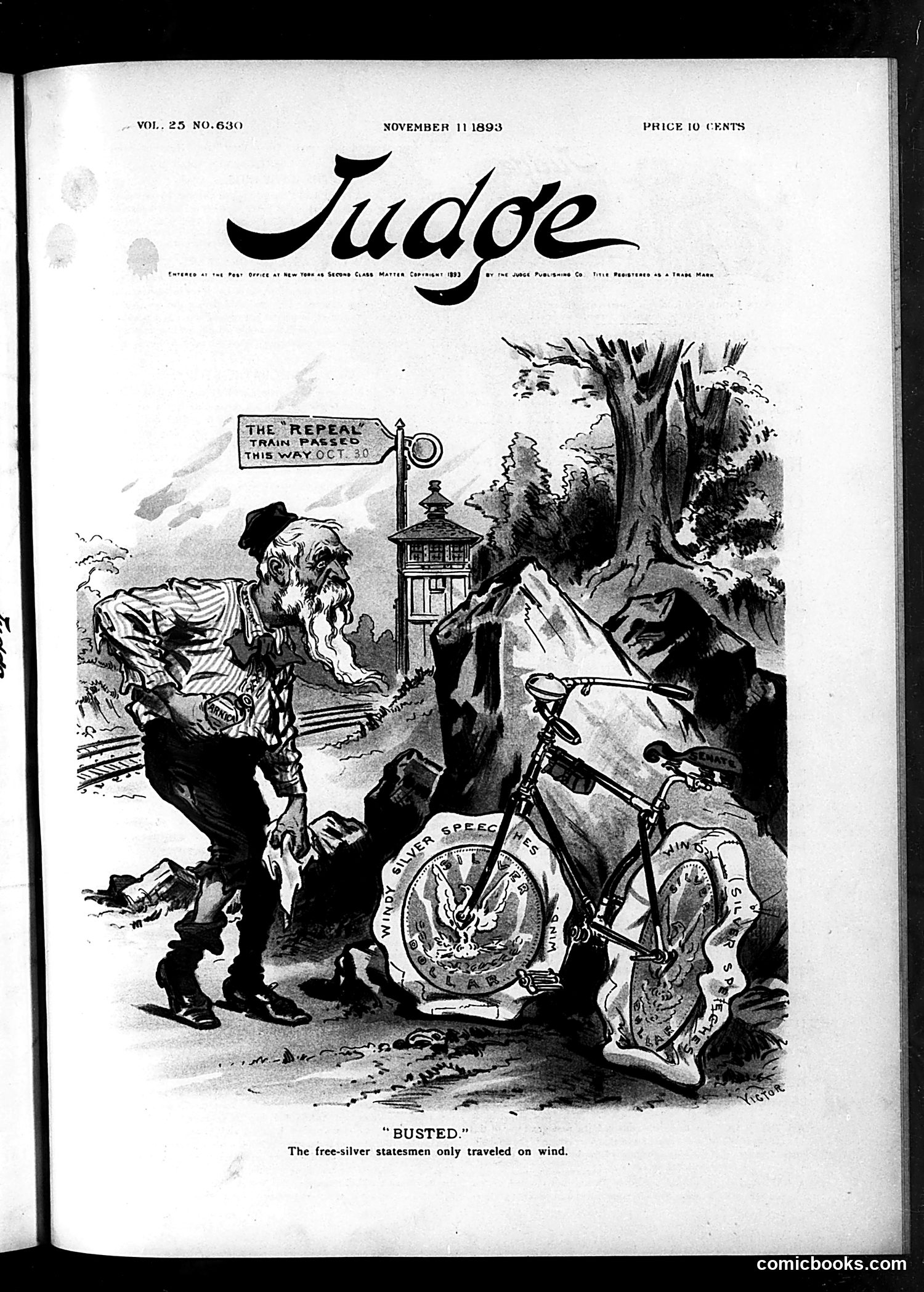
This political cartoon satirizes free-silver advocates during the 1893 economic depression. The sign reading "THE 'REPEAL' TRAIN THIS WAY OCT. 30" references recent political efforts around currency policy. The cartoon depicts a bearded figure (representing a free-silver statesman) with a broken bicycle labeled "FREE SILVER SPEECH" and "SOUND MONEY" wheels. The caption states: "The free-silver statesmen only traveled on wind." The satire mocks free-silver politicians as all talk and no substance—their rhetoric (wind) cannot sustain actual policy. The bicycle's deflated wheels suggest their arguments have collapsed under scrutiny. This reflects the intense 1890s debate over monetary policy between free-silver and sound-money factions.
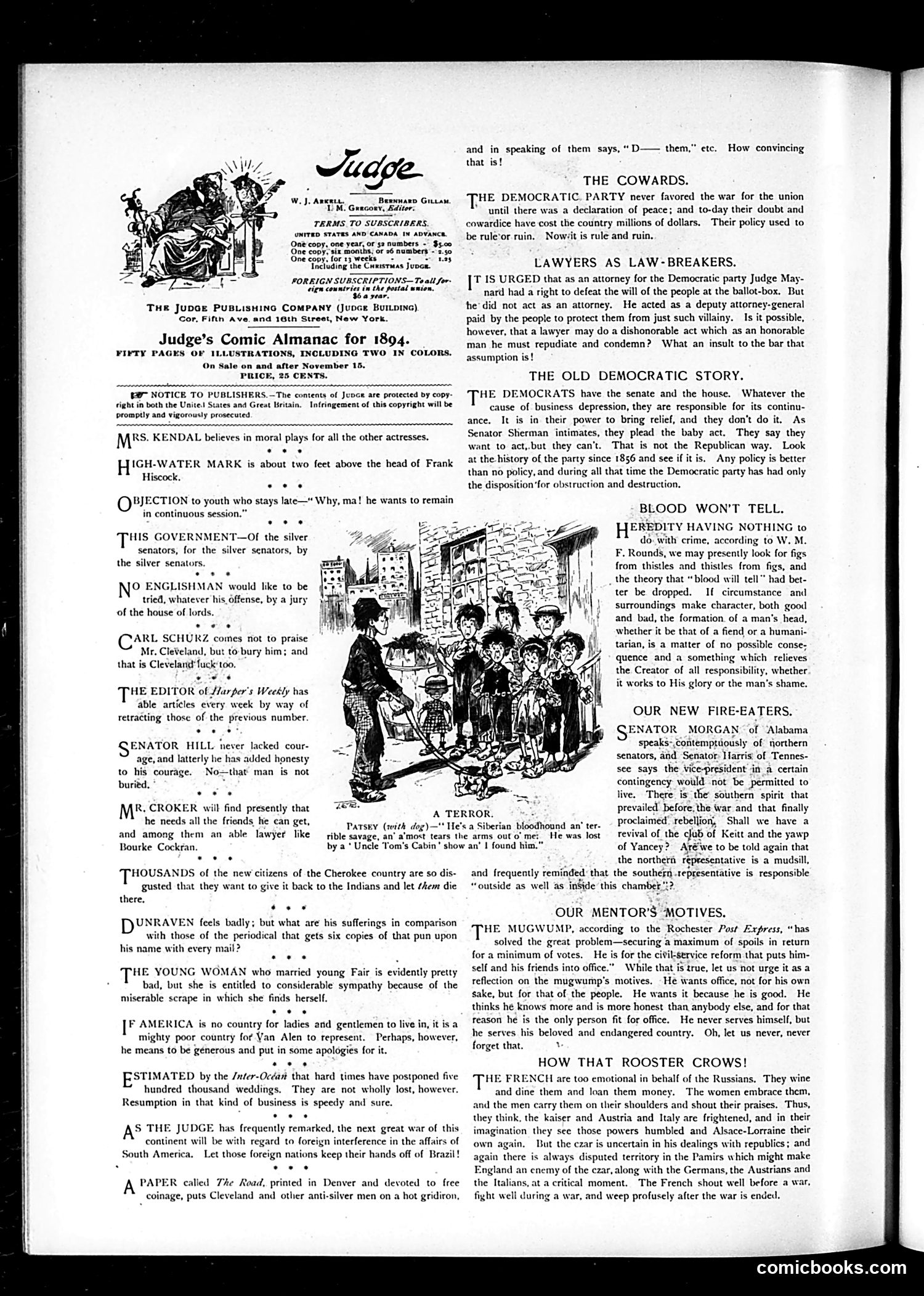
This 1894 Judge page contains multiple political commentary sections attacking Democrats. Key sections include: **"The Cowards"** - Criticizes the Democratic Party for their opposition to the Civil War and Union cause, claiming their "cowardice has cost the country millions of dollars." **"Lawyers as Law-Breakers"** - Argues that Democratic attorneys who opposed Union victory should be disbarred, calling this a moral obligation. **"The Old Democratic Story"** - Attacks Democratic control of Congress, suggesting their policies favor destruction over construction. **"Blood Won't Tell"** - References W.M. F. Round's views on crime and character formation, appearing unrelated to partisan politics. The cartoon labeled "Terror" depicts what appears to be a frightened scene, though its specific reference is unclear from the visible text. Overall, the page reflects post-Civil War Republican attacks on Democratic opposition to Union causes.
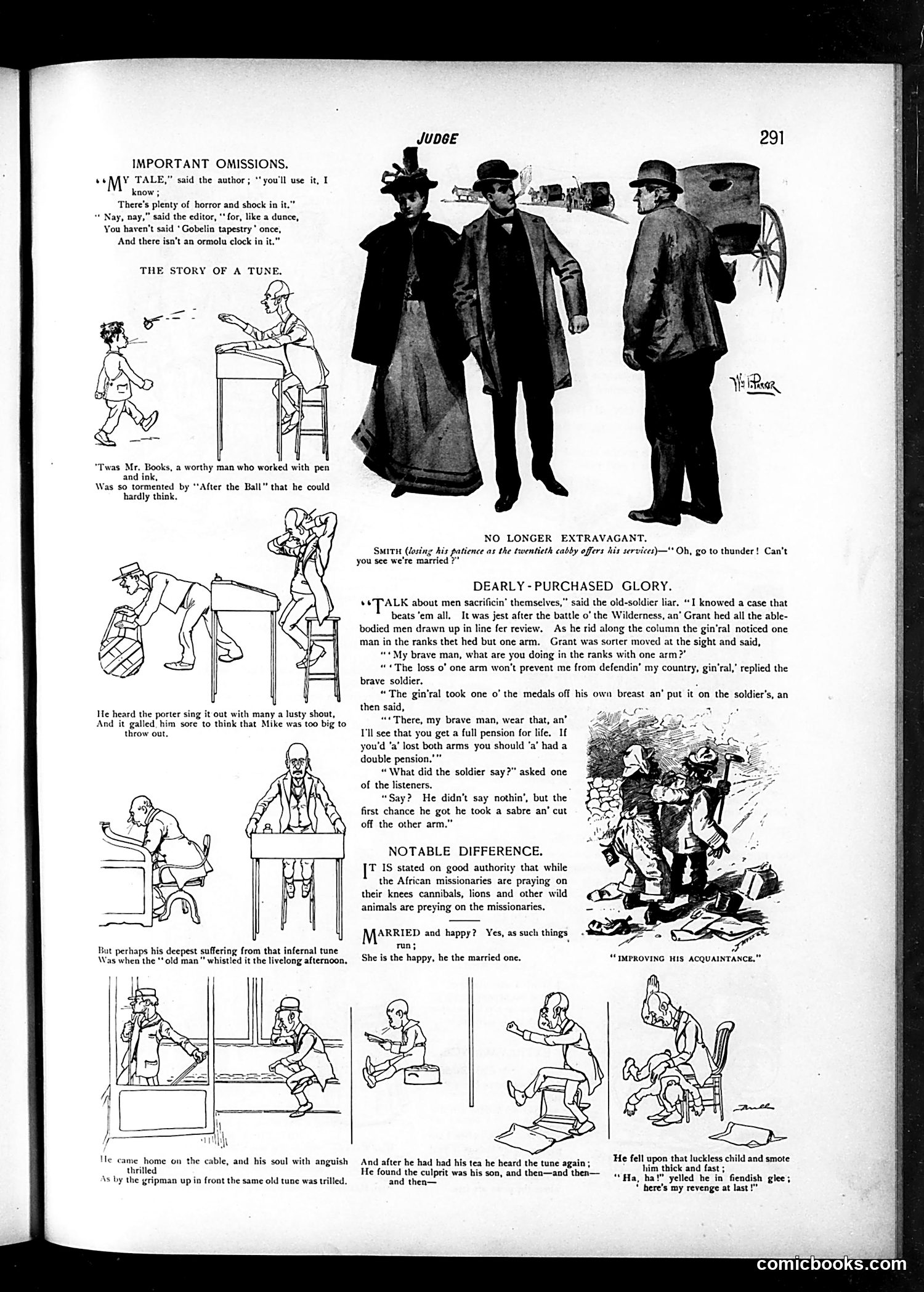
This page contains several humorous sketches and anecdotes typical of Judge's satirical style: **"The Story of a Tune"** depicts a writer (Mr. Books) tormented by the phrase "After the Ball," unable to stop thinking about it—satire on catchy, intrusive popular songs. **"No Longer Extravagant"** shows a married couple, with the husband noting his wife's newfound frugality after marriage—commentary on changing domestic economics. **"Dearly-Purchased Glory"** recounts a Civil War anecdote: a soldier loses an arm but receives a medal and pension, presenting disability as ironic "glory." **"Notable Difference"** contrasts African missionaries praying while predators hunt them with married couples, suggesting marriage involves reciprocal "prey." **"Improving His Acquaintance"** shows sequential slapstick: a man returns home via telegraph cable, encounters a child, and gets revenge through physical comedy—typical period slapstick humor.
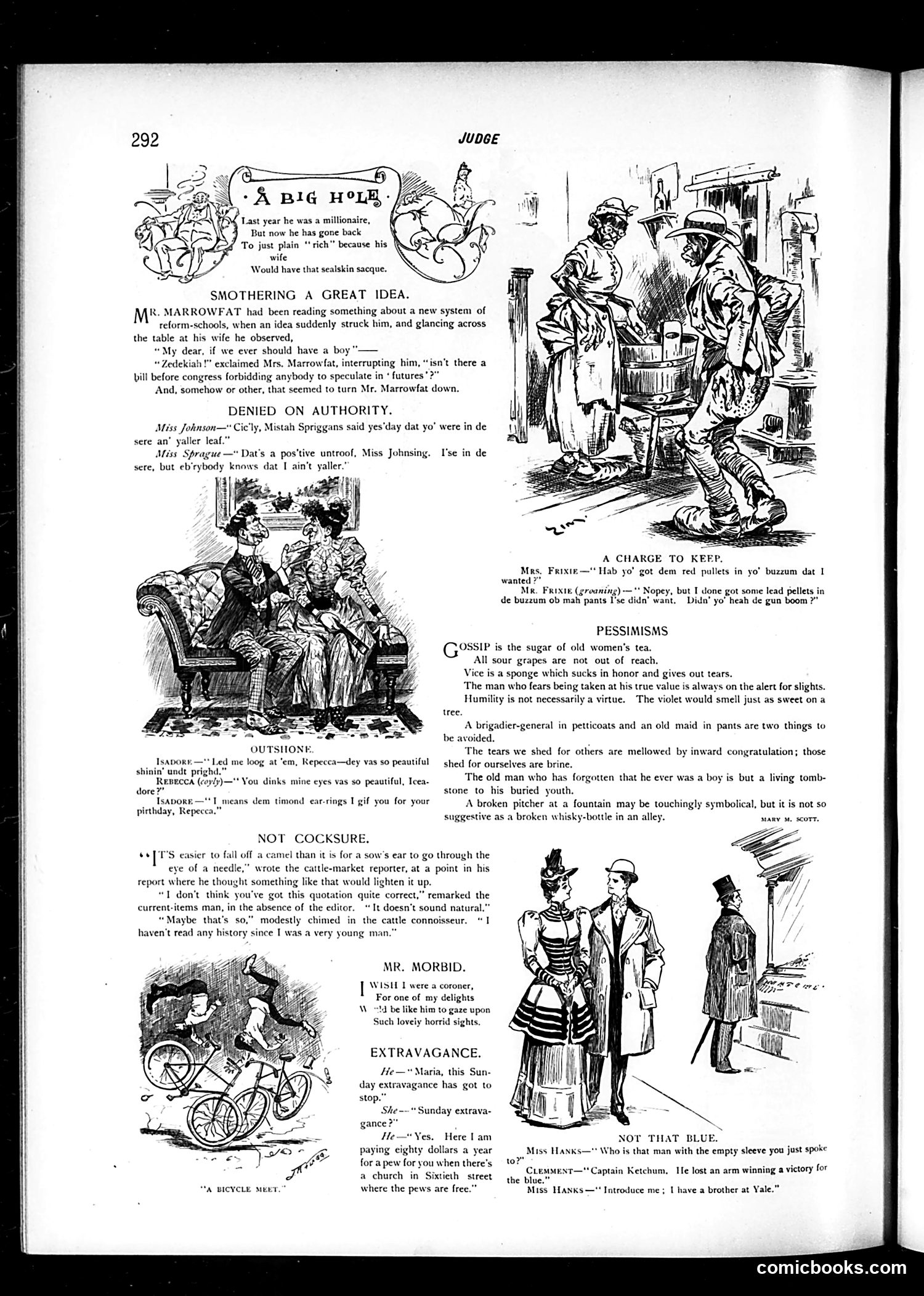
This page contains multiple brief satirical sketches typical of Judge's humor: **"A Big Hole"** mocks a wife's extravagance—a millionaire reduced to merely "rich" by her demand for a sealskin sacque (jacket). **"Smothering a Great Idea"** satirizes wives controlling husbands: Mr. Marrowfat begins discussing reform schools but his wife cuts him off by invoking a pending congressional bill about futures speculation, shutting down his thought entirely. **Dialect sketches** ("Denied on Authority," "A Charge to Keep") use African American vernacular for comedic effect—standard but now offensive Judge fare of the era. The humor relies on malapropisms and misunderstandings. **"Pessimisms"** offers cynical aphorisms about human nature (gossip, hypocrisy, false humility). **"Not Cocksure"** jokes about a cattle-market reporter's botched biblical quotation. **"Not That Blue"** features a one-armed man (likely a war veteran) being introduced as a romantic prospect, with the woman interested only upon learning he has a Yale-attending brother. The page reflects Gilded Age concerns: female spending, marital dynamics, class consciousness, and casual treatment of disability and racial stereotypes.
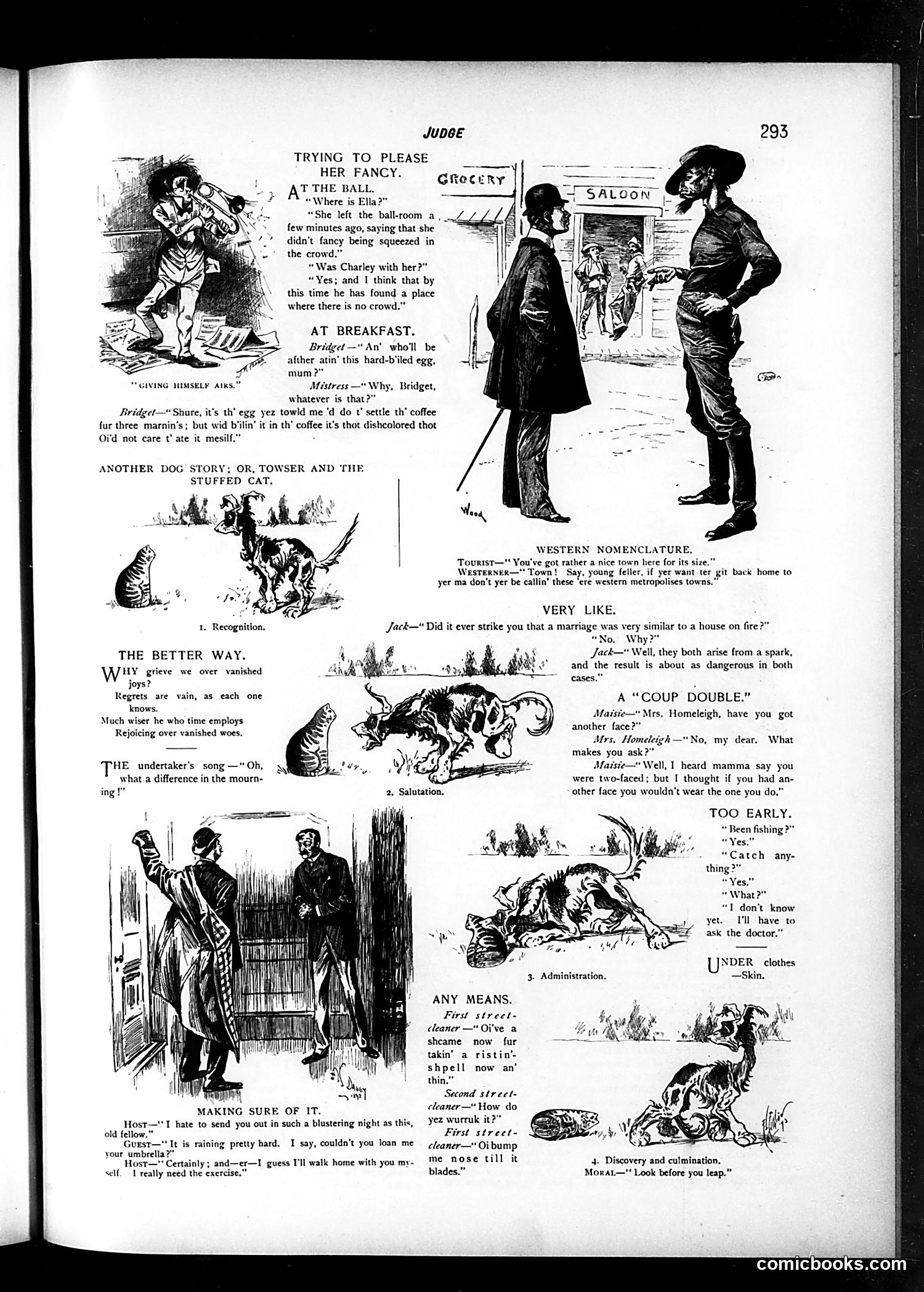
This page contains several short humorous pieces typical of Judge's satirical style: **"Trying to Please Her Fancy"** jokes about a woman leaving a crowded ball with a man named Charley, implying they've found a private spot—mild romantic humor. **"At Breakfast"** features Irish servant-dialect humor (common in period publications), where a maid misunderstands instructions, boiling an egg in coffee to "settle" it, creating an inedible result. The humor relies on working-class linguistic comedy. **"Western Nomenclature"** satirizes Western American braggadocio—a visitor calling a town "nice for its size" gets corrected by a local insisting it's a "metropolis," mocking frontier pretension. **"Very Like"** compares marriage to a house fire through absurdist logic. Additional pieces include dog-and-cat stories, poetry, and brief witty dialogues. The page emphasizes domestic situations, class-based humor, and gentle social observation typical of early-20th-century American humor magazines—nothing explicitly political or controversial.
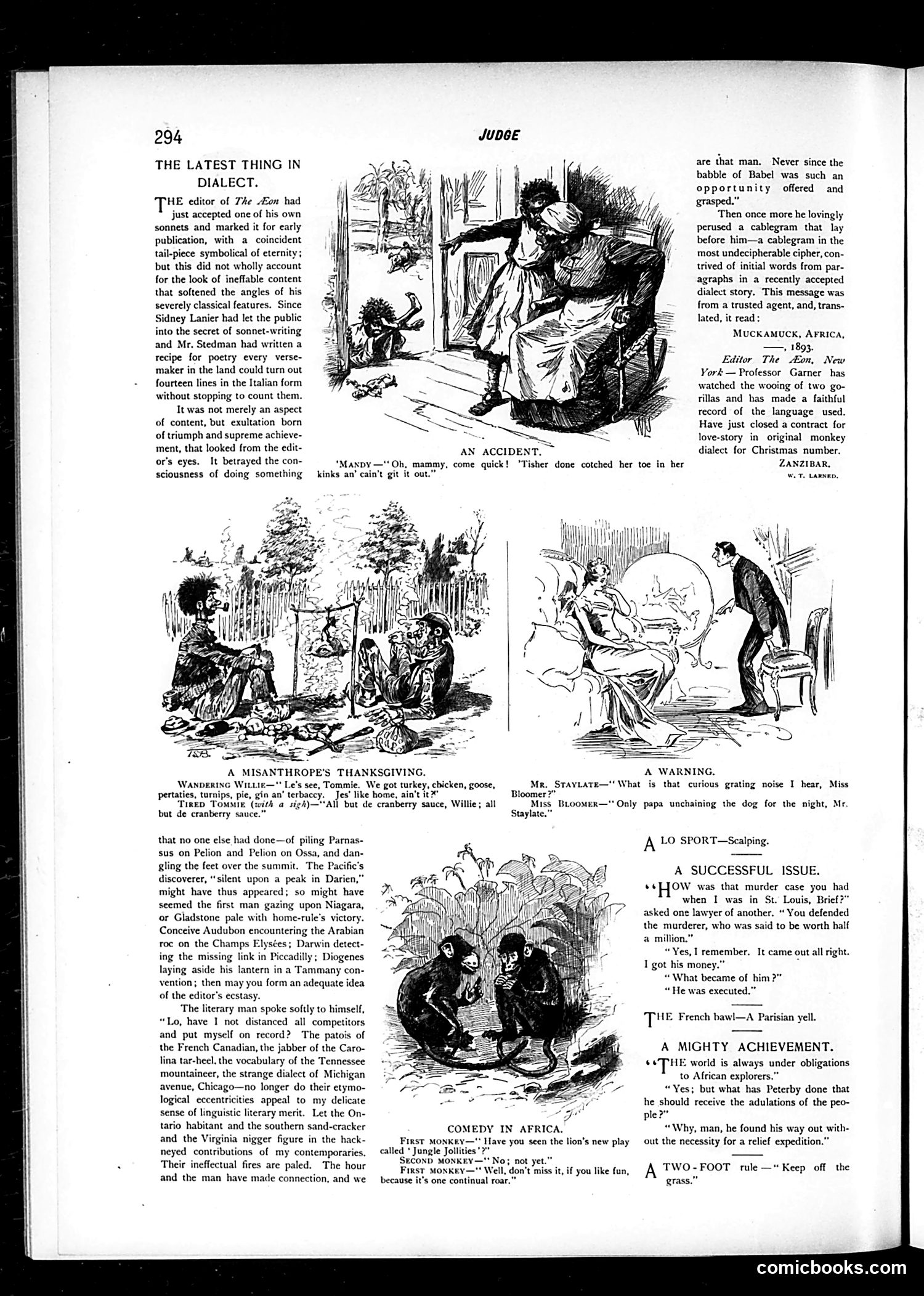
This page satirizes late-19th-century American literary pretension and ethnic stereotyping. The main article mocks editors' obsession with "dialect" writing—fashionable among contemporary authors. The editor boasts of publishing a story written entirely in "monkey dialect" from Africa, supposedly based on Professor Garner's observations of gorillas. This represents Judge's cynical take on the era's faddish fascination with exotic and marginalized speech patterns as literary material. The accompanying cartoons reinforce this theme through crude racial humor: depictions of African Americans and African natives using exaggerated dialect ("mammy," "ain't git it out"). These reflect period attitudes treating non-standard speech as comedic and primitive. The "Africa" section jokes about animals speaking in "roars"—equating African speech with animal sounds. The satire targets both literary pretension and the dehumanizing racial caricature that characterized fin-de-siècle American popular culture and publishing.
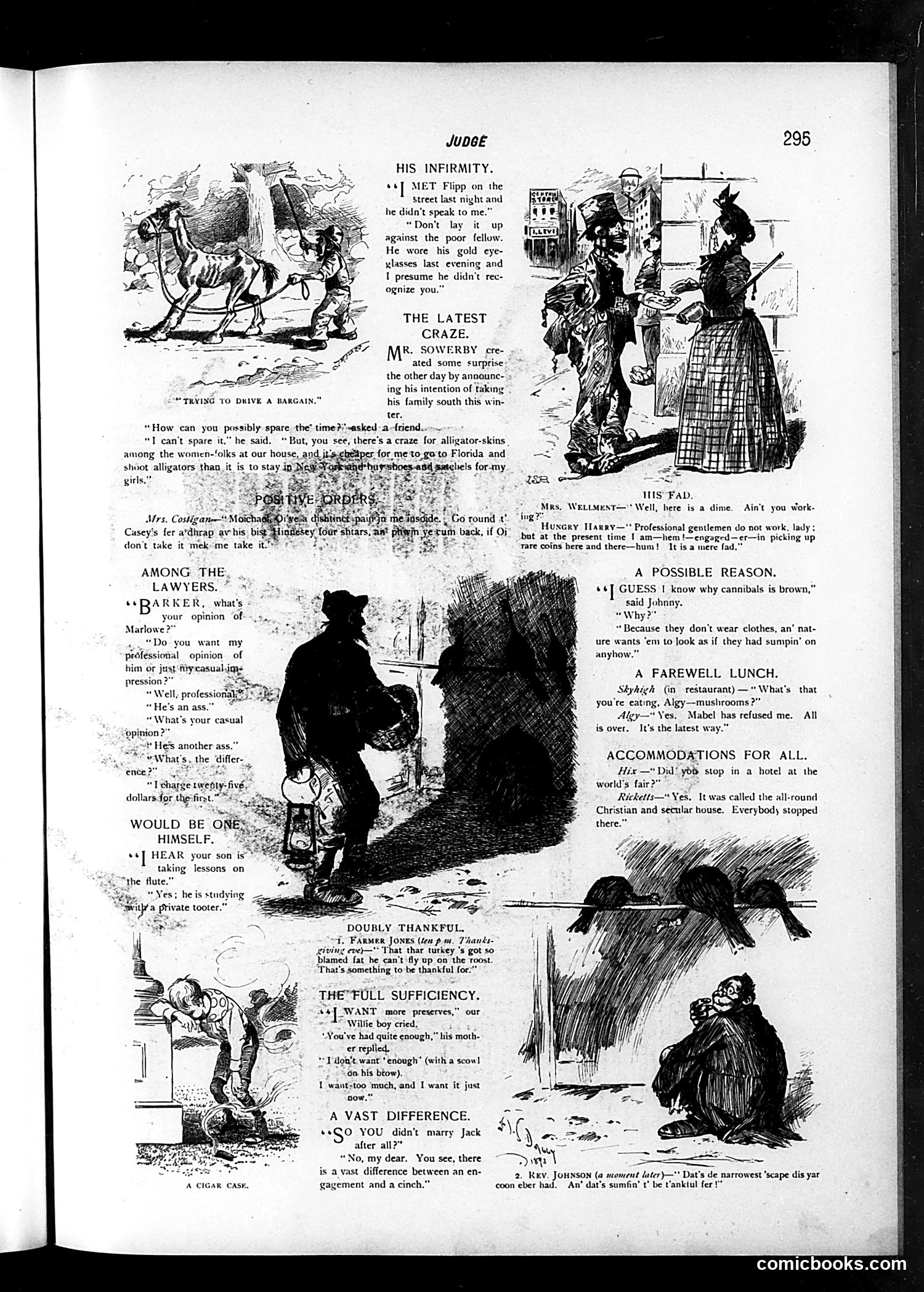
This page contains multiple short satirical jokes typical of late 19th/early 20th-century American humor: **"His Infirmity"**: A man wearing gold eyeglasses failed to recognize an acquaintance—the joke being his supposed vanity and poor eyesight make him unreliable socially. **"The Latest Craze"**: Mr. Sowerby plans a Florida trip to hunt alligators for their skins (fashionable at the time), finding it cheaper than managing his household. **"Among the Lawyers"**: Two lawyers describe a colleague identically as "an ass"—the humor lies in charging different fees for identical professional versus casual opinions. **Other brief jokes** include racist humor about cannibals' skin color, a man claiming fasting is "fashionable" after romantic rejection, and commentary on hotel accommodations and childhood greed. The page reflects period attitudes: casual racism, materialism, and social climbing. The drawings are typical Judge illustrations—detailed pen-and-ink satirical scenes mocking middle-class pretension and absurdity.
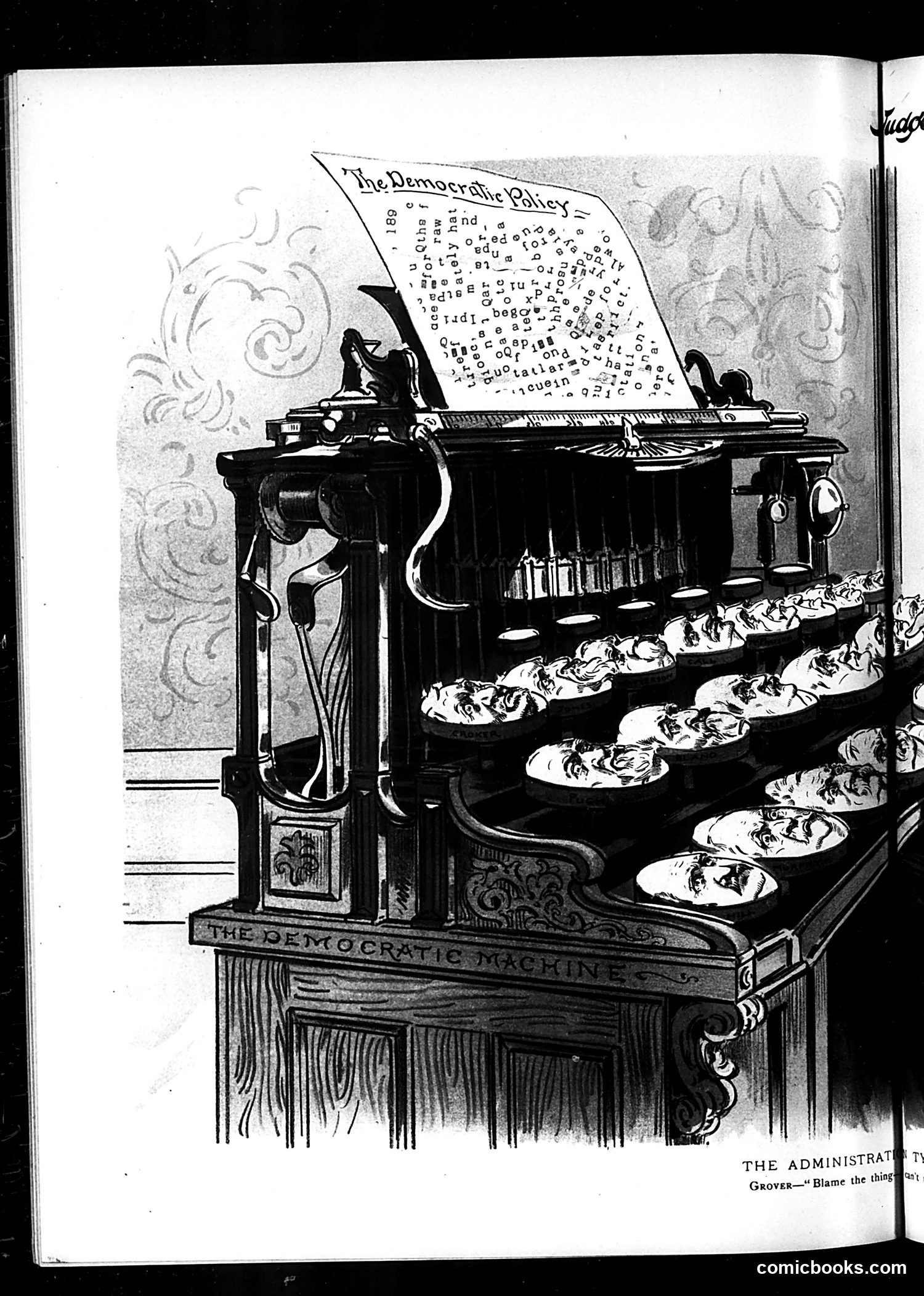
This is a satirical illustration titled "The Democratic Machine" depicting a player piano—a mechanical device that plays music automatically from perforated paper rolls. The piano's roll is labeled "The Democratic Policies," and sheet music with scattered letters and symbols fills the interior. The satire suggests that Democratic policies are mechanically produced, impersonal output rather than genuine political thought. The reference to "Grover" (likely President Grover Cleveland) and the fragmentary text "Blame the thing" reinforce the critique: Democratic leadership merely operates a machine, deflecting responsibility for unpopular policies onto the mechanical system itself rather than taking personal accountability. This reflects late 19th-century Republican attacks on Democratic administration, portraying their governance as hollow, automated, and evasive.
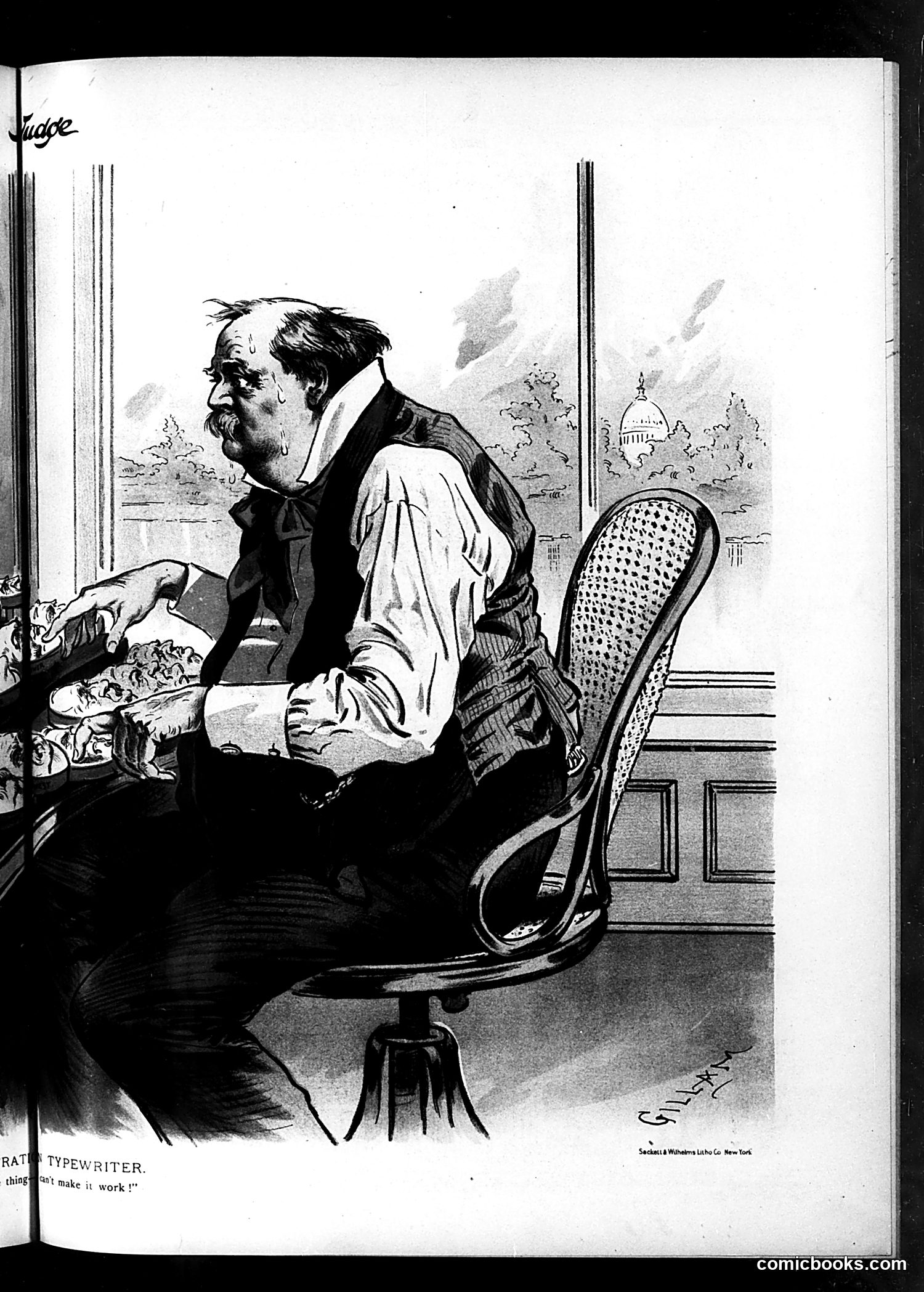
This Judge cartoon satirizes the difficulty of operating early typewriters. A bearded man sits at a desk with a typewriter, looking frustrated and gesturing in exasperation. The visible caption reads "thing make it work!" (likely "I can't make it work!"), expressing his struggles. The cartoon's title, "A Rat-Typewriter," appears to be a pun—possibly suggesting the machine is as unpredictable or difficult as herding rats. The illustration captures the era when typewriters were relatively new office technology that many found temperamental and frustrating to use. The man's disheveled appearance and body language convey the irritation these machines regularly caused their operators, mocking both the technology's imperfections and users' struggles to master them.
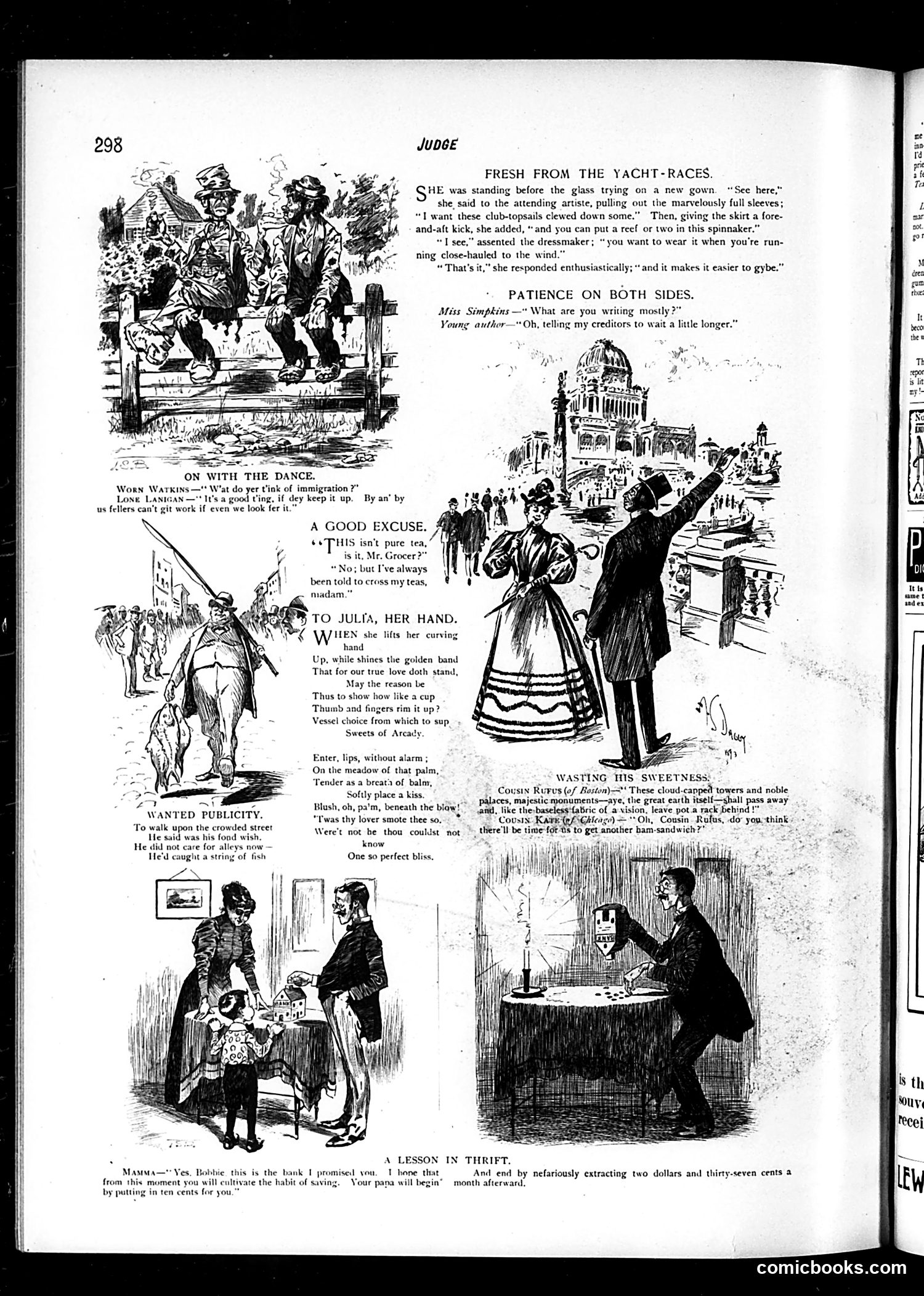
This page contains several satirical vignettes mocking upper-class social pretensions and financial struggles of the era: **"Fresh from the Yacht-Races"** ridicules wealthy women adopting nautical jargon when ordering dresses—she uses sailing terms ("club-topsails," "spinnaker," "close-hauled") to describe her gown, treating fashion with mock-serious maritime vocabulary. **"Patience on Both Sides"** jokes about a struggling young writer telling creditors to wait while he pursues authorship—commentary on impractical artistic ambitions versus economic reality. **"Wanted Publicity"** depicts a man willing to be arrested for public attention, satirizing desperation for fame. **"A Good Excuse"** is a grocer pun about crossing tea leaves (a fortune-telling practice) rather than crossing out the letter "t" in "tea." **"Wasting His Sweetness"** shows two cousins—one poetically romantic (Boston) discussing transcendent beauty, the other (Chicago) pragmatically asking about lunch. This contrasts East Coast intellectual pretension with Midwestern practicality. **"A Lesson in Thrift"** implies a child will learn savings by banking modest allowance—though the final line suggests the parent's dishonest plan to extract it later.
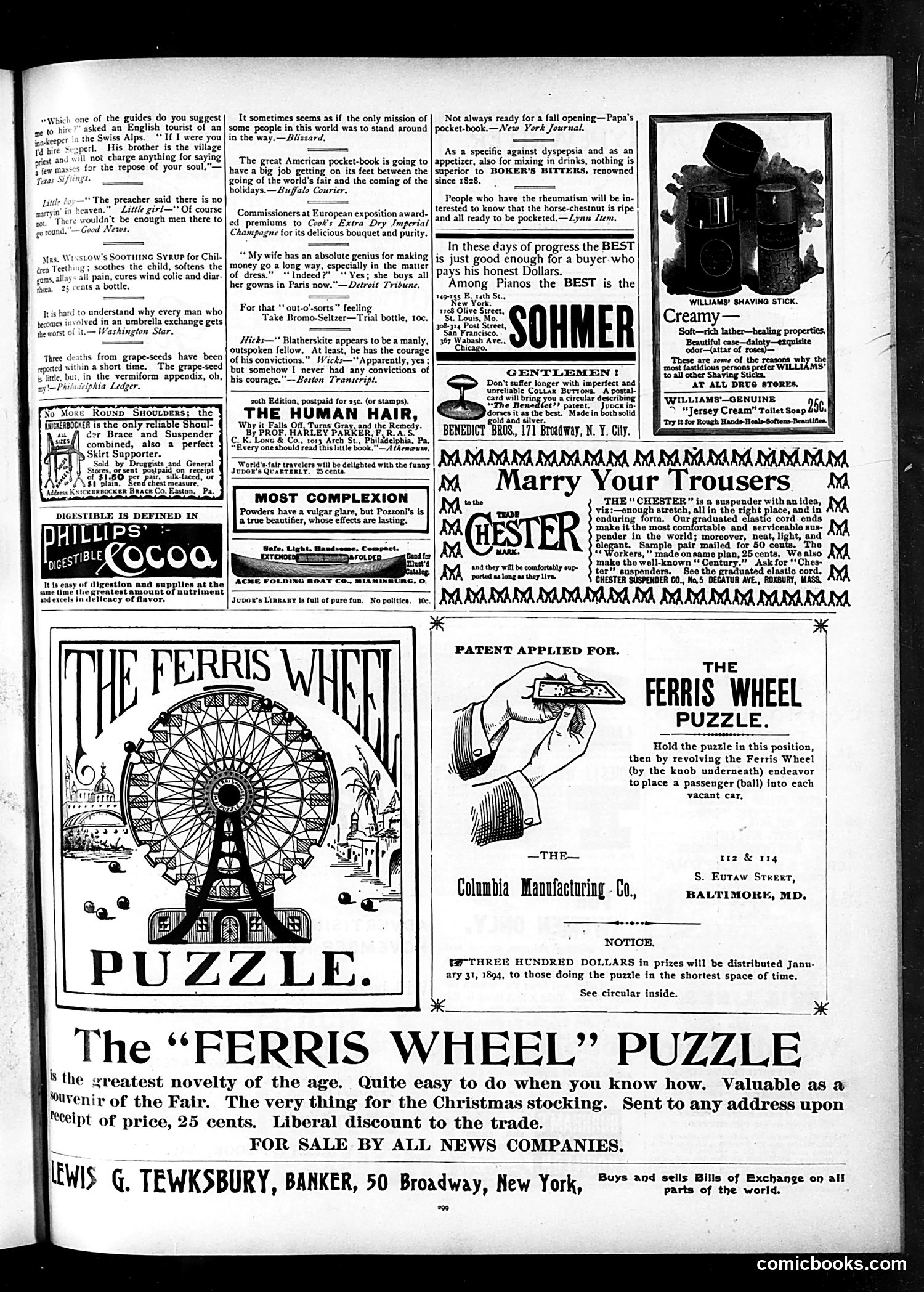
This page is primarily **advertisements and filler jokes**, not political satire. The content includes: **Humorous short jokes** about Swiss guides, preachers, umbrellas, and marital finances—typical light humor for the era, mostly playing on wordplay and social observations rather than political commentary. **Product advertisements** dominate: remedies (Bromo-Seltzer, Mrs. Winslow's Soothing Syrup), beauty products (Pozzoni's powder), shaving supplies, pianos, and clothing supports. These ads reflect late 19th-century consumer goods and health product marketing. **The Ferris Wheel Puzzle** is the featured novelty item—a mechanical puzzle based on the famous Chicago World's Fair attraction, priced at 25 cents. The page contains **no identifiable political cartoons or caricatures**. It appears to be a typical Judge magazine page mixing light humor, advertisements, and novelty items rather than the publication's more famous satirical editorial content.
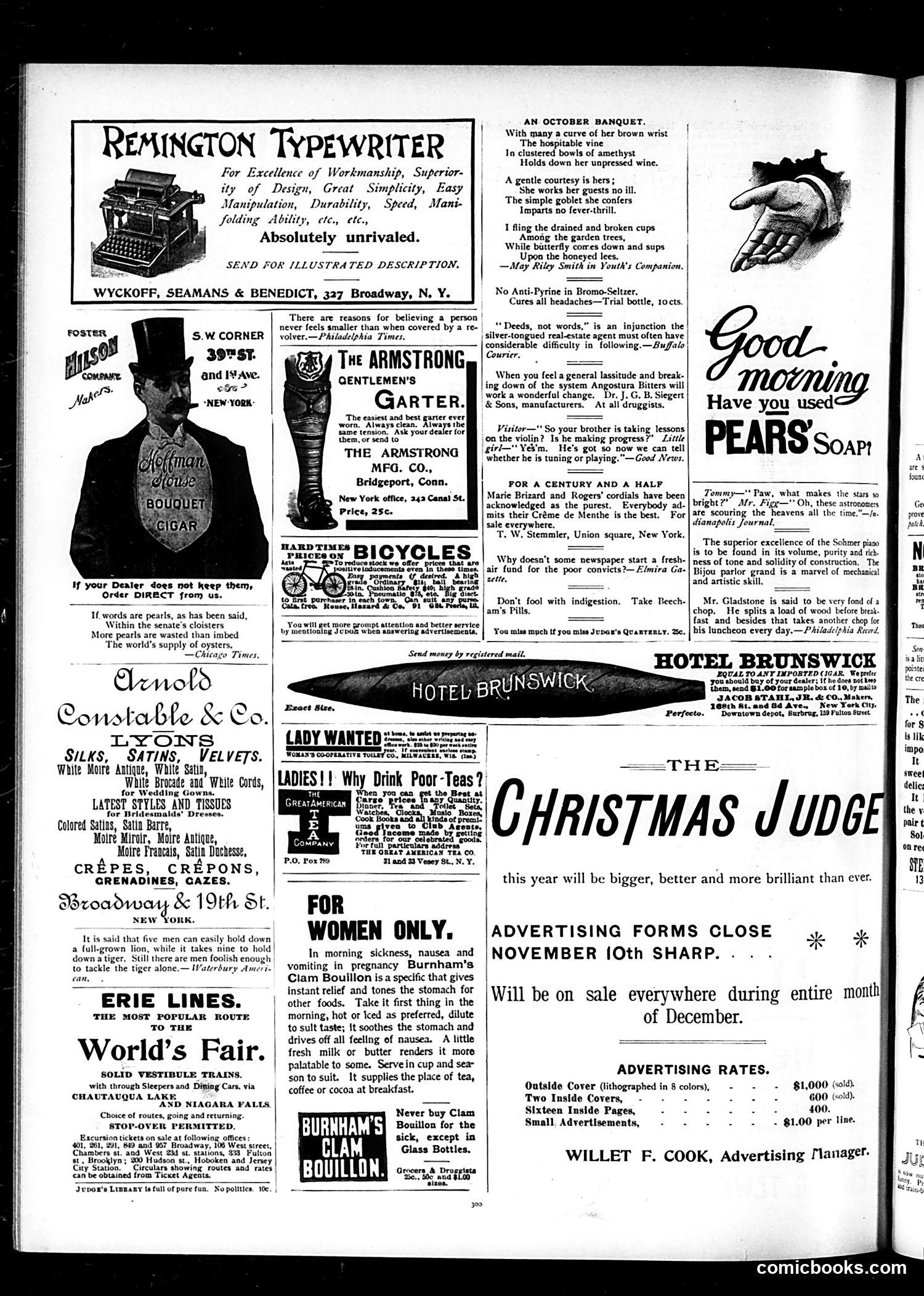
This page is primarily **advertisements and filler content**, not political satire. Judge magazine devoted substantial space to commercial ads for products like typewriters, clothing, railroad tickets, and patent medicines. The few editorial pieces are **lighthearted social humor** rather than political commentary: - A quip about senators wasting words ("pearls") in debate - A joke comparing men foolishly wrestling tigers to dealing with tigers alone - Observations about revolvers making people feel small - Domestic humor (a child asking why stars are bright, a violin student) The only potentially satirical content is an untitled poem, "An October Banquet," which appears to celebrate *moderate* wine consumption—perhaps subtle commentary on Gilded Age excess, though this is unclear. The page reflects Judge's typical mix: national advertisements (Erie Lines, World's Fair), luxury goods (Arnold Constable silks), patent medicines (Bromo-Seltzer, Bitters), and genteel humor for middle-to-upper-class readers. No specific political figures or events are identifiable.
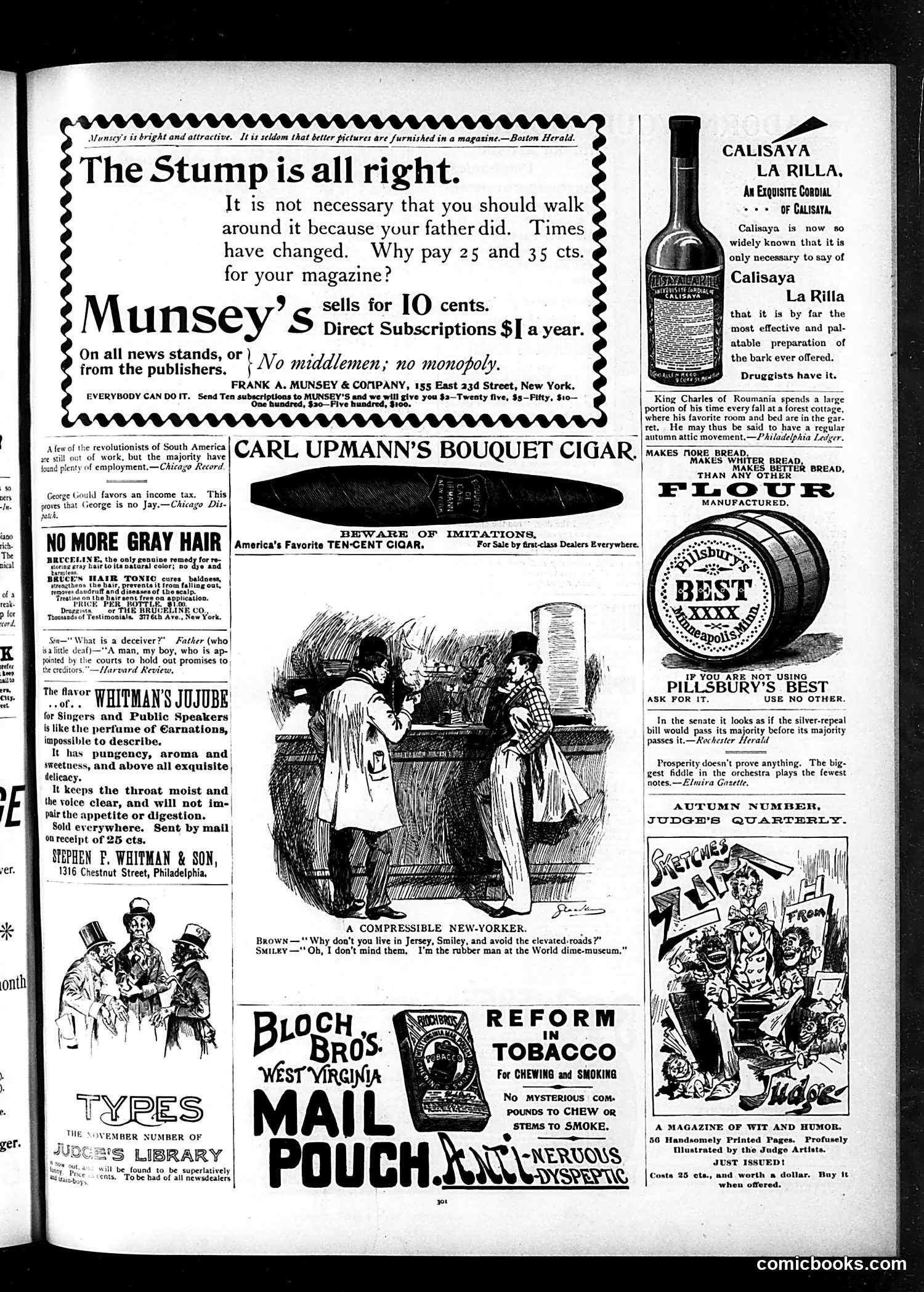
This page is primarily **advertising**, not editorial content or political cartoons, typical of late-19th-century magazines. The one cartoon present—"A Compressible New-Yorker"—is a mild joke about urban life. A man claims he doesn't mind the elevated railways because he works as a "rubber man" at the dime-museum (a circus sideshow), implying he's so flexible he can compress himself to fit anywhere. It's wordplay satire rather than political commentary. The advertisements reflect period concerns: hair-coloring products (vanity/aging), cigars, flour, tonics, and magazines. Notable is **Munsey's magazine promotion**—priced at 10 cents versus competitors at 25-35 cents, claiming "no monopoly" and emphasizing affordability and direct subscriptions. This reflects early-1890s magazine industry competition and democratization of publishing. The page lacks substantive political satire. Judge's role here appears purely commercial—selling advertising space to manufacturers while promoting its own publication's value proposition.
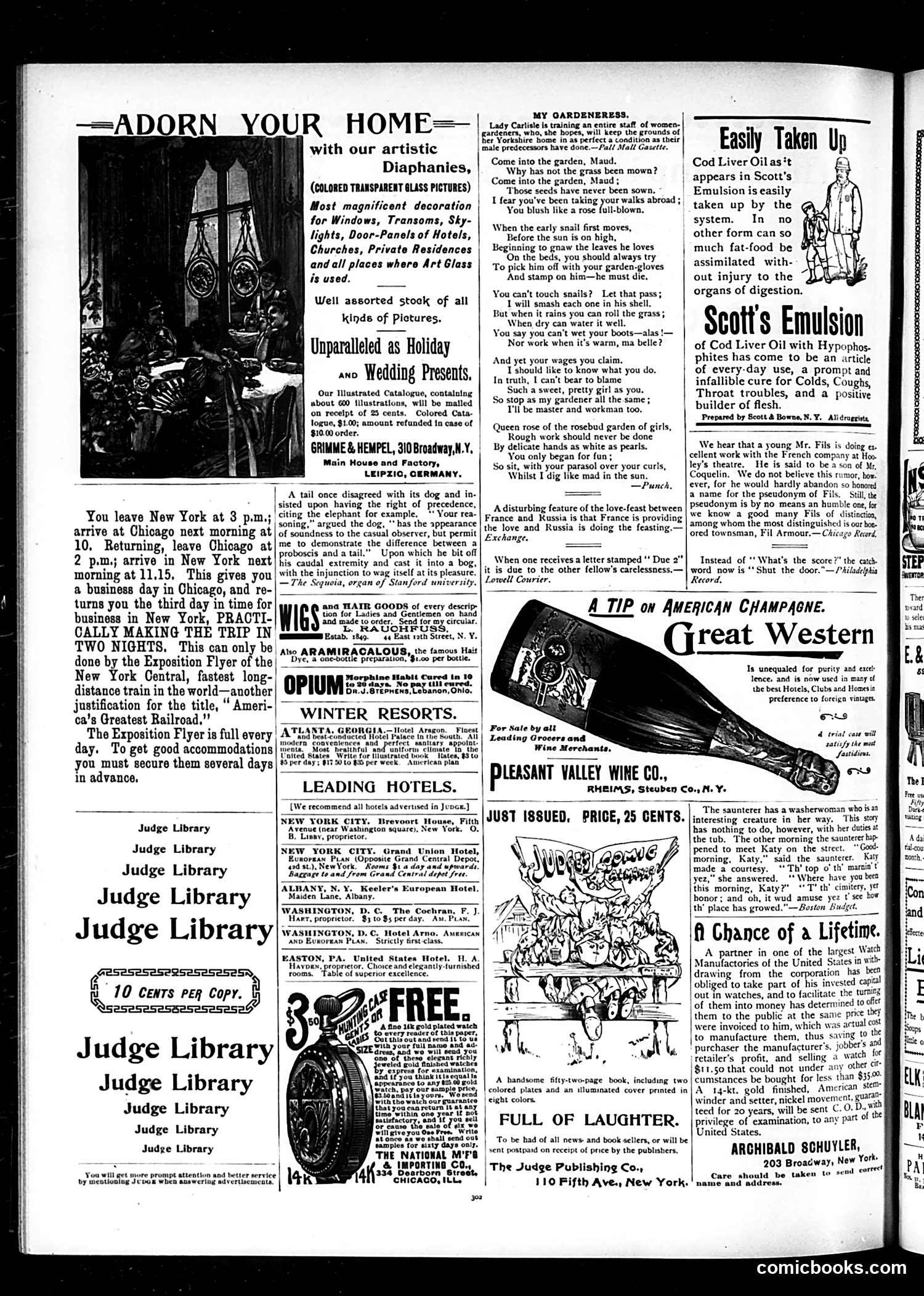
This page is primarily **advertising and light verse** rather than political cartooning. The main content includes: **"My Gardeneress"** — A humorous poem (attributed to Punch) mocking the trendy practice of Lady Carlisle employing an all-female gardening staff. The satire ridicules the contradiction: the employer expects a delicate, well-dressed woman to perform hard manual labor ("dig like mad in the sun") while claiming she can't get her boots wet or work in warm weather. The joke exposes the impracticality and hypocrisy of this fashionable but absurd employment arrangement. **"A Tail Once Disagreed"** — A fable-like anecdote where a dog bites off his own tail to prove a logical point, illustrated by the absurd consequence. It's general humor rather than political commentary. The rest comprises **commercial advertisements** for colored glass art, railroad travel, hotels, hair products, and Scott's Emulsion cod liver oil—typical Judge magazine filler content aimed at upper-class readers.
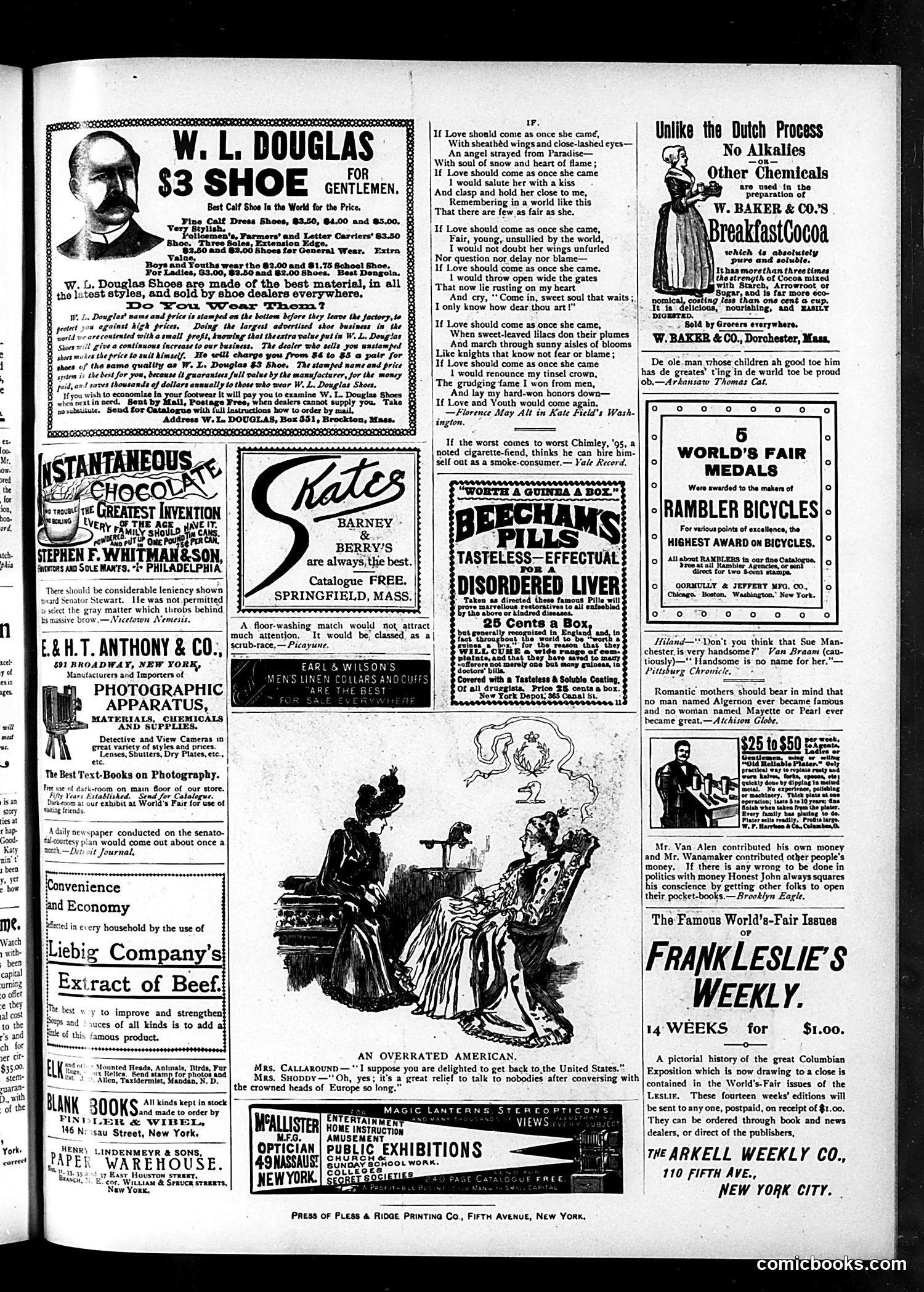
This is primarily an **advertising page** from Judge magazine, not a political cartoon. The page contains numerous product advertisements (W.L. Douglas shoes, Beecham's Pills, Baker's Cocoa, bicycles) interspersed with light humor and poetry. The main literary content is a **sentimental poem titled "If"** about romantic love, which has no apparent political satire. The scattered **brief jokes** include: - A quip about "Chimley" being a cigarette-addict who'd rent himself out as a "smoke-consumer" - A comment about Senator Stewart lacking intelligence ("gray matter") - Wordplay about a "floor-washing match" attracting no attention These are generic, apolitical humor items—typical filler for magazine advertisements of this era. **Without visible date or bylines, I cannot identify specific political figures or events referenced.** The page appears to be a commercialized space mixing modest comic relief with product promotion, rather than substantive satire.
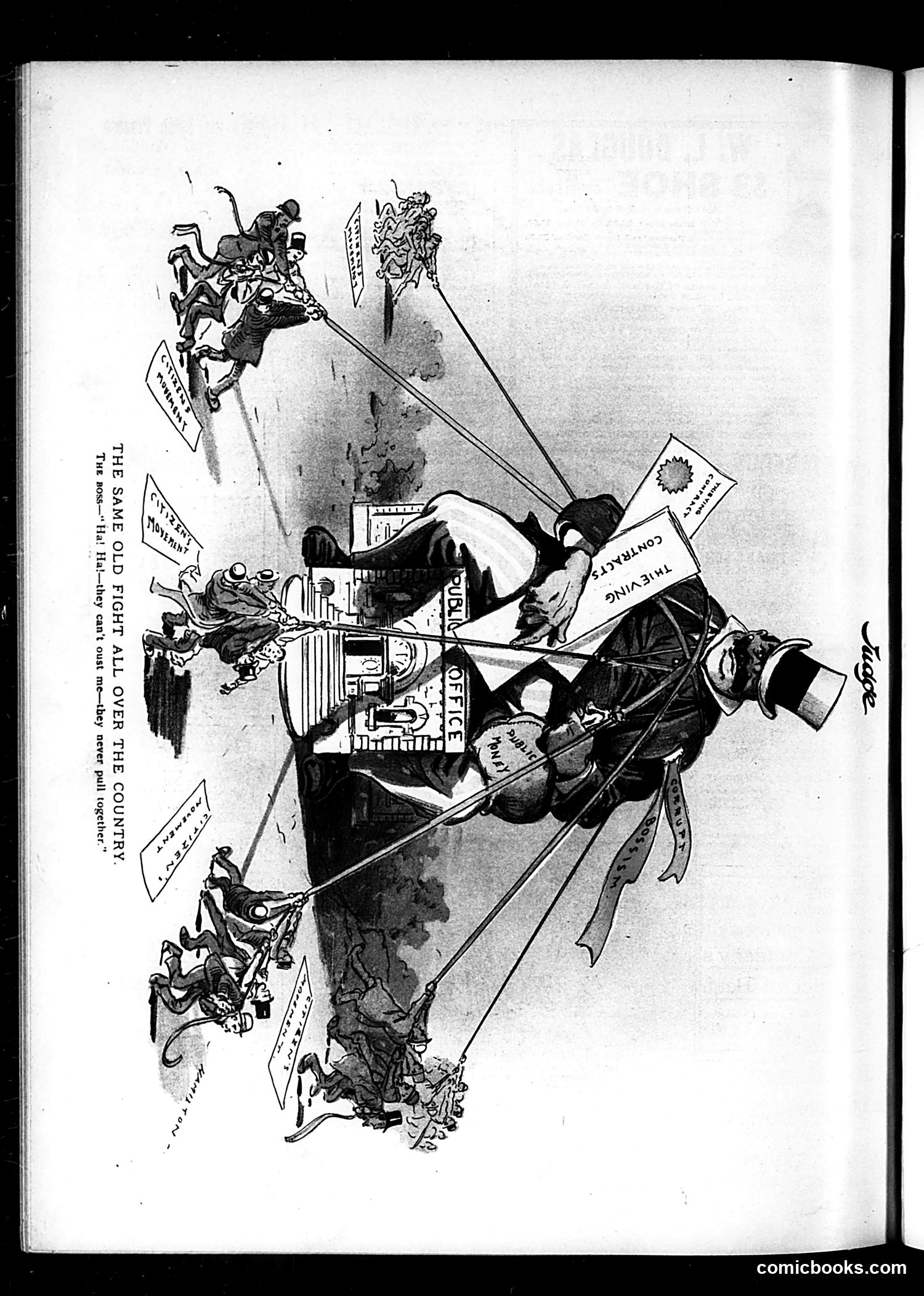
This is a satirical cartoon depicting a central figure labeled "OFFICE" being attacked from multiple directions by various groups, each holding flags or banners. The central character appears to be an entrenched political boss or corrupt official confidently declaring "they can't oust me—they never pull together," suggesting his opponents are fragmented and disorganized. The surrounding figures represent different reform or opposition movements attacking from various angles—appearing to be competing reformist factions, labor groups, or anti-corruption forces. The satire suggests that while numerous groups oppose the political establishment, their lack of unity allows the boss to maintain power. The title indicates this represents a widespread national pattern of political struggle between entrenched machines and fragmented opposition movements, likely from the Progressive Era when such anti-corruption battles were common.