
Judge, 1893-11-11 · page 3 of 16
Judge — November 11, 1893 — page 3: what you’re looking at
What you’re looking at
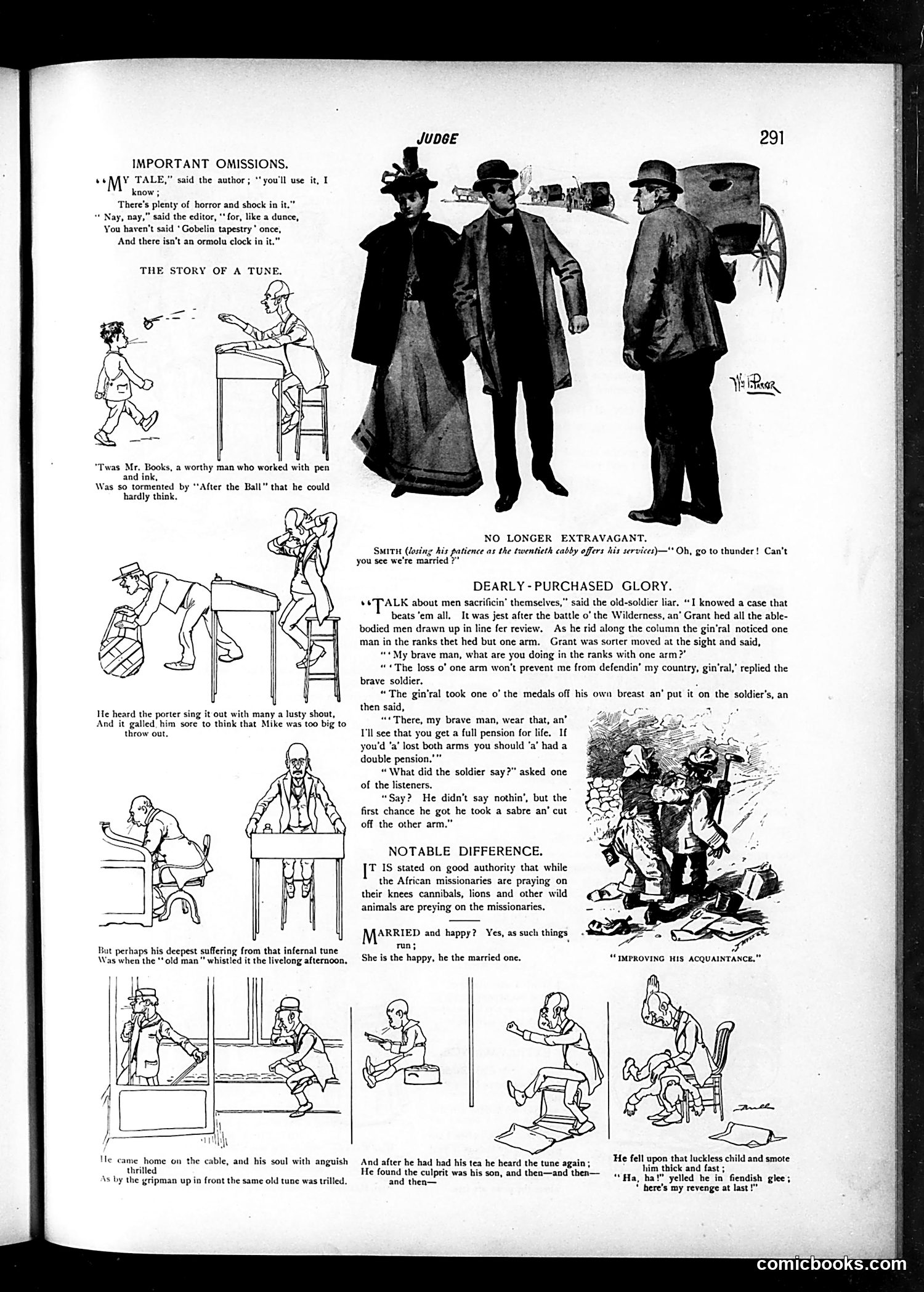
This page contains several humorous sketches and anecdotes typical of Judge's satirical style: **"The Story of a Tune"** depicts a writer (Mr. Books) tormented by the phrase "After the Ball," unable to stop thinking about it—satire on catchy, intrusive popular songs. **"No Longer Extravagant"** shows a married couple, with the husband noting his wife's newfound frugality after marriage—commentary on changing domestic economics. **"Dearly-Purchased Glory"** recounts a Civil War anecdote: a soldier loses an arm but receives a medal and pension, presenting disability as ironic "glory." **"Notable Difference"** contrasts African missionaries praying while predators hunt them with married couples, suggesting marriage involves reciprocal "prey." **"Improving His Acquaintance"** shows sequential slapstick: a man returns home via telegraph cable, encounters a child, and gets revenge through physical comedy—typical period slapstick humor.
📄 Transcribed text from this page (OCR, searchable)
Machine-transcribed from the original scan — historical spelling and the odd misread are preserved.
IMPORTANT OMISSIONS. s6MY TALE,” said the author; “you'll use it, I know ; There's plenty of horror and shock in it.” “ Nay, nay,” said the editor, “for, like a dunce, You haven't said *Gobelin tapestry * once, And there isn’t an ormolu clock in THE STORY OF A TUNE, “Twas Mr. Books, a worthy man who worked with pen and ink, Was so tormented by ‘After the Ball” that he could hardly think, He heard the porter sing it out with many a lusty shout, And it galled, him sore to think that Mike was too big to throw out. But perhaps his deepest suffering from that infernal tune Was when the “told man" whistled it the livelong afternoon, mh 'le came home on the cable, and his soul with anguish thrilled \s by the gripman up in front the same old tune was trilled. NO LONGER EXTRAVAGANT. SMrtH (losing his patience as the twentieth cabby offers his services)—"* Oh, go to thunder! Can't you see we're married?” DEARLY - PURCHASED GLORY. . TALK about men sacrificin’ themselves,” said the old-soldier liar. “I knowed a case that beats ‘em all, It was jest after the battle o' the Wilderness, an’ Grant hed all the able- bodied men drawn up in line fer review. As he rid along the column the gin‘ral noticed one man in the ranks thet hed but one arm. Grant was sorter moved at the sight and said, “+My brave man, what are you doing in the ranks with one arm?" “ «The loss 0” one arm won't prevent me from defendin’ my country, gin'ral,’ replied the brave soldier. : “The gin’ral took one 0 the medals off his own breast an’ put it on the soldier's, an then said, ~ “*There, my brave man, wear that, an’ I'll see that you get a full pension for life. If you'd ‘a’ lost both arms you should ‘a’ had a double pension.’” “What did the soldier say?” asked one of the listeners. “Say? He didn’t say nothin’, but the first chance he got he took a sabre an’ cut off the other arm.” NOTABLE DIFFERENCE. [7 JS stated on good authority that while the African missionaries are praying on their knees cannibals, lions and other wild animals are preying on the missionaries. MARRIED and happy? Yes, as such things run; As She is the happy, he the married one. He fell upon that luckless child and smote him thick and fast ; ‘Ha, ha!” yelled he in fiendish glee; * here's my revenge at last !" And after he had had his tea he heard the tune again; He found the culprit was his son, and then—and then— and then— comicbooks.com