
A complete issue · 16 pages · 1893
Judge — October 14, 1893
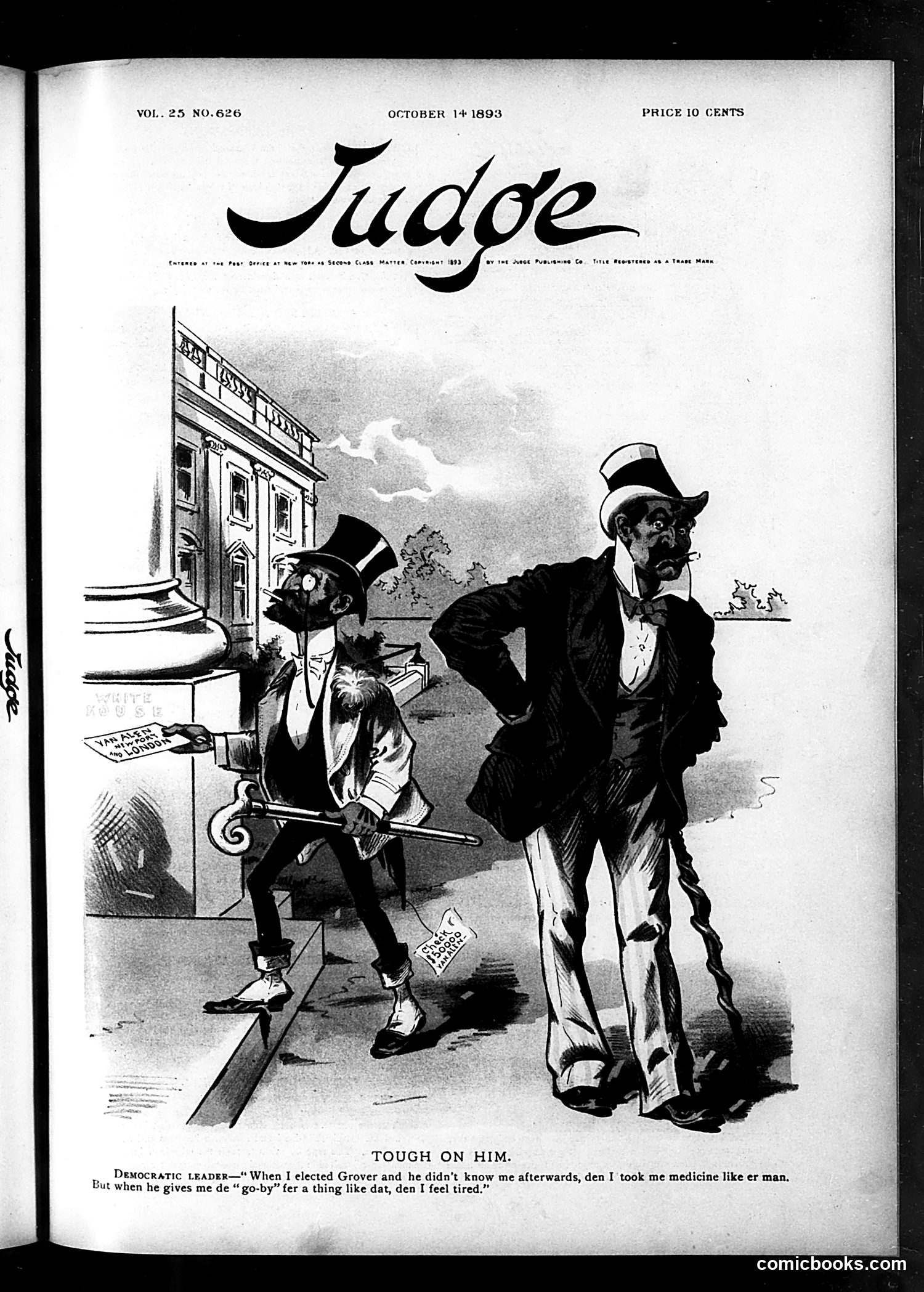
This political cartoon satirizes Democratic leadership's treatment of President Grover Cleveland. The caption quotes a Democratic leader claiming he "took medicine like a man" when Cleveland didn't acknowledge him after his election, but now feels exhausted by Cleveland giving him a dismissive "go-bye" for something trivial. The cartoon depicts two figures in formal dress outside what appears to be a government building. The imagery suggests internal party conflict—specifically, Cleveland's apparent coldness toward Democratic allies or supporters. The satire mocks the Democratic leader for enduring Cleveland's discourteous behavior while pretending to be stoic about it, implying Cleveland's poor interpersonal treatment of his own party members was notable enough to warrant public ridicule.
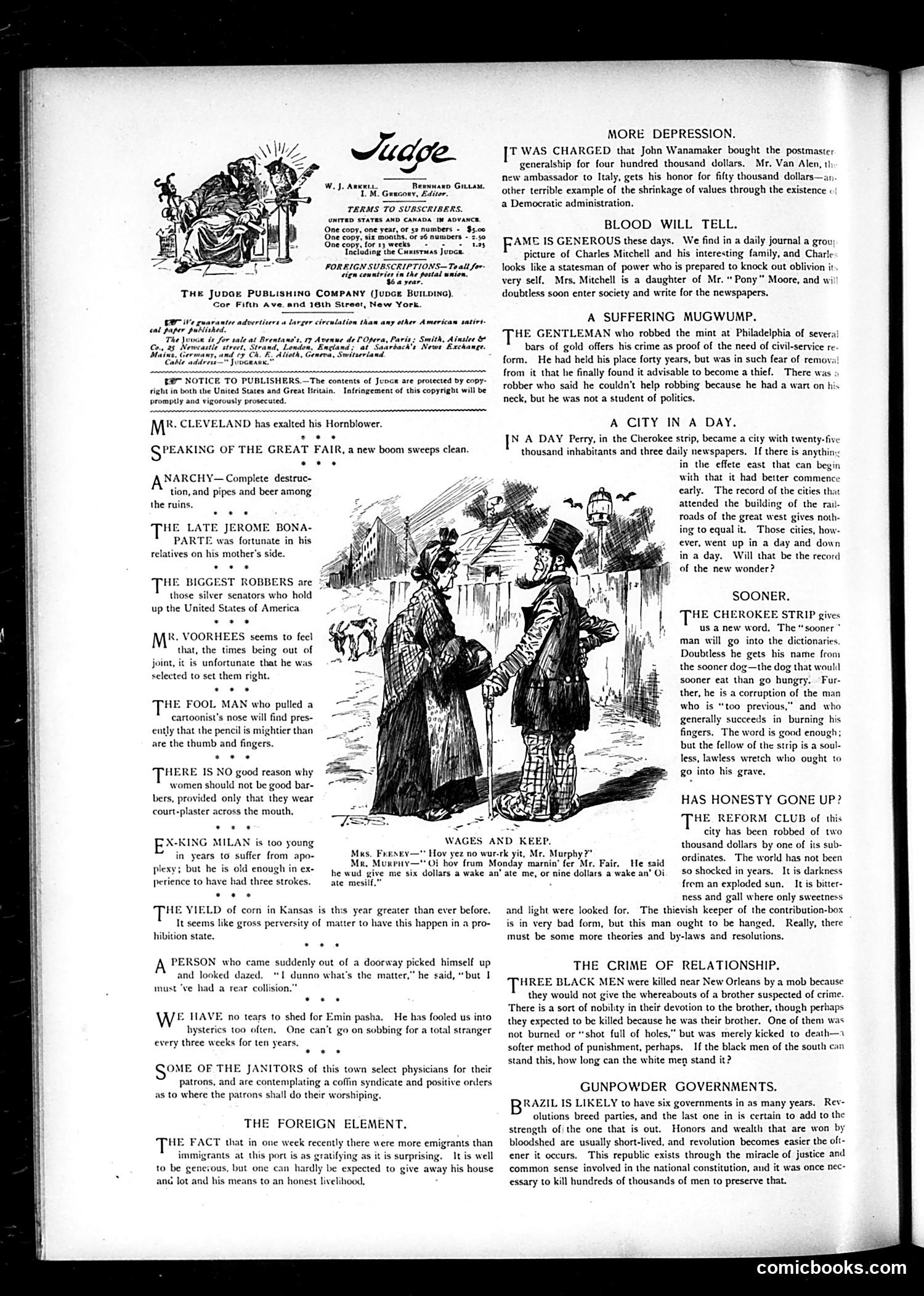
This page contains satirical editorial commentary rather than a single unified cartoon. The central illustration depicts two figures in conversation, likely representing political or social commentary about urban development—one section titled "A CITY IN A DAY" discusses rapid Cherokee Strip settlement. The text items are brief satirical jabs at contemporary figures and issues: - "MR. CLEVELAND exalted his Hornblower" (likely referencing President Cleveland) - Commentary on corrupt senators and financial schemes - Critique of mob violence near New Orleans targeting Black men - Discussion of Brazilian political instability Without clearer identification of specific individuals or precise dates in the masthead visible here, the exact targets remain somewhat unclear. The page reflects late 19th-century Judge's typical blend of political criticism, social satire, and commentary on violence and corruption.
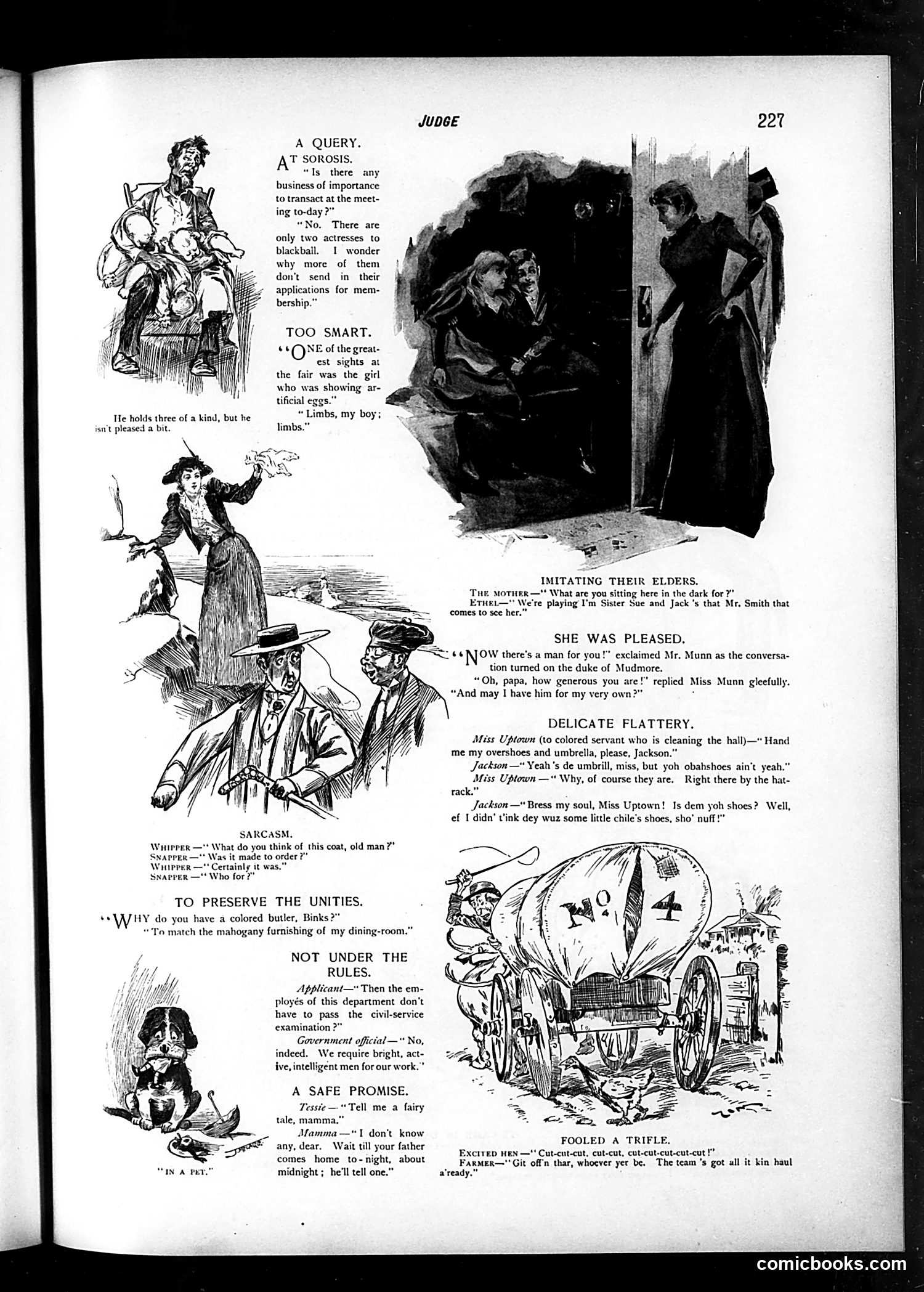
This page contains several unrelated satirical sketches and humorous anecdotes typical of Judge's format. The cartoons mock: 1. **"A Query/A Diagnosis"** - Social commentary on women seeking club memberships, suggesting only "two actresses" apply, implying theatrical women were considered unsuitable for respectable organizations. 2. **"Too Smart"** - A joke about a fair girl displaying artificial eggs, with crude humor about "limbs." 3. **"Imitating Their Elders"** - Children playing house in dark corners, mimicking adult behavior. 4. **Various vignettes** on servant management, civil service examination debates, and domestic situations. 5. **"Fooled a Trifle"** - A cartoon about an excited team with a large barrel, suggesting someone's been tricked. The page reflects late 19th/early 20th-century class attitudes, gender stereotypes, and servant-employer dynamics common to Judge's satirical content.
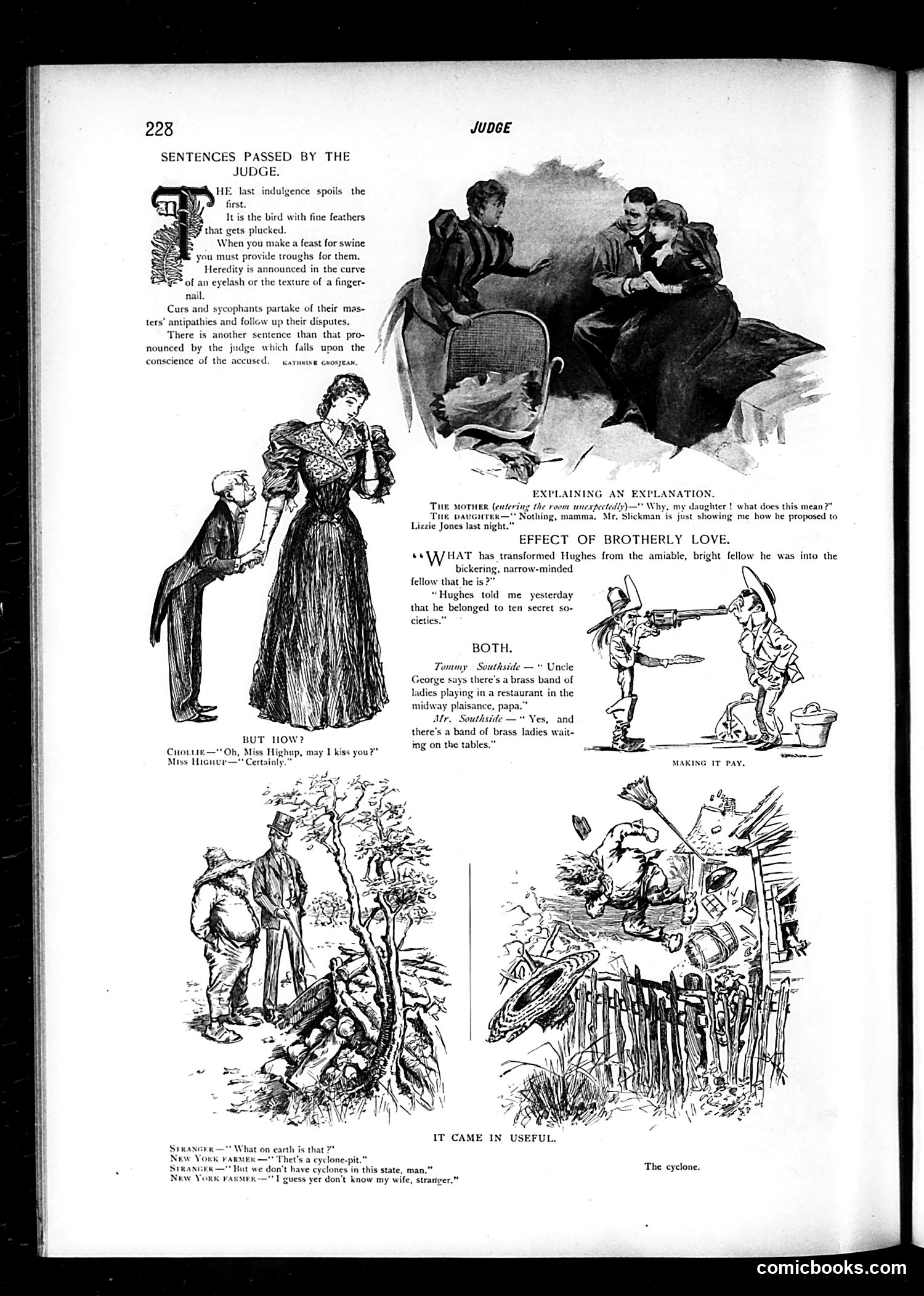
This page contains moral aphorisms ("Sentences Passed by the Judge") followed by several short comic scenarios satirizing domestic life and social behavior. The cartoons mock: 1. **"Explaining an Explanation"**: A daughter questions her mother's mysterious statement about "entering the room unexpectedly"—satirizing awkward parental evasiveness. 2. **"Effect of Brotherly Love"**: Mocks how secret society membership corrupts character, turning an amiable man into a quarrelsome one. 3. **"Both"**: A pun-based joke about a restaurant's "brass band" of women servers. 4. **"But How?"**: A young man asking permission to kiss. 5. **"It Came in Useful"**: A Nebraska farmer boasts that his wife is worse than a cyclone—suggesting domestic strife is as destructive as natural disasters. These are typical Judge humor: domestic complaints, wordplay, and gentle mockery of social pretension and marital discord. The illustrations are detailed period engravings in the magazine's characteristic style.
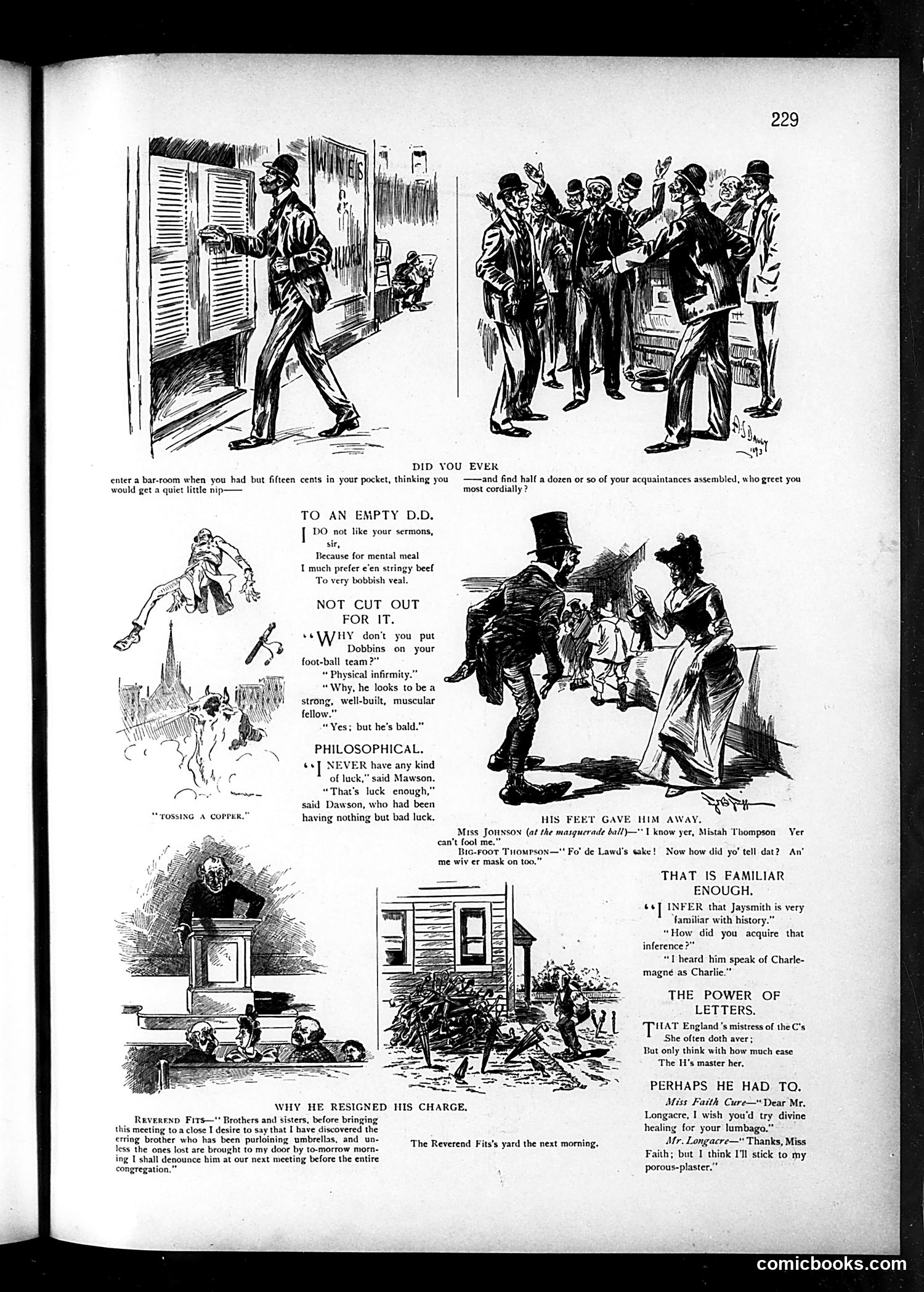
This page contains multiple short satirical sketches targeting social pretense and human folly. Key pieces include: **"To an Empty D.D."** mocks a clergyman (D.D. = Doctor of Divinity) whose sermons are compared unfavorably to stringy beef—brutal commentary on poor preaching. **"Not Cut Out for It"** jokes that a physically fit man can't play football because he's bald, satirizing shallow reasoning. **"His Feet Gave Him Away"** depicts a Black masquerade party-goer (Big-Foot Thompson) recognized despite a mask, playing on period racial stereotypes and minstrelsy conventions common to the era. **"Why He Resigned His Charge"** shows a reverend threatening to publicly shame a congregation member who stole umbrellas—mocking both clerical pomposity and petty moral theatricality. The overall tone ridicules hypocrisy, social climbing, and the gap between pretense and reality. These are typical Judge magazine fare: class commentary and situational humor reflecting late 19th/early 20th-century American anxieties.
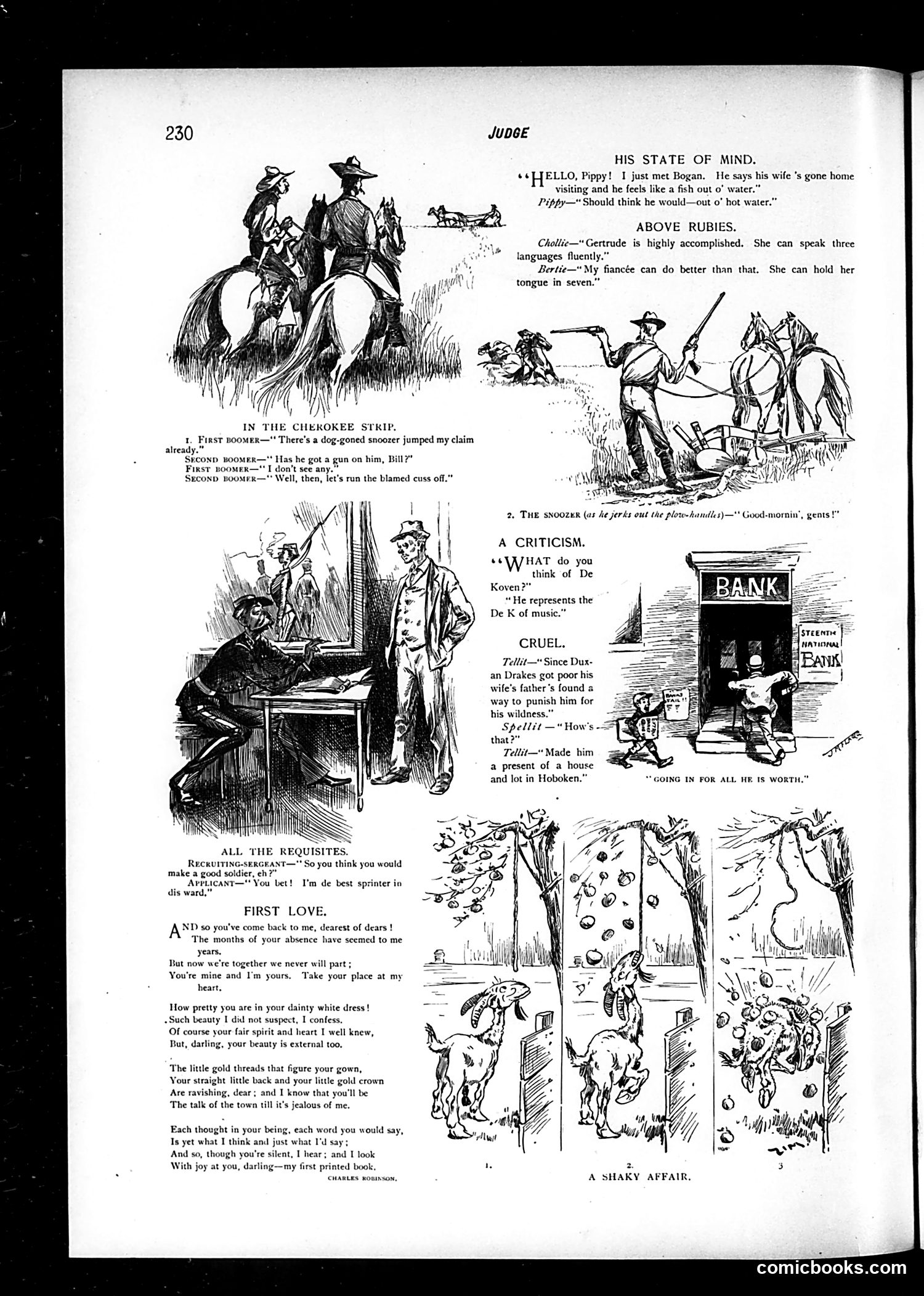
This page contains several brief satirical sketches typical of Judge's humor circa the 1890s-1900s: **"His State of Mind"** jokes about a man whose wife is away—he's out of his comfort zone, like "a fish out of water" (or "hot water," implying domestic troubles). **"Above Rubies"** contrasts languages with a fiancée who can "hold her tongue"—a common jab at women's talkativeness. **"In the Cherokee Strip"** references the Oklahoma Land Rush era, depicting prospectors staking mining claims and encountering each other. **"A Criticism"** mocks composer Reginald De Koven, reducing him to a pun ("De K of music"). **"First Love"** sentimentally describes a man reunited with his beloved, whom he compares to "my first printed book"—suggesting his love is literary, not authentic. **"A Shaky Affair"** (bottom illustrations, unclear context) appears to depict dogs causing mischief around furniture or structures. The humor relies on wordplay, social observation, and period-specific references rather than political commentary.
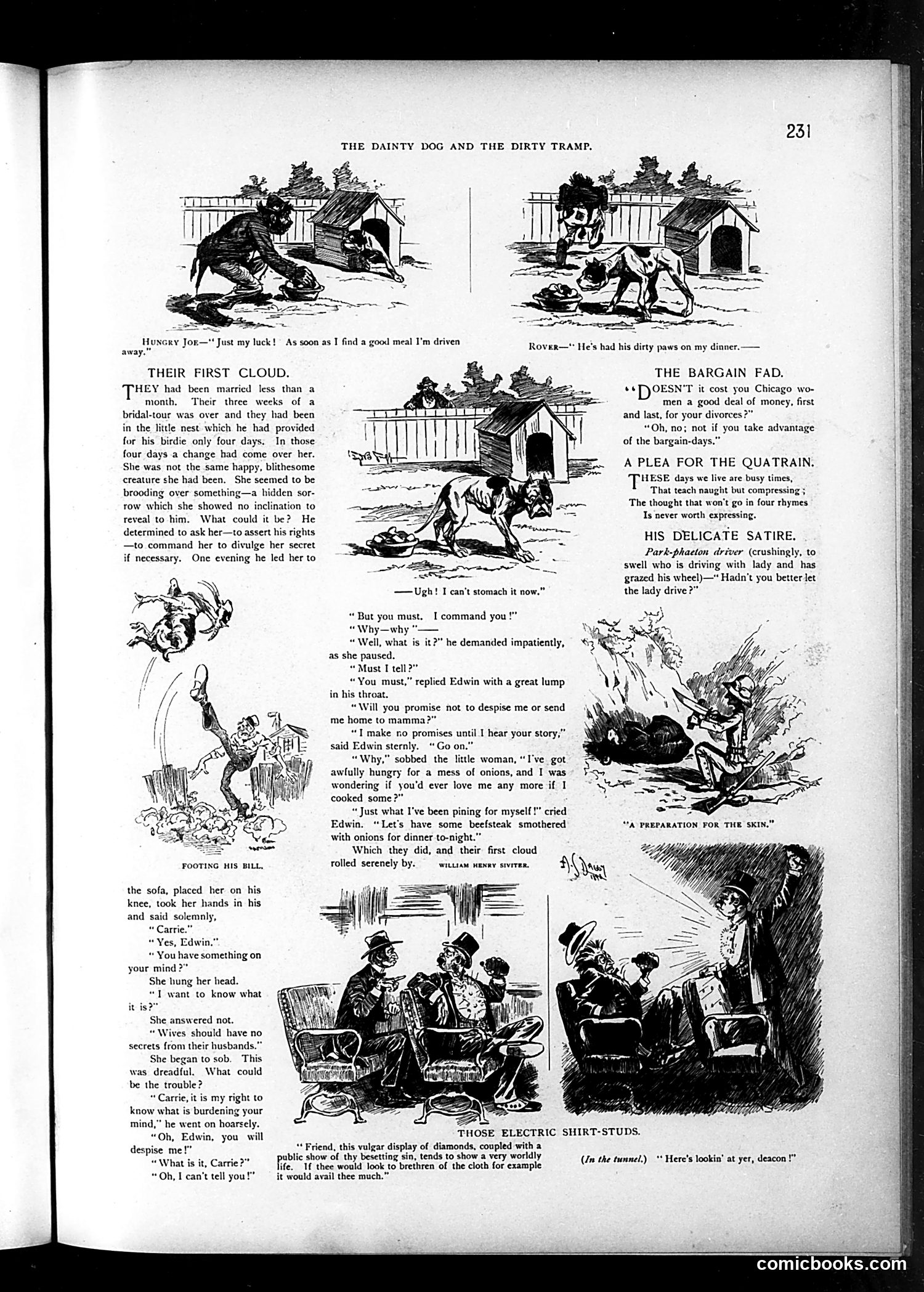
This page contains several brief satirical sketches typical of Judge magazine's humor: **"The Dainty Dog and the Dirty Tramp"** presents anthropomorphized dogs with a class commentary—a refined dog complains that a vagrant tramp has contaminated his dinner with "dirty paws," reflecting anxieties about social contamination and class boundaries. **"The Bargain Fad"** mocks Chicago society women's frequent divorces by suggesting they time them strategically to coincide with "bargain days," satirizing both the ease of divorce among the wealthy and the commercialization of marriage dissolution. **"Their First Cloud"** depicts newlyweds' marital discord resolved absurdly—the wife's hidden shame is merely craving onions, not infidelity or serious conflict. The remaining pieces ("Delicate Satire," "Electric Shirt-Studs") offer brief social commentary on pretension and hypocrisy. Overall, this is genteel satirical humor targeting upper-class behavior, marriage customs, and social pretense—typical Judge magazine fare from the late 19th or early 20th century.
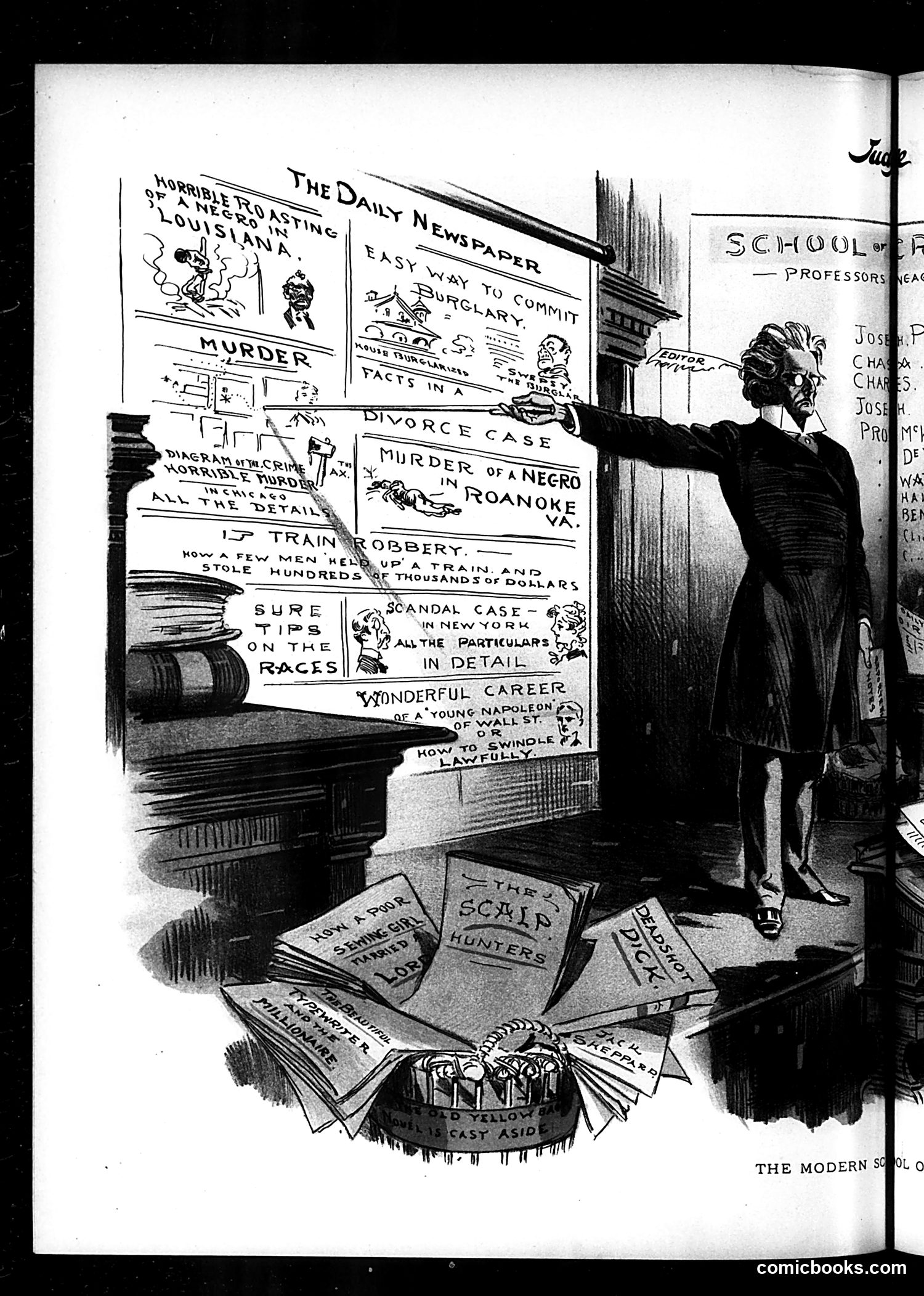
This satirical illustration critiques sensationalist newspaper journalism of the era. A figure (appearing to be a newspaper editor or publisher) points proudly at "The Daily Newspaper"—a billboard displaying lurid headlines advertising crime, scandal, and vice: "Horrible Roasting," "Murder," "Divorce Case," "Train Robbery," "Scandal Case in New York," and similar salacious content. Below the billboard lies a pile of discarded books labeled with serious subjects like "History," "Science," "Literature," and "Classics." **The satire's point**: Newspapers of this period (likely early 1900s) prioritized sensational crime and scandal coverage over substantive reporting, while serious intellectual content was being abandoned. This mocks both yellow journalism's excesses and the public's appetite for tabloid-style entertainment over genuine news and education—a critique still relevant today.
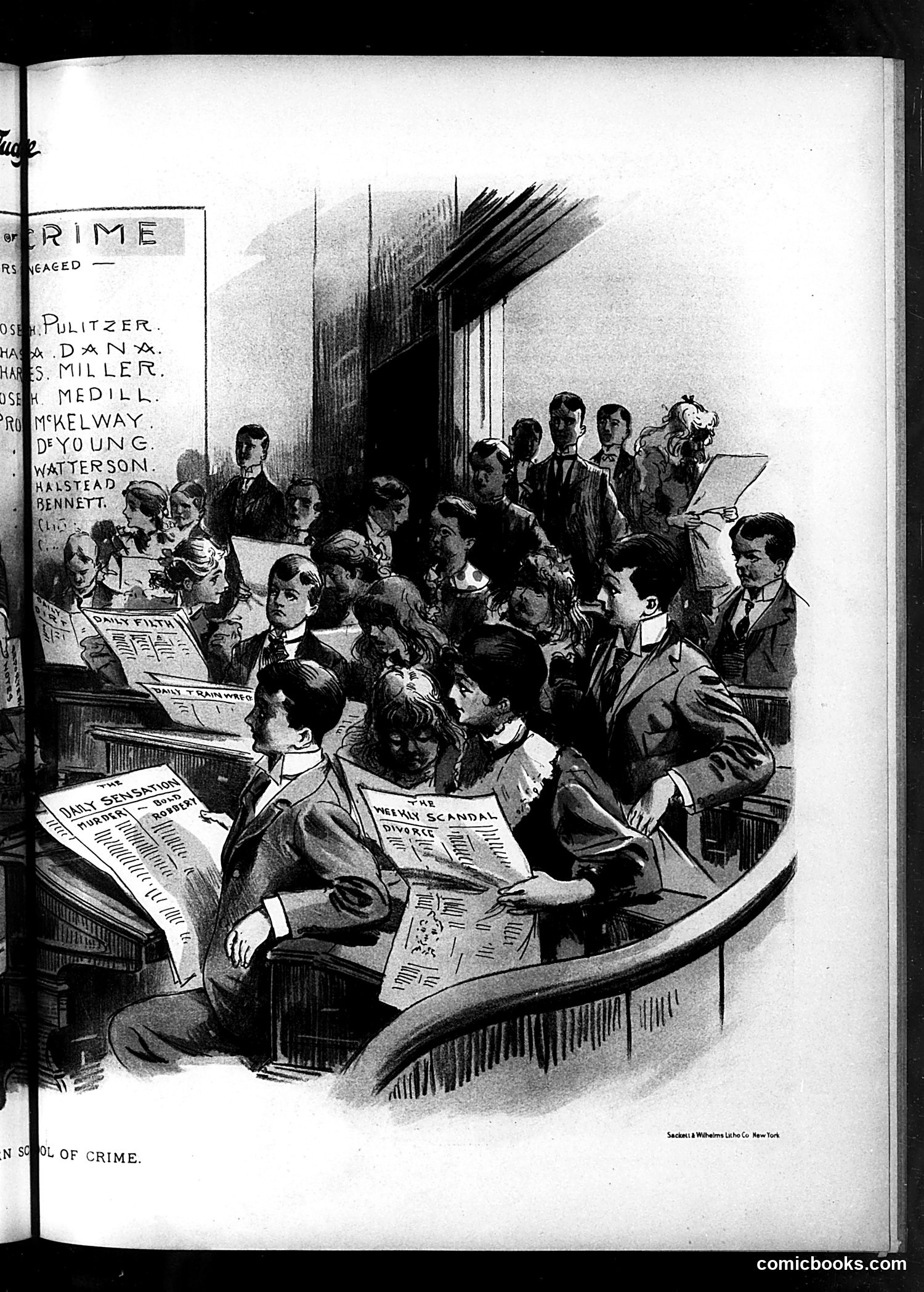
This satirical cartoon depicts prominent American newspaper publishers as criminals teaching a "school of crime." The visible names list influential editors: Pulitzer, Dana, Miller, Medill, Young, Watterson, Halstead, and Bennett—major figures in late 19th-century American journalism. The satire critiques sensationalist "yellow journalism," where these publishers competed fiercely for readers by covering scandals, crimes, and scandals prominently. The cartoon suggests their sensational crime reporting was itself criminal—teaching the public to be fascinated by vice and wrongdoing. The crowded classroom scene of attentive "students" implies this media influence shaped public morality negatively. This reflects contemporary concerns about journalism's power and responsibility during the era of intense newspaper competition.
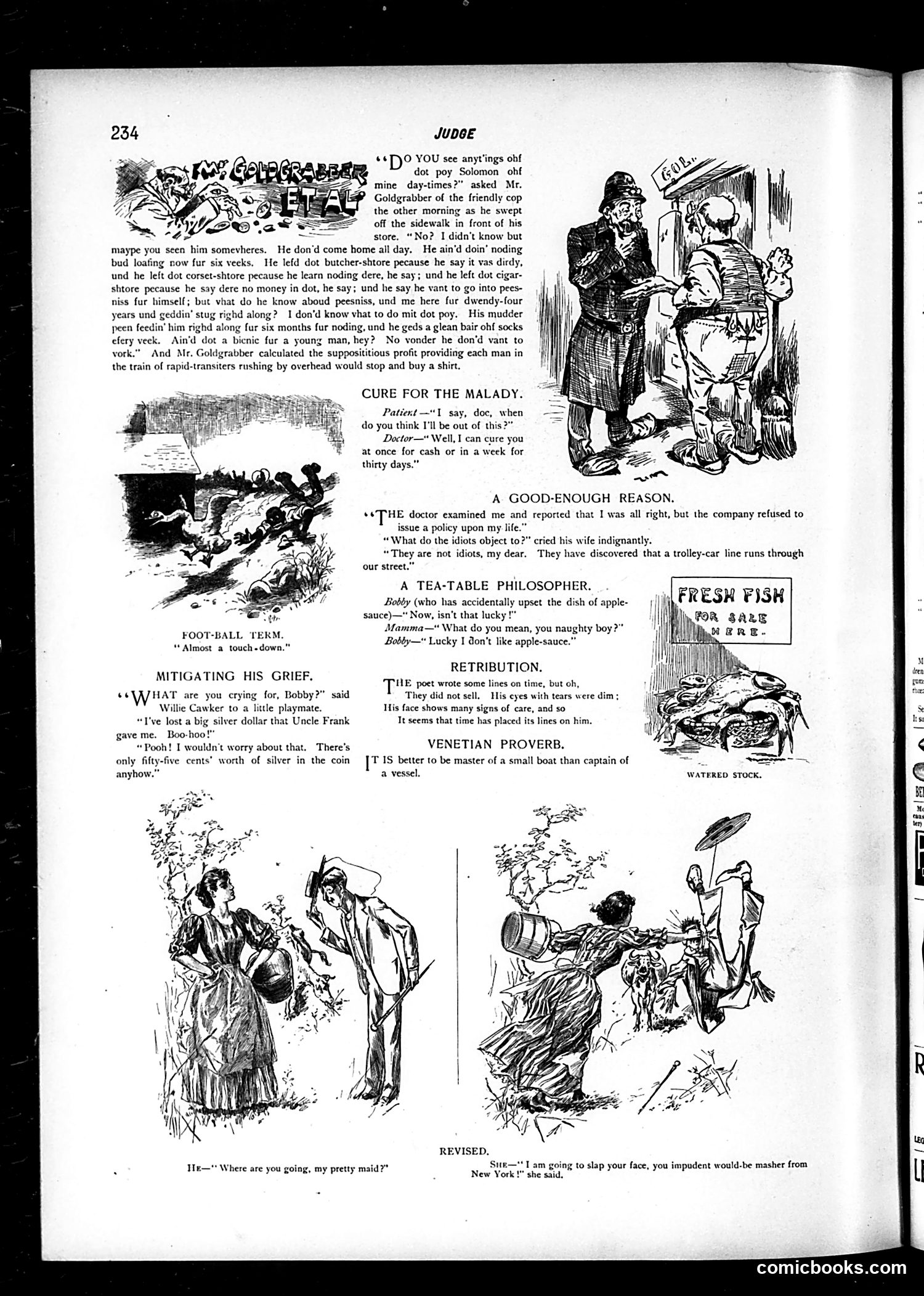
This page contains several unrelated humorous sketches typical of Judge's satirical format: **"Goldgrabber and the Cop"** features a Yiddish-accented immigrant shop owner complaining to a policeman about his lazy son Solomon, who won't work. The satire targets both the stereotyped "lazy youth" of the era and immigrant work ethic anxieties—contrasting the father's decades of labor with the son's entitlement. **"Cure for the Malady"** and **"Good-Enough Reason"** mock insurance companies' evasiveness about payouts and trolley-car accident risks, satirizing emerging industrial-era insurance practices. **"Tea-Table Philosopher"** presents a child's illogical reasoning—turning a spilled dish into good fortune because he dislikes apple-sauce—as innocent humor. The remaining sketches address courtship, poetry commerce, and common expressions. The page reflects Judge's blend of immigrant caricature, emerging corporate satire, and domestic humor popular in early 20th-century American periodicals.
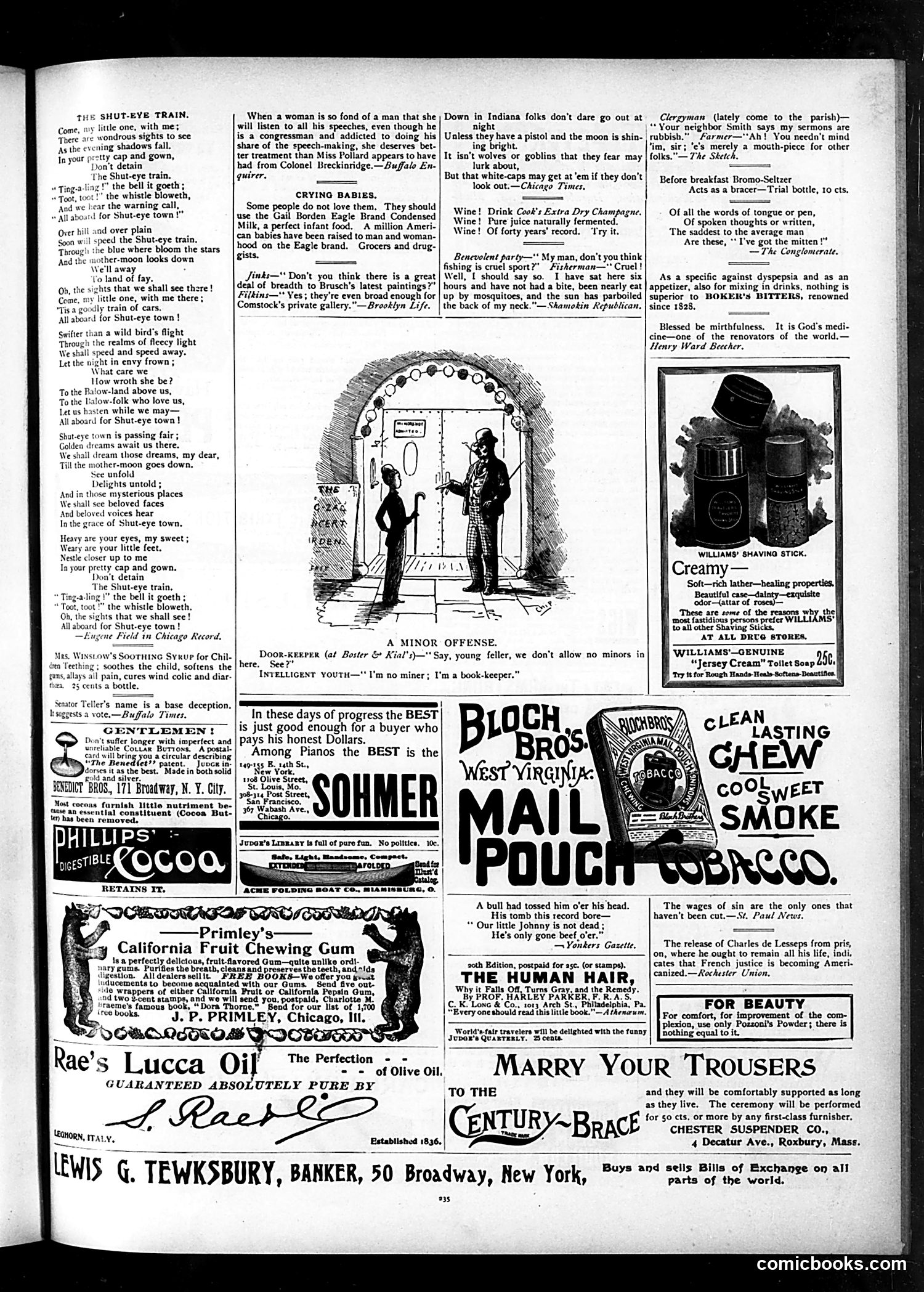
This page from *Judge* magazine (a satirical weekly) contains primarily **advertising and light humor** rather than political satire. The main content includes: 1. **"The Shut-Eye Train"** — A whimsical children's poem by Eugene Field about bedtime, using the metaphor of a train to Sleepyland. This is literary content, not satire. 2. **Brief comic quips** — Short jokes about various topics: a congressman's speechmaking (mildly satirical), Indiana vigilante violence ("white-caps" referring to the Ku Klux Klan—a serious social reference treated flippantly), a fishing story, and a pun about "minors" in a bar. 3. **One cartoon labeled "A Minor Offense"** — Shows a doorkeeper refusing entry to someone he assumes is a minor, but the young man jokes that he's a book-keeper, not a miner. This is wordplay humor, not political commentary. The page is **dominated by period advertisements** for products like cocoa, shaving sticks, champagne, and patent medicines—typical for 1890s magazines. The satire is gentle and non-political.
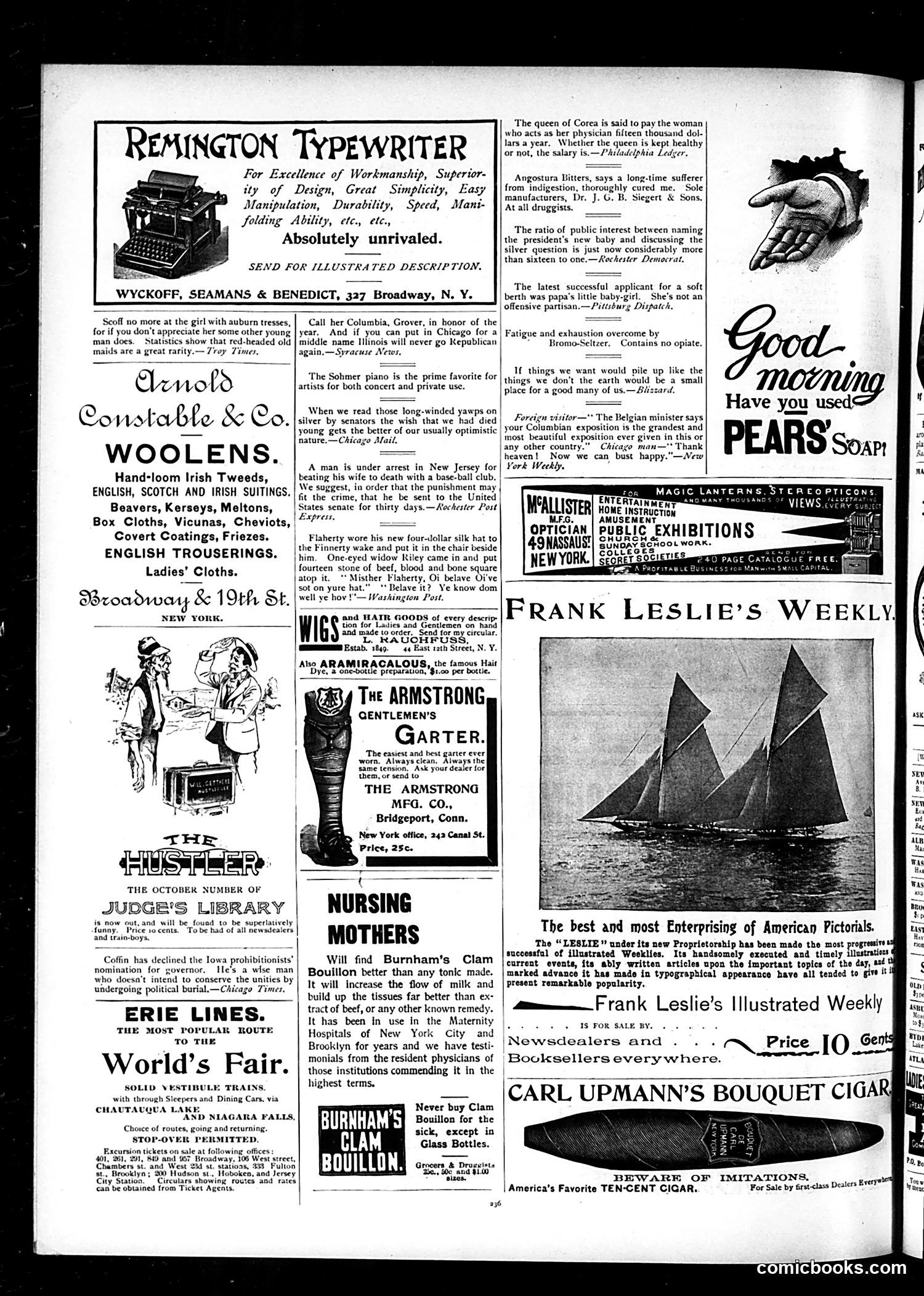
This is primarily an **advertising page** from Judge magazine, typical of late 19th-century periodicals. The page contains commercial advertisements for products like typewriters, woolens, pianos, and patent medicines. The few editorial jokes scattered among ads are brief, topical quips: - A reference to "Columbia" and "Grover" (likely President Grover Cleveland) regarding naming a baby, with a jab at Illinois Republican politics - A senator mockery comparing lengthy Senate speeches to drowsy, long-winded remarks - A dark joke about a wife-beater deserving punishment in the Senate rather than prison These one-liners reflect Judge's satirical style—poking fun at politicians (especially Republicans), contemporary scandals, and social absurdities. The page's primary function, however, is revenue generation through advertising rather than substantive political commentary. Without knowing the specific publication date, precise identifications remain uncertain.
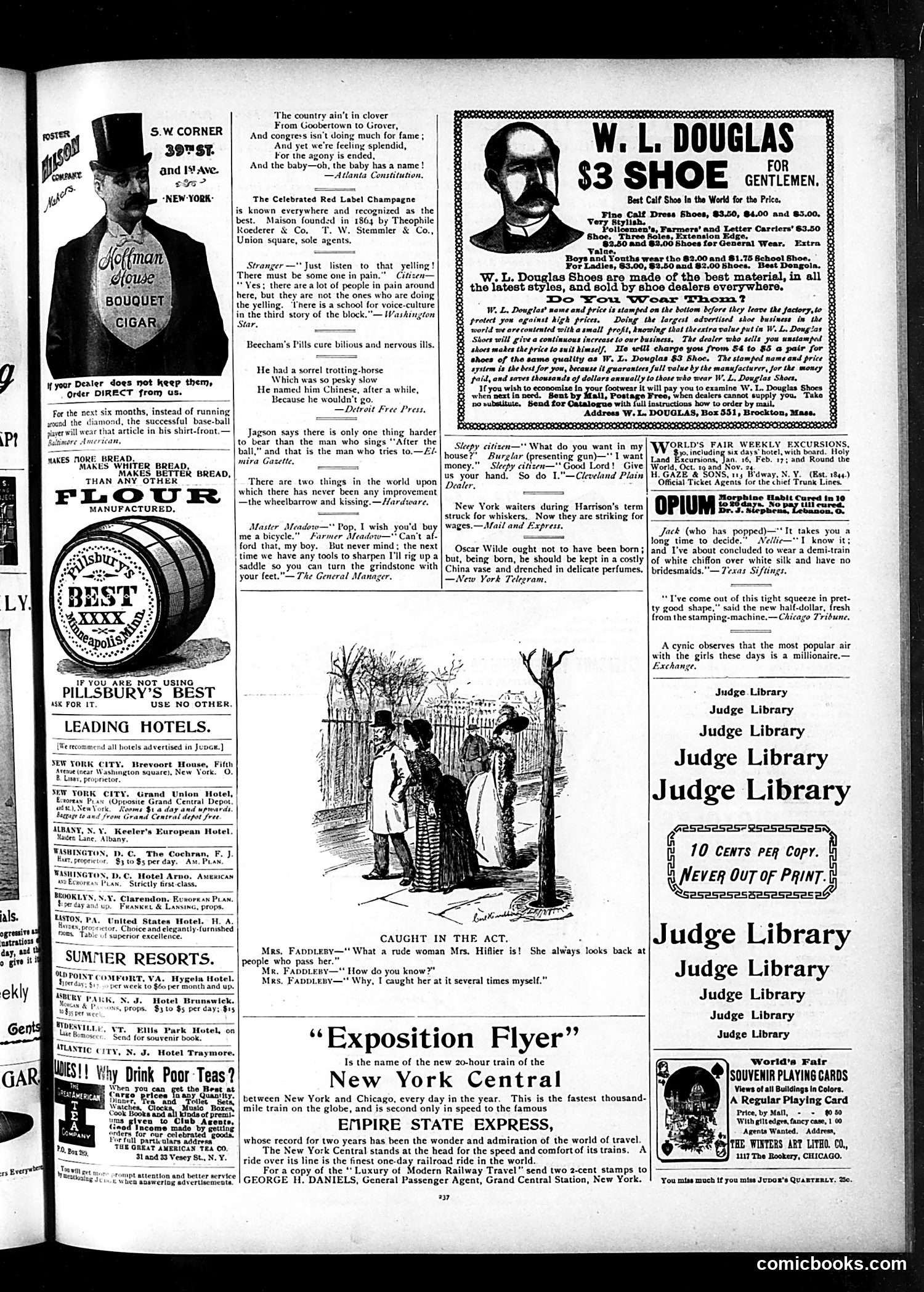
This page from **Judge** magazine is primarily **advertising**, with scattered satirical snippets typical of the era. The main cartoon, "CAUGHT IN THE ACT," depicts a woman (labeled Mrs. Hiller) being observed by a male figure. The caption jokes about her habitual staring—she claims to catch herself "several times" doing it, a mild social satire about vanity and self-awareness. The page is dominated by **product advertisements**: W.L. Douglas shoes ($3, emphasizing value), Pilsbury's flour, Beecham's Pills, and railroad/hotel services. These reflect late 19th-century consumer culture. Small humorous quips pepper the margins—jokes about Congress, Base-ball players, waiters' strikes, and romantic mishaps—typical Judge fare: light social commentary rather than sharp political satire. The "Exposition Flyer" advertisement promotes the **New York Central's new 20-hour train** between New York and Chicago, highlighting technological progress as a luxury amenity. Overall, this represents Judge's dual function: satirical humor magazine AND advertising vehicle for contemporary products and services.
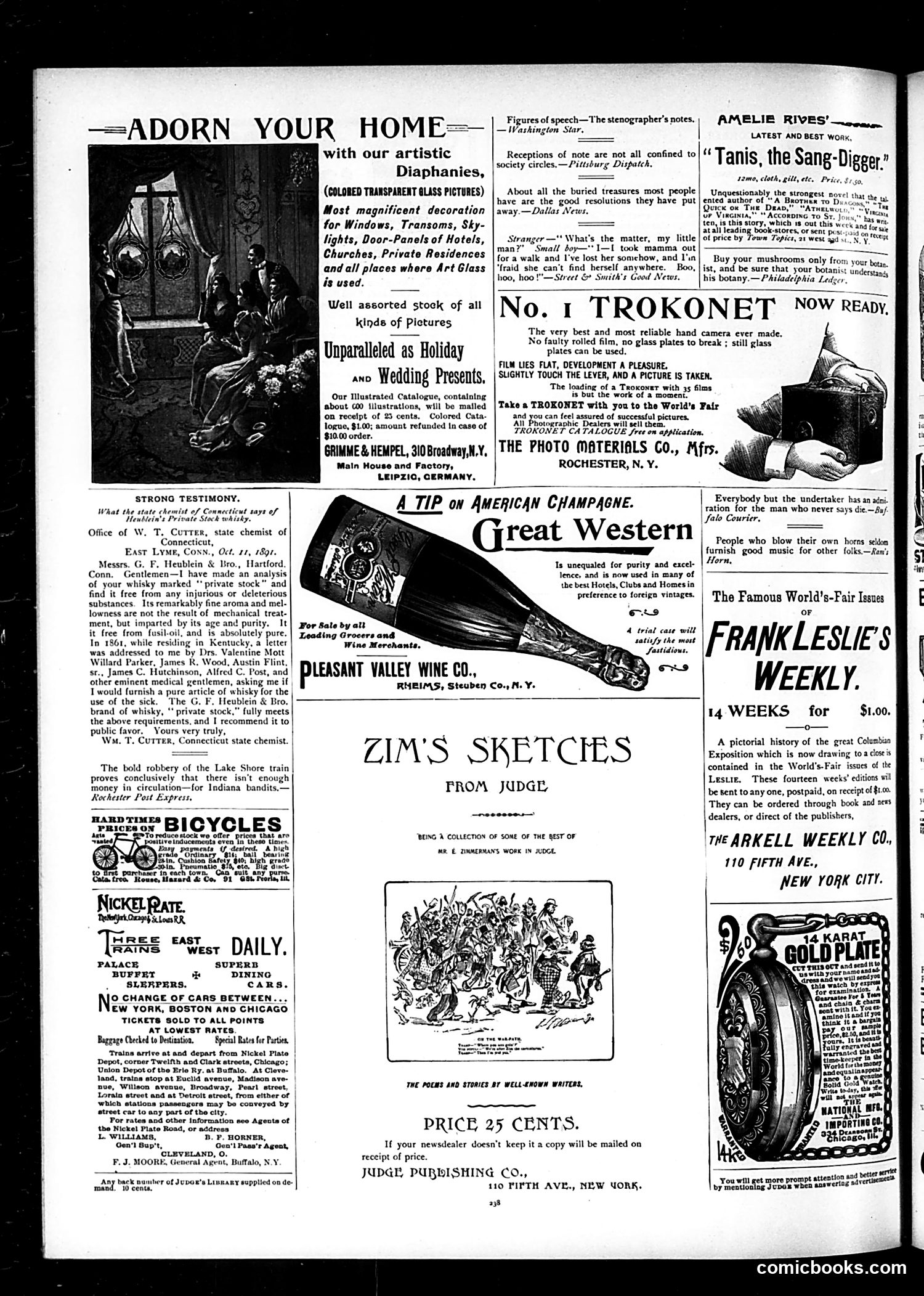
This page is primarily **advertisements and fillers** rather than political satire. The main visual element is **"Zim's Sketches from Judge,"** a crowded cartoon showing numerous figures in chaotic interaction—likely a humorous scene of everyday life or a social gathering, though specific identities aren't clear from the image alone. The page contains scattered joke fragments about everyday topics: a lost mother, buried resolutions, mushroom sourcing, and a train robbery quip about currency circulation. These represent typical late-19th-century American humor. Most content comprises product advertisements: decorative glass diaphanies, bicycles, wine, cameras (the Trokonet), whisky, and books including Amelie Rives' novel. A chemist's testimonial endorses Heublein's whisky quality—typical period advertising strategy. The overall page reflects **Judge's** function as both satirical magazine and commercial vehicle, mixing genteel humor with mercantile content targeting educated, affluent readers.
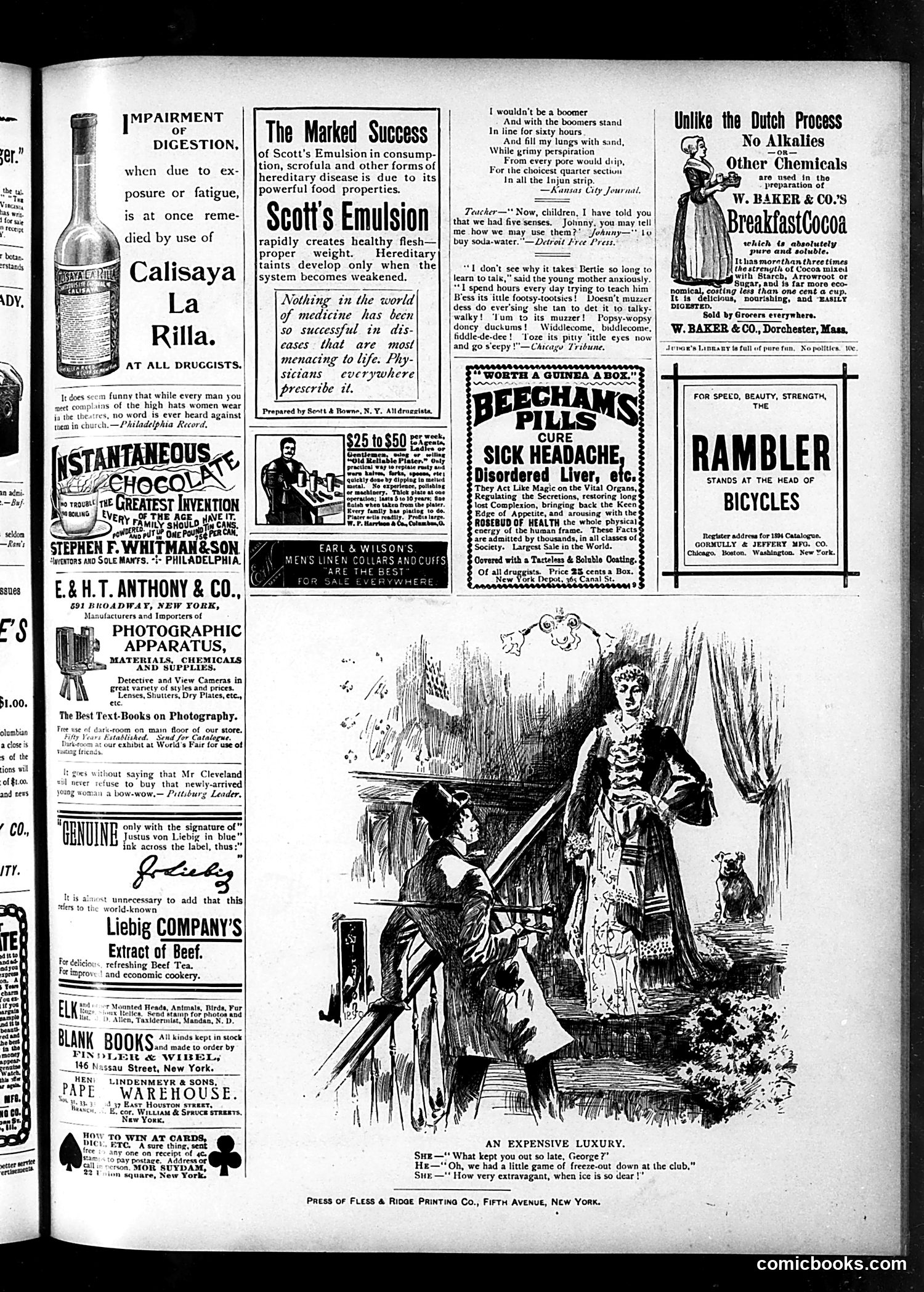
This page is primarily **advertisements and light humor** rather than political satire. The main content includes: **The Large Cartoon** ("An Expensive Luxury") depicts a woman and man in evening dress, with the woman explaining they stayed out late at a club playing "a little game of frescendo." The humor is domestic—poking fun at upper-class leisure activities and the expense of such entertainments to the husband. **The Humor Pieces** are brief, gentle jokes about childhood, teaching, and courtship—typical Judge content mocking social manners rather than politics. One jokes about a child learning five senses by buying soda water; another mocks baby-talk in parenting. **The Bulk of the Page** consists of patent medicine and product advertisements (Scott's Emulsion, Beecham's Pills, Liebig Extract, photographic equipment, etc.)—standard for period magazines. These ads promoted remedies for "impairment of digestion," "sick headache," and other ailments with largely unproven efficacy. **No significant political commentary** is visible. This appears to be a typical humor and advertising page from an American satirical magazine, likely from the 1890s-1900s era.
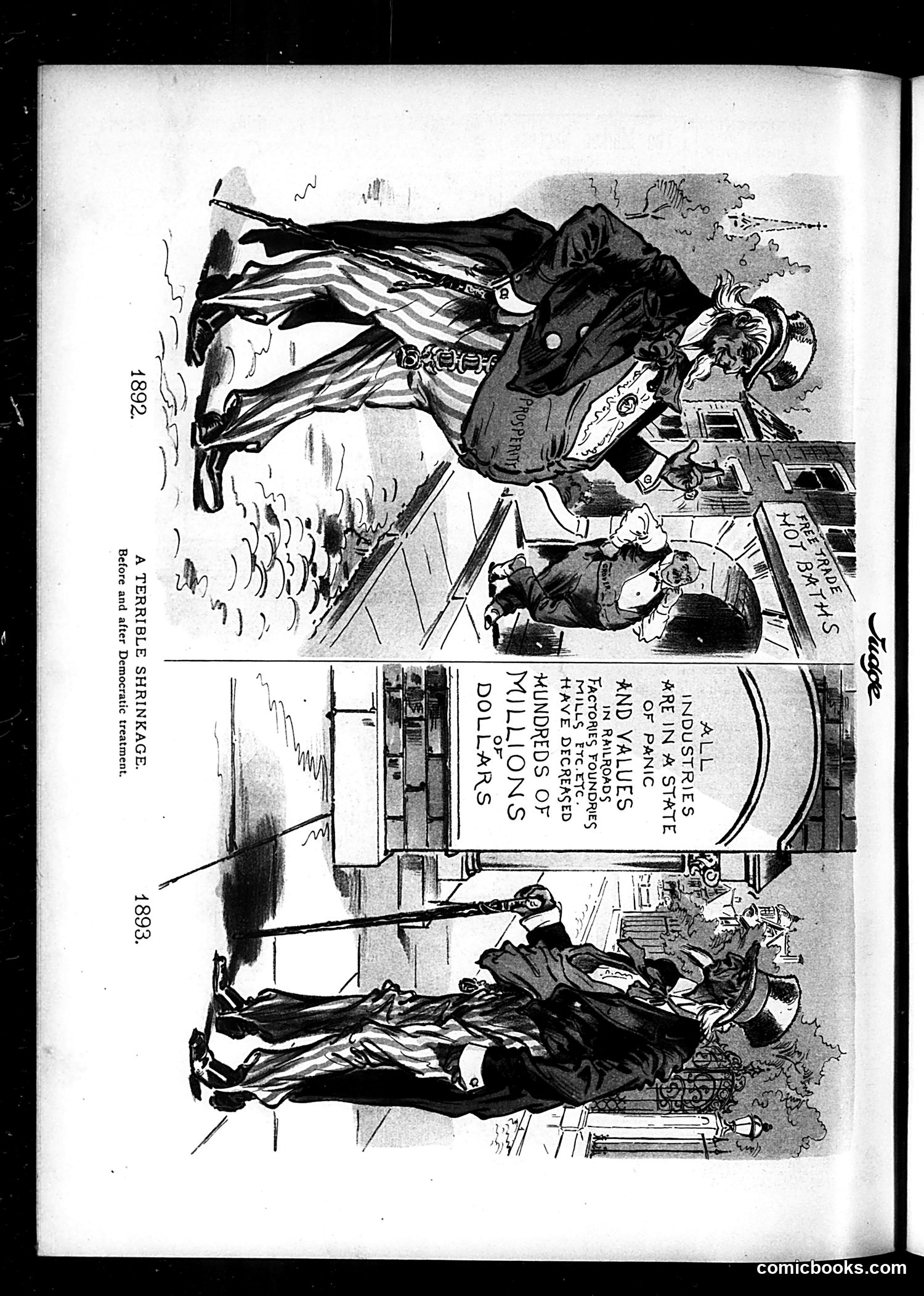
This appears to be a political cartoon from Judge magazine criticizing Democratic economic policies. The caption "A Terrible Shrinkage: Before and after Democratic treatment" suggests the cartoon contrasts economic conditions under different administrations. The visible text references panic in industries, decreased values in railroads, factories, foundries, and mills, and losses of "hundreds of millions of dollars." The top panel appears to show a prosperous figure (likely representing business or the economy before Democratic rule), while the bottom shows a diminished or suffering figure (after Democratic policies). Without a clear date visible, this likely critiques a Democratic administration's economic record, possibly from the late 19th or early 20th century when Judge regularly published partisan political satire attacking Democratic policies as harmful to American business and prosperity.