
A complete issue · 16 pages · 1893
Judge — August 19, 1893
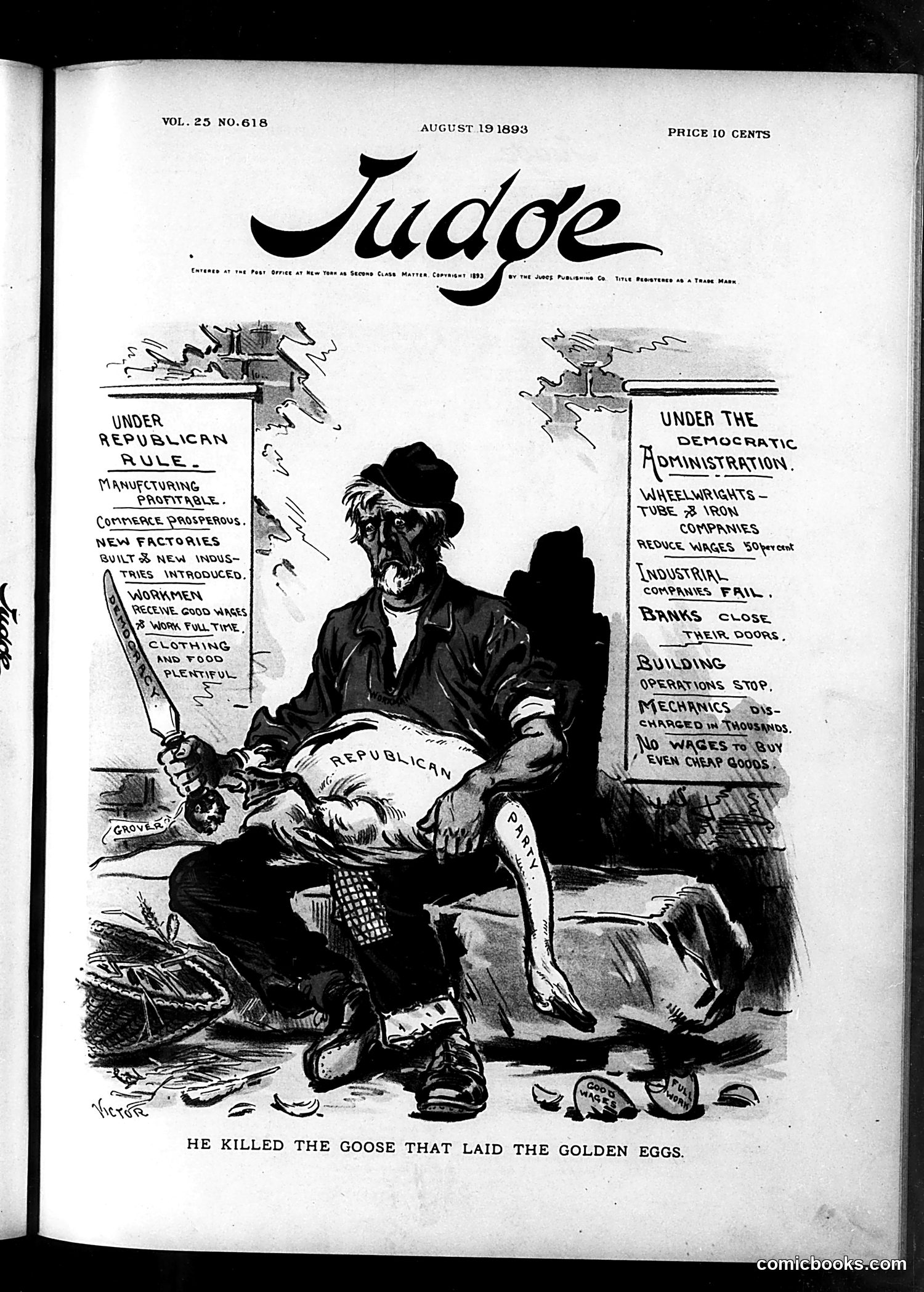
This political cartoon satirizes the economic consequences of Republican versus Democratic administrations. The skeletal figure represents the U.S. economy or working class under each regime. **Left side ("Under Republican Rule"):** Lists positive outcomes—manufacturing prosperity, new factories, thriving industries, full-time work, abundant clothing and food. **Right side ("Under Democratic Administration"):** Catalogs disasters—wage cuts, business failures, bank closures, halted construction, unemployed mechanics, scarce goods. The caption "He Killed the Goose That Laid the Golden Eggs" suggests the (unnamed) Democratic administration destroyed economic prosperity that Republicans had built. **Context:** This reflects the economic Panic of 1893, which occurred early in President Grover Cleveland's second term. Republicans blamed Democratic policies; this cartoon makes that partisan argument visually.
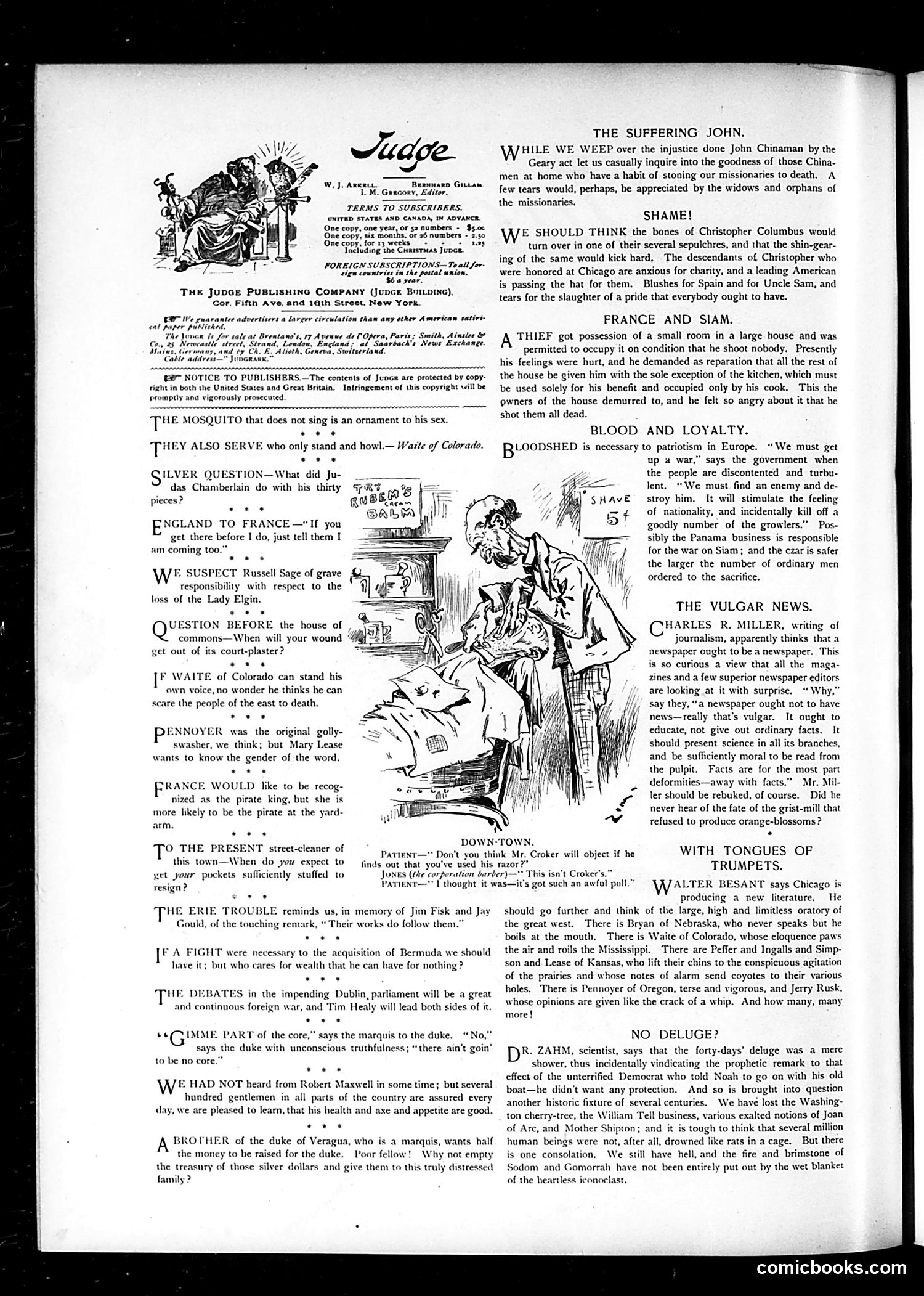
This page contains several brief satirical commentaries and a central cartoon. The main illustration depicts a patient in a doctor's office, likely satirizing medical practice or diagnosis. Key satirical pieces reference: - **"The Suffering John"**: Criticizes injustice toward John Chinaman (a period term for Chinese immigrants), suggesting indifference to their deaths - **"France and Siam"**: A brief anecdote about territorial disputes, mocking imperialism - **"Blood and Loyalty"**: Critiques warmonger rhetoric, likely regarding the Panama Canal or Siam conflict - **"The Vulgar News"**: Charles R. Miller argues newspapers should educate rather than sensationalize The cartoon and text together attack Gilded Age attitudes: indifference to Chinese suffering, imperial ambitions, and yellow journalism. The specific historical context—involving colonial competition and Chinese exclusion—would be unfamiliar to modern readers.
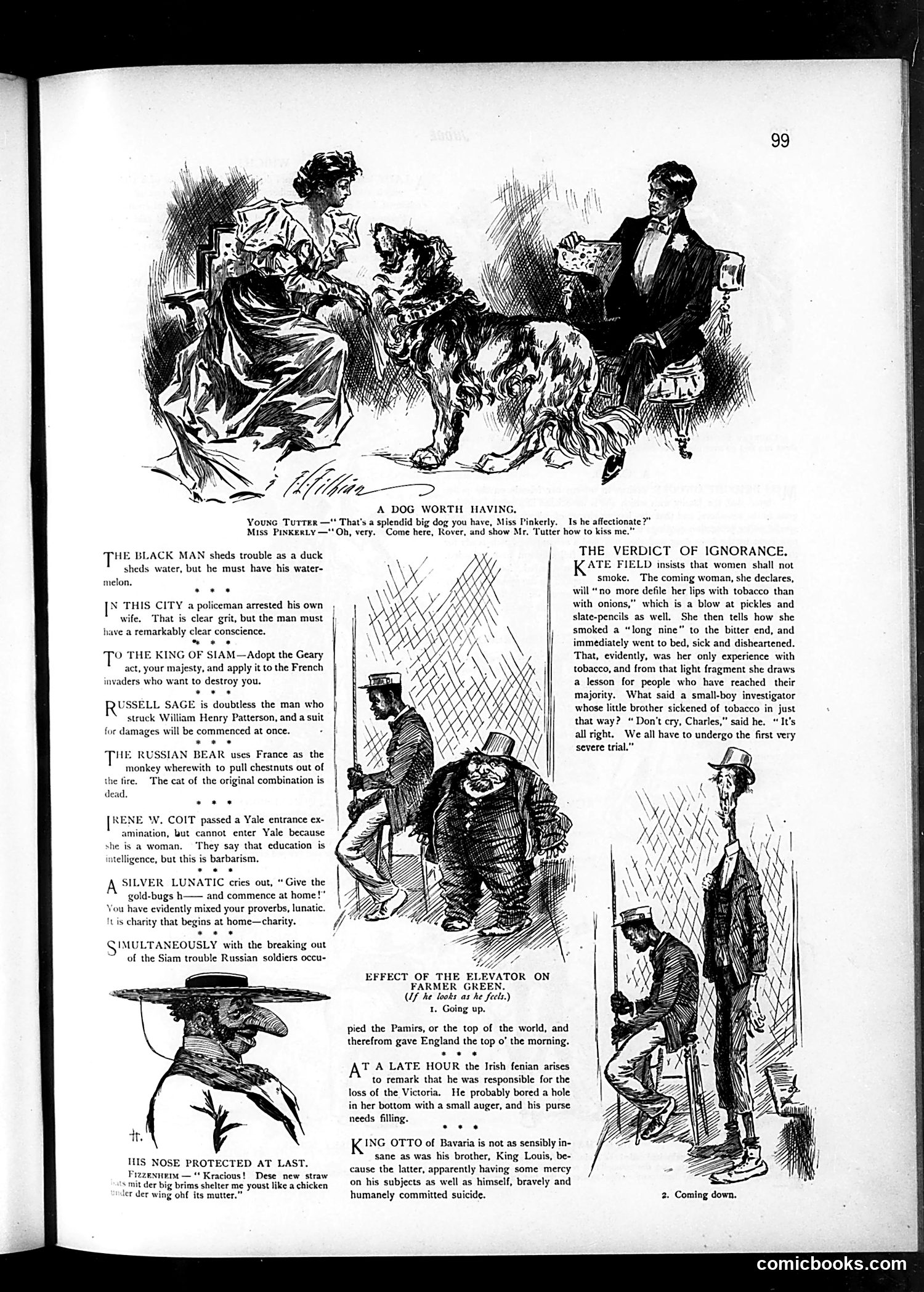
This page contains several brief political satirical quips and two illustrated sequences: **Top cartoon** ("A Dog Worth Having"): Shows a woman and man with dogs, likely satirizing proper social etiquette around pets and courtship. **Left column vignettes**: Brief sardonic commentaries on contemporary issues—a policeman arresting his own wife, the King of Siam, Russell Sage (a prominent financier), a Yale entrance examination, and Russian soldiers. These mock social hypocrisy, foreign affairs, and American institutions. **Right column**: "The Verdict of Ignorance" satirizes Kate Field's anti-smoking campaign for women, mocking the idea that moral lectures change behavior. **Bottom illustrations** ("Effect of the Elevator on Farmer Green"): Two-panel sequence showing a rural man's bewilderment with modern urban elevators—satirizing rural-urban cultural divide and technological anxiety among unsophisticated visitors to cities.
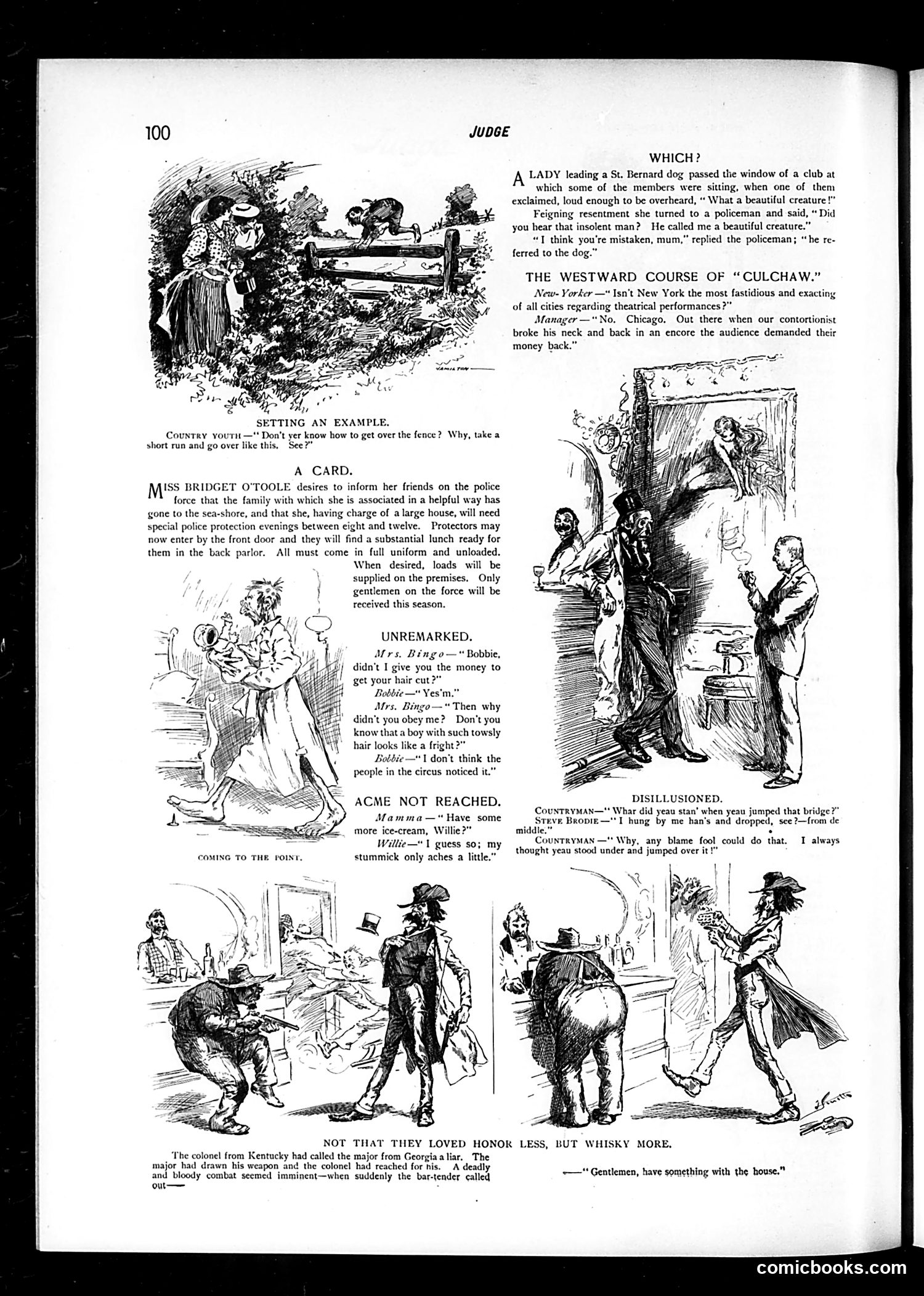
This page contains several unrelated satirical pieces typical of Judge magazine's format: **"Which?"** mocks a pretentious lady who calls a St. Bernard dog a "beautiful creature," then insults the policeman who owns it—the joke being her obliviousness to rudeness. **"The Westward Course of 'Culchaw'"** satirizes pretentious urban culture spreading westward from New York to Chicago, with a contortionist demanding money back after breaking his neck—mocking both the spectacle and audience expectations. **"A Card"** announces mock police services for protecting warehouses, with loaded guns available—likely satirizing urban crime concerns or inadequate municipal protection. The remaining pieces ("Setting an Example," "Unremarked," "Acme Not Reached," "Coming to the Point," "Disillusioned," "Not That They Loved Honor Less, But Whisky More") are brief joke exchanges without clear historical reference, relying on period-specific social humor about domestic situations and character types.
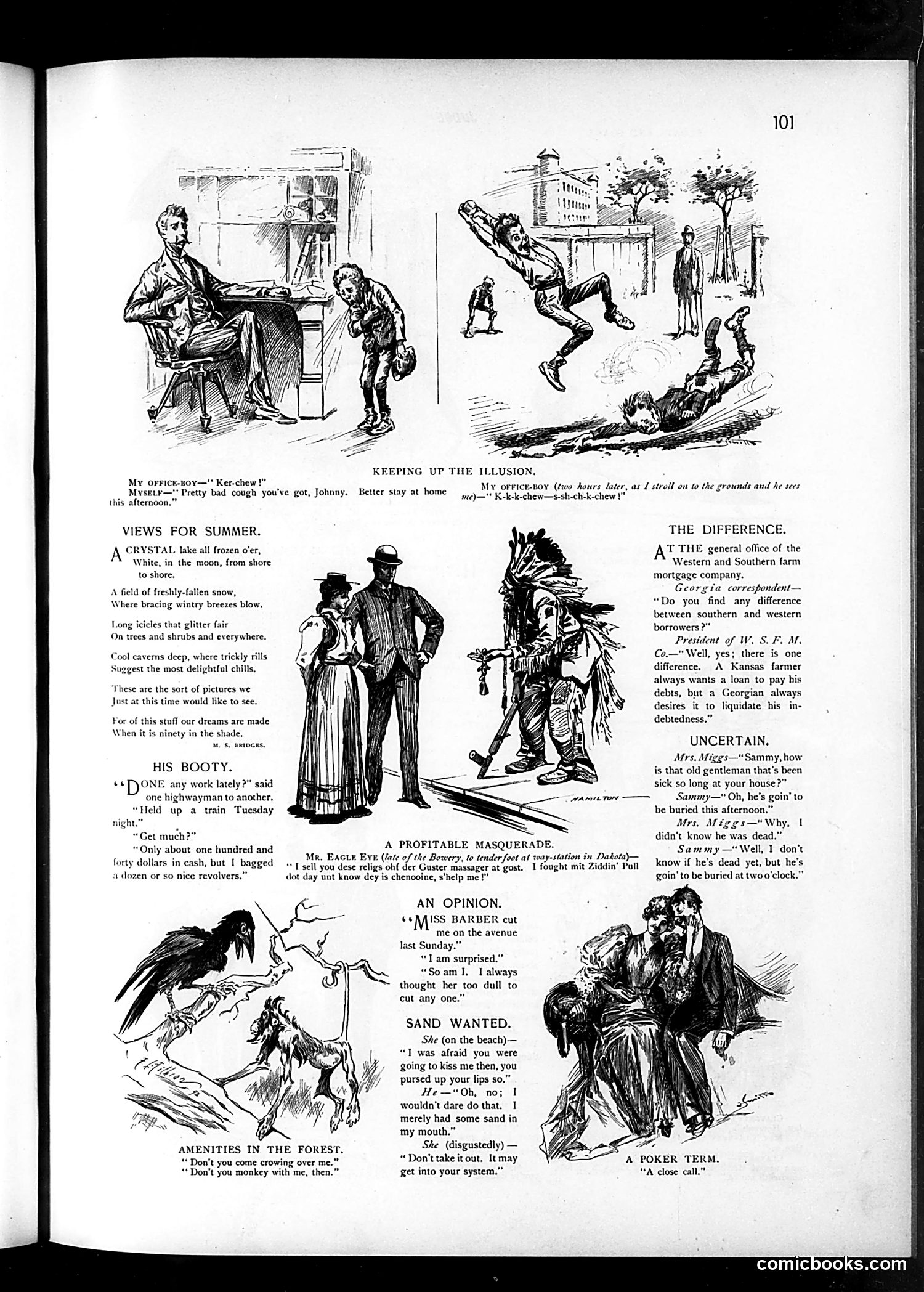
This page contains multiple brief satirical sketches typical of Judge's format, mixing social commentary with wordplay and visual gags: **"Keeping Up the Illusion"** mocks office workers pretending illness—the boy's cough recurs suspiciously once the boss departs, suggesting malingering. **"His Booty"** portrays two highwaymen casually discussing train robbery, satirizing crime's normalization in contemporary discourse. **"A Profitable Masquerade"** depicts a con artist ("Mr. Eagle Eye") with a German accent selling fake "Custer massager" relics to gullible tourists, playing on both immigration anxieties and frontier nostalgia. **"The Difference"** contrasts Southern and Western borrowers: Kansans borrow to *pay debts*, while Georgians borrow to hide insolvency—a regional stereotype about Southern financial irresponsibility. **"Uncertain"** features dark humor about a dying man—the boy doesn't know if he's dead yet, only that burial is scheduled. The remaining sketches offer light romantic and domestic humor. Overall, the page reflects late-19th-century attitudes toward crime, immigration, regional differences, and workplace deception.
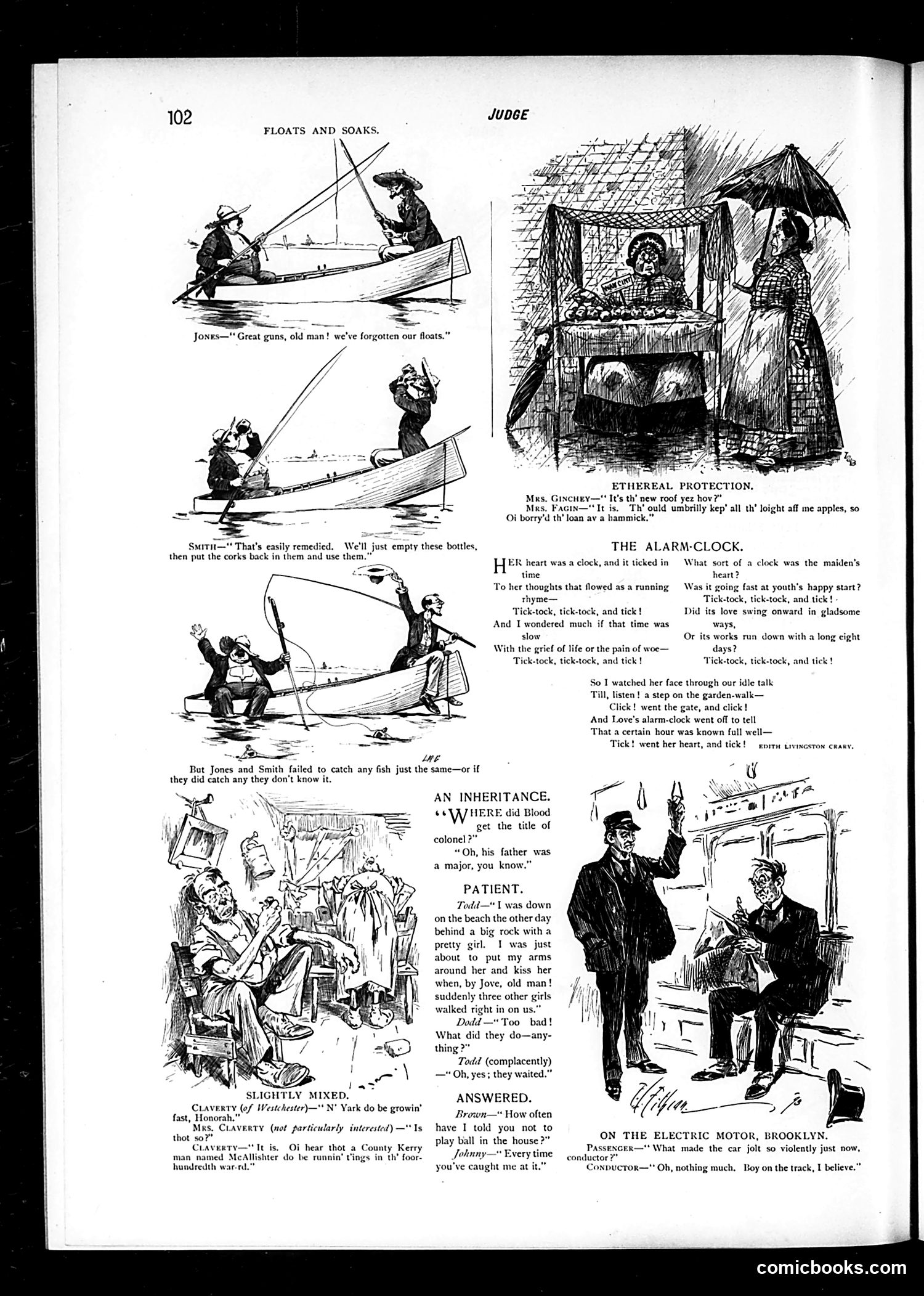
This page collects several brief comedic sketches typical of Judge's satirical humor: **"Floats and Soaks"** depicts working-class Irish characters (Jones, Smith, Ginchey, Fagin) in comedic situations—men trying to repurpose bottles as fishing floats, and a woman using a borrowed hammock as a makeshift roof patch instead of an umbrella. The humor relies on Irish dialect and resourceful poverty. **"The Alarm-Clock"** is sentimental poetry about a maiden whose heartbeat quickens when her lover arrives—a romantic piece amid the crude humor. **"An Inheritance"** and **"Answered"** are brief joke exchanges about blood relations and obedient children. **"On the Electric Motor"** references a Brooklyn trolley accident where a conductor blames a boy on the tracks for the jolt—dark humor about public transit hazards. The page reflects Judge's mix of working-class satire, ethnic stereotyping (common for the era), sentimental verse, and social commentary on contemporary urban life and technology.
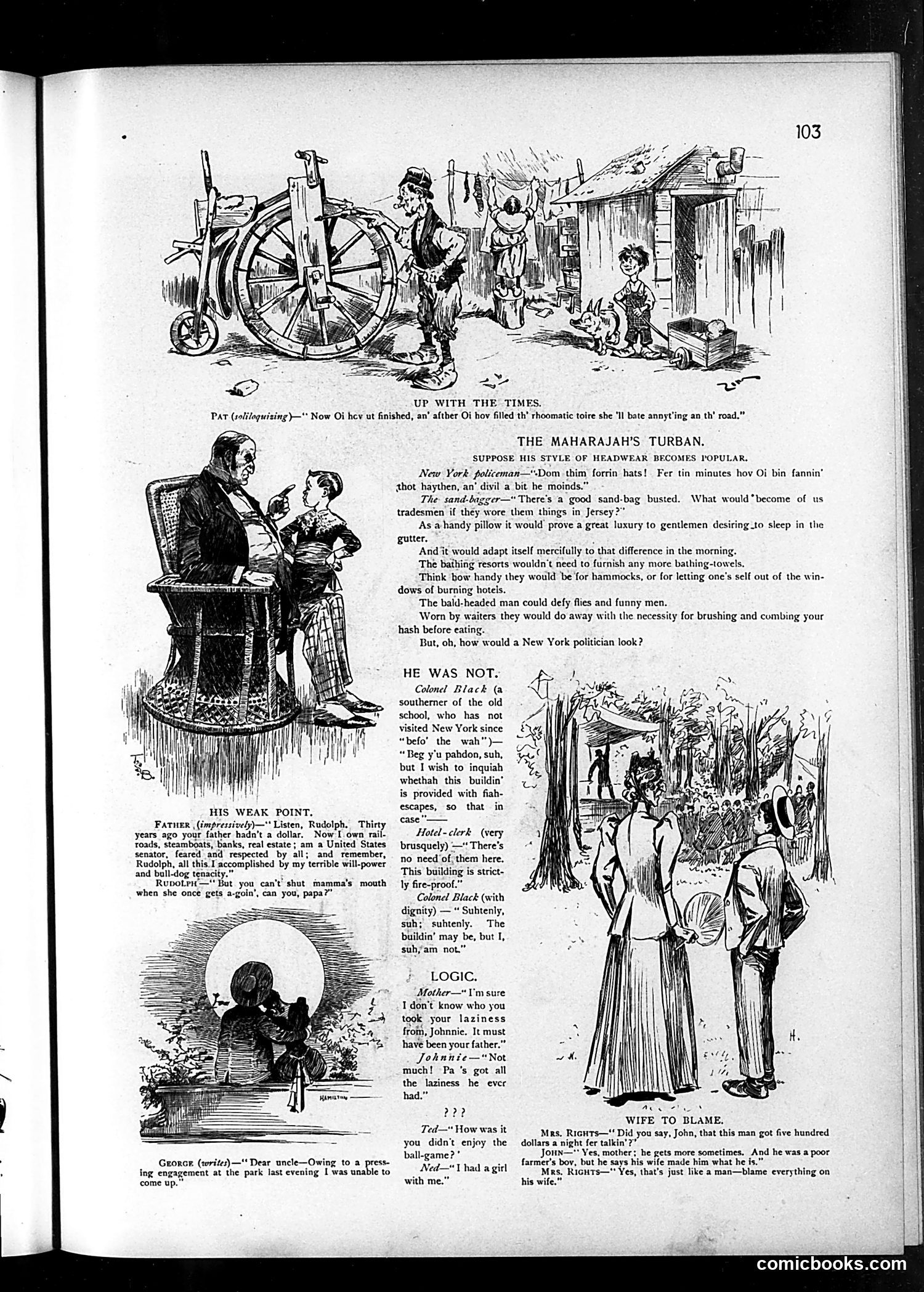
This page contains several brief satirical sketches typical of Judge's humor: **"Up with the Times"** mocks Irish immigrant laborers (indicated by "Pat's" dialect) who adapt quickly to American innovations—here, fixing pneumatic tires. **"The Maharajah's Turban"** satirizes what would happen if Indian headwear became fashionable in America. It jokes that New York police would struggle to manage such hats, sand-baggers would lose their weapon advantage, and it would serve practical purposes (pillows, hammocks, fire escapes). The implicit critique targets American gullibility toward foreign fashions. **"He Was Not"** plays on Southern stereotypes—Colonel Black, a pre-Civil War Southerner, obsesses over building safety while speaking in exaggerated dialect, contrasting with the hotel clerk's brisk modern efficiency. The remaining sketches ("His Weak Point," "Logic," "Wife to Blame") are quick domestic humor pieces about parental authority, laziness inheritance, and spousal blame—common Judge tropes requiring little historical context.
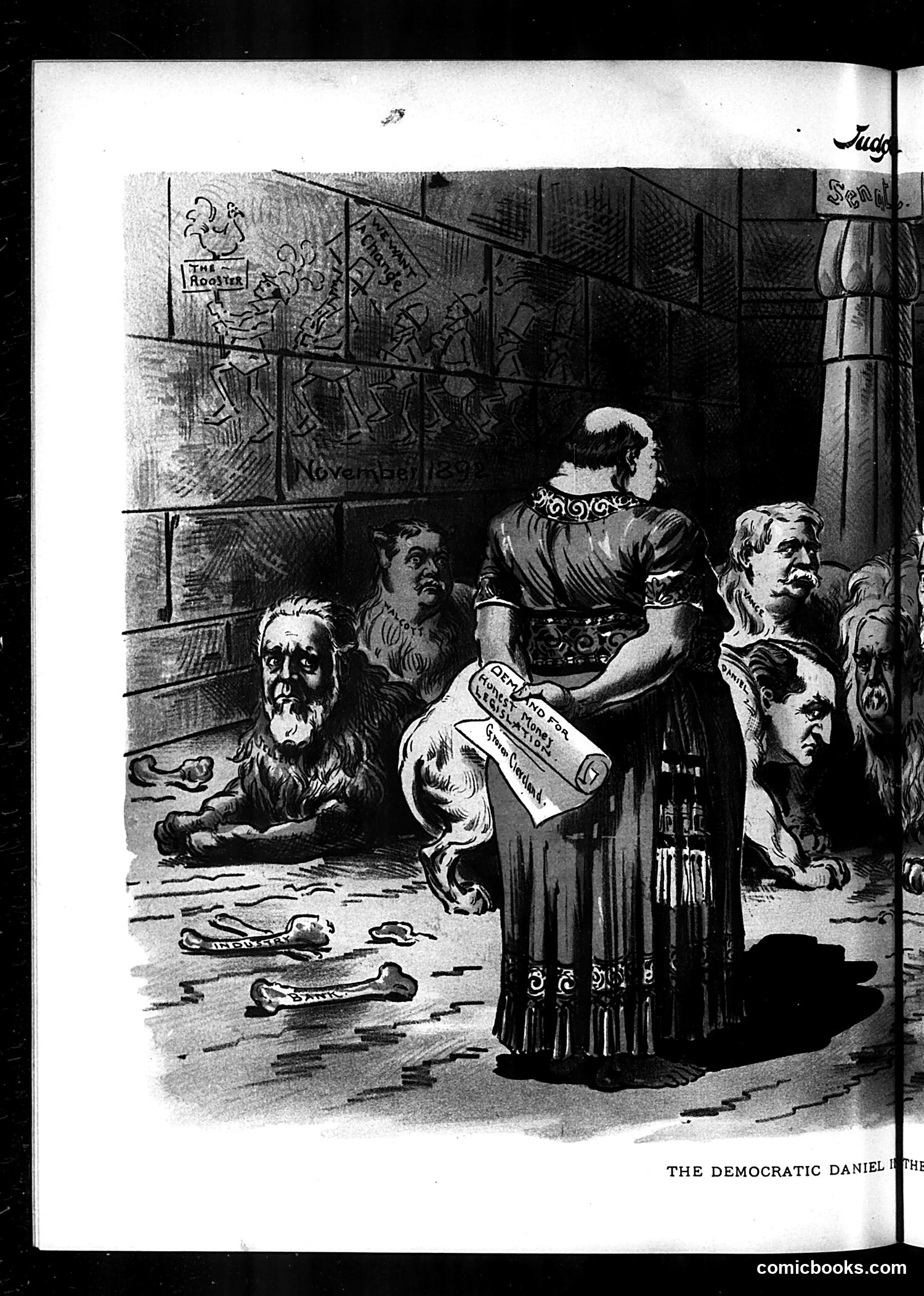
This political cartoon depicts a woman (likely representing the Democratic Party) presenting what appears to be a scroll or document labeled "LETTER AND TESTIMONY" to a group of men depicted as lions or beast-like figures in a den. The reference is to the Biblical story of Daniel in the Lion's Den—a test of faith where Daniel survives among dangerous beasts. The satire suggests Democrats are placing their faith or case before a hostile, dangerous opposition (the Republican-controlled Congress or judiciary). The "lions" represent political enemies who threaten to devour Democratic positions. By invoking Daniel's survival, the cartoon ironically questions whether Democrats can survive their political predicament, or warns that they're naively trusting their fate to hostile forces.
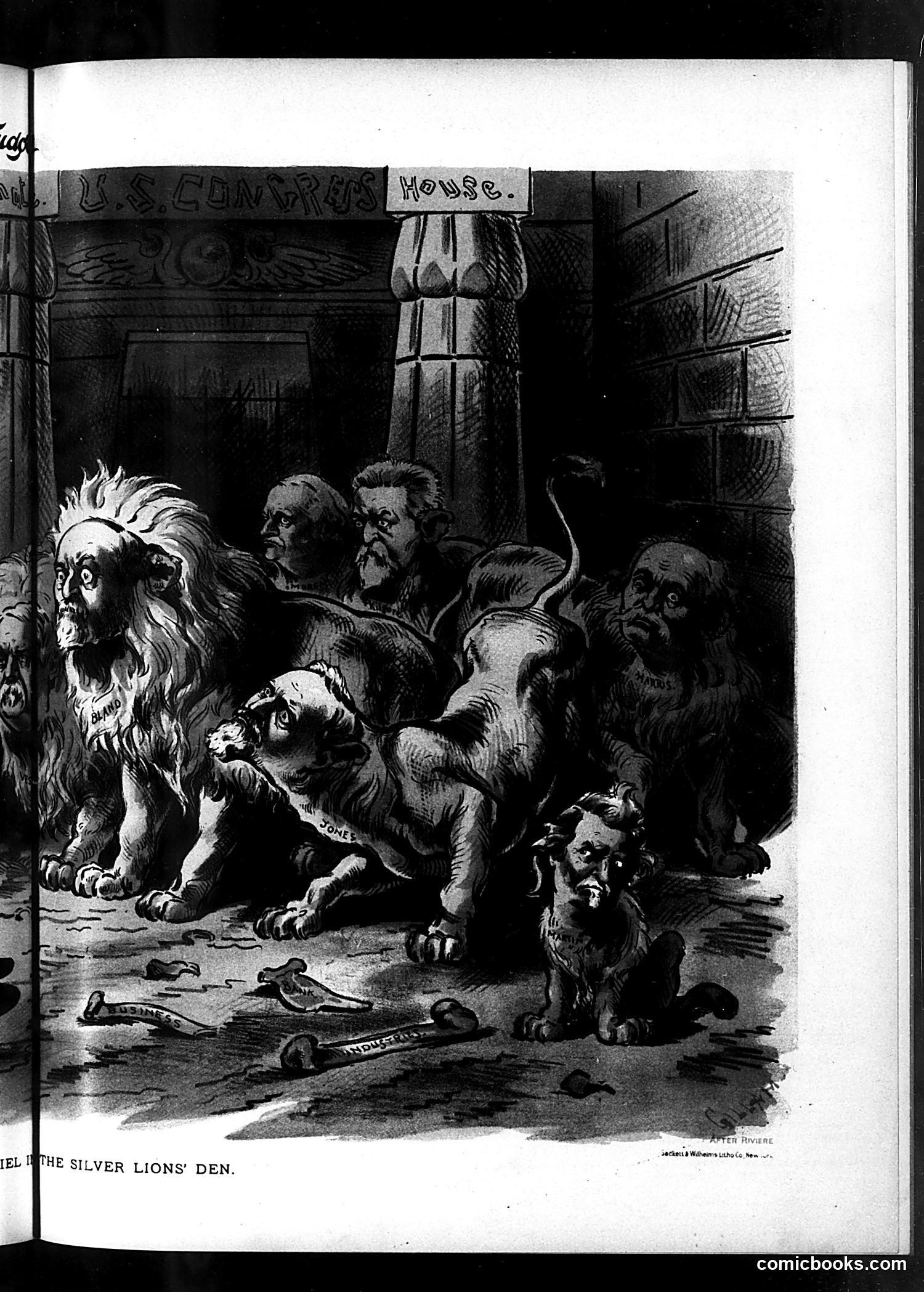
This political cartoon depicts several bearded men (appearing to represent Congressional figures) inside the U.S. Capitol building, confronted by large, aggressive lions. The lions likely represent either the American people's anger or some political force the cartoonist views as threatening to Congress. The caption "In the Silver Lions' Den" plays on the biblical "lion's den" reference, inverting it—instead of Daniel facing lions, here politicians face them. The "silver" may reference wealth or corruption. The scattered objects on the floor appear to include tools or implements labeled with text (unclear from the image), possibly representing abandoned legislative items or broken promises. Without a specific date, the exact political crisis referenced remains uncertain, but the cartoon satirizes Congressional vulnerability to public pressure or political opposition.
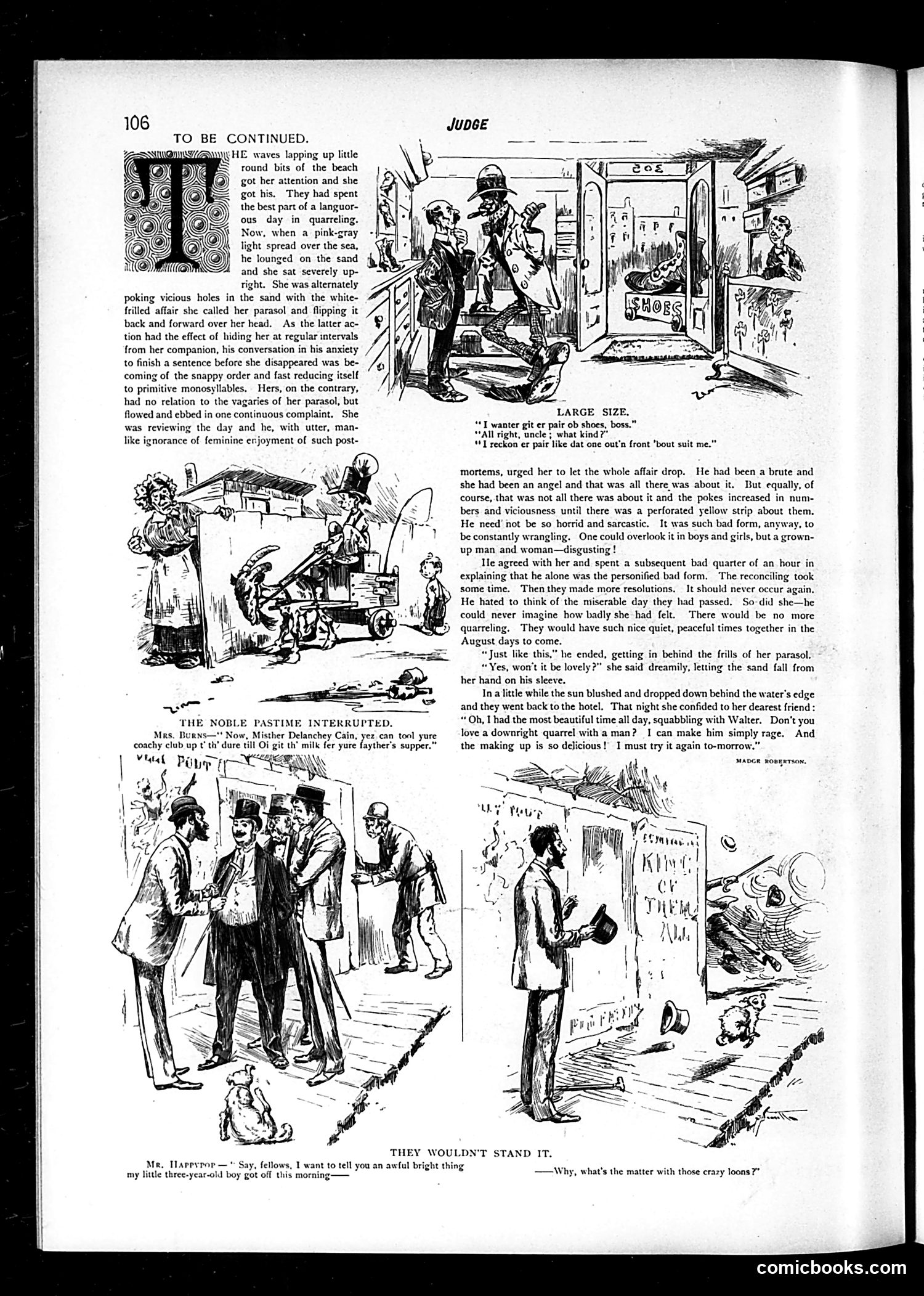
This page contains three separate satirical pieces typical of Judge's social commentary: **Main Story**: A romantic narrative mocking upper-class couples' beach quarrels. The text portrays a couple engaged in petty arguing, with the woman using her parasol theatrically while complaining. The satire targets how couples perform reconciliations—making grand promises ("no more quarreling") they won't keep. The woman's confession to her friend reveals the satire's point: she *enjoys* quarreling with her boyfriend because it allows emotional drama and "making up." **"The Noble Pastime Interrupted"**: A class-based joke. An Irish working-class woman (depicted with ethnic caricature dialect: "Misther," "Oi") interrupts her husband's leisure activity at a coaching club, demanding he leave to fetch milk for the father's supper—mocking how working-class domestic obligations intrude on men's recreation. **"They Wouldn't Stand It"**: References an unstated anecdote Mr. Happyfor wants to share about his three-year-old. The punchline appears cut off, but the joke likely involves children's misbehavior that respectable society wouldn't tolerate. All three pieces mock social pretension and domestic friction.
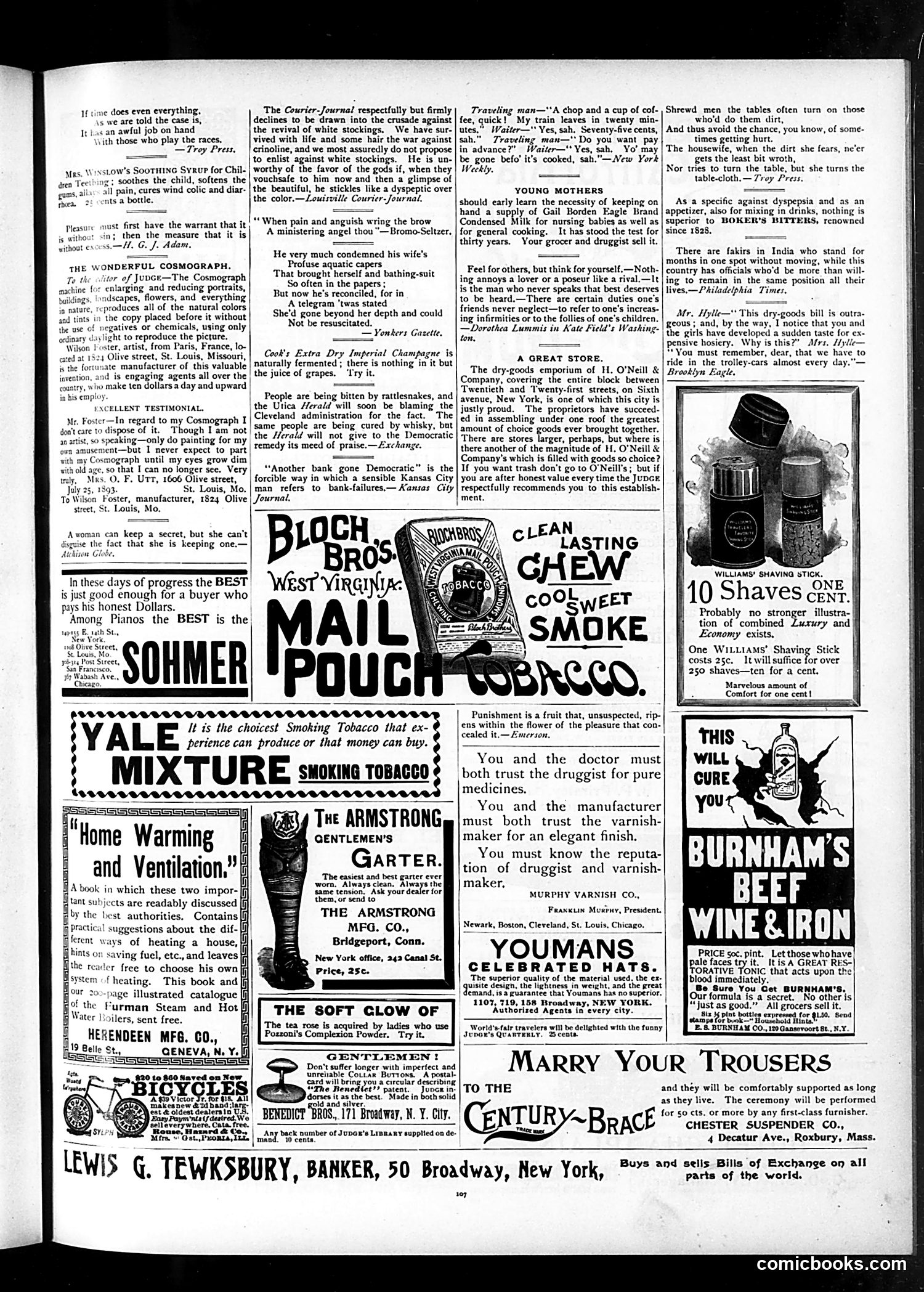
This page is primarily **advertising and miscellaneous short humorous items**, not political cartoons. The content includes: **Advertisements** for products like pianos (Sohmer), tobacco (Yale Mixture, Bloch Bros.), shaving sticks (Williams'), champagne (Cook's), and medicinal items (Bromo-Seltzer, condensed milk). **Short satirical quips** on contemporary topics: - A Kansas City newspaper's wry description of bank failures as banks "going Democratic" (likely referencing economic instability blamed on the Democratic administration) - A joke about a traveling salesman being charged high prices by a waiter who doubts he'll pay - A quip mocking the *Utica Herald* for blaming the Cleveland administration for rattlesnake bites while crediting Democrats for whisky cures The humor relies on readers' familiarity with the Cleveland presidency and period partisan politics. Overall, this reflects Judge magazine's mix of consumer advertising and light political mockery.
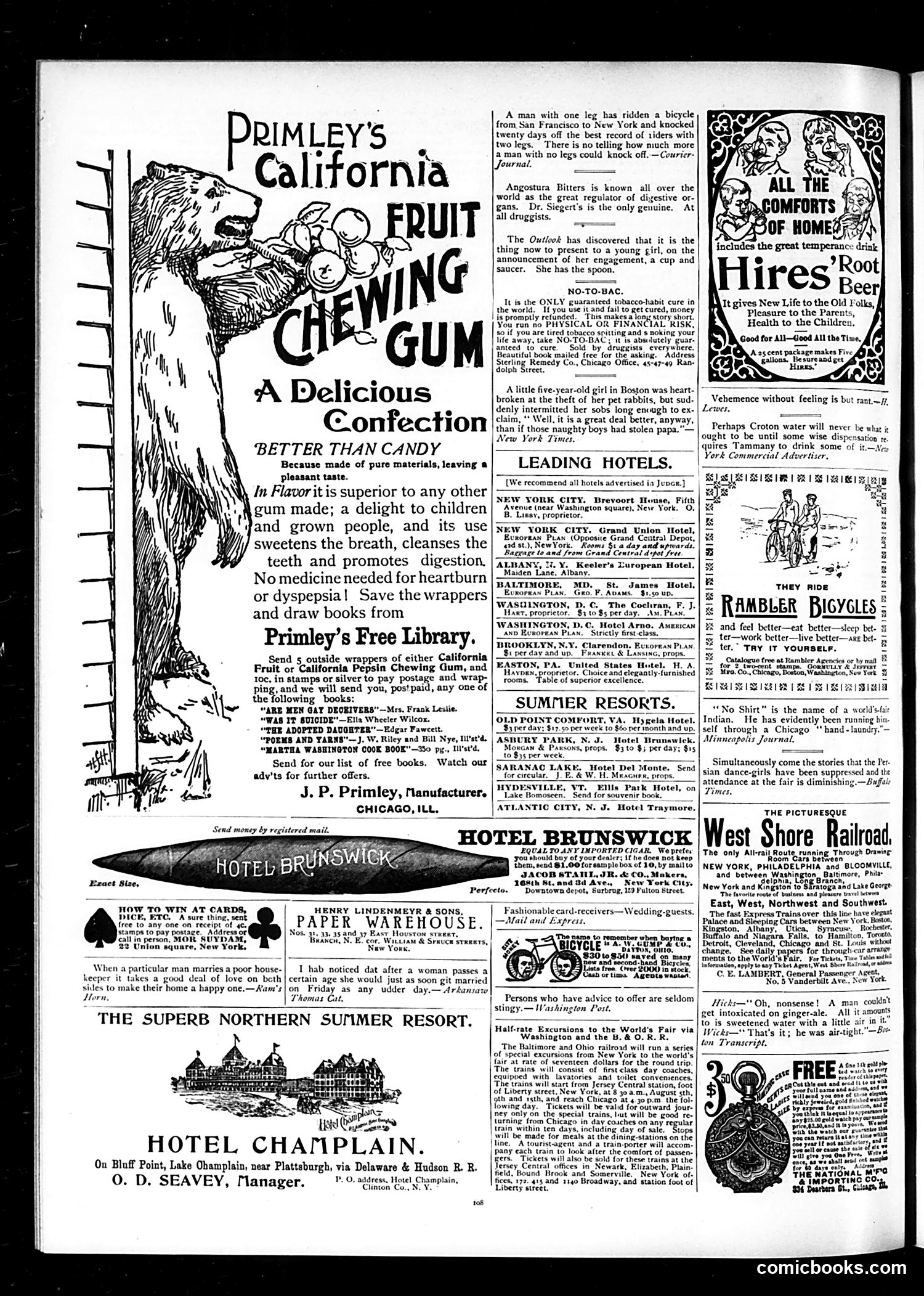
This page is primarily **advertising**, not political satire. The dominant feature is Primley's California Fruit Chewing Gum advertisement, featuring an illustrated bear with fruit, promoting the product as "better than candy" and superior in flavor. The page includes scattered brief humorous items typical of Judge's style: - A **joke** about a one-legged cyclist breaking records, implying absurdist humor about disability - A **quip** about presenting engagement gifts (a cup and saucer) - A **anecdote** about a Boston girl whose stolen rabbits theft she accepts philosophically The remainder consists of hotel and resort advertisements for the era (New York, Albany, Washington D.C., summer destinations), product ads (No-To-Bac tobacco cure, Hires Root Beer, Rambler Bicycles), and offers for free books through the Primley Free Library promotion. **No significant political or social satire is evident.** This appears to be a standard advertising-heavy magazine page from the early 1900s.
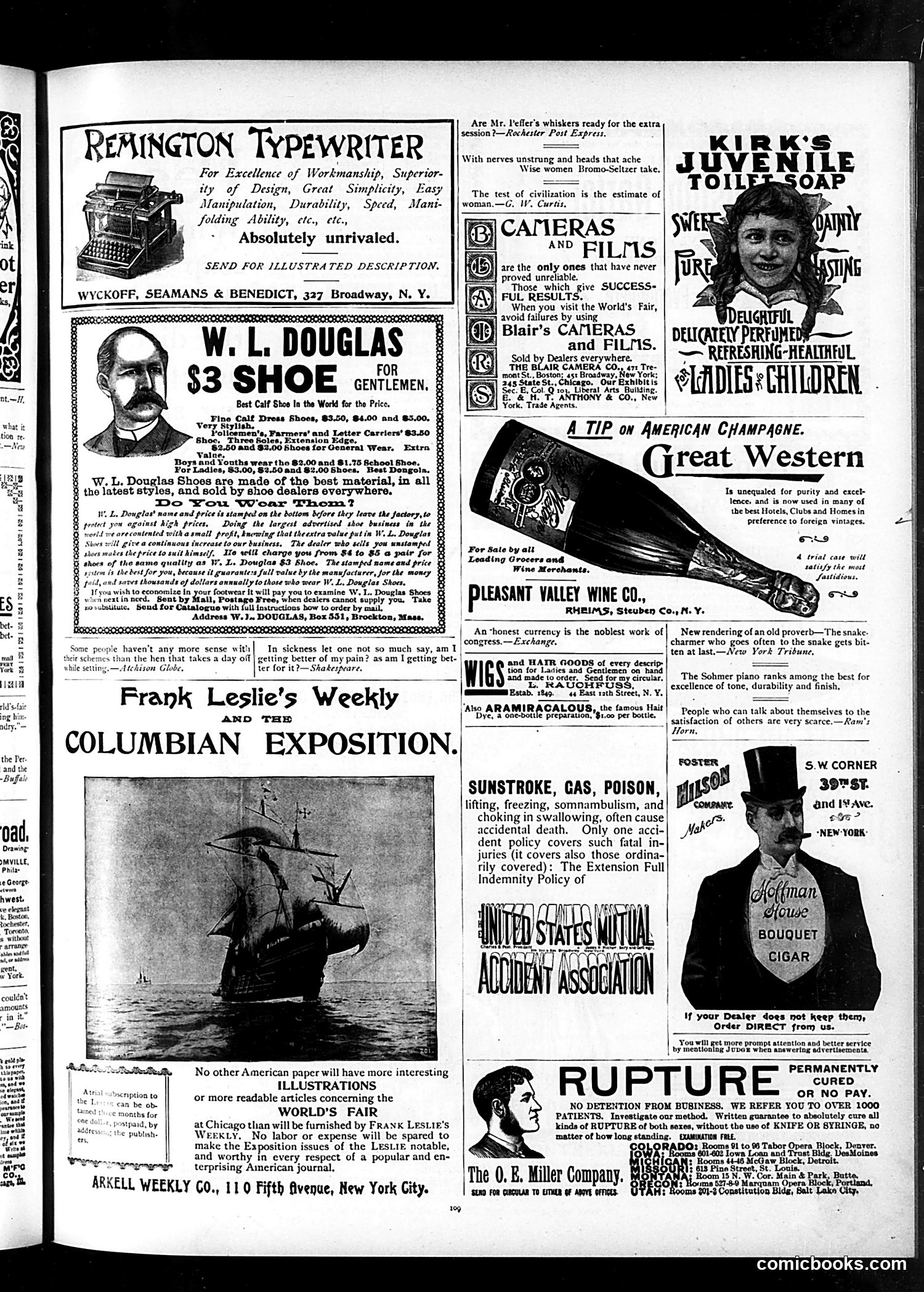
This is primarily an **advertising page** from Judge magazine, likely from the 1890s (references to the World's Columbian Exposition suggest 1893 or nearby). The page contains no political cartoons or satire—it's a collection of commercial advertisements interspersed with short humorous quotes and aphorisms. **Notable advertisements include:** - Remington Typewriter - W.L. Douglas shoes (prominently featuring the shoe manufacturer's portrait) - Kirk's Juvenile Toilet Soap - Blair's cameras - Pleasant Valley Wine Company champagne - Hoffman House cigars - United States Mutual Accident Association insurance - The O.E. Miller Company (appears to be a rupture/medical device) **The small humorous quotes** scattered throughout (about whiskers, civilization, and currency) are typical filler content Judge used between advertisements. They lack specific political targets and are generic observations. The page's primary purpose was generating advertising revenue while maintaining the magazine's brand identity through decorative typography and layout.
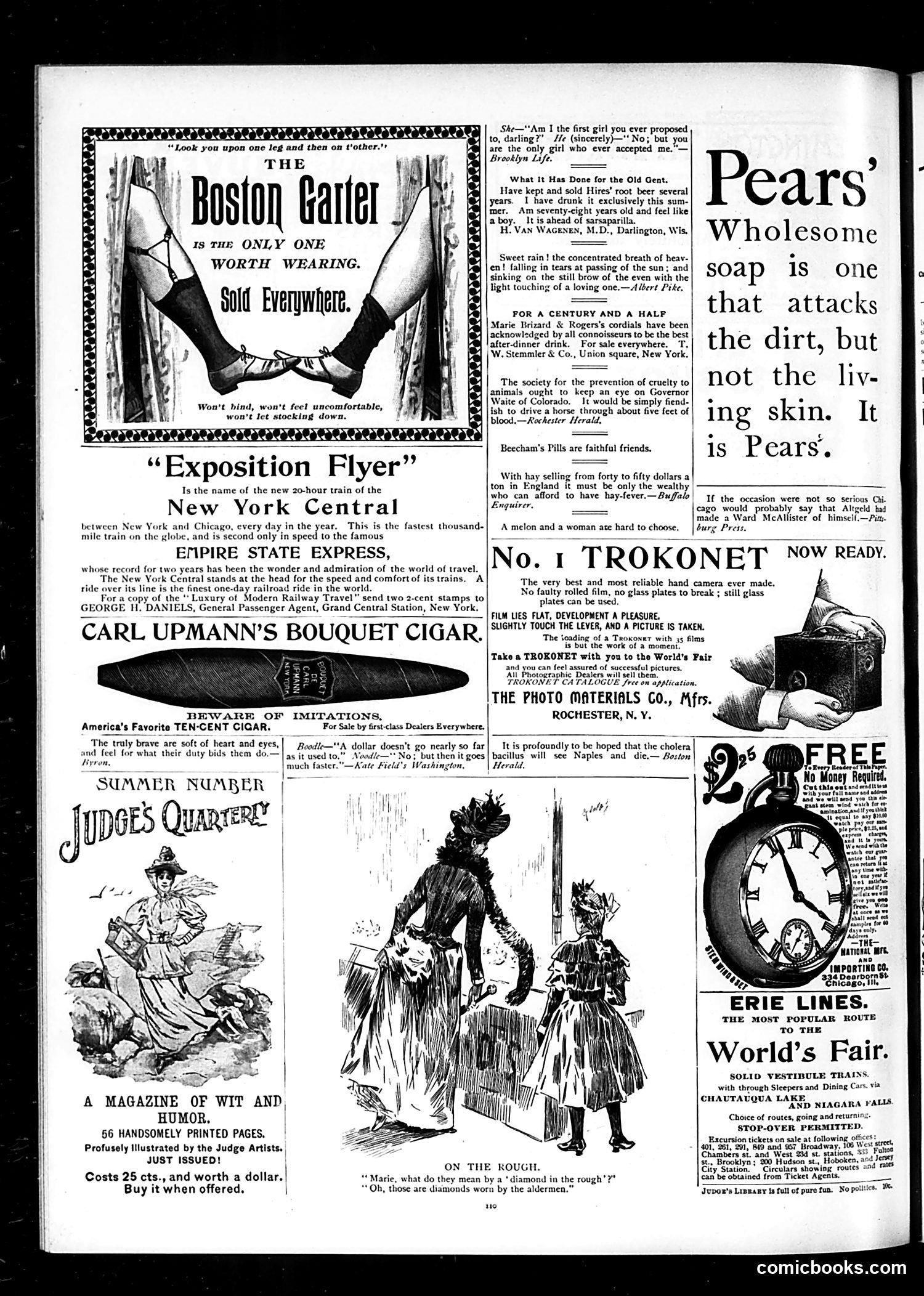
This page is primarily **advertising** with minimal political satire. The dominant content includes product advertisements (Boston Garter suspenders, Carl Upmann cigars, Pears soap, Hires root beer, the Trokonet camera) and promotional material for the New York Central railroad's "Exposition Flyer" train. The only clear satirical content is a small cartoon labeled **"On the Rough"** depicting a woman and children, with dialogue suggesting a sexual double entendre about "diamonds in the rough"—typical of Judge's humor style mocking Victorian propriety. There are also brief humorous snippets (attributed to publications like Brooklyn Life), including a joke about a man proposing to multiple women but only one accepting him. The page reflects late 19th-century advertising culture and Judge's blend of product promotion with light social satire, rather than substantive political commentary.
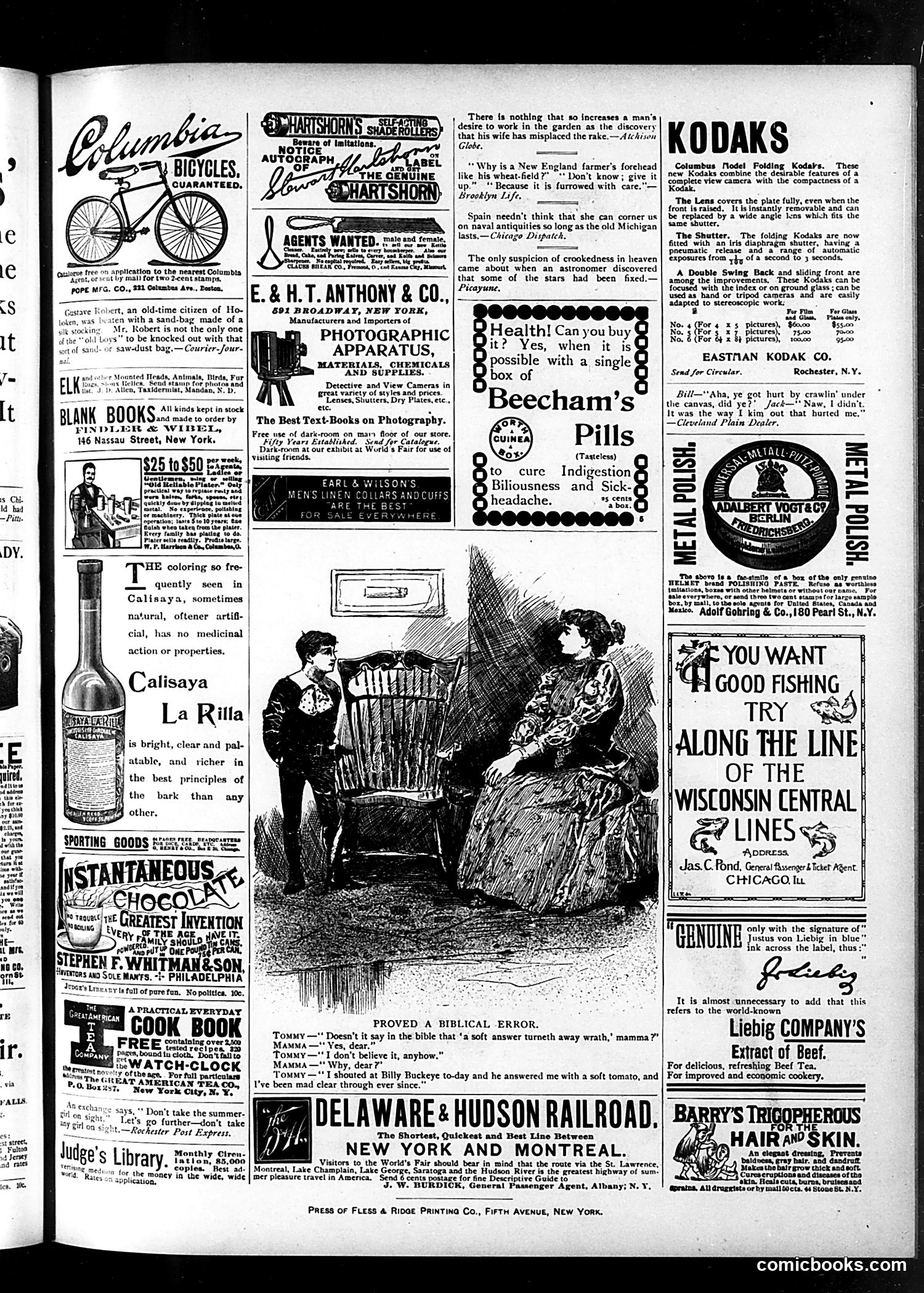
This is primarily an **advertising page** from Judge magazine, filled with late-19th-century product ads (bicycles, cameras, patent medicines, railroads). The page contains one small cartoon captioned "PROVED A BIBLICAL ERROR." ## The Cartoon The cartoon depicts a mother and child in conversation. Tommy asks if the Bible's promise that "a soft answer turneth away wrath" is true. The mother confirms it, but Tommy disputes her—he yelled at his friend Billy Buckeye, who responded by throwing a soft tomato at him. Tommy concludes the Bible is wrong because he got hit anyway. **The joke:** It's a children's humor piece playing on literal interpretation. Tommy misunderstands the proverb (which concerns *verbal* soft answers calming anger) as a guarantee against *any* retaliation. The humor comes from innocent pedantry and the unexpected physical punchline of the tomato—subverting the child's naive faith in Biblical wisdom. This is gentle domestic humor typical of Judge's family-friendly content, not political satire.
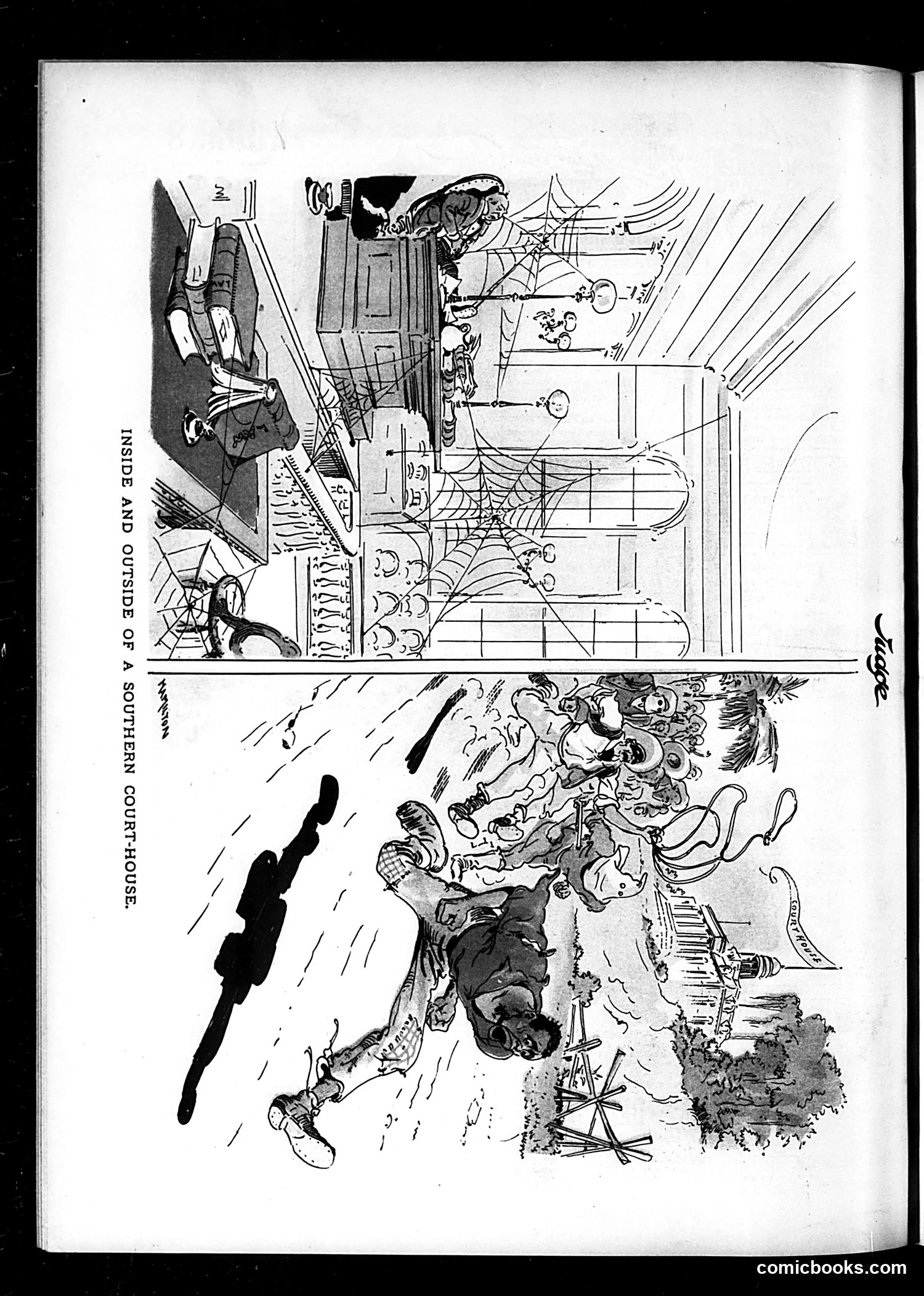
The OCR text appears to be corrupted or reversed and is unreadable, making it impossible to identify the specific satirical subject or political reference of this cartoon. From the IMAGE alone, I can see this is a Judge magazine cartoon page featuring what appears to be an interior architectural scene (top) and figures in period dress (bottom), but without legible text identifying the subjects, figures, or satirical point, I cannot reliably explain what contemporary political or social issue this cartoon addresses. To accurately explain this cartoon's meaning to a modern reader, I would need either: a corrected OCR text, the publication date, or clear labeling of the figures shown.